Czech
Czech French
 German
 Hebrew
 Noruegan
 Russian
 Spanish
 Swedish
 Polish
 Portuguese



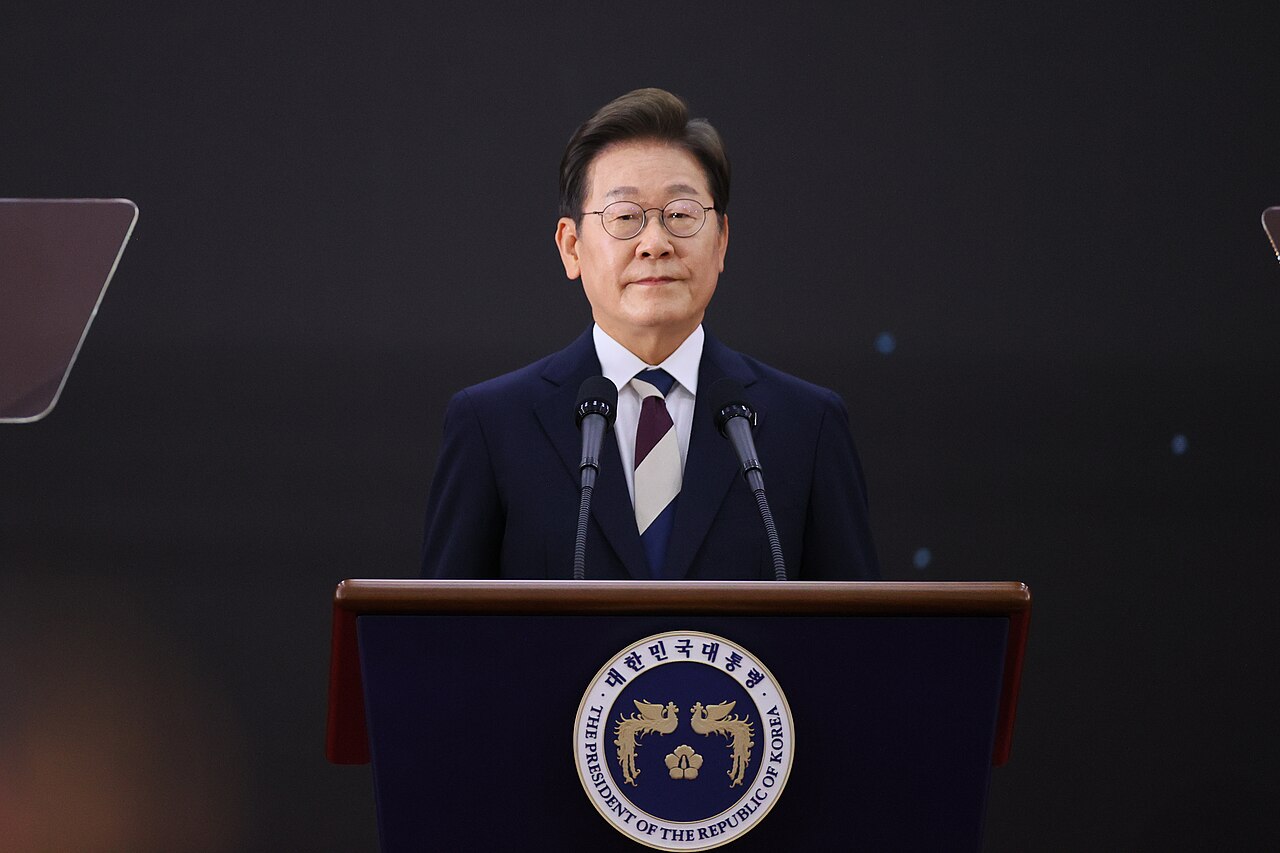
South Korean President Lee Jae Myung has ignited a diplomatic firestorm between South Korea and Israel.
He made false claims and hurled insulting and lurid accusations at Israel, combined with profoundly offensive Holocaust parallels as Israel commemorated Yom HaShoah that same week, remembering the murder of 6 million Jews by the Nazis during World War II.
All of this was based on a story from 2024, generated by a fake account as a legitimate current event. The Israeli Foreign Ministry swiftly reacted, expressing regret over Lee’s failing to mention attacks against Israeli civilians, including attacks by Iranian-sponsored terrorist groups.
Instead of de-escalating, Lee’s ruling South Korean Democratic Party issued further allegations of behavior contradicting international law and human rights, blaming the current U.S-Iran conflict on alleged Israeli influence.
Whether a diplomatic blunder or cynical political gambit, the relentless South Korean escalation based on fake news is unprecedented.
Since its creation, South Korea has balanced its relations with Israel and Muslim states in the Middle East. South Korea has had relations with Israel since 1948, elevated to full official diplomatic relations in 1962.
In the early 1960s, South Korea made the transition from export substitution to export-led growth. Bicycle repair shops turned into global corporations. South Korea achieved the Han River Miracle, astounding economic development spanning just a few decades. As South Korea became dominant in producing everything from cars to chips and ships, its economy grew increasingly dependent on fossil fuel.
After the first oil crisis in 1973, Korean construction companies aggressively explored markets in Middle Eastern countries flooded with oil money, earning about $70 billion from 1973 to 1985.
Although Israel closed its embassy in Seoul in 1978 due to South Korea’s favoring of Israel’s neighbors, the Israeli mission reopened in 1992. Driven by economic pragmatism and determination to become a responsible member of the international community, before Lee’s recent diplomatic faux pas, South Korea had generally maintained a neutral and balanced approach to Israel and all other Middle Eastern countries.
South Korea has earned exceptional capital on the world stage. One of the world’s poorest countries after the 1950-1953 Korean War, it has literally gone from rags to riches and has emerged as an economic and cultural powerhouse.
Korean movies, TV drama, K-culture and K-pop have taken the world by storm. South Korean bands such as BTS have followership in the range of tens of millions. K-pop is a global cultural phenomenon.
Once a recipient of international humanitarian, development and security assistance, South Korea has now become a provider of assistance throughout the Global South. South Korea has firmly established its authority as a leading middle power.
Why then would Lee break with the tradition of neutral, balanced diplomacy in the Middle East?
In a post-Cold War world of tension and conflict, South Korea has been an arsenal of democracy. After the Russian invasion of Ukraine, South Korea signed significant arms deals with Poland and Romania for K2 tanks, K9 howitzers and rocket launchers. A NATO delegation recently traveled to Seoul to explore deepening the partnership amidst Russia’s aggression in Ukraine and North Korea’s ever-escalating nuclear and missile threats.
In sharp contrast to South Korea, North Korea has been on the side of the “axis of tyranny.”
North Korea supports Iran in its conflict with Israel. That conflict was triggered by Teheran’s nuclear ambitions, its arsenal of ballistic missiles, and its instigation of proxy Hamas’ mass murder, rape and hostage-taking of Israelis on Oct. 7, 2023. A spokesperson for the Kim regime has even called Israel a “cancer-like entity for the peace in the Middle East.”
More than one-third of South Korea’s population is Christian. That said, the relatively recent South Korean Christianity, whether Protestant or Catholic, arrived with no antisemitic baggage, in contrast with Europe and other places in the world.
However, anti-Semitism is deeply embedded in the ideology of North Korea. In its official yearbooks, its “political dictionary” and other publications,
North Korea completely ignores Israel’s pre-1948 multi-millennial history. Instead, since the days of Kim Il-sung, Kim regime propaganda has claimed that “Israel was created in May 1948 by American and British imperialists through the partition of Palestine.”
Iran has depended on North Korean ballistic missiles, other weapons and tunneling know-how to achieve its fundamental strategic objectives: regional hegemony and the extinction of the state of Israel.
North Korea needs Iranian money to achieve its fundamental strategic objective: survival through the ultimate establishment of hegemony over the entire Korean peninsula. To achieve that goal, it needs money to keep its core elites happy and to continue developing its tools of death, despite sanctions by the U.N., the United States and others.
Is Lee’s South Korea now aligned with the Kim regime’s anti-Israeli stance? Is South Korea no longer a reliable diplomatic middle power? Or is there still hope that Koreans and Jews can overcome this diplomatic disaster, bring together their homelands and diaspora, in a spirit of mutual respect, honor and trust?
Abraham Cooper is chair emeritus of the United States Commission on International Religious Freedom and associate dean and director of Global Social Action at the Simon Wiesenthal Center. Greg Scarlatoiu is president and CEO of the Washington, D.C.-based U.S. Committee for Human Rights in North Korea.