Czech
Czech French
 German
 Hebrew
 Noruegan
 Russian
 Spanish
 Swedish
 Polish
 Portuguese




Palestinian Authority textbooks continue to glorify terror, demonize Israelis, traffic in antisemitic themes and advance exclusivist nationalist rhetoric despite promises to implement reforms, a comprehensive study of the authority’s teaching materials has found.
The report was released on Wednesday by the Israel- and UK-based IMPACT-SE watchdog, which monitors educational content. It alleges that textbooks from grades 1-4 and 12, meant to be updated recently to comply with international demands to scrub inciting content, in fact contain no significant changes.
Altogether, across 290 textbooks and 71 teachers’ guides serving those grades and others, researchers cited 210 examples of problematic content. Subjects covered included history, Islamic and Christian religious instruction, Arabic, science, mathematics, civics, social studies and geography.’
PA-produced texts have been flagged for years for containing content that critics say is a key factor in inculcating hate among Palestinian youths, fueling extremism and undercutting efforts to foster peaceful coexistence with Israelis. The materials are used widely across the West Bank and Gaza, including in classrooms run by the UN agency for Palestinian refugees, UNRWA.
Now, the report says the content of the textbooks has remained unchanged despite explicit commitments by the PA to reform the curriculum — and despite European officials’ public claims that such reforms were underway. IMPACT-se CEO Marcus Sheff said the findings “expose a stark and disturbing reality.”
Palestinian Authority textbooks continue to glorify terror, demonize Israelis, traffic in antisemitic themes and advance exclusivist nationalist rhetoric despite promises to implement reforms, a comprehensive study of the authority’s teaching materials has found.
The report was released on Wednesday by the Israel- and UK-based IMPACT-SE watchdog, which monitors educational content. It alleges that textbooks from grades 1-4 and 12, meant to be updated recently to comply with international demands to scrub inciting content, in fact contain no significant changes.
Altogether, across 290 textbooks and 71 teachers’ guides serving those grades and others, researchers cited 210 examples of problematic content. Subjects covered included history, Islamic and Christian religious instruction, Arabic, science, mathematics, civics, social studies and geography.
PA-produced texts have been flagged for years for containing content that critics say is a key factor in inculcating hate among Palestinian youths, fueling extremism and undercutting efforts to foster peaceful coexistence with Israelis. The materials are used widely across the West Bank and Gaza, including in classrooms run by the UN agency for Palestinian refugees, UNRWA.
Now, the report says the content of the textbooks has remained unchanged despite explicit commitments by the PA to reform the curriculum — and despite European officials’ public claims that such reforms were underway. IMPACT-se CEO Marcus Sheff said the findings “expose a stark and disturbing reality.”
“Virulent antisemitism, the glorification of jihad and incitement to violence remain deeply embedded across all grades of Palestinian Authority textbooks,” he said.
Reform of the Palestinian educational curriculum is also a central component of the US peace plan for the region following the war in Gaza. There was no immediate PA or EU response to the report upon its publication.
‘We carry the flame of the revolution’
Despite assurances earlier this year that books for grades 1–4 and 12 would undergo reform by September, problematic content persists, according to a litany of examples presented in the report.
In 1st-grade Arabic, a reading exercise introduces the word “shaheed,” or martyr, to teach about a letter. In Palestinian society, the word martyr typically refers to someone who is killed in a conflict with Israel.
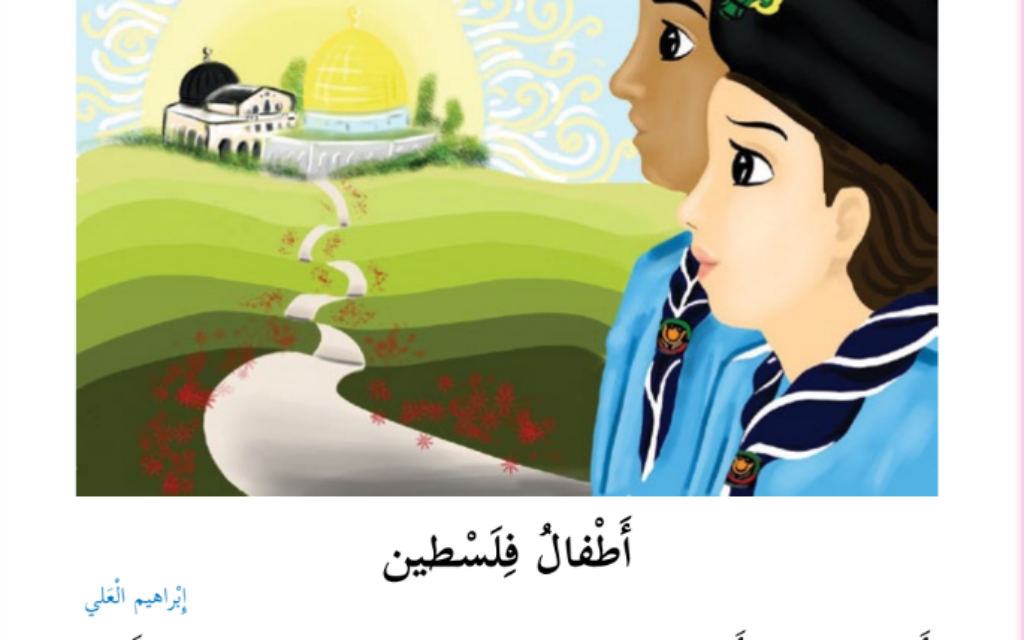
In 2nd-grade Arabic, a poem is presented to students, reading, “We give our souls for the revolution. We carry the flame of the revolution — to Haifa, to Jaffa, to Al-Aqsa and the Dome of the Rock.”
Haifa and Jaffa are within Israel’s internationally recognized borders, and Israel annexed East Jerusalem, which contains the Dome of the Rock and the Al-Aqsa Mosque, more than four decades ago. The poem appears with an illustration of a boy and girl in Palestinian scout uniforms gazing toward Jerusalem.
An illustration accompanying an audio segment about the use of hands, in a 1st-grade Arabic textbook, depicts an armed soldier holding a weapon and the Palestinian flag. The book presents illustrations for each of the activities mentioned, such as playing or planting a tree, but the illustration of the soldier is larger than all the others — underscoring its importance.
In a 12th-grade Islamic education book, Jews are presented as manipulators and liars through a traditional Islamic account in which Jewish leaders tried to persuade Muhammad to betray his faith by promising to convert if he ruled unjustly in their favor.
The characters, explicitly labeled “Jews,” are portrayed as immoral and hostile to Islam — with no attempt to contextualize the story in its historical period.
In addition, according to the study, references to Jewish history and Israeli-Arab diplomatic efforts, which appeared in earlier editions, have been removed. Mentions of the Camp David and Annapolis peace processes — as well as any content promoting non-violence or compromise — remain absent in the 2025–2026 textbooks.
In fact, any acknowledgement of Jewish history is absent, with the Holocaust ignored. Likewise, the persecution and expulsion suffered by Jewish communities in Arab countries upon the establishment of Israel is entirely absent.
Even in fields unrelated to Israel, textbooks fall short of UN educational standards, the report found, saying Islamic education books continue to present women as weak and subordinate to men.
No change despite explicit promises
The key commitment on educational reform was made in July 2024, when the Palestinian Authority signed a “Letter of Intent” with the EU’s European Commission pledging to reform its curriculum.
The 2024 Letter of Intent, in which the PA committed to changing the curriculum, served as the basis for the transfer of over €400 million ($462 million) from the European Union to the PA between July and September 2024 — conditioned on meeting education-related reform benchmarks. This followed previous years in which the EU froze funding over incitement concerns.
However, that September, Abdul Hakim Abu Jamous, head of the Humanities Division in the Palestinian Ministry of Education, told the Palestinian newspaper Al-Quds: “Not a single word has been removed or changed in the textbooks.”
He added that the Palestinian Ministry of Education had not agreed to any changes in the curriculum.
The PA first put out texts in 2000, replacing Jordanian and Egyptian books used until then. From 2016 to 2019, it rolled out new books, though studies by IMPACT-SE at the time showed that they still contained problematic content.
Both the PA and the European Union, which funds Palestinian educational activities, pledged that the educational materials would be revised again to remove content that incites hatred and violence.
EU statements from April 2025 claimed that the PA had agreed to a reform plan with measurable milestones, intended to translate the Letter of Intent into an actionable implementation document. But according to the study, as of November 2025, no public version of this plan exists, along with no timetable, and there is no evidence that it is being implemented.
In response to a parliamentary question in July 2025, EU Commissioner Dubravka Šuica had reaffirmed that new textbooks for grades 1-4, edited to meet UNESCO standards promoting peace and tolerance, were expected to be ready by September. Other grades were set to follow gradually in 2026–2027.
However, at the end of September, Šuica publicly admitted that so far, when it came to educational reform, the “latest round started with grade 12 at the end of 2024 and has moved to earlier grades in recent months.”
According to the IMPACT-SE report, even those early-grade books were not changed.
Now, the PA is setting new benchmarks. In his speech to the UN General Assembly in September 2025, PA President Mahmoud Abbas stated: “We will develop the educational curricula in accordance with UNESCO standards within two years.”
Encouraging conspiracy theories of Jewish global control
The study showed that textbooks across the intervening grades also continue to depict Jews as manipulative, inherently corrupt, or as enemies of Islam. This includes the use of classic conspiracy motifs — such as Jewish greed, control of the media, and dominance over financial institutions.
One example appears in an 11th-grade history textbook, which features a cartoon evoking antisemitic imagery of Jews controlling the world. Under the label “cultural colonialism,” the book presents a black-and-white image of two arms gripping a globe: one holding an American flag, the other an Israeli flag.
A 10th-grade history textbook claims that, after World War II, “the Zionists hoped the US would support the establishment of their national homeland in Palestine — by exploiting their political, media and financial influence in the United States.”
According to the study, in some cases, Israelis are portrayed as demonic figures, accused of atrocities, and portrayed as inherently evil. Poems and songs grant legitimacy to violence and teach that Israel’s very existence is illegitimate.
For example, in an 11th-grade Islamic education textbook, Quranic verses are used to teach that “the Children of Israel” are corrupt, destined for destruction, and divinely punished. Shifting to the future tense, it interprets the Quran as prophesying that the Israelites will briefly regain power but find their end in humiliation and defeat at the hands of “the servants of God.”
The demonization extends to secular subjects as well.
A 9th-grade civics textbook claims Israel “deliberately releases herds of pigs” to damage Palestinian crops and weaken the Palestinian economy.
A 7th-grade social studies book dismisses Jewish history in Palestine as irrelevant and labels Jewish historical presence in Jerusalem as a “fabrication” meant to erase Arab-Islamic heritage
A 7th-grade social studies book dismisses Jewish history in Palestine as irrelevant and labels Jewish historical presence in Jerusalem as a “fabrication” meant to erase Arab-Islamic heritage.
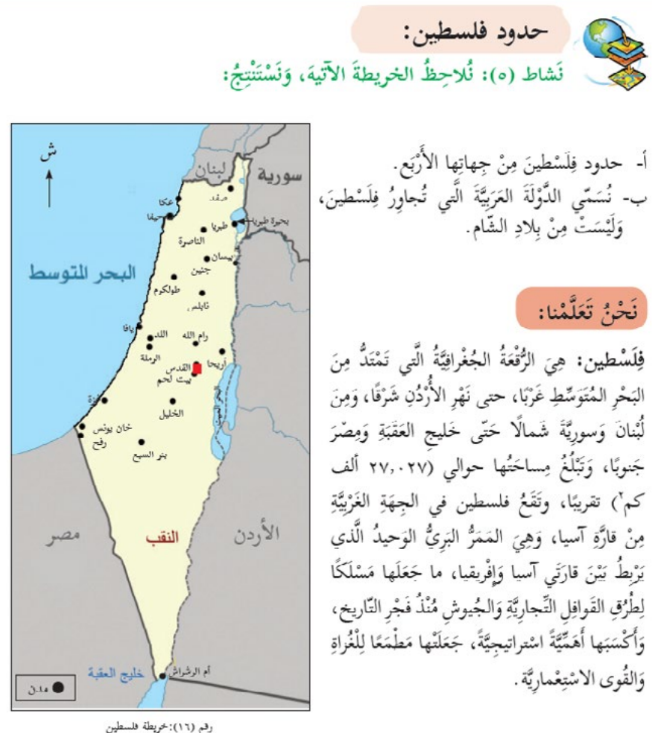
The erasure is reflected in maps as well, which omit Israel. In a 6th-grade social studies book, only Palestine is shown on the land between the Jordan River and the Mediterranean Sea.
Another textbook for national education likewise uses maps labeled only “Palestine,” while in other places, Israel is referred to repeatedly as “the Zionist entity” or “the Zionist occupier.”
In Israeli schools as well, most maps do not clearly delineate between Israel’s internationally recognized borders and the West Bank.
Modeling violence
Textbook analysis shows continued encouragement of violence and terrorism, including through an explicitly Islamic religious framing of the concept of jihad. In a 10th-grade Islamic education textbook, students are asked: “Under what circumstances is jihad to liberate Palestine considered a personal duty for every Muslim?”
According to the report, this wording represents an intensification of earlier content: The 2019 edition referred to jihad as a duty for all Muslims, but did not explicitly link it to “liberating Palestine.”
In a 7th-grade Arabic textbook, jihad is presented as a path to paradise, while an 8th-grade Islamic education text praises armed jihad, defined as fighting on behalf of Islam
In a 7th-grade Arabic textbook, jihad is presented as a path to paradise, while an 8th-grade Islamic education text praises armed jihad, defined as fighting on behalf of Islam.
Religious framing is reinforced with concrete examples of Palestinian terror attacks.
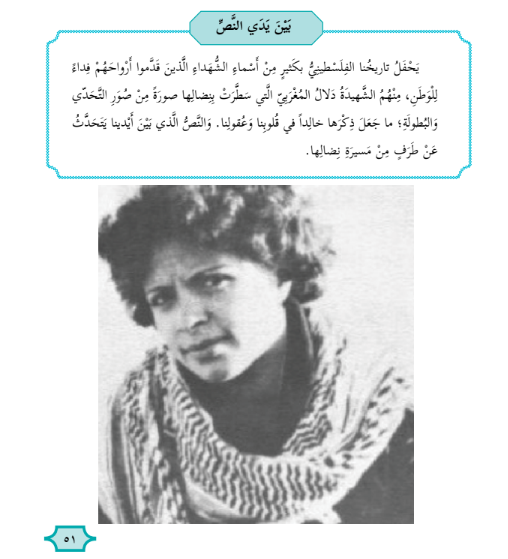
In a 5th-grade Arabic language textbook, students learn about Dalal al-Mughrabi, a Fatah terrorist who carried out the 1978 Coastal Road massacre, killing 38 Israelis — including 13 children. It was the deadliest terror attack on Israel before the Hamas-led onslaught of October 7, 2023. The 10-page text glorifies the attack as an act of “heroism” and praises al-Mughrabi.
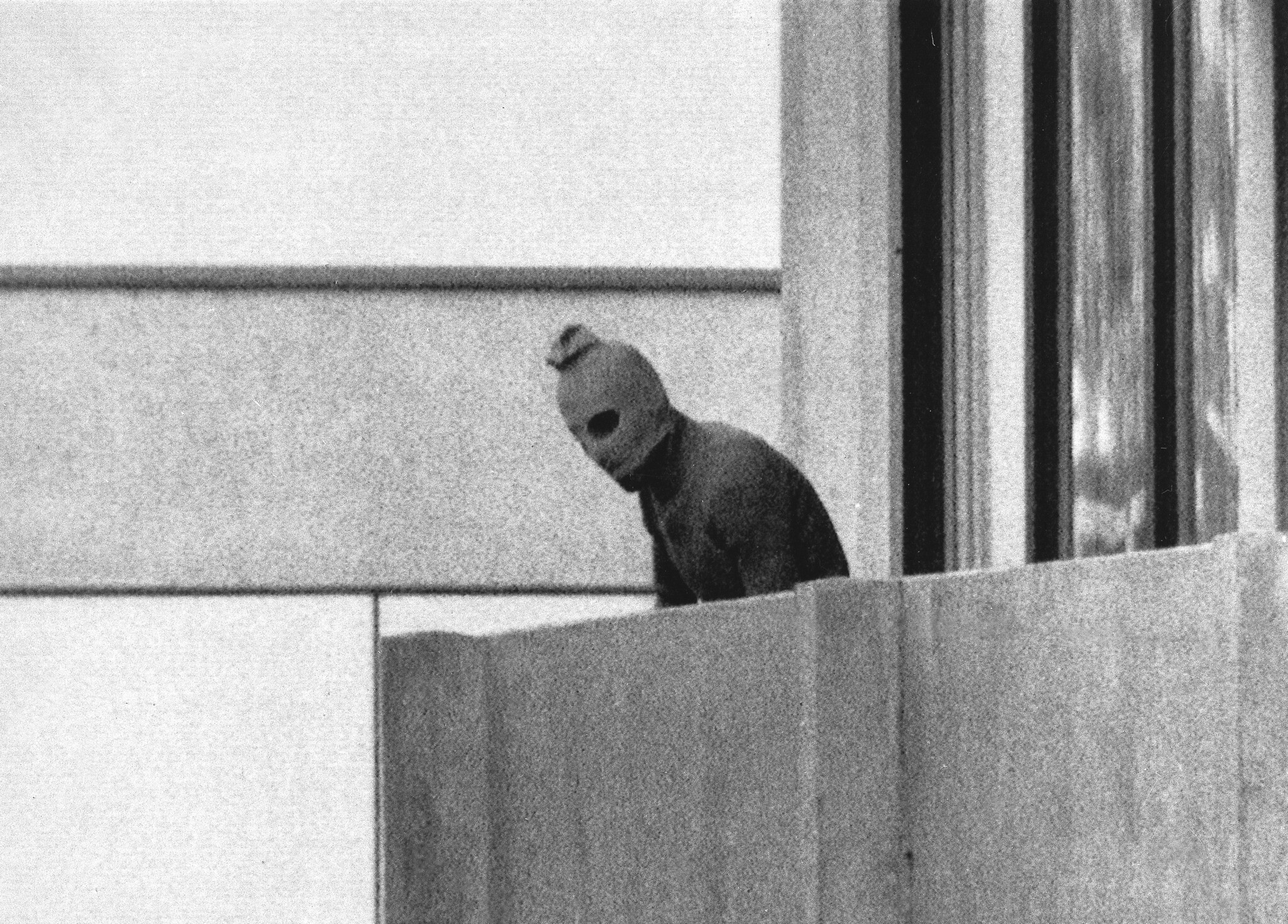
In an 11th-grade history textbook, the 1972 Munich Olympics massacre, in which 11 Israeli athletes and members of the Olympic delegation were murdered, is presented as a legitimate form of Palestinian resistance.
“The Palestinian resistance resorted to many methods in its struggle against the Zionist occupation. The fedayeen primarily used guerrilla warfare inside Palestinian territories, and also struck Zionist interests abroad — such as the Munich operation in 1972,” the book states.
In an 11th-grade history textbook, the 1972 Munich Olympics massacre, in which 11 Israeli athletes and members of the Olympic delegation were murdered, is presented as a legitimate form of Palestinian resistance
A 9th-grade civics textbook teaches students that armed struggle is justified: “The right of peoples to self-determination, including their right to resist occupation and foreign rule — even through armed force — is natural and legitimate.”
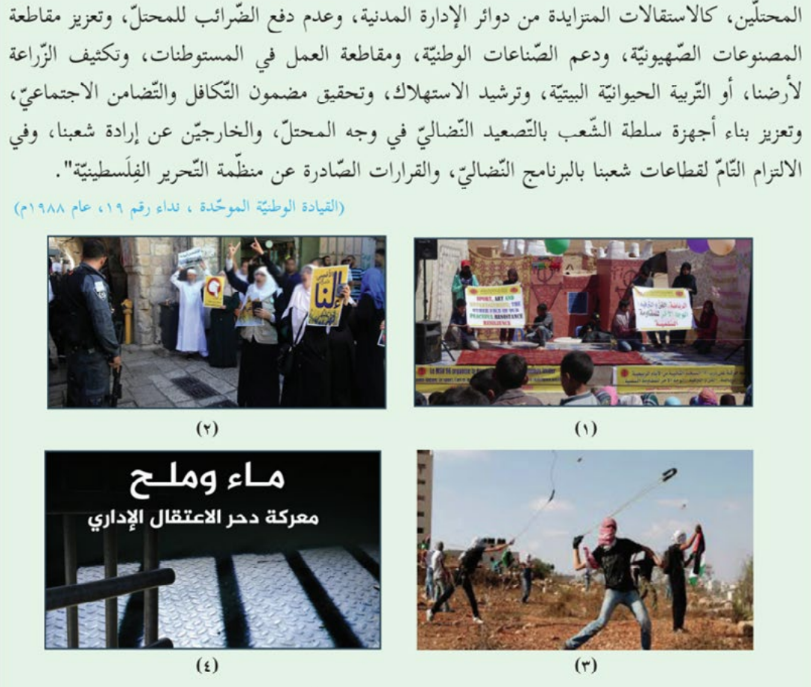
Alongside a passage on “peaceful resistance,” the book features an image of masked youths throwing stones — visually reinforcing the legitimacy of violence.
Math and science used to normalize violence
In many cases, terror-related themes are woven into subjects that have no connection to nationalism or history — reinforcing violent narratives through science and mathematics.
In a 10th-grade science textbook, Newton’s Laws are taught using the example of a young girl firing a stone from a slingshot.
A 3rd-grade math book teaches numeracy through the “number of martyrs” killed in Gaza in 2014 — referring to Israel’s Operation Protective Edge that year only as “the aggression against Gaza,” with no mention of the Hamas rocket fire or cross-border tunnel attacks that preceded it.
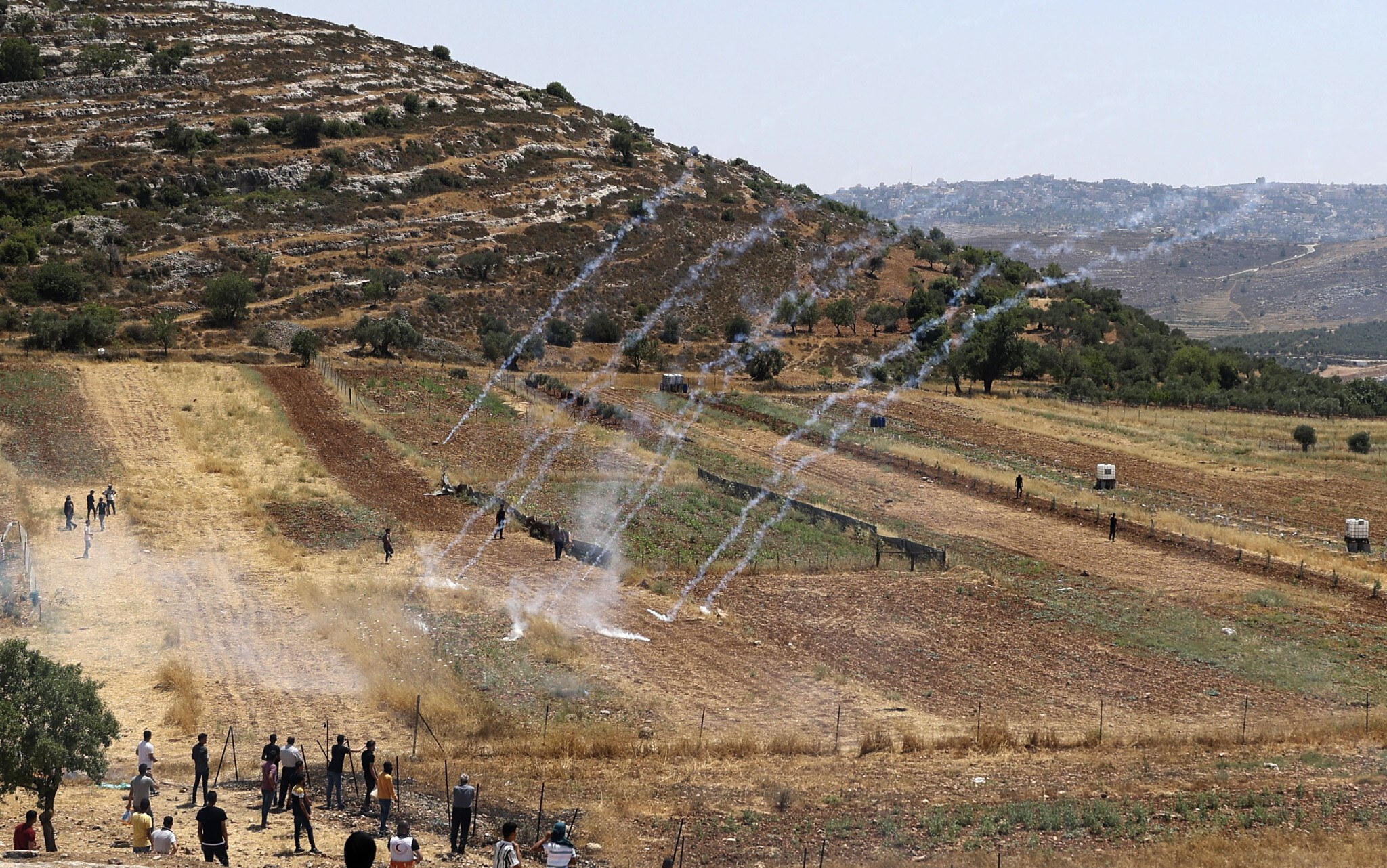
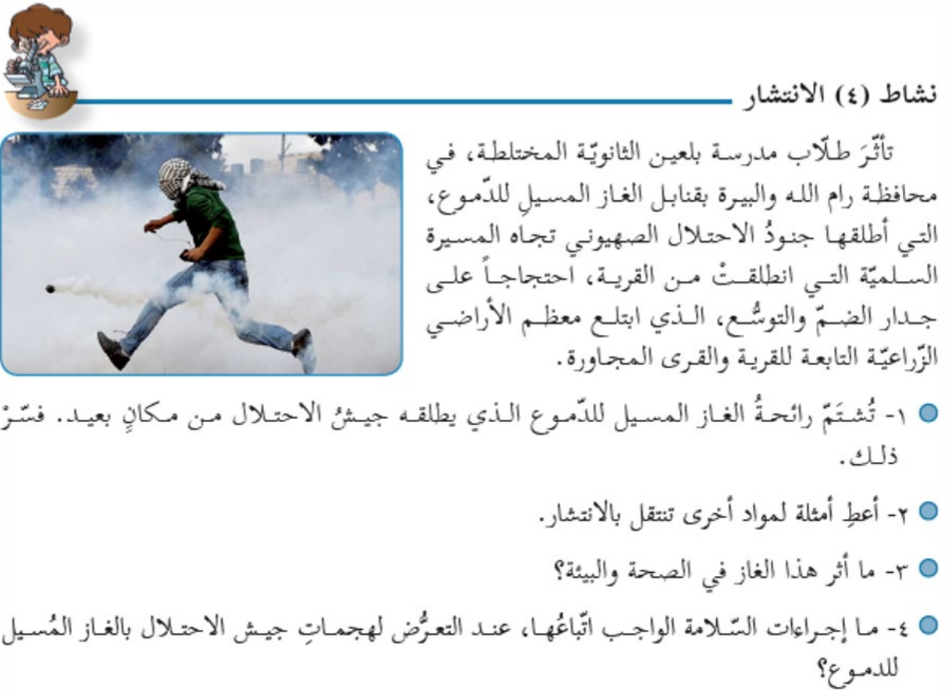
In an 8th-grade science textbook, students learn about elements of air through a story describing Israeli security forces launching tear gas in the Ramallah area of the West Bank. Next to the passage, there is a photo of a masked individual holding a slingshot.
Another example appears in a 7th-grade science textbook. Before introducing liquid solutions, the opening page is dedicated to Palestinian prisoners. The page claims that salt and water play a key role in “the hunger strikes of Palestinian prisoners” — alongside an illustration of an anthropomorphic stomach breaking chains, holding a Palestinian flag and a dove of peace, “surviving only on salt and water.”
Later in the same book, students study human physiology through a narrative of Israeli soldiers firing tear gas and smoke grenades at a youth camp near Ramallah.
The incident is presented as entirely unprovoked, and students are asked to identify bodily systems activated by fear and stress.
Similarly, in an 11th-grade math textbook, statistics are taught through the example of “a settler opening fire on cars on one of the roads.”
Teacher guides – even more extreme
The Palestinian Authority’s teacher guides — which were also examined — expand on the problematic and violent content, instructing educators on how to frame it in the classroom.
In an 8th-grade science teacher’s guide, during a unit on the classification of living organisms, teachers are directed to hold discussions about “the residents of villages and towns who were expelled by the Zionist occupation,” a clear reference to the displacement of Palestinians upon Israel’s founding in 1948, despite having no connection to the lesson’s subject.
In another guide, for 10th-grade modern history and geography, armed resistance is presented as one of the legitimate ways to “rise up against the settlements in Palestine.”
The text does not clarify that this refers only to settlements in the West Bank, but instead implies that it refers to all the land between the river and the sea.
A teacher’s guide for 8th-grade Arabic goes further, instructing teachers to teach that: “Zionism is modern terrorism and is destined to disappear,” and that the Right of Return must not be relinquished. This refers to the demand that millions of descendants of Palestinians who fled or were expelled in 1948 be allowed to return and settle inside the State of Israel, which Israel views as a recipe for its destruction.
A 10th-grade history teacher’s guide instructs educators to reject UN resolutions — even those calling for peace — if they are perceived to undermine Palestinian national rights.