Czech
Czech French
 German
 Hebrew
 Noruegan
 Russian
 Spanish
 Swedish
 Polish
 Portuguese



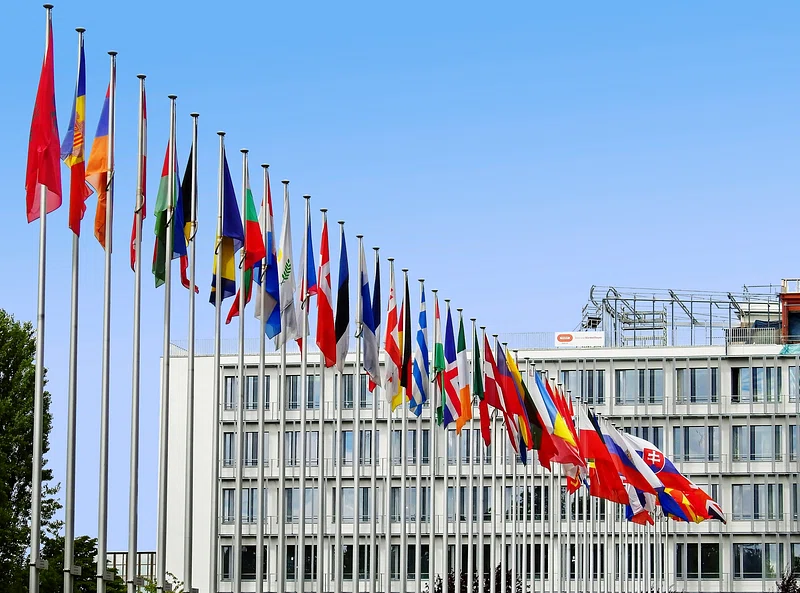
JERUSALEM, Israel — This month, the European Union of 27 nations decided to impose sanctions on what it described as “violent settlers in the West Bank.” However, after examining the details of the sanctions, it becomes clear that these measures are not primarily targeting violent individuals. Instead, they are aimed at law-abiding Jews and organizations deeply involved in building, defending, and advocating for Jewish communities in Judea and Samaria.
That distinction matters.
The sanctions do not focus on armed militias or individuals convicted of violent crimes. Rather, they target organizations involved in community construction, security coordination, land-use monitoring, and public policy work connected to Jewish life in Judea and Samaria.
This raises an important question: What exactly is the European Union trying to accomplish?
To understand the issue properly, it is necessary to place these sanctions within a broader international context.
Has the European Union imposed similar sanctions on Iran for the killing of protesters, the repression of women, or the execution of dissidents and homosexuals?
Has the EU sanctioned countries such as Qatar or Turkey for their support of Hamas before and after the October 7 massacre in Israel?
Has the EU sanctioned the Palestinian Authority over its longstanding “pay-for-slay” policy, under which terrorists and their families receive financial stipends? Has it sanctioned the Palestinian Authority for educational and media content that frequently promotes hatred and incitement against Jews and Israel?
The answer to those questions is obvious.
Yet when it comes to Jews building homes and communities in Judea and Samaria, the EU suddenly finds its moral voice.
The sanctions specifically target organizations such as Amana, which helps establish and support Jewish communities.
They also target the Nachala Movement and its chairwoman, Daniella Weiss, who is involved in promoting new Jewish communities throughout Judea and Samaria.
Other sanctioned groups reportedly include Shomer Yehuda VeShomron and former CEO Avichai Suissa, organizations connected to local security initiatives, as well as Regavim and CEO Meir Deutsch, whose work focuses on documenting illegal Palestinian Authority land activity and advancing policy discussions regarding state land in Judea and Samaria.
These are not violent militias.
These are not terrorist organizations.
These are individuals and groups involved in building homes, strengthening communities, improving local security, conducting research, and advocating public policy positions.
The European Union may disagree with their politics or their vision for Judea and Samaria, but disagreement is not violence.
I believe the “settler violence” narrative has increasingly become a political instrument used to delegitimize Jewish life in Judea and Samaria altogether.
That does not mean violence by Jews does not occur.
It does.
Any acts of violence committed by Jews should be investigated thoroughly and prosecuted under Israeli law. Israel is a democratic state governed by a functioning legal system, and criminal acts should be treated as criminal acts.
But the problem arises when isolated incidents involving extremists are used to portray an entire population of hundreds of thousands of Jews as inherently illegitimate or criminal.
The overwhelming majority of Jewish residents in Judea and Samaria are ordinary civilians. They raise families, operate businesses, attend schools, and serve in Israel’s military and national institutions.
Many also view Judea and Samaria not as foreign territory, but as the historical and biblical heartland of the Jewish people.
Cities such as Hebron are deeply connected to Jewish history and identity. Hebron contains the burial site of the biblical patriarchs and matriarchs, including Abraham and Sarah, Isaac and Rebecca, and Jacob and Leah.
For many Israelis and Jews around the world, Jewish life in these areas is not a colonial project. It is viewed as a return to the ancestral Jewish land with continuous historical significance spanning thousands of years.
Furthermore, the continued Israeli presence in parts of Judea and Samaria is governed in part by agreements signed during the Oslo process itself.
The Oslo Accords established areas of differing Israeli and Palestinian administrative control. They did not prohibit Jewish communities from existing in Judea and Samaria, nor did they resolve the final status of the territory.
That reality is often omitted from international headlines.
Instead, broad and emotionally charged phrases such as “settler violence” are repeated so frequently that they begin to shape global perceptions regardless of the underlying complexity.
In my view, the European Union’s sanctions are not fundamentally about violence.
They are about politics.
More specifically, they represent an attempt to pressure and stigmatize Jewish civic life in Judea and Samaria through economic and diplomatic means.
Reasonable people can disagree about borders, sovereignty, and future political arrangements.
But if the international community genuinely wishes to promote peace and coexistence, it cannot selectively condemn Jewish communities while ignoring terrorism, incitement, and systemic anti-Israel extremism elsewhere in the region.
That imbalance is precisely why many Israelis increasingly view the “settler violence” campaign not as a balanced human rights initiative, but as a politically motivated and deeply distorted narrative.