1. opinion stated as fact
2. only one side presented
3. incorrect fact
4. illogical conclusion drawn from facts
5. skewed choice of subjects that are presented
6. skewed choice of reports that are considered accurate
7. article gives last word to one side without its truly addressing the other side
8. no source cited or only unidentified sources are cited
9. exaggerated estimation
10. twisted moral equivalence
11. misleading headline
7.11.23
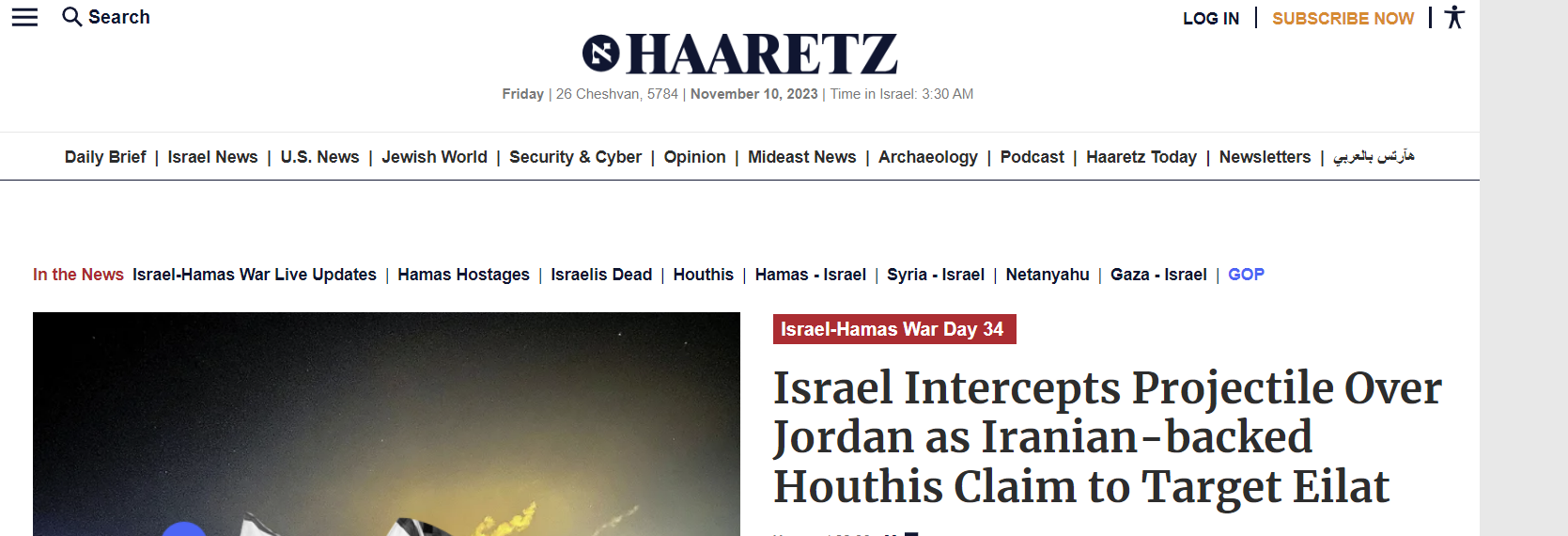
Israel News | Haaretz Today
Haaretz Today |
Netanyahu’s Far-right Ministers Are a Gift to Hamas
He brought these extremists into the center of power, and he refuses to part ways with them now, despite a commitment from opposition leader Yair Lapid to join the government if they are removed.
5. skewed choice of subjects that are presented
Anti- Netanyahu subject chosen.
3. incorrect fact
On August 2: “Ynet News reported that when Lapid was asked about the possibility of joining the government with Netanyahu, he replied, “Not while Netanyahu is there. I am the first one who would set up a coalition with Likud, but it’s impossible with Netanyahu.”
I haven’t heard of a change since this statement.
9. exaggerated estimation
“almost every day”
“mostly giving interviews these days”
“caused immense damage”
1. opinion stated as fact
“but as always, [Netanyahu] puts his own political needs and personal good above any other consideration.” (This is presented as a news article.)
Oct 11, 2023
Haaretz | Opinion
How Can Left-wingers Hail Hamas Atrocities Against Israelis as ‘Palestinian Resistance?’
“If it’s morally indefensible to kill Palestinian civilians, even when framed as a fight against terrorism, taking the lives of Israeli civilians is equally inexcusable, even when presented as a battle against occupation.”
10. twisted moral equivalence
It should say: “is even more inexcusable.” Because it is morally defensible to kill terrorists, but it is clearly not morally defensible to kill any Israeli (or anyone who happens to be in Israel) as a battle against “occupation.”
If the moral equivalence is accepted, then one can claim that:
“Since it’s morally defensible to kill Palestinian civilians, when framed as a fight against terrorism, taking the lives of Israeli civilians is equally defensible, when presented as a battle against occupation.”
2.11.23
Haaretz | Israel News
‘Criminal Record Can Be Overlooked’ |
Israel’s Army Plans to Recruit Settlers With No IDF Experience to Defend Ultra-orthodox West Bank Settlements
8. no source cited or only unidentified sources are cited
Just “dedicated website”, “a person who called the army”
The recruits do not have to be settlers and a criminal record may not disqualify in some cases, but will never simply be “overlooked”
30.10.23
Analysis |
In Its Most Difficult Hour, Israel Is Being Led by a Puppet
the prime minister blamed the massacre and the military defeat exclusively on “all the defense officials, including the head of Military Intelligence and the head of the Shin Bet [security service],”
4. illogical conclusion drawn from facts
The tweet may have been used by Netanyahu to avoid blame for the time being.
However, the quoted tweet does not explicitly “blame” anyone and it certainly does not do so “exclusively”.
It only says that Netanyahu received “evaluations” of those authorities “that Hamas is deterred…”
5. skewed choice of subjects that are presented
Anti- Netanyahu subject chosen.
30.10.23
Middle East News | Palestinians
‘Alarming and Catastrophic’: This Is What Aid to Gaza Was Like Before the War – and Now
11. misleading headline
7. article gives last word to one side without its truly addressing the other side
The headline, the beginning and the end present the Palestinian position.
In the middle, the Israeli position is fairly presented – that Hamas has stored supplies and will probably take possession of new supplies
However, the ending position simply ignores the real concern that any additional aid will be taken by Hamas – as the middle position confirms has happened in the past.
In this way, the article supports the conclusion that Israel must provide supplies that may assist Hamas in continuing its fighting.
29.10.23
Internal U.S. State Dept. Document Urges Pressure on Israel to Renew Gaza Water Supply
The recommendations carry implicit criticism of Minister Yisrael Katz’s sweeping order to halt the selling of all water, electricity and fuel to the Gaza Strip.
2. only one side presented
The recommendations carry equal implicit criticism of Hamas’ failure to provide supplies from what it has stored up.
5. skewed choice of subjects that are presented
In general, there are many articles about Arab suffering both within Israel and within Gaza. However, I saw nothing said about the suffering of Israelis apart from the attack on Simchat Torah.
No articles on the suffering of the families of the killed and the kidnapped, and certainly nothing about the suffering caused by rocket attacks – the tension, the need to take shelter, the evacuations, the traumatization, etc.
15.10.23
Israel News | National Security & Cyber
Musk’s X and Hamas’ Digital Offensive: Gaza Is a Perfect Storm of Disinformation
Pictures of Syrian President Bashar al-Assad’s chemical weapons slaughter of civilians, for example, were presented as if they were from the aftermath of an Israeli attack on Gaza. Such examples abound from both sides of the war.
2. only one side presented
It claims there are examples from both sides, but no example is given of Israel posting fake news regarding Hamas activity.
31.10.23
Haaretz | U.S. News
Biden Bleeding Support From Arab-Americans Over His Support for Israel, Poll Finds
Arab-American support for U.S. President Joe Biden has overwhelmingly dropped largely due to his support for Israel and its military operation in Gaza, according to a new poll commissioned by the Arab-American Institute.
4. illogical conclusion drawn from facts
It’s not clear that the poll indicates why support for Biden has dropped, especially since 40% say they would vote for Trump and only 17.4% for Biden.
1.11.23
Haaretz | Israel News
To Retain World Support, Israel Plays Up Humanitarian Aid to Gaza
The significant change over the past few days in Israel’s public stance on bringing food, water, and medical supplies into the Gaza Strip stems from an understanding that criticism of the operation will only grow.
1. opinion stated as fact
This is a news article which states as fact several assumptions regarding the intentions of Israeli publications and actions. For example, how is it known that the supposed change in public stance “stems from” a concern about criticism? Perhaps these assumptions are correct, but they should not be stated as fact.
1.11.23
Haaretz | Opinion
Israel Is Not Committing Genocide in Gaza
…instead of seeing this as positive and critical to put checks and balances on Netanyahu’s government, which indeed includes supporters of terror, genocide and full apartheid,
1. opinion stated as fact
Which members of the government supports “terror, genocide and full apartheid?”
30.10.23
Israel News | Haaretz Today
At War, Are Israelis Really Unified?
The leader of the city’s “garin torani” (a state-funded group of Jewish religious nationalists who are meant to indoctrinate their urban neighbors), called for all Arabs at the college to be expelled.
2. only one side presented
The garin torani “educates” not “indoctrinates”. The Arabs were expelled after eggs were thrown at Jewish worshippers
To date, six Palestinians have been killed by Israeli settlers since the war began.
3. incorrect fact
I know of only one purported case, not six. In another article from the previous day – “Five Palestinians Killed by Israeli Army Fire in West Bank, Palestinian Health Ministry Says” – also claims there are six but only mentions one.
It may be including soldiers as settlers.
2.11.23
Haaretz | Israel News
Israeli Defense Minister: Transfer Funds to Palestinian Authority Immediately
11. misleading headline
There is no article discussing this headline. I did searches for “transfer funds” “defense minister” and Palestinian Authority”
Did the defense minister say to transfer funds to the PA?
Haaretz Magazine
Israeli Peace Activists Who Lost Loved Ones in the Hamas Massacre Stand Their Ground
“The Palestinian people suffer a lot from the Hamas regime, but what can you do?”
4. illogical conclusion drawn from facts
Why make peace with Hamas if they cause the Palestinian people to suffer?
 Czech
Czech French
 German
 Hebrew
 Noruegan
 Russian
 Spanish
 Swedish
 Polish
 Portuguese