Donors like the US who seek to provide humanitarian assistance to people in need, demand accountability and compliance with international humanitarian standards.
On Monday, May 15, the United Nations (UN) will mark Israel’s 75th anniversary with a PLO-sponsored event commemorating The ‘Nakba’ (demonizing the creation of the Jewish state as a catastrophe) with the United Nations Relief and Works Agency (UNRWA) Commissioner-General Philippe Lazzarini as a featured speaker.
AUTHOR, UNRWA; ROADBLOCK TO PEACE (2014) & GENESIS OF THE PALESTINIAN AUTHORITY (2017)
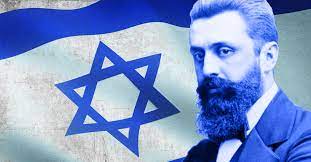
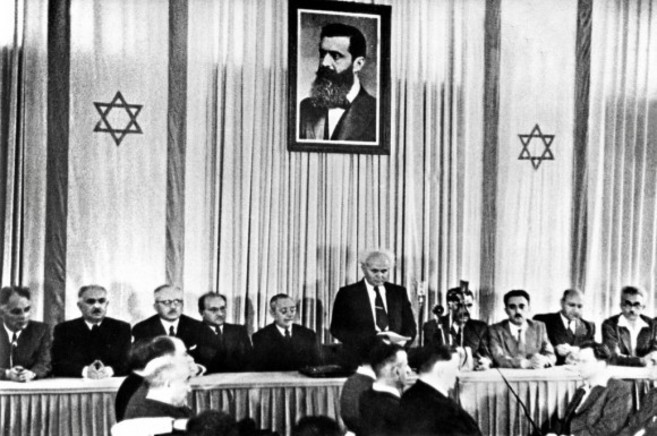
The icon of Zionism, Theodor Herzl, dreamed of a “normal” Jewish state,
However, the term “normalization” does not exist in either law or diplomacy.
Nonetheless, Jews are thrilled to hear that Israel’s enemies are now considering a policy of normalization.
That is because Israel’s adversaries have conducted a genocidal war throughout Israel’s history.
A breath of fresh air never hurts.
The Arab League of Nations, whose 1945 charter calls for liquidation of the Jews in Palestine, launched a total war in 1948 which continues to this day. The same goes for the Palestine Liberation Organization, which in 1964 also issued a charter of total annihilation of the Jews of Palestine, a covenant in force to this day.
Although Egypt and Jordan signed peace treaties with Israel, while Syria and Lebanon agreed to an armistice with the Jewish state, Saudi Arabia, kingpin of the Arab League, has never agreed to any armistice or any peace whatsoever with the Jews.
The Palestine Liberation Organization signed a peace treaty with Israel on September 13, 1993, Yet the Fatah, the leading entity of the PLO, would not ratify that agreement. Now news reports now have it that the Saudis and the PLO, operating under the nascent Palestinian Authority, are ready to normalize with the Jews.
The time has come to take Arabs at their word in their call for normalization.
What, however, would real normalization look like?
Begin with four steps:
1. Remove PA texts and teachers who advocate war against Jews. It would fly in the face of normalization if the PA were to maintain its war curriculum against the Jews.
Launch an effort to resettle descendants of Arab refugees from the 1948 war who now dwell in 59 “temporary” UNRWA refugee camps under the pretense of the “right of return” to pre-1948 villages from 1948 that no longer exist, . The time has come to remove the “right of return” roadblock to normalization.
After the party is over, the hangover usually kicks in.
Israel’s 75th birthday party had hardly finished when the usual domestic and foreign crowd surfaced to resume their well-orchestrated campaigns of deceit and denunciations.
In fact, the party was still in full swing as the usual critics, unable to contain their ire burst forth with orchestrated venom.
It is really sad and pathetic that the party poopers feel compelled to denounce and denigrate. Somehow the sight of Israelis celebrating three-quarters of a century of amazing achievements evokes a visceral spasm of bile that cannot be contained.
Woeful is most probably a rather mild expression to describe this phenomenon. Feel free to pick any one of the following synonyms which best explain some of the situations we face:
Whichever adjective you might have chosen most probably covers the spectrum of shameful episodes.
For most level-headed and sane Israelis the commemoration of the murder of six million Jews in the Shoah and the ceremonies honouring the enormous sacrifices made by our citizens in the defence of our country are solemn occasions. They are marked with wailing sirens, moments of respectful silence accompanied by tears and grief. Independence Day is one of unrestrained joy and celebration.
For many on the self-loathing extreme left, however, these three days represent everything that is evil about Jews and Israel. Unable to find anything positive to say which might indicate pride, patriotism or solidarity, their volcanic eruptions of negativity take centre stage.
Israel’s flagship leftist newspaper, Ha’Aretz, last week posted an op-ed online from one of its regular contributors (Gideon Levy) which perfectly illustrates the situation. This is how he describes the three Israeli observances:
“this is the essence of the Israeli zeitgeist: first a frenzied wallowing in the cult of mourning and a no less frenzied worshipping of death and the dead on Memorial Day, immediately followed by an ultra-nationalistic and militaristic orgy, with flights of self-adoration and tons of scorched meat on Independence Day.”
No wonder the international media love this sort of woeful commentary which finds a warm embrace from all Israel haters, post Zionists and breast-beating self loathers.
Denigrating one’s own people and country, unfortunately, is not confined to just these three aforementioned days.
A constant response from those who see Israel as their natural home and who despite difficulties and hardships, intend to remain here is exemplified by the expression, “we have no other country.” In essence, what this means is that Israel, as the world’s only Jewish nation with a history stretching back millennia, is the only country in the world where Jews constitute a majority. It is the only country where the Jewish calendar is an integral part of the fabric of society, where Hebrew is the official language, and Jews do not need to hide any outward signs of their ethnicity and faith.
It does not mean that Jews are unable to live in any other country. As in any democracy, Israelis are free to emigrate and make their permanent homes anywhere the grass seems greener. They may still have residual attachments of family ties, but those who relocate intending never to return, no matter how “Israeli” they may still feel, will inevitably find after a generation or two that the real Promised Land is no longer part of their children’s identity.
In contrast to all who believe that Israel is something special and that living here is part of a historical miracle, there are those on the secular ultra-left who feel otherwise. That is why the same contributor to Ha’Aretz in yet another display of bitter rhetoric, penned the following pearls:
“The national whine du jour is I have no other country. The French have another country as do the Swedes, Germans, Congolese and Indians. Only the poor Israelis, just them, have no other country, and the heart breaks for them. What a miserable nation it is that has no other country, and this gives it the right to do whatever it wants because after all it has no other country, so hapless it is. The Palestinians don’t even have one country but the Israelis lament that they don’t have a spare country. How terrible.”
As a gift to the Israel haters, this example of woeful “logic” is just the tip of the self-loathing iceberg where Israel‘s rebirth continues to resonate as an original sin.
One couldn’t finish the week without further outbursts of international hypocrisy.
South Africa recently hosted a rugby tournament to which an Israeli team had been invited to participate. As soon as I read about this, I knew that, without a doubt, there would be trouble. As a teeming cesspit of Israel hate where every outlandish accusation of “apartheid” and “colonial oppression” is treated as divine revelation there was never going to be any chance that an Israeli rugby team would be able to compete. As per a preordained script, there was an eruption of rage against allowing Israel to participate and unsurprisingly, the invitation was withdrawn and the Israeli team banned.
The ostensible reason given for this decision was a threat of violence against the Israelis, which the SA rugby authorities maintained would have put the competitors in danger. There is no denying that lawlessness, murder and mayhem are now regular features of the South African scene. If this was the real reason then the tournament should not have been held in the first place, as threats to the lives of all competitors would be paramount. Unbiased observers of the local scene know that this excuse was a transparent smoke screen.
Lo and behold the International Rugby Board which met to discuss the matter only after a complaint was lodged decided after due deliberation that no further action should be taken against the SA rugby authorities. They swallowed hook, line and sinker, the specious reasoning of the SA authorities and declared that there was no hint of discriminatory behaviour. This reminds me of the decision of the International Red Cross, who maintained that the Theresienstadt concentration camp was actually a holiday resort. In both cases, willful bias and deliberate deception won over a moral imperative to act honestly.
I wonder how the New Zealand and Australian representatives on the IRB voted. If they agreed with the majority, then they also are guilty of deliberately ignoring the truth.
In direct contrast to this display of moral cowardice, FIFA showed how to deal with bullies and boycotters of Israel. Indonesia was due to host an international under-20 soccer tournament to which Israel was eligible to compete. As a rabid anti-Israel cheerleader Indonesia announced that the Israeli team was disinvited. To its credit FIFA immediately removed Indonesia as a host and imposed sanctions against its soccer governing board.
It is important to record that the Palestinian Arab sports authorities cheered and applauded the SA rugby boycotts and roundly condemned FIFA’s exclusion of Indonesia. Is it any wonder that most sane and level-headed Israelis are no longer mesmerised by the mirage of a tolerant and peaceful two-state solution?
As I write, southern Israeli communities are being bombarded once again by rockets fired from Gaza. The terror groups claiming responsibility declared that this is in response to the alleged “assassination” of one of their murderous members in an Israeli jail. In actual fact, this prisoner was on a self-imposed hunger strike, refusing every offer of medical treatment that had been available. As is usually the case, truth is a casualty of the false fables spread by the terrorist groups and their enablers. Inevitably Israel’s retaliatory responses will be condemned by the usual suspects.
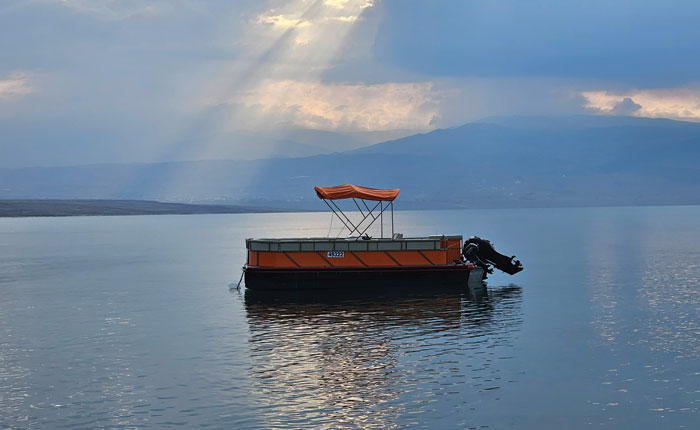
“Stars” – metaphorically, of course. There were no stars out on the day I took a trip on a little boat in the Dead Sea. I recently went with my close friend and neighbor, Sara Bedein. What else should two balabustas do a week before Pesach?
Seven years ago, Noam Bedein (Sara’s son) first visited the Dead Sea on a boat and learned of the catastrophic lowering of the sea level in a sea that, according to Bedein, used to reach minus 437 meters below sea level.
He reached out to Ari Fruchter, an art collector and Dead Sea advocate, who later became the Co-founder of the Dead Sea Revival Project in 2017. Since then, they have taken thousands of people, including filmmakers and top media outlets on excursions ranging from 90-180 minutes through the Dead Sea and along the coast, where one can see, with their own eyes, the levels that the sea used to reach. At one point he showed us a small mountain and said, “See those white lines? Like the lines in the trunk of a tree, each of those lines is the year that the sea reached that level.”
In 2021, Fruchter, a Member of the Board of Governors at the Tel Aviv Museum of Art, also founded the Dead Sea Museum in Arad, which will include installations, photographs, history and an immersive iconic building overlooking the Dead Sea.
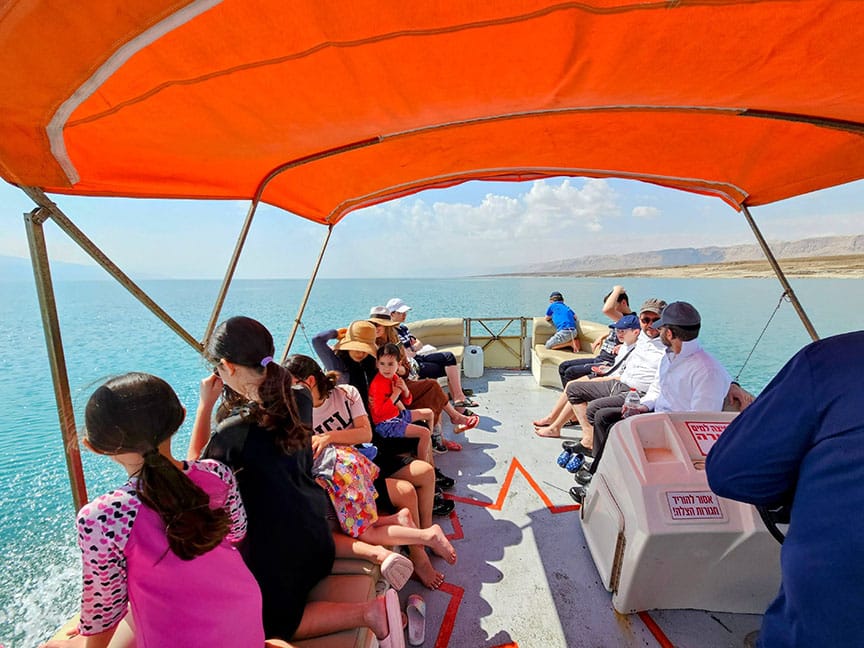
The people who joined us on the boat included tourists, journalists and Israelis, and one mom, an “olah” (new immigrant) from England, with her 9-month-old baby. Bedein looked a bit surprised when he saw her and said to me, quietly, “I didn’t know about the baby, but we’ll manage.” And then he announced on the boat that the baby was the youngest passenger ever to take a ride on this kind of boat on the Dead Sea.
Photo by Noam Bedein
We left from Neve Midbar, a gorgeous beachfront retreat in the middle of arid surroundings, that includes both a kiddie and adult fresh water pools, lush grass picnic and barbeque areas, a kosher restaurant and separate coffee and drinks bars, comfortable bathroom and shower facilities, and a gift shop where one can buy, among other things, Dead Sea cosmetic and skin care products and exotic Bedouin crafts, and of course a beachfront where one can dip in the Dead Sea itself, that is supposed to have exceptional healing qualities.
But to get to the actual shore we had to walk down about 100 steps. Bedein told us that the Dead Sea used to reach the top of those steps. It concretized for us the calamity of the sea’s retreat. Bedein and the Dead Sea Revival Project have been featured in National Geographic and CNN and recognized by NASA.
We were told in advance to wear shoes that were waterproof and clothes that we didn’t mind getting wet. Fruchter, Bedein and Amir Green, the boat’s captain, who lives in the nearby Kibbutz Kalia, helped the passengers tread through the salty water and climb onto the high motor boat.
We settled in for an exhilarating ride through the sparkling green-blue water, while Bedein gave us some current and past history.
He said that 30% of the problem of the drastic lowering of the Dead Sea is due to the factories both in Israel and Jordan that are pumping out the water, extracting the minerals for export and that 70% is due to less water flowing in from the “historic” sources, i.e. the Jordan River, the Kinneret, and their water sources from neighboring countries.
“Water is the most valuable asset in the entire region,” Bedein told us. “75% of our drinking water is desalinated from The Mediterranean Sea. which adds up to 550 million cubic meters of water. The Dead Sea needs 750 million cubic meters of water to stabilize and maintain the sea level.”
What comes first? The water-starved population of Jordan or saving a water treasure? “Water diplomacy between Israel and Jordan for saving the Dead Sea has never progressed to practical solutions,” says Bedein. “The World Bank promised ten billion dollars for the Red Sea-Dead Sea canal, but that fell through officially in 2022.”
A dedicated environmentalist, Bedein says, “Since the Abraham Accords, I have been promoting and exploring the issue of regional water-diplomacy and global conservation in the Arabian Gulf, in Africa, and recently in Asia, with the recognition and invitation of government ministries and professionals.”
Amir Green showed me a piece of material that they call “diamond salt.” He explained, “It is created from ground water sources that enter the Dead Sea and when it recedes, it leaves this kind of salt. There is another spot we may stop where you can see the squares of the ‘diamonds’ – the material of diamonds looks the same as this.” He broke off a piece for me. I took it home, washed off the mud, and now the sparkling “diamond” salt sits in a clear container on my Shabbat candlestick tray, a weekly reminder of the beauties of Israel.
Today the Dead Sea is more than minus 445 meters below sea level. The estimated drop, says Bedein, is around 1.2 meters a year, equivalent to 600 Olympic pools evaporating every day.
Today the Dead Sea is more than minus 445 meters below sea level. The estimated drop, says Bedein, is around 1.2 meters a year, equivalent to 600 Olympic pools evaporating every day.
We also saw sinkholes from afar. Bedein says that over 7000 of them are spread out on the northern Dead Sea shore, and that 700 new ones appear each year. “It means that the land is very fragile and the estimated damage cost is around $90M a year, due to the collapse of roads and agricultural fields, and resorts have closed down. That’s why 98% of the Dead Sea isn’t accessible to the public, and that’s the importance and need of the initiative that we took upon ourselves— in exploring and accessing the Dead Sea, by boat.”
When Bedein was asked where the border is, he said, “In the middle.” “But how does anyone know exactly where?” He said, “They don’t.”
Only 16 kilometers (less than 10 miles) separate its Israeli coast from the Jordanian side. When Bedein was asked where the border is, he said, “In the middle.” “But how does anyone know exactly where?” He said, “They don’t.”
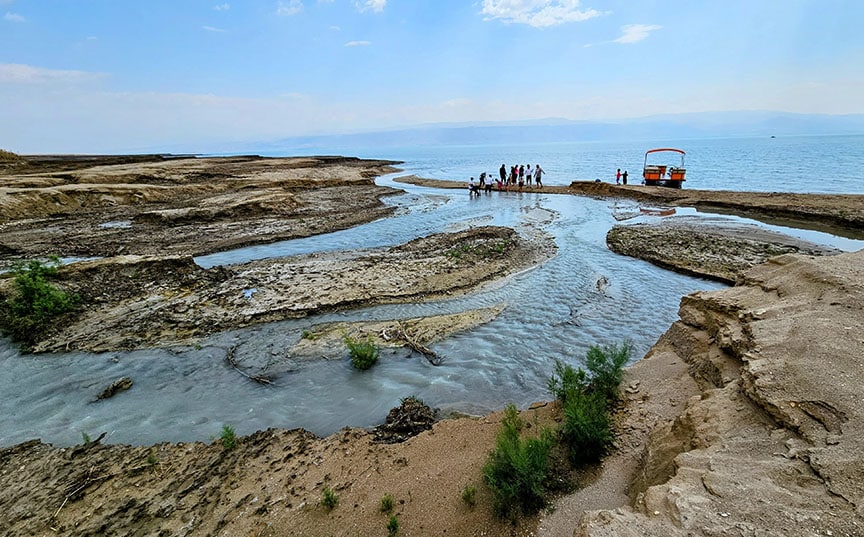
In the middle of the trip, the boat “docked” (in a manner of speaking – more wading through salty water) at a low, rocky area which Bedein says is “the untouched and unexplored Einot Tsukim nature reserves shoreline” where one can see a sparkling spring of water, flowing underground, from Jerusalem and the Judean Desert. There is also an exquisite Salt Rainbow Beach, about which Bedein says, “We found this while exploring the shores south of Neve Midbar.”
Einot Tzukim, Photo by Noam Bedein
When we reached the point at which the boat usually turns around and returns to the Neve Midbar shore, Bedein asked us, “What is your timeline? Do you want to see a place we haven’t been before with our new boat?” Explorers! Who could say no?
The crew then took the boat farther along the shore until we reached a place where we could look up and see a cave in the mountainside. Hanging from the top of the entrance were stalactites made of salt. Bedein explained that that was how high the sea had once reached when he first came out there seven years earlier. For the first time, he will be exposing his dramatic Dead Sea time lapse photographs in Arad Cultural Center for Earth Day 2023.
Whether you live in Israel or come as a tourist, treat yourself to this ecological and magical trip. You’ll come back with salt on your body and stars in your eyes.
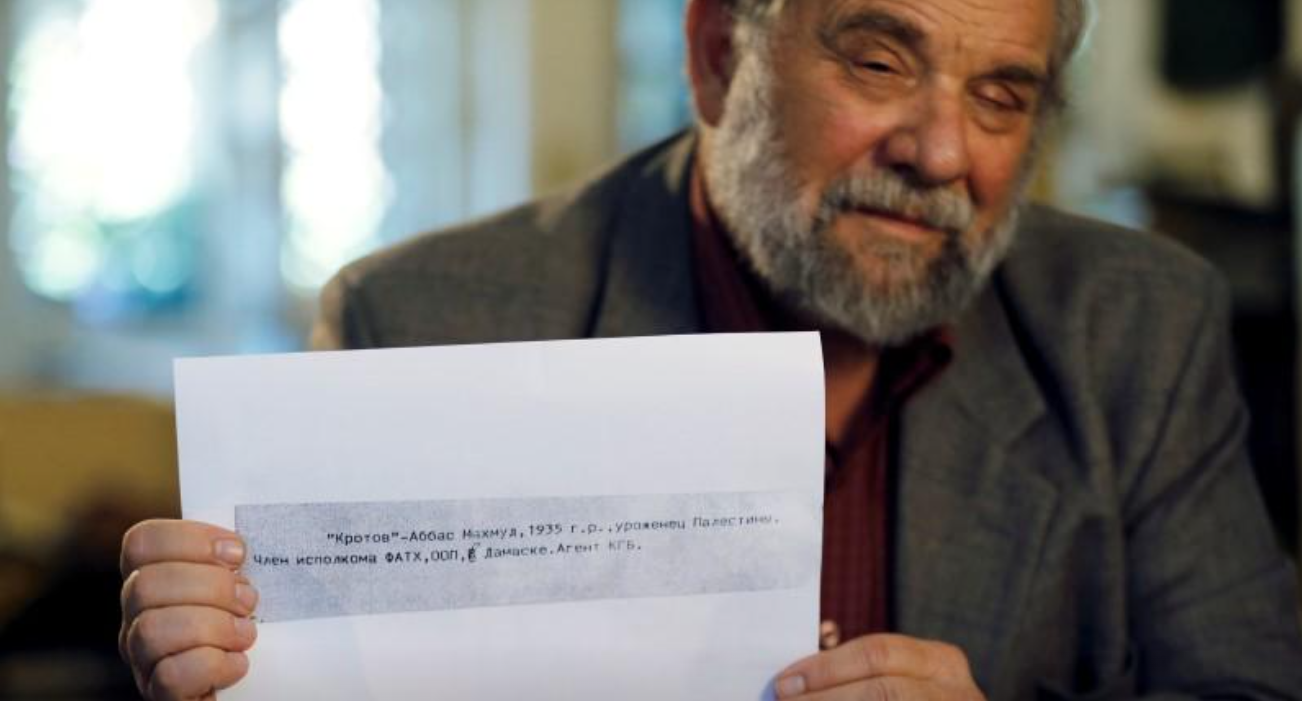
Soviet-era documents show that Palestinian President Mahmoud Abbas worked in the 1980s for the KGB, the now-defunct intelligence agency where Russian leader Vladimir Putin once served, Israeli researchers said on Thursday.
Slideshow ( 3 images )
The Palestinian government denied that Abbas, who received a PhD in Moscow in 1982, had been a Soviet spy, and it accused Israel of “waging a smear campaign” aimed at derailing efforts to revive peace negotiations that collapsed in 2014.
The allegations, first reported by Israel’s Channel One television on Wednesday, surfaced as Russia pressed ahead with an offer by Putin, made last month, to host a meeting in Moscow between Abbas and Israeli Prime Minister Benjamin Netanyahu.
Both leaders have agreed in principle to a summit, Russia’s Foreign Ministry said on Thursday, but it gave no date.
Gideon Remez, a researcher at the Hebrew University of Jerusalem’s Truman Institute, said an Abbas-KGB connection emerged from documents smuggled out of Russia by former KGB archivist Vasili Mitrokhin in 1991.
Some of the material, now in the Churchill Archives of Britain’s Cambridge University, was released two years ago for public research, and the Truman Institute requested a file marked “the Middle East”, Remez told Reuters.
“There’s a group of summaries or excerpts there that all come under a headline of persons cultivated by the KGB in the year 1983,” he said.
“Now one of these items is all of two lines … it starts with the codename of the person, ‘Krotov’, which is derived from the Russian word for ‘mole’, and then ‘Abbas, Mahmoud, born 1935 in Palestine, member of the central committee of Fatah and the PLO, in Damascus ‘agent of the KGB’,” Remez said.
Abbas is a founding member of Fatah, the dominant faction of the Palestine Liberation Organization (PLO), the main Palestinian nationalist movement. He became Palestinian president in 2005.
The documents cited by Remez did not give any indication of what role Abbas may have played for the KGB or the duration of his purported service as an agent.
A Palestinian official, who declined to be identified as he was not authorized to speak publicly on the matter, said that Abbas had served as an “official liaison with the Soviets, so he hardly needed to be a spy”, without elaborating.
The official said any suggestion that the president was a spy was “absolutely absurd”.
Adding to the intrigue, Russian Deputy Foreign Minister Mikhail Bogdanov, whom Putin has tasked with arranging the Moscow summit, served two stints in the Soviet embassy in Damascus between 1983 and 1994, covering the period in which Abbas was purportedly recruited.
Bogdanov was in the area this week for meetings with Israeli and Palestinian officials.
As we celebrate seventy-five years of re-established Jewish independence, I can’t help thinking is Israel still loved at 75?
When it comes to Israel in general and Jews in particular, the question should elicit a good old Jewish response which is another question.
“When in fact, have Jews and Israel ever been unconditionally loved?”
Despite the horrendous horrors of the Shoah years, the rebirth of Israel as the reconstituted homeland of the Jews was not a given. It was accompanied by duplicitous deceptions on the part of the British Foreign Office, denial of a safe haven for desperate refugees fleeing certain German annihilation and a post-war adamant refusal to admit survivors. Moreover, having already shamefully in 1921 handed half of the promised Jewish territory to its Arab Hashemite friends the Mandate authorities set the scene for much of today’s problems.
In one of those miracles that people tend to forget these days, both the USA and the Soviet Union actually voted in favour of the UN 1947 partition plan. This decision, of course, was vehemently rejected by all Arab States who proceeded to launch intensified terror with the aim of snuffing out any chance of the Jews living long enough to enjoy their independence.
The intended genocidal aims of our adversaries were thwarted as a result of British military help to the Hashemite Kingdom and military bans by so-called friendly nations against Israel.
We may have survived this onslaught, but it was at an enormous cost, both in lives and economically. Arab boycotts and continuing terror combined with a hostile and indifferent international community resulted in many years of deprivation and hardship.
Shamefully overlooked is the mass exodus of Jews from Arab and Moslem countries as a result of pogroms and deliberate anti-Jewish policies. Israel absorbed these refugees and, at great cost, gradually integrated them into the life of the new nation.
Today, of course, there are no refugee camps where Jews languish.
Instead, there are UNRWA refugee camps funded by the gullible taxpayers of the UN where generations of Arabs are born, educated to hate Jews and fed fables about their own self-inflicted Nakba (catastrophe).
As citizens stand while the sirens wail, evening and morning, the enormity of the sacrifices made in defence of the nation hit home. It is very sobering to realise that since at least 1920, those who wish to deny Jews any sort of presence here have inflicted and continue to inflict such staggering casualties.
The statistics reveal the numbers, but they do not reflect the ongoing lifelong after effects and tragedies which so many families have suffered. The numbers certainly do not resonate with all those UN member nations which continue to pillory and condemn Israel and lose no opportunity to deny our historical and legal entitlement to the land.
The number who have been killed pre-State from 1920 and in the defence of the country from 1948 amount to more than 24,000.
In the same period, the number of wounded totalled 75,000 and counting.
At least 100,000 armed forces veterans have been classified as disabled.
The number of Israelis murdered in Arab terror since 1948 totals more than 4,200.
Many people are under the impression that Arab terror only commenced in 1948. This, of course, is not true as pogroms and terror attacks date from at least 1920, if not earlier.
You should get some idea of what Yom Hazikaron (Memorial Day) actually means to countless Israeli families when you take into account the cost of hospitalisation, rehabilitation and personal effects on so many families.
On Yom Hazikaron this week, the UN Security Council decided to meet for its monthly session devoted to accusing and condemning Israel for the usual range of alleged “war crimes.” This session is being chaired by the Russian Foreign Minister, a dubious apostle of peace and democracy if ever there was one. In view of the fact that the meeting was scheduled for Yom Hazikaron he was asked by the Israeli representative to postpone it to another date. This request was refused, which neatly encapsulates the depths to which the UN has sunk. Israel’s Ambassador read out the names of those murdered by Palestinian Arab terrorists, lit a memorial candle and then led his delegation out of the meeting. The best next step would be to permanently walk out of the United Nations.
The transition from mourning and national grief to celebration and joy as Yom Hazikaron transits to Yom Ha’atzmaut (Independence Day) is an occurrence which amazes non-Israelis.
How is it they wonder that in an instant, the mood of the day can suddenly change?
To really understand this transformation, one has to know something of the resilience and, indeed, faith that has been a hallmark of the Jewish experience since Biblical times. No other group of people, small in numbers as they have always been, has managed to survive the decimations, persecutions, exiles and unrelenting hate of powerful empires. They have not only survived but they have thrived and contributed so much to an ungrateful world.
It is miraculous what has been achieved in the last seventy-five years in the face of obstacles and threats which would have vanquished most. One can only appreciate the scale of the achievements if one has lived here for some time and witnessed them. Even in the comparatively short span of thirty-two years that we have been in Israel, we have seen enormous progress in every field of endeavour.
Does this mean that there are no longer any problems to solve and overcome?
Of course not, and like every other nation in the world, there are numerous challenges and inequalities which need to be rectified. The difference, however, is that Israel must grapple with threats to its very existence at the same time as trying to improve the lives of its citizens. This is a superhuman task and one which we have faced far too often in the past annals of our history.
What other country faces relentless daily assaults by terrorists and verbal slanders and delegitimisation by those who promote this country’s illegitimacy and perceived sins?
In addition, we face the phenomenon of self loathers, domestic and foreign, whose activities fuel the media and all those looking for any excuse to rubbish the country.
Whenever there is a reason to celebrate remarkable Israeli milestones and bask in the success of an enterprise that pundits said was doomed from the beginning, you can always guarantee that there will be party poopers ready to ruin the party. The doomsday prognosticators are having a field day this year predicting the “death” of democracy, assaults on freedoms and threats of civil war. Instead of using the ballot box to achieve their supposed aims, they prefer to offer up a media spectacle by trying to ruin the celebrations on Independence Day. The media love nothing better than scenes of mayhem.
You can guarantee that what will be reported are acts of discord rather than a sober summary of Israel’s amazing achievements after the short space of seven and a half decades.
The best response is to make sure that the next seventy-five years are even more spectacularly successful than the first.
The road map is clearly laid out by our prophets of old.
Our task is not to complete the job but to ensure that succeeding generations carry on building and developing the Land which was promised to us at the dawn of Jewish history as a perpetual inheritance.
Den här veckan märkte FN:s hjälporganisation för palestinska flyktingar i Mellanöstern att USA inte kommer att tillåta UNRWA att använda de 330 miljoner dollar som USA har allokerat till UNRWA i år. Plötsligt har UNRWA inte tillräckligt med kontanter för att betala sina 30 000 anställda i 59 “tillfälliga” flyktingläger som etablerades för araber som lämnade sina hem i spåren av 1948 års krig.
Anledningen till att USA håller tillbaka medlen är att UNRWA inte kommer att uppfylla sin sida av samförståndsavtalet mellan USA och UNRWA från den 14 juli 2021, en diplomatisk överenskommelse som kräver att UNRWA tar bort anstiftan från sitt skolsystem som ett villkor för att få förnyat USA. fonder, som stoppades den 31 augusti 2018.
UNRWA:s taleskvinna gjorde det dock klart i en intervju med en schweizisk media att organisationen inte kommer att göra något för att få en förändring av UNRWA:s läroplan, som använder läroböcker från den palestinska myndigheten. UNRWA har inte gjort några anspråk på att de kommer att genomföra något av de åtaganden som de gick med på i detta dokument.
Därför, med stöd av den amerikanska kongressen, kommer USA nu inte att tillåta att UNRWA använder amerikanska medel.
Nu finns det en ny avdelning vid Palestinian Authority Curriculum Center, som övervakar läroplanen för PA- och UNRWA-skolor.
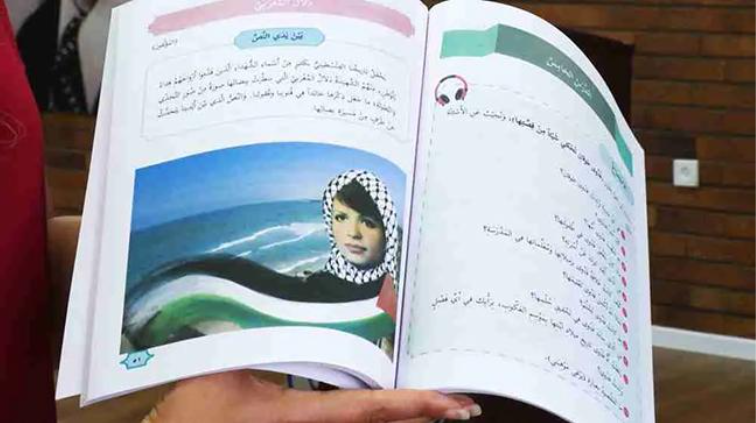
UNRWA, som förlitar sig på PA:s läroplan, publicerade denna vecka en ny 2023-utgåva av 5:e klass medborgarklassrumstext tillägnad arvet från Dalal al-Mughrabi, befälhavare för arabiska terrorister som landade i en båt på stranden i Maagan Michael naturreservat. lördag eftermiddag den 11 mars 1978.
Händelsen 1978:
Efter deras landning stötte terroristerna på en naturfotograf, Gail Rubin, en amerikansk medborgare, brorsdotter till den amerikanske senatorn Abe Ribicoff. De sköt ihjäl henne.
De fortsatte sedan mot Israels kustväg, tog kontroll över en hytt och en buss och senare över en annan buss.
Araberna samlade alla passagerare i en buss och fortsatte söderut mot Tel Aviv, medan de sköt längs vägen mot andra fordon och även mot flera passagerare inne i bussen – enligt de överlevandes vittnesmål.
Nära Gelilot-korsningen, norr om Tel Aviv, lyckades den israeliska polisen stoppa bussen och skottlossningen startade. Några av terroristerna brast ut ur bussen och sköt poliser, medan andra sköt passagerarna inne i bussen som försökte fly. Terroristerna hade riggat bussen och under striderna detonerat sprängämnena som gjorde bussen till en brandfälla där passagerarna som inte lyckats fly omkom. Trettiofyra civila israeler dödades, inklusive 13 barn. Nio av de elva terroristerna dödades, inklusive Dalal al-Mughrabi.
Två veckor efter att den ursprungliga Dalal al-Mughrabi-texten först tillhandahölls av PA för UNRWA-skolor 2017, följde jag med vår stab av översättare och analytiker för att presentera denna terrorbok och vår omfattande studie av UNRWA-uppvigling för den högre personalen på den nyligen installerade FN:s generalsekreterare, António Guterres. Mötet leddes av Rabbi Abraham Cooper, biträdande dekanus för Wiesenthal Center, och en erkänd NGO vid FN. FN:s generalsekreterare Guterres kontaktade UNRWA i Jerusalem och bad om att ta bort läroboken som glorifierar Dalal al-Mughrabi. Texten togs aldrig bort.
Den enda skillnaden nu är att det nya publiceringsdatumet är 2023: Ett meddelande om att UNRWA inte kommer att vika sig.
På dagen för bokens återpublicering dök vår nyhetsbyrå upp på PA-UNRWAs läroplanscenter och köpte 100 exemplar. Tanken är att förse FN:s lärobok med bilden av en mördare till alla möjliga beslutsfattare.
USA:s placering av medel för UNRWA i deposition tills UNRWA ändrar sin läroplan ger en modell som 67 givarnationer och 33 givarorgan kan efterlikna.
Är det inte lämpligt att en FN-skola bör tillskriva FN:s värderingar och inte ta direktiven från Palestina Liberation Organization?
On May 3, the Institute for Holocaust, Genocide, and Memory Studies [IHGMS] at the University of Massachusetts, Amherst, is holding a conference, “Encounters” Aftermaths annual series, on Zoom, together with the Avraham Harman Research Institute of Contemporary Jewry at the Hebrew University of Jerusalem. In the event, a conversation with Adel Manna will take place, on his 2022 book, Nakba and Survival: The Story of Palestinians Who Remained in Haifa and the Galilee, 1948-1956. The event is organized by Prof. Alon Confino, the Director of IHGMS, and Prof. Amos Goldberg, the Jonah M. Machover Chair in Holocaust Studies at the Department of Jewish History and Contemporary Jewry and the Head of the Avraham Harman Research Institute of Contemporary Jewry, at The Hebrew University of Jerusalem.
Dr. Adel Manna is a Palestinian specializing in the history of Palestine during the Ottoman period and Palestine in the 20th century. He has taught at The Hebrew University and Bir Zeit University since the early 1980’s. He is currently a senior research fellow at the Jerusalem Van Leer Institute.
Manna would hold the conversation with Amos Goldberg.
In his book Nakba and Survival, Manna “tells the story of the Palestinians in Haifa and Galilee during, and in the decade after, mass dispossession. Manna uses oral histories, diaries, memoirs, and archival sources to reconstruct the social history of the Palestinians who remained and returned to become Israeli citizens. Manna shows in his path-breaking book that remaining in Israel in the aftermath of the Nakba under the Israeli military government were acts of resilience in their own right.”
What Manna neglects to inform his readers is that less than a decade before the “Nakba,” the Palestinians, under the influence of Nazi Germany, were rioting against the British and the Jews.
A new book by Oren Kessler discusses the 1936-39 riots. A book review published last month states: “Describing the situation in 1936, just prior to the Great Revolt, Kessler reminds us that Hitler and the Nazis had been in power in Germany for three years, and that his intention to emasculate his Jewish population was already evident. In Palestine, the fanatical Izz al-Din al-Qassam, killed by the British police, had become the first Arab martyr and cult hero. Meanwhile, Jewish immigrants had been flooding into Palestine. By 1936 there were some 400,000. As Kessler puts it: ‘The Arabs of Palestine started to wonder…whether a world war was looming, one that might rid their country of Britain and the Jews for good.'”
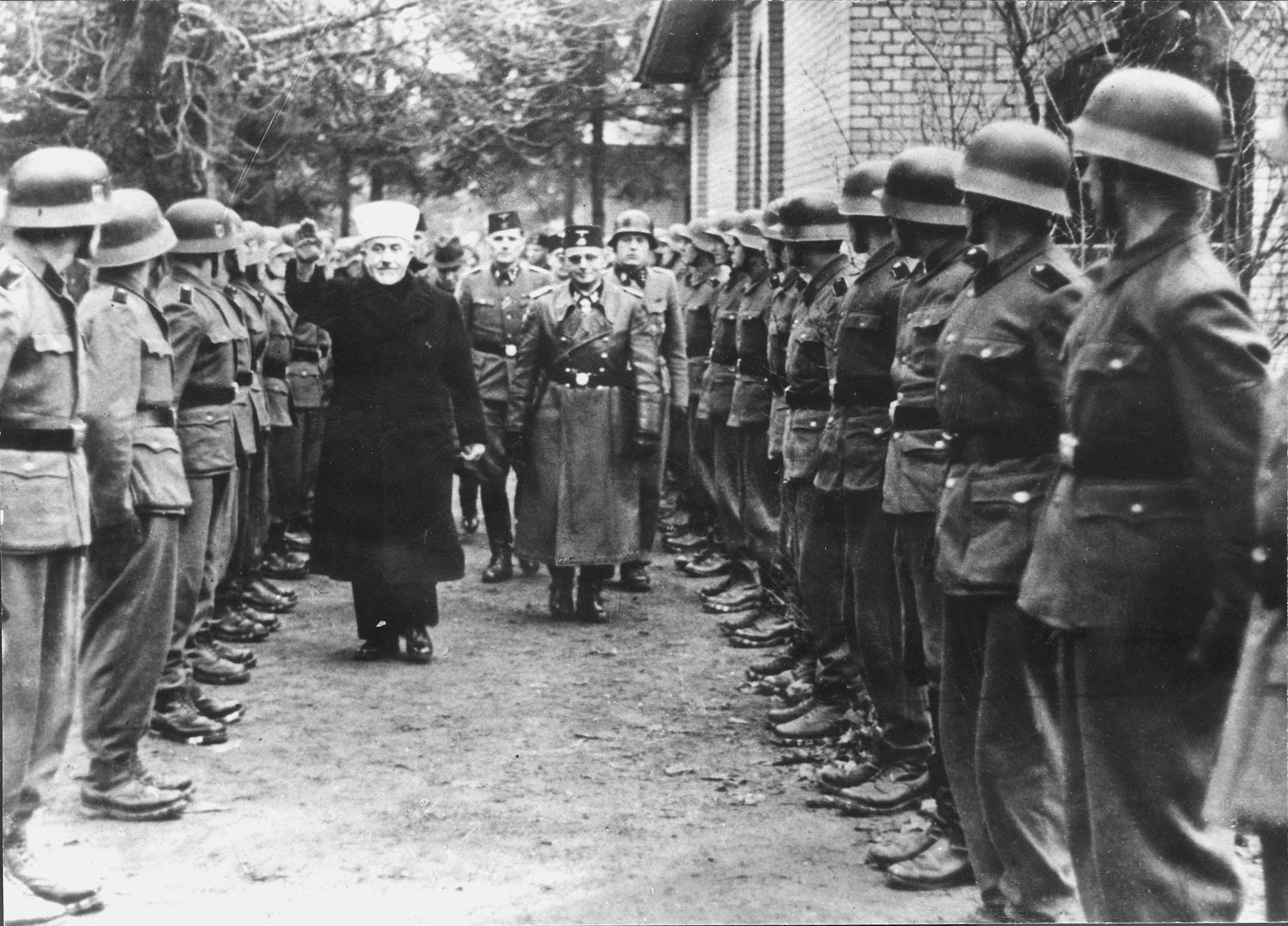
Dina Porat, Professor Emeritus of Modern Jewish History at the Department of Jewish History, Head of the Kantor Center for the Study of Contemporary European Jewry, and holds the Alfred P. Slaner Chair for the Study of Contemporary Antisemitism and Racism at Tel Aviv University, who, since 2011 served as Chief Historian of Yad Vashem, is an expert on the Holocaust. According to Porat, the Palestinian leader, Mufti Haj Amin al-Husseini, “was no lover of the Jewish people. He was an ardent antisemite… [He] had a specific agenda in meeting Hitler in 1941. The Protocol from this fateful meeting specifically states that ‘The Fuehrer replied that Germany stood for uncompromising war against the Jews and that naturally included active opposition to the Jewish national home in Palestine.’ Hitler promised that he would carry on the battle to the total destruction of the ‘Judeo-Communistic Empire’ in Europe.”
Moreover, in 1946, the American Christian Palestine Committee published its 50 pages report titled “The Arab war effort, a documented account.” The report details the Palestinian Arabs, including the Mufti, liaising with Nazi Germany.
At the very least, this evidence implies that the Palestinians had hopes that a Mediterranean-style Final Solution would solve their “Jewish Problem.” After the defeat of the Nazis, the Palestinian leadership put their faith in the Arab countries to wipe out Israel from the map. Needless to say, this mindset prevented them from accepting the 1947 UN Partition proposal.
Manna, like many Palestinian and pro-Palestinian historians, tries to hide the nexus between the Nazis and the Palestinians. As a result, not enough research has been conducted on this topic.
What is most troubling is the position of Goldberg, the chair of Holocaust Studies, who emerged as a major voice for those who push to equate the Holocaust with the Nakba – a fact IAM emphasized before. Goldberg was hired to teach and research the Holocaust, not to propagate his political agenda at the expense of the Israeli taxpayers.
Palestine 1936 is essentially the story of how two nationalist movements took root and developed, leading to the Great Arab Revolt and the start of today’s Arab-Israeli conflict.
Palestine 1936: The Great Revolt and the Roots of the Middle East Conflict is an eminently readable account of how the State of Israel emerged from the flames of Mandate Palestine, but it is much more. It is the first scholarly, extensively researched, investigation into the formative events of 1936-39 in the Holy Land – events that its author, Oren Kessler, demonstrates to be the origin and model for the subsequent unresolved, and perhaps unresolvable, Arab-Israel conflict. He shows how, during what he calls “the Great Revolt,” the concept of Arab Palestinianism was born while, at the same time, the decades-long Zionist dream of a Jewish state – Jewish nationalism – began to solidify into reality.
The Arab Revolt of 1936–39 was the first sustained uprising of Palestinian Arabs in more than a century. Thousands of Arabs from all classes were mobilized, and nationalistic ideas were disseminated throughout Arab society. The British, mandated to govern Palestine and create a national home for the Jewish people, were taken aback by the extent and intensity of the revolt. They shipped more than 20,000 troops into Palestine, and by 1939 the Zionists had armed more than 15,000 Jews in their own nationalist movement.
Dealing with the period leading up to 1936, Kessler describes the short, but deadly, pre-Mandate attacks on Jews – 1920 in the Old City of Jerusalem, and May Day 1921 in Jaffa – but he categorizes much of the later 1920s as “the Mandate’s calmest chapter.” The number of Jewish immigrants reached 80,000; agricultural settlements doubled to over 100; the Hebrew University was founded; and it was a time of economic and trade growth and development.
But it was the calm before the storm. In 1929, Tisha Be’av (the 9th of Av) – the day both First and Second Temples in Jerusalem were destroyed – marked the start of the deadliest clash so far between Jews and Arabs. British officialdom had promulgated new severe restrictions on Jewish access to the Western Wall. Mass protests by Jews generated counter protests by Arabs. The clashes between them got out of hand. Bloodthirsty Arab mobs embarked on a six-day killing spree which included lynching, rape and other unspeakable brutality. In addition to hundreds of wounded on both sides, 133 Jews died.
Britain set up a commission of inquiry. Its report, in the spring of 1930, concluded: “The outbreak…was from the beginning an attack by Arabs on Jews.”
An explosion is seen in Jaffa in 1939 amid the Arab revolt. (credit: Wikimedia Commons)
“The outbreak…was from the beginning an attack by Arabs on Jews.”
Describing the situation in 1936, just prior to the Great Revolt, Kessler reminds us that Hitler and the Nazis had been in power in Germany for three years, and that his intention to emasculate his Jewish population was already evident. In Palestine, the fanatical Izz al-Din al-Qassam, killed by the British police, had become the first Arab martyr and cult hero. Meanwhile, Jewish immigrants had been flooding into Palestine. By 1936 there were some 400,000. As Kessler puts it: “The Arabs of Palestine started to wonder…whether a world war was looming, one that might rid their country of Britain and the Jews for good.”
The incident that sparked the Great Revolt occurred on April 15, 1936. A Jewish poultry dealer, ambushed by Arabs seeking money for weapons intended to avenge the death of Qassam, could not meet their demands and was shot. Kessler recounts, with the pin-point accuracy only achieved through assiduous research, the details, one after another, that built up to a full-scale riot in Jaffa, known as the Bloody Day, while the British police attempted, and failed, to control the situation.
Shortly afterwards, an Arab National Committee was formed in Nablus, to be followed by local branches across the country, all urging the Arab public to withhold their taxes. Then came the establishment of an Arab Higher Committee (AHC), chaired by the mufti of Jerusalem, Hajj Amin al-Husseini, a visceral hater of the Jewish people. The AHC masterminded a general strike of Arab workers, demanding an end to Jewish immigration, an end of land sales by Arabs to Jews, and the establishment of a representative government to reflect the country’s Arab majority.
The Arabs’ anti-British action continued for months, with waves of armed rebellion, arson, bombings, and assassinations. Masterminded by the mufti, British soldiers and Jewish civilians were slaughtered indiscriminately, to say nothing of suspected Arab collaborators. In desperation, the government agreed to a step it had previously resisted – arming and training Jews for self-defense. The Jewish Supernumerary Police was founded.
Kessler describes how the mufti, alarmed at the effect the revolt was having on the Arab economy, maneuvered his way out of the uprising. The strike was called off in October and, with peace restored, Britain reverted to its time-honored device of a royal commission of inquiry.
Presided over by Lord Robert Peel, the commission was dispatched to investigate the volatile situation. The mufti, Hajj Amin, sent them a brief letter of welcome “to this holy Arab land” but declined to appear before them, given Britain’s efforts to “Judaize…this purely Arab country.”
Its star witness, Kessler tells us, was Chaim Weizmann, head of the World Zionist Organization. During the Peel Commission’s two months in Palestine, he testified five times. In July 1937, the commission reported. In their view, the revolt was caused by an Arab desire for independence and the fear of the Jewish national home. They declared the Mandate unworkable and also that separate undertakings given by Britain to the Arabs and the Jews were irreconcilable. Consequently, the commission recommended that the region be partitioned. For the first time, a British official body explicitly spoke of a Jewish state. The Arabs, horrified by the commission’s conclusions, increased the ferocity of the revolt during 1937 and 1938.
Kessler charts how a change of direction within the British government led to the London conference of 1939, where the concept of limiting permitted Jewish immigration to Palestine and restrictions on Jewish land purchase surfaced. These concepts were later embodied in what is known in British parliamentary terms as a White Paper (the precursor to legislative action by the government), which was rejected by Arabs as inadequate and by Jews as oppressive. The Zionist opposition led to violent anti-government protests in Palestine and a flood of illegal immigration.
One Arab figure features prominently throughout the book. Musa Alami was the very opposite of extremist in temperament. The son of a one-time mayor of Jerusalem, he was probably the first Arab from Palestine to attend Cambridge University, which he did in the years following WW I. Mature and generous in disposition, he studied law but read widely in philosophy. He is also known to have read History of Zionism by Nahum Sokolov, a future head of the Zionist Congress.
It was after the 1929 riots that David Ben-Gurion first met Musa Alami. He described him as “a nationalist and a man not to be bought by money or by office, but who was not a Jew-hater either.” He was, Ben-Gurion wrote, “extraordinarily intelligent,” judicious and trustworthy. Their discussions in the early 1930s were Ben-Gurion’s first attempt to find common ground with the Arabs of Palestine.
The two men maintained a life-long relationship. After the Six Day War, Ben-Gurion phoned him in London, urging him to return to the Middle East to help make a viable peace out of Israel’s extraordinary victory, but this was a step too far for Alami. Two years later, they met in London and, according to Alami, Ben-Gurion discussed how Israel’s territorial gains might be used to achieve a permanent accord between Israel and the Arab world: In return for peace, said Ben-Gurion, Israel should relinquish all the territories conquered in 1967, with the exception of Jerusalem and the Golan Heights.
According to Kessler, Ben-Gurion reported these discussion to the Foreign Ministry, but it is unclear whether any attention was paid to them. By then, Ben-Gurion was near the end of his active career. He died in 1973. His friend Musa Alami passed away in 1984.
Palestine 1936 is essentially the story of how two nationalist movements took root and developed. Oren Kessler tells us that he is no academic. He is, though, an accomplished journalist who, some years ago, became fascinated by the then under-recorded history of the Great Arab Revolt of 1936-39 and decided to research and write about it. The extent and depth of his research is evidenced in the 49 pages of references that he includes in his work. But it is his journalistic skills that make the book so absorbing a read for everyone – scholar and general public alike. This detailed account of a seminal period in the history of both Israel and the Arab world is highly recommended. ■
Palestine 1936: The Great Revolt and the Roots of the Middle East Conflict Oren Kessler Rowman & Littlefield Publishers, 2023 334 pages, $26.95 orenkessler.com
EVENT: [IHGMS] “Encounters”: A conversation with Adel Manna on his book “Nakba and Survival: The Story of Palestinians Who Remained in Haifa and the Galilee, 1948-1956” (University of California Press, 2022) via ZOOM Webinar (May 3)
by Alon Confino (IHGMS)
[The Institute for Holocaust, Genocide, and Memory Studies at the University of Massachusetts, Amherst and the Avraham Harman Research Institute of Contemporary Jewry at the Hebrew University of Jerusalem present their “Encounters” annual series: Aftermaths]
In Nakba and Survival, Adel Manna tells the story of the Palestinians in Haifa and Galilee during, and in the decade after, mass dispossession. Manna uses oral histories, diaries, memoirs, and archival sources to reconstruct the social history of the Palestinians who remained and returned to become Israeli citizens. Manna shows in his path-breaking book that remaining in Israel in the aftermath of the Nakba under the Israeli military government were acts of resilience in their own right. In conversation with Manna will be Amos Goldberg.
Dr. Adel Manna is a Palestinian historian specializing in history of Palestine during the Ottoman period and Palestine in the 20th century. He has taught since the early 1980’s at The Hebrew University and Bir Zeit University. Currently, he is a senior research fellow at the Jerusalem Van Leer Institute.
Prof. Amos Goldberg is the Jonah M. Machover Chair in Holocaust Studies at the Department of Jewish History and Contemporary Jewry and the Head of the Avraham Harman Research Institute of Contemporary Jewry, at The Hebrew University of Jerusalem.
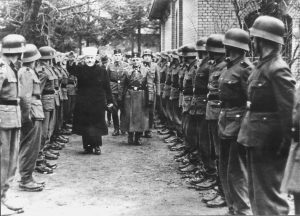
Bosnia and Herzegovina, Haj Amin al-Husseini, the Mufti of Jerusalem, reviewing a unit of Muslim Bosnians in the service of the Nazis
It is a well-documented and undisputable fact that many years before his rise to power, Adolf Hitler was already obsessed by the notion that the Jews constituted an existential danger to the humankind, and thus world Jewry needed to be eliminated at all costs.
This ideology began to be formed by Hilter when he was a solider during World War I. Hitler believed that the war had not only been caused by the Jews, but also that the Jews had stabbed Germany in the back. Hitler went on to develop his obsession with the Jewish problem in his infamous manifest, Mein Kampf, and later in other central documents of the Nazi Party that began to establish itself in the 1920s. Finally, in a speech at the Reichstag on January 30, 1939, Hitler stated outright that if world Jewry would ‘once again drag the entire world into a World War’ then the only possible outcome would be the extermination of the Jewish people.
All of these facts clearly show that Adolf Hitler was determined to annihilate the Jews, and subsequent historical events demonstrate how this mania developed them into official Nazi policies. Hitler didn’t need anyone else, including the Grand Mufti of Jerusalem, Haj Amin al-Husseni, to come up with the idea to implement the “Final Solution.”
The Grand Mufti’s visit, over two years after the outbreak of WWII, came once many “Final Solution policies were already in full swing. Almost immediately following the invasion of Poland in September 1939, Reinhard Heydrich received instructions from Berlin giving the orders to establish ghettos and Jewish Councils in the occupied Polish territories. It was widely understood amongst the SS that the ghettoization process of the Jews in Europe was a stepping stone for the implementation of the “Final Solution.” In addition, after the invasion of the Soviet Union in June 1941 the SS Einsatzgruppen began the mass murders of the 1.5 million Jews in Lithuania, Russia, and the Ukraine. The first extermination camp, Chelmno, began operations at the beginning of December 1941 just days after the meeting with the Grand Mufti. The building of the death camp had already been underway for several months when these two leaders met.
The Mufti had a specific agenda in meeting Hitler in 1941. The Protocol from this fateful meeting specifically states that “The Fuehrer replied that Germany stood for uncompromising war against the Jews and that naturally included active opposition to the Jewish national home in Palestine.” Hitler promised that he would carry on the battle to the total destruction of the “Judeo-Communistic Empire” in Europe. The Mufti of Jerusalem was no lover of the Jewish people. He was an ardent antisemite, but the idea of the “Final Solution” was Hitler’s alone, as was the implementation of its appalling policies and actions.
Dina Porat is Professor Emeritus of Modern Jewish History at the Department of Jewish History, Head of the Kantor Center for the Study of Contemporary European Jewry, and holds the Alfred P. Slaner Chair for the Study of Contemporary Antisemitism and Racism at Tel Aviv University. Since 2011 she has served as Chief Historian of Yad Vashem.
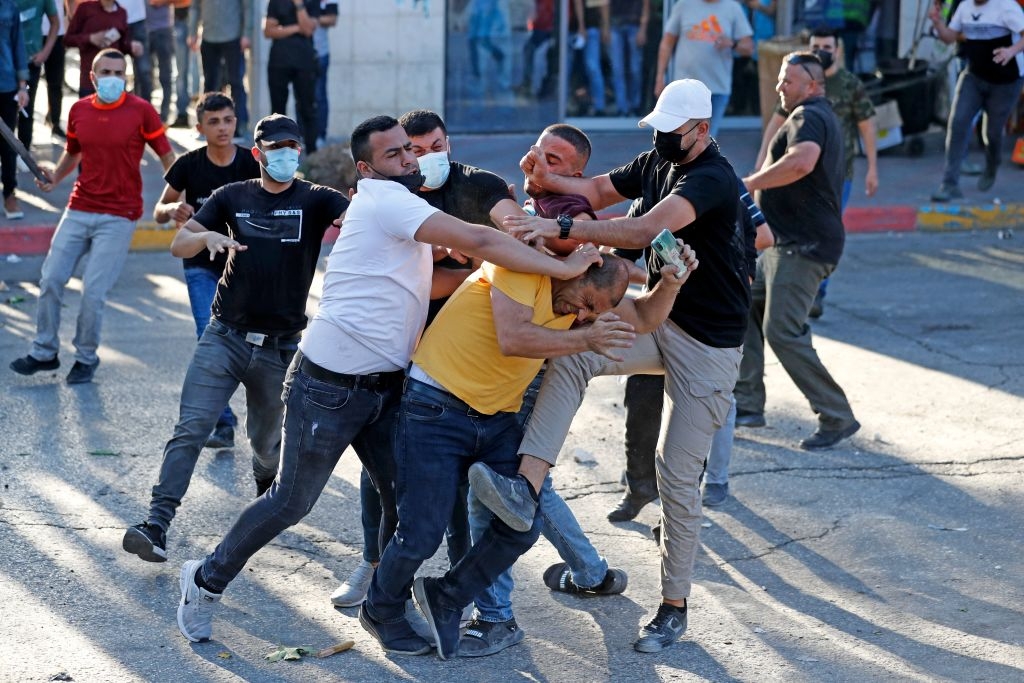
Palestinian plain-clothed security officers detain a man during a demonstration in the city of Ramallah in the occupied West Bank, on June 26, 2021, to protest the death of human rights activist Nizar Banat while in the custody of Palestinian Authority (PA) security forces. - Thousands of mourners attended on June 25 the funeral of the 43-year-old Banat, a day after he died in custody following his violent arrest by Palestinian security forces, which sparked outrage in the occupied West Bank. He was known for social media videos denouncing alleged corruption within the PA. (Photo by Ahmad GHARABLI / AFP) (Photo by AHMAD GHARABLI/AFP via Getty Images)
When Palestinians commit human rights violations against Palestinians, the European Union and the UN are beyond indifferent. It is only when Israel takes a decision to defend itself against terrorism that we hear their supposedly righteous cries.
 Czech
Czech French
 German
 Hebrew
 Noruegan
 Russian
 Spanish
 Swedish
 Polish
 Portuguese





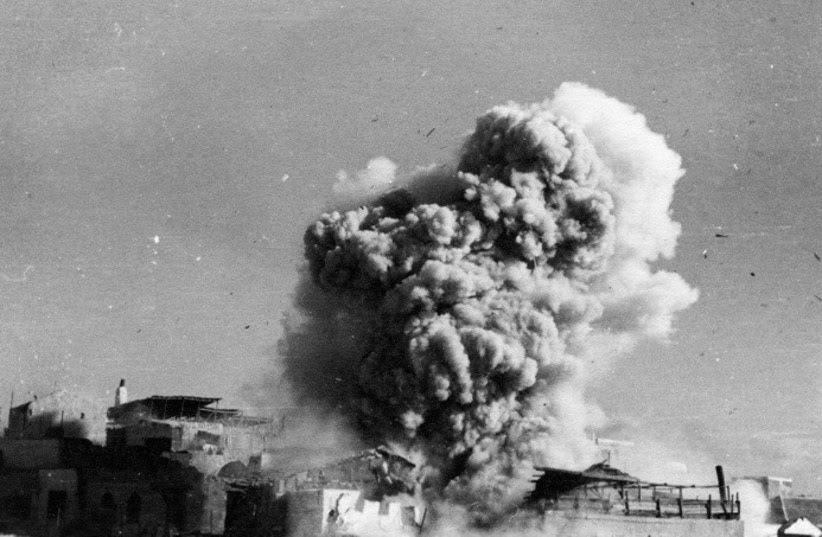 An explosion is seen in Jaffa in 1939 amid the Arab revolt. (credit: Wikimedia Commons)