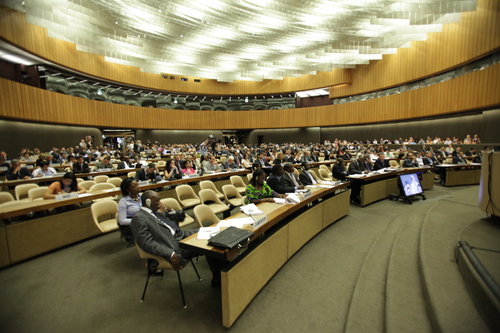
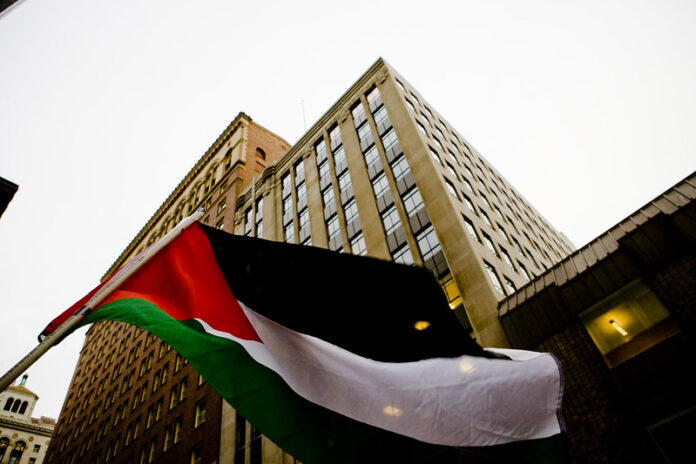
Late this month, and exquisitely timed to coincide with Rosh Hashanah, the United Nations General Assembly will meet and, addressing it, the president of France will recognize “Palestine” as a state. France will be the 148th country (by most counts) to recognize a state that does not exist and never will—a “state” with no borders, no government, no economy, and no control over its claimed territory. Norway, Spain, Ireland, and Slovenia recognized Palestine in May 2024 in a clear reward for the Hamas terrorist onslaught in October 2023. The United Kingdom, Canada, and Australia will join the French, as may a dozen or more other countries. These acts of “recognition” do nothing to help Palestinians. Their effect and their usual objective is to harm Israel, both by blaming it for the Gaza war and by making an end to that war more difficult to achieve. As Secretary of State Marco Rubio said in August, “Talks with Hamas fell apart on the day Macron made the unilateral decision that he’s going to recognize the Palestinian state.”
President Emmanuel Macron’s move, and those of Prime Ministers Keir Starmer of the UK and Anthony Albanese of Australia, are largely domestic policy matters—responses to low approval ratings and large Muslim populations. It seems to have escaped their attention that they are contributing to a Palestinian conclusion that only brutal violence will produce a path forward. In an effort to defend himself from such criticism, Macron stated “there is no alternative” to Palestinian statehood and announced in July that, “in light of the commitments made to me by the president of the Palestinian Authority, I have written to him to express my determination to move forward.”
What were the Palestinian Authority’s solemn commitments to the president of France? “To fulfilling all its governance responsibilities in all Palestinian territories, including Gaza, to reforming fundamentally, [and] to organizing presidential and general elections in 2026 in order to enhance its credibility and its authority over the future Palestinian state.” Canada’s Prime Minister Mark Carney told CNN that “Canada intends to recognize the state of Palestine . . . because the Palestinian Authority has committed to lead much-needed reform.” Albanese talked of “major new commitments from the Palestinian Authority” and proclaimed that the “president of the Palestinian Authority has reaffirmed these commitments directly to the Australian Government.” Similarly, while the so-called “New York Declaration,” adopted on July 30 by the entire Arab League, the European Union, and more than a dozen other countries usefully condemns the October 7 attacks and calls for Hamas’s removal from power, it calls for a Palestinian state under a reformed Palestinian Authority (PA) that will “continue implementing its credible reform agenda.”
It is difficult not to laugh at all those “commitments” to a “credible reform agenda” by the Palestinian Authority president, Mahmoud Abbas, who has made them and others like them over and over again during his nearly twenty years as head of Fatah, the Palestine Liberation Organization (PLO), and the Palestinian Authority. The PA is no closer to ruling Gaza than it has been since June 2007 when it was expelled from there by Hamas, nor any closer to fundamental reform. Macron also stated that “we must build the state of Palestine (and) guarantee its viability,” and it apparently never occurred to him to suggest that Palestinians must “build the state of Palestine and guarantee its viability.”
Why, after 80 years of efforts to partition the Holy Land, has a Palestinian state never been created? Why am I persuaded that this objective will never be achieved? Scores of new countries have been created since the Second World War. What is unique about the struggle for “Palestine” that has doomed it, and what are the alternatives? While my particular focus here is on the West Bank, most of the analysis that follows applies just as well to Gaza.
I.
The “two-state solution” is an offshoot of the older idea of partition—the division of the Palestine Mandate held by the United Kingdom into Jewish and Arab lands. Transjordan, a separate British mandate and now the Hashemite Kingdom of Jordan, came into being in 1946, and the UN General Assembly voted in November 1947 to create two more new states, one Arab and one Jewish. The Jews said yes and the Arabs said no.
There is a lot more to be said about the Israel-Palestinian conflict, but the essence of it remains in 2025 what it was in 1947: the Arabs said no.
Daniel Pipes has commented on this many times, writing of what he called the Palestinians’ “genocidal rejectionism.” Why haven’t peace and Palestinian statehood prevailed? In the early years, Pipes wrote, “The local population, which we now call Palestinians, didn’t want them there and told them to get out. And [the Zionists] responded by saying no, we are modern Westerners, we can bring you clean water and electricity. But Palestinians engaged in rejectionism, and said, ‘No, we want to kill you; we’re going to drive you away.’” Over a century ago, the Zionist leader Vladimir Jabotinsky explained that this is the response the Jews should expect to such offers of economic advancement, although he believed the attitude would change in the fullness of time. But little has changed, as Pipes writes:
It hasn’t worked because it can’t work. If your enemy wants to eliminate you, telling him that you’ll get him clean water is not going to convince him otherwise. What’s so striking is that the Palestinians have retained this genocidal impulse for such a long period. I would argue, as an historian, that this is unique. No other people have ever retained that kind of hostility for such a length of time.
Such views can be, and have often been, attacked as those of a Zionist and conservative. But Pipes’s conclusion has now been given support by an unexpected source: Hussein Agha and Robert Malley, who have written a book called Tomorrow is Yesterday: Life, Death, and the Pursuit of Peace in Israel/Palestine about their decades of efforts, individually and together, to promote Palestinian statehood. Agha was a trusted confidant and key negotiator for Yasir Arafat. Raised in Beirut, now holding a British passport (after previously having Lebanese and Iraqi citizenship), a member of Fatah from 1968, educated at Oxford and associated for 25 years with St. Antony’s College there, the wily and charming Agha advised the Palestinian leadership and participated in talks from the Madrid Conference in 1991 through those with John Kerry in 2014. Malley, son of a far-left and anti-Zionist Egyptian Jew, was special assistant to the president for Arab-Israeli affairs during the Clinton administration and then a key Middle East adviser and negotiator for Barack Obama. Malley and Agha worked together, each for his respective team, to prepare for the Camp David Summit in 2000, and then collaborated on a famous New York Review of Books article in August 2001 that defended Arafat and rejected the view (advanced by President Clinton and most other U.S. participants) that Arafat was to blame for the failure of the peace effort.
Their very latest collaboration was an article in the New Yorker in August that was largely based on the book but added new and exceptionally vicious condemnations of Israel. It is as if they worry that the balanced judgments about the history of negotiations in their book, whose publication date is September 16, are now out of date—and that they must join the chorus lest they be accused of inadequate zeal against the Jewish state. The time for careful reflection seems to be over.
But in their book Agha and Malley write that “the idea of an Israeli-Palestinian partition into two states has an interesting, troubled, and foreign pedigree. What it has not been, save for a relatively short period, is an indigenous Palestinian or Jewish demand.” This is because “the two-state solution is not the natural resting place for either Israelis or Palestinians [and] runs counter to the essence of their national identities and aspirations.” True, but the Zionists, in 1948, compromised and took what the UN was offering. The Palestinians did not.
The Palestinians did not want to live at peace with the Jews, so the UN partition decision in 1947, much less efforts like the Oslo process (designed to cope with Israel’s conquests in 1967), failed to address the underlying problem. Agha and Malley quote Arafat: “We are not concerned with what took place in June 1967 or in eliminating the consequences of the June war.” That is, the Israeli “occupation” of the West Bank and Gaza after the Six-Day War, held up time and again by Israel’s critics abroad (and even some of its supporters) as its great sin, was not the problem Arafat wished to solve; rather, his objection was to Israel’s existence. How do we know this is right? They comment: “Were it otherwise, Palestinians and Jews would not have fought in the 1920s and 30s, when no state of Israel existed; Arab nations would not have fought Israel in 1948, when the partition plan proposed a Palestinian state; and Palestinians should have made their peace between 1948 and 1967, when the West Bank and Gaza were not in Israeli hands.”
In other words, the problem is not the technical challenge of delineating borders or some diplomatic failing, that if solved will lead to Palestinian statehood. The problem is that Palestinian nationalism is fundamentally about destroying the Jewish state, not building a Palestinian one. In his famous Bar-Ilan speech of 2009, Benjamin Netanyahu put it this way: “this is the root of the conflict, this is what keeps it alive, and the root of the conflict was and remains that which has been repeated for over 90 years—the profound objection by the hard core of Palestinians to the right of the Jewish people to its own country in the Land of Israel.” State-building is not a Palestinian priority, and the absence of a state is not the cause of the conflict.
This is what Macron, Starmer, Carney, Albanese, and their many peace-processor predecessors, get wrong. To the extent that there is a logic to their arguments, it goes like this: there is an Israel-Palestinian conflict because Palestinians want an independent state where they can exercise their right to self-determination in their homeland, and to do so Israel will have to cede “land for peace.” If Palestinians have a state, their underlying grievance will be addressed and violence, like that of October 7 and of the ensuing war, will no longer be necessary. Hamas appeals to Palestinians at present because they believe its claim that only violence will achieve statehood. Granting a state to the PA will undercut Hamas, end the reason for conflict, and bring peace.
While this logic is internally consistent, all evidence contradicts it. If Pipes and Netanyahu are correct—and Malley and Agha seem to believe they are—then a Palestinian state will fail to meet Palestinian aspirations since it will still have to exist alongside Israel. The two-state solution solves the wrong problem.
To this analysis, it may be objected that in the Oslo Accords of 1993, Israelis and Palestinians did in fact reach an agreement, a meeting of the minds about peace and the two-state solution. Not really. What is called Oslo I established the Palestinian Authority and agreed to start negotiations on everything that mattered: “permanent-status negotiations will commence as soon as possible. . . . It is understood that these negotiations shall cover remaining issues, including: Jerusalem, refugees, settlements, security arrangements, borders, relations, and cooperation with other neighbors, and other issues of common interest.” In other words, there was agreement on none of the key issues that divided the parties.
Agha and Malley write that there was a signed document but those signatures “served to conceal their divide on issues as elemental as the rights of refugees, the attributes of a Palestinian state, and the legitimacy of the state of Israel. Surface consensus signaled continuation of the Israeli-Palestinian struggle by other means.” As to being an agreement on Palestinian statehood, nowhere in the Oslo Accords is such an objective even mentioned.
The Oslo Accords happened over 30 years ago now, and have failed. They were the apparent high point of Israel-Palestinian accommodation and agreement, but what has transpired since shows that their promise was empty. As David Weinberg put it, “Thirty years and billions of dollars and euros later, the return on Western investment in Palestinian independence is abysmal. There is no democracy, no rule of law, no transparency, no sustainability, no investment in economic stability, and no peace education in the PA.” An Economist editorial in September 2023 said the “lasting achievements” of Oslo were “to create a limited Palestinian government loathed by most Palestinians.”
These are grim conclusions, but most Palestinians agree with them. The leading Palestinian pollster, Khalil Shikaki, found in a September 2023 survey that, “thirty years after the signing of the Oslo Accords, about two thirds describe conditions today as worse than they were before that agreement; two thirds think it has damaged Palestinian national interests; three quarters think Israel does not implement it; and a majority supports abandoning it.” Palestinians say the PA is a burden on them rather than an asset, by 60 to 35 percent. Fifty-seven percent oppose the two-state solution (though support rises if you promise the 1967 borders, including in Jerusalem).
A plurality of 41 percent, when asked how to bring the occupation to an end, favors “armed struggle,” and this brings us back to the question of violence and Pipes’s stark reference to “genocidal rejectionism.” As I’ve explained, proponents of the two-state solution claim that Palestinian statehood will bring an end to Palestinian violence. They argue that it will instead produce, as the formula goes, “two states living side by side in peace and security.” But if the object of that violence is the destruction of the state of Israel, not the establishment of an independent state, why would the violence not continue (or increase) across the border of an independent Palestine, as it did across the border from the West Bank and from Gaza? Why would it not encourage Palestinians to believe that the old “phased plan,” as the historian Efraim Karsh explained, of taking “whatever territory Israel is prepared or compelled to cede to them and us[ing] it as a springboard for further territorial gains until achieving the ‘complete liberation of Palestine’” is working?
In their book, Agha and Malley make no effort to downplay Palestinian violence. Of Arafat, whom Agha knew very well, they say that he “believed in a negotiated outcome [but] he also clung to the belief that violence was needed to reach that end.” As to the second intifada, which killed more than 1,000 Israelis and over 3,000 Palestinians, they write of Arafat that “an armed confrontation, he thought, could not hurt. Who knows, it might help.” Nor has much changed: as for Fatah, still the ruling party in the PA and PLO, they assess that “Hamas’s religious doctrine, not its resort to violence, is what sets it apart from Fatah. From the start, Fatah’s defining trait was armed struggle, often with scant heed to whether its victims were civilian or military.” And they conclude that “deep down, Oslo notwithstanding, Fatah never truly reconciled itself with laying down its arms.”
Even more striking is what they write about the Hamas massacres on October 7, 2023: “October 7 was neither uniquely Hamas nor distinctively Islamist. It was Palestinian through and through.” And again, “there is no denying that Palestinians largely embraced the events of October 7 because they spoke to their most profound feelings. October 7 was Palestinian to the core.”
That is where we are, 30 years after Oslo and 77 years after the UN resolution on partition. The attention of the “international community” and, too often, pressures from the United States remain focused on what Israel can or must be forced to do, while meaningless Palestinian pledges (such as the recent ones to Macron, Carney, and Albanese) are taken at face value. But the core of the problem remains the reality and the potential on the Palestinian side. Will Palestinian society ever abandon support for violence and terrorism? Will dreams of destroying Israel ever be replaced by efforts to build a real state? Will businessmen, honest officials, doctors, lawyers, architects, and engineers ever replace terrorist murderers as the most honored citizens? Einat Wilf noted recently that “there are perfectly capable people in Gaza, as we saw on October 7. That massacre required billions of dollars, years of investment in infrastructure, leadership, strategy, and vision, of the most perverse kind. What it shows is that the people of Gaza are not lacking capacity or resources. Their problem is ideological.” From the early Zionist days, to those of Haj Amin al-Husseini, to Arafat, to the present, Palestinian nationalism and even Palestinian identity have been irredentist and negative: about destroying, not building. That is why there is no Palestinian state.
II.
The Palestinian Authority was created under the Oslo Accords to change that. Palestinians would use creative energy in both the West Bank and Gaza to build institutions of self-government. The goal of statehood was officially adopted by the United States during the George W. Bush administration. The “Roadmap,” issued in 2003 and formally titled “A Performance-Based Roadmap to a Permanent Two-State Solution to the Israeli-Palestinian Conflict,” set Palestinian statehood as its goal. But the achievement of that goal was conditional on Palestinian conduct:
A two-state solution to the Israeli-Palestinian conflict will only be achieved through an end to violence and terrorism, when the Palestinian people have a leadership acting decisively against terror and willing and able to build a practicing democracy based on tolerance and liberty.
A Palestinian state was to be earned, not awarded. To help achieve that goal, Bush forced the creation of the post of prime minister. The idea was to limit Arafat’s power to maintain the corrupt structures that characterized the PA, PLO, and Fatah, and begin building institutions. Mahmoud Abbas served as prime minister briefly, until he was pushed aside by Arafat. After Arafat’s death in November 2004, Abbas was quickly chosen to succeed him by the PA, PLO, and Fatah, and legitimized himself through winning a January 2005 presidential election.
Staying in power, not state-building, was and is Abbas’s objective, but state-building was the objective of the man who served as finance minister from 2002 to 2005 and prime minister from 2007 to 2013—Salam Fayyad. His goals were clear, and it is fair to call them Zionist in inspiration: “Israel as a state was not established in 1948,” Fayyad said in 2010. “Statehood was proclaimed in 1948. The key institutions of state and the services were there long before.” Similarly, he argued, “Palestine is not going to emerge in a vacuum but on the strength of the institutions of government” and people would “see statehood translated and transformed from the realm of concept to the realm of reality. This is enormously powerful.”
He explained this over and over. In 2009:
The Israelis have also expressed concerns that our program is not really about state-building but a plan for “declaring a state,” which is most emphatically not the case. We already declared our state in 1988 within its own set of objective conditions, and we have no need of another declaratory statement. What is certainly true is that if the Palestinians are seen by the international community as having built a de-facto state, even if the occupation is still in place, there will be great pressure on the Israelis to end the occupation.
In 2024:
the task was always about building the state and projecting its reality on the ground. And that’s why I invested a lot in the process of making it happen. Creating it—you just create it, make it happen, build it. Build its institutions; project its reality. Let it grow on people, as opposed to it happening top-down. And then, work politically, somehow, with the international community to impart sovereignty.
This is precisely what Bush and the Roadmap were all about, and it all failed. Palestinians have not built institutions of government, they have not built a de-facto state, and the reality on the ground is disastrous. Why did “Fayyadism” or genuine state-building yield so little? Some part of the blame goes to Israel, the United States, and the European and Arab countries, all of whom cheered Fayyad but did too little to help him. For Western countries there was always something more important: the “peace process” itself. Negotiations, visits, declarations, summits—these were the proximate goals; state-building was arduous, long, boring, and unrewarding. Western politicians needed something flashy to fill an immediate political need. This is precisely what we are seeing today in the ritual recognition of the non-existent state of Palestine by Western governments. The “peace process” has become not a process of construction but an alternative to it—substituting declarations and conferences for hard work that, the leaders knew, was unlikely to be undertaken, to succeed, or to make anyone very happy in the short time that politics demanded.
Certainly it was not rewarded by the Palestinians themselves. In 2005 Fayyad resigned as finance minister to run in the 2006 parliamentary elections. His party received 2.4 percent of the vote and two seats in the 132-seat parliament. In that election, Hamas defeated Fatah, winning 44 percent of the votes to Fatah’s 41 percent.
Why did Hamas win? President Bush took the view that Palestinians were rejecting Fatah’s corruption and voting for clean government. Others argued that it was religion: Fatah was a secular party while Hamas was Islamist, so people were voting for Islam. I had a different view. Perhaps Palestinians were voting for the party that was killing Jews over the party that was negotiating with them. Perhaps this vote showed, yet again, that Fayyad’s step-by-step state-building and Fatah’s negotiations for statehood both failed to satisfy what many Palestinians wanted more: armed struggle against Israel.
As prime minister, Fayyad continued to promote building the state and in 2009 he announced a 54-page, two-year plan that would lead to statehood by building more and stronger institutions. Fayyad got Western encouragement, but his plan abandoned Oslo and its requirement of a negotiated resolution of the conflict. It was to end in 2011 with a unilateral declaration of statehood on the 1967 borders. Fatah politicians didn’t like it because it sidelined them and their control of the negotiations with Israel. Fatah and Hamas leaders noticed that it was an abandonment of “armed struggle,” which was always Hamas’s main focus and which had been endorsed by Fatah again that very year.
Fayyad’s plan did not work and of course armed struggle was never abandoned. But in another way it may be seen as a critical turning point: the Oslo paradigm was that peace would be negotiated between Israelis and Palestinians. Fayyad was now jettisoning the centrality of getting Israeli agreement.
Fayyad wanted to build the institutions of statehood, but other Palestinians wondered why Palestinians should bother with all that travail if they could achieve statehood without it. What if a Palestinian state could arise not from the hard work of building institutions, not by abandoning violence, but as a gift from foreign governments? And what if it turned out that “armed struggle” against Israel inspired not revulsion in those foreign governments but further demands on Israel and further support for the Palestinian cause?
That is precisely where we are today. The conditions that Bush demanded twenty years ago seem almost quaint now. Everyone understands that the Palestinians will not meet any prerequisites that are set. So, leaders like Macron instead accept Abbas’s empty pledges that “reform” has taken place, is under way, or will soon happen. It doesn’t matter: he is lying, they understand fully that he is lying, and they have decided that the lies do not matter. The alternative approach is that of Starmer, who says Israel must achieve impossible goals by a certain date or he will recognize a Palestinian state. Then he can do so and blame Israel at the same time. In all these cases, the goal is to fill a political need (namely, to attack Israel) rather than to bring Palestinian statehood or any concrete improvement in Palestinian lives closer.
The position of the United States in the Biden years was a variant of this, and used a phrase that has become almost universal now. On February 7, 2024, exactly four months after the Hamas massacres, Secretary of State Antony Blinken gave prepared remarks in Israel and called for “a concrete, time-bound, and irreversible path” to a Palestinian state. With those words Blinken destroyed the Bush Roadmap’s demand for preconditions to the creation of a Palestinian state. “Time-bound” and “irreversible” are the exact opposite of the Roadmap’s “performance-based” idea.
The trajectory over the decades is clear. First, negotiations with Israel were said to be absolutely required. Israel offered peace and land (most clearly under Ehud Barak in 2000 and Ehud Olmert in 2008, as we will soon see) but that would have required difficult compromises as well on the Palestinian side, so Palestinian leaders said no. Then came the idea of building a state bottom-up and, once the institutions were ready, declaring a state unilaterally. But Palestinians did not build those institutions, blocked by a combination of the corruption and incompetence of the PA, PLO, and Fatah; terrorist movements that had very wide support in their dedication to violent attacks on Israel instead of positive actions to create new realities; and by their own deeper interest in destroying Israel than in creating a state that would surely be poor, face limitations on its sovereignty, and be politically and psychologically unsatisfying. So, now, the “international community” is throwing in the towel and simply recognizing a Palestinian state anyway—even though it does not exist.
The Soviet Union led the way, recognizing “Palestine” in 1988. Soviet satellites and sympathizers of course began to follow, as did Arab and Muslim states. But Western nations held out honorably, imposing demands and preconditions. We are now watching that principled resistance collapse. Neither Israel nor moderate Arab nations nor Western democracies could force or entice Palestinians to develop decent, moderate leadership and build modern state institutions. Under left-wing political pressure and the demands of growing Muslim populations, even the Anglosphere democracies—Canada, Australia, and the UK—that were once a staunch bulwark against radical demands and often voted against senseless and one-sided UN resolutions have given up. They know what a Palestinian state will require to be successful, but they no longer care, the political pressures are too great to resist, and they wish to punish Israel and its right-wing government for the sin of defending itself. Which Palestinian cannot be struck by the fact that so many world leaders do not even require the release of all hostages before they make their self-indulgent declarations?
Nothing has been more pernicious to building a decent, democratic, peaceful Palestinian state than such “support.” The message to Palestinians is clear: what you need to do to get your state recognized is nothing. No reform, no institution building, no democracy, no defeat of terrorist groups, no competent government. All of that will happen magically in the Palestinian state once it comes into existence. The use of brutal and inhuman violence will bring some nice rewards, while Israel’s reactions will bring it punishment—for it is crystal clear that without the October 7 attacks Macron, Starmer, Albanese, and Carney would not today be recognizing this imaginary state.
The last point is worthy of emphasis. As David Weinberg has said, writing not of Gaza but of the West Bank, “Nobody is under the illusion that any Palestinian ‘authority’ can or will counteract the buildup of Iranian-backed Islamist terrorist armies in these areas—which directly threaten Jerusalem and central Israel. Only the IDF can and will; thus, the full-scale military operations in places like Jenin, Tulkarm, and Nablus to rout such threats resolutely will continue.” Every Israeli knows that that is right. To recognize Palestinian statehood now is to insist that Israeli military action in those areas is illegitimate, which is a roundabout way of saying that Israeli self-defense is illegitimate.
And that Israeli self-defense will have to continue, not even if but especially if a Palestinian state were ever created. As Agha and Malley write, “Israelis might have been more open to persuasion, if offered reason to believe that territorial withdrawals would yield security. Their experience suggests otherwise.” Because as we have seen, the mere creation of a weak, landlocked, poor Palestine will not bring Palestinians the historic and emotional victory they seek. Only Israel’s destruction will, and efforts to bring that day closer will continue. The establishment of a Palestinian state will be viewed as a tremendous but partial victory—and one that provides many Palestinians an assurance that the ultimate victory is still possible.
It is worth recalling what Palestinians have in fact said “no” to—the Israeli offers of statehood they have turned down. Here is the account of the late Saeb Erekat, the chief Palestinian negotiator during the Oslo period, later minister of negotiation, and then secretary-general of the PLO from 2015 to 2020.
On July 23, 2000, in his meeting with President Arafat in Camp David, President Clinton said: “You will be the first president of a Palestinian state, within the 1967 borders—give or take, considering the land swap—and East Jerusalem will be the capital of the Palestinian state, but we want you, as a religious man, to acknowledge that the Temple of Solomon is located underneath the Haram al-Sharif.” Yasir Arafat said to Clinton defiantly: “I will not be a traitor. Someone will come to liberate it after ten, fifty, or one hundred years. Jerusalem will be nothing but the capital of the Palestinian state, and there is nothing underneath or above the Haram al-Sharif except for Allah.” That is why Yasir Arafat was besieged, and that is why he was killed unjustly. [Note that, in reality, Arafat died of natural causes.]
In November 2008, . . . Olmert . . . offered the 1967 borders, but said: “We will take 6.5 percent of the West Bank, and give in return 5.8 percent from the 1948 lands, and the 0.7 percent will constitute the safe passage, and East Jerusalem will be the capital, but there is a problem with the Haram and with what they called the Holy Basin.” Abu Mazen [i.e., Mahmoud Abbas] too answered with defiance, saying: “I am not in a marketplace or a bazaar. I came to demarcate the borders of Palestine—the June 4, 1967 borders—without detracting a single inch, and without detracting a single stone from Jerusalem, or from the holy Christian and Muslim places.” This is why the Palestinian negotiators did not sign.
If those Israeli offers were insufficient, none ever will be. And those offers are inconceivable right now to Israelis, because the risks they would impose are unacceptable to Israelis left, right, and center after October 7. Olmert was in fact willing to place the entire Old City of Jerusalem under international control, an astonishing concession that was unlikely to pass his Cabinet or the Knesset and will not be repeated. But even that elicited no response from Abbas, nor did he respond to the Kerry-Obama peace proposal in 2014.
Thus the “progress” of the “international community,” from insisting on negotiations, to insisting on state-building, to insisting on nothing; a Palestinian state must be recognized immediately without negotiations between it and Israel, and without its having achieved any of the normal prerequisites for statehood.
III.
There is a certain logic to that progression if you don’t really care about Israelis and Palestinians, and if you are acting for domestic political reasons. But it won’t work, for two reasons. First, at the moment there is one key holdout among powerful nations: the United States, which is still insisting that this wave of recognition of “Palestine” is a reward for terror. Indeed, on July 31, the State Department imposed new sanctions on PA and PLO officials for “not complying with their commitments and undermining the prospects for peace” and for “continuing to support terrorism including incitement and glorification of violence (especially in textbooks), and providing payments and benefits in support of terrorism to Palestinian terrorists and their families.”
Second, Israelis will not commit suicide. As Michael Oren put it, “since the massacres of October 7, 2023, the majority of Israelis view a Palestinian state as a dangerous reward for terror. Nobody knows what that state would look like, who would run it, or whether it would be democratic and peaceful or Islamic and jihadist. Nobody can adduce evidence that the Palestinians are capable of maintaining a nation-state.” The advice that only when there is a Palestinian state will Israelis have “genuine true security,” which Secretary Blinken and hundreds of other diplomats have repeated for years, gets only laughs in Jerusalem.
Cynics or Machiavellians might suggest that the Israelis accept some formula now for Palestinian statehood later (or, much later) when certain conditions are met—because everyone knows the conditions will never be met. So the state will never be created and Israel will get the credit now for saying the magic words. The problem with this formula is that as we have seen, there are no more conditions. Empty promises suffice. Even as war continues, even as hostages remain in captivity, even as the “reformed Palestinian Authority” remains entirely mythical, country after country insists on immediate Palestinian statehood. Israelis know that whatever conditions they set will eventually be abandoned.
This is an odd moment, then: as the insistence on immediate recognition of Palestinian statehood spreads, the possibility of that outcome narrows—not least because its supporters make it increasingly clear that they are indifferent (or hostile) to the security of Israelis. Agha and Malley say this about the leaders now demanding immediate Palestinian statehood:
[T]hey know this is implausible and cannot describe a practical plan to achieve it. Deep down, believers in two states, confronted with all reasons to surrender their faith, fall back on a single argument: there is no alternative. Partition is considered inevitable, even as it becomes harder to imagine, because they are not capable of imagining anything else. . . . The most likely outcome is perpetuation of the status quo. . . . It has lasted for over half a century, despite repeated objections and obituaries, far outstripping the nineteen years during which Israel did not control the West Bank or Gaza.
They’re right. Many supporters of the two-state solution acknowledge all the problems but say “there is no alternative,” as France’s foreign minister told the big July meeting at the United Nations and as Blinken often said.
But there are alternatives. The first and most obvious, as Agha and Malley acknowledge, is the situation that has obtained since 1967. Everyone in the diplomatic world insists that it is “unsustainable,” but, as I have argued previously, something that has been sustained for 58 years is not exactly ephemeral. The Palestinian leadership in the West Bank remains dedicated to staying in power, a delicate goal when Abbas will be ninety in November and what follows him is uncertain. Will a successor wear his and Arafat’s three hats, as head of PA, PLO, and Fatah? Will the struggle over succession be brief and polite, or long and murderous? Given the state of those three organizations, will it matter who follows or are they now incapable of winning back public loyalty and respect? One thing should be clear: while they are engaged in a brutal fight for power among themselves, those PA, PLO, and Fatah leaders will have limited or non-existent ability to build new Palestinian institutions or to negotiate peace with Israel. If I were betting on what the West Bank would look like a year from today, or five years, I would say that deep change is unlikely.
The main diplomatic issue now being debated about future governance in Gaza is what role the PA will play there, and whether it will be able to govern the place as it did before Hamas ejected it in five violent days in 2007. Most diplomatic proposals, such as the “New York Declaration,” are adamant that the PA will once again rule Gaza as part of a unitary state. Historically the West Bank and Gaza have often been separate, though at other times linked. After long periods of rule by the Ottomans and Egypt, Gaza—like the West Bank—became part of Britain’s Palestine Mandate right after the First World War. Egypt seized Gaza in 1948 when the British left, though it never annexed the area; Jordan seized the West Bank, so from 1948 to 1967, the West Bank and Gaza were ruled by two different countries. The period of greatest linkage was the Oslo years, when Arafat’s PA held sway in both Gaza and the West Bank. Once Hamas seized power in Gaza in 2007, links were largely broken again.
Every proponent of Palestinian statehood believes that Israel must return almost entirely to the “1967 borders,” which are actually the 1949 armistice lines, and believes that the imaginary Palestinian state must consist of both Gaza and the West Bank. None seems concerned that the PA has no ability today to govern or rebuild Gaza and has had no role there for a generation. Their idea is that the world will help Gaza recover under international and PA tutelage, and at a certain point Gaza will join the West Bank as a normal district under rule from Ramallah—or indeed from Jerusalem, if a negotiated agreement divides that city and makes part of it the Palestinian capital.
My focus here is not the future of Gaza. I believe that when the war ends, an international committee to rebuild Gaza will be created whose members will be key Arab states (Jordan, Egypt, the Gulf donors), the EU, and the United States. It will work to rebuild schools (hopefully along modern Emirati lines rather than those of Qatar or worse yet UNRWA, for whom education is primarily indoctrination in terrorism and anti-Semitism), hospitals, and all civil functions. The PA’s blessing will legitimize whatever governance or administrative structures are imposed in Gaza as well as the intrusive foreign role, and the PA will try hard to make believe it is central to all of this. That might strengthen its international position, but will do little to enhance its reputation and support in the West Bank or in Gaza because in all likelihood it will perform its functions with the customary incompetence and corruption.
The hard part is security in Gaza: who will provide it? The PA cannot, lacking the requisite number of trained troops. Most likely is a messy combination of vetted Palestinian police, private security contractors, and Arab/Muslim forces that some states may be willing to send at least to perform limited tasks like protecting a food warehouse or a government building. Meanwhile, as in the West Bank, the IDF will do what the PA and Arab forces likely will not: fight Hamas and prevent its reconstitution.
But the very most that can hoped for in Gaza, if Hamas is destroyed and the entire place is physically rebuilt by some grand international coalition, is that it will resemble the West Bank. There will still be a residue of twenty years of Hamas indoctrination of an entire generation, there will still be thousands of young men trained by Hamas to fight, and there will still be all those Gazans who voted for Hamas and tell pollsters they still support it. A May 2025 poll found that 64 percent of Gazans oppose disarming Hamas and a majority oppose exiling Hamas military leaders; if legislative elections were held with all the parties who ran in 2006, voters in Gaza would go 49 percent for Hamas versus 30 percent for Fatah. Forty-six percent of all Palestinians told pollsters they support “a return to confrontations and armed intifada” (a higher number than in the September 2023 poll mentioned earlier). When asked what the most vital Palestinian goal should be, 41 percent said statehood, including East Jerusalem as the capital—but 33 percent said it must be the “right of return” to their 1948 towns and villages, which would of course mean the destruction of Israel as a Jewish state.
Those clamoring now for immediate recognition of Palestinian statehood never seem to mention any of this, or to recognize the true condition of Palestinian society. Each half of its population has been almost entirely separated from the other half for a generation, with the half in Gaza ruled since 2007 by a death cult and the half in Judea and Samaria ruled for even longer by corrupt politicians whom Palestinians loathe. Recognizing a Palestinian state today not only fails to solve this crisis in Palestinian society—a crisis not only of governance but of ideology and national purpose—but fails even to acknowledge it. Instead, again, the reply is “there is no alternative” and the status quo since 1967 is “unsustainable.”
The idea that Palestinian institutions should be built up first, largely as Fayyad proposed but necessarily with a far more realistic timeline, is rejected out of hand. Improving Palestinian lives pragmatically—better jobs, better educations, better futures, better government—seems to satisfy no one in diplomatic circles because it quiets none of the political pressures governments are under. Demonstrators are surrounding parliaments and spray-painting government buildings with the slogan “from the river to the sea,” not “let’s build effective institutions.” So the pragmatic alternative of a much-improved version of the status quo is politically “unsustainable.”
But the alternative of creating a Palestinian state now will fail because it is far greater a threat to Israel than Israelis (or any nation) would be willing to accept. As we have seen, this widely acclaimed “alternative” is not even the real goal of Palestinian nationalism, and would create a launching pad for future attacks on Israel from what would become sovereign territory under international law.
IV.
The nonsensical “one-state solution” of an Israeli/Palestinian combined state and society would, like the “right of return,” destroy Israel as a Jewish state. Nor is it believable today that such a state would ever attain internal peace, or would satisfy the desires of Israelis or Palestinians. As Agha and Malley put it, “A pure one-state solution is unappealing to many Palestinians. . . . Palestinians invoke it more as a threat to motivate Israelis to accept a two-state solution than as a genuine aspiration.”
But there is an alternative that has been around for a long time, and is roundly rejected as unrealistic and impossible, although it is far more realistic than the one-state or two-state solutions. Those who pay closest attention, and have for decades, know the two-state solution is not going to happen. Agha and Malley, veteran peace negotiators, admit it:
the idea of partition has been around for over 80 years. Attempts to reach a two-state solution have persisted for a quarter of a century under vastly different configurations of policy and power. In terms of longevity, creativity, and the cast of characters involved, it would be hard to fault the quest for a two-state solution. Yet regardless of setup, content, personality, and style, the result did not vary. . . . A time comes when even the most optimistic must retire their faith.
So what is the idea that they then raise? Jordan. As they write, “another potential outcome is a Jordanian-Palestinian confederation comprising the Hashemite Kingdom and the West Bank. . . . Israelis . . . might view a Jordanian security presence in the West Bank as reliable, more so, certainly, than a Palestinian one, more so, possibly, than a Western one.” King Hussein proposed such a confederation in 1972: a united kingdom consisting of two districts, with full West Bank autonomy except for Jordan’s control of military and security matters and foreign affairs. In 1977, President Carter raised it with Menachem Begin; at various times, President Sadat of Egypt and Henry Kissinger espoused the idea. Hussein and Arafat agreed to such a confederation in 1985. But Jordan renounced the idea in 1988 and today rejects it, demanding Palestinian statehood.
The idea still has some currency. Shlomo Ben-Ami, the Israeli Labor-party (and later Meretz) politician who served as foreign minister under Ehud Barak, wrote this in 2022:
Since all other attempts to solve the Israeli-Palestinian conflict have failed, it may be time to revisit the Jordanian option. . . . King Hussein’s waiving of Jordan’s claim on the West Bank was never ratified by the country’s parliament and was seen by many, including the former crown prince Hassan bin Talal, as unconstitutional. In 2012, he said that since no two-state solution was still possible, the Palestinian Authority should let Jordan recover its control of the territory. . . . A Jordanian-Palestinian confederation has a more compelling logic in terms of economics, religion, history, and memory.
King Hussein, like Israel and most Arab leaders, never favored a fully independent Palestinian state. He feared it could be radicalized and fall into the hands of “a Gaddafi-like leader,” as Jimmy Carter had put it. To Hussein, a Palestinian state was bound to inherit the revolutionary traits of the Palestinian national movement. In 1985, Hussein reached an understanding with the PLO chairman Yasir Arafat in which Palestinians would exercise their “inalienable right of self-determination” within the context of a confederated Arab States of Jordan and Palestine. Hussein defended this as a question of “joint destiny,” “a matter of shared history, experience, culture, economy, and social structure.” He believed that the chaotic Palestinian national movement would be saved by linking its destiny with Jordan, “a sovereign state which enjoys credible international standing.”
It is striking that the concern expressed by those favoring a role for Jordan is precisely what we saw at its worst on October 7, 2023: the radicalization of any Palestinian state because it would “inherit the revolutionary traits of the Palestinian national movement” which was “chaotic.” The point about confederation should be clear: it would finally partition the old Palestine Mandate into a Jewish part and an Arab part, and do so in a way that guarantees—through the Jordanian army and mukhabarat (secret police)—that Hamas and other terrorist groups would not take over the Arab part or use it as a launching pad for attacks on Israel.
Agha and Malley acknowledge that such proposals will meet with “considerable hurdles” in Jordan. But they explain the advantages for both sides:
[F]or Jordan, a confederation would mean expanding its size and political weight. For the Palestinian elite, Amman already serves as a substitute political and social hub. . . . Palestinians would gain economic and strategic strength, reduce their vulnerability and dependence on Israel, obtain valuable political space, and form part of a more consequential state.
Palestinian support for the idea has risen and fallen, but the leading Palestinian pollster said in 2018 that previous polls had found support to be above 40 percent. Why raise the confederation idea here, and why now? In part to demonstrate that it is not an idiosyncratic notion but rather an option with historical roots and real advantages. In part as a reminder that it is simply false and facile to state that “there is no alternative” to full Palestinian statehood. And, in part, because Palestinian statehood is not going to happen, so contemplation of alternatives will at some future point be required. One of the worst effects of the “there is no alternative” position has been to stifle all discussion of what other options might exist.
It can be argued, of course, that such a confederation would not satisfy Palestinian nationalism. But in its current form Palestinian nationalism cannot fully be satisfied without Palestine extending “from the river to the sea”—that is, by replacing Israel rather than living “side by side in peace and security.” A more positive form of Palestinian nationalism would indeed be satisfied by complete local autonomy in a confederation with Jordan, which is an Arab, Muslim, and already half-Palestinian state. Those who wish to argue that this is insufficient—that Palestinian national identity or ethnicity require an independent state—must tell us why the same is not true for Kurdistan, Tibet, Xinjiang, Quebec, and Somaliland, among many other cases. The declarations that Palestinians have a “right” to an entirely separate and independent state are not convincing as a matter of history or international law, and are no more persuasive than it is to declare a million times that the PLO is the “sole, legitimate voice of the Palestinian people” when that is manifestly untrue.
What would convince Jordan to agree to this option? Today, nothing; the clamor for Palestinian statehood is too great. But after a while, when the Gaza war has ended and Palestinian statehood seems no closer, when serious Arab states like Saudi Arabia and the UAE that want an end to Israel-Palestinian conflict acknowledge that a Palestinian state will be unstable and radical, when billions in aid for Jordan are offered for a role in helping to solve the conflict by returning to the position King Hussein once took, and when Palestinians who seek to end Israeli rule in all of the West Bank turn to Jordan, things may change.
At some point Palestinians should be offered this additional option, when it becomes clear again that despite the clamor in Turtle Bay there will be no Palestinian state. Perhaps the way to get there is that offered by Salah Khalaf, a founder of Fatah who was the chief of intelligence for the PLO and the second most senior official in Fatah after Arafat. Agha and Malley cite him by his nom de guerre, Abu Iyad:
After the PLO’s acceptance of the two-state solution in the late 1980s, Abu Iyad, then one of its senior-most officials, spoke of Palestinians enjoying five minutes of independence before engaging in talks with Jordan on a form of confederation.
I’ve heard that line repeated over the years by a few thoughtful and often weary Palestinians looking for a way forward that separates them from Israel, guarantees a great deal of self-rule and real autonomy, and brings their children a better life, yet prevents Palestinian radicals, extremists, and terrorists from turning their imaginary peaceful “Palestine” into a simulacrum of yesterday’s Gaza—before October 7—or today’s. They understand something elemental that the Macrons and Carneys and Starmers do not: the Israel-Palestinian conflict and the wide support for violence in Palestinian society will not be solved by the magical incantation of recognition, and will in fact be worsened by it.
Until Palestinian nationalism is not fundamentally about destroying Israel, and until options like an organic link to Jordan are examined, neither that internal crisis nor the violent confrontation between Israel and Palestinians will be resolved. Israelis will not, to say it again, commit suicide, and that means they will not empower those who would murder them and their children and would destroy their state. That is the fact that needs to be faced, and is daily evaded, by facile diplomats who claim to be protecting Palestinians and by self-satisfied politicians motivated by their own need for more votes.
A Palestinian state living in peace and security side by side with Israel is a mirage: despite all the claims that we are getting closer to it, it always recedes. Perhaps someday the Islamic Republic of Iran will fall, and a new government there will stop supporting every terrorist group that wishes to destroy Israel. Perhaps someday leaders of the major democracies will treat Israel with fairness and justice, and will demand and enforce fundamental changes in Palestinian society that root out the disastrous effects of a century of murderous anti-Semitism and efforts to destroy Israel. Perhaps Palestinians will someday find and support a national leader who, unlike Husseini or Arafat, truly wishes to build a decent society rather than attacking the one next door. But until such things happen, Palestinian statehood must remain an impossibility.
The most apt metaphor for Palestinian life today is the Gaza cityscape as it existed on October 6: behind and beneath the facades of homes, hospitals, schools, and mosques lay a vast network of terror tunnels and weapons storehouses. And underlying that physical network lay, and lies still, an intellectual and ideological network of beliefs—beliefs that lead to such widespread support for Hamas even today, and that lead the Palestinian Authority to name schools and plazas after the terrorist murderers of children, and to pay salaries and bounties to terrorists in Israeli prisons.
Israel has done a great deal toward eliminating the physical infrastructure of terror, but there cannot be a Palestinian state unless and until the intellectual network that prizes “armed struggle” against the Jewish state above building a normal life for Palestinians ends as well. That is a task for Palestinians, not Israelis, and it is a task that Palestinians will not take up while international organizations and leaders of important nations assure them that statehood will come to them soon and without conditions.
 Czech
Czech French
 German
 Hebrew
 Noruegan
 Russian
 Spanish
 Swedish
 Polish
 Portuguese