Trump’s lifting of Syria sanctions solidifies Iran’s regional defeat

While in Riyadh on 13 May, US President Trump announced that he was lifting sanctions on Syria, and then followed that up on 14 May by meeting Syrian President Ahmed al-Sharaa, who flew quickly to Riyadh to extend his gratitude. While Trump was light on details about how the lifting of sanctions would unfold, he stated that he wanted to give Syria “a chance at greatness”.

The move settled a bitter dispute within the US government, sealed a rift between the US and Israel on one side and America’s Arab, Turkish, and European allies on the other, and most important, has arguably blocked any realistic chance of Iran exploiting a weak, divided Syria to restore its “Shiite Crescent.” The historic impact of this decision, following and culminating the series of defeats Iran and its proxies have suffered, and the closing of ranks of the international community on the Middle East, cannot be overstated.

While Israel appears isolated given its aggressive approach to the al-Sharaa government (and its Turkish sponsor), cracks in its position have been appearing for some time, including deconfliction discussions with the Turks on Syria in Azerbaijan, and more positive statements by the hard-line Israeli foreign minister on Syria in recent days. But most importantly, by reducing Iran’s options in Syria, and presumably allowing the Israeli military to draw down on at least one front, Trump’s decision could boost Israel’s security as well as that of everyone else in the region.

Nevertheless, there is still hard work to be done, beginning with a meeting in Türkiye this week between the US secretary of state and the Syrian foreign minister. There is no indication when the sanctions will be formally lifted by Congress, which, unlike a presidential waiver that Trump could do quickly, can take time. Initial responses from Congress to the president’s announcement have been positive, but details are important.

Meanwhile, the US still has Hay’at Tahrir al Sham (HTS), al-Sharaa’s organisation, on the terrorism list, and Syria as a whole listed as a state sponsor of terrorism. Finally, the US has not officially recognised the new al-Shaara government and the US list of demands passed in Brussels to the Syrian foreign minister, Asaad al-Shaibani, remains in discussion. The meeting of al-Shaibani and Marco Rubio on 15 May will likely focus on the status of those demands.

Trump also pressed al-Sharaa to sign the Abraham Accords and thus recognise Israel

Laundry list

They include a laundry list of security issues, requesting Damascus assist in recovering missing Americans, help resolve outstanding chemical and other weapons of mass destruction issues from the Assad regime, deal with the Islamic State (IS), both on operations, as well as with the detainees at al-Hol and other camps in the northeast, authorise US counter-terrorism military operations anywhere in Syria, and act against a long list of terrorist and militant organisations, starting with the IRGC and Hezbollah, but including various Palestinian groups long residing in Syria.

Finally, Damascus must avoid oppression against minority groups, ensure a diverse government, and weed out foreign jihadists from the senior ranks of the Syrian security forces. President Trump also pressed al-Sharaa to sign the Abraham Accords and thus recognise Israel.

By all accounts, the Syrian response so far to this fairly long set of demands has been mixed, with some already underway, and some—from formally green-lighting US military operations to removing key foreign military leaders, which present Damascus with complicated security and diplomatic issues— that still need to be worked out carefully with Washington. The Abraham Accords may be a step too far at the moment, but al-Sharaa appears interested in adopting the 1974 agreements between Syria and Israel.

And despite Trump’s bold decision, there are enough details to hammer out, and enough second thoughts about al-Shaara and HTS within Trump administration ranks, to hold off on celebrations. In particular, when the dust clears from the announcement, commentators will wonder who will wind up with the most influence over the new Syrian government, its original sponsor, Türkiye, or Saudi Arabia, and now, critically, the US. And once again, Israel still has cards to play, vis-à-vis rival Türkiye, with the Druze in the south, but also perhaps now with al-Shaara.Russia factor

Finally, there is the question of Russia. The fall of Assad was a tremendous geostrategic blow for Moscow, particularly given the fact that in 2019, then-Secretary of State Mike Pompeo offered Putin a compromise solution to the Syrian quagmire, which he rejected at the time.

For its part, Moscow has been talking with Damascus about retaining its bases near Latakia, and despite the wartime enmity between Russia and Syria’s new rulers, both sides are pragmatic, and supposedly, the talks may bear some fruit. And apparently, various sources have indicated that neither Türkiye nor Israel are particularly interested in the Russians leaving, as both see Russia as a potential ally in Syrian politics, and both (particularly Ankara) have other important security, diplomatic, and economic interests with Moscow that Turkish President  Recep Tayyip Erdoğan does not want to upset over a secondary issue like Syria bases.

But now that Trump has embraced the new Syria, his position vis-à-vis the Russians will carry much weight, and could well become a pawn in the critical Ukraine negotiations Washington is strongly supporting.

$400bn price tag

The World Bank has estimated that 14 years of war have generated over $400bn in damage to infrastructure and the economy. Almost half the population has fled their homes—half of them (six million plus) as refugees to neighbouring countries and Europe. Absent the lifting, or at least the waiving of the crushing American “Caesar” sanctions, little aid will be able to flow due to fears of legal action, if not by the current, then some future, US government.

Furthermore, while they can facilitate one-time delivery of assistance and development funds, presidential waivers alone will not permit long-term investment by the international business community, which is the most important and effective way to rebuild the country. Firms need predictability, and a temporary waiver will not provide the needed level for serious financial commitments.

But finally, taken with other recent dramatic developments, not just the regional defeat of Iran, but the near destruction of IS and the recently announced dissolution of the PKK, the reintegration of Syria could open the door to a new, prosperous, peaceful Middle East.

The Sanity of John Fetterman

Lt. Gov. John Fetterman listening to speakers. Pennsylvania State Police (PSP) Commissioner Robert Evanchick confirmed today that Trooper Martin F. Mack III, 33, and Trooper Branden T. Sisca, 29, were struck and killed by a driver earlier this morning on I-95 south in the area of milepost 18 in Philadelphia City, Philadelphia County. A male pedestrian was also struck and killed at the same time.
Philadelphia, PA – March 21, 2022

Let us ponder the strange similarities linking the striking stories of Warder Cresson and John Fetterman. Ostensibly these two individuals, whose lives are separated by more than a century, have nothing to do with each other. Yet both embody, in their own way, archetypal American tales, in that they reflect the bonds between this country and the Jewish people and the way these bonds have endured despite the efforts of some to undo them.

Warder Cresson’s 19th-century tale has already been told in these pages (“The Forgotten Proto-Zionist,” December 2019). The first person appointed American consul to Jerusalem, he was born a Quaker and proceeded as an adult to join the Shakers, an ecstatic form of Christianity. He then embraced Mormonism, then adopted the teachings of Seventh-day Adventists and then the teachings of the frontier Restorationist movement. After embracing these four different denominations—all of which had been created in America within decades of each other—Cresson set sail for the Middle East, ultimately returning from Jerusalem an Orthodox Jew, predicting a Jewish return to the Holy Land.

It was at this point that the woman he had married before his departure had him declared legally insane, utilizing the declaration to seize control of Cresson’s property. The application of lunacy to Cresson seemed solely based on his conversion to Judaism; in contrast to his many other previous conversions, it was only a love for the Jewish people that was considered crazy. Cresson, in turn, sued, instigating a multiyear trial in which he had to litigate his sanity, ultimately establishing, in his attorney’s words, that “the only charge left with which to accuse my client is that he became a Jew.” He emerged from his battle victorious and returned to Jerusalem, establishing as a legal principle that concern for the Jewish presence in the Holy Land does not mean that one has lost his mind.

I thought of the Cresson case when New York magazine issued its recent article that ominously proclaimed: “John Fetterman insists he is in good health. But staffers past and present say they no longer recognize the man they knew.” The implication, of course, is that the senator, a stroke victim who struggled with depression, has lost control of his faculties. A brief study of the piece reveals that even as Fetterman seems far healthier than he was when he ran for office, there is one new feature of his public life that alarms those who once embraced him: his support for Israel since October 7. Fetterman’s former chief of staff gives the game away in his own quoted comment: “Part of the tragedy here is that this is a man who could be leading Democrats out of the wilderness. But I also think he’s struggling in a way that shouldn’t be hidden from the public.” Is Fetterman well enough to lead, or isn’t he? Like Warder Cresson’s wife, Fetterman’s disgruntled former staffer seems to assume that a concern for the Jews in the Middle East means he is no longer fit to serve as a Democratic senator.

The New York article was followed by a Politico piece informing us that “few fellow Democrats have rushed to Fetterman’s defense after an explosive article in New York magazine reported that current and former staffers are seriously concerned about his mental and physical health.” There is, of course, an obvious explanation for this, and it tells us more about Fetterman’s fellow Democrats than about him. Meanwhile, as I type, a new hit piece on Fetterman has just dropped—a report issued by Axios noting that Fetterman has missed votes on the floor. The article runs under the hysterical headline “Fetterman Doubts Explode into Capitol Hill Firestorm.” To paraphrase Cresson’s attorney, the only charge left with which to accuse the senator is that he cares about murdered Jews.

Yet there are millions of people who are utterly unperturbed by Fetterman’s embrace of Israel and his present political persona. This multitude happens to be…the Pennsylvanians who elected him in the first place. The senator continues to enjoy high poll numbers among his own constituents; apparently, if Fetterman is crazy, then they don’t want their senators to be sane. It is not the denizens of Pennsylvania who are bothered by Fetterman’s support for Israel, but rather the media—a media that assured us that President Biden was fine when he clearly was not and that now inform us that one of the few public figures speaking with moral clarity about the Middle East has lost his mind.

Warder Cresson and John Fetterman represent uniquely American stories, both highlighting the special history of the relationship between this country and the Jews. Cresson’s religious journey reflected how the 19th century featured the founding of new forms of faith in America and the freedom felt by Americans to openly embrace them. The Second Great Awakening’s explosion in religious devotion drove many of the events of the decades to come, including the rise of the abolition movement, as well as a heightened American interest in the Middle East and an embrace of the Jewish return to the Holy Land.

Meanwhile, Fetterman’s own political journey on Israel has become part and parcel of a new chapter in American Jewish history. In May 2024, he received an honorary doctorate from Yeshiva University, and then, strikingly, he joined Yeshiva’s rabbis and students on stage in a dance, as a Jewish song celebrating Judaism played over the loudspeakers. At National Review, Natan Ehrenreich, a Yeshiva alumnus, described how the commencement ceremony embodied an “Only in America” moment and how the political leaders who have stood with Israel—such as Fetterman and Speaker of the House Mike Johnson—reflected the uniqueness of the United States.

Fetterman gave a fantastic speech with several memorable moments. But even more remarkable was his joining Yeshiva’s students to dance to the song “Geshmak to Be a Yid,” which literally means “delicious to be a Jew,” though “delicious” doesn’t really capture the essence of the Yiddish term geshmak — it’s used to refer to something fun or pleasurable but nonetheless profoundly meaningful….

Yes, there is antisemitism in America. Yes, it is worrying. Yes, it must be addressed to secure the future of American Jewry. But Mike Johnson and John Fetterman remind us of a fact that has forever been true and remains so: America is exceptional. For Jews, one can even say it’s geshmak.

It is just this that Fetterman’s critics cannot stand about America. That is why, ironically, Fetterman’s choice to stand with the Jewish people is driving them crazy.

Pulitzer Prize Official Mocked Juror For Questioning An Anti-Israel Writer’s Award

A Pulitzer Prize administrator mocked a conservative journalist and member of its nominating jury for questioning why the group gave an award to an anti-Israel journalist who downplayed Hamas’s October 7, 2023 attack on Israel.

Eliana Johnson, editor-in-chief of the Washington Free Beacon, was invited this year to serve on the five-member jury for the Pulitzer Prize’s National Reporting award. But after the Pulitzer’s Commentary award went to Palestinian poet Mosab Abu Toha — who objected to the media describing an Israeli victim of  the October 7 massacre as a hostage — Johnson had questions.

As she wrote in the Free Beacon this week, Johnson asked Pulitzer Prize administrator Marjorie Miller several questions about the prize, most notably, whether or not “members of the Pulitzer board themselves aware of Abu Toha’s public statements?”

The statements in question had to do with Emily Damari, who was taken hostage at Kibbutz Kfar Aza on October 7 and held by Hamas for 471 days.

“How on earth is this girl called a hostage? (And this is the case of most ‘hostages’),” Abu Toha wrote just before the Pulitzer deliberations began. “This is Emily Damari, a 28 [year-old] UK-Israeli soldier that Hamas detailed [sic] on 10/7… So this girl is called a ‘hostage?’ This soldier who was close to the border with a city that she and her country have been occupying is called a ‘hostage.’”

“Imagine for a moment a Pulitzer going to an extremist Israeli settler poet who had minimized and mocked the suffering of civilians in Gaza; who put ‘Palestinian’ or ‘innocent civilian’ in quotation marks the way Abu Toha does ‘hostages,’” Johnson wrote. “You can’t, because it would never happen.”

In response to Johnson’s query, Miller — whose social media accounts are littered with pro-Kamala Harris and anti-Trump posts — delivered what Johnson called a “non-response response about the board’s commitment to recognizing ‘excellence in reporting.’”

Johnson then began querying other members of the Pulitzer committee, prompting Miller to allege that Johnson’s emails violated the confidentiality agreement she had signed upon joining the jury.

Miller ended her email by noting that, while jurors are selected “for their character, expertise and integrity…Unfortunately, we occasionally misjudge.”

“She and her colleagues have misjudged, starting with the minor issue of what the confidentiality agreement actually says,” Johnson noted.

“As part of providing my services to the Pulitzers, I agreed not to discuss deliberations over the National Reporting category, nor to reveal the finalists before the winner was announced,” Johnson wrote. “I did not agree to refrain from reporting on a separate category in which I had no role.

“The Pulitzer board’s position that any reporter who participates on one of its many juries is prohibited from doing any reporting about the organization itself—even when one of its awards has become an international news story—is preposterous.”

Other jurors on the board with Johnson included Zeba Khan, the founder of Muslims for Obama; Jon Allsop, who has accused the Israel Defense Forces of deliberately targeting journalists; and Julia Preston, who has stated that President Donald Trump is “an existential threat to our democracy.”

Damari slammed the Pulitzer board, saying they had rewarded a voice that denies truth, erases victims, and desecrates the memory of the murdered.

“How to use language is precisely a journalist’s job—and a poet’s, too,” Johnson noted. “It’s not outlandish, then, to believe that Abu Toha meant exactly what he said and said exactly what he meant: No mercy for the men, women, and babies Hamas kidnapped on Oct. 7.”

Echoes of a disastrous past

Students of history will recognise current developments as yet another disastrous rerun of past failed political objectives.

How many times can the same old mistakes, misconceptions and dead-end policies be repeated?

Endlessly, it seems, with the certainty of similar disastrous results.

The number of non-Jewish students learning about history, ancient and modern, is decreasing annually. As a result, the present and upcoming generations know little or nothing of past events, which resulted in disaster for Jews in particular and humanity in general.

One has only to observe current trends to discern which dead-end cul-de-sac things are hurtling down.

Facing up to rapidly emerging threats requires determined leadership and unflinching courage if we are not to succumb to the inevitable toxic fallout.

Identifiable threats mutated from previous centuries include such maladies as isolationist politicians, deal brokers, Jew haters and deniers of reality.

Each one of these incurable conditions has resurfaced with a vengeance and threatens to engulf all those targeted.

Isolationist policies seem to have been a standard feature of American foreign diplomacy since the founding of the Republic. Its basic premise was “non involvement in European and Asian conflicts and non entanglement in international politics.”

This aversion to foreign intervention meant that in the First World War, the USA initially refused to take sides. From 1914 until April 1917, young men from Britain and the Empire and France fought and died in large numbers. The only reason that the USA finally entered the conflict was because of American ships being targeted by German submarines and an intercepted telegram which implied that Germany was about to attack the US via Mexico. There is no doubt that the US entry in the war hastened its eventual end.

However, it did not eliminate isolationist tendencies. President Wilson’s creation of the League of Nations, which was embraced by most other nations, was rejected by US legislators, and America never joined this organisation. The strength of the isolationist lobby meant that the League was hobbled right from the start. It also constrained FDR in his efforts to become more involved internationally.

The rise of Italian Fascism and German Nazism went unchallenged as US isolationists and British appeasers refused to face up to the looming threats. Concurrently, these policies also prevented desperate Jewish refugees from finding a safe haven and doomed most of them to certain death. When war was eventually declared in 1939, the UK and France stood alone. With the collapse of the French only Great Britain stood against German domination of Europe. Despite the destructive Blitz and Japanese victories in Singapore, Hong Kong and elsewhere, the USA refused to become involved.

It was only after Pearl Harbour that the USA belatedly entered the scene. One speculates as to what might have happened had the Germans successfully invaded Britain. Would the US have recognized its Nazi occupation and tried to reach a “deal” with the Nazis?

This background is important to remember because it has a direct bearing on what is transpiring in our time. The isolationists in Washington have once again resurfaced and are influencing how the USA responds to today’s threats and challenges. Vice President Vance, when asked about the conflict between Pakistan and India, replied that “it is none of our business.” The fact that his boss subsequently brokered a fragile ceasefire seems to imply some sort of disconnect at the top.

Coupled with a desire to disconnect from defending free democracies is a rediscovered enthusiasm for making deals. Unfortunately, these so-called deals can easily end up selling allies down the river and enabling aggressors and terror sponsors to continue their nefarious activities.

President Theodor Roosevelt was spot on when he stated “speak softly and carry a big stick – you will go far.”

The current incumbent in the White House has taken the opposite approach. Bluster and bombastic threats have been followed by reversals and flip-flops. Punitive tariffs one day and backpedal the next. Warnings to Hamas that the gates of hell will open if all Israeli hostages are not released followed by no consequences when that did not occur. Hamas says that “we were advised to give Trump a gift – in return he will give us back a better one.”

One solitary hostage is released, and Washington claims a victory. Where are the threatened consequences if all the hostages are not released? They are nowhere to be seen. The Houthis engage in piracy. The USA bombs Yemen and then abruptly stops, claiming that the terrorists will cease targeting US vessels. The only problem is that they continue to fire missiles at Israel, knowing that they are safe from US retaliation.

Shifting red lines on preventing Iranian nuclear weapons capabilities now abound. Originally it was “cease” and “dismantle” or else dire results would ensue. Now there is talk of “civilian” nuclear power for a country which is awash in oil. Immediate compliance has been replaced by endless negotiations designed to deceive and delay.

Claims that the Ukraine/Russia conflict could be solved in a day turn out to be an illusion. Back in 1938, Chamberlain told the Czechs to relinquish the Sudetenland to Hitler. We all know where that ended. Today, Trump is telling the Ukrainians to relinquish Crimea to Putin.

During the last outburst of appeasement and isolationist frenzy, the democracies of Europe were abandoned and sacrificed, leading to the tragedies of the Shoah.

Given the current US frenzy to make “deals” one wonders what the leaders of Taiwan, South Korea and other threatened countries must be thinking. The northern part of Cyprus is illegally occupied by Turkey, a NATO member and Tibet lost its sovereignty a long time ago to the Communist Chinese. The most surreal piece of news recently was the announcement that France and Poland are going to sign a mutual defence pact, which would guarantee that if either country were attacked, the other would come to its aid. Obviously, the Poles have had a major lapse of memory because the last time they signed up to such an arrangement in 1939, neither Britain nor France saved them from German aggression. Relying on the French in particular is a lost cause given their track record.

The other noxious echo from the past, which is now rampaging worldwide, is, of course, Jew hate. Ostensibly driven by opposition to Israel, but in actual fact incubated and reincarnated by humanity’s oldest virus, this plague has now become a pandemic.

Swedish Jews who once felt secure now find themselves questioning whether they can continue to call Sweden home. Faced with a rising tide of hate, the latest reports maintain that 80% of Jews feel very pressured and threatened.

A Norwegian hotel has emailed Israeli tourists that “we have to boycott you” because the hotel’s employees‘ union has decided to ban Israeli travellers.

An Israeli couple was kicked out of a Naples restaurant for being “Zionists.”

The editor of a Dutch Jewish newspaper admitted that she is very pessimistic about the future of Jews in Europe. In the face of increased Jew hate in the Netherlands, the silent majority have chosen to remain silent once again. This is in a country where 75% of its Jewish citizens were rounded up, betrayed and deported to their deaths during the Shoah.

Eurovision is being held in Switzerland this week. Jews have been advised that if they attend, they should be careful not to wear anything that might identify themselves as Jews and definitely should not speak Hebrew. Who in their wildest nightmares would have imagined this scandalous situation, reminiscent of pre-Shoah Germany and Austria, would once again become the norm?

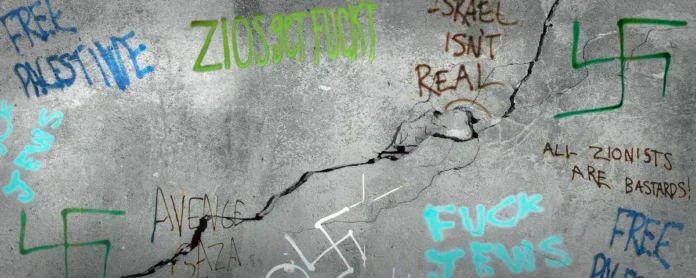
In Wellington, the Capital of New Zealand, graffiti appeared on a wall with the message reading “I hated Jews before it was cool.”

Condemnation of this hateful message followed, but there was one jarring and disgraceful response from a trustee of The Helen Clark Foundation, a self-styled “think tank” created by the former Prime Minister of NZ. Her husband is a trustee and professor. His tweeted response to this graffiti was that “you reap what you sow.” In other words, Jews are responsible for being hated because, presumably, of what Israel is doing to protect its citizens.

This classic leftist defence of Jew hate in projecting all sins onto the evil Zionists is a perfect example of how far the poisonous pus of hate has penetrated the addled minds of even the most so-called educated sectors of the population.

This is definitely an eerie echo of the past now revived.

It is therefore amazing that, given all the available evidence, there should still be many who continue to deny the obvious.

It is time to hearken to the words of Psalm 146 – “put not your trust in princes (mortals) in whom there is no help.”

Hamas Praises Murder of Pregnant Israeli Mother After Terrorist Attack in West Bank

Hamas sparked global outrage after lauding the murder of a pregnant Israeli mother of three — shot in the West Bank on her way to the hospital to give birth — as “historic,” amid a surge in violence and ongoing efforts by mediators to reach a ceasefire in Gaza.

Shortly after the shooting terrorist attack near the West Bank town of Bruqin, Abu Obaida, spokesperson for the Qassam Brigades — the military wing of the Palestinian terrorist group — issued a statement praising the assault.

“We commend the heroic shooting operation near Bruqin, west of Salfit, carried out by the brave members of our people in the West Bank,” Obaida said.

“We call on our people to rise up against the occupation in defense of Al-Aqsa, to confront the aggression in the West Bank and its refugee camps, and to support their steadfast brothers and sisters in Gaza,” he continued.

On Wednesday, a Palestinian terrorist opened fire on Israeli vehicles in the northern West Bank, fatally wounding a pregnant woman and injuring her husband as they made their way to the hospital to deliver their baby.

After the attack, the 30-year-old woman, identified as Tzeela Gez, was quickly transported to Petah Tikva’s Rabin Medical Center in critical condition. Despite doctors’ efforts to save her, she was pronounced dead early Thursday morning.

With an emergency C-section, doctors managed to deliver her baby, who is now in stable condition but continues to fight for his life.

According to the hospital, her husband Hananel, who was driving the car, sustained minor injuries after his condition was initially reported as serious.

Gez’s funeral took place at Jerusalem’s Givat Shaul Cemetery at 5.30 pm on Thursday.

Israel’s Foreign Ministry condemned the attack and described Hamas’s celebration of the murder of Gez — who was in her ninth month of pregnancy — as “sickening” in a statement posted on the social media platform X.

United States Ambassador to Israel Mike Huckabee also condemned the assault, saying it “shows Hamas is proud to stand behind cold-blooded murder.”

“The savage & uncivilized contempt for a pregnant woman & her baby reveals what Israel is fighting [for],” the American diplomat said.

The Israel Defense Forces (IDF) announced an intensive search for the terrorist who fired on multiple vehicles, with Chief of Staff Lt. Gen. Eyal Zamir vowing to bring the perpetrators to justice.

“This is a difficult and painful attack in which an Israeli civilian was killed on her way to a delivery room,” Zamir said in a statement. “I share in the deep sorrow of the family.”

“We are engaged in broad fighting against terror in Judea and Samaria [the West Bank] and we will continue,” the statement read. “We will activate all our tools, and we will reach the murderers to bring them to justice.”

Israeli Prime Minister Benjamin Netanyahu also condemned the shooting, saying he was “deeply shocked by the horrific terrorist attack.”

“This abhorrent incident precisely reflects the difference between us, who desire and bring life, and the reprehensible terrorists, whose goal is to kill us and destroy life,” the Israeli leader said in the statement released by his office.

Israeli Defense Minister Israel Katz extended his condolences to the Gez family and offered prayers for the newborn baby’s recovery.

“We will continue to fight terror with great force” in all areas of the West Bank and “will not allow it to raise its head,” he said in a statement.

Tectonic Shift: Why Bibi Is Saying No to American Military Aid

Something big is happening behind the scenes—and the media is totally missing it.

Don’t trust the scary headlines about Trump or Israel right now, because when even Netanyahu is signaling an end to American military assistance, it means the ground is moving beneath our feet.

Tzeela Gez, pregnant Jewish woman murdered yesterday in drive by shooting

Statement by President Isaac Herzog

Thursday 15 May 2025  17 Iyar 5785

“The murder of Tzeela Gez, on her way to give birth at the hospital, is a spine-chilling, horrific act of terror that shakes us to the core. At the very moment life was about to begin — life was taken in the most brutal way. My heart goes out to her grieving family and all her loved ones who are in deep shock. We’re all praying now for the baby’s health and for the recovery of her injured husband, Hananel…

https://x.com/isaac_herzog/status/1922865103902265621?s=46&t=xC3TVfLd9wRukz0tF3-O-g

Question to Jason Pearlman, Presidential Spokesman, 052-6328795

Will President Herzog demand that the PA/PLO not award the murderer of Tzeela Gez with a fee for life, in accordance with PA murder incentive law?

PA murder incentive law:

https://jcpa.org/paying-salaries-terrorists-contradicts-palestinian-vows-peaceful-intentions/

En utmaning väntar Rabbin Yehuda Kaploun, president Trumps särskilda sändebud som övervakar och bekämpar antisemitism. Rabbi Kaploun, känd för sitt expertområde på terrorism i Mellanöstern och antisemitism på universitetsnivå, står nu inför den känsliga uppgiften att ta itu med Saudiarabiens medverkan i vidmakthållande av hat.

As President Trump prepares for a Saudi visit, Special Envoy Rabbi Yehuda Kaploun must address Riyadh’s financing of PLO textbooks promoting antisemitism and rejection of peace with Israel. (Photo: Supplied.)

Sedan den 1 augusti 2000 har vår nyhetsbyrå och forskningscenter övervakat nya Palestinska läroböcker. I över två decennier har palestinska myndighetens (PA) utbildningsmaterial brutit mot UNESCO:s standard och internationell rätt.

Enligt omfattande övervakning och översättning genom forskningsorgan definierar tre kärnprinciper dessa läroböcker:

Tre grundprinciper för PLO-utbildningen är:

  1. Delegitimering av Israel: Läroböckerna förnekar judiska historiska band till landet, raderar Israel från kartor och avfärdar judiska heliga platser som exempelvis Tempelberget som historiska påhitt.
  2. Demonisering av judar: Israelisk politik likställs med nazism, och judar framställs som förtryckande och våldsamma.
  3. Förespråkande för våldsam kamp: Fred med Israel avvisas till förmån för “motstånd”, utformat som en religiös plikt. Martyrskap och väpnad kamp glorifieras, och terrorattacker mot israeler rättfärdigas som legitima och dödandet av judar uppmuntras.

 Nedan är vår senaste rapport;

“Israel, judar och fred i skolböcker och lärarhandledningar som används i UNRWA-skolor i Judéen, Samarien, östra Jerusalem och Gazaremsan ” 

(eng text:)   https://www.terrorism-info.org.il/app/uploads/2024/05/E_114_24.pdf

(svensk text:)    https://israelbehindthenews.com/wp-content/uploads/2025/02/PA-skolmaterial-Svensk-oversattning-2.pdf

Europaparlamentet frös nyligen finansieringen till PA för deras läroböcker med hänvisning till “antisemitiska referenser, uppvigling till våld och glorifiering av terrorism”. En resolution från 2025 kopplade uttryckligen EU:s ekonomiska stöd till läroplansreformer, vilket PA hittills har ignorerat.

Saudiarabien, en viktig amerikansk allierad, är fortfarande en stor finansiär av PA:s utbildningssystem. Läroböcker som finansieras av saudiska och EU-bidragsgivare lär ut att “jihad och martyrdöd” är skyldigheter för att “befria” Jerusalem. Böckerna utelämnar fortfarande Israels existens från kartor och framställer sionismen som expansionistisk.

När Kaploun följer med president Trump till Riyadh uppmanas han att med amerikanskt inflytande påverka för ett stop av saudisk finansiering av PA:s hatuppvigling. Att konfrontera Saudiarabien, en strategisk partner, riskerar dock att komplicera de diplomatiska förbindelserna.

Kaploun behöver balansera diplomati och ansvarsskyldighet och förstärka Menachem Mendel Schneersons varnade ord; det existentiella hotet mot Israel utgör en fråga om liv eller död för det judiska folket.  

Has Qatar BOUGHT the TRUMP Administration?

The Qataris are gifting a $400 million luxury jet to the Trump administration just as Donald Trump prepares to visit Qatar and negotiations heat up for the release of hostages held by Hamas. But that’s not all — Trump’s children, his son-in-law Jared Kushner, and key Trump allies like Steve Whitcoff and Pam Bondi all have substantial financial ties to Qatar, raising serious questions about conflicts of interest and influence. In this video, we unravel the web of Qatari money, Trump family business deals, and troubling political connections that could have far-reaching implications for U.S. foreign policy and Middle East negotiations.

Forces locate over 1,000 weapons and assault tools intended for terrorism in Bethlehem raid

Border Police forces arrested two suspects in Bethlehem for possession and trading of weapons, and discovered hundreds of weapons and assault tools hidden inside electrical appliances during the raid. The forces seized more than 1,000 batons, axes, knives and additional combat equipment suspected to be intended for terrorism.