How a Chabad house in Panama built the world’s most critical retreat model for IDF veterans

The Chabad House overlooking the Pacific in Playa Venao stands as an unlikely yet essential sanctuary where structure and nature meet to support Israeli combat veterans in recovery. (photo credit: NOAM BEDEIN)
For more than a decade, my work as a travel photojournalist has taken me to places where nature strips people down to their essentials. Over the past year, that journey sharpened into a deliberate exploration of how wild environments, intentional distance, and structured community can function as practical tools for healing trauma.

That exploration was never detached from home. Moving through remote landscapes and emerging wellness models, I kept returning to Israel and what our people have been through. I became convinced that healing, especially for those who carried the war on their bodies and in their souls, would become one of the central national challenges of the years ahead.

Since Oct. 7, that realization is no longer theoretical: It demands a response.

Adventure, trauma, and the pursuit of wellness

The emotional cost carried by Israel’s combat soldiers is not abstract. It lives in their bodies and their silence; in the difficulty many face when attempting to return to ordinary life after giving everything. Those who paid the highest toll are often the least equipped to articulate it.

Existing frameworks in Israel are under strain, and the scale of this moment demands new thinking, new spaces, and models that are both professional and humane.

For decades, tens of thousands of young Israelis have marked the end of service by traveling abroad. Since the war, many combat soldiers leave Israel carrying unprocessed trauma, moving directly from an intense, life-threatening reality into the freedom of the world outside.

Without a structured transition, that gap can become dangerous. In uncontained environments, the search for quiet can slide into disconnection, and the absence of boundaries can lead to unhealthy coping mechanisms, including substance use, isolation, and emotional collapse.

It was through this movement of Israeli backpackers that the story of Retreat Lochamim (Fighters’ Retreat) began.
Rabbi Yariv and Lital Klein did not set out to build a retreat. Over more than a decade, they hosted tens of thousands of Israeli travelers through their Chabad House. After the Israel-Hamas War, they began encountering combat soldiers arriving with burdens far heavier than familiar post-army fatigue. Panama wasn’t where this story began: It was where the need finally took shape.

That understanding led me across the world, from Israel to the Pacific coast of Panama, to a place called Playa Venao.

Playa Venao: The origin of Retreat Lochamim

Playa Venao sits far enough off the map that you have to mean it if you want to go there. The road narrows as you leave the highway, the jungle thickens, and the air grows heavy with heat and moisture. Then the Pacific opens up and long lines of waves roll toward a wide beach.

The retreat is held in a private villa compound on a quiet stretch of coastline, away from crowds. The setting is not a luxury detail. This is part of the clinical logic: silence, routine, and a protected perimeter that allows the nervous system to downshift before deeper work begins.

This is where Retreat Lochamim operates: a structured, research-backed retreat for IDF combat soldiers navigating PTSD, emotional collapse, numbness, hyper-alertness, insomnia, and profound loneliness.

Along this quiet Pacific shoreline, everyday life unfolds against a coastline that feels like a remote edge of the world.
Along this quiet Pacific shoreline, everyday life unfolds against a coastline that feels like a remote edge of the world. (credit: NOAM BEDEIN)

The retreat grew organically, shaped by who kept arriving at the Chabad House, and emerging from what the Kleins witnessed. For years, their Chabad House was a landing pad for Israeli post-army travelers. But after the war, something shifted. Soldiers were no longer arriving simply to decompress: They were arriving wounded in ways that were difficult to identify.

Rabbi Klein described it to me as “a change in the soul.” Soldiers avoided eye contact. Many were emotionally distant, unable to articulate what they carried. Some appeared numb, others hyper-alert. Loneliness often outweighed physical exhaustion. Bar Yohanan, part of the retreat’s operational leadership, described rising patterns of depression and behavior that no longer matched the familiar post-service profile.

What united these soldiers was not a single battlefield story but a shared inability to process what they had returned with. Many had gone to reserve duty and come back different, without having a language to express that difference.

Brilliant Macaws show their presence, highlighting the vivid ecosystem that frames this journey far from Israel.
Brilliant Macaws show their presence, highlighting the vivid ecosystem that frames this journey far from Israel. (credit: NOAM BEDEIN)

In Israel, few felt they had a safe platform to speak openly. Judgment, expectations, and unit dynamics often silenced them.

Rabbi Klein recognized that this was no longer a matter of hospitality: It was an emergency unfolding quietly, traveler by traveler. He began raising support in Panama City, describing the moment not as a strategy but as a call to mission. What became clear was that warmth alone was not enough – what was needed was structure.

Retreat Lochamim became that structure: a first-of-its-kind model designed for combat soldiers who need emotional healing through a supportive community and disciplined, body-based experiences. It is built around sequence: moving soldiers from guarded survival into regulated presence, and from isolation into belonging.
The program is supported by integrative academic research conducted through Ben-Gurion University of the Negev.

An Iguana in the surrounding jungle underscores the raw, untamed environment that creates distance from routine and space for healing.
An Iguana in the surrounding jungle underscores the raw, untamed environment that creates distance from routine and space for healing. (credit: NOAM BEDEIN)

In January 2026, a research article by Prof. Nurit Zeidman summarizing the first year of a three-year study was published. The paper examines the effect of surfing after group processing circles were held, exploring how the combination functions as a trauma-treatment sequence rather than separate activities.

Building trust: Clinical discipline and the road to the discussion circle

When I arrived to document and understand the retreat, I was not allowed to participate in its first three days. The decision came from clinical discipline.

The opening phase is sealed. No observers. No journalists. No visitors. Only the participants and the therapeutic professionals guiding the process. Being asked to step back did not feel like exclusion – it felt like discipline. The retreat’s first loyalty is to the internal safety of the group, not to documentation.

At first light, a participant prays beside the water, weaving spiritual grounding into the retreat’s disciplined structure.
At first light, a participant prays beside the water, weaving spiritual grounding into the retreat’s disciplined structure. (credit: NOAM BEDEIN)

Roni Yaari, a yoga, meditation, and somatic instructor, explained the logic: “We won’t do deep work, like intensive rebirthing, on the second day. First, the greenhouse must be ready; the womb must be ready.” Intensity without containment, she said, can do harm.

The first three days are devoted to building trust. Combat soldiers are grouped with others who share similar service backgrounds. Shared reference points allow trust to form quickly. Silence does not require explanation.

Throughout the week, alcohol and drugs are strictly prohibited. The retreat insists on clarity, so emotions can surface without distortion. The process is designed to remain clean and unfiltered, allowing participants to stay present with their emotions without numbing or distortion.

As daylight fades, surfers gather in the water – a daily ritual of rhythm, patience, and shared presence.
As daylight fades, surfers gather in the water – a daily ritual of rhythm, patience, and shared presence. (credit: NOAM BEDEIN)

My most direct interaction with participants came before the retreat began. I joined the shuttle from Panama City to Playa Venao, a long drive that gave space for silence and for stories to surface.

The men in that van came from everywhere. The youngest was 22; the oldest, 42. There were tank commanders, infantry soldiers, and veterans of elite units. Some had only recently left Israel; others had been traveling for months.

One man beside me said he had slept no more than two hours a night for the past two years. A combat tank sergeant. Always responsible. He had recommended the retreat to soldiers under his command before finally allowing himself to come. “This is the first thing I’ve done only for myself,” he told me.

By the time we reached Playa Venao, nothing had been resolved, but something had shifted. Strangers had become familiar; differences began collapsing into recognition.

A howled monkey moving through the canopy signals just how far from home this process begins.
A howled monkey moving through the canopy signals just how far from home this process begins. (credit: NOAM BEDEIN)

The retreat experience: Six days of structure, bodywork, and community

When I saw the group again after three days, the change was visible. Shoulders lowered. Eye contact steadier. The intensity had redistributed.

Michal, a clinical social worker and emotional affairs officer in the reserves, articulated the core injury: “The main injury is to trust. Trust in myself, in those above me, and in people. Relationships are injured, and relationships need space where people can be trusted again.”

Shabbat marked an emotional peak. The Chabad House filled up on Friday night, and the retreat participants were joined by additional elite combat soldiers connected to a separate community-led initiative called Masa Leiter (Leiter’s Journey). Another process, another circle, under the same roof. It did not dilute the experience. It revealed what Venao has become – a place capable of holding parallel needs without confusion.

­Panama offers Jewish infrastructure, cultural familiarity, and enough distance to loosen the grip of routine. When soldiers are removed from familiar geography and social roles, expectations loosen and defenses soften. There is room to feel without the immediate demand to function. This disconnection is not indulgence; it is a starting condition for healing.

While the retreat is meticulously structured, it is also held by the local Israeli community in Playa Venao, a committed network of families and professionals who have made the project a shared responsibility.

Physiotherapist Rotem Sol works directly with participants, focusing on the body, often the first place where trauma speaks.

“When a soldier arrives, the whole community mobilizes,” she told me. “That is what makes the model work. It is a home.”

The support network extends beyond Venao. The Jewish community of Panama City has helped fund the project, with restaurants and families hosting soldiers upon landing. The initiative also receives active support from the Israeli Embassy in Panama.

Retreat Lochamim runs for six days under the professional supervision of Dr. Lia Naor and is studied as a unified system within a doctoral research framework at Ben-Gurion University of the Negev.

The week follows a consistent rhythm: morning meditation and yoga, group circles to process war experiences, then body-based work that reinforces what words alone cannot carry. The toolkit includes surfing, breath-based work, ice baths, body treatments, and evening practices that support integration, including a bonfire circle and a future vision board at the close of the retreat.

Yohanan described the structure: “We begin with the mind: the discussion circle. On top of that come the body and spirit. After the circle, there is surfing.” The sequence matters. Language without grounding drifts; bodywork without reflection can remain locked.

Michal followed the group from the opening discussion circle to the final one. At the start, soldiers arrived guarded, carrying skepticism and defenses shaped by years of service. Trust was limited. Openness was cautious.

By the final day, that posture had shifted. A cohesive group formed, grounded in shared language and mutual recognition. Trust developed both in the professional team and between participants. Soldiers committed themselves to the process, to the group, and to themselves.

Michal also described what she witnessed between the first circle and the closing one on day six. “They started as strangers,” she said, “different in age, personality, and the units they came from, and they finished as a cohesive group with a shared denominator and a real group to continue with.”

The early armor – skepticism, cynicism, quiet judgment about who carried more or less – gradually dissolved as safety took hold. Soldiers learned an emotional language many had never used: how to name a trigger without collapsing into it, how to share without performance, and how to listen without trying to fix. The shift was not sentimental. It was measurable in the room: more eye contact, more patience, more willingness to be seen.

For many, the week included first-time experiences that were intentionally framed as confidence-building rather than thrill-seeking: paddling into waves, rebirthing breath work, ice baths, even standing on nails. Even participants who had done some of these before described the difference here: the same practice, inside a protected container, with a team that watched the nervous system as closely as the story.

By the end, Michal said, the most important change was relational: trust in others returned, the sense of loneliness softened, and the feeling of being “broken” became less absolute. “It was far beyond expectations,” she concluded.
Yaari framed her role as giving soldiers tools they could carry home: “Through breathing, I can return to some kind of zero,” she said. Surfing, the retreat’s most visible element, is not treated as a sport. It is nonverbal therapy. Waves demand presence. They force breath control. They teach surrender without collapse.

The final days focus on transition, preparing participants for the emotional drop that can follow leaving a contained space, and emphasizing connection and continued support. The retreat does not promise closure – it offers direction.

Continuity and expanding the circle

Healing does not end when the retreat does. After returning to Israel, participants are invited into an ongoing support framework. Once a month, alumni gather for six-hour mini-retreats held at centers across Israel, with facilitated circles and practices drawn from the retreat week. The intention is to sustain momentum and keep soldiers connected to a community that understands what they are carrying.

Retreat Lochamim has expanded beyond male combat soldiers. The first retreat for women combat soldiers was held, with another scheduled in the coming months. In November 2025, a dedicated retreat was held for young IDF widows who lost their spouses during the Israel-Hamas War. Each program follows the same principles: structure, containment, and respect for process.

The people who carry it forward: Leadership and a model that can travel

As of December 2025, Retreat Lochamim has hosted more than 150 combat soldiers across 14 cycles, with hundreds more applying. The growth has been organic, driven by word of mouth. Operationally, the model now runs at a steady pace, with about two retreats each month, each serving 12 soldiers.

Yohanan described the demand: “My registrations fill up by themselves. For every retreat, I have over 40 people registered and only 12 spots. This is word of mouth, and it reflects the national need.”

Tzachi Banay arrived in the first cycle after months of reserve duty, carrying exhaustion and uncertainty. During the retreat, something aligned. He stayed on and now manages kitchen operations and logistics, present in every cycle since. His role is not clinical, but it is essential.

Klein described another long-term trajectory. A Supernova music festival survivor and combat soldier diagnosed with PTSD arrived unable to fly alone. After the retreat, he remained in Venao for a year, integrated into the community, learned to surf, and gradually rebuilt his confidence. He later returned to Israel and now speaks publicly about his journey. “Seeing that two-year trajectory proves the strength of the model,” the rabbi said.

What I encountered in Playa Venao is not a location-specific miracle. It is a model built on four elements: a trusted Jewish home, a committed local Jewish and Israeli community, professional trauma-informed leadership, and a wild natural environment that intensifies experience.

Surfing the waves can be replaced by mountains, desert, snow, or rivers. What must remain constant is structure, clear boundaries, and respect for process.

The global Chabad network already provides much of the necessary infrastructure. Retreat Lochamim demonstrates how that infrastructure can be activated with professionalism rather than improvisation, and with a clear understanding that hospitality alone is not treatment. The vision is to share this model with organizations in places where Israeli soldiers already travel, including India, Thailand, North and South America, and Australia.

The model is already moving outward. The team is scheduled to fly to Sydney to teach trauma-coping tools for leaders of Sydney’s Jewish community following the terrorist attack at Bondi Beach during Hanukkah.

Toward a sustainable blueprint and national resilience

Two directions stand out for expansion without losing integrity.

First, formalize an Ambassador Program. The most powerful vehicle for understanding this work is not a brochure. It is a soldier who can speak honestly about the journey from collapse to function, from sleeplessness to breath, from isolation to belonging. A structured ambassador track can identify those ready for that role, train them, and bring them into communities through curated events and trusted networks.

Second, develop a mission-aligned “soft landing and taking off” layer that strengthens, rather than competes with, the retreat. Guided nature-based experiences and structured outdoor programming can provide continuity for graduates while creating modest earned income. Done with discipline, this layer can add stability, meaningful roles for veterans, and an added dimension of self-efficacy that supports long-term healing.

Israel is entering a long season of recovery. Reserve duty cycles continue, and emotional processing lags behind operational demands. For many combat soldiers, the battlefield remains present long after the uniform comes off.

Models like Retreat Lochamim are not substitutes for Israel’s mental health system. They complement it by addressing what often falls between categories: the need for distance, containment, community, and a language that allows soldiers to reconnect with themselves without being reduced to diagnoses.

What I witnessed in Panama was recovery, carried out with structure. A remote stretch of Pacific coastline became a place where soldiers could breathe again, speak honestly, fall without collapsing, and begin moving forward with direction rather than avoidance.

For this generation of combat soldiers, that is a core need.

More than 500 soldiers have applied for limited places. Each retreat is intentionally small, usually 10 to 12 participants. Soldiers contribute roughly $500, but the full cost per participant, including staff, accommodation, food, logistics, and programming, is estimated at about $1,850, placing the operating cost of a cycle in the range of $18,000 to $22,000.

Recovery for combat soldiers is not measured in weeks – it is measured in years. Keeping such a protected space open requires stewardship and long-term commitment from those who understand that national resilience is built one healed individual at a time.

If this model is protected, refined, and allowed to grow with integrity, it can become one of the most meaningful contributions the global Jewish community makes to this generation of warriors.

The waves of Playa Venao will continue to break, indifferent to human struggle. What matters is that, for a brief and carefully held moment, those waves are used with intention, turning distance into healing, and helping soldiers return stronger to the lives, families, and responsibilities waiting for them.`


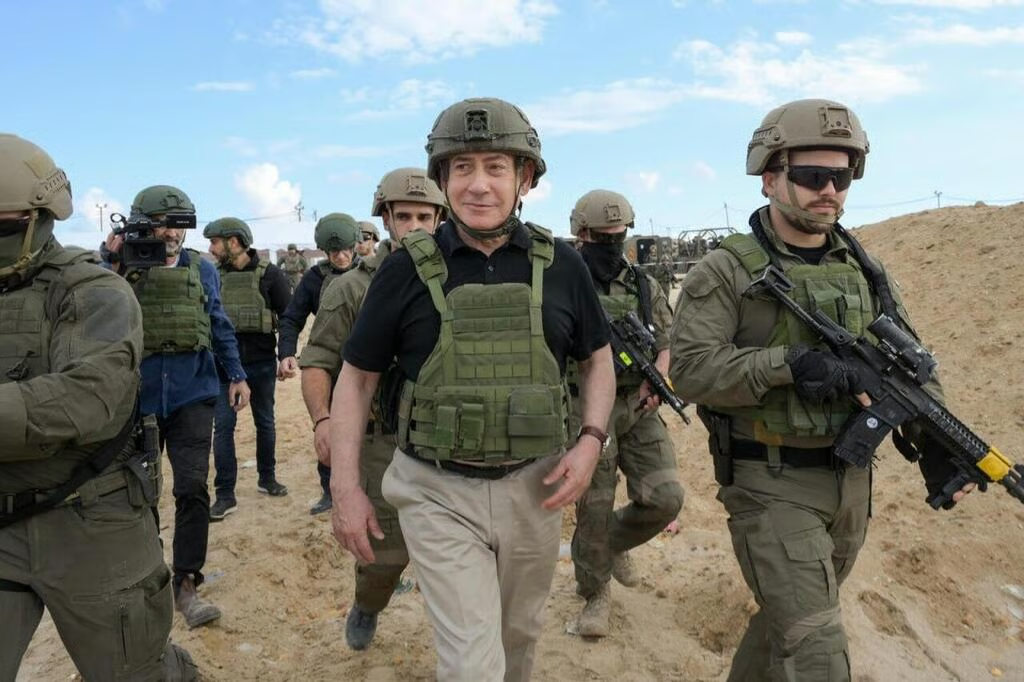
From the Israel Defense Forces

On Iran Attacks, J Street Is Beyond the Pale

Photo Credit: ChatGPT

Echoes of some of the very darkest periods of recent Jewish history reverberated in the statements made by anti-Zionist Jews over the weekend of the initial phases of joint U.S.-Israel strikes on Iran.

That outside-the-pale groups Jewish Voice for Peace and IfNotNow would attack Israel and America for bombing Ayatollah Ali Khamenei’s regime should come as no surprise. But the fact that J Street, which claims to be “pro-Israel, pro-peace, pro-democracy,” would sound almost the same as them does much to validate what its critics have been saying about the D.C. pressure group for years.

“We are appalled by President Trump’s reckless decision to launch a war of choice against Iran, explicitly seeking regime change,” blared a statement issued by J Street while Israeli fighter planes were still in the air. The organization said its press release was in response to U.S. President Donald Trump’s decision to commence military action in coordination with Israeli Prime Minister Benjamin Netanyahu.

What must be called out here is J Street’s specific highlighting of Netanyahu in its statement. That’s because the full spectrum of the prime minister’s political opponents in Israel strongly support the decision to degrade Iran at its weakest point in memory. All of them.

J Street’s criticism of Netanyahu and the “military action” of the Jewish state stands in stark contrast to the leadership of Israel’s left, including politicians featured by the agency as speakers at its annual conventions and that it very much wants to be seen as being allied with.

If J Street doesn’t have any Israeli political leaders who agree with its views, then how exactly is it “pro-Israel?”

Merav Michaeli addressed the 2018 J Street conference and tweeted on March 1 that Israel had achieved “tremendous successes” against Iran.

Yair Golan appeared at the J Street conference in 2022 and posted on X on Feb. 28: “Eliminating Khamenei is a dramatic and significant step. Israel’s security forces, together with the American forces, have once again demonstrated intelligence superiority and impressive operational capability. I salute you.”

Former Israeli Prime Minister Ehud Olmert is a longtime critic of Netanyahu and was scheduled to speak at the J Street conference that started on Feb. 28. On Newsmax that day, he told his audience that “this has been the focus of Israeli policies for more than 20 years now…. Now (that Trump) took this action, and I hope it will be successful, and it will last until it is done.”

Michaeli, Golan and Olmert are not outliers. Benny Gantz, Naftali Bennett, Gadi Eizenkot and Yair Lapid are all leaders of parties that run against Netanyahu’s Likud Party, and consistently condemn him and his policies. And every single one of them has tweeted enthusiastic support for Netanyahu and the attacks against the Islamic Republic. Not one of these top Israeli politicians sounds anything at all like J Street.

The organization’s repeated criticism of Israeli actions of self-defense – and now, its opposition to the elimination of a nuclear threat – raises real and significant questions about its priorities. This isn’t a minor policy disagreement. It’s a fundamental divergence on how to ensure the safety and survival of the Jewish state. When American Jewish organizations weigh in on matters of life and death for Israelis, there is an obligation to speak from a position of real knowledge.

“Iran does not present an imminent threat that requires launching a ‘preventive’ war,” J Street claimed in its Feb. 28 news release, and no Israeli political leaders are saying the same thing. Why is J Street on the same side as JVP and IfNotNow, and not Israel’s left-leaning parties?

That’s the real takeaway here. J Street is not what it claims to be and perhaps never has been.

Israeli President Isaac Herzog strongly supports the attacks on Iran, tweeting: “I congratulate the IDF and the U.S. Army on the bold joint operation ‘Roaring Lion’ against the Iranian threat. This is a dramatic and historic step, and I thank the president of the United States, Donald Trump, and Prime Minister Benjamin Netanyahu for the decision in the hope that it will bring historic change for us and for the entire Middle East.”

Let’s remember that Herzog is a former chairman of Israel’s Labor Party.

Once again, this underlines how J Street has positioned itself far outside the mainstream Jewish community. And it reminds us why both of the major Jewish umbrella organizations (the Conference of Presidents of Major American Jewish Organizations and the American Zionist Movement) have rejected it.

These important umbrella groups understand that J Street is extreme and stands for nothing but its own radical political agenda.

In the Eye of The Storm

NASA 2071127 82.4F

I had already determined the topic of my op-ed this week but as so often happens dramatic events dictate otherwise.

This past Shabbat was one of the special ones leading up to Purim and Pesach where we read an extra Torah portion. On this occasion it is the reading for Shabbat Zachor. This word means remembrance and it relates specifically to recalling the deceitful deeds of the Amalekites.

This tribe heard about the liberated Hebrews making their way across the Sinai desert towards the Promised Land. They had heard about the escape from Egypt and how the mighty Egyptian army and Pharaoh had been vanquished. Believing that this multitude posed a threat, the Amalekites determined to attack, aiming at first to kill those most vulnerable, namely the elderly, young and sick.

As we know from the narrative their plan to destroy the Hebrews failed thanks to the determined fight back by Joshua and his army and also with help from Hashem.

This important episode in the exodus story was deemed so important that it was decreed that henceforth on an annual basis the perfidious event should be recalled. Not only recalled, but it also was intended to be a warning for future generations.

The unrestrained hate and enmity exemplified by the Amalekites’ desire to wipe out the Hebrews would be carried forward to future generations of Jew haters

We are therefore mandated to remember this every year. In fact we are told to not only remember but also take steps to make sure that this evil never succeeds.

Recalling this just prior to Purim is therefore very relevant because Haman who plotted to exterminate the Jews of Persia is traditionally believed to be a descendant of the Amalekites.

The reading of this portion of the Torah took a dramatic turn last Shabbat as we prayed in our local air raid shelter minyan. The sky was filled with the noise of multitudes of Israel air force planes which is something not usually heard on a Shabbat.

At the precise moment when we read about the Amalekite episode the military forces of the Jewish State were on their way to counter the nefarious designs of the current Iranian plotters against Israel.

We did not know at the time but it soon became clear as home front warnings were issued that a major campaign was under way.

How symbolic that this should all commence on Shabbat Zachor and at the precise moment that in prayer gatherings all over the country we were reading the commandment to remember to thwart the devious ambitions of our enemies.

It had been previously reported that the Americans expected Israel to lead the charge against the mullah regime. Without a doubt Israel was always going to be blamed by the hypocrites of the world for whatever transpired. This time and for perhaps the first time since the Presidency of Harry Truman there is a President in the White House who is prepared to confront the modern incarnation of Haman and his followers.

Since last Shabbat morning and as I write these lines we have, like everyone else in Israel, been woken up during the night and day by alerts and sirens. Israel has the most sophisticated alert system whereby the Home Front Command can alert and update each and every person with a mobile phone when incoming missiles and drones are detected. Alerts give you time to get dressed if necessary and prepare to enter either a safe room or communal air raid shelter.

This early warning system details exactly where and when threats are expected and it means that by the time the sirens blare forth one is ready to seek shelter. The alert sounds are so loud and strident that it is impossible to miss and ignore. For those who are hearing impaired the mobile phones light up with flashing lights and vibrations.

Unlike Israel and the USA who target military and security sites the Iranians fire off missiles and drones into the midst of civilians and in this latest round their indiscriminate victims include friends and foes alike.

The celebration of Purim this year has been surreal. As we read about the events of ancient Persia and how the genocidal plot to kill all the Jews was thwarted, the recitation was accompanied by alerts warning us of incoming missiles from today’s Jew haters in Islamic Iran.

In fact in the process of writing this op-ed I have had to seek shelter innumerable times as missile and drone alerts erupted.

Predictably, all those who were silent while the Iranian authorities massacred their own citizens, have now burst into life. All of them articulate a common theme which reveals their true agenda and prejudices.

Instead of cheering the possible impending liberation of Iranians from jihadist oppression these critics condemn the USA and Israel for having the “chutzpah” to actually act rather than pontificate.

The likes of former NZ Prime Minister, Helen Clark and her coterie of “elders” whose use by date has long expired, complain that international law has been breached. They maintain that in the perceived absence of an imminent threat the attack on Iran is illegal and must be condemned. Obviously these luminaries are oblivious to reality or more likely they are so blinded by their genetically induced hatred of Israel and Trump that they refuse to see what is obvious. The same malady afflicts most on the political left, the Greens and in NZ also the Maori Party.

Since 1979, Iranian leaders and officials have made no secret of their ultimate goal which is the total destruction of Israel. Towards that end they have spent decades and billions of dollars in building and constructing the very means to achieve their ambitions. This has included the funding and arming of proxy terror groups and the building of underground facilities where illicit nuclear development is being pursued. In addition they have manufactured and developed missiles capable of delivering weapons of mass destruction as well as drones. These drones have been exported to Russia and are being used to kill Ukrainians.

Do any of the “elders” and others realize what all these developments signify?  They have only one purpose and that is to achieve the means to destroy Israel and blackmail other countries. The ability to do so is all part of the Iranian Mullahs’ plan to wipe out “unbelievers” and hasten the coming of Islamic domination.

Within the last few days, Steve Witkoff, one of the American negotiators, revealed that the Iranian representative boasted that his country had enough enriched uranium to be able to manufacture eleven nuclear bombs. When one realizes that the Iranian missile and drone capabilities together with their declared aim of “nuking” the “illegal Zionist entity” is almost ready to activate, one can understand why firm action was required.

The “elders” and others, including all delusional politicians, media critics and haters, believe that diplomacy and talks will achieve peace and a dismantling of the weapons. These hallucinatory individuals have obviously learnt nothing from history. They remain oblivious to the fact that kowtowing to bullies, tyrants and dictators and appeasing their voracious appetites has never succeeded in averting genocidal ambitions.

Look at who is cheering on the despotic Iranian regime and issuing hypocritical condemnations of Israel & the USA and you will understand exactly how futile any sort of negotiation would be. China, North Korea, Russia and other assorted UN members together with the UN Secretary General and the Pope are joined together in an unholy alliance.

There is ample proof that a direct and imminent threat exists and that all those bleating about a breach of international laws are acting like lambs being led to their ultimate slaughter.

The Jewish People have been down this dead end road too many times in the past. Most, except for the pitiful few self loathers, are not prepared to fall for this charade again.

Most Israelis know that kicking the can down the street only makes the threats and dangers greater.

They appreciate that there is a President in the White House who despite everything is prepared to act. His predecessors allowed the Islamic Republic to cheat their way to nuclear status and to be in a position to complete a “final solution.” Not since Harry Truman have we seen such resolute resolve to act rather than hide behind false rhetoric.

The world will be a better place if regime change can be achieved and the long suffering Iranians released from their four decades nightmare. The terror proxies will be defanged and hopefully human rights restored.

What better time for this to occur than at Purim?

I do not know who writes the Australian Prime Minister’s messages to the Jewish community but his latest one is full of incredible hot air.

Contrary to his assertions I cannot find any message in the Book of Esther which makes me feel “uplifted with a message of generosity and kindness”. His belief that “hate can be fought by pride and joy” is another pie in the sky delusion.

Instead of pontificating nonsense he and others like him should take note of the wise words of the late Rabbi Moshe Hauer, who penned these memorable lines:

“Purim is connected to Yom Kippurim, the Day of Atonement. As Jews we believe firmly that people can change, that they can turn the page on past evil deeds, and when they do, we forgive and even embrace them. But for the unrepentant who do not turn the page and remain committed to their evil designs, for the Haman’s of then and now, we can make no more tragic mistake than to forgive them and forget.”

This is the real Purim message as we confront Iran and its willing partners.   

The attack on Gail’s by the anti-Israel mob is twisted beyond belief

Smashed windows. Shards of glass on the street. Hostile graffiti in blood-red paint. And that most chilling of slogans: “Reject corporate Zionism.”

No, I am not describing a scene from 1930s Europe but rather an attack that took place in Archway in North London this week. Once again a mob of anti-Zionist imbeciles has roughed up a branch of Gail’s, the upmarket bakery chain. It opened on Junction Road near Archway Tube station last week and was instantly besieged by the usual keffiyeh clowns yelping about Israel’s “genocide”.

The preening fools of the cult of Israelophobia gathered outside the bakery to unfurl a vast banner saying “Boycott Israel for Genocide and War Crimes in Gaza”. Busy patrons hoping to pick up a sausage roll or a honey cake for their morning commute will have rightly wondered what a high-end bakery in North London has got to do with Israel’s war against the anti-Semites of Hamas.

The activists’ official justification seems to be some convoluted connection between the bakery’s current majority owner and Israel. But I can’t be alone in wondering if their true motivation is rather different. Gail’s was founded by the Israeli baker Gail Mejia. It was then turned into a chain – and a hugely successful one – by the Israeli entrepreneur Ran Avidan.

Neither Mejia nor Avidan are associated with the business anymore. But I’m not sure that would make a blind bit of difference to the frenzied Israel-haters of the noisy activist class. To them, the very fact that Gail’s was founded by someone from the Jewish state they love to hate would be enough to damn it as toxic, morally unclean, and a chain that all good people must boycott.

In either case, they see Gail’s as being stained by the blackest of original sins – a connection with the Jewish homeland.

Rarely has the bigotry of the bourgeois haters of Israel been so graphically on display. If Gail’s was sending delicious sweet treats to IDF soldiers in Gaza, maybe a protest would make sense. That would also make me pop in there more often, to show my support for Israel’s existential war against the Jew-hating terrorists who dream of destroying it.

But as far as I know, it isn’t doing that. Its main crime is apparently that a citizen of the Jewish nation founded it. To rage against a bakery on that basis is to make a spectacle of your own swirling prejudices and irrational hatreds.

The mob stepped up its cruel campaign with this week’s attack in the dark of night. They hurled projectiles at the windows of the Archway Gail’s. In deep red they daubed that foul cry: “Reject corporate Zionism.” Their graffiti also pleaded with the people of Archway to “boycott” this allegedly demonic cafe.

Everyone familiar with the horrors of the mid-20th century will find this attack profoundly unsettling. It felt to me like a woke Kristallnacht. The smashing of windows and hollers for a boycott, all because 30 years ago someone from the Jewish homeland set it up.

We need to talk about the ancient animus that fuels today’s frenzied boycotting of any institution or individual that has a link with Israel. Among the self-righteous activist set, it is de rigueur to ring-fence one’s life from the wares and art of that apparently unholy nation. You prove your virtue in polite society by shunning everything that comes out of Israel. Its fruit, its books, its films, its musicians – you touch none of it, lest the Israel pox should rub off on you.

Hence we see students fuming like a medieval mob whenever an Israeli representative is invited to their campus. And hotheads wearing the Palestine flag like a pashmina smashing Israeli produce in the supermarket aisles so that no poor soul will be ailed by such tainted goods.

Or witness the ceaseless protests outside Erev in Notting Hill, a restaurant founded by Israeli chefs. Listen, if you spend your time wailing for the boycott and closure of cafes and restaurants whose only sin is that Israeli Jews founded them, then you are not one of the good guys.

Making moral cleanliness dependent on one’s willingness to boycott Israel is twisted beyond belief. The old fascists wanted to make Europe Judenfrei – the new lot want to make it Israelfrei. Different words, same vile bigotry.

My advice? Go to Gail’s. Get a cake. Don’t let these losers win.

Pray for the Jews of Tehran and New York

There is a scene in the Torah that feels almost uncomfortably contemporary.

Sdom is about to be destroyed. The decree is sealed. The angels are standing inside Lot’s home telling him to leave.

And he hesitates.

Rashi explains that he lingered because of his wealth. He was calculating what he would lose. His holdings. His assets. His financial security. A city moments away from annihilation, and he is thinking about liquidity.

It’s easy to shake our heads at Lot. It’s harder to admit how much we resemble him.

For nearly eighty years, something unprecedented has existed in Jewish history: a sovereign Jewish state in Eretz Yisrael with open gates. An army. A functioning economy. Infrastructure. An airport with daily departures. Organizations like Nefesh B’Nefesh guiding Jews through the process. Flights on El Al ready to carry families home.

This is not mystical abstraction. It is operational reality. And yet millions remain comfortably in exile.

Chazal tell us that during Yetziat Mitzrayim, only a minority left. The Midrash famously teaches that 80% of the Jews remained in Egypt, unwilling to abandon the familiarity of their environment. Slavery was brutal, but it was structured. Predictable. The desert was unknown.

Sometimes bondage feels safer than freedom.

Persian Jews have their carpet businesses, their silversmith shops, their intergenerational trades woven into the bazaars. American Jews have their nursing homes, their diamond exchanges, their law firms, their portfolios. Entire communal identities built around industries that became pathways to success.

Different continents. Same psychology.

We tell ourselves: this is how we survive. This is how we secure our children’s future. This is where our sustenance comes from.

But the Torah has already dismantled that illusion.

Lot wasn’t denying danger. He wasn’t philosophically confused. He simply could not detach from the machinery of his parnassah. He confused the vessel with the source.

We speak fluently about bitachon. We declare that Hashem sustains all living beings. We teach that parnassah is decreed from Above. Yet when geography enters the conversation, our faith tightens.

“Yes, Hashem provides… but salaries are higher here.”
“Yes, Hashem provides… but the market is stronger here.”
“Yes, Hashem provides… but my investments perform better in this country.”

At some point, intellectual honesty demands the question: do we believe our sustenance comes from carpets and diamonds, from nursing homes and stock exchanges, or from the Ribbono Shel Olam?

Hishtadlus is real. The Torah never endorses passivity. You work. You build. You calculate responsibly. But hishtadlus is the vessel, not the source. Vessels crack. Markets implode. Regimes shift. Industries evaporate. Jewish history is filled with once-dominant professions that disappeared overnight.

Exile trains us to anchor security in environment. Redemption demands anchoring security in Hashem.

There is another brutal pattern we rarely acknowledge: we almost always figure it out too late.

Before revolutions, there are speeches. Before expulsions, there are warnings. Before borders close, there are rumors. There is always one more school year to finish. One more promotion. One more reason to postpone.

Windows in Jewish history do not close gradually. They slam.

For nearly eighty years, the gates of Eretz Yisrael have been open in a way they were not for two millennia. No angels dragging us. No sealed borders forcing urgency. Just an open invitation.

That kind of patience from Heaven should not be mistaken for permanence.

When we daven for Jews in places like Iran, we should do so with full hearts. They are ours. Their vulnerability is ours. But we should also hear the echo. The same comfort that keeps Jews rooted in Tehran is the comfort that keeps Jews rooted in Manhattan.

Slavery can feel stable. Exile can feel sophisticated. Bondage can masquerade as success.

The question is not whether Hashem can provide parnassah in Eretz Yisrael.

The question is whether we trust Him enough to step into the unknown before the known collapses.

Eighty percent once chose the familiarity of Egypt over the uncertainty of redemption.

History does not linger over their grandchildren.

Hashem has opened a window. No one knows how long it will remain open.

The real risk may not be leaving behind a familiar trade. The real risk may be assuming the illusion will last forever.

October 7 revealed why Two-State Solution won’t work, what will actually protect Israel – opinion

The paradigm shift following the events of October 7 sparked a sharp public and strategic debate over the security worldview successive Israeli governments adopted in recent decades regarding Gaza. The guiding assumption, that Hamas was deterred and therefore did not constitute a significant threat, proved to be a flawed conception that exacted a devastating blood price. That said, it is important to note that the claim “Hamas is deterred” was only one component of the broader conception and does not capture it in full.

The government’s full conception was wider in scope and inherently political. According to this view, the split between Hamas rule in Gaza and the Palestinian Authority in the West Bank prevents the emergence of unified Palestinian representation, thereby thwarting any possibility of meaningful diplomatic negotiations.

However, this view disregards the security costs generated by Israeli policy. Israel assumed it could allow Hamas to stabilize its political standing while simultaneously preventing its military strengthening. To that end, Israel was required to preserve economic stability in Gaza. Consequently, it was not only necessary to permit the entry of goods, but also to allow the flow of Qatari cash directly to Hamas. This approach suffers from an obvious failure: once Hamas becomes sufficiently wealthy, it will possess the resources needed to grow stronger not only politically, but militarily as well.

With its back to the wall, Iran has used the ‘Doomsday weapon’ against its neighbors

The Iranian regime has its back to the wall and senses its end is approaching. Only this can explain the decision to attack oil facilities in countries across the Gulf – a type of doomsday weapon.

As far as is known, the American Incirlik Air Base in Turkey – more or less the only country in the region that still gave some support to the ayatollahs – has not been attacked. Thus far, at least one oil facility has been targeted. The facility belongs to the world’s largest oil company, the Saudi “Aramco,” in Ras Tanura. Operations at the facility were halted immediately to prevent damage and fires, and a decision was made across all Gulf states – Oman, the UAE, Saudi Arabia, Bahrain, Qatar, and Kuwait in the north – for a dramatic reduction in the activity of all oil and gas facilities, including pumping, transmission, refining, and liquefaction. All militaries are diverting the bulk of their defense capabilities to the oil facilities, and since last night, aircraft from Britain and France stationed in the area have joined them, following a decision reached Sunday in Europe.

Who will join the US and Israel?

An Arab diplomat familiar with military coordination told Israel Hayom that intelligence and operational cooperation among all countries is improving under American leadership, and that joint exercises and experience from the June war are aiding this.

According to the official, Iran has attacked civilian targets in the Gulf states from the first moment and not just American bases, and it continued during the night with more strikes on oil facilities and infrastructure. The defense forces of the Gulf states managed to intercept most of the missiles and UAVs, the official said, noting that the UAE was the most targeted country.

That same Arab diplomat added that the decision made Monday at the Gulf Cooperation Council allows each of them to decide on joining American and Israeli forces in counterattacks against Iran, strikes that will focus on missile and UAV launch sites. According to the source, there is no decision yet on a retaliatory strike against Iranian oil facilities, but if the Iranian fire on Gulf facilities continues, this is certainly an option.

Alertness in Europe

The CENTCOM war room, which coordinates activities between regional militaries, has added all regional countries to the battle picture, including Cyprus, which was also attacked, as well as Greece, France, and Italy. The British were in the picture from the first moment and even participated in the interceptions of missiles and UAVs launched toward Israel and Cyprus while they passed over Jordanian soil. On Monday, an Iranian UAV hit the British base at Akrotiri in Cyprus. Representatives of the German military were also added to the circle of information recipients, in anticipation of the possibility that the German Air Force may be involved later.

The European decision was made both due to Iranian attacks on British and French bases in the Gulf, due to attacks on the Gulf states, and to prevent excessive damage to oil and gas facilities and the tankers carrying them, which could greatly increase their prices and primarily harm Europeans.