‘We’re the flood; we’re the day after’

Anyone belittling U.S. President Donald Trump’s plan for post-war Gaza should observe the spectacle of Hamas monsters and their ardent supporters gathering in droves to terrorize each hostage before his or her release, while asserting “victory” over the “Zionist enemy.”

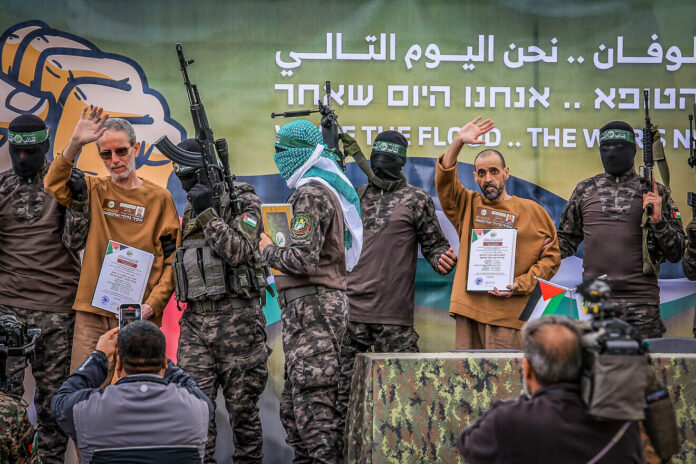
The latest example of this travesty—the least of what the kidnapped Israelis and foreign nationals have been subjected to during their captivity—was displayed on Saturday. Hate-filled Gazans of all ages, sporting Hamas’s signature green headbands, cheered while Eli Sharabi, Or Levy and Ohad Ben Ami were led to a podium and forced to put on a performance for jihadist propaganda purposes.

Hanging from the stage was a banner with the Hebrew phrase, “Total victory,” the vow-turned-slogan reiterated by Israeli Prime Minister Benjamin Netanyahu as the goal of the war. On each side were posters of “martyred” Hamas commanders. The graphic setup wasn’t merely an expression of ridicule; it also conveyed that the West is no match for enemies who glorify death.

The backdrop for the horrific scene of the emaciated victims, alongside their rifle-wielding brutalizers who shoved microphones and cameras in their faces, was a massive banner. It contained a fist and Palestinian flag next to a sentence in Arabic, Hebrew and English—the latter poorly translated—reading: “We’re the flood; we’re the day after.”

The first part of the boast was a reference to the Oct. 7, 2023 massacre, dubbed by its barbaric perpetrators and all those who celebrated it as “Operation Al-Aqsa Flood.”

The second alluded to Trump’s announcement on Feb. 4, during a joint press conference at the White House with Netanyahu, that the United States would be taking over Gaza and transforming it into a flourishing international hub.

The very idea of America’s playing any role in the “day after,” let alone assuming responsibility for the enclave run and inhabited by mass murderers, had never crossed anybody’s mind—least of all Hamas’s. But the organization must have taken seriously Trump’s earlier threat that “all hell would break loose” if the hostages weren’t released by the time of his Jan. 20 inauguration.

Though only three were freed a day before his swearing-in ceremony, it was the start of the “ceasefire” deal that Hamas had refused to accept until then. It’s an arrangement that even those Israelis who realize the concrete perils inherent in its fruition have come to view as a necessary pill to swallow. Few disregard the impossible situation foisted on the Jewish state by Hitler-emulating Islamists.

As Hannah Arendt wrote in The Origins of Totalitarianism, “Who could solve the moral dilemma of the Greek mother, who was allowed by the Nazis to choose which of her three children should be killed?”

To get a sense of Israel’s own moral dilemma, a description of three individuals in three different relevant categories is in order. Let’s start with the men who emerged after a year and four months in Hamas terror tunnels looking like Holocaust survivors.

Sharabi, 52, was abducted from his home on Kibbutz Be’eri, along with his older brother, Yossi, during the Hamas massacre. Unbeknown to him, his wife and two daughters, aged 13 and 16, were slaughtered that day, and Yossi was killed while in captivity. Returning to Israel dangerously thin, pale and obviously ill, he was confronted with the news of his annihilated loved ones.

Levy, a 34-year-old resident of Rishon Letzion, was abducted from the Nova Music Festival, where his wife, Eynav, was murdered inside a bomb shelter by a Hamas grenade—something he only discovered upon his return. The couple’s then-2-year-old son, Almog, was cared for by both sets of grandparents.

Ben Ami, 57, was kidnapped from Kibbutz Be’eri. His wife, Raz, who was also abducted, was released as part of a week-long ceasefire in November 2023. Like Sharabi and Levy, whose depictions of their cruel treatment at the hands of Hamas are coming to light, Ben Ami appeared as though he’d been in a concentration camp.

Another three men deserving of note—and honor—are Israel Defense Forces reservists Maj. Netanel Hershkovitz, Master Sgt. Ori Moshe Borenstein and Master Sgt. Tzvi Matityahu Marantz. Members of the 5460th support unit of the IDF’s 460th Brigade, they were killed on Oct. 10, 2024, in a Hamas ambush on their vehicle in Jabalia. Each had donned his uniform on that fateful Black Sabbath to fight for the country and search for the hostages.

Hershkovitz, 37, a resident of Jerusalem, was survived by his parents, six siblings, a wife and three children.

Borenstein, 32, from Moreshet in northern Israel, was survived by his parents, three siblings and a soon-to-be fiancée.

Marantz, 32, from Bnei Adam, was survived by his parents, two siblings, a wife and three children, the youngest of whom was born halfway through the war.

third triplet crucial to highlight is that of Wael Qassem, 54, Wassam Abbasi, 48, and Mohammed Odeh, 52—all Hamasniks from eastern Jerusalem with blood on their hands. Key players in the Second Intifada, they were convicted in 2002 and sentenced to multiple life terms for orchestrating some of the deadliest attacks on Israeli civilians, including the bombing at the Hebrew University in Jerusalem in which nine people were killed.

As part of the ceasefire deal, they were released from prison on Jan. 25 and exiled to Egypt, where their families intend to join them. A nice, neat happy ending for savages who are bound to reoffend at the glimpse of an opportunity. For them, there is no “day after”—only an ongoing campaign to repeat the Oct. 7 atrocities “again and again.”

On one hand, rescuing the remaining live hostages and retrieving the deceased ones for burial is a religious duty in Judaism. It’s also viewed by Israelis as an imperative, particularly considering the way in which Hamas took the military and political echelons by surprise, enabling the events of that fateful Simchat Torah holiday to take place at all.
On the other hand, hundreds of IDF soldiers risked their lives, and paid with them, to defeat the demons in Gaza, in addition to many others who lost limbs or became otherwise disabled. Israel cannot allow their sacrifice to have been in vain.
Nor can the victims of the nearly 2,000 terrorists to be let out of jail by the end of the first six-week phase of the ceasefire, in exchange for 33 of the hostages, be discounted. The pain of their loss is just as relevant to the debate as anyone else’s.

Which brings us to future targets of terrorist rape, arson, decapitation and abduction. Their faces aren’t on placards and T-shirts because we don’t yet know who they are. We can be certain, however, that it’s just a matter of time before we’re bemoaning their plight. Negotiating with Hamas, through Egypt and the terrorist state Qatar, guarantees it.

Despite having its capabilities severely weakened, Hamas still holds the cards that allow it to call critical shots. Hopefully, Trump’s sudden shuffling of the deck that his predecessor had stacked against Israel will lead to a return of all remaining hostages and the eradication of Hamas power.

Any other scenario—such as going through with the next two phases of capitulation—will encourage Hamas to believe in its mantra of “We’re the flood; we’re the day after.”
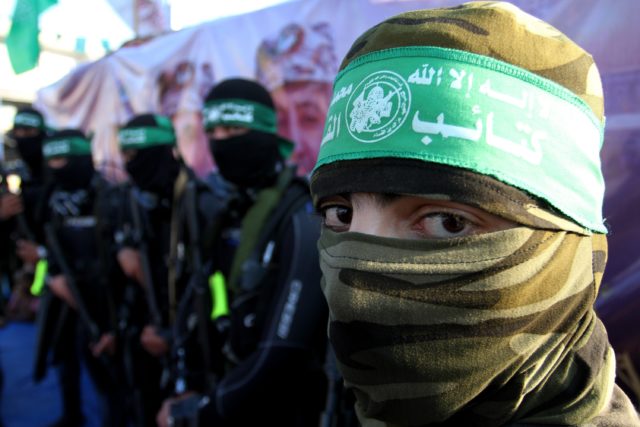
Can Hamas ever be defeated?

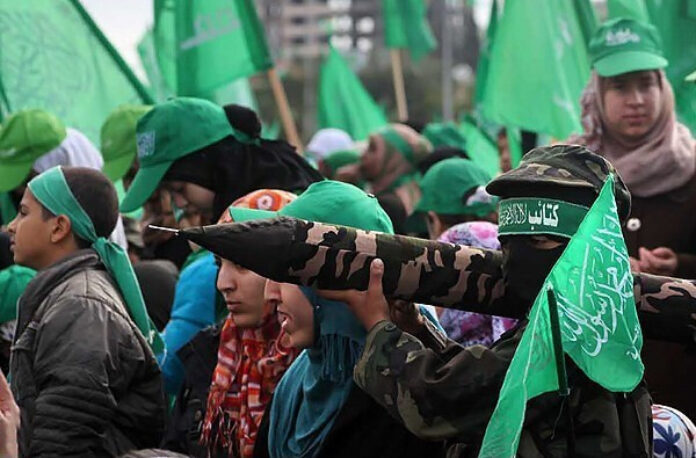
Palestinian members of the marine unit of the al-Qassam Brigades, the armed wing of the Hamas movement, take part in an anti-Israel parade in Rafah, in the southern Gaza Strip on July 13, 2015. Photo by Abed Rahim Khatib / Flash90 *** Local Caption *** çîàñ
òæä ôìñèéðé
ôìùúéðé
ôìùúéðàéí
îöòã
ðù÷
öåììðéí

No matter how many times it is vanquished or decisively discredited, ‘Palestinianism’ persists as an ideology unwilling to die. Rooted in Muslim Arab nationalism, it remains fundamentally opposed to the very existence of Israel – a Jewish, liberal, and free state. Hamas, one of its most notorious champions, has in recent weeks orchestrated a carefully staged spectacle as it releases Israeli hostages from Gaza. Masked gunmen stood triumphantly, their performance captured in high resolution by cameras that had somehow survived the supposed genocide. The message was clear: this was a moment of victory, a display of strength. Never mind that Hamas had suffered catastrophic losses – its military infrastructure shattered, its leaders eliminated, its people’s homes reduced to rubble. What mattered was the illusion that they remained unbroken.

Ideas, like nations, do not survive by accident

Donald Trump and Benjamin Netanyahu’s extraordinary press conference on Tuesday may signal the war’s end. But while Trump articulated a clear vision for what comes next, he has yet to outline a strategy for getting there. For now, Hamas remains in Gaza, parading hostages like trophies through the wreckage, ready to claim victory. How, then, can they ever truly be defeated? Destroying their military capabilities has not been enough. As long as their ideology endures, they can rebuild. The real challenge is not just dismantling Hamas as an organisation, but eradicating the idea that sustains it.

For 16 months, Middle East dilettantes have dismissed Israel’s military action as futile, insisting that ‘you cannot kill an idea’. Yet history suggests otherwise. Ideologies have been crushed – Nazism in Germany, imperialism in Japan – so thoroughly that they became objects of national shame. If this was possible, why does Hamas’ ideology persist?

After the second world war, Germany and Japan were not merely defeated; their belief systems were dismantled. Public trials, mass education, and historical reckoning imposed an ideological erasure. Germans were forced to confront the Holocaust. Japanese society renounced its imperialist past, with Emperor Hirohito publicly relinquishing his divine status in 1946. Shame became institutionalised, turning these ideologies into moral taboos.

But Hamas, and the broader political Islamic worldview, operates on a different foundation. For them, suffering does not provoke reflection – it reinforces their narrative of divine struggle. Death is not a failure but an honour. Humiliation does not lead to reckoning but to greater determination. Those who assumed that Hamas leaders would abandon their cause after seeing their people suffer fail to grasp a disturbing truth: for Hamas, every casualty is another step toward ultimate victory. Even the prospect of American rule in Gaza does not alter its status as Dar al-Islam (the Land of Islam), which, under their ideology, must never be ceded to non-Muslims. It must always be reclaimed by force.

This is why Hamas could stage the hostage release as a moment of pride. Immune to shame, they weaponised the event, transforming it into propaganda. Their military losses did not translate into ideological defeat. And while Hamas has proven itself impervious to collapse, the West appears determined to embrace its own. The irony is staggering: one ideology refuses to die, while another eagerly destroys itself.

Take Britain, for example – a nation that led the abolition of the slave trade, spread parliamentary democracy, and built one of the world’s most enduring legal and political systems. Yet today, expressions of national pride are met with suspicion. Marchers waving the Union Flag are often viewed as extremists, while those brandishing the PLO flag in London are labeled ‘social justice’ activists. Young Britons are encouraged to dwell on their country’s past sins rather than its achievements. The idea of Britain as a force for good is fading, replaced by a narrative of guilt and self-reproach.

Western societies have embraced the idea that shame is a necessary corrective – that confronting past injustices is the highest moral duty. In moderation, this can be healthy. Taken too far, it becomes self-destructive. Britain, like much of the West, has reached a point where its historical achievements are seen as embarrassments, its cultural identity something to be apologised for.

Hamas cannot feel shame. The West seems incapable of feeling anything else. Though early signals from Trump’s return suggest this may be changing, much of the West stubbornly drags its feet.

Ideas, like nations, do not survive by accident. They endure because they are defended – culturally, politically, and sometimes militarily. Hamas’ ideology persists because it is reinforced at every level: in schools, mosques, media, and through unwavering external support. It is constantly nourished. Meanwhile, Western ideals – free speech, democracy, national identity – are being systematically eroded from within.

A society that cannot defend its own ideas will inevitably be overtaken by those who can. Maximalist, antisemitic Palestinian leaders understand this. So do the ideological forces reshaping the West. But will Western societies realise it in time to fight back?

Can an idea be killed? History says yes. But it does not happen by accident. It requires a conscious, forceful decision to defeat, discredit, and replace what came before. If Western states recoil at the prospect of America imposing its will over Gaza, might they at least find the will to reclaim their own ideologies and societies?

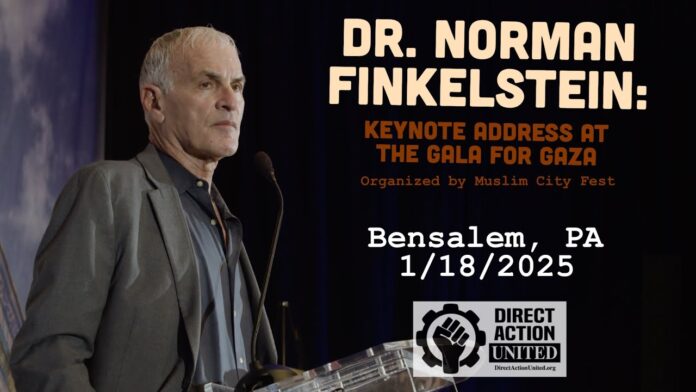
Video of Norman Finkelstein ‘speech’ at Bensalem Gala For Gaza 1/18/2025

Dr. Norman Finkelstein: Keynote Address at the Gala for Gaza Organized by: Muslim City Fest Speaker: Dr. Norman Finkelstein Event: Gala for Gaza Location: Bensalem, PA. Date: 1/18/2025

Advisers to families of hostages held in Gaza backed by Qatari funding

THE QATARI MONEY BEHIND ADVISERS TO FAMILIES OF GAZA HOSTAGES: Some of the families trying to free their loved ones held hostage by Hamas in Gaza are getting advice from individuals and entities that have received funding from Qatar, Daniel reports — an unusual arrangement given Qatar’s role as one of the chief mediators between Hamas and Israel and that the country is home to Hamas’ political leadership.

— As hostage families work to keep their relatives in the news and urge the Qataris to get Hamas to release them, a consultant working for the Qataris, Jay Footlik, has also met with the families in both Washington and Israel to prep them for their meetings with Qatari officials and also help organize them, according to two people familiar with the matter.

— Footlik’s consulting firm ThirdCircle Inc. has been registered under FARA since 2019 to help arrange trips to Qatar for American elected officials on behalf of the Qatari Embassy, which pays the firm $40,000 per month, according to filings with the Justice Department.

— Footlik, a former special assistant to former President Bill Clinton and liaison to the American Jewish community, told PI his work with the hostage families began because he had a long-standing relationship with Israeli businessperson Eytan Stibbe, who asked for his assistance since Footlik had relationships with Qatar.

— He said that he then contacted Qatari ambassador Meshal Al-Thani and asked if he would meet a relative of several of the Israeli hostages, Avichai Brodutch. Al-Thani immediately agreed and soon asked Footlik to help facilitate direct communication with hostage family members who wanted to meet with Qatari officials, he said.

— “Since that initial meeting with Avichai Brodutch, we have been working tirelessly, really around the clock, at the request of Israeli families being held to meet with Qatari officials, and I’m proud of the work that I’m doing. If it saves even one life, it’s all worth it,” he said in an interview. “The Qataris have been instrumental in working with the U.S., the Israelis and others to secure the release of the first 109 to come out, and I think it’s natural to come back to ask them to continue to use their relationships to try to bring everybody home.”

— The hostage negotiating group Richardson Center for Global Engagement, which the late New Mexico Gov. Bill Richardson founded, has also received significant amounts of money from Qatar. Mickey Bergman, the vice president of the center, has also been a frequent adviser to many of the families and has reportedly advised them to not criticize Qatar.

— The Richardson Center said the partnership began in Qatar with an initial contribution in 2019 of $900,000 that helped the organization increase its capacity and get more hostages home. That same level continued for 2020 before declining; the last donation was $250,000 in early 2023.

— “The Richardson Center is a nonprofit organization and works on behalf of families at their request and at no cost to them. Beginning Oct. 8, we’ve been approached by dozens of families to assist them in getting their loved ones,” Bergman said in an interview, adding that its relationship with Qatar had been disclosed and is “one of the pillars of our strategy about why we can help them.”

— One family member of a hostage said they’ve found Bergman — who is close to State Department hostage envoy Roger Carstens — to be very useful in working hard to advocate for their relatives’ release. The person also said that he’s been transparent about the center’s funding.

Happy Wednesday, and welcome to PI. Send lobbying tips: coprysko@politico.com. And be sure to follow me on the platform formerly known as Twitter@caitlinoprysko.

LOTS OF YELLING, LITTLE PROGRESS: “Senators lit into the CEOs of MetaXTikTokSnap and Discord on Wednesday morning, attacking them on their ability to keep kids safe from sexual exploitation online and drug sales on their sites — as well as the mental health impact of their immensely popular platforms,” our Rebecca KernRuth Reader and Mohar Chatterjee write.

— “By midday, however, the grilling had started to reveal the manifest challenges to any kind of fix. The apparent bipartisan consensus about the problem — both Republican and Democratic senators took aggressive shots at the companies — masks larger issues in Congress moving any kind of new rules forward. The industry has largely opposed any new laws aimed at protecting kids, and CEOs offered at best partial support for multiple bills currently stalled in the Senate.”

FIRST IN PI — ACCOUNTABLE LAUNCHES OVERDRAFT CAMPAIGN: Liberal watchdog group Accountable.US is coming to the defense of the Biden administration’s new proposal to rein in fees charged by banks for overdraft services. The group is launching a digital ad buy that begins tomorrow and will run through February criticizing the banking industry’s protestations of the proposed CFPB rule.

— The ads will be served up to smartphones, tablets and laptops within a certain radius of the Capitol and Union Station, and Accountable.US plans to project it onto the headquarters of the Consumer Bankers Association next week, urging viewers to “be a bank lobbyist’s worst nightmare” and read up on the practice.

— The ads will direct viewers to a landing page that highlights a recent report from Accountable.US in which the group found overdraft fees brought in at least $2.3 billion last year for the 10 largest banks who still charge them. The initial buy is five figures, but could expand, the group said.

FLYING IN: “The companies and crews digging ditches and laying fiber optic cable to expand the nation’s broadband networks are calling on Washington to address immigration reform in order to address a shortage of workers,” our John Hendel reports.

— “The Power & Communication Contractors Association will visit lawmakers and agencies in Washington, D.C., this week to make the case for legislation that would create a path allowing undocumented workers to help perform these key tasks. Twenty-five association members will be on the Hill to discuss the difficulties they’re facing in finding workers to build out the nation’s broadband network.”

— “Association CEO Tim Wagner told POLITICO he believes the U.S. is short by hundreds of thousands of workers needed for construction in the coming years,” a shortage that comes “as the Biden administration is set to dole out more than $42 billion in broadband infrastructure grants to all the states to support the buildout of internet networks,” on top of other projects.

— The trade group “will focus this week’s lobbying in favor of a bipartisan immigration bill called the Dignity Act, H.R. 3599 (118), which the group supports due to its provisions giving a path for undocumented immigrants to work in the country,” and will be “targeting meetings with Hill offices who have not co-sponsored the legislation, according to Wagner.”

PATAGONIA’S NEW PATH: “A little more than $3 million to block a proposed mine in Alaska. Another $3 million to conserve land in Chile and Argentina. And $1 million to help elect Democrats around the country, including $200,000 to a super PAC this month. Patagonia, the outdoor apparel brand, is funneling its profits to an array of groups working on everything from dam removal to voter registration,” according to The New York Times David Gelles and Ken Vogel.

— “In total, a network of nonprofit organizations linked to the company has distributed more than $71 million since September 2022,” an influx of giving made possible by “an unconventional corporate restructuring in 2022, when Patagonia’s founder, Yvon Chouinard, and his family relinquished ownership of the company and declared that all its future profits would be used to protect the environment and combat climate change.”

— “Patagonia and the Chouinards set up a series of trusts, limited liability corporations and charitable groups designed to protect the independence of the clothing company while distributing all of its profits through an entity known as the Holdfast Collective,” which received an initial dividend from the company of $50 million in 2022, and another, undisclosed sum, last year. “Each year going forward, Patagonia will transfer all the profits it does not reinvest in the company to Holdfast.”

— But “for a group that is distributing so much money, the Holdfast Collective has so far managed to remain largely under the radar, unknown to several philanthropy experts and Democratic fund-raisers who were asked about it.”

LIVE NATION DOUBLES ITS LOBBYING OUTLAYS: “Live Nation Entertainment more than doubled its federal lobbying spending to $2.4 million in 2023 from $1.1 million in 2022 as it navigated legislative and regulatory efforts to break up its power in the live entertainment and ticketing industry,” The Hill’s Taylor Giorno reports.

— “The lobbying blitz comes on the heels of the infamous Taylor Swift ‘Eras Tour’ presale that crashed Ticketmaster in November 2022, which prompted congressional scrutiny of the ticket vendor’s parent company.”

— “It’s no secret we’ve stepped up our advocacy efforts this past year. More than ever, Congress is focused on ticketing policies, and there is an unprecedented amount of lobbying going on by ticket resellers and competitors attempting to use legislation to protect ticket scalping and deceptive sales practices to advance their own competitive interests,” Dan Wall, Live Nation’s executive vice president of corporate and regulatory affairs, told The Hill.

IT COMPANIES LAUNCH NEW COALITION: A quartet of government IT stakeholders has launched a new coalition aimed at increasing competition and diversifying cloud providers and IT infrastructure used by the federal government. The Small Business Multi-Cloud Coalition comprises software providers Aretec and Westwind Computer Products and industry consultancies ATX Defense and Daston.

— The coalition wants the government to shift away from single cloud providers toward a multi-cloud approach that could help rivals (both big and small) compete with behemoths like Amazon Web Services and spark improvements and efficiency in cloud offerings. The coalition will also advocate for “harmonizing cybersecurity and risk management compliance while prioritizing modern cybersecurity strategies.”

SPOTTED: At Brownstein Hyatt Farber Schreck’s annual fundraising dinner for the NRSC at Altria’s D.C. office, per a PI tipster: Senate Minority Leader Mitch McConnell (R-Ky.), NRSC Chair Steve Daines (R-Mont.), Sens. Marsha Blackburn (R-Tenn.), John Boozman (R-Ark.), Bill Cassidy (R-La.), Susan Collins (R-Maine), Kevin Cramer (R-N.D.), Deb Fischer (R-Neb.), Bill Hagerty (R-Tenn.), John Hoeven (R-N.D.), Cynthia Lummis (R-Wyo.), Markwayne Mullin (R-Okla.), Pete Ricketts (R-Neb.), Mike Rounds (R-S.D.), Eric Schmitt (R-Mo.), Rick Scott (R-Fla.), Dan Sullivan (R-Alaska), John Thune (R-S.D.), Thom Tillis (R-N.C.), Tommy Tuberville (R-Ala.), Roger Wicker (R-Miss.) and Todd Young (R-Ind.); and Norm Brownstein, Will Moschella, Brandt AndersonRosemary Becchi, David Bernhardt, Geoff Burr, David Cohen, Steve Demby, Leah Dempsey, Bill Duhnke, Will Dunham, Emily Felder, Jon Hrobsky, Charlyn Iovino, Joe Jaso, Greta Joynes, Melissa Kuipers Blake, Marc Lampkin, Doug Maguire, Elizabeth Maier, Bill McGrath, Brian McGuire, Tripp McKemey, Lauren Mish, Travis Norton, Ed Royce, Preston Rutledge, Adam Steinmetz, Jon Towers, Mark Warren and Ari Zimmerman of Brownstein along with other friends and clients of the firm.

Hamxs’ Twisted Propaganda: Terrorists Forced Hostages to “Celebrate” Their Own Release

Weekly Commentary: Gazans Consider Israel, Not Gaza, Their Homeland

Here is a typical rant posted recently against relocating the Gazans from their disaster site to continue their lives in safety and prosperity.

“Their attachment is to the land, which they cannot relinquish, substitute,
or be compensated for. This is where they belong, where their ancestors lived and died, where their cultural heritage resides, and where they still dream of having a better and brighter future and living with dignity.”

Nice rant.

But clueless.

And also an insult to the Gazans.

Because when you claim that the Gazans are somehow devoted to living in Gaza you deny the devotion and commitment of the people of Gaza to “returning” inside Israel.

They don’t struggle to liberate Gaza; they want to “liberate” Tel Aviv.

And they make no bones about this.

The first step toward solving a problem is recognizing what it is.

And this time, it is easy – because the Gazans are telling us.

They’ve been brainwashed for generations to believe that their goal is to move into Israel after ridding it of the Jews.

And under the best of circumstances its going to take generations to cleanse the Ganza of this poison.

The world can spend billions of dollars building housing in Gaza, but as far as the Gazans are concerned, it’s temporary housing.

And if billions of dollars of temporary housing are demolished in the course of their next attempt to destroy Israel so be it.

Relocating the Gazans doesn’t deny their attachment to Israeli land.

But beyond providing them with a better life, relocation may also help initiate the long and arduous process of their de-radicalization.

A blueprint for sustainable peace: The White House and Middle East waters

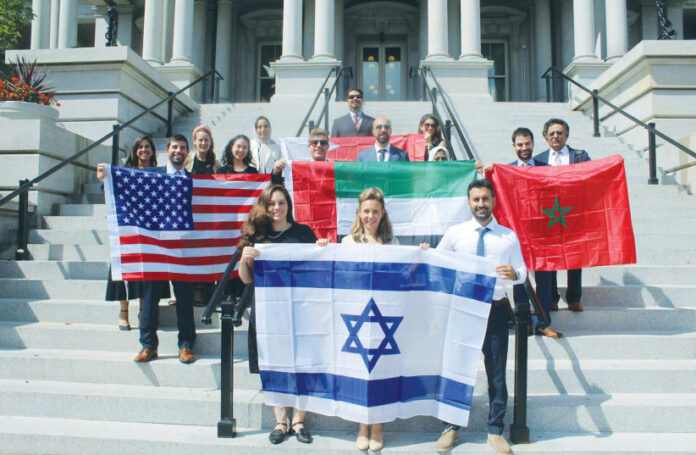
MEMBERS OF a delegation of young leaders from the Middle East pose on the steps of the Capitol in Washington, promoting the third anniversary of the Abraham Accords, just three weeks before the October 7, 2023 atrocities. (photo credit: ISRAEL-is and the American Jewish Committee)

In light of recent geopolitical shifts, including President Donald Trump’s pivotal meeting with Prime Minister Benjamin Netanyahu at the White House, followed by anticipated engagements with King Abdullah II of Jordan and President Abdel Fattah al-Sisi of Egypt, the Middle East stands at a critical crossroads. This meeting signals not just a realignment of strategic interests but also an opportunity to redefine the region’s approach to sustainable peace.

Beyond discussions of security realignments – such as the transfer of displaced Hamas-controlled Gaza populations and the strategic reassessment of territories in southern Lebanon and Syria – lies an urgent, often overlooked priority: regional water diplomacy. The Trump-Netanyahu dialogue offers a unique platform to spotlight this issue, emphasizing the intersection of environmental stability with geopolitical security.

Water diplomacy and civil diplomacy

Water diplomacy and regional sustainable tourism emerge as powerful methods of civil diplomacy, fostering connections beyond political agreements. They cultivate grassroots cooperation, mutual respect, and a shared commitment to environmental stewardship.

Israel must seize this moment to champion the next phase of the Abraham Accords, advancing a vision of sustainable peace rooted in environmental cooperation. The shared water sources of the Middle East – the Tigris, Euphrates, Nile, Jordan, and the Dead Sea – are in critical decline. These biblical lifelines are under threat from overextraction, pollution, and climate change, exacerbating regional instability. According to the United Nations, the Middle East and North Africa are the world’s most water-stressed regions (UN Water Report, 2021).

A model for regional cooperation

With the support of the current US administration, Israel and the Abraham Accords nations can establish a global model for regional civil diplomacy. Environmental stewardship, water conservation, and sustainability are universal values that transcend political boundaries. My global work in sustainable tourism demonstrates how cross-border environmental projects and leadership programs cultivate genuine peace through mutual respect and shared purpose.

Trump’s meeting with Netanyahu reflects the potential for US-led diplomatic efforts to extend beyond traditional security concerns and address foundational issues like water security. Integrating water diplomacy into the Abraham Accords framework could foster deeper ties among signatory nations while setting a precedent for future agreements.

Saving the Dead Sea as a regional model

Now is the time for decisive action to protect and restore the region’s most vital water bodies, particularly the Dead Sea, which has been shrinking at an alarming rate of over one meter per year (Geological Survey of Israel, 2022). The first focus must be saving the Dead Sea within its regional context, transforming it into a positive symbol of regional cooperation.

This model case can reflect broader efforts to manage major Middle Eastern water sources, advancing water management, innovation, conflict resolution, and sustainable tourism.

The Dead Sea requires freshwater – not saltwater – to sustain its levels. Success in regional water management to save the Dead Sea will not only halt its decline but also provide solutions for water-scarce populations across the region. Effective management of the Dead Sea’s water sources can serve as a proof of concept, demonstrating how cooperation over shared resources can meet both environmental and humanitarian needs.

A comprehensive regional strategy must prioritize the rehabilitation of the Jordan River and its key tributaries – the Yarmouk River in southern Syria, the Arnon River (Wadi Mujib) in Jordan, and other essential streams, including the Degania Dam at the Sea of Galilee, another critical water source for the Jordan River (Israel Water Authority, 2023).

This vision calls for Israel, alongside its global water management expertise, to collaborate with more MENA countries under the US administration’s guidance. The Abraham Accords can evolve into “Abraham Accords 2.0,” where nations sit around the same round table, advancing shared environmental goals through civil diplomacy.

Key measures for sustainable peace:

1. Restoring natural water flow: Enforce the removal of unauthorized water pumps – estimated at around 1,000 on the Jordanian side – to allow the Jordan River’s natural course to replenish the Dead Sea.

2. Desalination and water security initiatives: Jordan’s acute water scarcity demands immediate solutions. Constructing a large-scale desalination plant in Aqaba will provide sustainable drinking water, reduce Jordan’s dependency on Israeli water resources, and foster regional cooperation to save the Dead Sea (Jordan Ministry of Water and Irrigation, 2023).

3. Sustainable water management in Syria: The Syrian civil war, partly fueled by water mismanagement, highlights the dire consequences of environmental neglect. Overextraction of groundwater led to widespread drought and mass displacement, intensifying conflict. The Yarmouk River in southern Syria should be proclaimed by Israel and managed through regional cooperation, opening an environmental diplomatic arm with any Syrian governing regime. Regional cooperation can support sustainable water solutions as part of broader stabilization efforts.

4. Invest in sustainable tourism: Governments and private sector stakeholders should collaborate to develop ecotourism initiatives that highlight the region’s natural and cultural treasures while promoting conservation.

5. Strengthen people-to-people diplomacy: NGOs and civil society organizations play a crucial role in fostering people-to-people connections. Their work should be supported and expanded to build a sustainable infrastructure for peace.

Water, peace, and the promise  of Abraham Accords 2.0

The Abraham Accords represent an unprecedented opportunity to integrate water diplomacy and regional sustainable tourism into peacebuilding frameworks. Joint initiatives in water management, environmental education, and sustainable tourism can nurture a culture of shared responsibility. This transcends politics – it is about securing the future for hundreds of millions who depend on these precious resources.

Regional leaders must act with urgency and vision, transforming water from a source of conflict into a catalyst for cooperation. The Trump-Netanyahu meeting at the White House underscores this potential, offering a rare diplomatic opening to position water diplomacy and regional sustainable tourism as cornerstone civil diplomacy methods for lasting peace. The Abraham Accords have opened the door – now it is our responsibility to step through, guided by the conviction that water, the essence of life, can also be the foundation of enduring peace.

The writer is a photojournalist, conservationist, and the founder of the Dead Sea Revival Project and MENA Ecotourism.

Inevitability

“The future is not inevitable. We can influence it, if we know what we want it to be.”

This piece of wisdom by an Irish philosopher is particularly relevant given current circumstances.

Unrelenting demonization of Israel over a long period of time has inevitably sown the seeds of noxious perniciousness so prevalent in international forums. Failure to tackle the root causes of this malevolent manifestation has resulted in an out-of-control overflow into Jew hate.

Incitement against Jews, of course, existed well before Jewish sovereignty was re-established. Haters always had and still have plenty of reasons to target Jews, but the daily doses of condemnations against the Jewish State have empowered a wider and growing number.

When those engaged in nefarious activities see the weak and pathetic responses of Governments and law enforcement authorities they become ever more emboldened. In regimes where democracy is fiction and anti-Israel policies are official, the continual drip feed of poisonous propaganda endangers Jewish communities. In countries where Jews no longer live the scourge of hate still lingers.

Add in the rising tide of jihadist extremism and you have a perfect toxic brew. Authorities’ reluctance to face up to this spells trouble.

Once upon a time, Judeophobia was the exclusive preserve of Christian Churches and theology. Then, it morphed into extreme right-wing movements combining secular enmity with lingering religious dogma. Concurrently the rise of Islamic militancy resulted in targeting “infidels” which also encompassed Jews and Christians. At one stage, liberal socialists were staunch supporters of the rights of Jews and Zionism. Increasing numbers of them nowadays have been seduced by the virus of Jew, Israel and Zionist hate.

What we face today is a broad coalition of left and right, secular and religious, all united in their campaigns of delegitimization.

True, we do have staunch and devoted supporters who speak up on our behalf and fight for truth and historical justice. Unfortunately, their voices are often drowned out by the raucous rhetoric of the rabble and the double-speak responses of politicians.

At the end of the Second World War, some Nazi war criminals were put on trial. A few were hanged, while others were sentenced to imprisonment. They were gradually released over a period of time. Many of the worst murderers escaped with the help of the Vatican “rat line” to South America, where most lived out their lives unmolested, never having to face justice. Eichmann was an exception, and his capture by Israel unleashed a torrent of anti-Jewish hate.

Meanwhile, large numbers of those complicit in the Shoah genocide were, after the war, granted admission to various countries as “refugees.” Australia was a desired destination where awkward questions about past deeds did not prove an impediment for admission. Renowned Nazi hunter, Efraim Zuroff, spent his entire career exposing these fugitives from justice who had found a safe haven in these countries. A few, only a pitiable few, were extradited or put on trial.

The collective abdication of any sort of moral responsibility by host countries did not go unnoticed. No doubt today’s neo-Nazi arsonists and graffiti daubers feel safe in the knowledge that they can get away with their crimes.

I listened on YouTube to the speeches made by invited guests at the Holocaust Remembrance Day event hosted at the NZ Parliament. A universal theme was the urgent and vital need to educate the next generation about the horrors and lessons of the Shoah. Hearing this being expounded by NZ politicians made me wonder why, after all these years, Holocaust studies are still not a compulsory part of high school history curricula. It is all very well to say the same thing year after year but unless those in charge actually mandate a serious study of the history of those events nothing will change.

As in the past, successive generations of teenagers will inevitably remain clueless and susceptible to believing each and every lie and historical revisionist fable.

In recent years, great strides were made in interfaith activities whereby many of previous generations’ slanders against Jews and Judaism were finally laid to rest. It has not been an easy or untroubled journey and there have been some significant set backs. I think for example of the NZ Anglican Church’s decision in 1988 to expunge the words Zion and Israel from their Book of Psalms. This purging, in effect, conveyed a message to the Anglican masses that henceforth, Jews were written out of their ancient connection to the Promised Land.

The inevitable result has been a significant drift to anti-Israel rhetoric in the mainstream denominations and the World Council of Churches.

The Vatican only reluctantly recognized Israel in 1993. Its belated acceptance of the Jewish State’s legitimate existence has been half-hearted at best. In 2013, it recognized Palestine as a country despite clear evidence that those in charge deny any Jewish historical connection to Israel. Since the horrendous pogrom of 7 October 2023 by Hamas, the current Pope has condemned Israel’s campaign against terror.

Since 7 October, the chorus of condemnation against Israel from non-Evangelical denominations has escalated. Years of interfaith work have been destroyed in many communities because of reluctance to stand up to increased revisionist agendas.

This is the inevitable corollary of tampering with sacred texts, succumbing to woke political policies and surrendering to the rising tide of jihadist violence.

A perfect example of how a refusal to tackle historical revisionism results in ever-increasing outraged narratives was recently demonstrated.

A map downloaded by the Arabic language account of the Israeli Foreign Ministry showed the Biblical boundaries of the Kingdoms of Israel and Judea. The accompanying explanation stated, “Did you know that the Kingdom of Israel was established three thousand years ago?”  It then goes on to portray the Biblical accounts of Kings Saul, David and Solomon as well as the partition of the territory to the Northern Kingdom of Israel and the Southern Kingdom of Judea. What follows is a description of their respective destruction and exile by the Assyrian and Babylonian empires.

The post concludes: “However the Jewish People in the Diaspora continued to look forward to the revival and rebuilding of their state.”

Every student of history knows that these are verifiable facts and that the events described took place well before the advent of Christianity and Islam.

Nevertheless this Foreign Ministry posting initiated a whirlwind of hysterical hypocrisy from those described by the international community as “peace partners.”

The Jordanians huffed and puffed: “We condemn in the strongest terms the maps of the region claiming that they are historical for Israel, including parts of the occupied Palestinian territories, the Hashemite Kingdom of Jordan, Lebanon and Syria. The Kingdom rejects these policies and provocative statements that aim to deny the Palestinians’ right to establish their independent and sovereign state.”

In case that message was not clear enough, the Speaker of the Jordanian Parliament claimed “the maps express a criminal mentality and malicious ambitions that cannot be ignored or tolerated.”

For good measure, a Palestinian Authority spokesperson added, “we denounce the alleged map fabricating an Israeli history dating back thousands of years in line with the Hebrew allegations. This behaviour constitutes a flagrant violation of all international legitimacy resolutions and international law. These extremist Israeli policies are what ignited the region and led to the wars we are currently witnessing.”

What followed was a stunning silence from all those who aid and abet the delegitimizers of Israel.

Not a peep from the World Council of Churches, interfaith groups and the Vatican about this brazen denial of Biblical historical facts.

Nary, an outraged rebuttal, was forthcoming from the UN and the EU.

One can assume that all those countries who religiously vote to condemn Israel and deny its legitimacy find nothing amiss. After all, their acquiescence to condemnatory resolutions at the UN and its associated bodies endorses the fallacious lies of Abbas and his Islamic colleagues. Their silence is an endorsement that Judea, Samaria and Jerusalem have nothing to do with Jews or Judaism.

This collective silence speaks volumes and explains why the inevitable fallout is becoming so lethal and widespread.