After Knesset Bans UNRWA for Terrorist Ties, Israel Says Other UN Agencies Can Do Its Work

Since October 7th, 2023, the world has come to see the United Nations Relief and Works Agency (UNRWA) in a new light. The evidence of its direct collaboration with terror groups such as Hamas and Islamic Jihad raises the question: if UNRWA were to be dismantled entirely, who would do the work?

The site at a bomb shelter on the Gaza perimeter has been called a massacre within a massacre. That day, on October 7th, Hamas terrorists murdered 16 Israelis hiding in the bomb shelter after fleeing the Nova Music Festival. They also kidnaped several others, including Israeli American Hirsh Goldberg-Polin. In addition to being with Hamas, the man leading that part of the massacre had another job – working for UNRWA.

IDF Chief Spokesman Rear Adm. Daniel Hagari explained, “Mohammed Abu Itiwi was a Nukhba commander in the El Bureij Battalion of Hamas’s central camp’s brigade. He has also been employed by UNRWA since July 2022.”

Israel’s Minister of Diaspora Affairs and Immigration Amichai Chikili told CBN News, “You have employees of UNRWA who were leading the massacre.”

A report from Chikili documents those employees who took part in the October 7th massacre. He told us Hamas’ infiltration of the agency has been widespread.

“The entire system – because Hamas is in power – so, if you want to be an UNRWA employee with a very nice salary, you must be related to Hamas,” Chikili explained.

He added, “So UNRWA employees in Gaza were mainly all Hamas militants or Hamas civil organizations’ personnel, or the families of Hamas militants and members. If you’re not connected to Hamas directly or indirectly, you cannot work in UNRWA in Gaza.”

Evidence of this relationship is why the Knesset recently overwhelmingly passed a law that Israel divorce itself from UNRWA.

Boaz Bismuth, a Likud member of the Knesset, declared, “Just understand again the spirit of the bill. We have nothing against the international community, against foreigners, against the idea of humanitarian aid. This is what Israel is providing. It’s about the fact that UNRWA participated in the massacre on the 7th of October.”

After the vote, UNRWA claimed the law would be disastrous.

UNRWA director Philippe Lazzarini complained, “Today, millions of Palestinian refugees fear that the public services on which their lives depend will soon disappear. They fear that the children will be deprived of education, that illnesses will go untreated, and that social support will stop. 17,000 UNRWA personnel in the occupied Palestinian territory fear that they will lose their employment. The entire population of Gaza fears that their only remaining lifeline will be cut.”

Bismuth, who co-authored the Knesset legislation, disputes those claims.

“There will not be a vacuum because, just because they (UNRWA) were helping yesterday, doesn’t mean someone else cannot do the job tomorrow,” Bismuth countered. “The job will be done, because I will ask you the same thing in Gaza. You can tell me, you know, Hamas is reigning in Gaza. I mean, you kick them away so who will control? Someone else. It’s as easy as that, and it will be found. Other people can do it and will do it – and will do it beautifully – without being (a) terrorist.”

Chikili’s report cites how UNRWA has perpetuated the Palestinian refugee problem for generations.

“The fact that we have an entity solely for Palestinian refugees that can inherit (this) status to their kids, grandchildren, and great-grandchildren, creating more and more refugees every year. And then you have the rest of the world, UNHCR (U.N. High Commissioner on Refugees) entity, that is for any other refugees in Africa or Asia, or Haiti – it doesn’t matter,” Chikili explained.

His report contrasts UNRWA and the UNHCR overseeing 5.9 million refugees. UNRWA employed 30,000 workers in 2023. That same year UNHCR employed 18,000 while overseeing 59 million refugees worldwide. Chikili says the difference goes even deeper.

“The UNHCR is not an ideological entity related with the war against the State of Israel, and UNRWA is part of a war. It’s a war machine; (It) was designated to train the Palestinian younger generation for jihad. That is the reality. And also, when you go physically, and you go and you see in schools of UNRWA, in so many cases beneath the schools you have tunnels, within the schools you have ammunitions and missiles and weapons,” Bismuth said.

It’s why many in Israel want UNRWA abolished and support UNHCR to take its place. But, in a statement, UNHCR told CBN news:

“As we, with other U.N. agencies have previously warned, UNRWA is the only entity with the capacity to deliver the scale and breadth of assistance that 2.2 million people in Gaza, and millions of other Palestinians in the West Bank, Lebanon, Syria and Jordan need. As the U.N. secretary-general has stated, there is no alternative to UMWRA.”

Yet, critics cite that UNRWA’s most lasting and infamous legacy is its education system. Many principals of UNRWA schools in Gaza were also Hamas members. ChIkilI says it takes a village to raise a terrorist, and that UNRWA helped teach a genocidal ideology.

“This is the Palestinian ideology. It is UNRWA’s ideology,” Chikili insisted. “And, by the way, is also very, very important to understand the jihadist ideology to train the kids to hate – anti-Semitism – to teach them that the war against the Jews and killing the Jews, that is the most important thing on earth. And this is also a part of what we saw on October 7th.”

Under the Biden administration in 2023, the U.S. became UNRWA’s largest donor. In Donald Trump’s first administration, he ended the agency’s funding. Most here hope, that when he takes office in January, he will act quickly to do so again.
UN Watch: Former UNRWA chief hailed ‘spirit of partnership’ in meeting with terrorists

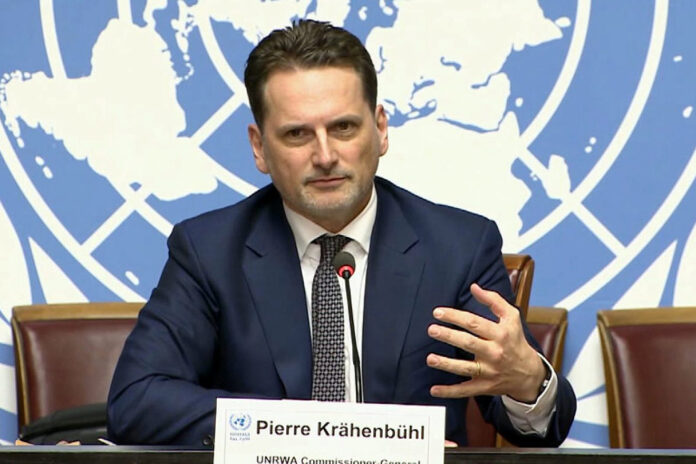
Former United Nations Relief and Works Agency (UNRWA) Commissioner-General Pierre Krähenbühl repeatedly met with senior members of Hamas and other Palestinian terror groups, expressing the U.N. agency’s willingness to work together in the “spirit of partnership,” Geneva-based watchdog group U.N. Watch revealed over the weekend.

Krähenbühl, who led the controversial U.N. agency until his resignation over misconduct allegations in 2019, attended a gathering of Palestinian terrorist leaders in Beirut on Feb. 12, 2017, according to the watchdog.

The former UNRWA boss, as well as the agency’s former Lebanon chief of staff, Hakam Shahwan, who similarly resigned following allegations of corruption, posed for a picture with senior terrorist members of Hamas, Islamic Jihad and the Popular Front for the Liberation of Palestine.

The gathering included Ali Baraka, who heads Hamas’s relations abroad and was recently indicted by the U.S. government for “heinous crimes” related to the Oct. 7, 2023 massacre, including conspiracy to murder Americans and to use weapons of mass destruction resulting in death.

Another participant in the Beirut meeting was Abu Imad al-Rifai, the representative of Iranian-backed Palestinian Islamic Jihad in Lebanon. U.N. Watch noted that Al-Rifai boasted about sending a wave of suicide bombers to Baghdad in 2003 to murder American and British troops.

Krähenbühl was said to have told the gathering of terrorists, “Regarding the principle of partnership you mentioned, and the necessity of being proactive so that we remain cooperative and not caught off guard, I completely agree with you and strongly support this perspective. I also have a request: that the spirit of partnership be mutual.”

He continued, “If you have any criticisms, observations, concerns, or issues you are dissatisfied with regarding UNRWA, let us come back and meet in similar gatherings—even if we meet a thousand times.

“Challenge our decisions, tell us, ‘We do not agree with this decision, and we criticize it.’ We might change it or even entirely tear it up. But we want the spirit of partnership to prevail in our meetings,” he stated.

According to the former UNRWA chief, “We prefer these discussions not to be public, as that could challenge our credibility. More importantly, it could lead to a loss of trust between donor countries and UNRWA, which might result in reduced or even halted funding.”

Krähenbühl reportedly concluded his remarks by reiterating that “if we can achieve this, it means we are united, and no one can separate us.”

U.N. Watch said that UNRWA has continued to meet covertly with terror operatives after Philippe Lazzarini took over when Krähenbühl left the agency to lead the International Committee of the Red Cross in 2019.

The Israeli government has long criticized UNRWA’s operations in the Gaza Strip as controlled by Hamas. That criticism sharpened after Oct. 7 and revelations that UNRWA employees took part in the mass slaughter.

Israel terminated relations with UNRWA on Nov. 3, a week after the Israeli parliament, by a vote of 92 to 10, passed legislation on Oct. 28 banning the organization’s operations in the Jewish state’s territory.

In July, the Israeli Prime Minister’s Office slammed UNRWA after Jerusalem’s Foreign Ministry published more evidence that the aid agency is employing hundreds of Hamas and Islamic Jihad terrorists.

“Israel has told donor countries that hundreds more of UNRWA’s 13,000 local staff are active Hamas terrorists,” PMO Public Diplomacy Directorate spokesman David Mencer told reporters.

“We have provided much evidence that UNRWA works hand-in-hand with Hamas,” Mencer added, referring to the Hamas server farm found under UNRWA’s Gaza headquarters, the UNRWA staffers who took part in the Oct. 7 massacre and the tunnels underneath UNRWA schools.

“UNRWA is useless at aid distribution. UNRWA is useless at education, except glorifying suicide bombers and encouraging Jew-killing, and Israel sees no role whatsoever for UNRWA in Gaza after this war ends,” he concluded.

Advice soug​ht. Without typos; How to cope with the backstory of the ICC steps against

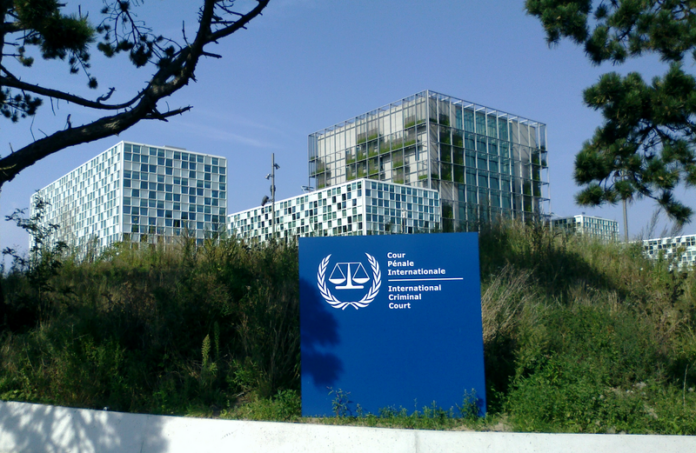
What people may not know: Americans for Peace NowThe New Israel Fund,The Israel Policy Forum, The Middle East Peace Foundation and J St Instigated a strategy to weaponize  the ICC- The International Criminal Court –  against Israel. 
 
These are the  same organizations that handed over lists of Jews who are cituzens of Israel to be sanctioned by the US government.
 
Question:
 
Since  Americans for Peace Now signed an MOU with the Conference of Presidents of Major Jewish Organizations that they will not  undermine  Israel as a condition to join the conference, what steps will  the conference take?

Resist or roll over

This is the dilemma faced by Jews since time immemorial when faced by threats whether physical or verbal.

Resisting hateful acts can take several forms. Depending on the situation, verbal confrontation and rebuttal of untruths can many times prove very effective. There is nothing more effective in demolishing slanderous canards than exposing them to the strong light of ridicule and reality.

Unfortunately we find these days that there is a scarcity of individuals ready, willing and able to step forward and expose their thoughts to public scrutiny. Often the responses are ineffective, given today’s preference in many circles for political correctness and an aversion to exposing political duplicities.

The tendency by some establishment organizations to suppress more robust responses discourages those who possibly could bring a clearer message of resistance.

Unsurprisingly, the mainstream media is complicit in censoring and banning vigorous responses to anti-Israel and anti-Jew items. This is where social media is a help although the downside is that it is also infested with the vilest followers.

When is it preferable to resist or roll over and hope that the problem will disappear?

This is a question which has plagued Jews over the millennia.

This conundrum faced the New Zealand Jewish communities,

I recall, some fifty-four years ago. At that time, there was no Israeli Embassy, and a gap existed in presenting any meaningful response to anti-Israel activity. Thankfully the communities were blessed with dedicated individuals who were not only very active in Zionist outreach but also very willing to stand up and be counted.

Thus, despite the absence of an Israeli diplomatic presence the establishment of an embryonic group enabled some sort of effective counter responses to emerging disinformation. There was no question of “rolling over.” On the contrary each and every lie was challenged.

I was asked to fly to Christchurch in order to attend a public meeting which was being addressed by an academic from Canterbury University. This gentleman’s theme song after the 6-Day War was similar to the current slanders being thrown around, namely that the wicked Israelis (i.e. the Jews) were guilty of every conceivable sin known to humanity. My task was to ask him some awkward questions.

Fortunately in those days there were no brainwashed students and therefore the assembled audience consisted mainly of locals and a couple of newspaper reporters. The chairman announced that limited questions would be allowed at the end of the presentation.

The speech accompanied by slides followed a predictable course. It was laden with untruths, half-truths, and, needless to say, a skewed and tendentious version of the Zionist movement. It was obvious that the audience was lapping up this distorted historical exercise because they were so mesmerized by the speaker’s eloquence that, at the end, they enthusiastically applauded. Nobody other than myself stood up to ask any questions.

I knew that I had a very limited time to make my points before the axe would fall. Therefore I launched into my rebuttal by exposing patently false accusations and questions as to the veracity of his conclusions.

As expected, the chairman intervened and declared me out of order, thus excusing the speaker from answering any of my challenges. However, it was obvious that some members of the audience had second thoughts, and this was confirmed when I met some of them over tea and biscuits and managed to enlighten them.

A subsequent short newspaper report was buried on an inside page and of course failed to mention question time. There was no social media, whatsapp or mobile phones to record proceedings in those days.

Was the whole exercise worth it?

I believe so because we thought that each and every lie needed to be confronted. Those propagating anti-Israel libels had to know that their efforts would always be exposed and that there never would be an occasion when the Jews “rolled over” and gave up.

Today’s runaway tsunami of hate requires counteraction without compromises.

Surveying the current scene it is obvious that this is still not occurring.

In far too many situations a reluctance to tackle outrageous rhetoric leaves an impression of weakness and surrender to the forces of ignorance and deliberate deception.

For far too many years, Abbas, the lifetime President of the corrupt PA, has been allowed to get away with incitement to murder and patently false assertions. This has resulted in him being crowned by the UN as a saint of peace and deserving of hymns of praise. A lack of will by Israeli political leaders and Diaspora spokespersons to divorce themselves from the fatal illusion of an Arab terror State has meant that Abbas and his colleagues can continue to peddle it.

Recently, Abbas repeated what has become standard fare for all Israel haters. He said that “Israel is a colonial project of the USA.” What was the reaction of the Biden Administration and the EU? Sending him and his corrupt outfit more money seems to be their default reaction. I discerned no outrage from any democratic member of the UN nor did I hear condemnatory retaliation from the usual Jewish groups.

Quite often, we manage to score spectacular “own goals.”

Take the recent visit to the Vatican by some returned hostages and their families as an example of an exercise in futility. I understand that desperate families need to do whatever they can to bring the plight of their loved ones to the attention of an indifferent world. However, as soon as a photo of the Pope blessing them was published I sensed that this could turn out to be a public relations debacle. Some may believe that Jews receiving a pontifical benediction is inspirational but anyone with knowledge of the Vatican’s dubious relationships with Jews and Israel would be wary.

My forebodings were immediately vindicated because soon after this meeting it was revealed that in a book written by the Pope he states that an investigation must be undertaken to see if Israel’s actions in Gaza meet the criteria for genocide. No condemnation of Hamas and demand for an unconditional return of the hostages.

I waited in vain for outraged responses and demands for retraction of this latest blood libel. The lack of meaningful denunciations by Israel, Diaspora Jewish groups and rabbinical representatives conveys a message. It says that you can defame us as much as you want and we will obligingly “roll over.”

At the Irish Remembrance Day Sunday service attended by the Irish President, the Anglican Canon, in his sermon, accused Israel of “deploying master race theories.”  No protest from the President or other attendees was forthcoming. This should come as no surprise because Irish school history textbooks describe Auschwitz as a “prisoner of war camp” and claim that “Jesus was a Palestinian.”

Israel had already withdrawn its ambassador from Dublin over previous such incidents. This latest outrage has caused nary a ripple, thus confirming to the propagators that they can slander Israel and Jews without any dire consequences.

President Macron issued another one of his “pearls of wisdom” when he declared that “Israel was sowing barbarism.” He then expressed surprise when sectors of French society target Jews on the streets of cities and towns. Once again this piece of Gallic chutzpah and hypocrisy attracted only muted outrage.

A Fatah/PLO spokesperson told the media that “what happened in the Netherlands is the best proof that the world is sick of the Jews.” This was reported by PMW (Palestine Media Watch) but ignored by most everyone else. Not a peep has been heard from Washington, London, Canberra or Wellington. Amsterdam’s mayor, in fact, denies that a pogrom took place, thus downgrading the violence against Jews as merely an act of civil hooliganism by unknown persons.

There are countless other examples of how taking the line of least resistance has become the default position these days.

Hushing up, rolling over and not making waves are failed strategies.

It’s time to get serious and fight back.

Israeli archeology giant killed after joining troops in Lebanon

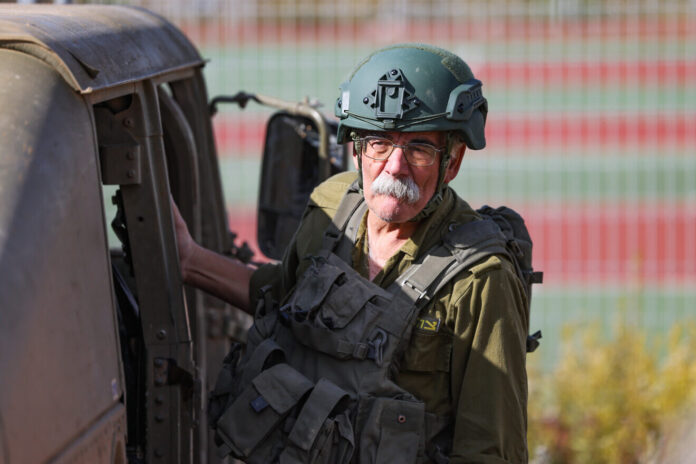
A distinguished Israeli scholar met a tragic end during an exceptional incident in Lebanon. Zeev “Jabo” Ehrlich, 71, was killed in an encounter after crossing into Lebanon with Golani Brigade forces while researching an ancient fortress. His family has been notified of his passing. It was unclear how he became embedded with the troops. Another soldier was killed in the incident, which is still being investigated.

Ehrlich stood among the leading authorities in the study of Judea and Samaria. As one of the founders of the Ofra Field School, he edited two influential book series focusing on the region. His scholarly legacy includes numerous academic publications and a weekly column in the Sabbath supplement of Makor Rishon.

Gush Etzion Council Head and former director of the Kfar Etzion Field School Yaron Rosenthal paid tribute to settlement pioneer Zeev (Jabo) Ehrlich: “Our hearts still struggle to comprehend the devastating loss of our dear friend Zeev ‘Jabo’ Ehrlich. Jabo was among the pioneering generation of tour guides and scholars of Judea and Samaria. Our generation followed his path and drank in his wisdom with unquenchable thirst.”

“Throughout his decades of work, he guided, researched, and, with boundless curiosity, strived to explore every corner and examine every archaeological site. Few scholars in the field possessed his level of passion or demonstrated such complete devotion to the land. Personally, Jabo was not just a mentor but a friend, and over many years, I learned invaluably from him. His absence will be deeply felt. We must now endeavor to follow the monumental legacy he leaves behind.”

Just two weeks prior, this reporter encountered Ehrlich in Nablus. Accompanied by Samaria Regional Brigade forces, we visited Joseph’s Tomb and continued to Tel Balata. At this historic site, Ehrlich identified it as the probable location of the biblical ceremony of blessings and curses. During our drive through the city, Ehrlich shared discoveries about ancient catacombs as our vehicle slowed to observe the site. “I visited Nablus in my childhood when one could wander here before the existence of walls and fences,” he recalled.

Ehrlich personified the essence of Israel’s historical scholarship. Equipped with a headlamp and Bible in hand, he would illuminate the ancient and sacred history of sites for IDF and Shin Bet personnel with characteristic expertise and passion.

Water diplomacy during the Abraham Accords: Building trust through shared resources

As interest grows in expanding the Abraham Accords following Donald Trump’s election, it’s crucial to consider how water diplomacy can serve as a tool for trust-building and cooperation in regions affected by historical conflicts.

Our journey from rainy Seattle to the dry landscape of Lake Havasu, Arizona, highlighted these themes. My wife, Adi, and I were invited by Pastor Ryan Speakman to share our experiences with communities in this beautiful lakeside city on the Arizona-California border.

During our visit, we explored the critical issue of water – a shared concern over dwindling resources in areas marked by drought, rapid population growth, and the urgent need for sustainable solutions.

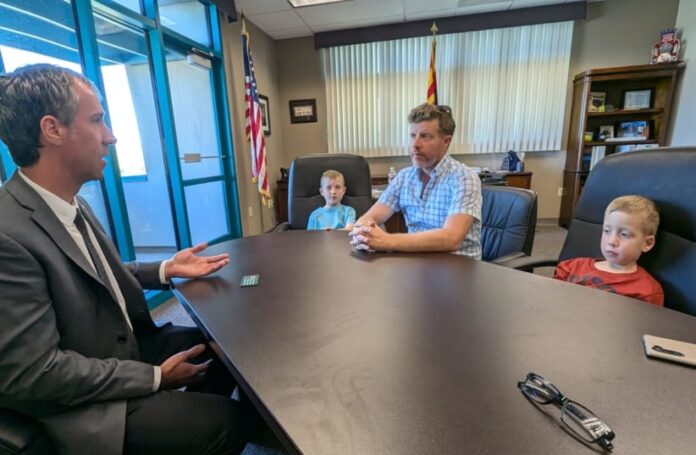
One highlight was a family gathering with Mayor Cal Sheehy, who expressed admiration for Israel’s water innovations and interest in similar approaches for Arizona’s 20-year drought. Lake Havasu’s water, drawn from the Colorado River, serves 35 million people across the Southwest, making sustainable water management a pressing need. Our conversation was a meaningful exchange on ways the US and Israel might work together to address shared water challenges.

We also visited Parker Dam, a place with a rich history in water diplomacy. Ninety years ago, Arizona’s National Guard was stationed at Lake Havasu to protect water rights from California – a powerful reminder of the lengths communities go to secure water, even among allies.

A global issue

Water challenges in the American Southwest echo issues faced by Israel with the Jordan River, Sea of Galilee, and Dead Sea, as well as across the Middle East’s historical rivers, which are rapidly drying up. Both regions face severe water scarcity and growing populations amid shrinking supplies, emphasizing a shared goal: finding sustainable solutions on local, regional, and global levels.

Water, as a critical shared resource, has the potential to bridge divides and foster cooperation. In the MENA region, with its complex history, managing shared water resources offers an opportunity to overcome rivalries and build understanding.

Toughest Customer Moments That Left Employees Speechless

In the American Southwest, water disputes go beyond local conflicts. Seven US states and two Mexican states are involved in negotiations over Colorado River rights. These tensions have existed since the 1920s, when water rights were first formally allocated under the Colorado River Compact. Recently, Colorado pressed for a larger share, adding strain to this vital resource.

The Biden administration has postponed decisions on water allocations to the next administration, which highlights the challenge of balancing state interests – a struggle similar to water disputes in the Middle East.

Three weeks before the tragic events of October 7, I was in Washington as part of a Middle East delegation of young leaders organized by ISRAEL-is and the American Jewish Committee (AJC).

Our purpose was to celebrate the third anniversary of the Abraham Accords, focusing on shared goals like water sustainability, culture, and environmental responsibility. Water diplomacy emerged as a central topic – an area where cooperation builds bridges and strengthens shared recognition of vital resources, forming a foundation for peace between nations historically in conflict.

These experiences underscore water’s potential as a unifying force, connecting people across borders and generations. In both the MENA region and the American Southwest, water diplomacy offers a path toward shared solutions and lasting peace. Recognizing water as a common bond can transform it from a source of conflict to a foundation for cooperation and sustainable peace.

As we continue this journey, we are working with the mayor’s office on a proposal to connect Lake Havasu to Israel’s water treasures, opening new possibilities for collaboration.

The writer is founder and director of the Dead Sea Revival Project, leading efforts for seven years to promote eco-tourism, MENA water diplomacy, and innovative methods of conservation through sustainable travel across the globe.

Nearly a hundred aid trucks looted in Gaza, as UN warns of ‘collapse of law and order’

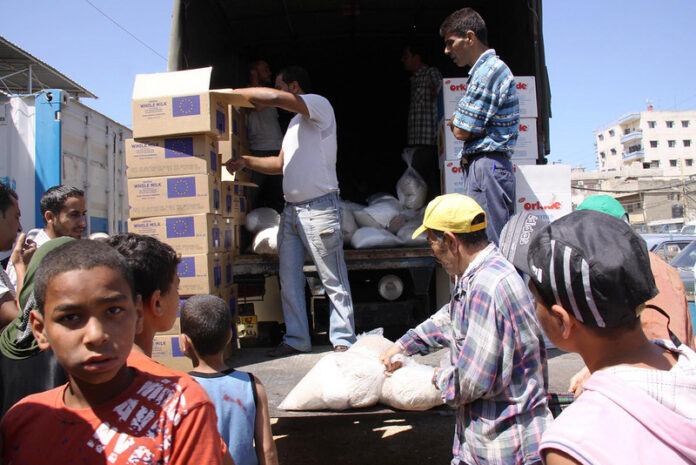
Nearly one hundred aid trucks were looted in southern Gaza on Saturday in what UNRWA, the UN agency for Palestinian refugees, has described as “one of the worst” incidents of its kind.

Of the 109 trucks carrying food supplies for UNRWA and the World Food Programme from the Kerem Shalom crossing into Gaza, 97 trucks were “lost” in the looting, UNRWA told CNN in a statement Monday.

Drivers were forced to unload trucks at gun point, aid workers were injured, and vehicles were damaged extensively, it said.

The Israeli military reportedly told the convoy, initially scheduled for Sunday, to “depart at short notice via an alternate, unfamiliar route (on Saturday),” according to UNRWA.

The UN agency did not identify the perpetrators of the looting, but blamed the “collapse of law and order” and the “approach of the Israeli authorities” for creating a “perilous environment.”

It said the challenges involved in delivering aid to Gaza had become “increasingly insurmountable,” with “trucks frequently delayed at various holding points, often looted, and subjected to escalating attacks.”

“Well, we have been warning for a long time about the total breakdown of civil order; (until) four or five months ago, we still had local capacity, people who were escorting the convoys. This has completely gone,” UNRWA chief Philippe Lazzarini told a press conference in Geneva on Monday.

CNN has reached out to Israeli authorities on the matter but has not yet heard back.

A spokesperson for the US State Department called the looting “abhorrent” and blamed it on the “overall breakdown” of security in Gaza, for which he said the the Israel Defense Forces (IDF) was partly to blame.

“They’re working to establish an improved security situation on the ground, but clearly, when you have looting going on, there’s a breakdown,” State Department spokesperson Matthew Miller said at told a press briefing on Tuesday. “And the IDF certainly bears part of the blame for that.”

In a report Monday that cited Gaza’s interior ministry, the Hamas-run Al-Aqsa TV channel claimed Gaza security forces had killed more than 20 people involved in looting aid trucks, though it did not specifically mention Saturday’s incident.

The National and Islamic Forces, a coalition of Palestinian groups, commended the ministry’s actions against the looters, who it referred to as “criminal thieves who disrupt the security of our internal front and steal the livelihoods, bread, and medicine of our citizens.”

Worsening shortages

The attack on the convoy – the worst of its kind “in terms of volume,” according to UN Secretary-General Stéphane Dujarric – comes amid warnings by the UN that already severe shortages of food and aid in Gaza will worsen without immediate intervention.

Civilians fleeing northern Gaza after weeks of intense Israeli military operations have told of a chronic lack of food and people dying of hunger, while aid agencies have warned that the area is on the brink of famine.

On Thursday, a UN Special Committee report alleged Israel was using starvation as a method of war – an allegation denied by COGAT, the Israeli agency that approves aid shipments into Gaza.

Israel insists however that the number of aid trucks entering Gaza has risen and that it is “working tirelessly” to get aid into the enclave. The US State Department last week assessed it was not blocking aid – though it said improvements were needed.

At his press conference Tuesday, US State Department Miller said the US was working with the IDF, COGAT and UN agencies to get more assistance to those who need it. He noted the opening of new aid routes to Gaza, which happened after the Israeli government allowed only limited access to the besieged strip for weeks. He said the US hoped some of the new routes would help divert convoys away from looters.

The attack on the convoy also comes amid a backdrop of deteriorating relations between Israel and UNRWA. The agency’s ability to deliver aid to Gaza took a hit last month when Israel’s parliament voted to ban it, in a move that is expected to severely restrict its operations in territories Israel occupies, including the West Bank and East Jerusalem.

The new law requires all contact between Israeli officials and the UN agency to cease by the end of January.

Israel claims UNRWA has forced it to act, alleging that some of its employees are affiliated with Hamas and that its schools teach hate against Israel. UNRWA has repeatedly denied these accusations.

At the press conference in Geneva, Lazzarini spoke of the UN’s concerns over the new law, warning there was no other agency that could replace UNRWA’s role in helping the Palestinians.

“Our staff in the region is deeply, deeply concerned, anxious, worried about what might happen,” he said.

Lazzarini also told the conference of an incident last week in which he said a female UNRWA worker had been searched at her home by IDF soldiers.

“When they realized that she is working for UNRWA, basically, they told her, ‘How come you work for a terrorist organization?’” Lazzarini said, adding that the soldiers asked her for access to all the data in her computer, brought her in for interrogation for a few hours, and handcuffed her to a post. CNN has reached out to the IDF about the incident.

Heavy toll on civilians

Meanwhile, Israeli strikes in Gaza continue to take a heavy toll on civilians.

On Monday, Israeli airstrikes killed at least 50 people, including 17 members of a single family, according to the local health ministry.

Most of the dead were killed in on northern Gaza, including the 17 family members who died in the city of Beit Lahiya, the ministry’s general director Dr. Munir Al-Bursh told CNN.

He said the 17 were family members of Hani Badran, a cardiologist who was working at the city’s Kamal Adwan hospital at the time of the strike that killed them.

A local journalist who spoke to the cardiologist told CNN that Badran’s children had been killed alongside his sister, her husband and their children. Among the killed children was his sister’s weeks-old newborn, who Badran had delivered and whose birth he had intended to register on Monday, he said.

The director of the hospital, Dr. Hussam Abu Safiya, said that everyone in Badran’s home at the time had been killed.

Safiya said the hospital itself had also been attacked.

“This scene is now being repeated almost constantly. Very violent targeting, with shells from tanks,” Safiya said.

He said patients were filled with “fear and horror,” adding “we are now pleading to the world. This killing machine must be stopped, the bombing must be stopped.”

CNN has reached out to the Israeli military for comment on the hospital attack. It has previously said it was operating “against terrorist infrastructure and operatives” in Beit Lahiya.

CNN’s Ruba Alhenawi, Kareem Khadder, Abeer Salman, Michael Conte and Jennifer Hansler contributed reporting.

Formerly Pro-Israel country votes in favor of ‘Palestinian sovereignty’ at UN

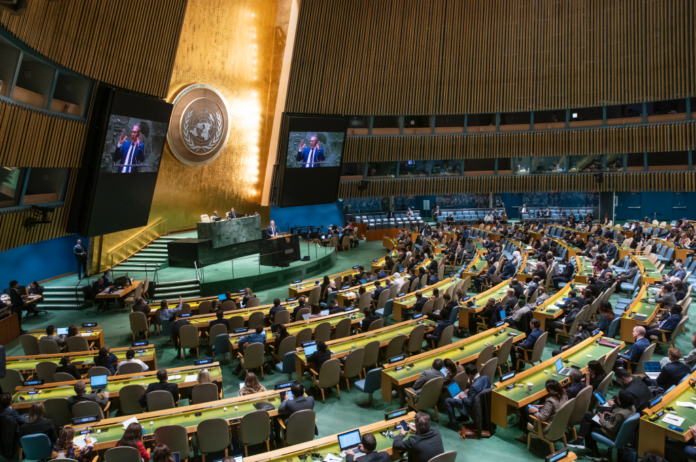
Australia voted with 158 other countries in favor of permanent Palestinian sovereignty in territories such as East Jerusalem.

This is the first time Australia has voted to support Palestinian sovereignty since the resolution was introduced around twenty years ago.

The resolution recognizes the “permanent sovereignty of the Palestinian people in the Occupied Palestinian Territory, including East Jerusalem, and of the Arab population in the occupied Syrian Golan over their natural resources.”

A spokesman for Australia’s Foreign Minister, Penny Wong, said that the vote reflected concern about “ongoing settlement activity, land dispossession, demolitions and settler violence against Palestinians”.

“We have been clear that such acts undermine stability and prospects for a two-state solution,” the spokesperson said.

“This resolution recalls UN security council resolutions that reaffirm the importance of a two-state solution that has had bipartisan support.”

  US official suggests Trump will revive 2020 Israel-Palestinian peace plan

In another draft resolution, Australia demanded that Israel compensate Lebanon for its role in a 2006 oil spill.

In May, Australia’s Parliament rejected by a margin of 80-5 a Greens Party proposal to recognize a “state of Palestine.”

, opponents of the proposal argued that a Palestinian state that isn’t committed to renouncing terror will promote peace in the region.

Assistant Foreign Affairs Minister Tim Watts said, “simplistic wedge motions in the house do nothing to advance the cause of peace.”

He continued, “A Palestinian state cannot be a threat to Israel’s security. We want to see a reformed Palestinian governing authority committed to peace, renouncing violence.”

Opponents cited Denmark whose government also voted against unilateral recognition of a Palestinian State.

“We cannot recognize an independent Palestinian state for the sole reason that the preconditions are not really there,” Danish Foreign Minister Lars Lokke Rasmussen said in April.

Israel-Basher Picked to Speak on Israel

A prominent institute for the study of antisemitism has once again chosen a professor who is hostile to Israel and Zionists to deliver a lecture about Israel and Zionists.

The Birkbeck Institute for the Study of Antisemitism, based at the University of London, has announced a December 3 online program about “Aliya, Antisemitism, and U.S. Zionism in the World,” featuring Doug Rossinow, a professor in Minnesota who has been harshly attacking Israel for more than twenty years.

In July 2002, Palestinian Arab terrorists massacred nine Israeli civilians on a bus near the town of Immanuel. Days later, Rossinow and fellow-extremists signed a large advertisement in the New York Times declaring that “both the Israeli and Palestinian peoples have suffered great wrongs at the hands of the other.”

Rossinow and his friends demanded in their advertisement that Israel return to the indefensible, nine-miles-wide pre-1967 lines, and they called for the mass “evacuation” (expulsion) of all Jews from the areas beyond those lines—meaning Judea, Samaria, the Old City of Jerusalem, and the Golan Heights.

Rossinow’s group also urged the U.S. government to use “our massive economic and military support” as “leverage” to force Israel to agree to those demands. They even asserted that “foreign troops may well be required to enforce [the terms], and they must be prepared to accept casualties.” Demanding that American and other soldiers give their lives in order to force Israel to its knees is a remarkable position to take, to put it mildly.

Over the years, Rossinow has participated in a number of public attacks on Israel.

In 2014, when Israel struck back at Hamas terrorists in Gaza, Rossinow joined an open letter denouncing Israel for “the ongoing carnage in Gaza” and “killing and wounding so many Palestinian children.” Rossinow and company also called for halting U.S. military aid to Israel.

In 2016, Rossinow signed a petition to the American Historical Association, falsely accusing Israel of “impeding instruction at Palestinian institutions of higher learning.” (They were referring to the fact that Israel has security checkpoints through which potential suicide bombers have to pass on their way to campus. So inconvenient!)

Rossinow seems to have some kind of obsession with AIPAC, which is noteworthy since his talk for the Birkbeck Institute on December 3 will be dealing with American Zionists.

In two articles that he authored in 2018, Rossinow denigrated the “swaggering” AIPAC, declaring it was “born of violence and conflict” and “born in awful knowledge.” He wrote that AIPAC was “formed to spin positive PR after Israeli atrocities” and “to deny, obscure, or downplay the piercing impact” of Israeli actions. And he added this vicious comment: “Violence by the Israeli state against Palestinians…lies like a hard stone gnarled in the roots of the Israel lobby.”

Rossinow’s upcoming talk isn’t the first time that the Birkbeck Institute has turned to a harsh critic of Israel to lecture about Israel. Last June, it organized a seminar by Harvard professor Derek Penslar, who has publicly accused Israel of “ethnic cleansing,” “apartheid,” and “Jewish supremacism.” Penslar was the person Birkbeck decided would be most qualified to lecture on Israel’s 1948 War of Independence.

The Birkbeck Institute’s mission statement says that its work “contributes to public debate on antisemitism” and provides “expertise and advice to a wide range of institutions.”

I don’t see how hosting Israel-bashers constitutes a contribution to meaningful public discussion of antisemitism. And I can’t imagine how what Rossinow has to say can be regarded as “expertise” on the subject of Israel or Zionism. Having a radical opinion, and expressing it in extreme language again and again, does not make one an “expert.”

Whenever anybody criticizes Israel-bashing academics, inevitably he or she is accused of “censorship.” So let me be very clear: I am not proposing that Doug Rossinow or other attackers of Israel be censored. I am saying that institutions which sponsor such individuals to speak about Israel or Zionism should be honest about whom they are inviting. It’s the old principle of truth in advertising.

The leaders of the Birkbeck Institute should not pretend that someone who regularly denounces Israel, such as Rossinow, is an objective scholar who can speak about Israel or Zionism in a non-partisan way. Rossinow’s record shows that he is an extreme partisan, with deeply-held views that are consistently unfriendly toward Israel.

I’m sure the directors of the Birkbeck Institute would be very interested to hear what the Jewish public thinks about this latest development. Those who care to share their opinions can reach them at: bisa@bbk.ac.uk

Deal which only stops Hezbollah from adding weapons recipe for disaster

Deal which only stops Hezbollah from getting more weapons recipe for disaster
Dr. Aaron Lerner 11 November 2024

While UNSCR 1701 requires that Hezbollah be completely disarmed (see below), reports of the “deal” only describe measures to prevent Hezbollah from getting MORE weapons.

Under the deal, Hezbollah holds onto, among other things, the long-range and mid-range missiles it has today.

We are assured “yihyeh b’seder” (it will be ok) because 80% of Hezbollah’s missiles have been destroyed.

So if we accept this deal we will find ourselves participating in a debating society in the future as to whether a particular missile that Hezbollah has in its possession was added to its inventory after the ceasefire.

And we are going to have the Russian apparently as a participant in the debating society.

Anyone who thinks that this debating society arrangement is going to work simply has no business engaging in policy making.

United Nations Security Council Resolution 1701 (2006)
Adopted by the Security Council at its 5511th meeting, on 11 August 2006
“The Security Council,
… 8. Calls for Israel and Lebanon to support …full implementation of the relevant provisions of the Taif Accords, and of resolutions 1559 (2004) and 1680 (2006), that require the disarmament of all armed groups in Lebanon, so that, pursuant to the Lebanese cabinet decision of 27 July 2006, there will be no weapons or authority in Lebanon other than that of the Lebanese State;”