‘UNRWA is Out’: Knesset Committee Moves to Curb UNRWA Activities in Israel

The Knesset’s Foreign Affairs and Defense Committee unanimously approved two legislative proposals on Sunday aimed at curbing the activities of the United Nations Relief and Works Agency for Palestine Refugees in the Near East (UNRWA) within Israel. The committee’s decision marks a significant step in the ongoing discourse surrounding UNRWA’s role and operations.

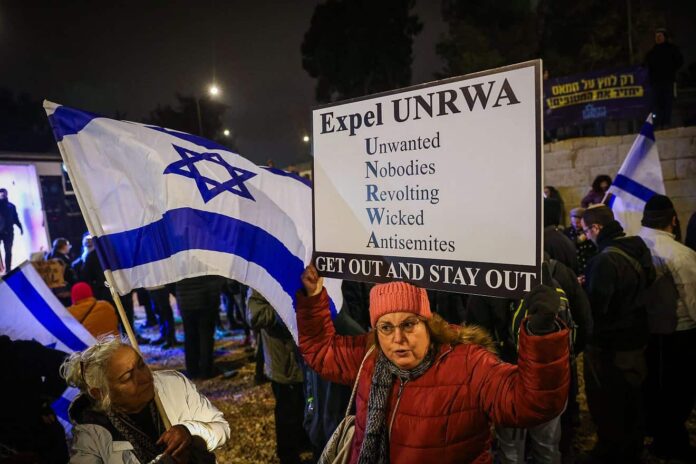
“UNRWA is out!” Committee Chairman MK Yuli Edelstein declared at the end of the vote. “The problem of UNRWA did not begin on October 7; it has long been a concern that has surfaced in all its malignancy. For many years, lawmakers from across the political spectrum have raised the issue and advanced legislative proposals.”

The first proposal approved by the Committee, introduced by MK Boaz Bismuth from Likud and merged with an initiative from MK Sharren Haskel from the Yamin Mamlakhti party, stipulates that UNRWA will not operate any representation, provide services, or conduct any activities—directly or indirectly—within the sovereign territory of Israel.

The second proposal consolidates three initiatives submitted by a group of other lawmakers and states that the invitation for UNRWA, based on correspondence exchanged between Israel and the agency dating back to June 14, 1967, concerning Israel’s facilitation of UNRWA’s operations, will expire on October 7, 2024, or upon final approval of the law in the Knesset. Furthermore, the proposal mandates that no state authority, including public officials and bodies, may engage with UNRWA or its representatives.

Following extensive discussions, some of which were open to the public and others classified, the proposals were passed unanimously by the committee. The open sessions included testimonies from social organizations, researchers, and families of victims, some of whom were reportedly harmed by individuals associated with UNRWA in Gaza.

During confidential sessions, the committee, alongside the Foreign, Defense, Justice, and Treasury ministries, examined the far-reaching implications of the proposals across diplomatic, legal, security, and economic domains. Numerous meetings took place between professional bodies and the legal advisory team to ensure the drafts addressed a wide array of concerns raised during the discussions.

Chairman Edelstein emphasized the urgency of the legislation, criticizing UNRWA’s actions during the recent war and highlighting that, “We know that some of the hostages were held by individuals working for the organization.”

The scrutiny of UNRWA intensified following revelations that members of its staff allegedly participated in the October 7 attacks, which resulted in the deaths of at least 1,200 people and the abduction of 252 Israelis and foreigners. The Israeli government has increasingly demanded that UNRWA be stripped of its authority in Gaza, further asserting that humanitarian aid should bypass the agency.

Recently, the UN announced the firing of nine UNRWA staff members for their involvement in the October 7 assaults, but this has been met with outrage in Israel, where officials claim the UN’s internal investigations failed to address the involvement of approximately 100 other personnel. “The UN investigation, which focused exclusively on 19 UNRWA workers, is a disgrace! Too little and too late,” tweeted former Israeli Ambassador to the UN Gilad Erdan, emphasizing that Israel had provided the UN with detailed information about over a hundred UNRWA employees with ties to Hamas.

UNRWA has faced scrutiny not only for its alleged role in the October 7 attacks but also for ongoing accusations of facilitating Hamas operations within its facilities. For instance, Israeli forces discovered a Hamas complex beneath UNRWA’s Gaza City headquarters earlier this year. Furthermore, more than 100 survivors of the October 7 attacks have filed a $1 billion lawsuit against UNRWA, alleging the agency “aided and abetted” Hamas.

With the proposals set to take effect 90 days after their final approval, the committee has mandated regular reporting from the National Security Headquarters to oversee the implementation of the law.

With the Knesset poised to finalize the legislation, the implications for UNRWA’s future operations and funding remain uncertain. Israeli officials are advocating for a restructuring of refugee aid, calling for Palestinian refugees to fall under the mandate of the UN High Commissioner for Refugees, as they assert that the current setup is unsustainable and detrimental to Israeli security.

Oct. 7 forever altered the global Jewish existence

For nearly a century, Jews in places like America, Canada, Great Britain and Australia took for granted their connection to and comfort within their homes and nations. Even if antisemitism still dwelt at the fringes of society, Jews in these places felt as though they had finally been woven into the very fabric of society and shared history.

There was comfort and confidence in being Jewish as well as a part of daily American, British, Canadian and Australian life. Finally, after wandering for thousands of years, we found homes and places where we could let our collective guard down.

It took a single day last year for that comfort and confidence to shatter. In the wake of Hamas’s gruesome attack in Israel, our homes, businesses and places of worship suddenly became targets of hateful acts, slurs, screams of “go home,” graffiti, assaults, gunshots and murder.

At no point since World War II have so many Jews in so many places across the world felt so insecure and untethered from the Western democracies in which they live. At no point in nearly a century have so many felt as though the citizenship and connection they had with their homes had suddenly and shockingly been ripped away. We have lost our basic sense of normalcy.

This latest watershed moment epitomized the existential threats facing the State of Israel. On Oct. 7, Hamas was responsible for the greatest number of deaths in a single day in the country’s history, leading to the most rapid, pervasive and tectonic transformation of global Jewish existence since the Holocaust. The Jewish sense of security, safety, acceptance and integration into our broader communities has been permanently altered across the world.

On this first anniversary of that dark day, it is incumbent upon us as Americans — as well as upon citizens of all democratic countries — to take stock of that transformation, to understand what it means to our greater society and to the future into which it is heading us.

This assessment cannot simply be limited to documenting the percentage increases in the number of antisemitic incidents or diagnosing the trends and types of threats now facing Jewish communities. It is imperative for us to recognize the truly global nature of the altered state of Jewish existence simply in a matter of one year.

Within one year, British Jews went from freely and safely using public transit in London to now taking separately designated buses as a way of keeping them safe.

Within one year, Jewish kindergartens in Perth, Australia, went from being openly integrated into their neighborhoods to now being protested by anti-Israel activists and needing 24-hour security protection.

Within one year, Jews in France went from having the choice of political parties across the spectrum to becoming politically homeless, as Marine Le Pen emboldened far-right nativist extremism, and far-left party leader Jean-Luc Mélenchon, accused of antisemitism multiple times, downplayed antisemitism in French society.

To be clear, many of the trends negatively impacting Jewish life did not begin with Oct. 7. The Anti-Defamation League has been documenting the normalization of anti-Jewish hate globally for the past decade.

I joined ADL as the senior vice president of international affairs in 2017. Even then, my number one task was to ring the alarm bells through data quantifying the year-over-year increase in antisemitism and highlighting incidents that impacted the lives of Jewish communities across the globe.

For the first five years of my tenure, I witnessed a consistent pattern of normalization of anti-Jewish hatred both in national and local settings impacting Jewish life in big and small ways. In Europe, we documented the “perfect storm” of the rise of far-right populist parties such as in Italy and Germany. In the United Kingdom, we watched far-left extremists such as Jeremy Corbyn hijack the Labour Party.

We witnessed the proliferation of radical Islam in both perpetrating acts of terror — such as the beheading of French teacher Samuel Paty in 2020 — and in daily life in Brussels, Paris, Madrid, and other cities where Jewish citizens have been harassed, accosted and even murdered.

In just one gruesome example in 2018, Yacine Mihoub murdered 85-year-old French Holocaust survivor Mireille Knoll and set her apartment on fire. After convicting Mihoub in 2021, a French court associated the brutal attack with a “broader context of antisemitism.”

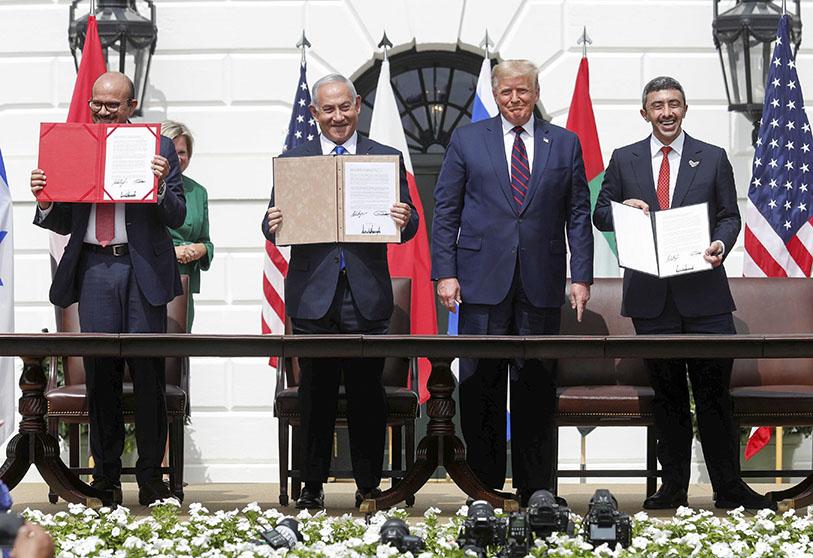
In the Middle East, as we witnessed the miraculous opening brought about by the Abraham Accords, we also documented the expansion of the Iranian regime’s fundamentalist Islamist ideology in Iraq, Syria, Lebanon, Yemen and Gaza Strip and the West Bank, as well as European and Latin American cities.

As the top state sponsor of antisemitism, Holocaust denial and terrorism, the Iranian regime’s direct support of the Oct. 7 atrocities is what brought all that we had witnessed in the past decade to a devastating new climax.

What Oct. 7 and its aftermath demonstrated to Jews around the world is that the lessons of the Holocaust have not been taught or learned effectively enough to prevent the replay of those very horrors.

We learned that “Never Again” is not real. Nor can we trust the world when it proclaims those words. We learned that the semblance of safety and security can be completely destroyed within a year; that blacklists of Jewish authors, musicians and artists can sprout up again; that Jewish businesses can again be targeted, vandalized and destroyed; that Jewish schools and institutions must yet again rely on their own security to keep their children and community safe while Jewish university students fear walking across campus alone.

So, if Oct. 7 communicated to global Jewry that we cannot trust the commitment to Never Again, then it should also convey to all people of the world that our democracies are in danger. If our Jewish citizens are so fearful, so isolated and so unsafe, then our very democratic values and institutions are on the brink of shattering.

What 4,000 years of Jewish history have taught us is that if it starts with the Jews, it never ends with the Jews. And what we have witnessed across our cities is not a Jewish problem for Jews to solve.

It is an American, Canadian, French, British, Australian, Argentinian and South African problem. It is a problem of democracy, telling us that our society is headed in the wrong direction. And we need to find an offramp from this dreadful highway we’ve been down before.

Sharon Nazarian is the president of the Y&S Nazarian Family Foundation, with a regional office in Israel named the Ima Foundation and founder of the Younes & Soraya Nazarian Center for Israel Studies at the University of California Los Angeles. She previously served as the Anti-Defamation League’s senior vice president in international affairs.

The real lessons of Oct. 7 must not be ignored

A public bomb shelter where Israelis were murdered at the Oct. 7 massacre one year ago, on a road near the Israeli-Gaza border in southern Israel, Sept. 19, 2024. Photo by Chaim Goldberg/Flash90.

The first anniversary of the Oct. 7 Hamas massacres in southern Israel adds yet another sacred date to a calendar already filled with those devoted to mourning tragedies in Jewish history. But the fresh pain from this most recent instance of Jewish suffering is due to more than the fact that it happened only 12 months ago. The war against Islamist terrorists that began that date is ongoing with hostilities against Hamas in the Gaza Strip and Hezbollah in Lebanon. And more than 100 of the hostages taken on Oct. 7 are still unaccounted for or continue to be held captive by Palestinian terrorists.

The main purpose of the memorial ceremonies and commemorations will be to mourn those lost amid that orgy of mass murder, rape, torture, kidnapping and wanton destruction by Hamas operatives and ordinary Palestinians who joined in the mayhem. Still, there’s little doubt that a lot of what will be said and written about the anniversary will be about the lessons that should be learned from what happened that day and the war that followed it.

In Israel, much of the commentary will focus, as it has in the previous 365 days, on pinning responsibility for the massive failure on the part of Israel’s military, intelligence and political establishments that allowed the catastrophe to unfold. At the top of the list of those who will be held responsible will be Prime Minister Benjamin Netanyahu on whose watch the disaster happened.

Others deserve to be in the dock with him, including the entire leadership of the Israel Defense Force as well as that of the intelligence agencies. Their complacency and blind belief in the “conzeptzia” that Hamas couldn’t and wouldn’t successfully attack Israel in force explained why the vaunted IDF was asleep on that Simchat Torah morning.

A widely shared complacency

Sadly, the complacency about Hamas was shared by most of Israel’s leading politicians, including those opposed to Netanyahu like former IDF Chief of Staff Benny Gantz, and former prime ministers Yair Lapid and Naftali Bennett, all of whom hope to replace Netanyahu at the next election. The truth is that no one except those considered on the “far right” rejected the notion that Hamas could be contained in Gaza and, if necessary, paid off in funds from terror- and Iran-supporting Qatar in order to keep the border quiet.

This is an issue that deserves not just discussion but a full-blown governmental investigation, although, like everything else that happens in Israel, the politicization of any such effort is more than likely. The debate about Oct. 7 should not be just another version of the one Israelis have been having for the last decade about Netanyahu’s seemingly endless tenure in office. Whether that is the way it plays out or not, other more important questions should be addressed.

The post-mortems about the Oct. 7 disaster shouldn’t be limited to how and why Hamas was able to breach the border so easily, setting in motion a day of horror that was the worst instance of mass slaughter of Jews since the Holocaust.

Both in Israel and in the Diaspora, the discussion about what happened must also include broader misconceptions that not only helped bring about this epic disaster but that might conceivably allow it to be repeated in the future. That’s especially true in the United States, where public discussion of the war on Hamas continues to center on myths that should have been rejected long ago.

The ‘solution’ was tried and failed

Belief in the idea of a two-state solution to the conflict evaporated in Israel in the wake of the collapse of the 1993 Oslo Accords with the outbreak of the Second Intifada in 2000, which brought nearly five years of suicide bombings into every realm of Israeli civilian life. The two-state concept was once embraced by a majority of Israelis amid the euphoria that ensued when those accords were signed on the White House Lawn in September 1993. But the once-dominant Israeli parties on the left were destroyed when the Palestinians—then led by the arch-terrorist Yasser Arafat, head of the PLO—proved they regarded them as merely a stepping stone to the destruction of the Jewish state.

That point was made even clearer after 2005 when then-Prime Minister Ariel Sharon withdrew every Israeli settlement, settler and soldier from Gaza in a vain effort to “disengage” from the Palestinians. Some on the left, especially in the United States and Europe, cling to the lie that Gaza was nevertheless still “occupied” by Israel or an “open-air prison.” The Strip might have been transformed—with the help of the billions in Western foreign aid—into a Palestinian Singapore; instead, it was taken over by Hamas in 2007, which turned it into a terrorist fortress.

More to the point, it was, for those 16 years until Oct. 7, an independent Palestinian state in all but name. As such, it was an experiment that demonstrated what a two-state solution that encompassed the far larger and more strategic Judea and Samaria (the “West Bank”) would mean.

Among those most resistant to this basic fact were those who wound up failing on Oct. 7. In the years following the Hamas takeover, I took part in dozens of public debates with a liberal colleague, former Forward editor J.J. Goldberg, about the two-state solution and related issues. When I would point out that most Israelis regarded the idea of repeating Sharon’s Gaza experiment in Judea and Samaria as not so much ill-advised but madness, he would invariably respond that his sources in Israel’s intelligence community disagreed. They were sure, he said, that the various efforts at “mowing the grass”—a term that referred to Israel’s periodic efforts to degrade Hamas’s military capabilities with offensive operations in 2009, 2012, 2014, 2019 and 2021, demonstrated that even a terrorist-controlled Palestinian state was no real threat to Israel.

The events of Oct. 7 proved just how wrong they were.

Yet none of this seems to have penetrated the consciousness of the American foreign-policy establishment and, in particular, those like Vice President Kamala Harris, who tout advocacy for a two-state solution as part of what she thinks ought to be the world’s response to Oct. 7.

While there are individual Palestinians who may believe in the idea of peace with Israel, they are isolated and overwhelmingly outnumbered by supporters of Hamas, Palestinian Islamic Jihad and the so-called “moderates” of the Fatah party (whose nearly 89-year-old leader Mahmoud Abbas serves as the head of the Palestinian Authority). They have all made it clear over and over again in their organizational charters, statements and rejection of every effort at a compromise peace plan over the decades that they deny the legitimacy of a Jewish state, no matter where its borders might be drawn.

The only relevant debate

To Israelis and those elsewhere who have been paying attention to Palestinian rejectionism, this is nothing new. Post-Oct. 7, belief in the myth that the conflict can be solved by partitioning the country beggars the imagination. The point of the mass terror attack wasn’t to end the “occupation” of a coastal enclave that had been evacuated by Israelis 18 years earlier or to push for a withdrawal from Judea and Samaria. It represented a Palestinian desire to turn back the clock to 1947 or even 1917 and destroy the State of Israel, even within the borders that existed before 1967.

The widespread support among Palestinians for this effort (and for the atrocities that ensued) lays bare the futility and the insanity of any attempt to force Israel to make territorial retreats to accommodate yet another attempt at a Palestinian state. Palestinian political culture is solely predicated on the premise that Zionism and a Jewish state are incompatible with the minimum demands of their national identity.

This is something that ought to be clear to all Americans by now. Oct. 7 should have ended the debate about two states and the peace process for the foreseeable future. That is frustrating and hard to grasp for Americans who believe compromise is always possible or for Jews who are hard-wired to believe in millenarian solutions even when the facts on the ground argue otherwise. At the moment, the only debate about Israel that is relevant is the one that the pro-Hamas mobs that took over America’s streets and college campuses since Oct. 7 have been wanting to have: whether one Jewish state on the planet is one too many.

Calling out the antisemites

That is a position many on the American left have increasingly adopted. Indeed, it is the reason why anti-Israel protesters chant “from the river to the sea” and “globalize the intifada.” The whole point of woke ideology, such as critical race theory and intersectionality, as it applies to the Middle East, is to delegitimize Israel as a “settler/colonial” state. Seen from that perspective, nothing it does in its defense—even against the most barbarous opponents, like Hamas and Hezbollah—can be falsely characterized as “genocide” since there is virtually nothing Israel could do to defend itself that could be justified in their eyes. And it’s why the same people dismiss the atrocities of Oct. 7 (which, like Holocaust deniers, they simultaneously justify and minimize).

And so, it is incumbent on Israelis and friends of Israel elsewhere to stop bickering over peace plans or pretending that Israel should be “saved from itself,” as former President Barack Obama believed it should.

In the absence of a complete transformation of Palestinian society that is nowhere in sight, any advocacy for a Palestinian state in the post-Oct. 7 world from those who claim to support Israel is a unique form of delusionary thinking.

The only logical way to defend Israel going forward must begin by recognizing this truth and stop treating those who wish to deny Israel the same rights granted to every other nation in the world as if their opinions were reasonable and well-intentioned. We must not hesitate to label those who seek to “flood” cities like New York with protests glorifying the Oct. 7 massacres as justified “resistance” and call them out for being antisemites and proponents of foreign terror groups.

After Oct. 7, we must no longer treat those who oppose Israel’s existence as if there was some distinction between their position and that of classic Jew-hatred. The brutal truth is that whether or not they root their stand in what they call “anti-racism” or even if they claim to be Jewish, those who wish to eradicate the only Jewish state on the planet are, at best, the “useful idiots” of the Oct. 7 murderers, rapists and kidnappers. At worst, they are their active supporters.

As much as Israelis can and must sort out the crucial questions about who bears the lion’s share of the blame for the success of Hamas’s brutal surprise attack, there are more important lessons to be learned from this episode than just another repeat of the same questions that were asked after the 1973 Yom Kippur War, which began with a similar failure. Doing so will be extremely hard for liberal Americans who believe in the two-state myth as if it were a religious doctrine handed down from Mount Sinai. But if we fail to learn them, then they will set the stage for more such tragedies, just as much as if the IDF chose to repeat its pre-Oct. 7 complacency.

Jonathan S. Tobin is editor-in-chief of JNS (Jewish News Syndicate). Follow him @jonathans_tobin.

Britain’s response to October 7 has been shameful

What do you say?

What do you say to a bereaved father who waits, broken- hearted, for the head of his murdered son to be returned by his killers? What do you say to a mother who prays for her daughter’s return, and who is tortured by thinking the unthinkable: is she dead, or alive in the tunnels? Has she been raped, or was she spared?

What do you say to the grieving mother of a young soldier kidnapped and later murdered? What do you say when she affirms, through her tears, that she couldn’t be prouder to see her two other children fight for their homeland? What do you say to a young woman who survived the Nova festival, by playing dead as her friends lay murdered around her? What do you say to a family displaced by rocket-fire: homeless, uprooted, and uncertain about their future?

Sometimes there are no words. Only humility, pain, and tears. One year on from the largest pogrom against Jews since the Holocaust, what does our country’s response say about us?

I wish I could say that our Government stood proudly with Israel: on the side of justice, self-defence, and freedom. I wish I could say that anti-Semitism has been stamped out, like other forms of racism. Sadly, I can’t.

For me, the most grotesque revelation of the last twelve months has been the lengths some will go to deny or defend terrorism. For some, even the evidence of murdered babies, sexually abused men and women, and other acts of heinous violence isn’t enough to loudly condemn the atrocities of Hamas or Hezbollah.

You don’t need to be Jewish to do so. But October 7 has exposed an ugly anti-Semitism that overshadows some of our institutions and communities. I’m not talking about isolated pockets of bigotry. This has the stench of a more ingrained and cultural prejudice.

Since the atrocities of October 7, we have seen commentators, activists, and even Left-wing politicians struggle to condemn Hamas. Consider the marches around the country on October 8, weeks before any Israeli military action in Gaza, not in solidarity with the victims and the hostages, but to celebrate the ‘resistance’.

We have seen chants of “Jihad”, the firing of flares, and the defiling of our monuments too often go uninterrupted by our police. Thousands have protested our railways stations, our cities, or Parliament, with their mantra of “From the river to the sea”- Israel erasure – echoing throughout.

Placards have been waved bearing ‘Victory to the Intifada’. Hateful slogans have been projected onto Big Ben. Armistice Day has been spoiled by protestors and counter-protestors fighting at the Cenotaph, to the background drum of apology after apology from the leaders of the Metropolitan Police.

What about the posters of Kfir Bibas, the baby taken hostage, ripped down by keffiyeh-clad activists? Or the hundreds of Palestinian flags that adorn whole roads in parts of our capital? What of the exponential rise in anti-Semitic incidents this year? Or the many Jews who have left the UK because they feel safer in Israel? It says something when a war zone seems more welcoming than North London.

How about the Islamist thugs who intimidate MPs, injecting their own sectarian politics into our democratic system? Or the death threats that forced a Conservative MP to leave public life? Or the hi-jacking of the Rochdale by-election and the silencing of Parliament? Labour MPs have been scared to speak, and terrified to vote.

And then our media. The BBC’s early refusal to describe Hamas as terrorists was but the tip of the iceberg. They have been accused of breaching their own impartiality guidelines 1500 times following October 7. It doesn’t stop at the BBC. Remember a Sky News presenter comparing Gaza with the Holocaust? After the apologies, how much changed?

Or what about our universities? Surely they would encourage tolerance, inclusion, and respect? Too often that spirit does not seem to extend to Jewish students. A five-fold increase in anti-Semitic incidents at our universities has been reported. The portrait of Arthur Balfour at Trinity College has been vandalised. Jewish students have been harassed.

Theatres, shops, and local councils have boycotted Israel since the atrocities. From the swastikas daubed in the toilets at an exclusive girls’ school to 600 top lawyers accusing Israel of genocide, a hatred for the Jewish state has almost become fashionable. Those pushing this creed have become so liberal that they are now illiberal, so pious that they are now dishonest.

But in the face of adversity, I’ve also witnessed awesome heroism. The Jewish people have been under siege for millennia and have always prevailed because of their ingenuity, resilience, and strength. Even as thousands of rockets rain down on them, when acts of unspeakable inhumanity have broken their hearts, and the world vilifies them, they don’t give up.

I am certain that, with or without her allies, as Israel battles for Western values and civilisation itself, she will succeed once again. As the country wins this battle for humanity, many of us will be honoured to say : “Israel, we are your friends”.

The Abraham Accords are not about Palestinians

Many pundits blame the Abraham Accords for throwing Palestinians under the bus, arguing that peace between Arabs and Israel enraged Palestinians and set the stage for Hamas’s October 7 attack on Israel.

But these peace accords – signed four years ago this month between Israel, on the one hand, and the United Arab Emirates (UAE), Bahrain and Morocco, on the other – have nothing to do with Palestinians.

The Abraham Accords prioritized national interests and ended 60 years of divisive pan-Arab nationalism, which birthed Palestine.

Abraham Accords governments understood that peace with Israel was not incumbent on whatever happens between the Jewish state and Palestinians.

Hence, 11 months after the outbreak of the Gaza War, the Abraham Accords are proving their robustness, even after Abraham Accords governments repeatedly voted against Israel at the UN.

In May, Reuters reported that the Gaza war had cooled “Israel’s once red-hot business ties with UAE.” Quoting “10 Israeli officials, executives and entrepreneurs,” the news agency argued that Israel’s “business ties with the influential Gulf state remain intact but, in a sign of how the conflict has dented enthusiasm, the [two sides] declined to discuss any recent deals.”

Blaming the Abraham Accords for not bringing peace to Palestinians continues. Palestinians and their supporters still expect the 21 member states of the Arab League to withhold peace with Israel until Palestinians get a state.

But if Palestinians expect the Arabs to lend them a hand, Palestinians should also expect the Arabs to have a say on how and when the conflict with Israel should end.

Unconditional Arab support for an open-ended conflict undermines the national interests of the different Arab states. Furthermore, Palestinians demand support but seldom reciprocate. The Abraham Accords upended this unequal relationship: If Palestinians wanted to fight forever, the Arabs had different plans.

Nobel Peace Prize 2024: PRIO Director’s Updated List Announced

Henrik Urdal 2021 2.jpg

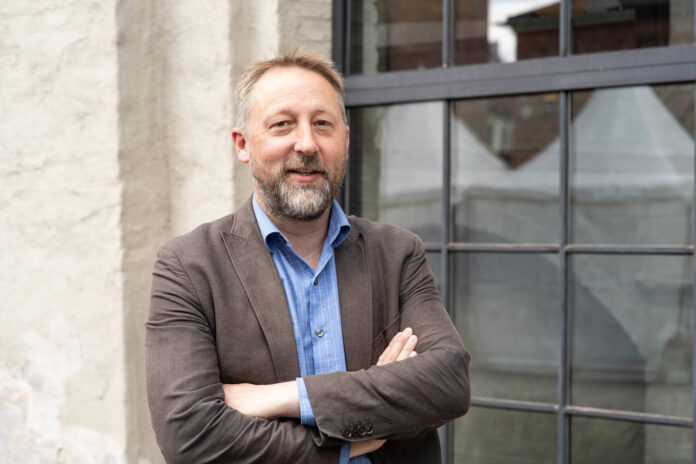
The Director of the Peace Research Institute Oslo (PRIO), Henrik Urdal, announced his updated list today for the 2024 Nobel Peace Prize, with election observers topping the list.

The 2024 list comprises of:

  1. OSCE’s Office for Democratic Institutions and Human Rights
  2. Sudan’s Emergency Response Rooms
  3. UNRWA and Philippe Lazzarini
  4. International Court of Justice
  5. UNESCO and the Council of Europe

“Democracy is on the ballot this year as more than half the world’s population live in a country heading to the polls, albeit not exclusively in democracies,” said Henrik Urdal. “Research shows that democratic states are more peaceful and stable. As elections are a cornerstone of democracy, election observers play a pivotal role in shaping perceptions about the legitimacy of electoral processes. A Nobel Peace Prize awarded to election observers sends a strong message about the importance of free and fair elections, and their role in peace and stability.”

Each year, PRIO’s Director presents his own list for the Nobel Peace Prize. He offers his opinion on the most worthy potential laureates, based on his independent assessment. The PRIO Director’s view on potential and worthy Nobel Peace Prize laureates is widely recognized and has been offered since 2002. Henrik Urdal presents his eighth list here since taking up the position of director. Urdal has no association with the Nobel Institute or the Norwegian Nobel Committee.

The OSCE’s Office for Democratic Institutions and Human Rights

2024 is set to be a historical election year. Record numbers of people across the world are heading to the ballot box. Against this backdrop, democracy is under pressure in Europe and globally, due to the rise of illiberal movements and authoritarian regimes. More of the world’s people are living in autocracies today than only a decade ago, and the number of countries democratizing is falling, according to democracy research from V-Dem. Upholding the pillars of democracy is more important than ever before.

The Office for Democratic Institutions and Human Rights (ODIHR) within the Organisation for Security and Co-operation in Europe (OSCE) observes elections throughout its 57 participating states. It also provides technical assistance to improve the legislative and administrative framework for elections in specific countries. ODIHR’s work to ensure that elections are free and fair would make it a timely recipient of this year’s Nobel Peace Prize.

Other notable candidates worthy of the prize based on their contribution to strengthening democracy through elections include The Carter Centre who has observed 115 elections in over 40 countries, and the American Civil Liberties Union (ACLU) who fights voter suppression in the United States.

Sudan’s Emergency Response Rooms

The armed conflict that erupted in Sudan in April 2023 has plunged the country into one of the world’s most severe humanitarian crises. Over 10 million people are displaced within the country, and another 2 million have fled to neighbouring states. The international system has struggled to meet overwhelming humanitarian needs, prompting community-led, volunteer aid networks in Sudan to step in and provide lifesaving services to millions of women, men and children. One notable initiative is the Emergency Response Rooms, which offer medical care and other services to those affected by the conflict.

Operating in a decentralized manner, these groups deliver essential humanitarian assistance in a highly complex conflict environment, with limited access to communities, resources and infrastructure. Volunteers often operate in insecure areas, facing threats of harassment and violence.

As 2024 marks the 75th anniversary of the revised Geneva Conventions, which were developed to protect civilians during war, awarding this year’s Peace Prize to a deserving humanitarian initiative such as the Emergency Response Rooms would highlight the critical importance of access to lifesaving aid in times of conflict.

UNRWA and Philippe Lazzarini

The United Nations Relief and Works Agency for Palestine Refugees in the Near East (UNRWA) was established in 1949 to provide aid, education and protection for Palestine refugees until a political solution was found. Today, its staff of over 30,000 people serve nearly 6 million Palestinians in the West Bank, Gaza and neighbouring countries. Nearly the entire Gazan population depends on UNRWA for basic assistance, including food and water.

The UN agency has faced a massive funding crisis for years, which has been exasperated by the war itself, and increasingly by the impact of US withdrawing funding following allegations by Israel that 12 participants of the 7 October attacks were Hamas militants, employed by UNRWA. The UN agency took the allegations seriously, by launching both an internal investigation and an external review of its procedures. UNRWA has extensive control mechanisms in place, with a zero tolerance, but not zero risk policy. They therefore terminated the employment of individuals where there was any indication that they might have had ties to militant groups. Throughout the war UNRWA itself has been heavily targeted by Israeli attacks, and by the end of September, 224 of its staff had been killed in Gaza, and 190 UNRWA installations had been damaged.

UNRWA’s operation is absolutely fundamental to avoid a humanitarian catastrophe in Gaza. A Nobel Peace Prize to the agency and its Commissioner-General Philippe Lazzarini would send a strong message about its role in supporting the lives of millions of Palestinian women, men and children.

International Court of Justice

Mechanisms for peaceful resolution of conflicts between states are particularly important to maintain and support peace in an increasingly polarized world. The International Court of Justice (ICJ) promotes peace through international law, akin to promoting peace congresses, another achievement highlighted in Alfred Nobel’s will. The ICJ would be a worthy recipient of the 2024 Peace Prize should the Nobel Committee wish to recognize the importance of multilateral collaboration for peaceful relations. The ICJ was established in 1945 by the Charter of the United Nations to settle legal disputes between states and advise on legal questions within the UN. With all 193 UN Member States party to the ICJ Statute, the Court has become a globally accepted multilateral mechanism for dispute resolution. While a Nobel Peace Prize to the ICJ would largely be seen as uncontroversial, the Court acted boldly in January this year ordering Israel to take action to prevent acts of genocide in the Gaza Strip. In addition, it acted early in March 2022 by ordering Russia to ‘immediately suspend the military operations’ in Ukraine.

Other deserving candidates for a prize focused on peace through international law are the International Criminal Court, or regional bodies such as the European Court for Human Rights or the Inter-American Court of Human Rights.

UNESCO and the Council of Europe

Educational institutions are integral to the development of tolerant, inclusive and democratic societies. One particularly important area is the way that history is being taught. Emphasizing multiple and diverse perspectives in history teaching is crucial for developing an understanding and acceptance of other groups and societies than our own, and contributing to counter false and chauvinist narratives.

The UN’s Educational, Scientific and Cultural Organisation (UNESCO) has been a pioneer in developing and promoting ‘multiperspectivity’ in history teaching. UNESCO emphasizes the importance of understanding history in a global context as well as developing regional, complimentary perspectives. By providing guidance and support to history textbook authors, and working to establish universal norms for history teaching, UNESCO promotes education as a tool for peaceful development.

Similarly, the Council of Europe works to support history teaching as a way to support critical thinking and strengthen democratic participation and practice. Emphasizing the importance of building historical knowledge through well-established scientific norms, the Council of Europe supports a number of scientific initiatives as well as political processes. A Nobel Peace Prize for the promotion of peace through history education would resonate well with Alfred Nobel’s call for ‘fraternity between nations’.

More information

  • To arrange an interview with PRIO’s Director, Henrik Urdal, please contact Senior Communication Advisor, Arnaud Siad. Mobile: +47 413 52 500; email: arnaud@prio.org.
  • A list of previous lists for the Nobel Peace Prize are available at the PRIO website.
  • More information about PRIO’s Director, Henrik Urdal, is available at his profile on the PRIO website.

Stop US intimidation of sovereign citizens of Israel

US sanctions against Israeli citizens and civil society organizations involve  unprecedented use of draconian measures usually applied against terrorist masterminds and drug lords- and they pose an unprecedented danger to freedom of speech in general, to the independence of Israel’s judicial system, and to the sovereignty of Israel, a democratic ally of the US.
 
The time has come to ask members of the US Congress to question this policy,

Seven Killed in Shooting Attack in Jaffa, Central Israel, 16 Wounded

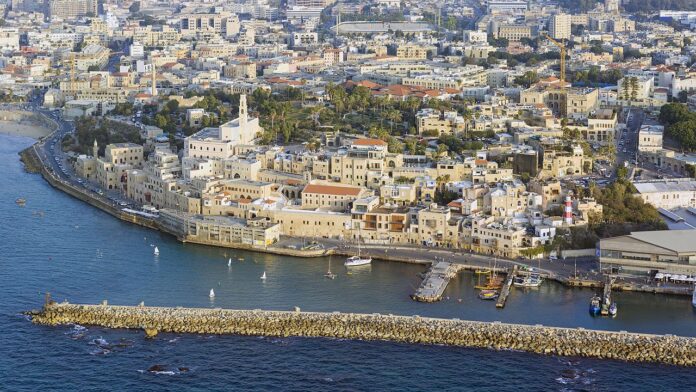
Seven people were killed and 16 others were wounded in a shooting attack in the city of Jaffa in central Israel on Tuesday, emergency services reported.

The police have identified two of the victims as 30-year-old Lod resident Shahar Goldman and 33-year-old Tel Aviv resident Inbar Segev-Vigder. One of the victims is a 17-year-old girl, the police added. Six of those wounded are in serious condition, four were moderately wounded and two were lightly wounded.
Shachar Goldman, who was a dancer, is survived by her husband Tai, her parents and three sisters. People paid tribute to the 33-year-old Goldman’s memory at the Havana Music Club in Tel Aviv and told Haaretz that she had “a captivating smile and great energy,” and that she “touched many lives.”
Inbar Segev-Vigder, 24, was the owner of a fitness and Pilates studio and worked as a coach at a CrossFit gym in Tel Aviv. A graduate of the Wingate Institute for Physical Education and Sportse, Segev-Vigder is survived by her husband Ya’ari and their nine-month-old son.

Her husband told in an interview with national broadcaster Kan on Wednesday that Segev-Vigder was carrying their son as the attack happened.

“Our miracle is that our son came out of it unharmed, really without a scratch. He was covered with blood a bit, but otherwise unhurt,” he said.

Nadia Sokolenco, 40, immigrated to Israel from Moldova 18 years ago. She is survived by her husband and 6-year-old daughter. She worked as an office manager at a high-tech firm, previously working as a stylist.

Haaretz reporter Rafaella Goichman, a close friend of Sokolenco, described her as “the embodiment of love of life, light and cosmic optimism.”
Revital Bronstein, 24, was earning a master’s degree in computer science. Before that, she attended an agricultural school, where she won awards related to computing and artificial intelligence. She was also an artist who created comics.
Ilia Nozadze, a 42-year-old Georgian citizen, was married and had two children. He worked as a truck driver.
26-year-old Yona Ionas Karussis, a Greek and Israeli citizen originally from Thessaloniki, who lived in Jerusalem and studied architecture in Tel Aviv, is the sixth named victim of the attack. He is survived by his parents, both doctors who immigrated to Israel.

According to police, one of the assailants was armed with a rifle and the other with a knife, and they attacked light rail passengers and passers-by near a station on Jaffa’s Jerusalem Boulevard.

Police say that the two assailants, later identified as Muhammad Khalef Saher Rajab and Hassan Muhammad Hassan Tamimi, were both in their 20s from the city of Hebron in the West Bank. They did not have a permit to be in Israel. At least one of them was shot dead by a passerby and a municipal security guard.

Tel Aviv district commander Haim Sargrof said that police ruled out that there were additional assailants after large police and IDF forces conducted extensive searches in the area.

A senior police officer said that footage from security cameras in the area shows that the assailants came out of a nearby mosque, attacked passers-by on Jerusalem Boulevard and killed two of them. Afterwards, at least one of them boarded the light rail car, killed four passengers and got off. According to police, the two were finally shot in the street.

Large police forces and the IDF counterterrorism unit conducted searches in the area, including a raid on the mosque from which the assailants emerged. Several individuals present were detained on suspicion of involvement in the attack.

In response to the attack, the IDF imposed a blockade on Hebron, the hometown of the attackers. Finance Minister Bezalel Smotrich stated that during tonight’s cabinet meeting, he would demand that the terrorists’ family members be deported “to Gaza tonight” and that their homes be demolished. “Without the High Court of Justice and without B’Tselem,” he added.

National Security Minister Itamar Ben-Gvir said, “If it turns out there is a connection to the mosque [from which the attackers emerged], the message is clear – it should be shut down and demolished.” He added, “We need to investigate; we’re not rushing to conclusions.”
An eyewitness who was at the scene of the attack said: “I saw a terrorist shoot a girl who was on the floor and another girl, then I saw the terrorist shoot a man on a bicycle who fell to the floor, but I don’t think he wasn’t hurt. At that moment a civilian arrived with a gun and shot the terrorist.”
Another eyewitness who was at a synagogue at the time of the attack said that he heard shots from an automatic weapon. “Among the worshippers were medics who volunteer at the MDA. We treated a man who was wounded in the synagogue and then ran to the street to help others who were wounded,” he said.

Another eyewitness who spoke to Haaretz said that he heard gunshots when he was in a store near the scene of the attack, and went out into the street to help administer first aid. “There was an injured girl on the road, there were already several people taking care of her, and then there were more shots from nearby,” he said. “We dragged the injured woman to a nearby restaurant’s kitchen and blocked the door with a heavy object. I put a tourniquet on her.”

Civilians near the scene of the shooting attack, in Jaffa, on Tuesday.Credit: Itai Ron

He added that after about 15 minutes security forces arrived in large numbers and began knocking on the door, and that the injured woman was conscious when she was taken to receive further treatment.

The attack occurred about 40 minutes before rocket sirens were activated in Jaffa due to the missile barrage from Iran. As the alarms sounded, many police officers sought shelter in nearby buildings, leading to a suspension of the searches in the area. Police Commissioner Danny Levy, who had arrived at the scene, also entered a building and continued commanding the forces from inside until the alarms ceased.

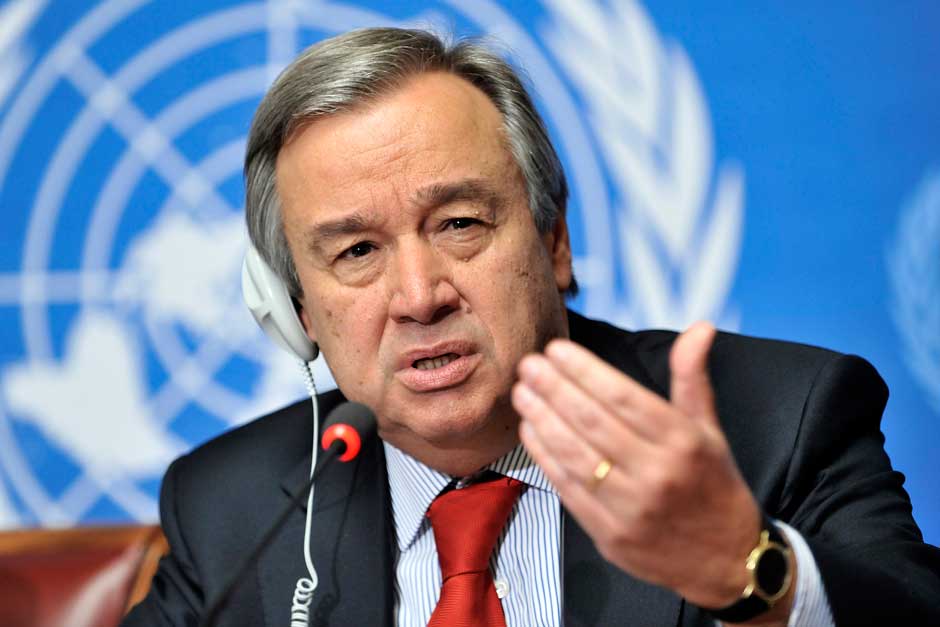
How did it happen that the head of the UN is forbidden entry into Israel?

My personal and professional​ experience with UN secretary general Guterres belies what has happened.​

I first met Guterres, after he visited UNRWA schools in Gaza, and then made a  presentation about the fate of the Jewish people at the Diaspora Museum in Tel Aviv

Mentioning that his wife is the head of the Jewish Museum in Lisbon,​Guterres introduced himself as a friend of the Jewish people.

I  approached Guettres and asked if he had seen UNRWA text books which our agency had been reviewing for years.

​Guterres said that he had heard that that the UNRWA texts were problematic and invited me to bring our UNRWA experts to his office, which resulted in four briefings for senior staff members of Guterres.

These briefings resulted in a request of Guterres to order UNRWA to remove UNRWA texts which praised those  who murdered Jews.

Since that time, Guterres has hosted a parade of Jewish groups affiliated with New Israel Fund, who describe Israel as  a criminal entity

Hence , the change in Guterres.

Israeli MP claims Australians are ‘paying the salary’ of terrorists amid uncovered UNRWA links to Hamas commander

Israeli MP Sharren Haskel has made the startling claim Australian taxpayers are “paying the salary” of members from terrorist groups Hamas and Hezbollah following fresh revelations regarding the UN’s Palestinian refugee agency.

New links to the United Nations Relief and Works Agency for Palestine Refugees have emerged after the killing of a top Hamas commander in Lebanon earlier this week, who has been uncovered as a suspended employee of an UNRWA-run school.

Fateh Sharif Abu El-Amin, who was killed in an Israeli airstrike on Monday along with his wife and daughter, was placed under investigation and suspended from his job in March after concerns emerged regarding his politics, UNRWA’s chief Philippe Lazzarini revealed at a media conference.

However Lazzarini has denied knowing Abu El-Amin was a Hamas commander, saying, “I never heard the word commander before. What’s obvious for you today, was not obvious yesterday.”

Israeli MP Sharren Haskel has made the startling claim Australian taxpayers are “paying the salaries” of members from terrorist groups Hamas and Hezbollah.

The Australian government in August faced scathing criticism over its decision to continue funding to UNRWA despite there being sufficient evidence nine of the agency’s staff had links to the October 7 Hamas attack.

In light of the new revelations this week, Ms Haskel argued the Australian government had been warned “for years” about UNRWA’s alleged links to terrorism.

“There are thousands of terrorists of Hamas and Hezbollah who are on the paycheque of Australian taxpayers’ money. They are paying the salary of those terrorists,” Ms Haskel told Sky News host Sharri Markson on Tuesday night.

She said it was “very simple” for the federal government to check who the terrorist activists working with the agency were, through requesting a list of employees from the United Nations.

“If they just cross them, they know exactly who is a terrorist, but they just ignore it. It’s very easy to ignore the facts. It’s very easy to ignore the truth when you don’t want to accept it. But they know it, they’ve known it for years,” she said.