A Test of Credibility

The “Rabbis for Human Rights” continue their cooperation with Palestinians on another level. As Rabbis, so director Rabbi Arik Ascherman, they work for a greater force than the State of Israel. The existence of the State of Israel is not to be maintained at all costs, says the controversial rabbi.

The “Rabbis for Human Rights” organization was founded in 1988 during the first intifada. It was a protest of religious bodies within Israel against government policy of breaking the bones of Palestinian children, to prevent them from throwing stones at Israeli security forces.

Currently, the “Rabbis for Human Rights” are involved with two major campaigns.

One is the “Committee against House Demolition”. Within this project, they cooperate with a range of different organizations. One of them is “Gush Shalom”, a radical Israeli group that advocates the forced expulsion of all Jews who live beyond the 1967 cease fire lines.

Another is the Palestinian “LAW” – an NGO designed to give legal support to the Palestinian Authority. Among “LAW” causes is the extensive campaign to indict Ariel Sharon in Belgium, on charges of war crimes against the Palestinian refugee camps in Lebanon. “LAW” is also active on having Israel declared an Apartheid State with the resulting economic sanctions imposed by the UN. Rabbi Ascherman denies that “LAW” calls Israel an Apartheid State, even though “LAW” has these campaigns publicly on their website. The other project of the “Rabbis for Human Rigths” is the “olive tree campaign”.

Around the village of Hares, based in Area B – under Palestinian control for civil affairs and under Israeli control for security reasons -, a certain amount of olive trees have been either uprooted or cut down.

According to information received from Hares liason officer and P.A. ministry of social affairs employee Nawwaf Souff, the trees were cut down on different occasions.

According to Souff, there are trees that have been uprooted by the Israeli Defense Forces using bulldozers and trees supposedly cut down by Israeli settlers living near by. So far no independent source could be found, to confirm the statements made by Nawwaf Souf.

At a visit in the village of Hares, it was evident, that the “Rabbis for Human Rights” director Rabbi Arik Ascherman had never been in the olive tree fields himself, prior to this occasion. Thus it must be assumed, that the whole campaign was mounted on the grounds of other people having reporting things to the “Rabbis for Human Rights”.

The person who did report back to the Rabbis, it was discovered, was one Neta Golan, a woman activist who had previously spent a week within the village of Hares. Her main activity has been to contact peace groups in Europe and America and to monitor volunteers of such organizations being placed in the line of fire in houses in villages like Bet Jalla or Bethlehem. This action has been done to prevent Israeli Defence Forces to retaliate for Palestinian attacks for fear of killing international civilians and thus involving other countries in the conflict. It must be assumed that this was done in order to draw even military intervention in support of Palestinians.

Yet according to Nawwaf Souf, the uprooted trees were replanted the very next day by the inhabitants of the village Hares.

Thus, a current visit reveals hardly any uprooted tree. The trees that have been cut, are already sporting new greenery and it is clear that they will completely recover from the cutting. Nawwaf Souf explained that depending where a tree is cut, it may recover.

The resulting assumption must be, that either who cut those trees was ignorant enough not to know that the trees would recover, or that the person who cut them, did not want to harm the trees on a long term basis. A possible explanation is delivered by Rabbi Arik Ascherman himself.

Those trees, he informed, have been used in the past by Palestinians as a cover to throw stones and attack Israelis at nearby roads. Thus, it can be understood, that the Israeli Defense Forces have removed the problem.

According to Rabbi Arik Ascherman, the Torah states clearly, that one is not allowed to cut down fruit trees even in war. Because they provide the opponent with food and once a war is over, this also may be an obstacle in the relations between both people. This rule of nor cutting trees is the main reason, so Rabbi Arik Ascherman, why the “Rabbis for Human Rights” got involved in the “olive tree campaign”. But seeing how the trees were cut, one has to give recognition that they were cut down in a way maintaining two Torah principles to save lives and not to destroy fruit trees. There are some trees which have been removed, to make way for road construction and installation of electricity plants.

The “Rabbis for Human Rights” have raised 70 000 Dollars for the “olive tree campaign”. These funds are not intended to replace trees, as the organization stated while fundraising. The funds are going to be paid to Palestinian families in cash. The “Rabbis for Human Rights” have no list of families who’s trees have been damaged. Palestinian contacts are in complete charge of the money distribution. The “Rabbis for Human Rights” hand over the 70 000 Dollars to their contacts. The contacts are for one the secretary of the “Committee for Land Defense”, Issa Samandar, as stated by himself in a telephone interview, and Nawwaf Souf, as witnessed while bills were exchanged between him and Rabbi Arik Ascherman in Soufs family house.

The “Rabbis for Human Rights” trust their Palestinian contacts completely and thus see no need to control what actually happens with the money, once it has been handed over. At this moment it is not yet known what is purchased with that money.

Issa Samandar made it a point to stress that the families should have the feeling that they are not receiving charity as not to hurt their dignity. So far no answers have been provided as to how the “Committee for Land Defense” achieves this purpose.

The “Rabbis of Human Rights” have received extensive support for their “olive tree campaign” from within the Palestinian society. They have been exempt from the general ban pronounced by the Palestinian umbrella organization for NGO’s – “PNGO” against Israeli NGO’s. They have also received, so Arik Ascherman, considerable backing from P.A. officials. As far as monetary support is concerned, they were able to fund raise successfully from the “Rabbinical Association of the Reform, Conservative and Reconstructionist Movements.”, “Not In My Name”, the “Shefa Fund” and the “New Israel Fund”. In Europe, donations are said to be coming from Christian communities in Germany, Holland, Switzerland and England. “The Economic Cooperation Foundation” has sponsored some ads in the newspapers for the “Rabbis for Human Rights” campaign and they do have regular meetings with each other. In consideration of the actual political climate, following the terrorist attacks on New York and Washington, it has to be seen if the “Rabbis for Human Rights” will continue to receive as much support from international sources. So far, Rabbi Ascherman does not seem to want to discontinue the work they have been doing in the area. The olive trees are a symbol of Palestinian nationalism. They are actively used to claim or deny land on both sides of the fence. While Palestinians are trying to defend their trees against Israeli destruction, as well as using them as a weapon against Israelis, it seems that there is also a campaign organised by the “Committee for Land Defense” to register land in Area C (under complete Israeli control) and to try to regain this land for Palestinians, even prior to any final settlements on land ownership and border outlines between the Israeli government and the Palestinian Authority.

The olive trees and the money collected by the “Rabbis for Human Rights” are thus not merely a means to provide a family with an income, but rather a political weapon being used in the Israeli-Palestinian conflict.

Israel Foreign Minister Shimon Peres: Oslo Process Cannot be Erased

The Oslo Process was a moral and a Jewish choice. The late Yitzhak Rabin and I went to Oslo for moral reasons: not because we had no choice, not out of weakness, but with a sense of national mission and historic conscience.

We went to implement the deep internal desire of our people not to control another people. Throughout all the years of Jewish history, we never controlled another people, and our occupation of the territories was the outcome of a security reality. At Oslo there was an historic encounter between historic expectations, necessary pragmatism and a moral choice on the Israeli side, with the new expectations and necessary pragmatism on the Palestinian side.

There is no question that the Palestinian problem is (and remains) the heart of the Middle East conflict. We will apparently know no rest until this problem is resolved by peaceful means. On the Israeli side, we knew that the Palestinians had expectations regarding the right of return, Jerusalem and the map of Israel. However, I believed then, and I still believe today, that problems can be resolved without relinquishing dreams. Not all of our dreams can be realized either.

The right of return was, in my opinion, an Arab dream that is sentenced to remain a dream. I remember that when I proposed to Yitzhak Rabin that we “go for peace with Jordan” (in contrast to the assumption then that we could reach a peace agreement with Syria first), he told me that he did not believe that King Hussein would give up on the issue of refugees and their right of return to the West Bank. I asked his consent to try and check this out with the Jordanian king. And indeed, I found that if we restored land, gave water and preserved Jordan’s status on the Temple Mount, we could make peace even without realizing the right of return to inside the State of Israel. I believe that this also holds true for the Palestinians. In Oslo, for the first time, we embarked on a daring path. We went far, without leaving reality behind.

What did we get from the Palestinians?

For the first time, a Palestinian partner was created with whom we could conduct negotiations. A partner that recognized the State of Israel’s right to exist and did not call for its destruction. This was not the Jerusalem mufti, this was not the Arafat who replaced him. They were no partners to peace, they were the leaders of a war of terror. Until Oslo, that is. In Oslo, for the first time, there was a Palestinian leader who said and promised to move from violence, to negotiations.

In the letter appended to the Oslo agreements, Arafat crossed the Rubicon and committed to move from bullets to words: The PLO recognizes the State of Israel’s right to exist in peace and security and commits to resolve problems by peaceful means, it is written.

It is worth remembering that in order to reach an agreement, one needs a partner, not just a plan. Both of these conditions were created at Oslo. For the first time, there was a Palestinian leader and a Palestinian movement that sufficed with the ’67 map (22% of the entire Land of Israel). Even if we did not like this, there was no ignoring the Palestinian viewpoint, which saw this as a compromise.

And for the first time, a Palestinian side was created that was willing to move toward peace gradually in regard to time, authority and place. In other words, five years until a final status arrangement; autonomy before statehood; Gaza and Jericho first.

Incidentally, the Oslo agreement would have never come about if I had proposed “Gaza first,” to which I added Jericho (with Yitzhak Rabin’s consent of course and with Hosni Mubarak’s support).

For the first time, the State of Israel was recognized in fact and in deed, and things began to happen on the ground: terror decreased dramatically, the start of self-rule began in Gaza and Jericho, a new mood prevailed in relations between Jews and Arabs, the peak of which was the Casablanca conference, the most impressive conference on peace and economics ever to take place in the Middle East — 1,000 political leaders and 1,000 economic leaders from all over the world and the region, including Jews and Arabs.

Thanks to Oslo, we made a peace agreement with Jordan. Israel began to flourish economically, politically and security-wise. New markets opened up and diplomatic relations were established with many Arab states such as Morocco, Tunis, Qatar, Oman and others.

To my great sorrow, Iranian involvement in the ’96 elections by means of cruel and evil terror via Hamas and Islamic Jihad led to a change of government by a margin of less than one percent.

This interference was by means of terrible bombs put on buses in Jerusalem and Tel Aviv. Arafat only realized the danger too late, and only then employed a strong hand against these organizations, he imprisoned their leaders, confiscated their weapons, seized their archives, and in clashes with us, around 20 men of these organizations were killed.

The fruits of these actions against terror were enjoyed by those who replaced me as prime minister.

What did the Palestinian side get?

Recognition of the Palestinian entity; a promise of getting back most of the territory; international legitimacy; gradual release of Israel’ control over their lives (a control that in any case we wanted to put an end to for moral reasons. The Jewish people have never wanted to control another people). They tasted the taste of freedom, the hope for independence, the opportunity to build their own house and to be released from the tragedy that was partly of their own doing.

They earned international support to build their own economic infrastructure.

They, like us, began to realize that a good neighbor was better than a big gun.

The results of the ’96 elections put an end to the Oslo process.

The frame was built, but the house was not completed. It was left open to the winds and to human doubt.

The Oslo Process real sin was that the agreement was not upheld. We were left stuck in the middle, with one government proposing a too-little alternative, and another government proposing too much.

The balance became lost.

What was sown in Oslo cannot be erased. It began a new chapter, a chapter of hope, a chapter of security, a chapter of good neighbors, a chapter of peace. There is no doubt that this chapter will be completed, sooner or later. No one has any other choice.

Those who deny this can rejoice for now. Those who believe must not despair, neither today nor tomorrow.

This article ran in Yediot Aharonot, September 17th, 2001

A Moral Victory in Durban

THE FORUM of non-governmental organizations or NGOs at the World Conference Against Racism can be considered a turning point in the history of the global human rights movement – not because of the victory of one of the longest-suffering victims of colonialism, nor because reparations for slavery were introduced on the international agenda, but because the role of the southern states at this world event eclipsed the usual center stage role of the northern and international NGOs.

Still, the southern NGOs should not be euphoric, as their victory was more moral than strategic. Its practical dividends are very limited and rely upon the ability of the southern NGOs to follow up and widen their discourse.

Inserting new language

The importance of the final declaration adopted by the 3,750 organizations that met in Durban is that it established new language for the victims beyond the legal-bureaucratic standard behind which international NGOs have always hidden. Three developments were prominent, the first of which addresses the apartheid model of Israeli colonial politics. It is not striking that the South African organizations strongly supported Palestinian claims, considering that representatives of the Network of South African NGOs (SANGOCO) visited Palestine during the Intifada and saw first-hand how the Oslo negotiations process has created Bantustans out of the Palestinian territories.

The conference declared that “Israel is a racist, apartheid state in which Israel’s brand of apartheid as a crime against humanity has been characterized by separation and segregation, dispossession, restricted land access, denationalization, ‘bantustanization’ and inhumane acts.” Thus, the conference program of action called for the launching of an international anti-Israel apartheid movement similar to that implemented against South African apartheid, which established a global solidarity campaign network of international civil society, United Nations bodies and agencies and business communities and for the ending of the conspiracy of silence among states, particularly the European Union and the United States.

It also called upon “the international community to impose a policy of complete and total isolation of Israel as an apartheid state, as in the case of South Africa, which means the imposition of mandatory and comprehensive sanctions and embargoes, the full cessation of all links (diplomatic, economic, social, aid, military cooperation and training) between all states and Israel.”

It asked that South Africa “take the lead in this policy of isolation, bearing in mind its own historical success in countering the undermining policy of ‘constructive engagement’ with its own past Apartheid regime.” It also condemned those states supporting “the Israeli Apartheid state and its perpetration of racist crimes against humanity including ethnic cleansing, acts of genocide.”

The second development that emerged was, in my mind, a kind of irrational revenge taken by the Palestinians against the Western media and international NGOs’ half-hearted criticism of Israeli policies. The declaration generalized the use of “acts of genocide” to refer to what Palestinians, as well as the Kurds, have experienced in their colonial conflicts. It is in general disputable whether Israeli policies can described as such, although in particular cases such as the 1982 massacre of Palestinians in Sabra and Shatilla refugee camps the United Nations General Assembly and the High Commissioner of Human Rights spoke of “acts of genocide.”

But what is important here is that the victims set out to alarm international organizations that traditionally only use strong language such as “war crime,” “crime against humanity” and “genocide” when Western countries or their interests are parties to the conflict (as in Bosnia, for one). What has happened in developing countries, on the other hand, has usually been described by these same organizations in banal terminology. This declaration was quite rational and even revolutionary in using the words “ethnic cleansing” and “crimes against humanity” in the Palestinian case in such an important document.

The third development of the conference established a separation between anti-Semitism on the one hand and anti-Zionism and anti-Israeli policies on the other. The Palestinians and the Arab delegates insisted on their sympathy for victims of anti-Semitism and anti-Jewish sentiment. They pointed out that the session should separate Judaism as a confession from the political program of Zionism and Israeli policies, so that it be evident that being anti-Israeli is not conflated into anti- Jewish racism (just as being anti-apartheid is not conflated into anti- white racism).

The reperteur of the session on anti-Semitism did not take this into account and forced an article onto the draft declaration that considered all critics of Israel as de-legitimizing the State of Israel and perpetrating a form of anti-Semitism. But when the article was proposed by the ecumenical caucus, 37 of the 39 caucuses – all except the Jewish caucus and abstaining international NGOs caucus – voted to delete this item.

In this debate, the critics of Zionism as a national ideology were largely absent. In fact, many discussions were held previously in Cairo and Geneva and Durban between the Arab caucus members. Most of these members, supported by most of the Palestinian human rights organizations, opposed the mentioning of Zionism. Other organizations, like the Arab Lawyers Union, were in favor. The compromise was that the declaration mentioned the political practices of Zionism and not Zionism as a national ideology and cultural and social thought.

An Arab participant did try to contest the declaration’s usage of “Holocaust” with capital “H” on the basis that the lower case “h” includes all communities subjected to the genocidal policies of the Nazi occupation of Europe, notably the Roma and Sinti communities, and to underscore that the term ought not be used to refer to the genocide of only one ethnic group excluding all others. However, the steering committee did not accept this proposition.

It did accept the addition of a paragraph that attempted to highlight anti- Arab sentiment and Islamophobia. The final declaration noted that: “the Arabs as a Semitic people have also suffered from alternative forms of anti-Semitism, manifesting itself as anti-Arab discrimination and for those Arabs who are Muslim, also as Islamophobia.”

Voices of the victim and the south are heard Although many believe that the Intifada had a major impact on the sympathy of world NGOs, I consider its role to be quite secondary. I think three other major factors played a hand: the role of the southern organizations in setting the agenda of the conference, the marginalization of international human rights organizations and finally, the importance of the voice of victims at Durban.

Simply, this conference was not like other world and international conferences such as the Social Development Summit in Copenhagen or the World Development Network in Bonn. There, northern organizations monopolized preparations and the setting of the agenda, thus deciding who should talk and for how much time and when. Subsequently, the southern voice was marginalized. (Even when conferences have been held in a southern country, this hegemony has not often differed. When the World Conference on Women was held in Beijing in 1995, China was in isolation from the international scene and took a low profile in the preparations, satisfied with its role as a host country.)

This conference against racism was held in a highly symbolic country that suffered tremendously under apartheid. SANGOCO played a major role in preparing the conference and in the choice of the speakers and the steering committee for the NGO Forum. Furthermore, SANGOCO also organized jointly with Islamic organizations a demonstration of 40,000 people, as reported by the South African newspaper Mercure, on the third day of the conference.

The second important factor in this conference’s success was the marginalization of international organizations like Amnesty International and Human Rights Watch. While they attempted to influence the process behind the scenes, they were grouped into the International NGOs Caucus, which had one voice just like any of the other caucuses.

Inside this caucus there were different positions. In this respect, the International Federation of Human Rights was more sensitive to the claims of Palestinians than others. Amnesty International, on the other hand, had a very curious position. Irene Khan, its General Secretary, intervened in the last session to propose adding to the first paragraph of the declaration the following sentences: “As NGOs, we are a diverse group, representing different constituencies, with varied interests, experiences and perspectives. But we are united in our goal to denounce and combat racism and human rights violations, in whatever form and wherever they occur. The contentious and complex nature of some of the problems should not obscure the broad agreement within the NGO community on a range of issues. A global anti-racist and human rights network is slowly emerging, and no one can afford to ignore its voice.” Her point was to say that there are different narratives from the victims and that these narratives did not express a kind of consensus.

During her intervention the head of the Jewish Caucus gave her a paper, which she was ready to read until the public protested. Finally, the chair of the meeting asked the participants if they agreed with her proposal. Only very few hands were raised.

In addition, the international organizations tried to convince some Palestinian members of the NGO delegation to compromise on the language of the declaration in the name of real politics and the necessity of achieving a compromise with the Jewish caucus, despite its small minority. On this, the position of Human Rights Watch was clearer. Reed Brody, Advocacy Director of the organization, declared that the use of the word “acts of genocide” to describe Israeli policies was not precise and that Amnesty was not justified in abstaining in the vote.

The third factor of the moral victory concerns the voice of the victim. Unlike other world conferences, participants were not only those accredited by the United Nations, which are large NGOs and not grassroots voluntary organizations. At Durban, about 3,750 organizations participated, most of them from southern countries. These were represented in the 40,000 demonstrators in the streets of Durban who included South African landless people, anti-privatization activists and, above all, those against apartheid in Israel. The demonstration closed by delivering to the South African president and General Secretary of the United Nations a memorandum of claims. From discussion with the participants, it was clear that this action came largely from grassroots organizations and not from elitist ones. It is not anecdotic to say that only the Palestinian and Jewish caucus had some members who wore ties. Most participants bore T-shirts inscribed with their cause.

Incontestably, this conference is the turning point in the history of the global human rights movement. The shift is not between the classic diplomatic actors and NGO actors, but towards actors who are victims themselves. The victory is hence a moral victory, albeit one not reflected in the conference resolution because international organizations had already set out to marginalize the NGO declaration. United Nations Human Rights Commissioner Mary Robinson even initially refused to receive the declaration from the NGOs, describing it as “rude.”

For the future, the Palestinian organizations can learn from this event that they should have more solidarity with other victims. For example, very few Palestinians participated in the demonstrations and workshops for the Dalits, Kurds and Romas. The cultural minorities and groups in the Arab world such as the Amazigh people (referred to by others as Berbers) have yet to get the attention of Arab human rights organizations. The Palestinian delegation did not participate in the thematic caucus, resulting in very little influence. It would help in the future for them to be global and humanistic and not local and parochial in their discourse.

Despite that criticism, one must say that this experience was a rich one for all the southern organizations, one that emphasized their solidarity and the importance of mobilizing the grassroots. -Published 12/9/01 ©Palestine Report

NOTE: For more details about the comparison between the Durban conference and other World conferences, see Hanafi and Taber, “Donors, International NGOs and Local NGOs. The Emerging of the Globalized Elite,” Ramallah: Muwatin (2001).

Sari Hanafi is Director of Shaml Palestinian Diaspora.
Published in Palestine Report, September 12, 2001

Seize The Moment

Israel now has a rare opportunity to turn world public opinion around in its direction and to take diplomatic and military action that it has refrained from taking until now for fear of international reactions.

The ideological alliance between Osama Bin Laden and Yasser Arafat, along with the pictures of the Palestinians celebrating the death and injury of tens of thousands of Americans as a result of terrorism, aroused nausea throughout the world. Now they better understand who it is that we are dealing with. Israel too needs at this time a leader that will seize the moment and take action against terrorism with means that they have not dared use until now. Ariel Sharon knows exactly what this refers to.

The Israeli Gov’t Filmed the Demos of Joy and Expressed its Disappointment with the Foreign Media

“Press under terror” was how deputy director general for PR in the Foreign Ministry Gidon Meir described the behavior of news agencies who refused to broadcast the Palestinian celebrations in the streets over the wave of terror attacks in the United States.

Government sources said that this referred to Reuters and AP, whose representatives were threatened by Palestinians that they would be hurt if these pictures were broadcast.

The Foreign Ministry heard by chance about the celebrations the Palestinians held in the streets. A police officer, the son of Gidon Meir, told his father of the Palestinian jubilation in East Jerusalem. Meir reported on this immediately to the foreign networks. The Foreign Ministry and the IDF Spokesman’s Office also filmed the events.

The Foreign Ministry has a great deal of material from these festivities, but has decided not to circulate it aggressively, but to give it to those who ask. Many media companies from all over the world did ask, and received, the Foreign Ministry material.

This artcile ran in Yediot Aharonot on September 14, 2001

French Ambassador to Israel Distinguishes Between Terror in NYC and Terror in Israel

Israeli figures have leveled severe criticism about the statement made by the French ambassador in Israel, Jacques Huntzinger, who said “the terror attack in the US should not be mixed up with the terrorist activity by Palestinians against Israel.”

At a reception President Moshe Katzav held for the diplomatic staff in honor of the Jewish New Year, Ambassador Huntzinger told reporters: “We all condemn the terrorism Hamas and Islamic Jihad perpetrate here. But this terrorism is linked to the Israeli-Palestinian conflict which must be solved. One cannot compare this conflict to the tragic events in the US. Such a comparison would be politically irresponsible. Arafat must act to stop terrorism, but this conflict must be settled.”

As for the terror attacks in the US, the ambassador, who is considered an important friend of Israel, said, “We don’t know for certain if Bin-Laden is tied to the terror attacks and who is responsible for the tragedy in the US.”

The ambassador appeared upset and angry while making these statements, which he repeated twice.

The journalists were astounded by what he said and by the way he was behaving which was termed “clearly undiplomatic.” They repeatedly asked him about comparing terrorism to terrorism. And the ambassador angrily repeated what he said, while condemning the terror attacks by Hamas and Islamic Jihad.

The ambassador’s statements caused astonishment. A political source in Jerusalem said, “In a proper country such an ambassador would not stay one minute longer. Had that terror attack taken place at the Eiffel Tower, the French ambassador would have spoken differently.” The Foreign Ministry are requesting clarification from the French government.

The political establishment also had serious criticism for the French ambassador’s statements. President Moshe Katzav said, “I regret that Europe is trying to maintain a balance between Israel’s decision to foil terror attacks, and the terror attacks themselves. One cannot maintain such a balance. Whoever says such things gives terrorism legitimacy and a green light.”

Chairman of the [Knesset] Education Committee Zvulun Orlev (NRP) said, “This is a serious statement which seems to have anti-Semitic and racist elements. If the ambassador does not apologize, he should be sent home.” Michael Kleiner (Herut): “The French ambassador is the Peton for the year 2001, an anti-Semitic racist whose letter of accreditation should be rescinded immediately and who should be sent to packing to Paris. The justices who convicted Dreyfus would be proud of him.”

A source in the French Foreign Ministry said last night that the ambassador is a “great friend” of Israel, and that the Foreign Ministry officials in Paris say jokingly of Huntzinger that he is “hooked on Israel.” The French source said he believed that ambassador “simply slipped up in speaking.”

Lior El-Hai adds: This morning a joint Labor Party-Likud demonstration is to be held in Haifa in front of the French consulate to protest the ambassador’s statements and call for his return to France, and “to replace him with a more suitable ambassador.”

This artcile ran in Yediot Aharonot on September 14, 2001

Terror Expert Prof Ariel Marari

Prof. Ariel Marari, a leading world expert on terror and political violence, who has held a series of key positions relating to world terror, tried to confront the question of questions this week: how is that a superpower, the only superpower in the world, was caught with its pants down.

Question: What does the world know now that it didn’t know Tuesday morning?

“It’s not that the world knows something it didn’t know before, but there is no doubt: the world has been dealt a blow to its consciousness. Among the scenarios, there was one called ‘catastrophic terror.’ But the truth is, it wasn’t taken seriously. This possibility was not internalized.”

Question: What do you mean by “not internalized?”

The American administration, in all its branches, made many preparations for ‘catastrophic terror,’ but this present occurrence is very unique. Regarding the method, there is nothing new here. It’s the same well-known method that has been in use for decades. The first plane ever hijacked was in 1931. The difference, this time, is in the results. As far as the results go, this is indeed ‘catastrophic terror.'”

Question: You mean they were ready for it?

“I say again, they never internalized this as a possibility. They said we’re working on it as a contingency plan, so that we have one. I, who dealt with this a lot, sat in working groups in which catastrophic simulation games were played, and had the feeling that this could perhaps happen in some undefined future. Certainly not here and now. The Americans have been dealt a hard blow, in their own home, on its most precious symbols.”

Question: And the writing was not on the wall?

“No. I did not consider it. If you’d asked me on Monday abut such an possibility, I wouldn’t have believed it. For years terror has been in a fairly static state. As far as the methods used, nothing had changed much.

What did we have, car bombs? Those have been around since 1947. Suicide bombers is also nothing new, and certainly not plane hijacking. So what is new here? Hijacking a plane to bomb it? Ahmed Jibril did this in 1970, with a Swissair plane, that blew up and fell into the sea, killing all the passengers. What is new here?

“But today we are talking about completely different dimensions. When you put it all together, the hijacking of four planes simultaneously, ensuring that the planes have an enormous amount of fuel, choosing destinations one of which is the most densely packed in the world (the Twin Towers building) and another target that is also heavily populated as well as a symbol of American military might (the Pentagon) the effect is far beyond what was common terror practice until now.”

Question: But if all the figures were known, how is it you didn’t think it would happen?

“A good question, for which I don’t have an answer. I can only apologize.”

Question: Binyamin Netanyahu spoke of it long ago. Now he also says that compared to what can still happen in the future, this attack was “small potatoes.”

“I don’t think it was ‘small potatoes.’ At the same time, when Netanyahu wrote his book a few years ago, I thought he was exaggerating. I must really be careful now.”

Question: He meant that within a short time, terrorists were liable to obtain a nuclear bomb and that then the situation would be much worse.

“The chances of a terror organization obtaining a nuclear bomb are not large, and they have no chance of producing such a bomb themselves. They can obtain biological or chemical weapons, but then they have the problem of dispersal. The Japanese cult had chemical weapons and no lack of funds, volunteers or technicians, but the number of those killed in the subway was only 12. Dispersing such weapons is problematic.”

Question: So what is new now? Is this war?

“Yes. This is definitely a new type of war. The person who did this broke new records. Until now, terrorists did not use all the capabilities at their disposal to cause the maximum number of casualties. There were limits they did not cross. George Habash’s Popular Front, for example, hijacked four planes in 1970, landed them, blew them up, but first took off the passengers. The person who perpetrated the present event had the goal of killing as many as possible. He must know — and he does know — that he has awakened the American giant from its slumber.”

Question: A giant that was asleep until today.

“Relatively. Relatively to other countries, the US was in fact very active in the war against terror. It has never rested until it has caught terrorists.”

Question: Would it be correct to say that Tuesday was an historic crossroads?

“Without a doubt. This is an historic crossroads for terror as well as for the war on terror. The world, in many senses, will be different now. The effect of this event goes beyond the significance of terror. It will have far reaching effects on all matters touching on international relations.”

Question: How will this be seen from the American aspect?

“In all sorts of ways. The US has a list of terror-sponsoring nations. American law states that the State Department writes up the list and America imposes sanctions on states appearing on the list. Iraq, Iran, Libya, Syria, Cuba and North Yemen appear on it. And indeed, American companies do not do business with them. On the other hand, European countries laugh hugely at this. Germany, France, even Holland, trade with them and call this ‘dialogue.’ The Germans explain to the Iranians: ‘We are different than you in our perceptions, we think that what you are doing when it comes to human rights is wrong, but if you want to do business, we’re ready.’ Iran owes Germany several billion dollars in credit and technical aid. Now, no European country will be able to relate indifferently to countries that sponsor terror.”

Question: In other words, it will be easier for the US?

“Definitely. For example, take sanctions on Iraq, which the US has been struggling for years to keep. Now it will be a lot easier. Not only in western Europe, but Russia and China as well.”

Question: And will this have an effect on Russia leaking weapons to Iran?

“I think so. There is no doubt that the Americans will apply all their weight from now on.”

Question: Is it significant that this is a Republican government?

“In this matter it makes no difference. The American people, just like with Pearl Harbor, now has a sense of being at war.”

Question: Let’s change direction. The world is now denouncing, but over time will reach the conclusion that it has to find a way to live with terrorists. To make compromises with them. Just as it did in the past with the PLO.

“In the example of the PLO, you’re right, that is exactly what happened. The Palestinians committed terror attacks in Europe, and all the countries in whose territories they happened were quick to proclaim how inhumane this was but, under the table, made arrangements whereby they promised the Palestinians that they would let them open delegations in their country and even support them in the UN when they asked for observer status, on condition they not commit terror attacks on their soil. But there is no parallel here.”

Question: Why not?

“Because in those cases, the attacks were against Israeli or Jewish interests, and only because it was convenient did the attacks take place in Europe. This week the Americans understood very well that this attack was directly against them. To kill as many Americans as possible, to strike at the heart of the United States. This time the Americans are the victims. Tuesday, without a doubt, was the watershed. The world will view things differently now.”

Question: When it comes to terror?

“Every year the State Department prepares a report on international terror. And there, among other things, are figures on the number of all the victims of terror. Each year this number comes to about 300 casualties. A colleague of mine once said ‘what does terror in fact do except make a lot of noise?’ After all, more people die every year from bee stings than from terror attacks. But over 10,000 dead in the heart of New York and Washington is an incredible shock. The world will not be able to adopt the same policy in place up until now.”

Question: Let’s say it is known that an organization in Damascus is planning a terror attack. Then what?

“If the Americans know that there is an organization in Syria planning an attack against Americans, the Syrians will immediately be given an ultimatum that within 48 hours, or something like that, they must transfer these people to the US to stand trial.”

Question: And if the Syrians don’t?

“They will do to them exactly what they did to Iraq, when American intelligence had information that Saddam Hussein was planning to commit an attack against former President Bush in the course of his visit to Kuwait. They did not commit the attack, but as punishment, the Americans struck at Baghdad with cruise missiles.”

Question: Can you envision a situation in which the Americans do such a thing to Damascus or Teheran?

Yes. Absolutely. There are no question marks here. After the present attacks, the Americans will have a light finger on the trigger, in a way we haven’t seen before.”

Question: However awkward it is to say this, perhaps this tragedy is good for Israel?

“In every bad there is some good. We are in the middle of a terrible week, a hard week, the pictures are awful, so many innocent people killed, all of them random victims. But like the NBC correspondent said who held up the headline of the Washington Post: ‘Disgrace.’ The Americans now feel that their national honor has been terribly insulted. There has been a frightful blow to everything the US stands for as the leader of the free world. There is no question that what happened will give a good shake to the apathy and egoism of many countries, such as the shameful European attitude toward Libya, Iran or Syria. This blow, that was taken by America, has changed international relations in a very fundamental way.”

Question: And where is Israel in all this? The Israeli-Palestinian conflict?

“One could say cynically that if we now wanted to wipe Jenin off the map, the Americans would say ‘go ahead.’ I’m assuming that we won’t want to wipe it off, but there is no doubt that understanding for us will be much greater. Not just from the Americans, but the Europeans as well.

“Take Carmi Gillon for example. What will the average Dane say if we hone the following dilemma: assume that the FBI catches one of this gang and this person has information that the cell is planning something terrible, but the man refuses to say what and he cannot be touched, even with your little pinkie. Or else he begins to claim his rights, asks to call a lawyer, who shows up and begins to prattle about ‘my client wants this, my client doesn’t want that,’ and then he has to be released on bail, while in the meantime an attack takes place killing 20,000 people. Would the average Dane think it immoral in that case to shake the suspect?”

Question: How will this attack effect terror organizations?

“For them, this attack has opposing consequences. On the one hand, it set a new threshold, something to aspire to. Not only that, look, it’s not even that complicated. On the other hand, I think that terror organizations are on alert today. They realize very well that the mood in the world is in favor of dealing a blow to terror, a mood of broad approval for taking action against terrorists.”

Question: Can Israel now allow itself to do things it has not done until now?

“If this is a strategic decision, there is no doubt that now is a very convenient time. Incidentally, I personally am against entering Area A.”

Question: Will Hamas and Islamic Jihad think twice today before dispatching a suicide terrorist?

“Hamas was always very radical from an ideological aspect, but also very pragmatic. They always made considerations of profit and loss before undertaking action. For example, after the attacks in 1996, when the Palestinian Authority came down hard on them, froze their bank accounts, took over their mosques and shaved their beards to humiliate them, they stopped terror attacks.”

Question: What does this mean for the immediate future?

“I believe they will take a break. While the real inclination of the Palestinian Authority and the Palestinian people is to rejoice and hand out candy, Arafat understood very quickly the political ramifications of this and began to make faces as if he was very sad and to send condolences. He realized that if he didn’t do this, he would be in big trouble with America.”

Question: So perhaps these events could be used as a means to obtain a cease-fire?

“If Arafat had any sense – something in doubt in light of all the strategic nonsense he’s committed in the course of his career — he could use this tragic event as a ladder to climb down from the tree. Because so far, he has climbed up the Intifada tree and placed all his political cards there, but not produced any gain. He has only caused suffering to his people, radicalized Israeli society, and there is still no sign that Israel is willing today to give him anything more than Ehud Barak was willing to give. Less, if anything. But I doubt he will have the courage and the long term vision to do so.”

Question: How can such terror attacks be prevented?

“This requires a series of answers. First of all, this was clearly an intelligence failure. Obviously it is not easy to obtain intelligence information on terror organizations, because it means infiltrating agents, and if it is a foreign organization, then it is not a simple thing. It’s particularly difficult when it comes to organizations that are very united ideologically, while geographically, like in the case of Bin Laden’s group, they are also very dispersed.”

Question: Could such an event also happen here?

“In principle, yes. You think Israeli intelligence has only had successes? Was a prime minister not assassinated in Israel? Have we not had terror attacks? Remember, the first plane to be hijacked was an El Al plane.”

Question: And how do you think we would react?

“I assume that if this happened here, God forbid, we would respond very harshly, including with territorial implications. And I also assume, that under these circumstances, Arab countries like Egypt and Jordan would not intervene.”

Question: Speaking of Israel, it is still more difficult to hijack an Israeli plane.

“Hijacking an airplane in the US is very easy, particularly domestic flights. In the US, the airlines are responsible for security, not the state. I assume this will change now. Pilots are also instructed to do whatever the hijacker says so as not to endanger the passengers. In the US they are not careful about keeping the cockpit door locked. On El Al, the door is locked and armored. There are guards on El Al. If there had been one guard with a gun, he would most likely have been able to stop their operation. Such an attack, with knives, could not have taken place on El Al.”

Question: As of now, no real organization has claimed responsibility. Bin Laden denies involvement. What interest does an organization have in committing these attacks if no one knows who they are?

“To cause pain to the Americans, to signal its supporters at home. For the Moslems, Bin Laden already has the aura of a true hero. But he knows that if he claims responsibility for the attack, then either Afghanistan will have to assassinate him itself, or serve him up on a platter to the Americans, or America will go to war against Afghanistan.”

Question: Indeed? If the Americans demand him and do not get him, will they go in and take him?

“I think that is what will happen. The moment the Americans feel they have enough proof, they won’t wait for a court ruling. They will issue an ultimatum to the Taliban, and the entire world will support them. They will demand Bin Laden and his helpers.”

Question: And if they don’t get him?

“The Americans have the power to hurt. Cruise missiles for example. They will make all sorts of special operations. Let’s say, for example, that they send in a force to hunt him down. This is not the same as going into the heart of Iran to rescue a group of diplomats. He’s stuck somewhere in the mountains. I assume that with an intelligence effort, they can send in a force to pluck him up and bring him to the United States.”

Question: Do you envision Israeli-American cooperation?

“Yes. We won’t rush to get involved in a war against Afghanistan, but I imagine, that whatever the Americans ask, they’ll get.”

Question: After this week, is terror in the world stronger or weaker? “Weaker. The world reaction will be so harsh, that it will weaken.”

Question: Is there a country hiding behind the wings? “That cannot be ruled out. If Saddam Hussein is indeed very ill, and knows he is about to die, he could have good reason to settle scores with the Americans. In other words, to ensure his place in history.”

Question: Could it be another country? “It’s hard to believe. It is really an act of suicide.”

Question: Let’s say it is Iran. Is this a cause for war?

“Yes. Enough senators have said that this was an act of war against the United States.”

Question: How soon will we see the missiles flying?

“As soon as the Americans have proof. I believe that within a few days we will know who was behind this.”

Question: Would you say Bin Laden is a dead man?

“Do you know the Arabic phrase — ‘every dog has his day?’ The Americans know it well. If he did it, his days are numbered.”

This artcile ran in Maariv on September 14, 2001

Witness to Terror: Watching the World Trade Center Implode and Listening to Security Sources in Israel

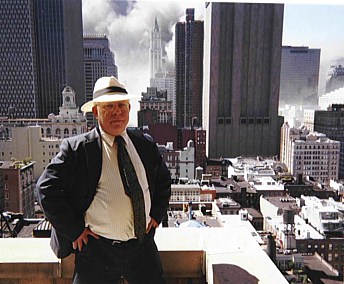
The terror at the Twin Towers caught me in Lower Manhattan, where I was giving briefings on how the PLO, the seemingly legitmated peace partner with Israel, had incorporated the Hamas and Islamic Jihad organizations and philosophy within the PLO’s Palestinian Authority, in its school books, media, maps, and evolving legal system.

Indeed, the new constitution of the Palestinian Authority, prepared as a framework for a new state, excludes any juridical status for Judaism or for Christianity within the new state. The borders of the state remain all of Palestine. The Islamic impulse to regain and liberate all of Palestine remain the dominant features of the PA school system. The entire population of the Arab refugee camps are mandated to return to the precise homes and villages that they left in 1948.

All this, at a time when the PLO’s Palestine Authority and UNRWA, the agency that runs the Arab refugee camps under the premise and promise of the right of return, have received massive help from around the world. The director of the European Union in Israel, Mr. Jean Breteche told me in an interview that the EU has poured more than $3 billion into the Palestinian Authority, an entity with no accountability whatsover, whose ideology could easily be described as Islam uber alles.

Before my scheduled lecture on the subject of the PA’s absorption of Islamic extremism scheduled for the afternoon of September 11th, I gazed in horror outside of the office that I was working in the 24th floor at 401 Broadway. Following the two plane crashes into the Twin Towers, I was witness to a towering inferno on top of a Twin Tower closest to us. I quickly cocked my camera in the direction of the building and caught the picture of its explosion and collapse.

Throughout the next 12 hours, I contacted trusted security sources in Israel to hear what they had to say.

Their feedback: to look beyond Bin Laden to determine who was responsible for this horrendous crime.

One source at the Israeli prime minister’s office noted that Israel was warning the US to examine the cooperation of several governments, NOT individuals,in the perpetration of this act: Afghanistan, Iraq and Iran, coordinated with Syria and the PLO.

A Former advisor on terrorism to Israeli Prime Minister’s Office, Mr. Rafi Eitan, told Jerusalem investigative reporter Dennis Eisenberg that all signs pointed to Iraqi leader Saddam Hussein as trhe leading perpetartor.

Another Israeli intelligence expert remarked that the Israeli government had warned that US airlines may have been infiltrated by Moslem personnel who could have been activated to carry out such attacks.

Meanwhile, my conversations with Palestinian reporters made it quite clear that the demonstrations of joy that occurred immediately following the attacks in the cities under the Arafat’s control could not have been organized without the direct approval of Yassir Arafat. Middle East Newsline Director Steve Rodan reported that Arafat’s personnel were out there at the forefront of the Palestinian street demonstrations that lauded the Twin Tower attacks. And most important,it was the PA that alerted and invited the AP, Reuters, BBC, CNN and NBC to film the mass Palestinian demos of support for the terror attacks against the US.

On the eve of Arafat’s first diplomatic visit to Damascus in a generation, it became clear that the PLO chieftan wanted to let the Arab world know that his people supported direct terrorism against ALL targets in the US, civlian and military.

However, Arafat condemned the attacks a few hours after the demos of joy took place, so that he could benefit from both worlds with two messages: Arafat successfully conveyed to the west that he condemned the action and successfuly conveyed to his own people that they should express their support for the attacks.

It will now be incumbent upon those of us to cover the Palestinian Authority to provide the media with the precise message that Arafat conveys to his own people in his own language, so that the world will judge whether or not the message that Arafat conveys is one of war or one of peace.

After a decade in which the US state department has asked Israel to ignore Arafat’s rhetoric and to get down to negotiations no matter what Arafat says, it will be interesting to note if the American people maintain that same level of patience when and if the official media of the Palestinian Authority continues to endorse terror.

There is only one way to tell: And that is to publicize the official message of the Palestinian Authority: Islam uber alles, from sea to shining sea.

Doomsday?

“A day that will live in infamy.” That was how President Franklin Roosevelt described the attack on Pearl Harbor 60 years ago. And that, and more, is how yesterday’s cataclysmic disaster will be remembered in the United States. From this morning, human history will never be the same.

Most residents of the global village looked on in shock at the horror movie that turned into a dreadful reality. The apocalypse suddenly seemed more tangible than ever, the war of Gog and Magog on our doorstep, doomsday, here and now.

It was indeed “conventional terror” according to the accepted definitions, but one with the effect of an atomic bomb, both because of the carnage it caused and the terror it aroused.

The hijacked planes hit the vital organs of the biggest, strongest empire in the world: the towers, like two giant missiles of the economic and judicial world of the United States, and the heart itself, the military nerve center in Washington. The wound is serious, and the shock is worldwide.

Now, history will test the newly elected rookie George Bush. With his abilities, which some claim to be fairly meager, he will have to bring the war to their doorstep, and with his leadership, which many hold in doubt, he will have to lift the American nation back up from the ground. The mission is great and broad, and it is feared that the shoulders which must bear it are narrow.

The Americans’ immediate suspect is the terrorist Osama Bin-Laden and, along with him, countries that support terror, the Palestinians among them. Along with this, and though the chances seem slim, we must not forget that this was also the consensual verdict given by experts after the Oklahoma City bombing in 1995, until it was found that the perpetrators were home-grown American madmen. As of last night, to complicate things even further, the Japanese were in the picture too.

History proves that the wrath of America, even delayed, can be fearsome and terrible. As long as it is not proved otherwise, America’s large Moslem community will need to go underground, and leaders of certain Middle Eastern countries will do well to go down into their bunkers.

The joyful dances of the Palestinians in East Jerusalem and the West Bank were, therefore, not only nauseating, but short-sighted as well. Israel, if it had such tendencies, now could do whatever it wished in the territories, and no one in America would bat an eyelash. “Just try and find us,” the Americans will tell the Palestinians as they celebrate, and that could go on for a very long time.

Most Israelis, on the other hand, empathized with their brothers and sisters in distress, because this is our own hell magnified thousands of times, and it happened in New York, their alternate homeland. And the loss, to our great grief, will only become stronger in the coming days, when it becomes clear how many Jews were among the victims.

This article ran in Maariv on September 12, 2001

Implications of Terror Attack for Arafat

The terrible disaster in the United States is a dark and gloomy day for Arafat. Arafat has lost his most useful vehicle, since he used terror to try to make the world criticize Israel.

I am almost completely convinced that Osama Bin-Laden is responsible for the terror strike. If that is true, he is a dead man. I believe that there will be acts of war from the United States, but I do not believe that there will be any use of nuclear weapons, since there is no need for this.

I have come to the conclusion that no country, such as Iran, Iraq or Libya, would have dared to commit this act of terror. A strike like this against America would bring about the destruction of the government that committed it. It is in effect a massive declaration of war against the United States. If Saddam Hussein is found responsible for it, Baghdad will not stand intact for long and Hussein will be eliminated. If it is Bin-Laden, he will no longer be able to exist. I will be very surprised if any nation stands behind the attacks. Bin-Laden does not need the infrastructure of any other state.

The force of the attacks is surprising. It is a step up in terror. Instead of a car bomb, airplane bombs are used. The dreadful attack works in our favor in terms of public relations. From the perspective of the Jews, it is the most important public-relations act ever committed in our favor. The pictures are terrible, and they are better than a thousand ambassadors trying to explain how dangerous Islamic terror is.

The writer is an expert on terror and the dean of the Lauder School of Administration in the Interdisciplinary Center in Herzliya.

This artcile ran in Maariv on September 12, 2001