The roots of Hamas’ terror attack can be found in Gaza’s schools

At the core of the tragedy unfolding in Gaza is a question: When Israel withdrew from the coastal Palestinian enclave in 2005, why did the romantic vision of it as a place that would function as a fit home for its citizens turn into the hellish reality of a failed state run by a terrorist organization? The easy and popular theories — a military blockade by Israel, a civil war between Palestinian political factions — miss a fundamental point. The roots of this generation of Hamas terrorism resides in ideas fomented in Gaza’s education system for decades.

While serving in Congress between 2001 and 2017, I studied what goes on in Palestinian schools. I reviewed their textbooks, met with educators and diplomats, and introduced legislation and amendments compelling the Department of State to monitor antisemitism in foreign classrooms. I saw firsthand that a generation of Palestinian children were being taught at an early age to reject living peacefully with Israel. They read about it in their schoolbooks and heard about it from their teachers. They were raised on a steady curriculum of violent rejectionism. My colleagues and I in Congress were unable to change that reality.

Now, as the world reels from the devastation of Hamas’ terrorism, understanding how Palestinian children are taught is essential to any discussion of the future in the region.

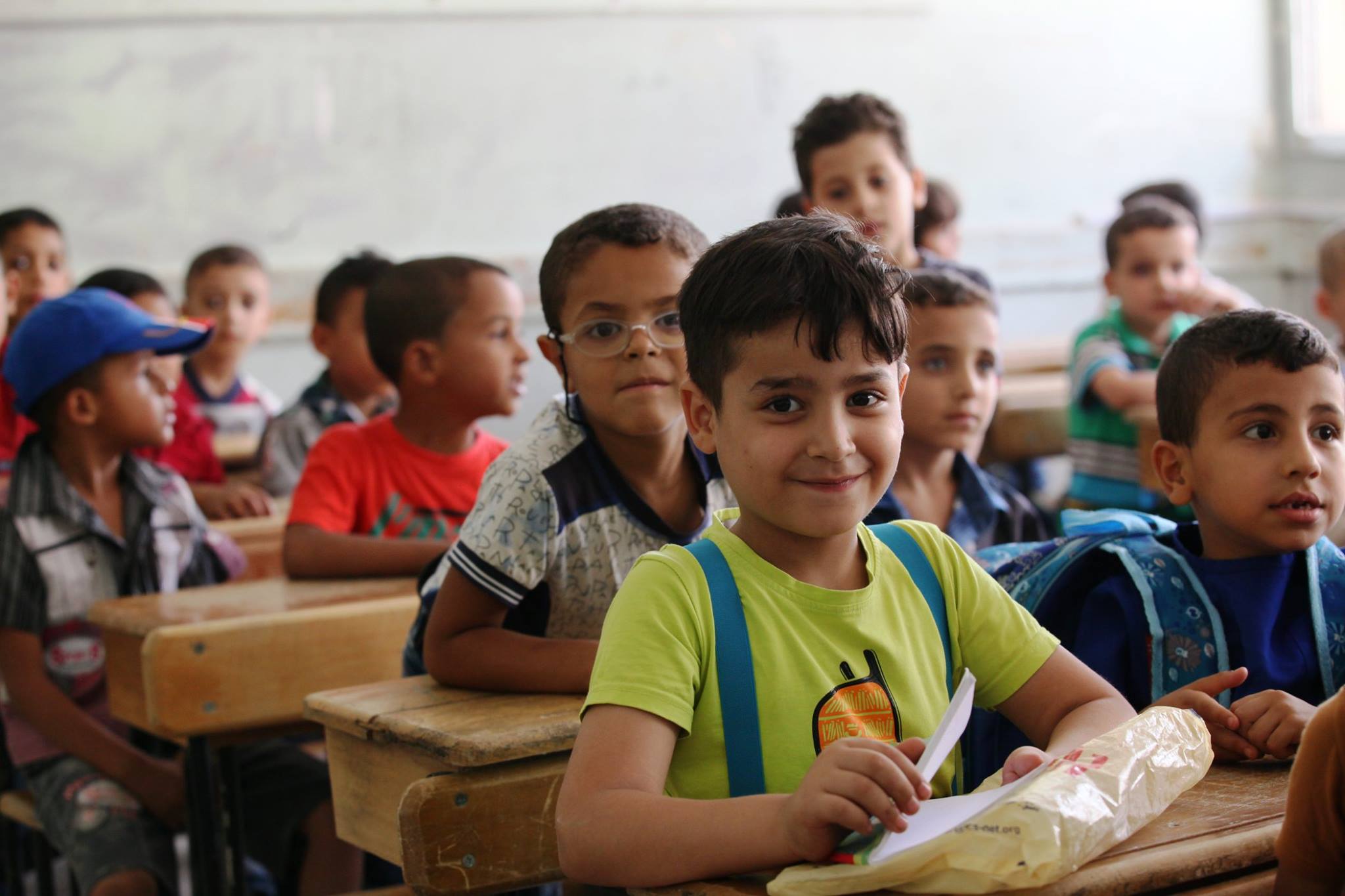
A startling 47% of the population in Gaza is under 18. A European human rights group recently reported that 91% of these children “suffer from some form of conflict-related trauma,” having grown up in impoverished, unsafe conditions and lived through multiple devastating rounds of warfare with Israel. This is a recipe for radicalization, supercharged by the fact that Hamas has sought to directly cultivate antisemitic attitudes in its education system.

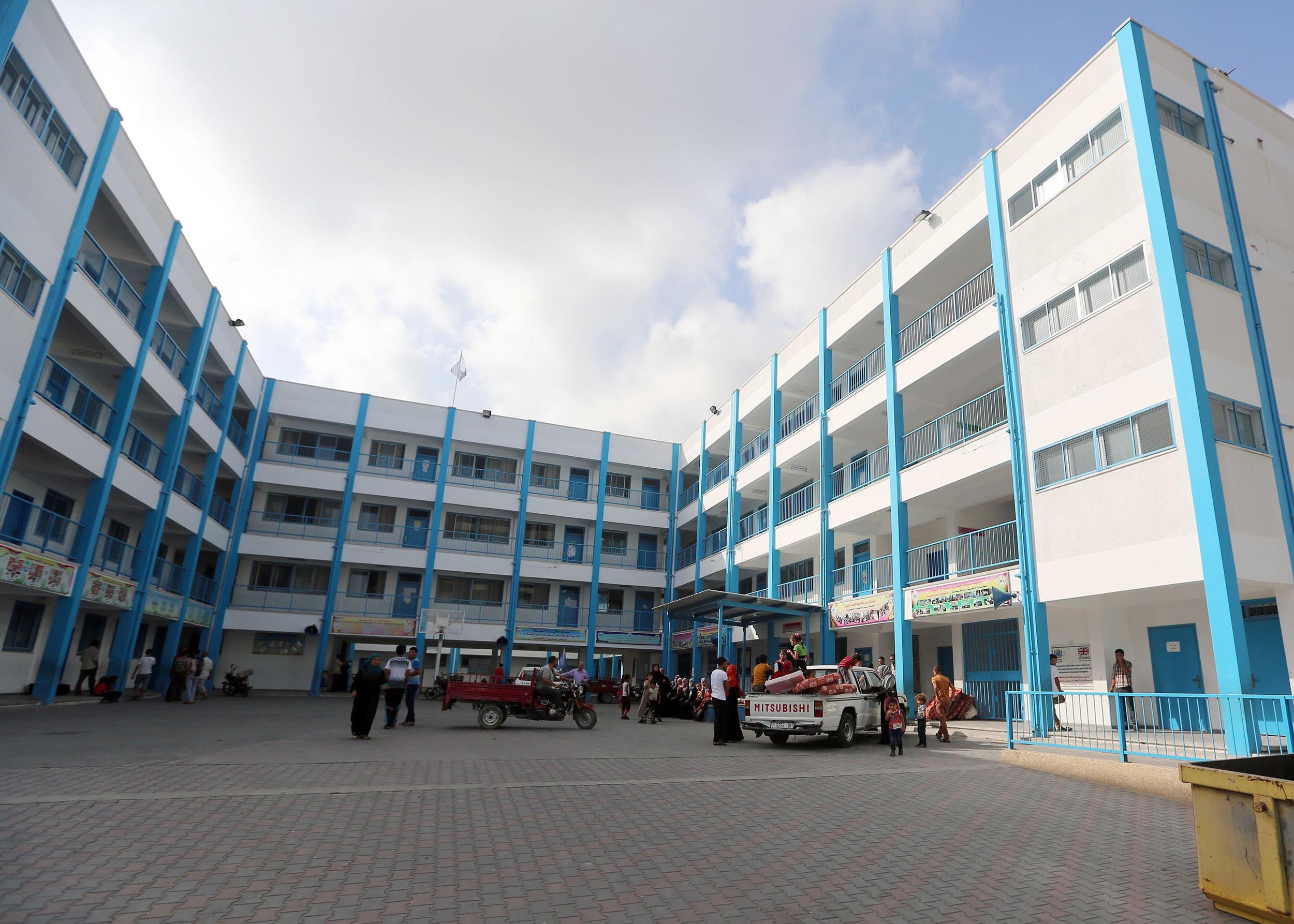
The children of Gaza have three education options: Those classified as refugees attend schools run by the United Nations Reliefs and Works Agency. Most others attend schools run by Hamas, the de-facto governors of Gaza. And there are a handful of private schools.

A 2013 New York Times article said that Gaza schools run by Hamas and the U.N. both use the Palestinian Authority curriculum that is also taught throughout the West Bank, but that “Hamas has added programs, like a military training elective” and other teachings to “infuse the next generation with its militant ideology.”

This curriculum “includes references to the Jewish Torah and Talmud as ‘fabricated,’” the Times reported, and a description of Zionism as a racist movement whose goals include driving Arabs out of the entire area between the Nile in Africa and the Euphrates in Iraq, Syria and Turkey.”

This is a curriculum designed to indoctrinate and radicalize its students in support of Hamas’ terrorist aims.

Even the comparatively moderate Palestinian Authority textbooks are problematic. In 2020, the European Union’s Parliament adopted three resolutions condemning the authority “for continuing to teach hate and violence in its school textbooks,” following a study confirming incitement in the curriculum. To teach physics, a textbook showed students “a picture of Palestinians hitting Israeli soldiers with slingshots,” the study found, while another “promotes a conspiracy theory that Israel removed the original stones of ancient sites in Jerusalem and replaced them with ones bearing Zionist drawings and shapes.”

UNRWA schools in Gaza, too, are replete with antisemitism. A 2018 article in The Times of Israel cited examples including the lionization of Dalal al-Mughrabi, who led a 1978 attack on a bus in Tel Aviv that killed more than 30  people, as a “heroine and martyr of Palestine,” and the description of the victims of an attack in Psagot, a settlement in the occupied West Bank, as “a barbecue party.”

When I hear Israeli survivors of the massacre describe the sheer hate and absence of humanity in the eyes of their attackers, I’m unsurprised. Those eyes were forced open to a false, hate-filled view of Jews for years.

Now, the children of Gaza — who have grown up in poverty, lost family members due to the ongoing violence, and been taught to hate the Jewish people — will be tasked with rising from the ashes of a brutal war triggered by Hamas’ indiscriminate murder of innocent Israeli civilians. Hamas has failed all of Gaza, yet those who have suffered most are the children.

Israel, the United States and other regional partners must work to build a better future for these children. That means an education system that abolishes hate from its curriculum. That means a government that teaches children how to build, not blow up. That means free and fair elections.

That means an end to Hamas’ reign of terror, and schools that do not teach students to hate their neighbors.

Join a war time effort to counter indiscretions of Haaretz English

Join a war time effort to counter indiscretions of Haaretz English
A source of confusion and hostility about Israel – especially during a time of war- lies with the English edition of Haaretz
Academia, Foreign press, Diplomatic corps and Jewish organizations rely on the English edition of HaAretz
War time is the time to  respond to the English edition of Haaretz

Seeking volunteers to form task force: Follow and respond to indisctretions in the English edition of Haaretz
Plan of action
Forming HaAretz English Language Study Group
1. Asking help to comb through HaAretz English and look for indiscretions
2. Asking help to communicate indiscretions of HaAretz English
  to foreign press, diplomatic corps and Jewish organizations.
3. Asking help to communicate with editors & advertisers of HaAretz
4. Asking help to consider legal action against HaAretz.
Media@IsraelBehindTheNews.com

International and Israeli Sociologists in Solidarity with Hamas

A new petition titled “Sociologists in Solidarity with Gaza and the Palestinian People” was posted recently, with some two thousand signatures from students and staff. It includes many Arabs and some Jews, including David Feldman, Professor of Sociology at Oberlin College, and two Israelis, Eliran Arazi from the Hebrew University and Ecole des hautes études en sciences sociales, and Dr. Eliran Bar-El, Lecturer in Sociology, University of York.

The petition states, “Sociology as a discipline is rooted in a recognition of relationships of power and inequality. As sociologists and human beings, we unreservedly condemn the latest violence against the Palestinian people in Gaza and the West Bank at the hands of the Israeli regime. Over the past seven days, the government of Israel has undertaken, in its own words, a ‘complete siege’ of Gaza—the second most densely populated place on the planet, home to 2.1 million residents, of which 1.7 million are refugees.”

Since Israel “claims” its actions are justifiable responses to the Hamas violence against Israeli civilians, “it has targeted the civilian Palestinian population of Gaza, while exhibiting little regard for the loss of human life. Using racist and dehumanizing language.” It then quotes Israel’s Defense Minister, Yoav Gallant, who remarked, “We are fighting human animals and we act accordingly.” Because in just ten days, “Israel has dropped over 6,000 bombs on Gaza, hit the Rafah crossing on the border to Egypt several times, targeted hospitals and ambulances, members of the press, universities, United Nations’ schools and relief offices, and used white phosphorus, a highly flammable munition that the United Nations has banned for use in dense civilian areas. Israeli forces have also cut off water, food, electricity, and medical supplies, which has pushed hospitals to a breaking point. This is an act of collective punishment.”

This, “in contravention of international law threatens the lives of over two million people, half of whom are children, with unimaginable violence and displacement.”

As of writing, ״over 4,385 Palestinians have been murdered, including a staggering 1,756 children, and over 13,561 injured. Israel’s military campaign has also displaced nearly half of Gaza’s population. It has unconscionably demanded that 1.1 million residents relocate from Northern to Southern Gaza in 24 hours, while simultaneously bombing caravans of those attempting to evacuate, and continuing to bomb the Southern part of Gaza. Calls for “evacuation” parallel the military offenses of 1948 and 1967, when Palestinians were forced to leave their homes and never allowed to return. The majority of people in Gaza are long-term refugees, and now again face genocide and ethnic cleansing. At the same time, Israeli settlers across the West Bank, recently armed by the Israeli government with 10,000 assault rifles, have targeted Palestinian civilians, with over 50 already murdered and two villages depopulated in the last week. We are witnessing internationally supported genocide. This latest siege comes as a continuation and escalation of the daily violence Palestinians faced for decades from Israeli colonization; an apartheid regime whose occupation is in clear violation of international law, but persists with the support of powerful governments globally. “

The petitioners are upset that the Western world sides with Israel and protest the “increased harassment of pro-Palestinian voices around the globe. We join people around the world who are raising their voices in protest of this assault on human life.”

They conclude that “As educators, it is our duty to stand by the principles of critical inquiry and learning, to hold the university as a space for conversation that foregrounds historical truths, and that contextualizes this past week’s violence in the context of 75 years of settler colonial occupation and European empire. We are also deeply troubled by the lack of concern and care for Palestinian and Muslim students at many of our universities, as well as efforts to clamp down on student organizing and free speech. We cannot sit back and witness the continuation of this genocidal war. We demand that our governments push for an immediate ceasefire. This stance follows in the tradition of the civil rights movement, anti-war and anti-apartheid protests of decades past. Aligning ourselves with these freedom struggles, we call on all of our colleagues to stand in solidarity with Palestinians and against settler colonialism, imperialism, and genocide.”

The petition is a classic example of the anti-Israeli activists in the academy. First, it decontextualizes the Israeli action from any empirical reality. Nowhere does the petition mention the brutal, ISIS-style attack of Hamas on the civilian population in the border communities. One would not know from the text that the terrorists burned people, raped women, beheaded babies, and kidnapped more than two hundred people to serve as hostages.

Second, Hamas is also hurting the civilian population in Gaza. The organization is in complete control of the enclave and, over the years, siphoned billions of dollars of international aid to build a virtual military fortress replete with missiles, rockets, drones, and miles of tunnel. Most egregiously, many, if not most, of the installations are built in or under public buildings, mosques, schools, and hospitals. This turns the civilians into human shields, a practice strictly prohibited in International Humanitarian Law (IHL). On the other hand, Israel has always tried to comport with IHL, even warning civilians to leave the premises before a strike.

As for the Israeli signatories, Eliran Arazi is a “PhD researcher at the Hebrew University of Jerusalem and the Advanced School in the Social Sciences (EHESS-Paris). He is currently also a research fellow at the Musée du quai Branly. Already in 2012, he signed a BDS petition.

Dr. Eliran Bar-El is a lecturer in Sociology at the University of York. In 2016, he also signed a BDS petition.

Clearly, by signing the sociologists petition, Arazi and Bar-El are signaling to Arab peers they are on their side, like many anti-Israel Israeli academics who are recruited to Western Universities.


References

https://docs.google.com/document/d/1wIKLuNYWre8jdV-tqqVJjz_GyM9_WasWjVuV9HSwazs/edit

Sociologists in Solidarity with Gaza and the Palestinian People

Sociology as a discipline is rooted in a recognition of relationships of power and inequality. As sociologists and human beings, we unreservedly condemn the latest violence against the Palestinian people in Gaza and the West Bank at the hands of the Israeli regime.

Over the past seven days, the government of Israel has undertaken, in its own words, a “complete siege” of Gaza—the second most densely populated place on the planet, home to 2.1 million residents, of which 1.7 million are refugees. While claiming its actions are a justifiable response to recent Hamas violence against Israeli civilians, it has targeted the civilian Palestinian population of Gaza, while exhibiting little regard for the loss of human life. Using racist  and dehumanizing language, Israel’s Defence Minister, Yoav Gallant, remarked, “We are fighting human animals and we act accordingly.”

In just ten days, Israel has dropped over 6,000 bombs on Gaza, hit the Rafah crossing on the border to Egypt several times, targeted hospitals and ambulancesmembers of the pressuniversitiesUnited Nations’ schools and relief offices, and used white phosphorus, a highly flammable munition that the United Nations has banned for use in dense civilian areas. Israeli forces have also cut off water, food, electricity, and medical supplies, which has pushed hospitals to a breaking point. This is an act of collective punishment, in contravention of international law, which threatens the lives of over two million people, half of whom are children, with unimaginable violence and displacement. As of writing, over 4,385 Palestinians have been murdered, including a staggering 1,756 children, and over 13,561 injured.

Israel’s military campaign has also displaced nearly half of Gaza’s population. It has unconscionably demanded that 1.1 million residents relocate from Northern to Southern Gaza in 24 hours, while simultaneously bombing caravans of those attempting to evacuate, and continuing to bomb the Southern part of Gaza. Calls for “evacuation” parallel the military offenses of 1948 and 1967, when Palestinians were forced to leave their homes and never allowed to return. The majority of people in Gaza are long-term refugees, and now again face genocide and ethnic cleansing. At the same time, Israeli settlers across the West Bank, recently armed by the Israeli government with 10,000 assault rifles, have targeted Palestinian civilians, with over 50 already murdered and two villages depopulated in the last week.

We are witnessing internationally supported genocide. This latest siege comes as a continuation and escalation of the daily violence Palestinians faced for decades from Israeli colonization; an apartheid regime whose occupation is in clear violation of international law, but persists with the support of powerful governments globally. In 2023 alone, the United States has sent $3.8 billion to prop up the Israeli military and consistently legitimized Israel’s human rights violations on a global stage. The European Union too has brazenly supported Israel’s aggression, while failing to reflect on the historical irony to “never again” commit genocide.

Furthermore, the dehumanizing language used by heads of state, military leaders, and journalists throughout the West, has begun to increase anti-Palestinian and anti-Muslim sentiment and violence. This has already led to horrible consequences, like the stabbing murder of Wadea Al-Fayoume, a six-year old Palestinian American child, a hate crime against a Sikh teen, and increased harassment of pro-Palestinian voices around the globe.

We join people around the world who are raising their voices in protest of this assault on human life. As educators, it is our duty to stand by the principles of critical inquiry and learning, to hold the university as a space for conversation that foregrounds historical truths, and that contextualizes this past week’s violence in the context of 75 years of settler colonial occupation and European empire. We are also deeply troubled by the lack of concern and care for Palestinian and Muslim students at many of our universities, as well as efforts to clamp down on student organizing and free speech.

We cannot sit back and witness the continuation of this genocidal war. We demand that our governments push for an immediate ceasefire. This stance follows in the tradition of the civil rights movement, anti-war and anti-apartheid protests of decades past. Aligning ourselves with these freedom struggles, we call on all of our colleagues to stand in solidarity with Palestinians and against settler colonialism, imperialism, and genocide.

Click here to become a signatory.

Signatories

  1. Mary Romero, Professor of Justice Studies and Social Inquiry, Arizona State University

  2. Aldon Morris, Emeritus Professor of Sociology and Black Studies Northwestern University

  3. Ruth Milkman, Distinguished Professor of Sociology, CUNY

  4. Dorothy Roberts, George A. Weiss University Professor of Law & Sociology, Raymond Pace & Sadie Tanner Mossell Alexander Professor of Civil Rights, University of Pennsylvania

  5. Julian Go, Professor of Sociology, University of Chicago

  6. Jessica Halliday Hardie, Professor of Sociology, Hunter College and the Graduate Center, CUNY

  7. José Itzigsohn, Professor of Sociology, Brown University

  8. Michael Burawoy, Professor of Sociology, Emeritus, University of California Berkeley

  9. Craig Calhoun, University Professor, Arizona State University

  10. Eric Margolis, Arizona State University

  11. Fatma Müge Göçek, Professor, University of Michigan

  12. Moon-Kie Jung, Professor, University of Massachusetts

  13. David Cook-Martín, Professor, CU Boulder

  14. Michael Rodríguez-Muñiz, Associate Professor of Sociology, University of California, Berkeley

  15. Jessie Daniels, Professor of Sociology, CUNY

  16. Gianpaolo Baiocchi, Professor of Sociology and Individualized Studies, New York University

  17. Arathi Sriprakash, Professor of Sociology and Education, University of Oxford

  18. Howard Winant, Distinguished Professor of Sociology Emeritus

  19. Anna Guevarra, Professor and Founding Director,  Global Asian Studies, University of Illinois Chicago

  20. Melissa Weiner, Professor, College of the Holy Cross

  21. Tianna Paschel, Associate Professor of Sociology and African American Studies, University of California, Berkeley

  22. Mara Loveman, Professor, UC Berkeley

  23. Cedric de Leon, Professor of Sociology and Labor Studies, UMass Amherst

  24. William I Robinson, Distinguished Professor of Sociology, University of California at Santa Barbara

  25. Joe Feagin, Professor of Sociology, Texas A&M University

  26. Tanya Golash-Boza, Professor of Sociology at UC Merced

  27. Deborah Gould, Professor of Sociology, UC Santa Cruz

  28. Ranita Ray, Associate Professor, University of New Mexico

  29. Brandon Andrew Robinson, Chair and Associate Professor of Gender & Sexuality Studies, UCR

  30. Ruth McAreavey, Professor of Sociology, Newcastle University

  31. Rebecca Elliott, Associate Professor of Sociology, London School of Economics

  32. Heba Gowayed, Assistant Professor of Sociology, Boston University

  33. Eman Abdelhadi, Assistant Professor of Comparative Human Development, University of Chicago

  34. James M. Thomas, Associate Professor, University of Mississippi

  35. Heather Randell, Assistant Professor, University of Minnesota

  36. Shay-Akil McLean

  37. Vaclav Masek, USC PhD Student

  38. Evangeline Warren, PhD Candidate, The Ohio State University

  39. Yannick Coenders, Postdoctoral Fellow/Assistant Professor of Sociology, Washington University in St. Louis

  40. A Johnson

  41. Julien Larregue, Assistant Professor of Sociology, Université Laval

  42. Chen Liang, Ph.D. Candidate, University of Texas at Austin

  43. Jack Thornton, PhD candidate, University of Pennsylvania

  44. Victoria Reyes, Associate Professor, University of California, Riverside

  45. Muhammad Ridha, PhD Candidate, Northwestern University

  46. Gabriel Hetland, Associate Professor, SUNY Albany

  47. Ricarda Hammer, Assistant Professor of Sociology, UC Berkeley

  48. Daniel R. Morrison, Associate Professor of Sociology, University of Alabama in Huntsville

  49. Christy Thornton, Assistant Professor, Johns Hopkins University

  50. Cihan Tugal, Sociology, UC Berkeley

  51. Nabila Islam, Doctoral Candidate, Brown University

  52. Andrea Constant, PhD Student, The Ohio State University

  53. Saida Grundy, Associate Professor of Sociology, Boston University

  54. Patricia McIsaac. Elementary Teacher

  55. Irene Pang, Assistant Professor, School for International Studies, Simon Fraser University

  56. Veda Hyunjin Kim, Assistant Professor of Sociology-Anthropology, Ohio Wesleyan University

  57. Shantel Gabrieal Buggs, Assistant Professor, Florida State University

  58. Zachary Levenson, Assistant Professor of Sociology, Florida International University

  59. Benjamin Bradlow, Assistant Professor of Sociology and International Affairs, Princeton University

  60. Raquel Douglas, Ph.D. student, Brown University

  61. Amaka Okechukwu, Assistant Professor, George Mason University

  62. Jamie O’Quinn, Assistant Professor of Sociology, California State University San Bernardino

  63. Shannon Malone Gonzalez, Assistant Professor, University North Carolina-Chapel Hill

  64. Semassa Boko, Graduate Candidate, University of California Irvine

  65. Danielle E. Midgyett, PhD Student, University of Delaware

  66. Daniel Aldana Cohen, Assistant Professor of Sociology, UC Berkeley

  67. Katie Kaufman Rogers, Assistant Professor, Regis University

  68. Salma Mostafa, graduate Sociology student at Northwestern University

  69. Pilar Gonalons Pons, Associate Professor University of Pennsylvania

  70. Paloma E Villegas, Associate Professor, California State University, San Bernardino

  71. Yichen Shen, graduate student, Department of Sociology, Northwestern University

  72. Cati Connell, Associate Professor of Sociology at Boston University

  73. Karin Yndestad, PhD Candidate, Northwestern University

  74. christina ong, PhD Candidate, University of Pittsburgh

  75. Vivian Shaw, Mellon Assistant Professor, Vanderbilt University

  76. Santiago J. Molina, Assistant Professor, Northwestern University

  77. Archana Ramanujam, PhD student, Brown University

  78. Carolina Hernandez, M.A., University of Pittsburgh

  79. Spyros Sofos, Assistant Professor, Simon Fraser University

  80. Nicole Jenkins, Assistant Professor Howard University

  81. Madeleine Govia, MSDS

  82. Carilee Osborne, PhD Student, Brown University

  83. Xianni Zhang, PhD Student, University of Michigan

  84. Brett Kellett, PhD Student, University of Michigan

  85. Yeneca Lee, PhD student, University of Pittsburgh

  86. Cat Dang Ton, PhD Student, Department of Sociology

  87. Jean Beaman, Associate Professor, University of California-Santa Barbara

  88. Lanora Johnson, PhD Candidate, University of Michigan

  89. Eyako Heh, Sociology PhD Student, Northwestern University

  90. Erika Kim, PhD Student, University of Michigan

  91. Xavier Durham, UC Berkeley

  92. Georgiann Davis, Associate Professor, University of New Mexico

  93. Katie Jensen, Assistant Professor of Sociology and International Studies, UW-Madison

  94. Sonia Planson, Postdoctoral Fellow, Brown University

  95. Kalyani Jayasankar, Postdoctoral Scholar, University of Southern California

  96. Laura Garbes, Assistant Professor, University of Minnesota

  97. Kelsey Weymouth-Little, PhD Student, UC Irvine

  98. Dr Babalwa Magoqwana- Nelson Mandela University

  99. Mo Torres, Assistant Professor, University of Michigan

True colours

It is at times like these when one can discover who is genuine and who is “missing in action”.

This is not the first time that Jews in the Diaspora and Israel have faced a situation where, in the face of unbridled hate, they have encountered “fair-weather friends.”  In 1933 when the Nazis were voted into power, German Jews experienced this first-hand. I remember my late mother telling me that all of a sudden, girlfriends with whom she had socialized at school dropped her and wanted nothing to do with her because overnight, she had become a “dirty Jew.” My late father likewise recounted how from one day to the next, Jewish university students were shunned and victimized, followed shortly thereafter with expulsions from all institutions of higher education.

Expulsion of Jewish university students and faculty may not yet have occurred in democratic countries but victimization and intimidation certainly is now a common event. Student and faculty groups are demonized, followed by verbal and physical abuse.

Those perpetrating these acts of hate are now showing their true coloursIt is becoming glaringly obvious which way the wind is blowing as university heads, administrators and boards either reveal their putrid poison or meekly remain silent and issue weak-kneed responses.  In the USA, in particular, this sickness has infected ultra-left and breast-beating groups that identify as “Jewish.” The phenomenon of those coming out of the woodwork and claiming some sort of Jewish identification while they participate in vile demonstrations against Israel and Zionism is nothing new.

Some of the worst enemies of the Jewish People in past history were individuals whose identification with anything Jewish was nebulous or nil. After they converted or decided that attacking other Jews was a guaranteed way of acquiring immunity from persecution themselves, they morphed into some of our most rabid and lethal enemies.

Today’s media love nothing better than discovering such disaffected Jews. Thus, someone standing with a placard that states that they “stand with Gaza” or a collection of anti-Zionist Jews dressed in Haredi garb and draped with Hamas and Fatah scarves immediately becomes media heroes. Never mind that these individuals are no more than a minuscule percentage of the Jewish People. They serve the purpose of propagating distorted news and proving that not all Jews are warmongering fascists.

It is in times like the present that we need to be clear-eyed as to who exactly are our genuine friends and who are faking it.

That means publicly denouncing hate groups and their followers and exposing them for the frauds that they really are. It serves no purpose to issue bland statements in the vain hope that nobody will be upset. Expecting a toning down of hateful rhetoric while it rages unchecked and unchallenged is an exercise in futility. The individuals and organizations spreading such slanders need to be confronted with exposure and condemnation. The same goes for those who cannot find the intestinal fortitude or honesty to denounce the cowardly silence of groups that purported to be our allies.

Interfaith groups have proliferated in recent times. Initially encompassing Jewish and Christian participants, they have, in many countries, now encompassed Islamic groups. When I was a member of the NZ Council for Christians and Jews the main focus of my attention was concentrated on learning about our common similarities and appreciating where we differed theologically. The most impressive aspect of the Council’s work was the respectful dialogue that ensued and the genuine friendships that developed. I always made a point of emphasizing that Judaism and the Land of Israel were an inseparable duo because, in reality, one could not exist without the other.

As mainstream Churches slowly gravitated towards a very ambivalent stance about Israel, the NZ Anglican Communion rewrote the Psalms in order to erase mention of Israel and Zion. This should have been a warning signal about what lay ahead.

Currently, with the three monotheistic faiths represented on some interfaith Councils, the situation has become more complex.

It is becoming glaringly obvious which way the wind is blowing. Islamic groups, with all the best goodwill in the world, would always be hesitant to openly acknowledge the centrality of Israel to Jews and recognize that Jewish sovereignty predated Islam.

Prevailing attitudes mean that nothing remotely inconvenient can be allowed to shatter the illusory narratives so beloved by practitioners of political correctness.

The current reactions by interfaith groups to the pogroms by Hamas do not surprise me in the least. Church groups (other than Evangelical Christians) and Islamic groups are united in their “even handed” reactions. Moderate Muslims who may wish to condemn Hamas are terrified of what may happen to them at the hands of their jihad-supporting colleagues. Some brave individuals have spoken out, as have a few Imams but unfortunately, it is the purveyors of fanaticism who are spreading hate. It is impossible to know what is being preached in each and every mosque, but one has only to witness the demonstrations supporting Hamas taking place to realize that something rotten is being incubated and spread.

The following declarations perfectly illustrated the situation whereby blame is apportioned evenly.

“As the conflict continues to grow in Gaza and Israel and tensions continue to rise regionally, members of the regional interfaith councils and faith leaders throughout Aotearoa New Zealand unequivocally condemn the violence and call for peace and justice. We send our healing love to our Muslim, Jewish, Christian and other faith brothers and sisters in the Middle East and to their families and friends here in NZ as they endure and try to come to terms with the huge loss, pain and worry. We ask all New Zealanders to reject all forms of hatred & violence through love, forgiveness, understanding the other and compassion at this dark time and forever more.”

The World Council of Churches, to which all mainstream denominations belong, stated:  “We appeal urgently for an immediate cessation of this deadly violence, for Hamas to cease their attacks and ask both parties for de-escalation of the situation. We are deeply concerned about the imminent risks of spiraling conflict between Israel and Palestinian armed groups – following a period of escalating tensions and violence in the West Bank and Jerusalem.”

The Roman Catholic Cardinal of Westminster pontificated: “Violence is never a solution. Retribution is never a contribution to peace.”

US Bishops: We call for a cessation of violence from both sides, respect for civilian populations and the release of hostages.”

Churches for Middle East Peace: “call for de-escalation, humanitarian access and addressing systemic issues after war breaks out in Israel/Palestine.”

Note the complete avoidance of condemning Hamas for its pogrom and calling them terrorists. Note also the frenetic attempt at casting blame on all parties concerned and thus equating Israel’s defence of its citizens with the terrorist group’s avowed agenda of murdering Jews. Painfully grating is the admonition that only love and a lack of retribution can defeat evil, given the millennia-long experiences of Jews in Christian Europe.

These few examples should demonstrate how interfaith fellowships have been damaged. A refusal and reluctance to openly condemn the murder of Jewish Israeli men, women and children and attempting to hide behind a façade of moral superiority makes a mockery of Jewish participation in any meaningful interfaith dialogues.

Last Friday, as reported by PMW, the PA Ministry of Religious Affairs issued this instruction for all Mosque preachers: All Mosques must teach that the extermination of Jews is an Islamic imperative.

The complete silence following this directive by Muslim groups worldwide, interfaith organizations, Churches, the UN and its Secretary General, plus all those politicians peddling a two-state solution, speaks volumes about what we are facing. As demonstrators march in various countries, shouting slogans such as “gas the Jews”. Jihad and “from the river to the sea,” the shameful silence from the rest of the world is shattering.

Jewish leaders should be acting by condemning and disassociating themselves from all those who refuse to own up to the truth and instead promote slanderous lies.

The current war against terror has also had an interesting flow-on effect for Israelis with friends and families domiciled overseas. It is at critical times like these that one discovers an individual’s true colours. We, like countless others, have received messages of concern and support from people we may not have heard from in years. Christian friends from New Zealand expressed their horror at events and are praying for Israel. Messages flowed in from Canada, USA, UK and Australia among other places. A non-Jewish colleague who I worked with over 40 years ago sent an email as did former Cheder (Hebrew School) pupils I taught more than 60 years ago. The outpouring of solidarity has been heartwarming.

The flip side has been the silence of those who many thought might show some empathy but who, it seems, have other more pressing priorities.

The American Secretary of State noted this week that “many world leaders express support for Israel in private but won’t publicly endorse its right to defend itself or denounce Hamas terror.”

Revealing one’s true colours has never been easier and more blatant.

Michael Kuttner is a Jewish New Zealander who for many years was actively involved with various communal organisations connected to Judaism and Israel. He now lives in Israel and is J-Wire’s correspondent in the region.

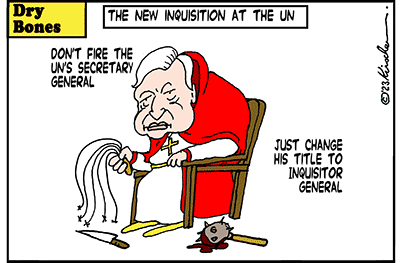
Inquisition at the UN

Antonio Guterres is Secretary General of the United Nations. His public response to the Hamas Oct 7 Atrocity was to justify the slaughter of Israelis by reciting a stream of pitiful excuses and outrageous explanations.

Unfortunately, the Secretary General is accurately stating the anti-Israeli view of most of the member countries of the organization that he heads.

At the UN the Jewish State faces a new inquisition, and Antonio Guterres is its Inquisitor General.

* * *I am asking for your support. A constant flow of Dry Bones cartoons during this war can be an important part of the war effort. Please help fund the Dry Bones coverage of the Hamas war. Do it thru PayPal or you could use your Credit Card to support us by just clicking on the link below:
Donate

ALSO PLEASE NOTE:
TO DONATE $50 or MORE BY CHECK (U.S. Tax DEDUCTIBLE)
1. Write a check to “REPORT, Inc.”
2. Write a cover note stating that these funds are to be directed to Dry Bones Project. Mail the Check and the accompanying cover letter to:
REPORT, Inc.
PO Box 1670
Southampton, PA 18966
U.S.A. ************

-Dry Bones- Israel’s Political Comic Strip Since 1973

The Day After Tomorrow

I teach film, among other things, and there is a film that comes to mind while assessing the current situation in Israel.

It is the 1996 American science fiction action film Independence Day. In the aftermath of a worldwide attack by aliens, one of them is captured. I think the most important exchange is the one that the president of the United States has with the alien. It has resonated with me many times.

Frustrated, getting nowhere with negotiations, the president asks the alien, “What do you want us to do?” The alien rasps out, honestly: “Die!”

This is what Hamas and other terrorist organizations, and Iran, have been telling us for years. They want us to die. Not give them land. (We’ve tried that.) Not give them jobs. (Ditto) Not treat them in our hospitals. (Double ditto.) None of that is good enough. They simply want us – all Jews everywhere – to die.

And, to borrow the title of another film, what will happen the day after tomorrow?

Dr. Guy Bechor is one of the few addressing that question.

Bechor, LL.B. MA, Ph.D, was the head of the Middle Eastern Studies Division of the Lauder School of Government, Strategy and Diplomacy at the Interdisciplinary Center Herzliya, Israel, and a visiting fellow at the School of Law, the Islamic Legal Studies Program, Harvard University. He is the author or co-author of three books relating to Islamic law and society.[1]

On Oct. 11, he wrote on his Facebook page [My translation – TKG]: “The Americans are preparing for the return of Mahmoud Abbas and his gang to rule Gaza, and the intentions to establish an independent state in Judea and Samaria and Gaza are expected to return. Tomorrow [October 12], U.S. Secretary of State Anthony Blinken will meet with Mahmoud Abbas in Jordan.

“This is how it will unfold — that the IDF soldiers will fight to liberate Gaza, for Abu Mazen [another name for Mahmoud Abbas]. We can fight against Hamas, and the West is behind us. We cannot fight against diplomatic initiatives, and the same West will be against us. The return of Mahmoud Abbas under the auspices of diplomatic initiatives is the most serious situation of all.”

He adds the following day, “…Abbas is ready, only if he receives a state on the West Bank and Gaza, as well as a port and an airport. A video shows Blinken meeting with terrorist supporter Mahmoud Abbas, in Jordan, with the enemy’s flag in the background. What a shame, what an insult.

“Will the IDF soldiers fight and pay the heaviest prices to return Mahmoud Abbas to Gaza? In this case the damage to Israel will be many times greater than the rule of Hamas, we will not be able to exist. Please, share the warning.”

According to Israeli officials, what will the post-war scenario be?

“We’ve had all kinds of end games,” Brigadier General Daniel Hagari told media during a news briefing, in response to a question about whether Israel’s military planned to stay and govern Gaza after its ground invasion. (Jerusalem Post) He also said it would be a “global issue” for discussion by Israel’s politicians and with other countries.

Will the Israeli government be lured by the current warm and fuzzy support Biden and Blinken to hand over Gaza to the PA and Abbas once Hamas is decimated?

A Times of Israel reporter says that, according to one American official, Israel is being pressured to come up with a plan after the war.

If that “plan” includes the PA or Abbas, it will be a disaster. The PA and Mahmoud Abbas have continued to glorify perpetrators of the most horrific terror attacks, even before this current war with Hamas, and there has been no resounding condemnation of the latest atrocities. Even his pareve “critique” of the latest massacre was backtracked. How fitting that his doctorate was on the denial of the Holocaust. Even the left-wing Haaretz newspaper wrote as recently as a month ago (published, symbolically, on September 11): “Mahmoud Abbas: Once an Antisemitic Holocaust Denier, Always an Antisemitic Holocaust Denier.”

Most worrying is that on the official White House website, a conversation is reported between President Biden and Abbas, that includes paragraphs which sound like a veiled reference to what Biden has in mind:

“President Abbas briefed President Biden on his engagement in the region and his efforts to bring urgently needed humanitarian assistance to Palestinian people, particularly in Gaza. President Biden offered President Abbas and the Palestinian Authority his full support for these important and ongoing efforts…President Biden detailed U.S. efforts to coordinate with partners to prevent the conflict from widening, and the two leaders discussed the need to preserve stability in the West Bank and the broader region.”

What exactly did the “two leaders” discuss regarding how to “preserve stability?”


The PA legacy and Pay for Slay

David Bedein is the director, since 1987, of the Israel Resource News Agency at the Nahum Bedein Center for Near East Policy Research. (On the web: UNRWA-monitor.comwww.cfnepr.comisraelbehindthenews.com.) He says, “The PLO never ratified the Oslo accords and never revoked its charter to liquidate the state of Israel.

“PA payments for murder began as the PA commenced in May 1994 and enacted a formal law in this respect in August 2015.” Bedein’s center sent an Arab journalist to the PA to get a copy of the law, which he subsequently publicized in the Jerusalem Center for Public Affairs.

He adds, “No country demands that the PA repeal the unprecedented law which mandates a salary for life for anyone who murders a Jew. Imagine if 135 nations, which aid the PA, were forced to condition that aid on the repeal of that law.”

Author of Genesis of the Palestinian Authority, he writes in answer to my query, “Having covered the PA since it came into being in 1994, I asked Dr. Pinhas Inbari of the Jerusalem Center for Public Affairs, formerly with leading left wing newspaper Al Hamishmar, to report on Abbas actions following the Simchat Torah massacres… Inbari confirms that the most Abbas would say is that the massacre was not appropriate to Islam. No condemnation, no regret. The US government publicizes that Abbas condemned the massacres. This continues the pattern. Abbas on the White House lawn with Arafat in Sept. 1993 together signed the Oslo accords. However Inbari flew to Tunis to witness the ratification of the accords, except that the PLO would not ratify the accord.”

As long as ten years ago, Bedein wrote in the Jerusalem Post in an article titled, “US aid to Palestinian forces may assist Hamas,” “[T]he Fatah policy and attitude toward Hamas can be summarized by an exchange I had with Fatah founder Yasser Arafat at a press conference in Oslo, Norway, on December 10, 1994, the night before Arafat became one of the recipients of the Nobel Peace Prize.

“My question: ‘Mr. Arafat, Israeli prime minister Rabin and Israeli foreign minister Peres said a few hours ago in answer to my question that you deserve the peace prize because you have committed yourself to crushing the Hamas terror organization.’ Arafat’s answer: ‘I do not understand the question. Hamas are my brothers.’”

The despicable practice of the Palestinian Authority, of Pay for Slay, under Abbas, is ongoing, and proof they are not genuine peace partners.

These payments, made by the Palestinian Authority, led by Abbas, continue. According to an item published in the Jerusalem Post on Oct. 17, “The Palestinian Authority will pay families of dead Hamas terrorists a combined total of around $2.8 million, according to a report by the Palestinian Media Watch (PMW), a nongovernmental organization and media watchdog group.” In addition, “The PMW claims that the $2.8 million payments is a low estimate because there will be more “martyrs” and prisoners from the Hamas terrorist organization.” PMW also accuses the Palestinian Authority  of receiving funding from countries from the European Union for this “program.”


Where is the UN and UNRWA?

Notorious textbooks in UNRWA schools have been well documented. In one article called, “UNRWA: Blurring the Lines between Humanitarianism and Politics” by Dr. Rephael Ben-Ari, published on the website of the Jerusalem Center for Public Affairs, Ben-Ari quotes a video that was uploaded to YouTube on July 2013, and was screened in part on Israel’s Channel 2 news.

He writes, “It was directed by journalist D. Bedein, and produced by the Nahum Bedein Center for Near East Policy Research… [The] video footage came to light, entitled ‘Camp Jihad,’ showing the curriculum of Palestinian children in several UNRWA summer camps, which incite hostility towards Israel and the Jews. The documentary that filmed summer programs in the Gaza Strip and Balata refugee camp (north of Nablus) shows young campers being educated about the ‘Nakba’ and taught about ‘the villages they came from,’ such as Acre, Ashkelon, Beersheba, Haifa, Jaffa, Lod, Nazareth, Safad, and even Tel-Aviv (Sheikh Munis) – all cities within sovereign Israel. Even the names of the teams in their summer camps take on the names of these cities.

“In the documentary, the director of the Gaza camp explains that these programs are meant to motivate the youngsters ‘to return to their original villages,’ and she expresses her deep gratitude to UNRWA for financing the camp.

Regarding UNRWA and the PA, Bedein published the book ROADBLOCK TO PEACE: How the UN Perpetuates the Arab-Israeli Conflict: UNRWA Policies Reconsidered.


“Selektzia”

We’re heard that before, including during the Entebbe raid in 1976. One of the most horrifying ideas that has emerged is the idea of “selektzia” while Israeli says adamantly that all the hostages must be released.

France is demanding that Hamas release Mia Schem, the French-Israeli about whom Hamas made a video. Yet Mia’s courageous mother, Keren, emphasized in an interview on Israel radio that “all the hostages must be released.”

In 2005, which Israel destroyed Gush Katif, with no peace agreement, the Gazan Arabs were handed a gift on a silver platter. They were given, through the years, billions of dollars of foreign aid. They could have created a paradise on earth. Instead, they burnt the Gush Katif synagogues, plundered the greenhouses, which had been left standing, and when Hamas took over Gaza two years later, they turned the entire area into a hell on earth, not just as a threat to Israel, but for their own residents, all of them human shields.

I found an article I published shortly before the expulsion from Gush Katif, including the story of what may have been the last brit milah.

Wednesday August 10, 2005

Everyone, even those of great faith, recognize that it may be the last brit mila in Gush Katif, and the atmosphere is heavily mixed with joy and sorrow. The lawns surrounding the synagogue are filled with well-wishers, the tables laden with cold drinks and watermelon slices. The child is named Amichai — “my nation lives.”

During the festive lunch (at tables decorated with orange ribbons and napkins), the rabbi of the community, Gabi Kadosh, the baby’s grandfather, says, “I invite you all to join us here for Amichai’s Shabbat hatan (the Shabbat before a wedding)!” One of the caterer’s workers rolls his eyes in disbelief. But I say to the people at my table, “Amichai’s father married young — at 19. And I remember how the children of Gush Etzion returned to their homes after the Six Day War in 1967, 19 years after they were driven out in 1948 when Gush Etzion fell to the Jordanians. These children, too, will return one day.”

I finish my little speech of hope and Hanan Porat enters the hall, to wish the family mazal tov. Hanan was the leader of the Gush Etzion children who returned in 1967, and I declare it to be an omen that my prophecy was true, and that the children of Gush Katif will return, one day, to this strip of land.

This coming year will be 19 years since the expulsion from Gush Katif.

Spoiler on the film Independence Day: The good guys fight back and win in the end.

________________


[1] Books by Dr. Guy Bechor: God in the Courtroom: The Transformation of Courtroom Oath and Perjury Between Islamic and Franco-Egyptian Law (Studies in Islamic Law and Society, 34)The Sanhuri Code, and the Emergence of Modern Arab Civil Law (1932 to 1949) (Studies in Islamic Law and Society) and From Intifada to War: Milestones in the Palestinian National Experience (Hebrew), the last together with co-authors Tamar YegnesYuval Arnon-OhanaEsther WebmanEhud YaariBruce Maddy-WeitzmanAmos NadanElie RekhessKhalil Shikaki and Daniel Schueftan, Published by The Moshe Dayan Center. More articles by Dr. Bechor can be found, in Hebrew, on his website: www.gplanet.co.il.

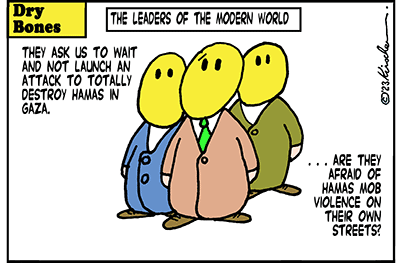
The Modern Dilemma

The Hamas war is Iran’s war against the modern world. It was long-planned, but the trigger that set it off was the blossoming of Israeli “normalization” with the Saudis.

The cartoon asks if the leaders are afraid of mass anti-Jewish violence on their streets. The answer is yes. Obviously.

The real question is what will they do about saving their democracies from the Islamofascists.
My hunch is, not much.

* * *We know that many worthy groups and emergency causes are competing for your support in this terrible time. We believe that a constant flow of Dry Bones cartoons during this war (like the great cartoonists of World War 2) can be an important part of the war effort.

Please support the Dry Bones coverage of the Hamas war thru PayPal or you could use your Credit Card to support us by just clicking on the link below:
Donate

ALSO PLEASE NOTE:
TO DONATE $50 or MORE BY CHECK (U.S. Tax DEDUCTIBLE)
1. Write a check to “REPORT, Inc.”
2. Write a cover note stating that these funds are to be directed to Dry Bones Project. Mail the Check and the accompanying cover letter to:
REPORT, Inc.
PO Box 1670
Southampton, PA 18966
U.S.A. ************

I Negotiated Israel’s Hardest Hostage Deal. Here’s What’s Next in Gaza.

Gilad Schalit, an Israeli soldier, had been a hostage for five years before Israel and Hamas were seriously willing to work toward his release. That was 2011. I had been pursuing secret back-channel communications with Hamas since a week after he was captured in a cross-border raid and dragged into Gaza. My partner in these secret negotiations was Ghazi Hamad, Hamas’s spokesman who was then also a political adviser to its prime minister.

Mr. Hamad showed compassion for Mr. Schalit and his family many times. In the end, the price of Mr. Schalit’s freedom was steep: 1,027 Palestinian prisoners. On Oct. 18, 2011, he returned to his home in northern Israel. When I talked to Mr. Hamad on the phone early that morning, he blurted out in a moment of spontaneous joy, “Next time we will negotiate peace!”

On the first night of Israel’s bombing, I have learned, Mr. Hamad’s home in Gaza City was destroyed in an airstrike. I saw it as a clear signal from Israel: Everyone affiliated with Hamas is a target. The time for talk is over.

Today, there are again hostages in Gaza — more than 200, according to the Israeli government. On Friday, Hamas released two of them — an American mother and daughter — but the fate of the others remains unclear. As deadly airstrikes on Gaza continue and Israel amasses troops at the border in preparation for a ground invasion, their safety grows more precarious each day. Should Israel negotiate to get their civilian hostages out of Gaza as quickly as possible? Should it sacrifice them to achieve its goal going into this war — to eliminate Hamas? Should it exchange them for prisoners, as it has done in the past?

These considerations present a stark dilemma for all Israelis, but perhaps none more so than Prime Minister Benjamin Netanyahu, who was once the staunchest opponent of negotiating with terrorists of any kind, but who also came to realize that the ethos of leaving no soldier behind did sometimes require that kind of engagement.

Israelis have been held hostage many times over the nation’s 75 years. In May 1974, members of the Popular Front for the Liberation of Palestine held 115 hostages, most of them high school students in the town of Maalot, in northern Israel, for two days, an episode that ended in the murders of 22 hostages. An Air Force officer, Ron Arad, was shot down over Lebanon in 1986 and was never returned. In May 1985, Israel released 1,150 Palestinian prisoners in exchange for the return of three Israeli soldiers captured in Lebanon.

Over the course of those painful episodes, the nation learned a great deal about how to work for its hostages’ release, whether through third-party negotiations, secret back channels or force. But today’s hostage crisis is unlike any other. It’s not just a few people being held by hostile forces. It’s about 200 people, including women, children and the elderly, and it’s unfolding in the midst of a full-blown war. None of the old rules apply.

Hamas held Mr. Schalit in a secret location. Is that possible with such a large group? Gaza is a very small territory with a very dense population, not all of whom support Hamas. The inevitable intelligence leaks could enable Israel to conduct rescue operations. Israeli intelligence analysts will be looking for leads anywhere they can find them, such as data from cellphones found on the bodies of terrorists killed since the attack on Oct. 7.

It is equally unclear how this group of hostages will be treated. Hamas treated Gilad Schalit surprisingly well during his years of captivity. He was never physically tortured. Could the same be the case with so many hostages? Hamas has said that some of them are being held by other groups, including Islamic Jihad. Whatever Hamas’s approach is toward these hostages, there is no guarantee that another group will share it.

Killing hostages is not what I would previously have expected from Hamas. But the killing spree of Oct. 7, including the butchering of whole families, the burning of homes, the destruction of whole communities, changed that. On Monday, it released a video of a 21-year-old hostage who appeared to have been wounded and was being treated on camera. There were no signs that she had been tortured but it was clear that she was under duress.

Negotiating for the release of hostages may also be less popular this time around. The Schalit deal was very difficult for Israel to accept. More than 300 of the Palestinians who were released from prison had been serving life sentences for violent acts, including killing Israelis. It was hard for me, too: My wife’s first cousin, Sasson Nuriel, was kidnapped and killed by Hamas in September 2005. Four of the people responsible for murdering him were released as part of the agreement that I negotiated. Still, in the end, nearly 80 percent of the public, according to one poll, along with 26 government ministers and the entire national security establishment, supported the deal. Prime Minister Netanyahu signed off on the agreement.

Today, Israel holds about 7,000 Palestinian prisoners, of whom 559 are serving life sentences for killing Israelis, according to Addameer, a Palestinian prisoners’ rights group. Will Israelis, still reeling from the atrocities of Oct. 7, be willing to accept this kind of bargain again? Is it safe to do so? One of the men who killed my wife’s cousin, who was released in exchange for Gilad Schalit, was among the leaders of the Oct. 7 terrorist attacks, according to Israel’s report of his recent killing.

I have no official authorization as a negotiator, but as far as I know I’m the only Israeli citizen who has contacts both with the leadership of Hamas and the leadership of Israel, so I have been in continual touch with both sides in hopes of advancing some long-term agreement. The release of those first two hostages is a positive development, but overall, prospects remain dim. Hamas continues to demand an end to “Israel’s aggression against Gaza,” and Israel says it has no intention of ending this war “until the job is done.” Mr. Hamad has not backed down from Hamas’s brutal attacks.

In my conversations with Hamas leaders, I have pushed them to release the women, children, elderly and sick as a humanitarian gesture. Hamas rejected the idea. I believe that Israel is open to accept a small deal in exchange for such a group, so I proposed to my Hamas contacts that they trade them for the 33 Palestinian women and 170 Palestinian minors currently in Israeli prisons, according to Addameer. Hamas rejected that, too. Right now, Hamas’s focus is achieving a comprehensive cease-fire.

There are still official talks taking place. Qatar is speaking with Hamas and the United States is speaking with Qatar and Israel. This is too convoluted and complex. There need to be direct talks between Israel, Qatar and Hamas, and no one else. Not the United States, and not Iran. The agreement of Hamas to release the two Americans was apparently negotiated by the Qataris and assisted by the International Committee of the Red Cross.

The United States still has a role to play. It should continue to pressure Qatar, which should give an ultimatum that if hostages are not released within, say, 24 hours, all of Hamas’s leaders will be expelled from Qatar, where many are based. I don’t believe that Qatar will agree to that — and certainly not without an Israeli cease-fire — but the American government and others have leverage over Qatar and it should be used.

There is still a small chance and a limited window of opportunity before the ground assault begins to attain the release of some of the hostages through this kind of agreement. After the invasion begins, it will depend on Israeli special forces to try to save them.

Some will again see their homes; others may not.

At the other end of this war, I hope that the trauma and suffering we are all feeling on both sides of the conflict will spur us to figure out how to share this land that belongs to both Israelis and Palestinians. Maybe our collective suffering and pain can be channeled to focusing on how to live together rather than killing each other. That will be a long process and cannot include the leaders on both sides who have brought us to where we are.

We need a new generation of leaders with new vision, new hopes, new dreams and the ability to lead. I hope that many of the hostages, together with their families, will soon be able to join the voices calling for change.

Gershon Baskin is the Middle East director of the International Communities Organization, a human rights advocacy group.


UNRWA incites during a time of war

At a time when the war in Gaza continues in full force, Israeli state security services are finally enforcing a crackdown on incitement, a step which our agency has advocated for more than 30 years.

In that context, more than one hundred Israeli and Palestinian Arabs have been arrested for demonstrating active support of the new campaign to butcher Jewish men, women children and babies.

What has so far gone unreported are the daily celebrations of these murders of Jews. celebrations which are now being conducted in the UNRWA refugee camps in Bethlehem and in Jerusalem, which have become weapons arsenals and may spill over into attacks on Jews in the heart of Israel, at any moment.

At this time, we dispatch TV crews to document the new campaign to incite genocidal violence in the UNRWA refugee camps of Deheishe and Aida in Bethlehem and the UNRWA camp in Shuafat in Jerusalem.

The crews are asked to interview the children in these camps. as we have done in earlier movies,which can be seen at https://www.cfnepr.com/205640/Movies

We are always a few steps ahead of the Israeli security establishment when it comes to our coverage of lethal incitement because our cameras are on site before the Israel Defense Forces and Israeli intelligence services arrive.

During the heyday of the supposed peace process, the Israeli security establishment did everything possible to prevent this material from being screened, since we unmask the true face of Israel’s “peace partners”.

For that reason, our initiative remains a private initiative.

That is why funds to produce this new short documentary which will expose  UNRWA incitement during this war will remain in the private domain.

https://israelbehindthenews.com/donations/