 Czech
Czech French
 German
 Hebrew
 Noruegan
 Russian
 Spanish
 Swedish
 Polish
 Portuguese



היהודים בספרי הלימוד של הרשות הפלסטינית שבשימוש אונר”א
הקדמה
ספרי הלימוד של הרש”פ, ובכלל זה אלו שנלמדים בבתיה”ס של אונר”א, כוללים 3 עקרונות יסוד
בהקשר הסכסוך:
1 .דה-לגיטימציה של קיום מדינת ישראל ושל עצם נוכחות היהודים בארץ, תוך הכחשת
ההיסטוריה שלהם והכחשת קיומם של מקומות קדושים להם בה.
2 .דמוניזציה של ישראל והיהודים, כולל מבחינה דתית – עם השלכה חמורה על תדמיתם בעיני
ילדים הבאים מחברה מסורתית.
3 .העדר הטפה לשלום עם ישראל. במקום זאת – קריאה למאבק אלים לשחרור כל הארץ תוך
הצגתו כמאבק דתי ושילוב הטרור בו, עם המשמעות של עידוד מעשי רצח נגד יהודים.
נייר זה מתרכז בהתייחסות ם של ספרי הלימוד הפלסטיניים ליהודים בלבד. הוא איננו מרחיב בנושא
ההתייחסות לישראל כמדינה ולדרכי המלחמה נגדה.
דה-לגיטימציה
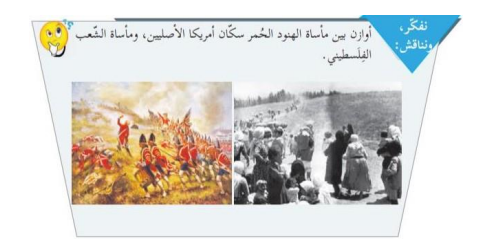
1 .תושביה היהודים של ישראל נחשבים לקולוניאליסטי ם:
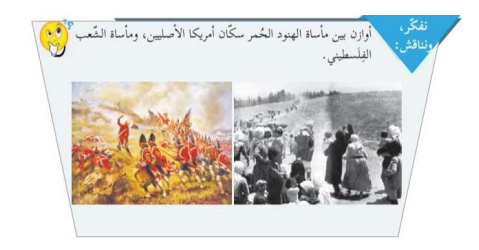
“נחשוב ונדון: אשווה בין הטרגדיה של האינדיאנים תושבי אמריקה המקוריים לטרגדיה של העם
הפלסטיני.”
Jews in Palestinian Authority Schoolbooks in UNRWA Use
Introduction
The Palestinian Authority schoolbooks, including those ones in UNRWA use, feature
3 fundamentals in the context of the conflict:
1. De-legitimization of Israel’s existence and the Jews’ very presence in the
country, including the denial of their history and the existence of any Jewish
holy places there.
2. Demonization of both Israel and Jews, also religiously – with serious
implications regarding the Jews’ image in the eyes of children who come from
a traditional society.
3. The absence of call for peace with Israel. Instead, there is a call for a violent
struggle for the liberation of the whole country, including pre-1967 Israel.
This struggle is given a religious color and terror is made an integral part
thereof, with the accompanying meaning of encouraging the murder of Jews.
This paper focuses on the attitude of the Palestinian schoolbooks to Jews only. It does
not elaborate on these books’ attitude to Israel as a state and to the methods of the war
against it.
PA presents reform plan calling to increase anti-Israel incitement
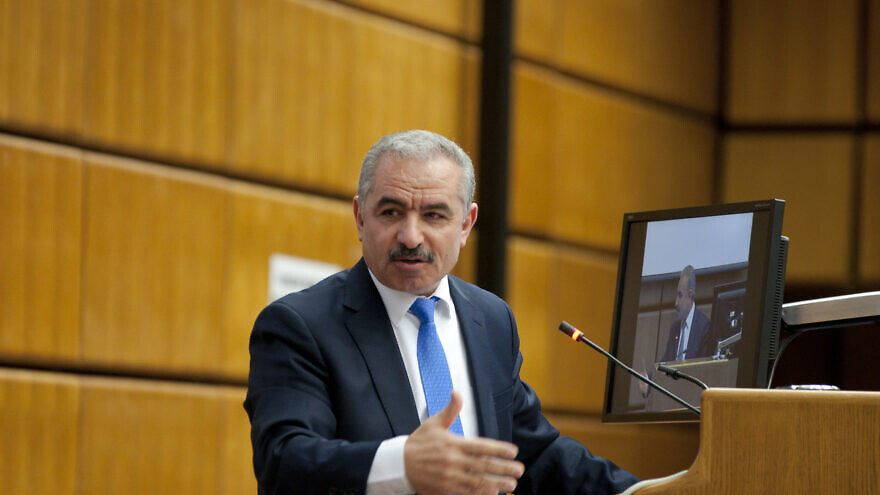
Palestinian Authority Prime Minister Mohammad Shtayyeh presented a “Reforms Proposal” to the Ad Hoc Liaison Committee’s (AHLC) biannual session last week in Brussels. The 40-page plan, a copy of which was obtained by Israel Hayom, outlines comprehensive reforms in various areas—but does not include a plan to reduce anti-Israel incitement.
Founded in 1993, the 15-member AHLC, a United Nations body, serves as the principal policy-level coordination mechanism for development assistance to the Palestinian people. Its primary mission is “to promote dialogue between donors, the Palestinian Authority, and the Government of Israel.”}
Israel’s Perilous Moment, Then and Now
A review of Israel’s Moment: International Support for and Opposition to Establishing the Jewish State, 1945–1949 by Jeffrey Herf, Cambridge University Press, 500 pages (April 2022)
On November 29th, Israel will commemorate the 75th anniversary of the UN resolution dividing British mandatory Palestine into two independent states, one Jewish and one Arab. Next May, Israelis will celebrate the 75th anniversary of their nation’s Declaration of Independence. Yet these jubilee events will be marred by the reality that the Jewish state’s most determined enemies have never accepted the UN partition plan, otherwise known as the “two state solution” for resolving the conflict. In Ramallah on the West Bank and on Israel’s Northern and Southern borders, the tattered banner of Palestinian rejectionism still flies. That also means there is no end in sight to the murderous terrorist attacks against civilians in the heart of Israel.
The Palestinian narrative of the Nakba (an Arabic word meaning “catastrophe” or “disaster”) has acted as an accelerant on this fire. It depicts the UN partition resolution as a Western imperialist plot, backed by powerful Jewish financial interests, which then led to the dispossession and expulsion of the land’s indigenous people, and this account remains at the heart of the school curriculum taught at UN-administered Palestinian refugee camps in the West Bank and Gaza. Palestinian leaders of all stripes continue to insist that the only recompense for this historically unprecedented crime is to grant millions of so-called refugees the “right of return” to their original homes in Israel. In other words, the Nakba also implies the end of Israel as a Jewish state.
Despite its absurd historical revisionism and political impracticality, the Nakba narrative has managed to capture the imagination of much of the international Left and become a vector for antisemitism. At elite campuses across America, “progressive” students now routinely chant the slogan “Palestine from the River to the Sea” and equate support for Israel with racism.
This is the grim present-day background that makes Jeffrey Herf’s new book, Israel’s Moment, so timely and essential. The author is a distinguished historian of modern Germany whose previous work has focused on the affinities between the Nazis’ revolutionary antisemitism and modern Islamist ideologies propagated by groups such as the Muslim Brotherhood, Hamas, al-Qaeda and the theocratic regime in Iran—a connection largely ignored in Middle East scholarship in the West.
In an earlier volume, Nazi Propaganda in the Arab World (2010), Herf relied on newly released German archival material to reveal startling new details about the wartime collaboration between the Nazi regime and Haj Amin al-Husseini, the preeminent leader of the Palestinian Arabs in the 1920s and ’30s. In 1921, the British mandatory government anointed Husseini as Grand Mufti of Jerusalem, charged with overseeing the city’s Islamic holy places. In the 1930s, the Mufti contemplated an alliance with the Nazis and sent Palestinian youth delegations to the Führer’s Nuremberg rallies.
After leading the violent Arab revolt against British forces in Palestine, Husseini escaped to Nazi Germany in 1940. In wartime Berlin, he helped organize the Nazi propaganda broadcasts transmitted across the Arab world. At an early audience with the Führer, he was informed about plans for the Final Solution and declared himself impressed. He then founded the Islamic Institute and issued a canonical statement emphasizing the symbiosis between Nazism and Islam, rooted in the Koranic prescription that “the most hostile people are the Jews.”
The Mufti also did some traveling on behalf of his wartime hosts. In Yugoslavia, he helped Reichsführer Heinrich Himmler establish a Waffen SS division for Bosnian Muslims, and became one of the brains behind German espionage operations in the Arab world. Had Rommel not been stopped at El Alamein, the Nazis might have conquered Palestine and the Mufti would likely have supervised the physical eradication of the Jewish community there.
Now, in Israel’s Moment, Herf tells the complicated and often surprising story of the internal political struggles in Western capitals, as well as in the halls of the United Nations, that erupted over the “Palestine question” after the end of the war. Delving deeply into American and French archival material, Herf challenges much of the conventional wisdom about how an independent Jewish state emerged in Palestine in 1948. Among its many benefits, Herf’s book exposes the big lie at the heart of the Nakba narrative—that Israel was created as a Western imperialist or colonialist outpost:
Contrary to four decades of Soviet, Arab state, Islamist and Palestinian nationalist propaganda, Zionism was not a product or tool of British or American imperialism. … From 1945 to 1949 the Zionists had four primary foes: the Atlee-Bevin Labour government in London; former Nazi collaborators leading the Arab Higher Committee; the reactionary Arab regimes of the time and their allies in British, American and European oil corporations; and the national security establishment of the United States.
Herf also shows that the most passionate political support for Jewish statehood “came overwhelmingly from American liberals and left liberals, French socialists and between 1947 and 1949 from communists in France and the Soviet bloc, especially in Czechoslovakia.”
Herf begins his book by returning to Haj Amin al-Husseini’s nefarious activities during the war. These are important because, after the Mufti was captured by French military forces in 1945, the debates among the victorious Western allies about what to do with him turned out to be a prelude to the internal political struggles in those countries over the creation of the Jewish State.
American progressives and leftists who later pushed for Israel’s independence first came together to launch a public campaign to bring the Mufti to justice for his collaboration with the Nazis and for possible war crimes. But Husseini was shielded from prosecution by high-level government officials in the US and France who were determined to protect Western influence in the Arab world. In Washington, the sudden concern for the Mufti’s safety came from the same anti-Zionist faction within the Truman administration that later tried to block the creation of a Jewish state in Palestine.
After capturing Husseini in May 1945, the French government placed him under “house arrest” in a villa outside Paris. The Yugoslav government then requested that the Mufti be extradited to face trial for the war crimes he committed in the Balkans. French Foreign Ministry documents unearthed by Herf explain why this was never going to happen. A diplomatic memo put the matter quite directly: If the French government complied with the extradition request from Yugoslavia, or indeed from any other allied government, “we would unleash a new wave of hostility against us in all the Arab countries, and would also deprive ourselves of the interesting and fruitful contacts that the Mufti maintains with important figures from the Arab world.”
In June 1946, French security forces guarding the house where Husseini was detained conveniently left the door open and he “escaped” to Egypt. The Mufti was granted asylum by King Farouk and received a rapturous reception upon his return. In Cairo, he was greeted as a conquering hero by the founder of the islamofascist Muslim Brotherhood, Hassan al-Banna. The Mufti, al-Banna declared, was a great leader who “challenged an empire and fought Zionism with the help of Hitler and Germany. Germany and Hitler are gone, but Amin al-Husseini will continue the struggle.”
Within months, Husseini was reinstated as Chairman of the Arab Higher Committee, officially recognized in international forums as representing the Palestinian Arabs. After the passage of the UN partition resolution in November 1947, Al-Banna and Husseini combined forces and sent thousands of fighters into Palestine to begin the war against the Yishuv (the organized Jewish community in British mandatory Palestine) with the intent of aborting the Jewish state.
Summing up this sorry chapter in postwar Western diplomacy, Herf writes that the refusal of the Allies to hold Husseini accountable for his crimes “made it more likely that the Mufti and his associates would return to the political stage and at the international stage at the UN, oppose any compromise with the Jews, start the war against the Jews in November 1947, urge the Arab states to invade the new state of Israel in 1948 and stimulate hatred of the US and the western democracies.”
Other historians of this period (most notably Allis and Ronald Radosh in their 2009 book, A Safe Haven: Harry S. Truman and the Founding of Israel) have recounted President Truman’s steadfastness in championing statehood for the Jews, even against powerful internal opposition. To this history, Herf adds the most detailed account yet of just what Truman was up against from within his own administration. It is not an uplifting story.
High-level officials at the State Department, the CIA, and the Pentagon formed an informal anti-Zionist caucus that sought to undermine the president’s announced policies and block the emergence of an independent Jewish state. All too often, they succeeded in damaging Israel during its struggle for survival. The caucus first tried to stop implementation of the UN partition plan, even after the president had officially endorsed it. As a State Department memo put it in January 1948: “Our vital interests in those areas [the Arab Middle East] will continue to be adversely affected to the extent that we continue to support partition.” State Department officials urged the administration to cooperate with Great Britain in intercepting the ships carrying Jewish Holocaust survivors to Palestine.
The anti-Zionist caucus successfully pushed for a US arms embargo during the Palestine conflict which ended up hurting only Israel. That’s because the Jordanian Arab Legion, the most effective fighting force among the six invading Arab armies, was fully armed and led by British military forces. The military balance was restored only when Czechoslovakia agreed to send advanced military equipment to Israel. The anti-Zionist US officials were convinced the Jewish state couldn’t survive a war against the Arab armies, but when the Jews actually began winning, they threw their support behind UN mediator Folke Bernadotte’s proposal to take the Negev region away from Israel and give it to the Arabs.
The unofficial leader of this opposition faction was George F. Kennan, director of the State Department’s Policy Planning Staff. During his long career as a government foreign policy expert, Kennan managed to exemplify the best and worst tendencies of the existing foreign policy establishment. While serving as the number two US embassy official in Moscow during World War II, he wrote the famous “long telegram” to his superiors in Washington predicting that the Stalin regime would pursue an aggressive and expansionist policy in Europe and that it could only be “contained” through active US countermeasures. Rewarded for his prescient analysis of Soviet behavior, Kennan was brought home by the Truman administration and installed as director of the State Department’s newly established Policy Planning Staff.
As Herf shows, it was partly because of the exigencies of fighting the Cold War that Kennan and many of his colleagues misread the postwar politics of the Middle East. The foreign policy establishment was caught off guard when the Soviet Union suddenly reversed course after two decades of ideological anti-Zionism and championed partition at the United Nations. That policy switch reinforced Kennan’s belief that a Jewish state in the Middle East would be harmful to America’s strategic interests in the Cold War.
Kennan and other US officials even came to believe the fantastic rumor (more accurately, the conspiracy theory) that the Soviets were sending thousands of communist agents into the new state in order to help establish a bridgehead for its own imperial ambitions in the Middle East. As a result, the FBI began investigating Jewish American volunteers serving in Israel’s defense forces for possible communist connections.
Incredibly, the New York Times, not especially friendly to Zionism then or now, fell for this canard and ran a front-page story headlined: “Red ‘Fifth Column’ for Palestine Feared as Ships Near Holy Land.” This was Cold War McCarthyism even before Joe McCarthy (though when Senator McCarthy did appear on the scene, he targeted the same State Department for harboring communists and spies).
Herf provides excerpts from a series of headshaking memos by Kennan and his staff who argued that support for a Jewish State would make American containment of Soviet communism more difficult. One document warned that “any assistance the US might give to the enforcement of partition would result in deep seated antagonism for the US in many sections of the Moslem world over many years.” Another referred to “the adverse effect on Aramco and Tapien of the Pro Zionist Policy of the United States Government. All Arabs resent the actions of the present United States administration as unfriendly to them.” Another high-ranking State Department official, Samuel K.C. Kopper, circulated his analysis that the partition plan was “unworkable” and the administration “should abandon its support for partition.”
It’s hard to imagine an operation more brazen, elitist, and anti-democratic than the Kennan group’s effort to reverse an American President’s carefully considered and publicly announced policies. Thankfully, the administration’s anti-Zionists were unable to achieve their goal of scuttling partition and sending the Palestine issue back to the United Nations. Despite intense pressure from almost the entire national security establishment, Truman held his ground and recognized the new state of Israel within hours of its formal declaration of independence.
Nevertheless, the Kennan faction managed to undermine the new state in significant ways, while encouraging the Arabs with false hopes that they could actually win their war against the Jews. Israel’s first government wasn’t fooled by the hoopla over US recognition. Herf reports that, when the war for independence was won, Prime Minister Ben Gurion told US Ambassador James McDonald that “if the Jews had been dependent on the United States for survival in the 1947–1948 war they would have been exterminated.”
If George Kennan is the main villain of Jeffrey Herf’s book, the heroes are a determined group of journalists who spoke out about the plight of Jewish Holocaust survivors blocked from entering Palestine. These writers then championed the Zionist project in several daily newspapers and in the pages of highbrow liberal magazines such as the Nation and the New Republic. Herf spends about 50 pages telling their story—arguably the most honorable chapter for liberal and leftwing American journalism in the 20th century.
The brightest stars in this constellation of pro-Zionist journalists were Freda Kirchwey, longtime editor of the Nation, and the legendary reporter I.F. Stone. Stone covered the Jewish refugee crisis in Europe after the Holocaust and then Israel’s war of independence for PM, the most influential progressive newspaper of the 1940s. Kirchwey, meanwhile, turned her venerable progressive weekly (founded in 1865) into a journalistic battle-tank fighting for the Jewish people after the Holocaust. She published dozens of major essays by a wide array of well-known writers and public officials supporting Zionist aspirations, including several by Stone. The series kicked off in 1945 with a fiery article by Senator Robert Wagner (a Democrat representing New York) denouncing Britain’s anti-Zionist policies and calling Jewish Palestine “the most successful pioneering effort in human history.”
Before the UN General Assembly was scheduled to vote on the partition resolution, the Nation submitted a lengthy report to all the voting member states titled, “The Arab Higher Committee: Its Origins, Personnel, and Purposes.” Supervised by Kirchwey, the report urged UN members to vote for partition and concluded by calling Husseini’s Arab Higher Committee “an almost exact equivalent in Middle Eastern terms, of the cabal that ruled Hitler’s Germany.” The theme that the Palestinians were led by Nazi collaborators was also stressed in many of the dispatches and essays that I.F. Stone wrote for PM and the Nation.
In his survey of the pro-Zionist journalism of the time, Herf devotes a lot of attention to Stone’s reports of the voyage he took aboard an “illegal” ship carrying Holocaust survivors to Palestine and the ship’s attempts to dodge the British Naval blockade. Stone’s personal dispatches were a spectacular example of courageous journalism, and the widely praised book he wrote about his experience, Underground to Palestine, had a big impact on the American debate over the Jewish State.
It’s too bad that Herf doesn’t discuss Stone’s next book, This is Israel, published in late 1948 by a major US publishing house. In my view, this second volume was even more important to the pro-Israel cause than his first. In Underground to Palestine, Stone expressed a preference for a bi-national state in Palestine that would satisfy the aspirations of both Jews and Arabs. But by the time Stone returned to Israel in May 1948, just as the Jewish state was about to be invaded by the Arab armies, he realized that no compromise was possible and that Israel had to win the war or die.
This Is Israel opens with a glowing forward written by Bartley Crum, publisher of PM. Crum writes that through Stone’s account of the Jews’ struggle for independence, “we Americans can warm ourselves in the glory of a free people who made a two-thousand-year dream come true in their own free land.” Indeed, Stone’s text reads like a heroic epic intended to generate support for the Israeli war effort. He calls the young state a “tiny bridgehead” of 650,000 faced by 30 million Arabs. “Arab leaders made no secret of their intentions,” Stone writes, and then quotes the head of the Arab League, Abdul Rahman Azzam, as follows: “This war will be a war of extermination and a momentous massacre which will be spoken of like the Mongol massacres and the Crusades.”
Significantly, Stone blames Haj Amin al-Husseini and the Arab Higher Committee for creating the Palestinian refugee crisis. The Palestinian leaders reminded him of the fascists he had fought with his pen since the Spanish Civil War, and he ticks off the names of Nazi collaborators leading Palestinian military units attacking Jewish settlements after passage of the UN partition resolution. “German Nazis, Polish reactionaries, Yugoslav Chetniks, and Bosnian Moslems flocked [into Palestine] for the war against the Jews,” Stone writes.
Though it’s not part of Jeffrey Herf’s book, I found myself thinking about the historical ironies that led the major political players during the struggles over the creation of Israel to eventually switch sides. Perhaps the most consequential example of this turnabout occurred when the Stalin regime reverted to its historical anti-Zionism, even criminalizing Zionist activism. Alarmed by the euphoric reception Golda Meir received from Russian Jews during her ambassadorial visit to the USSR in 1948, Stalin began to obsess about the threat posed to the Soviet Union by Jewish disloyalty. As a result, the Soviets unleashed the big lie that Israel was actually a creation of Western imperialism—propaganda that the Arab world was happy to embrace.
Six years later, the British and French governments collaborated with Israel in a joint military action against Egypt to obtain free passage through the Suez Canal, an operation aborted following pressure from the Soviet Union, the UN, and the US. But from the Kennedy and Johnson administrations onwards, successive American governments began to cast a friendlier eye on Israel as a potential military ally in the Middle East.
The most radical ideological change of direction regarding Israel occurred within the ranks of American journalism. By the late 1960s, the Nation had turned into a hot bed of anti-Israel commentary, as had many other leftist and liberal publications. In an essay for the New York Review of Books after Israel’s victory in the Six Day War, I.F. Stone, by now an icon of American journalism, castigated the Zionists for “moral myopia” and their lack of compassion for the Palestinians. Henceforth, most of the liberal media would dwell endlessly and disproportionately on Israel’s imperfections.
None dared recall that, only a few years before, Stone and the editor of the Nation had forensically documented the collaboration between the Palestinian Arab leadership and the Nazis, nor that these left-wing journalists had once argued passionately that the birth of Israel was one of the great moral triumphs of the 20th century. It is to Jeffrey Herf’s credit as an historian and scholar that he has provided this important reminder of who actually defended and opposed international justice for the Jewish people 75 years ago.
Rebranding the Israeli Narrative
The time has arrived to simply stop and read the writing on the wall, assuming it’s not too late. We must re-evaluate, re-calculate, and radically change what we do in response to the tsunami of Jew hatred that has swept the world whether it be in Israel or in the streets of Brooklyn, or anywhere in the world. Albert Einstein was quoted as saying that “insanity is doing the same thing over and over again and expecting different results”. This is a fair representation of how Jewish leaders and Jewish organizations including Israeli governmental agencies keep responding to today’s anti-Semitism with yesterday’s obsolete and ineffective apologetic thinking.
Jewish leaders, NGO’s, academicians, governmental agencies, and pro-Israel organizations must change and adapt their manner of responding to the anti-Israel and anti-Semitic narratives that have blurred the distinction between classical anti-Semitism, anti-Israel, and anti-Zionism. Jews, Israeli’s, and Zionists have all become “guilty by association” of one another. The process of “detoxifying” the Israeli narrative portrayed in progressive circles (including Jewish progressives) must be a strategic goal of the State of Israel. Unconventional yet empirically effective “info-war” techniques should be utilized for their efficacy in changing attitudes, perceptions, and prior biases. Developing. Designing and deploying persuasive/compelling communication strategies should be utilized not only to influence how the Israeli narrative is perceived but critically how one “feels” about them.
The rational and need: The perspective and perception held by NGO’s, academicians, the broadcasted and printed media, and social media regarding Israel can be a powerful tool in shaping public opinion. The ideological positions held by many if not most in key positions within the progressive side of the isle demands a radically new approach. The transformation of long held narratives and perceptions requires a pro-active and planned intervention that will result in a shift in long held views and prior biases. Importantly, the narrative representation of reality cannot be evaluated or challenged empirically or with dry facts and “hasbara”, but rather whether the message or response is coherent and ‘rings true’. The efforts to present the Israeli narrative through the prism of facts and truths has failed to alter or change the progressive understanding of the Israeli narrative.
Today’s progressive media organizations blindly and willingly accept and promote the Palestinian culture of deceit. The efforts of the State of Israel to show malice and the lack of factual and historical truth within the Palestinian narrative does not resonate within the progressive mind set and is incongruent to the progressive intellectual predisposition. Due to this predisposition, in the eyes of the progressive world, Palestinian terror is a legitimate response to the continued occupation of the occupied territories thereby absolving the Palestinians of any and all accountability for their actions. Only the State of Israel is held solely responsible and accountable. The logical extension of this narrative leads to the understanding that only the “undoing” Israel’s establishment and existence as a Jewish State will satisfy minimum Palestinian expectations and demands.
Information warfare: Propaganda in its most basic form is the use of a public persuasion means for political ends. Propaganda is a type of communication that is primarily used to influence or persuade an audience to further an agenda, which may not be objective and may be selectively presenting facts to encourage a particular synthesis or perception, or using loaded language to produce an emotional rather than a rational response to the information that is being presented.
Propaganda can be found in news and journalism, social media, governmental agencies, advertising, entertainment, education, and activism; often associated with material which is prepared by governments as part of war efforts, political campaigns, and health related campaigns. During the 20th century, the English term propaganda was often associated with a manipulative approach, but historically, propaganda has been a neutral descriptive term of any material that promotes certain opinions or ideologies.
When it is conducted in war, it is called psychological warfare. Although these are the classic definitions, the problem is that the reality is very flexible and changing constantly. Propaganda usually is not about a change from stark black to stark white or vice versa, but rather a strengthening or weakening of positions along the spectrum of conflicting ideologies and is an enormously powerful social science tool. Propaganda can be far more sophisticated than our primitive notion of Hitler waving and ranting. Almost every person is prone to being influenced at some point, yet everyone thinks that they are immune to such persuasion—and that is what makes them so vulnerable to propaganda.
A primary working principle of psychological warfare is to adapt your cause to both the local and contemporary cultures. When the cause célèbre of the 60s was colonialism, the Palestinians played up the notion of Israel as a colonizer; when human rights became the dominant cause, Israel was accused of human rights violations. And although at one time apartheid was only associated with South Africa, once it ended there, the PLO engaged in a “replacement oppressor” narrative with Israel taking South Africa’s place as the world’s number one purveyor of apartheid. In recent years the Palestinians have shifted vocal support for the annihilation of Israel to Israel being an illegitimate state due to her abuse of Palestinian human rights; same goal, different path to achieve this goal. The easy refutability of these libels have proven to be totally ineffective only because propaganda is about imbuing beliefs and emotions rather than facts.
Persuasion (a palatable synonym of propaganda) is also a powerful social science tool. In the past 150 years, it has developed unprecedently into a powerful social and political weapon. Channeling this technological know-how to develop an operational model that incorporates our ideological and political goals, will enable implementing “info-war” model to our advantage—which in our case is a safe, secure Israel and a safe, secure Jewish people in their respective countries.
In order to be able to overcome and outmaneuver the methodology and tactics that are being used against us, it will be necessary to “reverse engineer” the false and manipulative narratives that have been so successfully applied by our enemies. The State of Israel and the Jewish people around the globe are finally coming to this realization, albeit half a century too late. This fact presents the enormity of the challenges facing Israel and the Jewish world, incorporating all facets of the anti-Semitic, anti-Israel, and anti-Zionist narratives in the converging spheres of; media, social network, academia, progressive politics, social, religious, and cultural.
Anti-Israel propaganda has permeated every single facet of American (and Western) society including: labor (longshoremen’s refusal to unload an Israeli cargo ship and a national teacher’s union putting to vote a harshly anti-Israel resolution); sports (boycotting Israel at international competitions); cultural events (Roger Waters’ campaign to pressure musicians to boycott Israel, and a Swedish art museum glorifying Palestinian mass murderers); higher education (universities outright banning pro-Israel speakers and allowing extremely violent Arab and leftist “protesters” to attack pro-Israel speakers, driving them off campus); science (calls for boycotts of leading Israeli research institutes and termination of cooperation agreements); and numerous other examples. Israel has consistently forfeited her leverage in the world of technology, medicine, research, and military development against supporters and funders of the Palestinian and anti-Semitic coalitions. Without thinking twice or remorse, we simply let them “off the hook” consequentially further empowering their supporters and resulting in even more aggressive tactics/attacks against Jews and the State of Israel.
Progressive narratives embody fundamental assumptions by which any and all actions by the State of Israel are interpreted and presented negatively by the progressive media and within academic circles. Techniques based on Psychological Warfare and the application of “Info war” can provide an effective response to deafen the dissonance that automatically erupts with Pavlovian consistency when pro-Israel, and pro-Zionist narratives are expressed. Continuing on the current path of appeasing those at the forefront of Jew hatred demanding the end of Israel as the nation of the Jewish people, will only wet their appetites to question Israel’s legitimacy and continue to threaten and attack Jews wherever they may be. An endeavor of this magnitude can only be executed by Israel’s governmental agencies or non-governmental NGO’s in Israel who have a formidable reservoir of manpower capability with experience in the field of “psychological warfare” and the “info-war”.
Quote: Three things cannot hide for long. The moon, the sun and the Truth.
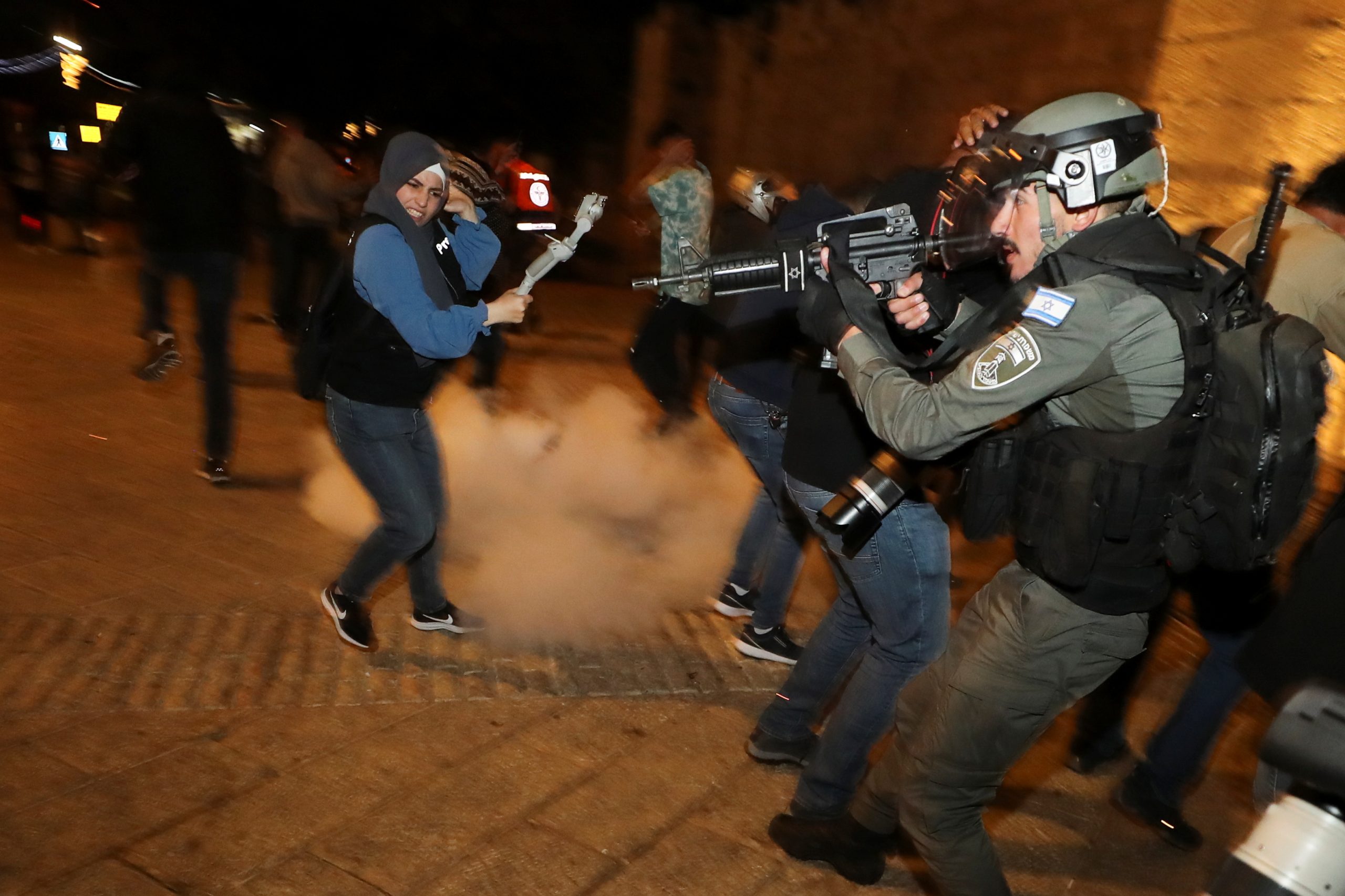
Israeli police officer stands in position as a stun grenade explodes by the gate to Jerusalem's Old City during clashes, as the Muslim holy fasting month of Ramadan continues, in Jerusalem April 24, 2021. REUTERS/Ammar Awad
The ability to hide the truth and evade stark evidence has been on full display this past week. Seeking some sort of culpability seems more distant than ever unless one falls for the suspect agenda of those purporting to be champions of the oppressed.
What follows will be four examples that have already been widely circulated by the general media in such a way that we already know who the guilty party is before one gets to the end of the first paragraph.
The fifth case is a J-Wire exclusive and should be of particular interest as Australians go to the polls to elect a new governing coalition.
ANNUAL RAMADAN RIOTS
Without fail and as regular as clockwork the annual celebration of Ramadan is an occasion for unbridled incitement and a perfect excuse for terror-related outbursts. Judging by the “surprised” and pious pontifications of the international community one would think that this was an unusual phenomenon. Blaming the “occupation” for Ramadan’s explosive expressions of hate is of course, the default position of all those who try mightily to hide the real reasons for this seasonal expression of religious fanaticism and intolerance.]
SELF INFLICTED NAKBA NARRATIVE
After 74 years, the rest of the world and our own believers of original sin still hide from the overwhelming evidence that a Jewish sovereign presence here is unacceptable, blasphemous and needs to be eliminated. The descendants of those Palestinian Arabs who massacred the Jews of Hebron and Jerusalem in 1929 and murdered the doctors and nurses on their way to work at Hadassah Hospital on Mount Scopus in April 1948 are playing by the same script today. In a recent poll, 75% of Israeli Arabs questioned replied that Jews have NO right to sovereignty. Why are these self-evident intentions hidden by successive Israeli spokespersons? Is it any wonder that clueless international leaders have no idea of what would happen to Israeli Jews if their pie in the sky “democratic and human rights” hallucinatory peace partners ever achieved their final solution aims?
Our own far-left “experts” liberally funded by an assortment of NGOs and European Governments together with post-Zionist media merely add fuel to the fire. A Knesset member from the far left recently asserted that “eliminating terrorists increases terrorism.”
With “noch shleppers” like that, it’s no wonder that Hamas, Hezbollah and all the other seekers of peace are busy plotting more murder and mayhem.
THE JORDANIAN FIASCO
If ever there was a case of deliberate deception, the role of this duplicitous British creation is worthy of an Oscar award. Despite having illegally occupied (1948 to 1967) half of Jerusalem, all of Judea and Samaria and ethnically cleansed all Jews from these locations as well as banning them from worshipping there, the monarch and his ministers masquerade as champions of religious freedom. Proof that this perversion of the truth has been successfully hidden is the fact that democrats and human rights abusers alike now tout Jordan as a bastion of guardianship for holy sites (Islamic and Christian only, mind you) and condemn Jews for wanting to assert freedom to pray on the Temple Mount and at the Kotel.
A few days ago, a group of Israelis on a short vacation to Jordan were denied entry because seven of them had Tefillin with them. The banning of Jewish religious items is standard fare as far as Jordan is concerned. Did you hear any protest from Biden when he met Abdullah at the White House? Not a peep was forthcoming. Instead, a stern warning to Israel on preserving the fake “status quo” and avoiding provocations was the official burble.
Clarifying this scandalous situation the Jordanian Foreign Minister stated: “there is no Israeli sovereignty over the Temple Mount – Jerusalem is the capital of Palestine.” Echoing this assertion, a former Arab MK proclaimed: “Jews have nothing to do on the Temple Mount. You want to pray? Change your religion!!”
International acquiescence to this farce reinforced by weak Israeli responses has resulted in the present continuing perversion of the truth and prepared the ground for future catastrophic upheavals.
Hiding awkward realities and seeking appeasement with those who don’t want you here are doomed strategies.
AL JAZEERA FIESTA
The fatal shooting of a journalist in the midst of a firefight between the IDF and Arab terrorists is a heaven-sent opportunity for the terror groups, their sponsors and funders and all Israel-hating groups to once again pillory and blame Israel for something which has yet to be proven. This ploy has been used most successfully on several previous occasions to great effect and it follows an old well-worn formula. Blaming Jews/Israel for anything is always a guaranteed recipe for worldwide hysteria, universal condemnations and creating narratives which will be recycled with additional lies forever.
The refusal of the PA to hold a joint investigation with Israel, their refusal to hand over the bullet for independent forensic analysis and their eagerness to involve “neutral” groups (those which have a dubious track record as far as Israel slander is concerned) should alert even the most gullible to the agenda involved. Running to the ICC before any real irrefutable proof is available and accompanying this with unbridled incitement exposes their real intent.
CANBERRA CONUNDRUM
A perfect example of “hide and seek” is encapsulated in this following exclusive J-Wire report.
On 16 January 2022, in other words, five months ago, as J-Wire’s correspondent in Israel, I sent the following email to the Australian Ministry of Foreign Affairs and Trade in Canberra. I should explain that initially, I had directed my question to the Australian representative in Ramallah who suggested I redirect it to Canberra.
“In view of the latest revelations concerning UNRWA funding, can you comment on what steps the Australian Government is taking to ensure that money provided by the Australian Government is not misused? Instead of resettling the refugees as UNHCR does it seems that UNRWA prefers to perpetuate refugee status forever which means that rather than a decrease in the number living in squalid refugee camps those now supposedly refugees multiplies each year. In addition, what steps is the Australian Government taking to ensure that text books used in UNRWA schools do not promote hate and incitement against Israel & Jews?
Thank you in anticipation.
Almost immediately and to my pleasant surprise the following response arrived: Confirming that we have received your email and are looking into this for you.
So far so good. On 4 February after a follow-up email from me this message was received: We are continuing to work on a response to your inquiry. Thank you for your patience.
On 10 February another message was received from Canberra:
We are continuing to look into your enquiry.
With such seemingly positive responses, I was persuaded that perhaps the subject was truly being investigated. By 27 February, I decided to follow up on the matter: It is now the end of February and I am interested to know when your inquiries may come to some sort of conclusion.
With the approach of the annual youth summer camps organised by the PA and UNRWA, it is important to remember that these occasions are used to indoctrinate youth with hate and incitement against Israel and Jews and are used to train youngsters in the use of weapons and other terror techniques. All this is facilitated by the millions of funds provided by international donors. A lack of accountability means that donor funds are misused. I can provide videos taken at these camps which show exactly what is taking place there.
Unless donor nations institute some sort of strict accountability and refuse to be seduced by specious assurances that nothing untoward is taking place, the scandal of continued donor funding to the PA and UNRWA will only grow.
The evidence is there for all those who want to see it.
Australia, to its credit, has now designated all of Hamas as a terrorist organisation. The hate brainwashing of the next generation at UNRWA summer camps needs to be addressed. In most cases these camps have been organized by Hamas and its affiliated groups.
What followed was a deafening silence. It is now the middle of MAY and for some strange and unaccountable reason my inquiry has disappeared into a black hole.
Why the sudden silence after several assurances that an investigation was being made? How long does it take to discover what the European Parliament already knows? For the third year running the EU Parliament condemned continuing incitement in PA textbooks. What could be clearer?
What is the Australian Foreign Ministry trying to hide?
We seek answers. The problem is that this is not a game. It’s deadly serious.
Michael Kuttner is a Jewish New Zealander who for many years was actively involved with various communal organisations connected to Judaism and Israel. He now lives in Israel and is J-Wire’s correspondent in the region.
האם מערכת החינוך של אונר”א מכינה את הילדים ובני הנוער הפלסטינים למלחמה נגד היהודים?*
האם מערכת החינוך של אונר”א מכינה את הילדים ובני הנוער הפלסטינים למלחמה נגד היהודים?* מאת ד”ר ארנון גרויס (מאי 2022)
הקדמה
סוכנות הסעד והתעסוקה של האו”ם לפליטים הפלסטינים (אונר”א) פועלת משנת 1950 בסוריה, לבנון, ירדן, יהודה ושומרון (כולל מחנה פליטים במזרח ירושלים) ורצועת עזה. היא מעניקה שירותי סעד, בריאות וחינוך לפליטי 1948 וצאצאיהם המוחזקים בתנאים ירודים בעשרות מחנות פליטים. למעלה ממחצית תקציבה מופנה לחינוך.
נייר זה דן בפעילות החינוך של אונר”א בשטחי יהודה, שומרון ועזה בלבד. עפ”י הנתונים באתרה משנת הלימודים 2019/20 היו לה בעזה 286,645 תלמידים ב-278 בתי”ס שבהן למדו בכיתות א’-ט’. ביהודה ושומרון (ומזרח ירושלים) היו לה באותה שנה 45,883 תלמידים ב-96 בתי”ס עם אותן כיתות, אך שני בתיה”ס שלה במזרח ירושלים כללו גם את כתה י’.
מחקרים שערכתי מאז שנת 2000 על היחס ל”אחר” היהודי-ישראלי ולשלום עימו בספרי הלימוד ומדריכי המורים שבשימוש בבתיה”ס של אונר”א, ואשר מוצאים לאור ע”י המרכז לתוכניות לימודים של הרשות הפלסטינית, העלו כי מתנהלת בהם אינדוקטרינציה לשנאה ואלימות, בסתירה מוחלטת למחויבותה של אונר”א, כארגון של האו”ם, לניטראליות ולקידום פתרון של שלום לסכסוך במזרח התיכון. אינדוקטרינציה זו מושתתת על שלושה עקרונות יסוד:
א. דה-לגיטימיזציה הן של קיום ישראל – מדינה חברה באו”ם – והן של נוכחות תושביה היהודים בארץ: ישראל אינה מופיעה על המפה ובמקומה מופיעה פלסטין כמדינה הלגיטימית באזור אשר נתונה “לכיבוש ציוני” מאז שנת 1948. 7 מיליוני היהודים החיים כיום בישראל נחשבים לפולשים קולוניאליסטים זרים ללא כל זכויות ועבר היסטורי בארץ. עריהם, ובראשן תל אביב, אינן מופיעות על המפה, או שניתנים להן שמות ערביים (למשל, אילת נקראת “אום אלרשראש”). מוכחש גם קיומם של מקומות קדושים ליהודים בארץ. הכותל המערבי, למשל, מוצג כאתר אסלאמי.
*ואם כן, מהו תפקידן של המדינות התורמות בעניין זה?
ב. דמוניזציה של ישראל ושל היהודים: ישראל מוצגת כשורש כל רע, ללא כל מידע אובייקטיבי עליה. במהלך השנים קיבצתי למעלה מארבעים האשמות כלפיה החל בגזל פלסטין ורצח ילדים וכלה בשילוח חזירי בר לפגיעה בשדות הפלסטינים. היהודים מוצגים כאויבי האסלאם מראשיתו – בעצם, כאויבי האל עצמו, כנוכלים בוגדניים וכבעלי כוונות השמדה כלפי הפלסטינים. אין שום התייחסות לפרט היהודי או הישראלי כאדם רגיל. ה”אחר” הזה מתואר תמיד כקבוצה – עם ההשלכות הנלוות לכך של איום קיומי על הפלסטינים.
ג. עם אויב מהסוג שתואר כאן אין אפשרות הגיונית לעשות שלום. ואכן מספרי הלימוד של הרשות הפלסטינית הנלמדים בבתיה”ס של אונר”א נעדרת כל הטפה לשלום ודו-קיום עם ישראל. אמנם אחד מספרי ההיסטוריה דן בהסכם אוסלו ובמסגרת זו מובא מכתבו של יאסר ערפאת ליצחק רבין ובו הכרה בזכותה של ישראל לחיות בשלום ובטחון והתנערות מהטרור. אבל לא נעשה שום שימוש במכתב הזה להטפה לשלום. להיפך, מודגש הצורך לשחרר את פלסטין כולה, כולל שטחי ישראל שמלפני 1967, במאבק אלים, תוך הצגתו כמאבק בעל אופי דתי – שימוש במונחים “ג’יהאד” ו”שהאדה” וקריאה לשחרור מסגד אלאקצא – ותוך אימוץ הטרור כאמצעי במאבק הזה.
להלן דוגמאות מתוך ספרי הלימוד ומדריכי המורים העדכניים ביותר אשר מבהירות את הנקודות הללו:
דה-לגיטימיזציה
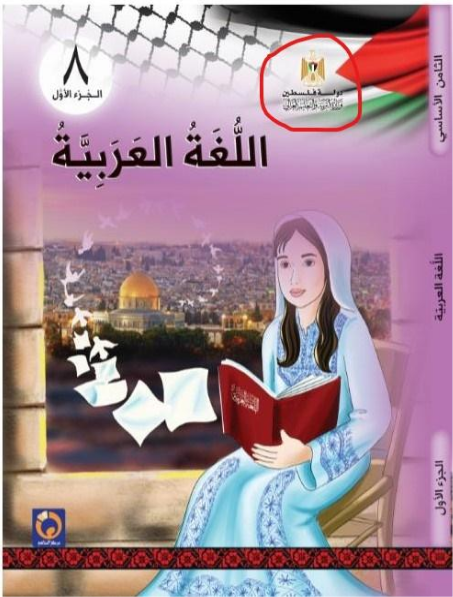
- הרשות הפלסטינית מכנה את עצמה “מדינת פלסטין” ומחשיבה את עצמה כמדינה לכל דבר תחת כיבוש שגבולותיו אינם מסתיימים בקווי 1967. השם “מדינת פלסטין” ולא “הרשות הפלסטינית” מופיע על עטיפת כל ספרי הלימוד. הדוגמה שלפנינו – עטיפת ספר לימוד ערבית לכתה ח’, חלק א’, שהודפס ב-2020 – מציגה את סמל הרש”פ כשהכתובת מתחת לו אומרת: “מדינת פלסטין; משרד החינוך והחינוך הגבוה” (מסומן באדום בפינה הימנית העליונה):
- פלסטין מוצגת כמדינה הלגיטימית באזור במקום ישראל:
“[שיעור] 2: פלסטין [היא] ערבית ומוסלמית”
 בשיעור מוצגת מפה בכותרת “מפת המולדת הערבית” שבה כל הארץ צבועה באדום כשלצידה השם “פלסטין” ומעליו הדגל הפלסטיני:
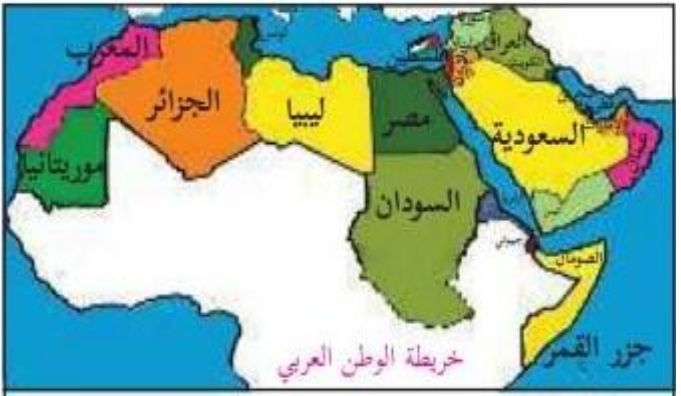 (טיפוח לאומי וחברתי, כתה ד’, חלק א’ (2020) עמ’ 8)
- במפה בכותרת “מפת פלסטין והלבנט” מופיעה פלסטין כמדינה ריבונית במקום מדינת ישראל, לצד לבנון, סוריה וירדן:
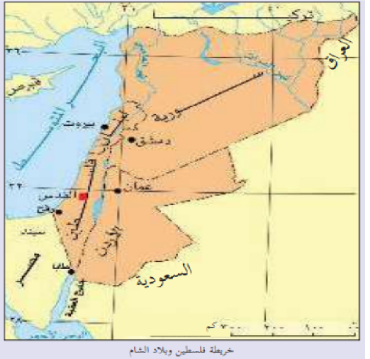 (גיאוגרפיה והיסטוריה מודרנית ובת-זמננו של פלסטין, כתה י’, חלק א’ (2020) עמ’ 8)
 - המונח “הכיבוש הציוני” מחליף בדרך כלל את השם “ישראל” בספרי הלימוד:
“…הצבאות הערביים נסוגו מפלסטין ושביתת הנשק של רודוס נחתמה בשנת 1949 באופן נפרד בין הכיבוש הציוני וכל אחת מ[המדינות] ירדן, מצרים, סוריה ולבנון…”
 (גיאוגרפיה והיסטוריה מודרנית ובת-זמננו של פלסטין, כתה י’, חלק ב’ (2020) עמ’ 7)
 - שטח ישראל שמלפני 1967 מוגדר כ”השטחים שנכבשו בשנת 1948″:
“הטבלה שלהלן מבהירה את מספרי הפלסטינים בשנת 2015 עפ”י מרכז הסטטיסטיקה הפלסטיני:
אזור מס’ התושבים
הגדה המערבית ורצועת עזה 4,750,000
בתוך השטחים שנכבשו בשנת 1948 1,470,000
במדינות ערב 5,460,000
במדינות זרות 685,000
אסדר את אזורי הימצאותם של הפלסטינים בסדר יורד לפי מספרי התושבים:
[ארבע מסגרות ריקות]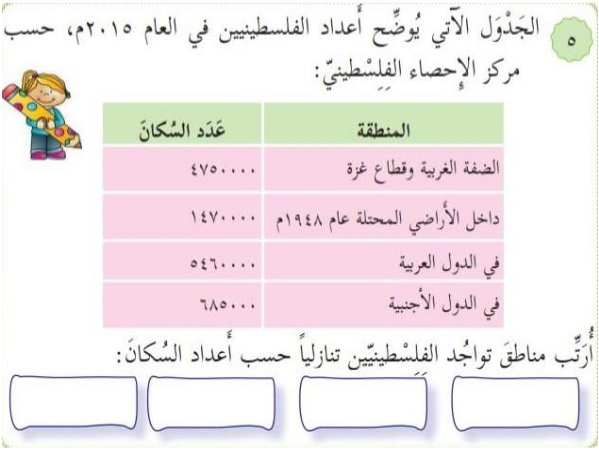
(מתמטיקה, כתה ד’, חלק א’ (2020) עמ’ 2. ההדגשה הוספה) - ישראל ותושביה נחשבים לישות קולוניאליסטית זרה:
“נחשוב ונדון: אשווה בין הטרגדיה של האינדיאנים תושבי אמריקה המקוריים לטרגדיה של העם הפלסטיני.”
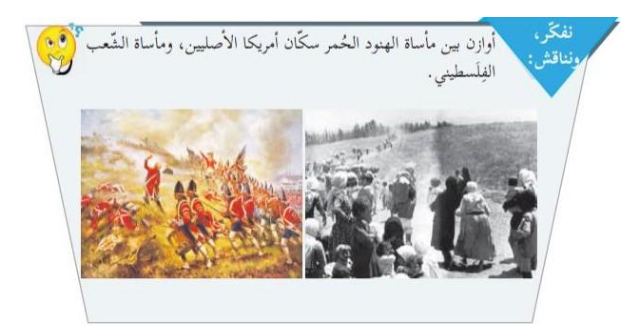 (לימודי חברה, כתה ח’, חלק ב’ (2020) עמ’ 34)
 - הכחשת קיומה של ההיסטוריה היהודית של הארץ:
“…[הכובש] בנה לעצמו ישות מלאכותית השואבת את זהותה וחוקיות קיומה מסיפורים, אגדות והזיות, וניסה בשיטות ודרכים שונות ליצור לאגדות אלה עדויות חומריות חיות, או הוכחות ארכיאולוגיות ארכיטקטוניות, אשר יקבעו את אמיתותן ומהימנותן, אך לשווא.”
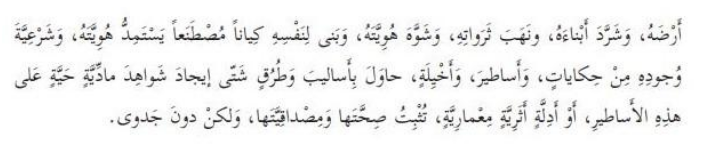
(השפה הערבית – המסלול האקדמי, כתה י’, חלק ב’ (2020) עמ’ 68)
- הכחשת קיומם של מקומות קדושים ליהודים בארץ, כולל הכותל המערבי בירושלים (ושימו לב לכך שהתצלום נחתך כך ש”יסתיר” את היהודים שמתפללים שם):
“כותל אל-בוראק
הארה: כותל אל-בוראק נקרא כך על שם אל-בוראק [בהמת הרכיבה השמימית] אשר נשאה את השליח [מוחמד] במסע הלילי [ממכה למסגד אלאקצא בירושלים עפ”י המסורת המוסלמית] והעליה [השמימה]. כותל אל-בוראק הוא חלק מהחומה המערבית של מסגד אלאקצא. מסגד אלאקצא, כולל החומה, הוא אדמה פלסטינית וזכות בלעדית של המוסלמים.”
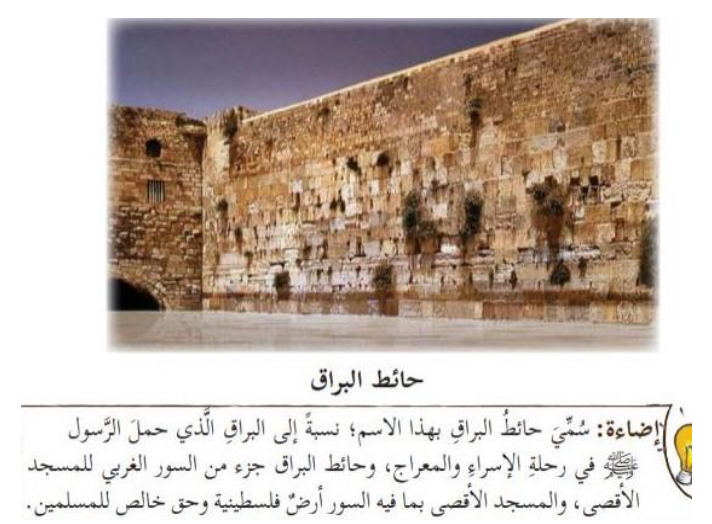
- (חינוך אסלאמי, כתה ה’, חלק א’ (2020) עמ’ 63)
- בהיותם נחשבים למתיישבים זרים, אין היהודים בארץ נמנים בין תושביה, והערים שבנו, כולל תל אביב, נעדרות מעל גבי המפה שבספרי הלימוד בבתיה”ס של אונר”א. המפה המוצגת כאן בכותרת “מפת פלסטין” אינה מראה את הערים האלה כלל, חוץ מאילת המופיעה תחת השם הערבי של המקום השומם שבו נבנתה אח”כ – “אום אלרשראש”.
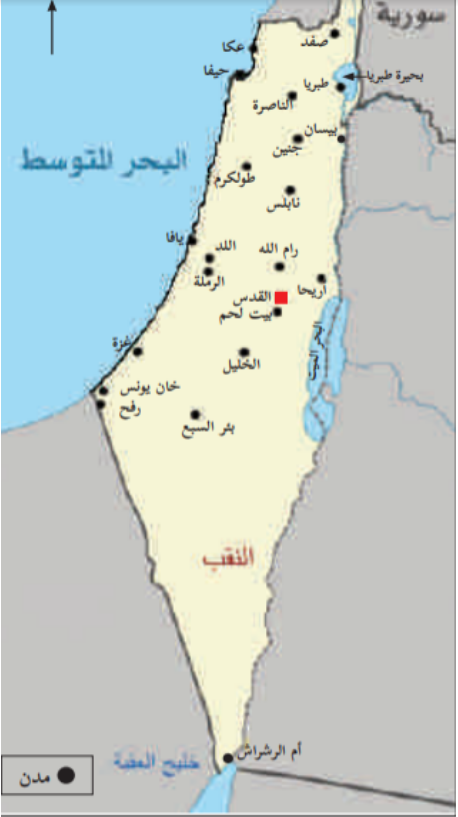
(לימודי חברה, כתה ו’, חלק א’ (2020) עמ’ 6)
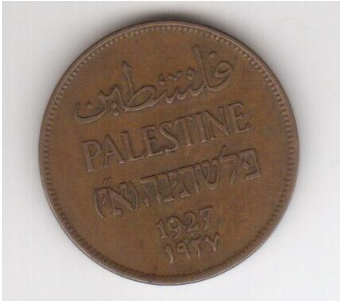
- עברית – שפתם של היהודים בארץ – נמחקת, פשוטו כמשמעו, ממטבע מתקופת המנדט הבריטי שהועתק לספר לימוד מתמטיקה:
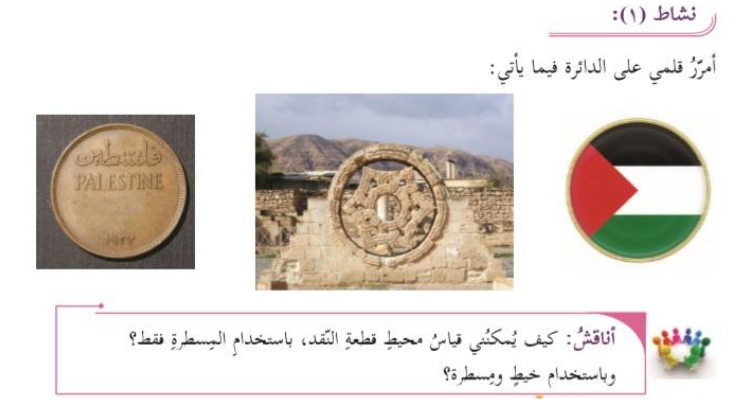 (מתמטיקה, כתה ו’, חלק ב’ (2020) עמ’ 65)
וראו את המטבע המקורי להלן:
- הקשר ההיסטורי והדתי של היהודים לירושלים זוכה להתעלמות מוחלטת:
“ירושלים היא עיר ערבית שאותה בנו אבותינו הערבים לפני אלפי שנים.
ירושלים היא עיר קדושה למוסלמים ולנוצרים.” (טיפוח לאומי וחברתי, כתה ג’, חלק א’ (2020) עמ’ 29)
 - תיאור קצר של היסטורית השמות של ירושלים מציג פער ענק של 1000 שנה בין היבוסים והרומאים, כלומר, התקופה ההיסטורית היהודית, ומתעלם לחלוטין מהשם “ירושלים” שבצורותיו השונות נפוץ בעולם כולו:
“העיר ירושלים נודעה בשם “יבוס”, על שמם של היבוסים הערבים שבנו אותה לפני 5000 שנה. כאשר כבשו אותה הרומאים, הם קראו לה בשם “אליה”. מאוחר יותר היא הפכה להיות נודעת כאלקודס או בית אלמקדיס, לאחר שהמוסלמים כבשו אותה בידי הח’ליף עומר בן אלח’טאב בשנת 637 לספירה…”
 (גיאוגרפיה והיסטוריה מודרנית ובת-זמננו של פלסטין, כתה י’, חלק א’ (2020) עמ’ 43)
דמוניזציה
- דמוניזציה של ישראל ע”י התקרבנות עצמית. להלן קטעים מ”מכתב של ילדה פלסטינית לילדי העולם”:
“מאז שנולדתי, הם רצחו את ילדותי. הם קרעו לגזרים את בובתי ואז החבאתיה בליבי. מאז שנולדתי, חודרת את אוזניי שריקת הכדורים והשחור אופף את כל הדברים מסביבי…
…מדוע הם שחטו את ילדותי לעיני ורצחו את הוורד בשדות? מדוע הם הרגו את הפרפרים בגינותינו והבהילו את הציפורים? מדוע חסמו את אור השמש, הפיצו אפילה וחסמו את הדרכים?”
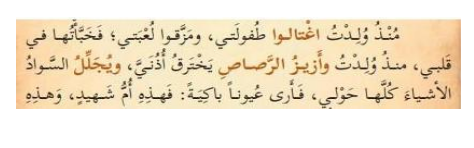
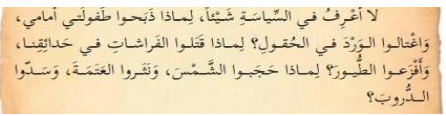
(השפה הערבית, כתה ח’, חלק א’ (2020) ע”ע 47, 48, בהתאמה)
- לציונים נעשית דמוניזציה והם מואשמים בכוונות השמדה כלפי הפלסטינים:
“1. הציונים הקימו את ישותם על [בסיס של] טרור, השמדה וקולוניאליזם. הבה נפרט זאת.”
 (השפה הערבית – המסלול האקדמי, כתה י’, חלק ב’ (2020) עמ’ 28)
 - ליהודים נעשית דמוניזציה ככופרים וכעוזרי השטן. קטע משיר:
היכן הם הפרשים [שירכבו] לאל-אקצא [כדי] לשחררו מאחיזת הכפירה, מעוזרי השטן?”
 (השפה הערבית, כתה ז’, חלק א’ (2020) עמ’ 67)
 - ליהודים נעשית דמוניזציה גם מחוץ להקשר הסכסוך, כאויבי הנביא מוחמד והאסלאם בשנותיו הראשונות, תוך ייחוס תכונות שליליות להם כגון בוגדנות ועוינות, ובכך הופכים אותם לאויבים נצחיים של המוסלמים היום:
“אך היהודים [של העיר מדינה] לא כיבדו את ההסכם [שכרתו עם מוחמד] ונקטו בכל צורות המעל, הבגידה והתוקפנות, והדבר חייב את המוסלמים להילחם בהם.”
 (חינוך אסלאמי, כתה ז’ ,חלק א’ (2020) עמ’ 52)
 - יתירה מזו, היהודים מוצגים כאויבי נביאי האל, ובמשתמע – כאויבי האל עצמו – עם השלכות חמורות ביותר בעיני ילדים הבאים מחברה מסורתית. להלן לקח ראשון מתוך כמה לקחים שיש ללמוד מפרק על ישו (שנחשב באסלאם לנביא):
“1. לחשוף את האופי של בני ישראל ואת עוינותם לנביאים.”
 (חינוך אסלאמי, כתה ט’, חלק ב’ (2020) עמ’ 21)
אינדוקטרינציה למלחמה
- עם אויב מהסוג שתואר כאן אין שום אפשרות הגיונית לעשות שלום. ואכן, אין הטפה כלל לשלום ודו-קיום עם ישראל בשום ספר לימוד. ההתייחסות היחידה בספרי הלימוד לעניין השלום עם ישראל נמצאת במכתבו של ערפאת לרבין ערב החתימה על הסכם אוסלו ב-1993 אשר מובא בספר לימוד היסטוריה. אבל ללא כל ניסיון להשתמש בו להטפה לשלום. להלן הקטעים הרלבנטיים ממכתב ערפאת:
“…ארגון השחרור הפלסטיני מכיר בזכותה של מדינת ישראל לחיות בשלום וביטחון. הארגון מקבל את החלטות מועצת הבטחון 242 ו-338. הארגון מחוייב לתהליך השלום במזרח התיכון ולפתרון של שלום לסכסוך בין שני הצדדים ומכריז שכל הנושאים הפוליטיים הקשורים למצב הקבע ייפתרו באמצעות מו”מ. בהתאם לכך, הארגון מגנה את השימוש בטרור ובפעולות אלימות אחרות…”
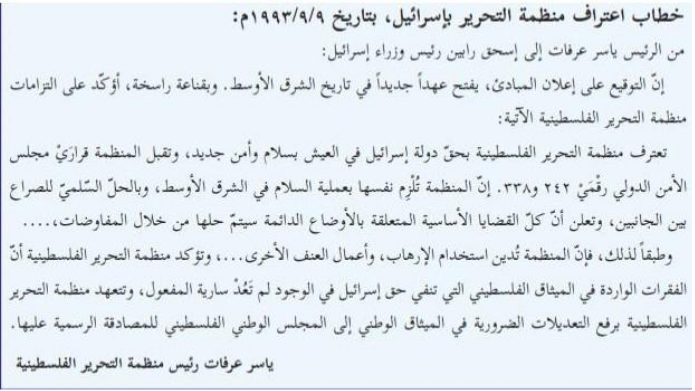
(גיאוגרפיה והיסטוריה מודרנית ובת-זמננו של פלסטין, כתה י’, חלק ב’ (2020) עמ’ 77)
- במקום הטפה לשלום יש קריאה למאבק אלים לשחרור. להלן ההימנון הלאומי של הרשות הפלסטינית הנלמד בביה”ס ובו ביטויי אלימות (מודגשים):
“[הבה] נכיר את הימנוננו הלאומי:
פעילות 1: נאזין ונחזור:
פדאי*, פדאי, פדאי, הו אדמתי, הו אדמת האבות
פדאי, פדאי, פדאי, הו עמי, הו עם הנצח
בהחלטיותי, אשי והר הגעש של נקמתי
וגעגועי דמי לאדמתי וביתי
טיפסתי על הרים ונכנסתי למאבק
הבסתי את הבלתי-אפשרי וניפצתי את הכבלים
פדאי, פדאי, פדאי, הו אדמתי, הו אדמת האבות
פדאי, פדאי, פדאי, הו עמי, הו עם הנצח
בסערת הרוחות ובאש כלי הנשק
ונחישות עמי להיכנס למאבק
פלסטין היא ביתי ודרך נצחוני
פלסטין היא נקמתי ואדמת העמידה האיתנה
פדאי, פדאי, פדאי, הו אדמתי, הו אדמת האבות
פדאי, פדאי, פדאי, הו עמי, הו עם הנצח
בתוקף השבועה בצל הדגל
באדמתי, בעמי ובאש הכאב
אחיה כפדאי ואמשיך כפדאי
ואמות כפדאי עד אשר אשוב
פדאי, פדאי, פדאי, הו אדמתי, הו אדמת האבות
פדאי, פדאי, פדאי, הו עמי, הו עם הנצח”
*פדאי – אדם המקריב את עצמו. מונח זה משמש היום לתיאור חברי ארגוני הטרור הפלסטיניים. 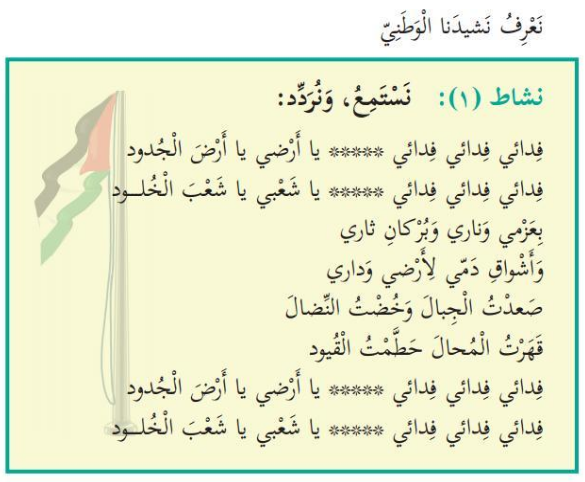
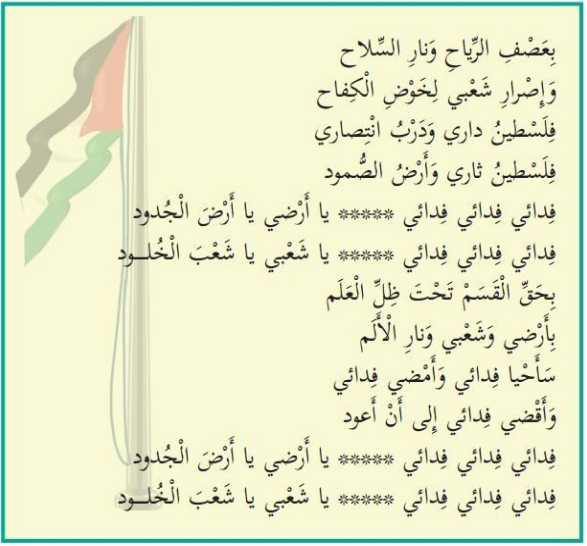 (טיפוח לאומי וחברתי, כתה ג’, חלק א’ (2020) ע”ע 16 – 17. ההדגשות הוספו)
3. המאבק לשחרור כפי שהוא מוצג לתלמידי כתה א’:
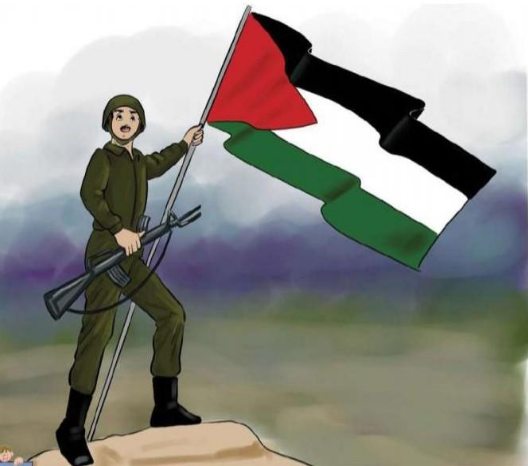 (שפתנו היפה, כתה א’, חלק ב’ (2020) עמ’ 83)
- המאבק לשחרור פלסטין אינו מסתיים בקווי 1967. חיפה ויפו גם הן כלולות בו:
“הבה נשיר:
ילדי פלסטין
אני גור אריות*; אני פרח** נתנו את הנפש למהפכה***
אבותינו בנו בתים לנו בארצנו החופשית
אני גור אריות; אני פרח נשאנו את גחלת המהפכה
אל חיפה, אל יפו אל [מסגד] אלאקצא, אל [כיפת] הסלע”
*גור אריות – חבר בתנועת הנוער של ארגון אלפתח
**פרח – חברה בתנועה הנ”ל
***מהפכה – הפעילות הטרוריסטית של ארגון אלפתח שהחלה ב-1.1.1965.
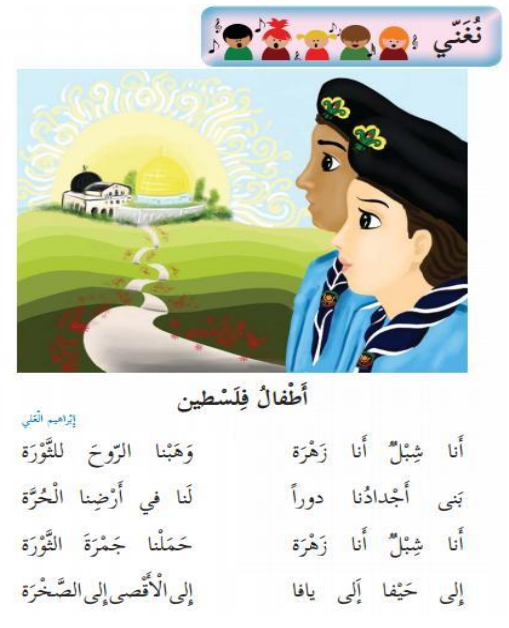 (שפתנו היפה, כתה ב’, חלק א’ (2020) עמ’ 44. ההדגשה הוספה)
- יפו נחשבת לעיר פלסטינית כבושה שיש לשחררה, כפי שנאמר בתרגיל לשון להלן:
“2. יהיה זה ראוי ליפו לשוב אל חיקנו.”
 (השפה הערבית, כתה ח’, חלק ב’ (2019) עמ’ 102)
 - אין מקום לישראל בפלסטין החופשית:
“FREE PALESTINE”
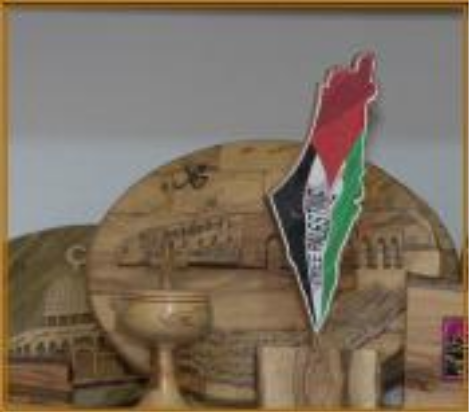 (מדעים וחיים, כתה ג’, חלק א’ (2020) עמ’ 65)
- למאבק האלים ניתן צביון דתי ע”י השימוש במונח המסורתי “ג’יהאד”:
“אלוהים ממריץ את המאמינים לג’יהאד ולמימונו ומזהירם מפני התעסקות בחיי העולם הזה על-פני הג’יהאד ומימונו, שהרי חיי העולם הזה מוליכים שולל את מי שעסוק בהם ועל המאמין לציית לצווי אלוהים ושליחו [מוחמד] ולהתרחק מהמריית פיו כדי שיזכה בשכר וגמול ביום תחיית המתים.”
 (חינוך אסלאמי, כתה ט’, חלק א’ (2020) עמ’ 27)
 - נוסף על אידיאל הג’יהאד, משתמשים גם באידיאל המסורתי של מות-קדושים (שהאדה). השהיד זוכה, לפי האמונה האסלאמית, לשכר רב בגן עדן, ובין השאר מחתנים אותו שם עם 72 בתולות. בדוגמה שלפנינו הלקוחה מתוך מדריך למורה במקצוע האמנות מוכנס בעניין זה נושא לציור בין שאר הנושאים (מסומן באדום):
“הצעות חלופיות:
…
3. ציור סצנה של חתונת שהיד.
…”
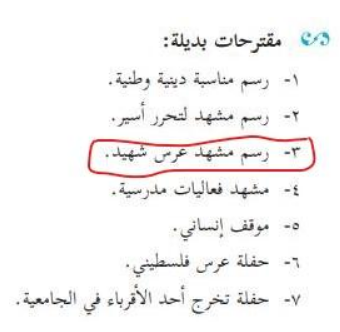 (מדריך למורה, חינוך לאמנות, כתה ו’ (2017 – המהדורה האחרונה עד כה) עמ’ 54)
 - סיום של סיפור על זיכרונותיו של פליט מדגיש שגם השיבה של פליטי 1948 תהיה חלק בלתי נפרד של השחרור המלא של פלסטין ולא שיבה כדי לחיות בשלום עם השכנים לפי החלטת האו”ם 194 שעליה מסתמכים הפלסטינים בטענתם לזכות השיבה:
“אנו נשוב; אנו נשוב עם הנשרים הדואים; נשוב עם הרוח הנושבת בחוזקה; נשוב אל הכרם ועצי הזית; נשוב כדי להניף את דגל פלסטין, לצד פרח הכלנית, על גבעותינו הירוקות.”
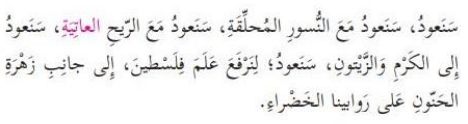 (השפה הערבית, כתה ה’, חלק א’ (2020) עמ’ 84)
 - חלק משיר בכותרת “זעקת פליט” מדגיש את אותה הנקודה:
“אני הבעלים של הזכות הגדולה ואני עושה ממנה את המחר
אשיב אותה. אשיב אותה כמולדת יקרה וריבונית
אזעזע את העולם מחר ואצעד כצבא אחד
יש לי פגישה במולדתי ולא יתכן שאשכח את הפגישה”
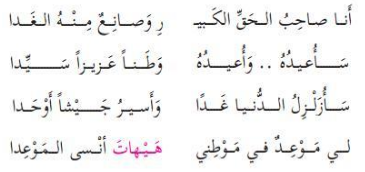 (השפה הערבית, כתה ה’, חלק א’ (2020) עמ’ 86, וראו בין השאלות הנלוות: “המשורר קבע את צורת השיבה. הבה נבהיר אותה כפי שהיא מופיעה בשיר.”)
 - הטרור הוא חלק בלתי נפרד מהמאבק לשחרור. להלן העמוד הראשון מתוך שיעור בן 4 עמודים המפאר את מפקדת התקפת הטרור על אוטובוס אזרחי בכביש החוף ב-1978 שבה נרצחו יותר משלושים ישראלים – גברים, נשים וילדים:
“דלאל אל-מוגרבי
(המחברים [של ספר הלימוד])
“אל מול הטקסט:
ההיסטוריה הפלסטינית שלנו מלאה בשמות רבים מרטירים שהקריבו את נפשותיהם למען המולדת, וביניהם המרטירית דלאל אל-מוגרבי שציירה במאבקה תמונה מתמונות קריאת התגר והגבורה, דבר שהפך את זכרה לנצחי בליבותינו ומוחותינו. הטקסט שלפנינו מספר על חלק מדרך מאבקה.”
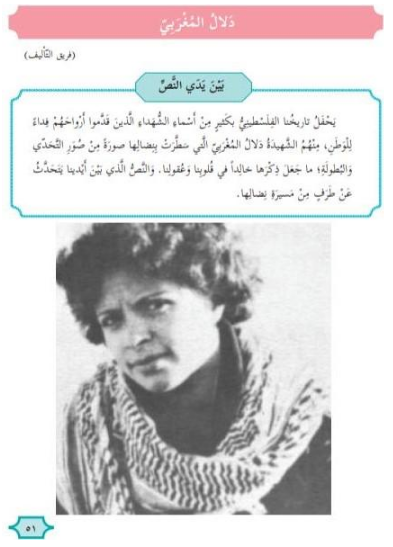
(השפה הערבית, כתה ה’, חלק ב’ (2020) עמ’ 51)
12. מסר ברור ונדיר בהתייחסות לשאלה:
מה לעשות ביהודים שיישארו בחיים לאחר שחרור פלסטין?
“נשיר ונלמד בע”פ: אדמת האצילים
אני נשבע! אקריב את דמי כדי להרוות את אדמת האצילים
ואסלק את הגזלן [ישראל] מארצי ואשמיד [אוביד] את שרידיהם המובסים של הזרים
הו, ארץ אלאקצא והמקום המקודש הו, ערש הגאווה והאצילות
סבלנות, סבלנות, שכן הניצחון שלנו והשחר מציץ מבעד לאפילה”
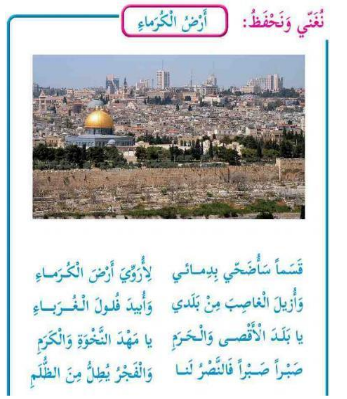 (שפתנו היפה, כתה ג’, חלק ב’ (2019) עמ’ 66. ההדגשה הוספה)
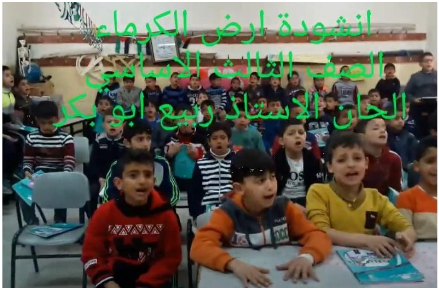
את השיר הזה שרים בכיתה! להלן תצלום מסך של תחילת הסרטון בערוץ יוטיוב של “קבוצת מורי ומורות פלסטין”. הכיתוב: “השיר ‘אדמת האצילים’, כתה ג’ של ביה”ס היסודי, לחן: מר רביע אבו בכר”
הקישור לסרטון עצמו:
https://www.youtube.com/watch?v=Yan7tf3E6UU
סיכום
ספרי הלימוד של הרשות הפלסטינית שאונר”א משתמשת בהם בבתיה”ס שלה עושים דה-לגיטימיזציה לקיומה של מדינת ישראל – מדינה חברה בארגון האו”ם – ולעצם נוכחותם בארץ של 7 מיליוני אזרחיה היהודים, תוך הכחשת ההיסטוריה שלהם וקיומם של המקומות הקדושים להם בה.
ספרי הלימוד של הרש”פ שבשימוש אונר”א עושים דמוניזציה הן לישראל והן ליהודים, עד לכדי אנטישמיות גלויה.
ספרים אלה אינם מטיפים כלל לפתרון של שלום לסכסוך הישראלי-פלסטיני. במקום זאת, הם קוראים למאבק אלים לשחרור עם דגש דתי שאיננו מוגבל בקווי 1967, ושבו ממלא הטרור חלק מרכזי.
כסוכנות או”ם, אונר”א מחויבת לניטראליות ושלום, אך השימוש שהיא עושה בספרי לימוד כאלה סותר באופן מוחלט מחויבות זו והופך את אונר”א לשותף מלא לאינדוקטרינציה האנטישמית של הרש”פ.
יתירה מזו, אונר”א מועלת בחובתה המקודשת כלפי רווחתם של הילדים ובני הנוער הפלסטינים שתחת חסותה ע”י חינוכם לקראת מלחמה עם מקביליהם הישראלים.
סוג זה של “חינוך” חייב להיפסק מיד ועל המדינות התורמות לומר את מילתן בעניין זה, ומוטב מוקדם מאשר מאוחר.
Does UNRWA Educational System Prepare the Palestinian Children and Youth for a War against the Jews?
Introduction
The United Nations Relief and Works Agency for the Palestinian refugees has been
operating since 1950 in Syria, Lebanon, Jordan, Judea and Samaria (including East
Jerusalem) and the Gaza Strip. It offers welfare, health and education services to the
1948 refugees and their descendants who are kept under miserable conditions in
dozens of refugee camps. Over half of its budget is directed to the educational field.
This paper discusses UNRWA’s educational activity in the territories of Judea,
Samaria and Gaza only. According to the data appearing on its site (from the 2019/20
school year) it had in Gaza 286,645 students in 278 schools that included grades 1-9.
In Judea and Samaria (including East Jerusalem) it had that year 45,883 students in 96
schools with the same grades, but its two schools in East Jerusalem included grade 10
as well.
Does UNRWA Educational System Prepares Palestinian Chidren and Youth for a War against the Jew (1)
UNRWA, the United Nations Relief and Works Agency, runs 59 “temporary” camps for 6.7 million Arab refugees & descendants from 1948
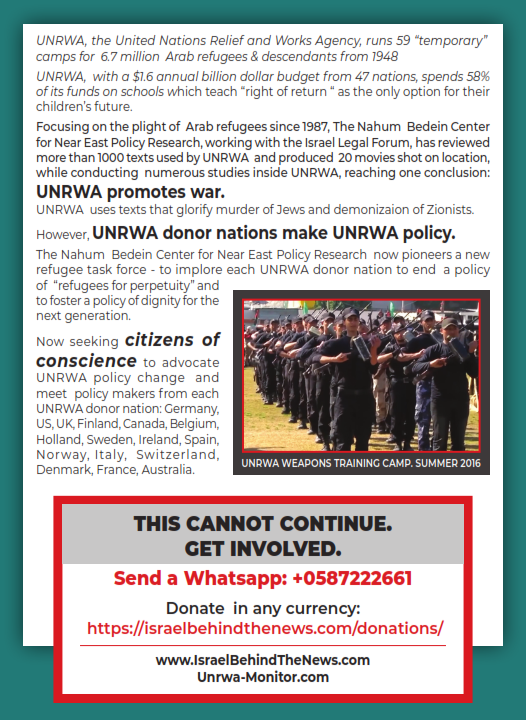
UNRWA, the United Nations Relief and Works Agency, runs 59 “temporary” camps for 6.7 million Arab refugees & descendants from 1948


