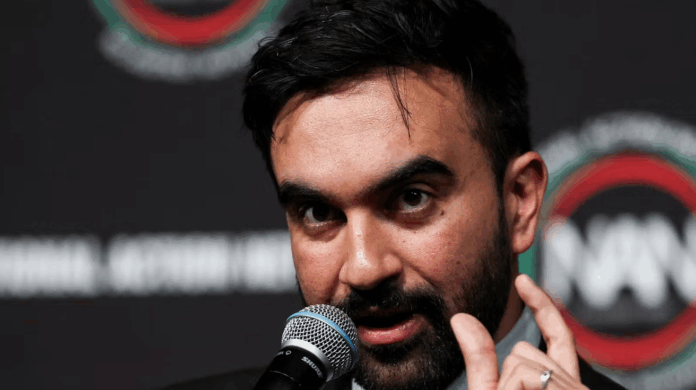
Yes – Take Mamdani at his word

Make no mistake. Patriotic, reform minded, anti-Islamist Muslims like myself and others in our Muslim Reform Movement have been warning the West on every one of our platforms for decades that just as Islamists radicalized Muslims across the planet, they will do so too with the Left.

Look no further than the BLM movement, (as I wrote in 2021) led by virulent antisemites of the likes of the Nation of Islam and other collectivist racist movements of convenience, tribalism, and antisemitism.

It is not rocket science that Zohran Mamdani’s worldview related to a worldview dominated by the utilitarian advancement of his only loyalty, to the world’s “Red-Green Axis” -the world’s Marxist-Jihadists.

Thus, wherever he is able to find “comrades”, as he calls them, whether socialists and communists of the DSA or Islamists and jihadis of the mosques of his radical imam network throughout New York, he’s at home.

Aspirationally, Marxist-Islamists like Mamdani, see themselves narcissistically as a vehicle for the ascendancy of that red-green axis globally and domestically into the West.

Mamdani screams “Islamophobia” before anyone can muster the courage to call out his antisemitic hate and seditious anti-Americanism. He intentionally conflates being an Islamist with being Muslim.

He gaslights Americans by claiming that antisemitism is weaponized against him, but in fact he is projecting the very racism that he is perpetrating. As an anti-American Islamist, his vernacular is saturated with unadulterated antisemitism.

Now, just before the election, in what would be his campaign’s ‘closing statement’ just a few days ago, his emphasis was not about his love of America nor the freedoms it gave him. Instead, he complained into the camera about how “he was victimized” and how he’s carried the “indignities” of being Muslim through his race after the 9-11 attacks. Steven Emerson has referred to this as the “Muslim Brotherhood Playbook.”

He shows zero capacity to understand what being a New Yorker or an American actually meant on 9/12/2001 when the city became “Ground Zero” in the Islamist terror war which Al Qaeda waged on 9/11/2001. He evinces that same moral blindness in refusing to condemn the genocide by Hamas on October 7.

Actually, this is how normal, anti-Islamist Muslims responded to the “Ground Zero mosque”. I wrote this for the New York Post in 2010 a Mosque Unbecoming: “To put it bluntly, Ground Zero is the one place in America where Muslims should think less about teaching Islam and ‘our good side’ and more about being American and fulfilling our responsibilities to confront the ideology of our enemies.”

Instead ‘Comrade’ Mamdani attacks New York’s police, security, and all New Yorkers who re-dedicated their lives to fighting Marxist-Jihadism, the very ideas he now advances, whether non-violent or not. As is classic of Islamists, he dissimulates and uses his Muslim identity, not as the ideology which it is – Islamism – but as a victimized race which it is absolutely not.

Meanwhile he uses every opportunity to unapologetically cozy up to the very radical imams in NYC including Siraj Wahaj, (see herehere) who the rest of us rational Muslims dedicate ourselves to defeating. I discuss in A Battle for the Soul of Islam how I actually confronted Imam Wahhaj at a 1995 meeting of the Islamic Society of North America in Indianapolis about his seditious and treasonous call at that meeting for Muslims to replace the U.S. Constitution with the Qur’an.

Mamdani claims “Islamophobia” for his family and his “Auntie” when it suits him, while his father, a Columbia professor and equally self-righteous immigrant, is seen radically comparing Abraham Lincoln to Adolf Hitler. The Marxist-Islamist apple doesn’t fall far from the tree.

He invokes the term “Islamophobia” to otherwise claim ‘anti-Muslim bigotry’, when in fact the term is used throughout the OIC (Organization of Islamic Cooperation- 56 Muslim majority nations of today’s ‘neo-caliphate’) to punish genuine dissidents in Muslim majority nations who speak out against Islamist theocrats and monarchs who weaponize anti-blasphemy laws to stay in power.

He could never get himself to condemn the phrase “from the river to the sea” nor even honestly explain its origin and meaning, which he most certainly knows. The mantra, “from the river to the sea”, has no other interpretation but the complete annihilation of the State of Israel. It is genocidal in its desire to re-create a pre-1948 Middle East if not resurrect the last Islamic Caliphate with Islamist hegemony. This position is bolstered by his support of the BDS movement, which by definition calls for the economic destruction of the State of Israel.

Mamdani’s world-view (Marxo-Jihadism) divides the world between Dar-al-Islam, the abode of Islam where Islam reigns supreme and the Dar-al-Harb, where war (civilizational or militant) can be waged to impose Islam. Such a world view sees Israel and America as living in the land of war. He has never openly, let alone convincingly, criticized the radical commentaries of imams like Siraj Wahaj who’ve openly called for Sharia law to dominate America.

The fact that Mamdani cannot bring himself to say anything critical of genocidal Islamist terror organizations like Hamas, ISIS, IRGC, Hezbollah, Al Qaeda, or the Muslim Brotherhood tells you why Mamdani should be the Mayor of Gaza City, not New York.

Reposted from IPT – The Investigative Project on Terrorism.

Dr. M. Zuhdi Jasser is the president of the American Islamic Forum for Democracy based in Phoenix, Ariz. He is a former U.S. Navy lieutenant commander and author of A Battle for the Soul of Islam: An American Patriot’s Fight to Save His Faith. He was a U.S. Senate appointee to the U.S. Commission on International Religious Freedom from 2012-16. He co-founded the Muslim Reform Movement and the CLARITy Coalition to Save the West, challenging Islamists and advocating for an Islam of moderation. He can be reached on X @DrZuhdiJasser. Watch Dr. Zuhdi Jasser’s most recent interview with Officer Tatum here.

Yossi Katz, The Land Shall Not Be Sold in Perpetuity

Yossi Katz, The Land Shall Not Be Sold in Perpetuity: The Jewish National Fund and the History of State Ownership of Land in Israel, (De Gruyter-Oldenbourg, Berlin, 2016), 237 pp.

The ownership, zoning, and future development of land have been a major issue in the Arab conflict with Zionism and have contributed to Arab rejection of the State of Israel over the years. In an essay published May 15, 2013,1 the sixty-fifth anniversary of the establishment of the State of Israel, journalist Dalia Hatuqa of Al Jazeera remarked that “the issue of land and property, is still the defining aspect of the conflict.” In fact, in the late 1950s, Al-Ard (“The Land”) was the name of an Arab political movement in Israel and its newspaper. Both the movement and the paper were banned in 1964. Briefly, Arab propaganda claims that European Jews sought to “take over Arab land” and decided “to colonize the land of Palestine” and that Jews are a foreign power that “divided up another people’s land”.

The review article by historian Diana Muir which appeared in 2008 inadvertently reinforces this view.2 Muir notes that Israel Zangwill was the first Zionist who used the phrase “a land without a people for a people without a land,” often repeated by anti-Zionists as an example of a “perfect encapsulation of the fundamental injustice of Zionism.” However, variant versions of the slogan appear in earlier works, such as The Land of Israel, written in 1843 by Church of Scotland clergyman Alexander Keith, and in a letter by Lord Shaftesbury to Lord Palmerston of July 1853, which stated that Greater Syria was “a country without a nation” in need of “a nation without a country.” Other examples include an essay by Scottish Presbyterian Horatius Bonar written in 1858, in William Blackstone’s “Palestine for the Jews,” which appeared in 1891, and in a novel by the English writer, Winifred, in 1902, and in the lead article of the Washington Post penned by a Christian journalist on December 12, 1917. Furthermore, the Biblical verse, Leviticus 25:23, occurs in land-related issues. It stipulates that the patrimony of the Jewish people, the Land of Israel (Eretz Yisrael), rightfully belongs to God and that “the land shall not be sold in perpetuity.” This verse became the foundational slogan of the Jewish National Fund, the organization founded by the Zionist movement, whose task was to purchase land in the historic Land of Israel on behalf of the Jewish people.

The Arab Badwil web site3 claims that the work of the Jewish National Fund and, subsequently, Israel’s legislation regarding the oversight of its activities are “attempt[s] to bypass legal oversight and to legislate against the right to equality in regards to land…the state [of Israel] will be able to ‘Judaize’ more land and discriminate against its non-Jewish citizens.” And, the late journalist, Dan Leon of Mapam, Israel’s Marxist-oriented Zionist party, wrote in 20054 that the three major problems concerning the issue of land were: 1. “‘Redeeming’ [purchasing] the land before the establishment of the State of Israel was often at the expense of Arab fellahin.” 2. “After the 1948 war, it was the holdings of Arab refugees or of ‘present absentees’ (and not land purchases from the little blue boxes) that accounted for most of the JNF’s land.” 3. “The JNF undertook projects with dubious moral overtones.” He also was upset that Himnuta, the JNF subsidiary implementing the organization’s policies, is active in areas taken by Israel in the Six-Day War in June 1967 as well.

In light of the above, the book on the workings of the Jewish National Fund by the eminent and prolific geographer and 2016 Israel Prize Laureate, Professor Yossi Katz of Bar Ilan University, is timely and important. The Land Shall Not Be Sold in Perpetuity provides much essential information about the activities of the Jewish National Fund, particularly after the establishment of the State of Israel in 1948. This is a major shortcoming. Perhaps the author could have devoted more attention to the pre-State activities of the JNF, which served as the instrument of the World Zionist Organization for purchasing land during the late Ottoman period. Indeed, he JNF was officially established in 1901 as a “fund [that] shall be the property of the Jewish people as a whole,” in accordance with the concept of the inalienability of national land mentioned in Leviticus 25:23, quoted above. In fact, Israel is the only Western country where most of the land is owned by the state and its public body. In fact, as early as page 12, Professor Katz begins his treatment of the transition period from Mandate to state from 1947-1949, and addresses the Arab claim of dispossession dealt with at length by Aryeh Avineri.5 The full details of property acquired through purchase appear only in Footnote 4 on page 34. Indeed, the book seems to be a continuation of Katz’s earlier work, published in 2005, which covers the history of pre-state land acquisition by the JNF.6 The present volume deals mainly with the details of internal deliberations, political maneuverings, and legislative procedures of the JNF. Based upon archival sources, this study is highly academic and background on the issues is recommended.

Furthermore, Yossi Katz is not simply an objective scholar (127). He served as an expert witness before Knesset committees and other bodies to lobby against government efforts to privatize state lands and even published articles supporting the position of the JNF. This should have been stated earlier in the book. The questions of proper administration, compliance with the law and the confrontation between the JNF’s ideology of the land belonging to the Jewish people and the State of Israel as opposed to private ownership is a motif throughout this study. The book traces the history of the intimate involvement of JNF staff and members of the Knesset in formulating various laws about land ownership. Katz’s analysis of the JNF and Knesset records is excellent as far as the goals, language and political manoeuvers adopted by the JNF to further its interests are concerned. The book, however, does not provide sufficient treatment of the issue of selling JNF land to non-Jews or those who are not citizens of Israel. The author refers to statements by David Ben-Gurion and includes several arguments by Herut members of the Knesset, but does not recall Ze’ev Jabotinsky’s major article, “The Jubilee Idea” (1930) which served as the ideological basis for the Herut movement’s policy regarding ownership of land. To his credit, the author notes the ideas of Zionists who were not members of the Labor movement, such as the Mizrachi (National-Religious) MK Zerach Warhaftig (110).

Katz also points out the fact that early on, there had to be legislation which defined new territory as the British Mandate had become the State of Israel. The language of this legislation, dating from in 1952, defined the new company that would replace the original JNF which was registered by Great Britain as “the State of Israel and any region that will be under the legal authority of the Government of Israel” ( 20). The rejection of a recent attempt by a Canadian Jew to have Canada boycott wines produced in Judea and Samaria echoes the above statement which defined the territory of Israel in the official Free Trade Agreement between the two countries is “the territory where its customs laws are applied.” The reason for this language was the possible loss of JNF property left in areas of the original Mandate territory outside the borders of the State of Israel. It included 16,666 dunams near E-Salt in Transjordan, 3,300 near Hebron and 1,200 near Gaza. Interestingly, Katz notes that in 1949 the Government of Israel intended to transfer abandoned Arab property to the JNF for the purpose of resettling Arab refugees (35).

The book is well written and the translation and adaptation from the original Hebrew, published in 2002, is excellent, with only several examples of awkward phrasing. On the whole, the book is an important contribution to the subject of the concept of Jewish land and the workings of the JNF in the State of Israel, and worth reading despite its somewhat narrow focus.

* * *

Notes

1 https://www.al-monitor.com/pulse/originals/2013/05/palestine-israel-conflict-land.html#ixzz4pLWmzD2d

2 Middle East Quarterly, Spring 2008, pp. 55-62

3 https://www.badil.org/en/publication/periodicals/al-majdal/item/1404-mahajneh-jnf-and-israeli-law.html

4 Palestine-Israel Journal, Vol 12 No. 4 & Vol 13 No. 1, 05/06

5 The Claim of Dispossession: Jewish Land-Settlement and the Arabs, 1878-1948, Transaction Publishers, 1982

6 The Battle for the Land: A History of the Jewish National Fund before the Establishment of Israel (Jerusalem: Magnes Press, 2005).

After Donald Trump’s “Peace” Israel’s Intellectual Imperative

President Trump at the Israel Museum. Jerusalem May 23, 2017

More than anything else, Israel’s survival requires intellectual supremacy. Though difficult to measure, such supremacy is necessary to preserving the country’s tactical and strategic advantages. Although generally overlooked, superior weapons technologies could never be adequate per se. Looking ahead, especially after Donald Trump’s conspicuously false peace, these technologies could confer only partial and temporary benefits.

There are many explanatory details. Even with its presumptive nuclear monopoly in the Middle East, Israel will need to optimize IDF military advantage in every sector of operations. On prospectively urgent matters concerning war with Iran and its reconfiguring jihadi surrogates, Israel will have to clarify that its military assets are purposeful at all levels of destructiveness. This includes an evident capacity to achieve “escalation dominance” in extremis.

For the moment, the most plausible paths to a renewed Israel-Iran war – one in which Iran remained non-nuclear – would involve unpredictable escalations against Islamic Republic surrogates. At some conceivable point during such an escalating conflict, a not-yet-nuclear Iran could elicit “limited” Israeli nuclear responses. While such responses could be made consistent with authoritative international law,[1] their cumulative effects would be destabilizing for friend and foe alike.

Notably worrisome escalation dangers would lie in any Iranian use of radiation-dispersal weapons and/or Iranian conventional attack on Israel’s Dimona nuclear reactor. In a worst-case scenario, an already-nuclear North Korea would engage Israeli military forces on behalf of Iran. In such an under-examined but still-credible scenario, North Korea would operate as an “equalizing” nuclear state proxy for non-nuclear Iran.

Historically, at least, this is not a contrived scenario. North Korea engaged militarily with Israeli forces in the past, most visibly during the 1973 Yom Kippur War. Back on October 31 2024, Pyongyang successfully completed missile tests demonstrating ICBM capacities against the United States. Israel, for targeting comparisons, is less than half the size of America’s Lake Michigan.

For Jerusalem, there are immediately important specifics to identify. By definition, all imaginable scenarios would be unprecedented or sui generis. This means, among other things, that related and derivative predictions could never express anything more than “quasi-scientific” judgments. In formal logic, it ought not to be overlooked, all assessments of probability must stem from a determinable frequency of relevant past events.

There has never been such an event. There has never been a genuine nuclear war. Hiroshima and Nagasaki were not elements of a nuclear war. More precisely, these mass-destruction events represented singular atomic attacks within a conventional war.

Even if Iran were to remain pre-nuclear, Jerusalem could at some stage calculate that it would be gainful to cross the nuclear combat “firebreak.” This high-stakes scenario would concern intra-crisis bargaining wherein the non-introduction of Israeli nuclear weapons could allow Iran to gain the upper hand. Accordingly, during an eleventh-hour existential crisis, Israel could decide to “go nuclear” at conspicuously limited levels to establish or maintain “escalation dominance.”

Prima facie, these are weighty analytic matters. They are not in any fashion matters of ordinary politics or “common sense.” In such challenging matters, common sense is the beguiling enemy of science and logic. Looking ahead, arcane matters of nuclear war and nuclear peace ought never to be left to politicians, generals or pundits.

For Israel, like it or not, nuclear weapons and deterrence remain essential to national survival. Jerusalem’s traditional policy of deliberate nuclear ambiguity or “bomb in the basement” goes back to early days of the state. During the 1950s, David Ben-Gurion, Israel’s first prime minister, understood the need for a dramatic “equalizer” vis-à-vis larger and more populous regional enemies. For “BG,” those original enemies were Arab states, primarily Egypt, Jordan and Syria. Today, after Trump’s dangerously false peace, exceptional perils could come from Arab Qatar, but also from non-Arab Pakistan and Turkey.

What next for the Jewish State? Still facing an intransigent and potentially nuclear Iran, Israel will need to update and refine its posture of “deliberate nuclear ambiguity.” The key objective of such enhancements would be credible nuclear deterrence, a goal requiring prompt policy shifts to “selective nuclear disclosure.” Though counter-intuitive, Iran and certain other adversaries will need to be convinced that Israel’s nuclear arms are not too destructive for operational military use.

There will be perplexing nuances. For Israel to fashion reason-based nuclear policies, Iran’s leaders should generally be considered “rational.” Still, it is conceivable that Iran would sometime act irrationally, perhaps in alliance with other generally rational states like North Korea and/or jihadi terror groups. In the case of North Korea, waging an actual and direct war would be more challenging for Israel than any conflict with Iran.

In the Middle East, Israel currently has no nuclear state enemies. But Pakistan, as an increasingly unstable Islamic state, is subject to coup d’état by jihadi elements and is closely aligned with both Saudi Arabia and Iran. The Sunni Saudi kingdom could sometime decide to “go nuclear,” not because of Israel per se, but in response to reasonable fears of Shiite Iran’s nuclear progress. This consequential decision could be reinforced by parallel or coinciding nuclear decisions in Egypt or non-Arab Turkey.

Facing the dissembling results of a “Trump Peace,” Israel needs to place less faith in “common sense” than in science. Above all, it needs more consistent faith in disciplined and refined strategic reasoning. Such reasoning will have to be logic-based and continuously dialectical. In principle, at least, its creators should approach J. Robert Oppenheimer or Yuval Ne’eman[2] intellectual status. A tall order, to be sure, but compelling nonetheless.

For Israeli nuclear deterrence to work longer-term, Iran and other potential state foes should be told more rather than less about IDF nuclear targeting doctrine and the invulnerability/penetration-capability of its nuclear forces. In concert with such major changes, Jerusalem will have to substantially clarify certain core elements of its still too-opaque “Samson Option.” The point of such clarifications would be not to “die with the Philistines” (per the biblical Book of Judges), but to enhance “high destruction” options on Israel’s strategic deterrence continuum.

Though the only purposeful rationale of Israel’s nuclear weapons should be viable deterrence at variable levels of military destructiveness, there will always remain circumstances under which Israel’s nuclear deterrent could fail. How might such prospectively intolerable circumstances arise? It’s not a hypothetical question. A comprehensive answer could be extrapolated from four basic conflict scenarios or narratives. Most plausibly, these narratives would be a “by-product” of Israel’s re-started war against Hamas and associated jihadi forces or the result of a re-started direct belligerency between Israel and Iran.

There is more. All such narratives could be impacted, modified or changed by anti-Israel interventions of Russia and/or North Korea. By definition, such game-changing interventions would remove Israel’s ongoing advantages regarding “escalation dominance” and render more realistic the specter of an Iranian-jihadist victory. Because such narratives would be historically unique, however, it would be impossible for Jerusalem to make any science-based judgments of probability. Here, intellectual supremacy would remain the source of all durable Israeli power, strategic and tactical, but still could not represent an absolute assurance of national survival. In all of these scenarios, nothing could be predictable except unpredictability.

(1)Nuclear Retaliation

If Iran or other enemy state were to launch a massive conventional attack against Israel, Jerusalem could ultimately/incrementally escalate to a limited nuclear retaliation. If adversarial first-strikes were to involve chemical or biological weapons, electromagnetic weapons (EMP) or radiation-dispersal weapons, Israel could immediately or incrementally launch a calibrated nuclear reprisal. This decision would depend, in large but unspecifiable measure, on Jerusalem’s expectations concerning follow-on aggression and comparative damage-limitation. A nuclear retaliation by Israel could be ruled out only in those circumstances where enemy state aggressions were conventional and “hard-target” oriented; that is, aimed toward Israeli weapons and military infrastructures and not involving Israel’s civilian populations. Foreseeably, there are residual circumstances wherein Israel could judge limited nuclear weapons use to be rational, lawful and cost-effective.

(2)Nuclear Counter Retaliation

If Israel should feel compelled to preempt enemy state aggression with conventional weapons, that belligerent state’s response would determine Israel’s escalatory moves. If this response were in any way nuclear, including “only” radiological weapons, Israel would likely turn to correlative forms of nuclear counter-retaliation. If this enemy retaliation were to involve other non-nuclear weapons of mass destruction or mass disruption (e.g., EMP weapons), Israel could still feel compelled to take enhanced escalatory initiatives. Assuming rational decision-making, this vital decision would depend on Jerusalem’s considered judgments of adversarial intent and its timely calculations of damage-limitation.

If the enemy state response to Israel’s preemption were limited to hard-target conventional strikes, it is unlikely that Israel’s decision-makers would move toward nuclear counter-retaliations. If, however, the adversary’s conventional retaliation was “all-out” and directed in whole or in part toward Israeli civilian populations, an Israeli nuclear counter-retaliation could not be excluded. Such counter-retaliation could be ruled out decisively only if the enemy conventional retaliation were presumptively proportionate to Israel’s preemption; confined to Israeli military targets; circumscribed by codified legal limits of “proportionality” and “military necessity;” and accompanied by variously persuasive assurances of non-escalatory intent.

(3)Nuclear Preemption

It is highly unlikely that Israel would ever decide to launch a preemptive nuclear strike against Iran or other state enemy. Though circumstances could arise wherein such a strike would appear rational in strategy and permissible in law, it is still implausible that Israel would allow itself to reach such “end-of-the-line” circumstances. An Israeli nuclear preemption could be expected only where Iran or other adversary had (a) acquired authentic (chain-reaction) nuclear and/or other weapons of mass destruction; (b) clarified that its intentions paralleled its capabilities; and (c) was believed ready to begin a “countdown to launch.” Also incentivizing would be belief by Jerusalem that exclusively conventional preemptions could no longer be consistent with preservation of the Jewish State.

(4)Nuclear War Fighting

If nuclear weapons should ever be introduced into a conflict between Israel and an enemy state, some form of nuclear war fighting would ensue. This would hold true so long as: (a) enemy first-strikes would not destroy Israel’s second-strike nuclear capability; (b) enemy retaliations for an Israeli conventional preemption would not destroy Israel’s nuclear counter-retaliatory capability; (c) Israeli preemptive strikes involving nuclear weapons would not destroy enemy second-strike nuclear capabilities; and (d) Israeli retaliation for conventional first-strikes would not destroy enemy nuclear counter-retaliatory capability. For the time being, at least, any adversarial nuclear capacity without Russian, North Korean or Pakistani backup would be limited to radiation dispersal weapons and/or conventional rocket attacks against Dimona.

Summing up, Jerusalem’s overriding security focus should remain fixed on enemy state capabilities and intentions, but ought also to include variously coinciding intersections with state and sub-state surrogates. The Iran/jihadi threat to Israel is not “just” an isolable terror threat, tactical threat or strategic threat, but a multi-dimensional peril that could at some point trigger nuclear warfare with Iran.[3] As for the incendiary warnings still blaring from Tehran, acting to fulfil such threats without tangible Russian/North Korean/Pakistani assistance would plausibly be more injurious to Iran than to Israel.

This logic-based conclusion is likely well-understood by authoritative leadership elements in Tehran et. al., and Israel will seemingly retain the upper hand in future struggles for “escalation dominance.” To best ensure that this Israeli advantage remains continuous and undiminished, Israel should promptly (1) declare credible shifts from “deliberate nuclear ambiguity” to “selective nuclear disclosure;” and (2) reveal the most potentially persuasive contours of its “Samson Option.” Among other things, both remedies should be oriented not to actual nuclear war-fighting, but rather to advantage-based postures of nuclear war-avoidance.

More than anything else, Israel’s survival will require intellectual supremacy.

LOUIS RENÉ BERES was educated at Princeton (Ph.D., 1971). Born in Zürich at the end of World War II, he is the author of many books, monographs, and articles dealing with Israeli nuclear strategy. Emeritus Professor of International Law at Purdue, he has lectured on this topic for over fifty years at leading universities and academic centers for strategic studies. Dr. Beres’ twelfth book, Israel’s Nuclear Strategy: Surviving amid Chaos, was published in 2016 (2nd ed., 2018).  https://paw.princeton.edu/new-books/surviving-amid-chaos-israel%E2%80%99s-nuclear-strategy

Professor Beres is the author of seven lead articles at Oxford University Press’ annual publication: Oxford Yearbook on International Law and Jurisprudence. In 2003-2004, he was Chair of Israel’s “Project Daniel” (Iranian nuclear weapons/PM Ariel Sharon). Beres was an early recipient of the Bulletin of the Atomic Scientists Rabinowitch Prize.

[1] No state, including Israel, is under legal obligation to renounce “militarily necessary” uses of nuclear force in extremis. On July 8, 1996, the International Court of Justice at The Hague (ICJ) handed down its Advisory Opinion on “The Legality of the Threat or Use of Force of Nuclear Weapons.” The final paragraph of this Opinion, concludes, inter alia: “The threat or use of nuclear weapons would generally be contrary to the rules of international law applicable in armed conflict, and in particular the principles and rules of humanitarian law. However, in view of the current state of international law, and of the elements of fact at its disposal, the Court cannot conclude definitively whether the threat or use of nuclear weapons would be lawful or unlawful in an extreme circumstance of self-defense, in which the very survival of a State would be at stake.”

[2] The present writer, Professor Louis René Beres, was a long-time acquaintance and colleague of Professor Ne’eman.

[3] For specialized accounts by this author of nuclear war effects, see: Louis René Beres, Apocalypse: Nuclear Catastrophe in World Politics (Chicago: University of Chicago Press, 1980); Louis René Beres, Mimicking Sisyphus: America’s Countervailing Nuclear Strategy (Lexington, Mass., Lexington Books, 1983); Louis René Beres, Reason and Realpolitik: U.S. Foreign Policy and World Order (Lexington, Mass., Lexington Books, 1984); and Louis René Beres, Security or Armageddon: Israel’s Nuclear Strategy (Lexington, Mass., Lexington Books, 1986). More recently, by Professor Beres, see: Surviving Amid Chaos: Israel’s Nuclear Strategy (New York, Rowman & Littlefield, 2016; 2nd ed. 2018).

Do Qatar and Turkey really want to see Hamas disarmed?

Many are breathing a massive sigh of relief now that the last of the living hostages abducted by Hamas on October 7, 2023 has been returned home. Once the remains of all the captives who have been killed are also back in Israel, the first phase of the peace deal will be completed.

The next step in the plan – and also its biggest challenge, as seen in the Gaza attack that killed two Israeli soldiers and prompted a wave of airstrikes – is getting Hamas to disarm and cede control of the Gaza Strip to a transitional Palestinian technocratic government supported by the International Stabilisation Force, a yet-to-be-established international body.

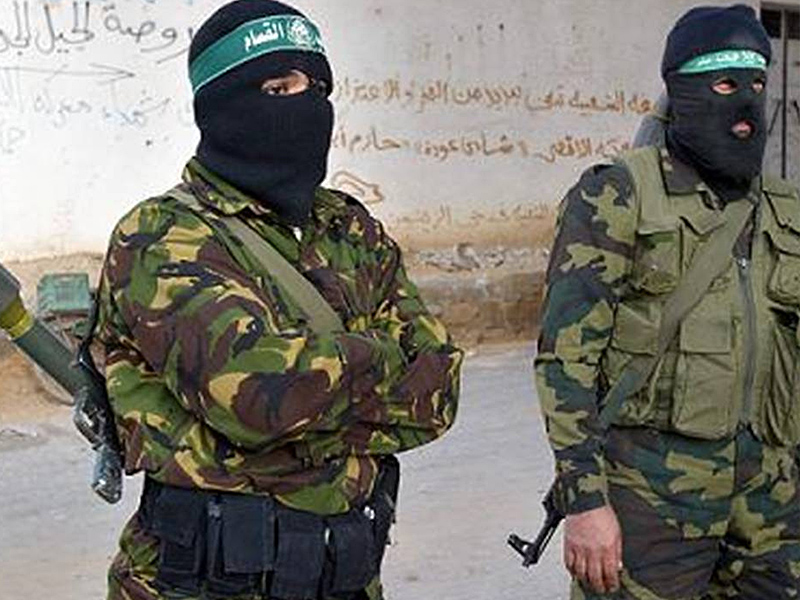
US President Donald Trump has succeeded in gathering together an influential group of mediators, including Egypt, Qatar and Turkey, to pressure Hamas into implementing the rest of the peace agreement. But it is not yet clear if the US partners in this deal will have the incentive or the wherewithal to push Hamas to give up its weapons, its terror infrastructure or its status as the ruler of Gaza.

Qatar and Turkey have conflicting interests: on the one hand, they would like to see Hamas stay in power because they ideologically support the terror group, but at the moment their overriding interest seems to be maintaining a close relationship with Trump by delivering Hamas – in anticipation of rewards from Washington. In addition, they may be motivated by the prospect of maintaining some influence over Hamas during the reconstruction of Gaza if they continue to support the US in urging disarmament.

As for Western countries, many have not been shy about making their voices heard on the Gaza conflict. Several have recently declared their recognition of Palestinian statehood – a move that rewards and emboldens Hamas, even as the jihadis bring disaster on the very civilians they claim to represent.

Now that there is a full-blown peace plan waiting to be implemented, the world must pressure Hamas to move to the next stage as soon as possible once the remains of the murdered hostages are returned. Only then can deradicalisation, normality and reconstruction begin in earnest and the civilians of Gaza finally live free of terrorist rule – and public executions.

Though Trump has said Israeli forces could return to the streets of Gaza if Hamas refuses to uphold its end of the deal, the resumption of hostilities is not an ideal outcome for any of the parties. But the disarmament of Hamas is likely to take time.

First Hamas needs to agree to it in principle, and then the requirements and procedures of disarmament must be spelt out. Trump’s plan specifies that once the International Stabilisation Force has been established, that body will be responsible for internal security, meaning that Hamas cannot get away with policing Gaza as a way to justify holding on to its weapons.

Israel has been fighting Hamas for two years to deliver the message that the 2023 massacre was not only terrible for the Israeli population but also terrible for Hamas, because it has been so weakened by the war it set off. And so if the world does not pressure Hamas to disarm, Israel will likely feel the need to step in and forcibly disarm Hamas to prevent the terrorists from attempting another attack that could kill thousands more, and to ensure October 7 is remembered in Palestinian history as a failure.

If the peace plan does get fully implemented, despite the obstacles, the Palestinians of Gaza will likely be the ones deriving the greatest benefit: living in a rebuilt land free from the rule of terrorists, which may help create what the peace plan calls “the conditions [that] may finally be in place for a credible pathway to Palestinian self-determination and statehood.”

Israel will, of course, also benefit from peaceful borders, and the impact could ripple even further outward, building towards broader stability in the Middle East. That could encompass the Arab world, from Oman and Qatar to Syria and, perhaps, Lebanon once Hezbollah is disarmed, as well as to countries in the broader Muslim world, such as Indonesia. A new Middle East may well be on the horizon – once the world pressures Hamas to lay down its weapons and let Gaza be rebuilt in peace.

Yossi Kuperwasser, a retired Israeli brigadier general, leads the Jerusalem Institute for Strategy and Security. He is a former head of the research division of the Israel Defense Forces’ military intelligence directorate and director-general of the Israeli Ministry of Strategic Affairs

Saudi Arabia pulls back as Hamas gains ground

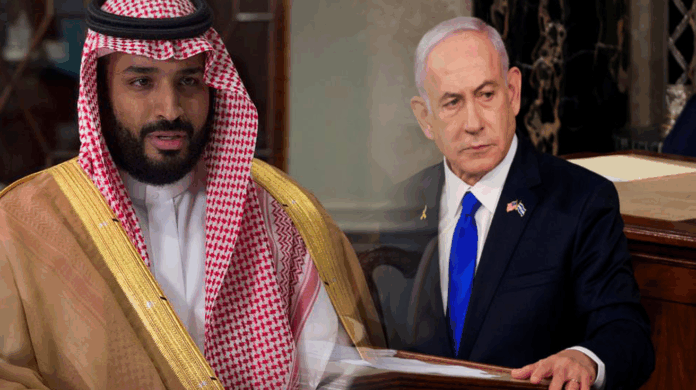
Finance Minister Bezalel Smotrich’s recent comments disparaging Saudi involvement, saying, “Let the Saudis ride camels”, dealt a serious blow to both negotiations with the kingdom on future diplomatic arrangements and Israel’s broader standing in ceasefire talks, A senior Israeli official told Israel Hayom.

Known for his deep, curious conversations with thought leaders, this American professor shares the 5 books he would re-read again and again.Blinkist Reading List

The fallout prompted a particularly harsh conversation between Prime Minister Benjamin Netanyahu’s office and Smotrich, which led the minister to issue a public apology.

According to the official, Riyadh had aligned with the majority of Israel’s demands, insisting—as Israel does—that any future arrangement begin with Hamas being dismantled of its weapons. “The Saudis have now reduced their participation in these talks to a minimum. It’s not only because of Smotrich, but his comments certainly pushed them in that direction,” the official said. “Israel is now dealing with a bloc that includes Turkey, Qatar and Egypt—countries interested in preserving Hamas’ role in Gaza to varying degrees and refusing to pressure it to disarm.”

The issue of Hamas’ weaponry remains the defining red line for the deal that ended the war. In recent days, countries that were expected to deploy forces to help stabilize the Gaza Strip have made it clear they will not do so as long as Hamas retains its weapons.

Israel Hayom previously reported that both Saudi Arabia and the United Arab Emirates oppose sending troops to Gaza while Hamas continues to wield military power. Arab diplomatic sources say Egypt is also unwilling to deploy troops at this stage, citing the need for the Palestinian Authority to assume control, as international law designates it the sovereign in Gaza. However, this explanation is largely seen as a pretext.

Egypt, like others, understands that clashes between its troops and armed Hamas operatives are only a matter of time, especially if there is any serious effort to disarm the terrorist group. This position is shared by other potential contributors to the stabilization force, including Indonesia, Azerbaijan, Jordan and Morocco. Even Qatar, which had reportedly planned to send police forces, is now refusing to do so for the same reason.

Some Arab nations involved in discussions had envisioned a lightly armed observer force patrolling the dividing line between IDF controlled areas and those under Hamas rule, without entering civilian areas. Hamas, unsurprisingly, supports this approach. The practical result is that no international force is currently willing to take responsibility for Gaza or carry out its primary mission, disarming Hamas in line with the Trump plan.

The Palestinian question can no longer be ignored

The war in Gaza has not ended; it has changed its shape. What began as a brutal confrontation has now hardened into a political and geographic experiment, one whose contours may define the region’s next decade. Beneath the surface of ceasefires and reconstruction plans lies a deeper transformation: the reappearance of the Palestinian question, after years of deliberate absence, as a central axis in the regional and global conversation.

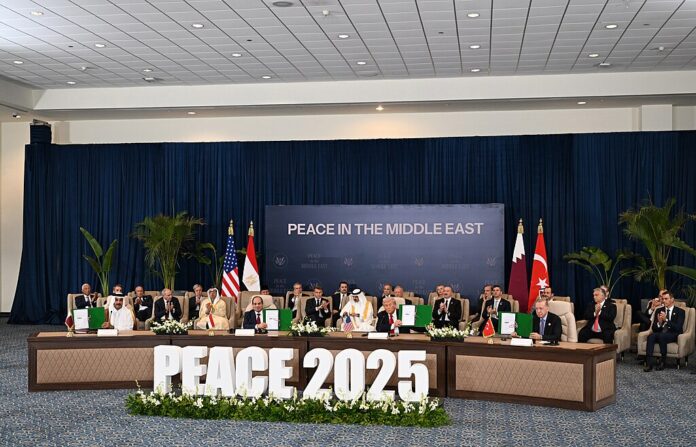
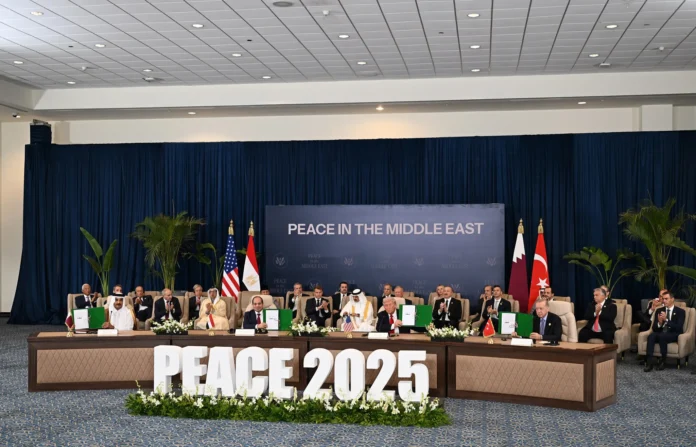
For nearly two decades, Israel and much of the Arab world succeeded in marginalising that question. Strategic normalisation, economic incentives, and the pursuit of calm made it possible to sustain the illusion that the conflict could be frozen indefinitely. That illusion has collapsed. The sovereignty vote in the Knesset, the statements in Washington, and the summit in Sharm el Sheikh are all expressions of a single fact: the question has returned to presence. Whether through annexation debates or statehood initiatives, it has become inescapable again.

The American vision that has emerged from this moment is vast in ambition and uncertain in outcome. President Trump’s envoys have constructed a regional framework that joins the recovery of Gaza to a broader architectural project – one linking Arab capital, American protection and Israeli restraint. It is an edifice that depends on constant movement: on momentum before substance, on appearance before solidity. For the moment, it works. Hostages have been released, the guns are quieter, and the promise of a new Gaza is being drawn on every conference table.

Yet within that promise lies a division. On the ground, two Gazas now exist. To the west, what I will call ‘Green Gaza’ – the remnant of Hamas authority, constrained yet unbroken, sheltered by Qatari money and Turkish sympathy. To the east, ‘Yellow Gaza’ – the zone under Israeli control, the area that Defence Minister Israel Katz calls the ‘yellow zone’, and which he has identified as the focus of Israel’s next strategic phase. In his words:

The demilitarisation of Gaza through the destruction of Hamas’s terror tunnels, alongside the disarmament of Hamas, is in my view the most important strategic objective for achieving victory in Gaza.

Katz has instructed the army to make the destruction of the tunnels its primary mission in the territory now controlled by Israel, while maintaining coordination with American officials on implementing ‘President Trump’s plan and finding a thorough way to address the dismantling and destruction of all terror tunnels in the remaining area under their responsibility’.

The language is careful, almost bureaucratic, yet its implications are extraordinary. Israel now accepts, implicitly, that it will not govern all of Gaza and that Washington will oversee the remainder. The region is moving toward a divided reality: Yellow Gaza demilitarised and reconstructed under international sponsorship, Green Gaza left to Hamas’s residual power and the patronage of its regional allies. It resembles nothing so much as a new Berlin – a territory split not by ideology alone but by the geometry of global compromise. As the Israeli commentator Ari Shavit has said, Israel will try to create an East Germany/West Germany-style contrast:

We will try to bring all the moderate Arab money and and whatever into the eastern part of Gaza, our 53 per cent. So we will have the beginning of a booming Gaza. It won’t be overnight. And we will leave the 47 per cent in the hands of Hamas and let the Palestinians choose.

Dr Dan Diker, president of the Jerusalem Centre for Foreign Affairs and Security, brings a cautionary lens to the mechanics of any agreement that leaves Hamas present in Gaza. He insists that Hamas, as an Islamic jihadist movement, ‘will not lay down its arms voluntarily because that would be tantamount to erasing its identity’ and argues that the only realistic agent of disarmament in the short term is the IDF.

This arrangement creates opportunity and peril in equal measure. The economic incentives are enormous. Arab states see in Gaza’s reconstruction a chance to stabilise the neighbourhood and secure American favour. Western capitals welcome a visible achievement after months of despair. Yet every actor pulls in a different direction. Egypt fears a strengthened Hamas; Qatar seeks to protect it. Turkey wishes to broker influence; the Emirates to contain it. The United States wants closure; Israel wants security. Within this tangle of motives, no one yet knows whether the structure will stand.

Everyday pressures will test any bifurcated Gaza. The predictable pattern of low-level Hamas aggression may fall short of triggering a full-scale legal case for retaliation while still incrementally rebuilding Hamas’s leverage. Its well-documented brutality towards its political opponents within the Strip shows other Palestinians that it controls the territory. Though Israel holds the Philadelphi Corridor where the Rafah crossing is, it will not fully regulate the humanitarian aid coming in, and insufficient inspection, interdiction and monitoring regimes will doubtless end up letting weapons back in.

The coming phase will test Israel’s ability to act as both participant and guardian of its own interests. The country’s military has achieved what can be achieved on the battlefield. What remains is strategic – to secure the gains, shape the reconstruction, and prevent the return of illusions. This requires not slogans, but a statesman with the skill to navigate the overlapping architectures of Washington, Cairo, and Riyadh; one who can manage pressure without losing direction.

At present, only Benjamin Netanyahu possesses that blend of political instinct, diplomatic endurance, and international authority. His critics abound, but there is no tested successor waiting in the wings. The complexity of this new order demands experience, not experiment. Diker suggests that Trump’s open praise in his Knesset speech for opposition leader Yair Lapid, urging Netanyahu to make peace with him, may hint at America’s desire for a broad unity government after Israel’s next election.

The regional map is being redrawn, and Gaza – divided between its Green and Yellow halves – is the first draft of that map. The real outcome will not depend on who declares peace but on who understands the long game beneath it: that in the Middle East, every truce is temporary, every structure provisional, and every absence eventually returns to presence.

After Trump’s Peace Israel, Jihadi-Terror And “Power Over Death”

It’s not bewildering. Merely to be born augurs badly for eternal life. Still, in their desperation to live perpetually, some human societies and civilizations have embraced a panoply of faith-based promises exchanging “life everlasting” for “undying loyalty.”

What are the likely consequences? In world politics, such loyalty is transferred from faith to state, which then battles other states in what seems a secular “struggle for power,” but is waged as a “sacred conflict.” The promised advantage to being on “God’s Side” in this conflict – a struggle in which the “transferee” is a sub-state terror organization like Hamas  – can be “immortality.”[1]

Taken by themselves, at least in scientific terms, hopes for power over death are vain but not necessarily destructive of others. In the Middle East, the problem of faith-based violence arises when states or individuals link these hopes to “martyrdom.” Increasingly, such linkages are fundamental to relevant calculations made by Israel’s jihadi foes. Nothing has been changed by Donald Trump’s 20-point peace plan except that Qatar and Turkey are being strengthened and released Hamas murderers will be able to re-join the “Holy War.”

There are meaningful details. What is the clarifying background of jihadi calculations? In essence, the problem of “power over death” challenges human security and international law. Though scholars and laypersons ordinarily identify power as a property of wealth, weapons or land, such traditional identifications fail to understand such assets as mere “reflections” (recall Plato’s The Republic) of what is authentically “true.”  Today, in the Middle East, even after the “Trump Peace,” jihadi terror groups seek to acquire such power and imperil the Jewish State with still-escalating harms.

From the start, Israel has fashioned its counter-terrorism policies as a narrowly military matter of strategy and tactics. To its survival detriment, little seems to have changed in this “textbook” orientation. Conspicuously, a disproportionate measure of Israel’s defense investments remains allocated to weapon system hardware and associated intelligence infrastructures.

There is more. The small country’s national security decision-makers seemingly ignore much “deeper” philosophical and behavioral aspects of counter-terrorism. To prevent potentially existential harms, Israeli counter-terrorist planning will need to take greater account of adversarial commitments to “power over death.” For a country smaller than America’s Lake Michigan, a terrorist enemy that identifies mass-murder of Israelis as a religious sacrifice can never be defeated by exclusively military means.

For Jerusalem, subsidiary policy questions are steadily accumulating. By definition, Israel’s jihadi foes are not animated by science or logic. How, after all, could the murder of one particular human being (here, “The Jew”) offer eternal life to another?

Reciprocally, how could a terrorism-opposing state build the core components of its functioning national security program on an enemy’s “hunger for immortality” (a phrase of Spanish philosopher Miguel de Unamuno’s Tragic Sense of Life, 1921)? A correct but distressing answer lies in the continuing attraction of jihadists to non-rational explanation. Though overlooked by the “Trump Peace,” it is a grave mistake to project one’s own reason–based decision-making processes on a jihadi adversary (state or sub-state) that ritualistically favors anti-reason.

Further clarifications are available. Even in our bewildering age of high technology, there is something in human beings that may yearn not for evidence-based persuasion, but for mystery and deflection. When confronting jihadi terrorist ideologies that promise the “faithful” a “life everlasting,” Israel’s leaders should remain wary of projecting their own ideas of rational decision-making on certain enemies. While projections of decision-making rationality do generally make sense across all geopolitical landscapes, there are still many sources of “landscape abnormality.”

What happens then? If Israel’s national leaders were to review the current terrain of jihadi terrorist organizations, a nexus between “martyrdom operations” and “life-everlasting” would become more obvious. Prima facie, it could represent an eye-opening and life-saving discovery.

There is more. In such time-urgent security matters, variously corresponding and converging elements of law should surface. To wit, jihadi insurgents who justify violent attacks on Israeli noncombatants in the name of a purifying religious “martyrdom” are law-violating. Always.

Under law, harm-bent insurgents, even Palestinian insurgents who passionately claim “just cause,” must satisfy longstanding jurisprudential limits on targets and levels of violence.  Left uncontrolled, Hamas and its terror group allies could at some point escalate to chemical, biological or nuclear (radiation-dispersal) weapons. Alternatively, these criminal organizations that tie “sacrifice” of “unbelievers” to “power over death” could launch non-nuclear rocket or drone attacks at Israel’s Dimona nuclear reactor in the Negev.

There is more. Law and strategy, though analytically distinct, are closely interrelated. On matters of effective counter-terrorism, the legal “bottom line” is clear: Violence becomes terrorism whenever politically-animated insurgents murder or maim noncombatants, whether with guns, knives, bombs or automobiles. It is irrelevant if the alleged cause of terror-violence is just or unjust. In the universally binding law of nations, any unjust means used to fight for arguably just ends is law-violating ipso facto.

Sometimes, martyrdom-seeking terrorist foes choose to stand on the legal argument known formally as tu quoque. This historically-discredited argument (see especially the Nuremberg Judgment following World War II) stipulates that because the “other side” is allegedly guilty of similar, equivalent or greater criminality, “our side” is automatically innocent of wrongdoing. In law, this argument is always disingenuous and always invalid.

In principle, tu quoque arguments can never be used as a correct justification by a defending state, but this is not what is taking place in Gaza. Though Israeli actions against Hamas and other terrorists have produced Palestinian civilian casualties and fatalities, these outcomes are the direct result of jihadi “perfidy” (shielding military-terror assets in schools and hospitals) and remain collateral to law-based efforts at self-defense. Unlike its jihadi terrorist foes who openly display “criminal intent” (mens rea), Israel’s security operations are conducted without such wrongdoing.

For conventional armies and insurgent forces, the right to use armed force can never supplant basic or “peremptory” rules of humanitarian international law. Such jus cogens rules (Vienna Convention rules that “permit no derogation”) are normally referenced as the law of armed conflict or the law of war. These synonymous terms concern both state and sub-state participants in any armed conflict.

Again and again, without a scintilla of law-based evidence, supporters of jihadi terror-violence insist that ends can justify means. Leaving aside the ordinary ethical standards by which such arguments should be rejected, there also exist binding legal rules. For more than two thousand years, unassailable legal principles have stipulated that intentional violence against the innocent is prohibited, but that unintended harms are defensible whenever a belligerent adversary resorts to “perfidy.” In the Gaza War, this means that the jihadi embrace of “human shields” has been exculpatory for Israel.

Under international law, whether codified or customary, one person’s terrorist can never be another’s “freedom-fighter.” Though correct that particular insurgencies can be judged lawful or law-enforcing (consider American revolutionaries of the 18th century or Jewish anti-British insurgents of the mid-20th century), even allowable resorts to sub-state force must conform to humanitarian rules of war.

Clarity exists in such jurisprudential matters. Whenever an insurgent group resorts to unjust means, its actions constitute terrorism. Even if adversarial claims of a hostile “occupation” were reasonably acceptable (e.g., Israel and the Palestinians), insurgent claims of entitlement to “any means necessary” remain false. Long-established under authoritative international law, most explicitly at Hague Convention No. IV, is an absolutely unchallengeable principle“The right of belligerents to adopt means of injuring the enemy is not unlimited.”

There is more. International law can never be shaped or articulated ad hoc. Always, it must display determinable form and content. It can never be invented and reinvented by terror groups or “nonmember observer states” (here., the Palestinian Authority) to selectively justify adversarial interests. This is especially the case when terror violence intentionally targets a victim state’s fragile and vulnerable civilian populations.

National liberation movements that fail to meet the test of just means can never be protected as lawful. Even if pertinent law were somehow to accept the argument that terror groups had fulfilled all valid criteria of “national liberation,” (e.g., PA, Hamas, Palestinian Islamic Jihad et. al].), these groups would still not satisfy the legal standards of distinction, proportionality, and military necessity. These enduringly critical standards were applied to insurgent or sub-state organizations by the common Article 3 of the four Geneva Conventions of 1949, and (additionally) by the two 1977 Protocols to the Conventions.

Standards of “humanity” also remain binding on all combatants by virtue of broader norms of customary and conventional international law, including Article 1 of the Preamble to the Fourth Hague Convention of 1907. This rule, commonly called the “Martens Clause,” makes “all persons” responsible for the “laws of humanity” and for associated “dictates of public conscience.” Although there can be no exceptions based on a presumptively “just cause,” a combatant that seeks immunity from punishment via perfidy can claim no law-based argument.

Under international law, even when inflicted by a “nonmember observer state” (in the matter at hand, the Palestinian Authority), ends can never justify means. Reinforcing the case of war between states, every use of force by insurgents must be judged twice, once with regard to the justness of the objective and once with regard to the justness of applied means.

Under international law, terrorist crimes mandate universal cooperation in both apprehension and punishment. Among other things, as punishers of “grave breaches” under international law, all states are expected to search out and prosecute (or properly extradite) individual terrorists. In no circumstances are states permitted to regard terrorist “martyrs” as law-based “freedom fighters.”

True law can never be created by observation or witticism. This is emphatically true for the United States, which incorporates international law as the “supreme law of the land” at Article 6 of the Constitution, and for Israel, which remains volitionally subject to the timeless principles of a “Higher Law.” Fundamental legal authority for the American republic was derived from William Blackstone’s Commentaries, which (in turn) owes much of its content to peremptory principles of Torah.

Ex injuria jus non oritur. “Rights can never stem from wrongs.” Even if jihadi-adversaries of Israel continue to identify insurgents as “martyrs,” this treatment would have no exculpatory or mitigating effect in assessments of terror- crimes. In the end, Hamas and associated foes are animated by the most compelling form of power imaginable, that is, the promise of personal immortality.

Inevitably, at least according to the decisional calculi of anti-Israel insurgents, “power over death” will override other kinds of power. Donald Trump’s cobbled-together “peace” notwithstanding, Israel could never defeat Hamas without first defeating the jihadi group’s underlying ideology. Accomplishing such necessary defeat will be an intellectual task, not one based on bombast (in logic, the fallacy called argumentum ad baculum) and threats of “obliteration.”

——————-

Louis René Beres was educated at Princeton (Ph.D., 1971) and is the author of many books and articles dealing with terrorism and international law. Emeritus Professor of International Law at Purdue, Dr. Beres was born in Zürich at the end of World War II. He is a frequent contributor to Harvard National Security Journal (Harvard Law School); International Security (Harvard); The American Journal of International Law; American Political Science Review; JURIST; Case Western Reserve Journal of International Law; Air and Space Operations Review ((USAF); Yale Global Online; Indiana International and Comparative Law Journal (Indiana University); World Politics (Princeton); Bulletin of the Atomic Scientists; The War Room (Pentagon); The Strategy Bridge; Israel Defense (IDF); Modern War Institute (West Point); Parameters: Journal of the US Army War College (Pentagon); The Atlantic; The New York Times; The Jerusalem Post; and Oxford University Press. His twelfth book is Surviving amid Chaos: Israel’s Nuclear Strategy (Rowman & Littlefield, 2nd ed., 2018).  https://paw.princeton.edu/new-books/surviving-amid-chaos-israel%E2%80%99s-nuclear-strategy

[1] In the words of Jewish philosopher Emmanuel Levinas, “An immortal person is a contradiction in terms.” See: Being -Toward Death as the Origin of Time (1976).

The westerners helping Hamas win the propaganda war

After two years of war, and despite Israel’s many successes on the battlefield, Hamas can also claim a kind of victory – at least for now. The terror group has survived and is once again exerting control in the areas of Gaza under its authority. Public executions, whippings, stonings and kneecappings have returned. In the first five days of the ceasefire, Hamas executed at least 100 Gazans.

Hamas’s survival was achieved not only through its remaining fighters and its holding of hostages, but also thanks to a chorus of western apologists. A coalition of so-called progressives and professional activists has excused, rationalised and defended the group’s actions across universities and in newspaper editorials. The BBC, Sky, the Guardian, the FT and the New York Times have all parroted Hamas talking points.

Tales of impending famine in Gaza, for instance, were broadcast as fact, sourced from UN bureaucrats and ‘aid agencies’ with long records of anti-Israel bias and, in some cases, open sympathy for Hamas. This isn’t journalism: it’s agenda-driven activism disguised as news. What the BBC and others failed to grasp is that, for Hamas, the western media is the battlefield – no less important to its survival than its rockets and tunnels.

While Israel was forced into a military campaign to protect its citizens, Hamas launched a far more cynical war, sacrificing Palestinians by firing rockets from dense civilian areas and daring Israel to respond. Their aim was to trigger international pressure for a ceasefire so as to restore the flow of weapons for their operations.

From the outset, even before Israeli troops had entered Gaza, Hamas’s operatives and sympathisers in the West were shouting about ‘genocide’ and ‘famine’. It was a propaganda trap – and the western media walked right into it.

Consider, for example, these headlines from the early weeks of the conflict in 2023:

11 October: Fuel in Gaza will run out in 48 hours

15 October: Fuel in Gaza will run out in 48 hours

30 October: Fuel in Gaza will run out in 48 hours

6 November: Fuel in Gaza will run out in 48 hours

The pattern speaks for itself. It’s been the same story with Gaza being ‘on the brink of famine’ for the past two years. This is how it works:

Step one: The Hamas ‘health ministry’ makes up a casualty number which could be debunked by the most cursory statistical analysis.

Step two: Aid organisations repeat the number without independent confirmation.

Step three: UN agencies in Gaza (some staffed by Hamas members) cite the aid organisations.

Step four: Media outlets quote the UN agencies.

Step five: Hamas’s supporters in the West claim the numbers are ‘UN verified’.

UN officials have also contributed to the fiction directly. In May, Tom Fletcher, a humanitarian coordinator for the organisation, told BBC Radio 4: ‘There are 14,000 babies that will die in the next 48 hours unless we can reach them.’ Almost no babies died as a result of the war in the following days. But that didn’t stop the BBC running the claim in bulletins and news outlets around the world repeating it, citing the BBC as a reliable source.

Some of the most widely shared images of ‘starvation in Gaza’ were from Yemen

The Hamas narrative has been amplified, too, by disinformation campaigns driven by Iranian, Russian and Chinese state-linked bots on social media, which have exploited Gaza as a means of destabilising western societies. These regimes understood how easily such narratives could tap into a pre-existing willingness among many in the West to believe anti-Semitic libels.

This tactic isn’t new. The Tsarist secret police famously forged The Protocols of the Elders of Zion to incite anti-Semitism, and the Soviet KGB spread anti-Zionist propaganda into western media and academia during the Cold War. In the Middle Ages, pogroms were fuelled by fabricated claims of Jews killing Gentile babies. Today, similar falsehoods are disseminated by journalists, academics and UN officials – cloaked in the language of human rights but echoing ancient prejudices.

Why were Hamas’s inflated casualty figures reported as facts? Why were incorrect claims of Israel bombing hospitals repeated without scrutiny – while confirmed cases of Hamas rockets hitting Israeli hospitals in Ashkelon and Beersheba were ignored? In part, this was down to journalistic complacency. The facts were accessible. Thousands of authentic Palestinian social media accounts from Gaza showed everyday life continuing, with cafés, restaurants, supermarkets, even beauty salons all operating, contrary to claims of complete destitution.

Independent researchers discovered that some of the most widely shared images of ‘starvation in Gaza’ were from Yemen. One prominent photo showing a skeletal child was highlighted by the media as evidence of famine. In reality, the child wasn’t malnourished due to famine. He had cerebral palsy, hypoxemia and other genetic conditions. The image was cynically selected to exclude his healthy sibling. Its source? An Islamist outlet in Turkey. That didn’t prevent the GuardianTimes and New York Times running it on their front pages, inflaming the emotions of millions of readers. The New York Times later slipped in a discreet correction, but by then the damage was done. Despite its substantial resources, the much-touted BBC Verify unit missed many of these falsehoods.

There has, of course, been great suffering in Gaza, as in any war. But that doesn’t justify using misleading photos, fake stats and Hamas-supplied images to condemn Israelis as child murderers.

The good news? Large swaths of the British public aren’t buying it. Scroll through the reader comments under articles about Israel, and you’ll find thousands of ordinary people who haven’t lost their critical faculties. They know casualty figures from terrorist regimes aren’t a sacred truth. They can spot propaganda when they see it.

Unlike some intellectuals, they don’t lose all logic the moment the word ‘Israel’ is uttered. As George Orwell once quipped: ‘You must be an intellectual. Only an intellectual could believe something quite so stupid.’ Today, he might have aimed that line at Guardian readers or BBC news staff.

In this war, it is not Israel or even Hamas that has lost its purpose, but the media.

Trump’s Sharm-el-Sheikh Doctrine: Containment Over Collapse in the New Iran Equation

Summary

President Donald Trump’s Sharm-el-Sheikh peace initiative marks a critical recalibration of U.S. policy toward Iran. Once dominated by talk of regime change, the new framework favors containment and calculated de-escalation. Tehran, weakened by sanctions, military setbacks, and domestic dissent, remains repressive but resilient. Trump’s approach—military encirclement without direct confrontation—aims to limit Iran’s reach while avoiding the chaos that followed interventions in Iraq and Libya.

For the Iranian opposition, this shift is a double-edged sword: it postpones hopes for liberation but clarifies that lasting transformation must come from within, not from foreign intervention. The exile community’s failure to unite and the emerging domestic reformist defection suggest a new phase of Iran’s opposition politics—one defined less by nostalgia and more by grassroots reinvention. Ultimately, containment may become the crucible for Iran’s eventual self-liberation, proving that sustainable change is born from indigenous will, not imposed upheaval.

To assess whether U.S. President Donald Trump’s Sharm-el-Sheikh peace agreement—aimed at de-escalating tensions in the Middle East, curbing Iran’s nuclear ambitions, and stabilizing regional alliances—will expand or constrain American-Israeli options for regime change in Tehran, we must first acknowledge a sobering reality: If regime change was ever a viable policy instrument in the post-1979 Iranian context, its prospects have probably been materially diminished under the current framework.

Tehran’s Current Predicament

Tehran stands exposed, vulnerable, and profoundly isolated on the global stage, yet the regime clings desperately to an image of domestic control. Economic sanctions, its humiliating military defeat, its spectacular proxy setbacks in Syria and Lebanon, and growing internal dissent have left it cornered, much like a chess player down to their last rook in a losing endgame.

President Trump’s recounting of halting Israeli jets en route to “take out” Ayatollah Ali Khamenei—framed as a deliberate pivot away from escalation—underscores this shift. What many hawks predicted as the act that would cause final regime collapse was instead contained, reflecting a calculated aversion to the chaos of Iraq, Afghanistan, or Libya.

The ghosts of those wars loom large in Washington and Europe: absent a viable, coherent, alternative, reflective of Iran’s very real social, political, and ethnic pluralism, ready to govern 90 million people, any forced collapse might fracture Iran into sectarian fiefdoms, destabilize the region’s oil arteries, and invite opportunistic intrusions by all sorts of rogue elements. Neither Washington nor Jerusalem nor the Sunni Arab states harbor the appetite for reopening that Pandora’s box.

The exiled opposition remains vocal, but lacks the inclusive, pluralist leadership capable of galvanizing Iran’s fragmented society. In this void, policymakers in Washington, Jerusalem, and most European capitals have reached a tacit consensus: containment, rather than collapse, may now be the preferred operative paradigm.

Karim Sajadpour’s recent Foreign Affairs analysis amplifies this recalibration. He portrays Iran’s regime as brittle yet durable: exposed abroad, but still commanding repressive might at home. Unlike the Shah’s elite, the current leadership has no safe exile plan-it will cling to power through coercion, not compromise.

Sanctions and diplomatic isolation have eroded the Iranian regime’s legitimacy but not its control. The revolutionary state, Sajadpour notes, has “scientifically refined repression.”

Trump’s Calculated De-escalation

President Trump’s approach reflects this realism. Though derided by hawks, his peace plan substitutes pressure for confrontation—a formula that combines military encirclement, financial strangulation, and diplomatic isolation with calibrated outreach.  He has reiterated his “preference for a deal with the Iranians,” noting their “tough situation.” He has signaled Tehran wants a deal, expressing confidence that he will broker a pragmatic accord.

In Trump’s view, this isn’t appeasement; it’s triage. The new containment doctrine seeks to freeze the battlefield—a status quo deterrence that extracts verifiable concessions on missiles, proxies, and enrichment without plunging the region into chaos.

Containment: Stings and Silver Linings

Yet even as it mollifies global powers, this policy will inevitably sting the Iranian people and the exiled opposition. For ordinary Iranians, it extends economic suffocation and postpones dreams of liberation; for the opposition in exile, which trumpeted Tehran’s impending collapse, it will feel like a geopolitical betrayal.

Still, within this pain lies clarity—the recognition that no foreign actor, however formidable or well-motivated, can midwife Iran’s transformation. Only Iranians themselves possess the agency and collective will to reshape their political destiny. History’s precedents—from the 1906 constitutional revolution, the 1978 upheaval, to the 2022 protests—bear this out: true change in Iran has always been endogenous and requires the masses to participate.

An Opposition at the Crossroads

This realization should serve as a reckoning for the exiled opposition. Their most persistent failing—an Achilles’ heel across generations—has been a fixation on rivalry over coalescence, nostalgia over imagination.

The globalized, tech-savvy youth of Iran expect visionary leadership, not sanctified martyrdom or past revivalism. The old status quo of fractured exilic politics will not inspire a nation of 90 million. If the opposition cannot coalesce, modernize its discourse, or mirror the pluralism of Iran’s own mosaic, it will remain sidelined as the regime and history move on.

Domestic Opposition Reconfigured

Meanwhile, within Iran, the political ground is shifting quite dramatically. Under economic agony and ideological exhaustion, remnants of the so-called “reformist” camp are openly abandoning the role of sanctioned dissenters.

Increasingly, younger reformists, disillusioned bureaucrats, mid-level technocrats, labor unions, and key civil society groups are taking decisive steps toward movements seeking fundamental change rather than regime recalibration. This may be the fusion of domestic and diaspora dissent—still embryonic but quite very plausible—that could redefine the anatomy of Iran’s real opposition in the immediate window ahead.

Strategic Implications

Ultimately, Trump’s peace plan does not extinguish Iran’s dream for liberty and freedom; it merely redirects its trajectory. By freezing the regime’s foreign adventurism, it will shift the locus of agency inward—to Iran’s citizens, its divided elites, and its emerging generation of innovators and idealists.

In so doing, it honors an enduring geopolitical truth: sustainable transformation in Iran will not come from bombardments or sanctions, but from the soil of indigenous resolve. Containment, paradoxically, may prove the crucible from which genuine sovereignty—and authentic revolution—finally emerge.

The US-led Gaza force is not working; Trump must let Israel act

At the Civil-Military Coordination Center being set up in recent days and hours in southern Israel, there’s a special department tracking media reports. I witnessed this during my Friday visit. My hope is that what follows will reach the department’s staff, and through them the CMCC commanders, since every passing day Hamas gains time, and this benefits neither them, Israel, nor President Donald Trump.

The new headquarters is being set up at a rapid and impressive pace. The Americans, as it happens, know how to improvise on the dime just as capably as the Israelis. Their leaders’ determination to closely follow developments is the reason for their aerial convoy to the site – not to provide Israeli babysitting, as critics suggest.

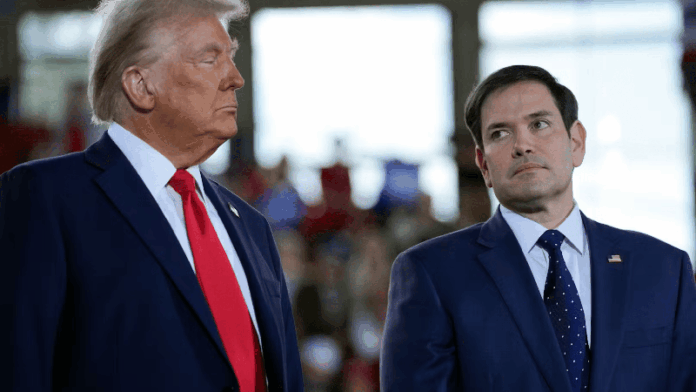
“There has never been anything like this,” Secretary of State Marco Rubio said while visiting the place two days ago. Indeed, there never has been. An international blend of Israelis, Americans, French, Germans, Canadians, Cypriots, Greeks, and others moves through the enormous hangars. I even thought I spotted a United Arab Emirates flag in the corner.

Nevertheless, it’s uncomfortable to report that at this preliminary stage, the crowds of soldiers, officers, and civilians don’t precisely know what to do with themselves yet. Before Rubio’s arrival, they didn’t even trouble themselves to sit at their computer workstations. Only when he neared the work stations did someone issue instructions to occupy the chairs to generate the appearance of “quiet, working.” I was present to observe it.

The hundreds of dedicated people who arrived to serve at the location don’t know what to do, for the straightforward reason that everything remains in organizational phases. Nobody possesses plans yet – even unclear ones – for where to proceed from here, only good intentions. The war halted abruptly, and this represents a tremendous international accomplishment. Nevertheless, the practical path forward is extremely complicated, and its execution will prove more challenging.

Here’s what’s absent: A unified international force, certainty regarding the nations that will comprise it, coordination methods between the different armies that will function within it, work plans, schedules, orderly directives, guidelines on what occurs in problematic scenarios, and evidently also a Security Council resolution without which the force – which obtained the acronym ISF – won’t be established whatsoever. This is likely not the entire list.

Pressure on Hamas

Preparing each of these stages will require time, especially if the Security Council intervenes midway. Consequently, even though the Americans and the Israelis assisting them are all functioning at Trump speed, in the optimal scenario, weeks will elapse before the ISF commences dismantling Hamas from its armaments, demolishing the tunnels, and demilitarizing Gaza. In the less favorable and more probable scenario, months will elapse.

Those already thoroughly exploiting the transitional period are Hamas murderers. It’s been five days they haven’t returned the deceased hostages, signifying they’re flagrantly violating the ceasefire agreement. Hamas is re-establishing its regime in the half of the Strip that remained under its control. It can be assumed that the organization is also restoring terror infrastructure at an expedited pace. That’s what it exists for, ultimately.

Hamas’ restoration while the ISF organizes is hazardous to Israel, naturally, but equally important – it jeopardizes Trump’s plan. Every day that elapses without someone mowing the terror lawn will render the ISF’s future work more challenging, perhaps even unfeasible. We’ve witnessed in the past the West’s struggles in eradicating terror in Afghanistan and Iraq.

Because ultimately – this is at minimum the intention – a moment will come when the international force will need to confront Hamas terrorists directly. Following two years of war, the organization is presently at the peak of its weakness. Trump’s interest ought to be that this situation continues. Nevertheless, time plays into the terrorists’ advantage. Like a phoenix, they’re reconstructing themselves afresh in Gaza’s dunes – construction that opposes the interests of both the US and Israel. Trump himself, and also Rubio on Friday, once more emphasized they’re committed to eliminating Hamas.

What, consequently, must be accomplished so the 20-point plan’s objectives don’t evaporate? The answer is that the transitional period until the ISF begins work must be exploited in a manner that won’t undermine the plan. How? The US must permit Israel to do in Gaza precisely what it authorizes IDF forces to do in Lebanon. Specifically, not allow terror to rear its head. No, this doesn’t jeopardize the ceasefire. The Israelis don’t desire the war’s renewal either. They overwhelmingly endorsed the plan the president presented.

Nevertheless, there are intermediate situations where there’s no full war, but also not sitting with zero activity facing strengthening terror. This is what’s occurring in Lebanon, in Judea and Samaria, and also in various theaters where the US functioned for many years and justifiably against terror.

Allow the IDF to operate

Trump’s plan was and remains beneficial for Israel, the region and peace. Nevertheless, until the international community advances to its subsequent sections, and so the force will possess the capability to do so, the IDF must be permitted to operate also in Gaza’s western side.

Trump believes, rightfully, in “peace through strength.” The most precise implementation of this principle is cutting down the emerging terror in recent days inside Gaza. This is the method to guarantee the ISF will have easier work, meaning its success in maintaining peace in the future will be greater.