Czech
Czech French
 German
 Hebrew
 Noruegan
 Russian
 Spanish
 Swedish
 Polish
 Portuguese




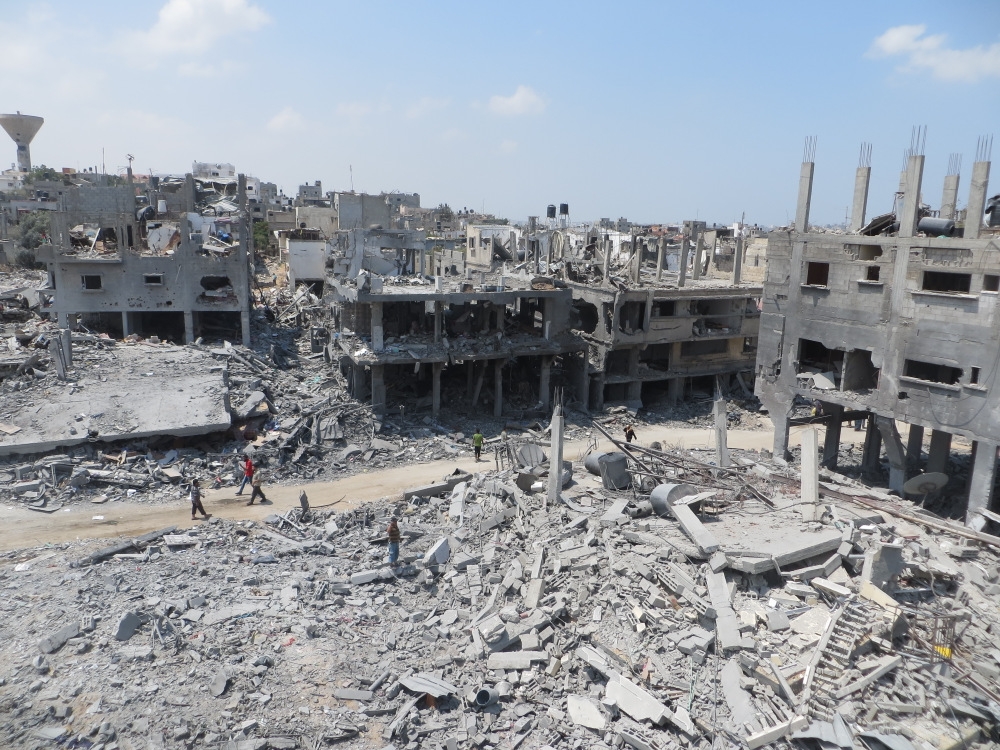
Gaza today lies in ruins. United Nations and World Bank assessments describe it as “uninhabitable.” Most homes and health facilities have been damaged or destroyed. A joint UN–World Bank report estimates about $50 billion is needed to restore Gaza’s infrastructure—and decades could be required. Even clearing the tens of millions of tons of debris could take some 15 years. Families struggle to survive amid destroyed infrastructure and scarce medical care.
Regarding the hundreds of thousands of now homeless Gazans, Sir John Sawers, former head of MI6 and UK ambassador to the UN, said urgently, “The extremely dire conditions in Gaza must be addressed.”
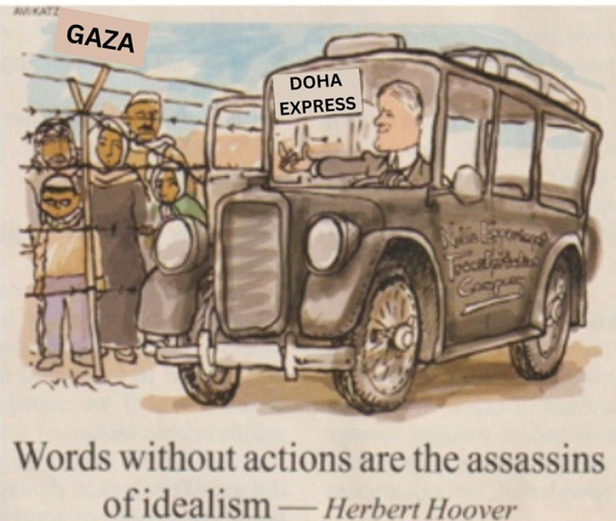
Something beyond talk is needed. About the talking-versus-doing syndrome, Herbert Hoover, U.S. president from 1928–32, said: “Words without actions are the assassins of idealism.”
Hoover’s life was a testament to action. During World War I, he headed the Commission for Relief in Belgium (1914–1917), feeding 10 million people and carrying out postwar reconstruction. In 1917, he served as U.S. food administrator. Following the war, he became Director-General of the American Relief Administration (ARA) from 1919 to 1923, overseeing large-scale famine relief in Central and Eastern Europe, including the Soviet Union. In 1927, as Secretary of Commerce, he successfully resettled 325,000 Americans rendered homeless by the Mississippi River flood.
A Quaker, Hoover passionately believed in peace, was appalled by the human costs of war, and devoted his life to public service. Even in his grandest projects, he kept the worth of the individual paramount. His title, “the Great Humanitarian,” was well deserved. During Europe’s next war, Hoover, then in his 70s, established the Polish Relief Commission, feeding 300,000 children in occupied countries. In 1946, President Truman asked Hoover to serve as a special food advisor, assessing global shortages and coordinating strategies to alleviate famine. His approach reminds us that large-scale humanitarian crises demand immediate, practical action, not just rhetoric.
Hoover’s concern extended to Palestinian Arabs. In December 1945, he submitted a plan to the Anglo-American Committee of Inquiry on Palestine, proposing a process by which both Jews and Arabs could benefit materially, potentially helping settle the Palestine question while providing ample Jewish refuge. Hoover described it as a “constructive humanitarian solution,” and the committee agreed it merited careful study.
He proposed that Iraq serve as the site for voluntary resettlement of Arabs from Palestine, offering immediate relief and long-term benefit. By 1949, over a half million Palestinians were living as refugees following the 1948 Arab-Israeli War, and Hoover wrote the White House that “they are in a deplorable condition.” He noted that Iraq could absorb them, strengthening its economy and providing a permanent solution for the displaced.
Two decades ago, when Iraq had been decimated by war, sanctions, and conflict, such a resettlement plan would have been feasible—and beneficial. Today, with hundreds of thousands of homeless Gazans, it is striking that, despite shared language, religion, and culture, Arab nations have not offered to take in their brethren. Some of these nations, particularly in the Persian Gulf, are among the richest in the world.
Consider Qatar, a major supporter of Hamas and over 30 times the size of the entire Gaza Strip. Qatar’s population is 85% non-Arab expat workers. It would be remarkable if Qatar opened its borders to Gazan resettlement—providing humanitarian relief while simultaneously blessing its own society. The world cannot afford to wait while words substitute for deeds.
What are Qatar and the world waiting for? Words without actions, as Hoover warned, are the assassins of idealism