Czech
Czech French
 German
 Hebrew
 Noruegan
 Russian
 Spanish
 Swedish
 Polish
 Portuguese



Walking With Fear In The Holiest Of Lands
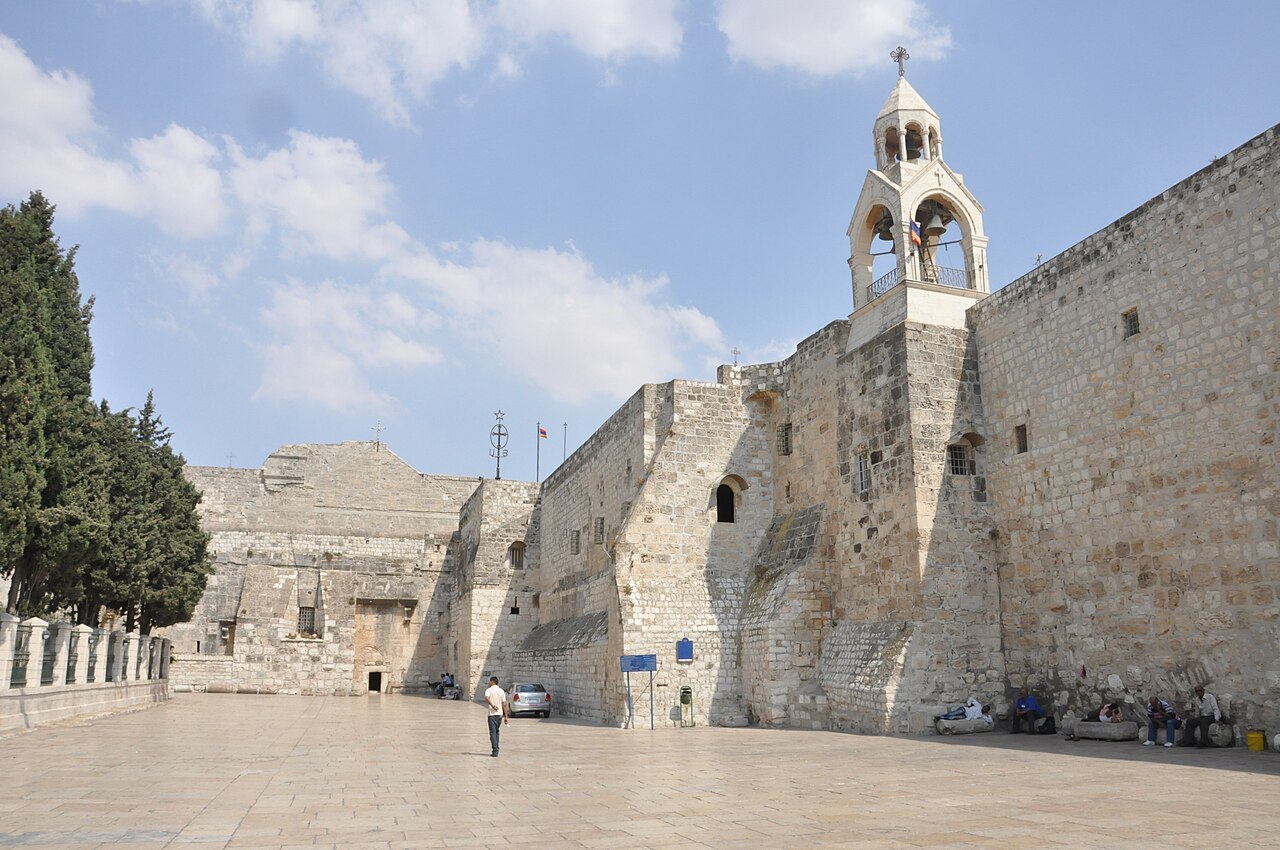
BETHLEHEM – On a crisp sunny day, Jerusalem’s Latin Patriarch Michel Sabah was preparing for the Christmas Eve midnight mass that has been held every year for centuries in the holiest Christian site on earth – the Church of Nativity in Bethlehem, identified by Christians around the world as the site of the birthplace of Jesus.
At midday, surrounded by 10,000 onlookers in Nativity Square, he walked solemnly in a red robe behind a group of Catholic priests and a marching band.
Just steps from the church, a loudspeaker from a nearby mosque brought the procession to a halt. The broadcast of the Muslim call to prayer from the mosque’s speakers silenced the ‘cheering crowd, and marching band. “Allah Hu Akbar,” or “Allah is the mighty God,” the speakers crackled throughout the hilled valley. Even in this land where spirituality seems to emanate from every corner of the earth, the moment seemed awkward. For many, it brought back a painful reminder of Pope John Paul II’s pilgrimage to Bethlehem in March of 2000, when a similar Muslim call to prayer interrupted a Papal mass for seven minutes.
“They don’t respect us,” explained Peter, a Greek Orthodox Christian whose family’s Bethlehem roots trace back about 2,000 years. “They put on the loudspeakers at that moment to remind people that Islam is the religion of Bethlehem. And it is sad, because now the city of Jesus is the city of Mohammed.”
For centuries, Christians were the majority in Bethlehem, but in recent decades the Palestinian Authority – the autonomous political organization run by the PLO – has taken steps to make Muslims the majority. In the early ’90s, then-Palestinian President Yasser Arafat expanded the district’s boundaries, and included nearby Palestinian refugee camps with large Islamic populations. Arafat also built new Muslim neighborhoods opposite the birthplace of Jesus, and instilled a Muslim governor to oversee the area. He also encouraged the building of new mosques – in 1970, just five existed in Bethlehem; in 1993, 67 existed; by 2005, the number of mosques in Bethlehem had grown to 87.
As the Islamic population has grown in the city, Christians have seen their numbers drop precipitously. According to census reports, the city was half-Christian in 1973; in 1990, just 37 percent of Bethlehem was Christian. Today, just 16 percent of the city is Christian, with different families leaving each week, mostly for the US, Canada and Central America. As the Christian population decreased, Palestinian Muslims have flocked to the city, forming a solid majority. The turning point of Muslim control of the city came in 2006, when seven Islamic fundamentalists – representing Hamas and Islamic Jihad – were elected to the 15 member board. That board – which controls the city – consists of just three Christians.
Christians say a growing Islamic fundamentalism that sees Christianity as a second-rate religion is one of the major reasons for their flight. Long time Christian residents also complain about having to pay blackmail to government-affiliated gangs to keep their land, homes and businesses. Sometimes, even when they pay, land has been taken and people have been violently beaten.
The Palestinian Authority declined to comment on Christian allegations of mistreatment.
Christians say they can only walk safely in certain sections of the town, and they also avoid the main market which is now Muslim-only. Women are particularly careful to plan their shopping, and complain of daily sexual harassment by Muslim men. Christians also fear for their gold and silver crosses and crucifixes, and say they are frequently ripped from their necks in public.
“We don’t have any hope left in this city, our dream is to emigrate,” explained George, a Bethlehem Christian attorney. “The choice is to have a gang, and to keep a weapon in every house or to bend our heads, give up our dignity and become sheep.”
The threats and intimidation have not been limited to just Bethlehem’s Christians and have spread throughout the West Bank and Gaza. In Gaza, the tiny Christian community of 2,000 was rocked by the murder of Rami Ayyad, a Palestinian Bible Society teacher who was stabbed and shot by Islamic extremists in October. Ayyad, who left behind a pregnant wife and two children, was found near a Christian book shop.
Also, in October, an American-born Palestinian-Christian was forced to leave Ramallah and to return to his native Alabama after being repeatedly threatened by Fatah military officials. Isa Bajalia, a Christian cleric who heads Middle East Missions in Ramallah, was approached over the summer by militants who demanded a $30,000 cash payment along with the deed to his family’s property.
“They told me that if I didn’t do what they wanted they could get me no matter – whether if I was in the [United] States or here. They said to me we will break your arms and legs,” said Bajalia.
After months of daily threats, Bajalia fled to the US, fearing for his life.
Christian suffering
Although world television reports focused on the masses gathering in Nativity Square on Christmas Eve and Christmas day, Bethlehem’s Christians say the reports were superficial and shade the real truth of their day to day lives.
Just seven years ago, tens of thousands of tourists and Christians from all over the world poured into Bethlehem to celebrate Christmas and to attend open-air masses. On Christmas Eve, just 6,000 Christian tourists came to Bethlehem.
At the Israeli checkpoint at the entrance of the city, it took seconds to pass through Israeli security. Just inside the city, restaurants that had been filled on previous Christmas holidays were empty or closed altogether. Around a small table, seven local Christian men ate peanuts and chocolates. All sipped whiskey – a rare public site in this increasingly Islamic city where Islamic law is unofficially enforced by local gangs.
The men said they did not want to discuss politics, or their lives as Christians. The men smiled, and shrugged their shoulders. “We are not talking about politics,” one man said after a long pause.
On the way to Manger Square the only reminder of the Christmas holiday was a dusty, inflatable Santa Claus that sat in front of a variety store. Palestinian flags decorated the streets, along with posters of a Palestinian who was killed after attacking Israelis.
Few tourists were in any of the stores, and the streets were filled with Palestinian police who held Kalashnikov rifles.
At Manger Square, Bethlehem’s Christians celebrated their holiday by dressing in their best clothes, and preparing to attend the midnight mass. The Christian men wore new suits, slacks and shoes; the women wore dresses, skirts, jeans and makeup. For women, Christmas would be the only day of the year they could dress like Westerners in their home city. Beginning Dec. 26, Islamic fundamentalists prohibit Christian women from wearing short skirts publicly, and there is a growing pressure for the women to cover their hair and the rest of their bodies like Muslim women.
The gathering was not solely a Christian event. In 1996, the Palestinian Authority declared Christmas as a national holiday and began to downplay the Christian origins of the day. As a result, Bethlehem’s Palestinian Muslims also jammed the square, and were joined by Muslims from Hebron, Jenin, and the nearby populated refugee camps, who stayed in the once-Christian square late into the evening.
“I wouldn’t dare take my wife and my children to the square at night. I don’t want the Moslems to harass them,” said Kondo, a local merchant. “Ten years ago all the Christians rejoiced, and choirs from all over the world were singing; it was a real happy evening.”
Publicly Christians will not talk about their plight in this city, and many fear for their lives. Christians say Muslims have targeted them for a least a decade; many have been publicly attacked and hospitalized; many say that small arguments often lead to violent attacks from mobs of Muslims.
Even in their homes they spoke in hushed tones.
“The future here is very black,” said Jonathan, a 65-year-old Christian merchant who sat near his Christmas tree on the holiday, and sipped coffee with his sons Peter and Matthew.
Peter and Matthew, who are both in their 20s, say their only hope is to emigrate. The two say they face a life of daily humiliation as Christians by their Muslim neighbors.
While they have both been attacked by Muslim mobs in the past, the brothers say they’re even angrier about how the birthplace of Jesus – the Church of the Nativity – is treated by local Muslims. In the spring of 2002, Palestinian gunmen loyal to Arafat’s forces held more than100 people hostage, and took over the church for three weeks. Using the church as a fortress, the gunmen used pages of its holy bibles for toilet paper, emptied the charity boxes, and also stole gold and silver icons that had been part of the church for centuries. They also set a section of the church on fire.
On Christmas Eve, Muslims also came to the church. During the mass, Peter and Matthew noticed a group of Muslims smoking cigarettes while sitting on the church floor.
“It made us very angry,” Matthew said bitterly. “Why can’t the Muslims honor and respect our holy place?”
‘The Lord is my refuge’
BETHLEHEM – On Christmas eve, Pastor Hanna Massad read the bible and prayed in the Church of the Nativity in Bethlehem.
Massad’s friend, Rami Ayyad didn’t have that opportunity. On October 7, Ayyad’s body was found face down in Gaza near the Christian bible store where he worked as an accountant and bookkeeper. He had been shot and stabbed numerous times. Just two weeks shy of 30th birthday; he left a pregnant wife and two small children.
“Rami’s death is a shock. We went through a difficult time and that’s why we are here in Bethlehem,” said Massad, with a pained look.
This has been a bittersweet week for Massad, a Palestinian-American who heads the 200-member Gaza Baptist Church. Just days before Christmas he came to Bethlehem with 400 other Christians from Gaza, hoping to find peace in a land where Christians say they are increasingly being persecuted by Palestinian Muslims.
“There is pressure and discrimination on all levels for all of the Christians in Gaza,” said Massad, who sat in a small house in East Bethlehem that belonged to his wife’s family.
In the Gaza strip, controlled by the Islamic fundamentalist Hamas, there are just 2,000 Christians living among 1.4 million Muslims. In the entire strip, there are only five small Christian chapels, a Christian school and a Christian bible store – the Holy Bible Society. Massad’s wife now serves as its director. The society has branches in more than 100 countries.
Massad was born in Gaza and has served as the church’s pastor since 1987. From 1991-97, he lived in America, obtained his citizenship and earned a Ph.D. in Theology from Fuller Theological Seminary in Pasadena, CA.
Massad, who is a medium-built man with sad brown eyes, sat on a sofa on a corner in the room and reflected on the violence that Gazan Christians have faced in recent months.
In 2006, and again this year, the bible store was firebombed by Palestinian fundamentalist Muslims. Massad said store employees did not hand out pamphlets or proselytize local Muslims, and did not give away Bibles. In fact, people were required to sign a paper acknowledging that they were buying a Bible on their own free will, he said. Still, militant Muslims linked to Al Qaeda continued to harass the stores employees.
On Oct. 6, the militants fulfilled their threats and kidnapped Ayyad shortly after he closed the bookstore. Massad’s wife, Pauline, said friends had called his mobile phone when he did not arrive from work. He told them he was running late.
On Sunday, instead of going to church, Ayyad was buried after church services.
After the funeral, Assad’s mother, Anisa, said he had “redeemed Christ with his blood.”
Ayyad was born in Gaza to a Greek Orthodox family but had attended Massad’s Baptist church since he was a child. “I’ve known him since has 10,” said Massad, who called him a “man of peace.”
At 29, Ayyad had already fulfilled many of his dreams. Married, with two children, he was just three courses shy of receiving his bachelor’s degree from Gaza’s Open University. “He had a very good sense of humor,” Massad recalled. “He liked to laugh and people liked to be around him. He liked to serve.”
When he was not at work at the bible store, or volunteering as the church’s youth director, he spent most of his time with his two sons, George, 2, Wissam, 1, and his wife Pauline. At the time of his murder, she was in her sixth month of pregnancy.
Now, with just weeks to go before she gives birth, Pauline has decided to call her yet-to-born daughter Samma or heaven in Arabic. Massad said that she chose the name for a specific reason. “She believes her husband is in heaven,” explained Massad.
For years, Massad said Gaza’s Christians have been living in fear – even before Hamas seized control of Gaza last June. “There is no law in Gaza. Nobody can count on anybody,” he said. “Even before Hamas came to power, the Palestinian Authority police and security said we cannot control the city and protect you,” said Massad.
Hamas, which has instilled Sharia or Islamic law in Gaza, has made life even more difficult for Gaza’s tiny Christian community. “Christians can’t openly wear their crosses outside. In the streets, because of the pressure, our women have started to cover their heads like the Muslims. Our people have become afraid,” said Massad.
After Ayyad’s murder, Hamas officials promised to investigate the vicious attack. Three days after the murder, Hamas security told Massad that they had suspects in the case. Several days went by, however, and no arrests occurred. Massad did not accuse Hamas of being behind the murder. He said he suspects militant Islamic fundamentalists who came to Gaza through Egypt during the last three years of being behind the attack. Today, no arrests have been made in the Ayyad murder.
He said local Palestinians have joined the fundamentalists, which now number in the hundreds. Over the last year, the groups have burned Gaza Internet cafes, prohibited the consumption of alcohol, and attacked churches. After the bible store was firebombed in April, people almost stopped coming to the store, said Massad.
Christians have lived in Gaza for centuries, and the community’s last remaining Christians now live in the Rimal section of Gaza City. Most are college educated professionals who work as engineers, doctors and merchants. At Massad’s church, activities are offered to the close-knit community almost every day – on Sunday, morning and evening services are held; on Monday, classes are held for children; Tuesdays are for women’s activities; on Wednesdays, parishioners attend Bible classes; Thursdays are for youth activities, and Saturday, university students attend the church.
The Bible Society also offers relief work and language and computer training courses to Christians and Muslims.
Relations between Gaza’s Muslims and Christians were good for centuries. Muslims respected them and some lived side by side in refugee camps. For years, Christian welfare organizations also provided aid to Gaza’s Muslims. But, relations began to sour over the last decade during the Palestinian Authority’s rule. And since Hamas won the Palestinian elections in Jan. of 2006, relations have between the Muslims and Christians have deteriorated.
In June, when Hamas seized power, they burned a chapel in a Catholic church and school, and damaged the rest of the building. And, Massad said his church has not been immune to the threats. “We receive threats from time to tie. Several times they have put bombs in churches,” he said.
In Sept. of 2006, militant groups tied to Hamas fired bullets into the Greek Orthodox church in the Zytoon section of Gaza. The same day, a group called “The Sword of Islam” declared war on Christians in Gaza, and threatened to bomb all of Gaza’s churches.
Publicly, the leaders of Hamas say they will protect local Christians, and speak glowingly about Gaza’s Christians. But, Islamic militants have openly questioned that policy, and have called for violence against Christians.
“Unfortunately, there is not much law in Gaza so in many ways you are alone. So when you say the Lord is my refuge, that’s real,” said Massad.
Last year was not an easy year for Gaza’s 2,000 Christians, and 2008 could be bleaker. Increasingly, Christian relief agencies, and non-governmental organizations are leaving Gaza, bowing to the Islamic fundamentalist’s pressure. Even journalists are leaving the area after the BBC’s Alan Johnston was kidnapped and held captive in Gaza between March and July. Only after he agreed to convert to Islam was he released.
Last week, a convoy of 400 Christians left Gaza for Bethlehem. All carried suitcases and many were not happy about leaving their homes and relatives. Still, many left with the realization that they would not return.
“There’s a lot of pressure. Some people want to stay here, they don’t want to go back, and some people already sold their property and came to Bethlehem,” said Massad.
Soon, Massad will leave the quiet of the Shepard Fields of the Bethlehem hills and return to the Palestinian’s Islamic stronghold of Gaza.
Said Massad, “We could go to the [United] states to live, but we feel our time is not finished in Gaza.”
Christians Uneasy In Bethlehem
BETHLEHEM – In a small house just yards from the Church of the Nativity, a middle-aged man sat in silence and sipped tea. Jonathan, who is 65, traces his family’s roots in Bethlehem back more than 2,000 years. He is a member of one of the oldest Christian families in the city.
As he held the teacup, a voice from a loudspeaker near the Mosque of Omar – located opposite the Church of the Nativity – cut through the silence. “Allah Hu Akbar,” or “Allah is the mighty God,” the voice chanted in Arabic.
Jonathan’s hands shook and he began to speak.
“It makes me nervous,” he said, turning toward the back of the kitchen and pointing in the direction of the mosque.
As Christians, Jonathan and his son Peter say they have good reason to be nervous about their Muslim neighbors. They say that over the last 20 years relations between the two religious groups have deteriorated, with Christians subjected to daily intimidation and humiliation by Muslims.
“Nobody knows about our situation here in Bethlehem, but a lot of things are happening here that is making our lives unbearable,” Jonathan said.
The men say that for more than a decade, the Palestinian Authority has demanded blackmail money from Christian businessmen and families, and over the last two years has taken land from several Christian families without compensating them. They also say they are unsafe on their streets and are ostracized and subjected to vicious beatings by Muslims just because they are Christians. In addition, they say Bethlehem’s Muslims regularly sexually harass women and young girls, and sometimes force them to convert and marry Muslims.
“We are a miserable people now,” said Jonathan, who stands just over five feet and is white-haired with a mustache.
The fear that has swept over the tiny Christian community has caused Christians to leave in droves each year for the last two decades. When Jonathan was born in 1942, the city’s Christians were the majority population. “Relations between Christians and Moslems were good then; it was a quiet city, there was no violence and no fundamentalism,” said Jonathan.
Up until 1972, the Christian population held a majority in Bethlehem. That year, just five mosques were in the city. Today, there are around 90 mosques in Bethlehem, and just 16 percent of Bethlehem is Christian.
In the 1980s, Muslims began to move into the city in large numbers and build additional mosques. At that time Islamic fundamentalism also began to flourish in the city, with radicals gaining a foothold into the political and social structure of the city. By the mid-90s, the district’s borders expanded, and former Palestinian President Yasser Arafat allowed new Muslim neighborhoods to be built downtown, near Manger Square and the Church of the Nativity. Also, at that time, Arafat removed a Christian as the district’s governor, and replaced him with a Muslim appointee.
By 1991, said Jonathan, Muslims began to preach anti-Christian teachings in mosques, with religious clerics delivering anti-Christian sermons over mosque loudspeakers. “They said the Christians are criminals; they collaborated with the Jews. They also talked about Christian girls on the loudspeakers; they said they dressed improperly and drank alcohol, and that Christians didn’t believe in God. They said only the religion of Moslems, and Mohammed is the true religion, and all the others are false.”
The public accusations sent shockwaves through the community, and a local bishop unsuccessfully tried to create a dialogue with Moslem leaders. The Christian mayor at the time was powerless to act against the fundamentalists.
By 1992, Christians began to avoid shopping in the downtown market, just steps away from Manger Square and the Church of the Nativity. They also had to watch out for angry mobs of Muslims intent on beating, and sometimes maiming, local Christians.
Seven years ago, Jonathan’s son Peter was preparing to go to church with two friends. As the three Christians stood outside of Peter’s home, they were approached by seven Muslims who swore at them for wearing crucifixes. Soon the three were surrounded by a mob that had grown to more than 100 angry men.
“The group began to chant ‘Allah Akbar’ and then started to beat us,” Peter remembered. As the three lay on the ground unable to move, they were repeatedly punched, kicked and beaten with sticks. One of Peter’s friends had a crucifix ripped from his neck, and later learned that it was sold in a local market.
The Palestinian Authority police arrived 15 minutes after the attack, and the men were hospitalized.
“The police didn’t help us. They didn’t arrest anybody. I am lucky I am alive,” said Peter.
That year, Muslim attacks against Christians became more frequent, and turned deadly. In 2001, Atif Abayat, who formerly served as a commander of Arafat’s Tanzim military division, tried to rape two Christian teenage sisters who lived in Beit Jallah. When they refused his advances, he killed both.
In 2002, Mohammed Abayat, another commander of Arafat’s Al Aksa Brigades, raped a Christian woman in Beit Sahur.
While the men did not deny the charges, they were never arrested by Palestinian police.
Also in 2002, a Bethlehem Christian who had been paying blackmail money to the Palestinian Authority for several years decided he would no longer pay the bribes. After having refused, he was found dead. Local Christians say he was killed by the Palestinian military. “They threatened him many times and they killed him,” said Jonathan.
Last year, a Bethlehem Christian was arrested and faced charges of raping a Palestinian boy. Charges were dropped after DNA revealed that the boy had not been molested.
“They wanted money,” said Peter, who regularly attends the restaurant owned by the man that was accused of rape. The night of the alleged attack, the boy entered the eatery, and asked the man for money. When he declined, the boy went home and fabricated the story. Within minutes, a mob of angry Muslims came back and destroyed the restaurant.
While sexual harassment is a frequent complaint by Christian women, more and more of the women are being targeted for conversion by Moslem men. Six months ago, a 17-year-old Christian Palestinian-American girl was found in a village near Hebron after she was allegedly kidnapped from her Bethlehem home. Muslims, however, say she agreed to come. After her family and Catholic priest located her, she was found garbed in a hijab – a Moslem head covering – and told her family that she had converted to Islam. When her family tried to remove her from the house, they were met with armed resistance.
“It was a real war,” says Faise Omar, the father of the man who brought the girl to the village. “There was a lot of shooting from both sides but I had a lot of weapons and they didn’t come close to my side. All of the [nearby] refugee camp came to our aid and fought against them. It was not just a war over the couple. It was a war between Muslims and Christians.”
After a representative of the American Consulate intervened, the girl left the village and flew to the US. She recently married a Christian man and now lives in Jerusalem.
Omar said the real reason why the woman was released was that he didn’t want his son to marry a Christian.
These stories, and the day-to-day hardships they face as Christians, make Jonathan and Peter want to leave their home town.
“If I have a chance to go anywhere I will go,” said Jonathan, who wants to sell his house and move to the United States or Central America. “The problem is, even if I try to sell my house, who will buy it?”
Peter, who never thought he would contemplate leaving Bethlehem, now dreams of moving to the US – where his sister lives. Out of the 15 students in his high school class from 1997, more than half have left the city. Between 2001 and 2004, 3,000 Christians emigrated from Bethlehem, and during the last six months 300 have left.
“Our life here is finished,” says Peter. “One day we will come back and find only churches here and no Christians.”
Tense Relations Between Christians And Muslims Have Changed Bethlehem’s Demographic
BETHLEHEM – Sixty years ago, when Jordan occupied Bethlehem after the 1948 war, 80 percent of Bethlehem’s population was Christian. At the time, a respected bishop gathered his parishioners together and announced, “A day will come when you will visit this city as a pilgrim because there will be no more Christians left in the city.”
That vision has turned into a prophecy, explained Shibley Kando, who owns one of the biggest Christian souvenir stores in Bethlehem.
“Now we are only 16 percent of the population. Every year the number is declining, what does the future look like? We don’t know. This is the reality of our life. Thank God we are still living here.”
Over the last two decades, life has become increasingly difficult for the tiny Christian community of Bethlehem. Christians here say they face daily threats and intimidation by their Muslim neighbors. Blackmail and land theft by Muslims tied to the Palestinian Authority is common here, they say. In addition, Christians say they are subject to anti-Christian verbal abuse and attacks from Muslims.
A 2007 religious freedom report on Israel and West Bank and Gaza, issued by the US Department of State, confirmed the allegations. The report stated, “The Palestinian Authority has not taken sufficient action to remedy past harassment and intimidation of Christian residents of Bethlehem by the city’s Muslim majority. The PA judiciary failed to adjudicate numerous cases of seizures of Christian-owned land in the Bethlehem area by criminal gangs. PA officials appear to have been complicit in property extortion of Palestinian Christian residents, as there were reports of PA security forces and judicial officials colluding with gang members in property extortion schemes. Several attacks against Christians in Bethlehem went unaddressed by the PA.”
This has led to a Christian exodus from the city – from 2001 to 2004, 3,000 Christians left the city for the US, Canada, Europe, Central America and South America. Jonathan, a lay leader at the Church of the Nativity, said that 300 Christians from Bethlehem have moved.
Palestinian Christians from abroad have risen to high political status in many countries. According to a Palestinian Authority census, 148,000 Christians with ties to Bethlehem live in Central America and South America. In El Salvador, the president is Tony Saca Gonzalez, whose family left Bethlehem last century; in Honduras, Carlos Roberto Flores, whose mother came from Bethlehem, served as a Palestinian official from 1998 to 2002.
Mr. Kando, a tall man in his early 40s, plans to stay – at least for now. Many of his friends have moved abroad, and just five out of his 28 high school classmates are still in Bethlehem. A lawlessness, and lack of justice, has spread throughout the city, he said.
“Life here is not easy. The Palestinian Authority is not providing enough law and order. Palestinian Authority police are loyal, first to their friends and family. If you have a disagreement with a person, and that person’s brother is a policeman, then the policeman will be loyal to his brother first,” said Mr. Kando.
These days, Bethlehem’s dusty streets and sidewalks are empty much of the time. Just 6,000 tourists came for Christmas – down from the more prosperous days in the mid-’90s when Palestinians and Israelis first made peace. At that time, 20,000 to 30,000 tourists would visit during the holiday, and restaurants, gift shops, and churches were full.
Bethlehem’s economy, which is almost entirely dependent on tourism, has been hard hit in recent years. On Christmas day, parts of the city seemed like a ghost town. And many of the Christians who still live here stayed inside their home to celebrate the holiday. In past years, they would have spent much of their time with friends and family celebrating at Manger Square, near the Church of the Nativity. Since the Palestinian Authority made Christmas an official national holiday in 1996, local Christians say the real meaning of their holiday has taken a backseat to the Muslim festivities which now take place opposite the site where Jesus was born.
“We worship on Christmas but Muslims think that the holiday is like Carnival in Brazil,” explained William Kando, a cousin of Shibley, who also lives in Bethlehem. Thousands of Muslims from nearby cities, like Hebron, now flock to the city to do things they can’t do in their own village, said Mr. Kando, such as drinking alcohol and looking at Christian women who do not wear hijabs, or head coverings. A decade ago, before the Palestinian Authority took control over the city from Israel, the Kandos say Christmas was a much happier time.
“Until 1993, the Israelis put up checkpoints at the entrance to the Nativity Square and Manger Square, and only Christians were allowed there,” said William. “Today, if you want to go to Manger Square on Christmas Eve, you have to go with a bodyguard because 98 percent of the people are Muslims.”
Christians say they have limited access to the squares near the birthplace of Jesus, and they also say it is dangerous to walk or shop in the city’s main market, just yards from the squares. Many say they have had their crosses and crucifixes ripped from their necks from gangs who resell them to Muslim merchants.
Christians still can pray at the church but no longer spend time outside fraternizing. Many are upset that the area is off-limits much of the time to Christians. Muslims use the square for their own political activities. For example, last January the Muslims set up a tent to protest against an Israeli archaeological dig in Jerusalem. Muslims also use the area for sports, and in fact, during the summer the square opposite the Church of the Nativity is turned into a soccer field by Muslims.
“They use the door of the Church of the Nativity as their goal,” said Peter, 28, a Christian TV producer who hopes to move to the US soon. “They have no respect for our religion. If we did this at a mosque they would kill us.”
“The 24th of December is the worst and saddest day in Bethlehem,” said Shibley Kando. “The joy and the happiness that we once had does not exist anymore. They took us out of the celebration.”
The day is particularly difficult for Christian women and girls who celebrate the holiday publicly. Sexual harassment by Muslims against the women and girls is a daily occurrence, they say, but it reaches a peak on Christmas eve when thousands of Muslims jam the squares near the church.
“My friends’ daughter got home after the midnight mass and saw that she had red blotches all over her body. They were from the Muslim men who pinched her, and she couldn’t do anything to stop them,” said William Kando.
As their population has diminished, their political clout has fallen. While Palestinian law still dictates that the city’s mayor must be a Christian, just three Christians – including the mayor – sit on the council that runs the city. For the first time in the city’s history, the council has a strong coalition led by Islamic fundamentalists – five of the members belong to Hamas, one to Islamic Jihad, and six are Fatah representatives.
Even before the 2007 elections the Palestinian Authority granted Hamas permission to build its largest center in the West Bank just one-half mile from Jesus’s birthplace. The nine-story building can be seen throughout the city, and is crowned by golden-domed mosques on its top floor. The building also contains a madrassa for Muslims to study shariah – Islamic law – a children’s school, Hamas’ administrative offices, and a senior center.
As their power has diminished, Christmas decorations have become scarce in the city. In the downtown area there were some illuminated stars and some Christmas trees near the Church of the Nativity, but for the most part just Palestinian flags hung down from street lights.
While Christians plot their steps before they travel throughout the city, and sometimes do not openly display their crosses and crucifixes in public, the opposite is true for Muslims. On the day after Christmas, a middle aged Muslim man spread a small rug on a sidewalk near the church, dropped to his knees and prayed as bystanders walked around him.
While the holiday is not the same as it once was for Christians, they still show their solidarity on the day before Christmas, when Christian youth marching bands from Bethlehem and other nearby villages parade through the downtown streets dressed in the boy and girl scout uniforms. Many carry flags and hold banners from their organizations.
The scout groups are organized by church leaders throughout the city and represent several denominations, including, Latin, Anglican, Lutheran and Greek Orthodox.
Every church has its own private school, managed and subsidized by religious organizations from Europe and the U.S.
“Our children do not attend public school. In public schools here they focus on teaching Islam, and it’s not an option for the kids. Children must study Islam in the public schools,” said Shibley Kando. “Also, in our Christian schools, the level of education is higher and we prefer this education for our children. That’s why wealthy Muslims send their kids to our schools. And we teach Islam to their children.”
Bethlehem Churches Bear Brunt Of Religious Hatred
BETHLEHEM – In certain parts of the Holy Land, you can’t go too far without seeing a church.
For centuries, millions of Christian pilgrims visited the Holy Land to pray in the holy houses of worship. Palestinian Christians from all denominations who built these churches for centuries had the freedom to worship, without any problems from the nearby Muslims.
Things began to change a decade ago, after the Palestinian Authority took control of major sections of the Holy Land. And, as Islamic fundamentalism has risen in those territories during that time, relations between the two religions began to deteriorate. As Islam has grown, lawlessness has spread throughout the territories, where Islamic militants have been emboldened to act – sometimes illegally – to advance their cause.
Christians now say they have experienced anti-Christian sentiment from Muslims that have ranged from verbal accusations to vicious beatings and murder. And basic holidays that Christians always celebrated have now been forbidden. In December, the Hamas government in Gaza banned any celebrations of New Year’s eve and New Year’s day, a traditional Christian holiday period. Also, in the West Bank, an Islamic group, “Keepers of Sharia (Islamic Law) warned residents not to celebrate the holidays.
Besides being shaken down by the Palestinian Authority for blackmail money, and having their land stolen in elaborate schemes from Palestinian Authority officials, some Christians say they have looked on helplessly as they suffered what they call the ultimate injustice: the burning and desecration of their holy churches.
Christians are still reeling from September, 2006, when seven churches in the West Bank and Gaza were attacked in a three day period after Muslims were infuriated by comments made by Pope Benedict VVI about Islam and the prophet Mohammed. The pope’s comments followed the publication of cartoons depicting Mohammed in a Dutch newspaper. After the churches were attacked by Islamic fundamentalists, a Hamas leader, Imad Hamto, called for the Pope to repent and to convert to Islam.
The attacks were not the first on churches in the Holy Land in recent years. In 2001, Palestinian gunmen took over Christian-Palestinian churches in Beit Jallah – a city near Bethlehem – so they could fire into Israeli neighborhoods. At the time, Palestinian snipers said they took control of
the holy churches because they were confident the Israelis would not attack them.
And, some say the worst case took place in 2002, when more than 100 Palestinian fighters loyal to former PA President Yasser Arafat took over the Church of the Nativity in Bethlehem and held dozens of hostages – including priests and nuns. Inside, the gunmen used bibles for toilet
paper, emptied the church’s charity boxes, and sold gold and silver crosses that had been in the church for centuries. They even lit a fire in a section of a church during the siege.
Christians say that the 2006 church burnings and attacks were a turning point in Christian-Muslim relations in the Holy Land.
“The Islamic people want to kill us. That’s their principle and belief. They don’t want Christians in this country. They don’t want to hear our names; they don’t want to see us. That’s the reality,” said Reverend Tomey Dahoud, who heads the Greek Orthodox Church in Taubas, a city near Jenin.
Dahoud’s church, which was built more than 100 years ago, suffered extensive damage after its entrance hall was firebombed in Sept. of 2006. That attack sent shivers through the remaining 14 Christians in Taubas, causing some to consider leaving.
“We’ve had problems before with Muslims but they never touched the house of God,” explained Dahoud. “What does it mean to set a church on fire? It’s terrorism, it’s a crime.”
In Tulkaram, the last Christian family that takes care of the 200-year-old Greek Orthodox Church say they’ve had enough and want to practice their religion freely.
“We are preparing to move abroad to a place where we can live a better life as Christians,” said Reverand Dahoud Dimitry, who heads the Tulkaram’s Saint George Greek Orthodox church that burned to the ground in an arson attack on Sept. 16, 2006.
More than 30 years ago, the Christian community numbered close to 2000, but now Dimitry’s family of 12 is the last remaining Christian family in this Islamic stronghold.
To date no one has been arrested or charged with the arson, which occurred after extremists poured gasoline throughout the church and on its alter.
The church was rebuilt but there are no funds for a security guard or for security cameras. During the fire, all of the church’s contents except one bible were incinerated.
“We had two icons from the 15th century and they were destroyed. We had a small library and the most important thing that we had was a registry of all the names of Christians who had ever lived in Tulkaram. All of that burned and now we don’t have any records of our ancestors.”
In Nablus, there are now just 700 Christians left – down from 3,000 just 40 years ago. And, last year, the small Christian community was hard hit after four of its churches were burned by Islamic fundamentalists following the Pope’s comments.
“We were afraid,” explained Jamal Mahmud, who works at the Jacob Well Greek Orthodox Church in Nablus. Mahmud said during the days when Muslim rioted, 25 Molotov cocktails were thrown at the church, which suffered minimal damage. “When somebody throws a Molotov cocktail at you it’s frightening,” added Mahmud.
“The future will be even more dangerous for Christian people, added Reverand Yousef Jibran Saade, the spiritual leader of the Greek Catholic Church in Nablus. Saade’s church was firebombed and riddled with bullets by unknown attackers on Sept. 16, 2006. No one has been arrested for the
attacks, and, like other West Bank Christian clerics, he said the attack caused parishioners to consider moving abroad.
In Gaza, following the Pope’s remarks, Islamic extremists bombed a 1,400-year-old Greek Orthodox Church. In addition, a group of Catholic nuns were threatened, and a bomb was placed outside of another church.
The attack and threats instilled fear into many of the church’s parishioners. But even before the September, 2006 rioting, the small Christian community of 2,000 – mostly Greek Orthodox – felt unsafe. Since Hamas won the Palestinian elections in January of 2006, Sharia – or Islamic law – has
been the informal law of the land. These days, Christian women cover their hair like Muslim women so as to not attract attention.
“It is dangerous for Christians in Gaza,” explained Pastor Hanna Massad, a Palestinian-American who runs the 200-member Gaza Baptist Church.
Massad’s church has been repeatedly threatened by fundamentalists in the last several years, and the bible store that his wife runs in Gaza City was firebombed twice in the last year. And in October, a bible store worker and one of his parishioners, Rami Ayyad, were kidnapped and murdered by Islamic fundamentalists. He was found near the Christian book store.
In Bethlehem, the threats, shakedowns, and anti-Christian sentiment have taken their toll on former Bethlehem Mayor Hanna Nasser. Nasser said the community is still in shock over the 2002 takeover of the 1,400-year-old Church of the Nativity by Palestinian gunmen.
“For Christians it was a brutal feeling,” said Nasser, who was born in Bethlehem, and also baptized and married inside the Church of the Nativity. “We were astonished and very angry. The church was not destroyed but we as Christians in Bethlehem, remain wounded.”
At 70, Nasser plans to stay in the city. But, like other Christian families that trace their roots to this city for centuries, he has watched family members, like his son and daughter leave the city.
“There is no future for Christians,” said Nasser.
Reverend Tomey Dahoud also says the pressure is mounting for all Christians to leave Palestinian-controlled lands. Still, he is prepared to stay, even if it means enduring violence. “Even if they are going to set fire to all of our churches we will stay and die here,” said Dahoud.