What’s new? The UN Relief and Works Agency (UNRWA) serving some three million Palestinian refugees is running out of money – again. This budget crisis appears especially concerning, reflecting both reduced funding for UN humanitarian operations generally and donor fatigue brought on by dwindling prospects for a lasting settlement of the Israeli-Palestinian conflict.
Why does it matter? A significant reduction of UNRWA services, or the agency’s collapse, would deprive millions of Palestinian refugees of health services and education, as well as food aid. An upheaval in the Israeli-occupied territories, Jordan or Lebanon could follow, particularly if Palestinians perceive that cuts signal the loss of their refugee status.
What should be done? UNRWA needs multi-year funding commitments. A mix of traditional donors and new ones – including China and wealthy Gulf countries – should provide them. Given the potential for a destabilising crisis, donors should realise that cleaning up after an UNRWA breakdown would be far more costly than closing the financial gap.
Executive Summary
Some 75 years after the establishment of the state of Israel and the ensuing Arab-Israeli war fomented a huge refugee crisis, up to three million Palestinians still rely on the UN for food, education, health and social services, as well as jobs in these sectors. But in a changing world, struggling with the economic fallout from the COVID-19 pandemic and Russia’s war in Ukraine, the UN is finding it increasingly hard to persuade member governments to fund its humanitarian operations. The UN Relief and Works Agency (UNRWA), created in 1949 to care for Palestinian refugees, is facing a particular challenge. With a $1.6 billion annual budget, its perennial funding difficulties are exacerbated by both donor fatigue and a creeping sense that the settlement needed to end the Israeli-Palestinian crisis may never come. UNRWA’s unravelling would be devastating, both for millions of refugees, who would be suddenly deprived of jobs and services, and for their fragile host states. Sufficient, sustained and predictable multi-year funding from traditional and new donors with regional interests is the best way to avert this looming disaster.
Repeatedly over the past few months, the UNRWA leadership has raised the alarm about the agency’s parlous financial state, warning that it may have to cease operations as soon as September and pleading with international donors for $200 million in additional funding to meet its budget needs. The response has been mixed – some governments have echoed the deficit concern, while others intone the unhelpful mantra that the agency has such a shortfall every year and invariably muddles through in the end. Perhaps they will be right in 2023, but as of mid-September, the agency had not yet been able to fill the gap. Yet even if it does so at the eleventh hour, the problem goes beyond the present funding cycle.
Even if UNRWA is bailed out at the last moment … the perpetual state of crisis is untenable.
Even if UNRWA is bailed out at the last moment, as has happened before and could indeed happen again in 2023, the perpetual state of crisis is untenable. It undermines staff morale, prompts salary strikes and reduces an international agency with a proud record of aiding Palestinian refugees to a miserable beggar for alms. It is also inefficient to run what amounts to a welfare state for three million people on a shoestring, as it militates against investing in infrastructure, digitisation and other updating of outlay, eroding the quality of services.
Worse, Palestinians fearing – rightly or not – an end to their status as refugees as a result of UNRWA’s collapse, or even a drastic cut in services, could foment new turmoil in the Israeli-occupied territories and destabilise Jordan and Lebanon. The Jordanian and Lebanese governments, in particular, are keen to see the agency survive and thrive, as they see no prospect for a durable two-state settlement of the Israeli-Palestinian conflict and realise that pressures will increase on them, as host governments, to assume the financial and political burdens of caring for the refugees in their countries. Israelis, who tend to reject the notion that Palestinian refugees have a right of return to their original homeland (today’s Israel), seeing it as endangering the Israeli state’s existence, are divided in their approach toward UNRWA. While some are staunchly opposed to it, viewing it as a vehicle for keeping the refugee issue on the political agenda, others see certain benefits from the stabilising impact of its services.
With the future of UNRWA, which will have its 75th birthday next year, at stake, various proposals are floating around for how to make it sustainable. Ideas in circulation concern how to make operations more cost-effective, gradually move from voluntary contributions to funding from the UN general budget, or shift part of the financial burden to other UN agencies or even host governments. None of these proposals has much currency or chance of being adopted, much less implemented, at least not in the short term. UNRWA itself is hoping to kickstart a conversation among donors to explore a move toward a service delivery model that delinks its services from the idea of Palestinian refugees’ right of return.
The only workable solution to the dire financial straits of an agency whose existence remains indispensable – for Palestinian refugees, the region and the world – is sustained and predictable multi-year funding, including from as of yet untapped donors, in addition to an urgent short-term injection of funds in 2023. Wealthy Gulf states, with their evident regional interests, and China, which is seeking to parlay its economic heft in the Middle East into political influence, are among the best prospects. Whether the UN will be successful in persuading these and other states to step up is entirely unclear, however. How it can secure stable donor support in an international environment increasingly less receptive to UN humanitarian operations and other multilateral initiatives, and with the possibility of a two-state solution to the Israeli-Palestinian conflict fading, is an open question. Part of the answer may lie in getting cash-constrained donors to consider the costs of allowing UNRWA to fail. Should they do so, $1.6 billion per year may start to look like nothing less than a bargain.
Jerusalem/Amman/Brussels, 15 September 2023
I.Introduction
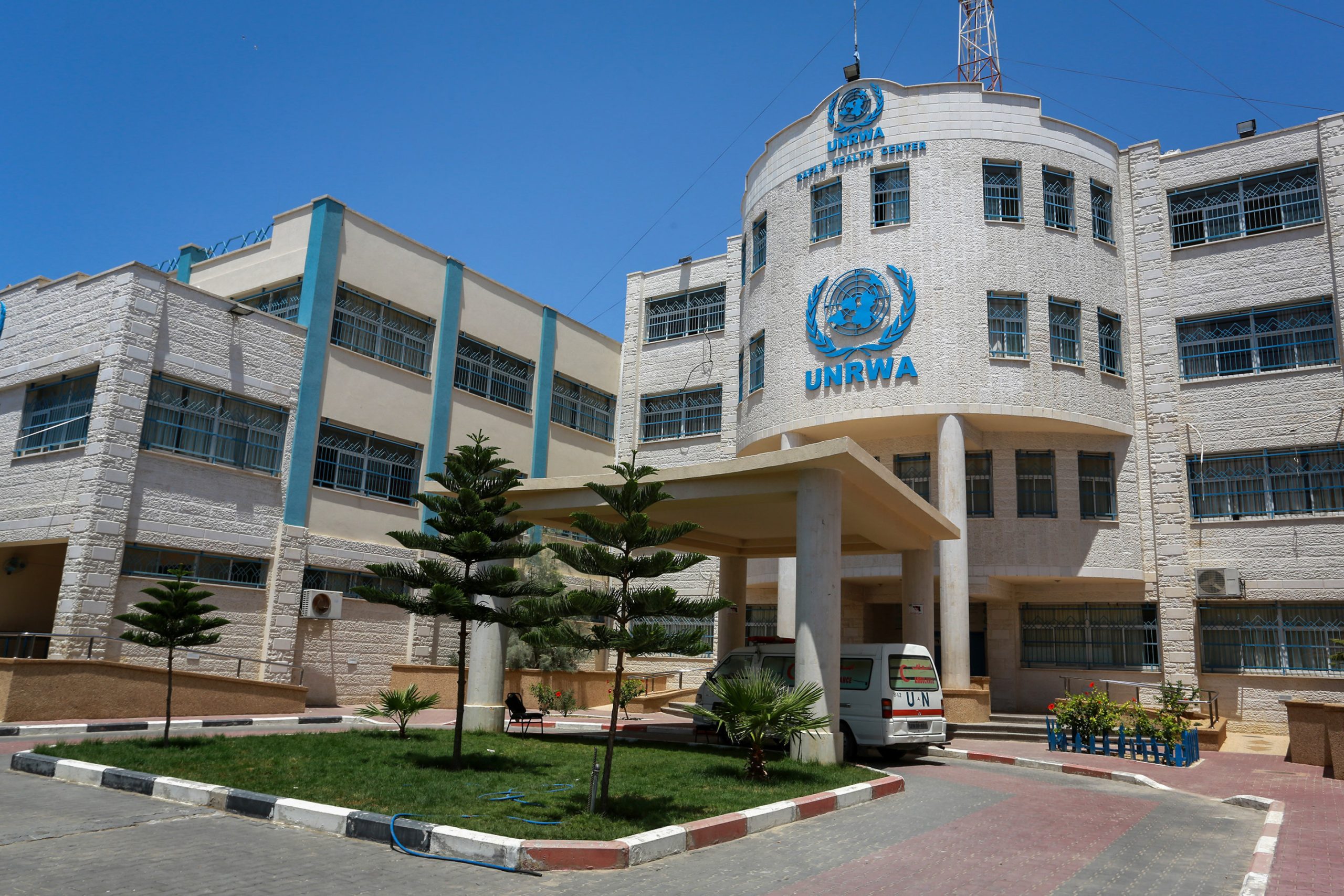
Created in 1949, the UN Relief and Works Agency for Palestine Refugees in the Near East (UNRWA) serves between 2.5 and 3 million Palestinian refugees – ie, roughly half the total number of 5.9 million registered Palestinian refugees. It generally works with host governments and authorities to provide education, health care and other services to this population.1
The refugee crisis UNRWA seeks to mitigate has become bigger and more complex because of waves of migration dating back to Israel’s independence. In 1948, victorious Zionist forces pushed more than 700,000 Palestinians from their homeland into Jordan (including the West Bank), the Egypt-controlled Gaza Strip, Lebanon and Syria. Because of the 1967 war, when Israel seized Gaza, the West Bank and East Jerusalem, over 300,000 Palestinians fled to Jordan. When the refugee crisis and the emergence of a Palestinian guerrilla movement threatened Jordan’s stability in 1970, a civil war erupted – known as “Black September” – in which thousands of Palestinian refugees and their leaders were killed or driven into a second exile in Lebanon. In 1991, following Iraq’s occupation of Kuwait, the Kuwaiti government expelled some 200,000 Palestinians with Jordanian citizenship, claiming that Palestine Liberation Organisation (PLO) leader Yasir Arafat had sided with Iraq. After 2011, Syria’s suppression of a popular uprising forced an outflow of 30,000 Palestinian refugees to Lebanon and another 20,000 to Jordan.2
Palestinian refugees’ socio-economic conditions, as well as their economic prospects, tend to be worse than those of host populations.
As discussed below, Palestinian refugees’ socio-economic conditions, as well as their economic prospects, tend to be worse than those of host populations, though each place is unique in this respect. Of the 5.9 million Palestinian refugees registered with the UN, 1.78 million are registered (though not necessarily living) in the Israeli-occupied Gaza Strip, 1.13 million in the Israeli-occupied West Bank, 2.56 million in Jordan, 679,000 in Syria and 564,000 in Lebanon.3 Some 1.5 million refugees still live in 58 recognised “camps”, sites akin to large shantytowns that have become more and more crowded as a result of natural population growth over the past 75 years. There are eight such camps in Gaza, nineteen in the West Bank (including Shuafat in East Jerusalem), ten in Jordan, twelve in Lebanon and nine in Syria.4 When they can, younger refugees often leave the camps to integrate with the host population, while maintaining refugee status, which in theory secures their right to return one day.
Against this backdrop, UNRWA plays a multi-dimensional role. One facet of this role is symbolic. As a rule, there is no higher political priority for the Palestinians than preserving the right to return. Consequently, they regard their refugee status under international law as sacrosanct and untouchable except as a “final status” issue negotiated as part of a comprehensive peace settlement with Israel. They see UNRWA as a symbol of international commitment to achieving such a settlement and helping Palestinians one day return to the lands that they were forced to vacate 75 years ago. (Inversely, most Israelis see implementation of Palestinians’ right of return as an existential threat to the state. See Section II.A for a further discussion.) Accordingly, Palestinians consider any discussion of trimming UNRWA’s budget and reducing its services taboo. Beyond its political saliency, however, UNRWA also provides critical services that address humanitarian and other needs. In so doing, it relieves much of the burden that would otherwise fall on host states, helping defuse grievances against refugees that could become dangerous.
But despite the important role it plays, UNRWA’s sustainability is in doubt. With a political settlement seeming increasingly far off, and Palestinian refugees dropping ever lower on the world’s list of priorities, UNRWA faces a growing struggle raising the funds it needs to operate. This report discusses the perennial challenges the agency has encountered in staying afloat, focusing on why the difficulty has become even more pronounced in 2023, amid growing disaffection with the multilateral institutions created after World War II and donors’ sense that there is no end in sight to the decades-old Israeli-Palestinian conflict. It explains the political and practical importance of UNRWA’s role in providing assistance to Palestinian refugees, as the UN General Assembly mandated when establishing the agency almost 75 years ago. Finally, it suggests ways to gird UNRWA against collapse and prevent the destructive impact such an eventuality would almost certainly have. It is based on some 30 interviews with donor state officials and others involved in the question, on both sides of the debate about the agency’s future.
II.A Humanitarian Agency’s Unique Role and Unique Challenges
Created nearly 75 years ago, UNRWA is both a lifeline for Palestinian refugees in the Israeli-occupied territories and neighbouring countries, and something more.5 It has become a symbol of hope for the Palestinian people, a source of both support and frustration for Israel, and a device that allows neighbouring states (especially Jordan and Lebanon) to keep the refugees they are hosting at a political and legal distance. But despite having become integral to the region’s political and economic landscape, UNRWA is facing enormous challenges. Donors understand its importance, but aid budgets are stretched, and the political intractability of the Israeli-Palestinian conflict is contributing to donor fatigue.
A.UNRWA’s Multi-faceted Role: Palestinian and Israeli Views
UNRWA was set up in 1949 by a UN General Assembly decision to “provide assistance and protection for registered Palestine refugees” who fled or were forced off their land during Israel’s war for independence in 1948 and their descendants.6 The term “assistance” relates to the services the agency provides, especially in the fields of education and health, and “protection” to efforts to safeguard the refugees’ rights under international law. In these twin tasks, UNRWA acts as an unofficial substitute for the host government or authority with respect to registered Palestinian refugees on its territory and, in that capacity, provides them with basic services they would otherwise lack, as well as jobs in its sectors of operation.7
UNRWA occupies an unusual place in the Palestinian political landscape and worldview. The agency itself goes to great pains to state that it is a strictly humanitarian, and not a political, organisation.8 But while it is a non-political organisation in its mandate and operations, it has been invested with political significance by the community it serves, as well as by Israel, the refugees’ host countries and their respective allies. UNRWA does not have a mandate to secure Palestinian refugees’ return to their homeland, and it stays agnostic on the highly contentious question of whether they should be able to return home or resettle. Yet Palestinians believe that UNRWA’s very existence is an assurance, if not insurance, that their refugee status, even after 75 years, is temporary, and will end once there is a just and fair resolution of issues relating to Palestine’s future. A Palestinian human rights activist said:
What the world, represented by the UN, agreed upon was to create UNRWA to deal with the issue of Palestinian refugees until they can return to the homes they lost in 1948. This is the whole purpose of its existence.9
Conversely, Palestinians would see the agency’s disbandment as a sign that they have, in effect, lost their right to return to the lands from which they – or their parents and grandparents – were expelled or forced to flee.10 A Palestinian NGO official said:
In the Palestinian consciousness, as long as UNRWA exists as a temporary international mechanism, which has now survived for 75 years, a Palestinian refugee has the right to return to his homeland. If UNRWA goes, his own status is no longer temporary but becomes permanent.11
These sentiments illustrate UNRWA’s political importance to Palestinians. They also explain why any discussion that even tentatively contemplates a reduction in UNRWA’s services or formally divorcing the role UNRWA plays in providing services from the idea of Palestinian refugees’ right of return – a suggestion that some have made, as discussed further below – is absolutely out of bounds for most Palestinians.12
Israeli perspectives on UNRWA are more complicated. On one hand, Israeli officials understand that the agency plays an important practical role in the occupied territories. In the Israeli-occupied West Bank, UNRWA has delivered services in parallel to the Palestinian Authority (PA), officially the “host authority” since its establishment in 1994 pursuant to the Oslo accords. In a de facto division of labour, the PA serves original West Bankers and UNRWA cares for refugees whose families were displaced in 1948. The situation is similar in Gaza, where the agency has worked side by side with the Hamas government, the “de facto host entity”, since 2007. A UN member state official said, “UNRWA is doing a big job. It is expected to deliver services like a government does, but it is not a government”.13
UNRWA’s presence largely enables Israel to maintain its system of control … without having to assume full responsibility … of the occupied population.
This situation has certain benefits for Israel. Similar to the PA, UNRWA’s presence largely enables Israel to maintain its system of control of the West Bank, East Jerusalem and, to a different extent, Gaza, without having to assume full responsibility for the livelihoods and basic rights of the occupied population. Some, especially in the security establishment, including Israel’s military authority in the West Bank, the Coordination of Government Activities in the Territories, see the issue through the lens of the need to maintain a modicum of stability. They are concerned that UNRWA’s demise and the corresponding collapse in services would wreak havoc in the West Bank and Gaza, or – just as importantly for Israeli interests – in Jordan and Lebanon, presenting Israel with unprecedented new security challenges.14
On the other hand, most Israelis across the political spectrum reject the notion that Palestinian refugees have a right of return, and many argue that any mention of it challenges the legitimacy of Israel and its existence as a Jewish state under UN Security Council Resolution 181 of 1947.15 They dislike the agency’s symbolism for precisely the reason that it resonates with Palestinians. They believe UNRWA to be harmful to Israeli interests by keeping alive the notion that Palestinians could return one day to live in Israel, which they believe is incompatible with preserving Israel as a Jewish state.
Many on the right in Israel want both the PA and UNRWA to disappear as part of a Greater Israel agenda that would see the West Bank fully incorporated into Israel and the Gaza Strip into Egypt, with the refugee question dispensed with once and for all. Some in the government of Prime Minister Benjamin Netanyahu are using their access to the world stage to advance this agenda, including by demonising UNRWA.16 In a speech to the UN Security Council, Israel’s ambassador to the UN, Gilad Erdan, decried UNRWA as a “destructive agency”:
When the UN and the international community promote an agency that preserves refugee camps and the refugee identity nearly a century after the problem began, then all that is accomplished is the perpetuation of the conflict. UNRWA continues to feed the Palestinian people a lie that the world supports their right of return. … Let me be clear, there is no right of return. You all know this. The demand of returning millions of descendants of refugees is a demand to obliterate the Jewish people’s right to self-determination and this will never happen.17
Still other Israeli officials fall somewhere between acceptance and full rejection of UNRWA’s role. An Israeli foreign ministry official said, “On one hand, the organisation perpetuates the Palestinian refugee issue; on the other, it is at times the only body that provides services effectively to the population, specifically in Gaza”.18 Another senior official said Israel “has a problem with UNRWA” regarding its advocacy for refugees and the textbooks in its schools, but added that Israel nevertheless does not seek the immediate wrap-up of its operations: “Some in Israel would say it needs to be shut down right now. That is not our view at the moment”.19 This somewhat indeterminate position appears to be governing Israel’s actions at present.
UNRWA is also caught up in other political issues beyond the right of return. Since the Oslo accords, its work has become intertwined with the internationally endorsed quest for a two-state solution to the Israeli-Palestinian conflict, by which Palestine is to receive its own territorial state and Palestinian refugees’ fate is to be a final status issue. But, as discussed below, with a two-state solution a non-starter for Netanyahu and the prospect of Palestinian return or even compensation fading, it may be hard to sustain international support for an agency increasingly seen as doling out charity to an impoverished refugee population from an apparently interminable conflict.
B.Host State Perspectives
It is not just Israelis and Palestinians who assign particular importance to UNRWA. So do Jordan and Lebanon – and, to a much lesser extent, also Syria. For them, the Palestinian refugee question is an unresolved matter, to be addressed as part of a future just settlement of the Israeli-Palestinian conflict. Depending on the nature of that settlement, and whether the host states can subscribe to it, the refugees’ status will change. At that point, UNRWA may disappear, but until then, it represents the refugees’ unsettled status in their host societies, while also carrying a significant part of the financial burden of caring for them.
The refugees’ unsettled status matters in Jordan and Lebanon, because while these countries could not stop the influx of Palestinian refugees, they have been able to keep them at political and legal arm’s length. In Jordan, UNRWA’s presence is critically important, not just because it lessens the state’s burden of care, or even, through the services it provides, may help prevent discontent and thus unrest among the refugees, who are the most deprived segment of the population, but also because it has come to symbolise the refugees’ separate status. Despite the absence of official census figures, it is safe to say that Palestinian-origin Jordanians constitute a significant proportion of the population. Of these, most are full citizens. Others hold a Jordanian passport but do not have a Jordanian national ID number; as such, they do not enjoy full political rights, and cannot serve in the armed forces or in senior government positions. Still others do not even have a Jordanian passport but can receive a laissez-passer instead, allowing them to travel abroad.20
The demographic question in Jordan became acute in the aftermath of the 1967 war and Israel’s occupation of the West Bank, a territory Jordan had annexed in 1950. Suddenly, Jordan faced new refugee arrivals but, unlike in 1948, to Jordan itself. The influx coincided with the rise of Palestinian nationalism, as represented by the PLO, which moved its centre of operations to Jordan. In 1970, Jordan fought a brief but bloody war with Palestinian groups operating under the PLO’s umbrella that were launching cross-border attacks on Israel from Jordanian territory, provoking heavy Israeli responses. Having defeated these groups in what became known as the “Black September” civil conflict, Jordan banished the PLO fighters (most went to Lebanon), and from that moment on prevented any form of political mobilisation on the basis of Palestinian national identity.
This history explains why Jordan so values UNRWA’s continued presence and vigorously backs continued international financial support for UNRWA.21 The country’s leaders and (presumably) its non-Palestinian minority could well come to view the agency’s demise, and the possibility that the refugees would be thoroughly integrated into Jordanian society with full citizenship rights, as an existential threat.
Lebanon sees UNRWA … as symbolising Palestinian refugees’ separate status.
Lebanon sees UNRWA in the same light – as symbolising Palestinian refugees’ separate status. Its approach to the refugees has been starker than Jordan’s: the state has granted them no fundamental rights or access to public services for fear that doing so would set them on a slippery slope toward naturalisation (tawtin). Should the Palestinians become citizens, Lebanese authorities believe, they would disrupt the balance among the country’s confessional groups, the building blocks of the country’s precarious power sharing system.22 The Lebanese government supports UNRWA taking responsibility for Palestinian refugees while they remain in Lebanon, but it would prefer that the Palestinians leave the country altogether, which would obviate the need for the agency’s continued presence.23
Beirut’s fear of Palestinians’ naturalisation has underpinned wide-ranging restrictions. These include laws that prohibit them from working in 39 professions, including medicine, law and pharmacy; registering for the social security fund; or getting access to public education and health care.24 Proscribed conduct extends to renting an apartment, buying property or installing electricity meters in their own names. Palestinians also cannot own businesses in Lebanon, which means that refugees often work inside the camps for less money than they would earn if they could run shops outside the camps.
For most refugees, UNRWA is thus their lifeline, one that cannot offer an escape from poverty but does allow them to live and work in the country. UNRWA’s Lebanon director, Dorothee Klaus, said the agency’s services “are highly relevant … given discriminatory legal frameworks … which have weighed significantly on the ability of Palestinian refugees to accumulate wealth or inherit property for more than four generations”.25 UNRWA is by far the largest single employer of Palestinian refugees in Lebanon.
For similar reasons, Syria has also kept Palestinian refugees stateless, with UNRWA serving these people in lieu of the state.26 But unlike in Jordan or Lebanon, where the demographic balance is far more precarious, these refugees are not seen as posing a fundamental threat to the state, and they have had full access to the labour market. To the extent that refugees joined popular protests and insurgencies from 2011 onward, the Syrian security apparatus targeted them with the same severity as it did Syrian nationals, while destroying three of the country’s Palestinian refugee camps.27
C.Donor Perspectives
UN officials say raising funds for UN humanitarian operations is increasingly difficult in an international environment in which support for the post-World War II order, with its multilateral institutions, is steadily eroding.28 They note that it is particularly challenging for UNRWA because of its uniqueness as an agency serving only one small community (Palestinian refugees), and because it is operating under circumstances that make its work appear both increasingly political and increasingly hopeless. Moreover, unlike other UN humanitarian agencies, UNRWA depends mainly on voluntary contributions from UN member states rather than drawing on the UN’s dues-funded general budget. It is thus more vulnerable to shifts in political mood among donors. All of these elements compound the agency’s problems.
In the past few years … UNRWA has come under increasing financial pressure.
As discussed below, in the past few years, in particular, UNRWA has come under increasing financial pressure. Two factors in particular appear to play an outsize role. The first relates to resources: with aid budgets stretched by pandemic-related economic shocks and now the war in Ukraine, donors show signs of fatigue when asked for renewed support. The second relates to the agency’s political profile. The linkage Palestinians and others make between its existence and the larger question of how to resolve the Israeli-Palestinian conflict makes the conversation about funding more of a lightning rod in donors’ domestic political debates. International discussions thus become more difficult as well. Diplomats and others say donors inevitably ask why states would want to invest in an agency that is, in effect, serving an unravelling status quo in an unfavourable political environment. As a UN member state official put it:
It is impossible to disassociate UNRWA’s work from this commitment to a viable peace … and so, if we lose hope in that peace, we naturally also lose hope in UNRWA’s potential.29
The absence of a political horizon in the Israeli-Palestinian conflict is particularly detrimental not just for UNRWA’s access to funds, but also for the World Food Programme (WFP) and the International Committee of the Red Cross (ICRC), both of which are facing similar difficulties in keeping their Palestine-related work fully funded.30 As discussed further below, the WFP had to terminate its food aid to 150,000 people in Gaza and 50,000 people in the West Bank in 2023. But unlike the WFP or the ICRC, which have global operations and can shift funding according to their priorities, and those of their donors (however much it might work to the detriment of the Palestinian people), UNRWA has only one mission – to assist Palestinian refugees – and would collapse if its funding dried up.
III.UNRWA Sounds the Alarm – Again
A major shortfall in UNRWA’s attempt to meet its $1.6 billion budget in 2023 would severely impair its ability to provide services to Palestinian refugees during the remaining months of the year, yet it may be facing precisely that.31 In June, UNRWA said it “urgently” needed around $200 million to continue delivering core services (health and education, in particular) to Palestinian refugees in 2023 in order to close the year without a deficit.32 Additionally, it would need to secure a further $75 million in emergency assistance to continue providing food aid to nearly 1.2 million people in the Gaza Strip alone “without interruption” during the remainder of the year. UNRWA also said it would need to secure an additional $30 million by October to avoid the interruption of cash assistance to over 600,000 Palestinian refugees in Syria, as well as Palestinian refugees who fled Syria to Jordan or Lebanon.33 At a meeting in Beirut, UNRWA Commissioner-General Philippe Lazzarini said:
Without immediate additional funding, UNRWA will be unable to maintain operations beyond September, threatening the closure of over 700 schools and 140 health centres. Emergency services in all of our areas of operation will grind to a halt, leaving millions of Palestine refugees, who are reliant on assistance from UNRWA, on the threshold of starvation.34
In mid-August, UNRWA had narrowed the $200 million gap for core program funding to between $170 million and $190 million through reduced spending, but the need for an additional $75 million for emergency aid for Gaza and $30 million for cash assistance for Palestinian refugees in and from Syria remained, and indeed had become more urgent. Officials said they had no indication that they would be able to fill the gap before the end of the year, though they expected some funds to still come through.35
2023 is not the first time that UNRWA has sounded the alarm about the looming prospect of running out of money – it has done so on a regular basis for several years, suggesting that the agency’s challenges are structural, not situational – but its plight is getting worse. The funding curve points downward. UNRWA officials say program budget funding (staff salaries and core services) has increased gradually over the past decade, but without keeping pace with rising costs linked to population growth, poverty, inflation or salary increases. It thus represents a decrease in real terms. Meanwhile, funding has declined considerably for UNRWA’s emergency/humanitarian programs.36
Moreover, UNRWA started the year with a $75 million deficit, the largest ever. In 2023, the breaking point – the point at which operating funds run out – is approaching sooner than in recent years (in September as compared to November), meaning that it has to fill the gap in less time than previously, with no reserves on which to draw.37 If it fails to do so, it will be confronted with difficult decisions about delaying salaries, cutting certain essential services and carrying over even more debt than before into 2024. A UN member state official concluded, “UNRWA is close to a state of total collapse”.38
UNRWA is unlikely to fall apart overnight, but it could enter a process of decline, which certain events could then accelerate to the point of total failure.
In fact, UNRWA is unlikely to fall apart overnight, but it could enter a process of decline, which certain events could then accelerate to the point of total failure. As noted, the organisation may exhaust its operating funds for the year as early as late September, when UNRWA staff’s monthly salaries, which make up 85 per cent of the agency’s monthly program expenditures of $70 million, are next due to be paid. That crisis could be postponed by a month with a last-minute infusion of donor funds, but it would hardly disappear.
As for what might push the organisation decisively over the edge, one scenario is that Washington might terminate its financial support, as the U.S. did when Donald Trump was president, and as it might do again should a new administration hostile to the agency take power following the 2024 election. If no other donor stepped forward to replace the lost funds, which constitute the largest share of UNRWA’s budget, the agency would be in serious trouble. At that point, the Commissioner-General could take the political decision to inform the UN General Assembly that in his view UNRWA would no longer be able to fulfil its mandate, leaving the agency’s fate in the Assembly’s hands.39
In the meantime, the situation has become so dire that UNRWA has been forced into debt to bridge funding gaps. At the start of the year, it delayed payments to staff and went yet further into arrears with payments for goods and services (cutting outflows by some $45 million in total). Earlier, it also took out a loan from the UN Central Emergency Relief Fund, or CERF, in the amount of $30 million.40 UNRWA spent the first part of the year paying off this debt. Late-paid bills harm the agency’s standing and induce suppliers to charge higher rates.41 Unlike most other UN agencies, which tend to have three months of costs saved up, UNRWA does not have the capacity to raise capital reserves.42 CERF funds are limited, precluding borrowing in excess of $30 million; moreover, UNRWA fears that other UN agencies may compete with it for these funds if it needs to dip back in toward the end of 2023.43
Alarming as they are, these facts have failed to persuade many governments that UNRWA is experiencing higher levels of distress; these governments say they have heard the same story over and over again. A UN official suggested that, “Some donors tend to believe that UNRWA likes to cry wolf. And in response they say, ‘We’ll believe it [the agency’s collapse, or a cut in services] when we see it’. Their perception is that the agency is bluffing”.44 Indeed, an EU official observed, “This year is not a year that seems particularly worse, as the issue comes up every year with similar urgency”.45 Another EU official sounded an optimistic note: “I expect the same as last year: some reduction in services and then someone steps up to the plate”.46 The U.S., in particular, appears deeply concerned about the implications of any cuts in services to Palestinian refugees. In the words of an UNRWA official, it does not want to be “responsible for kids starving”.47
Others, while conceding that UNRWA may again pull through, interpret the facts differently, pointing to the growing difficulty of raising operating funds the agency needs before it reaches the breaking point. A UN member state official said, “This is not business as usual. Something significant needs to be done”.48 Another member state official noted, “There is a general sense of apathy and fatigue: people believe that things will just continue to run – because they always do – and that they therefore do not need to do anything”.49
UNRWA officials note that UNRWA, unlike other UN agencies, is highly vulnerable to changes in donor governments.
UNRWA officials say they are hardly crying wolf – they have no choice but to raise the same alarm every year, if not repeatedly during the year, because the money does not come without it, and the situation is only getting worse.50 Unpredictability is part of the problem. They note that UNRWA, unlike other UN agencies, is highly vulnerable to changes in donor governments, such as when President Trump announced in August 2018 that the U.S. would discontinue its support of UNRWA amounting to $360 million a year, or a third of the agency’s budget. They also say it is difficult to make accurate predictions about the budget at any given time because funds arrive so irregularly. Donors often take time to make good on their pledges. Saudi Arabia, for example, promised $50 million to UNRWA in 2019; it transferred the first tranche of $25 million in 2020 and the balance in 2022. In addition, potential donors may send ambiguous messages about whether they will or will not transfer funds in a given fiscal year.51
In another example, the U.S. Congress appropriated $75 million to be disbursed by UNRWA in emergency food aid to Gaza in 2023 (to be transferred by the U.S. State Department to UNRWA), but a Republican lawmaker, Senator James Risch of Idaho, is blocking disbursement. UNRWA has warned that if the legislator does not release his hold, 1.2 million Palestinian refugees in Gaza, including 500,000 children, could be deprived of U.S. food aid.52
Sometimes, the unpredictability plays in UNRWA’s favour. The United Arab Emirates gave the agency $10 million for 2023 and another $10 million for 2024, both as pledged. But then, on the heels of the Israeli assault on Jenin refugee camp in early July, it unexpectedly donated another $15 million – for repairing damage (including to the camp’s main health centre) in this locality alone.53 This earmarked donation does nothing to address UNRWA’s overall funding crisis, however. UNRWA officials note that even if they fill the 2023 shortfall, as they managed to do in past years, the constant uncertainty is undermining the agency’s work and the staff’s morale, as evidenced by repeated strikes for salary increases, which are compounding the problem. Moreover, UNRWA will increasingly struggle to efficiently run its far-flung operations serving three million people, or maintain the quality of its services, when it cannot invest in infrastructure or digitisation.54
In sum, UNRWA may or may not pull through in 2023, but assuming it does, the growing difficulty of raising voluntary funds in an increasingly inhospitable political climate calls into question whether it could finally hit a wall in 2024 or the year after that. At the same time, the recurrent nature of the crisis undercuts the guaranteed delivery of services and causes anxiety and unrest among many Palestinian refugees who fear losing their lifeline. In other words, UNRWA’s situation of the past few years is becoming increasingly unsustainable, and it appears to be reaching an inflection point.
IV.Impact of Cuts or a Collapse
Looking beyond the present year, if UNRWA experiences a prolonged financial crisis, the effects on political stability could ripple through the occupied territories to Jordan and Lebanon. There is near-consensus among UN member states that UNRWA, whatever its mandate, promotes stability, and that funding it is a good investment in terms of what it delivers.55 An EU official said, “We are saying very openly that UNRWA’s collapse would be a disaster, because we see UNRWA as a stabilising factor in each country in and around Palestine”.56 If UNRWA schools close, especially in Gaza, the immediate and long-term consequences would be severe. A UN member state official said, “A lack of education for generations of Palestinians will just increase the odds of violence later”.57 Yet such assessments do not appear to outweigh the fatigue donors are feeling with respect to supporting humanitarian operations worldwide – and especially for Palestinian refugees.
A.Weakened Economies, Lapsing Services
There are different ways of measuring the harm a sharp reduction in UNRWA services or, in a worst-case scenario, the agency’s collapse would cause. UNRWA is unique among UN agencies in providing education. No other UN agency is capable of replacing it in that function. Only a host government or authority could, but none would want to be in that position. More than half a million children would be left without schooling.58
Moreover, UNRWA is not just a provider of services but also a critical source of jobs for Palestinians; the bulk of its budget is allocated to the salaries of its 30,000 national staff. A cut in services would reverberate in the local economy through people’s reduced spending power, especially in Gaza, where UNRWA spends 41 per cent of its overall budget.59 A Hamas official in Gaza said, “The money coming from UNRWA through its employees’ salaries is an essential part of the gears that drive the local economy. If it stops, the entire economy will stop spinning”.60 Local contractors would also be affected; UNRWA imports food for 1.2 million refugees in Gaza, for example, using such contractors.
In June, in a possible ill omen, the World Food Programme suspended 60 per cent of its cash-for-food program in Palestine as a result of financial difficulties, depriving some 150,000 beneficiaries of food aid in Gaza (and 50,000 in the West Bank) and thus pushing approximately 5,000 Gazan households (30,000 people) from being moderately to severely food-insecure.61 Owners of the more than 200 Gazan supermarkets and shops that contract with the WFP (and other organisations) to disburse food vouchers were also affected.62 A Gazan supermarket owner said, “Our business is already suffering, since 50 per cent of our income depends on these contracts. If these programs are stopped completely, we will suffer huge losses and would have to fire many employees who we employed only because of these programs”.63
UNRWA, [Gaza’s] second-largest employer after the Hamas government, pumps $600 million annually into its $2 billion economy.
A drastic cut in UNRWA’s services in Gaza would increase the impact of the WFP’s cuts manifold. UNRWA, the territory’s second-largest employer after the Hamas government, pumps $600 million annually into its $2 billion economy via salaries, vendor payments, food aid, construction and other activities. If both UNRWA services and those jobs disappear, and along with them the purchasing power they bring, the impact would radiate throughout Gazan society. Many would lose their livelihoods, precipitating the collapse of small businesses and curtailing new construction. Refugees would be left without primary health care and their children without an education. These are just the most obvious effects.64
Because Palestinian refugees’ reliance on UNRWA services varies from region to region, the repercussions of a dramatic reduction in services would differ accordingly. In the West Bank, for example, the PA operates many schools that might be able to absorb students in case of UNRWA school closures; in Gaza, there is no such fallback, as UNRWA runs most schools.65
The situation in Jordan is different in another way. The Jordanian state, despite its sensitivity about the refugee presence, also provides a number of services to Palestinian refugees, alongside UNRWA, thus providing an additional safety net. It could step in if necessary. But, for political reasons, Amman would strenuously oppose such a scenario; Jordanian officials are advocating vigorously for continued international support for UNRWA to help prevent it.66
There is no safety net at all in Lebanon, which has actively discriminated against Palestinian refugees in public health and education, and where Palestinian refugees’ fate would become almost indiscernible from that of Syrians who have sought refuge from that country’s civil war. Palestinian refugees in Lebanon are already in dire economic straits. Of the estimated 250,000 registered Palestinian refugees in the country, more than half live in twelve UNRWA-run camps.67 Lebanon’s economic implosion of the past four years has hit them hard. While the crisis has created huge stresses on society as a whole, those concentrated at the bottom rungs of the economic ladder, especially refugees, tend to suffer disproportionately. It worsened their already bad living conditions, as limited job opportunities contracted even further.68 For those still employed, purchasing power collapsed, with average annual inflation exceeding 150 per cent in both 2021 and 2022. The poverty rate among Palestinian refugees had reached 93 per cent by September 2022, similar to that among Syrian refugees in Lebanon.69
Against this backdrop, a cut in UNRWA services could well be disastrous. Palestinian refugees make up the majority of UNRWA’s staff roster in Lebanon, working as administrative officials, teachers and medical professionals. Palestinians, who do not have access to Lebanon’s public health system, rely largely on medical support from UNRWA clinics at steep discounts, but patients increasingly cannot meet co-payments as low as 10 per cent for non-primary health care services, which drives many to take on debt or forego treatment altogether.70 Most would be unable to afford resorting to Lebanon’s private health system, which like the public health system is already straining under an exodus of qualified personnel and huge arrears run up by the state in coverage of its own citizens.71
Most consequential for Lebanese refugees would be closure of UNRWA schools, which would deprive almost 40,000 Palestinian children and youths of education.
Most consequential for Lebanese refugees would be closure of UNRWA schools, which would deprive almost 40,000 Palestinian children and youths of education. Only a very few families would be able to afford sending their children to private Lebanese schools, while Palestinians do not have access to the public system, which is itself in a dismal state amid the economic crisis.72 Many Lebanese officials and Palestinian representatives warn that the combination of extreme poverty and a further deterioration of access to social services and education would create a combustible mix, making young Palestinians susceptible to recruitment into groups championing violence, involvement in illicit activities such as drug production and trafficking, or illegal migration.73
As for Syria, if UNRWA were to have to cut back on its services there, Palestinian refugees would see their troubles caused by a decade of civil war compounded. That war ravaged the Palestinian refugee camps, forcing the residents into the overall population of an estimated 12 million Syrian refugees and displaced. Syria counted some 500,000 registered Palestinian refugees before the civil war. That number increased after the war started, as many who had not needed UNRWA support in the past registered for assistance and protection – suggesting that these services are needed more than ever in Syria.74
Not everyone agrees that a reduction in UNRWA services would be catastrophic. A UN member state official argued, for example, that “Lebanon collapsed, but then was able to cope; Palestine will likely be the same. Palestinians are survivors”.75 In furtherance of this claim, some also point to the West Bank, where some 3,300 (of 4,300) UNRWA staff delivering services directly to refugees were on strike for almost four months in the first half of 2023, demanding a salary increase.76 But while the strike called into question UNRWA’s relevance as a service provider – UNRWA claims that no refugee died from lack of medical attention at one of its primary care centres – there was clearly a negative impact on services.77 Some 45,000 children in 90 UNRWA schools were forced to stay home; they had to use the summer months to catch up.78 Other services also suffered: garbage collection was a major challenge, as the PA refused to step in during the strike to perform this essential task.79
B.Potential Exodus
European governments fear that cutting UNRWA services will spur a new flow of migrants to Europe, exposing to them to the perils of a dangerous journey to less than welcoming shores. “People without services won’t stay”, said an EU official. “They will try to migrate (especially from Jordan and Lebanon)”.80
EU officials are concerned not just about the arrival of many more migrants, but also about what current host governments might insist on as the price for preventing new migration flows that European states are eager to forestall. A German diplomat pointed out, for example, that:
In Lebanon, the situation is politically difficult regarding all refugees; [the government] has already sent 1,500 Syrian refugees home. The government is using this as leverage against the West. UNRWA’s collapse would be politically costly for us: it would strengthen Lebanese demands for significant increases in aid. Lebanon and Egypt both are already calling for another Turkey facility for themselves.81
C.Risk of Violence
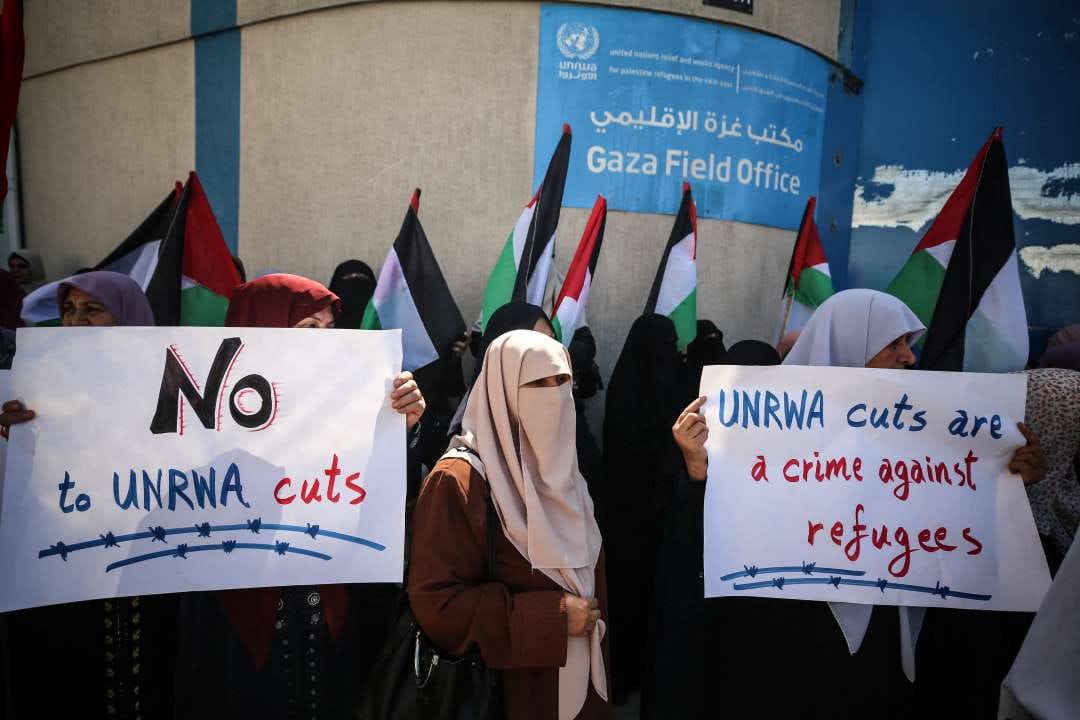
Those who have no recourse to migration, or face delays in being able to leave, may resort to protests, even violence, to express their frustrations. In a possible harbinger, a WFP official reported that demonstrations are already taking place outside the agency’s offices in the West Bank and Gaza in response to the above-referenced cuts, with protesters calling on donors to come through with funding and some threatening to immolate themselves, saying they cannot feed their families.82 An official with an international agency warned that Gaza would be only weeks away from widespread protests should food and cash run out, with “tens of thousands of hungry and angry young men” in the streets, and predicted the rise of armed groups and criminal gangs.83
Unrest could … follow if UNRWA cuts services
Unrest could also follow if UNRWA cuts services. A Hamas official in Gaza warned that the world could see a popular response, actively encouraged by Hamas, similar to what transpired on the last occasion that UNRWA faced a significant budget shortfall, namely when the Trump administration stopped U.S. funding for UNRWA in 2018. It prompted an intensification of protests as part of what is known as the Great March of Return, when Palestinians flocked to the fence separating the Gaza Strip from Israel following the U.S. decision four months earlier to move its embassy from Tel Aviv to Jerusalem.84
An official with an international agency painted a related, but different picture of what could transpire in Gaza. The official suggested that protests could prompt people to start looting UN facilities and then, once UN stores are empty, turn their ire on Hamas as the authority in charge. Hamas would presumably then seek to reassert its writ in clashes that could become bloody. Hamas hardliners would be strengthened in such a scenario. They might order rockets fired at Israel to divert attention from the fact that they lack broad-based support.85 Palestinian refugees in other places might also rise up in ways that would be shaped by the reactions of host governments or authorities.
V.In Search of a Way Forward
Placing one’s hope in the possibility that an UNRWA donor will decide at the last moment to help bail out the agency each and every year is not a solution. Against the backdrop of rhetoric about UNRWA’s crying wolf, it is as if donors are playing a game of chicken to see who will break ranks first to provide the agency with an eleventh-hour injection of funds. Even if one assumes that donors will come through in 2023, it would be no substitute for a strategy for coping with the downward trend in financial support for UNRWA, particularly not with hope dwindling for a two-state solution of the Israeli-Palestinian conflict.86
UN member states readily acknowledge that UNRWA’s financial structure is becoming unsustainable, but diplomats keep having the same conversation every year: how can one break the cycle in a way that will not hurt Palestinian refugees?87 Solutions range from pushing the agency to trim its expenditures by cutting services to shifting from reliance on voluntary donations to the UN’s general budget, asking host governments to pick up more of the cost of UNRWA services and trying to attract new wealthy donors. For their part, UNRWA leaders are toying with the notion of divorcing the question of service delivery from that of Palestinian refugees’ right of return.
A.Some Mooted Options
1.Cutting expenses
Observers are deeply divided over UNRWA’s ability to cut its budget. Some UN member state officials suggest that the only logical and viable way to deal with a chronic budget deficit when no new income stream is available is to develop criteria for denying people coverage to which they have grown accustomed.88 But an UNRWA official warned that Palestinian beneficiaries would interpret such reductions as international actors taking rights away from refugees.89 Most donor governments appear convinced that cuts in services are not the answer, and even those that favour them rarely use the term, instead saying UNRWA should “optimise its efficiency”.90 For some governments, a UN official said, “this is all symbolic. They don’t care about the money; they just want to see a few cuts to provide political justification for their continued support”.91 Indeed, there have been no concrete proposals as to what cuts UNRWA should make in its services in order to reduce its budget.
Moreover, cutting is easier said than done. A UN official said UNRWA is “one of the most efficient UN entities. It delivers educational and health services to 3.5 million refugees on an $800 million budget. It has a very thin management structure compared to other UN agencies”.92 UNRWA officials argue plausibly that there is very little, or no, “fat” to trim. They also say refugees themselves may resist any attempt at making UNRWA’s operations more efficient and reliable through technological innovation. For example, when UNRWA tried to introduce iris scans in Lebanon for Palestinian refugees seeking financial aid, Palestinians rejected it for fear that the method would be used to verify and then reduce the number of registered refugees – even though the UN refugee agency, UNHCR, has been using iris scans for non-Palestinian refugees in Lebanon for years. UNRWA was then forced to develop a more expensive alternative.93 Even if such innovations gradually gain acceptance, they are hardly a reliable solution: while they might translate into savings, they would take time to roll out, and setbacks are likely.
2.Funding from the UN regular budget
As noted, another commonly heard proposal is to move UNRWA, partly or wholly, under the regular, or “assessed”, UN budget.94 Since its creation, UNRWA has relied on voluntary contributions from UN member states for the bulk of its budget, with the UN covering only the costs of its international staff. Some 30,000 Palestinian staff are currently paid through voluntary contributions, while the UN funds 217 international staff out of its general budget.
In December 2022, the UN General Assembly called on the Secretary-General to determine ways to increase the proportion of UNRWA’s budget allocation from the UN regular budget.95 The idea is controversial in some quarters, because it would ask countries on the higher end of UN assessed contributions to pay considerably more. Countries such as Germany, Norway and Jordan are in favour, as it would make funding for UNRWA more predictable, but the Security Council permanent members have responded cautiously, not wanting to foot significantly more of the bill than they do at present.96
Moving UNRWA costs to the regular budget could help bring about a regular flow of resources into the agency.
This idea seems quite a long shot, and even if it succeeds in theory, it could founder in practice. Moving UNRWA costs to the regular budget could help bring about a regular flow of resources into the agency, but there is still no guarantee what member states will vote to fund every year. The UN budget process is a political nightmare in which countries are forced to make many tradeoffs on competing priorities. Given the sensitivities about Israel-Palestine in the UN more broadly, it is likely that any attempt to move UNRWA partly or fully to the regular UN budget would spark even more polarised debates.
3.Turning to other UN agencies and host governments
A third idea in circulation would see other UN agencies, such as the WFP and UNICEF, or even the host governments/authorities working through local municipalities, pick up the slack from any cut in UNRWA’s services.97 But the idea of soliciting help from UN agencies makes no financial sense, as UNRWA tends to operate at a lower cost than they do; UNRWA also provides a service, education, that no other does.98 Gearing up a new agency to offer education support would be expensive and inefficient.
As for the notion of shifting the service provision burden to host governments, it is inconceivable for a combination of reasons. One is financial, particularly in Lebanon and Syria, given the state of their public finances. But it would also be hugely controversial for already stated political reasons, especially in Jordan and Lebanon. As a UN official put it:
The host governments say no to all cuts, because they view the trajectory by which they would take on more of the burden as politically suicidal. So, for them garbage collection becomes politically significant, even existential.99
The symbolism is as important as the costs. Jordan has made clear it is not prepared to assume service delivery to Palestinian refugees from UNRWA, as “this would amount to saying that the two-state solution is dead”, in the words of an UNRWA official – something it cannot afford to do.100 For the same reason, the idea is “a no-go politically for Palestinians, who would see this as a step toward ending their refugee status and political aspirations”, as a UN official put it.101
4.Changing UNRWA
Conscious of the predicament UNRWA faces in a changing world, its leadership has begun to reflect on whether the agency itself should change. Based on this thinking, they have started to explore the possibility of initiating an informal donor discussion about the need to divorce the question of UNRWA’s service delivery from the idea of Palestinian refugees’ right of return. This conversation would involve preparing the narrative ground for convincing Palestinians, as well as Palestinian refugees’ host authorities, that their fundamental rights would not be harmed should UNRWA’s service delivery role diminish or otherwise change, as discussed above As another senior UNRWA official explained, delinking service delivery from questions about the right of return would:
help make it easier for UNRWA to make changes, or even talk about making changes to programs (this could include prioritising certain activities over others or strengthening partnerships), without such changes being instrumentalised as undermining the right of return.102
It thus could, officials say, enable some of the solutions mooted by various donor countries’ officials, such as trimming the budget and shifting certain services to other UN agencies such as the WFP.
This proposal carries echoes of Israel’s longstanding approach, which is to persuade the UN and its member states to transfer the burden of caring for the refugees to host states or authorities, which would then provide humanitarian aid based on need rather than status. Many Israelis favour this option because they see UNRWA as perpetuating the situation of Palestinian refugees and prolonging the Israeli-Palestinian conflict.103 It is for this reason that Palestinians have expressly and consistently rejected such ideas, relegating any discussion of them to final-status talks.
For UNRWA to delink its service delivery from questions concerning the right of return will therefore be an uphill battle. The two issues may not be linked under the agency’s mandate, but they are intertwined in the minds of most Palestinians, who see cutting services as tantamount to harming the refugees’ right of return. While senior UNRWA officials ask if Palestinian refugees really believe that they will lose their right of return if someone other than UNRWA collects the garbage, they do not yet appear to have a strategy for convincing them that they will not.104 There are other problems, too: agencies such as the WFP may not be able to pick up the slack, and host governments such as Jordan may strongly resist moves that jeopardise the status quo.
This situation of course could change at a make-or-break moment of absolute crisis, when resistance to previously intolerable ideas tends to break down. An emergency could occur if UNRWA collapses, for example, or if any attempt at cutting services provokes a sustained violent reaction from Palestinian refugees and causes instability in Lebanon, Jordan and/or the occupied Palestinian territories. UNRWA officials do not wish to wait for such a moment, however. They seek to pre-empt it, or at least begin a discussion that anticipates it and contemplates how humanitarian assistance to Palestinian refugees might continue under the circumstances, without harming the refugees’ claim to a right of return.105
Regardless of whether the proposal that UNRWA is floating will gain support, the financial crisis the agency faces is acute. Donors will have to find the funds now to allow UNRWA to survive, so that it can begin exploring a sustainable long-term solution.
5.Old and new donors stepping up
Perhaps the most straightforward solution to UNRWA’s problems would be for donors to meet the challenge. What UNRWA needs is sufficient, sustained and predictable multi-year funding from sources that are willing to ride out a political impasse that shows no sign of ending. Top donors should begin the hard work of preparing (and justifying in their own capitals) multi-year funding packages for UNRWA that would help mitigate the annual cycle of uncertainty.
Traditional donors may be more willing to make the sorts of commitments that are required if a new group also agrees to put some skin in the game. In particular, China and the wealthy Gulf states should pick up a larger share of the bill as voluntary contributors.106
China is projecting itself with increasing vigour in the region, not just economically but also as a power broker.
There is some geopolitical logic to them doing so. China is projecting itself with increasing vigour in the region, not just economically but also as a power broker – witness the deal it mediated between Iran and Saudi Arabia in March. It has walked a fine line in its relations with both Israel and the Palestinians, reflecting its broader approach in the Middle East. It hosted Mahmoud Abbas, the PA president, in Beijing in June, and in December 2022 voted in favour of a UN General Assembly resolution calling on the International Court of Justice to provide an advisory opinion on the legal consequences of Israel’s occupation of the Palestinian territories. At the same time, China maintains good relations with Israel, based primarily on bilateral economic cooperation (the two countries signed a Comprehensive Innovative Partnership in 2017). Prime Minister Netanyahu confirmed in June that he intends to visit China later in 2023.107
Against this backdrop, China has stood behind UNRWA, using its diplomatic platforms to express its strong support of the agency and its work on behalf of Palestinian refugees.108 Until now, China’s tangible contributions have been modest; its contribution for 2023 is $1 million, the same as in 2022.109 But while nothing says China would be willing to increase its support, there is at least an argument that doing so would enhance its stature and influence in the region, including among the countries that have come to rely on the agency. UNRWA says it is actively exploring whether Beijing might be interested.110
As for the Gulf Arab states, they both have an interest in helping the Palestinian people, who still enjoy broad public support in the region, and have ridden to the rescue before. They stepped in to help provide a stopgap when the Trump administration cut funding in 2018.111 The rest of the shortfall was covered by traditional donors, mainly Germany, the UK, Norway, Denmark, Japan and Canada. When President Joe Biden restored aid to the agency after entering office in 2021, the Gulf states stepped back, continuing to fund UNRWA at a lower level.112 They may be leery of giving more money to UNRWA in the knowledge that most refugees, if pushed out by intolerable conditions, will try to reach Europe instead of the Gulf, as a German diplomat surmised.113 Or they may prefer to funnel funds primarily to the PA out of political calculations, as a UN member state official suggested.114
But neither of these considerations stopped them from increasing their contributions during the Trump years, and they could arguably be outweighed at present by domestic political logic. In particular, it would make political sense for the Gulf states to use funding for UNRWA as a way to appease domestic audiences who see these governments, especially the signatories to the Abraham Accords with Israel like the UAE, as enablers of Israeli violence in the occupied West Bank and at al-Aqsa in Jerusalem.115
B.UNRWA’s Reckoning
For all the options that have been mooted in efforts to put UNRWA on a more sustainable path, it is not clear whether any will work. The best option – obtaining solid multi-year funding commitments from donors new and old – can only work if the countries in question summon a level of political will that is not yet evident. The other options present the challenges described above, and for these and other reasons have yet to develop meaningful momentum. So, what to do?
UNRWA is too important to regional stability and in serving the needs of the Palestinian people to continue with business as usual.
UNRWA is too important to regional stability and in serving the needs of the Palestinian people to continue with business as usual – muddling through from year to year and hoping (against the evidence) that the ground beneath it will not continue to erode. Under the circumstances, UNRWA may have little choice but to initiate a discussion about how the agency should position itself in the emerging reality in which the two-state solution is no longer on the table but the Palestinian refugee question persists. UNRWA’s current and prospective donors should embrace such a discussion without delay, review the options that have surfaced to date (and any others they may wish to broach), and collectively decide on how they are going to share the burden of supporting an agency that serves all of their interests. If nothing else, such a dialogue could help focus their minds on the new realities they would face should the agency become dysfunctional or collapse for lack of support – realities they may find even more unpalatable than continuing to pay for the refugees’ needs 75 years after the world helped create their predicament.
VI.Conclusion
The Palestinian refugee question is 75 years old and UNRWA, the agency set up to assist the refugees, will reach this age in 2024. The refugees’ status and the agency’s survival are bound up in the overarching quest for a durable settlement to the Israeli-Palestinian conflict. But because such a settlement seems ever more elusive after so many years, international resolve to underwrite UNRWA is fraying. Donor fatigue in turn has meant that the agency faces chronic – and growing – difficulties in raising the funds it needs to operate.
While there may be a short-term fix for UNRWA if traditional donors provide an emergency infusion of cash, as they have done in prior years, such a last-minute bailout would do nothing to place the agency on a firmer financial footing. Nor do the other widely considered ideas that have been mooted to date appear to hold much promise. Proposals to trim UNRWA’s budget by having the agency cut back on the services it provides; incorporate more of its financial needs under the UN’s regular, or “assessed”, budget; or share the burden of caring for the refugees with other UN agencies or even host governments and authorities have failed to gain momentum. They either present major political obstacles, would be financially inefficient or threaten to create more problems than they solve.
A better approach would be for donors to step up with generous, transparent, multi-year funding commitments.
A better approach would be for donors to step up with generous, transparent, multi-year funding commitments. These should include both the agency’s mainstay supporters and new benefactors, such as wealthy Gulf states (given their stake in the outcome of the Israeli-Palestinian conflict and the stability of Arab countries hosting Palestinian refugees) and China (which is increasingly starting to project power in the Middle East).
Beyond the individual logic that should propel each donor is a broader one: whatever the fate of the two-state solution, the Palestinian refugee question is not going away. Even as successive Israeli governments have tried to erase Palestinian refugees’ official status and insisted at international forums that there is no right of return, Israel’s unremitting de facto annexation of the West Bank will almost certainly create more refugees. International actors with the means should make all efforts, diplomatic and financial, to address the challenges posed by growing numbers of refugees originating in the Middle East, including Palestinian refugees and their descendants. If they do not, the price of cleaning up after an UNRWA collapse will almost surely be much higher than the cost of closing the financial gap and finding a more sustainable basis of multi-year funding for the agency.116
Donors face a choice, as they do in discussing any budget issue anywhere anytime. They should make the right one in this case, not just for the sake of Palestinians who feel abandoned after 75 years in the political wilderness, but also so as not to feed a refugee crisis that could in turn fuel yet another destabilising upheaval in the Middle East.
Jerusalem/Amman/Brussels, 15 September 2023
 Czech
Czech French
 German
 Hebrew
 Noruegan
 Russian
 Spanish
 Swedish
 Polish
 Portuguese




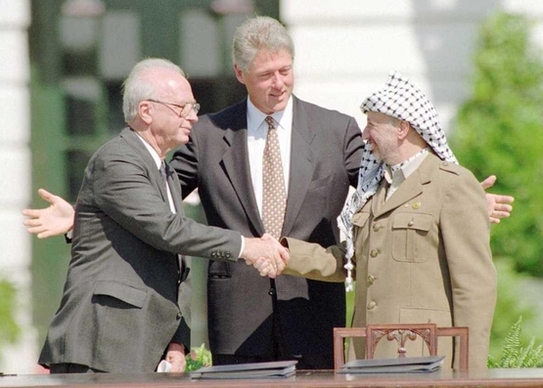 President Bill Clinton beamed as Israeli Prime Minister Yitzhak Rabin, left, and PLO Chairman Yasser Arafat shook hands at the White House on Sept. 13, 1993