Czech
Czech French
 German
 Hebrew
 Noruegan
 Russian
 Spanish
 Swedish
 Polish
 Portuguese





The U.N.-affiliated watchdog group that recently declared a “worst-case scenario of famine” in Gaza quietly changed one of its key reporting metrics while doing so, making it easier to formally declare that there is a famine in the Hamas-controlled territory.
The Integrated Food Security Phase Classification (IPC)—a network of Western governments, the United Nations, and nonprofit groups—determined in a July 29 report “the worst-case scenario of famine is currently playing out in the Gaza Strip,” claiming that “mounting evidence shows that widespread starvation, malnutrition, and disease are driving a rise in hunger-related deaths.” Media outlets like the New York Times, NPR, CNN, and ABC News relied on the IPC report to claim that Israeli policies have led to mass starvation, with the Times stating that “months of severe aid restrictions imposed by Israel on the territory” have caused a famine “across most of Gaza.”
Unlike previous IPC reports on the humanitarian situation in Gaza, the July report includes a metric—known as mid-upper arm circumference (MUAC)—the agency has not historically used when issuing a “famine classification,” its most dire determination. The report also includes a lowered threshold for the proportion of children who must be considered malnourished for the IPC to declare a famine, down to 15 percent from 30 percent. The 15 percent threshold had previously been used to indicate a famine was likely.
Aid workers traditionally conduct detailed weight and height measurements to determine whether a child is suffering from acute malnutrition. MUAC, by contrast, consists only of a child’s arm circumference, a measurement that can be done more quickly and is considered less precise. In its past Gaza reports, the IPC has said it would declare famine after finding that 30 percent of children in an area are suffering from acute malnutrition using their weight and height measurements. In the recent Gaza report, the IPC said it would declare famine if it found that 15 percent of children were suffering from acute malnutrition using their arm circumference measurement and if the agency found unspecified “evidence of rapidly worsening underlying drivers.”
The “pretty big shift” in standards, one veteran aid industry insider told the Washington Free Beacon, suggests the IPC is “lowering the bar, or trying to make it easier for the famine determination to be made.”
The IPC report revealed that shift through a small statement attached to an asterisk under a graphic titled, “When is Famine Classified?” It cited the MUAC metric, which is commonly collected in conflict settings but not meant to replace the more detailed measurements when determining famine.
Indeed, the IPC itself considers weight and height measurements as its primary indicator of malnutrition, according to a source familiar with the organization’s methodology. Its July report directs readers who want “further information on how the IPC classifies Famine” to a “Famine Fact Sheet” that makes no mention of MUAC. And its technical manual makes clear the organization can only issue an official “famine classification” once it establishes “reliable data” on acute malnutrition using weight and height measurements or one other metric that is not MUAC.
That did not stop the organization from using the metric to determine acute malnutrition levels in the Gazan cities of Deir al-Balah, Khan Younis, and Gaza City. A chart included in the notice shows less than 8 percent of children in Deir al-Balah and Khan Younis suffer from acute malnutrition “based on MUAC.” That figure is 16.5 percent in Gaza City, just above the new 15-percent threshold but well below the 30-percent level the IPC traditionally uses.
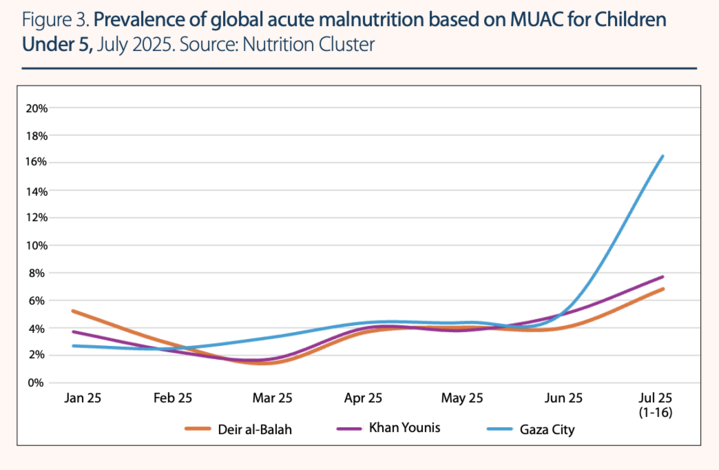
The organization’s decision to change its practices and rely on a 15-percent MUAC metric for its most recent Gaza report caught some veteran aid workers by surprise.
“If this is what you are considering, it is an issue,” one veteran aid practitioner told the Free Beacon. “If you’re planning to make a famine declaration based off the 15-percent MUAC, we as practitioners would say that’s an issue.”
The aid worker pointed to previous “famine classifications” the IPC issued in Sudan and Somalia in 2024 and 2011, respectively. In Somalia and certain regions of Sudan, IPC used the 30-percent malnourishment threshold as shown through weight-and-height measurements to declare famine. It used arm circumference measurements to establish malnutrition in other parts of Sudan, but those measurements exceeded the 30-percent threshold, not the 15-percent one cited in the most recent Gaza report.
“In all of the famines that have been declared, they’ve been using the 30-percent global malnutrition measurement, most of which have been based on the weight-for-height metric—which, again, is much harder to collect, much more burdensome, and it’s 30 percent,” the source said. “So, this asterisk that’s been added for Gaza essentially says that they’re going to allow a 15-percent global malnutrition rate measured by MUAC.”
“I think many people would say it’s like lowering the bar or making it more possible, essentially, to declare whatever it is that they’re going to declare.”
In addition to the amended standards, the IPC’s July report states that “over 20,000 children have been admitted for treatment for acute malnutrition between April and mid-July, with more than 3,000 severely malnourished.” It also says Gazan hospitals “have reported a rapid increase in hunger-related deaths of children under five years of age, with at least 16 reported deaths since 17 July.”
Those statements, the report’s “references” section shows, are based on “internal documents” from sources that are “not publicly available,” making it impossible for outsiders to vet their credibility. Raw data the IPC assesses often comes from the Hamas-controlled Gaza Health Ministry (GHM) and other terror-linked aid organizations. One of the primary humanitarian aid groups feeding data to the IPC, for example, is Ard el Insan, which works closely with the GHM and has faced allegations that it serves as a front for the terror group.
The IPC did not respond to a request for comment on its methodology and changes noted in the July Gaza alert.
Richard Goldberg, a former White House and National Security Council staffer in both Trump administrations who spent a decade performing humanitarian aid oversight on Capitol Hill, told the Free Beacon the IPC standards are another example of U.N. malfeasance.
“If you keep pulling the thread here, you start to understand this is one of the greatest frauds ever perpetrated on the world,” said Goldberg, who now serves as a senior adviser at the Foundation for Defense of Democracies think tank. “There is no famine in Gaza—the data thresholds don’t support that claim—and yet we have the United Nations changing the rules to fit the desired political outcome.”
This piece has been updated to include additional and clarifying information on the IPC’s famine classification process.