The Song That Avi Piamenta Didn’t Get to Release

A song that the beloved flutist and singer Avi Piamenta had worked on but never got to release was shared by his family following his untimely passing this past Friday.

Piamenta, 69, was part of the Piamenta Band with his late brother Yosi Piamenta, a talented guitarist. Together, they wrote and recorded many joyous and soulful tunes.

Their personal story of becoming baalei teshuva and turning into dedicated Chassidim of the Rebbe was often reflected in their concerts and demeanor, which exemplified ahavas Yisroel and belief in Moshiach.

The song “Soon You’ll Understand” reflects that. Recently written in English by Piamenta, it discusses the current exile and how the hardships are part of the plan to bring the final redemption.

“He worked on it for a very long time,” a family member told COLlive.com. “He put his everything into it. Obviously, English wasn’t his first language. It was very meaningful to him, and he was very proud of it.”

“He was planning to put it out,” the relative added. “Until then, he ran it through AI to hear what it would sound like. And he never got around to put it out.”

COLlive presents the song in memory of Avraham Ben Yehuda.

VIDEO: Avi Piamenta – Soon You’ll Understand

LYRICS:

When you were afraid, I was holding you
When you felt alone, I stood beside you
When you asked, “Where are you?” I stayed still
Because my love ran deeper than your will

You thought I was gone, but I was near
Every silence, I was right here
You saw a wall, but I was the space
Making room for light, not just a place

And soon you’ll understand
There was no bad from my hand
What felt like pain was too high to see
What broke you down was building you free
You’ll look back and finally know
It was love, disguised below
And I never left you, not for a beat
Not in the dark, not in defeat

Every tear you cried, I cried it too
What touched your heart went through Mine too
You walked through fire, I walked with you
What crushed your strength, I carried through

They told you to wait, I waited too
Longing for the day I could reveal to you
That everything you feared was grace
Just wearing a deeper face

And soon you’ll understand
There was no bad from my hand
The night you hated was the way
To reach the light you’ll see today
And I never left you, not for a breath
I was inside your every step

I haven’t returned to my royal gate
Because I promised — I’d wait
I won’t wear my crown or rise above
Until I bring you back, with love

So my dear G-d, if this is the time
Please let it be gentle, let it shine
Let the good come clear, let the pain be gone
Let Moshiach walk in with a song
No more shadows, no delay
Let it be soon… maybe today

Zoom Administrator Wanted

Seeking to hire someone to administer zoom seminars in any language

Contact: dbedein@israelbehindthenews.com

A New Palestinian Offer for Peace With Israel

The idea of a two-state solution for Israel and the Palestinians has never seemed more futile than in the months since Oct. 7, 2023. But maybe that opens the door to a new way of achieving peace.

“We want cooperation with Israel,” says Sheikh Wadee’ al-Jaabari, also known as Abu Sanad, from his ceremonial tent in Hebron, the West Bank’s largest city located south of Jerusalem. “We want coexistence.” The leader of Hebron’s most influential clan has said such things before, as did his father. But this time is different. Sheikh Jaabari and four other leading Hebron sheikhs have signed a letter pledging peace and full recognition of Israel as a Jewish state. Their plan is for Hebron to break out of the Palestinian Authority, establish an emirate of its own, and join the Abraham Accords.

The letter is addressed to Israeli Economy Minister Nir Barkat, a former mayor of Jerusalem, who has brought Mr. Jaabari and other sheikhs to his home and met with them more than a dozen times since February. They ask him to present it to Prime Minister Benjamin Netanyahu and await his reply.

“The Emirate of Hebron shall recognize the State of Israel as the nation state of the Jewish people,” the sheikhs write, “and the State of Israel shall recognize the Emirate of Hebron as the Representative of the Arab residents in the Hebron District.” Accepting Israel as a Jewish state goes further than the Palestinian Authority ever has, and sweeps aside decades of rejectionism.

The letter seeks a timetable for negotiations to join the Abraham Accords and “a fair and decent arrangement that would replace the Oslo Accords, which only brought damage, death, economic disaster and destruction.” The Oslo Accords, agreed to by Israel and the Palestine Liberation Organization in the 1990s, “have brought upon us the corrupt Palestinian Authority, instead of recognizing the traditional, authentic local leadership.” That would be the clans, the great families that still shape Palestinian society.

The sheikhs propose that Israel would admit 1,000 workers from Hebron for a trial period, then 5,000 more. Sheikh Jaabari and another major sheikh say Mr. Barkat has told them this number will grow to 50,000 workers or more from Hebron. Work in Israel is a valuable source of income for Palestinian communities, which have had little development of their own under Palestinian Authority rule, but most permits were suspended after Oct. 7. The sheikhs’ letter pledges “zero tolerance” for terrorism by workers, “in contrast to the current situation in which the Palestinian Authority pays tributes to the terrorists.”

Mr. Barkat says the old peace process failed, so “new thinking is needed.” He has been working with the knowledge of his Israeli government to explore possibilities with the sheikhs. A senior Israeli source says Mr. Netanyahu has been supportive but cautious, waiting to see how the initiative develops. The timing may be out of his hands now that Sheikh Jaabari is extending the olive branch in public.

With their bold move, the sheikhs expect to swing Israeli public opinion to their side. “Nobody in Israel believes in the PA, and you won’t find many Palestinians who do either,” Mr. Barkat says. “Sheikh Jaabari wants peace with Israel and to join the Abraham Accords, with the support of his fellow sheikhs. Who in Israel is going to say no?”

The 48-year-old Sheikh Jaabari often cites his illustrious ancestors, but his actions are guided as much by his view of the future. “There will be no Palestinian state—not even in 1,000 years,” he says. “After Oct. 7, Israel will not give it.” A second major Hebron sheikh, who signed and declares his loyalty to Sheikh Jaabari, agrees: “To think only about making a Palestinian state will bring us all to disaster.” (The other sheikhs spoke anonymously for their safety.)

I watched videos of Sheikh Jaabari and another sheikh signing the letter and reviewed documents elaborating on the plan made with Mr. Barkat, which includes the creation of a joint economic zone on more than 1,000 acres near the security fence between Hebron and Israel. The sheikhs expect it to employ tens of thousands.

A document in Hebrew lists the Hebron-area sheikhs who have joined the emirate initiative. The first circle has eight major sheikhs, who together are believed to lead 204,000 local residents. The second circle lists 13 more sheikhs, who lead another 350,000. That makes a majority of the more than 700,000 people in the area. Both circles have sworn allegiance to Sheikh Jaabari in this matter, an Israeli associate of the sheikh witnessed. Those clan members also include many of the Palestinian Authority’s local foot soldiers. The sheikhs expect them to side with family.

“I plan to cut off the PA,” Sheikh Jaabari says. “It doesn’t represent the Palestinians.” The clans governed their own localities for hundreds of years, he says. Then “the Israeli state decided for us. It brought the PLO and told the Palestinians: Take this.” Yasser Arafat’s PLO had been exiled to Tunisia, after being chased out of Jordan and Lebanon, when the first Oslo Accord in 1993 installed it in the West Bank. This was called the peace process, but the sheikh says he never saw any peace from it.

“There is an Arab proverb,” Sheikh Jaabari says: “Only the village’s calves plow its land. This means that a person who lives for decades outside—what does he know about where the springs of water in Hebron are located? The only thing you”—the PLO—“know about Hebron is collecting taxes.”

Four other Hebron sheikhs, whom I interview separately over Zoom, are even more strident. “The PLO called itself a liberation movement. But once they got control, they act only to steal the money of the people,” one major sheikh says. “They don’t have the right to represent us—not them and not Hamas, only we ourselves.”

“We want the world to hear our pain,” another sheikh chimes in. “The PA steals everything. They even steal our water. We don’t have water to drink.” They make do, they say, only because Mr. Barkat got the mayor of the Israeli settlement Kiryat Arba to build a water pipe connecting to central Hebron. The sheikhs say they mostly get along with the settlers and that many Palestinians used to earn good money in the settlements.

The settlers will find much to like in the plan, which breaks from the Oslo Accords’ scheme to divide the land. While the Hebron sheikhs would gain territory, so would the settlers, from the open land in what’s known as Area C. But how much, and where? Could it turn into a land grab?

These are key details that the letter merely says must be negotiated. They contain the potential for explosive disagreement. Then again, the sheikhs’ letter mentions conversations with Yossi Dagan, the settler leader for Samaria. He says he supports and has worked on the plan, and that issues of land can be worked out between people of faith who want peace. Mr. Dagan says he first met Sheikh Jaabari 13 years ago: “His father was a courageous leader who put his people first, and the son is the same.” The sheikhs also met Israel Ganz, who leads the settlement council, and with whom Mr. Barkat has worked on potential maps.

Mr. Barkat says people around the world ask Israel, “You’re against the two-state solution, and you’re against the one-state solution, so what the hell are you for?” The answer he found, about five years ago, was the emirates solution. It’s the brainchild of Mordechai Kedar, a scholar of Arab culture at Israel’s Bar-Ilan University. Mr. Kedar brought Sheikh Jaabari to Mr. Barkat and watched the partnership bloom.

“You’ve seen the letter?” Mr. Kedar exclaims. That means it’s really happening. For 20 years, he’s been trying to sell the idea of Palestinian emirates, with the West Bank’s seven culturally distinctive cities run individually by their leading clans. He first met Sheikh Jaabari’s father, Sheikh Abu Khader, 11 years ago. “To gain and earn trust, you have to sit with a man,” Mr. Kedar says. “That means to speak with him in his own mamaloshen”—the Yiddish term for mother tongue—“in Arabic.”

He says failing states in the Arab world—Lebanon, Syria, Iraq, Sudan, Yemen, Libya—are conglomerates of ethnic, religious and sectarian groups, with modern states imposed flimsily on top. Successes—Kuwait, Qatar, Oman, Saudi Arabia and the seven emirates of the U.A.E.—are each controlled by one family. “Al-Sabah owns Kuwait. Al-Thani owns Qatar. Al-Saud owns Saudi Arabia,” he says. “Dubai has very little oil, but it’s run by one family, al-Maktoum,” so it can thrive.

The idea of the PLO and the Palestinian Authority was to supplant traditional clan and religious loyalties with a national Palestinian identity. “It failed,” Mr. Kedar says, “and the proof is Hamas,” which puts radical Islam first. Underneath it all, the clan system survived: “Somebody from Hebron—not only will he not move to another West Bank town because he will be viewed as a foreigner, but even in Hebron he will not move to another neighborhood that belongs to another clan.”

Hebron’s clans are particularly strong. “Hebron is much more traditional, much more conservative, especially compared to Ramallah,” Mr. Kedar says. “Hebron will be the test case for this idea of the emirates.” He, Mr. Barkat and the sheikhs all expect Hebron to lay the groundwork for change in other West Bank cities, perhaps next in Bethlehem, refashioning Israel-Palestinian relations.

“Organizations like the PLO and Hamas try to construct their legitimacy on Jew-hatred and hatred of Israel. But the clans are legitimate by definition,” Mr. Kedar says. “They don’t need an external enemy to frighten everybody to come under the aegis of an illegitimate ruler.”

The Ramallah-based Palestinian Authority “can’t protect us, it can’t even protect itself,” Sheikh Jaabari says. His fellow sheikhs warn that the PA could allow an Oct. 7-style terrorist attack on Israel, after which they expect the West Bank to look like Gaza, their great fear. But a prominent Hebron sheikh says: “If we will get the blessing of honorable President Trump and the United States for this project, Hebron could be like the Gulf, like Dubai.”

That’s more or less how Mr. Trump laid out the options for the Middle East in his May 13 speech in Saudi Arabia. Do you want to be like Iran or like the Gulf? The sheikhs have made their decision.

But will their plan get off the ground? The first five sheikhs were ready to move at the end of Ramadan, after signing the letter on March 24, Mr. Barkat says. They complain that he asked them to wait for months because Israel was busy, first in Gaza, then in Iran. Mr. Barkat reminds Israeli officials that the sheikhs have put their lives in peril and operate on a timeline of their own. Now, he says, Israel must protect them: “The PA is the problem, and they are the solution.”

Many more sheikhs have joined the initiative since March, and the leaders are confident they have the Palestinian Authority outmanned and outgunned. “The people are with us,” one sheikh says. “Nobody respects the PA, nobody wants them.” The only reason to wait for Israel “is because it protects the PA.”

That’s the problem. If the sheikhs’ illegally armed men take to the street, will the Israel Defense Forces and Shin Bet security agency stand against them? If so, it would be the triumph of habit over reason, Mr. Barkat says. “Since Oslo, 30 years ago, the Israeli security services have been instructed to work with the PA. It’s all they know.”

The Shin Bet declined to comment. Political and security sources, however, say that the agency views the authority as critical in the fight against West Bank terrorism, and has opposed the sheikhs’ plan internally. Worries abound of potential violence or anarchy in other West Bank cities, where sheikhs aren’t prepared. The IDF also has raised concerns.

Many in Israel’s security establishment believe West Bank clans are too fragmented to govern or to fight terrorism. “How do you deal with dozens of different families, each of them armed, each under its own control?” asks retired Maj. Gen. Gadi Shamni, who led IDF Central Command from 2007-09. “The IDF would be caught in the crossfire—it would be a mess, a disaster.” Mr. Shamni rejects the idea that “the national aspirations of Palestinians will disappear and you can deal with each tribe separately.” In his view, “there is no way to control the West Bank and manage life there without the central authority.”

Retired Brig. Gen. Amir Avivi, founder of the Israel Defense and Security Forum, disagrees. He says the Palestinian Authority is the central incubator of terrorism, via school indoctrination and pay-to-slay salaries to terrorists. He also suggests the Shin Bet may change its mind when David Zini, the right-wing general nominated by Mr. Netanyahu, soon takes over the agency.

Mr. Avivi has met Sheikh Jaabari several times and judges him serious, especially after rallying so many other sheikhs to his side. He adds, “If Israel’s position is that the PA can’t be allowed to rule in Gaza because they’re terrorists and they’re corrupt, why are they OK to rule in the West Bank?”

The sheikhs say they can remove the PA from Hebron in a week, or a day, depending on how aggressively they move. “Just don’t get involved,” a leading Hebron sheikh advises Israel. “Be out of the picture.” They believe Mr. Trump’s support can clinch it with Mr. Netanyahu.

They also say they’re capable and motivated to fight terrorism. “We know who makes problems and who doesn’t,” one says, “because we live in our land.” Ideology and extremism are threats to the tribal loyalty and economic pragmatism on which the sheikhs’ power depends.

A cynic could say the sheikhs disdain the Palestinian Authority for extracting rents that they would prefer for themselves. But consider the competition. An Israeli associate of the sheikhs shows me a video of the Palestinian Authority governor of Hebron, Khaled Doudin, complaining in a Jan. 4 speech that the sheikhs’ men fire at them but not at Israel.

Palestinian Authority security forces are already unwelcome in the sheikhs’ neighborhoods and would risk their lives if they appeared there without prior Israeli coordination. In 2007, Palestinian police shot and killed a teenage member of the Jaabari clan. The sheikh’s father asked for the shooter to be turned over. When the Palestinian Authority refused, the sheikh’s men took over its police station, burned 14 jeeps and held 34 officers hostage, according to an article in Israel’s Yedioth Ahronoth newspaper. The clash ended only when President Mahmoud Abbas backed down, declaring the boy a martyr and paying his family lifetime compensation. Ever since, the PA has held less sway in the area.

Asked if he is worried his vision of coexistence with Israel will be called a betrayal of the Palestinian people and their cause, Sheikh Jaabari scoffs. “The betrayal was done in Oslo. You forgot, but I remember—33 years of it,” of false promises, violence, theft and poverty, even as billions of aid dollars poured in from the West. “I believe in my path,” the sheikh says. “There will be obstacles, but if we confront a rock, we will have iron to break it.”

Mr. Kaufman is a Journal editorial-board member. Yonah Jeremy Bob contributed reporting from Hebron.

“What I’ve Learned from 12 Years in Britain” – Rabbi Dweck on Antisemitism, Extremism and Identity

Rabbi Joseph Dweck has spent over a decade as Senior Rabbi of Britain’s oldest Jewish community. Now, as he prepares to leave the UK and move to Israel, he joins Jonathan Sacerdoti for an unflinching conversation about antisemitism, extremism, identity, and the moral decline of Western civilisation.

In this moving and courageous interview, Rabbi Dweck reflects on his years in Britain, the backlash he faced for challenging orthodox norms, and the deep dangers he sees in a society that has lost confidence in itself. From Islamist threats to cultural appeasement, from Jewish pride to political cowardice, he explores what Britain must do to recover – and what Jews must do to survive.

He also opens up about his infamous controversy over homosexuality, the costs of candour in religious leadership, and his growing fear that we are no longer willing to call evil by its name.

Watch if you want to understand Britain’s Jewish future, the ideological crossroads of the West, and why Rabbi Dweck believes it’s time to reclaim faith, identity, and courage.


End to Indoctrination

Two weeks ago, a friend asked where do we go from here.
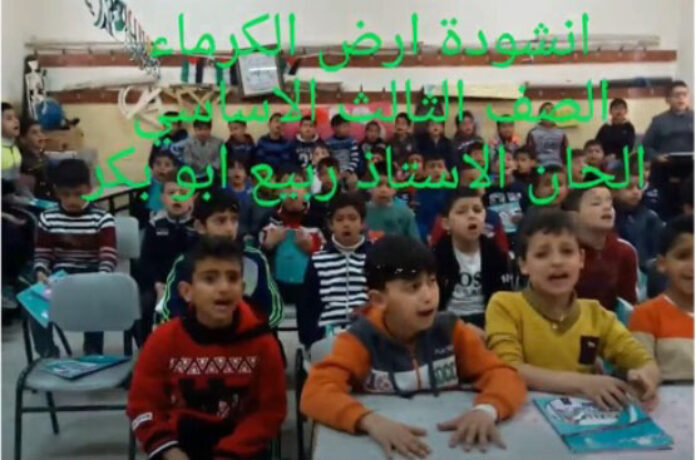
The answer must be a clear resolve to stop the weapons of mass instruction, to demand an end to Arab education which indoctrinates a new generation to murder Jews .
Arab indoctrination to murder is not on the agenda.
 Not for Saudi Arabia. Not for the US. Not for Israel. Not for any Jewish organization.
I think back to a seminal moment, in December 1969 when I was at The University of Wisconsin.
Reconstructionist Rabbi Mordechai Kaplan convened a conference of students from across the US , commencing the conference with a call to stop sudden infatuation with the PLO.
He began by reciting the PLO charter which has never been changed, and mentioned the derivative of the PLO charter :
The 1945 covenant of the Arab League of nations; the basis of Arab education ever since.
SAUDI ARABIA IS TODAY THE KINGPIN OF THE ARAB LEAGUE OF NATIONS,

We Need to Talk About the ‘Hilltop Youth’

Following a meeting between state prosecutors and the police, it was decided on Thursday that charges cannot be filed against the “hilltop youth” arrested for clashing with Israeli soldiers in the West Bank last Shabbat.

The prosecution concluded that the evidence presented is insufficient to indict the teenagers and does not support the IDF battalion commander’s narrative of the incidents in question.

After the publication of a video from the time of the incident, the battalion commander was summoned to the police station for further testimony.

Following a consultation Wednesday night between a special investigation team and the Jerusalem district prosecutor’s office, it was decided that the two remaining teenagers in custody should be released.

The teens were represented by Attorney Daniel Shimshilashvili of the Ḥoneinu legal aid organization.

“Our claims, which we made from the very first day, were proven to be true,” Shimshilashvili said.

“I suggest that all those who accused and published false claims about the youth come and apologize to them for the great injustice done to them. These are good boys, most of whom are set to serve in the IDF.”

For much of the past week, Israel’s news cycle has been dominated by efforts to incite the public against the hilltop youth subculture.

This came following a series of incidents, including one last Friday night in which a 14-year-old Jew was shot by Israeli security forces.

The accounts of the incident provided by the soldiers and teenagers involved sharply contradicted.

The army claimed that the youths had attacked soldiers in order to resist an evacuation from what had become a closed military zone.

The teens, by contrast, said that the battalion commander initiated the violence, used unnecessary force, and repeatedly threatened to kill them. They also reported that security forces fired live ammunition in their direction and even arrested a medic for attempting to treat the boy who had been shot.

While both sides released videos to corroborate their claims, the IDF video was less convincing. Yet the local and foreign press had carefully framed the incidents as a phenomenon of “Jewish terrorists” violently targeting Israeli soldiers.

Public figures demanded harsh crackdowns on the entire hilltop youth subculture. Nearly every government minister and lawmaker across the spectrum condemned the teenagers and called for swift action against them.

Journalists spent the week arguing that these kids are a threat to the state – to the entire Zionist enterprise – and that they should be treated no different from Palestinian threats.

Even national-religious politicians, municipal leaders of West Bank Jewish communities, and rightist social media influencers had come out against the teenagers.

But given the fact that a 14-year-old boy was wounded by live gunfire, shouldn’t the primary instinct have been to scrutinize the army’s version of the incident more closely?

Why did everyone blindly accept the army’s narrative and rush to condemn the teenagers?

Are we concerned that questioning the IDF’s account of such incidents would open the door to us challenging its credibility on other fronts?

Or could it be that some have an interest in inciting Israeli society against the hilltop youth (or even West Bank Jews more broadly)?

We need to be honest with ourselves.

Had something similar happened to a youth at an anti-government protest on Kaplan street in Tel Aviv, we would justifiably see round-the-clock press coverage and the burden of proof would be on the security forces.

But when a Palestinian teenager is injured in comparable circumstances, the overwhelming majority of Israelis side with our soldiers and assume that the teen had it coming.

This is largely due to the fact that Palestinians are perceived by the overwhelming majority of Israeli society to be part of an enemy collective that threatens our existence. Whether right or wrong, the fact that Jews and Palestinians have been locked in conflict for over a century makes this understandable.

But when it comes to the hilltop youth, could it be argued that Israelis view – or are being conditioned to view – this group more similarly to Palestinians than to politically active Israeli teens in Tel Aviv?

If so, why?

We shouldn’t blindly accept the claims of the hilltop youth as true. We shouldn’t blindly accept the claims of the army as true. But the proper response to these incidents shouldn’t have been incitement against an entire subculture but rather calls for a professional investigation to uncover the truth.

The 14-year-old who had been shot was released from the hospital to his home on Thursday. The bullet that had been removed from his body was transferred to Israel’s military police, which has now opened an investigation into the actions of the battalion commander. But this is barely receiving a fraction of the media attention that had been given to the story when it was about “Jewish terrorists” attacking the IDF.

The way in which the incidents of the past week were approached by the army, the media, and political figures across the spectrum is dangerously irresponsible. It can only serve to increase tensions and further reinforce the image many members of this subculture have of themselves as an oppressed group in Israeli society.

In fact, one could be forgiven for suspecting that at least certain public figures are less concerned with calming tensions than with weaponizing the incidents to incite the Israeli public against the youth.

Are the ‘Hilltop Youth’ a Threat to Zionism?

It’s no secret that Israel’s dominant institutions often target and vilify the hilltop youth.

This romantic counterculture of idealistic teenagers living organic Jewish lives off the grid in the mountains where our people’s early history unfolded is often presented to the public as a prime example of society drifting too far from the values of the state’s Zionist founders.

When it comes to Israel’s broader cultural conflict between forces of Western liberalism and a resurgent ancient Jewish nationalism (for lack of a better term), our elites rarely miss an opportunity to use the hilltop youth as a caricature to delegitimize the entire camp seeking to move Israeli society in a more deeply Jewish direction.

These teenagers represent a Jewish national consciousness far deeper and more authentic to the region than Zionism was able to produce and they serve as a clear example of Israel’s more tribalist and traditional forces gaining strength at the expense of the state’s westernized ruling class.

Most Israelis, including the national-religious sector, are principally opposed to extra-legal Jewish violence – against Palestinians and even more so against our own soldiers. But it’s also important to understand that because these kids have a tenuous relationship with the state and the army, many see themselves as responsible for their own security and experience themselves as punching up when attacking Palestinians (especially when the attack is a response to Palestinian violence).

The hilltop youth isn’t a monolithic group.

Some are troubled thrill seekers engaging in a dangerous game of adventurism. Others are impatient idealists rushing to advance the Jewish liberation struggle beyond its stagnated Zionist stage. And others still simply seek to live as authentic a Jewish life as possible in the mountains where our early history took place.

It’s generally unwise to cause an ideological group to feel like a persecuted minority. The abusive behavior of Israeli security forces toward the hilltop youth will likely only harden and further radicalize Judean teenagers. Not only the extreme cases of youth being imprisoned without charges and “aggressively interrogated” but also the thousands of other examples of young people seeing themselves as living under a system in which they have no democratic protections.

Are these youth a threat to the Zionist vision of Israel as a liberal outpost of Western civilization? Probably. But societies evolve. And no matter how much the press demonizes them or how much our security forces try to intimidate or hurt them, the hilltop youth subculture is likely to continue growing.

Model for a Postcolonial Jewish Identity?

If we were to examine all of the different Jewish communities in Israel and in the Diaspora today, we could argue that the hardline national-religious sector in the Judea and Samaria regions – with all of its various flavors – is the group that most closely resembles precolonial Judean society prior to the Roman destruction of our civilization.

If we were to take this examination a step deeper, we could argue that the hilltop youth – the young West Bank Jews who herd livestock and farm the land and refuse to live according to modern nation-state or settler-colonial structures and attempt to take responsibility for their own security needs (with mixed results) – have built communities and a way of life that appears to be an almost caricaturish recreation of ancient Israelite society.

It’s important to note that the hilltop youth isn’t the only model for what a decolonized Jewish identity can look like. And the goal of Jewish decolonization work shouldn’t be to become romanticized caricatures of our precolonial ancestors.

But it’s nevertheless easy to argue that this subculture has reached a more advanced stage of decolonization than any other group in the Jewish world.

The Solution

The “tribe” of Israeli society that the hilltop youth represent has tremendous revolutionary potential. But it needs to be properly channeled in such a way that advances Jewish national interests..

The best way to put a stop to the violence is not to make that violence a pretext for the persecution or suppression of the entire subculture, but rather to change the roles Palestinians and the Israeli state play in their narrative.

As counterintuitive as it might seem, the “Jewish extremists” – including the hilltop youth – may represent the sector of Israeli society most capable of successfully reconciling with our neighbors.

First of all, because they’re not coming with a colonial mentality. They don’t see themselves as “civilized westerners” fighting “violent savages” but rather as a local tribe engaged in conflict with other tribes.

When it comes to the Jews and Jewish communities in the territories, there are two spectrums. One is the extent to which they live according to settler-colonial structures. The other is how violent they are.

These spectrums are actually inverted. The most violent are the least “settler” and those actually living as “settlers” here are generally the least violent.

Unlike the Jews living in walled communities with full military protection, the hilltop youth live without walls and fences. They distrust the army and they see themselves as responsible to deter any security threats on their own. While at present, this may lead to more acts of extra-legal Jewish violence, in the longterm it could lead to reconciliation and a healthier relationship dynamic than the Zionists could ever achieve.

In addition to the fact that they share many core values and cultural norms with their Palestinian neighbors, the hilltop youth also share many experiences of oppression. Police violence, demonization in the Israeli press, administrative detention, aggressive interrogations, and politically motivated house demolitions.

The “tribe of Shimon” is the sector of Israeli society best equipped to change our relationship with the Palestinians – and the broader Arab world – for the better. It’s therefore in our interest to make them Israel’s face to our neighbors in the region. The challenge will be figuring out how to most effectively put them in this role.

Inescapable

We currently face a situation that cannot be escaped, ignored, or avoided.

On all fronts, the enemies of Israel and the Jewish People are clearly identifiable as they vent their hate and chant their slogans.

The twelve-day campaign to thwart Iranian genocidal plans and the still ongoing war against their proxy, Hamas, is only one part of a multi-pronged effort to neutralise and destroy jihadist terror.

An equally threatening spectre of potential threats against Diaspora Jewish communities looms on every continent.

Whereas in Israel almost every Jewish citizen, except for the hopelessly befuddled lemmings of the extreme left, recognises the dangers, the same cannot be said for large swathes of Jews in the Diaspora.

Life for Jews as a minority group in various countries has always been fraught with uncertainty. In regimes where democratic values were a fiction, they survived only at the whim of whoever ruled at that moment. At any given period, they could be tolerated or persecuted, depending on the political and often religious agenda of the time. Pogroms, expulsions and ghettos occurred in a regular cycle yet despite these clear manifestations of intolerance, Jews either returned to the scenes of the crime or recreated shattered communities.

Many fled to the “golden medina” of America or washed up on the shores of the United Kingdom. Some even made it to the relative safety of South Africa, Australia and New Zealand. Unfortunately, however, far too many remained on the blighted continent of Europe, where millions were to be eventually murdered at the hands of those poisoned by Jew hate and incitement.

The lucky minority who found sanctuary in the USA and UK faced discrimination, but eventually democratic and liberal forces enabled them to take an equal place in those societies.

Where equal rights were granted, Jews rapidly became loyal citizens and contributed far in excess of their small numbers to the welfare and advancement of their adopted countries.

The virus of Jew hate never completely disappeared, and as in previous centuries, it did not take much to reawaken its potent force.

The malign effects of ignorance can now be seen and felt as the memories of the Shoah are fading fast, and a generation has arisen which knows nothing of Jewish history or the contribution that Jews have made to civilisation and religion.

Virus mutations mean that the ancient delegitimisation and derangement symptoms are now transferred onto Israel. The nation State of the Jewish People has become the repository of all that is evil and menacing in today’s warped world.

There still remains a residual community in Iran of some nine to ten thousand Jews. They cite various reasons for not having escaped when they had the chance. It is a familiar theme such as business considerations, material comfort, loyalty to the country and a belief that they can “weather” all challenges. No doubt a naïve thought that “it will all blow over” and that “exaggerated threats” can be ignored featured in their decision to remain in the Islamic Republic of Iran.

They make the same fatal mistakes as other Jewish leaders and communities of previous generations in other places. They believe that their safety will be assured if they demonstrate their solidarity with the Islamic Mullahs, proclaim their undying solidarity and loyalty with the masses and pillory Israel and Zionists. The spectacle of Iranian Jewry’s religious and lay leaders marching in solidarity with screaming mobs demanding Israel’s extinction is a classic case. Hoping that the crocodile you are feeding will not devour you at the end of the day is a proven failed tactic.

So it is proving at this very moment.

Reports of widespread roundups of Jewish families in Iran and accusations of them being either in cahoots with Mossad or sympathetic to Israel should come as no surprise. It is yet further proof of how a grossly misplaced and blinkered aversion to reality can precipitate dangerous and fatal illusions.

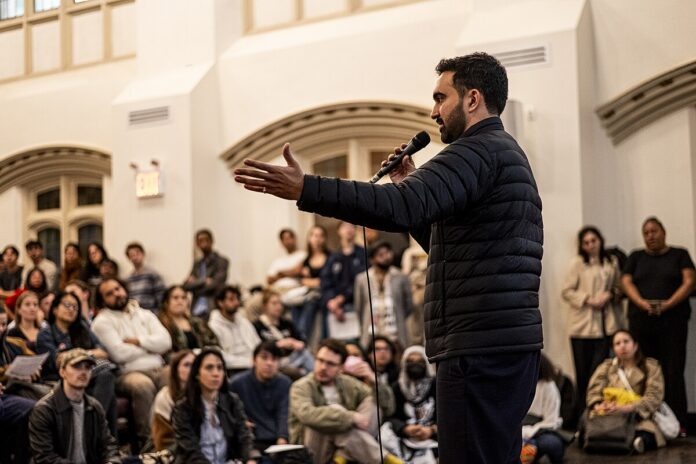
The selection of a progressive socialist democrat candidate for the upcoming New York mayoral elections is another case in point. His anti-Israel and anti Zionist credentials are impeccable. His selection is another example of how the US Democratic Party is sliding towards the lunatic left. Jewish Americans who genetically vote for the Democrats generally dismiss this as an “aberration” and prefer to hallucinate that there is nothing to worry about. Even worse is their blindness as to likely future electoral implications. The sight of Bernie Sanders and Chuck Schumer, as well as other Jewish politicians, joining the bandwagon careening left is another indication of how far the detachment from reality has taken hold.

Increasing numbers of US, UK and European Jewish university students report feeling threatened and intimidated. The resultant ballot box impacts will become more evident as the intimidating individuals increases. Their violence against Jews, Zionists, and anti-Israel hysteria will reach unprecedented levels. As more brain-addled students graduate, they will take their acquired Israel-hate prejudices into the political arena. In no time, the resultant effluent will pollute and threaten democratic societies.

A recent survey revealed that half of young Americans support Hamas. Scenes from the recent UK Glastonbury music festival which looked more like a Hitler youth rally, shows how far the rot has already penetrated.

One can already see the beginning of this insidious infection in many democracies where a coalition of leftist ideologues and green deniers of Jewish sovereignty co-operate in sanctioning, divesting and delegitimising. Even so-called liberal and semi-conservative parties are not immune to succumbing in the face of this onslaught.

The question that then arises is how local Jewish communities should react.

Do they shut their ears and eyes and, like those in Iran and elsewhere, hunker down, join the anti-Israel mobs and hope that the nightmare will dissipate? Do they pretend that “it can’t happen here” and thus remain while the cauldrons of hate become increasingly volatile? Do they assimilate in the vain hope that the haters will overlook them and instead pick on the visible Jews? Do they try to disassociate themselves and their communities from anything to do with Israel and pretend that Judaism and Israel are not one and the same?

All these strategies have been tried in the past and all have ended disastrously. Are those communities facing rising hate and violence and witnessing demographic realities of the electoral process, doomed to a bleak future? The stark fact is that a decreasing Jewish population and a rapidly rising jihadist-supporting electorate spell danger in the near and not-so-long-term future.

I listened to an interview recorded a week ago between Radio NZ and a spokesperson for the New Zealand Jewish Council. To say I was horrified would be putting it mildly.

The first question posed related to Israel being bombarded by Iranian missiles and the Jewish communities’ reactions. Imagine my shock when the spokesperson’s first response was to assert ”that Judaism and Israel are two different things”. This is the same sort of language spouted by the Iranian Jewish spokespersons to prove that the Jewish State has nothing to do with the Jewish religion. In actual fact, Judaism and the Jewish People’s march to sovereignty are very much intertwined.

Instead of stressing this, the spokesperson then compounded his initial faux pas by energetically attempting to distance NZ Jews from what was occurring. His frantic attempts to create some sort of moral equivalence between Iran, which is dedicated to Israel’s obliteration, and Israel’s response to thwart it became more embarrassing as the short interview continued. His comparison of Iran’s agenda to wipe out Israel with Donald Trump’s desire to make Canada part of the USA was ludicrous and quite frankly disconnected.

Instead of a robust defence of Israel’s dismantling of Iranian genocidal ambitions and preventing its proxy in Gaza from murdering Israelis, he repeated that NZ Jews held a variety of opinions and that suffering on all sides was equally bad. He expressed mystification as to why NZ Jews should be blamed for what the Israeli Government was doing. After all, he plaintively asserted, loyal Jews such as himself supported “not getting involved” and condemning violence by all sides in the conflict.

Not one word was uttered about the Israeli kidnapped hostages still being held in tunnels in Gaza, and whose continued incarceration is the reason that Hamas and its supporters are still being targeted.

If, as he asserted, Judaism has nothing to do with Israel, why do Synagogue services include, in addition to a prayer for the welfare of the country, a prayer for Israel and one for the men and women who defend it?  Is the representative of the NZ Jewish Council suggesting that these prayers should be deleted? After all, if, as he claimed, Judaism and Israel are two different and presumably unconnected things, that is the logical next step.

In the late 1980s, the NZ Anglican Church sanitised the psalms of King David and removed all reference to Zion, Israel and Jerusalem. That is the consequence of distancing Judaism from Zion.

In June 1967 Nasser’s genocidal aim of developing rockets with the help of Nazi German experts and driving all Israeli Jews into the sea was thwarted by swift Israeli action. The response of the NZ Jewish community was prompt, loud and unapologetic. It issued unequivocal support for Israel, organised emergency meetings and raised funds via the United Israel Appeal. Young men and women volunteered and joined thousands of other Jews from around the free world in travelling to Israel and helping out on kibbutzim and in essential industries.

NZ abstained at the UN and refused to join the Arab and Soviet condemnations of Israel.

What a difference fifty-eight years can make.

Today, the NZ Government votes against Israel at the UN at every opportunity.

Today, there is no United Israel Appeal in NZ and instead of a robust communal support for Israel’s war against terror nations and their supporters, there is silence or attempted equivocation. Even worse, there is a frantic attempt to dissociate from any solidarity with Israel in case it attracts negative consequences.

The reality is that those who hate Israel consciously or subconsciously also hate Jews. No amount of denial by the haters and self-haters can change this evident fact.

Apparently, that salient truth has yet to be recognised.

Review of “A Destiny of Memories”

This evocative submission dives deep into the psyche of a Vietnam War veteran, exploring memory, trauma, and identity. The narrative captures the juxtaposition of a soldier’s life in battle with his return to civilian life, offering a poignant reflection on the enduring impacts of war. Through its detailed prose, the work invites readers to share in the protagonist’s inner turmoil and emotional journey.

Overview

“A Destiny of Memories” is an introspective narrative focused on Brad Hill, a United States Marine Corps veteran returning home from the Vietnam War. The work centers on themes of betrayal, survival, and the haunting memories of combat that persist long after a soldier leaves the battlefield. Although the story is fictional, it is grounded in the harsh realities faced by many Vietnam veterans, effectively capturing the psychological scars left by war. The text both complements and challenges historical narratives, asking readers to consider the personal cost of national conflicts.

Relevant References

Including a clear literature review helps reviewers quickly see what’s new and why it matters, which can speed up the review and improve acceptance chances. The following references were selected because they relate closely to the topics and ideas in your submission. They may provide helpful context, illustrate similar methods, or point to recent developments that can strengthen how your work is positioned within the existing literature.

Long, Jerome H. “Reflections on A Soldier’s Story: For Blacks, A War Within the War.” Film & History, 1995, doi:10.1353/flm.1995.a395846.

Ross, Matthew. “Haunted by the Ghosts of Pickett’s Charge: Echoes of the Civil War in Two Novels by Vietnam Veterans.” Southern Cultures, University of North Carolina Press, 2015, doi:10.1353/scu.2015.0013.

Loeb, Jeff. “MIA: African American Autobiography of the Vietnam War.” African American Review, Saint Louis University, 1997, doi:10.2307/3042186.

Doyle, Robert C. “Stolen Valor: How the Vietnam Generation Was Robbed of Its Heroes and Its History.” Journal of American & Comparative Cultures, Bowling Green State University, 2000, https://www.questia.com/…/stolen-valor-how-the-vietnam….

“Ordinary Lives: Platoon 1005 and the Vietnam War.” Choice Reviews Online, Association of College and Research Libraries, 1999, doi:10.5860/choice.37-1734.

“War Veteran as Victim and Victimizer in Bill Cain’s 9 Circles.” Journal of Literature, Languages and Linguistics, 2020, doi:10.7176/jlll/67-06.

Vincent, Jonathan. “Fighting for Real: Truth and American War Memory.” American Literary History, Oxford University Press, 2023, doi:10.1093/alh/ajad073.

Stéfani, Anne. “Unexampled Courage: The Blinding of Sgt. Isaac Woodard and the Awakening of President Harry S. Truman and Judge J. Waties Waring by Richard Gergel.” Journal of Southern History, Southern Historical Association, 2020, doi:10.1353/soh.2020.0150.

Strengths

The narrative excels in portraying the inner world of a Vietnam veteran, drawing readers into a visceral experience of the protagonist’s emotions. The imagery used is vivid and compelling, enhancing the reader’s ability to visualize both the combat scenes and the introspective moments. The historical context, interwoven with personal stories, enriches the text’s authenticity and emotional depth. Moreover, the work captures the stark contrasts between the expectations and realities of war, a theme that resonates deeply given the historical context of the Vietnam War and its aftermath.

Major Comments

Methodology

The narrative structure predominantly uses a third-person omniscient point of view, which effectively conveys the protagonist’s inner conflict and emotional landscape. However, the transitions between past and present experiences are sometimes abrupt, potentially confusing the reader. It might be beneficial to implement more seamless transitions or clearly marked separations between different time periods to enhance the narrative flow.

Thematic Depth

While the story effectively delves into personal trauma and the socio-political ramifications of war, it could benefit from a broader exploration of the protagonist’s interactions with others post-war. Introducing additional characters who represent various perspectives on the conflict and its impact on American society could provide a richer thematic canvas.

Minor Comments

Formatting and Organization

The manuscript would benefit from clearer chapter demarcations. The text is interspersed with large blank spaces which can disrupt reading continuity. Consider revising for more uniform spacing and consistent formatting for headings and sections, which would improve overall readability.

Terminology and Language

Certain military terms may not be immediately accessible to all readers. A brief glossary or occasional footnotes regarding specific military jargon could aid in comprehension and enhance reader engagement.

Reviewer Commentary

This work touches on the complex interplay between personal experiences and broader historical narratives, inviting contemplation on the long-term effects of military conflict on soldiers. It has potential interdisciplinary relevance, intersecting literary analysis, historical discourse, and psychological studies of post-traumatic stress disorder. Ethically, the text encourages reflection on how societies honor veterans and address the psychological scars left by war.

Summary Assessment

“A Destiny of Memories” presents a poignant exploration of a Vietnam veteran’s internal struggles as he returns home, shedding light on the enduring effects of war. The narrative contributes to conversations about historical memory, patriotism, and the fracturing effect of conflict on personal identity. While the work would benefit from some structural refinements, its thematic richness positions it as a compelling piece within war literature. With thoughtful revisions, it could serve as a powerful catalyst for discourse on veterans’ experiences and historical remembrance.

The narrative’s power lies in its evocation of the personal costs of war, prompting readers to grapple with the realities soldiers face both on and off the battlefield. It stands as a testimony to the resilience of those who have endured the frontlines, urging us to remember and learn from these stories.