Czech
Czech French
 German
 Hebrew
 Noruegan
 Russian
 Spanish
 Swedish
 Polish
 Portuguese



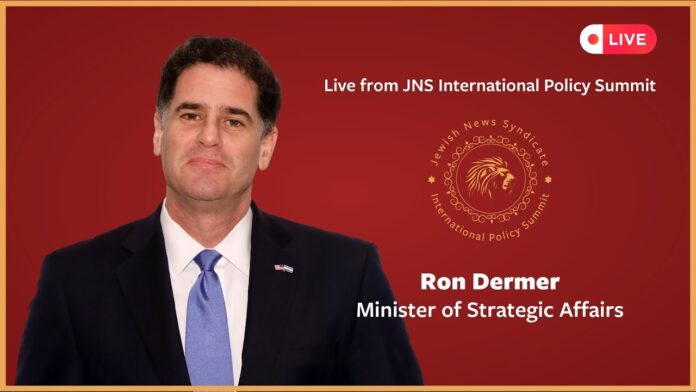
Watch Minister of Strategic Affairs Ron Dermer’s address at the JNS International Policy Summit. This landmark convention convened the most influential leaders and decision-makers to address the critical issues shaping Israel’s future and its role in the global arena. Ron Dermer is Israel’s Minister of Strategic Affairs, a position he has held since 2022. He previously served as the Israeli Ambassador to the United States from 2013 to 2021 and has been a close advisor to Prime Minister Benjamin Netanyahu. In February 2025, he was appointed as the head of negotiations for the release of hostages.
Why Hasbara Failed: We Fought the PR War, Not the Real One
“If you know neither the enemy nor yourself, you will succumb in every battle.”
—Sun Tzu, “The Art of War”
That’s the quote. The one we should’ve etched into the walls of every Federation office, every campus Israel group, every well-funded “Hasbara” initiative. Instead, we plastered graphics, hashtags, and slogans onto social media like band-aids over an open wound, not realizing we never addressed the infection. The Hasbara movement — modern Israel advocacy as it’s been constructed in the West — has failed. It wasn’t loud enough, not because it lacked money, but because it fought the wrong war. It treated antisemitism like a branding issue. It treated Zionism like a marketing campaign. And it treated Jewish identity like an afterthought.
Worse still, it ignored the central battlefield altogether: context.
We trained students to recite talking points without ever giving them the historical, spiritual, or even geopolitical foundations to understand the story they were trying to tell. We taught them to defend a country they could barely locate on an emotional map — and worse, we taught them to ignore the Palestinian narrative entirely, as if ignoring someone else’s story makes yours stronger. The Hasbara class doesn’t know the Jewish people. And it certainly doesn’t see the enemy. Nor, to its peril, does it understand the weight and power of the Palestinian story — not in truth or falsehood, but in resonance. While our enemies teach history — distorted, yes, but deep, emotional, generational history — our advocates memorize tweets. While the world radicalizes against the Jewish State with ideological fervor, we teach 19-year-olds to repeat, “Israel has a right to exist.” How revolutionary. How original. How utterly meaningless in the face of those who believe your very existence is a colonial crime.
This is the tragedy: we trained kids to explain checkpoints without explaining Herzl. We taught them to debate apartheid without introducing them to Ahad Ha’am, Rabbi Kook, or the Book of Joshua. We armed them with casualty charts, not courage. With U.N. resolutions, not roots. With talking points, not Torah. Hasbara failed because it tried to outsource pride. Because it assumed the average young Jew could fight for Israel while remaining estranged from Hebrew, from Zion, from the soul of their people. Because it traded the moral complexity of the conflict for the false clarity of press releases.
We never taught them to understand the Palestinian grievance — not to justify it, but to comprehend its potency. And by doing so, we robbed them of the ability to explain why our return is not a negation of another people’s story, but the reclamation of our own.
Identity is not built in PR firms. It’s built in language, in memory, in rootedness. And so, this moment demands something entirely different: a revolution of Jewish education. A renaissance of context. A return to knowing who we are, not just what we’re defending. We don’t need more content creators to explain why Israel is right. We need Jewish children who know why they are Jewish. We don’t need another “crisis comms” playbook. We need people who speak Hebrew, dream in Zion, and learn how to walk into a room not begging for understanding but embodying truth.
We don’t need another “crisis comms” playbook. We need people who speak Hebrew, dream in Zion, and learn how to walk into a room not begging for understanding but embodying truth.
Hasbara is dead. Let it be. Now, let us rise, arm in arm with our prophets, warriors, poets, and ancestors who dreamed of home. Let us teach our children to fight not with slogans but with their souls. Let us build Jews who know themselves so deeply, so intimately, that no enemy’s propaganda can pierce the armor of their inheritance. Because only when we know ourselves—and yes, when we understand the story of the other — will we finally begin to win.
Adam Scott Bellos is CEO of the Israel Innovation Fund and author of “Never Again Is Not Enough: Why Hebraization Is the Only Way to Save the Diaspora.”
A long journey home

It has taken more than two thousand years for Jews exiled by the Romans to finally return to their promised homeland and reclaim sovereignty.
The Romans may not be a force to be reckoned with these days, but the poisonous seeds which they cultivated are sprouting with increased virulence.
We are fortunate to be living at a time when Jewish sovereignty has been restored, even if it is still only partially. Unfortunately, the struggle to safeguard independence continues to exact a bitter toll of fatalities and seriously maimed and wounded. From the 1920s during the British mandate and then subsequent to 1948, Islamic terror and wars have claimed thousands of military as well as civilian lives.
Despite gestures that included territorial withdrawals and futile, fake accords leading to increased terror and misplaced illusions of fraternity, genuine peace remains a mirage. The Abraham Accords are a glimmer of hope, but those who plot and plan Israel’s demise remain numerous and implacable.
The one constant factor which remains is the age-old animosity, hypocrisy and indifference of most of the international community.
This year, when everyone stands silently and remembers their sons and daughters who have fallen in the defence of the country, we will also have our remaining hostages in mind. Instead of a worldwide revulsion at the barbarity of Hamas and their enablers, Israel is being prosecuted at The Hague. Unlike previous generations, we can at least fight back, and it is this facet that upsets our adversaries so much.
Jews retaliating against those who individually or collectively threaten them is an alien concept especially for a world so used to compliance and submissiveness in the face of hate and terror. It also terrifies some Jews who tremble at the prospect of being accused of complicity in whatever Israel might do.
It is understandable after two millennia of being the eternal scapegoat and of having to flee rather than fight that hitting back and making tormentors pay for their criminality can engender feelings of anxiety.
This has exposed a fundamental fissure between not only trembling Diaspora Jews but also those in Israel who still dream that appeasement will buy the love of our enemies.
During the last eighty years or more, Zionist leaders and decision makers have offered a multitude of plans and agreements which would have enabled the establishment of “two states for two people.” Unfortunately, right from the outset, implacable opposition by Islamic and jihadist religious and lay leaders made any accommodation impossible. One has only to read the recorded speeches made by Islamic leaders over the years, to recognize that nothing short of the complete destruction of Israel was and remains the aim.
The perfidious British slammed shut the gates of the mandate and condemned Jews attempting to flee Nazi Europe to a certain death. Prior to that, they sliced off the eastern part of the mandated territory already promised to the Jews and created an artificial country called Transjordan. Today, the majority of its citizens are descendants of mandated Palestine Arabs. In effect, the so-called two-state solution already exists.
Two of the biggest confidence tricks ever perpetrated are the “eternal” Arab refugees and the claim of Arab/Islamic indigenous entitlement.
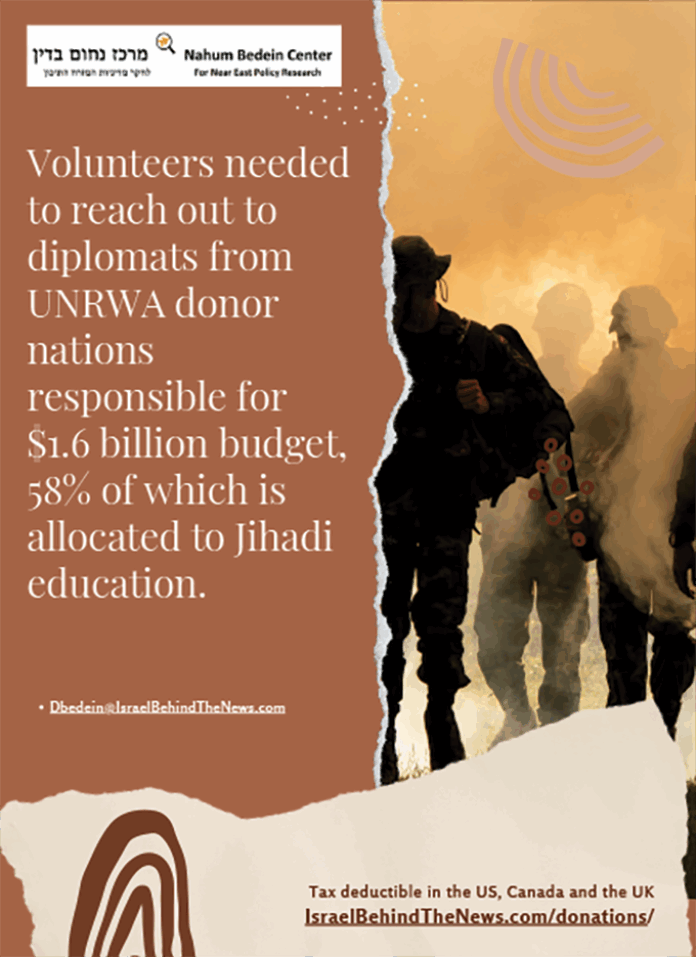
The UN and its immoral majority (including Australia & New Zealand) have been sucked into financing an ever increasing number of fake refugees now numbering over nine million. So-called refugee status is handed down to every generation with no possibility of resettlement. Brainwashed to hate Jews and Israel in UNRWA schools and financed by clueless donor nations, these individuals remain victims of cynical manipulation.
The rewriting of Jewish history and the inventing of a substitute narrative has become accepted as the real truth by the same immoral countries that vote against Israel at every opportunity. Whether it is as a result of ingrained prejudice, willful ignorance or plain stupidity, the lie of indigenous authenticity has become an accepted part of international discourse. No matter how outrageous the denial of Jewish historical reality may be the repetition of distorted claims is swallowed by all those who prefer fiction over actual facts.
A perfect example is the latest outburst by PA President for life, Mahmoud Abbas, anointed patron saint of fictional Palestinian statehood.
At a PLO central council meeting held last week, he trotted out this nonsense:
“In the noble Quran and I believe that also in other divine books, it says that the First and Second Temples were in Yemen. People who like reading about religion can check it out.
The Jews say this is ours and that was ours and this is where Solomon’s Temple was. I am telling you a large part of history is falsified. People who read the Quran know this.”
Of course, anyone with the slightest knowledge of Biblical history and archaeological facts knows that Abbas is speaking rubbish. It becomes even more ludicrous when one knows that former Nobel Peace Prize winner and chief terrorist, Yasser Arafat, asserted that “the Temple didn’t exist in Jerusalem – it existed in Nablus. There is nothing there – i.e. no trace of a temple on the Temple Mount.”
Apart from the fact that Abbas obviously forgot to read Arafat’s claims and thus picked Yemen instead of Nablus, his speech to the faithful demonstrates the latest in years of distortion and fabrication. Like Holocaust denial, repeated lies about Arab indigenous authenticity and Jewish fictitious history falls on fertile ground.
Not a peep of protest issued forth from all those countries touting two states living side by side in peace and fraternity.
What we saw instead, apart from a shameful silence, was in effect the validation of the great lie by the European Union and the UK Government.
The EU announced it would fund the Abbas-led PA with US$1.8 billion over three years.
The UK Prime Minister and his Foreign Minister are hosting the PA Prime Minister and committing to recognising “Palestine.” In addition, they pledged £101 million for economic development and support of what is erroneously called PA governance reform.
Neither the UK nor the EU mentioned the “pay for slay” payments made by the PA to murderers of Israelis nor how they were going to ensure that this latest pot of taxpayers’ money will not be filched and diverted to terror purposes.
By remaining silent in the face of blatant revisionist fables and showering the liar with cascades of funds those who purport to support Israel are in actual fact once again stabbing it in the back.
It has been a long and treacherous road back from exile to reclaimed sovereignty.
Every step of the way has been hard fought and at the cost of enormous sacrifices.
It is best summed up in this short explanation that I read recently:
“The story of the Jewish People is against all logic. It’s a miracle. No other nation in the world survived 2,000 years of exile, inquisitions, pogroms and the Holocaust and kept dreaming about the Land of Israel. After 2,000 years people who were broken (a third of the nation was wiped out) built up a country. With seven Arab countries trying to eliminate them, in nearly 80 years they show the world how to defend themselves and are leaders in medicine, healing, technology and agriculture.”
As we celebrate Yom Ha’Atzmaut this year, we also celebrate the miracle of our rebirth and look forward to the prophesied time when universal peace and justice will prevail.
Trump’s Nuclear Talks With Iran Prompt Concern Among Republicans, Applause From Ex-Obama Officials

As the US continues to negotiate a potential nuclear deal with Iran, the Trump administration has drawn praise from political adversaries and criticism from traditional allies over a perceived reversion to the basic framework of the now-defunct 2015 nuclear accord, which US President Donald Trump has lambasted as a dangerous agreement.
Members of the former Obama administration have expressed cautious optimism that the approach of Trump and his team to the current nuclear talks might mirror the steps they took to reach the Joint Comprehensive Plan of Action (JCPOA), the 2015 deal which placed temporary restrictions on Iran’s nuclear program in exchange for the lifting of major international sanctions. Trump withdrew the US from the accord during his first presidential term in 2018, arguing it was too weak and would undermine American interests.
Meanwhile, Republican lawmakers and hawkish foreign policy analysts have increasingly raised skepticism about the Trump administration’s approach to the Iranian nuclear program, suggesting that the White House has been receiving bad advice.
Such critics have argued that the White House may have relaxed its hardline stance against Iranian uranium enrichment, potentially allowing Iran’s Islamist regime to continue enriching uranium “civilian purposes.” Tehran has previously rejected halting its uranium enrichment program, insisting that the country’s right to enrich uranium is non-negotiable. Iranian officials have also refused to include their ballistic missile program, which would allow Iran to continue improving its weapons delivery capabilities, in negotiations with Washington.
The 2015 deal, which the Obama administration negotiated with Iran and other world powers, allowed Iran to enrich significant quantities of uranium to low levels of purity and stockpile them. It did not directly address the regime’s ballistic missile program but included an eight-year restriction on Iranian nuclear-capable ballistic missile activities.
Allies of Trump had argued such terms of the deal were insufficient, as they would allow the regime to maintain a large-scale nuclear program and wait for certain restrictions to expire before ramping up their activity. Supporters of the deal countered that the accord kept Iran further away from being able to break out toward a bomb quickly and gave international inspectors greater access to Iranian nuclear sites.
The current framework being advanced by the Trump administration “suggests that the Americans have, at least for now, abandoned several of the fundamental demands that were emphasized before negotiations began,” the Israeli outlet Israel Hayom wrote.
Former US Secretary of State Mike Pompeo, who served as Trump’s top diplomat from 2018 to 2021, questioned the utility of attempting to broker a nuclear deal with Iran “while it is at its weakest strategic point in decades” in a recent article for the Free Press. He appeared to be referring to Israel’s military activities in recent months decimating Iran’s air defenses and proxy forces — particularly Hamas in Gaza and Hezbollah in Lebanon — in the Middle East. Pompeo argued that conservatives who “coddle” Iran in hopes of avoiding war are only ensuring that Tehran eventually acquires a nuclear weapon.
The White House has also received criticism from fellow Republicans in Congress. In a comment posted on X/Twitter, Sen. Ted Cruz (R-TX), for example, lamented, “Anyone urging Trump to enter into another Obama Iran deal is giving the president terrible advice.” Urging the White House to reverse course, Cruz added that Trump “is entirely correct when he says Iran will NEVER be allowed to have nukes. His team should be 100% unified behind that.”
Andrea Stricker, a research fellow at the Foundation for Defense of Democracies, where she works as deputy director of the think tank’s Nonproliferation and Biodefense Program, also warned against any deal allowing Iran to retain its uranium enrichment capabilities.
“Only the full, verified, and permanent dismantlement of Iran’s enrichment, weaponization, and missile-delivery programs constitutes a sound deal with Iran,” she told The Algemeiner. “Leaving enriched uranium, associated facilities, centrifuges, and infrastructure in the country means Tehran can renege on a deal and ramp its nuclear threat up at any time. Iran’s breakout time would also be considerably shorter today given its stock of thousands of fast-enriching advanced centrifuges.”
Stricker continued, “The regime’s goal is to wait out the Trump administration, delay sanctions pressure, and avoid a military strike. The administration should make clear that dismantlement is the only possible deal that allows the regime to avoid major consequences.”
David Bedein, director of the Jerusalem-based Center for Near East Policy Research, blasted the Trump administration for supposedly keeping the details of the negotiations a “mystery” and potentially compromising Israel’s long-term interests in the region.
The Trump administration’s allowing Iran to continue enriching uranium would be “an absolute violation of Israel’s interests,” he told The Algemeiner.
Bedein also claimed that the intentions of Trump’s special envoy to the Middle East, Steve Witkoff, are “dangerously unclear,” noting his ties to Qatar, which has long maintained close cooperation with Iran and supported terrorist groups such as Hamas.
In 2023, the Qatar Investment Authority, the country’s sovereign wealth fund, purchased one of Witkoff’s New York properties for nearly $623 million. Witkoff further raised eyebrows earlier this year when he praised Qatar as a partner of the US and a stabilizing force in the Middle East.
Witkoff drew backlash last month when, during a Fox News interview, he suggested that Iran would be allowed to pursue a nuclear program for so-called civilian purposes, saying that Iran “does not need to enrich past 3.67 percent.” The next day, Witkoff backtracked on these remarks, writing on X/Twitter that Tehran must “stop and eliminate its nuclear enrichment and weaponization program.”
US Secretary of State Marco Rubio said on Thursday that Iran has to “walk away” from uranium enrichment and long-range missile development and it should allow nuclear inspectors access to military facilities.
Despite pursuing diplomacy, Trump has said he is committed to ensuring Iran never gets a nuclear weapon and has threatened additional sanctions, tariffs, and military action if Iran does not agree to a deal to curb its nuclear activity.
Harsh US sanctions levied on Iran during Trump’s first term crippled the Iranian economy and led its foreign exchange reserves to plummet. Trump and his Republican supporters in the US Congress criticized the former Biden administration for renewing billions of dollars in US sanctions waivers, which had the effect of unlocking frozen funds and allowing the country to access previously inaccessible hard currency. Critics argue that Iran likely used these funds to provide resources for Hamas and Hezbollah to wage new terrorist campaigns against the Jewish state, including the brutal Oct. 7 massacres throughout southern Israel perpetrated by Hamas-led Palestinian terrorists.
Iran has claimed that its nuclear program is for civilian purposes rather than building weapons. However, the International Atomic Energy Agency (IAEA), the UN’s nuclear watchdog, reported last year that Iran had greatly accelerated uranium enrichment to close to weapons grade at its Fordow site dug into a mountain.
The UK, France, and Germany said in a statement at the time that there is no “credible civilian justification” for Iran’s recent nuclear activity, arguing it “gives Iran the capability to rapidly produce sufficient fissile material for multiple nuclear weapons.”
However, former key players within the Obama administration have praised the similarities between Trump’s efforts and the JCPOA.
Ilan Goldberg, a national security advisor in the Pentagon and State Department during the Obama administration, praised the Trump administration for doing the “right thing” by revisiting key components of the now-scrapped JCPOA during their negotiations with Iran.
“It’s hard not to take a jab at Donald Trump for walking away from the nuclear deal in the first place, because I think if we get to a deal, it’ll probably be something pretty similar,” Goldberg told Jewish Insider.
Phil Gordon, a national security advisor to Vice President Kamala Harris and White House Coordinator for the Middle East, North Africa, and the Persian Gulf Region during the Obama administration, said that the Trump team will learn that they are likely to “have to accept some of the same imperfections that the Obama team did.”
Israel has been among the most vocal proponents of dismantling Iran’s nuclear program, with Israeli Prime Minister Benjamin Netanyahu arguing that that the US should pursue a “Libyan option” to eliminate the possibility of Tehran acquiring a nuclear weapon by overseeing the destruction of Iran’s nuclear installations and the dismantling of equipment.

UNRWA’s Misuse of Donor Funds
UNRWA’s mandate has been renewed by the UN General Assembly for the past 70 years, and its current mandate is set to expire on June 30, 2020. Yet, as additional countries join the ranks of those refusing to renew this financia and managerial black hole known as ‘UNRWA,’ the continuation of the charade of ‘perpetual refugee-ism’ may be in doubt.
This paper examines the exorbitant, highly inflated rise of UNRWA’s budget demands over the past 10 years ($1.11 billion USD in 2018 alone), and both the misuse and the utter lack of transparency and accountability as to how those billions of dollars have been spent.
I. Historical Overview
On 14 May 1948, the 30-year British Mandate for Palestine was formally ended by the British Colonial Office. Britain’s chaotic evacuation of its civilian and military personnel was immediately followed by an invasion by seven Arab countries vowing to annihilate the newly declared State of Israel. In the course of the 1948 Arab-Israeli War, approximately one million people, both Arabs and Jews, were left displaced and homeless. In the aftermath of these developments the UNGA responded by calling to a post-World II war refugee crisis upon international organizations such as the International Committee of the Red Cross (ICRC) to provide humanitarian aid to the refugees.
II. Creation of UNRWA
Six months after the war, in November 1948, the UN established the United Nations Relief for Palestine Refugees (UNRPR) to extend aid and relief to Arab refugees who did not remain under Israeli sovereignty, and to coordinate the efforts of NGOs and other UN bodies. On December 1948, the UN established the ‘United Nations Relief and Works Agency for Palestine Refugees in the Near East’ (UNRWA), as a ‘subsidiary organ of the UN’. UNRWA was assigned the assets of the UNRPR and took over the ICRC’s refugee registration records.
III. The UNRWA Mandate
According to the UNRWA website, the UN agency was originally mandated to “carry out direct relief and works programs in collaboration with local governments, consult with the Near Eastern governments concerning measures to be taken preparatory to the time when international assistance for relief and works projects is no longer available, and plan for the time when relief was no longer needed.”
All other UN refugee relief efforts globally are handled via the United Nations High Commissioner for Refugees (UNHCR) which is tasked, as part of its specific mandate, “to aid its refugees to eliminate their refugee status via local integration into the host country, resettlement in a third country, or repatriation where feasible.” (Emphasis added.)
No such requirement to resolve the refugee status of beneficiaries has ever applied to UNRWA.
IV. Perpetuation of Refugee Status
The UNRWA definition of ‘refugee’ differs radically from that used by other refugee relief agencies. According to the UNRWA mandate, the operational definition of a Palestine refugee is any person whose ‘normal place of residence was Palestine during the period 1 June 1946 to 15 May 1948 and who lost both home and means of livelihood as a result of the 1948 conflict”—and descendants of fathers fulfilling the definition. In practice, this means that ‘Palestinian refugee status’ is inherited from generation to generation.
V. Today’s UNRWA Refugee Beneficiary Figure
The official figure of displaced Arabs stands at 700,000—although even that figure is in dispute given the records of the 1949 census and the report of the UN Mediator on Palestine which arrived at a figure 472,000, and which calculated that only about 360,000 Arab refugees required aid.
Regardless of the original figure of Arab refugees from the 1948 war, due to its policy of ‘perpetual inheritability of refugee status’, UNRWA cites a whopping 5.4 million ‘Palestinian refugees’ on the dole of UNWRA. It is this figure that UNRWA points to as it campaigns to wrest additional millions of dollars from donor countries to fund its ‘duty stations’ in the West Bank, Gaza, Jordan, Lebanon and Syria.
VI. Critical Findings Of DIOS: UN’s Internal Oversight Apparatus
In April 2018, the UN’s Department of Internal Oversight Services (DIOS) released its report covering a wide variety of investigations of management and financial improprieties of UNRWA during 2017.
A. Lack of integrity of UNRWA Promotion process
Among the issues cited by DIOS were instances of promotion to senior positions even as those staff members who were facing serious, unresolved allegations of misconduct. No legal framework existed for dealing with such, nor was there any provision to delay an appointment while such allegations were being investigated. The DIOS report cited the need for integrity checks—for which no procedure currently existed—to be made before promotion to senior positions. Furthermore, they cited the need for management to have the legal capacity to delay an appointment until integrity objections were resolved. Thus, the spectre of cronyism and nepotism looms over UNRWA’s promotion and selection process without regard for circumstances which, for other international organizations, would halt such promotions.
B. No AdCom Oversight over Financial or Operational Management
It must be noted that although UNRWA has an advisory commission (AdCom), it has neither charter nor power to inspect or examine financial expenditures and operational management. Furthermore, it has no input into senior appointments or strategic direction.
In consequence of that lack of oversight controls, the DIOS report raised the following caveat:
UNRWA appears to be unique in the UN system, in not having any board of governors, board of directors or similar body. It appears no other UN body has this situation. Compounding matters, UNRWA does not have an audit committee. These two bodies would normally examine operations, inspect finances, and approve senior appointments.
Those serious governance deficiencies have resulted in UNRWA operating at both the managerial and the fiscal level with a significant lack of transparency.
C. Lack of Centralized Investigations
As DIOS reported in previous years, the conducting of decentralized investigations by individual UNRWA Field Offices has limited the influence of DIOS and hampered the ability to undertake centralized, objective investigations. DIOS’ operational staff is thus hobbled, both in terms of the technical skills of the investigators, and their lack of independence from Field Office Senior Management.
D. 15% Increase in Misconduct Allegations
The total numbers of misconduct allegations at UNRWA received by DIOS has continued to increase steadily since the previous review in 2004. Corporal punishment cases continue to be the most frequent type of allegation received among all Field Offices except in Syria. Notably, Breach of Neutrality violations (de-legitimization, demonization, and teaching of war education against Israel) increased from 16 2016 to 55 in 2017.
E. Mismanagement at Cairo Liaison Office
DIOS’s inspection of the UNRWA Cairo Liaison Office in Egypt revealed a pattern of mismanagement of UNRWA resources, misrepresentation, and ‘conduct not befitting a civil servant’. Pursuant to the issuance of the 2017 report, various actions were taken by management to rectify the situation, but not all recommendations have been implemented.
VII. Funding “Citizen- Refugees” of Host States
Not only are UNRWA’s beneficiary ranks swelled by the aforementioned ‘inherited refugee’ status of all of those descended from male displaced persons, but also by an oxymoronic category of ‘citizen-refugees’. Indeed, individuals who, rather than remaining ‘homeless’, have obtained citizenship in host countries, nevertheless continue to be classified as ‘refugees’ entitled to UNRWA relief. This is especially true in Jordan, where the vast majority of UNRWA ‘refugees’ hold Jordanian citizenship. To a lesser degree, the same scenario presents in Lebanon. Furthermore, this ‘status-based’ basis for receiving UNRWA aid has nothing to do with a ‘need-based’ assistance program.
No real justification exists for millions of dollars’ worth of donor funds going to subsidize beneficiaries who are citizens of Arab states and who can well afford to pay for the very UNRWA benefits they receive.
VIII. Inordinate Population Growth
In December 1982, the UN General Assembly, aiming to increase the Palestinian displaced persons count, requested that UNRWA issue identification cards to ‘all Palestinian refugees globally and their descendants, irrespective of whether they were recipients of UNRWA rations and services’. Prior to that resolution, UNRWA ID cards were issued ‘per family’. Among the significant aspects of this resolution was the population figure for UNRWA aid recipients being pegged at ‘1.9 million’. Yet, the 2019 figure used by UNRWA in order to convince donor countries of the need to boost their UNRWA donations, is 5.4 million—a 280% increase— much higher than neighbouring Egypt and Syria and more than double that of industrialized Western countries over the same 37 years.
IX. Global Palestinian Population Count Falls Short of Claims
To assist in the implementation of the aforementioned resolution, governments around the world were asked to report on resident Palestinians. From the few replies received, the total of those referred to was less than 500. In light of the unexpectedly low figures submitted by world governments, the UN Secretary General determined that he was ‘unable, at this stage, to proceed further with the implementation of the resolution’.
X. Bloated Budget, Bloated Staff
UNRWA’s $1.2 billion budget is out of line relative to the beneficiaries it serves. By contrast, the 2019 budget of UNHCR—the UN’s relief agency serving all other displaced persons from every other conflict around the globe—is $8.6 million. Note that UNHCR funds the relief efforts for 20.4 million refugees—four times the reputed number of UNRWA beneficiaries and 11 times more than actual registered refugees—on that comparatively meager budget. Thus, UNRWA has approximately $530-$1500 per refugee for every $1 available to UNHCR.
Similarly, UNRWA’s bloated staffing numbers defy all logic: 30,000 employees are on the UNRWA payroll, but about half that number—16,800—are on the payroll of UNHCR.
XI. Contractors’ Opposition to GRM
Five years ago, an arrangement was carved out between Israel, the UN, and the Palestinian Authority (called the Gaza Reconstruction Mechanism, or ‘GRM’) pursuant to which war-torn areas of Gaza were to be rebuilt, and ‘essential construction materials’ would be allowed into Gaza. Objections from numerous Palestinian organizations scuttled the deal. Nevertheless, UNRWA claimed GRM housing assistance expenses for over 11,000 families as part of its budget, and further claimed to be coordinating dozens of UNRWA infrastructure projects.
XII. UNRWA Contractor Tenders
Among the requirements for bidding on UNRWA infrastructure projects in Jordan and Gaza is that the contractor be a ‘member of the Palestinian Contractors Union’. No other UN agency has such exclusion clauses designed to benefit a particular trade consortium. To do so would raise fair play and open competition issues in violation of the UN’s own ‘Guiding Principles on Humanitarian Assistance of 1991’. More troubling still is that Israel has identified 40% of those contractors as security risks to whom projects should not be awarded nor dual-use material transferred.
XIII. Skewing UNRWA’s Expenditures
Make-work projects for ‘construction of a retaining wall’ or for endless ‘camp infrastructure’ and ‘remodelling’ are hidden in UNRWA’s otherwise impressive ‘Educational Budget’—leaving donors to assume that all such expenses are for books, teachers, and classrooms rather than for well-connected contractors.