Abbas ups his rhetoric: Israel is committing a crime of ongoing mass extermination

In a speech delivered on the occasion of International Water Day, Palestinian Authority (PA) chairman Mahmoud Abbas sharply criticized Israel, accusing it of being responsible for “a crime of ongoing mass extermination for over a year and a half.”

Abbas claimed that Israel is taking measures that lead to the “slow death” of the Palestinian Arab people, particularly in the Gaza Strip.

He further asserted that Israel is using, in his words, “an additional weapon”—the cessation of basic services, primarily water supply, and the prevention of humanitarian aid from entering. “The occupation seeks to expel our people,” Abbas said, “and to implement illegal expansion plans aimed at eliminating the Palestinian issue.”

He added that Israel’s current actions in the Gaza Strip and Judea and Samaria bring back to Palestinian consciousness the “Nakba” of 1948 and the “tragedy” of 1967, asserting that “the entire world now understands that the occupation’s goal is expulsion and the loss of rights—not security.”

The PA chairman called on the international community to take “practical and urgent steps” to prevent the continued harm to the civilian population in Gaza and the destruction of infrastructure, with an emphasis on the water supply system.

Government Response To Petition To Stop Dismissal of Ronen Bar

Government Response To Petition To Stop Dismissal of Ronen Bar
Dr. Aaron Lerner 24 March 2024

The response includes many strong arguments, including the following
(ChatGPT4 used to translate):

During deliberations of a joint subcommittee of the Knesset Foreign Affairs
and Defense Committee and the Constitution, Law and Justice Committee on the
proposed ISA Law, held on November 26, 2001, the committee discussed this
very issue. On page 34 of the protocol, then-Deputy Attorney General (later
Justice) Meni Mazuz explained the reasoning behind how the term of the ISA
Director was set.

He stated:

“In the previous Knesset, there was debate about the length of service for
the Director. Some MKs raised concerns about the system where a four-year
term could be extended by one year at the discretion of the government. This
could create a situation where the Director becomes beholden to the
appointing authority-whether he behaves ‘well’ or not-depending on whether
his term is extended by a few months or not.

An alternative proposal was submitted to stipulate a five-year term, unless
the government set a shorter term at the time of appointment, and that the
Director’s tenure would continue unless a replacement is appointed within
three months of the term ending-to allow for continuity and overlap. But the
main idea was to establish a fixed term.”

At that point, MK Yuval Steinitz interjected:

“Anyway, the Prime Minister can always fire the Director.”

Mazuz replied:

“Correct. That’s the additional point. We wrote explicitly in the law: ‘The
Director’s tenure may end under the following circumstances.'”

Chairman David Magen added:

“That sounds appropriate-five years and three months.”

Mazuz concluded:

“Instead of listing detailed grounds for termination, we included a general
clause: the government-not the Prime Minister-may terminate the Director’s
tenure before the end of the term. Without needing to cite reasons A, B, or
C. The underlying assumption is that the ISA Director, like several other
key positions, cannot remain in office without the confidence of the
government.”

Steinitz emphasized:

“Sometimes urgency demands action, and therefore the Prime Minister must
have the power to immediately suspend the Director, even before the
government acts formally.”

Mazuz confirmed:

“The government appoints based on the Prime Minister’s recommendation, so
dismissal can also be initiated that way. If necessary, the PM can even
convene an urgent session by phone vote.”

.This discussion is recorded in the committee protocol dated 26/11/2001.

Justice Mazuz’s remarks highlight the logic behind why the law does not list
specific grounds for dismissal. It is based on a clear, democratic
understanding: the ISA Director, due to the importance and sensitivity of
his role, cannot serve without the confidence of the appointing
authority-the government. Therefore, the government may dismiss the ISA
Director even via telephone vote, according to Section 19A of the
Government’s Rules of Procedure.
===

The response concludes with a request that the Honorable Court deny the
petition,

Is it Time to Declare the Failure of the Oslo Accords?

L-R: Former Israeli Prime Minister Yitzhak Rabin, former U.S. President Bill Clinton, and former PLO Chairman Yasser Arafat, at the Oslo accords signing ceremony on the White House lawn, 1993. (Wikimedia)

Institute for Contemporary Affairs

Founded jointly with the Wechsler Family Foundation

Vol. 25, No. 5

  • The Oslo Accords were designed to achieve lasting peace between Israel and the Palestinians. The Palestine Liberation Organization (PLO) used the Palestinian Authority (PA), created as part of the Accords, to cultivate ever-deepening Palestinian hatred of Israel and promote terrorism. As a result, the Oslo path has been disastrous for Israel and the Palestinians alike.
  • The Oslo Accords, that provided self-governance for Palestinians in Judea, Samaria, and Gaza, were predicated on the assumption that the PLO recognized Israel’s right to exist and abandoned violence and terror as a means to achieve Palestinian aspirations. Yet the PLO-PA have consistently perpetuated a narrative, both within Palestinian society and in international organizations and fora, of Israeli delegitimization.
  • These policies include the constant radicalization of the Palestinian education curriculum, thereby brainwashing and poisoning the minds of generations of Palestinians, and adopting and implementing a multi-billion-dollar “Pay-for-Slay” program that promotes, incentivizes, and rewards terror.
  • As a result of the Oslo Accords, the PLO-PA was given autonomous rule of extensive areas in Judea, Samaria, and Gaza. Instead of building a functioning, democratic, and prosperous society, these areas were turned into safe havens for terror and an incubator for Palestinian terror groups.
  • Despite being given the funding, the opportunities, and the capabilities to establish a functioning and prosperous Palestinian economy, the PLO, the PA, and the Palestinian leadership abused international aid, including substantial U.S. and EU aid, to promote Palestinian national aspirations to destroy Israel.
  • Recognizing and accepting the Oslo Accords’ failure would allow all the relevant actors to re-evaluate and develop alternative solutions.

The Oslo Accords were designed to achieve lasting peace between Israel and the Palestinians. Betraying this noble goal, the Palestine Liberation Organization (PLO) used the Palestinian Authority (PA), created as part of the Accords, to cultivate ever-deepening Palestinian hatred of Israel and promote terrorism. As a result, the Oslo path has been disastrous for Israel and the Palestinians alike.

The following are some relevant considerations for assessing whether it is time to finally declare the Oslo Accords’ failure.

The Oslo Accords have failed: The Oslo Accords, that provided self-governance for Palestinians in Judea, Samaria, and Gaza, were predicated on the assumption that the PLO recognized Israel’s right to exist and abandoned violence and terror as a means to achieve Palestinian aspirations. While the PLO committed to these assumptions, the PLO and the PA, that has been dominated by Fatah (the largest faction in the PLO), that will cumulatively be referred to below as the PLO-PA, have fundamentally breached these commitments.

The PLO-PA have consistently refused to recognize Israel as a legitimate state and have perpetuated a narrative, both within Palestinian society and in international organizations and fora, of Israeli delegitimization. While presenting themselves to the international community as rational political entities, the PLO-PA have maintained policies and rhetoric that erode trust and fuel hostility. These policies include inter alia, the constant radicalization of the Palestinian education curriculum, thereby brainwashing and poisoning the minds of generations of Palestinians, and adopting and implementing a multi-billion-dollar “Pay-for-Slay” program that promotes, incentivizes, and rewards terror. Incitement to violence and terror against Israel and Israelis, and the glorification of terrorists and acts of terror, are an integral part of the PLO-PA ideology, implemented daily.

The PLO is not different from Hamas: While there is often a tendency to classify the PLO (dominated by the Fatah movement) as a moderate organization in comparison to Hamas, the fact of the matter is that both organizations aspire to destroy Israel and differ only, occasionally, on the tactics employed to reach this goal. While Hamas promotes solely using violence as a means to achieve the immediate destruction of Israel, the PLO employs intermittent diplomacy, supported by violence, when its unreasonable demands are not met. For the PLO, the Oslo Accords were nothing more than a Trojan Horse, adopted pursuant to the organization’s 1974 “Plan of Stages” to destroy Israel.

Adopting the October 7 massacre: The October 7, 2023, massacre was never condemned by the PLO-PA leadership. Instead, it was embraced as a legitimate expression of “Palestinian resistance.”

The Oslo Accords and PLO actions led to more violence: As a result of the Oslo Accords, the PLO-PA was given autonomous rule of extensive areas in Judea, Samaria, and Gaza. Instead of building a functioning, democratic, and prosperous society, these areas were turned into safe havens for terror and an incubator for Palestinian terror groups. The Oslo Accords were designed as a basis for ending the Palestinian conflict with Israel. However, due to PLO deception in the last three decades since the adoption of the Accords, more Israelis and Palestinians have been killed than ever before.

The PLO and the PA allowed Hamas to seize control: While the PLO-PA committed in the Oslo Accords to combating terror, in practice, they view Hamas and other internationally-designated Palestinian terror organizations as legitimate Palestinian factions. For this reason, they demanded that Hamas be allowed to participate in the 2006 PA elections, which Hamas overwhelmingly won. These elections then provided the basis for Hamas to seize control of the entire PA, later limited to the Gaza Strip. Hamas then used the Gaza Strip as a base for building its terror capabilities and to attack Israel, culminating with the October 7, 2023, massacre – the worst massacre of the Jewish people in a single day since the Holocaust. This approach exposed, in the most calamitous manner, the danger posed to Israel as a result of creating self-governed Palestinian areas in which terror festered.

The Two-State Solution poses an existential threat to Israel: The concept of a Palestinian state in Judea, Samaria, and Gaza is not a path to peace but rather a catalyst for regional destabilization. Establishing a second state to the west of the Jordan River would not promote peace. Instead, it would provide Palestinian terrorist organizations with a sovereign region that would be used to promote the destruction of Israel and provide the Palestinian leadership with international legitimacy to continue demonizing Israel.

The PLO-PA is an obstacle to peace: The PLO and the Palestinian leadership have persistently acted as a hurdle to achieving international goals and interests in the Middle East and the Arab world. Instead of promoting peace, the PLO continues to block regional normalization with Israel. Recurring cycles of Palestinian-initiated violence and war have required the international community to devote both substantial attention and resources to prevent a regional war. These efforts have been further complicated by the Iranian support for terror and the creation of the “circle of fire” around Israel.

Internally, the PA’s governance and rampant corruption exacerbate internal divisions within Palestinian society, undermining any possibility of a substantial and moderate middle class that could serve as a stabilizing force or perhaps an economic lobby to counter the PA’s policies. Despite being given the funding, the opportunities, and the capabilities to establish a functioning and prosperous Palestinian economy, the PLO, the PA, and the Palestinian leadership abused international aid, including substantial U.S. and EU aid, to solely promote Palestinian national aspirations to destroy Israel.

The international community’s misplaced focus: Since the adoption of the Oslo Accords, the international community has been manipulated into viewing the PLO-PA as legitimate partners for peace while ignoring its obstructionist and rejectionist role in preventing it from happening.

The Palestinian issue as an obstacle to regional conciliation: Since Israel’s creation, the Palestinian leadership has managed to hold hostage the other Arab countries of the region. While the original Arab-Israeli conflict has gradually contracted through peace agreements with Egypt (1978), Jordan (1995), and the U.S.-led Abraham Accords (2020), the Palestinian leadership has nonetheless done its utmost to prevent the further expansion of regional agreements while simultaneously rejecting repeated offers to find a permanent solution.

The Gaza Strip: Having seized control of the Gaza Strip, Hamas turned the entire area into a base for terror. Instead of investing in the development of Gaza, Hamas dug hundreds of kilometers of terror tunnels. It imported, developed, and manufactured attack capabilities that included rockets, missiles, and mortars, and built up a terror army that exceeded 40,000 people. Since the Israeli disengagement from the Gaza Strip and Hamas seizing control, the Gazan terrorists have fired over 20,000 rockets, missiles, and mortars indiscriminately targeting Israel’s civilian population. The Gazan terrorists have also conducted hundreds of attempts, some successful, to infiltrate Israel and murder Israelis.

PLO-PA promises to the Palestinian people that can never be realized: By promising the Palestinians that Israel will be destroyed, Jerusalem will be the capital of the Palestinian state, Jews will be prevented from alighting the Temple Mount, and all of the six million “Palestine refugees” will be permitted to return to Israel, the PLO-PA and the Palestinian leadership have entrenched false hopes and, in practice, prevented the creation of any pragmatic Palestinian leadership. Having made grandiose and unrealistic promises, the PLO-PA have set unattainable goals as foundation stones for any discussions with Israel. The inability of the Palestinian leadership to attain these goals then fostered and will continue to foster further Palestinian disenchantment.

Suggested Paths Forward

Acknowledging the failure of the Oslo Accords: By constantly subjugating policy development to the Oslo Accords and the “Land for Peace” paradigm, Israel, the United States, and other countries have ignored the realities on the ground. Recognizing and accepting the Oslo Accords’ abject failure would allow all the relevant actors to re-evaluate and develop alternative solutions.

Abandon the policy of wilful blindness: In an almost desperate attempt to breathe life into the Oslo Accords, Israel, the United States, and other actors adopted and implemented a policy of wilful blindness to the actions of the PLO-PA and the Palestinian leadership. This approach undermined the foundations of the Accords and emboldened the Palestinian actors, who constantly pushed and exceeded all limitations. To foster Palestinian-Israeli peace, any future Palestinian leadership should be held to strict adherence and conformity with accepted norms and held directly and immediately accountable for any deviation.

Demand the immediate abolition of the PLO-PA “Pay-for-Slay” policy: In the short term, the PLO-PA should be required to abolish all manifestations of its “Pay-for-Slay” policy immediately. To achieve this goal, the PLO-PA should be given a clear ultimatum that sets a short deadline for compliance. Failure to entirely abolish the policy must result in the PLO-PA being internationally designated as a sponsor of terror, and all Palestinians and others who continue to participate in the implementation of the policy should be sanctioned and, if necessary, held criminally responsible and punished accordingly.

Dismantle the PA: The PA has failed to uphold its commitments and has consistently rejected fundamental reform. In practice, under the banner of the “PA Security Forces,” the PLO-PA has established an army trained and funded by both the US and the European Union. This army should be immediately disbanded.

A new reality: In place of an antagonistic and rejectionist PA, the international community and Israel should adopt a policy to promote localized civic autonomy. The Palestinians would elect their local leadership through municipal elections. These municipalities would have the power and jurisdiction to enact local ordinances and provide services. The new entity would be devoid of any nationalistic characteristics and goals and would work, under international supervision, to provide essential services and opportunities to the Palestinians.

Socio-economic development over national aspirations: Israel and the international community should work to foster economic development within Palestinian society as an alternative to unachievable nationalistic aspirations. Within this goal, all actors should be required to work toward eradicating Palestinian corruption and developing a Palestinian middle class that would support economic prosperity, social stability, and peace. These efforts would be complemented and founded on the principles discussed and suggested in the U.S.-led 2019 Manama dialogue.

De-radicalization of the Palestinian education curriculum and system: The radicalized PA education curriculum and system would be replaced with content that supports and promotes peace and coexistence. Adopting, for example, an education curriculum similar to that of the United Arab Emirates would provide the basis for the long-term de-radicalization of the Palestinians. While this process may take many years, preventing further hostilities is a fundamental prerequisite.

Gaza after the war: Allowing the PA to assume any future governance role in the Gaza Strip will only guarantee more violence. Thus, as already suggested by the JCFA, Gaza, after the war, will come under exclusive Israeli security control. Together with Israel, an international coalition of Western and moderate Sunni-Arab countries would work to rehabilitate and reconstruct the area in a manner that would support peace and economic development. In place of a centralized governance structure, the Strip would be divided into administrative districts run by Palestinians who are not affiliated with either Fatah or Hamas. A new education curriculum and system would ensure the long-term de-radicalization of the Gazan population.

The “Palestine Refugees”: Instead of relying on false and unattainable promises that have held the “Palestine refugees” in perpetual limbo for the last 76 years, the unsustainable UNRWA would be disbanded. The “Palestine refugees” who have been living in their host countries for almost eight decades should be integrated into those countries.

Abbas replaced the PA with the PLO: Since its creation, the PA has been dominated by Fatah, first under the rule of Yasser Arafat and then under the rule of Mahmoud Abbas. In his twilight years, Abbas, now 89, has effectively replaced the PA envisaged by the Oslo Accords with the PLO mechanisms. His decisions and moves were designed to obscure the new reality from public discourse and scrutiny, and ensure Fatah’s continued hegemony and corruption.

The same body, just dressed in different clothes: When Abbas is no longer capable of performing his duties, the PLO-PA will present the new unelected PLO leadership as “pragmatic” and “new faces,” in a manner similar to the passage of power from Arafat to Abbas. While this tactic would create the false hope of fundamental change, the new leadership would be no different from the existing leadership.

Conclusion

Seize the opportunity: The opportunity to dismantle the PA is time-limited and will effectively close, for the foreseeable future, upon the transfer of power from Abbas to whichever Palestinian leader uses the most amount of violence to seize control of the Palestinian entity. Accordingly, Israel should seize the opportunity presented in the aftermath of the October 7, 2023, massacre together with the aging of Abbas to announce the fundamental change.

UNRWA still operating in Israel despite laws barring agency

Likud MK Dan Ilouz (right), sitting alongside Minister of Jerusalem Affairs and Jewish Heritage Meir Porush, chairs the Knesset Lobby for Closing UNRWA at the parliament in Jerusalem, Feb. 20, 2025. Credit: Knesset.tv.

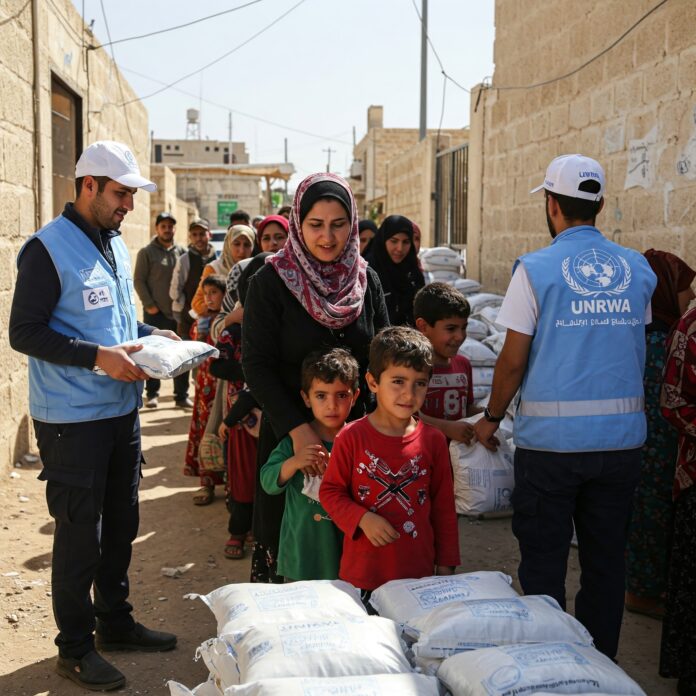
Israel’s UNRWA ban went into effect on Jan. 30 but has been only partially implemented. That worries activists and Knesset members involved in the effort to shutter the terrorism-linked U.N. agency.

To help ensure the law is applied, Likud MK Dan Illouz, who sponsored one of the two bills to bar UNRWA (full name the United Nations Relief and Works Agency for Palestine Refugees in the Near East), formed the Knesset Lobby for Closing UNRWA. It held its first meeting on Feb. 20.

“We know and have experience that very often laws that are enacted in the Knesset are not necessarily applied,” Illouz told JNS.

Possible threats to the laws’ implementation aired at the lobby’s meeting included High Court interference and attempts by Israeli businesses enjoying commercial ties with UNRWA to sabotage the law.

The two bills, passed into law on Oct. 28, merged four separate private bills. “They were all put together and translated into two historic laws that are meant to put an end to UNRWA’s effective presence in any area controlled by Israel,” Illouz said.

The first law prohibits UNRWA from “operating any representative office, providing any service, or carrying out any activity, directly or indirectly, in the sovereign territory of the State of Israel.”

The second law prohibits any Israeli authority or public servant from dealing with UNRWA. “A government authority, including other bodies and individuals performing public duties according to law, shall not have any contact with UNRWA or anyone acting on its behalf,” the legislation states.

“These two laws together make it almost impossible for UNRWA to continue acting long-term in Israel,” Illouz said.

The key is making sure they are fully enacted. He noted that a mechanism is built into the laws requiring the Foreign Affairs and Defense Committee to meet every three months to track the enforcement progress. However, those meetings will be mainly closed-door, leading Illouz to form the lobby.

“There’s a lot of knowledge in what we call in Israel the civil sector—NGOs and the like. I wanted this lobby to be a platform in which those organizations could share their findings with members of Knesset,” he said.

Opening the first meeting, Ilouz reviewed why UNRWA needed to go. “UNRWA not only teaches terrorism, it participates in it. UNRWA not only teaches children to murder, it lets Hamas use its schools for weapons storage,” he said.

‘Failed in its duty’

Several activists addressed the lobby session, which became heated at times. Noga Arbell, a public policy analyst who helped shape the legislation, lashed out at the government, including Illouz, for tarrying in its effort to close UNRWA’s operations.

“UNRWA could have been closed without the law. The Israeli government has all the authority. It is the sovereign. Our government has failed in its duty to protect the public from the threat that is UNRWA,” she said.

“Also, scheduling follow-up every three months … it’s not serious. Do you want to apply the law? Then meet every week and ask what you did today to close UNRWA. It shouldn’t take three months. In three months, there shouldn’t be a trace of this thing here,” Arbell said.

She also criticized the Foreign Affairs and Defense Committee for holding its meetings behind closed doors, something that was without justification according to the Knesset’s own criteria for confidential hearings, she said.

Illouz defended MK Yuli Edelstein, chairman of the Knesset Foreign Affairs and Defense Committee, noting he was a “full partner” in the mission to shut down UNRWA.

Aharon Garber, deputy director of the law department at the Kohelet Policy Forum, a Jerusalem-based think tank, warned of the possibility of interference by the High Court of Justice.

Garber noted that while the court had rejected a petition by two radical NGOs, Adalah—The Legal Center for Arab Minority Rights in Israel and Gisha—Legal Center for Freedom of Movement, requesting that it issue an injunction suspending the laws’ implementation, it didn’t reject the appeal outright, leaving the possibility that it would intervene at a later date.

“There’s still a chance the court could reject the laws. I don’t envision that will happen because those laws passed with a huge majority,” Illouz said. The laws passed 92-to-10.

“It would be unprecedented because of the subject matter, which is foreign policy,” Illouz added. “Unfortunately, the court has done unprecedented things many times in the past and so it’s always something we have to watch out for.”

MK Yulia Malinovsky of Yisrael Beitenu, an opposition party, co-sponsored the law with Illouz. She also criticized the government’s failure to implement the laws in full, tweeting on March 10 slamming six coalition ministers, among them Minister of Energy and Infrastructure Eli Cohen, for not cutting power to UNRWA buildings, and Minister of Finance Bezalel Smotrich for not closing UNRWA’s Israeli bank accounts.

Illouz said that Malinovsky, as a member of the opposition, would naturally focus on the government’s failures. Still, he admitted, “We have to say she’s right. We have to get to 100%. But to focus only on the 20% that hasn’t been done is unfair. This government has passed a historic law, and it’s on the right track to implement it.”

David Bedein, director of the Jerusalem-based Center for Near East Policy Research, who has spent 35 years warning about UNRWA, said that Israeli business interests also may try to torpedo the legislation.

“There are 450 Israel corporations that operate in Judea, Samaria and the Palestinian Authority,” Bedein told JNS.

“These corporation have a de facto monopoly providing supplies to the P.A. and UNRWA facilities. For example, Dor Alon [an Israeli energy company] has a monopoly on providing gasoline inside UNRWA and the P.A. These companies don’t want anyone to mess with that,” he said.

“We’re looking into the things that David has brought up,” Illouz said. “It’s too early to say, but I tend to trust David because he’s been right on this subject for years.”

Bedein also expressed concern that “State of Israel” will be defined down. “From my point of view, ‘within Israel’ includes all of Judea and Samaria. However, certain politically correct people say otherwise. It’s a crazy interpretation but people have interpreted this law to only apply to pre-’67 Israel.”

Defining Israel’s borders

Juliette Touma, UNRWA’s director of communications, certainly sees it that way. “There is a difference between how we define in the United Nations the borders of the State of Israel and how Israel defines it. Because for the U.N., east Jerusalem is occupied territory and so we treat it as such.”

Touma said the laws barring UNRWA definitely have impacted operations. The agency’s employees are no longer working from UNRWA’s Jerusalem headquarters, which is responsible for Judea and Samaria—what she refers to as “the occupied West Bank, including East Jerusalem”—as their visas have expired. Some have gone to Jordan while others returned to their home countries to work remotely.

UNRWA has hired a security service to guard the building “but we don’t have international staff in it now because we don’t have visas,” she said. “And our local staff are understandably absolutely terrified. We’ve had several incidents of local staff being summoned by the police.”

Otherwise, UNRWA’s services in Jerusalem continue. “Two areas of focus are our schools that have 50,000 boys and girls, and also our primary healthcare clinics,” she told JNS. “However, since the law came into effect, there have been several attempts to close some of our facilities down.”

A small number of international staff remain in Gaza, the location of UNRWA’s main headquarters. Their focus is on humanitarian aid, she said.

UNRWA remains in the dark as to its future. “We’ve not received any communication from the State of Israel on how they plan to implement these two laws,” she said.

The biggest challenge is the law barring Israeli officials from communicating with the agency, Touma said. “What it means is that we’re not receiving any resources from the Israeli authorities; that we’re not able to call them as we used to.

“We also face a huge disinformation campaign and labeling campaign that bullies our staff, that refers to our staff as terrorists, and that links each and every single person who works for the agency, regardless of where they work, regardless of whether they’re local or international, as Hamas, or Hamas-affiliated, or terrorist-affiliated, and that’s harmful,” she added.

UNRWA continues to refer to Israeli revelations about the agency’s terrorism ties as “disinformation,” but the U.N.’s Office of Internal Oversight Services (OIOS) confirmed that Israeli claims about the involvement of UNRWA employees in the Oct. 7, 2023, massacre were true.

Israel also uncovered “deep and systemic infiltration” by terrorist organizations, especially Hamas, into the ranks of UNRWA.

Illouz said that UNRWA has gone on a worldwide sympathy campaign, describing “how bad things are for it on the ground in order to try and get more money.”

His advice to the international community: ignore it. “The international community’s budget would be much better served investing in recognized international organizations that haven’t been infested with terrorism,” Ilouz said.

Bedein said anyone with lingering doubts about UNRWA should just look at its curriculum, which advocates for the “right of return” for descendants of Arab refugees and indoctrinates children to commit violence.

Despite his concerns, Bedein is optimistic that the agency will be closed. “Hundreds of IDF soldiers in Gaza saw UNRWA’s facilities stocked with weapons and ammunition. It’s no longer a theoretical problem,” he said.

‘There Are No Lone Wolves’: Ayaan Hirsi Ali Dismantles the New Popular Narrative on Islamic Terrorism

Author and public intellectual Ayaan Hirsi Ali is warning about the threat that Islamist activist organizations pose to the U.S. and the broader Western world.

Speaking at National Review Institute’s Ideas Summit on Thursday, Ali pushed back on the popular “lone wolf” narrative used to explain recent acts of Islamist terror, like that perpetrated on Bourbon Street in New Orleans earlier this year, arguing instead that terrorism is one tactic used by a global Islamist network that is pursuing a broader, unrecognized strategy.

That network, Ali argued, advances its goals by infiltrating American institutions and spreading its propaganda through ostensibly nonviolent Islamist activist organizations, which provide cover for violent terrorists.

“There are no lone wolves,” Ali declared.

“So now you have the nonviolent Islamization process that is overseen by groups like the Muslim Brotherhood that is international and universalist in its approach. And then you have the military offshoots of the Muslim Brotherhood like ISIS and al-Qaeda and Hamas engaging in this strategic violence,” she explained.

“That’s a well-thought-through strategy that fits very well into one another, and we underestimate it because we talk about ‘lone wolves.’ We try to chase terrorism across the world. We allow them to establish this great infrastructure for Islamizing, for creating that pipeline through nonviolent means in America and in Europe. We are stupid and they are smart.”

Hirsi Ali’s comments came in response to a question from NR Senior Writer Noah Rothman about the Islamist terrorist who drove a car through a crowd of New Year’s Eve revelers, killing 14 and injuring many more. The perpetrator, a 42-year-old Army veteran, flew an ISIS flag in window of the pickup truck he used in the attack. He converted to Islam years before the attack and attended a mosque near his home in Houston.

In the wake of the attack, many commentators described the attacker as a “lone wolf” who had likely been radicalized online, free from the influence of major Islamist organizations. That explanation, Ali argued, discounts the broad reach of the Islamist movement.

As a former Muslim and Dutch-American Somali refugee, Ali speaks from a position of personal familiarity with radical Islam.

After fleeing Somalia, Ali became an outspoken atheist and rose to prominence for her critique of radical Islam, which drew upon her experience of oppression growing up in Somalia. Ali remains a critic of Islam and strains of left-wing ideology as a fellow at Stanford University’s Hoover Institution.  She converted to Christianity in 2023 after concluding that the faith is necessary for preserving Western civilization.

During the Thursday panel, Rothman also asked Ali about the marriage of convenience between Islamist and progressive ideologies seeking to put an end to American hegemony. Ali laid out how those ideologies emphasize the need to infiltrate American institutions and mentioned a Muslim Brotherhood document outlining the strategy. It was crafted in 1991, and over 30 years later, the Islamists have succeeded in developing an infrastructure within the U.S. and maintaining ties with immigrant communities.

The ideological fusion Ali described can be see on American college campuses, in academic departments and radical campus activist organizations. Anti-Israel protests broke out across college campuses last year during Israel’s multifront war in the Middle East, and many of demonstrators embraced a critique of the U.S. as a racist, colonialist project, drawing on strains of Islamist and radical left-wing thinking.

The Trump administration is combating the outgrowth of antisemitism on college campuses with civil rights investigations into dozens of colleges for antisemitic harassment. The White House’s task force on antisemitism has already cut $400 million of grants from Columbia University because of its high-profile tent encampment and the broader issue of antisemitic student activists and faculty on campus.

Unmasked yet again

Purim is hardly over, and the true faces of the haters and loathers have already been revealed.

Michael Kuttner

Not so long ago, it was considered best to hide behind a mask and express slanderous incitement against Jews anonymously. Those days are now well and truly gone. Instead, we face openly expressed verbal and physical violence of the most pernicious kind.

The responses to this tsunami vary from genuine shock to bored indifference. The setting up of more commissions and committees is an exercise in futility. The perpetrators know this and that is why they are not deterred. Increases in punitive penalties sound great, but unless they are actually enforced by the police and judiciary, they also are mere window dressing.

As has been mentioned on more than one occasion, the introduction of the compulsory teaching of Holocaust studies in high schools would be a critical first step. Today, a generation of teenagers graduate from high schools without the faintest idea or knowledge about what Jew hate is all about and without the ability to counter this scourge.

Proof that ignorance about the Shoah years is rampant was provided in a news report that surfaced this week. A 16-year-old student in the USA who is a bright individual, a great sportsman and level-headed was caught drawing a swastika. It transpired after close grilling that this guy had no idea what the swastika represented, its sinister meaning and how it factored into the story of the Nazi period. In fact, on further probing, he admitted that he knew nothing about those years, had never met a Jewish person and even had no idea who Hitler was.

When faced with the actual facts, he was aghast. Instead of punishing him, the enlightened authorities decided that a far better course of action would be to have him mentored by a Rabbi. This proved to be an astounding success, and this young man not only now realizes how fatal his previous ignorance had been but now feels he is much better equipped to counter hate and incitement against Jews.

It is obvious that the sooner youngsters are exposed to the truth and learn about historical events the better. Prattling politicians who peddle useless panaceas should be told that the first step must be an inoculation of knowledge, especially during formative teenage years.

The continued refusal to implement this is a scandalous situation. A demand for immediate action should be at the top of the agenda. Now is the time to act with Yom Hashoah fast approaching and the usual annual and banal political rhetoric about to be unleashed.

This year, the knee-jerk Israel haters at the UN did not wait for Purim to end before firing off the latest volley of anti Israel resolutions and accusations. In fact the festivities had not even commenced as the misnamed UN Human Rights Council trundled out its knee-jerk condemnations.

Once again, Israel is accused of further “war crimes” in Gaza. This time around, according to the fetid minds of delegates on the Council, the heinous Israelis are “destroying the reproductive capacity of the Palestinians in Gaza.”  Once upon a time,e Jews were accused of poisoning wells and killing Christian babies in order to make unleavened bread for Passover. This updated version has Jews deliberately destroying IVF clinics in an alleged devilish plot to prevent Palestinian babies from being born.

Nobody, of course, questioned why Hamas terrorists hide in hospitals and clinics and embed themselves among civilians. It’s much easier and more convenient to target Jews with outlandish libels. The brain-addled masses and the media can always be relied upon to spread these mistruths, knowing full well that once unleashed, they will take off.

Meanwhile, real and horrific war crimes are being committed in Syria, Iran, Sudan and parts of Africa without attracting any resolutions of censure from the UN and its associated corrupt institutions. The old adage that if it doesn’t involve Jews, it’s not news holds true.

In actual fact, the persecution of Christians in parts of Africa by jihadist fanatics has reached epidemic proportions. The silence of Church leaders in the face of this Islamic onslaught has been highlighted by the Chief Rabbi of South Africa. In a hard-hitting video, he denounced the hypocrisy of the South African Government and the resounding silence of Churches. This mass refusal to confront the rising tide of jihadist violence and murder against Africa’s Christians is scandalous.

The contrast between the selective outrage at each and every Israeli act of self-defence and the cowardly silence in the face of real jihadist genocidal actions exposes the realities behind the masks.

Recently, apologists for Palestinian Arab President Abbas lauded his supposed decision to stop “pay for slay” stipends to murderers of Israelis. Those not mesmerized by appeasement mirages knew that his declaration was merely designed to avert pressure from the US Administration. Lo and behold, it has just been revealed by Palestine Media Watch (PMW) that the Ramallah-based kleptocracy has paid out February’s instalment. In other words, as predicted, nothing has changed.

Needless to say this ongoing charade has attracted no attention from the world’s media or the UN Human Rights Council.

In what could qualify for the top prize in any Purim “shpiel”, the Russian Foreign Minister has demanded that the US cease its military action against the Houthis and instead engage in “dialogue.” Coming from the representative of a country that invaded Ukraine and continues to attack its territory, this piece of chutzpadik advice is hypocrisy in full bloom.

Time and again, those who suffer from the genetic defect of self-loathing manage to unmask themselves and reveal their true agendas.

They masquerade as anti-Zionists and protest that the return to Zion has nothing to do with Judaism. Whether adherents of Haredi sects awaiting the messianic age or disaffected individuals with an extreme secular left axe to grind, they are all united in hating the resurrected Jewish nation.

Just when one thinks that these groups and individuals can’t sink any lower, they manage to demonstrate that, indeed, it is possible to plumb new depths.

Four incidents this past week illustrate how easy it is for real intentions to be unmasked.

Popping out of the woodwork just in time for Purim were the opinions of several loathers, primarily in the USA, who condemned the celebration of this Jewish anniversary. Their general theme was to denigrate the Purim episode because “it celebrated retribution by Jews against Persians.” Stripped down to its bare meaning, their message of how Jews fought back and defended themselves against genocidal designs is intrinsically evil.

The corollary of these confused and ashamed Jews is, therefore, easily transferred onto today’s Jews/Israelis who are fighting back against terror schemes. It takes sick minds to twist the Purim story this way, but that is what passes for blind anti-Zionist/Israel paranoia. How else does one explain the establishment in the US of “anti Zionist” places of worship where so-called spiritual leaders propagate the belief that Israel has no connection to Judaism?

The second incident was the antics of those such as the misnamed “Jewish Voice for Peace” who invaded the lobby of a Trump hotel and who demonstrated against deporting foreign agitators who lead anti Israel/Jewish riots at universities. It never ceases to amaze when one sees rioting Jews defending the rights of Hamas and terror supporters while they remain mute when Israelis/Jews are massacred by these same groups. The media love the sight of these loathers with their masks and keffiyehs. They make great visual headlines, especially when they are besmirching Zionists.

The third “shande” (Yiddish for disgrace) was a viral video of Haredi youth at a wedding in Israel of a fellow Yeshiva student, singing and dancing against the IDF and defending the country. Urged on by the Yeshiva head and father of the Chatan (groom), this mass display of self-loathing for the very country that pays their stipends and supports their institutions caused a massive reaction of revulsion by all who viewed the video.

The fourth example of unhinged loathing was revealed in a report from the New York Post.

A Hollywood actress, Debra Winger, declared to Al Jazeera during an anti-Trump protest in New York that she has “a debt to pay” for having been born Jewish. “I was brought up Jewish with a lot of things that were untrue. I had to unlearn them and it’s taken a lot of years. I have a debt for what I grew up with and believed on what the State of Israel has done and what they haven’t done and how they are conflating Judaism with Zionism.”

In case her convoluted message was not clear enough, she rejected the idea of Israel as a Jewish homeland and added that she considered the US Administration as a fascist regime.

This is not the first time that so-called Jewish Hollywood elites have been unmasked as ignoramuses about Israel and Judaism.

We have been inflicted with these types throughout our long history.

The best response is to expose them and make sure that their warped narratives are countered.

Eli Sharabi’s full address at the United Nations

Eli Sharabi’s full address at the United Nations today. He survived 491 days of Hamas captivity in Gaza, and with remarkable resilience and strength, he shared his story with the world. Upon being released from captivity, he learned the heartbreaking news that his wife, Lianne, and their two daughters, Noiya and Yahel, were murdered by terrorists on October 7, 2023.


Douglas Murray Notices Something BIZARRE About The Israel-Hamas Ceasefire NO ONE Else Saw

Douglas Murray Exposes the lies against Israel for Attacking Hamas.

Grim Lessons From Phase One of the Israel-Hamas Deal

Last week marked 17 months since, under the cover of thousands of rockets it rained down on civilian communities in southern Israel, Iran-backed Hamas in Gaza launched a savage invasion of the Jewish state. On Oct. 7, 2023, the jihadists killed some 1,200 persons, mostly civilians, among them more than 30 Americans, and kidnapped 251 persons, mostly civilians, among them as many as 12 Americans.

By means of its surprise attack, Hamas’ Gaza branch sought to draw Hamas in Judea and Samaria and Iran-backed Hezbollah in Lebanon into a multi-front war aimed at crippling and ultimately destroying the Jewish state. Instead, by November 2024 Israel had inflicted heavy losses on both Hamas and Hezbollah and, with precision air strikes, had severely degraded Iran’s air defenses and destroyed Tehran’s ability to produce ballistic missiles.

Yet Gaza remains a battlefield and a nightmare. Despite Israel’s extraordinary military accomplishments, Hamas still stands, and the jihadists have exploited the ceasefire that went into effect on Jan. 19 to recruit, rearm, and prepare for renewed fighting. Meanwhile, Israel continues without a concrete plan for dealing with Gaza’s approximately 2 million Palestinians once major military operations end.

President Donald Trump’s radical plan is not concrete, and the administration has not offered a clue about its implementation. On Feb. 4, at a televised White House press conference with Israeli Prime Minister Benjamin Netanyahu, the president startled many of his own senior staff, caught Netanyahu off guard, aroused indignation among Europeans, and rattled America’s moderate Arab partners. In front of the world, the president affirmed a more extravagant version of the idea of moving 2 million Palestinians from Gaza – so that the 50,000 tons of rubble produced by the war could be removed and the territory’s infrastructure could be rebuilt – than the one he first raised in a Jan. 25 telephone conversation with Jordan’s King Abdullah II. Trump’s staff defended the proposal, Netanyahu pocketed it, Europeans scoffed at it, and America’s moderate Arab friends and partners unequivocally rejected it.

Within two weeks, despite – or because of – Trump’s grandiose plan to displace Gaza’s 2 million Palestinians and construct there a “Riviera of the Middle East,” Egypt announced that it was working on its own plan to rebuild Gaza. The Egyptian proposal takes for granted that Palestinians will stay put and that even if they wanted to leave, other moderate Arab states, starting with Jordan and Saudi Arabia and very much including Egypt, won’t take them in.

On March 4, at an Arab League summit in Cairo, “Arab leaders adopted a five-year Egyptian reconstruction plan for Gaza,” according to the Times of Israel, “that would cost $53 billion and avoid displacing Palestinians from the enclave.” The plan envisaged the eventual handover of Gaza to the Palestinian Authority but left unclear Hamas’ role. Hamas promptly welcomed the Arab proposal. On March 6, Israel and the United States rejected it.

Meanwhile, as of March 1 when the Israel-Hamas deal’s first phased ended, 33 Israeli hostages had been released, eight of them dead, in exchange for around 2000 Palestinian prisoners, many with blood on their hands. Hamas continued to hold 59 hostages, of whom 32 Israel believes to be dead.

Discussions about the second phase, which would have included Israel’s withdrawal from Gaza and the end of the war in exchange for Hamas’ release of the remaining hostages, never commenced. Israel accepted and Hamas rejected United States Special Envoy to the Middle East Steve Witkoff’s proposal for Israel to extend the phase-one ceasefire through Ramadan (Feb. 28-March 29) and Passover (April 12-20) and for Hamas to release all remaining hostages. In the absence of an agreement, Israel stopped aid to Gaza and considered resuming military action “to pressure the terror group into making further concessions.”

As Israel determines whether to return to the negotiating table or the battlefield, it grapples with the anguish stemming from the nation’s bargain with the devil. Israelis will not forget – they have trouble pushing to the periphery of their hearts and minds – the ghoulish spectacle Hamas made of the hostages’ return. The jihadists paraded abductees on stages in Gaza, turned over emaciated kidnap victims, and sent back in coffins to Israel the brutalized bodies of three members of the Bibas family – mother Shiri, and sons Ariel, who was four, and Kfir, who was not quite nine months old, when Hamas ripped them from their homes.

In “The Untold Story: How We Lost in the Negotiations Despite the Military Victory in Gaza,” Eyal Tsir-Cohen acknowledges the “great happiness steeped in anxiety and sadness” with which Israelis have experienced the ceasefire and hostages’ return. He nevertheless urges his fellow citizens to look beyond the here and now, the assignment of blame for the October 7 massacres, and the imperative to return the remainder of the hostages. A former member of Israel’s hostage-negotiation team, Tsir-Cohen brings the big picture into better focus by examining where the Jewish state went wrong in the Hamas negotiations. An improved understanding of Israel’s mistakes, he argues, enhances the nation’s grasp of, and ability to counter, the looming threats.

Four “erroneous working assumptions,” maintains Tsir-Cohen, led Israel to overestimate its capabilities.

First, Israel’s political echelon and defense establishment wrongly assumed in the winter of 2024 that Israel military force would in the coming months swiftly and decisively weaken Hamas’ senior leadership. Notwithstanding Israel’s killing of Marwan Issa (deputy commander of Hamas’ military wing) in March 2024, Mohammed Deif (Hamas military chief) in July 2024, and Yahya Sinwar (top leader of Hamas in Gaza) in October 2024, much of Hamas’ core leadership fled underground – literally – and survived. This substantially diminished Israel’s ability to dictate terms at the negotiating table.

Second, Israel’s political echelon and defense establishment wrongly assumed that intensified fighting and mounting death and destruction in Gaza would open a rift between Hamas and the rest of the Palestinian population that would impel the people to drive out the jihadists. The error sprang from the belief that Gazans are Hamas’ passive victims, prisoners of a fanatical terrorist organization. Too few on the Israeli side appreciated how thoroughly Hamas’ jihadist spirit is woven into the fabric of Palestinian society and how tightly it is bound up with Gazans’ identity. Add to that massive humanitarian aid flowing to Gaza during the negotiations – some 250 trucks a day – and a population whose median age is 19.5 years, and Hamas’ replenishment of its ranks with young and willing Gazan recruits ceases to baffle. “In Gaza in 2025,” writes Tsir-Cohen, “there is truly no bottom to the barrel of terror.”

Third, Israel’s political echelon and defense establishment wrongly assumed that if military pressure compelled Hamas to come to the negotiating table, Qatari and Egyptian mediators would persuade the jihadists to compromise. But, observes Tsir-Cohen, “Already by February 2024, it had become clear that even if the mediators’ heads were in the West, their hearts remained in the Middle East.” The Qataris and Egyptians operated with a cool and calculating professionalism, taking no sides between Hamas who wished to destroy the Jewish state and the Israelis who wished to survive and thrive. Qatar’s two-facedness is well known, hosting both Hamas leadership in Doha luxury hotels and American forces at Al Udeid Air Base, “the largest US military installation in the Middle East.” But Egypt’s refusal to take Israel’s side despite Cairo’s dislike of Hamas – the Palestinian branch of Egypt’s enemy, the Muslim Brotherhood – should be a stinging reminder that unlike the logic of politics elsewhere, the enemy of one’s enemy in the Middle East is not necessarily one’s friend.

Fourth, Israel’s political echelon and defense establishment wrongly assumed that the Israeli government’s excruciating 47-minute film documenting Hamas atrocities – featuring footage shot by the jihadists’ GoPro cameras – would shock consciences worldwide, compelling nation-states around the globe to stand by Israel and encourage it to demolish Hamas. This, according to Tsir-Cohen, is the most painful error, and it derives in part from overestimating the Biden administration. From January 2024 a procession of intellectuals and diplomats, foremost among them from the United States, visited Israel, writes Tsir-Cohen, “with one question: ‘When will you Israelis withdraw from your positions and terminate the war?’” The Biden administration was hardly alone in deploring Israel’s refusal to put the cessation of hostilities ahead of defeating Hamas. “It is difficult to exaggerate the intensity, the frequency, and the urgency of the cries of pain of our allies,” reports Tsir-Cohen. Hamas heard those cries and drew the obvious conclusion. The Gaza jihadists realized that they needn’t agree to painful compromises because even Israel’s friends, despite the seven-front war that Iran was waging against the Jewish state, put the pressure for major concessions on Israel.

These grim lessons for Israel – about Hamas leadership’s elusiveness, Hamas’ power over Gazan hearts and minds, moderate Arabs’ ambivalence, and international public opinions’ cluelessness or rottenness – ought also to inform Trump administration thinking about the Jewish state’s strategy and Gaza’s future.

Peter Berkowitz is the Tad and Dianne Taube senior fellow at the Hoover Institution, Stanford University. From 2019 to 2021, he served as director of the Policy Planning Staff at the U.S. State Department. His writings are posted at PeterBerkowitz.com and he can be followed on X @BerkowitzPeter.

New Investigation Exposes UN Agency’s Shocking Ties to Terror Groups

A bombshell new investigation from international human rights group UN Watch exposes the disturbing links between the UNRWA and Palestinian terror organizations. According to the report, Hamas and Palestinian Islamic Jihad have not only infiltrated the $1.5 billion UN-funded agency but are actively influencing its operations and fueling violence against Israelis.

The explosive findings reveal that UNRWA has employed Hamas militants, allowing the terror group to interfere with key agency policies and operations in Gaza and Lebanon.

UN Watch is calling for the immediate dismantling of UNRWA, saying the organization has become a conduit for terrorism and a facilitator of violence in the Middle East.

“UNRWA isn’t just a bystander in the Arab-Israeli conflict – it’s a primary enabler,” observes Hillel Neuer, Executive Director of UN Watch.  “By allowing terrorists to infiltrate its ranks and incite violence, UNRWA isn’t promoting peace, they’re perpetuating hatred and war.”

The report includes images of terror leaders with UNRWA officials, and details years of instances where leadership of the UN agency closely cooperated with terror groups in secret.  The report implicates many members of UNRWA leadership, including current-UNRWA Commissioner-General Philippe Lazzarini.

“People need to understand that UNRWA isn’t the firefighter, it’s the arsonist.  The U.S. and other Western nations who have given billions to UNRWA need to wake up.  Your money is being used to employ terrorists, indoctrinate children, and build the infrastructure of hate and violence.  The U.S. alone has given more than $1 billion to UNRWA over the past four years.  This is a betrayal of your taxpayers and your values.”

“The time has finally come to dismantle UNRWA, an agency that glorifies terrorism,” said Neuer.

______________

Read Full Report: The Unholy Alliance: UNRWA, Hamas, and Islamic Jihad 

An investigation into the secret ties between terrorist organizations and the UN’s largest aid agency

Executive Summary

This report reveals how UNRWA, despite its claims to be a humanitarian agency, has forged an unholy alliance with Hamas, Palestinian Islamic Jihad, and other terrorist organizations. This secret relationship allows the terrorist organizations to significantly influence the policies and practices of a UN agency with 30,000 employees, and a $1.5 billion annual budget that is funded primarily by Western states.

The report shows how UNRWA’s international officials, and its senior local managers, routinely meet with terrorist groups in Lebanon and Gaza, mutually praise each other for “cooperation,” and describe each other as “partners.”

The terrorist groups frequently make demands of UNRWA and influence its decisions. Moreover, when the terrorists oppose specific actions by UNRWA— such as the introduction of biometric IDs for beneficiaries of UNRWA financial assistance, an ethics code affirming LGBT rights, or suspension of employees for promoting terrorism—the terrorist groups are often able to foil implementation, including by issuing threats.

Examples of the UNRWA-Terrorist Alliance

Examples of the UNRWA-terrorist alliance, documented in the report below with 68 photos obtained from open sources, include:

  • UNRWA Commissioner-General Philippe Lazzarini made a deal with Jihadi terrorist groups, at a Beirut meeting in May 2024, by which UNRWA allowed Hamas leader Fathi Al-Sharif to remain as principal of a major UNRWA school, and as the head of the UNRWA Teachers Union. For years, Al-Sharif had openly glorified Hamas terrorist attacks, including on his Facebook page, and published photos of his fraternization with heads of terrorist organizations. Contrary to its claims of robust neutrality mechanisms, UNRWA for years allowed Al-Sharif to occupy a senior position overseeing thousands of UNRWA teachers and students. Only when a formal complaint was made to UNRWA by a government, in early 2024, did the agency give Al-Sharif a slap on the wrist by suspending him. Immediately, Hamas and other terrorist groups responded by effectively shutting down UNRWA in Lebanon, mobilizing massive protests by UNRWA teachers and students. Three months into the shutdown, Lazzarini flew to Beirut and met with the alliance of terrorist organizations who were behind the strike. Local media reported on June 1, 2024 that Lazzarini and the terrorist groups reached “understandings” that would lead to a “positive” result for Al-Sharif, and the strike was called off. On September 30, 2024, Al-Sharif was eliminated by an IDF missile. Hamas announced that indeed he had been their leader in Lebanon, and eulogized the senior UNRWA figure for his “Jihadi education.”
  • Former UNRWA Commissioner-General Pierre Krahenbuhl met with terrorist leaders from Hamas and Palestinian Islamic Jihad, in February 2017, where he emphasized the “spirit of partnership” between them and UNRWA. He invited the terrorist leaders to privately challenge any UNRWA decision which he could then change or “tear up.” The head of UNRWA urged the Jihadi terrorist groups to ensure that their “discussions not be made public” so as to avoid harm to UNRWA’s “credibility.” Mr. Krahenbuhl, who was forced to leave UNRWA in 2019 due to a corruption and sexual abuse scandal, was this year absurdly appointed to head the International Red Cross, prompting a sharp protest by 17 members of the United States Senate.
  • Likewise, in June 2022, current UNRWA chief Lazzarini stressedthe importance of “partnership” with Gaza terrorist groups. He met regularly with Gaza terrorist groups under the umbrella of the “Joint Refugee Committee,” which is headed by Mahmoud Khalaf, a member of the central committee of the Democratic Front for the Liberation of Palestine (DFLP), designated as a terorrist organization by the United States and the European Union.
  • Matthias Schmale, the former UNRWA director in Lebanon, addressed a Hamas rally in August 2018 alongside Ali Baraka, one of six Hamas terrorist leaders indicted in September by the US Department of Justice, as the latter told the crowd that donor states must support UNRWA “until we return to Palestine.” Schmale thanked the terrorist groups “for their understanding” and reassured them that UNRWA is on their side. In October 2020, now serving as UNRWA Director in Gaza, Schmale met with the Joint Refugee Committee headed by DFLP official Mahmoud Khalaf, to discuss “the problem of forcibly dismissed employees.” In numerous such cases, local UNRWA staff suspended for links to terrorism were reinstated under pressure by the terrorist groups.
  • Former Deputy Commissioner-General Leni Stenseth personally went to Gaza, in June 2021, to kowtow before Yahya Sinwar, the Hamas terror chief who masterminded the October 7th massacre. Hamas had been angry with UNRWA after its then Gaza Director Matthias Schmale, an ardent supporter of the Palestinian narrative, unwittingly admitted in a TV interview that Israeli strikes on Hamas, during the May 2021 war, were “very precise.” The interview was widely shared by supporters of Israel. Outraged, Hamas declared Schmale a persona non grata, and orchestrated mob protests to threaten him. Stenseth obediently removed Schmale from his post, throwing him under the bus to appease Sinwar, and called Schmale’s interview “indefensible.” She went to visit Sinwar in Gaza to personally thank him “for his positivity and desire to continue cooperation in facilitating the agency’s work in the Gaza Strip.” Stenseth is now Director-General of the foreign ministry of Norway, UNRWA’s most ardent state supporter. Stenseth uses her current position to fund groups that lobby for UNRWA, such as the Chr. Michelsen Institute, which was unethically chosen to conduct the “independent review” of UNRWA led by Catherine Colonna.
  • UNRWA Lebanon Director Dorothee Klaus shared a stage with the leader of Hamas in Lebanon, Fathi Al-Sharif, was as noted above was also an UNRWA school principal and head of the UNRWA Teachers Union. At the event, before a cheering crowd, Al-Sharif proclaimed his support for “the resistance.” Ms. Klaus did not object.
  • UNRWA managers have participated at an annual Hamas conference which discusses internal UNRWA affairs such as employee vacancies and UNRWA Teachers Union elections. At the 2021 conference, Hamas offiical Ahmad Abd Al-Hadi announced the launching of a joint committee to “supervise the relationship with UNRWA and ensure it implements its obligations.”
  • In February 2018, UNRWA Program Director in Lebanon Gwyn Lewis met with Hamas official Ahmad Fadl, and they agreed on “ongoing cooperation and coordination.”
  • UNRWA regional directors routinely meet with local terrorist leaders for “cooperation and coordination.” At a November 2017 meeting, they told UNRWA’s Sidon Director Fawzi Kassab that UNRWA must exist until Palestinian refugees “return to their homes” and threatened that if donors do not continue funding UNRWA, the Palestinians will start a “popular revolution.”
  • In February 2022, UNRWA Lebanon Director Claudio Cordone, the former acting chief of Amnesty International, visited Ain Al-Hilweh camp to meet with a coalition of terrorist groups, including Hamas, Islamic Jihad, and Ansar Allah. The terrorists told Cordone that the Palestinian issue in Lebanon is “a political issue and cannot be reduced to a humanitarian or security issue.” Likewise, in January 2018, Cordone met with Hamas official Ahmad Abd al-Hadi who affirmed that the terrorists support UNRWA because it “remains a living witness to the 1948 Nakba.” Contrary to what the world is told, UNRWA’s main purpose is not humanitarian aid, but rather to promote the narrative that Israel’s creation was an “injustice” and that the Palestinians will one day dismantle Israel.
  • In February 2017, UNRWA Lebanon Director Hakam Shahwan told terrorist leaders that UNRWA was “fully prepared” to have “a strong partnership mechanism” with them, so long as the partnership should not reach a stage “where some believe that we are partners in decision-making.”

Conclusion

This report reveals how UNRWA’s senior management not only knowingly employ individuals tied to Hamas terrorism, but also allow the terrorist groups to influence critical agency decisions and policies.

Through uncovered photographic evidence, the report exposes the close relationship top UNRWA officials have with designated terrorist organizations.

Current and former UNRWA officials with terrorist ties included in the report are:

  • UNRWA Commissioner-General Philippe Lazzarini (2019-present)
  • UNRWA Commissioner-General Pierre Krähenbühl (2014-2019)
  • UNRWA Director-General in Lebanon Dorothee Klaus (2023-present)
  • UNRWA Director-General in Lebanon Claudio Cordone (2017-2022)
  • UNRWA Deputy Director of Programs in Lebanon Gwyn Lewis (2015-2018)
  • UNRWA Director-General in Lebanon and Director of Operations in Gaza Matthias Schmale (2015-2021)
  • UNRWA Director-General in Lebanon Hakam Shahwan (2016-2017)
  • UNRWA Gaza Director Thomas White (2021-2024)
  • Acting UNRWA Director-General in Lebanon Munir Manna (2023)
  • UNRWA Director-General in Lebanon Ann Dismorr (2012–2015)
  • UNRWA Deputy Commissioner-General Leni Stenseth (2020–2023)
  • Numerous UNRWA Regional Directors in Lebanon