For Ilhan Omar, not all foreign influence spending is bad

During her time in Congress, Rep. Ilhan Omar (D-MN) has frequently voiced concern over the influence of foreign interests on American politics — most controversially with regard to the pro-Israel community in the U.S.

But when she visited Qatar last November to watch the World Cup, it was unclear who had paid for the trip, which the progressive lawmaker neglected to clarify. Her office did not answer questions from The New York Times in December about the funding source after she had returned.

It turns out that the trip was funded by the Qatari government, according to an annual House financial disclosure filed in May. The new statement, which has not previously been reported, shows Qatar paid for the four-day visit to Doha that overlapped with the U.S. men’s team’s opening match against Wales. Both “food” and “lodging” were covered by the Gulf nation, the disclosure indicates.

The Qatari Embassy in Washington, D.C., confirmed it had paid for Omar’s visit to the Gulf kingdom last year. The congresswoman “accepted an invitation from the Embassy of Qatar to attend events in Doha in November 2022,” a spokesperson told Jewish Insider last week, “as part of a program authorized under the Mutual Educational and Cultural Exchange Act,” or MECEA, which allows House members to take trips funded by foreign governments provided that the travel is later disclosed in their annual financial statements.

The embassy did not share an exact figure for the cost of the trip, which was not listed in Omar’s financial report.

Omar was not alone among congressional lawmakers who quietly accepted funding from Qatar to attend the World Cup last year, recent disclosures show. That shouldn’t come as a surprise, according to Jonathan Schanzer, senior vice president for research at the Foundation for Defense of Democracies, which has been critical of Qatar. “We see a huge amount of Qatari influence in the halls of Congress on a regular basis,” he said in an interview with JI. “I don’t think that Ilhan Omar is unique in that sense.”

Still, Schanzer suggested that Omar’s visit stands out in particular because of her outspoken criticism of the pro-Israel lobby and its involvement in American politics — underscoring what he characterized as a kind of “selective outrage.”

“Perhaps her most famous quip is that support for Israel is ‘all about the Benjamins,’” Schanzer said, referring to comments Omar made as a freshman that were condemned as antisemitic and for which she later apologized. “If there is a lobby right now that is truly ‘all about the Benjamins,’ it is the lobby that is spending tens of millions of dollars per year in order to acquire influence in the capital of the United States,” he said of Qatar, which has drawn condemnation for its treatment of migrant workers and ban on homosexuality, among other matters. “She does not seem to be bothered by that.”

In a statement to JI, Jeremy Slevin, a spokesperson for Omar, defended the congresswoman’s decision to accept the junket to Doha. “Rep. Omar attended the World Cup on a delegation with several elected officials, including Democrats and Republicans,” Slevin said. “As a lifelong soccer fan, she was proud to support Team USA. She remains committed to upholding human rights and the rule of law around the world, including FIFA’s mistreatment of migrant workers, and she shared these concerns during her trip.”

Two months before the visit, Omar was among a group of House Democrats who signed on to a letter expressing “dismay regarding FIFA’s inaction and heel-dragging on human rights abuses in Qatar” — and requesting a “written response” concerning FIFA’s “commitment to concrete steps for migrant worker compensation and empowerment.”

But the Minneapolis lawmaker has been comparatively muted when it comes to raising concerns about Qatar itself, which has been criticized for boosting the Muslim Brotherhood and funding Hamas. On the other hand, she has frequently condemned human rights abuses not only in Israel but in other Gulf nations including Saudi Arabia and the United Arab Emirates, which were among a group of Arab countries that imposed a three-year blockade of Qatar beginning in 2017.

Omar does not appear to have spoken publicly about the Qatar trip until after it had ended. “It was such a delight to root for #TeamUSA at the World Cup in Qatar and today we are excited to root for them here at home,” she wrote on Twitter in late November, posting a photo with David Beckham. “It was fun watching a World Cup game with him.”

“You can call for accountability, you can ask for justice, but you can also just enjoy the beauty of the game,” Omar explained to Business Insider shortly after she returned from Qatar, emphasizing that “there are no perfect countries that have a perfect record.”

In addition to Omar, the Qatari government also paid for Reps. Eric Swalwell (D-CA), André Carson (D-IN), Claudia Tenney (R-NY), Darin LaHood (R-IL) and Bryan Steil (R-WI) to visit Doha during the World Cup, according to financial statements reviewed by JI. With the exception of Carson — who as a congressman has traveled to Doha on multiple trips sponsored by the Gulf monarchy — the lawmakers’ offices did not respond to requests for comment from JI.

“Congressman Carson has traveled as a member of Congress to strategic locations, including those of our allies and security partners, with some trips sponsored by the United States or other governments,” Caroline Ellert, a spokesperson for Carson, said in a statement to JI on Tuesday. “As a champion of human rights, he has consistently addressed violations of human and civil rights and will continue to do so. As a member of the House Intelligence Committee, Rep. Carson typically does not publicize details of such trips or discussions during overseas trips.”

At least two other House members — Reps. David Valadao (R-CA) and Lou Correa (D-CA) — accepted invitations to attend the World Cup in Doha but failed to disclose the travel on their financial statements, their offices confirmed to JI on Tuesday.

“Rep. Valadao was in Doha on this trip,” said a spokesperson for the congressman. “There was a mistake in his financial disclosures, which we are now working to amend.”

A spokesperson for Correa attributed the omission to an “inadvertent oversight” and said the “trip was mistakenly not added” to his annual financial statement. “As such, the congressman has amended his financial disclosure to include this trip.”

The Qatari Embassy did not respond to requests for comment on its outreach to other House members, nor would it share a full list of lawmakers who accepted funding to attend the World Cup last year.

Sens. Todd Young (R-IN) and Chris Murphy (D-CT) were in Doha during the tournament, but their trips were funded by the U.S. government.

“The lack of super robust disclosure pre- and post-trip makes it harder to know the purpose of the trip and all the things you would get from privately sponsored travel,” Delaney Marsco, senior counsel for ethics at the Campaign Legal Center, a nonprofit government watchdog, said in an interview with JI last week. “That’s not ideal from a transparency perspective.”

Months before the World Cup, Omar, for her part, also traveled to Pakistan, where she made a controversial visit to a disputed part of Kashmir that drew criticism from India. The six-day trip, which took place in April 2022, was funded by Pakistan’s government, according to her financial disclosure.
Pull the other one

When someone tells you something that is so patently absurd, the natural response is an old English expression “pull the other one, it has got bells on it.”

This past week has been notable for a torrent of unbelievably asinine expressions of double speak and patently insincere rhetoric. In fact, there have been so many declarations that if we were to “pull the other one” the bells would be ringing continually.

Unsurprisingly those who should be screaming from the rooftops and exposing this tsunami of fake outreach are instead rather subdued. Apart from some mild expressions of disapproval, there has been no vigorous pushback, and as a result, those burbling nonsense are not held to account.

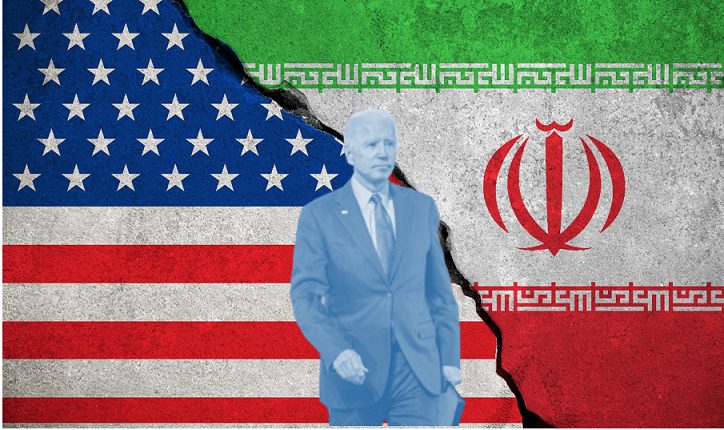
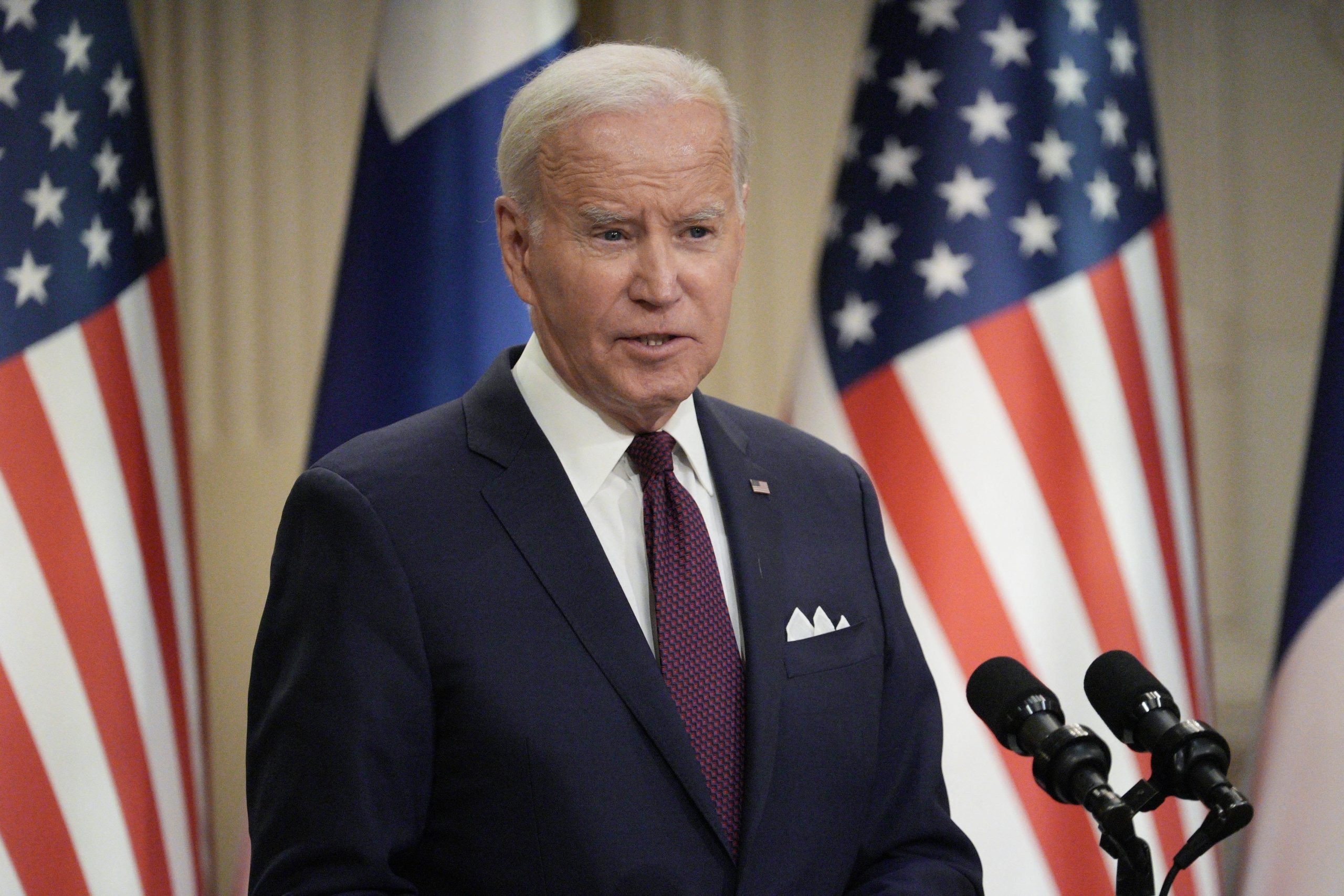
Some people are obsessing over the fact that President Biden has not yet issued a formal invitation for Israel’s Prime Minister to visit the White House and take part in the choreographed photo opportunities which inevitably follow. To be quite frank, following the pathetic performance of Biden when he and President Herzog met the press, I can’t understand why a similar rerun is so desirable. Seeing Biden mumbling incoherently while looking down at his prompt sheet exactly underscores the absurdity that characterises American foreign policy. When Bibi eventually meets Biden, it is doubtful that the latter’s understanding or comprehension of the reality confronting Israel will be any clearer.

Take the looming Iranian threat as a classic example.

Ever since the Mullah regime came to power, it has used the age-old tactic of taking hostages in order to achieve its various nefarious objectives. The most spectacular event took place in 1979 when American hostages were seized after the storming of the US Embassy. A botched attempt to rescue the hostages led to fruitless diplomatic bargaining and UN resolutions which were ignored. The Iranians demanded the lifting of economic sanctions and other punitive measures. The hostages were only released as Ronald Reagan was inaugurated. Perhaps the Iranians suddenly realised that instead of a weak, vacillating Democratic Jimmy Carter they were about to face the wrath of a determined Republican Ronald Reagan.

Fast forward to the present situation and you have a replay taking place, albeit with far more lethal consequences. Despite denials to the contrary, it has always been on the cards that the Biden Administration is desperate to consummate a deal that will shower the Iranians with dollars, thus enabling them to accelerate their march to the nuclear bomb. If, in the process, Israel and Gulf nations are caught by collateral damage, they can always be fooled and sidetracked by some diplomatic double-speaking State Department officials.

So it has come to pass.

In exchange for hostages illegally seized by Iran, the US will now shower the Iranians with US$ 7 billion. True to form, Secretary of State Blinken, with a straight face, asserted that “there would be no sanction relief.” In addition, “significant oversight” would be put in place to ensure that this windfall was used only for legitimate purposes.

Who are they trying to fool? Only the eternally gullible of course.

One has only to look at how “successfully” the international community has succeeded in preventing North Korea from developing missiles and nuclear capabilities to understand the total fiasco which will accompany this latest triumph of American diplomacy.

Another deal accompanied by murky denial which will gladden all the Democratic progressives and woke self-loathers, is gestating in the background. This is why Bibi will be invited to the White House. It will be another show to bolster Biden’s 2024 prospects and demonstrate his oft-repeated mantra of being one of Israel’s best buddies.

Washington will hope that this farce will be swallowed by enough local Jewish voters and Israelis eager to self-flagellate and that with the help of an always compliant media, the whole exercise will be a triumph of Hollywood make-believe. Incredibly, a majority of American Jews will still vote for a Democratic candidate no matter how many times that party lurches further to the progressive left and abandons its once solid support for Israel.

Another case of lurching leftwards and embracing false narratives is evident from the decision of the Australian Government to re-designate Judea, Samaria and Jerusalem as illegally occupied Palestinian territory. In doing so, the Labor Party has joined the UN’s immoral majority, which claims that these historically Jewish sovereign places are off-limits to present-day Jews. Peddling patently fake Arab revisionist claims may gladden the hearts of the left-wing, Jewish and non-Jewish alike and the increasing Islamic voters. Still, it certainly won’t bring genuine peace one centimetre closer.

The biggest farce is when the Australian Prime Minister and his Foreign Minister put their hands over their hearts and pledge an undying solidarity with Israel.

How do they reconcile their rejection of Israeli sovereignty at the Kotel, Temple Mount, Tomb of the Patriarchs and Matriarchs, Hebron, and Rachel’s Tomb, among other places with a supposed solidarity? Why is there a glaring silence about the daily torrent of hate and incitement against Jews issuing forth from the PA and associated terror groups? Why is the Australian Government sending taxpayers’ money to UNRWA when everyone knows that its schools are inculcating poisonous ideas?

As the heirs of those who illegally occupied the Australian continent in the first place and established a penal colony there, it is the height of chutzpah for today’s politicians to be lecturing Israel.

Finally, trying to bask in the reflected glory of Dr Evatt, who, as the Labor Foreign Minister in 1947/1948, gave enthusiastic support to the re-establishment of the Jewish State, is glaringly hypocritical. Only gullible individuals, of which there are many, would fall for those sorts of verbal acrobatics.

The Israeli Foreign Minister is reported as asserting that “a security treaty with the USA would reassure regional allies that they are protected from Iranian aggression and therefore negate the need for nuclear weapons.” He was presumably alluding to Saudi Arabia. I cannot imagine anyone in Saudi Arabia falling for that pie-in-the-sky illusion. All one has to do is look at how North Korea has thumbed its nose at the US over the last few years. Has a US security treaty with South Korea and Japan prevented the acquisition of nuclear weapons and missiles by North Korea? How secure do they feel when North Korean missiles fly overhead and land in the ocean not far from their shores?

How safe and secure do the Taiwanese feel knowing that the Chinese intend to invade and destroy them one day? Can they actually be confident that when push comes to shove the American cavalry will ride to their rescue in time?

Israel knows from past bitter experience that so-called guarantees given by erstwhile friends can easily turn out to be worthless.

The US recognised Israel in 1948, and then when Arab armies invaded in an endeavour to destroy it the Administration imposed an arms embargo. This tactic was employed again in subsequent years every time the US disapproved of anything the Israel Government implemented. When Nasser blockaded Israeli shipping in 1967 and prepared to attack, the US abandoned its guarantees and left Israel to deal with the situation alone. During the Yom Kippur War, President Nixon did resupply urgently needed armaments but only after a crucial delay.

South Koreans, Japanese, Taiwanese or Gulf States will be sadly mistaken if they are pinning their hopes on the US coming to their rescue in time in the event of a North Korean or Iranian nuclear attack. It will be all over before the White House, State Department, Congress and Senate manage to get their act together.

Most likely, the UN Security Council will still be deliberating after it is all over.

The Israel Intelligence Minister has urged the United Kingdom and European Union to act with moral clarity against Iran and its terror facilitators.

Pulling the other one has never been easier.

Iran Is About to Conduct a Nuclear test

According to a terrifying story in the Jerusalem Post that cites numerous European security agencies, the Iranian terror regime may be perilously close to conducting a nuclear bomb test.

Its biggest supporter appears to be the Biden administration, which has openly let Iran develop nuclear weapons while employing delay strategies in the name of continued “negotiations”.

The Post reported that the regime “has sought to obtain illicit technology for its active atomic weapons program, according to a series of shocking European intelligence reports released in 2023.”

The report also claims that Iran has consistently broken the Obama nuclear deal.

Based on research from the Netherlands, Sweden, and Germany, the Middle East Media Research Institute (MEMRI) published translations of the materials on its website.

The rapid creation of weapons-grade uranium in Iran, according to the Netherlands General and Intelligence Security Service (AVID), “brings the option of a possible Iranian first nuclear test closer.

That report states, “Iran advanced its nuclear program last year. The nation keeps building up its inventories of 20% and 60% enriched uranium. This can be used to further enrich the uranium to the 90% enriched level required for a nuclear bomb using centrifuges.

The Joint Comprehensive Plan of Action (JCPOA) agreements were made, according to the AVID assessment, but Iran continues to disregard them.

Additionally, it is improving its capability for enrichment by utilizing uranium enrichment centrifuges of ever-growing sophistication.

An authority on Iran, Israeli Brigadier General Yossi Kuperwasser, told the Washington Post that “Iran is evidently committed to its nuclear weapons plan.

“The European intelligence reports describe covert Iranian efforts to reduce the breakout time of a nuclear arsenal by acquiring it illegally from various European countries,” Kuperwasser stated.

He said that the stories might be exaggerating the situation. “The reports only reveal a portion of Iran’s activities in Europe, and it is prudent to presume that the majority of those activities have remained covert.

Since European and US actions against Iran have been sluggish and uninspiring, Iran is likely to see Western policies towards it as a show of weakness. According to him, the US’s efforts to strike a nuclear agreement with Iran are “rewarding Iran with a new ‘understanding’ and would only incentivize Iran to continue and intensify its efforts to secure the necessary nuclear weapons components.

Askar – UNRWA: Cradle of Killers (Hebrew Version)

Shot on location at the Askar refugee camp in the Jenin area, UNRWA policies and practices encourage the latest wave of martyrs in murder sprees and terror attacks in Israel.

5 Ways the U.S. Hostage Swap Will Strengthen the Islamic Republic of Iran

1. Emboldens the Regime

While there’s much to celebrate about the release of Americans that were imprisoned in Iran, the United States unfreezing billions of dollars of Iran assets emboldens the regime to repeat their hostage diplomacy scheme. Since the very foundation of the Islamic Republic in 1979, the Islamist supporters in Iran, Lebanon, and other parts of the world have been able to make demands of the U.S. and other western countries by kidnapping government officials and civilians. Despite international condemnation against kidnapping citizens, Iran continues to be emboldened and incentivized in their kidnapping diplomacy, facing no credible consequences and even gaining rewards. While the Biden administration may claim that the U.S. is providing relief to the people in Tehran, the fact is that much of the funds will go to strengthen the Ayatollahs and allow the Islamic government to continue its campaign of repression against Iranian citizens and sponsor terrorism abroad.

2. Worries Allies

As the Islamic Republic of Iran continues to fund Islamic-terrorist groups in the Middle East, the latest hostage transfer for funds has allies in the region worrying. Following the hostage transfer, Israeli Prime Minister Benjamin (Bibi) Netanyahu sounded off on the exchange, stating that the latest actions “do not dismantle Iran’s nuclear infrastructure, will not stop its nuclear program, and will only provide it with funds that will go to terrorist elements sponsored by Iran.” Israel’s Prime Minister and other experts see the funds going to groups like Hamas in the Gaza Strip and Hezbollah in southern Lebanon, using the money to train more terrorist fighters, purchase lethal arms against Israel, and lead to more rocket attacks against Jerusalem and Tel Aviv. In the Persian Gulf, terrorist groups like the Houthis in Yemen and other proxies will have the means to continue launching attacks.

3. Strengthens Terror Proxies

The exchange will strengthen the terrorist entities supported by Tehran, including the Islamic Revolutionary Guards Corps (IRGC), its own paramilitary branch. Observers of the latest hostage transfer for funds note that the administration’s latest actions are akin to when then-Secretary of State John Kerry, under the Obama administration, acknowledged that the billions of dollars in sanctions relief to Iran would go to some terrorist groups. Despite promising to use the funds for the Iranian people, the regime in Tehran has had a history of lying to the international community about its true intentions, transferring vast amounts of funds from its domestic and international coffers to use for terrorism against America, the West, Israel, and Arab monarchies. In the past few months, terrorist proxies like Hezbollah, Palestinian Islamic Jihad, the Houthis in Yemen, and Iranian-backed Iraqi groups have been able to receive weapons from the regime to sow chaos, and now thanks to billions in unfrozen assets, such groups will be able to have more financial resources than ever before.

4. Provide Relief to the Regime

With the Ayatollahs receiving around $6 billion (about $18 per person in the U.S.) in sanctions relief from the U.S., many Iranian experts say such funds will assist the mullahs and their cronies. Following the major protests in Iran, ranging from the 2009 Green Revolution to the ongoing revolution which began in September following the death of 22-year-old Mahsa Amini at the hands of the Islamic Republic’s morality police over her hijab wear, the Islamic Republic has relied on its security forces to crush these movements. As a result of the Biden administration’s latest actions, the Islamic Republic will now have financial resources to continue to provide plainclothes, proxies, and supporters to crackdown on dissidents, target women who defy Islamic law, and purchase more military equipment to defend against any potential strikes. According to Iranian experts, the unfrozen assets will also most likely help the regime in its nuclear program, providing Tehran with the financial resources to possibly build more underground centrifuges, purchase material for atomic enrichment, and strengthen the security of its nuclear program. Subsequently, family and friends closely associated with the Ayatollahs will also gain a significant financial boost, given that they will most likely be able to transfer such funds overseas and secure their financial safety net.

5. Diminishes American Strength

In the past few months, America’s presence on the global stage has been devastating following Russia’s invasion of Ukraine, China’s brokering peace agreement between Saudi Arabia and Iran, and international economic turmoil. While the Biden administration continues to tell Americans that the country is strong and secure against foreign threats, the latest hostage transfer suggests that the administration is kowtowing to enemies, displaying weakness. From Republican to Democrat administrations, Iran and other threats have been able to diminish America’s strength through hostage diplomacy and terrorist attacks, devastating the lives of military and civilian personnel at home and abroad. At a time when China, Russia, and Iran are consolidating their strength and power against the US, the latest actions are a boost to the rising axis that sees itself expanding in Asia, Latin America, Europe, and the Middle East.

Related Story: 5 U.S. Citizens Held by Iran Regime to Be Freed for $6 Billion in Frozen Assets

Boat trip aimed at saving Dead Sea also explores marvels revealed by its evaporation

As the owner of the second boat to sail the Dead Sea in the past 75 years, Noam Bedein knows its salty waters better than almost anyone. But lately, his excursions have led him to discover sites neither he nor anyone else has ever seen.

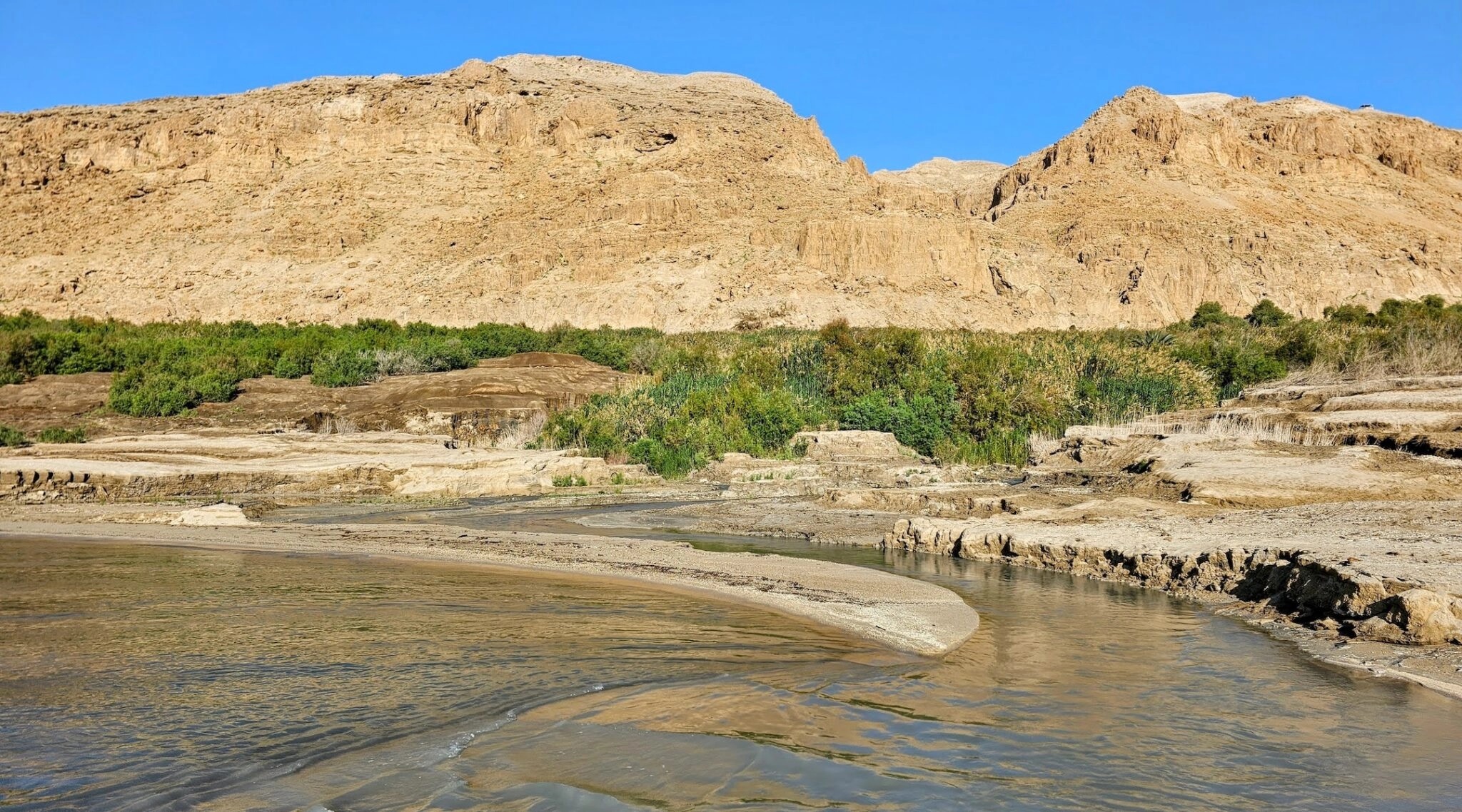
A few days before World Water Day in late March, Bedein came upon a bubbling brook feeding into the sea, which he named the Jerusalem River. The stream, the animals surrounding it and the beach it flows through were submerged underwater as recently as the mid-2000s. Bedein and his partner, Ari Fruchter, believe they are the first people ever to set foot there.

It’s an experience Bedein keeps having, and for him, it’s a paradoxical one: His mission is to save the Dead Sea. But as it dries up, it reveals new wonders to him.

“Out of the devastation, life finds a way,” Bedein told the Jewish Telegraphic Agency during one of his boat’s first excursions.

Bedein is the latest activist to confront a problem that has bedeviled Israel — how to save this ecological marvel and tourist attraction that is being depleted by water scarcity, industry and climate change. Bedein’s approach with his and Fruchter’s nonprofit, the Dead Sea Revival Project, is to raise awareness about the disappearing Dead Sea by bringing people to see it for themselves.

Bedein’s immersive boat tours provide visitors “with an intimate encounter that fosters deep connection and understanding” about the Dead Sea, he told JTA.

Bordered by Israel and the West Bank on the west and Jordan on the east, it is the deepest point on earth, has almost 10 times as much salinity as the ocean and is renowned for its therapeutic mud. In 2019, according to records from the Israeli Tourism Ministry, it was the country’s third-most visited site, after Jerusalem and Tel Aviv, drawing a million tourists per year, reported Israeli business publication The Marker.

The Dead Sea is also an economic engine for Israel — something that, ironically, is a threat to the sea’s continued existence. A market research report published last year found that the Dead Sea mud cosmetics market is slated to be worth $2.6 billion by 2031. The chemical factories producing the cosmetics, which extract potash and bromine from the area, are found in both Israel and Jordan, and pump some 61.3 billion gallons of seawater per year in total as of 2018, according to NBC.

That extraction, plus a reduction in the inflow of water from the Jordan River, has led the Dead Sea to dry up in recent decades. A 2022 Israeli government report said that since 1980, the sea has lost some 40% of its volume and is retreating by more than three feet per year. According to Bedein, the Dead Sea’s water loss amounts to as much as 600 Olympic pools every day.

The southern basin of the Dead Sea, which is called Ein Bokek and is lined with hotels, has been disconnected from the northern part. Today, the “sea” at Ein Bokek is actually comprised of 12-foot-deep evaporation pools that are entirely artificial. According to Bedein, most tourists at the hotels are unaware that they are not actually at the Dead Sea.

“However you look at it, there isn’t a magic pill to fix this, and that’s the reason nothing’s been done so far,” Nadav Lensky, head of the Dead Sea Observatory at the Geological Survey of Israel, told JTA. “Every solution that is put forward comes with problems of its own.”

Hailing from the West Bank settlement of Tekoa, Bedein, 41, worked in Israel advocacy in the Gaza border town of Sderot before shifting his focus to the Dead Sea. He is an environmental photojournalist by training who has now trained his lens on this body of water, hoping to show people what it actually looks like — and the ecological damage that is caused — when a large saltwater lake disappears.

The Dead Sea has lost 40% of its volume in recent decades. (Noam Bedein via JTA)

To do that, he convinced the Israeli government to allow him to sail a boat on the Dead Sea, a quest that involved more than a year of overcoming bureaucratic hurdles. It is only the second boat to take to the water since Israel’s 1948 War of Independence. The boat, which holds up to 13 passengers, makes up to three trips a day, three times a week, but as of September, its operations will be expanded to five days a week. In total, Bedein says he has hosted between 400 and 500 people on private excursions.

Bedein is acutely aware that the end goal of saving the Dead Sea is “way above my personal shoulders,” but, he said, that knowledge does not detract from his mission.

“The journey is fascinating and motivating for me,” he said.

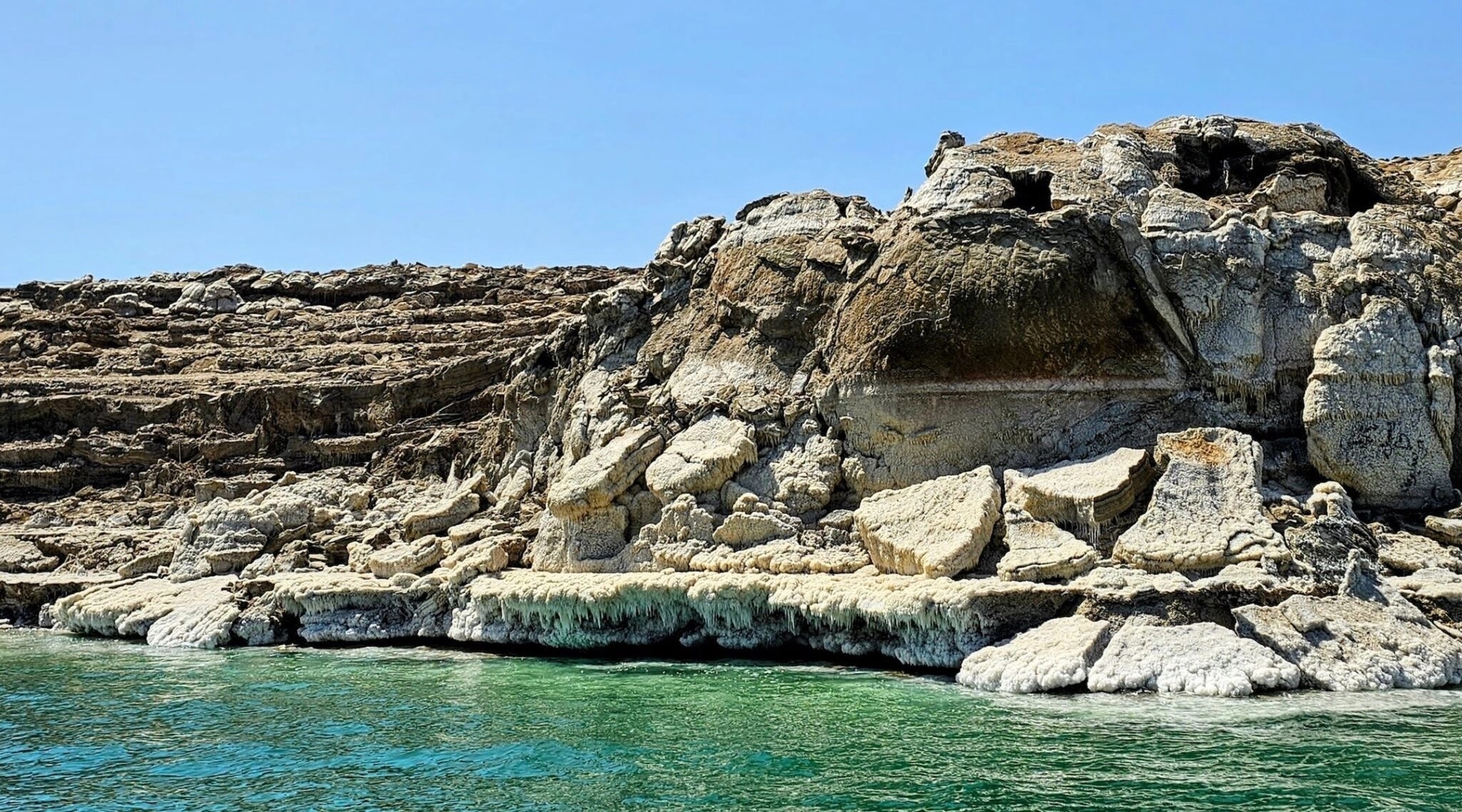
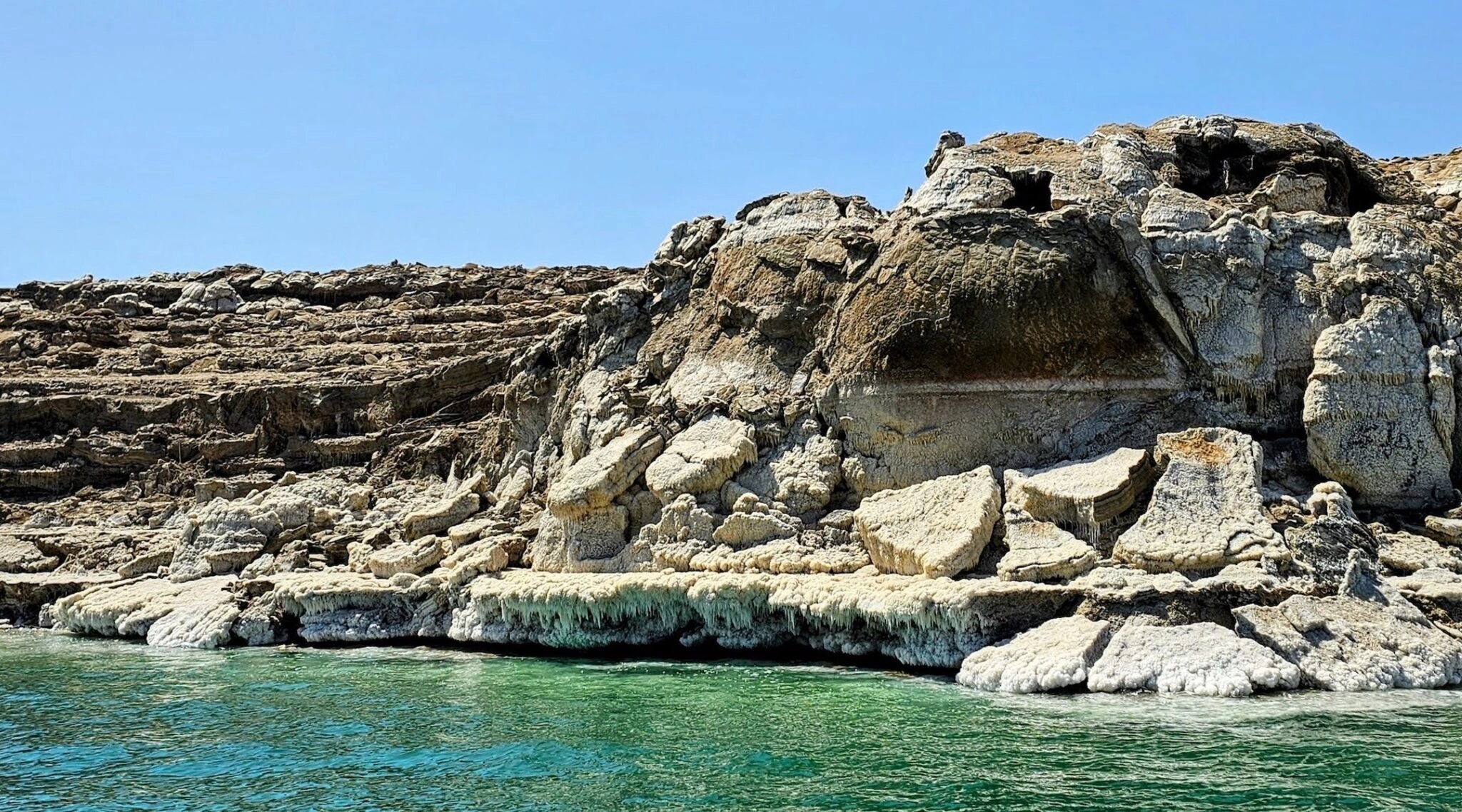
The boat’s two-hour journey is filled with wonders. On a recent outing, the blinding white salt formations look like glaciers or the snow formations known as penitentes, and clash with the backdrop of the Judean Desert’s brutal reddish rock. Graduated terraces hewn out of the cliff look manmade, but each three-foot-high step represents another summer in which the waters of the Dead Sea have evaporated.

A salt cavern perched on a rock several meters above sea level elicits a gasp from Bedein. He has not been to the area in at least three years. Rifling through a wad of photographs, Bedein shows the passengers on the boat a photo of the same cavern from 2016, its mouth at sea level. He snaps a shot of the newly elevated cavern. The side-by-side images went on display as part of a timelapse photo exhibition marking this year’s Earth Day at the Cultural Center in Arad, a city 17 miles west of the Dead Sea.

“You can feel the density of the water lugging at the boat and the bitter, sticky spray on your face and lips,” said Naomi Verber, who was on board with her baby. “The salt rock formations are otherworldly, like seeing the transition between sea and land in suspended animation.”

(Bedein claimed that Verber’s child was “the first infant to sail the Dead Sea in at least 100 years.” Whether that is true is unclear. Orit Engelberg-Baram, an environmental historian who wrote her doctoral dissertation on the Dead Sea, told JTA that a baby may well have sailed its waters during the evacuation of Kibbutz Beit Ha’arava, located in what is now the West Bank, during Israel’s War of Independence in 1948.)

Fruchter, meanwhile, is spearheading an effort to promote awareness about the ecological crisis of the Dead Sea  by raising money to build the Dead Sea Museum of Art on a five-and-a-half-acre parcel of land in Arad. The museum, which hopes to attract half a million tourists a year once it is constructed, will combine exhibits on climate tech innovation and multimedia art installations in a carbon neutral building to both educate people about the sea and, in a grim but possible future, memorialize it.

While the industrial activity surrounding the sea often gets blamed for its depletion, Bedein says it isn’t the main culprit. He estimates that the chemical plants contribute 30% of the problem, while the other 70% is due to the reduction of the source of the water in the Jordan River.

According to Lensky, 60 years ago, a billion cubic meters of water flowed from the Jordan River into the Dead Sea. Today, less than 10% of that amount reaches it, partly because of the construction of dams around the Yarmouk River — which flows between Israel, Jordan and Syria — and partly because Jordan, one of the driest countries in the world, cannot afford to both provide water to its population and regenerate the Dead Sea. Jordan, Syria and Israel all draw water from the Sea of Galilee basin that would otherwise be flowing into the Dead Sea.

The chemical plants, Bedein said, also draw attention to the Dead Sea, which he sees as a positive.

The receding waters of the Dead Sea have revealed new rock formations. (Noam Bedein via JTA)

“It’s not about how much water is being pumped out of the Dead Sea, it’s about how much water is coming in,” he said. “It’s very reductive to blame the factories. If you close down all the factories tomorrow, there goes the entire industry in Ein Bokek, and you will have reduced awareness even more.”

The key to saving the Dead Sea, researchers say, is to bring freshwater back into it, or what Bedein terms as “restoring its historical flow.” According to Lensky, bringing freshwater back into the Dead Sea is easier said than done.

“We have no freshwater in the region and if we wanted to create some, it would come at a high price, environmentally and economically speaking,” he said.

Several projects – planned within the Israeli government and between countries – to mitigate the Dead Sea’s evaporation have been launched, including a proposed plan to construct a canal to replenish the Dead Sea with desalinated water from the Red Sea — called the Red-Dead Canal. That plan, like others, has attracted its fair share of controversy, in part because of the environmental risks it poses both to the Gulf of Aqaba and the Dead Sea itself.

Bedein is not optimistic about those initiatives. The last meeting of the Knesset committee on saving the Dead Sea, which Bedein attended, took place in 2017. The five rounds of elections Israel has held since 2019, he said, haven’t helped. “The government changes every year or two, this isn’t a priority and there’s simply no one to speak to,” he said.

In the meantime, Bedein will keep taking passengers out on his boat, and will keep marveling at the new features that come to light as the sea level dips lower.

“We have the opportunity to explore uncovered landscapes for the first time,” he said. “It’s inspiring.”

Self-flagellation

Surprising as it may seem, this ancient form of afflicting the body is still practised among various groups these days.

Roman Catholic devotees, especially in places like the Philippines and elsewhere, continue to indulge in this ritual, particularly at Easter time.

It is also widely practised by Hindus in India, among other places.

Shia Muslims beat themselves with swords during the Festival of Tatbir.

Among Jews, this sort of extreme physical mutilation is nowadays non-existent and lingers in mainly a symbolic form among some on Yom Kippur eve.

However, there is another form of self-flagellation that seems to be endemic and very much alive in our time. It seems to be a particularly potent affliction, especially in Jewish communities and, of course, in the Jewish State.

It takes the form of blaming oneself for each and every situation, which in turn results in no less damage and incapacity than the physical variety.

A common myth that, however, has some element of truth to it is that Jews are more guilt-driven than any other people on the planet. Perhaps that is why the disciplines of psychology and psychiatry have attracted so many Jews over the years.

Past and recent events seem to point to a definite trait that afflicts large swathes of Israeli and Diaspora Jews. Plainly spelt out, it is the uncanny and unhealthy phenomenon of feeling guilty for each and every event where Jews are targeted.

When bad things happen, there are those who inevitably conclude that the events must have been precipitated by some heinous act carried out by the victims themselves. This knee-jerk guilt-by-association syndrome has now become endemic among some sectors. It leads to a completely distorted perspective as to the real motives behind each and every incident of hate and incitement.

Excusing the perpetrators because of a perceived provocation by the victims is the default argument trotted out by the legions of the woke left and their myriad politically-correct followers. They have one thing in common, and that is an uncontrollable urge to pillory Israel.

Ongoing recent incidents should help to explain how self-flagellation has established itself as a seemingly acceptable reaction.

Some opinion pieces in post-Zionist and leftist media outlets assert that “because Israel is built on the idea of Jewish supremacy over the indigenous Palestinians”, there can be no mystery as to why they embark on a murderous spree of mayhem. This totally warped and fallacious reasoning is also endorsed by the leader of the ultra-left Meretz Party and its associated gaggle of lemmings. No amount of reality can shake them from their dogmatic tunnel vision whereby the State was born in original sin and continues to perpetuate this sin by actually surviving endless waves of terror.

Presumably, the only way to be absolved is to confess and be prepared to suffer the consequences. This means disappearing as the nation-state of the Jewish People and embracing the paradise of some sort of mythical Garden of Eden where Jihadists will live in perfect harmony with “the descendants of pigs and apes”, as Jews are described.

An IDF spokesperson has blamed “settler terror against Palestinians” as the logical reason for the rise in Palestinian acts of violence. He went on to assert that “as soon as settler violence is eliminated there will be less Palestinian terror.”

While one cannot condone Jews taking unlawful action against anyone, a few questions need to be asked.

Is Arab terror against Jews something new and of recent origin?

Anyone with even a smattering of historical knowledge should be fully aware that this terror jihad has been ongoing since at least the 1920s. Its lethal consequences have left a trail of murdered Jews and bereaved Jewish families in its wake ever since Islamic mobs massacred Hebron’s ancient community in 1929. Claiming that the Temple Mount is being invaded is not something new and has been used as an excuse for pogroms in the distant past. Terror groups incited their followers this recent Tisha B’Av to carry out a pogrom against Jews praying at the Kotel.

For how long are Jews expected to be willing sacrifices? Once, we were powerless to either defend ourselves or retaliate. Is this the preferred status we are expected to adhere to in 2023?

As recent events have clearly demonstrated, Arab terror makes no distinction between religious chalutzim (settlers) and those who imagine themselves as politically correct secular residents of Tel Aviv.

Teenagers and even those younger are having their minds poisoned at summer camps and UNRWA schools. A fifteen-year-old proudly stated that “only martyrdom is fitting for the life of a Jihad fighter.” Abbas, the PA lifelong President, laid a wreath in honour of these martyrs, and his colleagues assert that Israel’s apprehension and elimination of these “martyrs” is a war crime.

Those dedicated to the demise of Israel and Israelis, based on their past track records, are hardly likely to throw in the towel if the victims of their nefarious agenda turn the other cheek. We tried that failed scenario with the fatal Oslo disaster, and only masochists would want to repeat that sort of flagellation again.

It is worth noting that Palestinian Arabs don’t even need Jews as an excuse to perpetrate violence. They are rampaging and murdering their own people quite successfully as it is. In fact, it has become so bad in Lebanon that some Arab countries are advising their citizens not to travel there.

Who needs to blame “settlers” when they are so busy eliminating each other?

Deciding whether to emigrate is a fundamental right for citizens living in a democratic country and Israel is no exception. Despite hysterical and unhinged claims by those currently causing chaos because they oppose the present coalition’s legislative agenda, the ability to leave Israel and seek a home elsewhere is not under threat. One can find Israelis in every conceivable country. In fact, one can hear Hebrew being spoken in some unlikely places around the globe.

The problem is that in an increasing number of countries speaking Ivrit in public is becoming a hazardous and even life-threatening exercise. Jews are being attacked and assaulted in Germany and other parts of Europe as well as in the USA and the UK. School children are threatened on public transport, and Jews wearing identifiable clothing and kippot are regularly targeted.

There are many reasons for emigrating, including educational opportunities, employment, economic advantages and alternative lifestyle experiences.

The current excuse is disillusionment with the direction that the country is taking. Instead of staying and using democratic means to change things, many are threatening to abandon the Zionist enterprise altogether. If you don’t have a strong faith-based reason for living in the land of our Patriarchs and Matriarchs, then seeking a life in the Galut is no big deal.

However, the grass is not always greener elsewhere.

Assimilation in the Diaspora is increasing, and detachment from any Israeli connection gathers pace with each succeeding generation.

The biggest irony is when those leaving maintain that they are doing so in order to live in a more democratic country and for personal safety reasons. I read an interview with a family who are shifting to the paradise of California. According to reports, businesses and locals are actually fleeing California because of rampant crime, drug epidemics, homeless problems and illegal immigrants. It is highly unlikely that their children will be able, as they do in Israel, to safely walk down the street to visit and socialize with their friends. In the USA, where the Supreme Court judges are appointed by politicians, democracy is also under threat.

At least in Israel, one has a choice of over forty political parties. In the USA, you have a choice of only two, neither of which necessarily inspires great confidence.

Self-flagellation knows no boundaries.

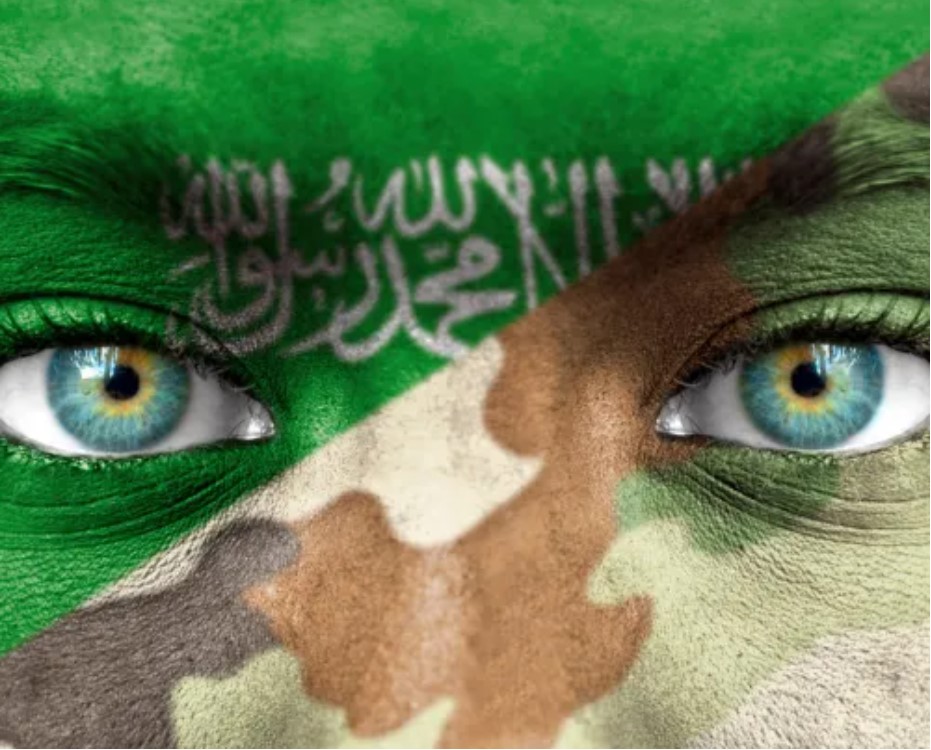
Unveiling Saudi Arabia’s Dual Face: Peace Gesture or War Funding?

In a surprising turn of events, renowned Middle East journalist Tom Friedman, known for his Pulitzer Prize-winning coverage, brought attention to a potential Saudi peace initiative in March 2002. While this revelation raised hopes of a breakthrough, it also contradicted Saudi Arabia’s longstanding anti-Israel stance within the Arab League. Friedman’s reportage offered a fresh perspective, especially amid the backdrop of ongoing violence and terror attacks in the region.

However, deeper examination of the Arabic version of the Saudi initiative revealed a more complex picture. Prof. Itamar Rabinovitch, an influential figure in the Israeli peace camp and a former Mossad official, shed light on the actual content of the refugee clause in the initiative. Rabinovitch’s analysis pointed out that the final draft explicitly demanded the “right of return,” negating the perceived flexibility that the initial statement held. This demand, rooted in UN Resolution 194, effectively calls for the return of Arab refugees from the 1948 war, backed by a staggering budget allocated for UNRWA refugee camps.

It’s crucial to note that 58% of UNRWA’s budget goes towards supporting an educational system that has been criticized for its failure to promote peace. A review of more than 1,000 UNRWA textbooks by David Bedein’s research agency unveiled a concerning lack of peaceful discourse.

Despite these revelations, Friedman’s credibility didn’t seem to wane. Instead, he returned with further misinformation, including silence regarding Saudi Arabia’s substantial funding of Palestinian education, particularly in relation to anti-Israel activities. Saudi-sponsored UNRWA summer camps, commemorating Arab martyrs who engaged in violence against Jews, have further fueled concerns about the intentions behind such support.

Bedein’s research agency even went a step further, dispatching TV cameras to capture UNRWA summer camps funded largely by Saudi Arabia. The resulting documentary, set to be screened at The Menachem Begin Center in Jerusalem on September 3rd, 2023, casts light on the murky undercurrents of Saudi funding for Palestinian education.

The revelation of Saudi Arabia’s dual face – one presenting a façade of peace while fueling anti-Israel activities – raises significant questions about the authenticity of potential peace initiatives. As debates continue, the ongoing support from entities like UNRWA and its implications for the region’s stability remain subjects of intense scrutiny.

The opinions and facts presented in this article / video are those of the author, and neither TheJ.Ca nor its partners assume any responsibility for them.

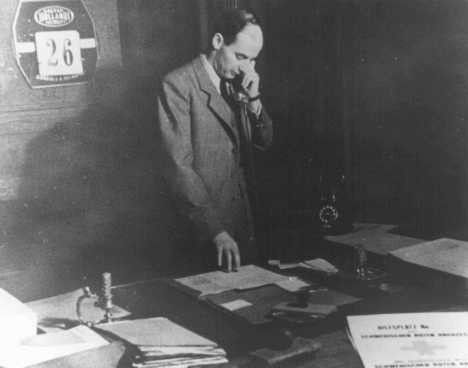
In loving Memory of Raoul Wallenberg

Friends around the world:
From the Office of Mr. David Herman ( a British-Israelí writer, composer, musician, poet and novelist, and Intelligent Service Agent) has requested me to share with you the following transcript from 1987 to celebrate the life of Raoul Wallenberg.
David Herman, was also a member of the Committee to investigate the Disappearing of this Diplomatic during the second war. May his memory be a blessing!
I decided not to edit any paragraph in order to present the original transcript as it was from 1987.
Thank you for taking the time to read until the end.
TRANSCRIPT OF EXPONENTS OF ABSENT HEALING THERAPY CONTACT WITH RAOUL WALLENBERG ON APRIL 23, 1987
Before the actual session began, the two anonymous exponents, A and B, told me that they had already made contact with Raoul Wallenberg a few days earlier and had learned the following: He can’t pass urine. The lower spine and feet are inflamed and so are his knuckles. His mind is clear, but he is frightened of losing his mind. The atmosphere changes affect his body. He is very depressed. The location of his prison seems to be north-west of Sverdlovsk, a very small place ringed by mountains.
A: He is sitting there. Why is he sitting there? He knows about it that many people are going free. His sixth sense is very sharp. Because of his sixth sense he is surviving despite the climate but he hasn’t got space to move anymore. And more and more he becomes depressed the more there is pressure outside. I told him already two weeks ago and last week that we are trying from outside. The pressure he is getting now it’s not his own mind. His mind is fine. It’s we people from outside who don’t forget him and want to help him and to see that we can get him out. I would like very much that we can get him alive to Israel, but all because the people that went through his hands , that he saved, now live in Israel.
What is very interesting is that he is picking up what I’m saying now. He is picking up exactly what I am saying now. He is with us, his mind is with us but he can’t it very long, he also can’t stand it. and he has a lot of pain so I’m going to pray…
Is that the place where you’re sitting, the prison?
B: Something like West, North-West, a very small place lower than the area around it, between mountains but a low place.
A: How does it look from the inside? Are there a lot of prisons?
B: Yes, I got before long yellowish walls. I’m not sure whether there is daylight. He is very emotional. He can hardly swallow it. Tears are running down his eyes from emotion. You see, it’s the very first time we are really going to sit down and communicate. Not only giving in him..Raoul, can you hear me?
B. Look, I, now blue light and I directed it towards him.
A: Raoul, what else can you tell us about the place where you are over there? We are speaking now here from Jerusalem, really from Jerusalem..
Raoul, go on, go on. You can cry afterwards. Let them run! But it Is Jerusalem. Yes, so we’re trying to help you with all the energy of Heaven, the Holy City, from the Holy City. Please, now do try to help!
He’s trying..He’s ready, He’s here with us.
B: He is in a very bad situation because they had disconnected him form everything outside. They don’t pass him messages. He is completely disconnected . He has lost direction because there is a kind of movement he is making. He is happy that we have connected ith him, but he can’t..the Russians are conscious that people will try to reach him.
A: Raoul, how long have you been in prison, in that prison?
B: What I got…. close to 30 years.
A: In that same cell??
B: No, not quite. He has been transferred a couple of time..
A: Now, are you sitting by yourself, or is there somebody with you?
B: He is alone and he is being watched.
A: Yes, I got before, too, that he is alone.
D.H: David Herman: Can I ask some questions?
A: Yes..And if you want to ask questions. Raoul, we are ready to reply, right?
B: Wait, Raoul wants very much that we reach him. He just can’t tell us any channel. He doesn’t know where he is. He has been completely disconnected form the world, and he does say that he knows thing.
A: What was it? What was it? Try and communicate with us. In just one word or two. What was it you’ve seen that made you fall in their trap?
B: So far as I can see he was connected . He saw some wrongdoing of high officials and he was thinking of a way, I don’t want to say to “damask”, but to interfere and they just… And this again, a picture which is there.. he was taken by force and disconnected from other people, so that he cannot intervene any more, and these people were.. There is some heaviness around those who took him. I can’t demask what is in their mind. I just see that they are very stony, closed people doing something ugly..there is..
D.H: We tried our best for you, we sent petitions to all the embassies for you.
A: He knows.
DH: And about the new book..
A: His heart is hot.
B: I got now light. He is with us again. He gets oxygen.
A: We are getting you.
B: His head is clearing now.
A: Speak up, we are getting you very clear, Raoul. Try to remember, all right?
B: Look, can I make a movement? He is doing something like this He was trying to place something out. I think he was taking out some documents from hanger filers, and these were documents probably of the people he wanted to unmask, high officials who were doing wrong to others. He wanted to save somebody and the high officials caught him on this that he was taking. Perhaps he didn’t want to do it officially, but he wanted to point out, and after that I see such a strong clash. It’s the kind of people who will do anything to shut others down,
AB: Are you willing to reply to some questions, Raoul
B:Yes.
DH: Can you tell me how he looks today? Can you describe him?
B: He is very swollen, hos whole upper body. He hardly moves his fingers. His knees are better than they were, but they are terribly sore , especially he left one.
DH: Has he got teeth still?
B: Rotten, very rotten. He has thin hair, very short cut, balding.
DH: does he look older or younger than his years?
B: Looks older at present.
A: Breathe deeply, Raoul. Can you feel the warmth coming into you now?
B: Yes, and there is warmth coming up to his chest, especially the breast. He has got a swollen breast. His eyes are painful, swollen, red. Especially the left eye is pulling, and the right arm, and the right inner arm is very painful.
A: And he has very bad blood circulation in his feet. He can’t bend the leg.
B: And he has also difficulties in bending his back, He turns a little bit to the right. He can’t sit completely straight because of the pain he has in his spine.
DH: Cam you tell me what kind of room he is in?
A: How big is the room?
B: It is not small. It is not always the same place. Sometimes it seems something like 3 to 4 meters.
A: It is like here.
DH: And he’s by himself alone?
A: Alone, and he ‘s watched.
DH: Are there guards?
A: They are aware that people are trying to contact…
DH: Does he have contact with anybody especially?
B: No, no, no, no! The guards don’t want him to pass any information or connections because they are conscious of either the possibilities..
DH: So, did he send any message to his friends?
A: No.
DH: When was the last message he sent?
A: Four or five years ago. 15 years ago he sent a few letters out.
DH: Does he have a friend in Israel called Felix, who’s helping him?
A: Oh yes, oh yes, oh yes! Whay, I just got smarmoret!
DH: Does he know that Felix just wrote a book called “Raoul Wallenberg Is Alive” to help him?
A: He knows from us now that there is contact, He feels, but he doesn’t know what he feels. He was frightened that he was going to die. He felt something, but he knows nothing.
DH: How does he keep up his morale?
A: Very bad..
DH: But he believes that he will be free?
A: That is a small hope. Maybe because from here we are busy, and that is why he is smiling. But he doesn’t know how long his body can still continue.
DH: Does he want us to continue to help him?
A: Very much, oh sure he does, oh very much, very much!
DH: Does he know that we are doing everything to help him?
A: Yes, he knows, he knows it.
DH: What is his dearest wish?
A: To get away from here and to see the sun and to come here?
DH: To get away from there and to come here?
DH: Does he want to go to Sweden?
A: No, because they forgot him. For Sweden, he’s dead.
DH: And his family.
A: He’s dead, no family any more. His family is those he saved . They want to receive him.
DH: Why does he think that the Russians are keeping him?
A: They just somehow haven’t got the heart to destroy him.
DH: Why does he think they want to keep and not let him go?
A: Because of what we mentioned.
DH: Can I ask more questions?
A: Too many questions..
B: He can’t even listen…
A: He’s got so much pain in his breast. Please ask short questions. Give us time to answer. He got really in distress and very emotional.
B: We close our eyes to focus better, We aren’t in a trance.
A: All the lumbar is without strength, his sacrum is inflamed, the chest is constricted and the neck is stiff, the left hand is in pain…half of his face is..There is no better place to come than to Jerusalem.
A: Now, Raoul, can you feel a little better? We are again with you. Look up into the light of the Lord and you’ll get strength there. Raoul Wallenberg, what is the name of his mother?
DH: Maj von Dardel.
A: Raoul Wallenberg, son of Maj von Dardel…
B: Can’t you do something about his left hand?
A: Oh, the abcess..breathe deeply. He’s too cold because of the cold.
B: You must be in a place close to a river. The whole area is not properly warm. It is wet.
A: Please Raoul, look into the light…to the right..
B: Our blue light is reaching him, can you see?
A: Yes, direct it to the hands and specially to the heart area and the ear and the neck, to the chest and the heart. It’s better. Raoul, do not get emotional please, otherwise it hurts you. We’ll contact you again. Now that we found there are some more people.. so it’s better we give you energy to get better. You’re going to get better… Don’t cry, OK? This makes you weak.
A: The hand is feeling better. I’m trying to pull the fluid down, to direct it to the urine bladder. We’re going to direct some heat. It goes down.. It’s pulling down to the sacrum. His bottom is very cold but there is no pressure on his forehead. His eyes are clear, they are not so burning. Raoul, when you get tea, keep the tea leaves and put them between your lip and your gum where the abcess is, the swelling. This will do you good. Oh sugar..Terrible! …salt… Raoul, are you ready for more questions?
DH: Tell him that we shall do all in our power to free him this year.
A: He starts to cry again
DH: Did he send any messages to his friend in Israel recently?
A: He thinks about him.
DH: And what is his friend’s name?
A: What do you get? The name of his friend.
DH: If I say the name Felix does this mean something to him?
A: Yes, that he says straight away. Straight away gave him a lot of pleasure.
B: He doesn’t think he will live so long to be free.
DH: Has he any contact with his fellow prisoners in the camp?
A: None.
DH: Is he in a prison camp?
B: But he has no contact with anybody. He can’t see outside the window. He is closed up completely because it is cold.
DH: Does he remember any of these names? Trushnovich?
B: It cause him a bad feeling in the stomach.
DH: Another name –Yanini?
A: He is cold, He is not very happy about these names.
B: No, don’t mention them. It is not good for him.
DH: They were prisoners with him on Wrangel Island.
B: He isn ‘t able to think so far. He can’t, don’t.
DH: Does the name of Wrangel island mean anything?
A: He doesn’t want to think. It doesn’t matter any more . He doesn’t even believe he will get out of prison any more still alive. He says this year is still long. He thinks he will not live to get out.
DH: Does he have any message to his friend Felix?
B: Look, to think about this he needs a lot of energy and he hasn’t got energy. All he needs is to get healthy again.
DH: Does he want to send through you any message?
A: Not at present. His heart is painful. He think that every day he is going to finish.
DH: What name did they give him there?
A: They don’t give him a name at all. They don’t talk to him. They put his food and he is like an animal. He sleeps there and he lies there or he stands there. The food is cold.
DH: When did he move from his last prison to the new one?
A: One week ago. In the prison he moves often. They change him. There is a little corner where he keeps something like.. thinks he keeps something there. Once he was writing and keeping it where he sleeps in a little bag in the mattress. He tried, but that’s why he got so depressed because they deprived him also of those little things.
A: They went him very much to die quick…
DH: Is he happy that we are trying to help him?
B: Very. That is why he is so emotional. That’s why it makes him so weak now. He wants us to stop.
DH: But our efforts to help him should go on?
A: But quick because he thinks that this year he is already in the other world. He thinks he is going to die within a month.
DH: Tell him to keep strong till his birthday in August.
END OF TRANSCRIPT
ALL RIGHTS BELONG TO DAVID HERMAN