Breaking Development

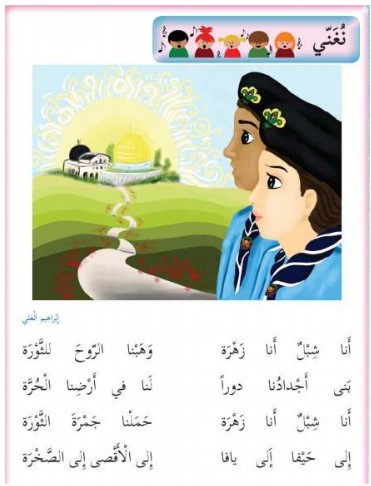
The Israel Ministry of Foreign Affairs has announced that it has formally requested that UNRWA remove a textbook of blatant incitement from the UNRWA school curriculum in the new school curriculum for the forthcoming school year which begins in late August. This is the language of the text:

Murder of Jews is an integral part of the liberation struggle.

Following is the first page of a four-page lesson exalting the female-commander of a terrorist attack against an Israeli civilian bus on Israel’s Coastal Highway in 1978 where over thirty Israelis – men, women and children – were murdered:

“Dalal al-Mughrabi”

Our Palestinian history is replete with many names of martyrs who sacrificed their souls for the homeland, among whom is the martyr Dalal al-Mughrabi who painted with her struggle a picture of challenge and bravery, which has made her memory eternal within our Hearts and minds. The text in front of us talks about one aspect of her struggle journey.”

(Arabic Language, Grade 5, Part 2 (2023) p. 51)

The distorted ‘nakba’ narrative

Palestinians outside the headquarters of the United Nations Relief and Works Agency (UNRWA) in the Askar refugee camp, east of Nablus, on May 8, 2023. Photo by Nasser Ishtayeh/Flash90.

Israeli Diaspora Minister Amichai Chikli is an angry man. Chikli, who has a history of being outspoken, has lately turned his sights on the German government. He has complained about inappropriate comparisons between the Holocaust and the Palestinian nakba—Arabic for “catastrophe.” Worse still, the German government has been sponsoring the dissemination of such comparisons.

Chikli’s complaint concerns a government-funded event in Potsdam at which German journalist Charlotte Wiedermann made the comparison in question. Wiedermann has denied doing so, but whether the allegation is true or false, the comparison has become increasingly common. It is now trendy to equate the industrialized murder of six million Jews to the displacement of Palestinian Arabs during Israel’s 1948 War of Independence.

This war was launched by seven Arab countries and resulted in the expulsion of every last Jew in eastern Jerusalem and Judea and Samaria. Arab League members then declared a second war against their own Jewish citizens, whom they branded “the Jewish minority of Palestine.” This resulted in the near-total destruction of ancient Jewish communities throughout the Middle East and North Africa. Ninety-nine percent of the regions’ Jews were forced to flee.

What angered Chikli the most was that the Potsdam event was officially sponsored by public institutions. Moreover, it was not the only event of its kind. It was part of a series of such events held in Berlin in recent months. These events included lectures with titles such as “Understanding the Pain of Others: The Holocaust and the Nakba,” “Hijacking the Memory of the Holocaust for the Benefit of Dehumanization in Palestine,” and “Zionism Can Also Motivate Antisemitism.”

This year, coinciding with Israel’s 75th anniversary, campaigners for the Palestinian cause have succeeded in moving the nakba from the margins to the mainstream. For the first time, the U.N. held a “Nakba Day” commemoration at its New York headquarters. Palestinian Authority chief Mahmoud Abbas, sporting a symbolic key affixed to his lapel, demanded permission to return to his native Safed, which is inside Israel proper.

Over 75 years, the meaning of the term nakba has evolved. It was popularized by the Syrian Christian journalist and historian Constantine Zureik. To him, the “catastrophe” in question was the Arab defeat in the 1948 war—that is, the Arab failure to destroy Israel.

Zureik wrote, “Seven Arab countries declare war on Zionism in Palestine. … Seven countries go to war to abolish the partition and to defeat Zionism, and quickly leave the battle after losing much of the land of Palestine—and even the part that was given to the Arabs in the Partition Plan.”

He concluded, “We must admit our mistakes … and recognize the extent of our responsibility for the disaster that is our lot.”

Since then, introspection and self-criticism have been in short supply among Israel’s enemies. History has been rewritten to imply that Israel pursued a deliberate policy of ethnic cleansing against the Palestinian Arabs, even though 160,000 Arabs still remained in the Jewish state.

Through this distortion of history, the nakba narrative attempts to create a Palestinian “catastrophe” that, as Abbas said last year, is equivalent to 50 Holocausts. Mimicking laws against Holocaust denial, Abbas even declared “nakba denial” a criminal offence.

In short, the nakba narrative appropriates Jewish history to transform the Palestinian refugees into the new Jews. It follows that their Jewish oppressors are the new Nazis.

The only way to correct the injustice of the nakba, the Palestinians claim, is to implement the “right of return,” not just for the refugees but their descendants as well. This “right” is also appropriated; in this case from Israel’s Law of Return. When he announced the first “Nakba Day” in 1998, Yasser Arafat hijacked Zionist language, calling for his people to be allowed to “return” from their “diaspora” to their land.

Since the definition of a Palestinian refugee has been expanded to include four generations of their descendants, over five million people now claim a “right of return” to Israel proper. If implemented, this would effectively transform Israel into the 23rd Arab state.

During the row over the Potsdam event, Chikli rightly pointed out that the wartime Palestinian leadership under Haj Amin al-Husseini enthusiastically collaborated with the Nazis. But even though he is the son of Jewish refugees from Tunisia, Chikli did not make the only valid nakba comparison: Between the Palestinian nakba and the Jewish nakba.

The latter was the expulsion of 870,000 Mizrahi Jews from Arab and Muslim countries. The two nakbas took place around the same time and in roughly similar numbers. In effect, it was a population exchange.

For most Mizrahi Jews, who with their descendants constitute more than half of Israeli Jews today, Israel was the only nation that would accept them. The Mizrahi Jews do not have the ability, legal right or desire to return to the countries that ejected them.

Unless Israel makes a forceful, proactive effort to set out the real facts, the distorted nakba narrative will continue to turn hearts and minds against Israel in Germany and elsewhere.

Israeli Policy Has Enabled and Encouraged Palestinian Violations of the Oslo Accords

Since the signing of the Oslo Accords in 1993, the Palestinian Authority (PA) has waged a campaign against Israel that has repeatedly, systematically, and intentionally violated its commitments under the Accords. The principal reason for the PA’s behavior is its fealty to the narrative of the Palestinian struggle, which includes the goal of establishing at the end of the process a Palestinian state in the entire land west of the Jordan River. However, the PA is also well aware that Israel will not agree to a final settlement that enables the Palestinians to keep striving to achieve their objectives.

Another reason this situation continues, however, is that the Palestinians know Israel prefers to avoid a harsh response to their violations, fearing that such a response would undermine the PA’s stability and its security cooperation with Israel. Additionally, the Palestinians expect their struggle eventually to bear fruit, even if meanwhile they (and Israel) encounter difficulties and disappointments along with achievements and successes.

Israel’s accommodating stance was based for a long time on a combination of willful blindness toward the Palestinians’ true intentions and a belief that making economic and diplomatic gestures, while ignoring most of the Palestinians’ infractions, would bolster more pragmatic Palestinian elements and curtail the terror and the other violations of the Accords. In addition, Israel believed that its placatory approach would soften international criticism. In reality, these hopes were disappointed, and it turned out that their chances of materializing were poor and perhaps nonexistent.

In recent years, most Israelis have overcome their blindness toward the Palestinians’ true aims and realized that the PA is not a partner for peace who will work to ensure Israel’s security and survival. Moreover, partly for that reason, the international community and the Arab world increasingly understand that the chances of reaching a settlement that will stabilize Israeli-Palestinian relations are fading and, indeed, close to zero in the foreseeable future. The political implications of such understandings for Israel’s domestic politics, its links with Arab states, and the Western approach to the conflict are far-reaching: They have seriously weakened Israelis who believed that satisfying Palestinian demands, as they interpreted them, would promote a settlement; the international community, for its part, is not making further attempts to advance such a settlement. Instead, the emphasis is on improving the Palestinians’ quality of life and preserving the possibility of implementing the two-state solution (for two peoples?) sometime in the future.

Even so, many in the Israeli political echelon, particularly in the defense establishment, prefer to stick with the accommodating policy toward the PA and ignore its violations of the Accords. In addition to the reasons already noted, this mindset is fueled by an unwarranted concern about preventing the emergence of a one-state reality.

The new Israeli government is trying to convey the message that it will no longer accept the Palestinian violations and will respond decisively to them. For instance, the security cabinet, in reaction to the Palestinians’ petitions to the International Court of Justice, decided to

  • confiscate NIS 139 million of the PA’s funds (which had been withheld as payment of fines levied on the PA in Israeli court for its responsibility for terror attacks during the Second Intifada);
  • apply a 2018 law, which deducts the sum of money the PA pays to terrorists and their families from tax revenues Israel collects for the PA, already at the beginning of the year—and without compensation in the form of a bridging loan, which governments had been providing since the law took effect in 2019, thereby emptying it of its content;
  • prevent unauthorized Palestinian building in Area C and deny entry permits to senior PA officials involved in the Palestinians’ petition to the court.
  • In addition, the defense minister denied such permits to PA officials who visited the freed Israeli Arab terrorist Karim Younis in his home.
  • Furthermore, against the backdrop of dismantling the illegal Jewish outpost of Ohr Chaim in Samaria, the government also undertook to dismantle new, illegal Palestinian buildings.
  • It then decided to legalize nine Israeli settlements that had been built without authorization and to approve the construction of another 7,000 housing units in existing settlements in Judea and Samaria.

These are indeed stricter measures than previous governments had taken for a decade. Still, there were precedents for them, some of which showed greater resolve. (These included a total freeze on transferring funds to the PA because of its appeals to international bodies during the preceding decade; the abovementioned 2018 law to offset the Palestinians’ “pay for slay” policy; and the extension of Israel’s security activity to PA territory since the Second Intifada). But eventually, even though the PA has not ceased its problematic behavior and has continued to breach the Accords, Israel retracted its measures, preferring the containment policy of shoring up the PA for fear of its collapse.

It is too soon to judge whether the present measures indicate a more substantial change. The decision to deduct the payments the court had ordered to be made to the Palestinian terror victims from the funds already withheld and not from those to be transferred to the PA is an alarming portent of things to come. From the PA’s standpoint, the measure does not create any new economic pressure since the payments were taken from funds it would not have received in any case. Hence, with good reason, this measure can indicate that Israel still seeks to avoid causing too much damage to the PA. In addition, the February 2023 security summit with the PA in Aqaba, with expectations that the PA would bolster its security forces, appears to be a further indication that the Israeli government still has not shaken off the logic of strengthening the PA, or at least preserving it, as a central plank of its policy.

In this way, Israel also managed to temper the international and Arab criticism of its punitive measures. The other steps are easily reversible or hard to monitor. If Israel sticks with them over time and does not compensate the PA for deducting the funds, it will mean it intends to adopt a different policy to convince the PA that it, too, must change its policy. The PA must realize that its current policy of a multifaceted struggle stands no chance of advancing the Palestinian objectives but will incur considerable costs. The hope is that such a change of Palestinian policy could eventually lead to a change in their goals, narrative, and vision, leading to peaceful relations between Israel and a Palestinian entity. Until such time, Israel will have to retain full security control of the land from which the Palestinians operate against Israel. This is especially the case as the PA prepares for 87-year-old Mahmoud Abbas’ inevitable departure from the political stage.

The Palestinian Violations

The Palestinian Authority has violated the stipulations of the Oslo Accords from the moment they were signed. The violations concern the core principles of the Accords and occur in various spheres.

Encouragement of Terror and Involvement in It

Not only does the PA do very little to fight Palestinian terror, as the Accords obligate it to do, but it is derelict in other responsibilities. For example, the PA does not arrest terrorists or systematically prevent attacks, put terrorists on trial, or incarcerate them, nor, when attacks are thwarted, complete the effort with investigations, interrogations, and weapons seizures.

The PA supports terror in many ways. At the top of the list are its huge salaries to terrorists imprisoned in Israel and its monthly grants to the families of terrorists killed due to their activities. The PA devotes about seven percent of its budget to payments to prisoners (about NIS 600 million per year) and families of terrorists killed or wounded (about NIS 700 million per year). The longer terrorists are imprisoned (based on the severity of the loss of life or limb in the attacks), the more significant their payments. The payments are made regardless of organizational affiliation. They are paid to terrorists who are Jerusalem residents and to those who are Israeli Arabs as recompense for every kind of attack, including those the PA had reservations about or even condemned at the time (for example, the 2011 murderous attack on the Fogel family in the Itamar community, in which two parents and three children were murdered in their beds).

The payments to the incarcerated terrorists are paid according to a PA law that calls them the “fighting sector of Palestinian society.” PA chief Mahmoud Abbas repeatedly declares that he assigns these payments the highest priority. Such payments to terrorists, guaranteed in advance, are undoubtedly an incentive to terror, and they make the PA an active partner in the attacks perpetrated by the terrorists who receive these payments. Moreover, many of the terrorists hail from the ranks of official Palestinian security forces or from the Fatah organization, which forms the basis of the PA. For prisoners from among the security services, the period of incarceration in Israel contributes to their seniority, and all the prisoners are promised a very generous grant upon their release and a job in the PA, with the length of imprisonment figured into seniority and the post they receive.

Incitement to Hate, Violence, and Terror

Palestinian messages that deny Israel’s right to exist (delegitimization), show Israelis as loathsome creatures (demonization), or justify and encourage a violent struggle against them, including using terror, are widespread in PA curricula, Palestinian media, statements by senior PA officials, and in Palestinian culture generally, with the endorsement of the PA.

Such messages include, among other things, glorifying terrorists and attributing noxious traits to Jews and particularly to Zionists while accusing them of crimes against humanity. Instead of honoring its commitment under the Oslo Accords to eschew incitement and promote a culture of peace and dialogue between the peoples, the PA, led by Abbas, takes a blatantly anti-Semitic line. The emphasis in recent years is on portraying Israel as a cruel apartheid state and undermining the Zionist narrative by transforming it into the distorted and historically fallacious Palestinian narrative.

Support for a Boycott and Sanctions against Israel, While Denying Its Identity as a Jewish State

In this endeavor, the PA cooperates, among others, with the BDS movement, which seeks to end Israel’s existence and replace it with a Palestinian state in the entire Land of Israel.

Unilateral activity to promote the Palestinian narrative among the international community — The PA engages in this effort while ignoring the PLO’s pledge, as part of the Oslo Accords, that the PA would eschew unilateral activity and international activity in general.

One of the high points in this campaign was the PA’s decision to declare itself a state and its success in promoting a UN General Assembly resolution that recognized it as an observer state. Based on that resolution, the PA joined numerous international organizations, such as UNESCO, and was able to push through anti-Israeli resolutions in all of them. However, not only is this unilateral activity a violation of the accords, but the accords say nothing about the establishment of a Palestinian state as an outcome of the final-status talks, in which the two sides are supposed to reach an agreement through discussion.

Building in Area C without Israeli Authorization — This is being done even though the accords state clearly that Israel alone can authorize building in Area C. In this endeavor, the PA cooperates with the United Nations, the European Union, and many European countries. It totally ignores the fact that the Accords defined Area C as “disputed territories,” not as Palestinian territory.

Including Hamas in elections to the PA institutions, even though Hamas does not meet the necessary conditions—most of all, accepting the accords themselves.

Corruption and Neglect of the Palestinian Residents’ Needs

Those needs are subordinated to the anti-Israeli struggle and the personal interests of the top PA officials.

Recently the PA also unilaterally halted the security coordination with Israel — a measure it had already taken in the past.

In addition, the PA Is working to persuade Israeli Arabs to act in its interests and adopt the narrative of the Palestinian struggle against Israel. As part of this effort, the PA pays salaries and stipends to Israeli Arab terrorists and their families, expresses support and glorification of these terrorists, and works to prevent normalized relations between Israel and Arab countries.

The Palestinian Narrative

The Palestinian narrative, which the PA inculcates among the Palestinians and disseminates to the international community, comprises seven tenets, most counterfactual and some anti-Semitic.

First, there are no Jewish People; therefore, Jews have no right to a state of their own.

Second, throughout history, Palestinians allege, there has never been Jewish sovereignty in the Land of Israel—unlike the Palestinian people, with its ancient and historical roots in the soil of Palestine. Therefore, a solution for the Jewish problem should not be situated in this land, especially since the Ashkenazi Jews are not descendants of the Jews who lived in the Land of Israel in the past but of the Kuzaris, according to this myth.

Third, the Jews, in general, and the Zionists, in particular, are intolerable creatures, which is why the Europeans tried to get rid of them. This is clearly and undeniably reflected in the cruelty and arrogance of the Zionist policy toward the Palestinians, which has comprised “50 Holocausts” and an “apartheid regime.”

Fourth, as those who have suffered the expulsion, the deportations, and all the Israeli measures against them, the Palestinians are the only victims of the Israeli-Palestinian conflict. As long as they have not achieved their goals and overcome the injustice done to them—for example, through the return of the refugees—they must create worldwide awareness of their suffering. Therefore, the Palestinian media daily and intensively propagates a distorted picture of Israeli cruelty toward the Palestinians in Judea, Samaria, and Gaza, in the prisons and the refugee camps, and even toward the Israeli Arabs. As victims of Israel and the West, the Palestinians have the right to use all means to advance their objectives, including terror, and their critics have no right to criticize them for it.

Familiar aspects of this distortion of history include, for example, minimizing the Holocaust; obscuring the Palestinian support for the Nazis, led by Hajj Amin al-Husseini; spreading falsehoods about the relations between the Zionist movement and the Nazis, as Abbas did in his doctorate; and characterizing Israel’s policy toward the Palestinians as a Holocaust no less and perhaps even more horrific than the one the Nazis inflicted on the Jews. The Palestinians believe they must counteract an Israeli plot to portray the Jews’ suffering in the Holocaust not only as worse than what the Palestinians experienced but as a case that is relevant to the conflict since it justifies the establishment of a Jewish nation-state in Israel/Palestine. In the Palestinians’ view, they must fight this to the bitter end.

Fifth, in light of all these considerations, the Palestinians are committed to a multifaceted struggle against Zionism until it is defeated. Abbas wrote in his book Zionism—Beginning and End, “Undoubtedly, the Palestinian struggle in cooperation with anti-Zionist Jewish elements will bring about the defeat of Zionism and enable the Palestinians to live again in tranquility in their land.” This struggle can take the form of diplomatic and economic efforts, clinging steadfastly to the land, “civil jihad” to improve the Palestinians’ status (as Member of Knesset Mansour Abbas called it), and violent activity. Such activity encompasses—in line with the cost-benefit calculations at any particular time—popular agitation, that is, violence without the use of firearms and explosives, which Abbas has long preferred, but also the frequent use of weapons, as favored by the more extreme organizations such as Hamas and Islamic Jihad. Recently Fatah and unorganized elements have been using weapons as well.

In the PA’s eyes, all forms of struggle are legitimate. Despite attempts to persuade him otherwise, Abbas has asserted that he will keep paying salaries to all the terrorists imprisoned in Israel and all the families of terrorists who died due to their attacks. Furthermore, Abbas has recently come out more explicitly in favor of the possible use of weaponry in the fight against Israel. He has even openly supported the armed struggle. In the background is the growing frustration over the Palestinian issue’s marginalization in the regional, international, and Israeli agendas, alongside the PA’s growing weakness on the domestic front, which, in Abbas’s view, requires it to identify with more extreme Palestinian elements committed to the narrative of the struggle.

Sixth, the Palestinian struggle is national and Islamic, and the two elements are fused. Hence Israel’s purported infringement of the sanctities of Islam, with emphasis on the Al-Aqsa compound, is seen as reflecting the dangerous nature of Zionism. Portraying the struggle as representing the national component, that is, the Arab nation to which the Palestinian people belong, has been made much more difficult by the Abraham Accords. The Palestinians, however, refuse to come to terms with the significance of that development.

And seventh—even if, at this stage, given the current inability to reach the final objective of vanquishing Zionism, a settlement must be based on an independent Palestinian state on the 1967 lines whose capital is east Jerusalem, alongside Israeli acceptance of the principle of the right of return—Israel must in no way be accepted as the nation-state of the Jewish people. That would entail renouncing the ultimate objective of liberating all of Palestine as the culmination of the “phased plan.” Hence, for now, the Palestinian objective is the two-state solution—but not two states for two peoples, one of which is the Jewish people (which, as mentioned, does not exist).

Israel’s Policy toward the PA

In light of all this, why is it so essential for Israel to strengthen Mahmoud Abbas and the PA he heads? This question is even more acute because Israel is reinforcing a leader and an entity that is not only hostile toward Israel and committed to fighting the Jewish State but is weak domestically. If so, there is no guarantee that Israel’s assistance will benefit them. They can probably manage, and perhaps even better, without Israel’s help, which casts them as collaborators with those they define as an enemy. (Indeed, when in 2020, the PA, on its own initiative, stopped accepting the revenue payments from Israel and halted the security coordination, its functioning was not harmed at all.)

The answer lies in Israel’s, and particularly its defense establishment’s, adherence to the status quo. Even if no one loves it, and indeed no one planned it, it is the reality produced by the actions of both sides in the Israeli-Palestinian conflict and also of international actors, namely, the Arabs and Iran. It is doubtful whether anyone has enough incentive to bear the costs of trying to change it, even if the Palestinians and some in the new Israeli government proclaim their desire.

Indeed, it is not even truly a status quo since reality keeps changing, and certain likely developments in the foreseeable future will probably accelerate the pace of change. One is the formation of an Israeli government with a distinct ideological line that has no precedent in Israel and differs entirely from former governments with their deep commitment to maintaining the status quo. The second is the contest over control of the PA, amid expectations that Abbas will soon exit the stage. The third is the growing pressure on Hamas, which is restrained and deterred at present, to demonstrate its commitment to its jihadist identity not just in words and rallies but also in deeds and not just in attempts to carry out terror attacks in Judea and Samaria. The fourth is the growing Palestinian unrest, fueling the spike in terror attacks.

In recent years, reflecting fears of an escalation, the Israeli government’s approach has combined fighting terror, deterring Hamas, buttressing the PA, and improving the Palestinians’ quality of life. Those governments were willing to live with the diplomatic pressure the PA mustered against Israel while seeking to strengthen and expand the Abraham Accords. At present, it is quite clear that the logic behind this approach has not proved itself, but rather the opposite.

Over the years, Israel invoked several reasons and pretexts for the policy of strengthening the PA. These were said to reflect realpolitik and the choice of the lesser evil. But, the defense establishment is sorely mistaken in justifying its advocacy of aid to Abbas because he opposes terror. As we have seen, Abbas does not fight Palestinian terror but, instead, sees it as a legitimate part of the multifaceted struggle to achieve liberation and Palestinian national objectives. At the forefront of those is a Palestinian state in the ‘67 territories, whose capital is Jerusalem, without recognizing Israel as a Jewish state. At present, Abbas regards certain kinds of terror, primarily involving firearms and explosives, as more costly than beneficial to the Palestinian struggle and hence prefers to eschew them at this stage. But the cost-benefit calculation could change, as Abbas has explained in some recent statements. When that happens, he will probably revert to backing that kind of terror. As noted, many of his associates and representatives of the organizations he heads are already expressing support for the shooting attacks in Judea and Samaria, not a few of which are perpetrated by Fatah members.

Second, Israel acts based on an assumption (also groundless) that absent Israeli support, the PA could collapse at any moment and that the alternative to the present situation would likely be worse. Yet, while the PA indeed needs help asserting its authority in the security sphere in some of the territories it holds, it is not in danger of collapse and continues to function in the civilian spheres. Once Abbas leaves the scene, chaos could erupt, necessitating a temporary Israeli takeover of the PA lands. However, it needs to be clarified to what extent Israeli efforts to boost Abbas can avert such a scenario with its various ramifications. Those include succession battles within Fatah, a fragmentation of the PA into the regions that now compose it, and an attempt by Hamas to exploit the situation. At the moment of truth, there is no guarantee of an orderly transition or, eventually, of continued control by Abbas’s putative successors—the secretary of the PLO Executive Committee, Hussein al-Sheikh, and the commander of the security mechanisms, Majid Freij.

In line with the current conception, however, Israel sees the PA as a convenient tool that exempts it from closely administering the lives of the Palestinian population of Judea and Samaria, which is perceived as a heavy and undesirable civil, economic, and security burden. From the defense establishment’s standpoint, the PA is essentially an effective arm of the Civil Administration, providing education, health, and the rest of the governmental and economic services for the Palestinian population. The better it can fulfill that role, the better it will serve Israel’s ends.

Third, the coordination with the PA’s security mechanisms is perceived as contributing to Israel’s security. The defense establishment usually exaggerates the value of this coordination, since the PA acts only against the terror operatives that challenge it and Fatah. It does not act against all the terror operatives in its territory, and it even encourages them, as noted, by paying high salaries to terrorists imprisoned in Israel and portraying terrorists as exemplary, praiseworthy figures. At any rate, the security coordination ensures that the PA forces do not interfere with Israel’s counterterror activity and arrests within the PA. Most members of the forces and a portion of the Fatah members do not actively take part in the fight against Israel. They also rescue and return Israelis who stray into dangerous situations in PA territory and operate against elements threatening the PA itself, thereby restraining Hamas.

Fourth, Israel’s working assumption is that improving the Palestinians’ quality of life through the PA dampens their inclination to encourage and perpetrate terror—though that assumption, too, has no solid basis. The Palestinians indeed desire a better quality of life. The terror, however, does not stem from feelings of economic distress but from commitment to the narrative of the struggle against what is described as Israeli colonialism that uses apartheid methods against the native Palestinian population. The PA continues to promote this narrative whether or not Israel aids it, and the unrest among Palestinian young people, which leads to their involvement in terror, continues despite all efforts to improve the population’s living standards.

And fifth, the international community, with the United States, Egypt, Jordan, and to a certain extent, the partners to the Abraham Accords at the forefront, expects Israel to pursue this approach and fortify the PA. Such an Israeli policy, in their view, justifies relegating the Palestinian issue to the margins of the international and Arab agenda, keeps Hamas in check, promotes the Palestinians’ quality of life, and builds an infrastructure, they believe, for the future implementation of the two-state solution—that is, the establishment of a Palestinian state on the 1967 lines with east Jerusalem as its capital.

To all these, in recent years has been added the illusory notion, blown up out of all proportion, of the threat of a single binational state, which would compel Israel to give up one or the other of the two components of its identity since it would be unable to remain both Jewish and democratic.

The PA will not disintegrate of its own volition. The Palestinians regard it as the most outstanding achievement of their national struggle and as the basic infrastructure for the future Palestinian state, even if they have much criticism of its rampant corruption and are repelled by its leadership. It is also the largest employer of the Palestinians. Israel, for its part, will never agree to a binational state that would nullify its identity as a Jewish and democratic state. The PA, and the Gaza entity led by Hamas, have long been the political and administrative entities responsible for managing the Palestinians’ affairs, apart from aspects that directly affect Israel’s security. This reality is not going to change whether or not Abbas is strengthened. Even if, after his departure, the PA collapses amid a Palestinian civil war, almost all the Palestinian factions will share the aim of reestablishing it.

Israel, then, faces a dilemma. The more that the problematic attributes of the PA and its leader become evident, stemming as they do from their hostile and anti-Semitic narrative, the harder it is to justify an ongoing friendly dialogue with the PA and its senior advisers, such as the relationship the previous defense minister, Benny Gantz, maintained, as well as the continued aid to the PA. Nevertheless, the Israeli defense establishment and government are committed to the problematic justifications for sustaining that dialogue and that aid. The main concern is to prevent, or at least defer, a violent outbreak in the near term, and Israeli officialdom believes that bolstering the PA contributes to that goal. One can only hope for a frank discussion between the political echelon, which does not want an escalation but sees the broader picture, and the security services, convinced of the need to focus on short-term considerations.

This mindset was evident in the decisions of the new government’s security cabinet, both in response to the Palestinian initiatives in the international arena, particularly the appeal to the International Court (ICJ) of Justice in The Hague, and to the severe terror attacks in Jerusalem on January 27 and 28, 2023, in which seven civilians were murdered—and, in addition, on the question of evacuating the Bedouin shantytown of Khan al-Ahmar on the strategic highway between Jerusalem and Jericho. The cabinet adopted some decisions reflecting a willingness to take a tougher line toward the PA. These included deducting, on the date specified, the total sum of about NIS 600 million that the PA paid to terrorists in 2022, using NIS 139 million of that sum to compensate families of terror victims, whom an Israeli court had ruled the PA was to compensate; greater determination to dismantle illegal Palestinian buildings in Area C; and denying entry permits to Israel to senior Palestinian officials involved in the turn to the ICJ. Later, permits were denied as well to officials who came to congratulate the freed Israeli Arab murderer Karim Younis and glorify his acts.

As noted above, however, these decisions have a limited significance that does not deviate from previous governments’ policies. The continued evasion of the Khan al-Ahmar issue is a clear example. The only real difference is that the new government apparently will not compensate the PA for the deducted funds with a special loan.

Abbas, too, confronts a difficult dilemma. He is not prepared to settle for the role that Israel, in his view, accords him as its chief executive of the civil administration in Judea and Samaria. From his standpoint, the mission of the PA is to advance the Palestinian national objectives in line with the Palestinian narrative, not just to improve the situation in the civil, economic, and security spheres as Israel and even the United States seek. Abbas hopes at this stage to buy quiet and scale down the conflict by improving the Palestinians’ quality of life, a task mainly to be delegated to the PA. Hence, Abbas may opt for an escalation, especially if he can pin the blame on the “extremist Israeli government” and thus recruit the international community to his side. His experience, however, has shown him (unlike harshly critical young people who did not experience the Second Intifada) that, while it is easy to incite, it is hard to foresee how a conflict will develop. Despite the temptation, then, he is likely to show caution.

Given the new government’s outlook, it would probably like to make a far-reaching change in the status quo. In light of the complex reality, however, it also recognizes the limits of its power and will refrain from applying Israeli law to the disputed Area C. It appears, however, that it will take some measures that have the potential to inflame passions (such as legalizing the outposts of the young settlements and the Israeli presence in the once-evicted Homesh and Evyatar settlements; cracking down on illegal Palestinian building in Area C; providing easy terms for the Israeli settlers that could boost the incentive to live in the territories; and increasing construction in the existing settlements) and will rethink the determination to shore up the PA at any price. In contrast to its predecessor, the new government will likely inform Abbas that there is a price to be paid for hewing to the mendacious and antisemitic narrative that he pushes and for continuing to support terror—for example, by paying the salaries to the jailed terrorists. The government will continue to fight hard against the terror infrastructure in the PA and respond to radical Palestinian towns under the violent rule of Hamas and the Palestinian Islamic Jihad. The current Israeli government will probably stick with the previous government’s policy toward Gaza as long as Hamas keeps reining in terrorism. Still, it may show greater resolve toward Hamas if it does engage in terror. On the sensitive issue of the Temple Mount, Netanyahu will probably avoid a fundamental change in the status quo. However, he may find himself challenged by more extreme elements in his government.

Conclusion

In summary, even if the PA as a framework contributes to the ability to live with the ongoing conflict, manage it, and prepare the ground for a peace settlement, the content that fills the framework is problematic. The Palestinians should be encouraged to change it so they will eventually accept Israel’s existence as the democratic nation-state of the Jewish people. The more the Palestinians can be convinced that their chances of achieving their far-reaching aspirations are receding, the more a gradual improvement will be possible.

The Israeli voters’ shedding of illusions about the Palestinians led to the formation of a right-wing government determined to counteract the Palestinians’ ongoing anti-Israeli activity in the different spheres, particularly regarding terror and land seizures. That development should help clarify this message to the Palestinians. The reduced interest in the Palestinian issue among the international community, which is occupied with other problems, should help as well, and the trump card in this context is supposed to be the effort to add Saudi Arabia to the sphere of normalization.

At the same time, those elements in the Palestinian population that are not promoting the problematic narrative and not involved in terror should be encouraged to use measures that will improve their quality of life and will not compromise, to the extent possible, the ability to deal with security risks. This would be an alternative to offering such measures as gestures to the PA even as it is committed to that narrative.

Indeed, the votes in the Palestinians’ favor in the United Nations, the European support, the mobilization of the American left, and the sympathetic atmosphere in parts of the Arab world, together with domestic and foreign criticism of the Israeli government in the Palestinian context, will be seen by the Palestinians, along with terror attacks, as reasons to keep believing they can achieve their goals and to adhere to the narrative of the struggle. Those factors will also highlight the difficulty of attaining the Israeli objective.

Nevertheless, Israel must keep pursuing that objective and seek to apprise its friends of the problems entailed by continuing the current situation. That is all the more the case as the Mahmoud Abbas era nears its end, and many of the “day after” scenarios will require Israel to address those problems with special urgency.

How Arafat saved Israel from Ehud Barak

Former Israeli Prime Minister Ehud Barak addresses the Chatham House think tank in London, March 27, 2023. Source: YouTube.

On June 19, the Israel State Archives released material showing that during Dec. 2000 negotiations, then-Prime Minister Ehud Barak was prepared to give up Israeli sovereignty over parts of the Old City of Jerusalem and the Temple Mount.

At the Camp David talks five months earlier, Barak had already offered the Palestinian Authority control over territories that went far beyond what most Israeli military strategists believed the nation could give up and still retain defensible borders.

U.S. envoy Dennis Ross, who was involved in all the relevant discussions, later stated, “Barak’s government … formally accepted ideas that would effectively divide East Jerusalem, end the IDF’s presence in the Jordan Valley, and produce a Palestinian state in roughly 97 percent of the West Bank [as well as all of Gaza].” Ross added that Barak agreed to give up the Temple Mount as well.

In contrast, Barak’s predecessor Yitzhak Rabin, even as he pursued the Oslo process, had insisted that Israel hold on to parts of Judea and Samaria in order to block traditional invasion routes and protect both Jerusalem and the low-lying coastal plain, home to some 70% of Israel’s population.

In his last speech to the Knesset before his assassination, Rabin declared, “The borders of the State of Israel, during the permanent solution, will be beyond the lines which existed before the Six-Day War. We will not return to the 4 June 1967 lines.”

“These are the main changes, not all of them, which we envision and want in the permanent solution,” he said. “First and foremost, united Jerusalem, which will include both Ma’ale Adumim and Givat Ze’ev, as the capital of Israel, under Israeli sovereignty.”

Rabin further stated that “the security border of the State of Israel will be located in the Jordan Valley, in the broadest meaning of that term” and spoke of “changes which will include the addition of Gush Etzion, Efrat, Beitar and other communities, most of which are in the area east of what was the ‘Green Line,’ prior to the Six Day War” and “the establishment of blocs of settlements in Judea and Samaria.”

The factors that shaped Rabin’s strategic considerations did not change between his speech and Barak’s concessions. Yet Barak tossed Rabin’s considerations aside essentially on his own.

P.A. and PLO chief Yasser Arafat, having rejected Israeli and American proposals at Camp David and offered no counter-proposals, launched a terror war in Sept. 2000. But even before Camp David, as reports of what Barak was prepared to concede leaked out, elements of Barak’s coalition began to abandon the government.

When Arafat initiated his terror war and Barak failed to respond strongly, public opinion turned definitively against Barak. He retained the support of less than a third of the Knesset, with no mandate to pursue negotiations. Yet he did so nonetheless, offering Arafat further concessions.

In early Dec. 2000, it became clear that Barak’s government was about to fall. Rather than face a vote of no confidence, he resigned. A date was set for new elections, but in the interim Barak would serve as head of a caretaker government. While it is not enshrined in law, caretaker governments are not supposed to make major policy decisions. Yet Barak pressed on with negotiations until a week before the elections.

Arafat had made clear even on the day the initial Oslo Accords were signed at a White House Rose Garden ceremony in 1993 that he saw the accords as a stage in the process of Israel’s destruction. On the evening of the ceremony, he appeared on Jordanian television explaining that the accords were the first step in the PLO’s 1974 “plan of phases.”

According to this plan, the PLO would acquire whatever territory it could through negotiations and use it as a base to annihilate the Jewish state. Indeed, some years before the phased plan was adopted, Arafat explicitly stated that a terror war prosecuted from bases in the West Bank and Gaza could fatally undermine Israel. It was clear that once Arafat had exhausted his acquisition of territory by negotiations, he would launch an armed conflict.

Barak, however, offered much more territory than Arafat could have hoped for. The terrible costs to Israel of Arafat’s terror war are well known, but those costs would have been much higher if Arafat had agreed to Barak’s offers and then initiated his terror war.

The current understanding of Arafat’s refusal is that he would have been required to sign an end-of-conflict agreement in return for Israel’s concessions. He was not prepared to do so because it would inhibit his freedom of action against Israel as he pursued his ultimate goal.

There are problems with this explanation, however. Arafat had a long history of reneging on agreements with Arab leaders. He did so many times with Jordan’s King Hussein prior to Arafat’s attempted coup in Jordan in Sept. 1970. He did the same in regard to the Lebanese government after he and the PLO relocated to southern Lebanon. He had forgone all his obligations under the Oslo Accords to end his support for terror and anti-Israel incitement.

Thus, the question remains: Why did Arafat refuse to sign a final status agreement, pocket Barak’s concessions and breach the agreement after having gained the territorial advantage?

It may be that Arafat was concerned about the optics of such an agreement and what it would convey to his followers.

More likely, however, Arafat knew that he was already very ill. Taking control of the territories Barak conceded would take several years. This meant his terror war would not be launched immediately. He could not tolerate the thought that he might die before he had his chance to attempt to destroy Israel. If he had, the final status agreement would be his legacy, while his heirs would reap the glory of casting it aside.

Whatever the details of Arafat’s calculations, his rejection of Barak’s concessions and launching his terror war without the advantage of the additional territories ultimately saved Israel from a war that would have been far more costly.

As to Barak’s proffered concessions, it is an obvious understatement that leaders who pursue self-deluding, potentially suicidal policies and render their nation dependent on the missteps of its enemies are courting national disaster. To say that Israel needs to eschew such leaders is another understatement.

In Gaza, Hamas-run summer camp has started

Islamic Jihad: We must use crisis in Israel for war against it

Dalit Halevi(A7)

Nasser Abu Sharif, a member of the Islamic Jihad terror group’s political wing, has called on the Palestinian Arab groups to unite in a war against Israel.

Abu Sharif stressed, “The Zionist entity is also facing real crises and suffering from significant internal disagreements. Therefore, the Palestinian nation is facing a new stage, and standing before a historic opportunity which it must utilize for fighting and the conflict for the sake of the Palestinian problem, and to achieve victory and remove the occupation from the Palestinian land.”

Speaking to Al-Quds Radio, which is affiliated with the Islamic Jihad, Abu Sharif said that the Palestinian struggle is continuing and even intensifying in Judea, Samaria and Jerusalem, because the Palestinian people see the struggle as the proper way to fight the Zionist operation which executes policy of “Judaizing” the land.

“We are facing a dilemma and a great danger. We have no solution other than battle and conflict. We are also facing a historic moment in which we need to unite behind this path. Unfortunately, the internal disagreements between us and the internal problems we have still exist, since the Palestinian Authority continues to repress, bring to trial, and stop the fighters of the Palestinian opposition, while using its old tactics.”

He also called on the Palestinian Authority to stand by the “Palestinian nation” in its conflict against Israel, and provide it with everything necessary to manage the war against the “Zionist occupation, the plans of Judaizing, and the settlers’ herds.”

“We are standing before a historical moment which we must utilize for war against the Zionist entity, which is facing real and large crises,” Abu Sharif emphasized.

The US-Israel fantasy world

Picture this new world:

  • Israel’s prime minister doesn’t visit Washington for a year, and no one notices.
  • Israel adopts another outrageous domestic policy, and there’s no acid-dripping comment from the US.
  • Israel informs the US that its latest fighter aircraft isn’t suitable for Israel’s needs, and it will either look elsewhere or build its own.
  • Israel invites Chinese leaders for an official visit, and the requisite bilateral agreements are signed.

Why is all this in the realm of wild fantasy? After all, many other countries could take one or more of the above steps, and you wouldn’t hear a threat to “reassess relations,” as we heard from Washington toward Israel in recent days.

That’s because you don’t have to reassess relations when relations are already on a logical, realistic level, which the Israel-US relationship is most decidedly not.

The problem is that we’ve outgrown our classic “special relationship” with the US, yet we’re still defining our ties with that relationship as yardstick.

Worse, American Jews are caught in a never-ending spin cycle of loyalty to a candidate based either on the politician’s perceived support of Israel or on sensible domestic policies. Often those two considerations conflict.

The US-Israel “special relationship,” in its simplest form, means that the US will have Israel’s back with it comes to regional threats, and Israel will take care not to undermine US policy anywhere or, heaven forfend, undertake policies that appear wrong in the eyes of the State Department.

For the first 30 years or so of Israel’s existence, the “special relationship” made sense. Israel was struggling to build a viable economy, and it did not have the resources to maintain sufficient military strength to fend off its enemies.

The 1973 war highlighted that reality. After a surprise attack on two fronts, Israel’s ammunition and spare parts were close to running out. The US agreed to a last-minute airlift of hardware and munitions, without which Israel could well have been overrun, and I wouldn’t be writing about this today.

But here we are, half a century later, and the situation is radically different. Israel no longer needs that safety net.

Israel of 2023 features the region’s leading military and leading economy. Most of its problems are what they call “first world”—insufficient affordable housing, expensive milk products, overcrowded classrooms, and so on.

Even though things look bleak here with the standoff over judicial reform and religious extremism, there is no fear that Israel’s army cannot defend the country against enemy attack, or that the economy will collapse in a heap if someone in Washington says “boo.”

Indeed, Israel weathered the 2008 economic collapse better than the US.

The centerpiece of the outdated “special relationship” is American aid to Israel. It’s why there is a perception that Israel must do what Washington says, “or else.” It’s why Israel’s Jewish supporters in the US over the White House’s relates to Israel.

But what if the “or else,” meaning cutting American aid to Israel, would actually benefit all sides?

First, a quick look at the aid itself. It’s all military aid, and we’re halfway through a 10-year, $3.8 billion a year plan approved by then-US President Barack Obama.

Here’s the catch—almost every dollar must be spent in the US. So not only is it a backhanded subsidy to US defense industries, it actively harms Israel’s economy by moving jobs overseas.

That’s to say nothing of the sophisticated weaponry that Israel can and does produce by itself, but not for itself. It’s well known that significant parts of the flying white elephant known as the F-35 fighter plane are made in Israel.

Stopping American aid, gradually through negotiations and agreements, would cut about 10 percent out of Israel’s defense budget. That’s a significant hit, to be sure, but here’s what it would mean:

  • Israel would be free to sell weapons without the threat of an American veto, like killing the 2000 sale of surveillance planes to China, while at the same time taking American policies into account as others do. New sales could make up the shortfall in a period of a few years. Yes, some of the customers would not make it onto the “World’s Nicest Guy” list, but small countries have to do business differently from large countries. For example, some take issues like human rights into account, some don’t.
  • Israel could negotiate for weapons and supplies from the US and other nations, getting what it really needs, sometimes in exchange for Israeli technology.
  • And most significantly—ending US aid to Israel would remove the already artificial club critics bash Israel with, and supporters fear the most.

Canceling the aid would allow Israel and the US to reconfigure their relationship along logical lines of shared interests, not emotions and outdated perceptions. Objectively, Israel and the US are natural allies for geographical, strategic and societal reasons. There’s no reason to distort that with a layer of artificial guilt and fear over aid.

And then there’s China. The US is big and strong enough to confront China any way it wants. Israel, plain and simple, isn’t. China is an up-and-coming power in the Middle East, and Israel’s interests are to get in line with that. It doesn’t mean that Israel becomes a satellite of China and paints its flag red. It means that Israel builds relations with China based on shared or intersecting interests, just as it would with the United States under the new relationship.

The region is already trending in that multilateral direction. With the Abraham Accords, Israel has forged ties with Arab nations after decades of hostility. Militant, extreme Iran is more and more an outlier, to be confronted by the region as a whole. Likewise the Palestinians.

Israel can confront them by itself, but it doesn’t have to. Instead, Israel and the US can face the shifting future together as partners, not as overseer and underling.

— — —

Correspondent MARK LAVIE has been covering Israel and the Mideast since 1972. His second book, “Why Are We Still Afraid?” recaps his career and comes to a surprising conclusion.

Unhinged

29/07/2014 Montaje de banderas palestinas e israelíes
POLITICA INTERNACIONAL
EUROPA PRESS/REUTERS

I am not sure what is actually causing the insanity currently being displayed internationally and domestically.

Perhaps it is climate change that has addled the brains and common sense of so many or something in the water. Whatever the reason might be, mass hysteria on the part of sections of the population and an equal dose of lunacy by politicians of all persuasions is resulting in anarchy and unhinged behaviour.

Needless to say, Israel is unsurprisingly again the target of international hysteria, while domestically, those who don’t like the results of the last elections are endeavouring to impose their will by causing chaos.

Those disrupting the lives and freedom of movement of thousands of citizens by blocking motorways and other places scream that it is all being done to protect democracyThe irony is, of course, that their own actions are effectively sending a message that when the result of democratic elections is not to your liking, all you need to do to safeguard democracy is to cause mass riots and civil mayhem.

If those elected to govern introduce legislation that you oppose, then by all means, use all legal means to thwart it but breaking the law and interfering with the democratic rights of the rest of the population is not the way.

In Israel, general elections occur with monotonous regularity and very rarely do any coalitions last more than two or three years. Changing the Government, therefore, in a free and democratic country like Israel is as simple as casting one’s ballot.

One of the worst examples of the current turmoil is the rhetoric of two former failed Prime Ministers, one of whom served time in jail, who are so bitter and twisted that they are advocating civil disobedience and pressuring the US Administration to reduce its support of the country. Frustrated former leftist retired IDF officers, together with others of a similar ilk, are all lining up to vent their collective spleen at the fact that those who they oppose politically are actually in power as a result of an election.

It all started out originally over the intended reform of the justice system and the Supreme Court. The coalition has already watered down much of its intended reforms, and as a result, the protesters have now latched on to other perceived threats. Thus, some doctors are striking and warning that the proposed reforms will seriously impact the health system, although how exactly this will occur, nobody can rationally explain. Likewise, frenzied feminist groups are barricading the Rabbinical Courts, and other embittered leftists are disrupting train services and public transportation.

Making daily commutes a nightmare is hardly the best way to recruit support for one’s cause of overturning the democratically elected Government of the country. It is a sign of how unhinged certain people have become that no rational discussions are even possible.

In the international arena, the same insane phenomenon prevails.

After the burning of a Koran, the Swedish authorities threw their collective hands up in horror and then piously proclaimed that they wouldn’t do anything that infringes on freedom of expression. This prompted an Islamic protester to announce that he would be burning a Christian Bible and a Torah in retaliation. Needless to say, this intended bonfire caused a reaction of revulsion and, in the end, resulted in the event being called off.

The spectacle of burning holy books, reminiscent of nightmare scenes from the recent Jewish past, however, still did not propel the Swedish authorities actually to take a stand. The police declared that their hands were tied, and the Foreign Minister issued this pearl of a statement: “The Government is not authorised to infringe upon its citizens’ constitutional rights of free speech. At the same time, it emphasised the country’s efforts in combating antisemitism.”  This classic piece of political double speak should fool nobody, especially the country’s embattled Jews, who face increasing danger from Islamic extremists and right-wing fascists alike.

Sweden already bans shechita, and Brit Mila is also under threat which makes future meaningful Jewish life there untenable. This trend in the rest of the Nordic countries and Europe should be making Jews wary, but as usual, it might very well be a case of too little too late. This fatal mentality of minimising dangers and hoping that it will all blow over is still alive and well.

Meanwhile, in the United Kingdom, an interesting development occurred which seems to have sunk beneath the waves of political correctness.

It has been reported by the Jewish Chronicle and the Jerusalem Post, amongst othersthat last month B’nai B’rith UK together with another NGO contacted the Information Commissioner’s Office with a request to look into why the Foreign, Commonwealth & Development Office has not responded to a very important question. The query (under the Freedom of Information Act) wanted clarification on how British aid to the Palestinian Authority is being audited. The objective is to establish whether or not British taxpayers’ money is being used to support, facilitate or incentivise terrorism.

The UK Foreign Office refuses to disclose how Palestinian aid is audited, claiming that it would not be in the public interest to do so.”

If that reply does not ring warning bells, it definitely should yet this scandalous situation does not seem to have generated any outrage. It is well known that the PA pays stipends to murderers of Israelis and their families. As the PA cries poverty every Monday and Thursday and international aid keeps flowing, there should be no mystery as to how this generous remuneration is funded.

The same evasive fobbing has been expressed by New Zealand and Australian officials who claim that their aid is used only for humanitarian purposes. No hard proof has been provided despite ample evidence that school textbooks continue to teach hate and delegitimisation of Jews and that the PA proudly trumpets its support of “martyrs.”

As EU diplomats and representatives express their fervent solidarity with the terrorists eliminated in Jenin and the EU envoy to the PA paraglides over Gaza in a gesture to support a “free Palestine and Gaza”, it is no wonder that the kleptocracy in Ramallah seeks more money.

The EU Parliament has endorsed a resolution backing an International Criminal Court’s probe of “Israeli war crimes.”

The best proof that insanity has fatally infected the international community is provided by the reaction of the PA to Israel’s recent offer to prevent its collapse. Israel offered a series of measures, with conditions, designed to alleviate the alleged dire financial situation of the PA. One would logically think that if the situation were so critical, Abbas and the cronies would grasp the opportunity of Israeli assistance.

No such logic, however, prevails in the twisted thinking of those in charge in Ramallah.

Spurning all Israeli offers and declaring that funding of terrorist families is the top priority exposes the real agenda.

The fact that the international media and the UN remain mute in the face of this insanity is proof of exactly how “farkakte” (Yiddish for messed up) the world has become.

An IDF surgical operation which worked: UNRWA Jenin refugee facility, July 2023

While Israel’s adversaries have been used to providing illustrations  of civilian casualties and damage to private property after almost  every IDF action since 1987, this time things were different.
 
 The IDF strartegy .which focused on surgical targeting of terrorists and terrorist assets ,bore fruit this time.
 
Exactly 12 people were killed by the IDF, each of whom was an armed combatant, with the UNRWA facility of 12,000 residents suffering not even one fatality. 
 
Meanwhile, IDF shared pictures of capture munitions which were stored in UNRWA schools and UNRWA medical clinics, for the world to see.

The question that I had asked of UNRWA and UNRWA donors thoughout May and June of 2023 seems all the more pertinent in the wake of the IDF operation in the UNRWA refugee camp:
 
When will UNRWA conduct an inspection to look for hidden weapons in their facilities?
 
Pix taken from the UNRWA Jenin refugee camp after the Israel army withdrew from UNRWA, where  IDF  seized caches of weapons and ammunitio
 
Source: