Gaza: UNO-Schulen lehren Kinder Waffengewalt

David Bedein ist Gründer und Direktor des Bedein Center für Nahostpolitik-Forschung in Jerusalem, das seit 1987 Recherchen über das Palästinenserhilfswerk UNRWA betreibt, um die Öffentlichkeit darüber zu informieren, wie dessen Gelder, Schulen und Strukturen von palästinensischen Terrororganisationen für ihre eigenen Zwecke missbraucht werden.

Am 14. März 2022 sandte er eine E-Mail an Oliver Owcza, den Leiter der deutschen Vertretung in den Palästinensischen Autonomiegebieten. Darin schrieb er:

„Eure Exzellenz, das Bedein Center for Near East Policy Research hat das Vorhandensein massiver Waffen in UNRWA-Einrichtungen festgestellt. Das zeigen mehrere Dokumentarfilme, die das Bedein Center allein im letzten Jahr produziert hat. [Links zu den Websites waren beigefügt; Anm. Mena-Watch.]

Das Bedein Center stellt Ihnen als Diplomat einer UNRWA-Gebernation eine Frage. Werden Sie als UNRWA-Gebernation die UNRWA bitten, eine Inspektion aller Einrichtungen durchzuführen, um tödliche Waffen zu entfernen?“

David Bedein erhielt keine Antwort. Daraufhin stellte ich dieselbe Frage der Pressestelle des Auswärtigen Amts. Aus dem Auswärtigen Amt heißt es:

„Der von Ihnen genannte Vorfall, den Sie einer UNRWA-Einrichtung zuordnen, ist dem Auswärtigen Amt nicht bekannt. Deutschland steht in permanentem Austausch mit UNRWA.“

Eine Nichtantwort, die typisch ist für das Auswärtige Amt, wann immer es um palästinensischen Terrorismus geht (siehe auch hier und hier). Ich sprach darüber über Zoom mit David Bedein.

„Recht auf Rückkehr mit Waffengewalt“
Stefan Frank (SF): Herr Bedein, Sie haben sowohl dem deutschen Repräsentanten in Ramallah als auch dem Auswärtigen Amt Videoaufnahmen zugesandt, die zeigen, wie in Einrichtungen der UNRWA Kriegswaffen präsentiert und sogar abgefeuert werden. Ist das korrekt?

David Bedein (DB): Das ist richtig. Gestern wurde uns mitgeteilt, dass in genau vier Wochen ein neues Sommertrainingsprogramm zur Waffenausbildung von Kindern von UNRWA-Schulen beginnen wird.

SF: In welchen Einrichtungen findet es statt?

DB: Diese Übungen werden auf offenen Flächen unweit der UNRWA-Schulen durchgeführt. Die Personen, die das Programm durchführen, sind Lehrer und Schüler von UNRWA-Schulen.

SF: Steht das Gebiet, in dem die militärische Ausbildung stattfindet, rechtlich unter der Kontrolle der UNRWA?

DB: Schwer zu sagen. In früheren Filmen, die Sie ja kennen, von 2017 und 2018, fand sie tatsächlich vor der Kulisse von Bildern und Insignien der UNRWA statt. Als wir letzten Sommer filmten, sahen wir weder das UNRWA-Emblem noch die Flaggen der Vereinten Nationen. Aber im Januar haben wir UNRWA-Kinder mit Waffen gefilmt, in einem UNRWA-Flüchtlingslager in der Nähe von Bethlehem.

SF: Das Gebiet für die Militärübungen grenzt an die UNRWA-Schulen?

DB: Es ist direkt daneben. Der Drill findet nicht in den Schulen selbst statt, denn nachdem wir diese Filme mit Aufnahmen aus den Jahren 2017 und 2018 im Deutschen Bundestag und bei den Vereinten Nationen gezeigt haben, gab es viele Rückmeldungen, dass so etwas nicht passieren sollte.

Ich prognostiziere, dass die militärischen Übungen im Juli wahrscheinlich nicht vor Emblemen der UNRWA stattfinden werden; aber wenn wir die Schüler dann interviewen und fragen werden, woher sie kommen, werden sie – wie jeden Sommer – sagen, dass sie aus UNRWA-Schulen kommen. Sie werden uns auch erzählen, was sie in UNRWA-Schulen lernen: das, was sie „Recht auf Rückkehr mit Waffengewalt“ nennen.

Die jüngsten sind neun Jahre alt
SF: Was ist in den Videos zu sehen, die Sie der deutschen Vertretung in Ramallah und dem Auswärtigen Amt vorgelegt haben?

DB: Wir haben drei Videos eingereicht: Eines von 2018, in dem die Kinder mit Waffen marschieren. Man sieht Ausbilder der UNRWA, die ihnen die Idee des „Rechts auf Rückkehr“ mit den Waffen beibringen. Dann gibt es die Aufnahmen vom Sommer 2021, in denen Tausenden von Kindern aus den UNRWA-Lagern, rekrutiert in den UNRWA-Schulen, der Umgang mit automatischen Waffen beigebracht wird. Sie geben Kindern – die jüngsten sind neun Jahre alt – automatische Waffen, in dem Wissen, dass sie sie benutzen werden. Das dritte Filmmaterial, das wir zur Verfügung gestellt haben, stammt vom Januar dieses Jahres, dem „Fatah-Tag“ im UNRWA-Flüchtlingslager Deheishe. Man sieht wiederum Kinder mit Waffen.

SF: Was sagen Sie der deutschen Bundesregierung?

DB: Wir haben der Bundesregierung und anderen Geberländern eine ganz einfache Frage gestellt: Werden Sie als UNRWA-Gebernation die UNRWA auffordern, eine Inspektion aller Einrichtungen durchzuführen, um tödliche Waffen zu entfernen?

Gestern – das ist ein Zufall – erhielt ich eine Pressemitteilung von der Sprecherin der UNRWA, die sagte, dass sie mehr Geld für das UNRWA-Lager Dschenin brauche, das natürlich in letzter Zeit eine Brutstätte terroristischer Aktivitäten gewesen ist. Die Meldung erwähnte keine Regulierung der Gelder: Es kann in bar kommen und der Zweck ist fraglich. Meine Botschaft an die deutsche Wählerschaft lautet daher: Schauen Sie, was mit den UNRWA-Geldern passiert, schauen Sie, ob sie für militärische Zwecke verwendet werden.

SF: Das Auswärtige Amt gibt an, mit der UNRWA in Kontakt zu stehen und keine Kenntnis von Waffen in UNRWA-Einrichtungen zu haben.

DB: Es weicht meiner Frage aus: Werden Sie eine Untersuchung durchführen, um zu sehen, ob es Waffen gibt? Das ist die Frage. Wenn es keine Kenntnis hat, bedeutet dies, dass es keine Untersuchung durchgeführt hat. Wenn es eine Untersuchung durchgeführt und gesagt hätte: „Wir haben nichts gefunden“ – das wäre interessant. Aber zu sagen, dass es kein Wissen habe, bedeutet, dass es keine Untersuchungen durchgeführt hat.

Die Bundesregierung, die der wichtigste Geldgeber der UNRWA ist, hat nicht überprüft, ob es Waffen in UNRWA-Einrichtungen gibt. Die UNRWA bekommt sehr viel Geld von der Bundesregierung und deutschen Parteistiftungen wie der Friedrich-Ebert-Stiftung, der Konrad-Adenauer-Stiftung, der Heinrich-Böll-Stiftung, der Rosa-Luxemburg-Stiftung oder der Hanns-Seidel-Stiftung. Sie alle sollten überprüfen, was mit dem Geld passiert.

Erfolg bei der US-Regierung
SF: Haben Sie Kontakt zu den genannten Stiftungen aufgenommen?

DB: Ja. Ich fragte, ob sie überprüft hätten, ob das Geld, das sie schickten, für Waffen, für terroristische Zwecke verwendet wurde – keine Antwort.

SF: Sie haben ähnliche Anfragen in anderen europäischen Ländern und in Nordamerika gestellt. War das erfolgreicher?

DB: Ich hatte Erfolg bei der US-Regierung: Die US-Regierung gibt das Geld für die Bildung nicht frei, bis sie die Zusicherung hat, dass die Bildung überwacht und überarbeitet wird. Das heißt, die US-Regierung hat das Geld zwar zugeteilt, aber sie wird es nicht freigeben, weil der US-Kongress Rechenschaft darüber verlangt, was mit dem Geld geschieht. Die Vereinigten Staaten gaben also das Geld, stellten aber auch eine Bedingung: dass die UNRWA es nicht verwenden darf, bis sie den Vertrag erfüllt. Die Vereinigten Staaten und UNRWA haben im Sommer 2021 nämlich vereinbart, dass sie die Nutzung der Einrichtungen für terroristische Zwecke nicht zulassen werden.

Es ist sehr wichtig, sowohl die eingehenden humanitären Gelder als auch die eingehenden Bildungsgelder zu überwachen. 58 Prozent des UNRWA-Budgets fließen in die Bildung. Wenn Sie jetzt die Kinder in der Militärausbildung sehen, das ist Teil des Bildungssystems.

SF: Hatten Sie bei Ihren Bemühungen um eine Kontrolle der Gelder für die UNRWA irgendwelche Erfolge in Europa?

DB: Überhaupt keine. Das EU-Parlament hat bestimmte Empfehlungen zur Überarbeitung der Schulbücher ausgesprochen. Die Europäische Kommission, die die EU vertritt, hat jedoch keinerlei Anfragen an die UNRWA gerichtet. Während also das Europäische Parlament sehr sensibel auf unsere Fragen reagiert, lassen die EU-Entscheidungsträger nicht zu, dass sich etwas ändert.

„Tribut zahlen an Terroristen“
SF: Welcher ist Ihrer Meinung nach der Hauptgrund, warum es der EU und der deutschen Regierung widerstrebt, die Verwendung europäischer Steuergelder für die Finanzierung des palästinensischen Terrorismus und die Ermordung von Juden zu stoppen? Ist es Faulheit oder der Wunsch, diese Dinge unter den Teppich zu kehren?

DB: Es ist ernster. Das Auswärtige Amt strebt wirtschaftliche Beziehungen zur Palästinensischen Autonomiebehörde (PA), zur PFLP und zur Hamas an. Es ist alles eine Frage der Ökonomie, und sie wollen nicht, dass irgendetwas ihr Geschäft mit der PA stört. Ihre Politik lautet: Solange das Geld fließt, wird es Frieden geben. Für diese Annahme gibt es natürlich keine Basis in der Realität.

SF: Sehen Sie einen Zusammenhang dazu, wie europäische Regierungen in den 1970er Jahren palästinensische Terrororganisationen bezahlten? Damals zahlten Länder wie Deutschland und die Schweiz viele Millionen D-Mark und Schweizer Franken Löse- und Schutzgeld an die PFLP und andere Terrororganisationen, um nicht selbst ins Visier der Terroristen zu geraten.

DB: Es sind sehr große Ähnlichkeiten. Als ehemaliger Amerikaner kenne ich dieses Konzept als „Tribut zahlen an Terroristen“. Und davon reden wir. Tribut zahlen und wegschauen, wenn sie etwas falsch machen. Es wäre das Einfachste für die deutsche Regierung, die ein Büro in Ramallah hat, sich alle Flüchtlingslager in Judäa/Samaria, Gaza, Jerusalem anzusehen und zu schauen, was dort los ist. Und bei der Menge an Waffen – wir sprechen von Schusswaffen für 30.000 Kinder – ist es nicht schwierig, herauszufinden, wo diese Waffen aufbewahrt werden.

SF: Sollte dies nicht auch ein wichtiges menschenrechtliches Anliegen der Bundesregierung sein?

DB: Selbstverständlich. Es ist eine Verletzung der Rechte von Kindern, die von der UNO geschützt sind. Es gibt sehr strenge UN-Gesetze gegen die Bewaffnung von Kindern unter fünfzehn Jahren. Und wenn Sie sich die Filme ansehen, da sind Kinder, die sicherlich jünger als fünfzehn Jahre sind und eine militärische Ausbildung mit Waffen erhalten. Wir werfen der deutschen Bundesregierung vor, einen gewaltsamen Aufstand zu schüren. Sie kann nicht sagen, dass sie nicht wisse, was los ist. Dies geschieht in der Öffentlichkeit. Schaut sich die deutsche Regierung wenigstens an, was in Dschenin passiert?

Einen Schritt weiter als die Nazis
SF: Was können deutsche Bürger tun, die nicht wollen, dass ihr Steuergeld für Kinderbewaffnung und Terrorismus verwendet wird?

DB: Ich empfehle, dass sie das Thema der Waffen, der Hetze und der Indoktrination in UNRWA-Schulen und UNRWA-Flüchtlingslagern beim Auswärtigen Amt, beim Bundeskanzler, bei allen Parteien im Bundestag zur Sprache bringen und um eine vollständige Bewertung bitten. Nichts leichter, als diese Frage zu stellen.

Das Waffentrainingsprogramm für UNRWA-Kinder beginnt in der ersten Juliwoche. Werden sie zusehen, was in den UNRWA-Camps passiert? Der Kontext ist, dass die Palästinensische Autonomiebehörde, die diese Waffen liefert, die erste Entität in der Geschichte der Welt ist, die jedem, der einen Juden ermordet, eine Gehaltszahlung anbietet. Das hatten die Nazis nicht. Die Palästinensische Autonomiebehörde ist einen Schritt weiter als die Nazis. Die Nazis versuchten zu verbergen, was sie taten. Die Palästinensische Autonomiebehörde, die UNRWA, die Hamas tun alles, um publik zu machen, was sie tun. Hier ist nichts geheim.

Und das Wichtigste: Deutschland kann als größter Geber von UNRWA die Rehabilitation und Neuansiedlung dieser Menschen fördern, die seit 1949 in Flüchtlingslagern leben.

SF: Wo kann man sich über dieses Thema informieren?

DB: Wir haben eine deutschsprachige Website, auf der man weitere Informationen zum Thema UNRWA finden kann. Ich betone, dass wir privat finanziert werden. Wir bekommen von keiner Regierung auch nur einen Cent. Wer spenden will, tut dies bitte, auf der Website erfährt er, wie das am einfachsten geht.

Dieser Beitrag erschien zuerst bei Mena-Watch.

The Palestinian Authority: On a Journey to Nowhere

Nearly three decades after its establishment, the Palestinian Authority (PA) has failed to fulfill its historic national goal as a platform for the full implementation of Palestinian independence and the establishment of a viable state “with Jerusalem as its capital.” Despite the flickers of hope for reform, especially during Salam Fayyad’s tenure as prime minister, the PA is advancing nowhere; it offers no prospect of real change in the political, economic, or social situation. Israel, meanwhile, for lack of a better alternative and owing to political imperatives of its own, is locked into conflict management mode with no fresh political thinking to help break the stasis in relations. Thus, the PA in its present form is grounded in its failed function, increasingly loses the remnants of the legitimacy in the eyes of the Palestinian public and fails the test of controlling its destiny.

It can be asserted that the basic drivers for the PA’s failure to fulfill its mission can be found in the PA’s own conduct.

There are indications—not least in opinion polls and in the latest elections in the Birzeit University student body, as detailed below—that Hamas is effectively positioned as a political alternative. True, Hamas is not part of the PLO: although the official definitions and powers of the PLO as the sole representative of the Palestinian people have not yet changed since its inception and over the years, the PA has pushed the PLO, in effect, out of the center of national activity and has become the most prominent political factor in the Palestinian system. Thus, as senior PLO officials have joined the PA leadership—in fact, the PLO chairman is also the PA president—the center of gravity of the Palestinian people has clearly shifted to the PA territories, making the Fatah–Hamas rivalry (or alternatively, disintegration along sub-regional lines) potentially central to the Palestinian future.

This situation has made the role of the Palestinian diaspora marginal and has even removed its ability to influence agenda in the PA territories. In fact, the clear expectation of realizing independence and establishing a state lay at the door of the PA, and not of the PLO. The manifest weakness of Mahmud Abbas’s leadership—and the PA’s failures in the field of governance—thus pose for Israel, and the world, a poor but inevitable choice between sub-optimal conflict management, the alternative of localized centers of power, or the dangerous rise to dominance of more radical elements.

Although the verdict on the PA’s failure to fulfill its mission is clear and decisive, the question still arises as to why this has happened. Of course, circumstances external to the PA’s own conduct—including the inability of Israel to determine the possible outlines of a permanent status agreement—cannot be overlooked. Nevertheless, it can be asserted, based on the evidence of the last 28 years, that the basic drivers for this failure and the reasons why it cannot easily be undone can be found in the PA’s own conduct.

Chose to use the “divide and rule” method.
PLO chairman Yasser Arafat in the Gaza Strip, 1994. Photo credit: Reuters

Five main reasons, or rather, one cardinal reason and four auxiliary ones, can be adduced as an explanation (and as indicators of the difficulties that lie ahead). The main cause of failure, which can be presented as having inevitably caused the other four, can be identified in the failure of the Palestinian leadership—first of Yasser Arafat and then Mahmoud Abbas, each in his own distinctly different way—to carry out the necessary transition from a revolutionary movement, a national liberation organization that was also characterized by many as a terrorist organization, to a real and painstaking process of state-building. This would have required a change in the aspects of consciousness, organization, and political behavior, which did not come about; the political conduct of the PA and the Palestinian leadership in the institutional, economic, and social dimensions did not significantly change from the days of exile in Tunisia. These dimensions, in turn, feed:

  1. The deep domestic split between Fatah and Hamas, with the latter using the PA’s weakness to present a political alternative;
  2. The growing political distance between the Gaza Strip and the West Bank and increasingly also the loss of central control in parts of the West Bank;
  3. The lack of agreed-upon social and political mechanisms for managing disagreements, as the result of which the PA’s public legitimacy is further eroded;
  4. Under the circumstances, Abbas finds it difficult to assert authority, and voices for the leader’s resignation are increasing.

Thus, Fatah, as the hegemonic movement, is losing its grip and public support as Hamas strengthens at its expense. Public frustration is growing and translating into protest and even violence and the loss of the PA’s monopoly on organized violence, thus shortening its path to a semi-dysfunctional existence paradoxically kept alive by Israeli interventions on the ground.

It should be borne in mind that the PLO, self-defined as a revolutionary movement and a national liberation organization (“heir to the Vietnamese in their prime”), began its path in total opposition to the very existence of the State of Israel and advocated the armed struggle for the liberation of the Palestinian homeland, especially as reflected by the declaration of Palestinian independence in November 1988. Over time, the organization moderated its positions, and, in signing the Declaration of Principle in September 1993, the PLO agreed to establish a Palestinian state alongside the State of Israel—based on the 1967 borders—while keeping open other demands. However, despite the changes in the organization’s positions, the signing of the Oslo Accords and the establishment of the PA, Arafat continued to act as head of the PLO and to his last day rarely acted as a head of state. His conduct was always characterized by a duality of statesmanship and striving for an agreement, alongside cultivating an ethos of resistance and liberating the entire homeland.

More than 17 years after his passing, the message implicit in Arafat’s actions back then still feeds expectations about the temporality of the agreements, marking them as mere tools and a prelude to the establishment of a Palestinian state from the river to the sea. Attempts to posthumously reform the management of the PA’s daily routine, which was not at all conducted like a state-in-being, repeatedly failed. Although national institutions and government ministries were established, a state bureaucracy developed and services were provided to the citizens, Arafat made sure to keep all centers of power in his hands; in this problematic respect, Abu Mazen has retained his legacy.

The Palestinian Authority opted for a strategy of internationalizing the conflict, assuming that it could mobilize the international community to force Israel to establish a Palestinian state.

It should be said that while Arafat chose to tilt intelligence and security organizations against each other—using “divide and rule” methods—to prevent any organization or person from gaining too much power, Abu Mazen has allowed for the creation of a more centralized command structure under Majid Faraj. But neither he nor Fayyad as prime minister could undo the impact of the PLO’s corruption and nepotism imported into the PA.

As for the use of violence, there is a distinction but not necessarily a difference. Faced with failure to develop the economy and build civil society, Arafat ended his last years under siege in the Muqata in Ramallah, in the midst of a Palestinian terror war against Israel. Even if there are those who claim that Arafat did not initiate the Second Intifada, there is no denying that he did not prevent it, that he rode on the back of the tiger, and later even fed the tiger through the armed Tanzim (the forces loyal to Fatah), which he had nurtured over the years, As even the security forces were drawn into the fighting, the PA and Palestinian society came to the edge of the abyss of oblivion. Mahmud Abbas did warn against this outcome (in an essay in 2002, huzimna, “we have been defeated” [implicitly, by our own folly]). Although Abbas did avoid a similar descent into all-out conflict, he never fully disowned the “martyrs,” and the ambiguity continues to undermine prospects for resumed diplomatic progress (as does also the shift in Israeli opinion, another legacy of this bitter period between 2000 and 2005).

One specific result of this conduct and of the lack of Palestinian governance weakened the Palestinian position even further. During his years as PA chairman, Arafat managed to preserve (to some extent) the Palestinian veto power against the normalization of relations between Israel and the Arab states until the conflict was resolved as he would see fit. But even in Arafat’s era, Arab leaders increasingly grew tired of being held—in their own eyes—hostages to the Palestinian cause, when relations with Israel could serve important national interests. Consequently, following the signing of the Abraham Accords in September 2020, the Palestinian leadership found itself on the margins of the relevant Arab spectrum.

Thus bereft of one of its more potent strategic assets and increasingly shorn of its legitimacy due to failures of governance, the PA leadership could have opted for a more cooperative course toward Israel: but here is the grip of a maximalist ideology, characterized by a demand for absolute justice in the form of exercising the right of return and establishing a Palestinian capital in East Jerusalem while denying the Jewish heritage in Jerusalem and the legitimacy of any Israeli historical, religious, and national claims. This was translated into reluctant and stubborn conduct and the rejection of all policy initiatives, including Prime Minister Olmert’s proposal to Abu Mazen in September 2008.

Following the rise of Benjamin Netanyahu as prime minister in 2009, the Palestinian leadership eventually decided to abandon direct negotiations with Israel. Alternatively, the PA opted for a strategy of internationalizing the conflict, assuming that it could mobilize the international community to force Israel to establish a Palestinian state without the Palestinian side having to pay the price of mutual national recognition and of having to acknowledge Israeli security needs. Recourse to the International Criminal Court and the International Court of Justice in The Hague, as well as the UN General Assembly’s decision to recognize Palestine as a non-member state, came to replace the need for a practical compromise with Israel in the eyes of Abbas and Ereikat. Furthermore, President Obama’s decision in December 2016 to allow UNSCR 2334 to pass without a US veto may have also fed these expectations; however, his critical attitude toward Israeli policies faded with President Trump’s entry into the White House. Thus, the failure of the Palestinian leadership to understand the new mindset of the US and of much of the Arab world led to a complete severance of dialogue with the Trump administration.

The PA was unable to reverse the decision to move the American embassy to Jerusalem. American support for the PA and for UNRWA was drastically cut. The Abraham Accords further signaled the loss of Palestinian influence over regional affairs. These were the PA’s difficult hours, which became even more difficult due to the severe rivalry with Hamas. In turn, this fed—and was further exacerbated by—a dangerous acceleration of the PA and its leadership’s eroding public legitimacy, to the point of the public’s widespread demand for Abu Mazen’s resignation.

The Palestinian leadership found itself on the margins of the relevant Arab spectrum.
The Abraham Accords Signing Ceremony in Washington. Photo credit: Gripas Yuri/ABACA via Reuters Connect

A poll in December 2021 conducted by the Palestinian Center for Policy and Survey Research led by Prof. Khalil Shikaki illustrates this point well. 71% of the Palestinian public stated they were dissatisfied with PA Chairman Abu Mazen’s performance, and 74% want him to resign. The poll also indicates that had elections been held for the presidency of the PA, Hamas candidate Ismail Haniyeh would have defeated Abu Mazen by 58% to 35%, respectively, and in the Palestinian parliamentary elections Hamas would have won a majority against Fatah, by 38% to 35% respectively.

Another alarming indication is the results of the last student union elections at Birzeit University held in May 2022 where Hamas won handily. This result is perceived as meaningful at the national level and demonstrates the popularity of Hamas as well as the sense of disappointment with Fatah and the Fatah-led PA. The results shocked Fatah leaders: Some Fatah branches and offices closed their doors, and local leaders spoke about the need to reconsider the political options. Many consider the Hamas achievement at Birzeit as a turning point.

Meanwhile, Hamas has demonstrated its competence since May 2021, by openly seeking to establish a deterrent equation vis-à-vis Israel by including East Jerusalem, the West Bank, and the Arab citizens of Israel in its new rules of the game, in addition to the Gaza Strip itself. Indeed, Hamas has positioned itself as the defender of Jerusalem and as a valid alternative to Fatah in leading the PA. With the latter, rather than the PLO (to which Hamas does not belong) in the leading role determining the future of the Palestinian people, the Hamas leadership in Gaza has become the center of gravity of the Palestinian system.

Hamas’s rising popularity, which has crossed Gaza’s borders and reached the West Bank and the streets of Israeli Arab towns, is being used to sustain the pressure on both Israel and the PA, without descending into another all-out round of fighting in Gaza itself. Hamas is using the current terror campaign facing Israel since March 2022 to advance its strategic position in the Palestinian arena. Hamas leverages the sensitivity of Haram al-Sharif (the Temple Mount compound), improves its organizational capacities among the Palestinian Jerusalemites, and has demonstrated impressive capabilities in setting the national and regional agenda. It has derailed some of Israel’s diplomatic achievements and destabilized the entire system by using Jerusalem in a well-organized cognitive campaign as a generator for recruiting and motivating the masses.

All this locks the PA itself ever deeper into the conceptual failure, which has stemmed from misidentifying global and regional trends. This was demonstrated recently when Jibril Rajoub—a key Fatah figure—paid a visit to Damascus seeking President Assad’s support. Meanwhile, Hamas leaders—with a nod to Iran—have expressed support for the Houthis in Yemen. This conduct is a slap in the face of Arab leaders belonging to the pragmatic Sunni camp, which they perceive as an act of treason that undermines any progress in their relations with both the PA or its alternatives.

The PA, which failed to read the global and regional map and continued to adhere to the internationalization strategy while deepening the rift and disconnect with Israel and the US, has also failed to change its ways regarding the other reasons that have led to its failure. As a result, the Palestinian economy has continued to falter and its dependence on the Israeli economy is still complete; civil society has remained paralyzed and persecuted; and state institutions continue to be characterized largely by dysfunction saturated with corruption and nepotism. In fact, when Palestinian Prime Minister Salam Fayyad tried to end the Palestinian dependence on Israel, working to strengthen the institutional foundations of the PA during his tenure in 2007–2013, he was eventually ousted by Abu Mazen and the veteran Palestinian leadership.

The recent moves of the PLO Chairman and PA President Abu Mazen, such as postponing the elections that were supposed to take place in May 2021, his decision to appoint the PLO Minister of Civil Affairs Hussein al-Sheikh as the PLO head of negotiations with Israel, and his unwillingness to comply with the demands of the PFLP (Popular Front for the Liberation of Palestine) and the DFLP (Democratic Front for the Liberation of Palestine) regarding the conditions for convening the Palestinian National Council of the PLO further deepen the paralysis in the Palestinian system. The recent reconciliation moves in Algeria have also raised eyebrows, as the rift with Hamas has not been healed but rather has widened.

Abu Mazen’s willingness to hold meetings with Israeli Defense Minister Benny Gantz, as well as approve meetings of senior PA leaders with other Israeli ministers, does not basically change the PA’s gloomy outlook. In practice, these attempts are perceived as an attempt by Abu Mazen to cling to the horns of the altar and ensure his survival with Israeli assistance: in effect, opting—as does Israel—for conflict management. Not surprisingly, Abu Mazen’s moves are depicted by Hamas and his political rivals, as well as by many in the Palestinian public, as despicable cooperation with the occupier further feed Hamas’s efforts to leverage the Jerusalem question as a tool of delegitimizing such “collaboration.”

All this lends gravity to the fact that Abu Mazen has failed to establish agreed-upon mechanisms for the day after his departure. A bitter rivalry between Fatah officials who see themselves as worthy to step into his shoes therefore promises a difficult and probably violent struggle for succession, further exacerbating tensions with both Hamas and Israel. In fact, Abu Mazen’s departure from the Palestinian arena voluntarily or out of necessity, under natural circumstances, is no longer very far away, but there is no reason or hope for a real change of direction. The destination—nowhere, toward collapse or at best fragile conflict management—has long been marked, and the PA is walking toward it with its eyes closed. We will not be able to determine with certainty what the fate of the PA will be when it gets there: whether it collapses into the arms of Israel; whether it continues to exist and operate as it has since its inception, having a complex interaction with the Israeli military and intelligence services; or whether the West Bank will disintegrate into small and autonomous entities.

In any case, the historic failure of the PA and its leadership has become a painful paradox for the Palestinian people. In fact, the PA, which was established as a platform for the realization of independence and the establishment of a Palestinian state, has over the years become a platform that keeps the Palestinian people in limbo. The price is, of course, paid first and foremost by the Palestinian people. But the PA’s slide to nowhere can lead to sudden and disruptive “non-linear” developments—which may take a toll on Israel and its neighbors—and this will also affect regional security and stability.

Hence, Israel—which now counts, for the purposes of conflict management, mainly on the (somewhat improved) Palestinian security forces under Majed Faraj and on the existing pattern of security cooperation—must calculate its steps wisely and plan ahead for all eventualities. Israeli leaders must bear in mind that they may have very limited impact on the coming succession struggle, and if any player comes to being perceived as having been backed by Israel (say, if Marwan Barghouti would be released from jail so he can contend), that player would become all the more motivated to prove in action that he is no stooge. In terms of both intelligence collection and analysis, as well as operational capability, Israel needs to be ready to act in a timely manner in such a way as to minimize the potential for harm.

The UN vs. Israel, yet again

This year, the United States rejoined the United Nations Human Rights Council. It did so to try to advance fundamental values, strengthen multilateralism and address political corruption. But Exhibit A of this corruption is the UN’s unparalleled misuse as a propaganda tool against Israel.

At the UN, Israel — a country of fewer than 10 million people, barely the size of New Jersey — is excoriated more than all other countries.

Within the Human Rights Council, the permanent agenda features one item on Israel, another on all other 192 member states. Its “experts” include a bureaucrat dedicated to highlighting alleged wrongdoings against Palestinians — but not wrongdoings against Israelis. One-third of its emergency sessions have focused not on regimes like North Korea’s but on Israel, the Middle East’s only pluralistic democracy.

This reality reflects simple political realities. The UN includes nearly 60 Muslim states but only one Jewish state.

Arabs enjoy greater civil liberty in Israel than they do in Arab countries. And far more Muslims have been killed in Muslim-majority countries over the past decade than in some 75 years of conflict involving Israel.

Palestinians, however, have utilized the UN to damage, demonize and even delegitimize Israel. The latest product of this exploitation is the new ”Commission of Inquiry on the Situation in Israel, the West Bank and Gaza” singling out Israel for wild, one-sided smears.

The UN established its open-ended commission after Hamas again initiated hostilities with Israel last year. A jihadist group that rules the Gaza Strip, Hamas openly pledges Israel’s destruction. Yet the Human Rights Council launched its inquiry after condemning Israel in advance, without so much as mentioning Hamas. It appointed commissioners exclusively known for strident preexisting positions on Israel. To call this a kangaroo court is to risk insulting marsupials.

The result is already apparent. A first report, just released, simply promulgates the UN’s corpus of overt anti-Israel prejudice. After exploring past UN documents’ take on the Palestinian-Israeli conflict, the commission says “the findings and recommendations relevant to the underlying root causes were overwhelmingly directed towards Israel.” No kidding.

The commission claims that “Palestinian and Israeli stakeholders” alike identified Israel’s “perpetual occupation” as “the one common issue” behind the conflict. In this panel’s simplistic universe, expected to cost taxpayers millions of dollars annually, relentless Palestinian violence — and rejection of sweeping overtures for two-state coexistence in 1947, 2000 and 2008 — does not register as a “root cause.”

The commission also claims “Israel has no intention of ending the occupation.” The panel seems unfamiliar with Israel’s sacrifice of territory for peace with Egypt and Jordan, its reported offers of territory even to Syria and its painful surrender of land to the Palestinians. It also seems unaware of Israelis’ dramatically worsened security following their total withdrawal from a security zone along the Lebanese border in 2000 and pullout of all soldiers and settlements from Gaza in 2005.

Nor does the commission even feign interest in Palestinians’ endemic dehumanization of Jews, denial of their equal legitimacy and glorification of violence.

There is talk of Israeli “structural discrimination,” but not a word about the Palestinian Authority’s death penalty for selling land to Jews, or the top Palestinian leader’s railing that Israelis “desecrate” Jerusalem with “their filthy feet.”

There is talk of Jewish “settler violence,” when lethal attacks by “settlers” are both rare and consistently denounced by Israel. But there is zero criticism by name of Hamas — and no mention of Islamic Jihad, Hezbollah or their sponsor, Iran.

There is talk of past “Gaza conflicts” — labeled as if the conflicts didn’t involve indiscriminate bombardments upending the lives of millions within Israel.

There is talk of Israeli actions deemed “collective punishment…aimed at pursuing Israeli political objectives.” But no description of Palestinian actions as collective punishment motivated by political objectives.

The report even reaches for utterly unsubstantiated suggestions of “sexual and gender-based violence” against Palestinian women, without so much as paying lip service to Israeli women targeted with Palestinian sexual violence, or to Israeli women impacted by anti-Israel violence generally.

Similarly, the report cynically references “Palestinian children detained by Israel” — conjuring up wantonly imprisoned toddlers, not 17-year-olds incited to grievous violence — with no mention whatsoever of harm and trauma inflicted on generations of Israeli children of all backgrounds.

And all this by a commission of inquiry led by the UN’s top former human rights official, Navi Pillay. Not content with a mandate of unprecedented scope, her commission has already exceeded those terms by repeatedly referencing the “occupied Syrian Golan,” the critically strategic plateau that has enjoyed decades of calm, prosperity and freedom thanks to Israel. For that alone, Pillay should be removed from her position.

Her commission’s persecution of Israelis hinders genuine peacemaking — not to mention the UN’s purported impartiality in upholding human rights.

Mariaschin is the CEO, and Michaels is director of UN and intercommunal affairs, at B’nai B’rith International

Iran provides aid to Palestinian martyrs’ families in Gaza

AhlulBayt News Agency (ABNA): In cooperation with the Palestinian Martyrs’ Institute in Gaza, the Islamic Republic of Iran’s aid was distributed among the families of the martyrs and the wounded Palestinians in the Gaza Strip.

With the victory of the Islamic Revolution, the Islamic Republic of Iran declared the support of Palestine and Quds as the central issue of the Islamic world and has always supported the Palestinian people and resistance in various ways for the past four decades

Nasser al-Sheikh Ali, Head of the Palestinian Martyrs’ Institute in Gaza, told Iran Press on Monday that Iran had supported the families of Palestinian martyrs and wounded in Gaza for years.

He said about 7,000 families of Palestinian martyrs in the Gaza Strip were receiving humanitarian aid from the Islamic Republic of Iran.

Nasser al-Sheikh Ali noted that the Palestinian people live in absolute poverty and stand firm in defending the Palestinian land to have a dignified life under the siege of the Zionist regime.

He also called on the world to support the Palestinians in their homeland.

In an interview with Iran Press in Gaza, some families of Palestinian martyrs praised the support of the Islamic Republic of Iran for the people and the Palestinian resistance in defending their homeland.

……………………..
End/ 257

UK minister warns Palestinians on ‘problematic’ textbooks as EU renews UNRWA support

A Government minister has said she would “urge the Palestinian Authority to remove problematic content from its textbooks” after confirming the UK would be taking part in a pledging conference to commit funds for the United Nations Relief and Works Agency.

Minister for Africa Vicky Ford confirmed the UK’s involvement at the pledging conference in New York on June 23.

Asked about the issue of antisemitism in Palestinian textbooks, she added:” We have robust conversations with the highest levels of the Palestinian leadership, challenging them on the need to prepare their population for peace, including by promoting a positive portrayal of others.

“We have zero tolerance for all forms of incitement to violence or antisemitism.”

Ford added:”It is worth pointing out that the UK does not fund textbooks in the Occupied Territories.”

Her comments, made during Wednesday’s Westminster Hall debate on UNRWA, came as the European Union confirmed it had renewed its support for the Palestinian people with a £200 million assistance package.

This was approved after the EU were satisfied with Palestinian assurances over textbooks in the future.

Sarah Champion, for Labour, told MPs she agreed there should be “zero tolerance” of any antisemitism in textbooks.

But she told MPs the EU’s decision suggested “that issue having now been resolved.”

Ford reaffirmed that the UK was a long-standing supporter of UNRWA, and value the vital role it plays as a humanitarian service and a stabilising force in the Middle East.

She said in 2021,the UK provided the agency with over £27 million of support, including £4.9 million to the flash appeal that it launched following the Gaza conflict in May.

The UK’s annual contribution, she said, also helps UNRWA to provide education to more than 530,000 children every year, and helps 3.5 million Palestinian refugees to access critical health services.

Noting it had been a “difficult” decision to reduce the foreign aid budget, Ford said the UK would look in particular at “bringing back humanitarian aid and girls’ education” when it attends the pledging conference.

Ford was also highly critical of Israel actions over the movement of Palestinians into Gaza.

She said:”We continue to stress to the Israeli authorities that restrictions on movement, access and trade for the people of Gaza are damaging the lives of ordinary Palestinians.

“As I will say again and again, we urge all parties to drive for a durable solution for Gaza and take the necessary practical steps to ensure Gaza’s reconstruction and economic recovery. ”

Ford ruled out the idea of applying sanctions on Israel. She told MPs:” We believe that honest and open discussions, rather than imposing sanctions or supporting anti-Israeli boycotts, best support our efforts to get progress on peace and on getting a negotiated solution. ”

The minister added the government ” were totally appalled by the recent terror attacks in Israel.”

She added:” We condemn them in the strongest possible terms, and reaffirm that our thoughts are with the victims and their families.

“We will engage with Israeli and Palestinian leaders to support co-operation on building stability and economic development.”

On Wednesday the European Commission approved a new bilateral allocation to Palestine worth €224.8 million.

This package complements previous contributions, such as €92 million to support UNRWA, bringing the total EU assistance to the Palestinians in 2021 to €317 million.

This does not include a further €25 million in humanitarian funding announced in May.

Autoridad Palestina para la educación: Ninguna posibilidad para una solución de dos estados

 La Autoridad Palestina tiene tres características fundamentales:


        De – legitimización de la existencia de Israel y la sola presencia de Judíos en el país, que incluye la negación de la historia de los Judíos y la existencia de cuaquier sitio sagrado Judío en el país.


Demonización de Israel y los Judíos. También religiosa – con implicaciones sobre la imagen de los Judíos en los  ojos de niños que provienen de una sociedad tradicional.


La ausencia de un llamado a la paz con Israel.En lugar de ello, hay un llamado a la lucha  violenta destinada a liberar todo el país, incluyendo pre-1967 Israel. A esta lucha  le atribuyen un fervor religioso, por lo que el terror es una parte integrante de la misma, alentando el asesinato de Judíos.

De-legitimizacion

1 – Los ciudadanos judíos de Israel son considerados extranjeros colonialistas.

“Nosotros vamos a pensar y discutir: Yo voy a comparar la tragedia de los Indios, habitantes originales de América con la tragedia del Pueblo Palestino.”

(Estudios Sociales, 8° grado,Parte 2  (2020)  p. 34)

2 – La historia Judía del país es denegada. Incluyendo la existencia de elementos arqueológicos probando que  “El conquistador ha construído por si mismo una entidad artificial que deriva su identidad y la legitimidad de su existencia con cuentos, leyendas y fantasías, y ha tratado por todos los medios y formas de crear evidencia material viva de estas leyendas, o pruebas de arquitectura arqueológica que podrían determinar la verdad y autenticidad de lo que afirman, pero en vano”

(Lenguaje Arabe  Grado Académico  10° curso, Parte 2  (2020) Pág.68


3 –   La existencia de lugares sagrados Judíos en el país es sistemáticamente desmentida, incluyendo el Muro Occidental, (Muro de los Lamentos) en Jerusalém. Por favor notar que la foto ha sido cortada de manera tal que oculta la existencia de Judíos que oran allí.


“El Muro Al Burak”


El Muro Al Burak ha recibido su nombre de “AL BURAK” la  bestia sagrada  que llevó al Mensajero [de Dios, p.e. Muhammad] durante su Viaje Nocturno [desde La Mecca hasta la Mezquita de El Aksa, en Jerusalém, de acuerdo a la creencia Islámica] y la Ascensión [Al Cielo]

El Muro Al Burak es parte de el Muro Occidental de la Mezquita de El Aksa. La Mezquita de El Aksa, incluyendo el Muro, es tierra Palestina, y los Musulmanes tienen derecho exclusivo sobre ella.


Educación Islámica, 5° grado (Parte 1)   (2020) pág. 63

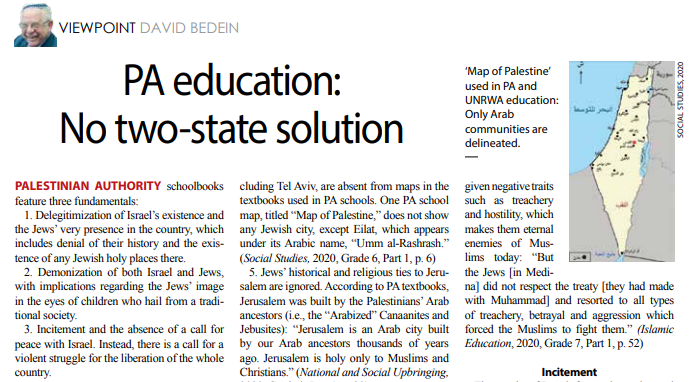
4 –  Habiendo sido considerado ocupantes extranjeros, los Judios en el país no son considerados como habitantes legítimos, y las ciudades que ellos construyeron, incluída Tel Aviv, no figuran en los mapas de textos usados por las escuelas de la Autoridad Palestina. El mapa que decimos, se ve mas abajo, titulado “mapa de Palestina”, no muestra ninguna ciudad Judía, excepto la ciudad sureña de Eilat que aparece bajo su nombre Arabe, un lugar desolado donde luego fue consruída – “ Umm al Rashrash”


Estudios Sociales,  6° Grado  Parte 1 (2020) pág.6

5 – Las conexiones históricas y religiosas de los Judíos con Israel son ignoradas.Según los libros de texto de la P.A. Jerusalem fue construida por los ancestros “ Arabes” de los Palestinos (por ejemplo,los “Arabizados” Canaanitas y Jebuseos) y es sagrada  para Musulmanes y Cristianos solamente. Los Judios no son mencionados en el contexto del siguiente párrafo “ Jerusalém es una ciudad Arabe,construída por nuestros ancestros Arabes, hacen miles de años. Jerusalem es ciudad sagrada para Musulmanes y Cristianos solamente.

Educación Nacional y Social 3° grado parte 1 (2020)  Pág. 29

6 -Una corta descripción histórica de los nombres de la ciudad muestra una enorme brecha de 1000 años entre la época de los Jebuseos y los Romanos, o sea, el período histórico Judío.El nombre “Jerusalem” en sus varias formas que es usado en cientos de lenguajes alrededor del mundo está completamente ausente:


“La ciudad de Jerusalem era conocida como “Jebus” después que los Jebusitas la construyeron 5000 años atrás Cuando los Romanos la nombraron “Aelia” Después de eso vino a ser conocida como “Al Quds” o “Bayt al Maqdis”, después que los Musulmanes la conquistaron por las manos del Califa Umar ibn al Khattab en el año 637 CE”

“Geografía e Historia Moderna y Contemporánea de Palestina, 10° grado Parte 1, (2020) Pág. 43

Demonizacion

 1-Los Judíos, algunas referidos como “Zionistas” con ninguna diferenciación real entre estos dos términos, son demonizados y acusados de albergar intenciones genocidas hacia los Palestinos.”Los Judíos han establecido su entidad sobre el terror, exterminación y colonialismo. Nosotros explicaremos esto”

Lenguaje Arabe, grado académico  10°  parte 2  (2020) pág.28


2 – Los Judíos son demonizados  como infieles y como ayudantes del Demonio. Un verso tomado de un poema: “Dónde están los jinetes (que cabalgarán) a Al Aqsa [Mezquita] para liberarla del puño de los infieles, los ayudantes del Demonio”?

Lenguaje Arabe, 7° grado, Parte 1  (2020) pág. 67


3- Los Judíos también son demonizados fuera de contexto de la guerra, como enemigos del Profeta Muhammad y el Islam en sus primeros años. Se les atribuyen rasgos negativos como traidores y hostiles, lo cual los hace eternos enemigos  del Islam al día de hoy:


“Pero los Judíos “en la ciudad de Medina”no respetaron el tratado “que habían concretado con Muhammad” y recurrieron a todo tipo de trucos , traiciones y agresiones que obligaron a los Musulmanes a luchar contra ellos”

  Educación Islámica, 7° grado, parte 1  (2020)  pág. 52


4 – Es más, Los Judios son presentados como enemigos de los Profetas de Dios, e implícitamente como enemigos del propio Dios en si mismo, una representación que causa un tremendo impacto en estudiantes que provienen de una sociedad tradicional: se debe luchar contra los enemigos de Dios hasta su completa destrucción.El siguiente ejemplo muestra la primera de algunas lecciones que deben ser estudiadas en un capítulo sobre Jesucristo, quien es considerado un profeta en el Islam:

“exponiendo la naturaleza de los niños de Israel y su hostilidad para con los profetas”

Estudio Islámico 9° grado parte 2  (2020) pág. 21

Alentando la muerte de Judíos

La muerte de Judios es presentada como una parte integral de la lucha por la liberación, y bien caracterizada en la primera página de una lección de cuatro páginas, exaltando a la comandante femenino de un ataque terrorista contra un ómnibus civil en la Autopista de la Costa en Israel en el año 1978,   en el cual más de 30 Judíos, ( hombres, mujeres y niños )fueron asesinados.

Dhalal al Mughrabi


En el frente del texto: Nuestra historia Palestina con muchos nombres de mártires que sacrificaron sus almas por la patria, entre ellos la mártir Dhalal al Mughrabi, quien con su lucha pintó un cuadro de desafío y bravura, que ha hecho su memoria eterna en nuestros corazones y mentes. El texto inmediato anterior nos muestra su bravura y como la demostró.

Lenguaje Arabe    5° grado  Parte 2  (2020)  pág 51

En conclusión, los libros de texto de la  naciente Autoridad Palestina delegitimizan la existencia del Estado de Israel, y la misma presencia de los 7 millones de ciudadanos Judíos en el país, cuya historia y lugares sagrados allí es negada.

Los libros de texto de la AP no auspician en ninguna parte una solución pacífica. En lugar de ello, los libros llaman a una lucha violenta para la liberación de toda la Palestina, con fuertes características religiosas,liberación que no está limitada por las fronteras de 1967, y en la cual el terror juega un rol central.


En otras palabras, la educación en la PA no deja espacio para “una solución de dos estados.”

Israel Advocacy Organizations Misled the Jews

WASHINGTON, DC - NOVEMBER 30: A small group of pre-schoolers from Gan HaYeled learn how to light a Hanukkah menorah from Rabbi Sarah Krinsky at Adas Israel Congregation November 30, 2018 in Washington, DC. This year, Hanuakka will begin at sundown on December 2 and last until sundown on December 10. (Photo by Alex Wong/Getty Images)

For well over a year, Israel advocacy organizations led people to believe that the EU would work with Israel to revamp the PA/UNRWA school curriculum, which indoctrinates the next generation of Arabs for total war against Jews.

Having commissioned the examination of more than 1,000 PA texts, beginning with those published in August 2000, when the PA began to produce its own school books, the Center for Near East Policy Research found no surprises as to the content of their text books.

So why were some people surprised when the EU recently took a strong positive position on the PA and UNRWA schools? One major reason is that Israel advocacy groups confused the European Parliament, which is advocating to change the PA texts, with policy-makers, namely, the European Commission of the EU, which expressed passionate support for the PA war curriculum.

Unfortunately, attempts to correct the Israel advocacy groups who confused the European Parliament with the EU proved utterly futile.

Now the damage has been done.

The time has come to mount a new campaign to challenge the EU support for the PA indoctrination of total war on the Jews.

If the allocation of public funds for such “education” is not war crime, then what is?

The PA curriculum of war on the Jews must be shared everywhere.

After 22 years of covering PA education, which is the source of UNRWA education, we can definitivelty state with complete confidence that every aspect of PA and UNRWA indoctrination involves the dispassionate murder Jews.

This message, conveyed without emotion and in a matter-of-fact manner, pervades their texts, their media, their murals and their songs.

The PA and UNRWA leave nothing to the imagination, except for those who delude themselves into thinking that if the European Parliament objects to teaching genocide then the EU will follow suit.

The statesman Edmund Burke famously remarked that he would rather be “an idealist without illusions than an illusionist without ideals”. It would behoove us to remember those words.

Sources:

EU restores PA funding unconditionally

Palestinian Authority education: No room for a two-state solution

Does UNRWA Educational System Prepare the Palestinian Children and Youth for a War against the Jews?


‘No strings attached’: EU releases funding to PA despite antisemitic incitement in textbooks

The European Union voted to release millions of dollars in funding to the Palestinian Authority that had been frozen over concerns about PA textbooks that encourage terror and promote incitement and hatred towards Jews, despite the PA reportedly not committing to change or withdraw those texts.

After a vote on Monday night, some $220 million in EU aid will be released, and PA officials hailed the move as a victory, telling Times of Israel that the funding comes “with no strings attached.”

Notably, the release of the funds coincides with EU Commission President Ursula von der Leyen’s three-day trip to the region. She is expected to meet with PA Prime Minister Mohammed Shtayyeh on Tuesday.

Olivér Várhelyi, the EU Commissioner for Neighborhood and Enlargement, said in late 2021 that funding to the PA should only come after the PA pledged to stop using antisemitic and terror-supporting textbooks in its classrooms.

That proposal sparked a months-long internal EU debate, as some argued that financial support for the PA should be unconditional.

Maintaining the PA’s stability appears to have emerged as the EU’s priority over concerns about antisemitism, as the struggling institution continues to wane in popularity and the majority of Palestinians have expressed a preference for Islamic Jihad and Hamas as potential rulers.

Knesset Speaker Mickey Levy told EU Parliament president Roberta Metsola that the current wave of terror Israel is currently facing can be directly traced back to PA educational institutions that promote hatred of Jews.

“It starts with the textbooks in the Palestinian Authority, which erase the existence of the State of Israel; antisemitic lies about Jews are spread, and there are explicit calls for violence; it continues with the money the Palestinian Authority pays terrorists for killing innocent people, while it receives donations and large amounts of money, also from the European Union; all the way to incitement and lies that are disseminated online – supposedly that the State Israel is harming the holy sites,” he said.

“These acts and lies fan the flames, spread hatred, create an atmosphere of violence, and eventually bring about a wave of terror.

“The State of Israel expects from you, Madam President, and from all the members of the European Union, to stand by it in the face of these dangerous phenomena, which fuel terror and murder and will never allow us to bring about a solution to the conflict. You have the power to influence and [protect] the younger generation from incitement in schools that is carried out with your money.”

Palestinian Authority Education: No Room for a Two-State Solution

By David Bedein                

Research: Dr. Arnon Groiss 


Palestinian Authority schoolbooks feature three fundamentals:

  1. De-legitimization of Israel’s existence and the Jews’ very presence in the country, which includes denial of their history and the existence of any Jewish holy places there.
  2. Demonization of both Israel and Jews, also religiously – with implications regarding the Jews’ image in the eyes of children who hail from a traditional society.
  3. The absence of a call for peace with Israel. Instead, there is a call for a violent struggle for the liberation of the whole country, including pre-1967 Israel. This struggle is given a religious color and terror is made an integral part thereof, encouraging the murder of Jews. 

De-Legitimization

  1. Israel’s Jewish citizens are considered foreign colonialists:

    “We will think and discuss: I will compare the tragedy of the Indians, America’s original inhabitants, to the tragedy of the Palestinian people.” 

    (Social Studies, Grade 8, Part 2 (2020) p. 34)

  1. The country’s Jewish history is denied, including the existence of archaeological items proving that:  “…[The conqueror has built for himself an artificial entity that derives its identity and the legitimacy of its existence from tales, legends and phantasies and has tried in various ways and means to create live material evidence for these legends, or archaeological architectural proofs that would determine their truth and authenticity, but in vain.”]

    (Arabic Language – Academic Path, Grade 10, Part 2 (2020) p. 68)
  2. Existence of Jewish holy places in the country is denied, including the Western Wall in Jerusalem. Please note that the photograph has been cut in a way that would “hide” the Jews who pray there:

    “Al-Buraq Wall”

The Al-Buraq Wall has been named after Al-Buraq [the divine beast] that carried the Messenger [of God, i.e., Muhammad] during the Nocturnal Journey [from Mecca to Al-Aqsa Mosque in Jerusalem, according to Islamic belief] and the Ascension [to Heaven]. The Al-Buraq Wall is part of the western wall of Al-Aqsa Mosque. Al-Aqsa Mosque, including the wall, is Palestinian land and an exclusive right of the Muslims.”

(Islamic Education, Grade 5, Part 1 (2020) p. 63)

  1. Having been considered foreign settlers, Jews in the country are not counted as  legitimate inhabitants and the cities they built there, including Tel Aviv, are absent from maps in the texts used in PA schools. The PA school map here, titled “Map of Palestine”, does not show any Jewish city, except the southern city of Eilat that appears under its Arabic name, desolate place where it was later built – “Umm al-Rashrash”.


(Social Studies, Grade 6, Part 1 (2020) p. 6) 


  1. The Jews’ historical and religious ties to Jerusalem are ignored. According to the PA textbooks, Jerusalem was built by the Palestinians’ Arab ancestors (i.e., the “Arabized” Canaanites  and Jebusites) and is holy to Muslims and Christians alone. Jews are not mentioned in this context: “Jerusalem is an Arab city built by our Arab ancestors thousands of years ago. Jerusalem is holy only to Muslims and Christians.”

    (National and Social Upbringing, Grade 3, Part 1 (2020) p. 29)
  2. A short historical description of the city’s names features a huge gap of 1000 years between the Jebusites and the Romans, that is, the Jewish historical period. The name “Jerusalem” with its various forms that is used in hundreds of languages around the world is completely absent: 

“The city of Jerusalem was known as ‘Jebus’ after the Arab Jebusites who built it 5000 years ago. When the Romans occupied it they named it ‘Aelia’. Later on it came to be known as ‘Al-Quds’ or ‘Bayt al-Maqdis’, after the Muslims had conquered it at the hands of Caliph Umar ibn al-Khattab in 637 CE…”

(Geography and Modern and Contemporary History of Palestine, Grade 10, Part 1 (2020) p. 43)

Demonization

  1. Jews, sometimes referred to as “Zionists” with no real differentiation between these two terms, are demonized and accused of harboring genocidal intentions towards the Palestinians: “The Zionists have established their entity upon terror, extermination and colonialism. We will explain that.”

    (Arab Language – Academic Path, Grade 10, Part 2 (2020) p. 28)
  2.   Jews are demonized as infidels and as the Devil’s aides. A verse taken from a poem: “Where are the horsemen [who will ride] to Al-Aqsa [Mosque] to liberate it from the grip of infidelity, from the Devil’s aides?”

    (Arabic Language, Grade 7, Part 1 (2020) p. 67)

  1. The Jews are also demonized outside the context of the war, as enemies of Prophet Muhammad and Islam in its early years. They are given negative traits such as treachery and hostility, which makes them eternal enemies of Muslims today: 

    “But the Jews [in the city of Medina] did not respect the treaty [they had concluded with Muhammad] and resorted to all types of treachery, betrayal and aggression which forced the Muslims to fight them.”

    (Islamic Education, Grade 7, Part 1 (2020) p. 52)
  2. Moreover, Jews are presented as enemies of God’s prophets and, by implication, enemies of God himself, a portrayal that has an enormous impact on students who come from a traditional society: God’s enemies should be fought against until their utter destruction. The following example features the first out of several lessons to be learned from a chapter about Jesus Christ, who is considered a prophet in Islam:
    “exposing the nature of the Children of Israel and their hostility to the prophets.”

    (Islamic Education, Grade 9, Part 2 (2020) p. 21)

Encouraging the Murder of Jews

The murder of Jews is featured as an integral part of the liberation struggle, and featured on the first page of a four-page lesson exalting the female commander of a terror attack against an Israeli civilian bus on Israel’s Coastal Highway in 1978 where over thirty Jews – men, women and children – were murdered:

“Dalal al-Mughrabi”  

In front of the text: Our Palestinian history is replete with many names of martyrs who sacrificed their souls for the homeland, among whom is the martyr Dalal al-Mughrabi, who painted with her struggle a picture of challenge and bravery that has made her memory eternal within our hearts and minds. The text before us shows her struggle and journey.”  (Arabic Language, Grade 5, Part 2) 

(2020) p. 51)

In conclusion, the nascent Palestinian Authority textbooks de-legitimize the existence of the State of Israel, and the very presence of its 7 million Jewish citizens in the country, whose history and holy places there are denied.

The PA books never advocate a peaceful solution. Instead, they call for a violent struggle for the liberation of all of Palestine, with strong religious characteristics, which is not limited by the 1967 lines and in which terror plays a central role. 

In other words, PA education allows no room for a “two-state solution”.

Does UNRWA Educational System Prepare the Palestinian Children and Youth for a War against the Jews?

Introduction
The United Nations Relief and Works Agency for the Palestinian refugees has been
operating since 1950 in Syria, Lebanon, Jordan, Judea and Samaria (including East
Jerusalem) and the Gaza Strip. It offers welfare, health and education services to the
1948 refugees and their descendants who are kept under miserable conditions in
dozens of refugee camps. Over half of its budget is directed to the educational field.
This paper discusses UNRWA’s educational activity in the territories of Judea,
Samaria and Gaza only. According to the data appearing on its site (from the 2019/20
school year) it had in Gaza 286,645 students in 278 schools that included grades 1-9.
In Judea and Samaria (including East Jerusalem) it had that year 45,883 students in 96
schools with the same grades, but its two schools in East Jerusalem included grade 10
as well.

Since 2000, I have conducted research projects regarding the attitude to the JewishIsraeli “other” and to the issue of peace with this “other”, as expressed by schoolbooks
and teachers’ guides issued by the Palestinian Authority’s Curricula Center and used in
UNRWA schools. The textbooks have been found to include hate and violence
indoctrination, in sharp contradiction to UNRWA’s commitment, as a UN
organization, to neutrality and to the promotion of a peaceful resolution of the
conflict. This indoctrination is based on three fundamentals: