The westerners helping Hamas win the propaganda war

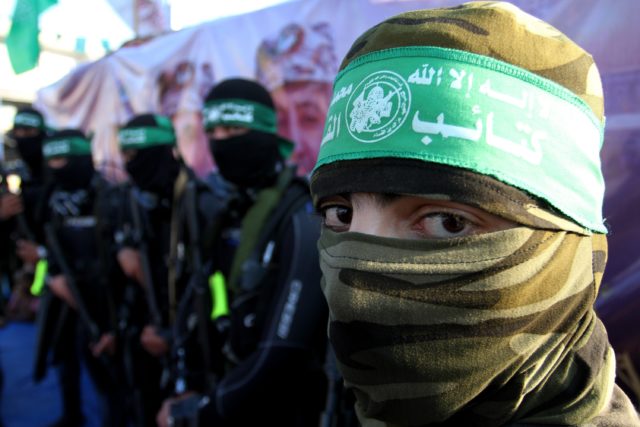
After two years of war, and despite Israel’s many successes on the battlefield, Hamas can also claim a kind of victory – at least for now. The terror group has survived and is once again exerting control in the areas of Gaza under its authority. Public executions, whippings, stonings and kneecappings have returned. In the first five days of the ceasefire, Hamas executed at least 100 Gazans.

Hamas’s survival was achieved not only through its remaining fighters and its holding of hostages, but also thanks to a chorus of western apologists. A coalition of so-called progressives and professional activists has excused, rationalised and defended the group’s actions across universities and in newspaper editorials. The BBC, Sky, the Guardian, the FT and the New York Times have all parroted Hamas talking points.

Tales of impending famine in Gaza, for instance, were broadcast as fact, sourced from UN bureaucrats and ‘aid agencies’ with long records of anti-Israel bias and, in some cases, open sympathy for Hamas. This isn’t journalism: it’s agenda-driven activism disguised as news. What the BBC and others failed to grasp is that, for Hamas, the western media is the battlefield – no less important to its survival than its rockets and tunnels.

While Israel was forced into a military campaign to protect its citizens, Hamas launched a far more cynical war, sacrificing Palestinians by firing rockets from dense civilian areas and daring Israel to respond. Their aim was to trigger international pressure for a ceasefire so as to restore the flow of weapons for their operations.

From the outset, even before Israeli troops had entered Gaza, Hamas’s operatives and sympathisers in the West were shouting about ‘genocide’ and ‘famine’. It was a propaganda trap – and the western media walked right into it.

Consider, for example, these headlines from the early weeks of the conflict in 2023:

11 October: Fuel in Gaza will run out in 48 hours

15 October: Fuel in Gaza will run out in 48 hours

30 October: Fuel in Gaza will run out in 48 hours

6 November: Fuel in Gaza will run out in 48 hours

The pattern speaks for itself. It’s been the same story with Gaza being ‘on the brink of famine’ for the past two years. This is how it works:

Step one: The Hamas ‘health ministry’ makes up a casualty number which could be debunked by the most cursory statistical analysis.

Step two: Aid organisations repeat the number without independent confirmation.

Step three: UN agencies in Gaza (some staffed by Hamas members) cite the aid organisations.

Step four: Media outlets quote the UN agencies.

Step five: Hamas’s supporters in the West claim the numbers are ‘UN verified’.

UN officials have also contributed to the fiction directly. In May, Tom Fletcher, a humanitarian coordinator for the organisation, told BBC Radio 4: ‘There are 14,000 babies that will die in the next 48 hours unless we can reach them.’ Almost no babies died as a result of the war in the following days. But that didn’t stop the BBC running the claim in bulletins and news outlets around the world repeating it, citing the BBC as a reliable source.

Some of the most widely shared images of ‘starvation in Gaza’ were from Yemen

The Hamas narrative has been amplified, too, by disinformation campaigns driven by Iranian, Russian and Chinese state-linked bots on social media, which have exploited Gaza as a means of destabilising western societies. These regimes understood how easily such narratives could tap into a pre-existing willingness among many in the West to believe anti-Semitic libels.

This tactic isn’t new. The Tsarist secret police famously forged The Protocols of the Elders of Zion to incite anti-Semitism, and the Soviet KGB spread anti-Zionist propaganda into western media and academia during the Cold War. In the Middle Ages, pogroms were fuelled by fabricated claims of Jews killing Gentile babies. Today, similar falsehoods are disseminated by journalists, academics and UN officials – cloaked in the language of human rights but echoing ancient prejudices.

Why were Hamas’s inflated casualty figures reported as facts? Why were incorrect claims of Israel bombing hospitals repeated without scrutiny – while confirmed cases of Hamas rockets hitting Israeli hospitals in Ashkelon and Beersheba were ignored? In part, this was down to journalistic complacency. The facts were accessible. Thousands of authentic Palestinian social media accounts from Gaza showed everyday life continuing, with cafés, restaurants, supermarkets, even beauty salons all operating, contrary to claims of complete destitution.

Independent researchers discovered that some of the most widely shared images of ‘starvation in Gaza’ were from Yemen. One prominent photo showing a skeletal child was highlighted by the media as evidence of famine. In reality, the child wasn’t malnourished due to famine. He had cerebral palsy, hypoxemia and other genetic conditions. The image was cynically selected to exclude his healthy sibling. Its source? An Islamist outlet in Turkey. That didn’t prevent the GuardianTimes and New York Times running it on their front pages, inflaming the emotions of millions of readers. The New York Times later slipped in a discreet correction, but by then the damage was done. Despite its substantial resources, the much-touted BBC Verify unit missed many of these falsehoods.

There has, of course, been great suffering in Gaza, as in any war. But that doesn’t justify using misleading photos, fake stats and Hamas-supplied images to condemn Israelis as child murderers.

The good news? Large swaths of the British public aren’t buying it. Scroll through the reader comments under articles about Israel, and you’ll find thousands of ordinary people who haven’t lost their critical faculties. They know casualty figures from terrorist regimes aren’t a sacred truth. They can spot propaganda when they see it.

Unlike some intellectuals, they don’t lose all logic the moment the word ‘Israel’ is uttered. As George Orwell once quipped: ‘You must be an intellectual. Only an intellectual could believe something quite so stupid.’ Today, he might have aimed that line at Guardian readers or BBC news staff.

In this war, it is not Israel or even Hamas that has lost its purpose, but the media.

Trump’s Sharm-el-Sheikh Doctrine: Containment Over Collapse in the New Iran Equation

Summary

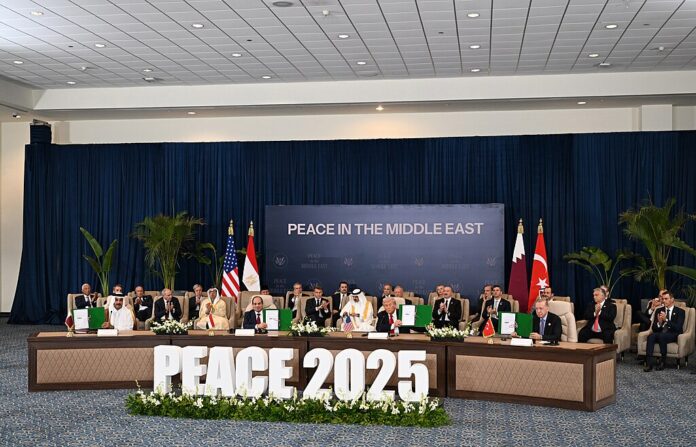
President Donald Trump’s Sharm-el-Sheikh peace initiative marks a critical recalibration of U.S. policy toward Iran. Once dominated by talk of regime change, the new framework favors containment and calculated de-escalation. Tehran, weakened by sanctions, military setbacks, and domestic dissent, remains repressive but resilient. Trump’s approach—military encirclement without direct confrontation—aims to limit Iran’s reach while avoiding the chaos that followed interventions in Iraq and Libya.

For the Iranian opposition, this shift is a double-edged sword: it postpones hopes for liberation but clarifies that lasting transformation must come from within, not from foreign intervention. The exile community’s failure to unite and the emerging domestic reformist defection suggest a new phase of Iran’s opposition politics—one defined less by nostalgia and more by grassroots reinvention. Ultimately, containment may become the crucible for Iran’s eventual self-liberation, proving that sustainable change is born from indigenous will, not imposed upheaval.

To assess whether U.S. President Donald Trump’s Sharm-el-Sheikh peace agreement—aimed at de-escalating tensions in the Middle East, curbing Iran’s nuclear ambitions, and stabilizing regional alliances—will expand or constrain American-Israeli options for regime change in Tehran, we must first acknowledge a sobering reality: If regime change was ever a viable policy instrument in the post-1979 Iranian context, its prospects have probably been materially diminished under the current framework.

Tehran’s Current Predicament

Tehran stands exposed, vulnerable, and profoundly isolated on the global stage, yet the regime clings desperately to an image of domestic control. Economic sanctions, its humiliating military defeat, its spectacular proxy setbacks in Syria and Lebanon, and growing internal dissent have left it cornered, much like a chess player down to their last rook in a losing endgame.

President Trump’s recounting of halting Israeli jets en route to “take out” Ayatollah Ali Khamenei—framed as a deliberate pivot away from escalation—underscores this shift. What many hawks predicted as the act that would cause final regime collapse was instead contained, reflecting a calculated aversion to the chaos of Iraq, Afghanistan, or Libya.

The ghosts of those wars loom large in Washington and Europe: absent a viable, coherent, alternative, reflective of Iran’s very real social, political, and ethnic pluralism, ready to govern 90 million people, any forced collapse might fracture Iran into sectarian fiefdoms, destabilize the region’s oil arteries, and invite opportunistic intrusions by all sorts of rogue elements. Neither Washington nor Jerusalem nor the Sunni Arab states harbor the appetite for reopening that Pandora’s box.

The exiled opposition remains vocal, but lacks the inclusive, pluralist leadership capable of galvanizing Iran’s fragmented society. In this void, policymakers in Washington, Jerusalem, and most European capitals have reached a tacit consensus: containment, rather than collapse, may now be the preferred operative paradigm.

Karim Sajadpour’s recent Foreign Affairs analysis amplifies this recalibration. He portrays Iran’s regime as brittle yet durable: exposed abroad, but still commanding repressive might at home. Unlike the Shah’s elite, the current leadership has no safe exile plan-it will cling to power through coercion, not compromise.

Sanctions and diplomatic isolation have eroded the Iranian regime’s legitimacy but not its control. The revolutionary state, Sajadpour notes, has “scientifically refined repression.”

Trump’s Calculated De-escalation

President Trump’s approach reflects this realism. Though derided by hawks, his peace plan substitutes pressure for confrontation—a formula that combines military encirclement, financial strangulation, and diplomatic isolation with calibrated outreach.  He has reiterated his “preference for a deal with the Iranians,” noting their “tough situation.” He has signaled Tehran wants a deal, expressing confidence that he will broker a pragmatic accord.

In Trump’s view, this isn’t appeasement; it’s triage. The new containment doctrine seeks to freeze the battlefield—a status quo deterrence that extracts verifiable concessions on missiles, proxies, and enrichment without plunging the region into chaos.

Containment: Stings and Silver Linings

Yet even as it mollifies global powers, this policy will inevitably sting the Iranian people and the exiled opposition. For ordinary Iranians, it extends economic suffocation and postpones dreams of liberation; for the opposition in exile, which trumpeted Tehran’s impending collapse, it will feel like a geopolitical betrayal.

Still, within this pain lies clarity—the recognition that no foreign actor, however formidable or well-motivated, can midwife Iran’s transformation. Only Iranians themselves possess the agency and collective will to reshape their political destiny. History’s precedents—from the 1906 constitutional revolution, the 1978 upheaval, to the 2022 protests—bear this out: true change in Iran has always been endogenous and requires the masses to participate.

An Opposition at the Crossroads

This realization should serve as a reckoning for the exiled opposition. Their most persistent failing—an Achilles’ heel across generations—has been a fixation on rivalry over coalescence, nostalgia over imagination.

The globalized, tech-savvy youth of Iran expect visionary leadership, not sanctified martyrdom or past revivalism. The old status quo of fractured exilic politics will not inspire a nation of 90 million. If the opposition cannot coalesce, modernize its discourse, or mirror the pluralism of Iran’s own mosaic, it will remain sidelined as the regime and history move on.

Domestic Opposition Reconfigured

Meanwhile, within Iran, the political ground is shifting quite dramatically. Under economic agony and ideological exhaustion, remnants of the so-called “reformist” camp are openly abandoning the role of sanctioned dissenters.

Increasingly, younger reformists, disillusioned bureaucrats, mid-level technocrats, labor unions, and key civil society groups are taking decisive steps toward movements seeking fundamental change rather than regime recalibration. This may be the fusion of domestic and diaspora dissent—still embryonic but quite very plausible—that could redefine the anatomy of Iran’s real opposition in the immediate window ahead.

Strategic Implications

Ultimately, Trump’s peace plan does not extinguish Iran’s dream for liberty and freedom; it merely redirects its trajectory. By freezing the regime’s foreign adventurism, it will shift the locus of agency inward—to Iran’s citizens, its divided elites, and its emerging generation of innovators and idealists.

In so doing, it honors an enduring geopolitical truth: sustainable transformation in Iran will not come from bombardments or sanctions, but from the soil of indigenous resolve. Containment, paradoxically, may prove the crucible from which genuine sovereignty—and authentic revolution—finally emerge.

The US-led Gaza force is not working; Trump must let Israel act

At the Civil-Military Coordination Center being set up in recent days and hours in southern Israel, there’s a special department tracking media reports. I witnessed this during my Friday visit. My hope is that what follows will reach the department’s staff, and through them the CMCC commanders, since every passing day Hamas gains time, and this benefits neither them, Israel, nor President Donald Trump.

The new headquarters is being set up at a rapid and impressive pace. The Americans, as it happens, know how to improvise on the dime just as capably as the Israelis. Their leaders’ determination to closely follow developments is the reason for their aerial convoy to the site – not to provide Israeli babysitting, as critics suggest.

“There has never been anything like this,” Secretary of State Marco Rubio said while visiting the place two days ago. Indeed, there never has been. An international blend of Israelis, Americans, French, Germans, Canadians, Cypriots, Greeks, and others moves through the enormous hangars. I even thought I spotted a United Arab Emirates flag in the corner.

Nevertheless, it’s uncomfortable to report that at this preliminary stage, the crowds of soldiers, officers, and civilians don’t precisely know what to do with themselves yet. Before Rubio’s arrival, they didn’t even trouble themselves to sit at their computer workstations. Only when he neared the work stations did someone issue instructions to occupy the chairs to generate the appearance of “quiet, working.” I was present to observe it.

The hundreds of dedicated people who arrived to serve at the location don’t know what to do, for the straightforward reason that everything remains in organizational phases. Nobody possesses plans yet – even unclear ones – for where to proceed from here, only good intentions. The war halted abruptly, and this represents a tremendous international accomplishment. Nevertheless, the practical path forward is extremely complicated, and its execution will prove more challenging.

Here’s what’s absent: A unified international force, certainty regarding the nations that will comprise it, coordination methods between the different armies that will function within it, work plans, schedules, orderly directives, guidelines on what occurs in problematic scenarios, and evidently also a Security Council resolution without which the force – which obtained the acronym ISF – won’t be established whatsoever. This is likely not the entire list.

Pressure on Hamas

Preparing each of these stages will require time, especially if the Security Council intervenes midway. Consequently, even though the Americans and the Israelis assisting them are all functioning at Trump speed, in the optimal scenario, weeks will elapse before the ISF commences dismantling Hamas from its armaments, demolishing the tunnels, and demilitarizing Gaza. In the less favorable and more probable scenario, months will elapse.

Those already thoroughly exploiting the transitional period are Hamas murderers. It’s been five days they haven’t returned the deceased hostages, signifying they’re flagrantly violating the ceasefire agreement. Hamas is re-establishing its regime in the half of the Strip that remained under its control. It can be assumed that the organization is also restoring terror infrastructure at an expedited pace. That’s what it exists for, ultimately.

Hamas’ restoration while the ISF organizes is hazardous to Israel, naturally, but equally important – it jeopardizes Trump’s plan. Every day that elapses without someone mowing the terror lawn will render the ISF’s future work more challenging, perhaps even unfeasible. We’ve witnessed in the past the West’s struggles in eradicating terror in Afghanistan and Iraq.

Because ultimately – this is at minimum the intention – a moment will come when the international force will need to confront Hamas terrorists directly. Following two years of war, the organization is presently at the peak of its weakness. Trump’s interest ought to be that this situation continues. Nevertheless, time plays into the terrorists’ advantage. Like a phoenix, they’re reconstructing themselves afresh in Gaza’s dunes – construction that opposes the interests of both the US and Israel. Trump himself, and also Rubio on Friday, once more emphasized they’re committed to eliminating Hamas.

What, consequently, must be accomplished so the 20-point plan’s objectives don’t evaporate? The answer is that the transitional period until the ISF begins work must be exploited in a manner that won’t undermine the plan. How? The US must permit Israel to do in Gaza precisely what it authorizes IDF forces to do in Lebanon. Specifically, not allow terror to rear its head. No, this doesn’t jeopardize the ceasefire. The Israelis don’t desire the war’s renewal either. They overwhelmingly endorsed the plan the president presented.

Nevertheless, there are intermediate situations where there’s no full war, but also not sitting with zero activity facing strengthening terror. This is what’s occurring in Lebanon, in Judea and Samaria, and also in various theaters where the US functioned for many years and justifiably against terror.

Allow the IDF to operate

Trump’s plan was and remains beneficial for Israel, the region and peace. Nevertheless, until the international community advances to its subsequent sections, and so the force will possess the capability to do so, the IDF must be permitted to operate also in Gaza’s western side.

Trump believes, rightfully, in “peace through strength.” The most precise implementation of this principle is cutting down the emerging terror in recent days inside Gaza. This is the method to guarantee the ISF will have easier work, meaning its success in maintaining peace in the future will be greater.

Hamas has 20,000 armed terrorists, hundreds of rockets, IDF estimates

More than two years after the Hamas invasion of Israel on October 7th, Hamas still has roughly 20,000 men under arms in the Gaza Strip, the Israeli military estimates.

According to a report published Tuesday morning by Channel 14, a recent Israeli intelligence assessment of Hamas has determined that the terror group likely has about 20,000 armed terrorists divided into six brigades, which are further subdivided into 24 battalions.

Prior to October 7th, 2023, Hamas is believed to have had as many as 40,000 armed terrorists in Gaza, including 20,000 highly trained members of the Izz ad-Din al-Qassam Brigades, Hamas’ military wing.

Hamas now is operating with roughly half as many men under arms as it had prior to October 7th, 2023, and its surviving 24 battalions are at varying levels of effectiveness.

In some cases, Hamas battalions in parts of Gaza have been forced to operate in isolation since the end of the previous ceasefire, in March.

The readiness and combat effectiveness of some Hamas battalions has likely further been degraded by the loss of experienced terrorists and their replacement by younger, poorly trained recruits.

The Israeli military estimates that after two years of war and thousands of rocket attacks, Hamas still has an arsenal of hundreds of rockets, with a small number of rocket launchers capable of firing short and medium-range projectiles.

Prior to the start of the war, estimates placed the number of rockets in Hamas’ arsenal in the tens of thousands.

In addition, the report said that Hamas likely has thousands of rocket-propelled grenades, along with thousands of bombs and thousands of AK-47 assault rifles.

Perhaps most concern, however, is the survival of much of Hamas’ underground infrastructure, with more than half of the group’s terror tunnels believed to still be intact.

The IDF intel assessment also determined that morale inside of Hamas appears to be low, following the elimination of much of the group’s senior leadership and a decline in Hamas’ command-and-control capabilities.

While Hamas’ overall offensive capabilities have been greatly diminished, the assessment found, the terror group still possesses some limited abilities to infiltrate into Israeli territory.

Trump considers release of Palestinian arch-terrorist Barghouti from Israeli prison in Gaza ceasefire agreement

U.S. President Donald Trump revealed that he had considered supporting the release of Marwan Barghouti – a convicted terrorist viewed by many Palestinians as a potential unifying leader – as part of a ceasefire agreement between Israel and the Hamas terror group in Gaza.

The discussion was reportedly part of the negotiations over which prisoners would be released in exchange for the Israeli hostages. Hamas has long demanded the release of Barghouti, who is serving five life sentences for orchestrating multiple terror attacks.

In an interview with Time magazine on Oct. 15, published Thursday, Trump was asked whom he views as a leader among the Palestinians.

“They don’t have a leader right now, at least a visible leader, and they don’t really want to, because every one of those leaders has been shot and killed. It’s not a hot job,” he replied.

The interviewer then mentioned Barghouti, who he said “is seen by many as the one figure who could unite Palestinians behind a two-state solution.”

“He tops most polls amongst Palestinians for whom they would vote for in a presidential election. But he’s in prison, and Israel has refused to let him out,” the journalist stated, adding, “He was arrested in 2002. Ron Lauder, a big supporter of yours, recently encouraged Israel to let him out. Do you think Israel should release him from prison?”

Trump responded, “I am literally being confronted with that question about 15 minutes before you called. That was the question. That was my question of the day. So I’ll be making a decision.“

Barghouti’s name has reportedly been mentioned during ceasefire discussions over the past two years, and he regularly tops opinion polls of the most popular Palestinian leaders. Palestinian Authority (PA) President Mahmoud Abbas is elderly and widely seen as a corrupt dictator.

Recent reports indicate that Barghouti’s release was supported not only by Hamas but also by World Jewish Congress President Ronald Lauder, who allegedly offered to travel to Egypt to personally advocate for including Barghouti in the deal, according to a senior Arab official, an Israeli official, and a third source familiar with the matter cited by The Times of Israel.

However, Israel has strongly rejected calls to free Barghouti, and the idea was dismissed this time by Prime Minister Benjamin Netanyahu’s office amid “overwhelming opposition” among Israeli cabinet ministers, the sources said.

Hamas’ motivation to secure Barghouti’s release – though he is not a member of the group but was affiliated with Fatah’s militant wing, the Tanzim – is likely driven by a desire to boost its prestige by freeing a popular leader and gaining his indebtedness.

A source quoted by The Times of Israel said Hamas told mediators that “Barghouti’s fate remains absolutely central to these talks.” An Arab official stated, “While Hamas pushed hard for his release, ultimately it could not be seen as holding up a ceasefire over one man.”

Among Arab leaders and many on the Israeli and international Left, Barghouti is regarded as a Mandela-like figure for his perceived ability to unify Palestinian factions and for his English-language statements rejecting violence against Israeli civilians while expressing support for a two-state solution.

Former Shin Bet chief and Labor party member, Ami Ayalon, advocated for Barghouti’s release in 2024, arguing he “is the only Palestinian leader who can be elected and lead a united and legitimate Palestinian leadership toward a path of mutually agreed separation from Israel.”

However, Barghouti called for “global and armed resistance” as late as 2014, and urged Palestinian leaders to “put an immediate end to security cooperation” with Israel.

Barghouti played a key role during the Second Intifada in the early 2000s, and in May 2004, he was convicted for involvement in five murders, receiving five life sentences.

One of the leading voices opposing Barghouti’s release from jail is National Security Minister Itamar Ben Gvir, who is responsible for Israel’s prison system.

In August, Ben Gvir drew criticism from across the political spectrum after publishing a 13-second video of himself berating Barghouti, in the first footage showing the 66-year-old man in over a decade.

“You won’t win. Whoever messes with the nation of Israel, whoever murders our children and women, we will wipe them out. You should know this, [this happened] throughout history,” Ben Gvir told him.

On Thursday, he responded to Trump by noting he had “great appreciation” for the president, while noting, “Israel is an independent sovereign state – the Members of Knesset vote according to their judgment. And Barghouti is a despicable Nazi murderer, with the blood of many civilians, women, and children on his hands. He will not be released and will not lead Gaza.”

Was Binyamin Netanyahu Born ‘Pregnant’?

In his 1978 memoir, In Search of Enemies, former CIA station chief John Stockwell offered a sickening insight into the agency’s operational doctrine. He described a plan to compromise Zambian President Kenneth Kaunda, who had publicly supported an embargo against shipping arms to Angola. The CIA’s plan, Stockwell wrote, was to entice Kaunda into permitting just one secret arms shipment.

“It was felt that if one planeload of arms could be introduced through Zambia, with Kaunda’s permission, he would be irreversibly committed,” Stockwell explained. The agency had a term for this state of strategic entrapment. “‘Pregnant’ we said in CIA headquarters.”

The jargon is cold, a product of a bureaucratic culture that, as some critics have noted, views moral compromise as a tactical tool. To be “pregnant” is to be irreversibly complicit, your future actions dictated by a past event you cannot afford to have exposed.

This American modus operandi provides a stark, unsettling lens through which to re-examine the career of Israel’s longest-serving prime minister, Binyamin Netanyahu. For decades, Netanyahu has defined Israeli politics, building a global brand as the ultimate Jewish nationalist, a fierce defender of Israeli sovereignty, and the only leader capable of saying “no” to Washington.

But this public persona has always coexisted with a starkly contradictory record: a history of stunning political capitulations, land concessions that violated his own “red lines,” and a pattern of acquiescence to American demands, often at moments of his greatest political strength. This chasm between rhetoric and action has fueled a persistent, unsettling question, one that his critics have asked from the very beginning: Is Binyamin Netanyahu an English-speaking Israeli, or is he, in terms of his loyalties and practical actions, a Hebrew-speaking American?

A ‘Man Without a Past’

Today, Netanyahu is a fixture of Israeli life, a political titan synonymous with the state itself. It is difficult, then, to recall the furor that greeted his first election in 1996. He was, to many, an outsider—an American-accented, media-savvy consultant who had rocketed to the top, bypassing the traditional hierarchies.

Just weeks after his victory, on June 21, 1996, the Jerusalem-based weekly Kol Ha’ir published a multi-page investigation that landed like a grenade in the new prime minister’s office. The article, titled “A Man Without a Past,” reported that Netanyahu’s U.S. Social Security file was “חסוי” (secret/classified). This classification, the paper alleged, was of a type reserved for employees of U.S. federal agencies.

The report went further. It claimed the file linked the name “Binyamin Netanyahu” to two others: “John J. Sullivan” and “John J. Sullivan Jr.” The paper, which had investigated his years in the U.S., including his time at the Boston Consulting Group where he was known as “Ben Nitay,” put the question bluntly: “Who are you, Mr. Netanyahu? … Is it all the same person? … Never was the history of an Israeli prime minister so secretive.”

The story exploded. On July 5, 1996, Deseret News, syndicating a report from the New York Times News Service, covered the growing scandal under the headline, “Israel wants ‘real’ Netanyahu to please stand up.” It confirmed that the Kol Ha’ir report had “prompted a parliamentary question this week from Labor Party legislator Ephraim Sneh.”

On the floor of the Knesset, Sneh (other accounts name different MKs, but the question was officially asked) demanded answers. According to Knesset protocol records and contemporary reports, the query was direct: “Why is this file classified? Did he ever work for the U.S. government? Did he serve as an informant for any U.S. government authority?”

The Prime Minister’s Office flatly denied the allegations. A spokesman, Charli Sitbon, called the report “groundless” and “a complete lie,” attributing the name “Ben Nitay” to a simple, Hebraized version of his father’s pen name, Nitai, which was easier for Americans to pronounce. The “John J. Sullivan” connection was dismissed as fabrication.

Political firebrand and rival Uri Avnery seized on a related issue: Netanyahu’s U.S. citizenship. Netanyahu, who was born in Israel but grew up and was educated in the U.S., had held American citizenship. While he claimed to have relinquished it as required by law, Avnery, writing in the Maariv daily, pointed out that no proof had ever been made public. “If he was an American citizen when elected prime minister,” Avnery wrote, “his election is null and void.”

The Prime Minister’s Office flatly denied the allegations, and with no smoking gun, the immediate furor subsided. But the questions lingered, unresolved. The new Prime Minister was now in a uniquely vulnerable position. With his loyalty and secret American past the subject of unresolved parliamentary questions and media speculation, he was about to enter his first major negotiation—the Hebron Accords—with the Clinton administration, the very power he was being accused of serving.

The Great Acquiescence

Had the “Man Without a Past” scandal been an isolated incident, it might have remained a historical footnote. But it was followed almost immediately by a pattern of political behavior that baffled his own right-wing base and seemed to confirm his critics’ deepest suspicions.

Netanyahu had won the 1996 election, in large part, by campaigning ferociously against the Oslo Accords, which he and his Likud party had branded as a catastrophic, criminal concession to terrorism. His supporters expected him to halt the process, to reverse the tide. Instead, he did the opposite.

In January 1997, Netanyahu signed the Hebron Accords. This agreement, brokered by President Bill Clinton’s administration, did what his nationalist voters considered unthinkable: it handed over 80 percent of the ancient Jewish holy city (H1) to the full civil and police control of Yasser Arafat’s Palestinian Authority.

The Israeli presence was reduced to a small, heavily guarded enclave (H2). This area included the volatile Abu Sneneh neighborhood, which remained under Israeli security control but PA civil control. From that very neighborhood, on March 26, 2001, a Palestinian sniper would aim his rifle at the Jewish settlement and murder 10-month-old Shalhevet Pass. For Netanyahu’s critics on the right, the line from the 1997 capitulation to the 2001 murder was a direct result of his first major act of irreversible commitment.

The Hebron Accords were just the beginning. In October 1998, Netanyahu was summoned by President Clinton to the Wye River Plantation in Maryland, alongside his defense minister, Ariel Sharon. His right-wing government was already fragile, and he went to Wye with a list of publicly declared “red lines.” He assured his constituency there would be no more land concessions without full Palestinian reciprocity on security, and, most critically, no release of Palestinian prisoners with “blood on their hands.”

After nine days of intense American pressure, the Sabbath passed over Israel. Israelis, turning on their radios and televisions after Shabbat, were met with a sense of shock and horror. Netanyahu had capitulated.

The Wye River Memorandum committed Israel to another 13 percent “further redeployment” from Judea and Samaria. More stunningly, it mandated the release of 750 Palestinian prisoners. While Netanyahu’s team argued the text gave them discretion to withhold murderers, the American-brokered reality was that terrorists with blood on their hands were, in fact, included in the releases.

Netanyahu returned to Israel to find his coalition, and his nationalist credibility, in ruins. His justification, offered to a furious public, became infamous: “We had no choice.”

For those watching, it was the classic defense of a leader who, being “pregnant,” truly has no other choice.

The ‘Mr. Security’ Paradox

The gap between Netanyahu’s nationalist rhetoric and his policy of capitulation was not limited to political deal-making. For contemporary security analysts, his actions constituted a national security catastrophe in the making.

In a scathing position paper (#107) from the Ariel Center for Policy Research, The Acquiescence of the Israel Government in Palestinian Authority First Strike Preparations in Judea and Samaria,” this author systematically dismantled the Prime Minister’s “Mr. Security” persona. The paper argued that the government was actively misleading the public, pairing “rhetorical ‘toughness’” with a “studied policy of acquiescence” to a massive, illegal Palestinian military buildup.

Citing intelligence sources, the paper detailed a Palestinian Authority that had swelled to 40,000 armed men—tens of thousands beyond what the Oslo Accords permitted. More alarmingly, this was not a “police force” to manage civil order; it was an army-in-training. The paper documented its acquisition of forbidden heavy machine guns, mortars, and anti-tank missiles, and its construction of fortified offensive positions, all in preparation for a “first-strike” against Israel.

The paper’s most damning charge was not that Yasser Arafat was building this army, but that the Netanyahu government knew every detail and was consciously letting it happen. This deliberate inaction, this “studied policy of acquiescence,” represented another step in an irreversible commitment, leaving Israel dangerously exposed while its leader maintained a public facade of toughness.

The Modern Vassal

This pattern of rhetorical nationalism concealing a policy of American-aligned acquiescence did not end with Netanyahu’s first term. It has, his critics argue, defined his entire career.

The Abraham Accords, widely hailed as his greatest foreign policy triumph, are seen by some analysts not as a sovereign Israeli achievement, but as a thoroughly American-led project. In this view, the accords were a strategic “trap,” designed by Washington to lock Israel into a formal Sunni-Arab alliance, serving America’s goal of creating a unified front against Iran. The lavish “Abraham Accords Cookbook,” for all its celebratory gloss, became a symbol of a deal that served Washington’s interests first.

This brings the question of sovereignty to the present day. In the wake of the October 7, 2023, catastrophe, Israel has witnessed an unprecedented American military presence on its soil. While U.S. logistics and air defense support are not new, the deployment of senior American military advisors, including special operations generals, to consult on Gaza operations has triggered alarm.

Recent videos and reports have raised concerns that Israel has been reduced to a “vassal state,” unable to act decisively in its own defense—from Gaza to Lebanon—without an American “green light.” Netanyahu’s office has been forced to issue unconvincing denials, such as a recent one claiming “we are not in a situation where U.S. troops will enter Gaza,” a statement that narrowly side

stepped the larger question of American control over Israeli war policy.

This is the ultimate paradox of Binyamin Netanyahu. He is the man who speaks of Jewish destiny and sovereign power, yet his record is one of serial capitulation. He is the man who lectures the world on Israeli self-reliance, yet he has, in the view of his critics, overseen the deepest penetration of American military and political influence in Israel’s history.

Was the 1996 “man without a past” allegation just a bizarre, forgotten smear? Or was it an early warning sign? Is Binyamin Netanyahu the masterful politician, the ultimate survivor, navigating impossible pressures as his supporters claim?

Or, to return to the cold jargon of the CIA, was the man who arrived from America in the 1970s as “Ben Nitay” already “born pregnant”—a leader whose entire career was committed to a script written in Washington, a Hebrew-speaking nationalist whose actions would ultimately serve another’s interests? The question, once whispered on the fringes, now defines the central crisis of Israeli sovereignty.

Senior Analyst: We are heading towards Hamas staying in power

The Arab affairs commentator, Zvi Yehezkeli, warns that the Trump administration – together with the mediators in the hostage deal – is about to bring about a situation in which Hamas will remain in power in the Gaza Strip.

“The mediators’ working assumption is that you cannot remove Hamas from power. They are assuming that it will simply return rebranded. You can include Hamas in any government and they know how to operate in a ‘quiet jihad.’ The mediators tell Hamas, ‘Give Israel all the bodies and then you will see Gaza’s rehabilitation and your return to power. You will benefit from it’,” explains Yehezkeli.

He adds, “Hamas sees the Americans pushing us toward the second stage and to rehabilitate Gaza, and that is the problem. Israel must understand that what is being drafted before our eyes is the return of Hamas to Gaza without disarming. The question is whether Israel has leverage in the agreement to prevent that. The second stage of the agreement is a very problematic stage in which not only will we still have Hamas in Gaza, but there will again be a government there that does not accept our existence.”

He says, “The US wants to show that the agreement is stronger than any reality. I believe there may be calm under the Trump agreement, but calm that is not good for us. Under its auspices they arm themselves, build and rehabilitate. In the long term this is bad. We haven’t seen what happens when things are calm – it leads to complacency. At the moment Israel must stand, even against Trump, and tell him what is forbidden and what is permitted in the Gaza Strip.”

50 Years of Anti-Zionist Propaganda: Why the UN’s ‘Committee on the Exercise of the Inalienable Rights of the Palestinian People’ Must Be Dismantled

For the past half-century, the United Nations’ Committee on the Exercise of the Inalienable Rights of the Palestinian People (CEIRPP) has worked to delegitimize the State of Israel by amplifying Palestinian efforts to depict the Jewish state as a “colonial” and “apartheid” regime.1 The Palestinians are the only people to have a dedicated propaganda organ inside the United Nations, while Israel is the only UN member state to face such attacks, violating the commitment to “the principle of the sovereign equality of all its Members” in the Charter of the United Nations.2

CEIRPP traces its origins to November 10, 1975, when the UN General Assembly passed Resolution 3379, equating Zionism — the national liberation movement of the Jewish people — with “racism.”3 That same day, the General Assembly also passed Resolution 3376, which created CEIRPP. In subsequent years, further resolutions expanded CEIRPP and provided it with greater resources.

A UN report from 2024 shows that financial resources dedicated to servicing CEIRPP specifically stand at $3.1 million per year.4 This memorandum documents CEIRPP’s inflammatory actions and argues that the U.S. government should seek its dissolution. Specifically, Washington should launch a diplomatic campaign aimed at securing the resignation of member states from CEIRPP while working within the UN’s Fifth Committee to block the allocation of additional funds for CEIRPP’s work.

CEIRPP’s Origins and the ‘Zionism is Racism’ Resolution

The Soviet Union, along with its satellite states and Arab allies, produced a steady stream of anti-Zionist propaganda during the Cold War as part of Moscow’s bid to lead the developing world in a broader anti-American alliance. Antisemitism was pervasive within the Soviet Union and the Arab world, but Moscow provided an ancient prejudice with an anti-colonial sheen designed to appeal to both Arab states and the Western left, officially presenting its enmity toward Israel as “anti-Zionism,” while simultaneously persecuting its domestic Jewish population.

The language of Resolution 3379 encapsulated the antisemitic themes of Soviet and Arab propaganda. In his address to the General Assembly opposing Resolution 3379, Israel’s then-UN ambassador, Chaim Herzog, remarked that the draft was being debated on the 37th anniversary of the Nazi pogrom known as Kristallnacht, adding that Nazi dictator Adolf Hitler would have welcomed the proceedings. “Zionism is nothing more — and nothing less — than the Jewish people’s sense of origin and destiny in the land, linked eternally with its name,” Herzog explained.5 Nevertheless, Resolution 3379 passed with 72 votes in favor, 35 opposed, and 32 abstentions.6

That resolution was ultimately rescinded in 1991, thanks to the USSR’s terminal decline and the United States’ aggressive lobbying of UN member states ahead of the Madrid conference on peace in the Middle East later that year. The vote for recission took place in December 1991.7 Nevertheless, CEIRPP continued to carry out its work, promoting the ideas at the heart of the Zionism-is-racism resolution, such as its condemnation of “the unholy alliance between South African racism and zionism,” and its call for “the elimination of colonialism and neo-colonialism, foreign occupation, zionism, apartheid and racial discrimination in all its forms.” All these tropes are key components of the global legal and political assault on Israel, unprecedented in scale, that unfolded after the Hamas atrocities of October 7, 2023.

Resolution 3379 was an attack on Israel’s right to exist and effectively licensed the various UN committees and agencies to import the themes enunciated in the resolution into their interventions on the conflict between the Palestinians and Israel.

Creating a UN Palestine Committee

In functional terms, CEIRPP sprang from the passage of Resolution 3376.8 Originally comprising 20 member states,9 the committee’s task was to “consider and recommend to the General Assembly a program of implementation” to secure Palestinians’ “inalienable rights” by taking “into account … all the powers conferred by the Charter upon the principal organs of the United Nations.”10

The General Assembly further authorized “the Committee, in the fulfilment of its mandate, to establish contact with, and to receive and consider suggestions and proposals from any state and intergovernmental regional organization and the Palestine Liberation Organization” while requesting that the UN secretary-general furnish the committee “with all the necessary facilities for the performance of its tasks.”11

Within two years of the committee’s creation, its work and mission became further entrenched within the internal UN bureaucracy. On December 2, 1977, the General Assembly passed Resolution 32/40 (B), authorizing the creation of a “Special Unit on Palestinian Rights,” which would serve the committee by “preparing studies and publications” devoted to both Palestinian rights and the United Nations’ own efforts in that regard.12 This included the announcement of the “annual observance of November 29” — the anniversary of the United Nations vote to partition Palestine in 1947 — as the “International Day of Solidarity with the Palestinian People.” The effect was to dedicate November 29 each year to anti-Israel propaganda. In 2009, the Day of Solidarity proceedings included speakers who compared Israel to Nazi Germany.13 In 2018, a Solidarity Day speaker concluded his speech before the committee at UN headquarters by calling for a “free Palestine from the river to the sea,” an objective that basically requires dismantling a UN member state and the ethnic cleansing of Jews from their homeland.14

The “Special Unit” grew into a Division for Palestinian Rights (DPR) in 1979, housed within what is now known as the Department of Political and Peacebuilding Affairs.15 The DPR’s current role includes planning and servicing the committee’s various meetings in New York and internationally, maintaining an online database on the “question of Palestine” known as the United Nations Information System on the Question of Palestine (UNISPAL), organizing the November 29 commemorations, liaising with NGOs advocating for the Palestinian cause, and hosting annual training sessions for officials from the Palestinian Authority.16 In all these endeavors, the DPR liaises closely with the United Nations’ Department of Public Information (DPI), whose mandate is to “promote global awareness and understanding of the work of the United Nations” in electronic and print media.17

The DPR also works closely with the Department of Global Communications (DGC), which has a mandate from the UN General Assembly to operate a “special information programme on the question of Palestine.”18 Essentially, the DGC promotes the Palestinian narrative and uses UN funds to act as another pro-Palestinian UN body. In 2024, the DGC organized two sessions on journalism and the Israel-Hamas conflict featuring speakers who falsely accused Israel of targeting journalists while omitting Hamas’ widespread concealment of its fighters as members of the press.19

Current CEIRPP Composition and Focus

The committee is presently composed of 25 member states and 24 observers. Meetings of the committee are designed to be attended at the ambassador level.

Member states number Afghanistan, Belarus, Bolivia, Cuba, Cyprus, Ecuador, Guinea, Guyana, India, Indonesia, Lao People’s Democratic Republic, Madagascar, Malaysia, Mali, Malta, Namibia, Nicaragua, Nigeria, Pakistan, Senegal, Sierra Leone, South Africa, Tunisia, Turkey, and Venezuela.

Observers number Algeria, Bangladesh, Bulgaria, China, Egypt, Iraq, Jordan, Kuwait, Lebanon, Libya, Mauritania, Morocco, Niger, Qatar, Saudi Arabia, Sri Lanka, Syrian Arab Republic, United Arab Emirates, Vietnam, Yemen, State of Palestine, African Union, League of Arab States, and Organization of Islamic Cooperation.

The committee works in five areas: promoting Palestinian self-determination, advocating for an “immediate end” to Israel’s control of territories conquered during the 1967 war, mobilizing international support, liaising with UN bodies on the Palestinian question, and working with civil society organizations and parliamentarians to advance the Palestinian cause. While the committee does not directly impact the foreign policy of member states, it influences policy discussions and provides anti-Zionist NGOs with access to UN diplomats, staff, and financial resources.

Recommendations: How to Dismantle CEIRPP

The late American ambassador and UN expert Richard Schifter, when asked how the committee and its associated infrastructure might be dismantled, responded:

A significant number of ambassadors in New York vote against Israel without instructions from their governments. Because these resolutions [enabling the Committee’s functioning] involve budgetary questions, they require a two-thirds majority vote at the UNGA under the provisions of the UN Charter. So, the answer to the problem is that you reach out to heads of government. You get them to give instructions to the ambassadors on how to vote.20

The first step toward dismantling CEIRPP is to secure the withdrawal of member states from the committee, which would weaken its credibility, especially if democratic governments withdraw, leaving behind a collection of dictatorships and autocracies. At the same time as waging a diplomatic campaign akin to its 1991 offensive to strike down Resolution 3379, Washington should simultaneously target the funding on which the committee relies.

Diplomacy succeeded in persuading the governments of Hungary in 2004, Romania in 2005, and Ukraine in 2020 to instruct their delegations at the UN to withdraw from the committee.21 While many of the current members and observers will be reluctant to follow suit, concerted U.S. diplomacy could persuade some or all of the following eight states to reconsider their status as members or observers, based on calculations of their respective national interests:

Bolivia: The Bolivian elections in August 2025 resulted in a decisive defeat for the leftist party in power, which pursued a Cuban-inspired foreign policy. The presidential runoff scheduled for October 2025 will see one of two right-leaning candidates elected to lead the country.22 Either is likely to follow a foreign policy friendly to the West and to Israel, which would ideally include Bolivia’s exit from the committee.

Bulgaria: Besides Bulgaria, no other EU state is an observer, although Malta and Cyprus are members. Moreover, Bulgaria’s continuing membership is a hangover from its days as a Soviet satellite state. As a pro-Western country with warm bilateral relations with Israel, there is no reason for Bulgaria to participate in any way in the committee or any other element of the UN’s propaganda apparatus targeting Israel.

Cyprus: The Mediterranean island state maintains a close commercial relationship with Israel. Together with Greece, Cyprus and Israel comprise the “Energy Triangle,” running a multibillion-dollar operation exporting natural gas from large gas fields in the Eastern Mediterranean. Cyprus also benefits from the revenues provided by Israeli tourists, around 400,000 of whom visit the island annually on average.23 Cyprus’s continued presence on the committee runs counter to its commercial interests.

Ecuador: Ecuador gave refuge to Jews fleeing Nazi Germany, voted in favor of the 1947 UN Partition Plan, and established diplomatic relations with Israel in 1950.24 Under leftist President Rafael Correa (2007-2017) the relationship deteriorated, yet under current President Daniel Noboa, very close security ties are developing between Ecuador and Israel. Noboa visited Israel in May 2025, declaring that Ecuador and Israel “have the same enemies” and that they will be working together as “friends, allies, and as nations that cooperate with each other.”25 In September 2025, Noboa issued a Presidential Decree designating Hamas, Hezbollah, and Iran’s Islamic Revolutionary Guard Corps as terrorist organizations.26

India: India and Israel have drawn much closer over the last 30 years. In 2024, bilateral trade between the two countries was valued at $4 billion.27 These burgeoning economic ties have been matched by a shared interest in combating the tide of Islamist extremism. As a leading force in the Global South, India’s departure from the committee could spur other countries to create the conditions for a workable solution rather than focus on attacking Israel.

Malta: Malta, which acceded to the European Union in 2004, imports key goods from Israel, including mineral oils, chemical products, and aircraft parts. Trade ties are not reflected in political discourse. In August 2025, Malta was one of several countries that announced their recognition of a Palestinian state.28 However, Malta’s continued membership in the committee, created amid a push to deny the moral and political legitimacy of the Jewish state through Resolution 3379, is antithetical to the country’s commitment to the two-state solution.

Nigeria: Nigeria was among the African states pressured by Arab countries to sever ties with Israel following the 1973 War. Diplomatic relations were restored in 1992, ushering in more than 30 years of ever-closer commercial ties.29 Israel is a market for Nigerian crude oil exports, valued at more than $500 million in 2023, while many Nigerian students and professionals visit Israel for training in agriculture, water management, and similar sectors.30

Sierra Leone: The West African nation has historically enjoyed a close relationship with Israel, with strong ties in the education, agriculture, and health sectors. During the 2014-2016 Ebola epidemic in the region, Israel provided Sierra Leone with vital medical assistance.31 Moreover, Sierra Leone’s former ambassador to the United Nations, Adikalie Foday Sumah, expressed his support for changing his country’s practice of voting against Israel at the United Nations following a visit to Israel in 2019.32

The exit of countries friendly to the United States and Israel would leave the committee with a roster of “the usual suspects” — Arab and Islamic countries and assorted dictatorships — thereby undermining its credibility. It would then be easier for Washington to make the case that CEIRPP and the other anti-Israel UN bodies should be shut down. Washington should also make clear to other member states with track records of hostility to Israel, such as the Republic of Ireland, Slovenia, and Spain, that they should not seek to strengthen the committee by applying for membership in the event that other states resign.

The United States should also adopt an aggressive approach within the United Nations’ Fifth Committee — the administrative and budgetary committee of the UN General Assembly — that approves and funds CEIRPP’s existence and activities. Traditionally, the Fifth Committee operates by consensus.33 As the largest donor to the United Nations by far, the United States possesses tremendous leverage, especially at a time when the United Nations faces a massive financial crisis due to the pause in U.S. contributions. By insisting on a “zero tolerance” policy for one-sided and unique anti-Israel institutions, Washington can absolutely refuse to grant consensus for any budget that includes funding for these bodies, which could prevent the entire budget from progressing to approval. There is also a role for the U.S. Congress, which could require the State Department to certify each year that the U.S. mission to the UN is actively opposing funding for CEIRPP and other one-sided anti-Israel bodies.

As the “Zionism Is Racism” resolution approaches its 50th anniversary, it is time for the United States to work for the abolition of the committee that continues to promote that twisted worldview.

APPENDIX 1: The UN’s Palestine Bureaucracy

In addition to the CEIRPP, there are several other UN bodies and practices solely dedicated to the Palestinian cause that should undergo urgent review. These include:

UN Relief and Works Agency (UNRWA): Created to provide humanitarian aid to Palestinians displaced by the 1948 Arab-Israeli war, UNRWA expanded its roster from an initial 750,000 to 5.9 million by embracing a uniquely expansive definition of refugees.34 UNRWA promotes the Palestinian demand to “return,” which would make Jews a minority in their own country.35 UNRWA’s complicity with Hamas has further come to light throughout the current war.36

Special Rapporteur on the Occupied Palestinian Territories: Launched by a resolution that endorsed violence against Israelis and praised the “brave intifada,” the mandate assumes Israeli crimes and calls for investigating one party, Israel, in a two-party conflict. In July 2025, the U.S. announced sanctions against the present rapporteur, Francesca Albanese, accusing her of having “spewed unabashed antisemitism.”37

Special Committee to Investigate Israeli Practices: Launched in 1968, the Special Committee has a mandate to investigate only alleged Israeli abuses.38 The committee’s reports include unsubstantiated allegations, such as claims that Israeli excavations undermine the structural foundations of the Al-Aqsa Mosque.39

UNHRC Agenda Item 7: The UNHRC maintains Agenda Item 7, which requires the body to scrutinize Israel’s human rights record at every meeting it convenes. Israel is the only country subject to this treatment.40

WHO Item 25: Since 1968, the World Health Organization (WHO) has maintained an agenda item dedicated to scrutinizing Israel’s health record at the annual meetings of the World Health Assembly, its decision-making body. Israel is the only state to face such an agenda item.41

UN Register of Damages: The United Nations has operated a Register of Damages (UNROD) since 2007 to assist Palestinians in collecting on claims of damages allegedly incurred by the construction of Israel’s security barrier in the West Bank.42 An internal UN oversight report in 2020 claimed that most of UNROD’s work is complete, calling into question the body’s ongoing annual budget of more than $3 million.43

Subversion of Thought as a Strategy to Delegitimize Israel and Undermine the West

For over two decades, state and non-state actors across the Islamic world have weaponized digital platforms to reshape global opinion. What began as basic online propaganda has evolved into sophisticated AI-driven operations systematically targeting Western audiences – particularly youth – with narratives designed to delegitimize Israel and normalize jihadist ideologies. This digital subversion constitutes a fundamental challenge to democratic discourse and Western strategic interests, exploiting the very technologies and freedoms that define liberal societies to undermine their foundational values.

While ostensibly targeting Israel, these operations threaten Western civilization itself. Hostile actors intent on destroying democratic institutions exploit open societies to erode public trust, manipulate political processes, and undermine the values sustaining free nations. Their demonstrated ability to systematically modify public opinion raises serious questions about democratic decision-making in digitally mediated environments.

Intelligence assessments and academic research reveal a coordinated ecosystem of digital manipulation, with Iran, Qatar, and Turkey investing billions. Key findings: Iran allocates $16.7 billion to defense spending with at least $600 million annually for propaganda;¹ Qatar’s Al Jazeera reaches over 430 million people as part of a $40 billion U.S. influence campaign:² Stanford Internet Observatory documented Iranian bot networks with 238 accounts producing over 560,000 tweets;³ polling shows 53% of Americans now hold unfavorable views of Israel (up from 42% in 2022), with only 14% of Americans under 30 sympathizing with Israel versus 33% with Palestinians.⁴

The Infrastructure of Influence: Finance Meets Technology

The resources committed represent one of history’s largest peacetime information warfare investments:

  • Iran’s 2024 defense budget includes at least $600 million for propaganda despite 40% inflation,⁵ funding opaque organizations that “never disclose their financial statements.”⁶ Beyond direct propaganda, Iran operates sophisticated broadcasting through the Islamic Republic of Iran Broadcasting (IRIB) –18 international television channels in various languages plus dozens of radio stations targeting regional audiences, combining traditional media reach with digital platform amplification.⁷
  • Qatar’s Al Jazeera’s media network reaches over 430 million people globally,⁸ receiving substantial state funding while operating at perpetual losses as part of Qatar’s $40 billion U.S. influence campaign.⁹
  • Turkey employs sophisticated “AK Trolls,” conducting coordinated harassment while exploiting Western legal protections to create seemingly independent content sources.¹⁰

Algorithmic Manipulation and AI-Powered Deception

These operations exploit fundamental social media algorithm vulnerabilities through coordinated engagement – multiple accounts simultaneously liking, sharing, and commenting to trigger algorithmic promotion.¹¹ Stanford research documents systematic manipulation amplifying anti-Israeli content through patterns designed to appear organic.¹² Iranian operations analyzed by Stanford: 238 suspended accounts producing 560,571 tweets before removal.¹³

Iranian-linked networks achieved cross-platform coordination with “professional branding” across Facebook, Instagram, Twitter, YouTube, and Telegram, accumulating nearly 1.5 million followers before removal.¹⁴ They exploit platform-specific algorithms: Facebook’s engagement-weighted systems through coordinated reactions, Twitter trending through rapid hashtag adoption, YouTube recommendations through watch time optimization, TikTok “For You” pages through strategic engagement.¹⁵ Stanford documented campaigns systematically using Palestinian advocacy hashtags with “mass hashtag amplification” – coordination across multiple accounts during specific periods to trigger recommendation algorithms.¹⁶

Artificial intelligence has transformed influence operations into predictive behavioral modification systems employing GPT-style models for human-like content generation and multimodal AI systems.¹⁷ Research by Israeli startup Tasq.ai and UC Berkeley professor Hany Farid identified numerous AI-generated images depicting false Israeli military actions,¹⁸ including fabricated scenarios posted months before conflicts they purportedly depicted.¹⁹ Researchers documented sophisticated AI tools creating convincing fake videos.²⁰ Documented examples include AI-generated images of bloodied babies in rubble that went viral in the conflict’s earliest days, videos showing supposed Israeli missile strikes, tanks rolling through ruined neighborhoods, and fabricated images of Israeli tent cities.²¹

Content amplification employs sophisticated sock puppet networks and astroturfing simulating organic community organizing.²² In practice, coordinated accounts simultaneously post identical claims about alleged Israeli war crimes, fake “eyewitness” accounts from non-existent Gaza residents republished by legitimate news aggregators, and recycled Syrian conflict images falsely captioned as recent Gaza incidents. The “liar’s dividend” creates the most concerning development – AI-generated content prevalence creating doubt about authentic evidence. UC Berkeley professor Hany Farid said, “the specter of deepfakes is much more significant now – it doesn’t take tens of thousands, just a few, and then you poison the well and everything becomes suspect.”²³ Real-world impacts: legitimate Hamas rocket footage dismissed as “Israeli propaganda,” actual terrorist documentation discredited as deepfakes, and authentic victim testimonies rejected because “AI could fake that.”²⁴

Targeting the Next Generation: Educational Exploitation and Movement Co-optation

The primary demographic target: Western university students aged 18-29 with high social justice engagement but limited historical or actual knowledge of Middle Eastern conflicts. Operations exploit cognitive bias targeting through content reinforcing existing beliefs, emotional manipulation optimized for anger to increase sharing, and social proof manipulation using fake popularity metrics.²⁵

Polling demonstrates dramatic shifts. Pew Research polls show 33% of adults under 30 sympathize primarily with Palestinians while only 14% with Israelis,²⁶ with favorable views of Israel falling 17 points since 2019.²⁷ Among traditionally pro-Israel young Republicans, 50% now have negative views versus 48% positive.²⁸ Campus research reveals widespread historical illiteracy – limited understanding of basic chronology and key events²⁹ – enabling operations to present narratives without factual context that resist subsequent correction.³⁰

Examples of falsified historical narratives include claims that Israel was created on “empty land” (ignoring Jewish historical presence including the 1917 Balfour Declaration and 1922 San Remo Declaration),³¹⁻³⁴ assertions that Palestinians are “indigenous” while Jews are “European colonizers” (reversing actual historical records),³⁵ fabricated timelines suggesting Israel initiated all conflicts (omitting Arab rejection of partition, repeated wars of aggression and constant terrorism),³⁶⁻³⁸ false “apartheid” claims (misrepresenting territorial disputes as racial oppression),³⁹⁻⁴² and invented histories of ancient Palestinian kingdoms that never existed.⁴³⁻⁴⁵

The “genocide” and “starvation” accusations represent perhaps the most pernicious misuse of legal terminology. Despite widespread claims amplified through social media, Gaza’s population data directly contradicts genocide allegations. Gaza’s population grew from approximately 240,000 in 1950 to over 2.3 million by 2023⁴⁶ – nearly tenfold. Even during current conflict, Gaza’s 2024 population declined only 6% to approximately 2.1 million, primarily due to approximately 100,000 Palestinians who left Gaza.⁴⁷ This contrasts starkly with actual genocides: the Holocaust saw European Jewish populations decrease over 60%, and nearly 80 years later, global Jewish population still hasn’t recovered.⁴⁸ Genocide’s legal definition requires intent to destroy a group “in whole or in part” – no such intent exists in Israeli military operations targeting Hamas infrastructure while facilitating humanitarian aid despite security risks.⁴⁹

No less pernicious is the “starvation” accusation adopted by the UN and included by the ICC prosecutor in Netanyahu’s arrest warrant.⁵⁰ This false accusation contradicts all objective statistics showing adequate food in Gaza with no starvation. The misuse weaponizes perhaps the gravest accusations in international law to delegitimize Israel’s self-defense while trivializing actual historical genocides.

University students receive news primarily through social media algorithms rather than direct source selection, making them vulnerable to coordinated content amplification.⁵¹ Campus activism demonstrates sophisticated coordination, deliberately linking Middle Eastern conflicts to familiar domestic social justice frameworks.⁵² The Climate Justice Alliance absurdly and explicitly linked Palestinian liberation with climate activism, stating “the path to climate justice travels through a free Palestine,”⁵³ systematically ignoring comparable or worse practices by neighboring Arab states.⁵⁴

The LGBTQ+ rights movement demonstrates the most paradoxical co-optation: organizations advocating for sexual minority rights simultaneously supporting Islamist movements mandating severe persecution of LGBTQ+ individuals.⁵⁵ Examples: LGBTQ+ groups hosting “Queers for Palestine” events while ignoring that homosexuality is punishable by death under Hamas rule, and pride organizations incorporating Palestinian flags despite Gaza’s systematic persecution of sexual minorities. These activists rarely acknowledge Israel is the only Middle Eastern nation with legal protections for LGBTQ+ individuals and anti-discrimination laws.

Strategic Impact: Digital Manipulation Driving Government Policy

Comprehensive polling demonstrates significant shifts correlating with documented digital influence operations. Pew Research polling shows that 53% of Americans now express unfavorable opinions of Israel, an 11-point increase from 42% in March 2022.⁵⁶ Among Americans aged 18-34, only 9% approve of Israel’s military actions, compared to 49% among those 55 and older,⁵⁷ suggesting systematic influence targeting younger demographics.⁵⁸ International polling across 24 countries reveals predominantly negative views of Israel,⁵⁹ with UK unfavorable views increasing from 44% in 2013 to 61% recently.⁶⁰ Research indicates these modifications remain stable even after exposure to corrective information, suggesting fundamental worldview changes rather than temporary fluctuations.⁶¹

Contemporary influence operations employ sophisticated detection evasion: behavior randomization with irregular posting patterns, account aging by operating dormant accounts before activation, and legitimate content mixing.⁶² While Twitter eventually removed 238 Iranian accounts producing over 560,000 tweets, they operated extensively before detection.⁶³ Current detection systems prove limited against sophisticated operations utilizing authentic accounts, organic engagement patterns, and selective information presentation to avoid automated detection.⁶⁴

Diplomatic and policy implications extend to documented electoral consequences and diplomatic relationships. The manipulation mechanisms affecting highest political levels became evident in 2025 when multiple Western leaders announced recognition of a non-existent Palestinian state – a decision traceable to coordinated social media campaigns manufacturing apparent grassroots pressure from Muslim constituencies.

The French case demonstrates the complete chain from digital manipulation of government policy. In June 2025, the French Interior Ministry issued an official report explicitly recommending that President Emmanuel Macron recognize a Palestinian state to “appease” domestic Muslim voters amid warnings of an “imminent threat” posed by the Muslim Brotherhood.⁶⁵ This “grassroots” pressure, however, was the product of sophisticated social media operations. Intelligence assessments reveal coordinated campaigns across Facebook, Instagram, and TikTok amplifying anti-Israel content specifically targeting French Muslim communities, with bot networks systematically promoting hashtags like #FrancePourPalestine and organizing what appeared to be organic protest movements.⁶⁶ The ministry report acknowledged that French Muslims perceived government positions through social media narratives, stating that “the recognition by France of a Palestinian state…could appease these frustrations.”⁶⁷ French analyst Michel Gurfinkiel noted that digital campaigns created an environment where Macron believed recognizing Palestine was “the only way for us to fight the Muslim Brotherhood,” when in reality, the apparent threat was manufactured through coordinated inauthentic behavior.⁶⁸

The United Kingdom experienced parallel operations creating manufactured pressure on Prime Minister Keir Starmer. Analysis reveals coordinated social media campaigns mobilizing over 300 Muslim organizations demanding recognition,⁶⁹ but examination shows coordinated messaging patterns, simultaneous posting across platforms, and engagement metrics consistent with bot amplification rather than organic activism. Campaigns specifically targeted Labour constituencies with significant Muslim populations, using micro-targeted advertising and coordinated comment campaigns to create an overwhelming constituent demand impression.⁷⁰

Canada’s political pressure followed similar patterns. The National Council of Canadian Muslims organized substantial grassroots pressure around Palestinian recognition, with multiple Liberal MPs from constituencies with significant Muslim populations receiving coordinated advocacy campaigns.⁷¹ MPs including Toronto’s Salma Zahid and Montreal-area’s Sameer Zuberi faced substantial constituent pressure.⁷² The operations exploited Canada’s multicultural environment by creating district-by-district pressure following identical messaging and timing patterns across constituencies.

Australia demonstrated how coordinated political pressure creates policy commitments. Muslim leaders revealed that Prime Minister Anthony Albanese had promised them that Palestinian recognition was a “first-term priority”⁷³ – a commitment reflecting sustained advocacy from Muslim communities regarding Labor’s electoral prospects. The coordinated nature of these announcements – occurring within days by UK, Canada, Australia, and Portugal, followed by France at the UN – reveals synchronized government responses to what appears to be transnational coordination of political pressure campaigns.⁷⁴

The complete manipulation chain operates as follows: State-sponsored bot networks systematically amplify anti-Israel content targeting Western Muslim communities → Algorithmic amplification creates echo chambers where manipulated narratives dominate → Apparent grassroots organizations emerge, their messaging coordinated through digital platforms → Traditional media reports on “growing community pressure” without investigating digital origins → Politicians respond to what appears to be authentic constituent demands → Foreign actors achieve policy objectives without direct diplomatic engagement.

Intelligence services documented specific operational techniques, including the coordinated timing of social media campaigns with parliamentary sessions, bot-amplified petition drives that created false mass mobilization impressions, strategic targeting of individual MPs through coordinated constituent comment campaigns, and systematic infiltration of community social media groups to inject manipulated narratives. This represents the pinnacle achievement of digital influence operations – utilizing social media manipulation to create the illusion of democratic pressure, thereby forcing policy changes that serve adversarial strategic objectives.

The Current Geopolitical Context: Trump’s Peace Arrangement and Regional Realignment

The relevance of these digital influence operations has intensified with the implementation of the Trump administration’s “peace” arrangement and the entry of Qatar and Turkey as major regional players. These developments represent the culmination of years of sophisticated influence campaigns successfully repositioning these jihadist-aligned actors as legitimate mediators and stakeholders in Middle Eastern peace processes.

Qatar’s decades-long investment in influence operations – from its $40 billion U.S. spending spree to Al Jazeera‘s global reach – has successfully transformed its international image from that of a state sponsor of terrorism and a host of Hamas into a seemingly indispensable diplomatic broker. Similarly, Turkey’s systematic digital campaigns obscured its support for Islamist movements, enabling its positioning as a key player in post-conflict arrangements.

Western leaders’ curious willingness to embrace these actors as partners reflects the profound success of the very influence operations documented here – operations fundamentally altering Western perceptions of Middle Eastern dynamics and appropriate policy responses.

This geopolitical shift illustrates how digital manipulation campaigns can achieve long-term strategic objectives that extend far beyond immediate opinion polling. By systematically eroding support for Israel while normalizing jihadist-aligned regimes as legitimate actors, these operations created conditions for dramatic policy realignments inconceivable absent sustained digital influence. Qatar and Turkey’s integration into formal peace arrangements represents not diplomatic pragmatism, but rather the successful exploitation of manipulated public opinion and compromised decision-making processes – precisely the vulnerabilities this analysis identifies.

Conclusion

The systematic exploitation of Western digital infrastructure by jihadist-aligned state actors represents a fundamental challenge to democratic discourse and strategic stability. The financial resources committed – with Iran allocating $600 million annually to propaganda and Qatar investing billions through Al Jazeera – reflect the strategic priority these regimes place on ideological warfare through technological means. The sophistication of AI integration, synthetic media production, and behavioral manipulation techniques reveals adversary capabilities surpassing most Western countermeasures.

The measurable success in modifying Western public opinion, particularly among university-aged demographics, creates cascading effects that persist throughout educational institutions, political processes, and policy development for decades. The co-optation of climate activism, LGBTQ+ rights movements, and other social justice causes reveals a strategic understanding of Western political psychology, enabling influence operations to achieve objectives through indirect manipulation. The Stanford Internet Observatory’s documentation of Iranian networks producing over 560,000 tweets through 238 coordinated accounts, combined with widespread AI-generated synthetic media, reveals a technological manipulation scale that current regulatory frameworks weren’t designed to address.

Whether Western democracies can develop and implement countermeasures that preserve democratic values while addressing sophisticated technological manipulation has become a vital and urgent question – the resolution of which will determine the future integrity of democratic governance in the digital age.

We are witnessing how the entire world’s opinion is being manipulated by advanced social media campaigns to accept patently false and manufactured stories designed to achieve specific partisan political and often military agendas. We are also witnessing how social media has successfully redefined the terms we use to communicate, adapting them to suit particular agendas. “Genocide,” “Apartheid,” “Starvation,” and “Zionism” are examples of insidious efforts to undermine our civilization. The dramatic effects of sophisticated technological manipulation on society as a whole – whether in academia, media, polling booths, or in the determination and conduct of foreign policy by governments – require urgent consideration and practical remedial action before it is too late.

* * *

Notes

¹ Iran’s military spending surge and Iran’s Propaganda Budget

² Al Jazeera Media Network – Wikipedia and How Al Jazeera Amplifies Qatar’s Clout

³ Analysis of February 2021 Twitter Takedowns

⁴ In views of Israel-Hamas war, younger Americans stand out

⁵ Iran’s military spending surge

⁶ Iran’s Propaganda Budget

⁷ Iran’s International TV Propaganda

⁸ Al Jazeera Media Network – Wikipedia

⁹ America for Sale: Qatar’s $40 Billion Spending Spree

¹⁰ Turkey’s troll networks

¹¹ Unheard Voice

¹² Analysis of February 2021 Twitter Takedowns

¹³ Ibid.

¹⁴ Muslim Brotherhood-Linked Information Operation

¹⁵ Digital Street Conflict

¹⁶ Analysis of February 2021 Twitter Takedowns

¹⁷ IntelBrief: AI-Powered Disinformation

¹⁸ Draw me a war: How AI fakes Israel’s war

¹⁹ Ibid.

²⁰ AI-generated deepfakes spread in Israel-Iran-U.S. conflict

²¹ Analysis of February 2021 Twitter Takedowns

²² AI images of Israel-Palestine conflict

²³ Generative AI and the Israel-Hamas war

²⁴ Young Voters and the Israel-Palestine Conflict

²⁵ Younger Americans stand out

²⁶ Ibid.

²⁷ US views early in Trump’s second term

²⁸ Young Voters and the Israel-Palestine Conflict

²⁹ Ibid.

³⁰ Ibid.

³¹ A land without a people for a people without a land – Wikipedia

³² Jewish Claim to the Land of Israel

³³ Balfour Declaration – Wikipedia

³⁴ The San Remo Conference and San Remo conference – Wikipedia

³⁵ Jewish Claim to the Land of Israel

³⁶ United Nations Partition Plan for Palestine – Wikipedia

³⁷ Myths & Facts Partition and the War of 1948

³⁸ 1948 Palestine war – Wikipedia

³⁹ Why Allegations that Israel Is An ‘Apartheid’ State Are False under International Law

⁴⁰ The History of Apartheid Proves Israel Is Not

⁴¹ Does Israel practice apartheid against its Arab citizens?

⁴² Allegation: Israel is an Apartheid State | ADL

⁴³ History of Palestine – Wikipedia

⁴⁴ Palestine (region) – Wikipedia

⁴⁵ Palestine – World History Encyclopedia

⁴⁶ Palestine and Israel: population growth from 1922 to 2025

⁴⁷ Gaza’s population is falling

⁴⁸ According to the CIA, the Gaza Population Grew in 2024

⁴⁹ Israel’s leader claims no one in Gaza is starving

⁵⁰ ICC Defendant: Netanyahu

⁵¹ Young Voters and the Israel-Palestine Conflict

⁵² Pro-Palestine protesters find solidarity with climate advocates

⁵³ Free Palestine – Climate Justice Alliance

⁵⁴ Pro-Palestine protesters find solidarity

⁵⁵ Young Voters and the Israel-Palestine Conflict

⁵⁶ US views of Israel early in Trump’s second term

⁵⁷ Support for Israel continues to deteriorate

⁵⁸ Ibid.

⁵⁹ Global views of Israel and Netanyahu

⁶⁰ Ibid.

⁶¹ Support for Israel continues to deteriorate

⁶² Coordinated Inauthentic Behavior continues

⁶³ Analysis of February 2021 Twitter Takedowns

⁶⁴ Unheard Voice

⁶⁵ France should recognise Palestine to ‘appease’ Muslim voters

⁶⁶ Ibid.

⁶⁷ France’s Macron and Israel-Palestinian State

⁶⁸ Ibid.

⁶⁹ Hundreds of UK Muslim organisations unite

⁷⁰ ‘A terrible mistake’: Israeli envoy warns France and Israel bristles as UK leads Western recognition of Palestine

⁷¹ Muslims rallying voters have a message for party leaders

⁷² Canada plans to recognize Palestinian state in September

⁷³ Muslims leaders reveal Albanese said Palestinian recognition a first-term ‘priority’

⁷⁴ Canada, Australia, Portugal join UK in recognising Palestinian statehood