Antisemitic textbooks: holding UNRWA to account

Yesterday, Ivo Vegter wrote about the recent attacks on Israelis by Palestinians imbued with a hatred for Israelis and Jews. This article deals with one of the key issues that influence terrorist attacks in Israel.

The European Union has recently delayed the payment of millions of euros in annual aid to the Palestinian Authority (PA) after Hungary’s EU delegate accused PA school textbooks of containing ‘antisemitism’, according to the Israeli newspaper, Haaretz.

Oliver Varhelyi, a Hungarian diplomat and the Commissioner for Neighbourhood and Enlargement in the European Commission in Brussels, has proposed that aid to the PA requires the removal of ‘antisemitism and incitement’ elements in textbooks taught in Palestinian schools.

The delayed payment amounts to annual aid of €214m (R3 891 000 000) until a final decision is made.

An investigation into antisemitism in PA textbooks was first commissioned by Federica Mogherini, then EU foreign affairs representative in 2019. The study was conducted by the Georg Eckert Institute in Germany.

The study — almost 220 pages and completed in February 2021— was released in June 2021 by the European Commission, which pays for the textbooks, according to the Jerusalem Post and German newspaper Bild, both of which had obtained copies of the report.

The European Commission told the Jerusalem Post that it ‘takes this study seriously and will act on its findings as appropriate.’

The EU planned to work with the PA to promote compliance with UNESCO standards on peace, tolerance and nonviolence, which the Commission said were non-negotiable.

The Commission also reiterated ‘its unequivocal commitment to the fight against anti-Semitism’.

The 156 Palestinian Authority textbooks and 16 teachers’ guides that were studied showed ‘an antagonism towards Israel’ — with ‘frequent use of negative attributions in relation to the Jewish people’, the study found.

The books reviewed were mostly from 2017 to 2019 but included 18 from 2021.

There was a ‘conscious perpetuation of anti-Jewish prejudice, especially when embedded in the current political context,’ according to the New York Post’s review of the report. One religious studies textbook asks students to discuss the ‘repeated attempts by the Jews to kill the prophet’.

’Resistance’ is a recurring theme, along with calls for a revolution; with one book carrying a photo of five masked men toting machine guns, and calling them ‘Palestinian revolutionaries’.

The United Nations Refugee and Works Agency (UNRWA) is the main provider of education to primary school children under the aegis of the PA’s Ministry of Education and Higher Education.

How can a United Nations agency play such destructive role in the politics of the region?

The Palestinians are the only group of people in the world who have a dedicated ‘refugee’ agency to look after them. This has resulted in the provision of decades of aid, creating an unhealthy dependency and perpetuating the Palestinian refugee crisis. Unlike with any other definition of ‘refugee’, UNRWA allows the status of Palestinian refugees to be passed down ad infinitum.

Every other refugee grouping in the world is looked after by the UN High Commission for Refugees and its mandate is always temporary. UNRWA has its mandate renewed year after year. This bizarre situation is rooted in the Arab/Israeli War of 1948. UNRWA was intended to assist both Arab and Jewish refugees. As Israel settled all Jewish refugees, it was left to support Arab refugees under the diktat of the Arab states, which exploited the lack of settlement for political reasons.

Israelis fear that antisemitism in schools will hamper the ability of both sides to negotiate peace, as the PA exposes its children in their schooling and in the media to virulently antisemitic messages. Children grow up seeing Israelis and Jews as the enemy that must be destroyed.

@LahavHarkov

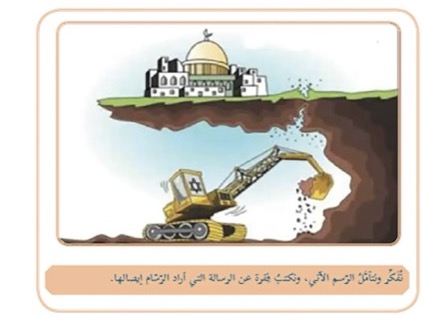
This picture from a Palestinian textbook portrays the Jews working to destroy the Dome of the Rock and the Al Aqsa Mosque in Jerusalem. It is a pernicious trope.

There is no truth in it but it is used every year to galvanise protests, particularly in the lead-up to the holy month of Ramadan. In 2021 it contributed to the war between Israel and Gaza.

According to the report, a maths textbook uses an image of Palestinians hitting Israeli soldiers with slingshots to describe Newton’s second law of motion.

The Islamic honorific bestowed on Muslims who embrace death in the cause against Islam’s enemies is ‘shahid’ or ‘martyr’. It appears throughout the textbooks. One ninth-grade maths book uses the term to refer to Fatah leader Khalil al-Wazir, who led the 1978 massacre of 38 Israeli civilians, including 13 children, according to Bild.

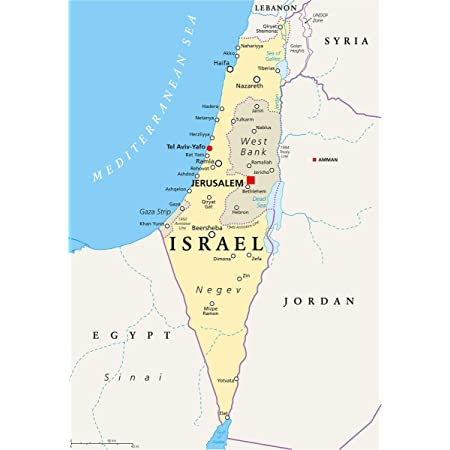
Most maps used in the textbooks entirely erase the state of Israel, dubbing it a ‘Zionist occupation’ and calling the entire region of Israel, the Gaza Strip and the West Bank, ‘Palestine’.

Israel’s Ministry of Foreign Affairs said in response to the findings of the report that they ‘prove Israel’s consistent claim that incitement is constantly present in Palestinian Authority textbooks’.

‘This is a claim that Israel has raised with the EU and its member states for many years.’

UN Watch, an NGO which monitors the UN’s approaches to human rights breaches, urged governments at an international donor conference for UNRWA in Brussels in November 2021 to demand accountability from UNRWA about allegations of antisemitism and incitement to terrorism by more than 100 teachers and other staffers.

UNRWA has reportedly suspended several of its employees after a report by UN Watch exposed over 100 UNRWA educators and other employees who have publicly propagated violence and antisemitism on social media, in breach of the agency’s proclaimed policy of ‘zero tolerance’ for incitement.

The suspension of UNRWA employees only came to light after the outraged reaction of Palestinians in Gaza was reported in Arabic-language media, including Al Jazeera and Al Araby, as a former UNRWA staffer – who was fired for his own ties to the Hamas terrorist organisation – accused the agency of caving in to ‘Zionist pressure’ for taking measures against the employees.

UN Watch executive director Hillel Neuer said: ‘I came here to Brussels today to urge our governments attending the UNRWA international donors’ conference to finally hold the agency to account for its teachers who poison the minds of Palestinian schoolchildren with incitement to antisemitism and terrorism.

‘I’m here urging delegations from the US, EU, Canada, UK, France, Germany, Sweden, Netherlands, Italy, Australia, Switzerland and many other countries to demand that their money to UNRWA – our taxpayer funds – not go to teachers who glorify Hitler.’

UN Watch welcomed the statement by Canadian Assistant Deputy Minister Sandra McCardell who underlined ‘the critical importance of UNRWA upholding humanitarian principles including neutrality in its work.’

‘Commitment to humanitarian principles, including neutrality, is unwavering for UNRWA,’ said Deputy Commissioner-General Leni Stenseth, addressing critiques by UN Watch and others.

She claimed, however, that ‘there are extraordinarily few verified breaches of neutrality’.

Neuer countered this. ‘The opposite is true. UNRWA has failed to respond to UN Watch’s August report on incitement, and failed to respond to our detailed follow-up letter in October to Commissioner-General Philippe Lazzarini.’

‘The agency has failed to provide even minimal transparency as to who it investigated from the list of 113 antisemitic teachers provided by UN Watch.’

UN Watch asked UNRWA to reveal which six of the 113 named employees were reportedly suspended.

The Biden administration recently restored more than $300 million in US funding for UNRWA, contingent on a Framework Agreement in which the agency promised ‘clear, consistent and prompt administrative or disciplinary action for staff violations of UNRWA’s Neutrality Framework.’

UN Watch is now calling for implementation of this pledge. ‘UNRWA owes basic transparency and accountability to its donors before they transfer vast sums of taxpayer dollars,’ said Neuer.

‘It’s time that UNRWA honors its solemn pledge to the US and other donors to apply a real “zero tolerance” policy, which means ensuring there is no place in the agency for teachers and other staff who incite racism, hate and violence,’ said Neuer.

If you like what you have just read, support the Daily Friend

Jews in Germany – “an uncomfortable existence”

http://www.winnipegjewishreview.com/article_detail.cfm?id=2939&sec=1&title=
_JEWS__IN__GERMANY_%E2%80%93_AN_UNCOMFORTABLE_EXISTENCE_

[ Editor’s note: The writer of this very thoughtful piece contacted me as a result of my article on the book I Sleep in Hitler’s Room.
http://www.winnipegjewishreview.com/article_detail.cfm?id=2823&sec=1&title=I_SLEEP_
IN_HITLER’S_ROOM:_U.S._JEWISH_AUTHOR_DISCOVERS_ALARMING_AMOUNT_OF_ANTI-SEMITISM_STILL_EXISTS_IN_GERMANY
.
I am very grateful that she did, and hope readers will read this piece carefully. It is a real eye opener.
Aliana Brodmann is a bilingual writer, translator and journalist in English and German. She is the daughter of Jewish Holocaust survivors from Poland. Her publications include: seven books, numerous articles and human interest stories in German and American newspapers and magazines. She was President of the PEN Centre of German Writers Abroad, the former German Exile PEN Centre, from 2003-2005.
Her new book of short stories in German SCHANDE- eine Liebe in Deutschland
(transl: DISGRACE – a love affair in Germany) is in progress.

JEWS IN GERMANY – AN UNCOMFORTABLE EXISTENCE

by Aliana Brodmann

Whenever I tell people abroad that I was born in Germany, or worse yet, that my parents- Jewish Holocaust survivors- never emigrated after World War II, the reaction is surprise and often outrage. How could they? How can they? The idea that people would voluntarily live among those who had murdered their families and robbed and abused them is inconceivable to others, particularly non-Jews and those who had emigrated under duress and with enormous sacrifices. The prevailing opinion is that Jews would only live in Germany because reparations of astronomic proportions were being paid to them or because they might be enjoying some other kind of extraordinary benefits, which compensate them for the unpalatable co-existence with their killers. Nobody seems to understand that most Post World War II Jews, particularly the Holocaust survivors, were emotionally too damaged to have been capable of any kind of coherent thought, not to speak of an ability to make sensible decisions about their lives. The Nazi persecution remained too much of an inescapable part of their daily existence. In addition they later suffered age-related impairments. Their descendents carry the multifaceted burden of their tragic legacy.


Medieval Gate leading into the city of Frankfurt
photo by Rhonda Spivak

Today two types of Jews live in Germany: those who were displaced or happened to find themselves there by the end of World War II and who had stayed for lack of opportunity or ability to leave, and those who built careers because they were Jews, in the media and in politics by conveying an amicable co-existence with Germans and thereby contributing to the desired image of a New Germany in which Jews appear to be living as equals alongside their German neighbors. These Jews call themselves proud Germans of Jewish faith, for which they are officially rewarded by German institutions with honors, grand gestures and decorations, while privately old attitudes and prejudices continued to prevail among the German public. In other words: both Jews and non-Jews are engaged in a strange sort of masquerade.

In discussing this self-representation, which is surely one of the strangest Jewish/ German phenomena, with a German non-Jewish journalist in New York recently, she protested: “What do you mean? I know many Jews in Berlin who consider themselves utterly German.”

Nobody seems to ponder, how and in what way Jews could possibly begin to imagine what it might feel like to be German, nor what kind of Germans specifically they think they are. But more importantly my colleague in New York didn’t even realize that her objection exactly confirmed my observation. It was only when I replied: “But that exactly is my point, since you for instance still see these so-called Germans as Jews,” that she fell silent and reproachfully so, as though I had deliberately trapped her.

My family, in any event, did not belong to this group, but rather to the first one, living a resolutely Jewish and pitifully deprived existence. We had little to do with the outside world and had only when absolutely necessary the most strained and uncomfortable exchanges with our German neighbors, who avoided us whenever they could. In the 50’s when I was growing up, one lived with a leaden silence that hung heavy and mercilessly above us, creating tension and fear of what would happen if it ever broke open. There was also a kind of stench that permeated the environment, incorporating the smell of burning coal in the winter-time that periodically threatened to suffocate you.

By what means my parents lived I could not understand, though it was obvious to me that they didn’t belong there and that they had endured something devastating beyond words that had ravaged their lives. This haunting mystery constantly preoccupied my mind and my imagination. I lived out my desperate lack of knowledge along with the sparse information I was able to extract from strange fantasies and terrible nightmares. My parents refused to talk about their painful past, which they must have felt too horrible for a child to know about. Of course, as we know today, that they simply lacked the language to communicate what they had endured. They felt, as most survivors, besmirched by what they had experienced and, contrary to today, nobody even wanted to know or hear anything about the Holocaust in Germany or any place else. The Germans kept silent for their own reasons.

I knew that there were these two groups living in this reeking ashen world: Germans and Jews. I also knew that our incredible sadness had something to do with them, that it was too devastating for my parents to talk about and that they, the Germans, pretended to have no clue as to what it had to do with them. There was an unwritten law that neither my parents, nor they could be asked about this disquieting circumstance. A horrible, huge thing that nobody wanted to talk about seemed to be stuck in everybody’s throat like some kind of indigestible obstruction, which everybody maneuvered around uncomfortably, accusing each other with highly charged silence. Despite this bizarre choreography, however, it became quite clear even to me with time, that the Germans had done something indescribably horrendous to us and that our fault lay in getting on their nerves by confronting them with it by our mere existence.

I was somehow made to understand, that we were guests, and that if one was a guest, one had to swallow whatever one was served, and even feign appreciation despite feeling like having to throw up. Because of my susceptibility to vomiting my mother introduced Princess Margaret to me as an example of exquisite refinement for having proven herself by eating live vermin with exemplary dignity as a guest in Africa. This was to convince me to work through the unappetizing muck I was served daily with just as much discipline. My mother couldn’t tell me, though, whether the princess hadn’t actually thrown up unbeknownst later somewhere in the jungle. She insisted that, no matter what, a lady, particularly a princess, wouldn’t be caught dead throwing up ever in any public place. That was why I usually threw up in private. Often I didn’t make it to the toilet in time, which was why I usually preferred to stay at home. In any event, I always felt sick. One lived with chronic nausea.

I eventually understood that my presence constituted a provocation to the Germans. I could tell by their looks of annoyance, particularly when I wore my chain with the Star of David around my neck or indicated may jewishness in some other equally provocative manner.

There were very precise distinctions as to what was German and what unGerman. And we were distinctly unGerman. This continued after World War II, when Germans resented that food and clothing be given to the refugees that had been displaced to Germany by force. They became particularly angry, when those tortured and robbed by the Nazis started asking to be reimbursed for their losses. Even those returning to Germany after the War, if they weren’t already despised for being Jewish, were taunted traitors, who had sunned themselves abroad while Germany suffered the War. The differentiation between them and us, German and unGerman had continued seamlessly.

No wonder, that decidedly ultra German authors like Thomas Mann, who returned from exile after the capitulation, were accused of an unGerman sentiment because of his critique of the Nazis. Any critical view of Germany, then as today, was and is considered unGerman, with a particular concern being Germany’s reputation abroad, which Thomas Mann was accused of having damaged. Actually the height of insolence: to rob, pillage, rape and kill, while demanding that one’s good reputation be preserved. There were only few and far between, who saw those returning emigrants as representatives of the true Germany, who had upheld Germany’s honorable name abroad and would be able to bring about a spiritual renewal at home. The majority of Germans confronted them with animosity. The playwright Berthold Brecht and the German Chancellor Willy Brandt are examples of those who had to bear the hostility Germans encountered upon their return from exile.

At some point I understood that Germans hadn’t accidentally killed Jews or had done so to comply with orders and under the threat of death, but on purpose and often menacingly for sheer sadistic pleasure. This I found extremely troubling because I had imagined deliberate killers to look visibly villainous, not oatmeal-colored and almost invisible as our neighbors in contrast to us Jews, who despite all efforts not to draw attention, always did.

Later I learnt, and with great emphasis, that not all Germans had killed. That some of them had even had Jewish friends. Only when they were asked about these friends, they never knew what had happened to them or where they had gone. Of course I wondered, what kind of friendships these might have been. After my initial relief to know that not all Germans hadbeen killers I realized that knowing this, one had to look really closely to see, who of them had blood on their hands and who didn’t. Also troubling new questions came up which were extraordinarily uncomfortable, such as: who exactly had done the killings, where, and how and why?

But there had also been – as we all know now – and what I of course had known all along- incredible looting. Everything belonging to Jews had been up for grabs. I knew about this because they had stolen my parents’ houses and everything in it. Even Jewish shops and entire businesses were officially confiscated from Jews. That, I figured, must have been extremely advantageous. Talking about the looting and stealing was especially taboo. Stealing couldn’t be explained away quite as easily as the destruction of people who had been declared a danger to Germany and unworthy of living. Stealing didn’t fit into the Nazi ideology of the Master Race. This was why the killing of undesirables eventually became a legitimate admission and an acceptable point of departure, not, however, any kind of reference to: when, where, how and everything else.

Some time ago I read that at a social gathering the late author, Primo Levi, had been asked by the wife of a German diplomat, where he had learned to speak German so fluently. When he responded truthfully: “In Auschwitz”, she had turned away with disgust, as though he had personally offended her. This incident reminded me of many experiences where I had caused irritation because of my honesty and naïveté. Jewish life experiences are considered insults, if not provocations to Germans.

A publisher of some of my books told me, that as a young girl after the War, she had been forced by the Americans to view documentary films about the concentration camps. I initially thought that she was expressing her outrage over the Nazi atrocities against the Jews. Only gradually did I realize that she had considered it offensive to be shown what her people had done to my parents and grandparents. The realization that she had considered the film and not the atrocities offensive explains the attitude of Germans to their crimes.

A high official in the German Foreign Service once remarked to me: “What is Germany actually being accused of (regarding the Holocaust)? After all, it is only because of our extraordinary abilities, our work ethics and discipline that we were able to perfectly execute what others have endeavored or are still endeavoring, isn’t it?”

Since I had long ago given up the habit of talking and therefore taken to writing, I didn’t respond, which gave him the opportunity to quickly conclude: ” Therefore one could really only accuse us of having extraordinary abilities, work ethics and discipline.”

In other words: not of robbing, killing, torturing or raping.

This attitude explains, why according to a German writer:”Most Germans have on a very basic level not understood, what they have actually done to the Jews.” It is no coincidence that no acceptable design for a Holocaust memorial in Berlin was generated for years, despite decades of effort. The vast compilation of ludicrous designs with even more ridiculous inscriptions for this memorial is symbolic of Germany’s evasiveness regarding her past.

The Germans simply haven’t understood what they did to us because they still don’t accept us as equals, human beings entitled to equal respect. And we are, among other things, speechless and unable to comprehend this gravely offensive mindset, which is infused with centuries of prejudices transmitted though Christian religions, folklore, literature, the arts and finally Hitler’s cunning propaganda.

For some of us the damage we have suffered manifests itself in a variation of the Stockholm Syndrome that presents as pathological submissiveness to Germans and shaming complicity. And not only those of us directly ravaged by the Holocaust, but even Jews around the world as renowned as Danny Goldhagen and Steven Spielberg, who were quoted as having said they considered their German honors to be the most significant ones they have received. Henry Kissinger described himself as touched to tears when he was made honorary citizen in his German hometown, which he had fled with his parents as a child. Even the late Jehudi Menuhin had shortly before his death allowed himself to utter statements, which could have well used some prior contemplation. These fellow Jews have all been unable to realize that the honors bestowed upon them were merely a ruse to generate prominent Jewish voices outside of Germany to hail Germany’s present day new image. It is still more important for Germany to have a clean reputation than to actually be clean, which is nowadays still best accomplished by positive Jewish voices abroad. Not only is Germany’s image in Germany is being promoted by display-Jews, but also Germany’s image in the world. While the sensationally talented Germans are slyly pursuing their interests the deeply disturbed Jews laud the non-existent emperor’s new clothes.

The gaping absence of wholesome Jewish life in current day Germany becomes apparent, where one generally looks for signs of life and continuity: in the condition of children and the state of their literature. The utter nonexistence of even just one story among all the children’s books on the market in Germany today which might refer to one live Jewish child in the country, speaks for itself. The fact that in stark contrast to this absence there are mountains of books about dead Jews must be contemplated.

The owner of a well-known children’s bookstore in Munich talked to me about the strange behavior of her customers who come into her store in the winter time to purchase Chanukah calendars, which she carries along with her Advent calendars for Christmas. She had noticed that the customers buying the Chanukah calendars take them to the cash register almost secretively, “as though they don’t want to be seen purchasing them”. She had given a perfect example of what it feels like to live as a Jew in Germany today: trying publicly to forever conform in quiet negation of one’s true identity, many Jews live two identities.

The most poignant testament to this impaired existence is a slim volume published by Kiepenheuer & Witsch with quotations by Jewish children. It is the only reference on the German book market that Jewish children exist there. In reading the quotations of these children I found that their fears, reservations and wishes in the 90’s were dreadfully similar to my own 40 years ago in the Germany of post World War II: their discomfort over notknowing whether their neighbors knew that they were Jewish; what they might do if they knew; all their associated insecurities together with their enormous fear about the general animosity towards foreigners.

The editor of a prominent children’s book publishing house said to me:” Stories about Jews don’t sell. They belong to the ” problem books like books about abuse etc.”

Ten years ago I surmised: “Normalcy will have arrived in Germany when Jews will no longer be integrated into literature because of their Jewish issues but as human beings, when they are called by their names like everyone else. Not: So-and-so the Jew, but Moritz Schwarz, the grocer, journalist or teacher.” Accordingly, we must still be light-years away from any kind of normalcy.

We are a people so impaired by our abuse from the Germans, that under the kindest of conditions it would take generations upon generations until we had regained our confidence and our dignity. Only this can explain the satirical novel by Michael Degen, Blondi, where a Jew is so desperate to be part of society that he doesn’t mind turning into Hitler’s dog. Our pain, our despair and our speechlessness are – as they were in the Thirties – their ticket to further digressions. Today there are again beatings of Jews in the streets of Germany with the police often unable to find the perpetrators, there are anti-Semitic declarations in public, which are being explained away as new unencumbered opinions, since of course they couldn’t possibly have anything to do with the old anti-Semitism due to the length of time that has passed since the 30’s. Nobody addresses the fact that after 1945 the same politicians, teachers, physicians and clerks remained in their positions and thereby promulgated their Nazi ideologies and contaminated the next generations. Nobody seems to believe that behavioral patterns, assumptions and beliefs within families and in the immediate environment influence the thoughts and actions of generations, particularly if nothing is being done to change these deeply ingrained patterns and with them the lack of German empathy for the Jewish soul.

In fact, the majority of Germans today want it to be understood, that they have no relationship to the past of their families or the history of their country. Or to quote the author Martin Walser, who voiced the collective German sentiment. When being honored with the venerable German Peace Prize for Literature he said that he: “chooses to look away whenever faced with the Holocaust,” starting an inflammatory public dialogue, which has been playing itself out ever since. A highly offensive statement to us Jews, still suffering the pain of the Nazi persecution, but also because we are a people defined by our collective memory, ever aware of how much our past is part of our present life. This too distinguishes us from the Germans: our awareness of how much the past is part of the present.

One worries, with what other kind of perceptional difficulties Germans are plagued and what else they choose to selectively include or exclude from their lives? We Jews in any event live with an ever present consciousness about our past, beginning with Abraham. We have a burning desire to know our individual family histories. We are aware that our individual as well as our collective history tells us, who we are and thereby gives us a sense of our possibilities in the world. We are taught that to claim the accomplishments of our predecessors, we must also bear the responsibility of any failings. We know that by looking away one becomes guilty.

No civilized human being turns away from a suffering person, but offers to ease the pain, particularly when he or she knows that this pain was inflicted by his or her parents or others in their immediate environment. To explain away a basic humanitarian responsibility by claiming: I was born later, this is none of my business, it all doesn’t concern me, is not only immoral and uncivilized. Today’s Germans, in fact, project a public image of commitment to humanitarian concerns of fighting diseases and human rights transgressions in the world. Hardly anyone would openly state that turning away from a person suffering AIDS or cancer is appropriate because they didn’t cause it. The call to turning away from Jewish suffering is grossly anti-Semitic. As it is to demand life threatening conditions that would be considered unreasonable for any other country as appropriate for Israel, the land of the Jews and only democracy in the Near East.

This reality is finally hitting home even to the German display-Jews, who had in their psychological confusion, their painfully established blind- and deafness tried to integrate themselves into the new Germany, but can now no longer keep up with the charade. To swallow the shame of having to witness Germans openly vocalizing in public forums what they had hitherto only dared to whisper among themselves is difficult to digest even for the most resistant Jewish stomachs such as Charlotte Knobloch’s, the former head of the Central Council of Jews.

A gaping absence in this public dialog are voices from all those Jewish institutions that claim to “ fight anti-Semitism” while living off their membership’s generous support. As in the past, the Anti-Defamation League, American Jewish Committee and others were complicitly silent when a recent public debate on circumcision ensued in Germany and escalated into condemnation of this religious ceremony practiced by Jews for over 4000 years as a human rights violation. Hannah Arendt might be turning in her grave.

Within this context it is obvious that the Peace Prize award to the Jewish author Fritz Stern was intended to temporarily placate the uproar against the disgrace of awarding it to Martin Walser the preceding year, regardless of how deserving Stern was of this honor.

This year’s bestowment of the Adorno Prize on the Jewish-American scholar Judith Butler, an extreme critic of Israel, can only mean that Germany is now also positioning itself to legitimize it’s increased distancing from the land of the Jews, which it had hitherto only begrudgingly supported to maintain appearances.

Copyright Aliana Brodmann 2000, 2012

Voluntary Servitude – Does it have to be in the DNA of the Jew?

By David Bedein,  A  HALF CENTURY SINCE THE CALL TO JERUSALEM

Full Disclosure:

It  was just before the  Seder more than 50 years ago that my father called me in Madison with the news:  

A letter of acceptance at Hebrew University for the Fall semester Jerusalem

My Bones shuddered.


Next Year in Jerusalem  would be 
this year in Jerusalem.

 The Seder took on new meaning

Yet Fellow Jews at the  Hillel seder in Madison were not impressed.

What I noted in a 1970 diary entry was ” the willingness of fellow  Jews to

live in slavery”

————————————

Most Jews  do not view israel as a step up from slavery.

Unlike other enslaved peoples, the Torah goes out its way, throughout the book of Genesis, to emphasize that  Jacob and his children, relocated to Egypt on their own accord, as a free people,  seeking  sustenance – for which they were ready to subject themselves  to a voluntary servitude of their souls.

“We shall be slaves to you, Pharoah!” היינו עבדים לפרעה  (Gen. 47:25) proclaim the people of Israel, represents the  opposite  theme of the Seder,   “We were slaves to Pharoah”

The Hebrew context of “willing servitude” says it best:

The Jews cried out:

היינו עבדים לפרעה

A full  generation before they cried out

עבדים היינו לפרעה

The Israelites  understood  slavemy in Egypt as a lifesaving moment

Therefore, Torah commentaries postulate  that only 20% of the Israelites chose to leave Egypt

Another reason to remain in Egypt was articulated on page 11 of the tractate Rosh Hashanah, which was  that the physical bondage of the people of Israel ended on Rosh Hashanah, seven months before the exodus from Egypt.

And Pharoah did not lift the spiritual oppression of the Jews when  he  ended their physical abuse as  slaves.

Pharoah offered to sustain descendants of Jacob in  Goshen,  as  slaves to  to the gods of Egypt

Indeed, the majority of Israelites opted for voluntary servitude in diaspora rather  than the  trials and tribulations of an uncertain trek to Israel.

In the “Amud HaAish”  TV  documentary series which documents the return of the Jews to Israel in the 20th century, Zionist leader Chaim Weizman laments   “Ayaecha”- “where are you” – to the people of Israel for not flocking  to Israel after the 1917 Balfour Declaration and the 1922 San Remo Conference, which bestowed international recognition and welcome  for the Jews to return.

Jews prefer voluntary servitude in suburban Goshen to life in Israel. Is that in their DNA?.

The challenge of the Jew is to reject that DNA.

Peace delegates from Israel hold summit at International Civil Rights Center and Museum

Peace delegates from Israel as a part of an international grassroots organization called Sharaka visited North Carolina and Atlanta, Georgia on March 21-25 to engage with other leaders who work towards social change.

Sharaka, which means ‘partnership’, was founded by young leaders from Israel and the Arabian Gulf in order to turn the vision of “people-to-people peace” into a reality. The Sharaka delegation is made up of people, who hail from countries that were part of the Abraham Accords.

The Abraham Accords is a joint statement between the State of Israel, the United Arab Emirates and the United States, reached on August 13, 2020. The Abraham Accords between Israel, the UAE, Bahrain and Morocco have opened the door to a new era of cooperation, friendship and partnership opportunities between businesses and individuals that were previously unthinkable.

The statement marked the first public normalization of relations between an Arab country and Israel since that of Jordan in 1994. The accords are named after Abraham to emphasize the shared origin of belief between Judaism and Islam, both of which are Abrahamic religions that adopt the belief of the worship one God, as told in the Holy Scriptures Book of Abraham. The Abraham Accords currently has 120 agreements from surrounding countries and that count is rising.

The group came to share the groundbreaking work that is already being done between all countries, new opportunities on the horizon and what it means for America and the rest of the world.

“What this delegation is trying to do is engage in people-to-people diplomacy. Start the conversation,” said Samantha Von Indie, director of academic affairs with the Consulate General of Israel to the Southeast.

The group spent a few hours at the International Civil Rights Center and Museum in downtown Greensboro, where they participated in a guided tour and then held an intimate group discussion with the museum’s director, Jon Swaine; museum scholar in-residence, Dr. Will Harris and local community and religious leaders, Ivan Canada, NCCJ Executive Director; Rabbi Andy Koren, senior rabbi of Temple Emanuel; Rev. Alan Sherouse, senior pastor of First Baptist Church in Greensboro and Deonna Sayed, a Greensboro author.

“I know for me being here specifically, simple acts can change a lot. We must always know history so that it doesn’t repeat itself. I think it’s very important to share our experiences and share what we saw today, so it doesn’t happen again,” said Fatema Al Harbi, Sharaka Gulf Affairs Director and delegation coordinator from Bahrain.

Dr. Najat Al Saied, delegation head, media and academic affairs advisor, Sharaka member, professor and columnist noted that there is a connection between the Civil Rights Movement in America and the Abraham Accords in the fight for peace and justice.

“It was so inspirational to see these pictures. The Abraham Accords is not only a peace agreement, but it is also a movement. A movement that started a new kind of history,” she said. “Sharaka means partnership in Arabic. We don’t want this for it only to be confined to government relationships. We also want to approach people-to-people relationships. That is what peace truly means,” she added.

The delegation is working on bringing additional groups of people from diverse backgrounds to build a cabinet that allows for learning across geopolitical perspectives on topics such as militaries, security and IT (information technology) and even to collect opinions on why people may be against the Abraham Accords.

“Diversity is not in only race in religion, but even in different types of opinions,” said Dr. Al Saied. “There is a direct analogy between our movement and what we’ve seen here in the Civil Rights Movement.”

The museum’s principal scholar in residence, Dr. Will Harris said the museum believes in not only telling our individual stories, but our stories as a community.

“The stories that we decide to tell constitutionally should not just be about the individuals, there’s been a great emphasis recently to focus on my story and your story individually and much less about cultivating the story of us together. Here at the museum, we try to add to the previous focus on combating injustice and undoing the negative and talk about moving forward. What does that vision look like from the community perspective?”

The group also discussed the contrast in relationships that are happening between the first generation of peacemakers from 20 years ago and the new generation of peacemakers now.

Haisam Hassenein, foreign affairs and Middle East analyst and scholar and Sharaka member, shared that although there have been sensitive relations between Muslims and Jewish people in the Middle East for decades, religious acceptance is being seen in the younger generations.

“It’s more common nowadays to look on social media and see Jewish and Arab people dressed in their traditional clothing and able to walk down the street together in Saudi Arabia. For the first time you have a Jewish presence going back, talking about it openly, meeting with Arab Muslims on Arab soil. More work needs to be done, but at least it’s a start. Right now, we’re learning,” said Hassenein.

Sharaka delegates also advocate peace through cultural community programs that can bring people together in an engaging and entertaining way.

Greensboro’s NCCJ Executive Director Ivan Canada talked about ANYTOWN, the 35-year-old community program that teaches high school students from various backgrounds about diversity and acceptance and touches on topics such as race, religion, socioeconomic status, sexual identity and orientation.

“Students are really learning and being exposed to these concepts in a way that is self-reflective for themselves to think about who am I in this world. And for marginalized students, I think it provides a sense of pride that they don’t feel in a lot of spaces that they occupy in their schools. This program is the spark that gets many of them thinking, how I, as a teenager or as an individual, can play a role in social change.” said Canada.

Anat Sultan-Dadon, the consulate general of Israel to the Southeast, based in Atlanta encouraged people to speak about peace in the ways that relate to you. She added that seeing the museum’s lunch counter for the first time was remarkable.

“Knowing and learning about the history becomes different when you see it with your own eyes, where it took place, where these courageous young men stood up for equality, was remarkable to see,” she said.

The delegation wrapped up its visit to Greensboro with a meet and greet with U.S. Rep. Kathy Manning at her downtown office.

“I’ve been to Israel many times over the last few years. I’ve seen how the country has developed and how it has struggled to create the right situation for its people. The brave things that these countries involved are doing together, can set an example for other countries in the region to join in, and really change the way people view the Middle East,” said Manning.

Before making a stop in Greensboro, the delegation met with Tracey Burns, deputy secretary of diversity, equity, accessibility and inclusion, under the N.C. Department of Natural and Cultural Resources in Raleigh. Then they joined city leaders for a “Tree of Peace” planting ceremony in East Durham Park with Mayor Pro Tem Mark A. Middleton. The City of Raleigh also issued a proclamation naming March 21 as “Sharaka Day.”

“Anti-Semitism is still here, racism is still here, and that is why it’s important to work together. This delegation is about peace, and the mutual learning that is happening in reshaping the Middle East. It is important that we bring all sides together because through learning from one another, it’s really how we can affect change together,” said Sultan-Dadon.


Passover road map

It may in the end have taken forty years to get here but the road map couldn’t have been clearer.

In the first recorded use of a GPS, the Hebrew slaves left Egypt guided by a cloud during the day and a pillar of fire during the night.

Their destination was not a secret and this in my opinion is the core meaning of Pesach. We should by all means remember the miracles which accompanied the exodus but too often these days many tend to sideline the real purpose of this epic journey.

From servitude and oppression to receiving a constitution at Mount Sinai and then onwards to the Promised Land – these are the historical events that each generation should be internalizing.

Back then there were lots of Hebrews who despite everything refused to join their brethren and preferred to remain in Egypt where according to them “the food was tasty and plentiful.” Why leave everything behind and set out on a journey to an unknown land via a hostile environment and with many challenges on the way? Better to stay even if the ruling authorities accused you of being subversive and life was one long grind every day of the week.

That was the thinking of those who stayed and of some who desired to turn back when the going got tough.

No doubt Moshe and Aaron had to deal with their fair share of critics who threw cold water on the very notion of travelling to a faraway country that had been promised to their founding Patriarchs and Matriarchs as an eternal inheritance.

I guess we could call them the first recorded group of anti-Zionists.

Amazingly we can witness the same sort of twisted reasoning today as enunciated by a host of groups all of whom echo more or less similar rhetoric and happily dish up dirt on our restored independence.

On the one hand, we have an assortment of extreme Charedi sects who deny the validity of our return to Israel. In their interpretation of reality, we are supposed to wait for the Messiah and as he has not yet arrived we are forbidden to reclaim sovereignty. This is a theological argument that I doubt Moshe and Aaron had to deal with. History has unfortunately taught us or should have taught us, that while the Messiah tarries, the Jew-haters of this world carry on with their work. Countless religious Jews were doomed to destruction precisely because they waited in vain for salvation during the Shoah years.

On the other hand, we have an assortment of individuals and groups which span the assimilation spectrum and see no reason to either identify or support a collective Jewish identity. In addition, there are also those, who like their predecessors at the time of the Exodus, feel that Jewish life can be adequately and safely practised even in countries where we are not that welcome. Within this group are many who fervently support the restored Jewish homeland and nurture an aim to perhaps join their brethren one day. Next year in Jerusalem remains a pious hope for some and a meaningless mumble for others.

A news item caught my attention the other day. Just in time for Passover, it has been reported that a Jewish Congregation in Chicago declared itself to be “anti Zionist” after a vote of congregants and its Board and with the Bracha (blessing) of its “rabbi.” This particular spiritual leader explained that “Judaism belongs in the Diaspora.” In fact, he went on to proclaim that “Israel has increased antisemitism and the country was created at the expense of another people.”

This deliberate falsification of history is mind-boggling and even more so when it comes from the mouth of a spiritual leader. Ignored, in a grotesque effort to justify an incredible decision, is the inconvenient fact that the Arabs of mandated Palestine were offered more than one opportunity to have their own country but rejected these offers in favour of trying to wipe out the Jewish inhabitants. Also ignored is the fact that there has never ever been an Arab sovereign presence in the territory concerned with Jerusalem as its Capital. In addition according to the San Remo Agreement endorsed by the League of Nations and subsequently confirmed by the UN (prior to 1947) all the territory from the Mediterranean to the Jordan River (and actually beyond) is legally designated for Jewish settlement and sovereignty.

Claiming that Judaism belongs in the Diaspora as a reason to hoist the anti-Zionist banner is inane especially when one realizes that most of the mitzvot revolve around the Land of Israel. However, I suppose that a “rabbi” and congregation who don’t accept them as a valid component of Judaism wouldn’t really care.

I can imagine these Chicago dropouts telling Joshua and King David that battling the Amalekites, Canaanites and Philistines were forbidden. After all, according to their present-day logic, defending Jews against those who plot to deny them their homeland is forbidden. Remaining at the mercy of Diaspora rulers must be far more preferable.

Moshe and Aaron confronted Pharaoh and gave him plenty of opportunities to change his mind about letting the Hebrews leave. It was only after a series of warnings that finally the last plague ensued and precipitated a hasty departure.

Contrast this with today’s pathetic performance in the face of the current Ramadan murderous mayhem.

When Abdullah of Jordan and our own assorted collection of leftist politicians all prostrated themselves at the feet of the President for life, Abbas, in the futile hope that he would prevent violence, they demonstrated a pathetic lack of understanding as to how terror supporters behave. After Abbas issued a patently transparent and insincere “denunciation” of the murder of Jews, he was showered with congratulations and lauded for his “honesty.”

Anyone with even the slightest hint of common sense should have known that the real agenda was being broadcast to the masses. The Supreme Shari’ah Judge and advisor to Abbas let the cat out of the bag (as disclosed by PMW): https://palwatch.org/page/31033

Instead of trying to placate and “buy off” the chief terror instigators and obtain worthless plaudits from the hypocritical international community, our befuddled leaders should have taken note of how Pharaoh was defeated. It’s not as though Abbas and the Palestinian Arabs haven’t been given umpteen chances.

The plagues of economic deprivation, refugee status, brutal oppressive and corrupt governance and a multitude of other self-inflicted afflictions will only get worse unless and until the promoters of terror are eliminated.

The best response that we can make this Pesach is to strengthen the Jewish presence in all parts of our restored homeland and to make “Next Year in Jerusalem” a practical reality.

Chag Sameach.

PA making terror payments to hundreds of Israeli citizens

Those receiving the benefits are serving prison terms for carrying out or assisting terrorist operations, or acting against Israel in other ways, according to Israel’s defense establishment.

The Palestinian Authority is disbursing stipends worth thousands of shekels to hundreds of Israeli citizens involved in terrorist operations, and to their relatives.

Click here to read full article. 

On the eve of Passover 2022, Four Questions to Israel Prime Minister Naftali Bennett. Journalist Inquiry

On the eve of Passover 2022, Four Questions to Israel Prime Minister Naftali Bennett.

Journalist Inquiry

Have been commissioned to write a feature on the latest study of Palestinian Authority textbooks, authored by Dr. Arnon Groiss, who has perused all 1000 PA school books that the Palestinian Authority has issued,ever since the PA began to publish their own textbooks on August 1, 2000:

That study can be found at: https://israelbehindthenews.com/wp-content/uploads/2022/03/Jews-in-Palestinian-Authority-Schoolbooks-in-UNRWA-Use.pdf

Dr. Groiss concludes that PA education is based on three principles:

1. De-legitimization of Israel’s existence and the Jews’ very presence in the country, including the denial of their history and the existence of any Jewish holy places there.

2. Demonization of both Israel and Jews, also religiously – with serious implications regarding the Jews’ image in the eyes of children

3. Absence of any call for peace with Israel. Instead, PA education advocates a violent struggle for the liberation of the whole country, including pre-1967 Israel. This struggle is given a religious color. Terror is an integral part thereof, with the accompanying meaning of encouraging the murder of Jews

Therefore, posting four questions to the Israel Prime Minister, on the eve of Passover:

1. Will you reinforce the mandate of COGAT , the Israel Civil Administration, which is supposed to check PA textbooks before they are put in use and has not been doing so of late.

2, Will the Prime Minister ask COGAT to issue a proper review of the texts used by the PA and UNRWA

3. Will the Prime Minister ask for removal of PA texts which laud Dallal El Mugrabi, the woman Arab terrorist who commandeered an Israeli civilian bus in 1978 and murdered 35 Jewish passengers.

4. Will the Prime Minister condition humanitarian aid to the PA on a revision of PA education?

Weekly Commentary: Apply Torts Ordinance Article 12 to Recover From The PA

Weekly Commentary: Apply Torts Ordinance Article 12 to Recover From The PA
All Compensation to Terror Victims

Dr. Aaron Lerner 14 April 2022

This week it was reported the Supreme Court of Israel ruled that the payment
by the Palestinian Authority of stipends to terrorists and their relatives
constitutes the “expression of consent” referred to in Torts Ordinance
Article 12 thus enabling terror victims and their families to sue the
Palestinian Authority for compensation if the terrorist responsible for the
attack or the terrorist’s family received a stipend from the Palestinian
Authority.

But Justice Yitzhak Amit went considerably further than that.

In Paragraph 53 of his decision, Justice Amit notes that the State of Israel
can apply Torts Ordinance Article 12 to have the Palestinian Authority
indemnify it for any and all payments which the Government or The National
Insurance Institute makes to victims of terror under the Victims of Hostile
Acts Law in terror incidents in which the terrorist was identified and
received a stipend or their family received a stipend from the Palestinian
Authority.

The Government of Israel could readily streamline this operation,
systematically checking, terror incident by incident, to see if the
perpetrator was identified and in turn if the terrorist or the terrorist’s
family received a stipend from the Palestinian Authority. Armed with this
information, the Government of Israel could sue in Israeli court to recover
from the Palestinian Authority the payments it made to the victims to date
as well as ongoing payments. As the collector of VAT and customs duty for
the Palestinian Authority for cargo destined to the Palestinian Authority,
the Government of Israel has easy access to Palestinian Authority funds when
the Israeli courts rule on these cases.

Given the straightforward nature of the proceedings, it would be reasonable
to expect a unification of cases so that ultimately there would be one
fortnightly or monthly lawsuit.

Justice Amit noted repeatedly in his decision that the previous Attorney
General declined to share his opinion in the case, but that doesn’t mean
that Gali Baharav-Miara has to follow his example.

Its time for justice.

________________________________________
IMRA – Independent Media Review and Analysis

Since 1992 providing news and analysis on the Middle East with a focus
on Arab-Israeli relations

Website: www.imra.org.il

For free regular subscription:
Subscribe at no charge: imra-subscribe@imra.org.il
Unsubscribe: imra-unsubscribe@imra.org.il

For free daily digest subscription:
Subscribe at no charge: imra-subscribe-digest@imra.org.il
Unsubscribe: imra-unsubscribe@imra.org.il

IMRA is now also on Twitter

Inmoral & misleading reporting on terror attacks against jews

Inmoral & misleading reporting on terror attacks against jews

Employee at USAID Contractor Celebrated Terrorist Attack Against Israeli Civilians

Just hours after news broke that a Palestinian terrorist gunned down several Israeli civilians last week, an employee for one of the U.S. Agency for International Development’s (USAID) top contractors took to Twitter to celebrate the attack.

Click here to read full article