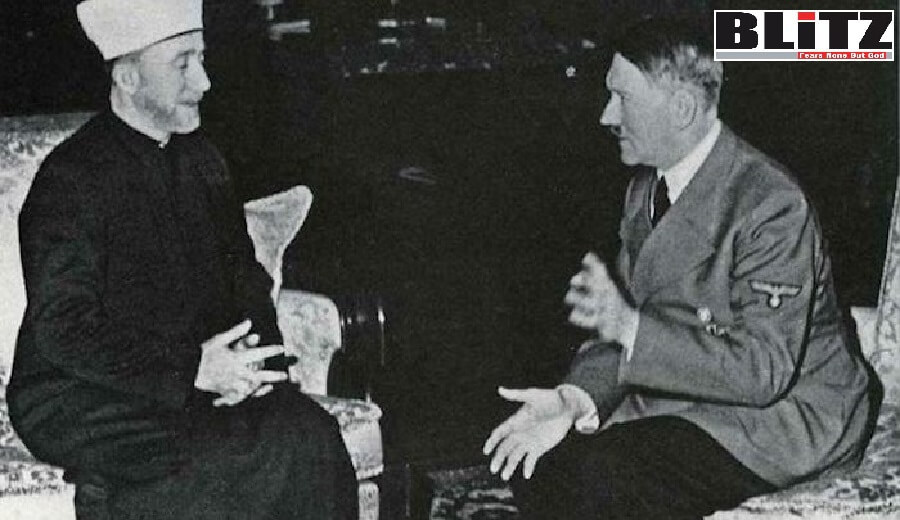
Holocaust Museum removes photo of Hitler with Mufti of Jerusalem

When Yad Vashem exhibits were redone, a telling photo of Adolf Hitler with Mufti of Jerusalem, Haj Amin al Husseini was not returned to the prominent position it had had before. Writes Shalom Pollack

I would like to introduce a notorious Nazi SS general, a leading Muslim cleric and the father of a nation – all in one.

This person is Haj Amin al Husseini.

Husseini was the powerful patriarch of the leading Arab clan in Palestine in the first half of the twentieth century. He used his political power and religious influence for his life’s motif – the murder of Jews.

In an attempt to “mainstream” the Mufti of Jerusalem ” the British appointed him to an official position of power and responsibility. It did not work. It only gave him the platform and prestige to pursue his passion of killing Jews.

This he accomplished on numerous occasions, most notably by instigating the barbaric Hebron massacre of dozens of Jewish families in 1929. (Note: in 1929, there was no Zionist “apartheid occupation”, no “occupied territories” nor “settlers”; just Jews of all ages living in Hebron and horribly killed by their neighbors)

A Nazi sympathizer, he fled British controlled Palestine during the war. He led a Nazi coup in Iraq where he instigated the bloody “Farhud” pogrom against the Jewish community of Iraq.

He then fled to Germany where he was made an honorary SS general by Himmler and proceeded to do all he could in helping the Hitler regime kill Jews. He addressed the Arab world by radio from Berlin winning huge support for the Nazis. He raised divisions of Muslim that fought in the Nazi army. One of their tasks was to guard so that Jews do not escape the trains to death camps.

Husseini intervened in a deal that would have saved a train load of Jewish children for a bribe. Husseini would not allow one Jewish child to escape the gas chambers.

Together with Himmler he visited the death camps and drew plans to build a “facility” in the Dotan valley in Samaria where the half million Jews of Palestine would be gassed as soon as Rommel defeated the British.

Eichmann was quoted as saying: “I am a personal friend of the Grand Mufti. We have promised that no European Jew would enter Palestine any more.”

After the war, SS general Husseini found refuge in Syria from war crimes judgment. Wherever he appeared in the Arab world he was received as a hero and mentor. His Nazi credentials together with his clerical position were the calling card that opened every door in the Arab world.

Yasser Arafat called him “the father of the Palestinian people”. PA authority president Abbas repeated this accolade.

Yad Vashem, the world’s foremost Holocaust Museum and memorial had a large photo of Husseini with Hitler on one wall. Opposite was a photo of Jewish soldiers from Palestine volunteering in the British army in the “Jewish Brigade” The contrast was clear.

I say had, because when Yad Vashem was refurbished and expanded in 2005, the Hitler – Husseini photo did not make it into the new museum.

As a tour guide since 1980, I have visited the old museum numerous times and remember clearly how my tourists were shocked by the duo in the photo.

In the new museum, instead of the Husseini – Hitler photo there is a far smaller one of Husseini and Himmler, in a dark corner that no one sees. I finally located it.

When I wrote to Yad Vashem and asked why they removed the photo from the new museum, I was told that the new museum “concentrates on the victims and less on the perpetrators”. However just a few feet from the small Husseini – Himmler photo is an entire wall of perpetrators – the architects of the “Wannsee Conference” that drew up the plans for the Holocaust.

I asked a number of local official Yad Vashem guides about the photo. They either did not know of it or said it was political and they did not discuss it with visitors. They were uncomfortable with my inquiry.

I wondered if associating Palestinian Arabs with Nazis was no longer politically correct since the Oslo accords with Arafat in 1993.

All this happened a few years ago. I felt then like I was fighting windmills by myself and so I put my efforts on pause.

Today there is a new chairman of Yad Vashem,

Mr. Dani Dayan came to the position with “right wing ” credentials, so I renewed my efforts. I wrote to him asking that he return the photo and asked for a meeting with him about the subject. I was refused a meeting and told that there will be no changes made.

I then encouraged people to write to Yad Vashem and request that the photo be returned. The letter writers were made to understand that there never was such a photo. Emails began bouncing back to the senders. I enquired with Yad Vashem and was told that they changed the email address. I was told the new one and the letter campaign resumed.

In mid-November 2021, Mr. Dayan addressed a well-known and affluent synagogue in Westhampton, NY. My brother, a member of the community, approached Mr. Dayan and told him of my concern. He said he was aware of it and assured him It is not political. My brother asked if he would meet me. He agreed and so I received a call from his office for a meeting.

At the meeting Dayan told me he did not meet with me earlier because he did not like the tone of the letters written to him. He told me that “no one will lecture him on Zionism and love of Israel. His credentials speak for themselves.” That is true, which is why I had expectations.

He claimed that I was interested not in historical record but the politics of the Jewish – Arab conflict. I said it was both, which he did not accept. He added that Yad Vashem is not a museum of the Arab – Jewish conflict, that Husseini played only a tiny part in the Holocaust and did not warrant more space than he has in the museum.

He told me that he is in charge and won’t bring the photo back, if there ever was one. His advisor chimed in: “There was never such a photo.” She asked me if I had photographic proof and I reminded her that it is forbidden to bring cameras into the museum. I asked her if the many signed testimonies of veteran guides that I have gathered is proof enough and she said it was a possibility.

Mr. Dayan was frustrated that I continued to hold firm to my position. I told him that there are growing numbers of people, Jews and non-Jews, who want the truth not be hidden at Yad Vashem and the photo returned. He asked that I leave his office.

I intend to continue my efforts to bring the full truth back to Yad Vashem. Political correctness will not stop me. “Jews, Israelis and Arabs” is my new book that sheds light on the current state of affairs in Israel and at places like “Yad Vashem”

Shalom Pollack is a veteran tour guide, who says: “I have the opportunity to observe many sides of our beloved country. As a Jew who has come home, I am passionate about sharing my observations and thoughts”.

This article is republished from the Arutz Sheva

Eli Kay’s father: This is my son’s message to the world

Eli Kay’s father: This is my son’s message to the world

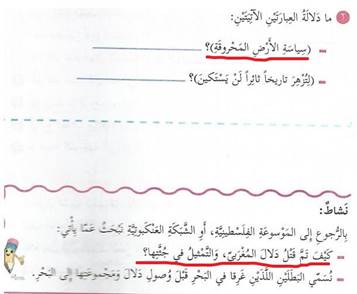
Dalal al-Mughrabi – A Murderous Terrorist as a Role Model In Palestinian Authority Schoolbooks Used by UNRWA

Research: Dr. Arnon Groiss (December 2019)

Dalal al-Mughrabi was the commander of an 11-person group of Palestinian terrorists who landed in a boat on the beach of Maagan Michael natural reserve on Saturday afternoon, March 11, 1978. The group had left Lebanon three days before, but lost its way at sea and two of its members drowned. The group’s goal was the release of Palestinian terrorists kept in Israeli prisons by taking Israeli civilians hostage. Following their landing, the terrorists encountered a nature photographer, Ms. Gail Rubin, an American citizen, and shot her dead. Then, they proceeded towards Israel’s Coastal Highway, took control over a cab and a bus, and later – over another bus. They gathered all the passengers in one bus and continued southward towards Tel Aviv, while shooting along their way at other vehicles and also at several passengers inside the bus – according to the survivors’ testimony. Four persons were killed due to that shooting. Near the Gelilot crossroad, north of Tel Aviv, the Israeli police managed to stop the bus and shooting started. Some of the terrorists burst out of the bus and shot the policemen, while others shot the passengers inside the bus who tried to escape. The terrorists had rigged the bus and during the fighting detonated the explosives which turned the bus into a fire trap in which the passengers who had not managed to escape perished. 34 Israeli civilians were killed altogether, as well as an IDF soldier who had reached the place incidentally and participated in the battle. 71 Israelis were injured. 9 of the 11 terrorists were killed, including Dalal al-Mughrabi, and 2 were captured and brought to justice.

The Palestinian Authority (PA) has glorified that operation, and Dalal al-Mughrabi in particular, for years. She is presented as a Palestinian national heroine, which is expressed by festive assemblages in her honor, naming schools and squares after her, etc., and it is also reflected in schoolbooks and teachers’ guides that were published lately by the Ramallah-based Curricula Center of the PA Ministry of Education. These books are used as well in UNRWA schools in the territories of the West Bank and Gaza. Thus, UNRWA actively participates in the PA terror indoctrination, which totally contradicts the former’s humanitarian mission and raises a huge question mark above the efforts that are currently made at the UN for the renewal of UNRWA’s mandate for additional three years.

Following are quotations taken from schoolbooks and teachers’ guides that present Dalal al-Mughrabi as a role model. It should be noted that teachers’ guides provide us with an additional perspective of the indoctrination process by emphasizing the “desirable” line within the educational material, either in the framework of the lessons’ goals or by giving the “right” answers to the questions appearing in the textbooks, or by suggesting additional activities and providing enrichment material for the purpose of deepening the knowledge and identification among the students regarding the studied subject in the desired direction. The teachers’ guides also contribute to our acquaintance with the indoctrination’s technical methods, such as repetitions, dissection of a subject into minute details, making historical comparisons, directing the student’s thinking by raising the “proper” questions and answering them, etc.

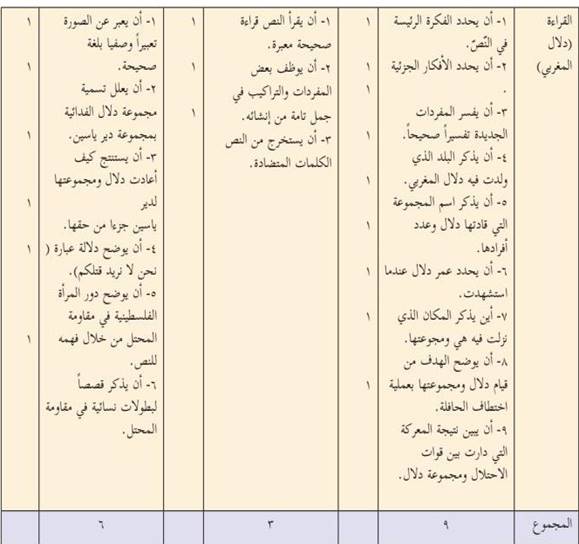
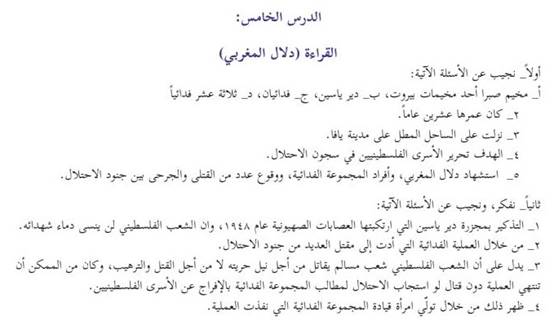
The obsessive dealing with Dalal al-Mughrabi starts in the reading material of lesson 5 in grade 5’s second semester. The lesson’s goals are defined in the teacher’s guide, that is, what are the prospected achievements the student should have at the end of that lesson. Indeed, some of these goals appear in the assignments accompanying the lesson. The goals are categorized according to the fields of knowledge, application and understanding the wider significance of the studied material. They are organized in the following chart from right to left:

“[Subject:]

Reading: ‘Dalal al-Mughrabi’

[Knowledge:]

  1. [The student should] define the main idea within the text.
  2. Define the secondary ideas.
  3. Explain the new words correctly.
  4. Mention the place where Dalal al-Mughrabi was born.
  5. Mention the name of the group under her command and the number of its members.
  6. Mention Dalal’s age at her martyrdom.
  7. Mention the place where she and her group landed.
  8. Clarify the goal of carrying out the operation of the bus abduction by Dalal and her group.
  9. Tell in detail the result of the battle that took place between the occupation forces and Dalal’s group.

Total: 9

[Application:]

  1. Read the text correctly and in an expressed way.
  2. Place some of the words and expressions in full sentences of his own.
  3. Extract antonyms from the text.

Total: 3

[Understanding the significance:]

  1. Express the [situational] picture in a descriptive way and in correct language.
  2. Explain the naming of Dalal’s fidai[1] group as ‘Deir Yassin Group’.
  3. Conclude how did Dalal and her group returned to Deir Yassin part of its right.
  4. Clarify the meaning of the expression: ‘We do not want to kill you’.
  5. Clarify the Palestinian woman’s role in the resistance to the occupier out of his understanding of the text.
  6. Mention [additional] stories of women’s heroism in the resistance to the occupation.

Total: 6.”
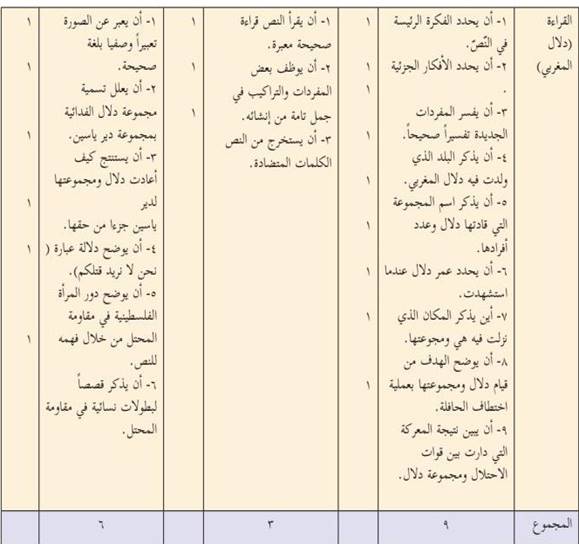

(Teacher’s Guide, Arabic Language, Grade 5 (2018) p. 110)

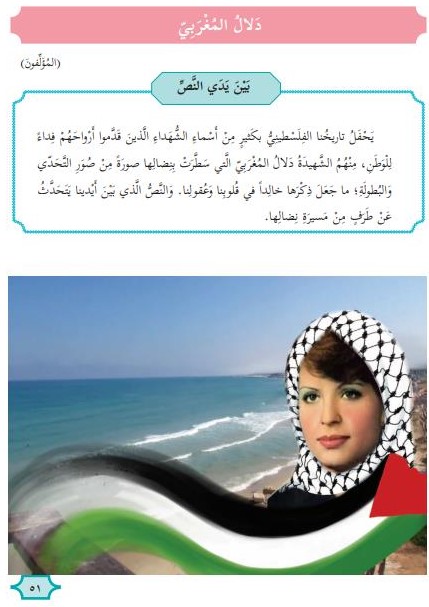
In the schoolbook itself, the lesson begins with an introduction followed by the story of the terrorist operation:

“Dalal al-Mughrabi

([By] the authors [of the textbook])

In front of the text:

Our Palestinian history is full of many names of martyrs who presented their souls as a sacrifice for the homeland. Among them is the martyr Dalal al-Mughrabi who painted with her struggle a picture of challenge and heroism that have made her memory eternal in our hearts and minds. The text in front of us talks about an aspect of the path of her struggle.”
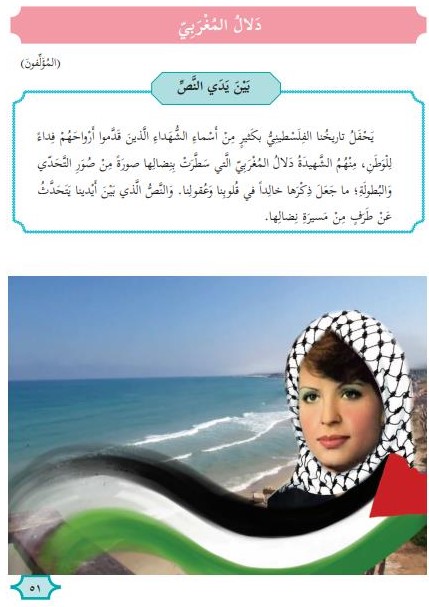

(Arabic Language, Grade 5, Part 2 (2017) p. 51)

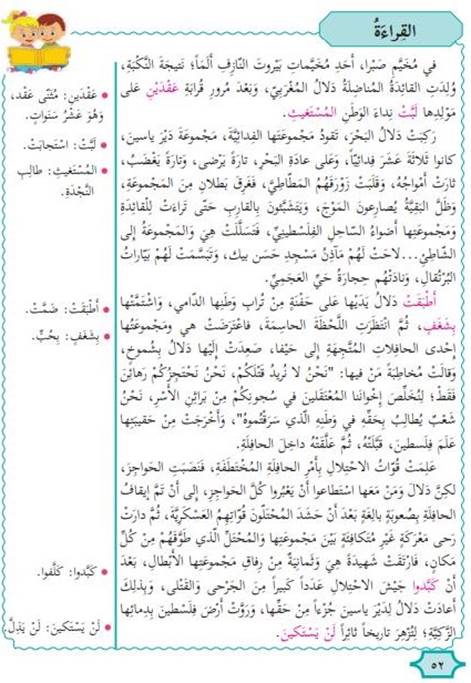
The next page gives the story with an explanation of some difficult words on the left (omitted from the translation):

“Reading:

In the refugee camp of Sabra, one of Beirut’s refugee camps that is bleeding pain, as a result of the Nakbah, the fighting commander Dalal al-Mughrabu was born. Close to two decades after her birth, she responded to the homeland’s call for help.

Dalal sailed at sea with her fidai group under her command, the Deir Yassin Group. They were thirteen fidais. As the rule is in high seas, which are sometimes calm and in other times – angry, the waves were stormy and their rubber boat was capsized. Two heroes of their group drowned and the rest continued wrestling with the waves and held to the boat until the lights of the Palestinian shore were seen by the commander and her group. Then, she and the group infiltrated into the shore. The minarets of Hasan Bek Mosque appeared to them, the orange orchards smiled to them and the stones of Al-Ajami neighborhood called them [all these are descriptions of sites in Jaffa, but they never arrived there, as they landed with their boat in the region of Maagan Michael south of Haifa. Indeed, this sentence was omitted from the 2019 edition of this book and replaced by: “the fields and orchards smiled to them”].

Dalal closed her hand upon a handful of her bleeding homeland’s soil and smelled it with passionate love. She waited for the decisive moment and then she and her group blocked the way of one of the buses heading to Haifa. Dalal came aboard proudly and said, talking to those who were on board: ‘We do not want to kill you. We are just taking you as hostages in order to save our brethren who are detained in your prisons from the claws of captivity. We are a people that demands its right over its homeland which you have stolen.’ She took out of her bag the flag of Palestine, kissed it and then hanged it inside the bus.

The occupation forces were informed of the abducted bus and they placed roadblocks. But Dalal and those who were with her managed to pass all the roadblocks, until the bus was stopped with great difficulty, after the occupiers had gathered their military forces. Then, an unequal battle took place between her group and the occupier who had circled them from all directions, and she ascended [to Heaven] as a martyr with eight of her group’s heroes, having inflicted on the occupation army a large number of killed and wounded. Thus, Dalal has reclaimed for Deir Yassin part of its right and watered the soil of Palestine with her pure blood in order to make blossom a rebellious history that shall not be humiliated.”
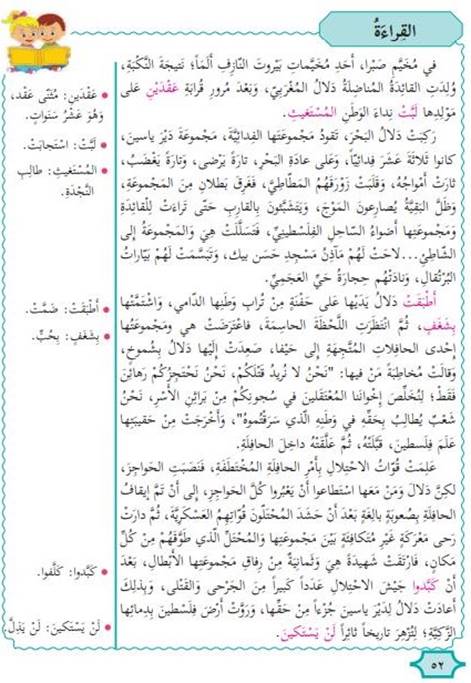

(Arabic Language, Grade 5, Part 2 (2017) p. 52)

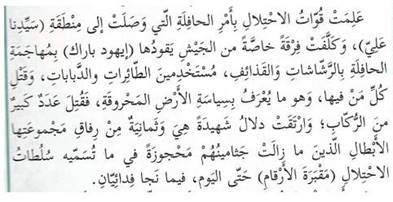
Certain changes have been introduced into the 2019 edition of this book in order to intensify the group’s heroism vis-à-vis tanks and aircrafts that were supposedly used against it and in order to make the Israeli forces responsible for the killing of the hostages. Dalal al-Mughrabi’s photo was also replaced:
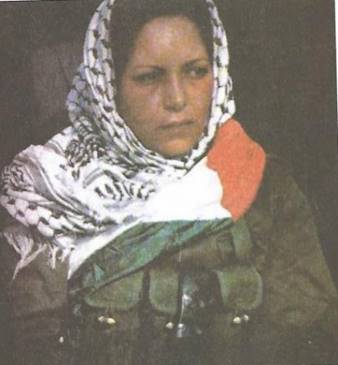

(Arabic Language, Grade 5, Part 2 (2019) p. 51)

The changed paragraph:

“The occupation forces were informed of the bus that had reached the area of Sidna Ali [Hertzlia] and they assigned a special army unit commanded by Ehud Barak with [the task of] attacking the bus with machine-guns and shells, while using aircrafts and tanks, and killing everyone who was on it. That is known by the ‘scorched earth policy’. A large number of the passengers were killed. Dalal ascended [to Heaven] as a martyr with eight of her group’s heroes, whose bodies are still kept in what is termed by the occupation authorities as the ‘numbers cemetery’, while two fidais survived.”
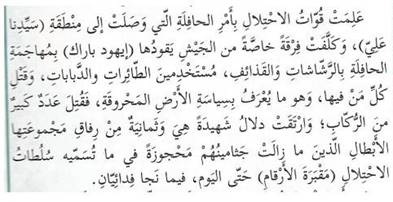

(Arabic Language, Grade 5, Part 2 (2019) p. 52)

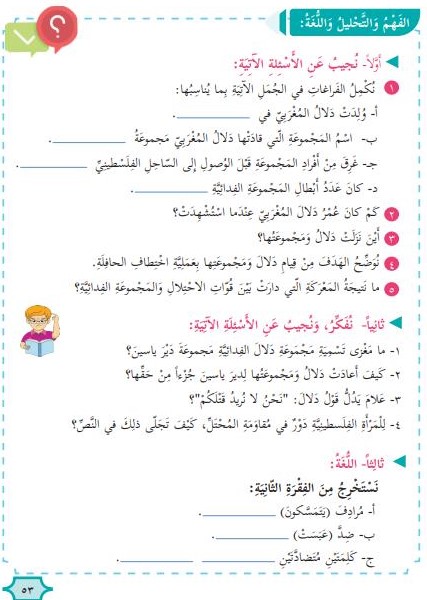
The third page of the lesson in the schoolbook contains assignments and questions that fracture the reading material into minute details in order to inculcate it in the students’ mind, as part of the indoctrination campaign:

“Understanding, analysis and language:

First, let us answer the following questions:

  1. Let us fill in the empty spaces within the following sentences with the proper details:
  2. Dalal al-Mughrabi was born in …………….
  3. The name of the group commanded by Dalal al-Mughrabi was the group of …………………………………………….
  4. ………………… of the members of the group drowned before reaching the Palestinian coast.
  5. The number of the fidai group’s heroes was ………………………….
  6. What was Dalal al-Mughrabi’s age at her martyrdom?
  7. Where did Dalal and her group land? [This question remained in the 2019 edition although it does not mention their landing spot and it is clear that the landing did not take place at Jaffa, as said in the 2017 edition].
  8. Let us clarify the goal of carrying out the bus abduction operation by Dalal and her group.
  9. What was the result of the battle that took place between the occupation forces and the fidai group?

Second, let us think and answer the following questions:

  1. What is the significance of naming Dalal’s fidai group as ‘Deir Yassin Group’?
  2. How did Dalal and her group reclaim for Deir Yassin part of its right?
  3. What do Dalal’s words: ‘We do not want to kill you’ indicate?
  4. The Palestinian woman has a role in the resistance to the occupier. How is it clarified from the text?

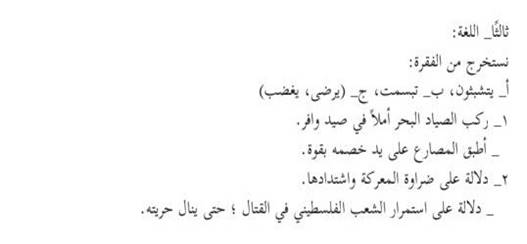
Third, language:

Let us extract from the second paragraph:

  1. A synonym for ‘holding to’ ………………
  2. An antonym for ‘angry’ ……………………
  3. Two words with opposite meanings …………….
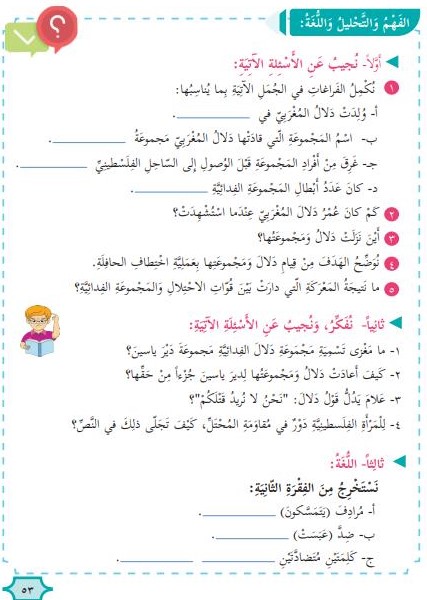

(Arabic Language, Grade 5, Part 2 (2017) p. 53)

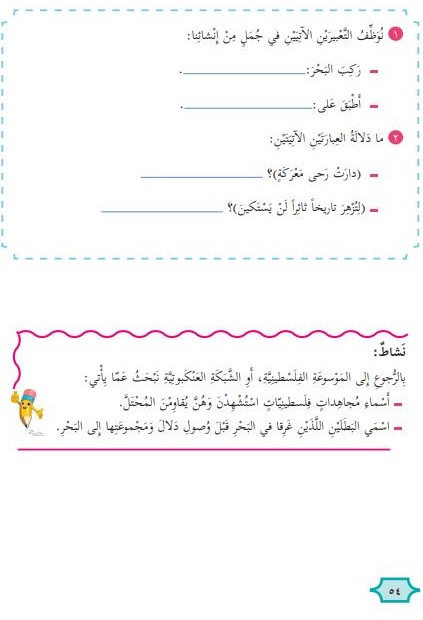
Additional assignments appear on the next page:

“1. Let us merge the following two expressions in sentences of our own:

-Sailed at sea: ……………

-Closed upon: …………….

  1. What is the meaning of the two following expressions?

-‘The battle’s mills were turning’ [in the 2019 edition it was omitted and the student is asked to explain the expression ‘scorched earth policy’ that appears in the amended paragraph].

-‘In order to make blossom a rebellious history that shall not be humiliated’

Activity:

By resorting to the Palestinian Encyclopedia, or to the Internet, let us search for the following:

-Names of female Palestinian Jihad fighters who fell as martyrs while resisting the occupier [In the 2019 edition it was replaced by: “How was Dalal al-Mughrabi killed and her body abused?”]

-Names of the two heroes who drowned at sea before Dalal and her group reached the sea [sic. and should be: reached the shore].”
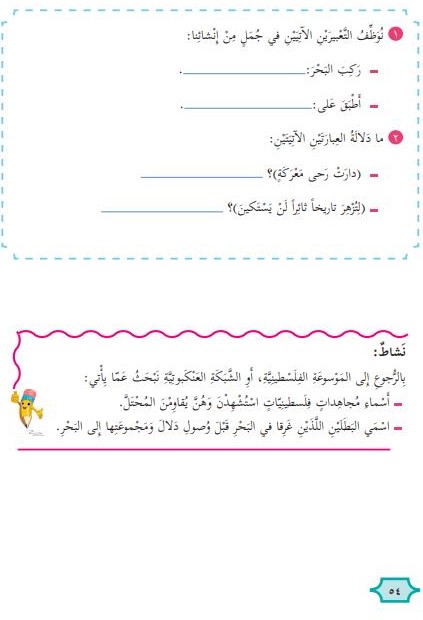

(Arabic Language, Grade 5, Part 2 (2017) p. 54)

The new assignments of explaining the expression of “scorched earth policy” and searching for details about the abuse of Dalal al-Mughrabi’s body (marked in red):
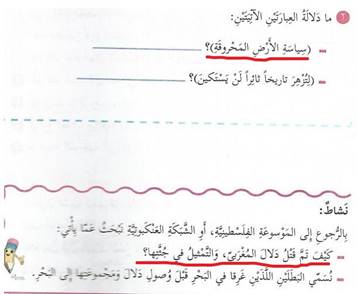
(Arabic Language, Grade 5, Part 2 (2019) p. 54)


Answers to most of these questions and assignments are found in the teacher’s guide:


“Fifth Lesson

Reading: ‘Dalal al-Mughrabi’

First, let us answer the following questions:

  1. The Sabra refugee camp, one of the refugee camps in Beirut. B. Deir Yassin
  2. Two fidais D. Thirteen fidais.
  3. Her age was twenty.
  4. She landed at the beach overlooking Jaffa.
  5. The goal [was] the release of the Palestinian prisoners-of-war from the occupation’s prisons.
  6. The martyrdom of Dalal al-Mughrabi and members of the fidai group and a number of killed and wounded ones from among the occupation soldiers.

Second, let us think and answer the following questions:

  1. Reminding of the massacre of Deir Yassin that was perpetrated by the Zionist gangs in 1948 and that the Palestinian people will never forget its martyrs’ blood.
  2. Through the fidai operation that brought about the killing of many of the occupation soldiers.
  3. They indicate that the Palestinian people is a peace-loving people that fights for achieving its freedom and not for killing and terrorization. It was possible for the operation to have ended without a battle had the occupation responded to the fidai group’s demands to release the Palestinian prisoners-of-war.
  4. It was revealed by the appointment of a woman to the position of commanding the fidai group that carried out the operation.”
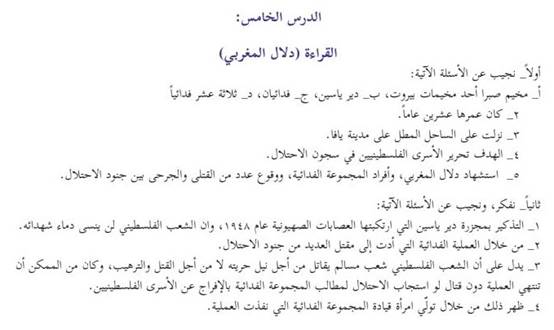

(Teacher’s Guide, Arabic Language, Grade 5 (2018) p. 213)

The answered assignments continue on the next page:

“Third, language:

Let us extract from the paragraph:

  1. To hold on to B. They smiled C. Calm, angry.
  2. -The fisherman sailed at sea hoping to have a plentiful catch.

-The wrestler closed his hand on his adversary’s hand forcefully.

  1. -An indication of the battle’s ferocity and severity.

-An indication of the continuation of the fighting by the Palestinian people until it               attains its freedom.”
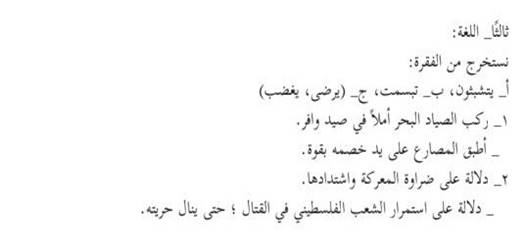

(Teacher’s Guide, Arabic Language, Grade 5 (2018) p. 214)

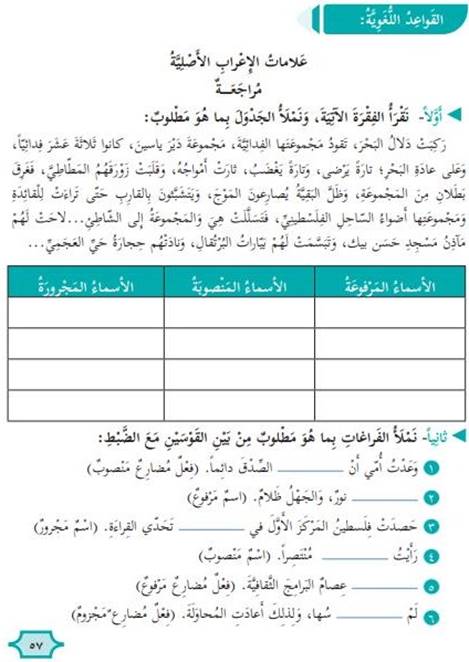
Additional exercises in the schoolbook use parts of the story given above:

“Grammar Rules:

The Primary Desinential Inflection Signs

Repetition

First, let us read the following paragraph and fill in the chart with the required [nouns]:

Dalal sailed at sea with her fidai group under her command, the Deir Yassin Group. They were thirteen fidais. As the rule is in high seas, which are sometimes calm and in other times – angry, the waves were stormy and their rubber boat was capsized. Two heroes of their group drowned and the rest continued wrestling with the waves and held to the boat until the lights of the Palestinian shore were seen by the commander and her group. Then, she and the group infiltrated into the shore. The minarets of Hasan Bek Mosque appeared to them, the orange orchards smiled to them and the stones of Al-Ajami neighborhood called them.”

The student is requested in this exercise to enter the nouns in the paragraph into the chart according to their respective desinential inflection in line with the rules of Arabic grammar (the next exercise is not related to the operation or to Dalal):
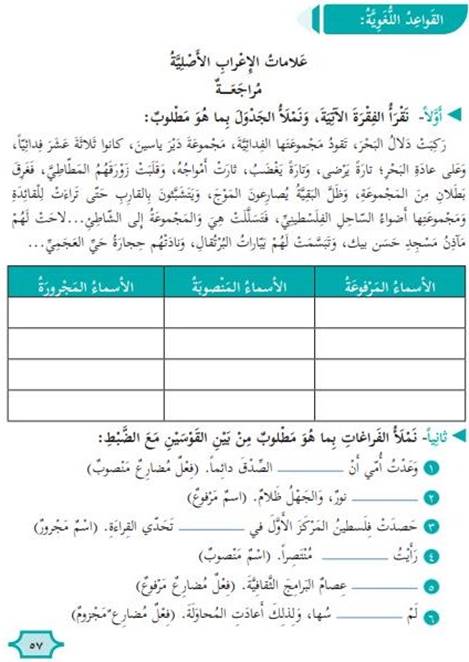

(Arabic Language, Grade 5, Part 2 (2017) p. 57)

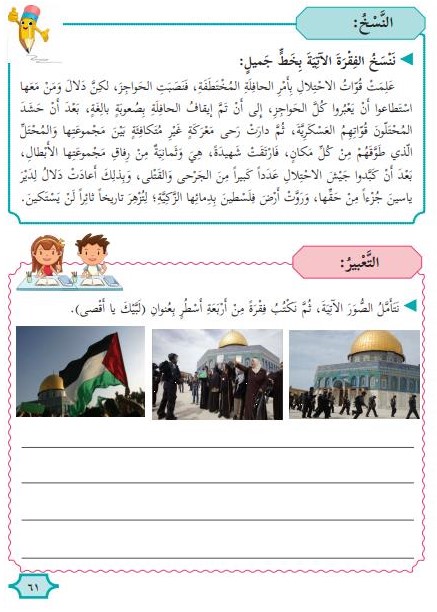
The following page includes an exercise (marked by a black framework) titled “Script”:

“Let us write the following in a Naskhi script [a certain type of Arabic writing] and pay attention to the writing of the letters R, Z:”

The sentence to be copied is taken from the description of the terrorist operation:

“Dalal watered the soil of Palestine with her pure blood in order to make blossom a rebellious history that shall not be humiliated.”
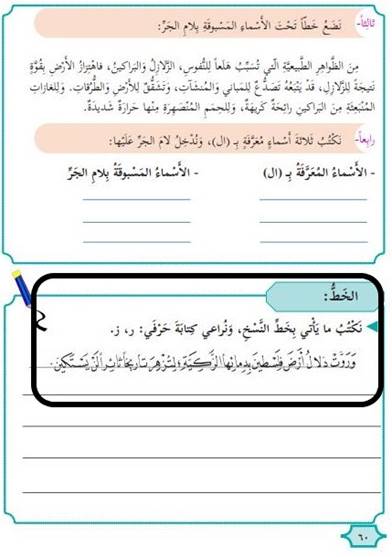

(Arabic Language, Grade 5, Part 2 (2017) p. 60)

And on the next page, the first part is an exercise in fine handwriting that also uses a piece of the story:

“Copying:

Let us copy the following paragraph in a nice handwriting:

“The occupation forces were informed of the abducted bus and they placed roadblocks. But Dalal and those who were with her managed to pass all the roadblocks, until the bus was stopped with great difficulty after the occupiers had gathered their military forces. Then, an unequal battle took place between her group and the occupier who had circled them from all directions and she ascended [to Heaven] as a martyr with eight of her group’s heroes, having inflicted on the occupation army a large number of killed and wounded. Thus, Dalal has reclaimed for Deir Yassin part of its right and watered the soil of Palestine with her pure blood, in order to make blossom a rebellious history that shall not be humiliated.”

The next part on the same page does not refer to Dalal or the operation.
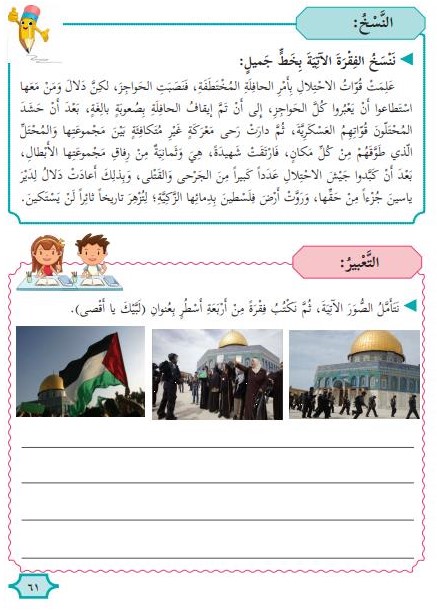

(Arabic Language, Grade 5, Part 2 (2017) p. 61)

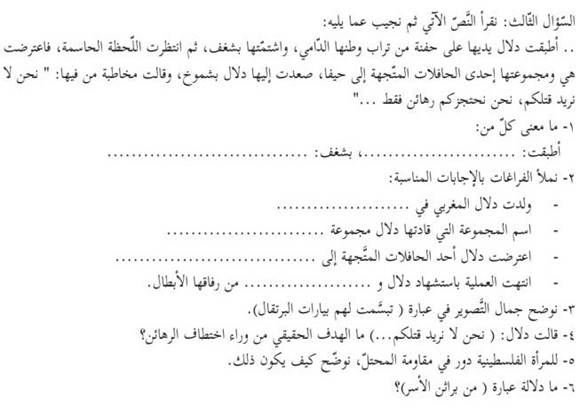
The teacher’s guide includes as well what is termed as “enrichment material” with additional questions referring to certain paragraphs in the story:

“Fifth Lesson

Reading: ‘Dalal al-Mughrabi’

The paragraph ‘In the refugee camp…Al-Ajami’:

  1. Why did the author describe the Sabra refugee camp as ‘bleeding’?
  2. Let us mention the dangers that were facing the group members during their sailing in the sea.
  3. Let us mention some of the landmarks of the city of Jaffa that were seen by the group members.
  4. Let us extract from the paragraph:

-A synonym for ‘sometime’ ……………  ‘appeared’ ………………….

-The plural form of ‘the mosque minaret’ ……, The singular form of ‘boats’ …….

  1. ‘And the rest continued wrestling with the waves’ – To what did the author liken the waves?
  2. ‘The orange orchards smiled to them’ – The author likened the orange orchards to ………………….
  3. ‘Infiltrated into’, ‘held on to’ – Let us use each of these combinations in a sentence of our own.

The paragraph ‘Dalal closed…the bus’:

  1. Let us write from the paragraph what indicates Dalal’s yearning to her homeland.
  2. Let us mention two traits of Dalal al-Mughrabi’s from our understanding of the paragraph.
  3. What is the significance of hanging the Palestinian flag in the bus by Dalal?
  4. Let us extract from the paragraph:

-The plural form of ‘hostage’ ……………, claw ……………….

  1. Let us use each of the following words in a sentence of our own: ‘decisive’, ‘proudly’.

The paragraph ‘[The occupation forces] were informed…humiliated’:

  1. What did the occupation forces do when they were informed of the abducted bus?
  2. How could the occupation stop the bus?
  3. Why was that an unequal battle, in your opinion?
  4. Let us search at the Internet the date of the fidai operation commanded by Dalal al-Mughrabi.
  5. ‘She ascended [to Heaven] as a martyr’, ‘she died as a martyr’ – What is the difference in meaning between the two expressions?”
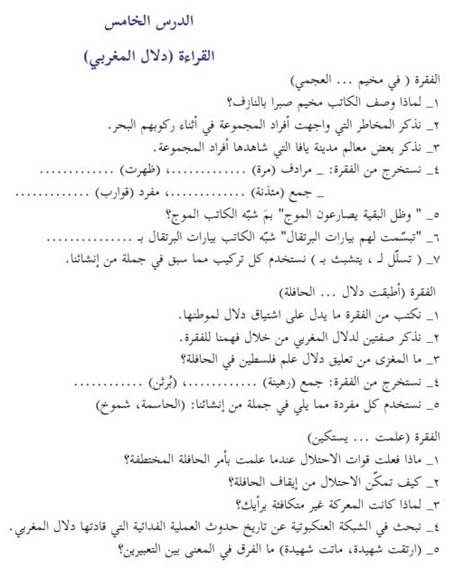

(Teacher’s Guide, Arabic Language, Grade 5 (2018) p. 243)

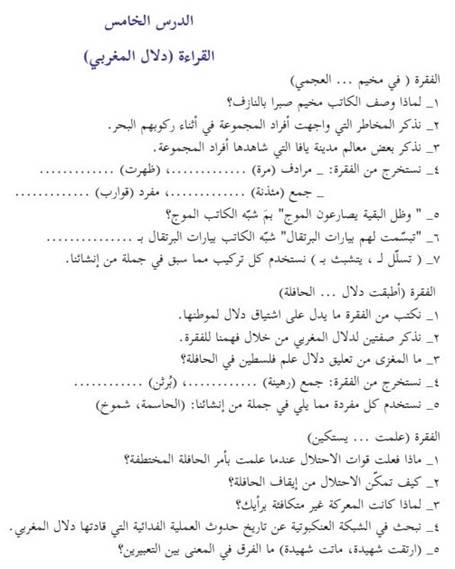
An exemplary test in the teacher’s guide also includes questions and assignments referring to Dalal al-Mughrabi’s story as given in the schoolbook of this grade:

“Third question: Let us read the following text and then answer the accompanying questions:

Dalal closed her hand upon a handful of her bleeding homeland’s soil and smelled it with passionate love. She waited for the decisive moment and then she and her group blocked the way of one of the buses heading to Haifa. Dalal came aboard proudly and said, talking to those who were on board: ‘We do not want to kill you. We are just taking you as hostages.’

  1. What is the meaning of:

‘closed upon’ …………………….  ‘with passionate love’ …………….

  1. Let us fill in the empty spaces with the right answers:

-Dalal al-Mughrabi was born in …………………

-The name of the group she commanded was ……………

-Dalal blocked the way of one of the buses heading to ……..

-The operation ended in the martyrdom of Dalal and …………. of her heroic comrades.

  1. Let us clarify the beauty of the description in the expression ‘the orange orchards smiled to them’.
  2. Dalal said: ‘We do not want to kill you’. What was the real goal of the hostages’ abduction?
  3. The Palestinian woman has a role in the resistance to the occupier. Let us clarify that.
  4. What is the meaning of the expression ‘from the claws of captivity’?
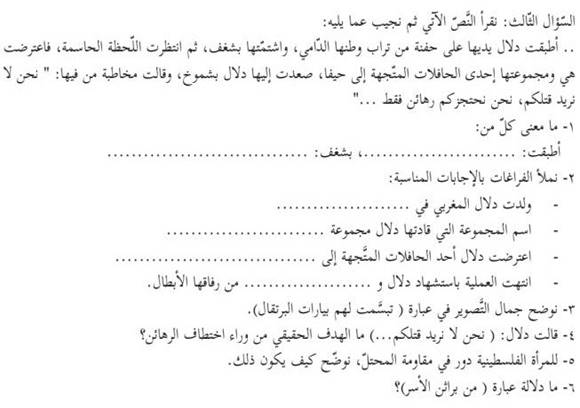

(Teacher’s Guide, Grade 5 (2018) p. 186)

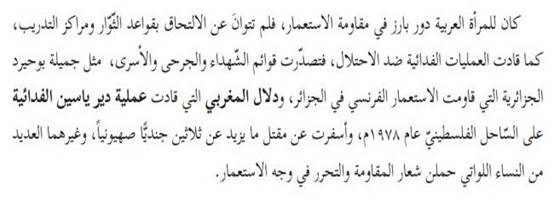
In higher grades, Dalal is made part of the more general framework of the struggle against Colonialism and the occupation within the subject of history studies:

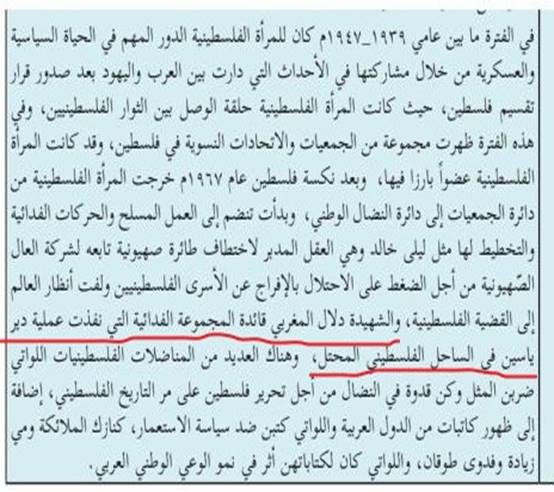
“The Arab woman had a prominent role in the resistance to Colonialism, for she did not hesitate to join the revolutionaries’ bases and the training centers. She also took command of fidai operations against the occupation and was at the center of the martyrs and the wounded list, like the Algerian Jamilah Buheired who resisted French Colonialism in Algeria and dalal al-Mughrabi who commanded the fidai Deir Yassin operation in the Palestinian coast in 1978 that ended in the killing of over thirty Zionist soldiers, and [like] many other women who carried the banner of resistance against Colonialism.”   
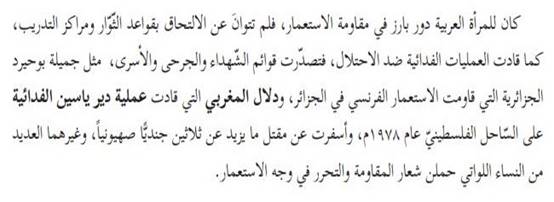

(Social Studies, Grade 9, Part 1 (2019) p. 51)

In the framework of the enrichment material for grade 9 there are questions and answers for further absorption. One of the questions reads: “Let us discuss the role of the Arab woman in resisting Colonialism”. The answer is quite long and part thereof describing the women’s activity within the Palestinian struggle since British Mandatory times is given here. Following is the relevant piece from the above-mentioned material that refers to the Palestinian female terrorist Layla Khaled as well. The reference to Dalal al-Mughrabi is underlined in both the original and the translated part:

“…After the defeat of 1967 the Palestinian woman stepped out of the realm of the [social] associations into the field of the national struggle and started joining the armed activity and the fidai movements and plan them, like Layla Khaled who is the planning brain behind the hijacking of a Zionist aircraft that belonged to the Zionist company El Al in order to pressure the occupation to release the Palestinian prisoners-of-war and direct the world’s eyes to the Palestinian problem, and the martyr Dalal al-Mughrabi, the commander of the fidai group that carried out the Deir Yassin operation in the occupied Palestinian coast…”
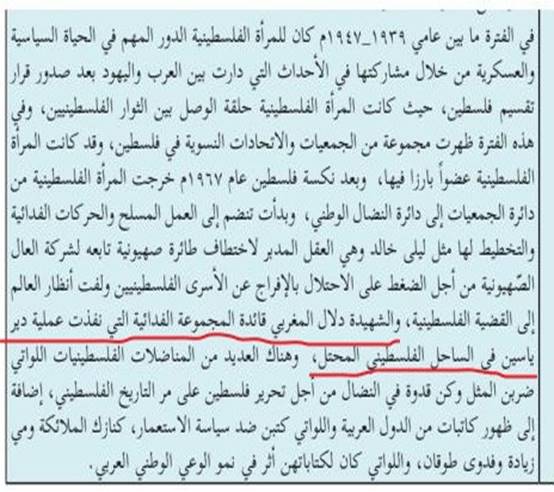

(Teacher’s Guide, Social Studies, Grade 9 (2018) p. 93)

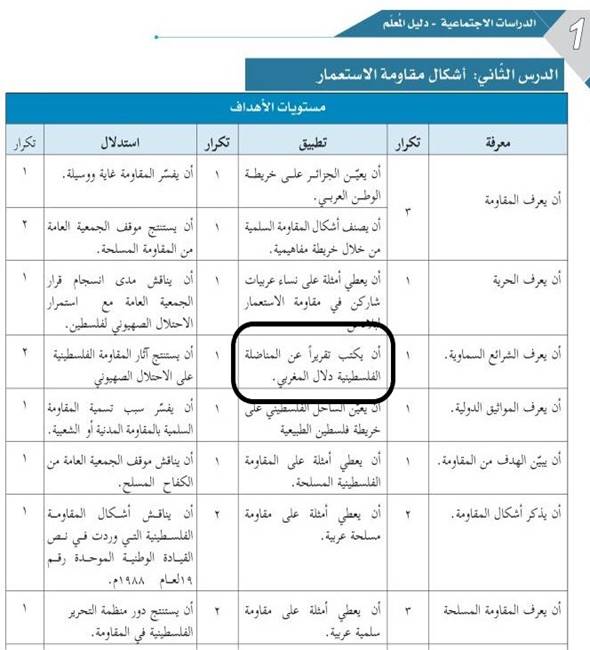
In this context, one of the goals of a lesson on the various forms of resistance to Colonialism is (marked by a black frame):

“[The student should] write a report about the Palestinian female fighter Dalal al-Mughrabi.”
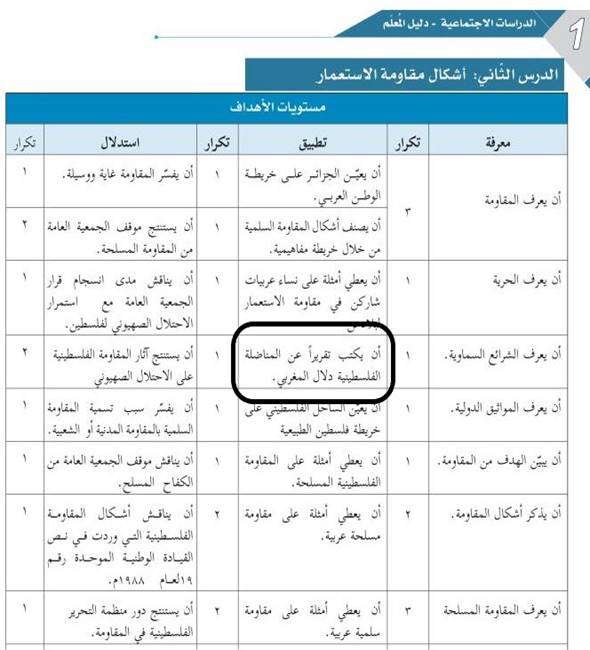

(Teacher’s Guide, Social Studies, Grade 9 (2018) p. 48)

Another piece in this regards mentions other Palestinian female terrorists as well:

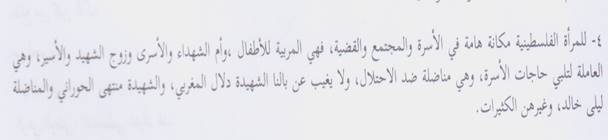
“The Palestinian woman has an important role in family, society and the [Palestinian] cause. She is the children’s educator, mother of martyrs and prisoners-of-war, wife of the martyr and the prisoner-of-war. She works for [the purpose of] providing the family’s needs and struggles against the occupation. And we do not forget the martyr Dalal al-Mughrabi, the [female] martyr Muntaha al-Hawarani, the fighter Layla Khaled and many others.”
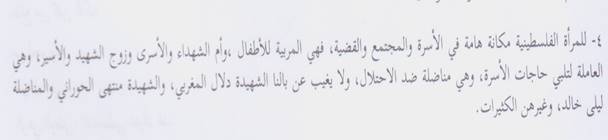

(Teacher’s Guide, Arabic Language – Academic Path, Grade 10 (2018) p. 251)

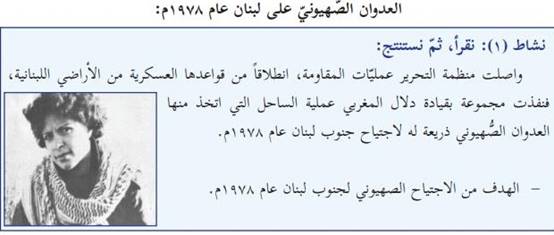
Another mentioning, with a different picture of Dalal al-Mughrabi:

“The Zionist aggression against Lebanon in 1978

Activity 1: Let us read and then conclude:

The Palestine Liberation Organization (PLO) continued the resistance actions from its military bases in Lebanese territory. A group under the command of Dalal al-Mughrabi carried out the coast operation which was used by the Zionist aggression as an excuse on its part to invade south Lebanon in 1978.

-The goal of the Zionist invasion of south Lebanon in 1978.”
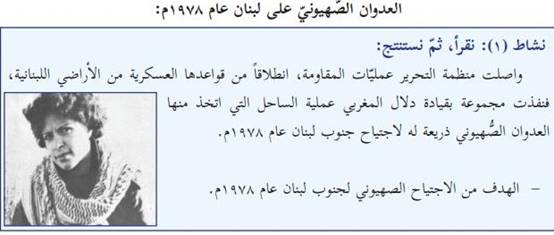

(Geography and Modern and Contemporary History of Palestine, Grade 10 (2017) p. 67)

Additional details about Dalal al-Mughrabi are brought in the enrichment material for grade 9, from which it becomes clear that she was a student in UNRWA schools:

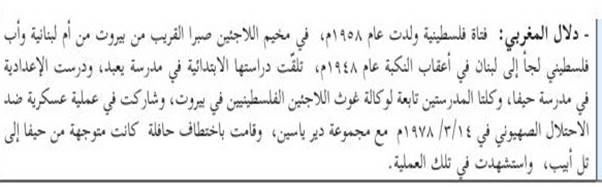
“Dalal al-Mughrabi: A Palestinian young woman who was born in 1958 in the Sabra refugee camp near Beirut to a Lebanese mother and a Palestinian father who had come to Lebanon as a refugee following the Nakbah in 1948. She studied in the ‘Ya’bed’ elementary school and in the ‘Haifa’ secondary school and both schools belong to the relief agency for the Palestinian refugees [UNRWA] in Beirut. She participated in a military operation against the Zionist occupation in 14.3.1978 together with the Deir Yassin group and abducted a bus that was on its way from Haifa to Tel Aviv. She fell as a martyr in that operation.”
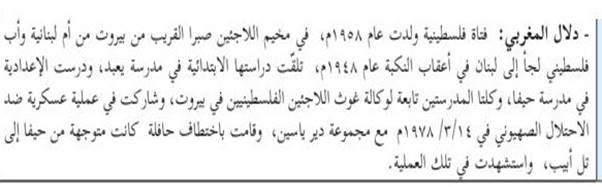
(Teacher’s Guide, Social Studies, Grade 9 (2018) p. 133)

Another enrichment material, from a higher grade, is similar to the previous one:

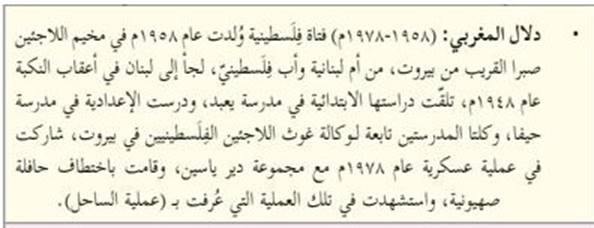
“Dalal al-Mughrabi: (1958-1978) A Palestinian young woman who was born in 1958 in the Sabra refugee camp near Beirut to a Lebanese mother and a Palestinian father who had come to Lebanon as a refugee following the Nakbah in 1948. She studied in the ‘Ya’bed’ elementary school and in the ‘Haifa’ secondary school and both schools belong to the relief agency for the Palestinian refugees [UNRWA] in Beirut. She participated in a military operation in 1978 together with the Deir Yassin group and abducted a Zionist bus. She fell as a martyr in that operation that came to be known as the ‘Coast Operation’.”
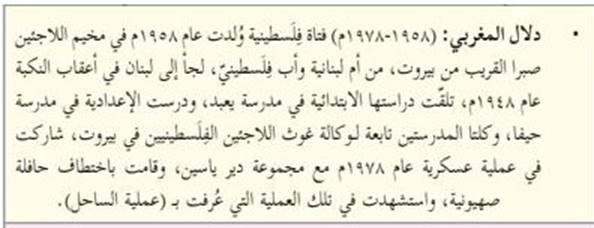
(Teacher’s Guide, Geography and Modern and Contemporary History of Palestine, Grade 10 (2018) p. 234)

And a question in an exemplary test:

“9. What is the name of the operation carried out by the martyr Dalal al-Mughrabi in 1978?

  1. Peace of Galilee B. The Shining Star C. Verdan       D. The Coast Operation”

(Teacher’s Guide, Geography and Modern and Contemporary History of Palestine, Grade 10 (2018) p. 221)

An important element in the indoctrination regarding Dalal al-Mughrabi is her elevation from a status of fighter and commander to that of a Palestinian leader of the first rate. In one of the language exercises appearing in the teacher’s guide for grade 5, the student is required to mark a number of sentences with a “V” if true and with “X” if they are not. In the following sentence, the answer is, in all probability, “true”:


“D. Yasser Arafat, Izz al-Din al-Qassam and Dalal al-Mughrabi – are all Palestinian heroes. (        )”

(Teacher’s Guide, Arabic Language, Grade 5 (2018) p. 170)

In other words, Dalal al-Mughrabi, who commanded a terrorist action on the Israeli Coastal Highway in which a civilian bus was abducted and over 30 unarmed civilians were murdered, is mentioned together with the central Palestinian leader in this age – Yasser Arafat, and with Sheikh Izz al-Din al-Qassam, who is considered the source of inspiration for the Hamas movement.

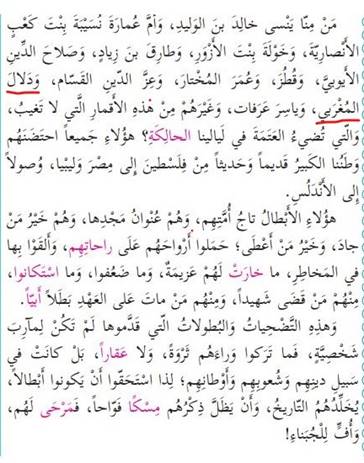
Nay, she is elevated to a higher position. The following piece, titled “Bravo to the Heroes” and appearing in a schoolbook for grade 5, exalts several Arab and Muslim heroes throughout history, including three Palestinians. Dalal is one of them (her name is underlined in red):

“Who among us will forget Khaled bin al-Walid [the chief Muslim commander against the Byzantines], Umm Umarah Nuseibah bint Ka’b al-Ansatiyyah [fought with Muhammad against the tribe of Quraysh], Khawlah bint al-Azwar [participated in the Muslim conquest of Palestine], Tareq bin Ziyad [conqueror of Spain], Salah al-Din al-Ayyubi [liberated Jerusalem from the Crusaders], Qutuz [defeated the Mongols], Umar al-Mukhtar [fought against the Italian occupation of Libya], Izz al-Din al-Qassam, Dalal al-Mughrabi, Yasser Arafat and others among those moons that never disappear and that lighten in the darkness of our gloomy nights? All those have been embraced by our great homeland in the remote past and recently, from Palestine to Egypt and Libya and all the way to Spain.

These heroes are the crown of their nation and the token of its glory. They are the best among those ones who made the efforts and the best among those who delivered. They carried their souls on their palms and tossed them into the dangers. Their determination did not fail, they were not weakened and were not humiliated. Some of them died as martyrs and some died while still unchanged as proud heroes.

That sacrifice and heroism they performed were not for personal purposes. They did not leave behind them wealth or landed property. Rather, it was for the sake of their religion, peoples and homelands. Therefore, they deserve to be heroes eternalized by history and that their memory will remain like diffusing fragrance. Bravo to them and down with the cowards!”
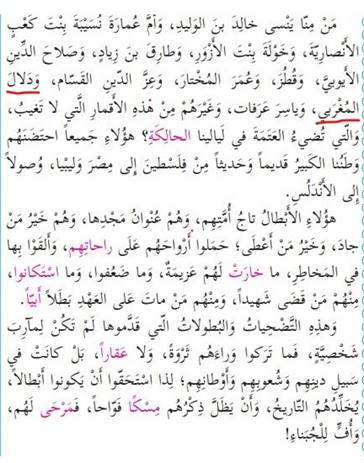

(Arabic Language, Grade 5, Part 1 (2019) p. 15)

One of the questions accompanying this text:

“2. Let us give the names of two Palestinian heroes mentioned in the text.”
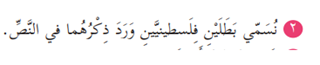

(Arabic Language, Grade 5, Part 1 (2019) p. 16)

The answer is found in the teacher’s guide of this grade:

“2. Yasser Arafat, Dalal al-Mughrabi”


(Teacher’s Guide, Arabic Language, Grade 5 (2018) p. 191)

That is to say, Dalal al-Mughrabi appears in this answer alongside Yasser Arafat while Izz al-Din al-Qassam is omitted! In other words, Dalal al-Mughrabi is elevated to a rank of a Palestinian super-hero alongside Yasser Arafat at the expense of Izz al-Din al-Qassam, seemingly, due to the ideological rivalry between the PA and Hamas.

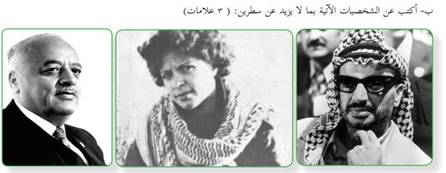
And in the following assignment Dalal al-Mughrabi appears alongside Yasser Arafat and Ahmad Shuqeiry – the PLO first chairman:

“Write not more than two lines about the following personalities (3 points).”
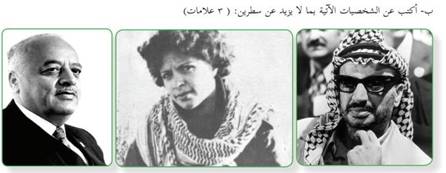
(Teacher’s Guide, Geography and Modern and Contemporary History of Palestine, Grade 10 (2018) p. 220)

Dalal al-Mughrabi is compared to prominent women in Arab and Muslim history:

“8. Among the examples of women who confronted the enemy: Khawlah bint al-Azwar [7th century], Nuseibah al-Mazeniyyah [7th century], Dalal al-Mughrabi (the students will give other choices).”


(Teacher’s Guide, Arabic Language, Grade 7 (2018) p. 219)

“4. Let us give examples from history of women who had a clear imprint in life.”


(Arabic Language, Grade 8, Part 1 (2019) p. 97)

And the answer:

“4. Lady Aishah Mother-of-the-Believers [Muhammad’s wife and an important source of traditions about him], Jamilah Buheired [member of the FLN underground in Algeria against the French rule. She was arrested, tortured and sentenced to death but eventually released], Dalal al-Mughrabi.”


(Teacher’s Guide, Arabic Language, Grade 8 (2018) p. 2017)

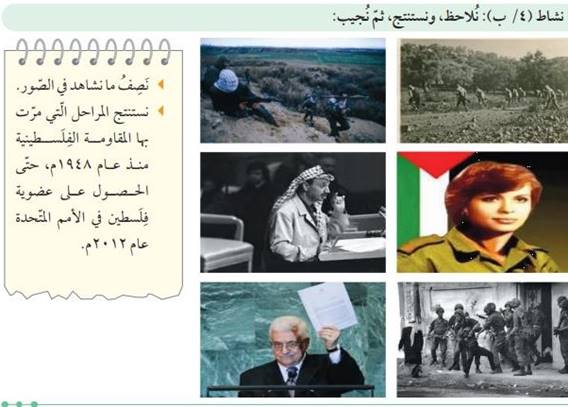
Finally, according to a history schoolbook for grade 11, Dalal al-Mughrabi and her operation signal a phase in Palestinian national history. Her picture appears among other ones that describe the development of what is termed as “Palestinian Resistance”, accompanied by the following words:

“Activity 4B. Let us observe, conclude and then answer:

-Let us describe what we see in the pictures.

-Let us draw conclusions regarding the phases through which the Palestinian resistance passed beginning in 1948 until the attainment of a membership status in the United Nations by Palestine in 2012.”
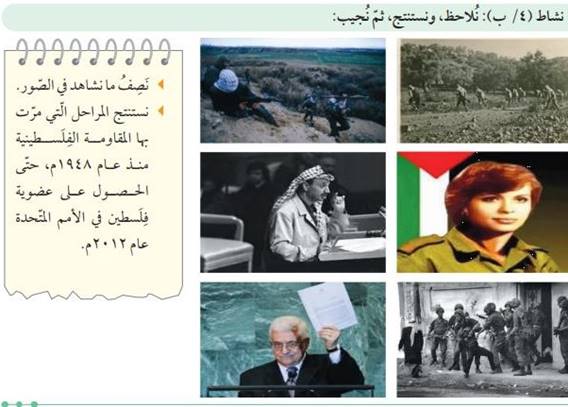

(History Studies, Grade 11, Part 2 (2017) p. 53)

The terrorist Dalal al-Mughrabi “stars”, then, in the Palestinian curriculum that is followed as well in UNRWA schools with no exception, as a Palestinian super-heroine, equal in status to Yasser Arafat and to the Prophet of Islam’s wife Aishah, and above Izz al-Din al-Qassam. She signals a phase in the development of Palestinian national activity. Her life and the story of the terrorist action she commanded are brought in detail, including the fact of her being an UNRWA student. She probably well applied the material she learned there and, accordingly, she is presented as a role model to Palestinian students in general and to the refugees’ descendants in UNRWA schools in particular. This is education to terror par excellence and all those involved internationally in the process of approval of UNRWA activity and its financing should take that into account.


[1] Fidai – “Self-sacrificing”, the Palestinian terrorists’ epithet.


Weekly Commentary: Hebron – Israel’s National Heritage, Model of Joint Access

Saturday, November 27, 2021
Dr. Aaron Lerner Date: 27 November 2021

President Isaac Herzog is slated to light a menorah for the first night of
Hanukkah on Sunday at the Cave of the Patriarchs in Hebron.

This is a building erected at the same time as Herod’s spectacular Temple in
Jerusalem.

That’s right.

Herod’s Temple was destroyed.

And this structure, which features the same architectural style and building
methods as the Temple, stands to this very day.

And yes. It does indeed sit on top of a “double cave” -a “Machpela” – as
described in the Bible as the final resting place of Abraham, Sarah, Isaac
and Jacob and other ancestors in the first recorded price gouging in a real
estate deal (“what’s four hundred shekels of silver between you and me?”
Ephron asked Abraham rhetorically).

For centuries of Moslem occupation Jews were denied access to this holy
site.

But in 1967, when the building finally returned to Jewish control, Israel
decided not to follow the Moslem precedent and claim exclusive Jewish
access. Instead Jews and Moslems share access, with each group assigned
space in the building along with exclusive use of the entire structure for
Jews and Moslems on the respective major holidays. [This gets a bit
complicated some years since the Moslem calendar is a lunar calendar without
a solar adjustment to the Moslem holidays are constantly shifting around the
year and sometimes coincide with Jewish holidays].

The Hebron model is proof positive of two important principles:

Open access to religions with contending claims to a site is only viable if
the site is under Jewish control.

That ongoing control can only be assured if it is supported by the presence
of a living community adjacent to the site.

Happy Hanukkah.

________________________________________
IMRA – Independent Media Review and Analysis

Since 1992 providing news and analysis on the Middle East with a focus on
Arab-Israeli relations

Website: www.imra.org.il

The facts behind Israel’s designating six Palestinian NGO’s as terror groups

The facts behind Israel’s designating six Palestinian NGO’s as terror groups

Theatre of the absurd

This past week has witnessed yet more acts of folly performed at the United Nations and on the world stage.

Multitudes of clowns and impersonators masquerading as politicians, experts and groupie lemmings all managed to either enthral or repel captive audiences.

At least when one goes to a theatre and is faced with a substandard or appalling show you can walk out and if you are lucky you can even perhaps demand your money back. Unfortunately, we the great unwashed public, have no chance of escaping from the barrage of tragedies touted as serious acting. Sure, we can press the delete button on our devices and refuse to pay hard-earned money on rags purporting to be serious and unbiased purveyors of news and opinions but always lurking in the undergrowth are demonstrations and rent a crowd groups peddling the vilest disinformation.

Rubbing in salt to our wounds is the fact that there is no possibility of any refund for our tax money which funds politicians’ burbling, diplomatic sleights of hand and spin doctors’ attempts at sanitizing toxic policies.

If you doubt my assertions then take a good look at what passes for international discourse as far as it relates to Jews and Israel.

The vast majority but by no means all lunacy associated with Israel obsessions originate at the UN and its associated partners in crime. As regular as a Swiss cuckoo clock or the German railway system, resolutions pillorying and condemning the Jewish State spew forth in endless eruptions of volcanic bile. Accompanied by threats of blind hate and language designed to delegitimize, these resolutions inevitably pass with large majorities. When one realizes that the organization has been taken over by non democracies the passage of these resolutions should come as no surprise. What is disgustingly disgraceful however are the morally corrupt voting patterns of those few nations who pretend to represent human rights and historical truths.

The very latest example of how low the international body can go is exemplified by a resolution passed last week at the tower of Babel situated in New York.

This was passed with 157 countries in favour and 7 against:

Condemnation of Israel for exploitation of Palestinian natural resources in GAZA, West Bank, East Jerusalem and of Syrians in the Golan. It also recognizes the rights of Palestinians and Syrians to claim restitution for the loss of such resources.

Apart from the fact that this resolution, like all others is totally detached from reality it reveals once again to all Israelis except those living in a parallel universe that the vast majority of those countries which profess undying solidarity for our security are nothing more than gutless pontificators.

A breakdown of the voting record shows that the seven nations which stood up to this onslaught of lies were Canada, Marshall Islands, Micronesia, Nauru, Palau, USA and of course Israel. Unsurprisingly, the EU and shamefully the UK fell into line with the human rights abusers of the world. For some inexplicable reason, Australia abstained and true to past voting patterns, New Zealand joined the Israel bashers.

This sorry spectacle brings me to an interesting discovery.

Researching information collated by UN Watch throws up the following disquieting facts. Voting patterns from 2015 to 2021 on resolutions condemning Israel for every conceivable sin known to humanity by Australia and New Zealand reveal the spotty record of the former and the abysmal record of the latter.

Australia: 41% – supporting Israel

19% – against Israel

41% – abstained


New Zealand: 0% – ZERO – ZILCH – supporting Israel

78% – against Israel

22% – abstained


These figures speak for themselves. One needs to remember the infamous Resolution 2334 co-sponsored by New Zealand which erases the Jewish connection to Jerusalem as well as Judea and Samaria and which to this day has never been officially repudiated.

Instead of waxing lyrical to Israel’s Ambassador over climate change challenges, the NZ Minister of Foreign Affairs would have been better advised to expend some hot air (pun intended) explaining her country’s dismal UN performance towards the Middle East’s only true democracy. How sincere one can ask, is a country which professes friendship and then stabs Israel in the back every time a resolution proposed by terror sponsoring or supporting regimes comes up for a vote?

Hard on the heels of this fiasco we are witness to the political contortions over designating Hamas (all of it) as a terror organization.

At this time only Canada, EU, Japan and the USA designate Hamas in its entirety as such. Others such as Australia, New Zealand, Paraguay and until recently the UK make an absurd arbitrary distinction between its military and “political” wings. Within recent days, the UK suddenly woke up to the fact that there is no difference between the military and political parts of Hamas and has now designated the entire terror group as a terror entity. This decision by the way has elicited howls of outrage by Jordanian MP’s who accuse the UK of “aggression against the Palestinian People and Arab nations.”

It is important to note at this stage that back in 2018 the United Nations General Assembly rejected a US sponsored resolution condemning Hamas as terror perpetrators.

Australia has now decided to label Hezbollah in its entirety as a terror group and while this is a laudable but long overdue step one has to ask what exactly is the difference between Hamas and Hezbollah. Canberra has stated that it is thinking about also eliminating the absurd distinction between the so-called political and military parts of Hamas but so far nothing has been decided. At least that is slightly better than the NZ Government which apparently as one can deduce from its silence on the subject is not thinking about it at all.

Hamas controls Gaza and has amassed a huge stock of rockets which in recent times have been fired at Israeli civilians. Its stated aims are the total elimination of Israel by terror. This week one of its disciples murdered a young Jewish man working as a tour guide in Jerusalem and seriously injured several others. Hamas and its supporters, including the fake peace partners of the PA, celebrated and lauded this attack and after the terrorist’s death hailed him as the latest “martyr” and promised many more such acts of terror.

Take a look at this revealing item from MEMRI:

https://www.memri.org/tv/hamas-gaza-military-exhibition-children-rockets-drones

Hezbollah controls Lebanon and likewise has enormous stocks of rockets aimed at Israel. Its aims and objectives are identical to Hamas. Like Hamas it has political and student divisions as well as a standing army of terrorists.

Can anyone therefore logically explain the difference between both groups? Is it not time for Australia, New Zealand and other democracies to acknowledge the facts and act to ban all of Hamas accordingly?

Condemnations over the murder of Jews are all very well but unless those responsible for planning and executing these foul deeds are held to account it is merely a continuing charade.

Does a Palestinian “Right of Return” Exist in International Law?

Institute for Contemporary Affairs

Founded jointly with the Wechsler Family Foundation

Vol. 21, No. 23

  • On November 9, 2021, the Fourth (Special Political) Committee of the UN General Assembly adopted by a 160-1 vote a draft resolution on Palestinian refugees. The U.S. abstained, although all previous administrations, apart from the Obama administration, had voted against this resolution.
  • In 1999, the U.S. representative (representing the Clinton administration) stated, “This delegation could not support unbalanced resolutions which attempted to prejudge the outcome of negotiations; lasting peace would come from agreements reached among the parties themselves, not from any action taken by the Committee.”
  • The international media pounced on the latest change in the U.S. voting pattern, erroneously claiming that it signified “support by the Biden administration for a right of return for Palestinian refugees to sovereign Israel.” In fact, the U.S. vote-change signifies no such thing, and the resolution does not mention any right of return for Palestinian refugees.
  • Several international legal and political documents try to tackle the question of return of refugees, but they do not establish any right of return for Palestinian refugees. UN General Assembly Resolution 194 states that “refugees wishing to return to their homes and live at peace with their neighbors should be permitted to do so,” but no resolution of the General Assembly has the capacity to determine laws or establish rights. The term “should” underlines that this is solely a recommendation.
  • Moreover, a “right of return” does not appear in resolutions of the UN Security Council, the International Covenant on Civil and Political Rights (ICCPR), or in Israeli-Palestinian Peace Process documentation.

On November 9, 2021, the Fourth (Special Political Committee) of the United Nations General Assembly’s 76th Session voted to adopt a draft resolution entitled “Assistance to Palestine refugees.1

This resolution, adopted annually for over 70 years, calls inter alia for continued assistance for Palestinian refugees and continued support for the work of the United Nations Relief and Works Agency for Palestine Refugees (UNRWA).

The resolution was adopted by a recorded vote of 160 in favor and 1 against (Israel), with nine abstentions (Cameroon, Canada, Marshall Islands, Federated States of Micronesia, Nauru, Palau, Papua New Guinea, United States, and Uruguay).

In this vote, the United States changed its traditional opposition to the draft resolution and abstained. In fact, the United States’ voting history regarding this resolution indicates that all previous administrations, apart from the Obama administration, have voted against this resolution.

In his explanation of the vote in the Fourth Committee of the UN General Assembly in 1999, the U.S. representative (representing the Clinton administration) stated, “his delegation could not support unbalanced resolutions which attempted to prejudge the outcome of negotiations; lasting peace would come from agreements reached among the parties themselves, not from any action taken by the Committee.”2

This position was reaffirmed in 2003 under the George W. Bush administration by the U.S. Fourth Committee representative who stated that the United States “had not voted in favor of several resolutions on that subject (humanitarian assistance) because it judged that they (…) were drafted in terms that could have repercussions on the peace negotiations in the region.”3

Finally, the same position was taken recently – even more assertively – by Cherith Norman Chalet in the Fourth Committee in 2019, during the Trump administration, who stated: “…such a one-sided approach damaged the prospects for peace by undermining trust between parties. It was disappointing that, despite the support for reform, member states continued to single out Israel.”4

A Wrong Interpretation

The international and Israeli media pounced on this change in the U.S. voting pattern, erroneously claiming that it signified “support by the Biden administration for a right of return for Palestinian refugees to sovereign Israel.5

In fact, the U.S. vote-change signifies no such thing, and the resolution does not mention any right of return for Palestinian refugees. Therefore, the U.S. abstention implies no support for a right of return.

In light of this erroneous perception arising from flawed and inaccurate media reporting, there is a need to clarify the issue of whether any such right of return exists.

A Brief Overview

The issue of Palestinian refugees has been seen as a principal obstacle to a conflict-solution between Israel and the Palestinians for over 70 years. The situation originated during the 1946-48 period when local Arab residents were displaced or chose to relinquish their homes during the course of armed conflict. In order to support those refugees, the UN Relief and Works Agency for Palestinian Refugees in the Near East (UNRWA) was established in 1949 with a budget of $50 million.6

As of today, UNRWA supports some five million registered Palestinian refugees. However, the UNRWA definition of refugees is considerably broader than the internationally accepted definition of refugees according to the Convention Relating to the Status of Refugees (1951),7 inasmuch as UNRWA includes descendants of refugees. Descendants are not included in the 1951 Refugees convention.8

UNRWA
UNRWA serves generations of Palestinians but will not resettle them. (UNRWA photograph)

Does a Right of Return for Palestinian Refugees Exist in International Law?

Several international legal and political documents try to tackle the difficult situation of return for refugees. But they do not appear to establish any right of return for Palestinian refugees.

I. UN General Assembly Resolution 194 (III)9

Resolution 194 (III) is the first major UN General Assembly Resolution that refers to the Palestinian refugees. Even though the Arab States initially strongly opposed Resolution 194 (III), claims to a right of return are now mainly based on this text. The resolution was adopted on December 11, 1948, by a vote of 35 (including the United States, the UK, Canada, and European states) in favor, 15 (six Arab League states – Egypt, Syria, Iraq, Lebanon, Saudi Arabia, and Yemen, together with the USSR and its satellite states) against, and eight abstaining.10 With this resolution, the General Assembly established a three-state Conciliation Commission for Palestine11 and instructed it to “take steps to assist the Governments and authorities concerned to achieve a final settlement of all questions outstanding between them.”12

Paragraph 11 of the Resolution addresses the situation of refugees. According to the paragraph, “refugees wishing to return to their homes and live at peace with their neighbors should be permitted to do so at the earliest practicable date, and that compensation should be paid for the property of those choosing not to return.

This paragraph neither establishes nor recognizes any right. In fact, no resolution of the General Assembly has the capacity to determine laws or establish rights. The resolution recommends that refugees “should” be “permitted” to return. The term “should” underlines that this is solely a recommendation. The element of permission is indicative of the fact that it is at Israel’s discretion to grant return. Secondly, it is subject to two conditions: that the refugees wish to return and that they wish to live at peace with their neighbors.

In light of the present situation in the area, and especially following the violence that erupted in May 2021, it is questionable whether such peaceful co-existence can be ensured.

Since the wording of Paragraph 11 does not establish a basis for a “right of return,” the resolution, therefore, cannot be interpreted as establishing a legal basis for such a right. The UN General Assembly is solely entitled by the UN Charter to make recommendations that do not contain binding obligations, and it cannot establish legal rights. The resolutions, therefore, do not carry a force of law, and a “right of return” cannot arise from them. Therefore, Resolution 194 (III) must be regarded as nothing more than a recommendation concerning those refugees wishing to return and live in peace.

II. Security Council Resolutions

A “right of return” does not appear in resolutions of the United Nations Security Council, the only organ that has the authority to adopt obligatory resolutions. The issue of Palestinian displaced persons was addressed by UN Security Council following the 1967 “Six Days War” in Resolution 237 (June 4, 1967). The resolution called upon the government of Israel to “facilitate the return of those inhabitants (…) who have fled the areas since the outbreak of the hostilities.” The resolution, adopted under Chapter VI of the UN Charter, dealing with the pacific settlement of disputes, was not an obligatory resolution and made no reference to a “right” of the refugees to return.13

Furthermore, in its famous Resolution 242 (November 22, 1967), which serves as the basis for the Middle East peace process, the Security Council solely “affirms further the necessity for achieving a just settlement of the refugee problem.14 If a right of return had been previously established by Resolution 194 (III) of 1948, then it would surely have figured here as the basis for settling the refugee problem.

Lastly, a right of return does not appear in other international refugee situations. During the Kosovo refugee crisis, for example, in its Resolution 1244 (1999), the UN Security Council did not refer to a right of return.15 If the Security Council accepted a right of return, it would have applied it to the situation in Kosovo.

III. International Covenant on Civil and Political Rights (ICCPR)

A right of return for Palestinian refugees can further not derive from international law sources dealing with human rights, such as the ICCPR. Article 12 (4) of this Covenant generally refers to a right to enter one’s country: “No one shall be arbitrarily deprived of the right to enter his own country.”

This Article is not applicable to the situation of Palestinian refugees. Firstly, it is questionable whether the term “to enter his own country” applies to Israel for Palestinian refugees. Secondly, it is disputed that the Palestinian refugees were arbitrarily deprived of entering Israel.

It is further advocated in international legal literature that the right of return in Article 12 (4) ICCPR is meant as an individual right.16 It was not intended to deal with claims of masses of people being displaced as a by-product of war and, therefore, cannot be applicable vis-a-vis the situation of Palestinian refugees.

IV. Israeli-Palestinian Peace Process Documentation

Lastly, the issue of Palestinian refugees is tackled by prior-ranking binding bilateral agreements between Israel and its neighbors.

Egyptian President Anwar Sadat, U.S. President Jimmy Carter, and Israeli Prime Minister Menachem Begin at Camp David, 1978
Egyptian President Anwar Sadat, U.S. President Jimmy Carter, and Israeli Prime Minister Menachem Begin at Camp David, 1978 (U.S. Government Archives, Wikipedia)

Article A (3), subparagraph 5 of the 1978 “Framework for Peace in the Middle East between Israel and Egypt,” negotiated at Camp David, established a “continuing committee to decide by agreement on the modalities of admission of persons displaced from the West Bank and Gaza in 1967.” In subparagraph 6 of this agreement, Egypt and Israel agreed to “work with each other and with other interested parties to establish agreed procedures for a prompt, just, and permanent implementation of the resolution of the refugee problem.”17

Both the 1993 Israeli-Palestinian “Declaration of Principles on Interim Self-Government Arrangements” (commonly known as “Oslo 1”), as well as the 1995 “Israeli-Palestinian Interim Agreement on the West Bank and the Gaza Strip” (known as “Oslo 2”), referred to the issue of refugees as an issue to be negotiated in the permanent status negotiations.18

In Article 8 of the Treaty of Peace between Israel and Jordan (1994), the parties agreed to seek to establish a quadripartite committee together with Egypt and the Palestinians to deal with displaced persons, as well as a multilateral working group to deal with refugees.19

The 2003 International Quartet’s “Performance-based road map to a permanent two-state solution to the Israeli Palestinian conflict” referred to the convening of an international conference to deal, inter alia, with the “revival of multilateral engagement on issues including regional water resources, environment, economic development, refugees, and arms control issues. “It also foresaw the final and comprehensive permanent status agreement ending the Israel-Palestinian conflict, with an agreement that would include “an agreed, just, fair, and realistic solution to the refugee issue. “20

In summary, a “right of return” does not appear in resolutions of the UN Security Council, the International Covenant on Civil and Political Rights (ICCPR), or in Israeli-Palestinian Peace Process documentation.


Notes

1 UN General Assembly document A/C.4/76/L.12 dated 1 November 2021 https://www.un.org/press/en/2021/gaspd743.doc.htm

2 Meeting record A/C.4/54/SR. 17 para. 39, available here: https://digitallibrary.un.org/record/419673?ln=en

3 Meeting record A/C.4/58/SR.17 para. 46, available here: https://digitallibrary.un.org/record/539233?ln=en

4 Meeting record A/C.4/74/SR.25 para. 8, https://documents-dds-ny.un.org/doc/UNDOC/GEN/N19/368/36/PDF/N1936836.pdf?OpenElement

5 See e.g. https://www.foxnews.com/politics/biden-reverses-trump-stance-on-palestinians-right-to-return-to-israel and https://www.jpost.com/international/us-changes-its-un-vote-from-no-to-abstention-on-unrwa-affirmation-684542 and https://www.palestinechronicle.com/us-changes-votefrom-no-to-abstention-on-un-resolution-on-palestinian-right-of-return/

6 https://www.unrwa.org/content/resolution-302#:~:text=UNRWA%20is%20created%20by%20General,conditions%20of%20peace%20and%20stability%E2%80%9D.

7 https://www.ohchr.org/en/professionalinterest/pages/statusofrefugees.aspx

8 https://www.unrwa.org/palestine-refugees

9 https://documents-dds-ny.un.org/doc/RESOLUTION/GEN/NR0/043/65/PDF/NR004365.pdf

10 https://en.wikipedia.org/wiki/United_Nations_General_Assembly_Resolution_194#Voting_Results

11 France, Turkey, and the United States were named as members of the Conciliation Commission

12 Ruth Lapidoth, “Do Palestinian Refugees Have a Right to Return to Israel?”, 2001, https://www.mfa.gov.il/mfa/foreignpolicy/peace/guide/pages/do%20palestinian%20refugees%20have%20a%20right%20to%20return%20to.aspx

13 https://unispal.un.org/DPA/DPR/unispal.nsf/0/E02B4F9D23B2EFF3852560C3005CB95A

14 https://documents-dds-ny.un.org/doc/RESOLUTION/GEN/NR0/240/94/PDF/NR024094.pdf?OpenElement

15 https://unmik.unmissions.org/united-nations-resolution-1244

16 See e.g. Stig Jagerskiold, „The Freedom of Movement”, in Louis Henkin, ed., The International Bill of Rights, New York, 1981, p. 180, or Ruth Lapidoth, “Do Palestinian Refugees Have a Right to Return to Israel?”, 2001, https://www.mfa.gov.il/mfa/foreignpolicy/peace/guide/pages/do%20palestinian%20refugees%20have%20a%20right%20to%20return%20to.aspx

17 https://www.mfa.gov.il/MFA/ForeignPolicy/Peace/Guide/Pages/Camp%20David%20Accords.aspx (Camp David Accords)

18 https://www.mfa.gov.il/MFA/ForeignPolicy/Peace/Guide/Pages/Declaration%20of%20Principles.aspx, and https://www.mfa.gov.il/MFA/ForeignPolicy/Peace/Guide/Pages/THE%20ISRAELI-PALESTINIAN%20INTERIM%20AGREEMENT.aspx

19 https://www.mfa.gov.il/MFA/ForeignPolicy/Peace/Guide/Pages/Israel-Jordan%20Peace%20Treaty.aspx

20 https://peacemaker.un.org/sites/peacemaker.un.org/files/IL%20PS_030430_PerformanceBasedRoadmapTwo-StateSolution.pdf

Canada Bank Transfer Details for Bedein Center For Near East Policy Research

Name of recipient

CAEF: 

Canadian Antisemitism Education Foundation

Earmarked for:  Bedein Center for Near East Policy Research

Bank of Montreal (BMO)

648 Sheppard Ave  W.

Toronto, ON M3H 2S1


Swift code: BOFMCAM2

Transit Number: 04362

Bank branch: 001

Account: 1988234


Bank ph number: 416-635-8210


For credit card payments, 

Donate on line at:

https://www.canadahelps.org/en/charities/canadian-antisemitism-education-foundation/

A máquina de doadores da Autoridade Palestina

Quando se trata de ajuda humanitária à Autoridade Palestina, não existe transparência.

O resultado é uma rica elite palestina, que constrói bairros exclusivos ao redor de Ramallah, deixando milhares de apartamentos mal construídos e sem serviços para o resto da sociedade palestina.

Yasser Arafat deu o tom para a AP quando chegou a Gaza em 1994. Arafat assumiu o controle de todos os contratos e investimentos, usando dinheiro de doadores para construir um portfólio secreto de U$1 bilhão, incluindo investimentos na Coca Cola, uma empresa tunisiana de telefonia celular, além de capital de risco de fundos nos Estados Unidos e nas Ilhas Cayman.

Arafat roubou U$1 bilhão da receita de impostos repassada por Israel para os trabalhadores palestinos. O dinheiro foi para a conta pessoal de Arafat no Banco Leumi, de Israel, em Tel Aviv.

Cerca de U$100.000 por mês iam para a esposa de Arafat, Suha, que morava em Paris. A fortuna de Arafat foi estimada por investigadores dos EUA em um valor entre 1 e 3 bilhões de dólares.

Três anos depois do estabelecimento da AP, os auditores palestinos descobriram que 40% do orçamento da AP, U$326 milhões, foi desviado, um valor que subiu para U$700 milhões uma década depois.

Nenhum governo ocidental se opôs. Isso deu sinal verde para o roubo em todos os níveis da AP. Os funcionários da AP pagavam altos salários a si próprios e desviavam o de outros.

Sob o sucessor de Arafat, Mahmoud Abbas, o nepotismo atingiu todos os níveis do serviço público. Funcionários, muitas vezes relacionados a Abbas, ordenaram salários de U$10.000 por mês, mais de 10 vezes o de funcionários públicos comuns, e abriram contas secretas na Jordânia com dinheiro recebido em subornos.

A diferença entre Abbas e Arafat: em vez de roubar da AP, Abbas empregou seus dois filhos, Tareq e Yasser, para abrir negócios que dominam o investimento estrangeiro, construindo um consórcio chamado Falcon, que assumiu o comércio palestino.
Abbas injetou U$890.000 na Falcon, com filiais na Jordânia e nos Emirados Árabes Unidos, além de monopólio da venda de cigarros dos Estados Unidos.

Depois, há a Al Mashreq Insurance Co., que opera 11 filiais na AP com um valor de U$35 milhões, chefiada por Yasser Abbas.
Ao todo, a riqueza dos filhos de Abbas é estimada em U$300 milhões.

Mohammed Dahlan, um opositor de Abbas, afirma que Abbas recebeu U$1,4 bilhão das finanças pessoais de Arafat após a morte deste em 2004. Dahlan também afirma que Abbas embolsou U$600 milhões deste fundo. Mohammed Rashid, assessor econômico de Arafat, avalia que a apropriação de Abbas chegou a U$100 milhões.

Abbas promove sua própria elite, constrói palácios e aprova a construção de comunidades fechadas para seus apoiadores em torno de Ramallah. Uma dessas comunidades é conhecida como “Complexo Diplomático”, onde Abbas aprovou a construção de um shopping center sob seu controle.
Em 2011, o conselheiro de Abbas, Majdi Khaldi, pediu U$4 milhões do Bahrein para essa comunidade. A AP garantiu a viabilidade do projeto com a transferência de terreno público a 60% do seu valor de mercado.

Khaldi aprovou a entrada somente de oficiais da AP, comandantes de segurança e membros do Fatah no “Complexo Diplomático”.
Abbas usa um palácio multimilionário sob controle de segurança da Autoridade Palestina. Visitantes não autorizados, principalmente equipes de televisão, são ameaçados de detenção.

Abbas envolve somente pessoas leais a si em seus negócios, como Mohammed Mustafa, ex-vice-primeiro-ministro da AP até 2015, nomeado chefe do Fundo de Investimentos Palestino, ligado ao Abbas, que detém 18% da Arab Palestinian Investment Corporation (APIC).

Abbas controla o Palestine Investment Fund (PIF) e escolhe todos os seus diretores.

Em 2009, Mustafa foi nomeado CEO de uma das duas empresas de telefonia celular na Cisjordânia, Wataniya Mobile. O PIF possui 34% das ações da Wataniya.

Mustafa está supostamente envolvido em evasão fiscal e lavagem de dinheiro, conforme documentado nos Panama Papers. No entanto, Abbas concede proteção a Mustafa de processos judiciais.

Em fevereiro de 2016, o membro do Conselho Legislativo Palestino Najat Abu Bakr exigiu uma investigação do Ministro da Governança de Abbas, Hussein Al Araj. Abbas ameaçou Abu Bakr de prisão, que fugiu para um prédio do PLC como refúgio seguro. O assunto foi silenciado.

Abbas lutou contra a corrupção de seus rivais – principalmente Dahlan, que muitas vezes pediu a renúncia de Abbas. Um tribunal da AP condenou Dahlan à revelia a três anos de prisão sob a acusação de desvio de fundos públicos em 2007.

No entanto, em 2010, Dahlan e sua esposa obtiveram cidadania em Montenegro. Dois anos depois, Dahlan serviu como elo entre a Sérvia e o vice-presidente dos Emirados Árabes Unidos, Mohammed Bin Zayed Al Nahyan, príncipe herdeiro de Abu Dhabi. Não muito tempo depois, Dahlan também recebeu a cidadania da Sérvia, o que lhe permitiu uma passagem segura por toda a Europa.

As fortunas de Abbas e Dahlan desempenharam um papel na batalha pela sucessão pela liderança palestina. Aos 84 anos, Abbas busca proteger o império econômico de seus filhos. Abbas tentou preparar o negociador-chefe da AP, Saeb Erekat, como seu sucessor, mas foi contestado pelo Comitê Executivo da OLP – um golpe para Abbas, que recompensou a lealdade no comitê, onde os membros recebem honorários de U$30.000 por mês, bem como um carro de luxo e privilégios.

Em vez disso, Abbas ofereceu a sucessão a um assessor de confiança – o chefe da inteligência, Majid Freij, vice de Abbas. No entanto, o oponente de Erekat e Freij foi Jibril Rajoub, ex-chefe de segurança da Autoridade Palestina.

O sentimento dos palestinos é que a AP é corrupta. Dos 1.200 palestinos entrevistados, 95,5% – ou praticamente todos – declararam que havia corrupção escancarada no regime de Abbas.

A corrupção da AP também se manifesta no mercado negro, com lavagem de dinheiro, tráfico de pessoas e lucros acumulados de contas em bancos estrangeiros – atividades consideradas secretas até que um novo governante surja.

Os governos ocidentais confirmam o desvio de sua ajuda à AP.

Em 2013, a União Europeia determinou que a AP administrou mal €2 bilhões entre 2008 e 2012. O Tribunal de Contas Europeu constatou que os funcionários públicos da AP recebem salários mensais sem se apresentarem ao trabalho, enquanto dezenas de milhares de outros que efetivamente trabalham nem sequer foram pagos. Bruxelas reconhece que não pressiona a Autoridade Palestina para reformar o serviço público.

O Departamento de Estado dos EUA fez pouco melhor, continuando a reter a divulgação de seus relatórios de apropriação indébita da Autoridade Palestina.

A US Aid cegamente forneceu à AP mais de U$5 bilhões nos últimos 25 anos. Washington tem consistentemente pago dívidas da AP a empresas privadas, evitando a preocupação com a responsabilidade fiscal e as prioridades de Abbas.

Em vez disso, os contribuintes americanos acabaram pagando às empresas controladas pelos filhos de Abbas. A Sky Advertising, de Abbas, até ganhou um contrato dos Estados Unidos para melhorar a imagem dos Estados Unidos na AP.

De 2005 a 2009, Tareq e Yasser Abbas receberam pelo menos mais de U$ 2 milhões. em contratos e subcontratos, a maioria deles da Agência dos Estados Unidos para o Desenvolvimento Internacional (USAID). A agência não divulgou os contratos com os filhos de Abbas e editou informações importantes, incluindo executivos e funcionários envolvidos nos contratos.

Os fundos humanitários de doadores ocidentais têm tido somente um propósito: atuar como um recurso político para Abbas e seus apoiadores.

A noção de que a ajuda humanitária à AP chega ao povo árabe palestino não tem base na realidade.

O primeiro passo para qualquer esforço para melhorar esta situação seria impor condições e requisitos para a assistência à AP, exigindo prestação de contas, transparência e o direito de proteção de denunciantes palestinos.

Neste ponto, ninguém no mundo defende tal mudança na política.


Texto publicado em 1º de fevereiro de 2020 no jornal Jerusalem Post

Tradução: Fábio Schuchmann

No news without Jews

Despite the fact that Jews make up only 0.2% of the world’s population they manage to feature almost 100% of the time in daily news reports.

Likewise, no international news bulletin is complete unless the Jewish State somehow is mentioned, usually negatively.

What mysterious attraction do Jews and Israel hold for the news media, whether online or printed, that they need to obsessively report, comment and issue a stream of dire diagnoses?

There must be something that compels every news outlet, from the most prestigious right down to the gutter level to pontificate endlessly about us. When you do some research you quickly discover that this is not a new phenomenon but has been standard practise ever since the printed word became a mass means of communication. Prior to that and quite frequently in conjunction with it, word of mouth and oral slanders spread like the plague. Today, social media, television and the world wide web ensure that any sort of phobia and disinformation about Jews and Israel, circle the globe quicker than the coronavirus can mutate.

To be fair, it’s not just the media that obsesses about Jews and Israel. Countries near and far, democracies and dictatorial regimes alike, politicians of all persuasions and of course groups from the extreme left to the extreme right, including spokespersons of various faiths, all collectively feel the overwhelming urge to comment, pontificate, condemn and admonish us.

There is one major advantage that we have these days which previous generations were unable to take advantage of. That is the ability for individuals and groups to counter false claims and fight deliberate distortions. It is a never-ending battle but the fact is that the more people who get involved the harder it will be for the deniers and the revisionists to spread their slanders.

Here are just a few of this week’s memorable moments which illustrate how we continue to be in the spotlight of international attention.

There are some countries that profess undying friendship and are more than eager to embrace Israeli technological expertise, engage in lucrative trade deals and in many cases provide workers to build the myriad of infrastructural projects underway which is transforming the country’s landscape. From roads, tunnels, bridges, ports, railways and agriculture these nations benefit and profit from their participation in our economic progress.

However when it comes to cosying up to our adversaries, whether by voting against us at the UN and other such forums or embracing despotic regimes dedicated to our demise and delegitimization, these same countries have no qualms or doubts. Take China as a classic case of such schizophrenic shenanigans and duplicitous diplomacy.

At every conceivable opportunity whenever at the UN and its associated bodies the inevitable anti-Israel resolutions are trotted out the Chinese vote is almost without fail in favour. One could plausibly argue that China is not unique in this respect. It is however a permanent member of the Security Council with veto powers and quite rightly sees itself as a major player on the world stage. This is where the situation becomes murky.

Recently a Fatah official (the group in charge of the PA) stated: “China will accept whatever we accept but knows that we want to make Israel swallow the poison one drop at a time.”

Iran boasted that they have a strategic partnership with China and hope to sign one with Russia.

China’s real intentions were reiterated: we express our firm support for the just cause of Palestine and for the establishment of an independent and fully sovereign State of Palestine on the basis of the 1967 borders with East Jerusalem as its Capital in accordance with international resolutions.

This from a country that occupied Tibet and intends to do the same with Taiwan. Likewise, Russia which occupied Crimea.

Meanwhile in Poland book burnings and demonstrations vilifying Jews took place ironically coinciding with the Kristallnacht anniversary. Obviously embarrassed, the Polish Government has arrested three suspects and condemned the incidents as has the Catholic Church. Unfortunately, this will do nothing to eliminate the rising tide of hate which once again has risen to the surface and threatens to spread.

In a rather bizarre performance, the Lebanese envoy in France implored expatriate Jews now living there to “return home.” He addressed his plea to a gathering of Jews at the Lebanese Embassy. Although no mass return to the paradise of Lebanon has thus far eventuated, one must award first prize to the ambassador for indulging in fantasies totally detached from reality.

The Chief Rabbi of Iran has been in the USA visiting the Syrian and Iranian Jewish communities. In between waxing lyrical about the wonderful life experienced there he tried to explain the contortions he and his flock have to indulge in so that they can continue to be “tolerated” by the Mullahs of Tehran. No doubt on his return he will recant any heretical utterances made in the land of the “great Satan.”  This is another example of a community closing its ears and eyes to reality and clinging to mirages while its spiritual leader is used as a willing stooge by a regime dedicated to Israel’s demise.

In South Africa, a heated controversy has erupted over Miss South Africa’s intention to participate in the Miss Universe competition which will take place in Eilat. Like everything associated with Israel these days this seemingly innocent event has been elevated to a major threat to world peace. True to form the South African Government has reacted with righteous indignation and demanded that Miss South Africa withdraw and boycott Israel. Joining the chorus of knee jerk anti-Israel agitators are numerous sectors of society ranging from trade unions, political groups, media and self-appointed ignoramuses who have never visited Israel and learnt facts for themselves.

So far and to her credit, Miss SA has resisted these BDS advocates and has reiterated her intention to travel to Israel. Whether she will be able to remain to be seen as the Government may yet impose a travel ban. The eruption of anti-Israel hate meantime should set off warning bells for the Jewish Community which continues to indulge in wishful thinking as far as its long term future is concerned. Like in Iran, the prognosis is not good and no amount of ostrich in the sand delusions fuelled by lay and spiritual exhortations of a glorious outcome can defer the inevitable fatal crunch.

Our past and recent history in Europe should make that abundantly clear.

With hardly a day in which Jews and Israel do not feature in some way, I can now fully understand why we have been designated as the Chosen People.