Propuesta – Cobertura informativa continua sobre la educación en el Estado de Palestina, año escolar 2025/2026
The Battle for Gaza City Begins – with Nadav Eyal and Amit Segal
On Monday night, the IDF began its highly anticipated incursion into Gaza City, which has been largely untouched by Israel until recent days. The IDF announced that 40% of Gaza City’s roughly one million people have already evacuated. Meanwhile, the Hostages and Missing Families Forum declared a “state of emergency” amid fears that Israel’s invasion of Gaza City jeopardizes the remaining 48 hostages.
On today’s episode, we are joined by Ark Media Contributors Nadav Eyal and Amit Segal to discuss this major development. What does the IDF’s incursion into Gaza City mean for the future of the war, the fate of the hostages, and Israel’s global standing?
Yemen Has Become a Central Theater of Confrontation Between Israel and the Iranian Axis
Senior security officials say the Israeli defense establishment is preparing for a Houthi response to Operation “Tipat Mazal,” in which the Houthi government was eliminated on August 28, 2025.
They assess that the Houthis will attempt to strike senior Israeli political and security figures and national infrastructure.
As a result, security for senior Israeli officials has been heightened.
The Houthis continue to launch ballistic missiles and unmanned aerial vehicles from Yemen toward Israel, and last week, Israel struck military and fuel facilities in the Sana’a area of Yemen.
The leader of the Houthi “Ansar Allah” movement in Yemen, Abd al-Malik al-Houthi, said in a speech on September 10 that “during the past two weeks 38 operations were carried out using missiles and unmanned aircraft.” He added: “A successful operation was the strike on Ramon Airport, and another important operation at Ben Gurion.” He also noted that “there were two operations to hit two commercial ships of the Israeli enemy in the northern Red Sea.” He claimed that “the killing of the Houthi prime minister and his colleagues, who were among the dead and worked in civilian ministries, does not constitute a military or security achievement for the Israeli enemy.”
Senior security sources say the Houthis are today Iran’s most active and strongest proxy, and that Yemen has become a primary confrontation zone between Israel and the Iranian-led resistance axis.
Israeli intelligence is now making a concentrated effort to acquire high-quality intelligence that will enable targeted assassinations of the Houthi military leadership, principally the leader Abd al-Malik al-Houthi.
The strategy of striking economic facilities in Houthi-controlled areas of Yemen is not sufficient to stop the fire toward Israel.
Israel has upgraded the deterrence equation to a new phase and moved to targeted neutralizations: direct strikes on the Houthi leadership.
This was manifested in the Israeli strike in Sana’a, in which the Houthi prime minister, Ahmad Ghaleb al-Rahawi, was eliminated along with nine ministers and several other senior figures.
Within one year since it began its strikes in Yemen, Israel has succeeded in delivering a severe blow to the Houthi leadership – a significant achievement that indicates a qualitative change in how the theater is being managed.
This success rests both on partnerships with actors possessing logistical knowledge in Yemen and on the exploitation of a permissive geographic environment where central sovereignty is absent.
In addition, intelligence cooperation between Israel and the United States – which has refrained from direct military action against the Houthis and has preferred economic sanctions – provided Israel with an important information base.
The U.S., seeking to avoid regional escalation, left the military mission to Israel, and Israel succeeded in achieving an important result.
The partnership with the United Arab Emirates also played a critical role in securing this Israeli achievement.
Perceiving the Houthis as a threat to freedom of navigation in the Red Sea strengthened cooperation between Israel and countries neighboring Yemen, led by the United Arab Emirates.
That opened an aerial operational space for Israel. Abu Dhabi’s direct military presence along Yemen’s coast helped Israel consolidate its military and intelligence foothold.
At the same time, the Houthis themselves present as the only supportive force for Hamas in the Gaza Strip and align with Iran’s interests.
Following the Israeli strike in Sana’a that eliminated the Houthi government, the Houthis intensified their attacks almost daily against airports and Israeli cities, as well as against Israeli shipping in the Red Sea.
Recently, they even struck an Israeli-owned tanker that was carrying chemicals in the northern Red Sea. The Houthis have expanded the range of weapons used – from drones and ballistic missiles to missiles with cluster warheads and canister munitions – all as part of a clear strategy of sustained military escalation.
However, Israel’s commitment to expand the fighting in Yemen presents the Houthis with a new military and political challenge.
The Israeli strike in Sana’a that eliminated the Houthi government exposed the imbalance of forces. It demonstrated the security vulnerability of the Houthi leadership and caused erosion of its political rule.
The deaths of the Houthi ministers raised serious questions inside Yemen about Houthi activity.
At the same time, reactions from the international community emphasized the isolation of the Ansar Allah movement, portraying the assassination as an attack on the Houthi entity rather than as Israeli aggression against Yemen as a state.
Israeli strikes on Houthi targets have widened internal fissures within the country. Even the way the Houthis handled the elimination of their civilian leadership – including the absence of official state mourning ceremonies – revealed weaknesses in their conception of statehood and authority and sent shockwaves through their alliances.
Therefore, senior security officials say, the recent outcomes of Israeli strikes in Yemen force the Houthis to undertake a profound reassessment of their war strategy against Israel.
Above all, they must make a new risk assessment regarding the direct consequences for the lives of Yemeni civilians in the face of Israel’s military power, which does not hesitate to strike hard at the Houthis as long as they continue launching missiles and UAVs toward Israel.
In Their Own Words: Hamas Turns Hospitals into Military Assets with NGO Compliance
Summary
- For years, claims that Hamas used hospitals to shield its leadership and fighters have been met by skepticism and disregarded by the international community and media. Newly-revealed internal Hamas documents prove that the terror group’s exploitation of medical facilities in Gaza has been systematic.
- Hamas ministry documents, dated February and March 2020, detail Hamas’ strategy of embedding its military infrastructure, fighters, and leadership within hospitals and medical facilities in Gaza, blatantly violating international law and endangering civilian lives. As with all such installations and services in Gaza, Hamas cynically exploits the healthcare system to provide cover for and expand its terror operations.
- Hamas explicitly states that health facilities in Gaza are not neutral spaces, but instead play a critical role in Hamas’ terror network. Hamas officials expressed alarm at the prospect of “hostile parties” gathering intelligence on medical facilities, since these “serve as places that the wounded” – who “hold sensitive positions in the resistance” (emphasis added) – “are gathered in during times of escalation.” In addition, they described medical facilities as places of “gathering for many commanders of the movement [i.e. Hamas] and the government in times of escalation” (emphasis added).
- Hamas also deliberately maintains a physical presence within hospital buildings. For example, Hamas officials note that the International Committee of the Red Cross (ICRC) “has chosen [to operate] in a wing inside Al-Shifa Hospital that is adjacent to the [Hamas] movement’s offices” (emphasis added).
- Despite being aware of Hamas’ control and exploitation of medical spaces, NGOs and UN agencies with a medical and humanitarian focus continued to operate under Hamas-imposed restrictions. They accepted Hamas’s surveillance, movement limitations, vetting of their teams, and were exposed to pressures and directives from Hamas security personnel.
- The NGOs also refuse to publicly admit their knowledge of Hamas’ use of medical spaces for military purposes, while simultaneously and hypocritically condemning Israeli attacks on terror targets in the vicinity of hospitals and medical centers. This selective reporting distorts reality, prevents the international community from obtaining reliable information from the field, encourages terror groups to continue exploiting areas that ought to be neutral, undermines humanitarian efforts in Gaza, and contributes to the demonization of Israel.
Introduction
Under international law, hospitals and medical facilities are designated as protected spaces, explicitly safeguarded from military use. However, in Gaza, Hamas systematically violates these protections by exploiting health centers for military purposes.
For Hamas, hospitals are not just places of medical care. They are command and control centers, entry and exit points for terror tunnel infrastructure, weapons storage sites, and hubs for intelligence-gathering and surveillance. Medical facilities serve as locations where wounded Hamas operatives, many of whom hold sensitive positions in the organization, are treated and concealed. They also provide cover for high-level meetings of Hamas commanders, secure communications, and coordination with terror networks. These practices transformed Gaza’s healthcare system from humanitarian spaces into critical components of Hamas’s terror apparatus.
NGO Monitor has examined documents originating with the Gaza Interior Security Mechanism (ISM), an official organ under the Hamas Ministry of Interior and National Security (MoINS – see Appendix for additional details on the MoINS and its Hamas leadership). The (Arabic language) documents have been declassified by the IDF and can be accessed by the public. The two documents, dated February and March 2020, contain very similar content focusing on perceived threats to the Hamas government and its security interests emanating from foreign non-governmental presence in Gazan health facilities. The February 2020 document is an internal memo submitted by the ISM’s Branch of Foreign Associations to the director of the Division of Foreign Activity, Aqid (Hamas rank for Colonel) Ayman Rouqa, (nom de guerre “Abu Islam”). The division is in charge of overseeing international NGOs and international government bodies, such as UN organs, and enforcing Hamas policies on said parties in Gaza. The March 2020 document is an internal memo submitted by an unknown party to the deputy general-director of the Intelligence Affairs Sector, Aqid Abu Rabi. ISM’s Intelligence Affairs Sector (IAS) is in charge of gathering intelligence and counterintelligence activities, such as recruiting informants across Gaza; as of mid-2022, the Branch of Foreign Activity (formerly the Division of Foreign Activity) is subordinate to the IAS. Both documents are intended to better coordinate NGO-linked decisions by the Hamas-run Ministry of Health, in line with Hamas’ security apparatus’ agenda and demands.
In addition – as described in these documents – Hamas tightly monitors and restricts the activities of foreign medical NGOs. The presence and support of foreign medical personnel provides Hamas with a number of benefits, such as promoting the organization’s messaging on casualties, as well as allowing Hamas to neglect its health care responsibilities towards the local population. At the same time, Hamas imposes strict restrictions on foreign medical delegations, monitors their movement, and forces compliance with its security policies to prevent exposure of military activities and leaks of information regarding activity inside health facilities. This control extends to pre-approving medical staff, dictating where NGOs can operate, and having Hamas security personnel accompany foreign medical teams during their work. The NGOs present in Gaza operate under Hamas’ terms, making them complicit in a system that exploits medical facilities to shield militant operations.
This report details Hamas’ military exploitation of Gaza’s medical infrastructure and its policy of managing, restricting, and co-opting foreign medical NGOs. It documents a system in which aid is constricted and forced to serve the agenda of a terror organization under the facade of objective and impartial healthcare and humanitarian assistance.
Hamas Military Exploitation of Medical Facilities
Hamas has long embedded elements of its military and security apparatus within medical facilities, systematically transforming hospitals into spaces that serve its operational purposes. This includes housing military personnel, maintaining offices within hospitals, and exploiting NGO facilities for secure communications and logistical operations.
In documents dated February and March 2020, the Hamas Ministry of Interior and National Security (MoINS) explicitly stated that health facilities in Gaza are not neutral spaces, but instead play a critical role in Hamas’ terror network. MoINS expressed alarm at the prospect of “hostile parties” gathering intelligence on medical facilities, since these “serve as places that the wounded” – who “hold sensitive positions in the resistance” (emphasis added) – “are gathered in during times of escalation.” In addition, MoINS described medical facilities as places of “gathering for many commanders of the movement [i.e. Hamas] and the government in times of escalation” (emphasis added).

Excerpts and translations from leaked Hamas documents
Hamas also deliberately maintains a physical presence within hospital buildings. For example, MoINS notes that the International Committee of the Red Cross (ICRC) “has chosen [to operate] in a wing inside Al-Shifa Hospital that is adjacent to the [Hamas] movement’s offices” (emphasis added). MoINS further states that Hamas maintains secure communications infrastructure inside hospitals, including in spaces where NGOs operate. For instance, when listing concerns about the Ministry of Health inadvertently authorizing NGO operations without consulting Hamas’ security apparatus, MoINS reports that “Doctors Without Borders (MSF) France chose the only room in Abu Yousef El-Najar Hospital that has a (safe) communication landline which belongs to the positive’s activity, in order for MSF to work in it separately.” “The positive” is a known term for Hamas’ Izz ad-Din al-Qassam Brigades. 1
Excerpts and translations from leaked Hamas documents
The documents list a number of other NGOs and international agencies, as well as the medical installations in Gaza within which they work within, that are subject to Hamas’ diktats: World Health Organization (WHO), MSF Belgium, MSF Spain, Medecins Du Monde (MDM) France, MDM Switzerland, MDM Spain, Palestine Children’s Relief Fund (PCRF), Handicap (France), Karolinska Institutet (Sweden), Physicians for Human Rights Israel (PHR-I), MAP-UK, Norwegian Aid Committee (NORWAC), Palestinian Medical Relief Society (PMRS) (Palestinian), Save the Children, Al-Khebra Center for consultant and development (Palestinian), Yeryüzü Doktorları [Doctors of the Earth Association] (Turkey), and the Gaza Community Mental Health Programme (GCMHP) (Palestinian).
These examples illustrate the extent to which Hamas has embedded itself into Gaza’s medical infrastructure, transforming hospitals from protected humanitarian spaces into strategic assets under a facade of medical neutrality.
Hamas’ Policies Towards Medical NGOs
Hamas views the presence of foreign medical NGOs in Gaza’s health sector as both a resource to be exploited and a security threat. As noted above, Hamas imposes tight restrictions on foreign medical delegations to prevent exposure of its military use of hospitals.
According to MoINS, the underlying concern is that foreign delegations might gather intelligence or uncover Hamas activities within medical facilities. To mitigate this risk, Hamas enforces strict protocols on foreign medical NGOs and delegations, designed to control their movement, limit access and operations, and prevent unwanted observation.
Foreign medical teams are permitted to operate only in specific, pre-approved areas of hospitals. According to MoINS, “MoH [Hamas-run Ministry of Health] allows medical delegations to move in specific places, such as the outpatient department, the specialized departments and operations rooms, but it prohibits the delegation from going inside the hospital where it is located” (emphasis added). Additionally, MoINS demands that “medical delegations should not be engaged when there’s a case of resistance leaders [present on the premises], and regular personnel [of Hamas] should be warned.” Additionally, when NGOs are given workspace in Gaza’s health facilities, these locations are deliberately set apart from Hamas’s sensitive operations. As ordered by MoINS, “When designating a place for these associations, it must be outside the main building of the clinic or hospital and far away from [Hamas] movement’s locations and [only] following security approval” (emphasis added). Moreover, “medical members [of Hamas] from Gaza will join incoming delegations, whether they work in hospitals and their [NGOs] designated locations” (emphasis added).
Excerpts and translations from leaked Hamas documents
To further control foreign medical delegations, Hamas requires extensive pre-approval procedures. MoINS demands that arriving NGO medical delegations “submit a request… attached with CVs of the doctors, listing the need [of arrival].” According to the documents, as part of coordinating medical NGO delegations, “The Ministry Of Health, in cooperation with the World Health Organization (WHO), formed a team for [coordinating with] emergency medical delegations that will visit the Gaza Strip.”
Even after entry is approved, foreign medical teams are placed under direct security surveillance, with “[Hamas] security personnel present with health delegations as they move from place to place” to ensure compliance and prevent exposure of Hamas activities.
Despite the humanitarian nature of their work and the generally sympathetic approach of the foreign personnel in Gaza, MoINS views NGOs with deep suspicion. Foreign medical delegations are treated not just as healthcare partners, but as potential intelligence threats because “much of the services provided have a security aspect to them since these involve people wounded as a result of the occupation’s aggression and burns, mainly resistance members or activists [in Hamas-guided operations].”
As a result, Hamas’s overarching approach is to allow medical NGOs to operate only when their activities are tightly managed and kept away from areas connected to Hamas’s military and security apparatus, as well as other sensitive locations. At the same time, the agencies and NGOs in Gaza agree to these limitations imposed by Hamas.
Conclusion
The internal Hamas documents reviewed in this report expose a systematic Hamas strategy to militarize Gaza’s healthcare system, using hospitals and medical facilities as extensions of its military and security apparatus. Medical centers in Gaza are not merely spaces of treatment, but rather they serve as hubs for Hamas leadership, gathering points for operatives, safe zones for wounded terrorists, and locations for secure communications infrastructure. To protect these operations, Hamas imposes strict control over personnel from foreign medical NGOs and international agencies, restricting their access, surveilling their personnel, and forcing them to operate under Hamas’ security directives. This arrangement is fundamentally inconsistent with the principle of medical neutrality in Gaza, transforming humanitarian spaces into dual-use facilities that serve both medical and military purposes.
Compounding this reality is the role of foreign medical NGOs and related institutions, whose activity under Hamas’ restrictive system raises serious ethical concerns. Many continue to present themselves as impartial humanitarian actors while concealing the reality of their complicity with Hamas’ security apparatus. They fail to disclose Hamas’ cynical use and violation of humanitarian spaces, nor do they report the conditions imposed upon them and the reasons behind said policy. This lack of transparency not only violates the core principles regarding the independence and neutrality of humanitarian aid, but also renders these organizations morally compromised as yet another party in Hamas’ exploitation of medical spaces.
At the same time, the public reports and statements issued by these NGOs frequently condemn Israeli military actions targeting hospitals or medical facilities, without acknowledging Hamas’s military activity embedded in these sites. By omitting this critical context – which they are clearly aware of – these organizations contribute to a distorted and misleading narrative, continuing to present hospitals as purely civilian zones, thereby helping to promote unjustified condemnations of Israeli actions.
Appendix: The Gaza Interior Security Mechanism
The Gaza Interior Security Mechanism (ISM) is an official organ under the Hamas Ministry of Interior and National Security (MoINS).
The Ministry commands the police force, along with other interior security forces responsible for surveillance, counter-espionage, political dissent, civil defense, border crossings, enforcement of Islamic law, and handling of prisoners in Gaza. After seizing control of Gaza in 2007, Hamas assigned the Izz Ad-Din Al-Qassam Brigades to oversee the security forces under the Ministry.
The Interior Security Mechanism is responsible for uncovering, preventing, and investigating crimes that threaten national security and government bodies. It combats espionage, provides protection and security for officials and leaders, and responds to external threats that may affect security, including political opposition. It is also responsible for operating informants and defending against cyber attacks.
In January 2021, Naser Maslah was appointed as Minister of Interior and National Security in the Hamas government. A month prior to the October 7th Hamas attacks, Maslah met with “representatives of the resistance factions in Gaza” in a meeting set up by the ministry’s “unit for factions coordination” in order to strengthen cooperation and coordination with the terror groups. Participants included members of Hamas and PIJ.
Prior to Maslah, Tawfiq Abu Naim headed the Ministry (2016-2020). Abu Naim is a leading member of Hamas and one of the founders of its military wing. He served more than 20 years in Israeli prison for murdering Palestinian collaborators.
As of January 2025 and until his death in March 2025, the Minister of Interior and National Security was Mahmoud Abu Watfa, named by multiple news outlets as “a leading commander in Hamas.”
Footnotes
- Hussein, A.Q. (2021).The Evolution of the Military Action of the Izz al-Din al-Qassam Brigades: How Hamas Established its Army in Gaza. Arab Center for Research and Policy Studies, 4(1), p. 83. https://www.jstor.org/stable/10.31430/almuntaqa.4.1.0078
What Israel Wants The Post–October 7 Security Strategy Driving Israeli Actions
The events of October 7, 2023, shook Israel to its core. Hamas’s brutal attack—which left some 1,200 dead and hundreds more held captive—made clear to Israel’s leaders and citizens alike that the country must change its approach to national security to ensure its survival. For many Israelis, October 7 demonstrated that it is impossible to contain groups such as Hamas or to accept their existence along Israel’s borders without compromising the country’s safety.
In the subsequent two years, Israeli decision-makers have discarded old security paradigms in favor of new strategies. Although Israel has long had the strongest military in the region and has fought conflicts beyond its borders, it had generally sought to limit its actions to the minimum necessary to remove immediate threats and restore quiet. Today, however, Israel is no longer content with weakening, rather than defeating, its adversaries. Instead, Israeli leaders are much more willing to employ the country’s military strength to proactively shape a new order that protects its national interests.
Despite opposition from some of Israel’s traditional elites, including some former security officials, Israel’s actions across the region since October 7 demonstrate that these new strategies are taking root. In addition to continuing its ground war in Gaza, Israel launched a campaign to degrade Tehran’s nuclear and ballistic missile capabilities and assassinate many senior security officials and nuclear scientists. Israel also struck targets in Lebanon to prevent the rearmament of Hezbollah, established a military presence in Syria, intervened directly in support of the Druze community against forces aligned with the Syrian regime, and conducted an airstrike aimed at Hamas officials in Qatar.
Israel’s targeted killings of senior leaders in Iran, Lebanon, Qatar, and elsewhere show that Israel no longer adheres to redlines that its neighbors believed it would never cross. Israel will not grant immunity to any leaders of hostile groups, no matter their political title or location, if Israel believes they are involved in terrorist activity. In the past, Israel would generally have carried out these actions in a low-profile manner or tried to hide its role in them, but now its leaders openly embrace these moves.
Some have interpreted Israel’s new strategy as a quest for regional hegemony. In reality, although it is the strongest military power in the region, Israel is not a regional hegemon—nor does it seek to be one. The Israeli economy does not represent a disproportionate share of regional GDP, nor can Israel unilaterally shape economic arrangements in the region to its benefit. Israel, with few natural allies in the region, also enjoys relatively little soft power among its neighbors.
Israel does not want to dominate the regional order. But it does seek to shape that order to a greater degree than ever before. This includes defending its assets and allies, holding territory and adjusting borders when strategically necessary, forging diverse alliances around common interests, and preventing any potential enemy from developing capabilities that would threaten its existence or security. Israel is willing to establish war goals that are far more ambitious than the ones it has pursued in the past, even if achieving those goals is costly and requires sustained or multifront military action.
n increasing number of decision-makers in the Israeli government, along with outside analysts (including both of us), believe that this strategy is more likely to stabilize the region and ensure Israel’s security than past strategies, which relied primarily on deterrence. Israel must avoid security concessions based on visions of peace that overlook the hatred of Israel and extremist views that have taken root among the Palestinians and other Arab populations. Israel should not exchange concrete and substantive victories on the ground for questionable diplomatic promises with unreliable partners. Any peace negotiations must start from an understanding of Israel’s security concerns and a willingness to accommodate the necessary arrangements to allay them.
Israeli leaders today believe that the country’s attractiveness as a diplomatic partner and ally stems from its strength. Concessions on core interests only diminish Israel’s value as a regional ally: as soon as Israel suggests a compromise for peace, countries hostile to Israel see it as evidence that the country will buckle under pressure. Tellingly, Arab countries that normalized relations with Israel as part of the 2020 Abraham Accords have continued to partner with the country on diplomacy, defense, and trade after October 7 because of the benefits of cooperating with a strong Israel.
The ultimate test of this strategy will be the war in Gaza. Although Israel’s determination to eliminate Hamas has been costly—its actions have destroyed Gazan infrastructure and led to the deaths of many, both combatants and civilians—the goal is critical to Israel’s future, and the approach is thus necessary. It is unfortunate that in many countries, including the United States, views of Israel have become increasingly negative since the war in Gaza began. But in the current moment, Israel must prioritize its war aims even at the cost of external criticism. Allowing Hamas to remain the dominant military and governmental power in Gaza, either de jure or de facto, is unacceptable. The full demilitarization of Gaza, which requires military force, is the only way to keep Israel truly safe.
ON THE FRONT FOOT
A core pillar of the new national security strategy is a greater willingness to use force to prevent enemies from developing capabilities that threaten Israel. Iran’s efforts to develop nuclear arms and produce thousands of long-range ballistic missiles pose an existential challenge to Israel. Although Israel carried out covert actions targeting Iran’s nuclear program in the past, in June, Israel launched an unprecedented military operation to degrade Tehran’s nuclear and ballistic missile programs and to significantly delay their development. Israel launched this operation despite being aware of the price it might pay in the event of Iranian retaliation and the possibility that its strikes would ignite a regional war.
Israeli leaders have not changed their goal of preventing Iran from rebuilding its nuclear and ballistic capabilities after the June campaign and subsequent cease-fire. Israel is willing to strike again if necessary, even if doing so leads to further rounds of fighting. The government now insists on enforcement arrangements that would prevent Iran from enriching uranium on its soil, controlling a nuclear fuel cycle, or advancing the weaponization of its nuclear capabilities. Israel also wants to prevent Iran from producing ballistic missiles and precision weapons that in significant quantities could pose an existential threat to Israel. Any agreement must include effective enforcement measures: Israeli leaders understand that enforcement without an agreement is preferable to a formal agreement that fails to actually stop Iran.
Although regime change in Iran is not an explicit goal of Israel’s strategy, Iran will remain a threat as long as any clerical regime guided by the vision of Ayatollah Ruhollah Khomeini holds power in Tehran. Iran’s economy and political regime are already weakened, so Israel hopes to encourage the United States and European countries to reimpose major economic sanctions on Iran, including freezing Iranian assets overseas, banning travel for Iranian individuals, and preventing the transfer of arms or military technology to Iran. The goal is to further isolate the Iranian regime and prevent it from posing a strategic threat to the region.
NO LETTING UP
Israel’s new strategy also means that the country’s leadership no longer restricts itself to conventional paradigms for how to address the ongoing war in Gaza and the simmering conflict in the West Bank. In its new approach, there is only one way to truly end the conflict in Gaza: removing Hamas as the dominant force and demilitarizing the territory by ridding it of weapons in the hands of hostile actors; killing, capturing, or exiling the vast majority of enemy commanders and fighters; and dismantling any infrastructure that allows Hamas to manufacture weapons or maintain its rule.
Israeli leaders believe that if Hamas emerges from the war still in control of Gaza, the group’s regional allies will see Hamas as the victor. This will embolden other jihadi groups, who will come to believe that they, too, can attack Israel and win.
This explains Israel’s strategy in Gaza. Israeli decision-makers feel they must be prepared to capture and hold territory in Gaza until Israel can neutralize the vast majority of remaining fighters and destroy Hamas’s tunnels, weapons, and workshops. From this perspective, Israel must retain control over parts of Gaza—particularly in the north and along the perimeter bordering Israel—to ensure that Hamas cannot attack Israeli border communities or rebuild its capabilities. In the longer term, Israel must retain the ability to use force to root out terrorists, even if local and international actors take responsibility for the day-to-day civil administration of Gaza.
To fully defeat Hamas, Israel must prevent the group from controlling inflows of supplies that it uses to feed its fighters, fill its coffers, and operate its tunnels. Israel must facilitate and enhance the distribution of food and medicine in ways that prevent such supplies from falling into Hamas’s hands. Going forward, the only way for Israel to ensure that aid is going to civilians and not Hamas is to provide aid in places where Hamas is not in control. The Israeli military should enable Gazan civilians to move to areas beyond Hamas’s reach and provide aid in those places. As the Israeli military campaign clears Hamas out of more parts of Gaza, Israel and humanitarian organizations can provide more aid and increase the number of distribution sites for civilians to access.
ROOTED IN REALITY
Although some observers have called for ending the war and proposed empowering alternative groups to run Gaza, these proposals will fail as long as Hamas remains the strongest force in the territory. If the group is not removed as the dominant power, a technocratic government made up of independent national administrators will merely provide a façade behind which Hamas could rebuild its military capabilities. Israeli leaders also cannot trust that any foreign peacekeeping force would be willing or able to carry out the difficult work of combating Hamas’s residual capabilities or of preventing the group from rebuilding its military strength.
The steep challenge of how to construct a postwar order in Gaza that would give Israel the security it needs has led many Israeli policymakers to conclude that the best idea would be to encourage voluntary emigration from Gaza. This would allow civilians to leave the war zone and also make it easier, quicker, and less costly for Israel to locate and destroy all of Hamas’s remaining tunnels and military infrastructure, which is necessary to enable the reconstruction of the territory. Although many world leaders dismissed U.S. President Donald Trump’s proposal for voluntary emigration as unrealistic or dangerous, it is one of the few ideas for how to solve the intractable conflict that rejects the failed orthodoxies of the past. Polls conducted both before and after October 7 by Palestinian and international research centers show that between 30 and 50 percent of Gazans would emigrate if given the opportunity. Israel and its neighbors must create the conditions that allow for such voluntary emigration, including by enabling the free and safe exit of civilians to third countries.
Although Egypt and Jordan are unwilling to accept large numbers of Gazans, other Arab and Muslim-majority countries may be willing to do so. The United States could facilitate this process by making U.S. investment in reconstruction projects in Syria conditional on the Syrian government relocating and hiring Gazans to do some of the work. In the long run, once Hamas has been eliminated and Gaza has been demilitarized and rebuilt, Palestinian civilians who want to return to Gaza could do so, as long as Israel retains security responsibility over the territory.
Israel’s new national security strategy recognizes the central role that ideology plays in motivating its enemies. In the past, Israel’s largely secular elites minimized the importance of radical Islamist ideologies. This has failed, so Israeli leaders today are crafting their new approach on the premise that Hamas’s ideology has deeply shaped the worldview of many Gazans. Given that the median age in Gaza is 18, and that Hamas took control of Gaza 18 years ago, at least half the population has grown up under Hamas’s rule and absorbed the group’s message through the schools, mosques, and media outlets that Hamas controls. Israel must pursue a program of long-term deradicalization, including introducing new educational curricula, banning religious leaders or media figures from promoting terrorism, and empowering new leaders who promote coexistence. Israel would need to insist that the actors responsible for the civil administration of Gaza are committed to advancing a culture of peace and moderation rather than one of terrorism and extremism.
Similar principles should apply to Israel’s approach to the West Bank. The Oslo accords, which aimed to establish a Palestinian state in the West Bank, failed to resolve the Israeli-Palestinian conflict and instead signaled to Palestinian leaders that Israel was weak and could be pressured into conceding territory. Now, Israel is taking a more forceful position to prevent hostile groups from operating on its borders and threatening its citizens. Israelis do not trust the Palestinian Authority, which runs the West Bank, because of its systemic corruption and support for terrorism. Rather than make security compromises to try to prevent the Palestinian Authority’s collapse merely because the PA is better than Hamas, Israel’s new security approach calls for intensifying military operations deep inside the West Bank, preventing Palestinians from building infrastructure meant to support terrorism, and maintaining a long-term military presence in areas in which terrorist groups operate.
After the October 7 attacks, most Israelis now believe that the PA is not a partner for peace capable of ensuring Israel’s security. There can be no two-state solution because the leaders of the PA and many Palestinians continue to reject the legitimacy of Israel’s existence. A May 2025 poll found that nearly half the Palestinians in the West Bank believed that armed struggle was the best way to get to a Palestinian state. Any type of lasting solution acceptable to Israel will require the Palestinians to reject terrorism in both word and deed and commit to accepting Israel as a sovereign Jewish state.
Today, to move forward in the West Bank, Israel should formally apply its domestic laws—rather than military laws—to the Jordan Valley, which constitutes up to 30 percent of the territory and is mostly under Israeli control. Given the critical importance of the Jordan Valley to Israel’s security, such a step would clarify that Israel intends to hold on to this area under any future political arrangement, a position that enjoys a wide consensus in Israel. Although some critics may argue that these moves would violate international law, Israel broadly views the West Bank as disputed territory over which Israel has a strong legal, diplomatic, and historical case for sovereign control. Israeli leaders therefore view it as a valid sovereign claim rather than an attempt to annex others’ land.
PARTNERS BEYOND BORDERS
For Israelis, the October 7 massacre was a searing reminder that Israel is still fighting for its existence. The conclusion that decision-makers have drawn—and that much of the public supports—is that Israel must embrace a new security approach built on strength, power projection, and proactive efforts to ensure its safety. Israel’s commitment to flexing its strength will require the country to change its approach to partnerships to protect its strategic autonomy.
Israeli leaders believe in cooperating with Arab and Muslim states, but they will not do so at the expense of critical security interests. Israel is committed to advancing the Abraham Accords and to working with any of its current partners—including Bahrain, Egypt, Jordan, Morocco, and the United Arab Emirates—to promote regional development and counter Iran and Sunni Islamist groups. Israel is also interested in promoting multilateral initiatives such as the India–Middle East–Europe Economic Corridor, a proposed trade route running from India to Europe. But Israeli leaders remain cautious of working with regional leaders who might harbor jihadi ideologies hostile to Israel, such as Syrian President Ahmed al-Shara, who previously belonged to an al-Qaeda affiliate.
The United States remains Israel’s most important ally and continues to play a central role in Israel’s new security paradigm, but Israel must recalibrate parts of its relationship with Washington to create more room for strategic autonomy. Former U.S. President Joe Biden’s actions to prevent or slow-walk the sale of some military equipment to Israel—and the continued support from some U.S. lawmakers for other restrictions on arms sales to Israel—have demonstrated the need for Israel to expand its domestic military production, diversify its military partnerships, and fortify its supply chains. Although Trump has supported Israel and provided the country with military assistance, Israeli leaders know they must develop new partnerships and capabilities beyond the United States.
To do this, Israel must invest heavily over the next decade in strengthening its military R & D and manufacturing capabilities. Israel can also strengthen its own position in its strategic partnership with the United States by gradually shifting away from an overreliance on U.S. military financing and toward U.S.-Israeli joint ventures. Israel greatly values its alliance with the United States, including in advanced technology and intelligence sharing, but at the end of the day, Israel’s new approach requires that Israel be able to act alone if it has no other choice.
By embracing a strategy that prioritizes real security concerns over wishful diplomacy and proactive intervention over reactive restraint, Israel is making itself stronger, not weaker. It can thrive only if its borders are secure, existential challenges on its periphery are removed, and its regional partnerships grow deeper. Even as Israel pursues peace, it must recognize the continued need for military action in the face of regional threats. As long as Israeli leaders continue to embrace this new paradigm, it will safeguard Israel and create the necessary conditions for a more stable and prosperous Middle East in the future.
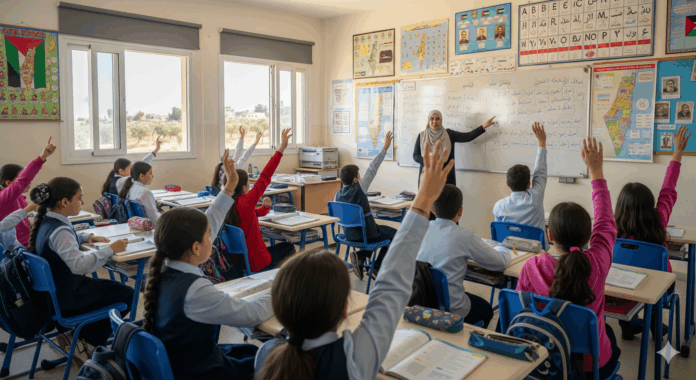
982 PALABRAS – La tan esperada educación para la paz de la Autoridad Palestina
El próximo debate en la ONU pretende promover lo que se conoce ampliamente como la solución de dos Estados para el conflicto israelí-palestino. En este marco, se espera que la Autoridad Palestina (AP) sea reconocida formalmente como Estado por la mayoría de los países occidentales. De esta manera, la comunidad internacional aspira a reactivar el proceso de paz iniciado con los Acuerdos de Oslo, firmados por ambas partes en 1993 y 1995, y posteriormente estancado debido a que la brecha entre sus respectivas posiciones sigue siendo demasiado amplia como para ser superada.
La resolución pacífica de la guerra es un objetivo mundial y se encuentra en el núcleo central de los Acuerdos de Oslo, en los que se basa la existencia de la AP. El esfuerzo continuo por elevar su estatus de entidad autónoma a Estado requiere, por lo tanto, una aclaración sobre su grado de compromiso con la idea de la paz con Israel. De lo contrario, cualquier medida de este tipo despertaría las sospechas de Israel, provocaría contraataques y aumentaría la inestabilidad en la región. Se intentó responder a esta pregunta en un estudio en el que examiné las referencias al conflicto en más de doscientos libros de texto y manuales docentes de la Autoridad Palestina (AP) de las últimas ediciones. Los criterios de análisis utilizados fueron las directrices de la UNESCO.
La decisión de utilizar este material de referencia en particular se basó en la premisa de que los libros de texto son el indicador más fiable de los ideales que una sociedad aspira a inculcar en la mente de las generaciones más jóvenes. Si estos libros son publicados exclusivamente por el gobierno, como es el caso de la AP, también representan mejor las convicciones más profundas de dicho gobierno en lo que respecta a sus aspiraciones políticas. Dicho de forma más clara: la actitud de la AP hacia la idea de la paz con Israel se refleja mejor en sus libros de texto.
Los Acuerdos de Oslo y el consiguiente establecimiento de la Autoridad Palestina existen en los libros. Lo más interesante es una carta que aparece allí, enviada por Yasser Arafat, presidente de la Organización para la Liberación de Palestina (OLP), a Yitzhak Rabin, primer ministro de Israel, antes de la firma de la Declaración de Principios (el acuerdo inicial firmado dentro del proceso de Oslo) en septiembre de 1993. En ella, la OLP reconoció el derecho del Estado de Israel a vivir en paz y con nueva seguridad, aceptó las resoluciones 242 y 338 del Consejo de Seguridad de la ONU, se comprometió con el proceso de paz en Oriente Medio y con la resolución pacífica del conflicto entre ambas partes, declaró que todas las cuestiones fundamentales relacionadas con la situación permanente se resolverían mediante negociaciones, condenó el uso del terrorismo, así como otras acciones violentas, confirmó que los artículos del Pacto Nacional Palestino que negaban el derecho de Israel a existir ya no eran válidos y se comprometió a presentar las enmiendas necesarias a dicho Pacto a la Asamblea Nacional Palestina para su aprobación oficial.
Este texto podría haber servido como una base sólida para la educación para la paz.
Lamentablemente, no es así. Todo el currículo de la AP está enfocado en la guerra. El lema es la liberación de la ocupación, y la lucha por la liberación es violenta y está basada en el terrorismo, en clara contradicción con el compromiso con la no violencia expresado en la carta de Arafat.
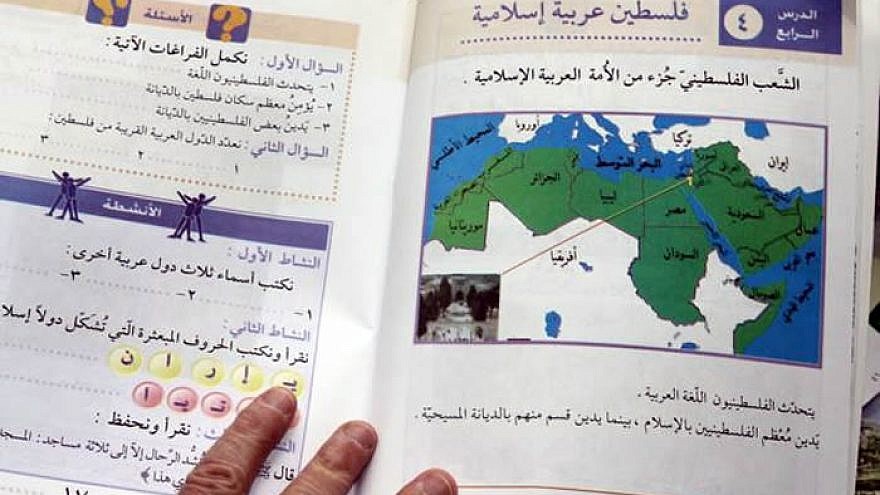
Además, la liberación de Palestina abarca la totalidad del país, contrariamente al reconocimiento de Arafat del derecho de Israel a existir. Las ciudades dentro de Israel, dentro de sus fronteras anteriores a 1967, como Jaffa y Acre, deben ser liberadas específicamente. De hecho, los estudiantes palestinos aprenden en la escuela que Palestina es el único estado soberano del país y que la Palestina soberana ha estado bajo ocupación sionista desde 1948. Por consiguiente, rara vez se menciona a Israel por su nombre, y más bien se le llama “la ocupación sionista”. Huelga decir que Israel, dentro de su territorio anterior a 1967, no aparece en ningún mapa.
También cabe señalar que los 7 millones de ciudadanos judíos de Israel se presentan como colonialistas extranjeros y las ciudades que construyeron, incluida Tel Aviv, no aparecen en el mapa. Se niega su historia en el país desde la antigüedad, así como la existencia de sus lugares sagrados, incluido el Muro de las Lamentaciones en Jerusalén, último vestigio de su antiguo templo. El hebreo, la lengua nacional judía, se borra —literalmente— de una moneda de la época del Mandato Británico anterior a 1948, reproducida en un libro de texto de matemáticas.
Note to Canadian PM Carney: End the Diplomatic Virtue Signaling & Focus on the Real Problem
The Canadian government plans to join France and the UK in recognizing a “State of Palestine” at the UN General Assembly later this month. The declaration – little more than diplomatic virtue signaling – does nothing to advance peace in the Middle East. Meanwhile. Canada continues to support the single greatest obstacle to that peace – the indoctrination of Palestinian children in UN and Palestinian Authority schools and camps.
First, a short history lesson for context.
The much vaunted “two-state solution” is nothing new. It was implemented shortly after World War One when the British partitioned “Palestine”, handing over all the land east of the Jordan River – approximately three-quarters of the region – to the Arabs and making Abdullah bin Hussein Emir as a reward for his family’s help defeating the Ottomans. The British also created Iraq for the same reason, installing Abdullah’s brother Faisal as Emir.
Although residents of the Hashemite Kingdom of Jordan (Abdullah and his brother were members of the Hashemite clan from the Arabian Peninsula) never really referred to themselves as Palestinians, they are as Palestinian as the Arabs who made their home west of the Jordan River. Even the Jews called themselves Palestinian prior to Israel becoming independent in 1948. “Palestinian” was, and remains, a political rather than an ethnic or national term.
Of course, none of this means that an independent Arab state in Gaza and the West Bank can never be part of a future negotiated agreement.
It has become fashionable to blame Israel’s current Prime Minister for the lack of progress toward such an agreement, but Benjamin Netanyahu’s opinion on the subject could not be less relevant. Arab leaders themselves rejected such a solution on four occasions since the original post-World War One partition, including as recently as 2008, and they launched three wars against Israel from Gaza after being given control of the territory in 2005.
How much more evidence does the world need?
A key reason for this persistent rejectionism can be traced to the Oslo Accords, when leaders of the Arab community in situ were forcibly replaced by Yassir Arafat and his PLO cronies at the behest of the international community and with the acquiescence of Israel. Since the year 2000 children in Palestinian schools and summer camps have been taught to disdain the idea of a Jewish State alongside an Arab one in the remaining 25 percent of Palestine. They receive military training and are indoctrinated into what has aptly been characterized as a death cult that worships violence, reveres martyrdom and seeks the destruction of Israel and the death of Jews.
What is particularly disturbing is that these schools and camps are funded by countries like Canada, that naively hand over hundreds of millions of dollars every year to the United Nations Relief and Works Agency for Palestine Refugees – UNRWA for short – with virtually no accountability for how the money is spent.
Originally intended to deliver basic services such as health care, food and education for refugees from the 1948-49 war, UNRWA has morphed into a multi-billion-dollar cash cow that perpetuates Palestinian dependence while bankrolling shady activities such as the “education” and training described above.
Last year Canadians contributed close to USD 40 million to UNRWA (according to the organization’s own report published onlin), despite having paused payments in January in response to revelations of UNRWA personal participating in the October 7, 2023, attacks on Israel. Those payments were resumed in April of last year and do not include direct grants to the Palestinian Authority or grants to NGOs operating in the West Bank and Gaza. The Canadian government contributes tens of millions of dollars a year to various Islamic charities, and PM Mark Carney recently pledged a further $10 million to the PA to finance its “reform” and help it prepare to assume the role of national government. Exactly what reforms Canadians are paying for is a mystery, as is how to recover the money if they are not achieved.
This is not simply an Israel – or Jewish – issue. What is being perpetrated in UNRWA and PA-run schools and youth camps is child abuse on a colossal scale – a humanitarian crime in which Canadian taxpayers are unwittingly complicit.
It is also a major contributor to the violence gripping the region.
For years the Nahum Bedein Center for Near East Policy Research has been documenting this abuse and has joined with affected parents in calling on UNRWA contributors to end their funding or, at least, make their continued support contingent on genuine, verifiable reform of the UN body and the “education” it provides. Sadly, with few exceptions, these pleas have fallen on deaf ears.
The world can no longer afford to turn a blind eye to this cancer. The young men who committed the frenzied attacks of October 7 – and took perverse pleasure in subjecting their victims to the most sickening violence imaginable – did not just appear from nowhere. They were – and are – the product of the macabre teaching being carried out in their schools and camps. They are the child soldiers the IDF is having to confront in Gaza, and their malevolent influence is now spreading beyond the region.
Instead of making a “two-state solution” the cornerstone of its Middle East policy, Canada can lead the world by highlighting this systematic theft of Palestinian children’s innocence and leveraging its aid and reputation as a staunch defender of human rights to press for its end. In so doing, Canada would be making a far greater contribution to peace than the meaningless proclamations Mr. Carney and his colleagues are currently proposing.
New 420-bed rehab facility in Ramla to aid Israel’s injured soldiers
The facility, led by Israel’s leading disability and rehabilitation network, will provide inpatient care, trauma therapy, hydrotherapy, adaptive sports, advanced imaging, and family support for soldiers and civilians wounded in the Gaza conflict.
“Every day brings dozens of new wounded soldiers — not only with broken bones, but with broken souls,” said ALEH CEO Yehuda Marmorstein. “Rehabilitation is not just about walking again. It is about living again.”
The US$81 million project, still in its early excavation phase, has raised US$14 million so far. The government is considering covering 40% of the cost, with additional support expected from the National Insurance Institute and international donors. Completion is expected in three to four years, a timeline many wounded soldiers fear may be too long. “The first months are crucial,” Marmorstein warned. “A lost year can mean permanent disability.”
Construction is expected to take around 2.5 years.
Until now, Aleh, a nonprofit, was known for providing specialised care for around 260 children and young adults with complex physical and cognitive disabilities. Many of the children at the Bnei Brak campus require ventilators and 24-hour medical support. The centre, which opened in 2019, offered advanced therapies, education, and medical care tailored to their unique needs. However, the site was damaged by an Iranian missile in June. Aleh is repairing the building and expects to resume its activities there in two months.
Nearly two years after the Hamas assault of October 7, 2023 — the deadliest day in Israel’s history — the war shows no sign of ending. Thousands of wounded soldiers and civilians are struggling with a rehabilitation system stretched beyond its limits. According to the IDF, 903 soldiers have been killed and nearly 7,000 wounded since the start of the war. Seven remain hospitalised in light condition, 137 in moderate, and ten in severe.
For many, the injuries are life-altering. “I just want to walk to my parents’ kitchen without crutches,” said Noam, a 23-year-old reservist who lost his leg in Gaza. He has undergone six surgeries and is still waiting for a prosthetic fitting. Yael, a mother of two from Ashdod injured in a rocket attack, said quietly, “My kids need me back, but I need help first.”
Even before the war, Israel’s rehabilitation system lagged behind international standards. The OECD average for rehab beds is 0.5 per 1,000 people; Israel had only 0.3, leaving a shortfall of roughly 500 beds and 100 doctors. Families report patients being transferred between multiple hospitals in search of care. Mental health support is similarly inadequate. Tens of thousands of survivors are expected to suffer post-traumatic stress, yet Israel has one of the lowest ratios of child psychiatrists in the developed world.
“My son is alive, but he’s locked inside himself,” one mother said. “We can’t reach him, and there’s no one to help.”
When finished, ALEH Zahav will include long-term care units, residential facilities for families, protected spaces, a synagogue, and a research incubator. The centre will stand next to Magen David Adom’s underground blood bank as part of a broader emergency response network.
Ramla Mayor Michael Vidal called the project “a national necessity.” “Rehabilitation will be one of Israel’s greatest challenges in the years ahead,” he said. “ALEH Zahav will play a vital role in healing our soldiers and civilians.”
For families of the wounded, the centre is a symbol of hope.
“My son gave everything for this country,” one wounded soldier’s father said. “Rehabilitation is the least we can give back.”
How Qatar’s Policy Endangers U.S. Interests in the Middle East
The Israeli strike on a Hamas leadership gathering in Qatar’s capital, Doha, has drawn international attention to the close ties between Qatar and Hamas, and the threat Qatar poses to American interests in the Middle East.
Qatar presents itself as a U.S. ally in the fight against terrorism, distancing itself from Hamas by claiming it hosts the group’s office at the U.S.’s request to maintain open communication for promoting peace in the region.
Qatar’s policy toward the U.S. is based on strategic deception. The country does not classify Hamas as a terrorist organization, and its relationship with Hamas goes beyond simple communication. Qatar has demonstrated full political support for Hamas, providing substantial aid to the Gaza Strip – nearly $2 billion, some of which was in cash. This aid has been administered by Hamas and has contributed to strengthening its military wing in preparation for the October 7 attack.
Hamas leadership viewed Qatar as a close and preferred ally over Egypt, thanks to Qatar’s mobilization of its institutions to advance Palestinian goals.
Qatar’s financial support continued even as Hamas leadership publicly reiterated its coordination with the Shiite axis – Iran and its proxies in the Middle East – for the “Promise of the Hereafter Battle” aimed at destroying the State of Israel and reshaping the Middle East.
Hamas’s plan, discussed in closed rooms and publicly echoed on Qatar’s Al-Jazeera channel, included overthrowing pro-Western regimes in the Middle East and establishing the “Great Islamic Revolution,” meaning a caliphate – an Islamic state – on the ruins of Israel and Arab regimes.
The Qatari Committee for the Reconstruction of Gaza operated an office in the Gaza Strip, whose leaders frequently met with Hamas leader Yahya Sinwar and other senior Hamas figures. Beyond Qatari media reports, they had direct access to information about Hamas’s goals and plans in the Middle East as part of the “Promise of the Hereafter Battle.”
While Qatar strengthens economic ties with the U.S., its policy of supporting Hamas, including after the October 7 attack, has advanced moves that could have led to the creation of an Islamic Middle East, resembling the Islamic State of ISIS, hostile to the U.S. and the West.
Strengthening Strategic Relations Between the U.S. and Qatar
In May 2025, U.S. President Donald Trump concluded a successful visit to the Arabian Peninsula, including the Emirate of Qatar (May 14-15). At the end of the visit, Trump announced a series of economic achievements, centered around the signing of a mutual trade agreement worth $1.2 trillion, along with economic deals totaling $243.5 billion. These include, among other things, Qatar’s purchase of Boeing aircraft and General Electric aircraft engines for Qatar Airways.1
During a formal dinner with Qatar’s leader, Trump spoke to reporters, commending Qatar for its positive diplomatic efforts. He highlighted Qatar’s role in pressuring Hamas to release an Israeli-American hostage who had been kidnapped on October 7, 2023. Trump also noted Qatar’s engagement with Iran to further a nuclear agreement with the United States.2
In an official statement on May 16, 2025, following President Trump’s visit, the Qatari Ministry of Foreign Affairs noted that “the State of Qatar and the United States of America work closely to address global and regional challenges.”
During the visit, President Trump recognized Qatar’s continued efforts in supporting regional peace and praised its contributions as a frontline partner in global counterterrorism, violent extremism and a critical contributor to crisis diplomacy. The meeting addressed ongoing regional developments in Gaza, Syria, and Lebanon. According to Qatar’s Ministry of Foreign Affairs, “President Trump recognized Qatar’s continued efforts in supporting regional peace and praised its contributions as a frontline partner in global counterterrorism, violent extremism and a critical contributor to crisis diplomacy.”3
Qatar: The Association with Hamas Aims to Foster Peace in the Region
In an interview with Tucker Carlson, broadcast on March 7, 2025, Qatar’s Prime Minister, Mohammed bin Abdulrahman Al Thani, stated that peace is a fundamental principle for Qatar, and therefore, the country works to promote peace in the region and for its allies. According to him, “peace has enemies,” and Qatar’s adversaries harm the region and its allies, including the United States.4
Al Thani emphasized that Qatar is a U.S. ally, as evidenced by hosting a U.S. Air Force base, assisting in the evacuation of American citizens from Afghanistan, and facilitating the release of American hostages worldwide. Based on these contributions, he argued that criticism of Qatar effectively harms the U.S. and its interests.
He explained that the Hamas office in Doha, Qatar’s capital, was established following a U.S. request for Qatar to open communication channels with Hamas, similar to those maintained with the Afghan Taliban. According to him, the presence of the Hamas office in Qatar is intended to promote peace, as demonstrated multiple times through Qatar’s mediation between Israel and Hamas since 2014, following rounds of conflict between the two sides.
“If you have a presence of someone in your country and you are engaging and talking, it doesn’t mean that you are endorsing his ideas,” said Al Thani.
Here are excerpts from the interview:
Tucker Carlson:
So, my sense is that part of the criticism and the confusion from Americans, well, I think two causes. One, you have a Hamas office here. Hamas has been designated, I think, repeatedly by the U.S. government, certainly by the Congress, as a terror organization, and people say, well, how could you have a Hamas office here? What is that?
Qatar’s Prime Minister:
We have to go back to the root of this office, like why it’s here in the first place. And Hamas office, when it was opened here in the first place, it was opened with full transparency and full consultation and actually even request from the U.S. And…
Tucker Carlson:
The U.S. asked you to put Hamas here?
Qatar’s Prime Minister:
They are actually, they have asked us to open the channels with them and to have an established communication channel with the same case what was applied to Taliban as well. And look, at the end of the day, if you have a presence of someone in your country and you are engaging and talking, it doesn’t mean that you are endorsing his ideas. It doesn’t mean that you are supporting him. The purpose of this office was to facilitate peace, to stabilize the region and to make sure that always it’s serving the purpose. And you can go through even everything that, all the events that happened in the recent 10 years since the office was officially opened here in Doha. How many peace deals have been brokered from that office through that channel? Many of them. [In] 2014 was the discussion and the negotiations was initiated here, and ended in Egypt in 2018, 2020 and [20]21 with all those escalations and many of escalations that we avoided to prevent a war. There are many, plenty of them. You will lose count. Then after 7th of October [2023], the first hostage deal that released the hostages, the women and children. was 109, and the foreigners, was 109 hostages. November 23 [2023] happened through that office. Second hostage deal, which we are going through right now, it was produced out of this office. So the office is a communication channel. It doesn’t make me, you know, feeling shy that I speak with someone whom I have a disagreement with. President Trump spoke with North Korea. He didn’t shy out. He met with him, he engaged with him. He wants to put an end to the conflict. He wants to make a deal with him. He’s a deal maker, and this country basically is brokering deals.
Tucker Carlson:
Initially at the request of the U.S. government?
Qatar’s Prime Minister:
Yes, and it continued like everything that we did looked [intelligible]. What I’m confident? That… throughout the years that I’ve been working under the leadership of the Amir. We are sure that every step we are taking, we are very transparent, coordinating with the U.S., and making sure that we are doing the right thing. So I have nothing wrong that I did that I am shying away from. I know that we have a lot of attacks, and unfortunately, we have attacks from the U.S. legislation like from the congress many times that although we did it at the request of the government yet. The Amir always tell me that if we are able to save a single life, it’s worth everything. And I’ll tell you something, we’ve been under a significant attack in the last 15 months during this war in Gaza. Unbelievable, no one would handle such an attack. And we work tirelessly on achieving this deal. And the moment we went out to announce that deal being achieved, and we see the celebration in the streets, whether it’s in Gaza or in Israel. That moment makes us forget everything.
Tucker Carlson:
You’ve been attacked by the U.S. Congress. The core question for me is, if Qatari is an enemy of the United States, why is our air base here? Have there been calls to remove the air base?
Qatar’s Prime Minister:
Well, there are like some voices who unfortunately very much misinformed that this is very critical for the U.S., for the U.S. security to be here in this region. And you know, actually, the base itself, when it’s moved, the first place it was moved after September 11th [2001] to Doha. And it was a very risky decision for any country to take it, and we took it. We took it because of the friendship that we have with the U.S., because of the partnership that we are committing ourselves together with the U.S., and it turned out to be like the most important U.S. base outside the United States. And basically, it served the security of the United States, but also it served the stability of this region.
Hamas Documents Reveal Strategic Alliance with Qatar
Documents seized by the IDF in the Gaza Strip contradict Al Thani’s statements, who downplayed the significance of Qatar’s ties with Hamas, describing them as merely hosting the Hamas office and holding talks with its senior officials to promote peace, without adopting or supporting Hamas’s positions.
Correspondence from mid-2022 between Hamas leader Ismail Haniyeh and Gaza-based Sinwar, along with a document detailing a meeting between Haniyeh and the commander of Iran’s Al-Quds Force, reveals that senior Hamas officials:
- Maintained a very close relationship with Qatar’s leadership, evidenced by secret meetings and direct financial aid to Hamas.
- Designated Qatar a central role in politically and financially supporting the Palestinian cause.
- Believed Egypt, backed by the U.S. and Israel, sought a leading role in Gaza’s reconstruction to demonstrate its political relevance to the U.S. administration, control aid funds, and influence Hamas, at Qatar’s expense.
- Acknowledged Egypt’s importance due to its shared border but clearly preferred Qatar to lead diplomatic efforts for the Palestinians, even granting Qatar a diplomatic achievement in 2020 over Egypt by securing a ceasefire after clashes between Hamas and Israel.
- Sought to continue Qatar’s direct cash aid transfers (via “suitcases of money”) to Gaza, lobbied Qatari authorities to avoid channeling aid through the Palestinian Authority or Egypt, and viewed the United Nations as the best alternative for managing aid if cash transfers were not feasible.
These findings highlight a strategic alliance between Hamas and Qatar, contradicting Qatar’s claim of merely hosting Hamas’s office for peace mediation.
Strong Ties Between the Leadership of Qatar and Hamas
On May 23, 2021, Haniyeh sent a “most urgent” letter to Sinwar to update him on the content of discussions held with the reigning Emir of Qatar, Sheikh Tamim bin Hamad Al Thani. Below is the translation of the letter’s content:5
Firstly: Today, we held a meeting with His Excellency the Emir [Sheikh Tamim bin Hamad Al Thani]. It was a good and heartfelt meeting. I conveyed your greetings and congratulations on the victory [in the military campaign of Hamas against Israel in May 2021, known as “Sword of Jerusalem” by Hamas and “Guardian of the Walls” by Israel], in which they [Qatar] contributed to strengthening the steadfastness of our people in Gaza, to the reconstruction [of the Gaza Strip], and through their diplomatic efforts.
In a private meeting between me and him [the Emir of Qatar, Sheikh Tamim bin Hamad Al Thani] after the delegation left, we discussed specific matters, and I reassured him regarding the situation of our brothers [in Hamas] and our resistance [Al-Qassam Brigades]. He was the one who initiated a question about the condition of the brothers [Hamas] in Gaza, and there are other points I will write about later. However, the urgent matter [to update you on] is that I agreed with him to hold a very private meeting the day after tomorrow, Tuesday, God willing, at his residence, away from the public eye. Brother Mohammed Nasser [a member of Hamas’s political bureau] will be with me, and we will discuss with him the necessary political matters, the reconstruction [of the Gaza Strip after the war], and discreet [financial] support, and he is ready for this.
Therefore, in light of the importance of adding blessing and momentum [to this initiative with the Emir of Qatar], I request that you write a letter addressed to me, focusing on the campaign [the military campaign against Israel in May 2021], Qatar’s role, and your perception of that role [of Qatar], your diligence in fulfilling it [the Qatari role], your urgent needs, and in it [the letter], dedicate the victory to His Excellency [the Emir of Qatar], and strengthen the image and role of the movement’s leader [Hamas leader] in the campaign [the military campaign against Israel in May 2021], and on other issues, to block attempts by an alternative party [likely related to the Palestinian Authority] trying to reach the Emir [of Qatar] and other figures [in Qatar’s leadership]. I request that the letter reach me by tomorrow at the latest. He [the Emir of Qatar], who is highly esteemed, has agreed in principle to provide discreet support but does not want anyone in the world to know about it.
Secondly: The Visit to Egypt: After placing my trust in Allah, I decided to accept their invitation regardless of what they might do. Yesterday, I explained to Brother Abu Jamal the circumstances surrounding the visit and the necessity of coordinating matters with them while they are with us in Gaza. This is because if they prevent my departure from Cairo again, it will have internal and external repercussions. I see the importance of your personal presence, along with a number of brothers, in Cairo to facilitate a meeting with you after the war and to arrange several internal matters and policies, especially given the presence of some brothers from the [West] Bank and abroad.
Additionally, it is essential that at least two brothers from Gaza participate in our tour of the countries, as this will have a significant impact on the nations and their people, given that they are coming from the land of the battle.
Thirdly: Main topics requiring study, formulation, and input from the brothers in Gaza to be prepared for our upcoming meetings with the full presence of all members of the leadership from Gaza and abroad:
- Consolidating the Victory: Policies and procedures required to consolidate the victory.
- Vision and plan for advancing the liberation project in light of the battle’s outcomes, which revealed the enemy’s fragility and the feasibility of liberating our blessed land, and the role of our people inside and outside, as well as the nation.
- The leadership positioning of the Hamas movement after the war and victory in the Palestinian national project.
- Evaluation of the war and the required needs.
Fourth: The Funds
So far, approximately $30 million out of the $75 million needed to support the movement [Hamas] in Gaza and to be at the disposal of the leadership [of Hamas] have been raised, as detailed below:
$13 million from Iran.
$11 million from the Father Emir [Sheikh Hamad bin Khalifa Al Thani]. When I visited him alone at his residence and spoke with him, I mentioned his role and support for Gaza, conveyed your blessings to him, and the blessings of the mujahideen. He, who is highly esteemed, sent this amount, which was transferred to Gaza through the mechanism [used for transferring funds].
$5 million in donations from the public.
There is good support in several countries and arenas [regional areas], especially in Kuwait, which is highly esteemed. I will continue to follow up on this matter, God willing.
Hamas’s Terror Chief in Judea and Samaria Attended Meetings with the Qatari Emir
In the aforementioned meeting with the Emir of Qatar on May 23, 2021, Haniyeh was accompanied by Saleh al-Arouri.6 Beyond his role as deputy head of Hamas’s political bureau, al-Arouri served as the overseer of Hamas’s military wing activities in Judea and Samaria. He was responsible for a long series of terrorist attacks against Israeli targets and played a key role in formulating the attack plan against Israel in coordination with the countries and organizations part of the “Unity of Fronts.” Al-Arouri also joined Haniyeh in previous meetings with the Qatari Emir, including on May 15, 2021,7 and December 16, 2019.8 9
Qatari Financial Aid to Gaza Supports Hamas’s Objectives
Haniyeh’s letter highlights the close relationship between him and the Emir of Qatar, who also had a secret one-on-one meeting with him. During this meeting, the Emir promised to provide financial aid discreetly, in addition to his commitment to fund Gaza’s reconstruction costs following the May 2021 conflict. This promise of confidential financial assistance to Hamas’s leader suggests direct support for Hamas.
Haniyeh stated that he obtained $11 million in financial aid from the Father Emir after delivering messages of goodwill from Sinwar and the mujahideen in Gaza. These remarks suggest that the Qatari leadership recognizes the possible connection between this financial aid and its potential use to support Hamas’s military wing, the Al-Qassam Brigades.
Following a meeting with Haniyeh, the Emir of Qatar announced an allocation of $500 million in economic aid for the reconstruction of the Gaza Strip after the war.10 The official statement specified that this financial aid is primarily intended for rebuilding health, education, and electricity facilities, as well as homes that were damaged during the conflict.
On May 17, 2021, the Qatari newspaper Al-Raya reported that Ambassador Mohammed Al-Emadi, head of the Qatari Committee for the Reconstruction of Gaza, confirmed that financial aid had been transferred to the families of 150 martyrs and to 800 homeowners whose properties were destroyed or damaged in the war with Israel.11
Since Israel targeted military objectives during the conflict, it is likely that the Qatari aid was directed to the families of Hamas members and other militants who were killed or who lost their homes, as well as to the reconstruction of infrastructure belonging to Palestinian terrorist organizations.
Qatar’s favorable stance on Hamas stems from its refusal to label Hamas as a terrorist organization, unlike Israel and other nations.12
Hamas Placed Supreme Importance on Qatari Financial Aid
Sinwar’s response letter to Haniyeh, dated May 30, 2021, highlights the critical significance Hamas attributed to its relationship with Qatar. Hamas regarded Qatar as a strategic ally that provided essential diplomatic and financial support to further its objectives.
Excerpts from Sinwar’s letter:13
Allah, the Exalted, has exposed the true nature of this entity and its supporters – a boastful, arrogant entity, proud of a mythical strength whose image has collapsed in this blessed confrontation.
Today, we and our allies, especially our brothers in Qatar, and to a lesser extent Turkey, are required to seize the opportunity that has been presented to achieve the greatest accomplishments, which include:
1. Strengthening the diplomacy of friends and allies: It has become clear to everyone that there is a ferocious, deadly tiger named Hamas and the Al-Qassam Brigades. When it becomes angry and decides to strike, it possesses the boldness to make that decision and the readiness to go further than people can imagine, prepared to sacrifice and knowledgeable about the components of the enemy, as well as the dynamics and equations of the region and the world. It has become evident to all that this tiger cannot be tamed by force, wars, or conspiracies. Everyone now realizes that it must be contained through entities that have influence over it. There is no doubt that the world recognizes Qatar as one of the countries with significant influence over Hamas, as expressed clearly and explicitly by U.S. Secretary of State [Anthony] Blinken, German Chancellor [Angela ] Merkel, and others. Their statements also mentioned Egypt as a key player in dealing with Hamas. The Egyptian regime understands this reality and recognizes that its ability to engage with Hamas and manage its rhythm meaning influencing Hamas] serves its diplomacy and grants it legitimacy, particularly in the eyes of the U.S. administration. The world has noticed the frequency of Biden and Blinken’s calls, Blinken’s visit to Cairo, and the inclusion of Egypt in world leaders’ statements as a key address for dealing with Hamas. The Egyptians, eager to play this role with precision and effectiveness, were in Gaza on the morning of Friday, just hours after the ceasefire, returned on Sunday, then again on Friday, and are now arranging for a visit by the minister and a large delegation to Gaza on Monday. This follows [Abd Al-Fattah Al-]Sisi’s statements about a $500 million grant for Gaza. They are keen to be present and to appear as the ones capable of managing Hamas’s rhythm. This serves the regime, granting it legitimacy with the Americans, enhancing its diplomacy, providing financial benefits, and positioning it as a gateway for aid and reconstruction grants. The Americans and the occupation likely prefer Egypt to play this role, as they are aware of its stance toward us and its eagerness to minimize our benefits to the lowest degree possible. The prevention of Ambassador [Mohammed ] Al-Emadi [the Chairman of Qatar’s Gaza Reconstruction Committee] from reaching Gaza may serve to bolster Egypt’s role at the expense of Qatar’s.
2. Regarding reconstruction, we and our friends must ensure that the reconstruction process is not exclusively controlled by the Palestinian Authority or the Egyptians, and that multiple channels are utilized. It is essential that the Qataris ensure they personally oversee the grant allocated by His Highness Emir Tamim through the Qatari Committee. As you know, the committee’s method of operation is reliable and transparent, ensuring that no party can question the entities receiving funds from them. It is also necessary to communicate with other donor entities and persuade them to directly supervise the expenditure of their grants like Kuwait, and let them have a committee similar to the Qatari Committee. It is equally important to urgently request that the Turks provide their (humanitarian) grant, to be implemented in the [Gaza] Strip by a Turkish committee with transparency, precision, and assurance that not a single penny reaches Hamas, the Al-Qassam [Brigades], or other factions. In this regard, repeated statements from the occupation’s leadership indicate their intent to redirect the (ongoing) Qatari grant through the Palestinian Authority to bolster moderates and block terrorists, as they claim. This must be rejected by the Qataris, who should insist on maintaining the previous method and accept no alternative. This method has proven that not a single penny goes to Hamas or the Al-Qassam [Brigades], reaching instead the poor and needy. We possess the leverage to pressure the occupation to revert to the previous method. Here, Qatari diplomacy can act effectively to contain the situation and prevent an escalation.
We believe that, despite the necessity of the Egyptian role due to geographical considerations, the Qataris are more sincere, devoted, generous, and loyal to us, and there is no comparison between the two. Therefore, we must strive to strengthen Qatari diplomacy and ncendiary balloons] in August 2020, when the Egyptians came and we made them leave empty-handed, while the Qataris came and we gave them the opportunity to reap the diplomatic rewards.
3. The current discourse is predominantly focused on reconstruction and the economy, with little in-depth discussion about the reasons behind the recent escalation. This is what Qatari diplomacy, in particular, and others should focus on. These issues include the matter of the holy sites, particularly Al-Aqsa Mosque, the displacement from homes, the Judaization of the city, ethnic cleansing, and apartheid in areas like Sheikh Jarrah, Silwan, Al-Bustan, and others. Additionally, the issues of settlement expansion, the practices of settlers and the occupation army in the West Bank, the illegal administrative detention policies, the treatment of prisoners, the rights of Arab citizens in the occupied interior [Israel], discriminatory policies against them, the blockade of Gaza, reconstruction, and economic revitalization. There must be a deep and focused diplomatic effort, led by the Qataris, to address the root of the problem and warn against adding fuel to the embers in the belief that it conceals the fire, as it will soon ignite. The international diplomatic campaign must emphasize that the occupation’s violations in these areas blatantly contravene international law and resolutions. Your visits to various countries could be an opportunity to push in this direction (whether Arab or non-Arab countries). It is clear that the international environment is conducive to this, and the matter only requires further engagement and coordination (with the Turks, Kuwaitis, Russians). For those you cannot visit, you may be able to speak with them by phone or communicate in writing.
4. There is no doubt that the victory achieved represents a unique opportunity to reorganize the Palestinian house if the Palestinian Authority’s leadership is sincere in its intentions. However, as you know, they cling to illusions, and Blinken, during his recent visit, sold them many of these illusions that will not benefit them in any way, yet they will bet on time. Our brothers in the [West] Bank office, and all of us, must exert significant effort and incitement to ignite the [West] Bank. We must take utmost care not to return to the cycle of disputes and bickering, as the atmosphere created by this round, with the masses rallying around the option of resistance, must not be disrupted by any quarrels or disputes. At the same time, we must remain committed to organizing the Palestinian house on sound foundations, starting with the [Palestinian] National Council and rejecting patchwork solutions. Our Qatari brothers can play a role in this matter. We have begun working with the factions that will coordinate with their leadership abroad to organize a collective effort in this regard. We will send you the minutes of a meeting we held (Hamas, Jihad, PFLP, DFLP, the Initiative, and the Brigades), which was excellent and can serve as a foundation for organizing a national campaign to compel the Authority to comply or bypass it.
5. There is also no doubt that global public opinion and the stance of world leaders and nations are ready and primed for political action to achieve a solution. I believe that if the Palestinian house is put in order, we can indirectly be part of this solution without any obligations on our part to recognize [Israel] or adhere to any of the Quartet’s conditions or any other commitments. We would only agree to a truce for several years in exchange for the occupation’s withdrawal from the West Bank and East Jerusalem, the dismantling of settlements, the release of prisoners, and the lifting of the blockade on Gaza. This is an extremely powerful card that Qatari diplomacy can maneuver with and use effectively through a campaign of engagement with the U.S. administration, European countries, Russia, China, and others.
I believe it is essential to arrange a quick visit for you to Russia to engage with the Russians and push them to take action, whether in terms of organizing the Palestinian house or participating in mobilizing international will to compel the occupation to respect international laws and resolutions regarding the aforementioned issues. The same applies to Turkey, other Arab and Islamic countries, and any foreign countries that can be engaged.
Before you, dear brother, lies a window of boundless opportunities, and we must hasten to seize all its prospects. Do not waste these opportunities waiting for a visit to Egypt, as it is the least important.
In a seized document detailing the content of discussions between senior Hamas officials and Ismail Qaani, the commander of Iran’s Al-Quds Force, held in Beirut on June 27, 2021, it was noted that Ezzat al-Rishq, a member of Hamas’s political bureau, stated during the meeting: “Efforts are being made to block Qatar’s role and prevent the transfer of Qatari grant funds [to the Gaza Strip], while attempting to channel them through the UN. Efforts are needed to prevent the movement [Hamas] from being subjected to extortion.”14
This statement by al-Rishq further illustrates Hamas’s clear preference for Qatar as the direct channel for aid to the Gaza Strip, which in practice meant direct support to Hamas.
Qatari Aid Funds Were Used to Enhance the Military Capabilities of Hamas
Economist Eyal Ofer, an expert on Hamas’s economy, discussed the importance of Qatari cash aid in U.S. dollars to the Gaza Strip from 2018 to 2021 for the advancement of Hamas’s military wing. In an interview with Maariv on September 16, 2024, Ofer stated:15
The Qataris began providing support to Gaza on a small scale more than a dozen years ago, gradually increasing their assistance over time. A significant increase occurred in 2017-2018 when the Palestinian Authority reduced the salaries of its employees in Gaza. The Qatari government stepped in to fill this financial gap. Since it was evident that these funds would primarily benefit Hamas personnel in the Gaza administration, approvals from the United States were necessary to ensure the money wasn’t being used to finance terrorism.
However, global banks were hesitant to process this money due to concerns about its potential links to terrorist activities. As a result, the Israeli government allowed the Qataris to deliver their support to Gaza in the form of suitcases filled with cash.
Additionally, another part of the Qatari aid involved purchasing fuel in Egypt, which was then sent to Gaza at no charge. This fuel was used to operate power plants for electricity generation and also provided an extra revenue source for Hamas, which sold the fuel at gas stations throughout the Gaza Strip.
These funds were essential for economic activity in Gaza. When individuals received their salaries, they purchased goods, which stimulated the local economy and allowed Gazans to import more products from Israel, including luxury items. Hamas primarily financed itself through taxes on all imports entering via Kerem Shalom and Rafah. They collected customs duties and imposed taxes on merchants in Gaza, which formed a significant portion of their budget.
To cover illegal smuggling expenses through Rafah – such as bribing Egyptian officials or paying smugglers – Hamas required cash in dollars. This cash mainly entered the Strip through the Qatari envoy, who distributed it to welfare recipients. These recipients then sold the dollars to Hamas’s money changers, who exchanged them for shekels. This process enabled Hamas to acquire the dollars needed to finance its smuggling operations.
In summary, Hamas sourced its funding through import taxes and the use of cash dollars, both of which were crucial for its economic and military activities.
The Relationship Between the Qatari Committee for the Reconstruction of Gaza and Hamas Leadership
The close relationship between Qatar and Hamas is evident through a series of frequent meetings held between 2020 and 2021. These meetings involved Sinwar and Ambassador Mohammed Al-Emadi, who heads the Qatari Committee for the Reconstruction of Gaza. Notable meetings took place on February 21, 2020;16 October 20, 2020;202017 February 1, 2021;18 July 12, 2021;19 and October 17, 2021,20 all held at Al-Emadi’s office in Gaza City. Rawhi Mushtaha, who was the head of the Hamas government in the Gaza Strip at that time, took part in several meetings. According to official statements, these discussions primarily centered around Qatari financial aid for the Gaza Strip.
According to data from the Qatari Committee for the Reconstruction of Gaza, Qatar transferred at least $1.743 billion to the Gaza Strip between 2012 and 2022. These funds were used for the construction of healthcare institutions, residential buildings, the operation of the power plant, payment of salaries to public sector employees, and various other purposes.21
In July 2020, Haniyeh, the leader of Hamas, announced that Qatar had allocated $25 million to establish a city for Palestinian prisoners who have been released from Israeli jails. He described this city as a “beacon of life for the released.”22
The term “prisoners” refers to Palestinians who have been convicted of carrying out terrorist attacks against Israeli targets. These individuals were released either after serving their sentences or as part of the October 2011 agreement in which Israel freed 1,027 security prisoners in exchange for Israeli soldier Gilad Shalit, who had been kidnapped by Hamas in 2006.
The Local Government in the Gaza Strip Was a Puppet Government Controlled by Hamas
Hamas played a central role in managing Qatari financial aid and its utilization. Haniyeh explained: “We [Hamas] assist them [the Qatari Committee for the Reconstruction of Gaza] in preparing the ground, logistics, and supporting the work of the [government] offices [in the Gaza Strip, formally subordinate to the Palestinian Authority] and in implementing projects, while identifying priorities for them. However, they [the Qatari Committee] oversee everything, which shows that Qatar stands with the Palestinian people, not with a specific faction of the Palestinian people.”23
Khaled Meshaal, the leader of Hamas operating abroad, acknowledged in an interview with Ammar Taqi, which aired on YouTube on January 19, 2024, that Hamas effectively controls the government offices in the Gaza Strip. He stated that the group exploits this control to strengthen its military wing. Below is an excerpt from Meshaal’s comments on this topic:24
The public [asked] Hamas, what have you gained? Aren’t you a resistance movement? Even some of our supporters feared that governance would change us, and they didn’t know that governance was a necessity and [involved] managing [Gaza’s affairs] to provide services to the public and to support the resistance [Hamas’s military wing] and to provide the political and administrative backing in all institutions to give the resistance [Hamas’s military wing] open space to operate. The important point is that I told that person [who questioned the benefit of Hamas taking control of Gaza], and he, of course, said these things based on an approach meant to embarrass Hamas, namely, what have you gained? I said: I swear by Allah, governance in itself has no real benefit, but there is one benefit, and it lies in our activity and presence in governance [which allowed us] to build the resistance [Hamas’s military wing] with all its means, its weapons, its [military] industry, its [military] planning, [military] training, [military] tunnels, and this while our back is protected [by the government]. In other words, there is no security coordination [between the government and Israel to harm Hamas’s military wing], and there is no [Palestinian] Authority pursuing us.
Hamas Acknowledges: There Were No Conditions Imposed on the Utilization of Qatari Aid Funds
On January 15, 2019, Mahmoud al-Zahar, a member of Hamas’s political bureau, clarified that no conditions were imposed on the use of Qatari aid funds. He stated, “The Qatari grant came without conditions. We in the resistance [Hamas] do not submit to any conditions. The resistance [Hamas] carries a large flag that says: ‘The matter of resistance: do not approach or photograph.’ Any entity wishing to provide grants or aid is welcome to do so, without any expectations or conditions. We do not even accept them imposing conditions on us regarding where to spend the money.”25
Mobilizing Qatari Media to Promote Hamas’s Objectives
Haniyeh expressed his gratitude to Qatar’s leadership for its generous and ongoing economic support for the Gaza Strip. He connected this aid to Qatar’s actively engaged policy in supporting and advancing Palestinian political objectives, specifically the stated goals of Hamas. In this context, Haniyeh remarked:26
We wish to proudly and honorably acknowledge their authentic Arab and Islamic stance, and their historic position in supporting the Palestinian cause and people. Qatar leverages its capabilities and soft power in all fields to support the Palestinian people and cause, so that the Palestinian people can realize their rights to establish a fully independent and sovereign state with Jerusalem as its capital. This is evident at the regional, international, and Palestinian levels. For example, [on the political level], we see Qatar’s active diplomacy during difficult turning points in the Palestinian cause, which is a hallmark of the Arab and Islamic stance in support of the cause. I want to emphasize that all components of the Qatari state operate in harmony – politically, in the media, legally, officially, and among the populace – indicating a clear and well-known state policy to its people and the world. Here, I commend the role of Qatari media and newspapers, which are highly respected among Palestinians. When I examine Qatari media and newspapers regarding their coverage of the Palestinian cause, it feels as though the Palestinians themselves are writing, as a result of the state’s strategy in addressing the issue. This also applies at the political and diplomatic levels in regional and international forums. All of these confirm that Qatar’s stance is steadfast, not driven by a transactional exchange of interests, but by a principled commitment.
Haniyeh’s remarks praising the Qatari media’s support for the Palestinian cause were substantiated by documents seized by the IDF and revealed on October 23, 2024. These documents confirmed that six journalists in Gaza working for Al-Jazeera – Anas al-Sharif, Alaa Salama, Hussam Shabat, Ashraf al-Sarraj, Ismail Abu Omar, and Talal al-Arrouqi – were operatives of the terrorist organizations Hamas and Islamic Jihad.27
The IDF Spokesperson presented documents including personnel tables, lists of terrorism training courses, phone directories, and salary records for terrorists, which unequivocally prove that these individuals function as military operatives of terrorist organizations in the Gaza Strip.
According to the IDF Spokesperson, “These documents provide evidence of Hamas terrorists integrating into the Qatari media network, Al-Jazeera. The majority of the journalists identified by the IDF as operatives in Hamas’s military wing act as the primary source for disseminating Hamas’s propaganda messages through their work at Al-Jazeera, especially in northern Gaza.”
Qatar Provided Support to Hamas While It Prepared for an Attack Aimed at Destroying Israel and Reshaping the Middle East.
Qatar’s support for the Gaza Strip, the Hamas regime in Gaza, and the advancement of Hamas’s objectives took place during the years when Hamas leaders were focused on developing the organization’s military wing. They established a large-scale local weapons manufacturing industry, built an extensive network of over 600 kilometers of military tunnels, devised a plan for a large-scale military attack against Israel, formed an army of thousands of fighters, and engaged intensively in military training and preparations for executing the attack, which was ultimately carried out on October 7, 2023.
As early as October 19, 2014, a senior commander in the Al-Qassam Brigades announced that only a few years separated the Palestinian “resistance” from the “Hereafter Battle to humiliate the Jews,” described as the “battle for the liberation” of Palestine. The Battle of the Withered Grain (the military confrontation with Israel in July–August 2014) is the beginning of the liberation battle [of Palestine]. We will soon humiliate the Jews and the occupation soldiers in their camps and residential areas,” he stated.28
Two days later, on October 21, 2014, the newspaper Al-Hadath noted that “Hamas’s military and political leaders have recently reiterated the term ‘the Promise of the Hereafter’ as the name chosen by the movement for the upcoming battle with Israel, which will be the battle to liberate Palestine.”29
In 2014, the “Promise of the Hereafter Institution” was established in Gaza to provide a clear vision for the entities tasked with liberating Palestine.30
At a memorial ceremony for Al-Qassam Brigades operatives in Khan Younis on November 16, 2018, Sinwar, speaking on behalf of Mohammed Deif, the supreme commander of the Al-Qassam Brigades, stated: “Every new event [military confrontation with Israel] confirms that we are getting closer to realizing the Promise of the Hereafter by eliminating this occupation.”31
In this context, Sinwar sent a threatening message to Arab states seeking to normalize relations with Israel, effectively warning that the “Hereafter Battle” to eliminate Israel could destabilize pro-Western Arab regimes in the Middle East. “Build palaces for them [the Israelis], but we in Gaza will show them [the Israelis] nothing but death. Your bet on the occupation [Israel] to secure your thrones will fail, and whoever wants to secure their throne must unite with their people in support of the nation’s cause [the Palestinian cause].”32
On September 30, 2021, the “Promise of the Hereafter” conference was held in Gaza, under the auspices of Hamas leader in the Gaza Strip, Sinwar, and with the participation of senior Hamas officials and other organizations. The conference participants, marking a significant milestone in the ideological preparation for the battle to liberate Palestine, discussed preparations for the future governance of the Palestinian state in various domains, in the phase following its “liberation” from Israel, which would cease to exist.33
In a speech at the conference, delivered on his behalf by Kamal Abu Aoun, a member of Hamas’s political bureau, Sinwar stated that “the battle for liberation and return to Palestine has become closer than ever.” Sinwar emphasized the importance of preparing for what is to come, citing the example of the “Sword of Al-Quds (Jerusalem)” operation, which, according to him, “did not erupt suddenly… but rather the resistance prepared for it over years of planning, training, and military and intelligence development…” He added, “The conflict cannot end except through the realization of the promise of victory and control that Allah has granted us, so that our people may live with dignity in their independent state with Jerusalem as its capital. To this end, we are working hard and exerting great efforts above ground and in its depths, in the heart of the sea and in the heights of the skies… We already see liberation with our own eyes, and therefore we are preparing for what comes after…”34
At the conclusion of the conference, the participants published a list of “ideas for operational methods during the liberation of Palestine” after Israel ceases to exist.35
Hamas leaders presented the “Hereafter Battle” as a move that would not only lead to the destruction of Israel but also to the downfall of pro-Western regimes in the Middle East. On June 5, 2021, Qatar’s Al-Jazeera channel reported on Sinwar’s speech, in which he stated that if the military campaign with Israel were to resume, the environment of the Middle East would change.36
In a speech broadcast on Al-Jazeera on May 26, 2021, Sinwar spoke about the battle to destroy Israel and noted that “I am confident that the entire Middle East will be completely different from what we know it today.”37
Mahmoud al-Zahar, a senior leader in Hamas, linked the “Hereafter Battle” to the future of pro-Western Arab regimes in the Middle East. In an interview with Al-Jazeera on September 17, 2020, al-Zahar stated:38
The truth is that this is betrayal in every sense of the word. It is, first and foremost, a betrayal of the fathers and grandfathers of these people, who preserved their religion, their faith, their land, and their nation. A true coup has taken place. The money of the Arab street is now going to [U.S. President Donald] Trump, knowingly and without any reason other than to protect themselves. These people thought that the power of the Israeli occupation is eternal. I want to present a clear picture based on the Quran. The Lord of the Worlds, exalted and glorified, promised us the ‘Promise of the Hereafter Battle, and its characteristics are clear. What might happen to these people if the Israeli entity ceases to exist in the midst of the ‘Promise of the Hereafter,’ which we see as closer than these criminals imagine? What might happen? At what level of shame and disgrace do they live? I say that these people have betrayed their religion, their faith, their fathers, their grandfathers, and also their future, by normalizing relations with the Israeli entity, normalizing with America, and accelerating in this direction. The true picture is that they must take into account that this entity is destined to perish. Their problem is that they say it is impossible, that it is unlikely, that Israel is a nuclear state, and that America backs it. The problem with these people is that they lack Arab depth, Islamic depth, faith in their nation, and faith in themselves. These were treacherous leaders who relied on betrayal to fortify their positions of power. Therefore, they will be exposed, and they will be exposed even more. Trump tells you five [countries], but these countries have carried out coups against their own people under the pretext of toppling political Islam, and they are moving in this direction.
Hamas’s Strategy Involved Toppling Pro-Western Governments and Creating an Islamic State in the Middle East
Documents seized by the IDF in the Gaza Strip revealed that the declarations by Hamas leaders about overthrowing pro-Western Arab regimes as part of the “Hereafter Battle” were actually part of a strategic action plan. This plan was formulated during closed-door discussions and coordinated with partners in the “Unity of Fronts” axis, primarily including Iran and Hizbullah.
In a correspondence addressed to Haniyeh on June 19, 2022, one of the potential scenarios for the imminent conflict that could result in the annihilation of Israel, the reconfiguration of the Middle East, and the initiation of the “Great Islamic Revolution” in the area was outlined as follows:39
1. Scenario of a Major Strategic Battle (The Battle of the Promised Hereafter):
We, along with the Party [Hizbullah], the resistance forces, and the Jerusalem Axis in the region (excluding Iran), would engage with all our strength in a surprise confrontation from all fronts with all available forces, aiming to dismantle the occupation state and end it, as well as end the state of collapse in the region. This would reshape the region, its systems, and its overall political reality, leading to the establishment of the Great Islamic Revolution in the region. The brothers in the military are convinced that if the Party [Hizbullah] possesses even a third of the military capabilities spoken of and participates fully, along with reasonable participation from Yemen, Iraq, and Syria (from the axis forces, not the states), and a fida’i [jihadist] participation through Jordan’s borders, combined with our strong participation and the eruption of the West Bank and the interior [Israel], we are capable, with Allah’s permission and support, of achieving the desired goal. This is the preferred scenario, and we must strive to reach an agreement on it. The title of the battle must be Al-Aqsa and Jerusalem, because it is a nuclear trigger in the entire region. The timing will undoubtedly be linked to one of the Jewish holidays when their incursions into Al-Aqsa, their assaults, and their Talmudic prayers increase. Certainly, Passover, which coincides in some way with Ramadan, is the most suitable, but there are other Jewish holidays that could serve as the spark for the explosion.
In a letter sent to Sinwar on July 1, 2022, Haniyeh stated that Iran and Hizbullah approved a scenario for a coordinated military move against Israel. Haniyeh wrote as follows:40
After an in-depth and lengthy discussion, His Eminence Sayyed Hassan Nasrallah’s position was clear and firm in support of the first scenario, seeing it as realistic and achievable based on the available data and circumstances, namely the elimination of Israel. Hajj Ramadan generally supported this but pointed out the need to study the capabilities, obstacles, and challenges before moving forward.
Hamas’s Declaration of War Also Aimed to Destabilize Regional Stability
In addition to Qatari media reports on Hamas’s intentions to reshape the Middle East through a military campaign to eliminate Israel, Qatar did not condemn the October 7, 2023 attack, despite Hamas’s official declaration of war by Mohammed Deif, the supreme commander of Hamas. In this declaration, Deif ordered Palestinians to kill Jews by any means and called on the Arab public, including in pro-Western countries, to join the jihad in opposition to their regimes’ policies, effectively inciting the destabilization of internal stability in these countries.
“Today, today, anyone who has a gun should take it out, because now is the time. Those who don’t have a gun should come out with a machete, a hammer, an axe, a Molotov cocktail, a truck, a bulldozer, or their car,” Deif instructed in a speech broadcast on Al-Jazeera.41
In a recent message to the Muslims across the region, Deif stated: “Oh, our people in Jordan, Lebanon, Egypt, Algeria, the Arab Maghreb, Pakistan, Malaysia, Indonesia, and all parts of the Arab and Islamic world, begin marching today – right now, not tomorrow – toward Palestine. Do not allow borders, regulations, or restrictions to prevent you from the honor of jihad and participating in the liberation of the Al-Aqsa Mosque.”
Qatar’s Support for the Hamas-led “Al-Aqsa Flood” – The October 7 Attack
The Qatari Ministry of Foreign Affairs exclusively held Israel responsible for the October 7 attack. They emphasized that the “Al-Aqsa Flood” should not be used as justification for a disproportionate war against the residents of Gaza. The ministry called for efforts to calm the situation and reduce tensions in the region.42
Qatar appeared to be trying to prevent or limit Israel’s retaliatory actions following the October 7 attack, which would align with Hamas’s strategic goals. Hamas sought to involve its “Unity of Fronts” partners in a military campaign against Israel while also making significant demands for the release of Israeli hostages, including the dismantling of settlements.
The Qatari newspapers characterized the “Al-Aqsa Flood” as “audacious,”43 “daring qualitative heroic operation,”44 “glorious Saturday,”45 “victory,”46 “a natural response to Israeli provocations,”47 “a strong slap in the face of the hypocrisy of the international community,”,48 “awakening of the Palestinian nationalism,”49 “shatters the myth of the occupation.”50
The Peninsula’s editorial praised the “Al-Aqsa Flood,” stating it “heralds the beginning of a new stage in the Palestinian-Israeli conflict.”51
Al-Watan’s editorial attributed the responsibility for the attack on October 7th to Israel, asserting, “there is no doubt that the occupation bears responsibility for the escalation of the situation in the occupied Palestinian territories.” An Op-ed in Al-Watan called on Arabs to strengthen their popular solidarity with the “triumphant resistance.”52
An additional op-ed in Al-Watan characterized “Al-Aqsa Flood” as “Gaza’s Khaybar,” alluding to the Battle of Khaybar in 628 initiated by Mohammad’s army against the indigenous Jewish tribe, which led to the death and subjugation of Jews, ultimately resulting in the expulsion of all Jews from the Arabian Peninsula. The author commended Mohammed Deif, the Chief Commander of the Al-Qassam Brigades, for his declaration of war against Israel on October 7, 2023.53
Al-Raya’s editorial described “Al-Aqsa Flood” as “merely a natural response to Israeli provocations” urging the intentional community not to “equate the aggressor with the victim.”54
Al-Sharq’s editor-in-chief wrote that by launching the “glorious” offensive “Gaza offers lessons in pride, dignity,” and “revived hope among Arab peoples for the complete liberation of Palestinian land.”55
An op-ed in Al-Sharq characterized “Al-Aqsa Flood” as a “victory” and a matter of “dignity” that “forever belongs to Muslims.” The author attributed this success to the “prowess of these valiant heroes who struck at the heart of the occupier.” The piece celebrated the victory and opposed the labeling of these actions as terrorism, concluding with a prayer for Allah to support Hamas in its struggle against Israel.56
Al-Sharq’s editorial described “Al-Aqsa Flood” as “an inevitable result of the grave and systematic Israeli aggression, crimes, and violations committed against the Palestinian people for decades.”.57
Al-Arab’s editor-in-chief provided a detailed review of the long-standing political and financial support from Qatar for Gaza, a euphemism for Hamas, stating “what happened yesterday revived the spirit of the nation in a historic day that will not be forgotten, October 7, when the resistance demonstrated rare heroism that will be studied throughout history.”58
* * *
Notes
- https://www.whitehouse.gov/fact-sheets/2025/05/fact-sheet-president-donald-j-trump-secures-historic-1-2-trillion-economic-commitment-in-qatar↩︎
- https://www.rev.com/transcripts/trump-speaks-at-qatar-state-dinner↩︎
- https://mofa.gov.qa/en/latest-articles/statements/qatar–us-strengthen-strategic-relations-during-president-trump%27s-visit-to-doha↩︎
- https://www.youtube.com/watch?v=kut47PODRSs↩︎
- https://www.terrorism-info.org.il/app/uploads/2025/04/079_H_01.pdf↩︎
- https://www.aljazeera.net/politics/2021/5/23/أمير-قطر-يستقبل-هنية-ويؤكد-على-دعم↩︎
- https://felesteen.news/post/88324/هنية-ووفد-من-قيادة-حماس-يلتقون-وزير-الخارجية-القطري↩︎
- https://www.diwan.gov.qa/briefing-room/news/receiving-guests/2019/december/16/hh-the-amir-receives-hamas-leader↩︎
- https://paltimeps.ps/post/246338/أمير-قطر-يستقبل-هنية-وقيادة-حماس-بالدوحة↩︎
- https://web.archive.org/save/https://alarab.qa/pdf/20210527_1622065903-153.pdf↩︎
- https://web.archive.org/web/20250721112615/https://www.raya.com/wp-content/uploads/2021/05/17001254/الراية-اليومية-17–05–2021.pdf↩︎
- https://www.raya.com/wp-content/uploads/2021/08/04193539/59D4E655-79B4-4B18-AE75-CFB5455B30C5.pdf↩︎
- https://www.terrorism-info.org.il/app/uploads/2025/04/079_H_02.pdf↩︎
- https://www.terrorism-info.org.il/app/uploads/2025/04/079_H_04.pdf↩︎
- https://www.maariv.co.il/news/politics/article-1132740↩︎
- https://q-grc.ps/details/184↩︎
- https://q-grc.ps/details/254↩︎
- https://q-grc.ps/details/226↩︎
- https://q-grc.ps/details/248↩︎
- https://q-grc.ps/details/255↩︎
- https://q-grc.ps/grants↩︎
- https://al-sharq.com/pdf/20200719_1595113887-621.pdf↩︎
- https://www.youtube.com/watch?v=d09_lSyPfvk↩︎
- https://paltoday.ps/ar/post/340079/حوار-د-الزهار-خمس-خطوات-قادمة↩︎
- https://al-sharq.com/pdf/20200719_1595113887-621.pdf↩︎
- https://www.idf.il/242150↩︎
- https://palinfo.com/news/2014/10/19/249543/↩︎
- https://tinyurl.com/374724dy↩︎
- https://www.memri.org.il/cgi-webaxy/item?5482↩︎
- https://tinyurl.com/6zs53emm↩︎
- https://www.memri.org.il/cgi-webaxy/item?5482↩︎
- https://www.aljazeera.net/politics/2021/6/5/أي-حرب-قادمة-ستغير-شكل-المنطقة-السنوار↩︎
- https://www.youtube.com/watch?v=CTqdxN6q9-8↩︎
- https://www.youtube.com/watch?v=nlJDCZWTRb8↩︎
- https://www.terrorism-info.org.il/app/uploads/2025/03/051_H_06.pdf↩︎
- https://www.terrorism-info.org.il/app/uploads/2025/03/051_H_07.pdf↩︎
- https://www.youtube.com/watch?v=-cxL5_Nw1l0↩︎
- https://web.archive.org/web/20230712133141/https://www.qatar-tribune.com/uploads/pdf/2023/10/08/qatartribune-20231008-1.pdf?ts=003733↩︎
- https://web.archive.org/web/20230712192115/https://www.al-watan.com/uploads/pdf/2023/10/08/watan-20231008-1.pdf?ts=015530↩︎
- https://web.archive.org/save/https://www.raya.com/wp-content/uploads/2023/10/08021954/الراية-اليومية-08–10–2023.pdf↩︎
- https://web.archive.org/save/https://thepeninsulaqatar.com/pdf-view/20231008_1696714857-250.pdf↩︎
- https://web.archive.org/web/20230713044610/https://al-sharq.com/pdf/20231008_1696718292-815.pdf↩︎
- https://web.archive.org/save/https://thepeninsulaqatar.com/pdf-view/20231008_1696714857-250.pdf↩︎
- https://web.archive.org/web/20230712192115/https://www.al-watan.com/uploads/pdf/2023/10/08/watan-20231008-1.pdf?ts=015530↩︎
- https://web.archive.org/save/https://www.raya.com/wp-content/uploads/2023/10/08021954/الراية-اليومية-08–10–2023.pdf↩︎
- https://web.archive.org/web/20230713044610/https://al-sharq.com/pdf/20231008_1696718292-815.pdf ↩︎
- https://web.archive.org/web/20230713072547/https://alarab.qa/pdf/20231008_1696712949-582.pdf ↩︎
The Real Significance of Operation ‘Summit of Fire’
By now, it seems clear that Israel’s strike on the Hamas political leadership in Doha didn’t succeed.
Tuesday’s bold attack – dubbed Operation “Summit of Fire” – targeted a gathering of Hamas leaders in the Qatari capital reportedly meeting to discuss a new hostage-ceasefire proposal from the United States.
It currently appears that the operation was unsuccessful and it’s been reported that Qatar is preparing to host an emergency Arab-Islamic summit in response.
It’s also becoming clear that the operation’s failure likely stemmed from Washington warning Qatari authorities just minutes before Israeli planes were set to strike. The Qataris, in turn, alerted the targeted Hamas officials, who quickly dispersed and evaded what should have been a decisive blow.
As difficult as it might be for many rightist Jews to accept, US President Donald Trump likely sabotaged the “Summit of Fire” operation due to his own shared interests with the Qatari leadership.
President Trump and many figures in his administration enjoy close economic ties with Qatari ruling class and it stands to reason that Trump would move to protect those interests.
Qatar also hosts the largest US military base in the Semitic region and serves as a key Arab mediator for Washington on a range of complicated issues.
In a statement on his Truth Social account on Tuesday, Trump expressed his displeasure with the Israeli operation.
“Unilaterally bombing inside Qatar, a sovereign nation and close ally of the United States that is working very hard and bravely taking risks with us to broker peace, does not advance Israel or America’s goals.”
Trump also made clear that the White House wasn’t told by the Israelis about the strike and was only first informed of it by US military officials shortly before Israel launched it.
The president further explained that he had instructed his special envoy, Steve Witkoff, to alert Doha of the impending attack as soon as the information was received, “but unfortunately it was too late to stop it.”
Chances are high that Witkoff’s warning is what saved the lives of the Hamas political leadership. This wouldn’t be the first time Washington sabotaged an Israeli military operation by warning the targets of said operation.
In truth, it’s naive for any Israeli to trust the United States. It’s unrealistic to expect the interests of a waning global hegemon to line up with those of a small Jewish state surrounded by hostile neighbors (some of whom are closely allied to the waning global hegemon in question).
But what’s most important about Tuesday’s strike is the fact that it signals an increasing sense of Israeli independence.
Prime Minister Binyamin Netanyahu (Likud) may no longer be as hesitant to act against American interests as in the past. Qatar’s close ties to Trump and to those around him, both in the administration and in the broader MAGA movement, are no secret. But they didn’t deter Jerusalem from penetrating into Qatar in pursuit of Israel’s enemies.
The operation may have failed but its message to the region should be clear. Israel’s no longer on America’s leash.