Natan Sharansky on Gaza
Foot in mouth outbreaks
A “foot in mouth” award is presented each year by the Plain English Campaign in the UK for the best baffling comment by a public figure.
Surveying the current outbreak of such rhetoric one could nominate an infinite number of nominees for this prestigious prize. In fact the sheer numbers who shoot off their mouths about Israel and Jews would necessitate more than one award.
Several different categories would need to be created in order to cater for the tsunami of inane pronouncements gushing forth from not only public figures but also media editors and presenters.
It is not just unhinged and uninformed pontifications which might qualify. There would have to be special recognition for self haters and loathers. Politicians would be in a class of their own because their “double speak” vocabulary needs to be translated.
A special prize for communal leaders and spokespersons is a must as quite often these individuals in a frantic endeavour to remain politically correct make the most horrendous blunders.
The possibilities are endless as a small sample of the latest offerings should testify.
British news channels, mainly BBC and SKY News UK, seem to delight in presenting distorted reports and commentaries on events in the Middle East and specifically concerning Israel. The former should receive first prize for its tendentious commentaries. Israel’s President, Yitzhak Herzog, issued a strongly worded reprimand protesting the BBC’s disgusting equivalence of emaciated Israeli hostages being released with exchanged Palestinian Arab terrorists.
One of SKY News UK favourite commentators, Alistair Bunkall, trotted out the old narrative about hundreds of thousands of Palestinians who were “displaced” during the 1948 war. Without any context whatsoever and pointedly omitting any reference to the ethnic cleansing of entire Jewish communities in Arab countries in 1948, Bunkall succeeded in rewriting history. Missing was any background as to what exactly this 1948 war was all about. No mention of the rejection of a Jewish presence and refusal by Arabs of Mandated Palestine to create their own nation. Completely omitted were the genocidal aims of the Arabs. No wonder viewers and readers of SKY and BBC are indoctrinated with fake and false fiction.
It is pertinent to point out that SKY Australia, in direct contrast, is a beacon of light when it comes to reporting and commentaries about Israel and events in the region. What a refreshing contrast.
Anyone hoping for any sort of honest and truthful statements from the United Nations and its associated bodies would continue to be sorely disappointed. This irredeemably corrupt organization is mired in anti-Israel activities. It is beyond redemption which is why the USA and now Israel have resigned from the UN Human Rights Council.
The Secretary General of the UN, who should be setting an example but instead acquiesces in the hypocritical charades of his organization, demonstrated yet again why the UN’s “use by date” has long expired. His conspicuous silence about the shocking emaciated conditions of the latest released Israeli hostages is a glaring example. His refusal to condemn Hamas and demand its exclusion from Gaza while admonishing Israel must surely earn him a golden “foot in mouth” award.
Iran qualifies for a special award in duplicity. It has been reported that Baha’i women were arrested for illegal proselytizing. This is part of an ongoing campaign of harassment and persecution of a religious minority which the rest of the world continues to ignore.
Instead of making Iran a pariah regime the opposite in fact occurs. Last month Iran was elected to chair the Asia-Pacific Group of the UN Human Rights Council. Did you by any remote chance hear expressions of disgust and condemnation about this travesty? Instead of democratic countries shunning this farcical UN body it has been business as usual. Shades of the doomed League of Nations spring to mind.
The EU is in the running for hypocritical appeaser champion prize. As reported by NGO Monitor they are funding an Arab Christian organization in Jerusalem which equates Israeli military operations with the crucifixion of Jesus. For good measure they also accuse Israel of genocide and apartheid.
Germany’s Foreign Minister meanwhile declared that Gaza, the “West Bank” and East Jerusalem belong to the Palestinians. No doubt hoping to garner votes in the forthcoming elections he rewrites historical facts. While professing sympathy with dead Jews he simultaneously lays the ground for the establishment of a terror entity in Israel’s heartland. He remains silent about the stated intentions of PLO, Fatah. Hamas, Hezbollah and others to perpetrate another “final solution” in the future.
To be fair, his rhetoric is no different to that issuing forth from Canberra, Wellington and other capitals.
A startling headline recently caught my attention. SKY News UK posted this: “We are no longer living in peacetime. Germany’s race to be ready for war.” The thrust of the report was the necessity for Germany to counter and face up to Russia’s aggression against Ukraine and other parts of Europe. This necessitates a massive German bolstering of its military with all that it might imply. If any country can claim a prize for past re-arming and militaristic disasters Germany would be in first place.
The aspiring Ottoman Sultan can always be relied upon to open his mouth and spew forth invective against Israel. This week he demanded that “Israel must rebuild Gaza and pay for the privilege to the tune of US$100 billion.” For good measure, no doubt in case his enmity was not clear enough, he added “two million Palestinians have been subjected to one of the most brutal acts of genocide in history.”
This latter slanderous accusation has become the standard mantra of not only deranged political pontificators but also the default position of the UN and its ancillary bodies. Circulated by a mendacious media it is no wonder that this brazen untruth has become the modern version of the old medieval blood libels. It does not take much for this venomous poison to infect whole sectors of society from respected religious leaders to brain dead students only too eager to latch on to a Jew bashing cause.
That is why the mobs demonstrating and disrupting in the streets and universities and vandalizing buildings use the “genocide” libel as one of their favourite themes.
It is incumbent on Jewish communal leaders and spokespersons to clearly and unambiguously squash this particular anti-Jewish accusation.
Make no mistake; it is as potent as the old “deicide” charge was.
Back in the not so long ago “old days” in Europe the Roman Catholic Church used this rallying cry as an annual ritual to unleash the mobs against Jewish communities. This resulted in death and destruction of Jews and their homes and Synagogues. The same tried and trusted methods are being employed today.
In the face of these realities, I was horrified to read a headline on the New Zealand STUFF website which read: “School not to blame for Israel Government’s actions Jewish Council says after Auckland graffiti attack.” According to the news report an unknown person had defaced the wall of the now vacated Jewish community centre which had housed a Jewish school. The word genocide was scrawled and the implication was unmistakable. Several persons were quoted in the body of the report all of whom condemned this vandalism.
However, and most unfortunately, the response of the spokesperson for the representative body of NZ Jews that garnered headlines was seemingly shameful. Assuming that the media report was accurate, the immediate and only impression left in the minds of uninformed readers was that, in fact, Israel is guilty of genocide, but you can’t blame NZ Jews for the alleged Israeli Government’s “despicable crimes.”
It is important to remember that headlines stick and that the majority of people would not bother to read any further. Therefore the claim that “the crime of genocide is nothing to do with us” immediately proves the Jewish State’s guilt. Instead of trying to prove that NZ Jews are not guilty by association, it is imperative to nip these lies in the bud right from the beginning.
This sort of “own goal” response makes rebutting tendentious lies nearly impossible, especially when the media love to distort and blame Israel at every opportunity.
Exposing the fallacies and hate behind these criminal actions and rhetoric must be hard-hitting and unrelenting. Hoping to garner sympathy by being politically correct and deflecting any connection to Israel is a failed and shameful strategy.
A REPORTER’S NOTEBOOK: A time for war and a time for peace?
SUNDAY, JAN. 19, AND IT’S early morning in Tel Aviv. I’m walking on Sha’ul Hamelech Street, a wide four-lane road where buses, motorcycles and cars fly by all day along. On the sidewalk, I share space with joggers, bicyclists and Vespa drivers delivering fast food. Like so much of this city, it was once marsh. Over 150 years ago, more than 1,000 eucalyptus trees were planted in an effort to dry the land.
Back then, it was known as Sarona, and settled as a German Templer colony. As devout Christians, they cleared the land for orchards and vineyards. But by World War II, many of the Templers had aligned with the Nazi party, and Hitler Youth groups and swastika armbands were common in the neighborhood. While the British deported many during the war, the Templers still exerted influence after Nazi Germany fell. The Jewish underground took notice and in 1946, five Palmach assassins killed the Sarona mayor Gotthilf Wagner, the leader of the German Templer colonies in Palestine. Two years later, the underground murdered two other Templers.
In 1948, after the British Mandate ended, houses and British army barracks in Sarona were taken over by the Israel Defense Forces. Since then, this place has been called the “Kirya,” or campus. Much of the area is now a sprawling military base, and it is the headquarters of the IDF.
It was here on Oct. 7, 2023, where Israel’s top military minds gathered – along with Prime Minister Benjamin Netanyahu – to monitor Hamas’s storming of the southern Gaza border. Fifteen months after that day, little is known about the decisions Netanyahu and his top military brass made on Oct. 7. Israel or the IDF has yet to conduct an official inquiry into the country’s intelligence failures that day or why the IDF did not immediately respond to thousands of calls and texts from Israelis desperate for help.
What is known is that over 1,200 people – mostly civilians – were executed that day in almost every way possible. It marked the largest mass slaughter of Jews in one 24-hour period since the Holocaust. Israelis were shot and stabbed; obliterated by rocket-propelled grenades; families were bound together and burned alive as Hamas terrorists laughed and filmed their last moments. Babies and children were murdered. People were beheaded, and men and women were raped and then executed. Over 360 millennials were murdered at the Nova music festival. In addition, about 300 soldiers were killed at several IDF border bases that Hamas captured. Hundreds of Israeli police officers were outgunned and mowed down by Hamas. More than 250 were dragged to Gaza. Hundreds were left maimed in Israel.
Shortly after Oct. 7, relatives of those kidnapped to Gaza began to gather daily across the street from the Kirya, on the plaza of the Tel Aviv Museum of Art. As the days went by, and little information about their relatives was forthcoming, they became more vocal and hunkered down on the property. Since then, Saturday night vigils have been attended by thousands – often tens of thousands – with Israelis demanding that the government fulfill its part of the social contract with its citizens: to protect them, and return them from harm’s way.
There were breakthroughs that occurred early in the war. In late November of 2023, 105 hostages were exchanged for Palestinian prisoners. But since then, the fighting has continued and just a handful of Israeli hostages have been rescued by the IDF.

I ARRIVE AT THE Kirya and look up at the sky. The day brings warm winds and a cobalt firmament to Tel Aviv. For Israelis, it’s the beginning of another work week. But few here are thinking about work. At 8:30 a.m., a ceasefire begins between Israel and Hamas. The deal calls for six weeks of calm, with 33 hostages (including 10 expected to come back in coffins) to be released during that time in exchange for hundreds of Palestinian prisoners – including many who are considered mass murderers. Stage 2 of the agreement calls for negotiations to begin this month, with the goal of reaching a deal that will lead to the release of the remaining hostages and the end of the war.
But this is a day Israelis have been anticipating for over a year. We are told that sometime in the late afternoon, three Israeli women who were kidnapped by Hamas on Oct. 7 will be released.
I am thinking about these women, their families. and all of the souls still held by Hamas. They’ve been tortured, starved, sexually abused, denied medical care, and held underground for 15 months. I’m thinking about the hell that Hamas released that “Black Saturday” – the phrase Israelis use for Oct. 7.
For millions of Israelis – and for millions of Jews on all corners of the earth – every day since Oct. 7, 2023 has been a long trail of tears. Hundreds of Israeli soldiers have been killed in Gaza and Lebanon. Each day, it seems, Israeli civilians have been targeted by terrorists with guns, knives, and bombs; some have been rammed with cars. Each night, Israeli TV shows clips of a funeral of a soldier – or two or three – killed in action. And since that day, it has become a nation of PTSD – with hundreds of thousands of Israelis reexperiencing the trauma of Oct. 7 daily. About one-third of Israel’s reserve troops have served 150 days since the war began – taking them away from their families and work, and upending their lives. Suicide is up among IDF troops, and after an initial rush of reservists to join the war, at least 15 percent of the troops have declined to return to their units.
The economy also is floundering. Tourism, one of the country’s biggest revenue generators, fell from 3 million people before the war to less than 1 million in 2024. Airlines bailed on Israel, leaving the market mostly to El Al. Since the Hamas attack, about 75,000 businesses have closed. Restaurants and hotels across the country – many of which are mainstays – have shut down. And emigration rose sharply in 2024, with 82,700 Israelis leaving the country, according to the Central Bureau of Statistics. While 23,800 Israelis returned home in 2024, and 32,800 new immigrants arrived, future emigration trends are not favorable: About one-quarter of all Israelis – or 2.5 million – contemplated leaving the country last year.
The Gaza Strip has been demolished and Hamas has claimed that tens of thousands of Palestinian civilians also have been killed. (Israel has countered that around 20,000 Hamas soldiers have been killed, and most of the rest of the Palestinian deaths occurred because Hamas used civilians as human shields.) In this heightened state of war, though, few in Israel talk about the Palestinian death count, nor do they celebrate their opponent’s demise. Across the country, most Israelis seem drained from the last 15 months and want all the hostages to return and the war to end. Hamas has repeatedly called for the destruction of Israel, and since Oct. 7, it has recruited 15,000 new soldiers in Gaza.
On the eve of the ceasefire, Hamas leader Khalil al-Hayya – who served as its top negotiator – called the Oct. 7 slaughter “an achievement” and said future generations of Palestinians would look back at the massacre of Israelis as a moment of pride. “Our enemy will never see a moment of weakness from us,” he said. “Our people will expel the occupation from our land and from Jerusalem at the earliest time possible.”

ISRAEL IS A SMALL country of about 10 million and military analysts assert that it is not suited to fight a war longer than a month. Up until Oct. 7, its longest conflict was the 1948 War of Independence, which lasted about 10 months. This war has been fought on numerous fronts – with Israel facing Hamas in Gaza, Hezbollah in Lebanon, Iran in Tehran, the Houthis in Yemen, insurgents in Syria and Iraq, and Hamas and Islamic Jihad terrorists in the West Bank. The 15-month battle for its existence has brought some major victories: Hezbollah and Hamas do not pose the same threat to Israel, and without those two major proxies, Iran has backed down from its daily threats to destroy Israel. Syria was overrun, and its new leader seems more focused on uniting the country than waging war against Israel.
But the backlash of Israel defending itself on multiple fronts has changed the way the world looks at the country, and Jews. The relentless Jew hatred that Oct. 7 unleashed continues in the diaspora. Jews have been attacked in every major city in the world. We’ve been called baby killers and supporters of genocide. We’ve been assaulted, spit on, had our businesses boycotted, and threatened because we are Jewish. Synagogues have been set on fire, and hate speech seems to be sprayed on a Jewish home or building every day.
In Boston and its suburbs, posters of the kidnapped have often been ripped down almost immediately. Mobs have gathered to shout support for Hamas and to intimidate Jews and supporters of Israel. Since Oct. 7, academics, elected officials, professional Jew-haters, and naïve social media users have willingly accepted a narrative that calls for Israel to be replaced by a militant Islamic theocracy. All of this has left Jews and Israelis contemplating the age-old question of antisemitism.

Meanwhile, Netanyahu – who was widely unpopular for much of the war and in the previous year when he pushed for a judicial overhaul that many say threatened the country’s democracy – has found a way to stay in office. While he refused to take responsibility for Israel’s intelligence failures on Oct. 7, and has had a contentious relationship with the hostages’ families and many of the hostages who have been released, Netanyahu rebounded with the public after the IDF killed Hezbollah leader Hassan Nasrallah and Hamas’s Oct. 7 mastermind Yahya Sinwar last fall. That has brought some of his once-staunch supporters back to the fold. He has held onto power by keeping his coalition intact, and that includes far-right, messianic leaders such as Itamar Ben-Gvir and Bezalel Smotrich. Many in the country have accused him of continuing the war in order to stay in power and prevent elections. Netanyahu also is on trial for corruption charges.
Since Oct. 7, Netanyahu has repeated his mantra of “total victory” in Gaza in nearly every public appearance. For him, “total victory” means defeating Hamas, returning the hostages to Israel, and preventing Hamas from ever again being a threat to Israel. But “total victory” has been elusive and the ceasefire he accepted was almost identical to the same one that was on the negotiating table a year ago.
Reaching a consensus has always been a challenge in Israel, and on this day, no one in Israel seems to love the ceasefire, including Ben-Gvir – an acolyte of the late right-wing rabbi and former Knesset member Meir Kahane. Ben-Gvir resigned from the cabinet after the deal was announced. Family members who were murdered by the hundreds of Palestinian prisoners slated to be released also are furious. But while the public may not like it, there seems to be an understanding that the deal needs to take place. An overnight poll by the Maariv newspaper reports that 73 percent of Israelis support the ceasefire and hostage deal.
While the majority of the country supports the deal, there is no mainstream peace movement in Israel. Most of the country moved center-right more than two decades ago after more than 1,000 Israelis were killed during the second Palestinian Intifada. The once-proud Labor Party of Yitzhak Rabin has just four members in the Knesset. Peace is never off the table here, though, and some talk of it with a far-off glint in their eye. But they do not pretend it will arrive.

“The deal is terrible and a very dangerous deal for Israel. But we have no other choice. We need to bring all of the kidnapped back to Israel, because we need to start to heal from the trauma that started on the seventh of October,” Ronni Shaked tells me. Shaked, who once led the Jerusalem bureau of the Shin Bet – Israel’s internal security secret services – and who worked as the Arab affairs reporter for Israel’s largest daily newspaper, Yedioth Ahronoth, is now a lecturer at the Hebrew University of Jerusalem.
Over the years, I worked alongside Shaked and interviewed Hamas leaders and Palestinian prisoners who had been convicted of the mass murder of Jews in terror attacks. “We are going to pay the price, and it’s going to be a heavy, crazy price, with so many terrorists being released with blood on their hands,” Shaked says.
Two come to mind quickly. There’s Zakaria Zubeidi, whom we interviewed in the West Bank city of Jenin in 2006 and 2010. Zubeidi, who led the PLO’s Al-Aqsa Martyrs Brigades in Jenin, calmly told me how he orchestrated a bombing attack in 2002 that killed six people in central Israel. When we first met, he was wanted by the IDF and showed up at a safe house with a machine gun slung over his shoulder. “I don’t regret anything I did,” he told me.
Then there’s Wael Kassem, whom we met in a jail in Northern Israel in 2006. He was the mastermind of bombings that killed dozens of Israelis, and received 35 consecutive life sentences. When we spoke, he looked me straight in the face and declared that he was not a killer. “I couldn’t kill a pussycat,” he said.
Earlier in the week before the ceasefire is announced, I drive by the Knesset in Jerusalem, where protesters stand gripping large banners of the hostages’ faces. Downtown, in a sidewalk tent near the prime minister’s residence, I am greeted by Lilach Friedland. She doesn’t know any of the hostages but she’s been coming here four days a week for the last six months because she can’t bear the thought of anyone being stuck in the ground for more than 15 months. “We need to take care of our people and bring them home. And after that, we can take care of everything else,” she says.
Nearby, in Paris Square, a dozen yeshiva students arrive to protest the ceasefire. Naor, who is 19 and a student in a Bat Yam yeshiva, says the ceasefire would work against Israel. “The first thing that we need to do is to destroy Hamas. And after that, we can rescue the hostages,” he tells me. Hours later, hundreds of ultra-Orthodox block traffic at the entrance of Jerusalem to protest the ceasefire.

THIS IS MY THIRD trip to Israel in the last 12 months. Oct. 7 seemed to shatter a part of my soul and I am still sleepwalking through my days. In many ways, I was not surprised that Hamas would wage a ferocious attack on Israel. During interviews for dozens of films about Hamas, I had been warned by its leaders in Gaza, its mass murderers who sat in Israeli jails, and by over 100 kids under the age of 16 that Hamas would attempt to destroy Israel. I’ve documented the “summer camps” that bring 100,000 children together where Hamas terrorists hand them guns and knives and teach them how to kill and kidnap Israelis. And I’ve read the educational curriculum of the United Nations Relief and Works Agency, or UNRWA, which does not recognize Israel in its Palestinian schools.
My phone rings and the screen flashes Jan. 19. I note that the date is familiar. My first trip to Israel took place some 45 years ago in January of 1980. It was one of the first times I was ever on an airplane and I had arrived to spend a semester at Tel Aviv University – just five miles from where I was now standing. Back then, I fell in love with the people here and the land. I didn’t necessarily feel Jewish here; I felt connected, plugged into a grid of kindness and humanity. There was a sense of unity, and a common goal of peace with the Palestinians and neighboring Arab countries. It was a young, socialist country. Not everyone had a car, and people had to wait years to get a telephone.
That was Israel in 1980, and the Tel Aviv skyline had one tall building – the Shalom Tower. Now, the skyline is filled with towers and Tel Aviv is one of the most expensive cities to live in (or visit) in the world.
I step onto the plaza. Since the war began, Israelis have called this place Hostages Square. They come here to share and process their grief, and sit in small tents across the courtyard each day to console one another. There’s a long table set up with hundreds of place settings for the hostages. A replica tunnel similar to the ones in Gaza where the hostages have been held is on display, and Israelis walk through the darkness to experience the terror of helplessness. When I visited in January of 2024, there were stirring exhibits: Hundreds of yellow chairs were bound together in a chain; a young woman in a drab stained smock had set up a live installation, placing herself in a small cage to reflect the sexual assault the hostages had endured.
A eucalyptus tree stands near the plaza entrance. Some regulars here call it the Tree of the Kidnapped. Posters of the hostages are hung on the branches and swing in the wind. A statue of a woman embracing a child stands in the shadows of the leaves. There is silence for a moment. It is haunting, and I wonder how it has come to be that this tree is one of the only objects on earth that will unconditionally support the souls of those who have been silenced. Here, the faces of the kidnapped are respected, and no one would dare to remove their images. I stare at the faces of the missing. How can they breathe in the tunnels? Do they still have faith in humanity?
On this day, hundreds stand silently, stone-faced, waiting for news about the three women held in Gaza. By 4 p.m., the crowd swells to thousands. The minutes go by and many close their eyes and clasp their hands in prayer.

In a small tent in the back of the plaza amid a group from Kibbutz Nir Oz, Yoav Shelhav waits on edge. On Oct. 7, more than 40 from the kibbutz were murdered by Hamas, and 76 were kidnapped to Gaza. Shelhav’s mother, who is 88, and his sister and nephew, spent 20 hours in a safe room before being evacuated. Shelhav knew 15 people who were murdered that day. “I have a lot of mixed feelings, a lot of anxiety,” he says.
Then the large screen on the plaza flashes live video and an Israeli newscaster seems hopeful that the women will be released. We see the faces of the three who have spent 471 days in captivity and may soon be free: Romi Gonen, 24, Emily Damari, 28, and Doron Steinbrecher, 31. The crowd cheers for them. And then the video cuts to Gaza, where we see a swarm of Hamas soldiers … patrolling the streets again. The Israelis gasp. The Hamas men are in army fatigues, gripping Kalashnikov rifles; with their black balaclavas concealing their faces and green Hamas headbands, they’d win an award for terrifying other humans if such an award existed.
We continue to stare in silence at the Hamas chaos that’s being televised from Gaza, which is just 43 miles from this block. That’s when I realize I am standing between two worlds: Israel, an imperfect democracy, and Gaza, a narrow stretch of seaside land led by a death cult. I am late to this equation that cannot be solved, at least, as it stands now. The Israelis have been dealing with this every day for decades. It is not a polarized group here, and there are plenty of Netanyahu supporters present. Still, no one is thinking about the prime minister’s mantra of “total victory” and “destroying Hamas.” Up on the screen, it’s the Hamas show – just like it was on Oct. 7, 2023.
The patchy video feed goes to snow and the Israeli announcers continue to speak and then, suddenly, I hear one of the newscasters reciting the Shehecheyanu prayer – a petition of gratitude. Thousands briefly applaud. A woman who has been standing for hours and crying faints in front of me but quickly regains consciousness. Chani Nachmani, Romi Gonen’s elementary school science teacher, finally puts down a poster of Romi that she’s been holding since the morning, and weeps. More tears begin to flow. Strangers hug. If there are smiles, they last but a second or two. This is not a celebration, though.
“It all depends if we bring them all back,” Rena, an 83-year-old woman, whispers to me after we learn that the three – Romi, Emily, and Doron – are back on Israeli soil. She reminds me that there are over 90 others still held in the tunnels of Gaza. “If we don’t, it will be a national disaster for all of the Israelis. We won’t believe in our government. We won’t believe in staying here.”

WHEN PEOPLE TALK ABOUT Northern Israel, they’re quick to point out the Haifa seaport, the mysticism that surrounds Safed, and the majesty of Mount Hermon. Historians also proudly recount how early Zionists drained the swamps of Israel, and it was here in the 1950s that pioneers transformed the Hula marshes – filled with wild animals such as panthers, leopards, and bears – into lush agricultural land. Here, pastel patches of green, pink, and brown dazzle the eyes.
But Kiryat Shmona, a city of 24,000 that sits in the Hula Valley and is nestled against the Naftali Mountain ridge and the Lebanese border, always has gotten the short stick when it comes to recommended garden spots.
Long ignored by the Israeli government and largely invisible to other Israelis in the rest of the country, Kiryat Shmona only makes the news these days when there’s a missile headed from Lebanon. At first glance, it seems like an ideal place to live: fresh mountain air, the Golan in your backyard, and a clear view of every constellation at night. But its location has been a blessing and a curse to its residents over the last century. Because of its proximity to Arab villages and the Lebanese border, it has always been a dangerous place to settle. Kiryat Shmona – which translates to “Town of Eight” in English – is named for eight Jewish fighters who fell in the Battle of Tel Hai in 1920, just north of here. And it was at Tel Hai, where the seminal words of a wounded and dying Russian-born Jewish commander were recorded and inscribed into Zionist mythology: “It is good to die for our country,” Joseph Trumpeldor is quoted as saying before taking his last breath.
Since Oct. 7, about 200,000 residents of the country have not returned to their homes. They were quickly evacuated along the northern Lebanon border and in the south, along Gaza. Since then, when 21,000 residents quickly fled Kiryat Shmona in fear of an invasion by thousands of Hezbollah troops, the city has been almost silent – save for Hezbollah’s daily barrage of rockets and missiles. Up until the ceasefire with Lebanon in November, about 800 buildings had been hit and while many were injured, there were just as many miracles of people avoiding being blown up. Old-timers will tell you about the missile that blew up the shopping mall, and the pious octogenarian who somehow escaped unscathed after a rocket crashed through his roof and blew most of the house apart. But not everyone has been that lucky. In late March last year, a 25-year-old man was killed by one of 30 missiles launched that day by Hezbollah. And last fall, two residents who were out walking their dogs were killed after being hit by rocket shrapnel.
Drive along the downtown streets and you’ll find a boarded-up mall, and strip after strip of shuttered businesses. Look closely and you’ll discover roads, apartment buildings, and businesses pockmarked from shrapnel. Glass is everywhere, along with twisted metal and doors that were blown from their entrances. The bus station still takes travelers but there are few fares. A supermarket is still open for limited hours, and along the city’s main drag, Tel Hai, the only activity is at the one restaurant that’s stayed open since Oct. 7. It’s a shawarma joint that sits conveniently across from a bomb shelter.

Toby Abutbl is 22 and has helped his father keep his restaurant open. But like just about everyone else here, he’s has had plenty of close calls with death since Oct. 7. He spent 73 days fighting in Lebanon, and when he returned, he spent much of his time in the bomb shelter that sits just past the sidewalk outside of the restaurant. He tells me that the missile warning sirens do not always sound to alert residents of the rockets. “I was driving in the city, and there was no alert, no anything,” he says. “And then an anti-tank missile hit the square, and a mother and her children were hurt very badly. I ran over to them and called an ambulance. It was not a good scene.”
Abutbl loves the city and plans to remain but says it has to reinvent itself. It needs to find a way to secure its borders for people to return, he says. Those who have left are in hotels in Tel Aviv, couch surfing with friends in other cities, or have found new work and have no plans to return. “It was a ghost town, but it’s a little better,” he says. “Not many will come back. Many have found jobs in the big city. But this is my home. We have rivers, it’s a green place. And everyone knows everyone. You can go in the street and you’ll know the person and his family. It’s like a village.”
Around the corner from Abutbl’s family restaurant and up a set of stairs, you’ll find an empty playground surrounded by a quad of closed storefronts. Children last played here 15 months ago and there’s no talk of any kids returning. But one door is open, and out steps Zeb Zvi. At 55, he’s worked as a food beverage manager and has kept a storefront open during the war to help out older residents and others who decided to stay. He plans to run for city council in Kiryat Shmona, and says it needs security and a total rebuild.
The development town, started by Yemenite Jews in 1949 and largely populated these days by Israelis of Moroccan and Russian heritage, has always been a target. Zvi says he grew up with violence all around him. “My mother was pregnant in 1974, and thought she’d be safer outside of her apartment during a Lebanese missile attack, so she jumped out of a window. She was OK,” he says with a wry smile. That same year, three terrorists from the Popular Front for the Liberation of Palestine murdered 18 people in an attack on a Kiryat Shmona apartment building. Eight of the dead were children and some of the kids were thrown to their death from the roof by the terrorists. There were more rocket attacks by the Palestine Liberation Organization from Lebanon in 1981 and 1986, and in 1996, Hezbollah begin to fire missiles at the city. During the 2006 Lebanon War, over 1,000 rockets hit the city and it was evacuated.
“There’s a feeling here that what’s happened here can happen again,” Zvi tells me, popping a cigarette into his mouth. “I was almost killed driving here recently. A bomb fell right next to my car. I don’t know how I survived.”
He tells me that Kiryat Shmona is a forgotten city. There’s no center of industry, and there are no jobs. Less than 30 real estate transactions have taken place since Oct. 7. “We are invisible to the government,” he says. “This is an economic disaster area. We need security. We need jobs. The closest hospital is in Safed, 40 minutes away. We’ll be lucky if half of the people come back [after the war]. We have a chance to rebuild, but now it’s a disaster.”
Past the boarded-up mall, the car climbs 2,500 feet up the Naftali Ridge that separates Israel from Lebanon. The switchbacks and green mountains and cliffs have the feel of rural New Hampshire or Maine, but even high above the Hula Valley – with its grand views of fertile green and brown farmlands – remnants of the war are everywhere. We follow a black carpet that was once a stretch of trees and grass up the twisting ridge. Bombs also fell here, regularly, over the last 15 months, and fires burned on the slopes until there was nothing else to consume.

BIRDS SING AT THE top of the ridge, and when we reach the plateau, a modest yellow gate slides open at the entrance of Kibbutz Manara. Manara means lighthouse in Hebrew, and the kibbutz is one of the most strategic slices of land in Northern Israel. It is a critical border community that forms a buffer and protects Kiryat Shmona, the Hula Valley, and the communities leading to the Golan. If it was overtaken by Hezbollah – which up until November had troops stationed just 50 yards away from the kibbutz – then the Iranian proxy could aim its missiles freely at much of the north, and then ascend down the mountain to Kiryat Shmona and to the nearby highways, which lead to Tel Aviv and Jerusalem.
The kibbutz was founded in 1943, and unlike other wealthy collectives, it was known as a place of beauty but a residence for only the hardy. In its orchards and vineyards, they grow apples, grapes, cherries, nectarines, and peaches. There’s also some poultry shacks. But kibbutzniks here say the fresh air and views combine to create a sense of nirvana.
“Kibbutz Manara is heaven,” says Moran Arunovksy, a beefy ex-IDF soldier who guards the gate and seems happy to meet a visitor.
He’s got a quick smile, and as one of the commanding officers of the kibbutz, he spends much of his days in the small guard shack at the gate, and patrolling the grounds. Once he was a chef at a big restaurant frequented by Israeli celebrities near Tel Aviv, but 10 years ago he drove north with his wife and remembered the kibbutz on the mountain that he saw from Lebanon when he served in the IDF during the 2006 Lebanon War. Once he and his wife visited the kibbutz, they made up their mind to move to this mesa that like everywhere else up here, has astonishing views of the Golan and Lebanon. They’re part of a group of younger families that moved from the center of the country and started families on the mountain. “When I came here 10 years ago the average age was 78, there was one child, and his best friend was 82. The day before the Oct. 7 war, we almost doubled the population, and the average age was 32.”

I ask about the border and he shrugs and looks up the hill. “It’s about 50 or 75 feet away from here,” he tells me, pointing to an antenna that marks the Lebanese village of Mais al-Jabal, a Hezbollah stronghold of about 6,000. Before the war, he’d sometimes exchange a wave to Hezbollah guerillas on the border. But up until the ceasefire with Lebanon, there was no time for pleasantries with the enemy. Shortly after Oct. 7, almost all of the 300 kibbutz members – including his wife and two children – were evacuated to a hotel in Tiberias. Rachel Rabin-Yaakov, who helped found the kibbutz in 1943 (and the sister of the late Prime Minister Yitzhak Rabin), also left.
Since Oct. 8, the kibbutz has been the most targeted Israeli community by Hezbollah in Northern Israel. About 110 of the 160 homes have been damaged; some 40 destroyed. Now, just one building has electricity and anywhere from two to 20 people remain – depending on the day.
Moran tells me he sleeps three hours a day, has just one meal during that time, and boils water to bathe. His wife and two kids have had their own challenges away from the kibbutz. “I stayed because this is my home and I need to protect it,” he says, “but we’ve been through a lot.” It’s been 15 months since the family lived together. He says his son, who was an infant on Oct. 7, didn’t recognize him when he visited, and burned himself after a hot water kettle fell on him in the hotel. His family is now in therapy. Now things are better – his wife and children live in his hometown of Rishon LeZion, near Tel Aviv.
I ask him what life has been like since Oct. 7. “The shooting was daily, sometimes hourly, for most of the 15 months,” he tells me, casually mentioning that he’s avoided rocket-propelled grenades, drones, and missiles from Hezbollah on numerous occasions.

What’s it like to tempt death?
“Oh, that’s happened many, many times. I don’t count. But you gotta brush it off,” he says, straightening his fingers and sweeping them over a shoulder. “Every day is a new one. Just brush it off and say they missed. I just want this kibbutz to be bigger, better, and stronger. I want this kibbutz to be full of life. I want this kibbutz to be full of children. We are not moving from here.”
Just then, Orna Weinberg ambles over and joins the conversation. She has long silver hair and wears a plaid long-sleeved shirt, a T-shirt that reads, “Do your job. Get them home!,” cargo pants, and open-toed sandals. Weinberg, who is 58, is fourth-generation Manara.
She has worked as a translator, doula, and until recently a caretaker for her mother and late mother-in-law. Orna smiles at the land and tells me that she knows every inch of the property. She’s lived with missiles and rockets and the threat of being attacked her whole life. “I grew up in bomb shelters. I learned to walk in a bomb shelter,” she says, as she leads us on the narrow road that overlooks Mais al-Jabal.
“This was a house of a family with two children. Luckily, they left the kibbutz on Oct. 8,” she says as we walk past a set of pink and silver hamsah amulets that hang next to a shattered front window. We enter a house that was hit by Hezbollah.
“This is what an anti-tank missile does to a house, and it burns in such degrees that it melts glass,” she says. The room’s walls, floor, and ceiling are scorched with black fire stains; the large picture windows have been blown out. Breezes blow through gaping sections of walls that are no longer. The remains of a microwave and a dishwasher are coated with soot, and aluminum and glass form a perilous patina over the floor. Where a large picture window once provided a breathtaking view of the nearby fields and mountains of Lebanon, a trumpet and a menorah now sit. Two Israeli flags stand sentry next to the mangled window frame.
“When we were 14, we moved to this house, which was called a class house,” Orna says. “This was our house. Now with the years and the changes in the kibbutz, we decided to privatize housing and people could choose a house for themselves and renovate it, and make it their home and that’s how this family got this home.”
Her own house, which sits nearby and also overlooks Lebanon, also was hit by a Hezbollah strike. She returned and braved sniper fire to help put out the fire, but was told by the kibbutz she could not continue to stay. Orna and her husband now live in a shed by the Sea of Galilee, but for much of the last year she’s spent her time bringing thousands of hot meals to soldiers stationed near the kibbutz and she visits her community every day. “It is my soul,” she says, spreading out her hands over the land. “This is like the physical expression of what my soul is. I would live in a hole here if I had to.”
We walk around the perimeter of the kibbutz and she briefly stops at the charred remains of her son’s car. There’s nothing left but a hunk of rusting metal. “He wasn’t here that day,” she says.
Last year, Combined Jewish Philanthropies stepped in and provided $300,000 in funding to help Manara residents temporarily resettle at Kibbutz Gadot. Now, Manara is creating a strategic plan to rebuild. Members and former members meet weekly on Zoom to discuss the future. There’s an online newspaper, and every six weeks members meet at other kibbutzim. They know that it will cost millions to reconstruct. The sun sets and the temperature quickly drops several degrees. A chilly wind blows over the mountain. “We will rise again,” she says, and then slips off into the darkness.

A YEAR AGO WHEN I met with former prime minister Ehud Olmert in his Tel Aviv law office, he insisted that Hamas had been defeated, and it was time for Israel to end the war and make a comprehensive deal to bring back all of the hostages from Gaza. “There is no greater moral obligation for the people of Israel than to bring back the hostages,” he told me.
These days, Olmert has not changed his mind and last summer, he signed a joint peace proposal with Yasser Arafat’s nephew, Nasser Al-Kidwa – the former foreign affairs minister of the Palestinian Authority. The deal is similar to the one Olmert tried to forge with P.A. President Mahmoud Abbas while he was prime minister from 2006 to 2009. After 36 meetings, the two sides were close to completing a deal. Abbas agreed to a demilitarized state, but wanted 95.5 percent of the West Bank. Olmert offered 95 percent of the West Bank, East Jerusalem as the Palestinian capital, and an international trust of the United States, Israel, the Palestinians, Jordan, and Saudi Arabia to administer Jerusalem’s Old City and the Temple Mount.
Abbas turned it down, but now Olmert is trying to put together a final deal that would end the violence between the two peoples. Olmert and Al-Kidwa’s proposal calls for an end to the war, the return of the hostages, Israel’s release of an agreed number of Palestinian prisoners, and an Israeli withdrawal from Gaza. As for Gaza, the former Israeli leader and former Palestinian foreign affairs minister believe that a new Palestinian entity could emerge there to lead and it should not include politicians from any existing Palestinian faction. That said, the proposed new leadership would be linked to the Palestinian Authority. In the meantime, Olmert’s Plan B for preventing Gaza from returning to a Wild West is to create a security force made of Palestinians and representatives of Arab countries such as Egypt, Saudia Arabia, Jordan, Morocco, the Emirates, and Bahrain.
The pair have revived Olmert’s pitch for an international trusteeship of the Old City. In the West Bank, the two have proposed that 4.4 percent of the land where Israel’s main settlements exist, including the Jerusalem area, be annexed to Israel in exchange for an equal size territory that Israel would give to the new state of Palestine.
Olmert and Al-Kidwa have spent much of the last four months pitching their proposal to leaders in Europe and admit that it is not the most popular plan. “It takes time. It’s not easy,” Olmert told me shortly after the first three hostages were released. He believes Israelis and Palestinians have two choices: Make peace or wage endless war against one another.
“Had it been very popular in the first place, no one would have needed us,” he says. “The fact that it is not popular is precisely why we have to raise it and promote it and to talk about it.”
If anyone knows about bridging the gap between Palestinians and Israelis, it is Gershon Baskin. Born in New York, he made aliyah to Israel and served as the founder and director of the Israel Palestine Center for Research and Information. He created a back channel with Hamas and helped negotiate the 2011 release of Gilad Shalit, an IDF soldier who had been kidnapped by Hamas and held for five years.
Baskin brought Olmert and Al-Kidwa to the table and got them to agree to the details of the current plan. Baskin says the two Palestinians that are most likely to run Gaza under his plan are Al-Kidwa (Arafat’s nephew) and former Palestinian Authority prime minister Salam Fayyad. Marwan Barghouti has long been mentioned as a future Palestinian leader, but he is still in an Israeli jail serving five life sentences for murder. If Barghouti is released in a hostage exchange, Baskin believes he will be deported to Abu Dhabi. “He’s definitely a symbol of the struggle, but you know, that might not be the same as being able to govern,” he says.
For Baskin, the peace proposal is not a pipe dream. Before Oct. 7, Baskin thought that the two-state solution was dead in the water. Now, he says it’s back because Israel has legitimacy in the broader Arab world, and strong military backing from America and the West – displayed during the coalition defense the U.S. and Israel put together to blunt Iran’s multiple attacks on Israel last year. Baskin says there’s also an understanding that almost no one in the region wants Hamas to continue to rule Gaza. “Israel has alliances here, but they have to go hand-and-hand with the commitment to resolve the Palestinian issue,” he says.
Unlike Netanyahu, he does not believe that the Saudis will agree to normalization with Israel without a commitment from Israel to allow a Palestinian state.
“Saudi Arabia is more obligated to seeing the creation of a Palestinian state than ever before, and Israelis who think that Saudi Arabia is going to march with Israel to attack Iran simply don’t understand what’s happening in Saudi Arabia today,” Baskin says. “The Saudis are engaging with the Iranians. They want a diplomatic solution to the conflict between them, and they’re not going to join an Israeli war against Iran. And I don’t think the Americans are going to send troops to Iran to fight there, either. So there are new situations here. I hope that the Israeli public … understands and this will be sustainable.”

IN LATE SEPTEMBER OF 2023, Netanyahu stood before the United Nations General Assembly and announced that Israel was on the cusp of a “dramatic breakthrough:” a historic peace deal between Israel and Saudi Arabia. In his speech, he also offered a hand to the Palestinians, saying the wider regional agreement would offer a path toward “genuine peace” with the Palestinians. Two weeks later, Hamas attacked Israel and since then, the deal has been on hold. He has steadily ruled out the creation of a Palestinian state, and since Oct. 7, Netanyahu has declined to answer questions about who will rule Gaza after the war ends.
This has left the Israeli public in limbo, says Ronni Shaked, the former Shin Bet leader in Jerusalem. Shaked does not believe either side is ready for peace, and that a new war could begin at any time with the Palestinians because of the intense hatred and lack of perspective on both sides.
“We need a new vision for the State of Israel,” says Shaked, who believes peace can come after war. “There is no other way to move forward. We have to think about this country 20 or 30 years from now, not just what it looks like today. We have a strong army. There is no other way but just to divide it and give them the West Bank and Gaza and let them build their country there, and give them some kind of hope. It’s part of the deradicalization that needs to take place among the Palestinians.”
Because of the war, daily terrorism, and the breaking news cycle, Israeli public opinion tends to shift from day to day. War is on everyone’s minds. Peace seems far away, and few here expect a dramatic development, such as when Anwar Sadat and Menachem Begin negotiated a final peace treaty in 1979.
Within Israel, many residents feel helpless that a sense of lawlessness in the West Bank and selective judicial enforcement has grown into an unofficial government policy. For much of the last year, roaming gangs of ultra-Orthodox men have attacked, burned, and even killed in Palestinian villages. Few have been arrested and Itamar Ben-Gvir – whose seven-member ultra-right religious Zionist party believes Israel should deport all Palestinians in Gaza and resettle it with Israelis – has defended the settlers’ actions.
Ben-Gvir has shrugged off all criticism, and considers settlers who attack Palestinian villages as defenders of Israel. As the leader of the far-right, ultranationalist “Jewish Power” party, his seven seats in the Knesset have helped Netanyahu maintain a majority of over 60, the number he needs to keep his coalition intact, and prevent new elections.
Olmert, the former prime minister, says the biggest threat to the country is not from the Palestinians or Hezbollah or Iran: It’s internal. “The real, serious danger to the well-being of the State of Israel is the enemy from within – the extremist messianic youth,” he says. “If it will not change, if we will not pull ourselves together and take the necessary measures in order to stop them, we’ll pay a terrible price for the well-being of Israel and the status of Israel across the world … I believe most of the Israelis do not agree with it, do not support it. For them, it’s intolerable and unacceptable. And I think, in a way, it helps create polarization and division within the Israeli society; and the present government is, unfortunately, grossly influenced by these groups, because they help keep the majority in Parliament, which keeps the government going.”

IN LATE JANUARY, I visit the fountain at Dizengoff Square in Tel Aviv, where people have left candles, framed photos, and other memorials to those who were murdered on Oct. 7 and in the war that followed. There, two young mothers, Helli and Noam, discuss the impact of the war while sitting on a blanket. Security and the Oct. 7 atrocities are still on their minds.
“Oct. 7 was like a second Holocaust,” says Helli, who holds her infant twins close. In a way, every day seems like Oct. 7 to her. A relative was kidnapped from the Nova music festival and killed in Gaza. “We also know a lot of friends who lost their families and their best friends,” she says.
Noam picks up her infant, and rocks the child in her arms. Things had changed quickly in Israel for everyone, she tells me. “I don’t feel safe here. I don’t feel safe raising my kids here. And it’s a really sad thought and feeling because we have nowhere to go.”
When asked about the prospects for peace, she sighs. “Peace is a state you can have, assuming that both sides want peace,” she says. “But it doesn’t feel that way. How can you make peace with someone who’s looking to attack and kill you all the time?”
When I ask about the Palestinians and the deaths of civilians, she pauses and then speaks softly: “We have to protect ourselves, and if someone wants to destroy us, we’ll need to protect ourselves first.”

A FEW HOURS AFTER I leave Helli and Noam, a Moroccan man with a U.S. green card stabs four Israelis a little over a mile from where we were sitting.
There are no answers here, just questions and more questions. If you read or watch the news, every day seems to bring another tragedy. There’s not a lot of clarity about much, but there’s one thing most Israelis can probably agree on: No matter how much you think you know about the war or the hopes for peace, there’s a good chance you might change your mind tomorrow. No one here knows the future, no one knows if there will ever be peace, and few really have a conviction whether they are safe or not. But while the country may not unite around politics, it unifies in a fierce and profoundly spiritual way when its people are threatened.
“This is the Israeli way,” Tzipi Tamir explains at Hostages Square, as she watches the first three female hostages return to Israel on the big screen in the plaza. Tzipi had driven from Haifa and says she had to be in the square because she was an Israeli. “We are all responsible for one another.”
How long that solidarity will last is in question. Since I left the country on Jan. 23, a total of 16 Israeli hostages have been freed in exchange for 566 Palestinian prisoners. The Israelis have been paraded out onto stages in Gaza, surrounded by Hamas gunmen. Last Friday, three were released – gaunt as Holocaust survivors – after being bound, starved and tortured for 486 days. Now, more than 70 hostages remain in Gaza. Some, like Kfir and Ariel Bibas, were just nine months and four when they were stolen from their parents and brought to Gaza. The Red Cross has never visited any of the hostages and no one knows who is alive and who is dead.
This is the reality of this war, and this ceasefire. The only certainty is that there is no trust, and a thirst for revenge continues on both sides. Meanwhile, every day seems the same: more terrorism, more dead, and the same leaders saying the same things again and again. Θ
Steven A. Rosenberg is the publisher and editor of the Jewish Journal. He can be reached at rosenberg@jewishjournal.org.
Law Which Replaces Palestinian “Pay For Slay”Law
Media across report that the PLO, now known as the PA, cancelled the PAY FOR SLAY law
LAW WHICH REPLACES PALESTINIAN “PAY FOR SLAY“LAW
رام الله- معا- أصدر الرئيس محمود عباس، رئيس دولة فلسطين، رئيس اللجنة التنفيذية لمنظمة التحرير الفلسطينية، مرسوما رئاسيا يقضي بإلغاء المواد الواردة بالقوانين والنظم المتعلقة بنظام دفع المخصصات المالية لعائلات الأسرى، والشهداء، والجرحى، في قانون الأسرى واللوائح الصادرة عن مجلس الوزراء ومنظمة التحرير الفلسطينية، وكذلك نقل برنامج المساعدات النقدية المحوسب وقاعدة بياناته ومخصصاته المالية والمحلية والدولية من وزارة التنمية الاجتماعية إلى المؤسسة الوطنية الفلسطينية للتمكين الاقتصادي.
وبموجب هذه التعديلات:
1) تخضع جميع الأسر التي كانت تستفيد من القوانين والتشريعات والنظم السابقة لنفس المعايير المطبقة دون تمييز على جميع الأسر المستفيدة من برامج الحماية والرعاية الاجتماعية، وفقاً لمعايير الشمولية والعدالة، والتي تنطبق شروطها على كافة الأسر التي تحتاج لمساعدة في المجتمع الفلسطيني.
2) وبموجب هذا التعديل، فقد أحيلت صلاحيات كافة برامج الحماية والرعاية الاجتماعية في فلسطين لمؤسسة التمكين الاقتصادي الفلسطيني، والتي ستتولى مسؤوليات تقديم برامج الحماية والرعاية الاجتماعية لجميع الأسر الفلسطينية التي تحتاج للمساعدة والمستفيدة بدون تمييز.
Translation
This is the translation of the decree- it says that the current one (that is specific to the families of prisoners and shaheeds) will be changed to be part of the new body that will give same allocations to all families. That’I s to say that the scope of applications will be expanded to the families of the Gaza war and current families will be added by the new Gaza families
All families who previously benefited from prior laws, legislation, and systems will be subject to the same standards applied without discrimination to all families benefiting from protection and social welfare programs, according to comprehensive and fair criteria that apply to all families needing assistance in Palestinian society.
Under this amendment, the authority for all protection and social welfare programs in Palestine has been transferred to the Palestinian Economic Empowerment Institution, which will assume responsibility for providing protection and social welfare programs to all Palestinian families in need of assistance, without discrimination.
‘Obscene Ceremonies’: Why The Behavior Of The Red Cross In Gaza Is Unconscionable
As soon as the first three young female Israeli hostages were finally released from Hamas captivity as part of the latest deal, the International Committee of the Red Cross (ICRC) was already lauding themselves for their role in the transfer.
The reality, however, is that the Red Cross utterly and unconscionably abandoned the hostages to the dungeons of Gaza — and now to the preying mobs surrounding them during their release.
In almost 500 days of captivity, under the most horrific of conditions, including torture, starvation, and sexual violence, not once has the Red Cross visited a single hostage or provided any proof of life for their families. The relatives of one of the released captives from November 2023, Elma Avraham, 84, who spent four months in the hospital upon her return, heartbreakingly described how the Red Cross refused to even accept the medicine they tried to give them to deliver to their elderly mother in Gaza.
Simply put, the Red Cross’ role has been relegated to no more than that of a glorified Uber driver, ferrying the hostages from Gaza into the hands of the IDF. But they cannot do even that while providing the hostages with even a shred of dignity. Instead, they have aided Hamas in turning the whole release of the hostages — including terrified young girls — into a propaganda circus, with sickening images of Hamas terrorists standing on top of Red Cross vehicles with guns and cameras, while Red Cross officials now routinely join Hamas on stage in these obscene ceremonies and parades.
One of the released hostages, Gadi Mozes (80), described how, at one point during his time in captivity, he was held in a truck right under the offices of the Red Cross in Gaza. Mozes was also in “mortal fear” during the release that he and fellow hostage Arbel Yehoud would be lynched by the frenzied mob around them.
Just this week we witnessed with absolute horror the release of three starved, emaciated male hostages, in scenes, as President Trump himself noted, were unmistakably reminiscent of the Holocaust. These scenes only underscore the chilling effects of the Red Cross’s abandonment. Inexcusably, instead of condemning Hamas, one member of the Red Cross was seen happily shaking hands with the masked Hamas terrorist on stage, as the three hostages were about to be gruesomely paraded.
It is also telling that whilst the Red Cross has managed to express “outrage” at the way Palestinian prisoners were released from Israel — even though it was fully in accordance with international law, and bearing in mind that unlike the innocent Israeli hostages coming home these were terrorist murderers with blood on their hands being let out of prison — they have refused to condemn Hamas over the obscene spectacles of the hostage releases in Gaza, instead jumping on stage with them for photo-ops. So much for that famous ‘neutrality’ they like to extol so much.
So much for that famous “neutrality” the Red Cross likes to extol. And, although the Red Cross likes to note that they have repeatedly (if passively) called for the hostages’ release, or that the macabre displays during the hostage release are outside of their control, that is woefully and pathetically inadequate, as is the excuse that they cannot do anything in the absence of an agreement between Hamas and Israel.
The fact that Hamas does not abide by any norms of international law or human dignity, or that they repeatedly rejected prior hostage release and ceasefire deals, does not absolve the Red Cross of their mandate under the Geneva Conventions to provide “humanitarian protection and assistance for victims of armed conflict,” as well as ensuring that the hostages’ release transfers “take place in a way that is both safe and dignified.” Nor is it enough to merely politely ‘call’ for the hostages’ release and then just give up when Hamas says no.
The Red Cross prides itself on being unwaveringly neutral, but when it comes to Israeli and Jewish lives, they are just unwaveringly absent.
In addition to the hostages kidnapped on October 7, Hamas is also still holding the body of IDF soldier Hadar Goldin, who was killed and taken captive during the 2014 war with Israel, and two civilians, Avner Mengistu, a 37-year-old Israeli with mental health issues, who has been held hostage by Hamas also since 2014, and Hisham al-Sayed, a Bedouin Israeli, who is seriously ill and has been held hostage since 2015.
Not once has the Red Cross seen any of these men in captivity.
And the entire time former IDF soldier Gilad Shalit was held captive in Gaza for almost 6 years, until finally his release in 2011, the Red Cross never once visited or provided him humanitarian assistance.
The reality is, when it comes to Israeli lives, the Red Cross is just nowhere to be seen. Nor is this the first time that the ICRC has failed Jews: the organization has already acknowledged and apologized for its abject failure to help protect the millions of Jews who were exterminated in the Nazi death camps. They used the same excuse back then that they are using now – they asked the Germans for permission, and were told no, so they just backed off.
Unforgivable.
As it relates to Gaza, not only have they failed to see even a single hostage, they have also ignored the irrefutable evidence right under their noses that Hamas is systematically using hospitals and UN sites as terrorist staging grounds.
With a new U.S. Administration in the White House, the Red Cross must be held accountable for their wholesale abrogation of duty.
On his first day in office, President Trump signed an Executive Order stating that “no further United States foreign assistance shall be disbursed in a manner that is not fully aligned with the foreign policy of the President of the United States.”
The United States is currently the single largest state donor to the Red Cross, contributing about $550 million in 2023. Given the Red Cross’s abandonment of the hostages, including American nationals still being held in hellish terror dungeons, and their effective whitewashing of Hamas’ crimes, not only does ongoing funding of the Red Cross not align with the foreign policy of the President of the United States, it runs entirely and dangerously counter to it.
Accordingly, if President Trump and the U.S. seek to eliminate wasteful spending, including under the newly created Department of Government Efficiency, they should cut funding to the Red Cross entirely — at least until they are restructured — and use some of that money instead to help the families of those whom the Red Cross has abandoned.
‘We’re the flood; we’re the day after’
Anyone belittling U.S. President Donald Trump’s plan for post-war Gaza should observe the spectacle of Hamas monsters and their ardent supporters gathering in droves to terrorize each hostage before his or her release, while asserting “victory” over the “Zionist enemy.”
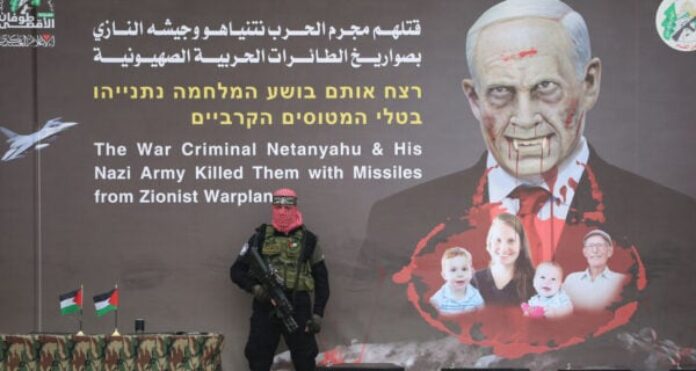
The latest example of this travesty—the least of what the kidnapped Israelis and foreign nationals have been subjected to during their captivity—was displayed on Saturday. Hate-filled Gazans of all ages, sporting Hamas’s signature green headbands, cheered while Eli Sharabi, Or Levy and Ohad Ben Ami were led to a podium and forced to put on a performance for jihadist propaganda purposes.
Hanging from the stage was a banner with the Hebrew phrase, “Total victory,” the vow-turned-slogan reiterated by Israeli Prime Minister Benjamin Netanyahu as the goal of the war. On each side were posters of “martyred” Hamas commanders. The graphic setup wasn’t merely an expression of ridicule; it also conveyed that the West is no match for enemies who glorify death.
The backdrop for the horrific scene of the emaciated victims, alongside their rifle-wielding brutalizers who shoved microphones and cameras in their faces, was a massive banner. It contained a fist and Palestinian flag next to a sentence in Arabic, Hebrew and English—the latter poorly translated—reading: “We’re the flood; we’re the day after.”
The first part of the boast was a reference to the Oct. 7, 2023 massacre, dubbed by its barbaric perpetrators and all those who celebrated it as “Operation Al-Aqsa Flood.”
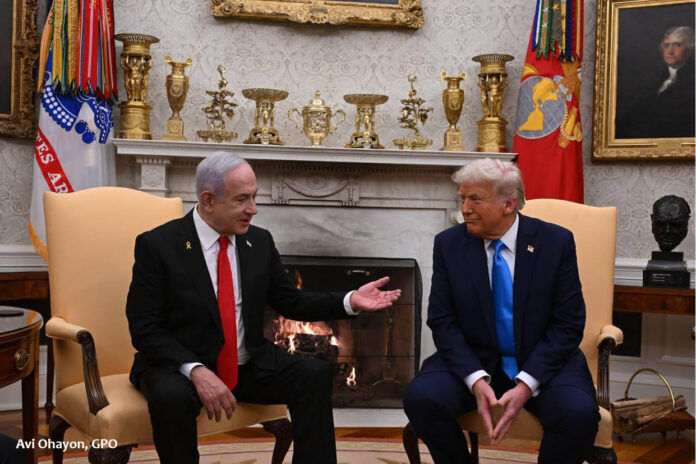
The second alluded to Trump’s announcement on Feb. 4, during a joint press conference at the White House with Netanyahu, that the United States would be taking over Gaza and transforming it into a flourishing international hub.
The very idea of America’s playing any role in the “day after,” let alone assuming responsibility for the enclave run and inhabited by mass murderers, had never crossed anybody’s mind—least of all Hamas’s. But the organization must have taken seriously Trump’s earlier threat that “all hell would break loose” if the hostages weren’t released by the time of his Jan. 20 inauguration.
Though only three were freed a day before his swearing-in ceremony, it was the start of the “ceasefire” deal that Hamas had refused to accept until then. It’s an arrangement that even those Israelis who realize the concrete perils inherent in its fruition have come to view as a necessary pill to swallow. Few disregard the impossible situation foisted on the Jewish state by Hitler-emulating Islamists.
As Hannah Arendt wrote in The Origins of Totalitarianism, “Who could solve the moral dilemma of the Greek mother, who was allowed by the Nazis to choose which of her three children should be killed?”
To get a sense of Israel’s own moral dilemma, a description of three individuals in three different relevant categories is in order. Let’s start with the men who emerged after a year and four months in Hamas terror tunnels looking like Holocaust survivors.
Sharabi, 52, was abducted from his home on Kibbutz Be’eri, along with his older brother, Yossi, during the Hamas massacre. Unbeknown to him, his wife and two daughters, aged 13 and 16, were slaughtered that day, and Yossi was killed while in captivity. Returning to Israel dangerously thin, pale and obviously ill, he was confronted with the news of his annihilated loved ones.
Levy, a 34-year-old resident of Rishon Letzion, was abducted from the Nova Music Festival, where his wife, Eynav, was murdered inside a bomb shelter by a Hamas grenade—something he only discovered upon his return. The couple’s then-2-year-old son, Almog, was cared for by both sets of grandparents.
Ben Ami, 57, was kidnapped from Kibbutz Be’eri. His wife, Raz, who was also abducted, was released as part of a week-long ceasefire in November 2023. Like Sharabi and Levy, whose depictions of their cruel treatment at the hands of Hamas are coming to light, Ben Ami appeared as though he’d been in a concentration camp.
Another three men deserving of note—and honor—are Israel Defense Forces reservists Maj. Netanel Hershkovitz, Master Sgt. Ori Moshe Borenstein and Master Sgt. Tzvi Matityahu Marantz. Members of the 5460th support unit of the IDF’s 460th Brigade, they were killed on Oct. 10, 2024, in a Hamas ambush on their vehicle in Jabalia. Each had donned his uniform on that fateful Black Sabbath to fight for the country and search for the hostages.
Hershkovitz, 37, a resident of Jerusalem, was survived by his parents, six siblings, a wife and three children.
Borenstein, 32, from Moreshet in northern Israel, was survived by his parents, three siblings and a soon-to-be fiancée.
Marantz, 32, from Bnei Adam, was survived by his parents, two siblings, a wife and three children, the youngest of whom was born halfway through the war.
A third triplet crucial to highlight is that of Wael Qassem, 54, Wassam Abbasi, 48, and Mohammed Odeh, 52—all Hamasniks from eastern Jerusalem with blood on their hands. Key players in the Second Intifada, they were convicted in 2002 and sentenced to multiple life terms for orchestrating some of the deadliest attacks on Israeli civilians, including the bombing at the Hebrew University in Jerusalem in which nine people were killed.
As part of the ceasefire deal, they were released from prison on Jan. 25 and exiled to Egypt, where their families intend to join them. A nice, neat happy ending for savages who are bound to reoffend at the glimpse of an opportunity. For them, there is no “day after”—only an ongoing campaign to repeat the Oct. 7 atrocities “again and again.”
Which brings us to future targets of terrorist rape, arson, decapitation and abduction. Their faces aren’t on placards and T-shirts because we don’t yet know who they are. We can be certain, however, that it’s just a matter of time before we’re bemoaning their plight. Negotiating with Hamas, through Egypt and the terrorist state Qatar, guarantees it.
Despite having its capabilities severely weakened, Hamas still holds the cards that allow it to call critical shots. Hopefully, Trump’s sudden shuffling of the deck that his predecessor had stacked against Israel will lead to a return of all remaining hostages and the eradication of Hamas power.
Any other scenario—such as going through with the next two phases of capitulation—will encourage Hamas to believe in its mantra of “We’re the flood; we’re the day after.”
Can Hamas ever be defeated?

Palestinian members of the marine unit of the al-Qassam Brigades, the armed wing of the Hamas movement, take part in an anti-Israel parade in Rafah, in the southern Gaza Strip on July 13, 2015. Photo by Abed Rahim Khatib / Flash90 *** Local Caption *** çîàñ
òæä ôìñèéðé
ôìùúéðé
ôìùúéðàéí
îöòã
ðù÷
öåììðéí
No matter how many times it is vanquished or decisively discredited, ‘Palestinianism’ persists as an ideology unwilling to die. Rooted in Muslim Arab nationalism, it remains fundamentally opposed to the very existence of Israel – a Jewish, liberal, and free state. Hamas, one of its most notorious champions, has in recent weeks orchestrated a carefully staged spectacle as it releases Israeli hostages from Gaza. Masked gunmen stood triumphantly, their performance captured in high resolution by cameras that had somehow survived the supposed genocide. The message was clear: this was a moment of victory, a display of strength. Never mind that Hamas had suffered catastrophic losses – its military infrastructure shattered, its leaders eliminated, its people’s homes reduced to rubble. What mattered was the illusion that they remained unbroken.
Ideas, like nations, do not survive by accident
Donald Trump and Benjamin Netanyahu’s extraordinary press conference on Tuesday may signal the war’s end. But while Trump articulated a clear vision for what comes next, he has yet to outline a strategy for getting there. For now, Hamas remains in Gaza, parading hostages like trophies through the wreckage, ready to claim victory. How, then, can they ever truly be defeated? Destroying their military capabilities has not been enough. As long as their ideology endures, they can rebuild. The real challenge is not just dismantling Hamas as an organisation, but eradicating the idea that sustains it.
For 16 months, Middle East dilettantes have dismissed Israel’s military action as futile, insisting that ‘you cannot kill an idea’. Yet history suggests otherwise. Ideologies have been crushed – Nazism in Germany, imperialism in Japan – so thoroughly that they became objects of national shame. If this was possible, why does Hamas’ ideology persist?
After the second world war, Germany and Japan were not merely defeated; their belief systems were dismantled. Public trials, mass education, and historical reckoning imposed an ideological erasure. Germans were forced to confront the Holocaust. Japanese society renounced its imperialist past, with Emperor Hirohito publicly relinquishing his divine status in 1946. Shame became institutionalised, turning these ideologies into moral taboos.
But Hamas, and the broader political Islamic worldview, operates on a different foundation. For them, suffering does not provoke reflection – it reinforces their narrative of divine struggle. Death is not a failure but an honour. Humiliation does not lead to reckoning but to greater determination. Those who assumed that Hamas leaders would abandon their cause after seeing their people suffer fail to grasp a disturbing truth: for Hamas, every casualty is another step toward ultimate victory. Even the prospect of American rule in Gaza does not alter its status as Dar al-Islam (the Land of Islam), which, under their ideology, must never be ceded to non-Muslims. It must always be reclaimed by force.
This is why Hamas could stage the hostage release as a moment of pride. Immune to shame, they weaponised the event, transforming it into propaganda. Their military losses did not translate into ideological defeat. And while Hamas has proven itself impervious to collapse, the West appears determined to embrace its own. The irony is staggering: one ideology refuses to die, while another eagerly destroys itself.
Take Britain, for example – a nation that led the abolition of the slave trade, spread parliamentary democracy, and built one of the world’s most enduring legal and political systems. Yet today, expressions of national pride are met with suspicion. Marchers waving the Union Flag are often viewed as extremists, while those brandishing the PLO flag in London are labeled ‘social justice’ activists. Young Britons are encouraged to dwell on their country’s past sins rather than its achievements. The idea of Britain as a force for good is fading, replaced by a narrative of guilt and self-reproach.
Western societies have embraced the idea that shame is a necessary corrective – that confronting past injustices is the highest moral duty. In moderation, this can be healthy. Taken too far, it becomes self-destructive. Britain, like much of the West, has reached a point where its historical achievements are seen as embarrassments, its cultural identity something to be apologised for.
Hamas cannot feel shame. The West seems incapable of feeling anything else. Though early signals from Trump’s return suggest this may be changing, much of the West stubbornly drags its feet.
Ideas, like nations, do not survive by accident. They endure because they are defended – culturally, politically, and sometimes militarily. Hamas’ ideology persists because it is reinforced at every level: in schools, mosques, media, and through unwavering external support. It is constantly nourished. Meanwhile, Western ideals – free speech, democracy, national identity – are being systematically eroded from within.
A society that cannot defend its own ideas will inevitably be overtaken by those who can. Maximalist, antisemitic Palestinian leaders understand this. So do the ideological forces reshaping the West. But will Western societies realise it in time to fight back?
Can an idea be killed? History says yes. But it does not happen by accident. It requires a conscious, forceful decision to defeat, discredit, and replace what came before. If Western states recoil at the prospect of America imposing its will over Gaza, might they at least find the will to reclaim their own ideologies and societies?
Video of Norman Finkelstein ‘speech’ at Bensalem Gala For Gaza 1/18/2025
Dr. Norman Finkelstein: Keynote Address at the Gala for Gaza Organized by: Muslim City Fest Speaker: Dr. Norman Finkelstein Event: Gala for Gaza Location: Bensalem, PA. Date: 1/18/2025