 Czech
Czech French
 German
 Hebrew
 Noruegan
 Russian
 Spanish
 Swedish
 Polish
 Portuguese



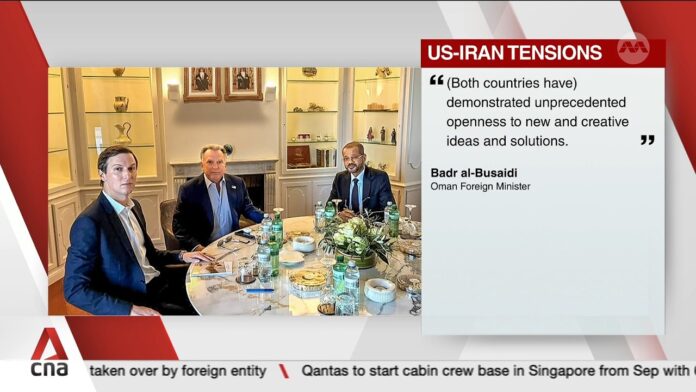
Geneva is playing host to both Iran nuclear negotiations and talks to end the war in Ukraine. It’s the third round of indirect nuclear talks between the US and Iran, mediated by Oman. Oman’s foreign minister said negotiators from both sides have shown openness to new solutions. The negotiations are taking place amid a massive US military build-up in the Middle East, fuelling fears of an American strike on Iran. Separately, Ukraine’s lead negotiator Rustem Umerov will meet US envoys Steve Witkoff and Jared Kushner to discuss rebuilding after the war waged by Russia. Kate Fisher reports from Washington DC.
Draft of New Movie Script – UNRWA Prepares Population For Total War In U.S.-Controlled Gaza
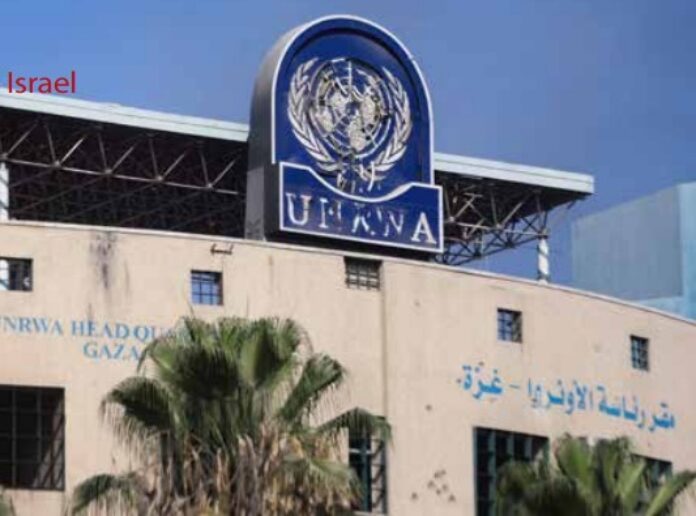
The October 7, 2023 massacre exposed UNRWA’s true face and its full cooperation with Hamas terrorism. UNRWA employees in the education system, including teachers, educators, and even school principals, took an active part in the massacre. UNRWA facilities, including schools, have been used as operational bases by Hamas. Since the Hamas takeover in 2009 of the UNRWA unions, which constitute more than 30,000 active members, Hamas has ruled UNRWA with an iron fist; HAMAS controls UNRWA.
oday, it is clearer than ever that UNRWA has educated its students toward the “right of return by force of arms”—which has one and only one meaning: the destruction of Israel.
Schools for refugee children have reopened. UNRWA is providing large blue tents that are used as schools. According to US claims, the schools in Gaza are run by UNICEF, yet the ruling hands are the hands of Hamas.
Site visits we conducted in UNRWA schools prove that nothing has changed. The incitement, hatred, and violent indoctrination towards the right of return are exactly as they were before the October 7 attack.
News teams from the Bedein Center visited the UNRWA school in the Shati refugee camp in northern Gaza, and spoke with students, teachers, and education supervisors while looking at the makeshift UNRWA classrooms conducted in their tents.
A grim picture emerged. In several classrooms we visited, next to the blackboard, a large poster bore a poem glorifying the right of return. The students sitting in front of the board read and memorized the desire to return to Haifa, to return to Jaffa, and to destroy the State of Israel.
Below is the translation by Dr. Arnon Groiss of the poem placed in the front of classrooms to remind students that the struggle for the right of return must continue:
Beloved Palestine, how can I live far from your valleys and hills?
he green-colored mountain slopes call to me, and on the horizon, signs of redness.
The shores call to me, weeping, and in time’s ears echoes the sound of sobbing.
Your orphaned cities call to me; your villages call to me with their domes.
omorrow we shall return, and the generations will listen to the pounding footsteps of return.
We shall return with the echoing storms, with lightning and the shooting star,
With winged hope and songs,
With the soaring eagle and the hawk.
Indeed, thousands of victims shall return; the victims of oppression will open every door.
In filmed conversations with students, they expressed their desire to return to their homes in pre-1948 Palestine.
In filmed conversations with students, they cursed and reviled Israel and the Jews. One student stated: “The Jews are dogs, they must be expelled…”
It became clear that the textbooks are the same textbooks which have been used to incite violence against Israel and Jews since the Oslo accords were signed in 1994. Where is the oversight process by the United States? Where are the deradicalization processes? Oversight and instructions come from the Ministry of Education in Gaza, under Hamas control.
During a random visit to an Arabic lesson, the teacher had written on the board praise for Palestine: “The land of Palestine is a good and blessed land.”
Fresh graffiti on the new classroom walls praises the “Toufan al-Aqsa” (“Al-Aqsa Flood”)—the name Hamas gave to the October 7 massacre.
They speak about Al-Aqsa (the Temple Mount)and Jerusalem and long for the day they will be at Al-Aqsa.
Students at the UNRWA school assert in unison:
“We learned not to surrender because Allah is with us.”
“Inshallah, God will liberate it from the Jews and from Israel.”
“I want to return to my home in Ashkelon.”
“The Jews are dogs.”
“The Jews took Gaza, Jaffa, Haifa from us…”
“Who are the Jews?”
“I hope we will liberate all of Palestine.”
“Even if thousands die, we must liberate Jerusalem.”
One child, who was wearing a shirt emblazoned with the Hebrew words “Bnei Akiva,” stated: “We in Gaza did not lose the war; Allah is with us.”
A boy sang: “Whatever happens, even if they destroy it, even if they kill us, we will realize the right of return.”
One girl sang songs in honor of Jerusalem. Another girl followed, singing about liberating Palestine.
There you have it. The legacy of the US-initiated “Peace Council.’
So much for the promise of US Secretary of State that the US would no longer work with UNRWA.
Hostage
What happens when a person is subject to the cruelest behavior man can commit – such as torture, starvation, psychological warfare and lack of medical care? In the hours following the October 7, 2023 Hamas attack on Israel, it became clear that the Palestinian terror organization – which has ruled Gaza as a militant theocracy since 2006 – was determined to inflict as much pain on the more than 200 Israelis it had kidnapped earlier in the day.
By evening – some 12 hours after Hamas had begun its attack by firing thousands of missiles toward Israel as the sun was rising at 6:29 a.m. – Israelis shuddered when the first videos of the kidnapped were released. It had already been the worst attack on Israeli soil since its founding in 1948. Over 1,200 had already been slaughtered that day in every nearly conceivable way a man can kill a fellow human being. Armed with machine guns, grenades, rocket propelled grenades or RPGs, and a staggering amount of other lethal weapons, Hamas had broken through more than 60 sections of the Gaza border fence, allowing as many as 6,000 Hamas terrorists to storm Israeli army bases, kibbutzim, and medium-sized cities such as Sderot and Ofakim with little opposition by the IDF.
In its initiative to spread world jihad, and normalize its vision where murder and oppression go hand in hand with religion, Hamas live streamed its attack on social media. Hence, they documented the mass murder as they sprayed bullets in the faces and backs of Israelis, burned families alive, and raped women and men before shooting them. In one case, after Hamas beheaded a soldier, they brought the head back to Gaza and put it up for sale.
As the country was reeling from the attack, the grainy videos of young and old Israelis bound in Gaza were a further insult to the largest intelligence failure in Israel’s 75-year existence. Young men and women, looking dazed and terrified, were filmed bound and face down on the floor. Hamas gunmen were filmed selecting Israeli female soldiers they desired. All had been subject to vicious beatings. It was impossible to grasp the horror and shock that they felt.
Somewhere, in the warren of streets and tunnels that lay under the darkness of Gaza on the evening of October 7, were four Israelis who had lived modest lives up until that day.
KEITH AND AVIVA SIEGEL expected that October 7 would be another quiet Shabbat and Simchat Torah on their kibbutz, Kfar Aza. The collective was their slice of heaven going back to the early 1980s, when they moved to the agricultural collective. Keith, the son of a prominent physician and professor at the University of North Carolina at Chapel Hill, made aliyah in his late teens and fell in love with Aviva, who had moved with her family to Israel from South Africa. Keith tilled the land and became a farmer, and Aviva settled in as the kibbutz’s kindergarten teacher. Keith went back to school and became an occupational therapist; he eventually went to work for a pharmaceutical company. Meanwhile, they made dozens of close friends on the kibbutz and raised their four children under the endless sunshine of their kibbutz – less than a mile from the Gaza border.
About nine miles south, along the main border road 232 – which rambles from Ashdod all the way to the Kerem Shalom Egyptian border crossing – Elkana Bohbot and Yosef Chaim Ohana were listening to the trance music that boomed throughout the night at the Nova Music Festival. Surrounded by thousands of other Israelis – and hundreds of others who had flown in from all over the world to attend the festival – and billed as a celebration of peace and nature at the bucolic grounds of Kibbutz Re’im, it was the culmination of six months of planning by Elkana Bohbot. Elkana grew up in the Ramot section of Jerusalem, and had moved to nearby Mevaseret Zion, with his wife Rebecca, and his toddler son, Re’em. Elkana was in charge of the mushroom stage at the festival along with his two business partners, identical twins Osher and Michael Vaknin.
Somewhere in the crowd, Yosef Chaim Ohana was smiling. He had grown up in the hardscrabble city of Kiryat Malakhi. He had come from a religious family but had gone out on his own, and by the time he enlisted in the Israel Defense Forces, he chose the Givati Brigade – an elite infantry, specializing in rapid deployment and combat operations. After his IDF service, he traveled extensively and returned to Israel to work as a bartender. Now, in the crisp morning air – amid a golden sunrise – he felt relaxed as he danced to the music he loved.
For social historians of the country, the Nova music and dance festival marked a significant change in societal expression. For much of Israel’s history, celebrations were modest and more in line with Israel’s socialist founding fathers’ ideals. Up until the 1980s, salaries were paltry, few owned cars, there was just one TV channel and it sometimes took years just to get a home telephone. Possession of recreational drugs – such as hashish or marijuana – meant a criminal record and often jail time. For most, the world revolved around the family.
But in recent decades, the country has embraced capitalism. Israeli high-tech innovators introduced the world to the USB flash drive, the GPS navigation app Waze, the first commercial firewall software and generations of Intel processors. Business has changed the family dynamic – and also created an economic divide: As cranes construct more and more skyscrapers in Tel Aviv – now considered the most expensive city in the world to reside in – one out of four children live below the poverty line in Israel.
As the country has grown, its priorities have shifted. For over 25 years, young adults who finish their army service have seen a backpacking trip abroad as a right of passage – with young IDF vets filling hostels from Thailand to India to Nepal. So, when thousands of young Israelis turned a remote kibbutz field into a giant outdoor dance floor just a couple of miles from the Gaza border – with a significant minority ingesting psychedelic drugs – few greeted the event with more than a collective shrug.
“Until October 7, if you had asked me to describe myself, I would have said that I was like a bird – because my freedom truly felt like a bird’s. Today, if you ask me how I feel, I still feel like a bird, but with a heavy burden on my back,” Yosef Chaim Ohana told me last month as he sat in a garden at an outpatient medical facility in Ramat Gan where he receives therapy for his wounds while in Hamas captivity. Ohana, who is 25, was released along with Elkana Bohbot and 18 others in October – more than two years after being dragged to Gaza by Hamas.
IN CIVIL SOCIETIES, human beings regularly discuss many of life’s scenarios including the subject of death. But few can imagine witnessing mass murder, or being kidnapped and tortured.
For Yosef Chaim Ohana, Elkana Bohbot and Keith and Aviva Siegel, life’s heavy burden quickly descended on them around sunrise on October 7.
“Everything around us changed,” Yosef Chaim explained, describing what it’s like to celebrate with friends at a safe and happy party, and in the next moment, run for your life. “The rhythm suddenly accelerated. Dancers became people running. Laughter and shouts of joy turned into screams of pain, anxiety, and fear. Everything flipped in an instant. I looked around, unsure whether the music would stop or come back on. I saw explosions in the sky and heard the sirens – but in Israel, we’re used to rockets being fired at us every few months.”
Yosef Chaim quickly sprinted to the main road, Route 232, which was jammed with murdered drivers and passengers still in their cars. Amid the carnage, he was able to save a woman with multiple bullet wounds. When he brought her back to the small infirmary, he realized this was not an attack by a handful of terrorists.
“I came back with the stretcher. We lifted her – her leg covered in blood – and ran toward the doctor. I remember the doctor clearly: he had a beard and stood there looking confused. When we arrived with the wounded woman, we thought he would immediately step in, that he would see a gunshot victim and focus entirely on her,” he said.
“But then we realized she wasn’t the first. On the ground nearby, several other wounded women were already sitting there. The doctor simply told us to place her on one of the beds and didn’t even approach her – understanding that there was nothing more he could do.”
At the stage areas at Nova, Elkana Bohbot was looking to save lives. It was Elkana who quickly reacted after the initial missiles were fired from Gaza, climbing on to the stage and announcing that the party was over and that everyone needed to leave as soon as possible. In the next hour, he raced back and forth – handing out water bottles to those in shock and also trying to convince police that they needed to open another road out of the festival. The authorities finally acquiesced and opened a new exit to loosen the bottleneck of cars.
“I said to everybody, go to your car very fast and quickly. We have a road to the exit, and everybody, please go to your car and don’t stop. Just go and follow the police car,” said Elkana. “And we saved like 100 cars.”
He could not save his partners, Osher and Michael Vaknin – who were murdered that morning by Hamas gunmen. After 8 a.m., the Nova site was filled with Palestinian terrorists. “They killed policemen first, those with guns,” said Elkana, who began to run from the concert grounds. He likened it to a grisly Hollywood movie, but one in which he was running for his life. He eventually chose to hide on a small hill nearby with others, where he waited for the IDF to arrive. But instead of the IDF, he heard Hamas gunmen approaching the area speaking Arabic. People prayed, said goodbyes to their loved ones on their cell phones, and then called out for their mothers as Hamas sprayed the area with bullets from their machine guns. The sound was deafening, and when it stopped he heard the cries of his fellow Israelis. “And then it was quiet, dead quiet,” he told me when we met last month at the Sheba Medical Center outside of Tel Aviv, where he is being treated for a variety of ailments.
Hamas bound his hands, and by 8:45 a.m., he found himself in Gaza – surrounded by a jeering mob who took turns beating him. “They were all clapping. Kids as young as four, five and six – girls and boys – hit me,” he recalled.
Back on Route 232 near the Nova site, Yosef Chaim found an ambulance in the middle of the two-lane highway. But when he opened the door he discovered that everyone inside had been murdered. “We broke into the ambulance and began taking out every piece of equipment that could help us. We loaded it into a small car, thinking that with a smaller vehicle we might be able to drive along side roads. We emptied the ambulance’s equipment into a Volkswagen Golf and drove off,” he said.
Soon, he and a friend found themselves in the middle of a gun battle between Hamas and Israeli police. “Two police officers who were positioned on a vehicle were engaging in the firefight. Within moments, one of them was hit. He collapsed, bleeding,” he said.
“I took off my shirt and told myself, ‘OK, I’m going to jump to that officer, see where he was hit – maybe I can help stop the bleeding, put on a tourniquet.’ That’s why I took my shirt off. I waited for a brief moment when the gunfire paused and prepared to jump toward his vehicle. Then the vehicle he was on exploded. I was thrown through the air.”
Yosef Chaim started to run again and eventually heard a friend call out from an embankment. “I don’t know how long it lasted – somewhere between half an hour and an hour. During that time, there was a war happening outside and a psychological war happening inside us. I say ‘inside us’ because, over time, more and more people joined our hiding place, until we were eight or ten people together,” he told me.
“There was tension between us – constant discussion, speculation about what was happening outside. Then suddenly, we heard the sound of a helicopter, and you think, ‘The army is here. This is about to end. How many can they really be – 10 terrorists, 20 terrorists? The army is here. Enough time has passed for the army to arrive, to regroup, and to do something.’ For a brief moment, everything stopped. We were sure this was it – that the army had eliminated them and that we would be able to come out of hiding any second. Some of us were already preparing to leave the shelter.
“But another person and I said, ‘Wait – be patient.’ And then it didn’t end. More gunfire. The shooting started again and continued.”
An IDF tank passed and a wave of relief went through the group. But the tank disappeared. Then the group heard Arabic and more gunfire. “We all shrank inward, closed our eyes, and held hands – eight or nine men and women forming a tight circle, holding hands and taking a breath together.
“At that moment, a silence settled over us – one that came from a shared understanding among everyone in the hiding place: ‘This is it. There’s nothing we can do. In a few moments, we’re all going to die.’ We squeezed each other’s hands tightly and took a breath,” he told me.
“Then the shooting began at point-blank range. They were standing over us and started firing. I remember telling myself, ‘OK – let’s see how this feels. Where will the bullet hit me? Fine. We’ll feel it, and then we’ll die.’ About ten seconds passed, and I asked myself, ‘Am I alive, or am I dead?’”

The hands of fellow Israelis who had gripped his palms and fingers went limp and slipped to the ground.
“I found the courage to open my eyes. For a second, I opened them and saw that I was still alive. They were looking at me. I raised my hands as a sign that I was unarmed – that they didn’t need to be afraid of me, that they didn’t need to do anything else.
“One of them came over and pulled me by the hair. The others continued killing everyone around me. You have to understand: I was in the middle of the group. Everyone around me was being murdered, and not a single bullet hit me. They pulled me out of there.”
I asked him why he thought he survived.
“Until October 7, because of the life I had lived, I didn’t think much about this side of life – about miracles or divine providence. Today, I think differently. I am in a different place. But if you ask me why – why out of eight or ten incredible people, just like me, I survived while they were murdered – even if I wanted to answer you, I can’t. I don’t know. It’s a question I’m afraid to ask myself, a question I’ve already wrestled with enough. Everyone who was with me was a whole world unto themselves.”
As Hamas was taking Yosef Chaim to Gaza, Keith and Aviva Siegel were hiding in their safe room 15 minutes up the road in Kibbutz Kfar Aza. Over the years, they have spent countless hours taking shelter and know that missiles can be deadly – about 15 years ago their neighbor on the kibbutz was killed by a Hamas rocket.
But that morning, they sensed that this attack was different and stepped outside and looked at the sky. Said Aviva, “I saw all the rockets going all directions, and we ran back with another alarm, closed the door, closed the window, and I remember looking at Keith and we both said, ‘It feels like the end of the world.’ Our house was shaking. We could hear the rockets from outside and the alarms going on and on and on and then falling very close to us.”
The couple held hands as the bombing continued, and after four hours they could hear Arabic and then gunshots inside their house. About 15 terrorists broke into their safe room, picked up Keith and Aviva and threw them out of a window. Keith was shot in the hand and suffered broken ribs during the fall, and Aviva’s knee was injured. Soon, they were loaded into the back seat of Keith’s car where a terrorist held a large knife to their faces during the short drive to Gaza.
“When we arrived to Gaza, we saw all the people standing and clapping their hands and saying Allahu Akbar in Arabic, and shooting up in the air. And they were just happy. And I remember like, seeing old people – old people with a stick and babies standing there. And it was their happiest day on earth, because the terrorists that were with us, with guns on us and knives on us, were saying that we are from Israel,” said Aviva.
Soon they were brought to a home which had an entrance to a tunnel. They were forced into the tunnel, where they met other members of the kibbutz: Gali Berman – whose brother was also kidnapped – and Chen Almog- Goldstein. Goldstein was there with her three youngest children. But her husband, Nadav, and her oldest daughter, Yam, were not with her. They had been murdered that morning in front of their family by Hamas.

IN ANOTHER TUNNEL that first morning, a Hamas gunman stuck the point of a knife into Elkana Bohbot’s back and forced him to walk in the narrow, dusty shaft. In the darkness he alternately prayed for God to save his life so he could see his son and wife again; or for a quick death by a bullet. Instead, his guard insisted that he eat a piece of chocolate. Elkana declined three times and then was told if he didn’t eat the chocolate he would be murdered.
Elkana ate the chocolate, and was eventually taken to an apartment. Food was minimal – small pieces of bread with avocado, potato, or cheese. Over time, as the war escalated, the rations shrank. Bochot, who is rail thin, would lose 35 pounds and at times was so weak he could barely walk. After a few weeks, his captors approached him again. One guard, enraged over family members killed in an Israeli strike, told Bochot he would die that night. Blindfolded, Bochot was led out into the street, certain he was being taken to his execution. Instead, a metal door opened, and he was pushed down a long staircase, roughly 100 feet underground, into what he would learn was another artery of Hamas’s tunnel network. He was told he would spend four or five days underground. Instead, he was held captive in the narrow, airless underground maze for 23 months.
He described periods of repeated beatings – struck in the face and back, and once pinned by the legs and beaten with a piece of wood. Psychological torment accompanied the physical: guards regularly told him that his wife, son, and mother were dead, killed in rocket strikes or illness. One captor even knelt to pray that Elkana’s son would die.
Yosef Chaim Ohana spent his first few weeks as a hostage in an apartment. Like the others, he was starved and threatened constantly. “During the first weeks we were tied up, blindfolded, pressed to the floor, naked, with a fan blowing on us to cool us down. Every small thing ended with beatings. If you asked to urinate – you were beaten. If you asked to be covered, they would take a carpet, put it on you, and step on you. There were times when they urinated on the carpet, and we were lying on their urine.
“They put handcuffs on me for a period of time, and they didn’t have the key. My hand swelled up, and I was about to lose all feeling in it. On the day I started begging them to release my hand because I felt like I was losing it, they simply went and brought bandages, brought a knife, and told me, ‘Fine, we’ll cut your hand off now – you’ve driven us crazy.’ They didn’t cut off my hand, but I understood there was no one to talk to, so I simply stopped complaining,” he said.
Aviva Siegel was bound for 51 days before she was released during a ceasefire in November of 2023. Until she was freed, she was held with Keith and other Israelis – including young girls she protected including one who was sexually assaulted by Hamas. “One of the girls came back from the bathroom after one of the Hamas terrorists touched most of her body. She’s young, and she was shaking, and I’ll never, ever forget that moment I got up and gave her a hug. And when he [the terrorist] came into the room and he saw me hugging her, he started screaming, and I felt like, in a second, he’s going to just kill her, and kill me, just for hugging her. And then, after a couple of hours, she told us what happened, and she said that if he would know that she’s telling us what happened, he said that he would kill her,” she recalled.
On occasion, Aviva was pulled by her hair and thrown around by her Hamas captors. Bathroom breaks were rare. “Showering” for the hostages meant given a bottle of water with a hole in a cap every few weeks. Food and water were minimal – she lost 22 pounds – and medicine was nonexistent. The one constant seemed to be the brutality Hamas displayed. She described the wanton violence perpetrated by Hamas on the kidnapped Israelis.
“One of the days, one of the girls was called out, and a Hamas terrorist with a gun in front of her eyes, told her to get dressed. And while she bent down to pick up a hijab – because we had to be dressed like Arabs while we were moving – she said that she’s scared that they’re going to take her, she’s going to be alone. And while she said that, he threw on the floor and put the gun in front of her eyes and said, ‘One more word, I’m going to kill you.’ And they took her and they said that she was lying, and they beat her to pieces,” Aviva said. “She was sitting and crying like a baby, I never forget the way she was red all over, and her hair was standing. They covered her with a blanket, and they handcuffed her, and they were just beating her.”
Keith also witnessed brutal beatings, and the torture of a young Israeli woman.
One day, Keith was brought into a dungeon where an Israeli woman was being tortured. They had falsely accused her of being an IDF officer and insisted that Keith convince her to confess.
Said Keith, “I saw this woman lying on her back, on the floor. Her hands were tied together and her feet were tied together, and they had covered her mouth, and they like propped her up behind her knees or under her knees … and two of the terrorists were beating her with a rod, and they took turns.
“I was standing next to this woman, and he [the Hamas terrorist] came around, and he put a rod to her forehead. So, he was standing behind this woman, and like with the rod, applying pressure to this woman’s forehead. And I just did what they told me to do. I told her that she needs to confess, and I knew she had nothing to confess to. And then one of them had a pistol, and he put it to her head,” he said. “She was on her knees, and he put the pistol to her head, and he said, if she doesn’t confess, he’s going to kill her. This was right in front of us.”
After 51 days, Aviva was told there was a ceasefire and that she was being released – without Keith. Amid the turmoil of the exchange with the Red Cross, Palestinians flooded the Gaza roads and surrounded the van that would bring her back to Israel. “I’m very, very lucky to be alive, because on that day, I could have been killed,” she recalled. Hamas and other Gazans were blocking the roads and throwing rocks at the Red Cross convoy. Meanwhile, inside the van, Aviva comforted Elma Avraham, 85, who had been taken from Kibbutz Nahal Oz, and was in serious condition. Avraham had lost half of her body weight, and her face was turning purple.
Said Aviva, “She couldn’t hold her head up, and when I touched her, she was freezing cold. So, I asked them for a blanket, and I started massaging her body and shouting at her that she needs to keep alive for her family, kids and grandchildren. I didn’t even know when I was massaging her some of the times that she was alive, but I continued doing that for a couple of hours, and when I arrived to Israel, I was very worried about it, because I wasn’t sure that she made it. She came to Israel, her body temperature was 28 degrees [Celsius], and the doctor said that if she would have come a little while later, she would have been dead.”
Back in Israel, Aviva appeared in shock. She had thought that her son, Shai, had been killed on October 7 and was overjoyed when she learned he had survived the attack. She reunited with her three daughters and grandchildren. Despite her wounds from October 7, and what she suffered in captivity, she began campaigning immediately for Keith and the other hostages’ release. Within two weeks, she flew to the U.S. and met with President Joe Biden, and the U.S. Senate and for more than a year made several trips to the White House. (In the recently released documentary about Melania Trump, she is seen being comforted by the First Lady.)
In Gaza, Keith tried to focus on the positive – even as he was being starved and in the process of losing 60 pounds. The beatings continued – and over the 16 months he was held, he was moved 33 times. Wherever he was taken, he remembers seeing guns and other deadly weapons.
“There were always weapons; rifles just there, visible. And one of the places I was held in, there were hand grenades – seven – I counted them. They were always on a table next to the bed. And the rifles were like leaned up against a wall, or propped on the wall, you know, with the magazine in and RPG, like just lying on the bed. There was a bed and RPG missiles, just like lying there, and pistols,” he told me. “I remember now in one of the apartments we were in with Aviva, with three young children aged like three, two and under a year there, and one day, the three-year-old girl was like walking around with a real pistol in her hand. I went into the toilet one day and there was a pistol just there on the shelf in the toilet.
So, I like remember thinking, you know, I need to tell them that the pistol is there. Somebody forgot it, or maybe they didn’t, I don’t know what, but, you know, I feel like it’s my responsibility to let them know that the pistol is there. Just thinking like, you know, I want to be of some benefit to them. If that makes sense.”
NOTHING WAS predictable with Hamas, and at any given moment Keith could be threatened. There was a time when a terrorist picked up a rifle and aimed it at him and other Israelis. Several times he was told he would be killed by a Hamas terrorist brandishing a knife. Another time, a month after Aviva was released, one of the Hamas guards approached him screaming. “He spat on me, and he cursed me, and he kicked me in my ribs, on my right side, and on my legs,” Keith said.
And another time, a terrorist seemed to lose his mind in front of him – first threatening to kill Keith and then turning the pistol on himself.
“One of them threatened to kill me. He pointed a pistol at me. We were like, right next to each other, lying down, and he handed me the pistol, and he said, ‘Take it.’ I said, ‘I don’t want to take it.’ He said, ‘Take it. Take it.’ I said, ‘No, no, I don’t want to take it.’ And then he pointed at me, and he said, ‘Now I’m going to kill you.’ And he said, ‘Now you’re dead. And then he took it and he put it – this is a real pistol with the magazine and bullets inside of it – and then he put it to his forehead, and he said, ‘Now I’m going to kill myself.’
“Anyway, I was just like feeling, OK, you know, if he’s going to kill me, he’s going to kill me. But I think I was more worried about what would happen if he killed himself, and the other terrorists would think that I had killed him, and then what would happen to me. That’s weird, but I think that was more scary: thinking that he would kill himself, than he would kill me.”
During his 16 months as a Hamas hostage, Keith was held alone for six months – much of the time in the dark. On one brief occasion, he was able to glimpse the sky and felt a sense of hope. Back in the darkness, he turned to his Jewish roots and remembered Hebrew prayers he had hummed during his childhood in Chapel Hill. He began to recite the Shema. “I think my Jewish identity and faith changed,” he told me when I visited him and his wife in their temporary home near the Sea of Galilee. “I would say the blessing before eating. I would say Shabbat Shalom, Shavua Tov, Shema Yisrael – you know, the whole Shema. And that became a daily thing that I would do over and over again, just throughout the day. And I also had a lot of thoughts about the Jewish people, my belonging to the Jewish people, and that was inspiring … I think I felt God, or I received strength and I was empowered.”
He also practiced mindfulness – which allowed him to focus on the moment while producing a sense of calm. And he began to think of his family, and send messages of hope to them during his meditations. The goal was to let his loved ones know that he was OK. He first began with his mother – who died while he was in captivity – and then continued to send love to his wife, Aviva, and four children and five grandchildren, and his siblings. “So I did that, but I also was practicing a lot of gratitude, you know, appreciating everything that I had, that I was alive and my body was in one piece,” he said.
Siegel said one of the keys to his survival was upholding his ethics. Even as his captives tortured him, and tried to convert him to Islam, he remained respectful. During his 16 months in captivity, he was held by 60 different Hamas members and he said he tried to interact with them on a level that steered away from religion, politics or ideology or anything that would create negative feelings.
“I was trying to keep it positive,” said Keith. “I feel blessed. I feel grateful to have had a loving family that gave me a lot of strength; belonging to the Jewish people, which gave me a lot of strength. The fact that I’m Jewish gave me a lot of strength and mindfulness, which I practiced, which also was very beneficial to me. So, I mean, I think it’s very, very useful tool. I came to realize how helpful it could be to me in an extreme situation.”
On Feb. 1, 2025 – during the first ceasefire since his wife Aviva Siegel was released, and after being held for 484 days – Keith Siegel was paraded on a Hamas stage before a jeering group of Hamas gunmen. At 5 foot 10 inches, he had lost 60 pounds and was escorted by machine-gun toting Hamas terrorists who were draped in black, their faces covered with balaclavas. At 65, he was on his way back home. Soon, he would make the first of eight trips to America – including three visits with President Donald Trump. His goal? To bring back all of the hostages from Gaza.
In January, when I visited Keith in the Galilee, the 20 remaining living hostages had been released three months earlier. And late last month, the last hostage held – the body of Ran Gvili, an Israeli policeman killed on October 7 – was returned.
When I asked him how he felt, he replied: “I have all sorts of unpleasant body sensations, including pain and other weird sensations, but again, it’s not present in my conscious every second. It comes and goes.”
For Elkana Bohbot and Yosef Chaim Ohana, their odyssey would continue for another seven months after Keith Siegel’s release – 738 days after the October 7 Hamas attack. Their release seemed surreal to them – back in Gaza, not a morning went by when each wondered if it would be their last day on earth.
Elkana spent 23 months in the tunnels – sometimes alone, sometimes with other hostages, like Yosef Chaim Ohana. Each morning he’d awake with the same dread … and hope. “I didn’t see any light, there was no air – nothing. I was like a dead man, a dead man with a beating heart. That’s what you feel. Nobody can help you. Nobody can listen to you. You get depressed, you get very sad, but you have to be optimistic,” he told me.
The beatings and psychological warfare continued. He was forced by Hamas to do propaganda videos – including a fake suicide where Hamas drew blood from him and beat him. When he’d ask for food, the gunmen forced him to watch Hamas propaganda footage of Israeli soldiers being killed in combat. Barefoot, and dressed in rags, he said he was thrown around like a garbage bag.
The starvation and abuse got worse during his last six months underground, before his release in October. One day, one of the terrorists approached Elkana and the other Israeli hostages in their tiny cell with a boxcutter. “He said, ‘I need to take one finger to the boss, to the commander. And because many [Palestinian] kids died today, we want to have, like blood for blood, so we want one finger.’ And everybody was like, ‘No, don’t do it, please.’ You know, we cried for a long time. And he said, ‘I won’t choose. You can choose between you who will take the finger.’’’ After almost an hour of pleading with the gunman, he left but threatened to return.

YOSEF CHAIM OHANA said the worst part of his 738 days in captivity was the psychological warfare Hamas employed.
“Everyone copes differently with psychological torture,” he said in a calm, steady voice. “With physical torture – when they come and lash you with a belt or a stick, on the legs and the back – everyone reacts the same way: screaming and begging, ‘Enough! Why?’
“But when they come and tell you, OK, it’s possible that your time is coming, or that we might execute you, or suddenly they call your name – for example, one of the hardest things is the absence of food, and there is no escaping that.
“Hunger – you feel it in your body. When you’re hungry, you’re hungry. You can’t escape it. You need food to survive. And they played with us using that – not once a month, not once every two weeks, not for two or three days. It was a game – from the very first day until the very last day. Even in the days before the deals, when they gave us more food – OK, so we’d gain weight and look better – even then it was done in a twisted, torturous way.
“We didn’t know why it was happening, when it would happen. They’d come and take it away from you. You hadn’t eaten all day, and then in the evening you’d go – there was this kind of lamp they had, and they’d flash the light, and then you knew that two people had to walk toward the light to get the food. It was like a dog experiment: every time there’s a bell, food arrives, and the dog starts salivating just from hearing the bell. That’s how it was in the tunnel.
“When the light would flash, something in us would release. You’d come alive. You knew that in a moment you’d eat.”
But often there was no food waiting for them. While he was in the process of losing 44 pounds, there always seemed to be food for the terrorists, who often ate complete meals in front of the starving Israelis.
“Then two people would go out toward the captors to take the food. And they’d look at us like it was a joke and ask, ‘What are you doing here? Go back!’ They would let us think they were bringing us food. We’d walk all the way over to them, believing they were about to give us something to eat – and then we wouldn’t get anything,” he said. “You just collapse onto the floor, not knowing what to do.”
But he knew that to survive he’d have to pick himself up right away.
“So maybe on the occasions when they called us to come get food and we came back empty-handed, I would tell myself: ‘How amazing those 10 minutes were, when I thought we were going to have food.’ I truly tried to see the good in everything. That’s how I behaved. If I hadn’t managed to see something good – I wouldn’t have been able to survive.”
And then there were the constant threats, with a gun pressed against his body.
“One time, I went to use the bathroom. A Hamas soldier came up, loaded his weapon,
stuck it into my back, and said, ‘That’s it. I don’t need you anymore.’ I thought he might be joking – but what are you supposed to think when there’s a loaded gun pointed at your back?” he said.
He does not downplay the beatings, which he still suffers from to this day.
“Every day when they came in there was this kind of ritual, like a morning ceremony. They would approach us, and we already understood what was about to happen. We would take off our shirts and press ourselves against the wall. Face to the wall. And they would beat us on the back with their hands, with rings, with sticks,” he said.
One time he and other Israelis were singled out and brought to an area where they were beaten until they were unconscious.
“They covered our eyes. We were two out of the group,” he recalled. “Each of us is given a very strong blow to both ears so that we lose our balance and fall. We fall to the floor. They insult us, grab our legs, and tie them to a single strong stick. One of them knew a bit of English and Hebrew and explained, saying that now they are taking revenge on us for what we did to them, and now we will feel in our own flesh what they do.
“My mind immediately says: ‘OK, they’re going to cut our legs to break us, maybe even kill us.’ They step on our heads, on our hands, kick us. Then the legs are tied into the stick – it’s a kind of an Islamic punishment, but one that doesn’t leave marks.
“It’s basically whipping the soles of the feet with a long stick. The soles of the feet are an area full of nerves, so the pain isn’t just in the legs – when they hit your feet, the pain spreads through your whole body.”
He was left to recover in the darkness. All the while, he witnessed Hamas’s indifference to the suffering of the residents of Gaza, who were used as human shields. “One of the reasons it’s extremely hard to reach their generals, and even more so the lower-level fighters, is that every senior commander made sure to keep one or two hostages with him as human shields. And this is their method of fighting. They use human shields – not only hostages, but their own civilians as well. They choose to place command centers beneath hospitals, using hospitals as protection.”
He described the intimidation he witnessed. “In the last two months, I was alone, inside the headquarters of almost all the senior commanders in the central area – Deir al-Balah, Al-Bureij. I understood Arabic well. The way they operated during that period of the war, and I’m sure it was always like this, there’s a rulebook. If they ask you to do something – bring money, hand over your car, leave your home – and you refuse, they come and take it by force. And if you say something they don’t like, and Hamas hears about it, they break one of your knees,” he said.
“If they find out that you took food without going through them, they come and confiscate it. And if you refuse, they break both of your knees. I heard a commander – and I understand Arabic – sending one of his fighters and saying: ‘Go break his knee. But do it properly.’”
He wondered why, after October 7, the world does not understand their goals – which he believes go far beyond the destruction of Israel.
“If this is how they treat their own civilians, so how do you expect them to treat us? And all the lies about how, ‘If they’re given their own state, they’ll stop killing’ – that’s not true. Their goal is not just to take Israel. Their goal is an Ottoman-style empire. Their dream is to unite and control the world.
“Even now, after the war, after seeing the damage to their own civilians and what happened here – the only thing they focus on is how to do it again and stay in control. Step by step. They live for this. They are patient,” he said. “They live, with their whole being, to repeat October 7. So anyone who shows compassion toward Hamas is agreeing with their vision – to conquer the world, to murder, to kidnap, to rape.”
What’s it like to live in a Hamas tunnel?
“Down there, there’s no air-conditioning,” he said. “In the summer, you can’t breathe – there’s no oxygen. You’re sealed inside an enclosed space, and it reaches 45 degrees Celsius, like being inside an oven. In the winter, you freeze and shiver, and they don’t give you clothes.”
He believes he has to tell his own story now to heal, and also because the media and western democracies have all but forgotten about what Hamas did on October 7 and how they treated the hostages.
“It must not be forgotten – by anyone. Two years since October 7. A terrible day. At first, everyone supported our recovery. Now, only two years later, people are denying it ever happened. Right now, I carry this period with me – these two terrible years – for two reasons. First, it’s the way back to life. To remember that this, too, was part of my life. And that I need to grow from it, to become stronger. What doesn’t kill you makes you stronger.
“If I survived, then what I went through can be remembered, not erased. Because I believe that if I suppress it, if I try to forget this period, it will remain as trauma – PTSD that will never leave me.”

DESPITE THE TORTURE they endured, Yosef Chaim Ohana, Elkana Bohbot and Keith Siegel all believe that there can be peace with the Palestinians – as long as Hamas is eradicated.
Keith Siegel says he prays for peace.
“Peace has been made between Israel and bitter enemies. It is possible, and I personally am willing and wanting to engage with any person that wants peace, and personally willing to work hard at reaching peace,” he said. “I dream of a world where children can live, will live in peace, safety and security, and I feel like it’s my responsibility to help make that happen.”
“I believe deeply in peace. Peace is possible with civilians in Gaza and the West Bank. But with Hamas – and its ideology of global domination – there can be no peace,” said Yosef Chaim.
Said Elkana, “When you make peace, you do it with the enemy. So yes, why not? We want peace. We don’t want to fight. I believe that most people in Israel want peace and don’t want to fight. But when something happens like the seventh of October, we cannot sit by our side and be quiet.”
Meanwhile, for former hostages like Elkana, the psychological torment continues. Sometimes his wife finds him in the middle of the night or morning staring quietly at the sky, thinking of the 20 friends who were murdered on October 7, or the beatings he endured. And there is more stress – more than two years after their abduction, the four have no permanent housing, or work.
Yosef Chaim Ohana, Elkana Bohbot and Keith and Aviva Siegel never expected that their lives would change so suddenly and that their morals, values, relationships and overall philosophy about life would be tested by the torture and brutality that was inflicted upon them. The stories they shared are but a glimpse of what they experienced. There will be few epiphanies and little closure from the abuse they endured. But every waking moment offers them the promise of a new beginning, and if anything, these remarkable souls deserve just that. Θ
Steven A. Rosenberg is the editor of The Jewish Journal of Greater Boston. Email him at rosenberg@jewishjournal.org.
Peace Council Raises Unanswered Questions About Palestinian Authority Policies And Education
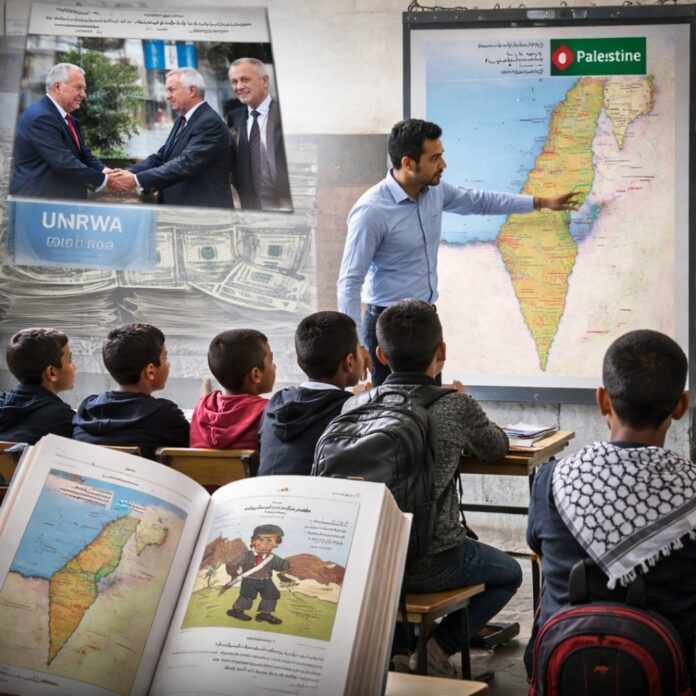
A U.S. government–convened Peace Council meeting held on February 19, 2026, has left significant questions unanswered regarding Palestinian Authority policy, education, and long-term commitments to peace with Israel, according to veteran journalist David Bedein, who has covered Middle East diplomacy for more than four decades.
In a draft analysis following the meeting, Bedein said he submitted a series of questions to Israel’s Ministry of Foreign Affairs seeking clarification on core issues related to Palestinian governance and peace commitments. According to Bedein, a spokesperson for the ministry declined to comment.
The unanswered questions, he wrote, go to the heart of whether diplomatic initiatives can succeed without structural reforms within Palestinian political institutions and educational frameworks.
Among the questions raised were whether the Palestinian Authority would cancel financial stipends provided to individuals convicted of attacks against Israelis, whether a future Palestinian constitution would formally revoke clauses in the Palestine Liberation Organization charter calling for Israel’s destruction, and whether Palestinian educational curricula would be revised to promote coexistence.
Education Policy At The Center Of Debate
Bedein’s analysis places particular emphasis on Palestinian Authority education, arguing that school materials remain a central obstacle to reconciliation.
According to his review of Palestinian textbooks and curriculum materials, the Palestinian Authority describes itself as a sovereign state under foreign occupation rather than an autonomous governing body operating under negotiated agreements. He asserts that educational texts present historical narratives in which Israel does not appear on maps and is instead referred to using terminology such as “Zionist occupation.”
Independent research organizations have also examined Palestinian educational content in recent years. Reports by groups including IMPACT-se and studies referenced in European parliamentary discussions have similarly debated whether curriculum reforms have adequately addressed concerns about incitement and historical representation.
Bedein argues that Palestinian textbooks characterize the conflict as beginning in 1948 rather than 1967 and frame cities inside Israel, including Haifa, Jaffa, and Acre, as territories to be “liberated.” He further contends that Jewish historical ties to the land receive little or no recognition in instructional materials.
He writes that these narratives influence younger generations and shape long-term political attitudes.
Religious And Political Messaging
The article also raises concerns about religious messaging in certain educational materials, claiming that terminology related to jihad and martyrdom appears in lessons and cultural content.
Critics of Palestinian curriculum reform have long argued that such themes undermine peace education. Palestinian officials, however, have previously stated that curriculum revisions reflect national identity and historical experience rather than incitement.
International debate over the issue has intensified because many Palestinian schools operate under or receive support connected to the United Nations Relief and Works Agency for Palestine Refugees in the Near East, known as UNRWA.
UNRWA has repeatedly stated that it is committed to neutrality and reviews educational materials used in its schools. The agency has said it addresses problematic content when identified and works with host authorities to align instruction with United Nations values.
Bedein disputes the effectiveness of those oversight mechanisms, writing that donor nations’ funding of UNRWA education should be subject to stronger accountability measures regarding curriculum standards.
Historical Context And Oslo Legacy
The analysis notes that formal recognition of Israel by Palestinian leadership dates primarily to correspondence exchanged between Yasser Arafat and Israeli Prime Minister Yitzhak Rabin before the 1993 Oslo Accords.
Bedein argues that subsequent educational and political developments have not sufficiently reinforced the principles of mutual recognition envisioned during that period.
Supporters of renewed diplomacy maintain that peace negotiations must address governance, economic development, and security concerns simultaneously, while critics contend that ideological and educational reform must precede any durable political agreement.
Policy Implications After The Peace Council
The February 2026 Peace Council gathering was intended to explore pathways toward renewed regional diplomacy amid continuing instability following the October 7, 2023, Hamas attacks and ongoing regional tensions.
According to Bedein, the absence of clear commitments on education reform, recognition of Israel, and incitement policies leaves fundamental questions unresolved.
He concludes that donor governments and international institutions may need to reassess oversight mechanisms tied to Palestinian governance and education if future negotiations are to produce sustainable outcomes.
Whether the Peace Council process results in concrete policy changes remains uncertain. For now, the issues raised highlight the enduring gap between diplomatic initiatives and the structural reforms many analysts consider necessary for long-term peace between Israelis and Palestinians.
Peace Council Convenes in Jerusalem; Implications
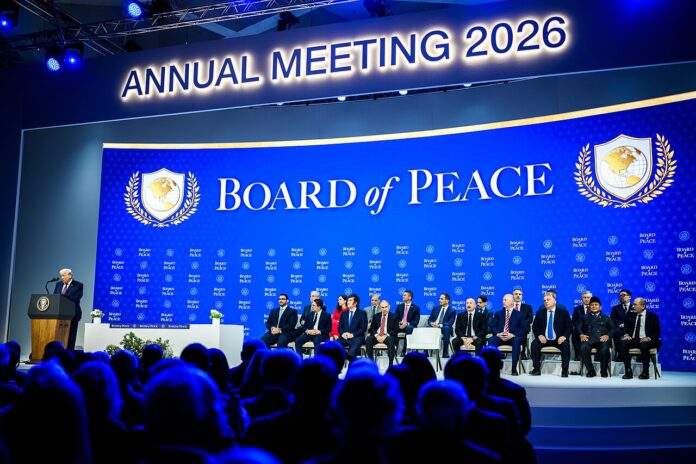
President Donald Trump participates in the Board of Peace Charter Announcement and Signing ceremony during the World Economic Forum, Thursday, January 22, 2026, at the Davos Congress Center in Davos, Switzerland. (Official White House Photo by Daniel Torok)
The Peace Council that the US government convened on February 19, 2026 has left major Middle East policy questions unanswered.
As a journalist who has covered Middle East negotiations over the past forty years, I posed the following questions to the spokesman of the Israel Ministry of Foreign Affairs, who declined comment.
Will the Palestinian Authority cancel its statute that provides a gratuity for anyone who kills a Jew?
Will the new Palestinian State Constitution finally revoke the PLO charter to destroy Israel?
Will there be changes in the Palestinian curriculum, so as to advocate peace with Israel?
CONSIDER MAJOR INDISCRETIONS IN PA EDUCATION
- The Palestinian Authority refers to itself as “the State of Palestine,” considering itself a full state under foreign occupation, not restricted to the 1967 lines.
- There is no State of Israel on maps or in the texts of PA schools. PA Textbooks declare that “Palestine is Arab and Muslim,” displaying a Palestinian flag.
- PA Texts state that Palestine has been occupied since 1948, not 1967. The phrase “the territories occupied in 1948” replaces the term “Israel’s [pre-1967] territority.” The term “Zionist occupation” appears throughout, instead of “the State of Israel.”
- Since there is no Israel to the PA. Texts are devoid of any recognition of Jews’ historical or geographical truths. References to religious sites such as the Western Wall and references to cities such as Tel Aviv, are non-existent. The cities of Haifa, Jaffa and Acre are described as occupied, with calls to liberate them.
- The UN 1948 resolution regarding the (Arab-Palestinian) refugees return to their homes on the condition of living in peace with their neighbors (on which the current argumentation of the so-called “ (Palestinian) right of return” is based, has never taken place.
- Jews and Israel are demonized and described as evil, with genocidal intentions towards Palestinians and accused of war crimes and massacres in 1948. Children are encouraged to write stories and dramas about this.
- Muslim religious indoctrination comes out in questions posed: “We all know the Zionists’ extent of cunning and malice towards Al-Aqsa Mosque and their effort to eliminate and destroy it by various means.” The internationally-recognized term of Israel’s Dome of the Rock is renamed to Al-Aqsa Mosque. Jews are demonized as infidels, the devil’s aides, and enemies of God’s (Arab) prophets. Traditional Islamic terms of “Jihad” and “Martyrdom” appear throughout.
- There has been no adoption of the notion of peace since one letter from Yasser Arafat to Yitzhak Rabin, prior to the signing of the Oslo Accord in 1993. Instead, example after example advocate a violent struggle, including violent expressions in their national anthem.
- As a UN agency, UNRWA is committed to neutrality and peace but its schoolbooks violate that commitment repeatedly. UNRWA IS complicit in anti-Semitic indoctrination and jihad.
- UNRWA schoolbooks betray its sacred obligation towards the wellbeing of the Palestinian children and youth under its care, preparing them for war against Israel.
10. Donor states who are funders of UNRWA education should have a say in this. There is currently no accountability to funders or to donor nations considering Palestinian education, which is focused on Jihad, a Holy War, to liberate Palestine, all of Palestine, from the Jews
ISGAP Rejects Columbia University’s Denial of Findings on Qatari Funding and Calls for Full Disclosure of All Foreign Support

The Institute for the Study of Global Antisemitism and Policy (ISGAP) rejects Columbia University’s dismissal of ISGAP’s research into undisclosed Qatari-linked funding and has called on the University to publicly disclose all foreign-sourced funding, financial arrangements, and affiliated entities connected to its academic programs.
ISGAP’s June 2024 report was based on extensive documentary analysis and publicly available evidence indicating that Qatari-linked funding and institutional partnerships associated with Columbia raised serious questions under Section 117 of the Higher Education Act. Columbia’s claim that it received no Qatari funding requiring disclosure does not address the central findings of the research, including whether foreign state-linked funds were fragmented, routed through intermediaries, or otherwise structured to avoid disclosure while still exerting influence.
Dr. Charles Asher Small, Executive Director of ISGAP, said: “Denying the findings of independent research is not the same as disproving it. Columbia’s response rests on narrow technical assertions rather than full transparency. If the University is confident in its compliance, it should release a complete accounting of all foreign funding sources, affiliated entities, and financial intermediaries, not simply assert that reporting thresholds were not met. The issue is not compliance on paper but whether American universities are willing to be fully transparent about who funds them, and what influence those funders may seek.”
ISGAP notes that federal authorities have repeatedly found that Section 117 disclosure requirements have been inconsistently applied and inadequately enforced across higher education. Columbia itself acknowledged these shortcomings in its 2025 agreement with the federal government, committing to strengthened compliance and transparency regarding foreign funding.
Given Qatar’s documented use of academic institutions as instruments of soft power, ISGAP reiterates its call for an independent federal review of Columbia’s foreign funding disclosures and for stronger enforcement mechanisms to ensure that universities cannot obscure foreign state-linked funding through technical or procedural loopholes.
New Investigation And Film Examine UNRWA Education And Refugee Narrative In Gaza
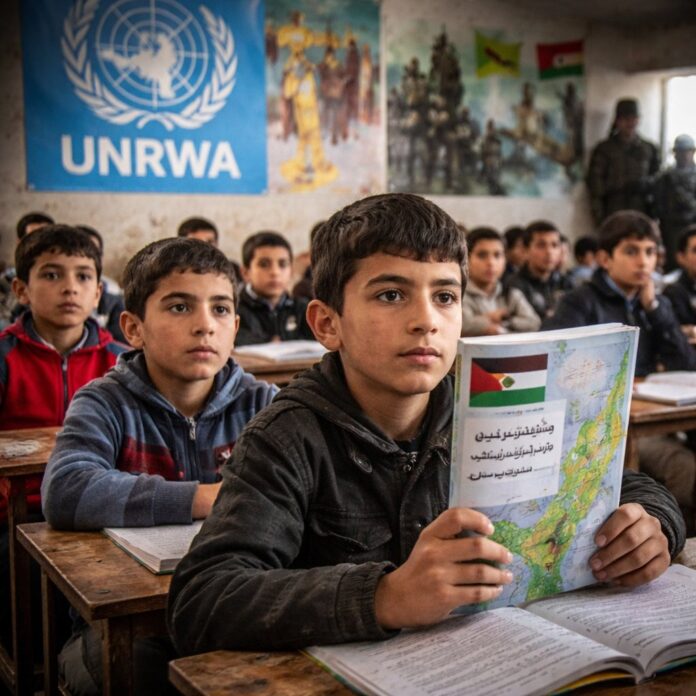
A new investigative film and research initiative is set to examine the role of the United Nations Relief and Works Agency for Palestine Refugees in the Near East, known as UNRWA, with a focus on refugee education, funding, and curriculum in Gaza and other Palestinian refugee camp environments.
The project, which includes an on location documentary and accompanying academic study, aims to analyze how refugee identity and historical narratives are taught across generations. Researchers involved in the initiative say the study will review educational materials, funding sources, and classroom messaging to assess how these factors influence political attitudes and long term conflict dynamics.
UNRWA was established in 1949 by the United Nations General Assembly to provide humanitarian assistance and social services to Palestinian Arab refugees following the 1948 Arab Israeli war. According to UNRWA’s official reports, the agency currently serves approximately 5.9 million registered refugees across Gaza, Judea and Samaria, Jordan, Lebanon, and Syria. Its services include education, healthcare, social services, and emergency assistance.
Education represents one of UNRWA’s largest operational sectors. The agency reports that it operates more than 700 schools and educates hundreds of thousands of students annually. UNRWA has stated publicly that its curriculum aligns with host authority education systems while incorporating United Nations values such as human rights, neutrality, and conflict resolution.
The forthcoming investigation will focus in part on refugee camp schools in Gaza. Researchers say they plan to review textbooks, classroom materials, and educational programming to better understand how historical narratives and political perspectives are presented to students.
The research team includes veteran Arabic language expert Dr. Arnon Groiss and Israeli security analyst Dr. Roni Shaked. Both have previously conducted studies examining Palestinian Authority textbooks and educational content. Their earlier research involved reviewing hundreds of textbooks used in Palestinian schools, with findings published in academic and policy reports.
According to the project organizers, the documentary component will include interviews, classroom observations, and documentation of educational environments within refugee camps. The film is expected to present findings from fieldwork conducted on location in Gaza, subject to security and access conditions.
UNRWA has consistently stated that it maintains strict neutrality and adheres to United Nations standards in its educational programming. The agency has also emphasized that it operates under international oversight and undergoes regular audits by donor governments and independent evaluators.
UNRWA’s funding comes from voluntary contributions by United Nations member states and other international donors. According to the agency’s financial disclosures, dozens of countries contribute to its annual budget, which supports humanitarian and educational programs. The agency has acknowledged ongoing financial challenges and has called on donor nations to maintain support to ensure continued delivery of services.
Critics of UNRWA, including some Israeli officials and policy organizations, have argued that aspects of refugee education and institutional structure may contribute to prolonged political grievances rather than resolution. UNRWA has rejected such claims, stating that its mandate is strictly humanitarian and educational.
The new documentary and research initiative seeks to contribute additional data and documentation to ongoing international discussions about refugee education, humanitarian assistance, and the future of the Israeli Palestinian conflict.
Researchers involved in the project say their goal is to present primary source material and firsthand observations to inform policymakers, educators, and the public. The findings are expected to be released in both film and written report formats following completion of field research and analysis.
The investigation comes at a time of renewed global attention on Gaza, refugee conditions, and the role of international organizations in humanitarian and educational efforts. Observers say the study’s conclusions could influence future debates over education policy, donor funding, and conflict resolution efforts in the region.
A final note: On Feb 19, President Trump plans to roll out his peace council, oblivious to the fact that we have documented on film that Trump has transformed Gaza into a staging ground for yet another total war on the Jews.
To support the documentary, visit here.
Pressure Points: School Books in Qatar Continue to Teach Hatred of Jews and Israel
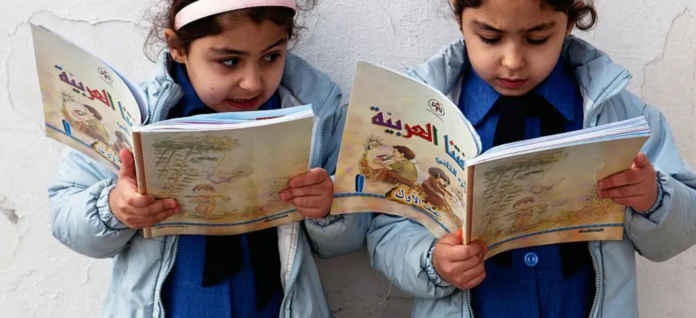
Despite its efforts to present itself as a modern state that promotes stability and peace in the Middle East, Qatar continues to teach its children contempt for Jews, Judaism, and Israel.
That is the conclusion of a new study of Qatari school textbooks, entitled “Review of The Qatari National Curriculum 2025-2026 Grades 1-12” that was conducted by the Institute for Monitoring Peace and Cultural Tolerance in School Education known as “ IMPACT-se,” the invaluable NGO that studies school texts around the world.
Here is what the report’s Executive Summary concluded:
Textbooks continue to teach antisemitic content. This consists of religiously motivated polemic, portraying Jewish people as materialistic, arrogant, deceitful, and hostile to Islam. Jews are further associated with traits such as lying, scheming, fleeing in fear, spreading discord, breaching agreements, and excessive attachment to material wealth,
thereby reinforcing an image of Jews as fundamentally untrustworthy. In the context of the Arab-Israeli conflict, antisemitic tropes depict Jews as cynically manipulating global affairs. Textbooks also deny Jewish historical ties to Israel/Palestine and the right to self-determination, framing Jewish people as undeserving of empathy.
Violent jihad and the glorification of martyrdom remain prominent features. Violent interpretations of jihad prevail as religious ideals, and are embedded in a variety of contexts, particularly in Islamic education. Textbooks praise the upbringing of children “to love jihad,” and students are taught that God rewards those who fight and die for Islam by granting them entry into Paradise.
Disrespect towards non-Muslims is expressed through terminology such as “Infidels” and “pagans/polytheists,” through derogatory portrayals of non-Muslims, and through discussions of punishment for disbelief in Islam. Textbooks employ a consistently Arab nationalist, anti-Israel narrative that legitimizes violence.
Here are some examples from Qatari textbooks:
— Islamic Education, Grade 6, Vol. 2, 2025–2026, p. 139: An Islamic education lesson teaches that one of the ways to measure a good Muslim woman is to raise children to sacrifice their lives, in what is understood to be violent jihad. The chapter about classical Islamic figure Nusaybah bint Ka‘b praises the fact that she raised her children “to love jihad”, pointing out that her three children later “died as martyrs for the sake of Allah Almighty”. The textbook authors describe this type of upbringing as “optimal”.
— Islamic Education, Grade 11, Vol. 1, 2025–2026, p. 147: In a subsection titled “The Duty of Muslims towards Palestine, Jerusalem and Al-Aqsa Mosque”, Qatari students are told in Islamic education that they should “exert any effort that would aid the liberation of Palestine from the Occupation” while “not conceding on any part of Palestine, for it is an Arab, Islamic land.” As the Qatari curriculum consistently identifies the entirety of Israel’s territory as Palestinian, this line seems to be asserting that Islam mandates Israel’s destruction.
— History, Grade 12, Vol. 1, 2025–2026, p. 31: An introductory page for a lesson on Jerusalem names “the Jews” as the final group in a list of “colonizers” who have set their “greedy ambitions” (aṭmā‘) on Jerusalem throughout history. Associating Jewish people with greed and colonialism contributes to their portrayal as an immoral group of people. Furthermore, the lesson concedes that Jerusalem is sacred to “Muslims and Christians” alone, conspicuously omitting its religious importance to Jews, thus effectively denying Jewish historical and religious ties to the city.
— Islamic Education, Grade 11, Vol. 1, 2025–2026, p. 146: The 1948 establishment of Israel is described as an “occupation,” with Israel referred to by a variety of terms such as “Occupation State,” “Zionist State,” and “Israeli Entity,” expressing non-recognition of its existence.
–Arabic Language, Grade 8, Vol. 1, 2025–2026, pp. 127–128, 130, 132: In an Arabic-language textbook, a poem by Egyptian poet Ali Mahmoud Taha (1901–1949) titled “Palestine” calls on Arab readers to commit violent jihad, “draw swords” and sacrifice their lives, in order to defend Palestine and Jerusalem from “the oppressors” and “the butchers”. The poem also pointedly references Jerusalem’s “churches and mosques”, ignoring the holy city’s significance to Judaism.
— History, Grade 12, Vol. 2, 2025–2026, p. 74: Students learn that during the Second Intifada (2001–2004), Palestinians “resorted to military operations to face the Occupation’s crimes”, in reference to suicide bombings and other terror attacks against Israeli civilians which characterized that period. The lesson effectively legitimizes violence against civilians, in violation of international law and the Oslo Accords, while blaming Israel for presumably forcing Palestinian groups to resort to such methods.
— History, Grade 12, Vol. 2, 2025–2026, pp. 42–43: The internationally recognized pre-1967 territory of Israel is labelled “Occupied Palestine” in maps outlining borders following the wars in 1948 and 1967. The map does not label the Jordanian and Egyptian occupation of the West Bank and the Gaza Strip during the 1949–1967 period.
— Geography, Grade 12, Vol. 1, 2025–2026, p. 134: A geography textbook describes the Sea of Galilee as being in “Palestine”, despite it being located in internationally recognized Israeli territory.
— Geography, Grade 12, Vol. 2, 2025–2026, p. 180: Israel is not included on a regional map of the Middle East and North Africa in a geography lesson about borders. Instead, the entire territory is labeled “Palestine”, in defiance of international resolutions affirming Israel’s existence and territory.
All of this is at variance with Qatar’s self-depiction as a force for stability and balance in the region. Moreover, there have been no improvements over time in Qatari texts: as the IMPACT-se report states, “All previously identified problematic content in Qatari textbooks remains unchanged for the fourth consecutive year.”
Throughout the Middle East, IMPACT-se has found many efforts to modernize school curricula and foster peace and tolerance. But that is not the case in Qatar, whose efforts seem to be focused on public relations campaigns and Qatar’s image rather than changing what it teaches its children.
It’s Noon in Israel: Has Bibi Finally Had It With Trump?
It’s Sunday, February 8, and a broken clock has to be right at least once, right? According to Iran, their talks with the U.S. in Muscat on Friday concerned “only” the nuclear issue—despite the initial position that ballistic missiles, regional proxies and Iranian protesters would all be on the table.
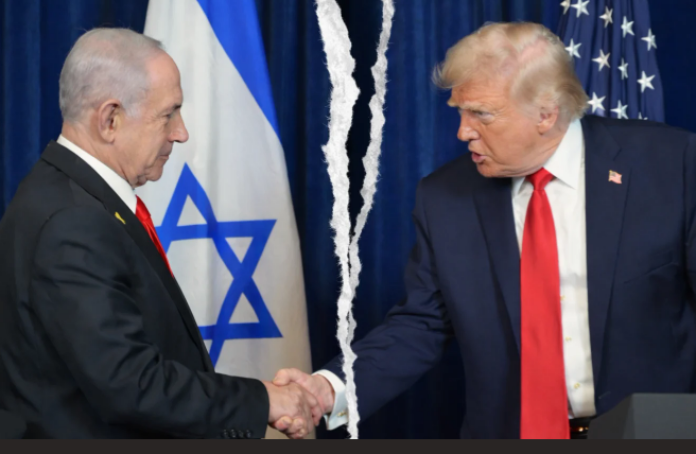
Now Benjamin Netanyahu is scheduled for a Wednesday visit to Washington to discuss the talks. After so many false readings, has the daylight between Israel and the United States finally materialized?
Well, let’s slow down.
So far, nothing combative has come out of Jerusalem. Then again, to date, Netanyahu has never publicly confronted Donald Trump. The worst he has done was issue a midnight statement against Trump’s Board of Peace for allowing a Palestinian flag in the technocratic council logo, and sent Foreign Minister Gideon Sa’ar to “talk to the Americans.” The latter sounds innocuous, but it’s a snub—where the U.S. is concerned, Netanyahu is the foreign minister.
But past experience teaches us to be cautious. Every time there’s talk of a serious rift, it later turns out to be the opposite of what it appeared. The most prominent examples being Operation Rising Lion, the end of the war in Gaza, and several other episodes that were initially interpreted as confrontations and later revealed to be coordination.
I would suggest two alternative possibilities for the current perceived tension.
The first is that the Americans—like anyone with basic common sense—understand that asking Ayatollah Ali Khamenei to swallow four cups of poison may be too much, even for him. His predecessor, Ruhollah Khomeini, claimed to have drunk the “poison” of ending the Iran-Iraq War without total victory—and survived. But the chances that Khamenei can stomach the loss of the nuclear program, ballistic missiles, the dismantling of Hezbollah and Hamas, and ending the killing of demonstrators are low.
If that’s the case, an attack remains more likely than not. And when it happens, Netanyahu will say: Look, I helped bring this about by insisting on pushing the demands.
The second possibility is simpler.
Netanyahu was meant to attend a meeting of Trump’s Board of Peace in Washington next week. A photo of him sitting next to Qatar and Turkey in any context—especially when discussing their American-ordained future role in Gaza—is not one he wants circulating in an election year. Fake tension with the U.S. that precipitates an earlier visit may simply be Bibi’s way of taking a rain check.
The answer will have to wait for Wednesday, Netanyahu’s seventh Trump visit since the latter’s second inauguration.
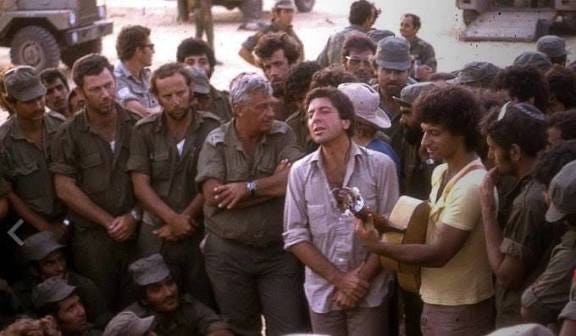
Leonard Cohen singing for soldiers during the 1973 Yom Kippur War, with General—and future Prime Minister—Ariel Sharon on the left and Israeli musician Matti Caspi on the right.
This morning Israel lost one of it’s music legends, Matti Caspi. In Israel, Caspi was one of the defining voices of the 1970s, known for songs like “Lo Yadati SheTelchi Mimeni” (“I Didn’t Know You Would Leave Me”) and “Brit Olam” (“Covenant of Love”). For non-Israelis, he might have more significance as a little-known partner of the “poet of rock,” Leonard Cohen.
Many people will recognize the iconic photographs of Cohen visiting the Sinai Peninsula to entertain disheartened Israeli troops during the 1973 Yom Kippur War. Less well known outside Israel is that Caspi was by his side on that journey. The song Leonard—going by his Hebrew name, Eliezer—wrote during the visit, “Lover Lover Lover,” was arranged with Caspi’s help.
During the visit, under the heading “Air Base,” eight lines appear in Cohen’s handwriting:
I went down to the desert
to help my brothers fight
I knew that they weren’t wrong
I knew that they weren’t right
but bones must stand up straight and walk
and blood must move around
and men go making ugly lines
across the holy ground
Cohen later had second thoughts about his involvement, crossing out the line “to help my brothers fight” and replacing it with “to watch the children fight.” Throughout that intense and emotionally charged journey, Caspi was by the poet’s side.
Caspi’s loss is a significant one in Israel’s musical history—and, to borrow Cohen’s words from Tower of Song: “I bid you farewell, farewell, farewell.”
For more on Leonard Cohen’s journey, check out Matti Friedman’s excellent book, Who by Fire: War, Atonement, and the Resurrection of Leonard Cohen.
In Israel, I’m often asked how I get to the TV studio so fast.
Many of you know I’m an Orthodox Jew, which means that from sundown on Friday until the stars come out on Saturday, I observe Shabbat: no electricity, no work, and definitely no driving. I don’t live at the studio—and yet every Saturday night I appear on Channel 12 just after Shabbat ends.
Burn the kitchen down
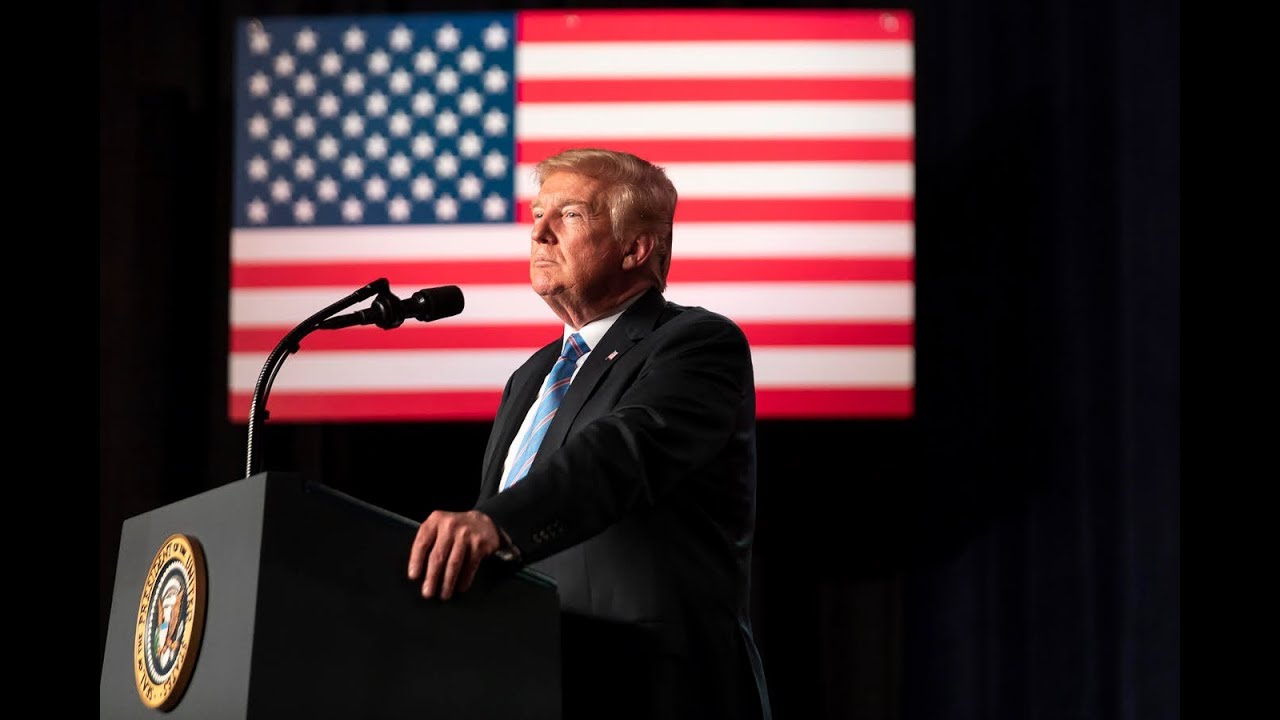
Trump must strike at Iran now. If his bluster against Iran and his promises of “help on its way” to the Iranian people occasion just another Obama-style soft deal that kicks the Iranian nuclear can down the road – then Trump’s presidency is finished. He will never be the “transformational” president with “historic” achievements in international affairs that he so explicitly wants to be.

The oh-so-sophisticated foreign policy specialists and expert defense analysts are out in full force explaining to anybody who will listen that it would be a mistake for US President Trump to attack Iran.
A military assault on Teheran will not save the brave Iranian protesters from savage repression by the Basij and Revolutionary Guard Corps, say the “experts.” It won’t bring about regime change; it will only rally Iranians around the regime. At best it will bring to power an alternative Iranian dictator, a military general perhaps, who will be as repressive and aggressive as the ayatollahs. It will only dent and delay the Iranian nuclear weapon and ballistic missile programs.
Yes, yeah, yeah, all that may be partially true, but this (mis)analysis misses the point: That a significant US strike on Iran is critical to resetting the regional and international balance of power.
A crushing military blow on Iran is necessary to create a Middle East and a broader world where Washington and its friends are far stronger, and its enemies far weaker, than ever before. Indeed, that is what Trump’s second term as president is all about.
As Elliott Abrams wrote last spring in Foreign Affairs, “The United States now has a chance to keep Iran and its allies off balance. Because the only true solution to the problem of the Islamic Republic is its demise, the United States and allies should mount a pressure campaign on behalf of the Iranian people – who wish for the regime’s end more fervently than any foreigner.”
“(Occasional) negotiations (with Iran) should be viewed as a tactic in the long struggle for a peaceful Middle East – a goal that cannot be reached until the Islamic Republic is replaced by a government that is legitimate in the eyes of the Iranian people and that abandons its terrorist proxies, its hatred of the United States and of Israel, and its desire to dominate other countries in the region. Until that day, the military presence of the United States must not diminish…,” according to Abrams.
To which I add that Trump’s plans for “winning” in the global struggle against China and his hopes for a reset in relations with Russia depend to a great extent on proving his mettle in confrontation with Iran.
If Trump’s bluster against Iran, and his promises of “help on its way” to the Iranian people, occasion just another Obama-style soft deal that kicks the Iranian nuclear can down the road – then Trump’s presidency is finished. He will never be the “transformational” president with “historic” achievements in international affairs that he so explicitly wants to be.
US Ambassador to Israel Mike Huckabee said it colorfully this week. In his trademark forthright and folksy style, Huckabee noted that “many plates of poison” are coming from Iran, and that it is best to “burn the kitchen down” than simply “changing the menu.”
“Many plates of poison – Hamas, Islamic Jihad, Hezbollah, the Houthis – are being served all out of the same kitchen, Tehran,” Huckabee remarked at the International Conference on Combating Antisemitism in Jerusalem. “You can change the menu; (but it is) better to burn the kitchen down and not let them serve those plates anymore.”
THERE IS SO MUCH that must be done to put Iran back in its box; to end its hegemonic advances.
According to US Admiral James Stavridis (former head of global operations for NATO, dean emeritus of the Fletcher School of Law and Diplomacy at Tufts University, and author of a chilling must-read book about a war with China, 2034: A Novel of the Next World War), the US can strike high-value leadership targets (including the mullahs), and command-and-control facilities of the Revolutionary Guards and the conventional military.
The US also can hit Iran’s logistics supply chain for both the military and the civilian police including the ironically named “morality police;” and critical elements of the Islamic Republic’s energy infrastructure such as maritime installations, refineries, and port facilities.
Non-kinetic options listed by Stavridis include offensive cyber activity against Iran’s energy sector, consumer supply chains, military command and control nodes, police and Revolutionary Guard facilities, telephone systems, and military-production infrastructure, notably facilities that produce drones and ballistic missiles.
And then, maybe, the so-called international community will get serious about implementing the multiple rounds of sanction regimes against Iran that have been passed by the UN Security Council (but never taken too seriously by America’s Western allies).
This includes six UNSC sanctions resolutions (numbers 1696, 1737, 1747, 1803, 1835, and 1929, passed between 2006 and 2010) that were reimposed last September after Iran was found by the IAEA to be in “continuing significant non-performance of its nuclear commitments.”
And then there are the new rounds of restrictions on business and government dealings with Iran passed by the EU after Tehran’s recent slaughter of its protesting citizenry (and also in response to Iran’s support for Russia’s war against Ukraine). The EU even, finally-finally, agreed to include the IRGC on its list of terrorist organizations. Even the supercilious French agreed to do so.
There is more to be done. Richard Goldberg of the Foundation for the Defense of Democracies in Washington has published a manifesto for “maximum pressure” on Iran that goes far beyond “maximum sanctions.” This includes an end to all sorts of waivers and licenses that facilitate Iranian world trade, rigorous sanctions enforcement (mainly targeting Iran’s oil trade with China), multilateral sanctions on third-party countries (including European countries) that facilitate Iranian banking and Iranian-backed radical Islamist NGOs in the West, and more.
Gregg Roman of the Middle East Forum has published a comprehensive strategy for democratic transition in Iran that should have been put in place years ago. This involves an aggressive information campaign, amplifying internal pressures backing opposition ethnic groups, leveraging regional cooperation networks, and kick-starting transition planning for post-regime scenarios. This would include political warfare against the regime: Constant criticism of its economic failings and brutality, and overt and covert aid for efforts by Iranians to protest a regime most of them clearly loathe.
THIS IS THE PLACE to credit Nadim Koteich for his important article this week entitled “Khamenei Can’t Give Washington What It Wants.” He points out that the prevailing (and mistaken) consensus in Western capitals, articulated most recently by Trump administration envoy Steve Witkoff, is that when faced with the specter of total collapse, Iran will trade its ideological soul for its material skin.
After all, from a Western, neo-liberal perspective, a “Great Bargain” with Trump is Iran’s only logical exit from the current crisis.
But this rests on a fundamental category error: That the Iranian regime is a rational, utility-maximizing actor. It is not. Rather, the ayatollahs “preside over a Byzantine structure where reform is not a lifeboat, but a torpedo. They are running a regime based on a theology of absolute power, on metaphysical claims to divine legitimacy.”
Ayatollah Khamenei sees himself as guardian of a holy revolutionary state whose preservation supersedes even the fundamental pillars of Islam. “By descending from the sacred to the negotiable, Khamenei would effectively abolish the theological basis of his own office.” As a result, he cannot and will not “discard theology for the hard metrics of realpolitik.”
Therefore, Iran is a brittle system that has mistaken rigidity for strength. “When Khamenei says that American demands are impossible, we should believe him. The regime he has spent a lifetime fortifying, is designed to break, not to bend.”
I say: Time to break Iran, to burn down its kitchen and then manage the consequences of a fracture that is now historically inevitable.
The alternative is far worse. Surrendering to Iran will inexorably lead to surrendering to Hamas in Gaza, to Turkey and Qatar in Syria and Lebanon, to China in Taiwan and in Africa, to Russia in Ukraine, and to the forces of radical Islam in Europe and in America itself.


