Eye on Syria: Timely Report on Developments

Welcome to Eye on Syria, a timely report on developments in Syria as well as a review of pertinent articles in the Syrian official press as well as what is written about Syria. The service is meant to illuminate Westerners to one of the most closed societies in the world. The report is based on facts and analysis culled from numerous Syrian and Arab newspapers as well as diplomatic sources by correspondents in Jerusalem, London and Cairo.

First, a quick look at the Syrian media. Syrian newspapers, radio and television are all owned and controlled by the regime. Nothing appears in the media without the approval of authorities. Broadcasters are given text to read and have no room to improvise.

Syria has one radio station, television station and news service. They are leaden and dull but they faithfully reflect propaganda from Damascus. Slogans are repeated ad nauseum in a reflection of the highly ideological regime. We will spare subscribers of the rhetoric and, instead, give the main points of the media.

There are four Syrian dailies and they are remarkably similar. Al Baath is the newspaper of the ruling Baath Party. It focuses on so-called popular issues, largely the activities of the party around the country. Al Thawra is the ideological organ of the Syrian regime. Tishrin is the government daily. The Syrian Times is the English-language daily.

Quote of the day:

“The issue of the Lebanese resistance is a matter for Lebanon to discuss.” –Syrian Foreign Minister A-Shaara rejects calls for Syria to crack down on Hizbullah military campaign against Israel.

Today in Syria

  1. Assad Losing Control of Family Feud
  2. Bashar Assad Expected to be Given High Post
  3. Syria Links Lebanese Talks to Israeli Withdrawal
  4. Syria Admits Killing of Major Islamic Leader
  5. Iraq, Syria Agree to Reopen Pipeline
  6. Iran: We Support return of Golan
  7. Syria Allows Criticism of Peace Talks

Assad Losing Control of Family Feud

Syrian President Hafez Assad, growing increasingly weak, is spending much of his time as peacemaker to quell the feud within his family over the grooming of his elder son Bashar as heir.

Intelligence sources in Washington, Tel Aviv and Paris said the difficulties faced by Assad in grooming his son as successor is pushing the president to win the Golan Heights in a treaty with Israel. They said this is the main reason Assad decided to resume talks with Israel last week.

“Until now,” an authoritative U.S. defense source said, “Assad felt that even if Syria wouldn’t get the Golan back, he could still ensure that Bashar takes over. Now, he’s no longer sure.”

Sources said the most intense opposition to Bashar, a congenial British-trained opthamologist, appears to be within the family and leading members of Assad’s Alawite sect.

“Clearly, something is wrong in the family, particularly among the children,” a source with excellent ties to the Syrian leadership said. “Assad has no choice but to intervene and make peace.”

The sources said Assad has failed to win his son a seat in the Baath Party inner leadership, a prerequisite for any president. They said a party congress to consider the issue is scheduled for spring of 2000.

“Why the delay?” a source asked. “Assad can easily move up the date. What appears to be the case is that there is too much division in the family and this has affected the other Alawites.”

The sources said the effects of the shooting of Assad’s son-in-law Assaf Chawkat, head of military intelligence, in November by Assad’s son, Maher, another military commander, continues to ripple through the ruling family. They said the tension is being compounded by Chawkat’s wife and Assad’s daughter, Bushra.

“We are dealing with a very vocal and dynamic woman, which is extremely rare among the Alawaites,” a source said. “She has very strong views about the succession issue.”

Chawkat is said to support the 34-year-old Bashar as successor to the president. The younger Maher is said to oppose the choice.

Lebanese sources following the succession issue said Bashar lacks determination and is “at best half-hearted” in his drive to become president. They said he made a poor impression during his visit to Paris last month during which he met French President Jacques Chirac.

The sources said Assad’s health is increasingly deteriorating. The president works at most 2-3 hours a day and his mind often wanders at meetings.

They said Assad no longer travels and contributes little in meetings. They said in meetings with U.S. and other Western officials, Assad will say several words and his translator will go on for several minutes.

“It is obvious that the translator is told what to say in advance,” a source said.

The problem is compounded, the sources said, by Assad’s lack of capable aides. They said Assad returned the ailing Foreign Minister Farouk A-Shaara to his post because he couldn’t find anybody else trustworthy to deal with Israeli and U.S. officials.

A-Shaara, a member of the Sunni Muslim majority, rather than Bashar, the sources said, is being employed to lobby the ruling Baath Party to support negotiations with Israel. European Union peace envoy Miguel Moratinos told Israeli officials last week that A-Shaara spent five hours trying to persuade the Baath Party’s central committee to support the negotiations.

A-Shaara was said to have been slated for retirement. But Arab diplomatic sources on Dec. 21 said Assad plans to name A-Shaara as Syria’s new prime minister. The London-based A-Sharq Al Awsat said the move could be announced on Monday and is meant to raise his title to that of Israeli Prime Minister Ehud Barak by the time the two men meet near Washington on Jan. 3.

Sources said Assad hopes to obtain billions of dollars in Western and Arab aid in the wake of a peace treaty. They said a formula is being discussed in which the European Union will contribute $3 for each $1 in U.S. aid.

Eliahu Kanovsky, a professor at Bar Ilan University and regarded as one of the most prominent economists in the Middle East, said Syria wants a quick infusion of billions of dollars in Western aid similar to that Egypt received when it signed a peace treaty with Israel in 1979.

“I believe that the economic situation, which has deteriorated in recent years, is behind the expressed willingness of Syria to seek a peace agreement with Israel, hoping that this will save the situation,” Kanovsky said in a study.

Bashar Assad Expected to be Given High Post

The son and heir-apparent of Syrian President Hafez Assad is expected to be appointed to a senior post, diplomatic sources said.

The sources, who monitor developments in Syria, said the president appears ready to embark on a new effort to advance the career of his son, Bashar, in a bid to ensure his succession. They said the 34-year-old Bashar is being considered to a senior government post.

That move, the sources said, will probably involve appointing Bashar to a leadership position in the ruling Baath Party. A session of the Baath Party Central Committee is not scheduled until the spring but Assad could call for an early convention.

The sources said the appointment of Bashar will probably be announced as part of a new Cabinet. Assad is expected to appointed Foreign Minister Farouk A-Shaara as prime minister. The London-based A-Sharq Al Awsat daily said on Dec. 21 that A-Shaara will keep his post at the Foreign Ministry.

The newspaper said the new government is expected to be announced before the start of the next round of Israeli-Syrian negotiations on Jan. 3. Syria has pledged that it will maintain an equal level of representation at the negotiations, the Israeli team of which is led by Prime Minister Ehud Barak.

During A-Shaara’s illness in October and November, Bashar served as de facto foreign minister and was sent to Paris to hold talks with French President Jacques Chirac as well as visits to the Gulf states. Bashar is believed to have also been placed in charge of Syrian-Iranian relations, regarded as the most sensitive element in Syria’s foreign policy.

The diplomatic sources said Bashar’s key role has been trying to drum up Gulf financial support for Syria. The efforts appear to have led to results.

On Monday, Kuwait agreed to grant a loan to Syria to develop infrastructure projects. Syrian Minister of State for Planning Abdul Rahim Sbei and the director general of the Kuwaiti Fund for Arab Economic Development, Bader Hameidi, signed an accord whereby the fund will provide a loan of 6 million Kuwaiti dinars help finance a provincial highway in the north.

The Kuwaiti fund has provided Syria with 25 loans. Diplomats said Kuwait has agreed to consider financing other projects in Syria in the fields of communications, electricity and sewage.

Syria Links Lebanese Talks to Israeli Withdrawal

Syria has delayed a green light for Lebanon to join negotiations with Israel until the Jewish state issues a commitment to withdraw from the entire Golan Heights.

The London-based Al Hayat daily said on Dec. 21 Syrian leaders have told their Lebanese counterparts that they are waiting for an Israeli commitment to withdraw to the June 4, 1967 lines, the eve of the Six-Day war in which Israel captured the Golan Heights and other territory. So far, Israel has objected.

The newspaper said this will be the major demand by Syrian Foreign Minister Farouk A-Shaara in the next round of negotiations with Israel, scheduled for Jan. 3 at a secluded location in Virginia. Earlier, President Hafez Assad told U.S. President Bill Clinton that neither Lebanon nor Syria would sign a separate peace treaty with the Jewish state.

On Dec. 20, A-Sharaa briefed President Emile Lahoud, parliamentary speaker Nabih Berri, Prime Minister Salim Hoss, and Interior Minister Michel Murr at Baabda Palace. He said the decision whether to allow Lebanon to begin talks would be made after the next round of Israeli-Syrian negotiations.

A-Shaara grew testy when he was asked by a reporter when Syria would withdraw its 40,000 troops from Lebanon. “Nobody has the right to ask this because we have not heard of this [demand],” the foreign minister said.

The Syrian foreign minister said the priority in the current negotiations is the return of Israel to its June 4, 1967 borders, the eve of the Six-Day war. That is to be followed by an Israeli withdrawal from the Golan Heights, relations with Israel and water issues.

“The elements of peace are known,” A-Shaara said.

A-Shaara would not say whether Syria has fulfilled a U.S. demand to press the Hizbullah and Amal militias to end their attacks on Israel.

“The issue of the Lebanese resistance is a matter for Lebanon to discuss,” he said, adding that Syria “understands the role of the resistance in Lebanon and the important role Lebanon has played in defending its rights against the Israeli occupation.”

Syria Admits Killing of Major Islamic Leader

Syria, seeking to head off concern of increasing unrest, has acknowledged that a leading Islamic cleric was assassinated in what the regime asserts was a criminal attack.

Syrian sources said Sheik Mohammed Amin Yakan, 62, was assassinated on Dec. 16 as he was driven to Tarhin village near Aleppo. They said four suspects were arrested and two remain at large.

Yakan was a leader in the Muslim Brotherhood and served as a mediator for President Hafez Assad in his attempts in 1997 to reconcile with the underground Islamic opposition. Assad drove the Brotherhood underground in 1984 in a campaign that was said to have killed 20,000 opponents of the regime.

On Dec. 21, the London-based Al Hayat daily quoted official Syrian sources as saying that Yakin was killed in a hail of gunfire by opponents trying to reverse a government decision on land use. They said the sheik was responsible for a piece of land being sought by an Aleppo-area family and designated for the construction of a research center.

The suspects were quoted by Syrian sources as saying that they meant to shoot toward Yakin’s car to intimidate him. They said they did not mean to kill him.

The sources said Syrian authorities are continuing their investigation. Diplomatic sources said the killing has raised tension around Aleppo and the surrounding area and could point to a loosening of President Hafez Assad’s grip on power as his health deteriorates and his family is divided.

Syria, the sources said, is undergoing a creeping process of Islamization, with Islamic fervor increasing both in Damascus and particularly in provincial cities. They cited an increase in mosque attendance, beards and public observance of the fast month of Ramadan.

The Islamization has a militant side, the sources said. They report that Christians and non-Sunnis are expressing rising concern over pressure to observe Muslim tenets in towns with large non-Sunni minorities.

Iraq, Syria Agree to Reopen Pipeline

Iraq and Syria have agreed to reopen an oil pipeline shut down since 1980.

The reopening of the oil pipeline would allow Iraq to export oil through Syria to Western Europe at reduced cost. The pipeline will also bring revenue to Syria.

Officials said the pipeline has a capacity of 300,000 barrels a day. It was closed by Syria after Iraq invaded Iran, Syria’s leading ally.

For years, Iraq has been exporting oil the Iraqi harbor of El-Bakr on the Gulf and through a pipeline that passes through Turkey to Jihan harbor on the Mediterranean Sea.

Oil analysts said the reopening of the pipeline through Syria could lead to an increase in Iraqi exports. They said it would also reactivate the Gulf harbor at Khour El-Amia.

They said Iraqi oil exports could be increased from nearly 600,000 barrels daily to nearly 2.9 million barrels daily for the coming year.

In another development, the U.S.-based Largo Vista Group Ltd., said it reached an agreement for 49 percent of a joint venture to establish operations in the United Arab Emirates for distribution of petrochemical products worldwide. Majority share would be held by the UAE’s Silver Falcon.

Iran: We Support return of Golan

Iran has provided a qualified endorsement of Syrian negotiations with Israel.

In its first official response, an Iranian Foreign Ministry spokesman said Teheran supports Syria’s efforts to obtain the Golan Heights. The spokesman said Iran understood that this would mean negotiations with Israel.

Hamid Asefi, the spokesman, said Teheran did not regard Syrian negotiations with Israel as part of the Middle East peace process opposed by Iran.

“The Syrians have also proved that they move in line with their rights,” Asefi said on Dec. 21.

But the spokesman said Iran, Syria’s leading ally, will continue to oppose reconciliation with and recognition of Israel. He said the Palestinians are making concessions to Israel on their basic rights.

“No progress has been made regarding the restoration of Palestinians rights” Asefi said.

The break in nearly two weeks of silence by Iranian officials come as Bashar Assad, the son and heir-apparent of President Hafez Assad, is expected to arrive in Iran over the next 48 hours to meet leaders of the Islamic regime. The focus of the talks will be the Israeli-Syrian negotiations.

On Dec. 19, the Kayhan International daily, which is aligned with the ruling Islamic clergy, raised the specter that Israel and Syria might reach a peace agreement. The newspaper said Iran would not stand in the way of such a development but would not join any reconciliation effort.

“Although there has been some sort of a mixed reaction in the Islamic republic over the resumption of Syrian-Israeli talks, political observers believe that at the end, Iran cannot be more Syrian than Assad but at the same time maintain its position that Israel is an illegitimate entity,” the newspaper said.

The mild tone constrasted with assessments reported in Israel. Israeli government sources said on Dec. 20 that European Union Miguel Moratinos brought a message from Syrian leaders to their Israeli counterparts that expressed Assad’s fear that Iran and Hizbullah would torpedo any agreement.

The message urged Israel to quickly agree to a peace treaty before Iran and Hizbullah could organize opposition.

Kayhan said it expected tough negotiations between Israel and Syria in a land-for-peace deal. The newspaper said the Golan Heights is of “crucial strategic importance” for both Israel and Syria.

Iran, the daily said in an editorial, has been cautious in its response to Syria’s efforts. Kayhan said that since Syria first agreed to negotiate with Israel, Iran has done little more than express implicit criticism.

Earlier, the Iran News said Teheran is divided over Syrian talks with Israel. The argument pits those who urge Iran to prepare for joining the process of reconciliation with Israel against those who pledge never to make peace with the Jewish state.

Iranian parliamentary speaker Ali Akbar Nateq-Nouri urged the Islamic world not to reconcile with Israel and instead bolster its militaries. In a speech at Teheran University, Nateq-Nouri said, “Palestine is for Palestinians. The thieves have to leave so we can go back home.”

Syria Allows Criticism of Peace Talks

In an unusual move apparently designed to increase support for any peace treaty and forshadow official policy, the regime of President Hafez Assad has allowed criticism of Syria’s decision to resume negotiations with Israel.

A Syrian writer has warned that Israel stands to gain more from a peace accord than Syria and warned against normalization of relations with the Jewish state. This could harm Syria’s relations with the Palestinians and Arab regimes in the Middle East.

Ali Orsan, chairman of the Syrian Arab Writers Association, said Damascus has signalled that it will make significant concessions to Israel in return for the Golan Heights and allow full Israeli control of the Sea of Galilee and an Israeli presence in an early-warning station on Mount Hermon.

“The success of these negotiations will facilitate many dangerous Arab changes regarding the Arab-Zionist conflict,” Orsan wrote in the Al-Usbu al-Adabi magazine. “The Zionist occupier will have recognized borders, water, normalization and a reputation for striving for peace. We, on the other hand, will remain with thorns stuck in our throats.”

Orsan is regarded as heading an organization subservient to the Syrian regime and excerpts of his article were also published in the London-based Al Hayat daily.

Western diplomats said the criticism voiced in Syria was meant to prepare Syrians and other Arabs for normalization of relations with Israel that would include full diplomatic ties, open borders, tourism and trade. Another aim, they said, was to signal Syria’s pledge to help the Palestinians after a peace treaty is signed by Damascus and the Jewish state.

Arab diplomatic sources and report asserted that Syria has rejected the opening of embassies until the “last Israeli soldier” leaves the Golan Heights. The Al Hayat daily said Syria has also rejected an Israeli proposal for an exchange of territory to ensure that Israel maintains the Hamet Gader outpost, which oversees the Yarmouk River.

Orsan said Syria won a “political victory” when Israel agreed to resume negotiations at the point they were suspended in 1996, an implicit recognition that the late Prime Minister Yitzhak Rabin pledged a full withdrawal from the Golan Heights. But this does not mean that Israel will honor such a commitment.

“This omission does not mean Syria failed to learn the lessons of the past, when Zionist deception was revealed on several occasions,” Orsan wrote. “It is sufficient to mention the American attempts to evade Rabin’s deposit in order to force Syria to resume the negotiations without mentioning the progress that was achieved at the Wye Plantation. It is possible that Syria received a written American guarantee for a withdrawal to the June 4, 1967 border, but the question remains whether this issue has become inevitable from the Israeli perspective? I seriously doubt it.”

“It seems that this issue will become one of the obstacles the negotiators will face, but will not lead to the breakdown of the new negotiations, nor will it prevent the forging of some mutual understanding,” he added.

Orsan appeared to confirm reports that Syria has agreed to an Israeli presence in the establishment of an early warning station on Mount Hermon, the highest point in the region. He said security arrangements and water-sharing, particularly Israel’s insistence of full rights to the Sea of Galilee, have been obstacles to a peace treaty.

“It is plausible that security, emphasized by the Zionist entity, achieved the understanding of the Syrians regarding the early warning station in the Hermon,” Orsan said. “The Syrian side will also consider the Zionist entity’s need for water. We may not be able to legally drink from the water of Tiberias [Sea of Galilee] but we would be able to fish in it, using long arms. There may be some merely cosmetic modifications to the border that would connect the principle of the June 4, borderline with the so-called international border, drawn by Britain and France in 1923.”

But Orsan, in what could forshadow the intentions of Damascus, said after a peace treaty, he will focus on ending Israeli occupation of the Palestinian territories.

“The Arab-national aspect of the Palestinian problem is stronger within me than all the marginal [interests] of [one Arab] country,” Orsan wrote. “The problem of Palestine will remain an existential conflict with the Zionist occupiers, until victory, the removal [of the Zionists], and the liberation, even if it takes a hundred years.”

The Man Who Convinced Eshkol

The course of history can be changed by the determination of one man who stands up for what he believes in when he is listened to by people who are in a position of power.

The initiative to demand that Israel take the Golan Heights came from not from real estate-seeking settlers who wanted to move to the Golan, but rather from the residents of the Upper Galilee, or, to put it better, directly from the regional Mayor of the Upper Galilee, Yaakov (Yankela) Eshkoli, the man who led the delegation of Upper Galilee residents to lobby Israeli Prime Minister Levi Eshkol and the Israeli government on the fourth night of the Six Day War.

Eshkoli’s mission: to convince Eshkol to issue an order to the Israel Defence Forces Northern regional command to take the Golan Heights and to remove the Syrian threat, once and for all, from over the heads of the Galilee settlements.

Eshkoli, now 88, was elected four times to be the regional mayor of the Galilee, and served in his position from 1955-1971

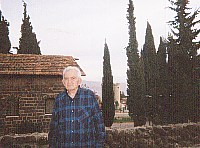
Speaking with remarkable resilience and a clear memory after 20 years of severe heart disease, the aging Eshkoli, with his ninety year old wife Yaffa at his side, cannot keep repeating how pleased he is that he has lived to tell his story, while talks with Syria get under way and while the future of the Golan is indeed on the agenda.

“13 years ago I had a heart attack and the doctors declared me to be clinically dead. I guess I recovered so that I could tell my story today”, Eshkoli says, with a wink and a twinkle in his eye, when I met him on his porch, on Kibbutz Cfar Giladi.

Cfar Giladi is one of the oldest Galilee settlements, located just north of Kiryat Shmoneh and sandwiched in between Lebanon and the Golan Heights, where he and Yaffa, now 90 years old, have been kibbutz members since 1932.

Eshkoli says that he is always eager to relate the role that he played in convincing the Israeli government to take the Golan in the midst of the 1967 war.

As Eshkoli tells it, by the fourth day of the 1967 war, it was clear that Israel had delivered a solid defeat to Jordan and Egypt.

That left Syria, which had been raining a steady stream of rockets into the Hula Valley below, leaving the residents of 31 settlements in the Upper Galilee region in Eshkoli’s jurisdiction to spend those glorious days of 1967 in deep underground bunkers, glued to their transistor radios.

Eshkoli recalls how he placed constant calls into Israeli Deputy Prime Minister Yigal Allon from his underground bunker on the Kibbutz to ask to see Levi Eshkol, then Israel’s prime minister, to demand action on the Syrian front.

Allon, the 1948 war hero who with liberated the Galilee, promised to get Eshkoli called him on the fourth day of the war with the good news that Eshkoli could meet Eshkol and the Israeli cabinet that evening, warning him that at least one senior Israeli cabinet minister opposed any move towards the Golan Heights….

Leaving his kibbutz in an army jeep, picking up Kibbutz leaders from other settlements in the region, while every kibbutz member was ordered into the shelters because of the continuing Syrian artillery bombardment, Eshkoli remembers that he had the feeling that his Hula valley was burning while the rest of the country was dancing in the streets

Eshkoli speaks of his descending the steps into the underground headquarters of the Israeli government in Tel Aviv as if it happened last night. Eshkoli gets tears in his eyes when he describes the hug that Levi Eshkol gave him when he showed up. Eshkoli that his full delegation of four be allowed to enter the cabinet meeting, and he recalls the Bible that he was asked to swear on that any matter of security that he would hear would be kept in strictest confidence.

Eshkoli was given five minutes to speak. “The longest five minutes in my life”, Eshkoli remembers. His appeal was simple and clear, when he reminded Eshkol that he and every Israeli leader who had ever come to visit him in the Galilee after Syrian rocket attacks had promised them that if there would ever be another war, that they would use that opportunity to remove the Syrian threat, once and for all.

Eshkoli reports that the one Israeli minister to oppose the idea: Moshe Dayan, the former Israeli commander in chief who had just been appointed to be Defence minister. Dayan had given the veto to his northern regional commander, “Dado” Elazar, whom he forbid to attack Syria on the Golan, “lest this cost us 30,000 dead and risk a war with the Soviet Union”, which had just pushed through a cease-fire in the UN Security Council. Dayan the war hero from the 1956 war with tremendous popular following, also made a great impression on the cabinet.

Eshkoli recalls that he then thought to himself: “Will I be responsible for world war”, and then said that ” I could only think of my wife and the children of the kibbutz who at that moment were in the shelters”. It was then that Eshkoli made a threat, which he says to this day that he meant with all his heart, which was that if the IDF does not remove the Syrians from the Golan then he would recommend that all Kibbutzim pack their bags and leave, and that the people of Kiryat Shmoneh would follow. Silence followed Eshkoli’s emotional appeal to the Israeli cabinet.

As Eshkoli turned and began to leave the meeting, Israeli Prime Minister Levi Eshkol grabbed his hand and proclaimed that “The words of Eshkoli have entered the heart of Levi Eshkol, and they will play a crucial role in what we decide to do on the Golan Heights”.

Eshkoli could not know when he left the government meeting, heading back north, whether he had succeeded in his mission. Would his words hold greater weight than Moshe Dayan?

Heading back to Kfar Giladi, Eshkoli stopped off at the bunker of the IDF Northern regional command. By then it was 5AM. “Dado” was slumped over his desk, next to a bottle of half-empty scotch.

Eshkoli reported to “Dado” what had happened at the government meeting. And while they were talking, “Dado” received a call from the Israel Defence Ministry. Moshe Dayan’s resonant voice was on the line with an order – “Ascend the Golan and Succeed” were Dayan’s words, and they were repeated on the 6AM Voice of Israel radio newsreel.

“Dado” loudly said to Eshkoli that he had succeeded with Dayan where he, the IDF northern regional commander had not.

Indeed, Dayan’s vote in the government was the lone voice in the government to vote against the Golan attack….

Dayan never forgave Eshkoli for besting him at the government meeting. Eshkoli shows me a yellowing news interview from 1976 with Moshe Dayan with the Israeli daily newspaper Yediot Aharonot, where Moshe Dayan could only recall Eshkoli and his delegation with anger and resentment, characterizing them as “Dado”‘s agents, claiming that, anyway, “the provocation’s of the Galilee farmers and fishermen in no-man’s land were the cause of the Syrian shellings”.

Eshkoli looks at the picture of Moshe Dayan and starts to yell at him “Right – All of my 31 communities provoked the Syrians from their shelters. Our provocation against the Syrians is that we live and prosper here in the Galilee, which the Syrians see as a province of their country”.

Asked about the current negotiations that might bring the Syrians back to the Golan Heights that face down on his kibbutz, Eshkoli could only raise a trembling hand and point to the hills and say that to “bring back the Syrians would be suicide for us”.

Eshkoli’s successor as regional mayor of the Upper Galilee region, fellow Kfar Giladi member Aharon Valenci, is much more sanguine in his attitude to the possibility of territorial compromise on the Golan, saying that he trusts Israeli Prime Minister Ehud Barak and that if the Syrians are serious about peace, then the issue of the Golan would not be as important as it once was, noting that “99%” of his kibbutz were supportive of the peace process with Syria. Valanci said, however, that he will wait to see what the Syrians convey to their own people in their own media.

However, another prominent Galilee kibbutz leader, Muki Tzur, from Ein Gev, on the shores of the Sea of the Galilee and meters away from the Golan Heights and what might again be Syria, writes an interview with KIBBUTZ, the magazine of the Kibbutz movement, that it was premature to take a position on the peace process.

Tzur, the 1967 author of the best selling book known as the Seventh Day: Conversations with Fighters from the Six Day War, writes in his article that Jewish and Israeli history has taught us that any peace process with Israel’s adversaries will be long, hard and complex, and that no decision can be made under the pressure of an immediate desire for peace. The price of a mistake in the peace process in the North would be guns in place once again on the Golan, trained on the 31 settlements of the Hula Valley in Israel’s lush Upper Galilee region.

Yankela Eshkoli stood up to Moshe Dayan.

That is why the guns in the Golan were removed, and that is why 33 Israeli settlements replaced 15 Syrian army camps on the Golan Heights.

Can Tyrants Make Peace? A Perspective on the Syrian/Israel Talks in Washington

One of the lessons of the twentieth century that is that a tyrant does not make peace with a democratically elected leader.

A dictator views an agreement with a democracy as one of expediency, designed to strengthen and bolster his regime of military supremacy, press censorship, government corruption and suppression of human rights and civil liberties.

A leader of a democracy believes that the spirit of freedom in his nation will preserve any such peace agreement for generations to come.

A dictator who gains tangible assets at the negotiating table thinks that he has won a battle by his sheer show of force, as he readies himself for the next round of conquest, which can be by either military or diplomatic means in the future.

A democratic leader promises “peace in our time” to his people, while the residents of his nation envision of a life of peace, for themselves and for their children.

As Israeli Prime Minister and Syrian Foreign Minister arrive for crucial talks in Washington, the media in Israel is rampant with the word “peace”. Yet the government-controlled media in Syria is rampant with the word “liberation of Palestine” as these talks begin.

Meanwhile, pundits in Israel debate the pros and cons of ceding vital security assets of the Golan Heights to Syria as the price of a peace treaty with Damascus. Yet Syrian government TV conveys a daily message to their people, promising that the Golan Heights is the first step of the Syrian nation liberating all of Palestine. “The Galilee is next, and then on to Jerusalem”, proclaim Syrian spokesman on official Damascus radio.

Tell that to most Israelis and they are incredulous.

The Jews of Israel, tired of continuous war that has plagued the Holy Land since 1936, would like to live in a nation that is not under military threat in the next century. Who wouldn’t?

Many Israeli entrepreneurs have developed recent business contacts with people in the Arab world, and they are delighted to hear a desire for peace from Arabs whom they meet with, in every walk of life.

That most certainly includes Syrians whom Israelis have been meeting with in discrete joint business ventures over the past few years.

However, what people who live in a democratic country cannot conceptualize is that a popular desire for peace may not be reflected in a totalitarian regime.

The late Prime Minister of Israel, Yitzhak Rabin, asserted in his last appearance on October 31, 1995 at the Israeli Knesset parliamentary Foreign Affairs and Security Committee that the missile capacity and military resolve of Syria, aligned with Iran and with Libya, represented a threat to the very existence of the Jewish state. After Rabin’s assassination four days later, official Syrian media praised Rabin’s killing, describing it a as a “confidence building measure”.

And after a series of bombings in Jerusalem and in Tel Aviv in February and in March of 1996, official Syrian media endorsed these “acts of liberation”. That is when talks broke down, while Shimon Peres was Israel’s Prime Minister and while Ehud Barak was Israel’s Foreign Minister.

Now peace talks resume, with Ehud Barak firmly at the helm of the Jewish state.

Has anything changed? Hardly.

Except that Barak, working closely with the outgoing Clinton administration, would like to push for a definitive peace treaty with Syria and wave that piece of paper to the people of Israel when he descends AIR FORCE ONE in Israel, arm in arm with the US president.

Yet on a more sanguine note, long time peace activist and newly elected Israeli Knesset speaker Avrum Burg said on Israeli Channel One Television two days before Burg’s departure for the US that at the only way that Syrian President Assad will be able to “sell” any peace agreement with Israel will be for Assad to make that appeal for peace directly to the people of Israel, from the rostrum of Israel’s Knesset in Jerusalem, just as President Sadat did in 1977, when he addressed the Israeli Knesset and declared – “no more war, no more bloodshed”.

Towards an Arab Comprehensive Strategy For Peace

If one reviews the peace process since its launching after the U.S. aggression against Iraq in which the Syrian regime participated, s/he will realize why the Syrians looked for a peace settlement with the U.S. rather than Israel.

President Assad believes that the U.S. can impose such a settlement on Israel. In addition, he made Israel pay a heavy price in South Lebanon. And regardless of the political changes that took place in both Israel and the US, President Assad adhered to his own negotiating strategy.

Barak, the prime minister of Israel, therefore, tailored a special strategy for his negotiations with Syria which is different from the one Israel adapted on the Israeli Palestinian track. For example, while the word security features quite often in all peace agreements with the Palestinians, the word peace dominates the dialogue between Israel and Syria. Barak claims that the security of Israel dictates the conditions of peace with the Palestinians. On the other hand, he says that peace with Syria brings security to Israel. This explains why Israel would not accept the implementation of the same negotiating strategy with all Arab countries.

Apart from how Israel differently perceives the Palestinian and the Syrian peace tracks, there are certain differences and similarities between the two tracks from our points of view as Palestinians and Syrians. Syria, like Egypt and Jordan, is seeking a permanent solution that leads to a peace accord with Israel. This helps the Syrians in adhering to their position which is derived from their interpretation of U.N. Resolution 242 and the principle of land for peace. Withdrawal from Syrian territories occupied in 1967 and not to international borders as Israel demands, will achieve peace and security to Israel. This requires certain arrangements that will be implemented following Israel s complete withdrawal from the Golan Heights.

To the Israelis, the Golan Heights is in a similar position that of Jerusalem. Both are Arab territories occupied in 1967 and were annexed by Israel in violation of international law and Geneva Fourth Convention. Unlike earlier precedents, Israel’s full withdrawal from the Golan Heights is of particular importance to the issue of Jerusalem.

It is difficult to predict what the Israeli Syrian negotiations will lead to, under the sponsorship of President Clinton. But one thing is clear. Barak, in the political arena, has a military mentality; he wants to achieve victory against more than one enemy. Although it seems that Barak has given in to the Syrian negotiating strategy, he has taken a calculated risk realizing that the U.S. role will diminish sooner than the Syrians expect. President Clinton, after all, will at a certain point be unable to impose on Barak a peace settlement on both the Palestinian and Syrian tracks. We should not forget that the U.S. presidential elections have somehow started. Barak, also, understands that he can make an achievement if he connects the Lebanese track to the Syrian one. This will enable him to withdraw his troops form south Lebanon in return for a complete withdrawal from the Golan Heights. Such a deal, selling the camel and the cat together, would guarantee the success of the referendum he promised his people.

These days, the number of observers who think that there is no war without Egypt and no peace without Syria, is on the increase. However, history shows that there is no war or peace without Palestine. Mistaken are those who believe that Israel can achieve peace with Mauritania while it continues to deny the rights of the Palestinian people. Peace with Jordan and Egypt and, in the future, with Syria and Lebanon, will remain frozen as long as Jerusalem is not the capital city of the independent state of Palestine. However, the Israelis continue to assume that peace with Syria can be achieved due to certain internal considerations that concern Syria. They also assume that stability in the area can be brought about without considering the Palestinian role. But this is not true. Comprehensive peace can not be made without solving all the permanent status issues. This requires an Arab and, in certain cases, Islamic consensus. Palestinians, for example, can not by themselves decide the future of Jerusalem without obtaining the consent of the Arab and Muslim nation. As to the issue of refugees living in the Arab world, no solution can be made without being coordinated with the countries concerned. Borders of the independent Palestine are also of great concern to all Arab countries bordering on Palestine. Will Israel able allowed to create buffer zones with these countries as it is now doing inside Palestine? The answer is surely no.

The Palestinian position towards the Syrian demands stems from the same understanding. Syria s call for the liberation of all Arab occupied territories received the full blessing of the Palestinian leadership. This also applies to the liberation of Al-Hima and Ka wash triangles, an area which was under Syrian control and was occupied in 1967. Differences of opinion with the Syrians will not make us negotiate their liberation with Israel.

A future outlook requires that Syrians and Palestinians coordinate their positions to achieve a comprehensive peace. Egypt, Saudi Arabia and Jordan are asked to play an effective role to bring about an Arab unified position on all permanent status issues; i.e. borders, Jerusalem, refugees and Israeli settlements. For this reason, an Arab summit is necessary to block Israel s attempts to impose their hegemony on the region. It is also necessary for the Arab world to renew its hopes for unity at the outset of the third millennium.

Coordinating our position with the Arab world may require a confrontation with the Israelis over the construction of settlements. The tenth round of final status talks has ended without any positive results. The U.S. and Israeli positions on settlements do not meet our demand to halt any further construction of settlements. The currect situation is in the interest of the Israeli government which assumes that settlements and peace can go together.

Starting the Israeli Syrian negotiations was not an easy task to Barak. Jewish settlers in the Golan have warned that they will wage a fierce battle against any future dismantling of their settlements. Obtaining the Knesset s approval was also difficulty. Only forty seven members voted in favor of starting negotiations with Syria. Arab members played a crucial role in the voting.

Relying on the support of the opposition will undermine any serious efforts on the part of the Israeli government and will also make Barak play one track against another. Palestinians will then have to reassess their own situation. Internal social and economic conditions ought to be given our utmost concern. The claim that we are in the middle of the peace process and those internal condition are of secondary importance, is not true. Strengthening our home form is a prerequisite for peace negotiations.

Nobody should despair. The international legality, Arabs and all peace loving nations support the Palestinian position. And we will continue to be in a very strong position as long as we believe in the inevitability of victory.

Revolution Until Victory

That Was the Week That Was in the Official Media of the Palestinian Authority

The Palestinian media highlighted the latest in the negotiations with Israel and preparations for final status negotiations. The lead story concerned the dispute between Israel and the Palestinian Authority over plans by Prime Minister Ehud Barak to withdraw from five percent of the West Bank. The PA demanded the right to approve Israel’s map and called for the withdrawal to focus in the Samarian district around Ramallah. This would give the PA territorial contiguity in the West Bank.

The week began with PA astonishment over Barak’s statement that United Nations Security Council resolution 242 and 338 do not apply to the West Bank and Gaza Strip. Barak’s argument was that the sovereignty of these two areas were never defined and so they can’t be automatically returned. The Al Quds daily on Nov. 8 said Barak decided to expand area of settlement near Nablus by tenfold. The daily quoted PA Cabinet secretary Ahmed Abdul Rahman as saying, “Barak’s statement is very dangerous and destroys the whole peace process.”

The newspaper also quoted Information Minister Yasser Abed Rabbo, the head of the Palestinian final status talks. Abbed Rabbo said that the expansion of Israeli settlements “is our top issue in negotiations today. Abed Rabbo said the decision to expand the Itamar settlement near Nablus reveals the real policy of the Israeli government, which “rejects international legitimacy and the peace process.”

In an editorial, Al Quds said the real test of whether Israel and the Palestinians can reconcile lies in the final status negotiations, which began in early November.

“These sessions will be the real test if the peace process will fail or succeed,” the editorial said. “The final-status negotiations are different since they deal with permanent issues that will decide if the region will witness comprehensive peace. Achieving the goal of the final-status negotiations must not move away from the international legitimacy and the national rights of the Palestinian people, mainly the right for self determination and the establishment of the independent Palestinian state. Away from euphoria or black pessimism, we must say that the negotiations will be hard in light of the gap between the two positions.”

PLO Executive Committee member Faisal Husseini referred to Barak’s interpretation of UN Security Council resolution 242 in an interview on Voice of Palestine. Husseini said the final status talks have been launched to implement that resolution.

“He cannot ignore this reality,” he said. “If he doesn’t implement 242 resolution, and and 338, there is another resolution, 181. If he also want to deny this resolution, he in fact getting us back to square number one.”

UN Security Council resolution 181, passed in 1947, calls for the partition of the British mandate of Palestine into a Jewish and Arab state. The PA has said this would be the basis for final status talks.

Regarding settlements, Husseini said, “This is totally a blatant violation to the basic principals that guide negotiations. The principals include that no party should conduct unilateral measures that preempt the final settlement.”

The PLO news agency, Wafa, went further. It covered the remarks of a Jewish author, George Steiner. During a visit to Israel this month, the agency said, Steiner said Jews are not in need of a state.

Steiner, a lecturer at Cambridge University, “confirmed that Judaism is a religion built upon loving the others not suppressing them. The writer is a lecturer at Cambridge university and has published many cultural books,” Wafa said. “He considers himself to be an international thinker.”

Palestinian newspapers also covered new settlement activity in the West Bank as well as Palestinian attempts to build in Israeli-controlled territories. They reported that Israeli authorities halted construction of a school in Kalkilia that was being built in Area C, under full Israeli control. The reports said the school will alleviate overcrowding in PA schools.

The Suha Affair

The Palestinian press was on the defensive in the wake of accusations by Palestinian First Lady Suha Arafat, who said on Nov. 11 during a ceremony in Gaza with her U.S. counterpart, Hillary Clinton, “Our people have been subjected to the daily and extensive use of poisonous gas by the Israeli forces, which has led to an increase in cancer cases among women and children.”

Palestinian newspapers and radio and television were upset by the U.S. reaction to Suha’s remarks. They accused American leaders of merely bowing to Jewish pressure. “The main motive for the White House’s eagerness to condemn sister Suha’s statement lies in its wish to make New York Jews happy in order to get a few votes supporting Hillary Clinton’s candidacy,” Fuad Abu Hijleh wrote in Al Hayat Al Jadida. “If elections to Congress bring the United States to endorse such a position, what can we expect in the presidential elections?”

Al Hayat Al Jadida, with the smallest circulation among Palestinian dailies, has a new policy of strident advocacy of the PA and PA Chairman Yasser Arafat.

Other Palestinian columnists said Suha’s charges are nothing new. They ignored statements by some PA officials that expressed reservation over Mrs. Arafat’s remarks.

“Since the occupation’s beginning, Israel has conducted a pre-meditated campaign against the Palestinians and their land,” Fathi Abd Hamid said in the Al Manar weekly.

“Water poisoning incidents are known and proven. The burial of nuclear waste is not a secret. and spoiled foodstuffs are collected in settlements with the knowledge of Israeli leaders, and thrown to Palestinian markets. Suha Arafat’s statements represent the people’s suffering of hated Israeli colonialism, which continues. despite the beginning of the peace process.”

Abd Hamid’s assertion reflects the statements of Palestinian ministers that resemble Suha’s charges. Over the last year, Health Minister Riyad Zanoun has accused Israeli doctors of experimenting on Palestinian patients. Deputy Supply Minister Abd Hamid Qudsi has asserted that Israel is trying to annihilate Palestinians by bringing diseased food into Palestinian areas. Environment Minister Yusef Abu Safiyeh has repeatedly charged Israel with dumping poison into Palestinian groundwater.

Palestinian Independence

Palestinian independence day was celebrated around the West Bank and Gaza Strip on Nov. 15. The celebration included marches in Ramallah and other major cities. The daily newspapers that morning highlighted the 11th anniversary of the PLO declaration of statehood. The front page of each newspaper published numerous congratulatory messages. The PA-aligned Al Ayyam and Al Hayat Al Jadida contained the same independence photos. Al Quds did not have an independence day photograph.

Al Hayat published a front-page editorial that reviewed Palestinian independence plans. “Today, we are hanging on to our land grain by grain and we will confront the occupation throughout the entire negotiations and we will liberate our prisoners step by step and our leadership will head our independent state and we are getting closer and closer to our capital, the holy Jerusalem. We have the right to be proud of this achievement.”

But there were plenty of stories absent from the official PA media. Here’s one that concerns Farouk Abu-Hassan. A Palestinian human rights group says the PA has detained Abu-Hassan five years without charges because he supported peace with Israel, a human rights group says.

The Palestinian Human Rights Monitoring Group said Abu-Hassan has been held for five years without charges in Gaza prison. Abu-Hassan, 45, was arrested by the Palestinian Intelligence Service on Nov. 8, 1994.

The group said the reason for the arrest was a letter signed by Abu-Hassan and others, addressed to President Anwar Sadat of Egypt, in 1981. In the letter, Abu-Hassan congratulates Sadat on his initiative of peace agreement with Israel in 1977.

The PLO and most of the Arab world was against the Egyptian move.

The group, in a statement on Nov. 16 to mark Palestinian independence day, said Abu-Hassan said he was tortured. His wife was ordered to pay $12,000 for Abu-Hassan’s release. But Abu-Hassan remained in jail.

The human rights group said the PA is holding 220 political prisoners and 250 security prisoners in jail without charges. They said the security prisoners include Palestinians accused of collaborating with Israel, or selling land to Jews.

Cooperation with Israel

Al-Hayat Al-Jadida reported that Col. Mohammed Dahlan, Chief of the Palestinian Preventive Security Apparatus in Gaza concluded an agreement with Israeli Transport Minister Yitzhak Mordechai to form a joint Palestinian-Israeli Committee to grant facilities to investors in the industrial zone at the Gaza Al-Mintar entrance to the safe passage between Gaza and the West Bank.

WAFA reported that Dahlan and Mordechai also discussed ways to facilitate the transportation of commodities and passengers through the entrance and the safe passage, in addition to discussing the obstacles encountered by the Palestinian investors in the Palestinian territories.

On security issues, Al Ayam reported that Israel and the PA intelligence apparatuses revealed that they jointly thwarted a chemical weapons terror attack, against Israel, planned to take place before the Israeli elections last May.

“A terrorist chemical attack by Hamas that was scheduled to be executed on the eve of the Israeli elections last May. The TV said a head of a Fidai [fighter] cell, one of the most extremist men in Hamas, received detailed information from abroad, it seems, on how to prepare chemical substances and transfer them to chemical weapons. The Israeli Deputy Defense Minister Efraim Sneh said the attack was frustrated but he could not deny the fact that capabilities of Hamas are developing,” Al Ayam said.

On the continuation of negotiations, the Voice of Palestine reported that both the Palestinian and Israeli sides in Jericho decided on activating all of the interim phase committees including the Prisoners Committee to review the release of another group of Palestinian prisoners before the month of Ramadan.

WAFA cites a report from the Israeli human rights group B’Tselem asserting that the Israeli General Security Services is recruiting more Palestinian collaborators.

“The GSS is exerting more pressure to recruit the Palestinian workers as collaborators,” WAFA said quoting the report. “The GSS is misusing its responsibilities and delegations of providing permits of work and magnetized cards to bargain them on collaborating with the it. The increasing pressure came after the Israeli redeployment from the Palestinian cities and the decrease of its intelligence information in Gaza.”

The unpublished report includes testimonies of several Palestinian workers who describe the humiliation they encountered from the Israeli soldiers and border guards.

Settlements

The Voice of Palestine reported that PA Chairman Arafat announced at the International Socialism Conference in Paris that Israel should withdraw from all the areas that it occupied on 1967. He reiterated that the Palestinian Israeli peace process is represented in the U.N. resolutions 242, 338 and the other resolutions. For the first time, Arafat said, the Palestinians are able to have a resolution that demands Israel to halt its unilateral measures particularly settlements.

The Voice of Palestine also reported that the Israeli army dismantled a settlement enclave in Havat Ma’on near Hebron. The removal of the enclave was part of an agreement between Prime Minister Ehud Barak and the Jewish settlers representaive body.

In an editorial on November 10, Al Quds castigated the Israeli settlers who refused to vacate Havat Ma’on and had to be evicted by the Israeli army and police force.

“It has become clear that the so called Israeli peace policy is in the hands of a group of non-sensible settlers, most of whom are teenagers and adolescents who seek to create the conditions for a violent confrontation with the Israeli government and free the extremist feelings deep inside them. It seems that Barak prefers to be flexible when dealing with the settlement phenomenon, which explains his retreat from his previous promises to dismantle “illegal” settlement sites although he made a deal with settlers to dismantle some sites,” Al Quds said.

Questioning whether the settlers who opposed the Israeli government decision were representative of all the settlers or that they acted independently, Al Quds asked, “Are these adolescent settlers acting on their own or do they constitute the tip of the iceberg in the confrontation between the settlement movement and the slow peace process?. Even if the Israeli government ignores the settlement phenomenon, settlers seem determined to sabotage the peace process and that some kind of confrontation with the government will take place sooner or later.”

In conclusion, the editorial said, “past experiences have shown that using a flexible policy with the settlement policy will only encourage settlers to continue their provocative acts. The peace process requires a firm policy to make the settlers understand that their government is really serious in its path towards peace, that is if the Israeli government really seeks a just and comprehensive peace. There is no place for settlements in the peace process.”

WAFA reported that the annual yearbook released by the Israeli Central Bureau of Statistics stated that there are 166,000 Jewish settlers in the West Bank and 6,100 settlers in the Gaza Strip, amounting to an increase of 1200 settlers during 1999.

The extensive editing and research for this monitor of the Palestinian media is made possible through tax deductible contribtions to The Center for Near East Policy Research, 170 R Gardner Street, Boston, MA 02132

P.A. Accountability

While the US Congress deliberates over whether or not to comply with the request of President Clinton to grant an additional $400M to the Palestinian Authority, a team of Palestinian and Israeli journalists have prepared a comprehensive report concerning Palestinian Authority fiscal accountability.

This carefully researched Palestinian-Israeli analysis reports severe financial mismanagement by the PA that casts doubt on the ability of the PA to be responsive to the health, education, welfare or even the business needs of the Palestinian Arab population.

Principle problems documented by the report:

  • At least two private bank accounts of the Palestinian Authority operate under the exclusive control of Yasser Arafat, and the monies that go through those accounts are not invested in any concerns of the Palestinian Arab people. Half a billion dollars remain in these private accounts.
  • The Palestinian Authority recklessly and brutally domineers the business affairs of the Palestinian Arab population through monopolies in industries such as cement-mixing and gasoline, which kick back all profits to private coffers of PA officials. The US state department estimates that there are 27 PA-controlled monopolies.
  • Fourteen PA security services collect taxes from the Palestinian Arab population, with little coordination by the PA treasury. These militias all claim loyalty to Arafat under the aegis of the various arms of the Palestinian Liberation Army.
  • Assets of the PLO abroad are not being transferred to the Palestinian Authority.
  • Laxity of supervision from donor-nations has given Arafat free and arbitrary control over the 2.75 billion dollars received so far from those nations.
  • Proliferation of thousands of unnecessary employees in public service of the Palestinian Authority

Meanwhile, the report notes that agreements signed between Arafat and all donor nations to the PA require total supervision of the Palestinian Authority’s bank accounts along with knowledge and certification of exactly what the funds were used for. For that reason, the International Monetary Fund was brought in as a “consultant” to the Palestinian staff to prepare the Authority’s annual budget.

The report points out that the Palestinian Authority gladly accepts foreign donations but is unhappy with the supervision that accompanies it. In fact, two budgetary systems operate within the PA; one ruled by Arafat with little or no accountability to the World Bank, the IMF, and donor nations. The other, under the supervision of the contributing countries which serves to develop PA infrastructure.

The World Bank and the IMF which represent the donor nations have repeatedly demanded that the Authority close the secret set of accounts that remain under Arafat’s personal control, and whose assets run in excess of half a billion dollars. Yet Arafat has simply ignored those requests, with no consequences.

At the conference of donor nations to the PA that was held in mid-October in Japan, the Palestinian Authority promised to clean up the arbitrary accounts and to make various economic reforms. In private discussions, however, Palestinian Authority representatives joked in the corridors of the conference that they will continue to do whatever they like with the money that they receive.

A theory propagated by proponents of the Oslo process was that the flow of capital to the Palestinian Arab community would foster peace and a “new Middle East”. Instead, the billions of dollars of cash-flow in Palestinian society has led to rampant corruption and a seething population that may turn to violence – not only against Arafat’s PA, but also against Israel and the US, whom the Palestinian people blame for imposing a corrupt regime upon them.

Part I

Introduction

With regard to the economic policies of the Palestinian Authority it is important to note several severe problems of inappropriate and illegal financial management. These problems cast a heavy shadow over the ability of the PA to transform itself into a sovereign state with a stable ruling system. The lack of economic planning and questionable policy making taking into account only narrow political interests, is not economically directed and is based on corrupt norms, nepotism and defective administration. These policies have the potential to stimulate the rise in power of extremist movements and the collapse of the peace agreement.

Among the principal problems are:

  • Private banks accounts which remain under the exclusive control of Arafat, with monies not invested in the Authority’s interests.
  • The Authority’s involvement in business affairs in the form of state monopolistic rule.
  • A total lack of knowledge, rule or control regarding the amont of money that the Authority receives from these monopolies.
  • Concentration of significant governmental economic strength in the hands of one unsupervised individual (Mohammed Rashid).
  • Collection of taxes by various state bodies for the financing of their own activities, without supervision or rule by the Palestinian treasury.
  • Most of the assets of the PLO abroad have still not been transferred to the Palestinian Authority.
  • Laxity in supervision by the donor nations over actions taken by the Authority and a lack of desire to confront Arafat.
  • Exaggeration of the governmental staff regarding unnecessary employees and the creation of a large measure of concealed unemployment.

Economic Agreements with Israel

The underlying premise of the economic negotiations between Israel and the Palestinians, held simultaneously with the political discussions, was that the two economies were dependent upon one another and integrally connected. The Paris Protocol, signed in April 1994, determined two clear principles: the absence of a financial limitation between Israel and the Authority and the existence of a unified tax mantle. In other words, tax officials, value added tax officials and other governmental collectors will not be situated at the Erez checkpoint or at the demarcation line, but rather on the external borders only. Thus, the Palestinian Authority adopted Israel’s customs and taxation policy.

The Paris Agreements determined that Israel would “repay” the amounts to be collected under the four types of taxes, to the Palestinian Authority. For example, if a television is imported through the Ashdod port into the Palestinian Authority, the importer pays the Israeli government import tax. The amount received from these tax revenues will later be transferred to Palestinian Authority representatives. The same procedure would take place in exchange for bills for V.A.T. collected for a purchase in Israel, stamps on gasoline, alcohol, tobacco, income tax on employees from the territories and health tax. From this sum, Israel deducts a handling fee and, at intervals, deducts the Palestinian debt to Bezek (phone company), the electric company and hospitals in Israel.

Immediately following the Oslo Agreements, the parties and contributing organizations promised to transfer four billion dollars to the Palestinian Authority in three stages:

  • A general promise of money and aid.
  • Appropriation of monies from the contributing group for a specific purpose.
  • Actual transfer of the money for that purpose.

The entire $4M has already been appropriated for specific purposes, including $2.75 billion which has actually been contributed. The contributing countries demanded accountability in exchange for money. They insisted on total supervision of the Palestinian Authority’s bank accounts; they insisted on knowing and certifying precisely how the money was used and they requested that the International Monetary Fund participate as a “consultant” to the Palestinian staff preparing the Authority’s annual budget.

The Palestinian Authority gladly accepted the money but objected to the supervision that accompanied it. The contributing countries demanded an investment of funds in the rehabilitation of the territories’ primitive infrastructure and the creation of as many work places as po. They did not authorize exaggerated expenditures. Also they did not designate their monies to support institutions and individuals that overlapped the President’s national goals. Chairman Arafat had other ideas.

The Secret Account

According to the Paris Agreement, in 1994, 72 million NIS were transferred to the Authority. In 1995 the sum increased to NIS 792 million. In 1996, NIS 1,391million was transferred and in 1997, one billion, six hundred million NIS. In 1989 and 1999, the annual budget remained at an average of NIS.2.3 million. These monies are the prinicpal lifeline for the Palestinian Authority. The Authority uses this money for one purpose: to pay salaries. All of the investments in infrastructure and welfare are made by the contributing countries. In this manner, two budgetary systems have actually been created in the Authority: one ruled by Arafat with some oversight by the World Bank, the IMF, and the contributing countries, and the second, under the total supervision of the contributing countries designated expressly for development. The donor nations claim the privilege of supervision over the first budget. If Arafat has extra money in these budgets (such as that which is in the secret account) then these funds should be invested in aiding the activity of the contributions to infrastructure development.

Upon implementation of the Paris Agreements, representatives of the Israeli Treasury requested clarification from the Palestinians as to where the funds should be deposited. The Palestinians asked that all of the transfers be made to four separate accounts in the Palestine Bank and the Arab Bank in Gaza, excepting the repayments for taxes on gasoline. Mohammed Rashid then requested that those funds be transferred to a secret account in the Chashmonaim branch of Bank Leumi in Tel Aviv. Israeli representatives hsd no interest in becoming involved in the manner in which the Palestinian economy was handled. Up until February 1997 about half a billion Shekels were deposited in the account. Since then the rate of transferring of monies to the bank has stabilized at an average of NIS.35 million per month, i.e. NIS.1.5 million from 1994 until today.

This account in the territories and in Israel is known as “As-sundouk at-tanee – Cashbox B, the second budget, the secret budget, the budget of the Ra’is. According to an investigation conducted by senior personnel within the countries contributing to the Authority, only two people have the right of signature on the account, Yassir Arafat himself and his senior financial consultant, the mystery man, Mohammed Rashid (see below). In an internal report, the IMF determined that the account in Tel Aviv “is not under the supervision and rule of the Palestinian Treasury”. What happened to the money? How much is left in the account and how much has been transferred to financing other activities or has arrived in the hands of individuals? Nobody knows. Senior Israeli clerks report hearing harsh complaints from generations of ministers of the Palestinian Treasury and finance (several replacements have occurred regarding this position) that the monies transferred into the Tel Aviv account do not find their way to the Palestinian Treasury.

An Israeli government source states two additional purposes for Cashbox B: The Palestinian Authority wants to assure the possibilty of smuggling family members and several senior officials in the event of a coup and to establish a government in exile. This program is highly organized and involves very large sums of money. Another reason is that the money in the Cashbox B account is used for a series of activities that Arafat’s regime feels obligated to finance– in order not to lose its political grip. This is unconnected to the economic condition. Thus, for example, Arafat continues to pay, from Cashbox B, the shahidim pensions given to widows and orphans. He continues to support those injured at Sabra and Shatila, whom he sees as his own children. For these purposes there is no financial logic and the contributing countries will never authorize such expenses.

Dr. Maher Al-Kurd, Palestinian Deuputy Minister of Finance and Commerce has stated:

“The Palestinian Authority has the permission to create financial reserves for itself for a time at which something such as a civil war will occur and it is a pity that the contributing countries and Israel do not understand this. If the Authority would receive all of the money they were promised from Israel and the contributors, our situation would be much better.”

Question: That is to say, you are maintaining another, hidden cashbox?

Answer: “I don’t know for sure that this cashbox exists, yet I think that I would definitely be happy if it did”.

Question: To which bank accounts are transferred the monies that Israel returns from the taxes?

Answer: To bank accounts in Gaza and the (West) Bank.

Question: Is there also an account in Tel Aviv?

Answer: “Actually I don’t know exactly what accounts we have and also I am not in charge of this. Ask someone else.”

The World Bank and the IMF which represent the contributing countries demanded that the Authority immediately close all the different accounts in which the monies are collecting and to unite them into one open account in the Palestine Bank in Gaza. In 1996, a three-party agreement (TAP) was signed between Israel, the contributing countries and the Authority in which the Authority promised that it would unite all of the accounts in March 1997. It fulfilled its promise, with the exception of the account in Tel Aviv.

Joseph Saba, Director of the World Bank in the territories certifies this: “Israel, the Palestinians and the contributors came to an agreement (TAP) in 1996 in which the Authority promised, among other things, to subject the said account or any other private account that they had, to the supervision and responsibility of the Palestinian Treasury. This was not done. Therefore we, the World Bank, like all of the other contributors, are not at all happy with the existing situation. We have no idea what is happening in that account.”

According to the estimate of the contributing countries, only thirty percent of the hundreds of millions of dollars actually arrive at the Palestinian Treasury. Something like forty percent finance the activities of PLO institutions throughout the world and are invested in welfare activities and in supporting orphans and widows in the Lebanese refugee camps. This sum increased in the last year as a result of a propaganda battle that is occurring in these camps between PLO supporters and Hamas trustees. The other thirty percent remains in the account as reserve or is transferred abroad to be used on the day of command.

In his response to the daily newspaper, Ha’aretz, Mohammed Rashid said that “the money for the indirect taxes is transferred from Israel directly to the territories.”

Question: And what about the account in Tel Aviv?

Answer: Ah, that, that’s nothing. That’s a transit account. Israel deposits money in it and the following day it is transferred to Gaza.”

Question: So why is it needed at all?

Answer: “The Israelis agreed to transfer money to there. You don’t really thing that someone steals this money or makes it into cashbox B. How is it possible to hide so much money? The Authority does not work under the table and we received permission from the contributing countries to hire enough policemen. Actually, I don’t know how many policemen we have, that’s not my job. We don’t have any need for a hidden budget, everything is lucid and clear. All of the money is transferred to the Treasury. I know that we promised to close all of the accounts and we are making great, serious and very sincere efforts to fulfill this promise.”

Recently Israel opened ano

Christian Groups Who Were Expelled This Past Month

While these groups vary slightly from each other in exact denomination and particular ideology, they share a common expectation: a return of Jesus sometime in the immediate future. This expectation has prompted the members who comprise these groups to abandon their homes, careers, and in some instances families, so that they might travel to Israel and await what they believe will be the Second Coming of Jesus.

Affiliation of these individuals with their respective groups has transformed what may have existed as a fairly isolated phenomena consisting of several individuals spread throughout the Jerusalem area into sizable, organized groups whose exact intentions and beliefs are not known by the general public. The following is an attempt to present information acquired through personal interaction with members of these groups over a three-month period. Also, an important aspect of the research I conducted of these groups was to provide a basic conjecture concerning their capability for causing harm to Israeli society and to recommend what action, if any, should be taken to prevent such harm. These conclusions and recommendations will be included in this paper.

House of Prayer

The first group, and affiliated members, to be dealt with, The House of Prayer, currently consists of approximately ten active members, each residing in the town of Bethany (Arabic: Azaria). The patriarch, a man approximately 55 years old, refers to himself as Brother David. Brother David arrived in Israel 20 years ago from the U.S where he claims to have been a preacher, and proprietor of a trailer park. Brother David does not utilize a last name, a common practice among ministry members, and has destroyed his passport. His residence within Israel is illegal and has resulted in his arrest on several occasions. The consequence of one such arrest was a two-month imprisonment in a Jerusalem jail. During his jailing Israeli police attempted and failed to ascertain Brother David’s identity and national origin. This failure resulted in an inability of the authorities to process him for deportation; Brother David was released.

Following this incident, attempts by authorities to deport Brother David were apparently abandoned and Brother David was allowed to continue building the membership of his ministry with little legal interference. He has, on three to four occasions been detained for questioning by Israeli police although, to my knowledge, he has never been formally charged with any offense.

During this interval of time Brother David made the acquaintance of Sharon (a.k.a.- Sister Sharon). Sharon, a woman approximately 50 years old, and mother of seven, is a native of Iowa who later moved to Grass Valley, California. Sharon, like Brother David attributes her decision to relocate to Israel and await the rapture and Second Coming of Christ to a call by G-d. During the imprisonment of Brother David Sharon assumed the bureaucratic duties of the ministry and has since remained the administrator of the ministry handling the money soliciting functions of the group as well as the details of the ministry’s charity functions. Brother David has preferred to concentrate on the social aspects of the ministry which include the leading of Wednesday night prayer meetings and conducting occasional tours of the Jerusalem area for the benefit of visiting Christians.

Brother David, with the aid of Sharon, relocated the ministry from a religious Jewish neighborhood in Jerusalem to the Arab village of Azaria from which the ministry currently operates. The principal reason given for the move was an attack by Haredi youth on David and Sharon during which their residence was vandalized and partially set on fire; the occurrence of this incident has not been confirmed by additional sources. The move to Azaria allowed Brother David over time to acquire houses intended for housing of visiting Christians and ministry members; ten houses in the village are now rented or leased by the ministry.

While the ministry underwent changes in physical location its membership also underwent transformation. Perhaps the most profound alteration to the ministry membership was the addition of Brother Raymond, the son of Sharon.

Raymond is a tall, thin man roughly 36 years of age; tattoos displaying crucifixes as well as the word G-d written in Arabic decorate his arms. His eyes are the most striking component of his physical appearance as they display an intensity which defies exact description yet affect all who make his acquaintance. Raymond’s personality is similarly striking. He immediately greets a stranger with his witness and an offer to read his poetry. Notable elements of Raymond’s witness include his reference to his twelve-year imprisonment for petty theft, and subsequent release from prison and transformation into a born-again Christian. Raymond’s spiritual revival resulted in his travelling to Israel where he eventually joined his mother to await the rapture and Second Coming. Both Raymond and Sharon claim that he was not aware of his mother’s exact whereabouts and that their reunion was merely coincidental, or as they would prefer it be described – a miracle.

Raymond is highly educated in New and Old Testament scriptures, theories of government conspiracy, and he possesses a genuine talent in the delivery of this knowledge to others. Raymond apparently struggles (see poetry) at times to remain on his newly chosen path although I never personally witnessed any major transgressions. Raymond smokes and occasionally drinks but I have seen no evidence of alcoholism or substance abuse of any kind. He has in one instance been accused of domestic violence. I saw no physical evidence of abuse on his wife nor was I able to investigate the truth of the claim. It is my opinion that Raymond is capable of violence if provoked. Raymond does not appear to hold clear suicidal tendencies yet a severe disruption in his life could result in such inclinations. Also of interest concerning Raymond is a severe weight loss which I have observed over the period of time I was in contact with him.

With the issue of personality at hand I would to describe Brother David in more detail. David is approximately six feet tall with brown hair, a mouth of missing teeth, and a larger than average build; features which combine to produce a man of an imposing physical stature. In striking contrast to his physical appearance is his generally gentle demeanor. Well educated in scripture, New and Old, Brother David acts as the head of the ministry, although no such formal title actually exists. Brother David occasionally deviates from the soft manner in which he normally speaks during times when he feels the need to reprimand ministry members. On one occasion I was present when Brother David instructed a member to disconnect, in mid-conversation, a cellular telephone call which the member received during a prayer meeting.

While Brother David may be the official (or unofficial) director of the ministry his authority is not unchallenged. It came to my attention that a rift exists between him and Brother Raymond over the issue of what David believes was Raymond’s hurried decision to marry. Sharon also seems to question David’s authority although both she and Raymond do not openly disobey his wishes; one example of this is their secret ritual of smoking in Sharon’s apartment. A power struggle does seem to exist though it is a fairly quiet one.

In the event of David’s passing Sharon would be the most likely candidate to assume control of the loosely structured ministry. This may soon be a possibility considering the fact that Brother David refuses to accept medical treatment and at the time of my departure from Israel he was suffering from labored breathing and high fever. Brother David does not, to my knowledge harbor intentions to commit violent acts against himself or others but would violently resist deportation if it appeared an actual possibility, as would Sharon and Raymond.

Sharon’s personality, in comparison to the other members of the group, may be described as down to earth. It is not unusual to overhear Sharon settling minor disputes or attempting to abate the concerns or fears of David. It is also Sharon, as mentioned earlier, who controls the financial aspects of the organization. Sharon believes strongly in the impending rapture and Second Coming of Jesus and related government conspiracy theories, but presents herself in a far more rational manner than the others.

Sharon is an attractive woman and it is unknown whether she or David were ever romantically involved. At times it appears that Sharon humors rather than respects Brother David but I have not known the two to argue openly. It is my opinion that Sharon does not pose a threat to herself or the Israeli public but, as previously stated, would violently avoid arrest if she felt it would lead to deportation; a fact which she has personally attested to.

Continuing with the treatment of member personalities one is led to Karen, Brother Raymond’s wife. Karen is a 40-43 year old self-proclaimed former Las Vegas showgirl, drug abuser and prostitute. It is the author’s belief that her claims are strongly exaggerated as it is the custom of born-again Christians to stress the difficulties which they faced prior to their ‘salvation’ so as to emphasize their reformation. Karen claims to have attended ‘Christian Boot Camp’ for a period of years before venturing to Israel. She hails from a wealthy family yet rarely mentions this. Shortly after her induction into the ministry Karen married Raymond in a ceremony conducted by Sharon; the marriage holds no legal authority. This marriage remains a sensitive issue between Raymond and Brother David. Karen often appears distraught and ill tempered in Raymond’s presence. It is highly likely that Karen will undergo some form of severe emotional trauma within the coming years. She should be closely monitored.

Al, an athletically built man about 45-50 years of age, arrived in Israel from the U.S. approximately seven years ago, because of his strong personality he also deserves close attention. Al is a learned man who acts as a tour guide of Jerusalem and other Israeli sites but it is unknown whether or not Al is a registered tour guide. He claims to have spent time abroad in several other countries including Japan and he possesses a blatantly arrogant attitude. While he clearly believes himself to be quite knowledgeable, it is this author’s opinion that he is of quite average intelligence and attained no more than a high school education.

Al’s most particular mannerisms surface when he is confronted by a person or persons who do not share his opinions concerning Christianity. This is a rather common occurrence as Al thrives and delights in confrontation and considers his beliefs both unique and infallible. The author is at a loss to give a concise explanation of his ideals although it is known that Al does not accept Jesus as the Lord but solely as the messiah. Al claims others in the House of Prayer share this belief yet refrain from expressing it out of fear of being ostracized; this conjecture cannot be confirmed or denied.

Al’s attitude has proven potentially dangerous to other members of the ministry; a claim which is based on an account of verbal abuse reported to me by a ministry member. This person, Kathy Frank, a Messianic Jew, and mother of three young children, was harassed by Al. His behavior concerned Miss Frank to the point that she became concerned for her safety and physically compelled Al to vacate her house after he refused to comply with her verbal request. During the argument, Al made it clearly known to Kathy and her family that he does not view them as true Christians. The account was verified by Kathy’s eldest daughter, Rebekah.

It is reasonable to assume that Al will continue to live in the village of Bethany and remain an integral member of the ministry. As the power struggle within the group escalates and Brother David’s health continues to worsen, Al may begin to establish himself as the logical replacement of Brother David as the ministry head. It is unlikely that the core members will accept this willfully and a significant upheaval, consisting of the purging of members who hold views in opposition to those of Al, will take place within the group. Such a shift could result in the complete disintegration of the ministry.

As expressed in the preceding paragraphs, Al demonstrates potentially violent behavior. His abusive behavior currently remains at the verbal level but may intensify under any number of seemingly normal situations. He should be monitored regularly and if possible, it would be beneficial for the Israeli government to examine the legality of his role as a tour guide and his visa status.

Sharing a strong friendship with both Al and Brother Raymond is Rod Higdon, a 40-year-old former country singer. Rod initially emerges as a relatively reserved personable Christian man of high values. However, his passionate soliloquies, which discuss the coming rapture, destroy any notions one might harbor of Rod as a reserved young man. Rod speaks to those who will listen of the immediate need to accept Jesus or face a future in hell. He also fervently offers advice to any person who refuses to embrace his beliefs and therefore will not experience the rapture; “Do not allow the mark of the beast to be put upon you!” Rod warns. “Better to have your head cut off your body, than to serve Satan,” Rod has explained. Rod physically demonstrates his readiness for the future rapture by wearing a robe that he has fashioned specifically for the event.

Despite Rod’s attempts to present himself as a genuinely benevolent man, sources within the group offered contradictory evidence. The House of Prayer occasionally distributes used clothing to the local Arabs and volunteers its services to a village orphanage. According to the source, Rod has refused to work at the orphanage, choosing instead to pay other members of the ministry to fulfill his philanthropic duties. Rod justifies his refusal with the following statement; “My job here is to be in front of the cameras. That is the only work I will do.”

Also of extreme interest is Rod’s unique relationship with Coby (Jacob), an Israeli military intelligence officer stationed in the nearby settlement of Moly Ad Amine. Coby has been visiting the House of Prayer in an official manner since the arrest of the Denver 11, or the Concerned Christians, in early January. As part of his routine observance of the group, Coby conducts formal interviews with ministry members; all interviews have been held at the Jerusalem Hilton. While the majority of the ministry offers polite cooperation, Rod has become a paid informer of Coby’s. In return for weekly meetings with Coby at which Rod provides detailed information concerning the group’s activities, Rod receives monetary compensation. Rod also communicates with Coby by telephone. The exact amount of payment which Rod is given, is unknown; however it is this author’s belief that the pay is between 200-300 shekels per interview. Rod has also solicited and accepted help from Coby in renewing his visa.

Rod is a man of subtle contradictions; the polite born again contrasted by the fervent rapture awaiting fire and brimstone spouting man. The loyal, friendly ministry member, is challenged by his role as a paid informer of Israeli intelligence. Rod maintains close friendships with Al, Raymond, and Brother David; his role as provider of information does not appear to have affected these relationships. Al’s behavior has, to this author’s knowledge, been challenged only by one fringe member of the ministry. Rod will most likely continue to reside on the Mt. Of Olives for an extended period of time, although he may travel back to the U.S. if he is in need of money (Rod receives stipends from his father) or if such a return would benefit his music career. As of early June Rod was considering a marriage to a Florida Native. In closing this analysis of Rod, it should be stated that he does not appear a physical threat by himself, but seems capable of being influenced by group pressure.

The final members of the House of Prayer will be described as a social unit. Said group consists of a widowed mother, Kathy Frank and her three children; Rebekah, David, and Tamara; all natives of St. Petersburg, Florida. Kathy’s deceased husband was a messianic Jew and the family identifies as such, although neither Kathy nor her children may be considered Rabbinically Jewish.

Following the loss of her husband in 1997 to a rare form of brain cancer, Kathy Frank visited Israel with her eldest daughter Rebekah in what was essentially an exploratory voyage to determine the feasibility of moving her entire family to the State of Israel. Kathy and her husband had considered such a move for several years although they had never realistically explored it. Kathy and her daughter returned to Florida invigorated from their journey but Kathy had not yet come to a final decision regarding the relocation of her family. During the interval of time, between Kathy’s return to the U.S. and her ensuing decision to move her family to Israel, Ms. Frank viewed a network news broadcast, which highlighted Brother David and the House of Prayer. Kathy cites this broadcast as having provided her the knowledge to contact Brother David once she had returned to Israel with her family. Despite this fact, Sharon vehemently denies that any person has ever been guided to the House of Prayer by any power less than G-d.

The Frank family became formal members of the ministry in February 1999 yet have essentially remained personally estranged from the larger group. This may be attributed to both the Frank’s tight family structure as well as their personal identification as Jews. Members of the House of Prayer have often commented about the obvious contradictions of Kathy Frank’s wish to lead a double life as both a fundamentalist Christian and as a Jewish woman. Some members of the ministry fear that should Kathy’s family be presented the opportunity to make Aliya, the Franks would distance themselves from the ministry in an attempt to be seen by the Israeli government as suitable candidates for citizenship. Being known members of a Christian cult would most likely have an adverse affect on the Franks’ citizenship eligibility.

The fears of the ministry concerning Ms. Frank are not unfounded. On 4/13/99, Mrs. Frank consulted the Ministry of Interior in reference to her eligibility as a potential Israeli citizen. The immigration officer informed Ms. Frank that she and her children may apply for Aliya pending the presentation of a valid katuba, a Jewish marriage certificate. Since this initial consultation Ms. Frank has begun to seriously consider the option of Aliya and has discussed undergoing orthodox conversion if necessary. She has also made attempts to conceal her ties with the House of Prayer as she fears these ties may adversely affect her ability to make Aliya. However, these attempts may be considered wholly futile due to the frequent interviews Israeli intelligence officers have conducted with Kathy, her children, and other ministry members.

Kathy Frank, a petite woman, roughly 45 years old, has offered reluctant cooperation during such interviews. She has expressed concern for her family’s future well being as a result of meetings with intelligence officers and has described these interviewers as extremely hostile. Frank has considered ceasing cooperation with Israeli intelligence and has voiced this view during ministry meetings. This topic has proven a cause of disagreement with other members who have urged her uninterrupted cooperation with authorities and dismissed her claims of harassment as overreaction. Several ministry members have spoken directly to the author in regards to this issue and appear extremely displeased with her behavior during her interviews with Israeli officials.

Despite the adversities of attempting to raise a family in a foreign country and at times being regarded as an outsider in her community, Kathy has, to this author’s knowledge chosen to stay both affiliated with the ministry, and to remain in the country, more specifically in the town of Bethany. Ms. Frank has on several occasions spoken of her attraction to the Arab village regardless of its lack of aesthetic appeal, the mentally retarded neighbor who often allows himself into the Frank apartment, and the status of Bethany as Palestinian controlled area. Her decision to remain in the village is most likely due to her position as a single mother whose only social contacts are her children and the ministry. Kathy’s familiarity with the town may be another important factor in her need for stability which she does not currently wish to abandon. Should Kathy make contacts in a more favorable section of the country or make Aliya she would undoubtedly remove herself and family from the village of Bethany. Ms. Frank is a strong personality although she is quite naive. She has little knowledge of current political affairs and seems oblivious to seemingly simple precautions which one must take while abroad. One example is that Frank and her children purchased food from local Arab street vendors and only realized the connection between consumption of this food and stomach ailments after being advised of the potential health hazard associated in eating this type of food. Frank’s knowledge of religion pales in comparison to that of other ministry members and she is extremely susceptible to suggestion. A statement spoken by one member or other individual, no matter if factual or not, may easily be adopted by Frank as truth.

In spite of these flaws, Frank remains an effective head of her family, all of whom are home-schooled. The eldest, Rebekah Frank, a seventeen year old whose appearance belies her age, seems to bear a large portion of the responsibility for the household. Rebekah acts in many ways as the representative of the family, scheduling appointments, making telephone calls, and handling email. She is a reserved young woman and has a strong aura of innocence which may be attributed to her sheltered childhood and exclusion from both public and private school systems. Her quiet demeanor may also be connected with the recent loss of her father.

Rebekah abhors the frequent media attention which has been given to the family from the time of their arrival at Ben Gurion Airport. She avoids the press when possible and is paranoid of their intentions. She may be coaxed, at times, into appearing on film though immediately afterwards she regrets her decision. Her avoidance of the media is based both on distrust as well as a basic adolescent embarrassment of appearing on worldwide television broadcasts.

Rebekah has adjusted relatively well to her surroundings. She has become involved with a Christian youth group based out of King of Kings and has begun babysitting for an orthodox family in the settlement Mole Adamin; she has kept her babysitting secret from the ministry for fear of their disapproval. Because of her exposure to the Jewish settlement, Rebekah has shown increased interest in Israeli society and has begun to consider Israel as a permanent home. She has also spoken of the possibility of working on a kibbutz or joining the Israeli military.

Approximately three years younger than Rebekah is her brother David, a tall boy of dark complexion and awkward mannerisms. David, like Rebekah has assumed certain burdens as a result of the absence of a father figure. On David’s shoulders has been placed responsibility for the religious leadership of the family. Ms. Frank encourages David to spend solitary hours studying bible and she has often spoken of a vision which David “received” during the family’s first week in Israel. As David’s stay in Bethany continues he is likely to take on many of the beliefs shared by the other ministry members concerning the end of times and rapture.

It should be noted that throughout David Frank’s life he has lacked a stable environment, a situation which was exacerbated by the passing of his father and the recent displacement of his family. Lacking a strong male role model and normal contact with peers David may face a difficult adult life as a result. He is not entirely without friends though, David often plays with children of the Branch Davidians, a primarily black ministry located near his home. David, unlike his elder sister, does not attempt to identify with Judaism or Israeli society, preferring to cling more to his Christian fundamentalist identity. David’s future is unpredictable and it would be in both his and the Israeli government’s best interests to periodically monitor David’s progression from adolescence to adulthood in the coming years. It is possible that David could emerge in adult life as a leader of another Christian ministry based on his early experience with the House of Prayer.

The youngest of the three children is Tamara, aged nine. There is very little to say about Tamara other than she is extremely shy and refuses to appear on film. When visiting the Frank’s apartment Tamara is most often found hiding in the bedroom away from the cameras and journalists. Kathy occasionally encourages Tamara to present herself to interviewers, yet to the author’s knowledge Tamara has never agreed to do so.

Two informal members of the House of Prayer also need to be mentioned in order for this to be considered a thorough report. These persons, John Wilbert and Steve Moshne stayed in the town of Bethany for short periods of time before moving on to their respective locations. John and Steve’s extreme passion for scripture is the only basis for their association. John Wilbert is an approximately 55-year-old ex-carpenter and native of Florida. Wilbert is an extremely secretive and paranoid man with a criminal history, which includes a charge of assault on an officer. During his time as a member of the ministry Wilbert avoided all weekly meetings and never appeared on film or spoke with any media representatives. He often criticized Brother David’s open dealings with the media. John is extremely well versed in scripture and popular conspiracy theories and has published a small pamphlet which deals with Christian fundamentalism.

In April, Wilbert abruptly left the ministry citing the unlawful marriage of Brother Raymond and Karen as his main justification; Wilbert resided in an apartment owned by Raymond and considered himself to be living in a house of fornication. Wilbert then moved to the Tabasco youth hostel located in the Old City of Jerusalem. He remained in this area for several weeks; his whereabouts are currently unknown. Wilbert has exhibited extreme paranoia and hostility, and his exact location should be ascertained before the coming millenium. It is most likely that he could be found in the Galilee region or that he will reappear near Yaffa Gate, in Jerusalem.

The second short-term member of the ministry, Steve Moshne, is a unique case. Born in Ramallah, Moshne was reared as a devout Muslim. Moshne’s family moved to the United States during his adolescent years and Moshne began to question his Muslim faith. Moshne’s questioning eventually led him to the conclusion that his Muslim faith was false and that Christianity is the only true faith. Moshne embraced Christianity wholeheartedly, has participated, and intends to continue participating in mission activities whose general focus is on Palestinian Muslims; he is a fluent speaker of Arabic.

Steve speaks with a stutter at times and seems to have trouble communicating his ideas clearly. He struggles between his identity as a Palestinian Christian and as a fundamentalist American Christian. At the heart of this internal struggle is the benevolent view towards Jews held by the majority of ministry members and fundamentalists in general. Steve realizes the need to respect Judaism if he wishes to remain a member of the community but his impression of the Israeli as a conquering force over his Palestinian brethren creates extreme difficulties for him. Steve’s Arab identity denies him the luxury of viewing the Arab/Israeli situation neutrally as the other ministry members must.

Steve appears at times emotionally unbalanced and has admitted that he is willing to risk his life in his attempts to convert Palestinian Muslims. During this author’s last visit with Steve, he explained his intentions to relocate to a Palestinian Church outside of Ramallah. From this base, he intends to pursue his proselytizing goals. His whereabouts are currently unknown and his safety should be considered in extreme jeopardy if he is indeed attempting to convert Ramallan Palestinians.

Having closely examined all core and auxiliary members of the House of Prayer, a clearer picture emerges of the common traits which members share.

All members share a common belief of an imminent second coming of Christ, they share a strong knowledge of Bible when compared to general society, and they have an intense distrust of the U.S. Federal government, reinforced by frequent exposure to books and audio tapes which deal with government conspiracy theories. All members expect the occurrence of the rapture within their lifetimes, although some may not admit this. Currently, the House of Prayer is loosely structured and its membership and leadership may undergo radical changes in the coming years because of the instability of the member’s psychological makeup and internal and external social pressures.

House of David

The second Mount of Olives based religious order whose members the author scrutinizes are followers of the 7th Day Adventist Branch Davidian movement; members of this group are predominantly black. This group which will hereon be referred to as “the Davidians” has stationed itself in Israel to await the rapture and Second Coming of Christ, just as the House of Prayer. The Davidians, under the leadership of Brother Solomon, a.k.a. Winston Rose, are affiliates of the greater Davidian organization which spans the world and strictly follows organizational dogma. The Davidians are legalistic Christians, observing kashrut laws as well as fasts and other Jewish holidays, although many of the dates of these celebrations have been readjusted by Brother Solomon to correspond with what he believes are the correct lunar based dates. Approximately 10-14 Davidians, including Solomon’s wife and mother, reside in the town of Bethany; the author was unable to gain sufficient access to members other than Solomon. At the core of the Davidian’s organization is the leadership of Brother Solomon, a Jamaican native and well-educated former English teacher and. Solomon goes to great lengths to ensure that he is at all times properly groomed and he will not appear on camera in clothing other than a full suit. His tall stature, booming accented voice, and well trimmed full beard, all act to form the outward appearance of a calculated and authoritative leader. This outward appearance is matched closely with a superb intellect and astounding knowledge of scripture supplemented with a thorough understanding of complex Davidian texts. Solomon believes that he has been appointed by G-d to serve as the next and final prophet in a line of Davidian prophets. Based on his status as a prophet Solomon cites scripture which states that G-d does not withhold information from his prophets, specifically information concerning the end of times. Acting under this assumption Solomon has implemented a complex mathematical formula whose product produces several important dates. He claims to have received heavenly guidance in the determination of these dates, most importantly the date of the rapture, which he calculated to July 20, 2001. All Davidians outwardly accept this date as valid. In the case that the rapture does not occur on July 20, 2001 Brother Solomon has stated that he will then rework his formulas and arrive at a new date; According to Solomon, the failure of the rapture to take place could be due to G-d having chosen to allow mankind additional time to prepare for the end of time.

Members of Solomon’s ministry, formally “The House of David” are, for the exception of two transient members, black Americans. These congregants, like Solomon, pay great attention to their outward appearance and take pride in a certain level of self-denial and strict obedience to Biblically based laws. While race does not appear as an issue to Solomon, members identify strongly as a black group and have complained of racist treatment by their Palestinian neighbors. This author had the unfortunate opportunity to be present during such an incident. Following a special Friday evening Passover service, I accompanied Rebekah and David Frank and a Davidian youth to the Frank’s home, located at the bottom of the hill. While walking, our group was approached by two Palestinian plainclothes police officers. At the sight of the officers, the Davidian youth, age 14, began to walk quickly. One of the officers roughly seized the youth by the arm and pulled him near. The Palestinians, in broken English, accused the Davidian of committing an act of vandalism at a nearby school; two boys had been reported near the area. Despite the presence of David Frank who also fit this description the police focussed their attention solely on the black youth. Eventually the situation was resolved by the author and the boy was remanded to my custody. Following the incident I questioned the Davidian youth and he revealed the frequency with which such harassment has been levied upon the black ministry members. Similar incidents have not been reported by any of Brother David’s congregation.

The House of David has received a great deal of publicity recently, although much of it fails to recognize the actual beliefs of the Davidians, focusing instead on their connection with the Davidians of Waco, Texas. The Mt. Of Olives Davidians are unique in their own right, as they are the only ministry in the vicinity which has specified a date on which the rapture will occur. Though Brother Solomon may be capable of coping with an error in his calculations of this date, it is likely that such an error could adversely affect his leadership status and general stability of the ministry. The group should obviously be monitored with increasing intensity as July 20, 2001 approaches; if Waco serves as any indication of their possible behavior in times of stress, human lives may be at stake. One additional note concerning the House of David, members vary radically from those of the House of Prayer in one major area. Davidians do not place great emphasis on conspiracy theories and rarely talk, if at all, about threats posed by the U.S. government. Unlike House of Prayer members, Davidians are not exposed to outside propaganda; instead they are inundated with various booklets published by Solomon and 7th Day Adventist Prayer books. In this way the House of David is much more insular than the House of Prayer. Also, membership does not fluctuate often, primarily as a result of the presence of Solomon’s immediate family as ministry members. However Brother Solomon expects a surge in membership during the coming months due to the proximity of the millenium.

Shared Characteristics of Both Ministries

The examination of both ministries reveals that while the two groups vary in certain aspects, their core beliefs are nearly identical. In addition to the common factors listed in the preceding analyses all members of both ministries hold the following as truths:

  • The end times as prophesized in Daniel, Ezekial, and the Book, of Revelations are near.
  • Jesus will gather the faithful in the “rapture of the true Church”.
  • The ingathering of the exiles (Jews to their homeland) is a certain sign of this.

The reign of the anti-Christ and the false prophet are about to start. Additionally, members of both ministries as well as many fundamentalist Christians believe:

  • The Pope is the anti-Christ or the false prophet.
  • The Temple must be rebuilt; in order to do so the Mosque must be removed (either by Divine intervention or by man) from the Temple Mount.
  • It is the duty of every true Christian to “witness” against the false prophet, and the anti-Christ and to ready himself for the rapture of the true church which will occur simultaneously around the world and on the Mt. of Olives.

Furthermore, ministry members and many Christian fundamentalists give credence to the following government conspiracy theories:

  • The U.S. is slowly establishing a New World Order, the culmination of which will put the U.S. under United Nations Control.
  • The U.S. government created the AIDS virus as a biological weapon.
  • The Federal Emergency Management Agency, under the guise of preparing for the Year 2000 computer bug, is building concentration camps for the internment of Christian Americans.
  • The Oklahoma Federal building was not bombed by Timothy McVeigh. The building was destroyed by government officials in an effort to destroy documents which were threatening to the President.
  • Foreign soldiers have begun to be stationed in the U.S. Finally, the fundamentalist Christian community, which is inclusive of both ministry memberships, believes that alien sightings do take place. However, the visitors are not aliens but agents of the devil.

A set of common beliefs such as the above creates a strong bond between the majority of Christian groups which have chosen to establish themselves in Israel and elsewhere. Though various ministries in Israel may differ in their ideologies concerning scriptural interpretation and the exact dates of the rapture and Second Coming, they remain a united force in the encouragement of the establishment of Christian based ministries in the Jerusalem area.

Contrary to the impression relayed by many media sources, these groups are not anticipating the end of times to occur on January 1, 2000. Contrarily, the House of David, the one group which has allocated a specific date, expects the destruction of the world to take place in the year 2001. A seven-year period of calamity, specified in the book of Revelations, must begin before the rapture and Second Coming are permitted to transpire. The House of David believes that the world has already entered this stage (which will conclude Jan, 2001) while the House of Prayer does not feel it has yet experienced the beginning of the seven years. Rather, they feel the millenium may serve as a point of reference from which the world will embark on the period of destruction and horror which these groups await.

Summary

I came to meet, and later gain a modest understanding of the before mentioned groups as a result of a fact finding mission conducted by Israel Resource Agency. The Agency’s goals were twofold, provide suitable advance information to an Israeli film producer who had contracted with Israel Resource, and to acquire intelligence concerning the activities of individuals and groups whose activities could prove harmful to the State of Israel; this information would ultimately be shared with the proper authorities. I was assigned to conduct the relevant research. Before the fieldwork began, it was anticipated by all involved that the ministries which the Agency had chosen to focus on would openly proclaim intentions to commit violent acts, or engage in mass suicide. Such documented plans would provide both the necessary footage for an undoubtedly interesting documentary as well as the evidence required to deport the members of these and other Christian “cults” who have the propensity for damaging Israeli society.

While groups such as the Concerned Christians, do exist I was not able to study them as a result of time constraints. The following descriptions offer a brief glimpse into several cults which have created an underlying fear in the Jerusalem area and abroad. As one reads these descriptions the similarities between these groups and those previously described should be noted as they are indicative of the potential harm the House of Prayer and the House of David are capable of. The following shall also serve as a conclusion to this paper Christian Identity is the name of a religious movement uniting many of the white supremacist groups in the United States. Identity’s teachers promote racism and sometimes violence. Their roots are deeply embedded in movements such as the Ku Klux Klan and the Nazis. They consider themselves the true Israel and view the Jews as half Devils and archenemies. They believe all but the white race are inferior creations. Identity’s religious and political views are often informed by conspiracy theories. According to this group, at the head of the world conspiracy that will lead to a final battle is ZOG: Zionist Occupation Government. Zionist Occupation Government is a term used to describe a clandestine group a Jewish leaders, extremely similar to those describe in The Protocols of the Elders of Zion, whom some fundamentalist groups believe will attempt to assume control of the world.

Sukyo Manikari

A secretive Japanese group said by former members to spread neo Nazi, anti Semitic dogma, it has established itself as a charitable organization in England. A group leaflet states that as the year 2000 approaches, mankind might be annihilated by the baptism of fire. Similar language was used in Aum Shinrikyo materials; Aum Shinrikyo was the cult famous for the deadly sarin gas attack in Tokyo. A spokesman for Sukyo Mahikiri has denied the cult is linked to Aum Shinrikyo or that it is anti Semitic.

The House of Yahweh

A former kibbutz worker named Jacob, now Israel, Hawkins started the House of Yahweh, a group that prophesizes the end of the world will arrive very soon if the laws set down in the Bible are not universally obeyed, and the temple in Jerusalem not rebuilt to lie side by side with the Dome of the Rock Mosque. Hawkins has about 3,000 followers who believe he will announce the Second Coming of Jesus before being murdered by Satan.

Concerned Christians

This group, whose members were ordered deported from Israel, was begun by Monte Kim Miller, who used to run an anti cult network in Denver. Persons who know the cult say Miller believes he is the last prophet on Earth before Armageddon. Miller, who reportedly believed he talked to G-d each morning before he went to work, was said to claim that American was Satan and the government evil. Miller has predicted he will die on the streets of Jerusalem in December 1999 but will rise from the dead three days later.

Order of the Solar Temple

Since 1994, more than 74 members of the order have committed suicide in Canada, Switzerland, and France, leaving behind rumors of gunrunning in Australia and money laundering in Canada and Europe. The Order was founded in 1977 by Luc Jouret, then thirty, a Belgian born in Zaire who believed he was a third reincarnation of Jesus Christ and that his daughter Emmanuelle, whom he said was immaculately conceived, was the cosmic child. Although he killed himself, the order still exists. The cult teaches that life is an illusion and after death followers will be reborn on a planet revolving around the dog star Sirius.

Church of the Final Testament

Started in the early 1990’s by a former Russian police sergeant named Sergei Torop who was dismissed from the force after he had a series of religious visions, the group holds particular fascination for former Communist Party members. Torop, who took the name Vissarion, rejects prohibitions on suicide. He tells his followers he is Jesus Christ, and attempts to physically portray him with flowing dark hair and a wispy beard. Currently building a city of the Sun on Siberia’s Mount Sukhaya, the Vissarionites are estimated to be the largest cult like group in Russia with thousands of followers. Russian politicians have recently warned that the Church members may commit mass suicide as the millenium approaches.

Elohim City

In the Cookson Hills of eastern Oklahoma lies the fortress town of Elhohim City, where about 100 heavily armed inhabitants work, pray and conduct paramilitary drills. A former Mennonite preacher named Robert Miller, 73, who envisions a white Christian nation in North America, runs Elohim City in anticipation of an Asian and invasion of the United States, an attack he considers inevitable. Miller, inspired by fundamentalist Christians, K. K. K. style racism and astrology, believes that Christ has been revealing himself for the last two millennia. He also preaches that a series of disasters is about to strike, probably soon after the year two thousand, during which time the unworthy and wicked will be cleansed from the earth. Convicted Oklahoma City bomber Timothy McVeigh phoned friends of his in Elohim City before the before the blast.

A 1997 Associated Press poll reported that nearly 25% of American adult Christians, more than 26 million people, believe that Jesus Christ will return to Earth in their lifetimes. His return, they believe, will set into motion the horrific events laid out in the biblical books of Revelations and Daniel. Events include the scorching of men by fire, a period of complete darkness, and the turning of the seas to blood.

Glossary of Terms:

Fundamentalist Christian: In most cases a born-again Christian. These persons usually do not affiliate with any specific Church. Their view of the Bible is literal.

Rapture: The time, according to the Book of Revelations, when the true Church will be physically taken from the Earth and left to dwell with Jesus Christ. The rapture is intended to serve as a reward for faithful Christians, as it will physically remove them from the conflict which will be take place on Earth proceeding their rapture.

Christians vary in belief on the permanence of the rapture, some maintain that it is eternal while others claim their bodies will return to Earth, although spiritually altered, following the period of conflict.

Armageddon: The final battle between G-d and Satan as detailed in the book of Revelations.

The Second Coming: The return of Jesus Christ as the political messiah, rather than as the suffering servant. Christian ideology cites the book of Isaiah as well as Revelations in reference to this prophecy.

The True Church: According to fundamentalist Christians, genuine born again believers in Christ. Catholics are not considered members of the True Church.

Mount of Olives: The geographic location in the State of Israel located outside of Jerusalem. In the New Testament, the location to which Jesus will return.

Editorial of The Forward, New York

“Isaiah & Solender”

“Information published today about a decision to present Yasser Arafat with the United Jewish Communities Isaiah Award misrepresents the facts and is misleading. There was never any intent to issue the award to Chairman Arafat. In addition, Stephen D. Solender, president of United Jewish Communities, stated that he is very concerned that inaccurate information has circulated. He plans to review internal procedures so thatthis type of situation does not occur in the future.”

* * *

That is the complete text of a press release issued by the United Jewish Communities on October 15. On October 18, the Jerusalem bureau chief of the Israel Resource News Agency, David Bedein, wired a letter to the Jewish leadership in America. In it he asserted that his news agency had “received, reviewed and verified the authenticity of correspondence sent out by the UJC office to the Jewish Agency, in which they affirm that they had purchased the award and were intent on granting it to Arafat.” In other words, Mr. Bedein is confirming the essence of the report two weeks ago in The Jewish Advocate newspaper of Boston, which added additional details in its most recent issue. Mr. Bedein goes on to say that Israel Resource News Agency interviewed officials of the Palestinian Authority, “who affirm that they have been informed by the UJC that it expects to grant the award to Arafat at a future date.”

And so the issue becomes not so much the question of whether Mr. Arafat merits an award in the name of Isaiah from America’s largest Jewish charity. Our own soundings suggest that, even among doves, the idea is dumb, if not offensive. Now the issue has become the candor — to put it kindly — of our leadership. Is the United Jewish Communities telling the full truth?

Somehow we get the feeling that The Jewish Advocate and the Israel Resource News Agency are more accurate here than our own leadership. Is there more to this than Mr. Solender suggests in his terse press release?

An October 14 memo to federation presidents and executives from Mr. Solender concedes only that Mr. Arafat’s name “was one of several considered early on.” Why haven’t we heard from Charles Bronfman and the other members of the lay leadership of the UJC? One lay leader, Joel Tauber, has been quoted as saying that he had no knowledge of remarks drafted for him to recite in presenting Mr. Arafat the award. What did the lay leaders know and when? Most broadly, how are we going to get any kind of reform in our institutions here at home if we can’t get a straight answer out of our leadership?

UJC hires Private Investigator to Find Out Bedein’s “Arafat Sources”

Background:

Israel Resource News Agency Bureau Chief, David Bedein, has refused to disclose his sources to the “United Jewish Communities” concerning his investigations of the UJC’s proposed grant of the “Isaiah Award for Peace” to Arafat. Bedein’s refusal to disclose sources has therefore prompted the “UJC” to hire a private detective…

The article in the Forward, published in New York this past week, speaks for itself:

Charity Hires a Gumshoe To Discover Who Leaked Its Plan To Honor Arafat.
Celebrated Detective, Jules Kroll, Raises Eyebrows Among UJC Bigs.
“Everyone Knows That a Terrible Mistake Was Made”.
by Elissa Gootman,

The Forward, Nov. 4, 1999

JERUSALEM — The United Jewish Communities is engaging a top private-detective agency to uncover who leaked the story about the charity’s plans to honor Yasser Arafat with its Isaiah Award.

The newly appointed president of the United Jewish Communities, Stephen Solender, confirmed to the Forward that Kroll Associates has already begun to investigate “where our system broke down,” though he stopped short of acknowledging that the purpose of the investigation is to locate and plug news leaks. UJC officials have denied “any intent to issue the award to Chairman Arafat” and said that Mr. Arafat’s name was one of many being considered for the award. Reports by The Jewish Advocate of Boston and the Israel Resource News Agency, however, say that Mr. Arafat had been notified of the charity’s plans to honor him and that the award had actually been purchased and a speech drafted for the event.

The hiring of Kroll Associates is prompting further outrage from Jewish leaders who were already upset by the news that the UJC was considering honoring Mr. Arafat. The UJC, an umbrella organization of federations that raise $790 million a year, was formed last April from the merger of the United Jewish Appeal, Council of Jewish Federations and United Israel Appeal. In part because the charity is new and untested, its moves are attracting scrutiny. Already, the focus on public relations and information dissemination is drawing criticism from those who say that the UJC should focus on content issues, of which there are many.

The newly appointed chairman of the UJC’s Campaign-Financial Resource Development pillar committee, Richard Wexler, called the hiring of Kroll “preposterous.” “This is not a matter worthy of investigation, seeing as I believe everyone knows that a terrible mistake was made. We ought to go about our business,” Mr. Wexler said. Mr. Wexler said that his committee’s first order of business will be to prepare a “set of procedures” to ensure that a flap such as the one over the Arafat award doesn’t ever happen again. Mr. Wexler said his committee had been assigned that task by the chairman of the executive committee of the UJC, Joel Tauber.

The first words that the president of the Union of American Hebrew Congregations, Rabbi Eric Yoffie, uttered when hearing that the UJC would be using the services of Kroll Associates were, “Oh, for crying out loud.” Rabbi Yoffie said, “The point here is that Jewish organizations, particularly large and important Jewish organizations that are in the public eye, really can’t expect to maintain a high degree of secrecy….For us to bring in private investigators to try to maintain a government-like atmosphere of secrecy — as if the security of the free world depended on such matters — I think is destructive of any organizational culture.”

“By and large, the problem in the Jewish world is that we want more openness…. There’s something unseemly about rushing around trying to block leaks or something, unless you’re dealing with something in which issues of security of Jewish lives are at stake,” Rabbi Yoffie said, adding, “It’s important that the UJC succeed.”

When informed that the UJC had hired a private investigator to discover how the Arafat story leaked, the president of the Combined Jewish Philanthropies of Greater Boston, Barry Shrage, said the news conflicted with his previous estimate of the intelligence of the UJC’s president, Mr. Solender. “Let me put it this way: I don’t believe it. I think that Steve and his group are way too smart to do that, and I just don’t believe it,” Mr. Shrage said. “We want to focus on the future. If we’ve made a mistake, we ought to say we’ve made a mistake and just move on. It’s just time to move on and to think honestly about how to tighten up the process to make sure that we do the right thing in the future. It doesn’t take a lot of consulting to figure out what the right process ought to be,” he said.

Mr. Solender confirmed to the Forward that Kroll Associates began to look into the Isaiah Award affair late last month. “So far it’s pro bono,” he said, adding that after the firm prepares an initial report, the charity will decide “whether we need to study this further or whether that’s sufficient.” Mr. Solender explained that Kroll is “looking into our internal procedurclarified so we can operate more effectively next time.”

When asked whether Kroll Associates was being employed at least in part to uncover how the story leaked to newspapers, he responded: “I want to find out where we made mistakes so that we don’t make them again.” When asked again, he said, “Part of what I want to find out is where our system broke down.” While Kroll Associates is known to videotape the subjects of its investigations, Mr. Solender said that the UJC investigation will involve “nothing that dramatic.”

When asked if he supports the hiring of Kroll Associates to uncover who leaked the story about the Isaiah Award, the chairman of the UJC, Charles Bronfman, responded via facsimile: “I do support the decision to ask Kroll Associates to look at UJC’s security measures.” Mr. Bronfman wrote that he became aware of the “Arafat business” only “when I was given a heads-up about a story the Boston paper was carrying.” He continued: “I believe that such an award would have been inappropriate at this time, and I would have said so.” Mr. Tauber said he supports the decision to have Kroll Associates look into where the UJC went wrong with the Isaiah Award report and how the charity can improve its process.

The national director of the Anti-Defamation League, Abraham Foxman, said he can “understand” the UJC’s decision to hire Kroll. “I think any organization is entitled to make decisions within its institution to ensure confidentiality” and to have its decisions “respected until they want to go public with them,” he said. Mr. Foxman said that organizational leaders should feel free to make tough decisions without being “pressured on that decision” by leaks emanating from the dissenting camp.

Some federation leaders are also voicing support for the UJC’s decision to engage Kroll Associates. “I think an organization has a right to determine who speaks on its behalf and how information is disseminated. I don’t find it hard to understand that an organization would take steps to ensure that it can act accordingly,” the executive vice president of the Jewish Federation of Greater Washington, Ted Farber, said.

The executive vice president of the Jewish Community Federation of Cleveland, Stephen Hoffman, said he had not heard about the decision to hire Kroll Associates in the wake of the Isaiah Award matter, but that it is a decision with which he empathizes. “If there was something about Arafat and if somebody leaked it inside the organization, I would be concerned about how people inside my organization are dealing with sensitive issues. And I would probably take appropriate steps to determine where things broke down,” Mr. Hoffman said.

Mr. Hoffman said that if he had employees who “didn’t have the discipline to know how an organization deals with sensitive issues,” he would no longer want them in his company.

Kroll Associates, founded by Jules Kroll, has grown from a small private-detective agency founded in 1972 to an international investigative and security agency whose stock is traded publicly and whose businesses have included manufacturing armored limousines and tracking Saddam Hussein’s hidden assets. Mr. Kroll’s wife, Lynn Korda Kroll, is on the board of the UJA-Federation of New York and is a member of its commission on Jewish continuity.

Interview: UJC VP Gail Hyman on Award to Arafat

IMRA interviewed Gail Hyman, Vice President of Marketing and Public Affairs at the UJC – United Jewish Communities – the major fundraising organization in the American Jewish Community.

IMRA: I understand that there is an investigation underway of the source of the leak within the UJC (United Jewish Communities)to the press of the UJC’s plans to present an award to Arafat. You can take the story from here since the last time I followed this story the UJC was still denying that it planned to give Arafat an award:

Hyman: On October 25 Steven Solender, President and CEO of the UJC, issued a statement. Basically what happened was that there was some decision done at the mid level of the organization and there were some inappropriate unauthorized steps taken to begin to present the award to Chairman Arafat and once it became known to the top leadership and management at UJC that action was halted and it was never formally approved by the right people.

So that’s what happened. It wasn’t that it was leaked in a sense. It was more that people rushed to leak it.

IMRA: It came to the attention of the people who stopped it after it became knowledge in the community or did they find out about it through internal channels?

Hyman: They became aware of it as an issue through the media-press interest. In other words it got out to the press even before it got to top management here.

IMRA: So in terms of timing is it conceivable that Arafat would have received the award even before top management learned about it?

Hyman: I guess it is conceivable.

IMRA: Well in terms of the schedule it was reported by the press only days before the award was slated for presentation. Top management would have, perhaps, been unhappy about it after the fact, but it would have already happened.

Hyman: I guess anything is conceivable. I wouldn’t want to speculate.

IMRA: Let’s move on to the other piece of news – that a detective agency has been hired to detect the leak.

Hyman: A detective agency has been hired, for minimal money, to understand how our operations here could allow for such poor management and poor control and to insure that proprietary information not ever intended to be part of the public record could be made available to the media in advance of its approval internally. The investigation is funded from a special fund – not contributor’s dollars.

IMRA: So the issue is not how it happened that the UJC was about to present an award to Arafat without the top management knowing about it but rather how the story was leaked to the press.

Hyman: I didn’t say that. The investigation is limited in scope. It is to insure that only accurate and complete information is disseminated to our constituents.

Dr. Aaron Lerner,
Director IMRA (Independent Media Review & Analysis)
P.O.BOX 982 Kfar Sava
Tel: (+972-9) 760-4719
Fax: (+972-9) 741-1645
imra@netvision.net.il