Lies and Unapologetic Antisemitism from the UN “Commission of Inquiry”

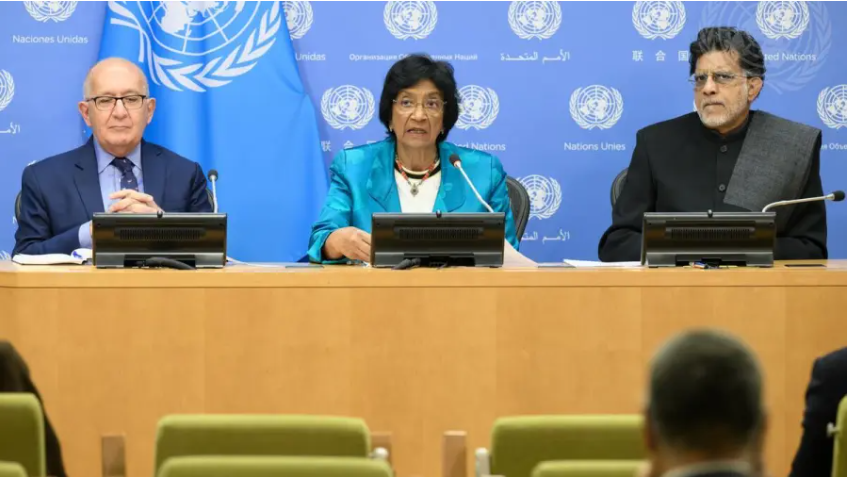
Antisemitism at the United Nations may be as ubiquitous as the UN’s dead silence on human rights violations around the world, but rarely has it been as brazen and transparent as on October 27, 2022. A presentation of a report to the General Assembly of a unique UN Commission of Inquiry on Israel, followed by a press conference with the three inquisitors at UN Headquarters in New York, was nasty, brutish and long-winded. Responding to the evidence-based charges of antisemitism tainting the inquiry and its members, Chair Navi Pillay wailed: “They’re all false and lies.” A response to her lies is essential to recognizing the real dangers of this exceptional UN attack on Israel and the Jewish people.

Background1

The Inquiry was created in May 2021 by the UN Human Rights Council at the behest of the Organization of Islamic states,2 joined by Council members and human rights aficionados like China, Libya, Russia, Somalia, Sudan, and Venezuela.3 The “inquiry” garnered zero Western democratic support.4

Quickly appointed as members of the inquiry were three individuals who lacked these qualities: objectivity, impartiality and independence. All those qualifications were mandatory under UN rules5 and all were summarily flouted when the target was the Jewish state. Navi Pillay from South Africa, who was UN High Commissioner for Human Rights from 2008 to 2014, was named as Chair, along with Miloon Kothari from India, and Chris Sidoti of Australia.6 All of them were extreme anti-Israel partisans who had pronounced themselves on the subject matter of the “inquiry” before passing go.7

Public scandals soon followed. Over the past four months, Sidoti ridiculed accusations of antisemitism8, Kothari said the “Jewish lobby” controlled social media and objected to Israel’s membership in the UN,9 and Pillay shamelessly defended them both.10 The UN circled the wagons and left all three reprobates still standing.

The official job description of the “inquiry” is to investigate “all underlying root causes of recurrent tensions, instability and protraction of conflict, including systematic discrimination and repression.”11

But the official summary of the “inquiry’s” first report to the General Assembly, issued on October 20, 2022, announced that the only human rights it dealt with were Palestinian.12 The report ended with a recommendation section directed to Israel, the UN and member states, and the Prosecutor of the International Criminal Court.13 Not a single recommendation was directed to Palestinians. The report never mentioned the word terror. Hamas and Palestinian Islamic Jihad never appeared. It was, in short, a farce masquerading as law.

The General Assembly: October 27, 2022

On October 27, 2022, the three inquisitors demonstrated why the world’s worst human rights violators are their biggest admirers, and how the UN system has been enlisted in the service of their anti-human rights and antisemitic agenda.

Pillay stage-managed the two-part event, both the “dialogue” with states14 and the news conference.15 She began by presenting the report at the General Assembly’s Third Committee. This Committee is composed of all 193 UN member states and is tasked with addressing human rights, even though the majority of UN members are not free democracies and think human rights protection is for losers. The sources of enthusiastic support for the “inquiry” from this environment was revealing.

Iran – currently engaged in a brutal bloody crackdown on the members of its civil society – participated in the General Assembly dialogue with this:

The Islamic Republic of Iran expresses support for the work of the Commission of Inquiry…The brutal Israeli regime has resorted to a new law in order to hinder the Commission’s work and its cooperation with civil society…Madam Pillay, in your opinion, how critical is the role of civil society in resolving the question of Palestine?16

Iran thus reminded listeners of the true nature of the exercise, namely, cynical political gamesmanship.

Syria – which murdered its own population by means of weapons of mass destruction – told “inquiry” members and the General Assembly:

I would like to thank the Chair and members of the Committee. We fully support your mandate, your efforts, and your report. And actually, we don’t find what was mentioned in your report weird or unreal. This is an ordinary result for a continuous occupation since 1948.17

Thus, Syria reminded listeners of the actual root cause of the conflict, namely, Arab rejection of Jewish self-determination.

Pillay’s presentation was a no holds barred attack on Israel from the UN podium, where she sat beside her two colleagues, accompanied by the Third Committee’s Chair, Ambassador José Blanco of the Dominican Republic. When she finished her tirade, Israeli Ambassador Gilad Erdan was given the floor.

Ambassador Erdan criticized the report, pointed to the bias of its authors, and introduced actual victims of Palestinian terror that were physically present in the seats behind him and dehumanized by the report.18

The next move was extraordinary. The Chair did not proceed simply to call the next speaker. Instead, Ambassador Blanco said:

Before we continue with the statement of the State of Palestine, I would like to recall to the Delegation of Israel that let’s stick to the text of the document and let’s avoid personal attacks or provocations for Members of the Commission.19

Such a reprimand from the Chair of the Third Committee to the Ambassador of any state – let alone a state responding to a direct attack on its legitimacy and its people – was unprecedented.

Blanco had no comment for the next speaker, the representative of the “State of Palestine,” after her series of vicious slanders like apartheid, killing, maiming, domination, and oppression.20 Just “Thank you very much.”

A few minutes later, the Chair gave the high-ranking Deputy Permanent Representative of Czechia (the Czech Republic), Miroslav Klíma, the same treatment he had meted out to Ambassador Erdan. Klíma said:

We were shocked by a recent interview in which one of the members of the Commission used terms such as ‘Jewish lobby’ and questioned Israeli UN membership. We strongly reject any form of antisemitism. Such comments contribute to the polarization of the situation and threaten to undermine the impartiality of the UN human rights mechanisms.21

Whereupon the Chair responded: “I remind all delegations that we should focus on the report being submitted and avoid personal attacks on members of the Commission.”22

This was not some trivial development in UN minutiae. It was an outrageous effort by the leadership of the General Assembly to silence the voices of member states objecting to antisemitism, and especially antisemitism emanating from a UN source. The UN apparatus had decided Kothari and his grotesque antisemitism, and his defenders, deserved protection and that it was the Israeli Ambassador and the Czech Deputy Perm Rep objecting to antisemitism who offended.

UN rules demanding impartiality, objectivity, independence, as well as personal integrity,23 are personal by definition. There’s nothing impersonal about personal integrity. The authors of the report don’t have immunity from fundamental breaches of key operating standards. And their bias goes to the heart of the credibility of their report.

So how did this contemptible action by the General Assembly’s top brass to curtail member states from naming and shaming the purveyors of modern antisemitism occur? Pillay herself exposed the source at the subsequent news conference. She said:

All three of us are not antisemitic. Let me make that clear. And then to add insult to injury, they said that the report is also antisemitic. Now, there isn’t one word in this report that can even be interpreted as antisemitic. Of course, it’s not new to us that this is always raised as a diversion. The President of the General Assembly [sic24] asked them to address the content of the report…We should not be subject to abuse such as this, which is just totally false. I don’t want to go into all the things they said. They’re all false and lies.25

The public criticism of the Israeli Ambassador and the Czechian representative – and the intimidation of all the other diplomats who might have attempted now or in the future to object to UN-driven antisemitism – had originated with the antisemitic bullies on the inquiry themselves.

Pillay’s outburst corroborated the very conclusion she was trying so hard to avoid. She had spent a high-profile career as UN High Commissioner for Human Rights from 2008 to 2014 and thereafter, peddling dangerous falsehoods about Israel and the Jewish people: blood libels such as Israelis deliberately target the innocent and murder children,26 and the Jewish state is racist.27 The claim that charges of antisemitism are a “diversion” is the diversion of the antisemite. The whine of the abusers that they are the abused is the classic diversion from the hurt of their victims, the victims of the Palestinian violence that Pillay and company incite and excuse. What’s totally false is that she and her crew are immune from criticism, and that well-documented charges of antisemitism are off limits because she says so.

Lies from Navi Pillay and the UN Commission of Inquiry

Pillay’s claim that the criticism directed at the inquisitors and their reports was “all false and lies” was deceptive propaganda. What follows, therefore, is a closer look at just some of the lies that should not be allowed to travel around the world before the truth gets its pants on.

Lie number one.

At the press conference a reporter from I24 News28 addressed the members of the “inquiry” with this question:

you’re already on record vocally as declaring Israel as an apartheid state. You’re vocally a proponent of boycotting and sanctioning Israel. Three weeks before you were appointed chairwoman of this Commission, you were signatory to a letter to President Biden attempting to implement punishment on Israel. So you have essentially prejudged every matter that is before this Commission in one form or fashion…How can you sit here and tell the world that this is an impartial commission?29

Pillay responded:

it’s all news to me that I have done all this. I have signed no petition or made no statement…I’d like to see it. I’ve never seen it. You know, because then maybe somebody has used my name, I want to know.30

That was a lie. She did sign the statement, an open letter to President Biden dated June 14, 2021.31 It’s easily accessible on the web – with her name on it, identified as former UN High Commissioner.32 It was issued shortly before she was appointed to the job of determining the same facts that the letter had pre-determined.

The letter says such things as:

We, the undersigned global coalition of leaders…call for U.S. leadership to take action to help bring an end to Israel’s institutionalized domination and oppression of the Palestinian people…[T]he United States must address the root causes of the violence… Your administration must apply concerted diplomatic pressure to help end the ever-expanding discrimination and systemic oppression and ensure accountability for Israeli authorities that violate Palestinian rights.33

(The undersigned global coalition of leaders – which included Pillay – made no call for pressure or accountability for any Palestinian violation of Israeli rights.)

Given the mandate of the Commission of Inquiry is to find “all underlying root causes of recurrent tensions, instability and protraction of conflict, including systematic discrimination and repression” – the charge of prejudging was exactly right.

Lie number two.

In the same press conference exchange, Pillay said she wanted to know where her signature on the June 14, 2021 open letter to President Biden could be found, as if it was all news to her. If we pretend for a moment that she didn’t sign it knowingly in the first place, she has certainly known for almost a year that her name was on it.

Numerous public complaints of bias have directed readers to her signature on that very document – and provided the link for her viewing ease. She has never removed what she now claims she didn’t approve.

Lie number three.

Pillay told reporters at the news conference when asked about her bias “all that’s been twisted into that I’m a campaigner for BDS. You know, I truly am not.”34

Actually, on November 29, 2017, Pillay spoke at a special event for “United Nations International Day of Solidarity with the Palestinian People.” Here she is in her own words after speaking about the world-wide boycott and sanctions campaign against apartheid South Africa:

I hope that the Palestinian struggle to end colonization gains this kind of momentum, especially in the civilian campaign of BDS, Boycott, Divestment, and Sanctions…On the BDS campaign. I’m very pleased to hear that there’s so much activity and support from South African civil society activists as well.35

On June 18, 2020 she signed a public letter organized by the South African BDS Coalition. The letter said:

We endorse the Palestinian call for banning arms trade and military-security cooperation with Israel; suspending free trade agreements with Israel; prohibiting trade with illegal Israeli settlements and accountability from individuals and corporate actors complicit in Israel’s occupation and apartheid regime…We demand that our governments fulfil their obligations under international law by: Adopting a resolution at the United Nations General Assembly which renews the call for, and provides the means to implement, targeted and lawful sanctions on Israel, including a military embargo.36

Pillay’s signature on the letter is accessible on the web, where it has been for over two years, and has been drawn to her attention multiple times.

Lie number four.

The “inquiry” on Israel is not discriminatory. Israel is treated in the same way as what the inquisitors consider to be the relevant comparisons: Ukraine (subject to a Russian invasion characterized by the daily targeting of civilians for 10 months); Syria (responsible for using chemical weapons against its own population and the murder of over 200,000 civilians in the last decade); and Myanmar (where grotesque forms of ethnic cleansing, sexual violence, and infanticide have victimized hundreds of thousands).

On this lie, not only is the democratic state of Israel not comparable to the human rights degenerates running Russia, Syria and Myanmar, the UN operations directed at these countries are not identical to the Israel “inquiry” – even according to Pillay and her colleagues. On the contrary, the members of the “inquiry” have repeatedly crowed that their mandate is a unique UN attack on Israel.

Here’s Pillay at the October UN press conference:

this morning we presented our first report to the General Assembly, and that alone is unusual. Commissions of Inquiry do not get the mandate to deliver in Geneva and here, and the reports we delivered are different.37

She also said: “Unlike other commissions, we have an open-ended mandate.”38

At the General Assembly Pillay herself expressly referred to “the unique mandate we are given.”39

Moreover, in a June news conference in Geneva, held after presenting their first report to the UN Human Rights Council, Pillay said: “we are very interested in the part of the mandate that requires us to identify individuals who are responsible and to work with judicial institutions for possible prosecutions and to secure justice. So all this is new.”40 On the same occasion, Chris Sidoti said: “the way in which accountability is framed in the mandate it’s different from other commissions of inquiry.”41

Lie number five.

These anti-Israel and anti-Jewish partisans are very keen on establishing their credentials by bloviating that all they’re doing is “law.” Irritated by the criticism, Pillay lectured states at the General Assembly: “if you read the report you’ll see clearly it’s based on law.”42 And she told the press conference: “how would I exercise the prejudice anyway? I’m dealing with international law here.”43

Not so. They are political hacks hired by political actors to conduct a political onslaught. Here’s “inquiry” member Miloon Kothari – who is not a lawyer – admitting to their non-legal agenda at the same press conference:

It’s quite different this mandate. If I may dare to say, it goes into the political issue rather than just reporting on violations, who killed who, and what happened.44

Of course, there is a reason these inquisitors cannot accurately apply the law to what actually happened. They don’t know the facts, including the realities facing military and security forces that might allow an armchair general to apply the legal standards associated with self-defense. And they don’t care.

Pillay herself said at the June news conference: “we want everyone to take this commission seriously because it’s the first time it can look into political questions which you can’t do under the Human Rights Council regular mandates.”45

At the October news conference a reporter asked Pillay: “imagine…the Government of Israel, the leaders of Palestinians, and even the President of the United States ask you, what we should do, what is the solution to our problem?”46 Addressing the global audience in response was one person, an anti-Israel radical appointed by anti-Israel radical states and their UN entourage, an individual having no authority, jurisdiction, knowledge or expertise to decide the terms and conditions of Arab-Israeli peace – let alone overrule the negotiated terms of existing agreements between the parties. And yet, without hesitation, Pillay rattled off a list of demands only for Israel and concluded with this: “I can think of a number of first steps that should be done before they enter into talks.”47

It wasn’t just hubris. This legal fraudster purported to dictate political answers by reciting a Palestinian list of demands – starting with derailing negotiations and eschewing an immediate unconditional halt to violence.

As even the Security Council has repeatedly reaffirmed, negotiations are the only hope to peace because they necessitate acceptance or recognition of the legitimacy of the other, while Pillay’s Palestinian clientele haven’t accepted the legitimacy of a Jewish state in 75 years.

Lie number six.

Pillay told the General Assembly and the world’s press corps: “I’m 81 years old, and this is the first time I’ve been accused of antisemitism.”48 Guffaws could be heard in the room.

Take but one example I can provide from as long ago as 2008. Pillay was UN High Commissioner for Human Rights and busy mounting a massive campaign to convince countries to back a UN racist “anti-racism” Durban “review conference.” Dubbed “Durban II,” the conference was intended to regurgitate the 2001 “Durban Declaration” and its antisemitic message smearing one country with the charge of racism – the Jewish one. At the time, I wrote in The Australian: “Human rights commissioner Navanethem Pillay, who will be the secretary-general of Durban II, has unleashed a wave of misinformation intended to whitewash UN-based anti-Semitism.”49 I also wrote in Forbes: “Durban I was the 2001 U.N. world conference on racism, most famous for spreading anti-Semitism rather than defeating it. Pillay is engaged in a frenzied attempt to silence critics of round two.”50

In this case, Pillay’s deceitful attempt to dodge and deny her role in enabling antisemitism vividly exploded. Pillay responded to the criticisms leading up to Durban II in a press release in March 2009: “[T]he review conference has also been the target of a disparaging media and lobbying campaign on the part of those who fear a repetition of anti-Semitic outbursts. This is unwarranted.”51

A month later, the only head of state to attend her UN confab was Iranian President Mahmoud Ahmadinejad whose invective from the UN stage included:

Following the World War II they resorted to military aggressions to make an entire nation homeless on the pretext of Jewish sufferings…The word Zionism personifies racism that falsely resorts to religion and abuses religious sentiments to hide their hatred and ugly faces.52

Lie number seven.

A reporter from the New York Sun53 asked Pillay at the October news conference: “I am told there were several NGOs that sent you all kinds of comments and reports that were ignored. Could you answer that?” Pillay responded:

“One of our first methods was to call for submissions…I think there were 5 million submissions or emails came from one address…It seems that they’re really records of Holocaust victims and so on, so not relevant to us. Our mandate doesn’t require us to look at the Holocaust.”54

The remark should be compared to Pillay’s statement when she opened the news conference:

“We are also mandated to investigate all underlying root causes of the recurrent tensions, instability, and protraction of conflict. So no time limit there. Look at the root causes from time immemorial to now.”55

So the inquisitors could deal with anything they chose from “time immemorial” and decided the that the murder of six million Jews who didn’t have self-determination and the protection of a Jewish state were irrelevant.

Since I submitted the millions of submissions to which she referred, here’s why the voices of Jewish victims ought to have counted in this UN “human rights” world.

The Grand Mufti of Jerusalem, Amin al-Husseini, was a Nazi collaborator and propagandist. But Palestinian Arabs called him “Palestine’s national leader,” “our hero,” and “the voice of the Palestinian people.”56 He continues to be a singular role model to the Palestinian terrorists and political leaders of today. If Pillay and company were actually looking for the root cause of the Palestinian Arab-Israeli conflict, al-Husseini’s antisemitism is key. He wrote the script for how to achieve the ethnic cleansing of Jews from the Middle East throughout the 20th and 21st centuries by equating the Jewish presence in the land of Israel with an existential threat to the Muslim faith – thus rendering Palestinian Arab rejectionism of Jewish self-determination intractable, if not insoluble.57 But to Pillay and company, antisemitism was a “diversion.”

Lie number eight.

All of the submissions sent by myself and a group of other non-governmental organizations – in response to the public call for submissions by the “inquiry” – were described by Pillay to the same reporter as: “I think there were 5 million submissions or emails that came from one address…It seems that they’re really records of Holocaust victims.”

Another lie. In fact, we sent 4,890,902 unique submissions in advance of the “inquiry’s” June 2022 report to the Human Rights Council, and another 180,316 unique submissions in advance of their October 2022 report to the General Assembly. These submissions were from multiple sources on a large range of subjects. In addition to submissions from the Touro Institute on Human Rights and the Holocaust and Human Rights Voices, they included:

  • 11,699 submissions from Palestinian Media Watch (PMW);58
  • 11,132 submissions from AICE and its Jewish Virtual Library;59
  • 12,642 submissions from the Middle East Media Research Institute (MEMRI);60
  • 2,872 submissions from the Meir Amit Intelligence and Terrorism Information Center;61 and
  • 7,807 submissions from the Committee for Accuracy in Middle East Reporting and Analysis (CAMERA).62

The inquisitors advertised on the UN website that they wanted specifics about “victims.” Over the course of seven months from February to August 2022, we obliged. In addition to the specifics of 4,987,090 victims of antisemitism during the Holocaust and the role and legacy of Nazi collaborator, propagandist and Palestinian role model al-Husseini,63 we sent the individual names and details of

  • 613,500 specific Jewish refugees and victims of Arab persecution in the Middle East and North African nations over the past 75 years, individuals who returned to their indigenous homeland in the land of Israel;64
  • 4,220 civilian victims murdered in Arab campaigns to eradicate Israel;65
  • 24,092 Israeli forces who fell defending their country and its people from Arab Jew-hatred;66

The “inquiry” repeatedly said that its central task was to identify the “root cause” of the conflict. So we sent the evidence that violent Palestinian Jew-hatred is at the root of the Palestinian Arab-Israeli conflict – including the specifics of

  • 5,875 attacks by Palestinian Arabs and their collaborators in the 21st century,
  • seven Arab wars against the Jewish state from 1947 on, and
  • seventeen defensive Israeli military operations in response to Arab aggression in the 20th and 21st centuries.67

So no, these submissions could not be obscenely dismissed as “only” records of Holocaust victims, nor were they only from one address.

Lie number nine.

Pillay said at the news conference the “inquiry” called for submissions but in the case of our submissions “Some of them are a bit difficult to read.”68

In fact, all of our submissions were in electronic form, readily searchable, and clearly formatted using a standardized template. All they needed in order to comprehend the material, including the volumes of photographic and video evidence, were their lying eyes.

Lie number ten.

Pillay told the press, referring to our submissions, “we didn’t ignore [them].”

False. To give but one example, our submissions included the details of the historical connection of the Jewish people to Hebron from “time immemorial” and the Arab massacre of the Jews of Hebron in 1922. The report mentions Hebron 14 times, does go back to 1922 and makes claims about historical ownership of Hebron. But it turns out that every one of these comments is about Israeli violations of Palestinian “rights” in Hebron. Palestinian violations of the rights of Jews in Hebron over an entire century is never mentioned. And the only historical connection to Hebron that these inquisitors could locate was to Palestinian Arabs.69

So yes, they did ignore.

Lie number eleven.

Pillay boasted to the General Assembly about the “inquiry’s” outreach to so-called “civil society” and how much they value and utilize the input from civil society. In her words:

We’ve consulted very many experts, both from Israel and Palestine and the rest of the world, and here we will continue to do that kind of research and get the opinions of civil society…This Commission began immediately by going straight to civil society representatives and academics who address these issues. Their role is vital to raise awareness of violations and possible international crimes.70

Actually, Pillay and company went straight to civil society representatives and academics – provided their contribution was more Israel-bashing. Those who she belittled at the June news conference as “pro-Israel” sources,71 those who she has labeled as “the extremist Israel lobby,”72 and those who fellow inquisitor Chris Sidoti dismissed as “GONGOs”73 – the acronym for government organized (fake) NGOs – got no calls, no invitations, and no requests for their opinions. They weren’t consulted, they were detoured.

Dismissing the voices of genuinely independent Jewish experts and victims of antisemitism as government of Israel toadies is especially ironic in view of the affiliations of “inquiry” member and allegedly “independent” expert Chris Sidoti. Sidoti, for instance, has had a close working relationship with the Palestinian Authority’s so-called “Independent Commission on Human Rights.”74

Lie number twelve.

When the going got rough at the press conference, “inquiry” members took the unusual step of calling upon the moderator, a UN staffer, for answers. The UN spokesperson for the “Human Rights Council branch” answered a question about the double-standards that the “inquiry” mandate applied to Israel this way:

there are several other open-ended mandates of the Human Rights Council, and all one needs to do is look at the website and you can see the large array of them.75

Actually, when you look at the UN website there is an array of thirty-six “International Commissions of Inquiry, Commissions on Human Rights, Fact-Finding Missions and other Investigations,”76 ever created by the Human Rights Council. In addition to the “inquiry” on Israel, only one other has no end date. That’s the clearly distinguishable case of Myanmar, where there was a prior finding that crimes against humanity had occurred before the permanent mission was created.77 And if “open-ended” includes a permit to investigate from “time immemorial,” the Israel-bashing license stands alone.

Lie number thirteen.

After Pillay’s presentation at the General Assembly, there was an unprecedented intervention by diplomats from eighteen states, and the European Union. Each of them took the floor either to condemn the antisemitism from “inquiry” members or to register objections to the “inquiry” itself. Given the last word, Pillay attempted to brush them all off with this scolding:

let me make absolutely clear, we are not antisemitic. Now there was a reference to statement made by one of the commissioners. This has been dealt fully by the President of the Human Rights Council, who is the proper authority to clear up criticism of the mandate and clear up criticism of those he selected for appointment as commissioners. So I do encourage you to look at the President’s website on that.78

The claim was insulting and false on many levels. Kothari made his overtly antisemitic remarks on July 25, 2022. At the time, criticism was swift and widespread. Nineteen states and the European Union condemned his remarks.79 The President of the Human Rights Council, Ferderico Villegas (Argentina), apparently spoke to Pillay privately about his behavior. Pillay responded by producing a formal public letter directed to the Council President on July 28, 2022.80 In her riposte she made no apologies; on the contrary, she defended her colleagues – no doubt well aware of her own comparable vulnerabilities.

The Council President then produced a written and public reply to Pillay on July 29, 2022 in which he called Kothari’s remarks “unfortunate” and said they “could reasonably be interpreted as the stigmatization of the Jewish people, which, as you’re all aware, is at the heart of any expression of antisemitism.”81 As for taking action, he did nothing. He whimpered that Kothari “consider the possibility” of “publicly clarifying” his comments and intentions. Though his predecessor in the position of President of the Human Rights Council82 had appointed all three inquisitors, he took no action to dismiss Kothari and the others, or to garner support for dismissal in any number of ways at his disposal, starting with a simple declaration that any or all of them had violated the UN “Code of Conduct”83 and were unfit for office.

On August 4, 2022, Kothari wrote to the President of the Human Rights Council to “clarify” his remarks.84 He was apologetic for his “choice of words.” Twice he called his choice of words “insensitive.” Poor Kothari said: “the offence I have caused by using these words has deeply distressed me.” Then he slammed Israel for what he said was “non-compliance” with UN decisions.

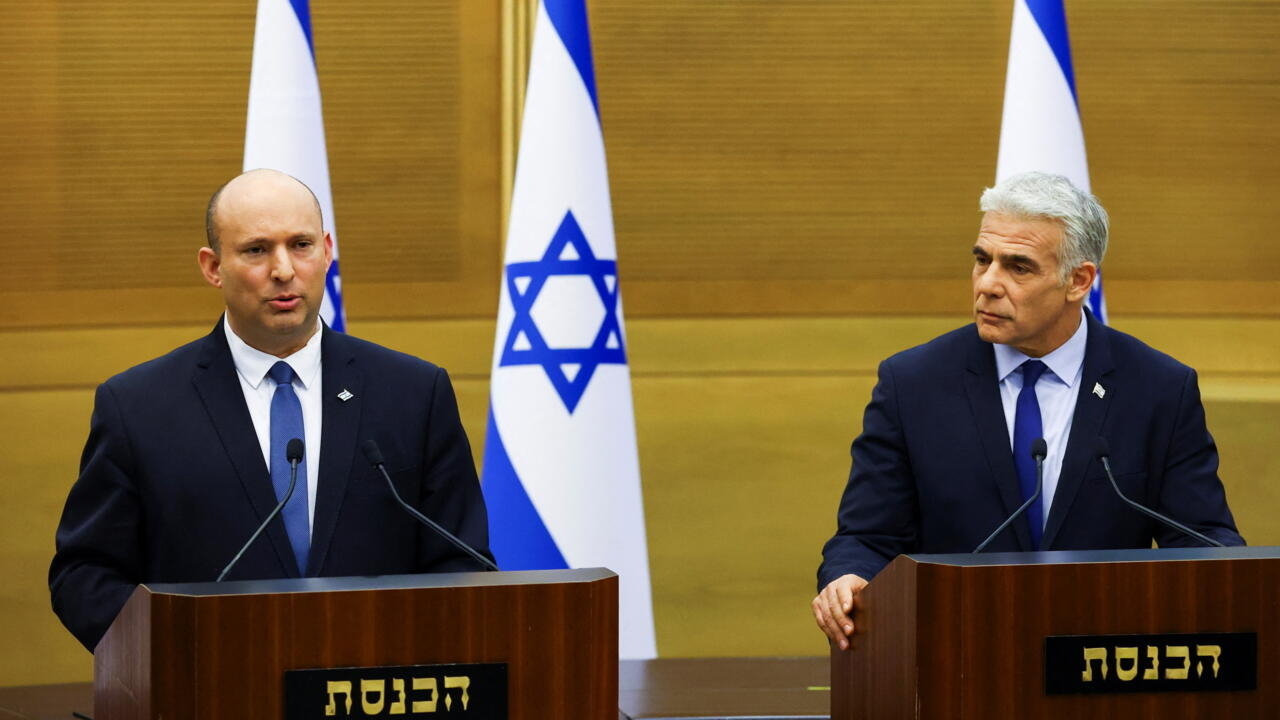
And that was the end of it – for the UN. The Prime Minister of Israel Yair Lapid wrote to UN Secretary-General António Guterres. Lapid called upon the Secretary-General to honor his pledge to stand “in the front line of the struggle against antisemitism” by taking the “necessary measures to bring about the immediate resignation of Ms. Pillay and the other commissioners, and the disbanding of the Commission..”85 Israel’s Prime Minister was completely ignored.

As far as the UN was concerned antisemitism from a UN “human rights” official, with a job description to find “discrimination and repression based on national, ethnic, racial or religious identity,” in a conflict between Jews and non-Jews (Arab or Muslim), had been dealt with “fully” by leaving the antisemitism exponent in the job.

Or more accurately, it hadn’t been dealt with at all.

Conclusion

This UN “inquiry” has only been in operation a year, but it has already left a deep stain on the United Nations. Its creators, enablers and mandate-holders are bent on the demonization and delegitimization of Israel and the self-determination of the Jewish people – the face of modern antisemitism. Evidently, they have no compunction about using deceit to accomplish these ends. Dishonesty that must not be allowed to stand.

* * *

Notes

* Thank you to Sarah Willig J.D. for her exceptional research.

1 This paper is one of a series on the UN Human Rights Council’s “Independent International Commission of Inquiry on the Occupied Palestinian Territory, including East Jerusalem, and Israel” (COI). See for more detail: Anne Bayefsky, “The Newest Anti-Israel UN Action Must Be Challenged – Now,” Jerusalem Center for Public Affairs, December 20, 2021, https://jcpa.org/article/the-newest-anti-israel-un-action-must-be-challenged-now; Anne Bayefsky, “The UN Commission of Inquiry: An Exercise in Historical Revisionism,” Jerusalem Center for Public Affairs, June 8, 2022, https://jcpa.org/article/the-un-commission-of-inquiry-an-exercise-in-historical-revisionism; Anne Bayefsky, “The Latest UN Commission of Inquiry on ‘Occupied Palestinian Territory’ Is an Inquisition,” Jerusalem Center for Public Affairs, June 27, 2022, https://jcpa.org/the-latest-un-commission-of-inquiry-on-occupied-palestinian-territory-is-an-inquisition/; Anne Bayefsky, “The UN Human Rights Council’s “Commission of Inquiry” Goes Openly Antisemitic,” Jerusalem Center for Public Affairs, August 1, 2022, https://jcpa.org/article/the-un-human-rights-councils-commission-of-inquiry-goes-openly-antisemitic/; Anne Bayefsky, “New UN Commission of Inquiry Report a Masterpiece of Modern Antisemitism,” Jerusalem Center for Public Affairs, October 23, 2022, https://jcpa.org/new-un-commission-of-inquiry-report-a-masterpiece-of-modern-antisemitism/

2 Letter from the Permanent Representative of Pakistan and the Permanent Observer of the “State of Palestine” to the President of the Human Rights Council requesting the convening of a special session “to address the grave human rights situation in the Occupied Palestinian Territory, including East Jerusalem,” May 19, 2021, https://undocs.org/A/HRC/S-30/1

3 “Ensuring respect for international human rights law and international humanitarian law in the Occupied Palestinian Territory, including East Jerusalem, and in Israel,” United Nations Human Rights Council Resolution A/HRC/RES/ S-30/1, May 27, 2021, https://undocs.org/A/HRC/RES/S-30/1

4 Results of the vote on “Ensuring respect for international human rights law and international humanitarian law in the Occupied Palestinian Territory, including East Jerusalem, and in Israel,” U.N. Human Rights Council Resolution, A/HRC/RES/S-30/1, May 27, 2021, https://hrcmeetings.ohchr.org/HRCSessions/SpecialSessions/30session/Documents/Vote_Result.pdf

5 “Code of Conduct for Special Procedures Mandate-holders,” Annex (Articles 3 (a), 3(e), 5, 8, 13(b)), UN Human Rights Council Resolution A/HRC/RES/5/2, June 18, 2007, https://ap.ohchr.org/documents/dpage_e.aspx?si=A/HRC/RES/5/2; “United Nations Human Rights Council: Institution-building,” Annex, II. Special Procedures, A. Selection and appointment of mandate-holders, Article 39, UN Human Rights Council Resolution A/HRC/RES/5/1, June 18, 2007, https://ap.ohchr.org/documents/dpage_e.aspx?si=a/hrc/res/5/1

6 “President of Human Rights Council appoints Members of Commission of Inquiry on the Occupied Palestinian Territory, including East Jerusalem, and Israel,” Office of the High Commissioner for Human Rights Press Release, July 22, 2021, https://www.ohchr.org/EN/HRBodies/HRC/Pages/NewsDetail.aspx?NewsID=27331&LangID=E

7 See “The ‘Inquiry’ Members,” Human Rights Voices website, https://humanrightsvoices.org/pillays-pogrom/the-inquiry-members/; Anne Bayefsky, “The Newest Anti-Israel UN Action Must Be Challenged – Now,” Jerusalem Center for Public Affairs, December 20, 2021, https://jcpa.org/article/the-newest-anti-israel-un-action-must-be-challenged-now/

8 Chris Sidoti: “Accusations of antisemitism are thrown around like rice at a wedding.” “ID (cont’d): Commission of Inquiry on OPT – 3rd Meeting, 50th Regular Session of Human Rights Council,” UN Webcast, June 14, 2022, https://media.un.org/en/asset/k1q/k1qtlzmbs2

9 In an online interview, Miloon Kothari said: “We are very disheartened by the social media that is controlled largely by whether it’s the Jewish lobby or it’s the specific NGOs. A lot of money is being thrown into trying to discredit us.” Referring to Israel, he also told the interviewer: “I would go so far as to raise the question as why are they even a member of the United Nations.” “Mondoweiss Podcast Episode 39: The UN is investigating the root causes of violence between Israelis and Palestinians,” July 25, 2022, http://mondoweiss.libsyn.com/39-investigating-israel-itself-a-conversation-with-un-human-rights-commissioner-miloon-kothari; transcript can be found here: https://hrvoices.org/assets/attachments/articles/Mondoweiss_Podcast_Episode_39_UN_Investigates_Root_Cause_Violence_Israelis_and_Palestinians_July_25_2022-2.docx

10 “Letter from Chair of the COI on the OPT, including East Jerusalem, and Israel to HRC President,” July 28, 2022, https://hrcmeetings.ohchr.org/PresidencyBureau/BureauRegionalGroupsCorrespondence/Correspondence/Letter%20from%20Chair%20of%20the%20COI%20on%20the%20OPT,%20including%20East%20Jerusalem,%20and%20Israel%20to%20HRC%20President.pdf

11 “Ensuring respect for international human rights law and international humanitarian law in the Occupied Palestinian Territory, including East Jerusalem, and in Israel,” UN Human Rights Council Resolution A/HRC/RES/ S-30/1, May 27, 2021, https://undocs.org/A/HRC/RES/S-30/1, para. 10

12 The “Summary” of the report to the General Assembly states that it is only about “the human rights implications for Palestinians.” “Summary,” “Report of the Independent International Commission of Inquiry on the Occupied Palestinian Territory, including East Jerusalem, and Israel,” UN General Assembly, A/77/328, issued October 20, 2022, https://undocs.org/en/A/77/328, p. 2

13 “Report of the Independent International Commission of Inquiry on the Occupied Palestinian Territory, including East Jerusalem, and Israel,” (hereinafter COI), UN General Assembly, A/77/328, issued October 20, 2022, https://undocs.org/en/A/77/328, paras. 92-95

14 “Third Committee, 35th plenary meeting – General Assembly, 77th session,” UN Webcast, October 27, 2022, https://media.un.org/en/asset/k1u/k1ukq81w1h

15 “Press Conference: COI, UN Webcast, October 27, 2022, https://media.un.org/en/asset/k1j/k1jzwzf8gg

16 “Third Committee, 35th plenary meeting – General Assembly, 77th session,” UN Webcast, October 27, 2022, https://media.un.org/en/asset/k1u/k1ukq81w1h

17 “Third Committee, 35th plenary meeting – General Assembly, 77th session,” UN Webcast, October 27, 2022, https://media.un.org/en/asset/k1u/k1ukq81w1h

18 “Third Committee, 35th plenary meeting – General Assembly, 77th session,” UN Webcast, October 27, 2022, https://media.un.org/en/asset/k1u/k1ukq81w1h. Shani and Asaf Avigal, the parents of five year-old Edo Avigal who was killed by Palestinian rocket fire on May 12, 2021, were present at the meeting and stood with a photo of their son as Ambassador Erdan spoke.

19 “Third Committee, 35th plenary meeting – General Assembly, 77th session,” UN Webcast, October 27, 2022, https://media.un.org/en/asset/k1u/k1ukq81w1h

20 “Third Committee, 35th plenary meeting – General Assembly, 77th session,” UN Webcast, October 27, 2022, https://media.un.org/en/asset/k1u/k1ukq81w1h

21 “Third Committee, 35th plenary meeting – General Assembly, 77th session,” UN Webcast, October 27, 2022, https://media.un.org/en/asset/k1u/k1ukq81w1h

22 “Third Committee, 35th plenary meeting – General Assembly, 77th session,” UN Webcast, October 27, 2022, https://media.un.org/en/asset/k1u/k1ukq81w1h

23 “Code of Conduct for Special Procedures Mandate-holders,” Annex (Articles 3 (a), 3(e), 5, 8, 13(b)), UN Human Rights Council Resolution A/HRC/RES/5/2, June 18, 2007, https://ap.ohchr.org/documents/dpage_e.aspx?si=A/HRC/RES/5/2; “United Nations Human Rights Council: Institution-building,” Annex, II. Special Procedures, A. Selection and appointment of mandate-holders, Article 39, UN Human Rights Council Resolution A/HRC/RES/5/1, June 18, 2007, https://ap.ohchr.org/documents/dpage_e.aspx?si=a/hrc/res/5/1

24 She meant the Chair of the Third Committee of the General Assembly.

25 “Press Conference: COI, UN Webcast, October 27, 2022, https://media.un.org/en/asset/k1j/k1jzwzf8gg

26 See for example: Navi Pillay, United Nations High Commissioner for Human Rights, UN Human Rights Council, 21st Special Session, July 23, 2014, https://hrcmeetings.ohchr.org/HRCSessions/SpecialSessions/21stSession/Documents/HC.doc; “Pillay condemns continuing attacks on civilians in Gaza,” OHCHR Press Release, July 31, 2014, https://www.ohchr.org/EN/NewsEvents/Pages/DisplayNews.aspx?NewsID=14916&LangID=E; Navi Pillay, United Nations High Commissioner for Human Rights, UN Human Rights Council, 21st Special Session, July 23, 2014, https://hrcmeetings.ohchr.org/HRCSessions/SpecialSessions/21stSession/Documents/HC.doc; “Pillay condemns continuing attacks on civilians in Gaza,” OHCHR Press Release,” July 31, 2014, https://www.ohchr.org/EN/NewsEvents/Pages/DisplayNews.aspx?NewsID=14916&LangID=E

27 Pillay was the world’s leading promoter of the manifesto of the Durban Conference (the 2001 UN “anti-racism” conference that declared Palestinians are victims of Israeli racism). She championed “Durban II” in 2009 and “Durban III” in 2011. See for example: “High Commissioner for Human Rights stresses need to tackle discrimination and inequality, and prevent genocide,” Office of the High Commissioner for Human Rights, September 8, 2008, https://www.un.org/en/durbanreview2009/pr_8-9-08.shtm;Tony Eastley and Sarah Collerton, “Anti-racism conference decision looms,” Australia ABC News, March 12, 2009, https://www.abc.net.au/news/2009-03-12/anti-racism-conference-decision-looms/1617096; Opening remarks by the High Commissioner for Human Rights, Navi Pillay, at the closing press conference at the Durban Review Conference, April 24, 2009, https://www.un.org/en/durbanreview2009/stmt24-04-09_pillay.shtml; “Committee on the Elimination of Racial Discrimination opens seventy-ninth session,” Office of the UN High Commissioner for Human Rights website, August 8, 2011, https://www.ohchr.org/en/press-releases/2011/08/committee-elimination-racial-discrimination-opens-seventy-ninth-session

28 Mike Wagenheim

29 “Press Conference: COI, UN Webcast, October 27, 2022, https://media.un.org/en/asset/k1j/k1jzwzf8gg

30 “Press Conference: COI, UN Webcast, October 27, 2022, https://media.un.org/en/asset/k1j/k1jzwzf8gg

31 “#NowIsTheTime A global call to President Biden,” Open letter by Now is the Time Coalition, June 14, 2021,

https://nowisthetimecoalition.com/

32 “#NowIsTheTime A global call to President Biden,” Open letter by Now is the Time Coalition, June 14, 2021,

https://nowisthetimecoalition.com/

33 Italics added. “#NowIsTheTime A global call to President Biden,” Open letter by Now is the Time Coalition, June 14, 2021, https://nowisthetimecoalition.com/

34 “Press Conference: COI, UN Webcast, October 27, 2022, https://media.un.org/en/asset/k1j/k1jzwzf8gg

35 Pillay continued: “So the Human Rights Council authorized the High Commissioner for Human Rights to conduct a database and a study of businesses that are cooperating in products made in the settlements. Now this is a huge victory…Watch their webpage, and you can always call the Palestinian desk at OHCHR [Office of the UN High Commissioner for Human Rights] to find out when the likely date is.” Judge Navi Pillay; Former UN High Commissioner on Human Rights,” United Nations International Day of Solidarity with the Palestinian People Seminar: The Year of Oliver Tambo and The Palestinian Struggle under Apartheid Rule, Pretoria, South Africa, November 29, 2017, Youtube video by Africa4Palestine, posted December 13, 2017, https://www.youtube.com/watch?v=nF61qfb5J-k

36 “250+ prominent South Africans call for sanctions to stop annexation,” South African BDS Coalition, June 18, 2020, https://bdsmovement.net/news/250-prominent-south-africans-call-for-sanctions-stop-annexation; The statement: https://mcusercontent.com/36542688e353931ee951122b3/files/f6b47740-527e-4747-bb30-b348b750dd2c/Global_South_Statement_FINAL.pdf; The signatories to the statement: “Endorsements of Global South Statement against Annexation of Palestine,” https://mcusercontent.com/36542688e353931ee951122b3/files/a274a945-68f2-4385-80c0-a6465753fb30/ENDORSEMENTS.pdf

37 “Press Conference: COI, UN Webcast, October 27, 2022, https://media.un.org/en/asset/k1j/k1jzwzf8gg

38 “Press Conference: COI, UN Webcast, October 27, 2022, https://media.un.org/en/asset/k1j/k1jzwzf8gg

39 “Third Committee, 35th plenary meeting – General Assembly, 77th session,” UN Webcast, October 27, 2022, https://media.un.org/en/asset/k1u/k1ukq81w1h

40 “Commission of Inquiry on the Occupied Palestinian Territory – Press Conference: Presentation of HRC report,” June 14, 2022, UN Webcast, https://media.un.org/en/asset/k1u/k1ukz5cf2s

41 “Commission of Inquiry on the Occupied Palestinian Territory – Press Conference: Presentation of HRC report,” June 14, 2022, UN Webcast, https://media.un.org/en/asset/k1u/k1ukz5cf2s

42 “Third Committee, 35th plenary meeting – General Assembly, 77th session,” UN Webcast, October 27, 2022, https://media.un.org/en/asset/k1u/k1ukq81w1h

43 “Press Conference: COI, UN Webcast, October 27, 2022, https://media.un.org/en/asset/k1j/k1jzwzf8gg

44 “Press Conference: COI, UN Webcast, October 27, 2022, https://media.un.org/en/asset/k1j/k1jzwzf8gg

45 “Commission of Inquiry on the Occupied Palestinian Territory – Press Conference: Presentation of HRC report,” June 14, 2022, UN Webcast, https://media.un.org/en/asset/k1u/k1ukz5cf2s

46 “Press Conference: COI, UN Webcast, October 27, 2022, https://media.un.org/en/asset/k1j/k1jzwzf8gg

47 “Press Conference: COI,” October 27, 2022, https://media.un.org/en/asset/k1j/k1jzwzf8gg

48 “Third Committee, 35th plenary meeting – General Assembly, 77th session,” UN Webcast, October 27, 2022, https://media.un.org/en/asset/k1u/k1ukq81w1h; “Press Conference: COI, UN Webcast, October 27, 2022, https://media.un.org/en/asset/k1j/k1jzwzf8gg

49 Anne Bayefsky, “When hate states set the agenda,” The Australian, December 23, 2008, Now available only at: https://hrvoices.org/newsletters/when-hate-states-set-the-agenda/

50 Anne Bayefsky, “The U.N.’s Dangerous High Commissioner for Human Rights,” Forbes, December 24, 2008, https://www.forbes.com/2008/12/24/navanethem-pillay-durban-oped-cx_ab_1224bayefsky.html

51 “UN rights chief urges all States to take part in anti-racism conference,” UN News website, March 2, 2009, https://news.un.org/en/story/2009/03/292712

52 “Statement by the Mahmoud Ahmadinejad, President of the Islamic Republic of Iran, as delivered at the Durban Review Conference,” April 20, 2009, transcript of statement as delivered available at http://www.humanrightsvoices.org/document/statement-by-the-islamic-republic-of-iran-as-delivered-unofficial-transcript (unofficial video available at: (Part 1) at 9:34 https://www.youtube.com/watch?v=hXQvZe9IPmE); (Part 3) at 2:30 https://www.youtube.com/watch?v=Wq2QMaJ73O4

53 Benny Avni

54 “Press Conference: COI,” October 27, 2022, https://media.un.org/en/asset/k1j/k1jzwzf8gg

55 “Press Conference: COI, UN Webcast, October 27, 2022, https://media.un.org/en/asset/k1j/k1jzwzf8gg

56 See submission concerning the victims of Jew hatred and incitement by Nazi collaborator and Palestinian leader and mentor Grand Mufti of Jerusalem Amin al-Husseini, Human Rights Voices, https://hrvoices.org/assets/attachments/documents/Holocaust_Victims_of_Hate_Monger_Al-Husseini.docx

57 See for instance: “Hajj Amin al-Husayni: Arab Nationalist and Muslim Leader,” United States Holocaust Memorial Museum, https://encyclopedia.ushmm.org/content/en/article/hajj-amin-al-husayni-arab-nationalist-and-muslim-leader; Jeffrey Herf, “Haj Amin al-Husseini, the Nazis and the Holocaust: the Origins, Nature and Aftereffects of Collaboration,” Jewish Political Studies Review, Fall 2014, Vol. 26, No. 3/4, pp. 13-37, at p. 17

58 See: https://hrvoices.org/pillays-pogrom/palestinian-media-watch-submissions and https://palwatch.org

59 See: https://hrvoices.org/pillays-pogrom/the-american-israeli-cooperative-enterprise-submissions and https://www.jewishvirtuallibrary.org

60 See: https://hrvoices.org/pillays-pogrom/the-middle-east-media-research-institute-memri and https://www.memri.org/

61 See: https://hrvoices.org/pillays-pogrom/the-meir-amit-intelligence-and-terrorism-information-center-itic-submissions and https://www.terrorism-info.org.il/en

62 See: https://hrvoices.org/pillays-pogrom/submissions-by-committee-for-accuracy-in-middle-east-reporting-analysis and https://www.camera.org/

63 See for submissions and accompanying text: https://hrvoices.org/assets/attachments/documents/Holocaust_Victims_of_Hate_Monger_Al-Husseini.docx; see original names (examples): https://hrvoices.org/pillays-pogrom/touro-college-institute-on-human-rights-and-the-holocaust-submissions

64 See for submissions and accompanying text: https://hrvoices.org/assets/attachments/documents/Jews_from_Arab._Muslim_Lands_Submissions_to_date.docx; see original immigration lists: https://hrvoices.org/pillays-pogrom/touro-college-institute-on-human-rights-and-the-holocaust-submissions

65 See for civilian victims of Arab violence: https://laad.btl.gov.il/Web/He/TerrorVictims/Default.aspx?page=0

66 See for fallen defense and security forces of Israel: https://www.izkor.gov.il/%D7%90%D7%94%D7%A8%D7%95%D7%9F%20%D7%94%D7%A8%D7%A9%D7%9C%D7%A8/en_399451c07d6af2edbb259e94a77362b2

67 Wars: 1947-1949: Israel’s War of Independence; October 29, 1956 -November 7, 1956: Suez Crisis; June 5-10, 1967: Six-Day War; March 1969-August 1970: War of Attrition; October 6-25, 1973: Yom Kippur War; June 1982-September 1982: First Lebanon War; July 12-August 14, 2006: Second Lebanon War; Defensive Military Operations: February 28, 1955: “Operation Black Arrow;” October 31, 1968: “Operation Shock;” April 9-10, 1973: “Operation Spring of Youth;” June 27-July 4, 1976: “Operation Thunderbolt;” March 14-June 13, 1978: “Operation Litani;” October 1, 1985: “Operation Wooden Leg;” July 25-31, 1993: “Operation Accountability;” April 11-27, 1996: “Operation Grapes of Wrath;” March 29-April 21, 2002: “Operation Defensive Shield;” June 28-November 26, 2006: “Operation Summer Rains;” November 1-7, 2006: “Operation Autumn Clouds;” December 2008-January 2009: “Operation Cast Lead;” November 14-21, 2012: “Operation Pillar of Defense;” June 12-30, 2014: “Operation Brother’s Keeper;” July 8-August 26, 2014: “Operation Protective Edge;” December 4, 2018-January 13, 2019: “Operation Northern Shield;” May 10-20, 2021: “Operation Guardian of the Walls”

68 “Press Conference: COI,” October 27, 2022, https://media.un.org/en/asset/k1j/k1jzwzf8gg

69 “Report of the Independent International Commission of Inquiry on the Occupied Palestinian Territory, including East Jerusalem, and Israel,” UN General Assembly, A/77/328, issued October 20, 2022, https://undocs.org/en/A/77/328, p. 22 (The report quotes an unnamed Palestinian declaring that Hebron is “our land and our fathers’ and grandfathers’ land.”)

70 “Third Committee, 35th plenary meeting – General Assembly, 77th session,” UN Webcast, October 27, 2022, https://media.un.org/en/asset/k1u/k1ukq81w1h

71 “In the Council today, there was an NGO input that they sent us 5 million submissions. So all of them would be pro-Israel, shall I characterize them as such.” “Commission of Inquiry on the Occupied Palestinian Territory – Press Conference: Presentation of HRC report,” June 14, 2022, UN Webcast, https://media.un.org/en/asset/k1u/k1ukz5cf2s

72 Judge Navi Pillay; Former UN High Commissioner on Human Rights, United Nations International Day of Solidarity with the Palestinian People Seminar: The Year of O R Tambo and The Palestinian Struggle under Apartheid Rule, Pretoria, South Africa, 29 November 2017, Youtube video by Africa4Palestine, posted December 13, 2017, https://www.youtube.com/watch?v=nF61qfb5J-k

73 “ID (cont’d): Commission of Inquiry on OPT – 3rd Meeting, 50th Regular Session of Human Rights Council,” UN Webcast, June 14, 2022, https://media.un.org/en/asset/k1q/k1qtlzmbs2

74 “Chris Sidoti… worked closely with Arab and Palestinian Human Rights organisations, and is a close friend and ally to ICHR [Independent Commission for Human Rights]” Chris Sidoti, “The Importance of a National Human Rights Institution for Palestine,” November 14, 2018, Independent Commission for Human Rights, https://www.ichr.ps/en/media-center/1366.html

75 Rolando Gómez, Public Information Officer at the Human Rights Council Branch, Office of the High Commissioner for Human Rights, “Press Conference: UN Independent International Commission of Inquiry on the Occupied Palestinian Territory, including East Jerusalem, and in Israel,” UN Webcast, October 27, 2022, https://media.un.org/en/asset/k1j/k1jzwzf8gg

76 “List of HRC-mandated Commissions of Inquiries / Fact-Finding Missions & Other Bodies (as of May 2022),” Office of the High Commissioner for Human Rights website, https://www.ohchr.org/en/hr-bodies/hrc/list-hrc-mandat

77 Report of the independent international fact-finding mission on Myanmar, A/HRC/39/64, September 12, 2018, https://undocs.org/A/HRC/39/64, para. 88 (“88. On the basis of information gathered, the mission finds that crimes against humanity have been committed…”). Subsequently, the Human Rights Council established “an ongoing independent mechanism” for Myanmar. United Nations Human Rights Council Resolution “Situation of human rights of Rohingya Muslims and other minorities in Myanmar,” A/HRC/RES/39/2, September 27, 2018, https://undocs.org/A/HRC/RES/39/2, para. 22.

78 “Third Committee, 35th plenary meeting – General Assembly, 77th session,” UN Webcast, October 27, 2022, https://media.un.org/en/asset/k1u/k1ukq81w1h

79 See “Positions and Advocacy Opposing Pillay’s Pogrom,” Human Rights Voices website, https://hrvoices.org/pillays-pogrom/positions-and-advocacy-opposing-pillays-pogrom/

80 Letter from Chair of the “Commission of Inquiry” Navi Pillay to the Human Rights Council President remarks by Miloon Kothari, U.N. Human Rights Council Extranet, July 28, 2022, https://hrcmeetings.ohchr.org/PresidencyBureau/BureauRegionalGroupsCorrespondence/Correspondence/Letter%20from%20Chair%20of%20the%20COI%20on%20the%20OPT,%20including%20East%20Jerusalem,%20and%20Israel%20to%20HRC%20President.pdf

81 Letter From President Of The Human Rights Council To Chair Of The “Commission Of Inquiry” Navi Pillay Regarding Remarks By Miloon Kothari, U.N. Human Rights Council Extranet, July 29, 2022, https://hrcmeetings.ohchr.org/PresidencyBureau/BureauRegionalGroupsCorrespondence/Correspondence/Letter%20from%20President%20of%20HRC%20to%20the%20Chair%20of%20the%20COI%20on%20the%20OPT,%20including%20East%20Jerusalem,%20and%20Israel.pdf

82 Nazhat Shameem Khan (Fiji)

83 “Code of Conduct for Special Procedures Mandate-holders,” Annex (Articles 3 (a), 3(e), 5, 8, 13(b)), UN Human Rights Council Resolution A/HRC/RES/5/2, June 18, 2007, https://ap.ohchr.org/documents/dpage_e.aspx?si=A/HRC/RES/5/2

84 Letter from “Commission of Inquiry” Member Miloon Kothari to U.N. Human Rights Council President Regarding His Recent Comments, U.N. Human Rights Council Extranet, August 4, 2022, https://hrcmeetings.ohchr.org/PresidencyBureau/BureauRegionalGroupsCorrespondence/Correspondence/Letter%20from%20Miloon%20Kothari%20to%20HRC%20President.pdf

85 Letter From Israeli Prime Minister Yair Lapid to U.N. Secretary-General Antonio Guterres, Office of the Israeli Prime Minister, July 31, 2022, https://www.gov.il/BlobFolder/news/spoke_guterres310722/en/UN.%20Sec%20Gen%20Antonio%20Guterres.%20COI.%2031.7.22.pdf
Monitor Israel Hebrew electronic media when the Sabbath has commenced in Israel

Have rented office space from the Israel Association of Journalists for the past 36 years.

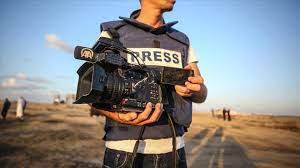
As journalists who work in Israel electronic media begin to retire, they tell us their secrets of the trade, one of which is that they often reserve their most egregious and tendentious news reports on Orthodox Jews for Friday night, when Sabbath observers cannot respond

A rumor  may surface on Friday night. For example, a story that someone with a kippa and tallis over his shirt has allegedly attacked someone who is not observant. The journalist who reports the story has not had time to verify the news item, but his or her   news outlet  solicits reactions from across the spectrum of opinion, except for the Orhodox, who are of course not available for comment.

This week, after Israel election results saw  an unprecedented 34 Knesset seats in the hands of Orthodox political parties, who will form a coalition with 32 members of the Likud to form the new Israel government, anger in the Israel electronic media reached flood level.

In the words of the Israel radio news announcer on Friday morning, Nov. 4th, three days after the decisive Israel election “I hesitate to say Shabbat Shalom”

When the Sabbath queen hovers over Israel this evening, transforming the Orthodox Jewish world into a collective inaccessible pumpkin, news anchors in Israel Channels 11,12,13 and IDF radio can have a field day reporting fake news about Orthodox Jews and about Israel’s national camp, who just swept the Israel elections.

This as a  call to Hebrew speakers abroad to listen and note possible inaccuracies in Shabbat reportage, which you can easily pick up online…And communicate questionable reporting to us in Israel, where our agency will hold these publicly funded news stations to account.

Send feedback:
Dbedein@IsraelBehindTheNews.com

Main Funder of Anti-Israel Sentiments on Campus: Qatar

Following the IAM post last week, another recent report needs attention. It was conducted by the National Association of Scholars (NAS) on the politically-motivated investments of Qatar in Western Universities. This second report provides a case study of Northwestern University-Qatar (NU-Q), that is, Northwestern University’s branch in Qatar. IAM is especially concerned because Qatar has shown hostility to Israel throughout the years. In particular, Qatar wants to influence American policy toward Israel.

The second NAS report notes that in 2013, NU-Q entered a formal agreement with the Qatari-owned news outlet Al Jazeera to train journalists to work for the outlet. They even created the Al Jazeera scholarships for NU-Q students and started exchange journalism programs and training for students. Moreover, NU-Q helped Al Jazeera in reaching the American media market.

Qatar has also used its influence to support its friends, which include Iran, the Muslim Brotherhood, and Hamas. The NAS report explicitly states that “American universities have invested substantial time and manpower to aid the development of an illiberal regime that funds and befriends entities hostile to American national interests.”

As the report states, Northwestern University’s only interest in the liaison with Qatar is financial. Qatar can preserve its “illiberal quasi-absolute monarchy and traditional Islamic mores and still escape criticism.” The report notes that “this cozy arrangement only further corrupts American universities and serves neither American interests nor ideals.” The report titled this arrangement the “new progressive illiberalism.”

From its inception in 2006, Al Jazeera has been extremely hostile to Israel and Zionism. As a rule, its reports focus on the negative to delegitimize the Jewish state.

For example, the Al Jazeera website defines Ζionism as a “colonial movement,” which, “as the likes of Israeli historian Ilan Pappe have argued, Zionist leaders were well aware that implementing their project would necessitate the ethnic cleansing of the indigenous Palestinian population. In 1948, David Ben-Gurion, then head of the World Zionist Organisation, proclaimed the founding of the state of Israel in Palestine. Zionists argued that Israel would provide a safe national home for Jews, allowing any Jewish person from anywhere in the world to immigrate there and claim citizenship. Critics, however, argue that Zionism has functioned like colonialism, pointing to the violent ethnic cleansing of the indigenous Palestinian population and the building of illegal settlements in the Occupied Palestinian Territories as evidence.”

Of course, Al Jazeera does not mention the 1948 war when five Arab armies attacked nascent Israel or the Palestinian Arabs riots against the Jews between 1936-9 which were influenced by Nazi Germany.

As IAM repeatedly reported, Iran, Qatar, and other enemies of Zionism have recruited Israeli academics to tarnish Israel. Ilan Pappe was one of the first among these guns for hire, followed by Neve Gordon, Shlomo Sand, Ariella Azoulay, and others.

However, Al-Jazeera should be reminded that Qatar is a more colonialist creation than Israel. Mohammed bin Thani, the ruler of Qatar, signed a treaty with Britain in 1868 to recognize it as a separate entity. Qatar became a British protectorate from the early 20th century until its independence in 1971. Contrary to Qatar, the Jews were promised a national home by the League of Nations, and Britain was given the Mandate to create the national home for the Jewish People in Palestine.

While the Abraham Accords changed much of the negative attitude that Arabs generally held against the Jewish State, hostility driven mainly by the Palestinians and their backers, such as Qatar and Iran, is still around. Since Qatar is a significant funder of Western universities, it is not surprising that antisemitism is skyrocketing, and so is anti-Israelism.


References

https://www.nas.org/reports/outsourced-to-qatar/full-report
Outsourced to Qatar A Case Study of Northwestern University-Qatar 

Neetu Arnold

September 14, 2022

Saudi Arabia has historically provided the largest amount of funding to American universities out of all the Middle Eastern countries. In recent years, however, neighboring Qatar has emerged as a significant rival. A small but wealthy Persian Gulf petrostate, Qatar recently became the top foreign funder of American universities, donating at least $4.7 billion between 2001 and 2021.1 Qataris fund research projects in many different fields, including medical research, cybersecurity, and economic development.

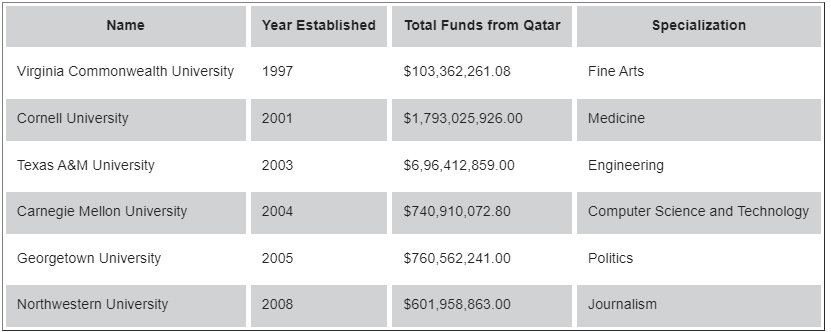
The top recipients of Qatari funds have something in common: they all have branch campuses in the country. According to the Department of Education, Northwestern University received more than $600 million in Qatari gifts and contracts since it opened a branch campus in the country in 2007. The Illinois-based university is one of six American campuses in Qatar, each of which has a particular specialization. Cornell University, for example, focuses on medical education, while Georgetown University specializes in government and politics. Northwestern University’s branch campus in Qatar (NU-Q) primarily covers journalism.

Figure 1: American Campuses in Qatar

Name Year Established Total Funds from Qatar Specialization
Virginia Commonwealth University 1997 $103,362,261.08 Fine Arts
Cornell University 2001 $1,793,025,926.00 Medicine
Texas A&M University 2003 $6,96,412,859.00 Engineering
Carnegie Mellon University 2004 $740,910,072.80 Computer Science and Technology
Georgetown University 2005 $760,562,241.00 Politics
Northwestern University 2008 $601,958,863.00 Journalism

The Qatar Foundation (QF), a state-led non-profit founded in 1995 by Qatar’s ruling family to improve Qatari society, funded this educational complex. Through the QF, the country hopes to 1) increase the workforce participation rate among Qataris; 2) equip Qataris to replace the foreigners who dominate many sectors of their current workforce; 3) prevent the “brain drain” that results when Qataris study abroad and fail to return home; and 4) maintain the strength of Qatar’s Islamic religious customs and traditions.2

After founding QF, Qatar began to recruit Western universities to build branch campuses in Education City, Doha, so that the nation could provide its youth with educational opportunities.3 The first branch campus, established by Virginia Commonwealth University, opened in 1997. NU-Q opened in 2008, largely due to the work of Carnegie Foundation of New York president Vartan Gregorian, who was both a member of QF’s board of trustees and a close friend of one of Northwestern’s trustees.4

About Vartan GregorianVartan Gregorian held many prominent leadership positions throughout his life—ranging from president of Brown University to CEO of the New York Public Library (NYPL). He was born in Iran in 1934 to Armenian parents and moved to the United States in the 1950s to pursue higher education.Gregorian’s immigrant background shaped his approach throughout his career. Prior to his leadership roles, Gregorian worked as a professor and specialized in Middle Eastern and European affairs. As the CEO of the NYPL during the 1980s, he increased circulation of multicultural materials. When Gregorian served as Brown’s 16th president from 1989 to 1997, he worked to increase the university’s international reputation and expand its influence abroad. And during his presidency for the Carnegie Corporation of New York from 1997 until his death in 2021, Gregorian expressed interest in projects that celebrated Islamic culture and society. In 2003, Gregorian published Islam: A Mosaic, Not A Monolith, which rebutted Samuel Huntington’s “clash of civilizations” thesis.5Gregorian’s interest to change Western perceptions of Islam and his expansive influence in the academic world made him an ideal candidate for QF’s board of trustees.

QF recruited Northwestern to establish a Qatari branch campus in the hopes that the university would train future journalists who could build Qatar’s media presence abroad. At first, this purpose was largely unstated. In 2013, however, NU-Q entered a formal agreement with the Qatari-owned news outlet Al Jazeera designed to train journalists for the outlet. NU-Q and Al Jazeera signed a Memorandum of Understanding that created Al Jazeera scholarships for NU-Q students and established journalist exchange programs and training workshops in which the students could participate. As part of the agreement, NU-Q committed to help Al Jazeera expand into the American media market via its Al Jazeera America (AJA) news channel:

NU-Q will conduct consultations with Al Jazeera leadership based on its faculty research interests and expertise in the American media industry, as the news network moves forward with its planning for Al Jazeera America.6

AJA shut down in 2016, but Al Jazeera continues to reach American audiences via its social media platform AJ+.7

Nearly 500 students have graduated since NU-Q’s founding; the number of graduates increased from 35 for the class of 2012 to somewhere between 75-80 in the 2021 class.8

Universities that enter into agreements with Qatar receive significant criticism because of the emirate’s illiberal practices. Qatar is a quasi-absolute monarchy that offers little in the way of protections for workers, women’s rights, or freedom of the press. Critics of the Qatari government frequently end up in jail, so academic freedom for professors at branch campuses remains a major concern—as does the willingness of American universities to turn a blind eye to Qatar’s illiberal practices.9 Qatar’s National Vision, a development plan, emphasizes its intention to modernize to keep up with globalization, but modernization does not mean liberalization. Indeed, the National Vision clearly stipulates that Qatar will not compromise its local and traditional values for the sake of modernization.

Qatar’s stipulation prompts a natural concern about whether American universities should enter partnerships with the Qatari government, since American values differ considerably from those of Qatar. Former Northwestern professor and faculty senate president Stephen Eisenman raised these concerns after visiting the NU-Q campus in 2015.10 He published a report that offered nine proposals for reform, including the three that follow:

—   Expanding scholarship programs for lower-income and non-Qatari students

—   Creating a shared-governance structure for NU-Q faculty

—   Informing the Qatari government that relaxed speech and press restrictions are preconditions for the university’s continued operation in the country

In an email to the author, Eisenman stated that, as of 2021, university administrators have not implemented any of his recommendations.11

Censorship meanwhile continues in full force in Qatar. In 2020, Northwestern moved an event featuring Lebanese Indie rock band Mashrou’ Leila, whose lead singer is gay, from its Qatari campus to its American campus. Qatar makes homosexual relations illegal, and perpetrators can go to prison. Northwestern claimed that they moved the event due to “security concerns.” The QF, however, contradicted Northwestern’s claim and stated that the NU-Q event was canceled because it did not adhere to Qatari social customs.12

The Qatari government also insists on maintaining heavy-handed oversight of the reading lists on its American branch campuses.13 In 2015, the Qatar banned a question in a media use survey that asked participants whether they believed the country was “headed in the right direction.” Then-Northwestern dean Dennis Everett led the Qatar National Research Fund (QNRF)-backed survey.14

It’s clear that Qatari values differ significantly from American values—in fact, the two belief systems often explicitly contradict. Furthermore, Eisenman’s report indicates that Northwestern has received negligible profits from its Qatari branch campus. So, the question arises: why would Northwestern bother to operate in Qatar?

One of Northwestern’s motivations seems to be a desire to exercise its influence to liberalize Qatar. In America, universities routinely use their authority, knowledge, and position to mold moral, political, and social decisions.15 Especially following the Arab Spring in the early 2010s, many American academics hoped that Middle Eastern countries would liberalize—and that they could assist with this transformation. As Everett said, “When we conducted our first study in 2013, there was enthusiasm for the idea that the Arab Spring might mark the start of a movement toward more freedom of expression.”16

Eisenman recalls the blind enthusiasm that Northwestern administrators had for NU-Q prior to his trip:

The president and then provost thought they were doing “God’s work” in establishing and supporting NU-Q, as they told me before my visit, and evidently felt no need to interfere with the Divine plan.17

In other words, it appears that Northwestern believed its branch campus would influence Qatar rather than become subject to Qatari influence.

The courses that NU-Q offers certainly disseminate the predominant ideologies of American universities.18 “Multiethnic American Literature” examines minority writers who challenged the “dominant narratives of America.” Courses such as “Social Construction” and “Children’s Literature” address gender constraints and propagate elements of gender studies.19 “Journalism in the Digital World,” a mandatory course for first-year Journalism and Media Industry & Technology majors, blends instruction in the craft of journalism with strictures to mistrust Breitbart News, an American conservative publication, because the publication has a “long history of distorting facts to suit a far-right agenda.”20 The course description fails to include instances of journalistic malpractice by left-wing media.21

Northwestern’s partnership with Qatar also provides the university with opportunities to expand both its reach and its revenue. In 2019, for instance, Northwestern Medicine announced that it would open a hospital in Qatar in partnership with Alfardan Medicine, a part of the Alfardan Group.22 The Alfardan Group is led by Omar Hussain Alfardan, who happens to serve on the Board of Trustees of Hamad Bin Khalifa University (HBKU). HBKU is also a partner of NU-Q.23 Northwestern’s connection with Qatar has also helped at home, as demonstrated by the five Qatari-funded professorships that the university now boasts.24

Through its relationship with Qatar, Northwestern has also gained access to a privilege only a handful of universities enjoy: Qatari research funds. Grants from the government-run QNRF are only available to institutions located in Qatar; but Northwestern’s branch campus in Qatar, therefore makes the university eligible to apply for QNRF grants.25 As of 2019, NU-Q received 11 QNRF grants, most of which addressed policy-relevant issues such as “driving behaviors in Qatar, Qatar’s foreign aid strategy, and…the development of the Qatar national identity.”26

As is often the case with government-funded research, QNRF proposals must address how the research benefits Qatar or aligns with the Gulf State’s National Vision. For instance, one of Northwestern’s accepted research proposals, “Assessing Qatari Emerging Media Engagement: A Study of How AR, VR, and other Emerging Media are Being Utilized in Qatar,” asks Qatari residents about their perception of media in the country. The proposal specifically states that the project will result in “increased opportunities to enhance Qatar’s regional and global reputation in the development of and engagement with technological innovation.”27

It is difficult to determine the full extent to which Northwestern has benefitted from Qatari research funds, as the university’s reports to the Department of Education have remained vague. The university, however, has revealed some of the dollar amounts itself via its celebratory announcements. In 2012, Northwestern announced that its Engineering and Arts School received two research grants from QNRF, both worth $1,050,000 over the course of three years.28 It remains unclear whether Northwestern has reported all QNRF grants to the Education Department.

Figure 2: Qatar Research Grants29

Title Institution(s) Amount
National Museums and the Public Imagination: A Longitudinal Study of the National Museum of Qatar University College London (UCL) – QatarNorthwestern University in QatarQatar UniversityUniversity of Puget Sound $800,521
Assessing Qatari Emerging Media Engagement: A Study of How AR, VR and other Emerging Media Are Being Utilized in Qatar Northwestern University in QatarNorthwestern UniversityQatar UniversityRutgers University $482,986
Qatari Women: Engagement and Empowerment Northwestern University in Qatar $150,000
Qatar and the World Values Survey: Ensuring Conceptual Validity and Cross-Cultural Comparability Northwestern University in Qatar $99,836
Hashtag Blockade: Exploring the Digital Landscape of the Gulf Crisis Northwestern University in Qatar $30,000
Fresh Global Media Players: Redistributing Media Power? Northwestern University in Qatar N/A
Media Use in the Arab Gulf: A Longitudinal Study Northwestern University in Qatar N/A
Content Innovation Strategies for Mobile Media in Qatar Northwestern University in QatarNorthwestern UniversityQatar UniversityRutgers University N/A
Media Use in the Middle East: Qatar in a Changing Region Northwestern University N/A
Assessing the Qatari news media’s capacities for fostering public understanding of and engagement with science: issues, challenges, opportunities and their socio-political implications Northwestern University in QatarUniversity of SharjahBournemouth University N/A
Qatari adolescents: How do they use digital technologies for health information and health monitoring? Northwestern University in QatarNorthwestern UniversityQatar University N/A
Virtual Reality as a Hybrid Learning Solution for Education in Peri-and-Post COVID-19 Qatar Northwestern University in Qatar N/A
Catalysts and constraints: Women’s and girls’ experience of physical activity and sport in Qatar Northwestern University in Qatar N/A
Qatar and the World Values Survey: Enhancing the Validity and Cross-Cultural Comparability of Survey Research Measurement Northwestern University in QatarQatar University N/A
Development of a survey based tool to measure digital literacy for Arabic Internet users: A new model of assessment. Northwestern University in QatarQatar University N/A
Chicken is for the birds: Changing the deadly driving behaviors of young Qatari men Northwestern University in Qatar N/A
Global Regulation of Parody & Satire as Policy Guidance on the Implementation of Qatar’s Cyberlaw Northwestern University in Qatar N/A
Arab Children and Youth Television: A Study of Role Models Northwestern University in Qatar N/A
Cultivating a Science-Based Community and Scientific Culture in Qatar Northwestern University in QatarHamad Bin Khalifa University N/A
Helping Oneself by Helping Who Needs: the discourses and practices of Qatari Foreign Aid to developing countries Northwestern University in Qatar N/A
Assessing and Improving Migrant Workers Access to and Utilization of Health Information and Resources Northwestern University in Qatar N/A
Entrepreneurship and Economic Sustainability: contribution of migrant entrepreneurs in Qatar Northwestern University in Qatar N/A
Keep Them Safe: A Child Car Seats Persuasive Campaign Northwestern University in Qatar N/A
Surviving the Covid-19 Pandemic: Socio-cultural impacts of coronavirus outbreak on migrants in Qatar Northwestern University in Qatar N/A

Observations

NU-Q provides an important case study in the unique way that Qatar-funded branch campuses operate. These types of partnerships are relatively new forms of foreign funding for American universities, but they have grown in popularity. NU-Q illustrates how foreign relationships can develop: the Qatari government went from paying for the operation of a branch campus to funding American fellowships, research, and even hospitals. By cultivating its relationship with the host country, the university gains the potential to rake in cash through initiatives that extend well beyond the walls of the original branch campus.

Qatar is unique compared to other Gulf States, and partnerships with Qatar pose a unique threat to American higher education. Unlike Saudi Arabia, Qatar exercises extensive bureaucratic oversight into university operations. The Qatari government also owns all the national partner organizations, including the Doha Film Institute, the Qatar National Research Fund, and Al Jazeera. Northwestern’s branch campus increases Qatar’s influence abroad—and Qatar uses its influence to aid its own friends, which include Western adversaries such as Iran, the Muslim Brotherhood, and Hamas. American universities have invested substantial time and manpower to aid the development of an illiberal regime that funds and befriends entities hostile to American national interests.

Branch campuses and other partnerships give American universities a stake in Qatar’s future, regardless of whether Qatar promotes or opposes American interests. Northwestern particularly seems eager to remain in Qatar whatever the costs. The university benefits from increased funding and the opportunity to expand—and, subject to Qatari censorship to preserve traditional mores, it can spread the modern brand of illiberal progressivism and identity politics that American academics think constitutes democracy.

American universities profit from Middle East branch campuses, and so do Middle Eastern countries such as Qatar. Northwestern requires nothing of Qatar beyond its money: the nation can preserve its illiberal quasi-absolute monarchy and traditional Islamic mores and still escape criticism. American universities meanwhile gain access to a new “mission field” in which they can work to export American identity politics and the new progressive illiberalism. But this cozy arrangement only further corrupts American universities and serves neither American interests nor ideals.


1 “College Foreign Gift and Contract Report,” Department of Education, accessed August 11, 2022, https://sites.ed.gov/foreigngifts/.

2 Qatar National Vision 2030, General Secretariat for Development Planning, Government of Qatar, July 2008, https://www.gco.gov.qa/en/about-qatar/national-vision2030/; “QF Stemming the Brain Drain,” The Peninsula, September 11, 2021, https://thepeninsulaqatar.com/article/11/09/2021/QF-stemming-the-brain-drain.

3 “About Qatar Foundation,” Qatar Foundation, accessed December 8, 2021, https://www.qf.org.qa/about.

4 Nancy Deneen, “Crown Gift Boosts Middle East Studies,” Weinberg College of Arts & Sciences, Northwestern University, Spring/Summer 2010,  https://weinberg.northwestern.edu/after-graduation/weinberg-magazine/crosscurrents-archive/2010-spring-summer/crown-gift-middle-east-studies.html.

5 Burton Bollag, “Vartan Gregorian: From Immigrant to Leading Philanthropist,” Al-Fanar Media, May 2, 2021, https://www.al-fanarmedia.org/2021/05/vartan-gregorian/; “Vartan Gregorian: 1934–2021,” Carnegie Corporation of New York, April 16, 2021, https://www.carnegie.org/news/articles/obituary-president-vartan-gregorian/; “Vartan Gregorian: 1989-1997,” Office of the President, Brown University, accessed April 8, 2022, https://www.brown.edu/about/administration/president/people/past-presidents/vartan-gregorian-1989-1997.

6 “NU-Q and Al Jazeera Network Sign MoU to Facilitate Knowledge Transfer, Increase Student Engagement, and Strengthen Collaboration,” Northwestern University in Qatar, March 19, 2013, https://www.qatar.northwestern.edu/news/articles/2013/03-nu-q-al-jazeera-mou.html.

7 Eyder Peralta, “Al-Jazeera Will Shut Down Its American Network In April,” NPR, January 13, 2016, https://www.npr.org/sections/thetwo-way/2016/01/13/462940239/al-jazeera-will-shutdown-its-american-network-in-april.

8 NU-Q Director of Communications and Public Affairs Nanci Martin, email to author, December 5, 2021.

9 See Will Fitzgibbon, “Life in Prison for Poet Who Dared Insult Qatari Leader,” The Bureau of Investigative Journalism, November 30, 2012, https://www.thebureauinvestigates.com/stories/2012-11-30/life-in-jail-for-poet-who-dared-insult-qatari-leader; Mark Lobel, “Arrested for Reporting on Qatar’s World Cup Labourers,” BBC, May 18, 2015, https://www.bbc.com/news/world-middle-east-32775563.

10 Stephen F. Eisenman, A Report on Northwestern University Qatar: Nine Proposals, March 2015, https://www.northwestern.edu/faculty-senate/about/faculty-resources/Senate%20Commentary%20-%20A%20Report%20on%20NUQ%20Mar%202015%20Eisenman.pdf.

11 Stephen Eisenman, email to author, December 2, 2021.

12 Sarah McLaughlin, “Northwestern University in Qatar Partner Claims Controversial Event was Canceled Due to ‘Qatari Laws’, ‘Cultural and Social Customs,’” FIRE, February 5, 2020, https://www.thefire.org/northwestern-university-in-qatar-partner-claims-controversial-event-was-canceled-due-to-qatari-laws-cultural-and-social-customs/.

13 Sama Abduljawad, “Education City Universities Face Book Censorship,” The Daily Q, accessed December 9, 2021, https://thedailyq.org/3909/features/education-city-universities-face-book-censorship/.

14 Nick Anderson, “In Qatar’s Education City, U.S. Colleges are Building an Academic Oasis,” The Washington Post, December 6, 2015, https://www.washingtonpost.com/local/education/in-qatars-education-city-us-colleges-are-building-an-academic-oasis/2015/12/06/6b538702-8e01-11e5-ae1f-af46b7df8483_story.html.

15 Arnold, Priced Out: What College Costs America.

16 Alice Yin, “NU-Q Researchers Look at Middle East Social Media Landscape,” The Daily Northwestern, October 11, 2015, https://dailynorthwestern.com/2015/10/11/campus/nu-q-researchers-look-at-middle-east-social-media-landscape/.

17 Eisenman, email to author, December 2, 2021.

18 Martin, email to author, December 5, 2021.

19 “NU-Q 2021-22 Undergraduate Catalog,” Northwestern University, accessed December 8, 2021, https://my.qatar.northwestern.edu/academic-resources/policies/NU-Q-Catalog-2021_22—Updated2.pdf.

20 “JOUR 202,” Northwestern University in Qatar, accessed December 9, 2021, https://www.qatar.northwestern.edu/academics/writing-center/resources-JOUR-202.html.

21 See Brian Flood, “Washington Post’s ‘Find the Fraud’ Correction Points to Larger Issue with Agenda-Driven Anonymous Sources,” Fox News, March 16, 2021, https://www.foxnews.com/media/washington-posts-find-the-fraud-correction-anonymous.

22 “Alfardan Group Moves into the Health Sector with the Launch of ‘Alfardan Medical with Northwestern Medicine’,” Northwestern Medicine, January 24, 2019, https://www.nm.org/about-us/northwestern-medicine-newsroom/press-releases/2019/launch-of-alfardan-medical-with-northwestern-medicine.

23 “Omar Hussain Al Fardan,” Family Business Council Gulf, accessed December 8, 2021, https://fbc-gulf.org/en/about/about-us/mission-vision-value; Northwestern is specifically has a partnership with Qatar Computing Research Institute, which is run under the purview of HBKU. “Institutional Partnerships,” Northwestern University in Qatar, accessed December 8, 2021, https://www.qatar.northwestern.edu/about/partnerships.html.

24 Eisenman, A Report on Northwestern University Qatar: Nine Proposals.

25 “Guidelines for Submitting Institutions Registration as Research Office,” Qatar National Research Fund, January 2019 revision, https://www.qnrf.org/en-us/Funding/Policies-Rules-and-Regulations/RO-Registration-Policy.

26 “Qatar Awards Grants to Northwestern Faculty/Students to Investigate Migrant Contribution and Car Safety,” Northwestern University in Qatar, August 19, 2019, https://www.qatar.northwestern.edu/news/articles/2019/08-UREP-grants.html.

27 “Assessing Qatari Emerging Media Engagement: A Study of How AR, VR and other Emerging Media are being utilized in Qatar,” NPRP12S-0227-190165, Qatar National Research Fund, accessed December 9, 2021, https://mis.qgrants.org/Public/AwardDetails.aspx?ParamPid=fhgjebebpg.

28 University Relations, “Grants Add to Northwestern-Qatar Partnership,” McCormick School of Engineering, Northwestern University, June 18, 2012, https://www.mccormick.northwestern.edu/news/articles/2012/06/qatar-national-research-fund-grant.html.

29 Qatar National Research Fund, https://mis.qgrants.org/Public/AwardSearch.aspx; “Christina M. Paschyn,” Northwestern University in Qatar, https://www.qatar.northwestern.edu/directory/profiles/paschyn-christina.html#awards-and-grants; “Jocelyn Sage Mitchell,” Northwestern University in Qatar, https://www.qatar.northwestern.edu/directory/profiles/mitchell-jocelyn.html#grants; “S. Venus Jin,” Northwestern University in Qatar, https://www.qatar.northwestern.edu/directory/profiles/jin-s-venus.html#Grants.

===========================================

https://remix.aljazeera.com/aje/PalestineRemix/zionism.html

ΖΙΟΝΙSΜ

A colonial movement supporting the establishment by any means necessary of a national state for Jews in historic Palestine

Zionism is a nationalist, political ideology that called for the creation of a Jewish state, and now supports the continued existence of Israel as such a state. Theodor Herzl, an Austrian Jew, is considered the “father” of political Zionism. The Zionist movement started in the late 19th century, amidst growing European anti-Semitism. The movement secured support among Western European governments, particularly after Zionists agreed to create their Jewish state in historic Palestine. The Zionists’ early objective was to claim as much of historic Palestine as possible, by driving out the Palestinian population.  Zionists actively encouraged the mass migration of European Jews to Palestine during the first half of the 20th century. Despite their efforts, and the sharp rise in anti-Semitism in Europe culminating in the Nazi persecution, Arabs still outnumbered Jews in Palestine. Thus, as the likes of Israeli historian Ilan Pappe have argued, Zionist leaders were well aware that implementing their project would necessitate the ethnic cleansing of the indigenous Palestinian population. In 1948, David Ben-Gurion, then head of the World Zionist Organisation, proclaimed the founding of the state of Israel in Palestine. Zionists argued that Israel would provide a safe national home for Jews, allowing any Jewish person from anywhere in the world to immigrate there and claim citizenship. Critics, however, argue that Zionism has functioned like colonialism, pointing to the violent ethnic cleansing of the indigenous Palestinian population and the building of illegal settlements in the Occupied Palestinian Territories as evidence.

MORE ABOUT “ZIONISM”

  1. If I speak of Zionism as a colonialist ideology supported by imperialist countries then the struggle against Zionism is not only a Palestinian struggle.Palestina Amore
  2. In it he warned of Zionism as a movement aimed at displacing the Palestinians.Al Nakba 1
  3. Zionism came to mean the establishment of a Jewish homeland in Palestine but not all Jews supported this.Al Nakba 1
  4. Zionism is trying to rewrite the history not just of the Middle East and Palestine but of the whole world.Palestina Amore
  5. Zionism has led to the loss of the Palestinian city identity It’s lost geographically and in people’s memories.Lost cities of Palestine
  6. Outcast in the Seychelles he wrote a diary condemning British policy and its support for Zionism.Al Nakba 2
  7. Ahmed Abu Hedbeh I read more than 1 000 books during my detention I learnt Hebrew and all about Zionism.Beyond the walls
  8. A Jewish paramilitary force called Haganah was trained by Orde Wingate a British officer and ardent supporter of Zionism.Al Nakba 2
  9. Former British prime minister Winston Churchill who had been a prominent and enthusiastic supporter of Zionism condemned the attack.Al Nakba 2
  10. Among the materials there is this book It’s compiled by the Palestine Forum It’s on the conference about Zionism we held in Rome in November.Palestina Amore
  11. For example comparing anti Zionism to anti Semitism A concept we have always rejected.Palestina Amore
  12. Since Zionism is a dynamic movement they knew that there was no finality about the borders then they knew that opportunities would arise in due course to take the rest of it and they did this in 1967.Al Nakba 3
  13. It also discussed the one state solution and the political ideology of Zionism as the main cause of the Israeli Palestinian conflict Only 5 Euros and you can help the resistance of the Palestinian people in Gaza We are group called Stop Agrexco.Palestina Amore
  14. 1885 In 1885 the term Zionism was first coined by Austrian writer Nathan Birnbaum.Al Nakba 1
  15. It has always been taboo to talk about Zionism But the conference broke this taboo Thanks to the contributions of scholars who enriched the event with their research.Palestina Amore
  16. DR AZMI BISHARA ARAB INTELLECTUAL The presence of Eastern Orthodox Christians in the Middle East causes a dilemma to the colonialists They rely on their Christian ideology to justify their support of Zionism.Al Nakba 1
  17. 1896 In 1896 Theodor Herzl an Austro Hungarian journalist wrote a book called The Jewish State It is considered one of the most important texts of early Zionism.Al Nakba 1
  18. Israel has to give up Zionism and the racist ideologies on which it was founded It has to take a path of reconciliation As in South Africa between the blacks and the minority whites when the blacks used to live in isolated islands.Palestina Amore
  19. July 7 1938 Bombing of a market in Jerusalem July 8 1938 Bombing of a bus station in Jerusalem Dr Anis Sayegh I cannot imagine Zionism without violence whether before or after the establishment of the state of Israel.Al Nakba 2
  20. The Arabs and Palestinians were aware of the concept of Zionism from day one It’s a racist movement seeking capital to colonise land and exploit religion to create a homeland for the remaining Jews of the world This was clear in the writings of Najib Azuri and Najib Nassar.Al Nakba 1

Behind the scene with David Bedein – November 1, 2022


Behind the scene with David Bedein – November 1, 2022

Analysis: The rise to power of Itamar Ben Gvir: Why?

Mainstream organizations and standard media outlets are crying “gevalt!” over the rise of Itamar Ben Gvir of The Religious Zionism Party, while  ignoring the rise of a PLO entity whose incitement to murder Jews is part and parcel of their public policy.

The PLO, the Palestine Liberation Organization, through their sophisticated sounding Palestinian Authority, now recognized by 135 nations, makes no attempt to sugar coat their actions and intentions.

Consider these points:

  1. The Palestinian Authority texts present murderers as role models.
  2. Their tournaments feature those who have murdered Jews
  3. Their newly enacted laws provide an automatic fee-for-life for anyone who murders a Jew.
  4. Their songs carry lyrics of praise for the extermination of Jews.

The unkindest cut of all is that the government of Israel endorses the PA as a moderate entity.

Meanwhile, the PSF (Palestine Security Force), equipped by the US  and trained by the IDF, now openly conducts armed attacks against Jews throughout the country.

Hence, the Ben Gvir reaction

Annual Operational Report 2021

In 2021, the United Nations Relief and Works Agency for Palestine Refugees in the Near East (UNRWA) was able to maintain delivery of quality human development, protection, and humanitarian assistance to Palestine refugees across its fields of operation, responding to the devastating health, social and economic consequences of the Coronavirus disease 2019 (COVID-19 or pandemic) felt by Palestine refugees across all fields of operations, in addition to existing crises in Gaza, Lebanon, Syria and the West Bank, including East Jerusalem. Overall, the number of Palestine refugees relying on the Agency’s core services increased during the reporting period, adding an additional burden on UNRWA as it continued to experience underfunding of its core programme budget and emergency appeals.

Download file

Members of the advisory commission

1. Australia
2. Belgium
3. Brazil
4. Canada
5. Denmark
6. Egypt
7. Finland
8. France
9. Germany
10. India
11. Ireland
12. Italy
13. Japan
14. Jordan
15. Kuwait
16. Lebanon  (Chairperson from 1 July 2021 to 30 June 2022)
17. Luxembourg
18. Netherlands
19. Norway
20. Qatar
21. Saudi Arabia
22. Spain
23. Sweden
24. Switzerland
25. Syrian Arab Republic
26. Türkiye
27. United Arab Emirates
28. United Kingdom (Vice Chairperson from 1 July 2021 to 30 June 2022)
29. United States


  1. European Union
  2. League of Arab States
  3. Organization of Islamic Cooperation (OIC)
  4. Palestine

Ballot box blues

If anecdotal feedback and surveys are anything to go by, an increasing number of potential voters are feeling tuned out as Election Day approaches on 1 November.

My own unscientific soundings of various age groups highlight a growing total disconnect from this latest attempt at electing a governing coalition. Obviously, the public is increasingly turned off by the juvenile antics of many who are aspiring to enter the Knesset.

This grassroots mood of discontent seems to have escaped the notice of those politicians still totally detached from the mood of weary citizens fed up with false promises and bombastic rhetoric.

The same failed individuals making yet another attempt at garnering our votes are repelling rather than attracting support.

What is it that they don’t understand?

In the good old days, political parties issued manifestos detailing their policies and describing how they would tackle the many problems facing the country, such as economic, security and social welfare. One could choose between good old-fashioned socialist solutions or opt for more liberal and competitive financial plans. The plain fact was that voters had the chance to peruse the various parties’ solutions to the problems of the day and decide which suited them best.

These days potential voters have to make do with vague generalities, sweeping assertions and unrealistic promises scattered like confetti which most of us know will never be fulfilled.

In addition, we once had political leaders whose personal lifestyles were modest and who had what seemed to be a genuine interest in improving the lives of ordinary citizens.

Prior to the advent of social media and its attendant intrusiveness, the things that counted most were coherent policies, a track record of service to the country, a devotion to the Zionist vision and a reasonable ability to articulate all the above.

Today, all it takes is an ability to look like a film star and rhetoric which glosses over the details and is instead big on generalities and taking down your opponents.

Once upon a time, it would have been unheard of for a twice convicted Cabinet Minister to not only lead a party (a religious one at that) but also be reelected to the position from which he had originally been removed. Today, we have an ex-jailed MK trying to return to the legislature and the Government. In addition, the head of the largest right-wing party is under indictment and striving to be PM again. Innocent until found guilty, he may be but isn’t there something shameless about someone in such a situation promising the moon and pleading for our support?

With its multiplicity of ethnicities, the Israeli electoral map straddles and encompasses most sectors of society which ensures a much fairer representation than is the case in democratic countries where only two or three parties always prevail. No system is perfect, but at least in Israel, there is a better chance of minority views being represented in the Knesset. With thirty-nine political parties vying for our vote and a relatively low 3.2% threshold required, critics complain that this is a recipe for instability, hence our frequent election cycles.

There are, however, two important mitigating factors that need to be taken note of.

In the absence of an upper House or Senate, the requirement to have coalitions means that compromises must be made and prevents a small majority from riding roughshod over minority opposition. The parliamentary system we have also ensures that a coalition or political leaders who have lost the confidence of the majority of the Knesset can be replaced and the electorate given another opportunity to elect alternatives. Contrast that with those countries like the USA and France, where the President remains in place for a fixed term and where short of a major scandal, they cannot be removed even if they prove to be incompetent or incapable of carrying out their duties.

As we roll up to the polling booths on 1 November, what factors must we take into account before casting our ballot?

What are the main major challenges facing the country, and do aspiring politicians have any coherent plan to tackle them?

Assuming that one issue parties have no chance, what choices do we face?

If you are a confirmed believer that Israel is guilty of original sin and that those who declare their intention to cleanse us from this land are really peace doves in disguise, then your choices are clear. You have a choice between Arab parties who are anti-Zionist and Meretz and Labour. Extreme left Meretz wants to return to the 1947 armistice lines and embrace Abbas, who incidentally is increasingly irrelevant as far as a growing number of Arabs are concerned. Labour which once was the dominant force in the early days has also drifted further left and, in the process, has ditched most of its socialist principles and support for developing settlements. Its current leader stated the other day that she saw no point in building transport infrastructure in the West Bank (her words) because that area was not going to be part of Israel in the future. Perhaps that explains why Labour is no longer a major force in the Israeli political landscape and has been reduced to a rump party.

If you are looking for a party in the centre but you are not sure whether it is centre left or centre right, you have several choices. Unfortunately, these alternatives all come with potentially severe flaws because they are composed in the main of refugees from other parties whose ideological acrobatics make discerning their real policies rather difficult and potentially fraught with dangerous consequences. Yair Lapid has pledged his allegiance to a two-State solution on our sovereign territory and has stated to Arab voters that he would make sure Jews do not (God forbid) pray on the Temple Mount. Benny Gantz has described the PA and Abbas as “moderates” even though their media and policies promote and support the murder of Israelis.

No wonder centrist voters are conflicted.

Right-wingers also face a conundrum.

Do they support Likud whose leader blows hot and cold every time the US Administration or the Charedi parties issue demands? In the past, he has supported a two-State solution and made agreements with Abbas, so can he be trusted in the future? If you believe that teaching core subjects is absolutely vital for Israel’s future and that the environment needs to be protected, how can you cast your ballot for a party whose leader promises to throw millions of shekels at Charedi schools which do not teach English and mathematics and promises to rescind the tax on disposable plastic goods and sweetened drinks just because his ultra-Orthodox allies demand it?

The alternative for religious right-wingers is the Religious Zionist Party. If, however, you are not a religious fundamentalist, then you will be repelled by some of their extremist views. In addition, “reforming” the judiciary so that one of its aims is to release the leader of Likud from current investigations is enough of a red flag to those who cherish the independence and separation of the courts and the legislature. On the other hand, if you support an uncompromising response to terror, then this party could be your natural choice.

The Charedi parties continue to pander to that sector. However, it is clear that slowly but surely, many younger, more modern members of that community are fed up with the ossified positions that they espouse. Caught in some sort of time warp dating back to the European shtetl these parties totally exclude women and are determined to keep their followers in abject poverty by denying them an education which would enable families to gain meaningful employment. When the head of one of these parties states that Israel does not need citizens who are proficient in English or mathematics or serve in the IDF, then you know that they are completely divorced from modern-day realities. Yet these are the very groups that Likud and Religious Zionist parties court.

This leaves right-wing voters who are tolerant of others and desire long overdue reforms in the areas of Kashrut certification and conversion and who once may have voted for the old Mafdal (National Religious Party) with a choice of the Jewish Home Party. However, owing to a feeling that they have now become too pareve and the fact that they will jump into a coalition with the above-mentioned parties it looks as though they will not garner enough votes to cross the threshold.

That leaves Yisrael Beiteinu, which is right-wing but secular and anathema to the Chareidi parties, who fear its policies of separating State and Synagogue and opening up all areas to more competition. Perceived as a purely Russian-orientated party, it does now attract other sectors but so far has not managed to receive double-digit representation. On the other hand, its leader (the current Finance Minister) keeps his promises and refuses to align with Netanyahu and his ultra-religious allies.

In common with the rest of the world, we face major challenges.

Cost of living, social disparities and associated economic hurdles need to be confronted.

Israel uniquely also faces other threats, such as defeating those plotting our demise and the rising tide of hate worldwide.

We do not, unlike New Zealand, need to introduce a flatulence (farting) tax or burping tax to “save” the climate. However, we could usefully introduce a hot air tax which, given the current emissions from our politicians, would certainly give our economy a boost.

The question remains. Who can we confidently vote for?

How to make the most of the israeli-lebanese maritime deal

After years of stalling and hedging, a major economic collapse in Lebanon, multiple unstable governments in Israel, and threats of violence, the United States has successfully brokered a maritime border agreement between Beirut and Jerusalem. War has been averted, and everyone is happy. At least for now.

Israel will receive the most immediate benefits from this deal, as it can now quickly begin to exploit existing energy reserves in the Karish gas field. Lebanon may benefit as well, but it has more challenges to work through. Without reforms to the energy sector, profits from any future gas finds may end up in the hands of the political elite, lining their pockets and doing little for ordinary citizens. Hizballah, for its part, has seen its resistance rhetoric take a major blow with its public recognition of Israel. Yet there are fears that it may now turn its weapons against the internal Lebanese opposition. 

U.S. envoy Amos Hochstein deserves enormous credit for getting this agreement over the finish line. Now, Washington should work to maximize the benefits for the Lebanese people and regional stability. This means increasing pressure on Lebanese officials to implement necessary reforms, particularly in the energy sector. 

The Benefits of the Deal

Actors on both sides had strong reasons to make this agreement work. With elections coming in November, Israel wanted to start digging the Karish gas field as soon as possible and position itself as a natural gas producer. Lebanon had its own set of considerations. President Michel Aoun’s term will also end on November 1, and he wanted to make sure his legacy was not limited to failure and economic collapse. Hizballah, in turn, wanted to give the president they chose this goodbye gift. More importantly, the group wanted to avoid a war with Israel they knew they could not afford. After numerous threats failed to prevent Israel from moving ahead on Karish exploration, Hizballah knew that only diplomacy would help them save face. 

Despite accusations that Israel accepted all of Lebanon’s conditions and conceded too quickly, the truth is that Lebanon started this round of negotiations with a low bar. First, knowing it was a nonstarter for Israel and the United States, President Aoun completely dropped any discussion of Line 29 as the maritime border. This proposed boundary, the southernmost of the lines under discussion, would have cut through the Karish field, giving Lebanon a stake in it. Instead, Aoun decided to negotiate over line 23 which gave Israel complete control over Karish. Second, while Beirut secured the Qana field, its ability to exploit it is contingent on Israeli approval. Total, the French company that will explore Qana, is required to reach a financial arrangement with Israel, in which Lebanon will have no say. In other words, Israel controls the Karish field, which has already been shown to contain gas, while Lebanon has to share the Qana field, in which gas deposits have not been located yet. And if there is any gas in Qana, Lebanon has agreed that Israel will receive a payment of at least seventeen percent of the revenues from Total. At best, the money will take five years to start flowing.

The End of the Resistance Narrative

In seeking to avoid a conflict while demonstrating that it could use force to advance Lebanese interests, Hizballah has now given Israel security guarantees that it will not target Karish. It has sought to spin the deal as a victory but has failed to translate this into domestic political gains. Although this is officially an agreement between Lebanon and Israel, in reality, many in Lebanon see it as a deal between Hizballah and Israel. Indeed, according to Reuters, the group reviewed and approved the agreement line by line. 

This in itself is a breakthrough. For forty years, Hizballah’s resistance narrative rejected any kind of border negotiations with its sworn enemy or any acknowledgment of the state of Israel. Now, not only have Lebanon and Hizballah acknowledged the existence of Israel, but they also share an economic interest and are forced to maintain stability across the border as they await the profits from the deal to materialize. Hizballah’s narrative has already suffered from the group’s involvement in the Syrian civil war, where it has ignored Israeli strikes against its military personnel, arms depots, and weapons factories. By opting for a pact with Israel rather than another military confrontation, Hizballah has rendered itself even more irrelevant.

I grew up in a Shia town in South Lebanon. I was eight years old during the 1982 Israeli invasion and the establishment of Hizballah as a resistance movement. The word “Israel” was taboo — not to be uttered under any circumstances. Although we all knew that the country existed and prospered beyond our southern border, Hizballah made sure we understood that denial was the best way to deal with this reality. And if anyone dared to say the word “Israel” the immediate reaction was a forceful reminder that “it is called Palestine!” or “the occupying entity.” 

In response to the maritime border deal, Hizballah’s leader Hassan Nasrallah said, “We do not have any problem with the agreement with Israel.” He didn’t say “occupied Palestine” or the “enemy state” — he said “Israel.” For many Lebanese people, this indicates a major shift in narrative and strategy. None of Hizballah’s officials have ever uttered the word “Israel” before. None of them tolerated ‎others who dared to say it. ‎ 

This new narrative may allow the group to buy time until it is more ready for conflict. Yet it still creates a new reality where the state next door actually exists, is Lebanon’s partner in gas, and has a say in Lebanon’s economy and stability. What’s more, Hizballah accepted U.S. mediation in the negotiations and acknowledged American diplomacy in a matter of utmost significance to its security and military strategy. 

For Hizballah, the main challenge now is to keep the resistance narrative alive. The group cannot afford to take risks against Israel at this moment, inside or outside Lebanon, and seeks to refocus internally. This doesn’t mean that the rhetoric against Israel will stop, but it will probably change, with threats becoming less imminent and more rote. The group’s leadership will go back to turning a blind eye to Israeli strikes in Syria and resort to narrating past tales of victories instead of seeking out new ones. 

But with Hizballah striving to maintain its role in Lebanese politics, the risk is that its weapons and resistance rhetoric will turn against internal opposition and protest. Since its last confrontation with Israel in 2006, Hizballah has been confronting its Lebanese opponents instead. This includes imposing a national unity government on May 7, 2008, provoking street clashes to hinder investigations into the Beirut port blast, assassinating rivals like former Prime Minister Rafik Hariri and Shia critic Lokman Slim, and targeting protestors in 2019, mainly in Shia areas. 

Upcoming Phases and Challenges

For Israel, the main challenge is to preserve the maritime deal after the legislative elections and the formation of a new government. Opposition leader Benjamin Netanyahu has already criticized the deal and threatened to overturn it if he becomes prime minister. Many analysts, however, think this is mere election posturing that would quickly be shelved if he won. 

For Lebanon, the next steps are much more challenging. If Total discovers gas in Qana, the revenues will not be enough to cover the country’s financial deficits, the banking sector losses, and the Central Bank’s depleted reserves. The only way out of this crisis is through substantial financial, economic, and legislative reforms that would protect energy revenues, instead of letting them be squandered through corruption. Setting up a sovereign wealth fund to manage gas revenue is particularly vital in light of this sector’s poor record for fiscal responsibility. For example, since 1992, corruption and mismanagement in the electricity sector alone have created $40 billion in debt, or 43 percent of the total government debt. 

Without reforms, Lebanon’s corrupt political class will use energy revenue to maintain their interests and positions. This also means maintaining the sectarian narratives and clientelism that have already contributed to the collapse of Lebanon’s state institutions. Indeed, politicians very much hope to use the deal as an excuse to avoid reforms. By presenting Qana as a quick solution to the current crisis, they have already helped push calls for reform off the political agenda. 

The U.S. Role

This deal demonstrated that the United States is still the strongest player in Lebanon. No other country — except perhaps France — was able to compel the Lebanese political class to make compromises for the sake of stability, and no one else could get Hizballah to accept a deal with Israel and acknowledge its partnership. Through this deal, Washington also enhanced its credibility and developed new channels of communication with important actors in Beirut. Biden should leverage this success to push the Lebanese government to implement long-overdue reforms. 

The United States can work with its European and Gulf partners to sanction state officials who are hindering reforms in the energy sector. Actors such as the International Monetary Fund and the 2018 French-sponsored CEDRE donor conference have already spelled out what needs to be done. This includes creating an independent electricity regulatory authority, modernizing the transmission grid, and raising prices for the first time since the 1990s. A transparent sovereign wealth fund should also be established without delay. 

In response to the threat posed by Hizballah, Washington can also play a positive role in the formation of a new government, the implementation of legal reforms, the investigation into the Beirut port blast, and the appointment of military officials. Over the years, the United States has become the biggest donor to Lebanon, mainly in the form of military assistance to the Lebanese Armed Forces and humanitarian assistance in the recent economic crisis. Combined with terrorism and corruption sanctions, this created a degree of influence that the Lebanese authorities understand very well. Washington can use this influence to push Lebanon to elect a new president, protect the judge investigating the port blast, and secure the elevation of responsible security officials. 

These are not only internal Lebanese issues. They can make or break a very fragile country, whose instability will spill over to its neighbors and affect American interests in the region. The maritime deal shows what U.S. diplomacy can do. Now is the time to do more.

Abbas deputy admits PA security personnel work with terrorists

Israeli security forces launched an anti-terror raid against the “Lion’s Den” terror cell, including a bomb-making factory, early Tuesday. The cell was responsible for several terrorist attacks.

In response to the terrorists’ deaths and the exposure of the factory, Fatah Deputy Chairman Mahmoud Al-Aloul admitted that the Palestinian Authority security forces were fighting alongside terrorists—the Tanzim—against Israel (or, as he put it, “the occupation”), according to a report by Palestinian Media Watch.

He said Israeli soldiers were injured “due to the brave position of the Palestinian security forces” and that all Palestinians, including the P.A. security forces and Fatah’s terror faction, are “one unit.”
“We speak about all the Palestinians. All the Palestinians are one unit. The Security Forces members, the Tanzim, the public, and everyone—one unit in dealing with this occupation,” said Aloul.

P.A. leader Mahmoud Abbas created the deputy chairman position, especially for Aloul.