What is Not Generally Known to the Public in IsraeL, one month before elections:
The Palestinian Security Forces (PSF), trained by the IDF, now carry out daily attacks against Jews through its PSF elite unit known as the Al Aqsa Brigades.
Yet the government of Israel continues full security cooperation with the PSF . (1)
With the knowledge of the government of Israel, the Palestinian Authority has enacted unprecedented legislation to provide a salary for life for anyone who murders a Jew. (2)
People in Israel know that the PA often pays killers.
Few know that there is a law in this regard.
The government of Israel has never asked for the repeal of this PA law, which functions as an incentive to kill.
Instead, The government of Israeli reduces allocations to the PA according to the amount that the PA pays convicted killers, while allowing Saudi Arabia, Qatar & other nations to fill in the cash flow gap for convicted felons.
With the full knowledge of the government of Israel, the Palestinian Authority has fostered a new school curriculum which indoctrinates children to make war on the Jews.(3)
The government of Israel could veto that curriculum, yet does not use its authority to do so.
The government of Israel will not even demand that the PA remove a new PA textbook which presents Dalal Al Mugrabi, who murdered 35 Jews, including 12 children, as a role model for the next generation (4)
UNRWA allocates a $1.6 billion budget to maintain 6.7 million descendants of Arab refugees in 59 “temporary” refugee camps, as refugees for perpetuity, while inculcating the “right of return” to villages which existed before 1948. COGAT, the Israel Civil Administration, which oversees UNRWA, will not ask for any change in UNRWA policy (5)
Meanwhile, PA texts used by UNRWA now provide 120 new maps in UNRWA
schools which replace any Jewish presence with Arabic names –on both sides of the 1967 line- a new form of Judenrein. (6)
The government of Israel could order COGAT to stop distribution of these maps.
Israel could demand that the PA and UNRWA use standard world maps in their schools that depict the geographic details of each member state of the UN, including Israel.
Yet the current government of Israel will not make that demand.
Instead, the government of Israel encourages Israel business interests to invest in the Palestinian Authority, yet without vetting terror connections of their PA business partners. (7)
All this occurs, without beginning to mention the Arab encroachments in area C of Judea and Samaria that Regavim has documented so meticulously, while the government of Israel allows this to occur.
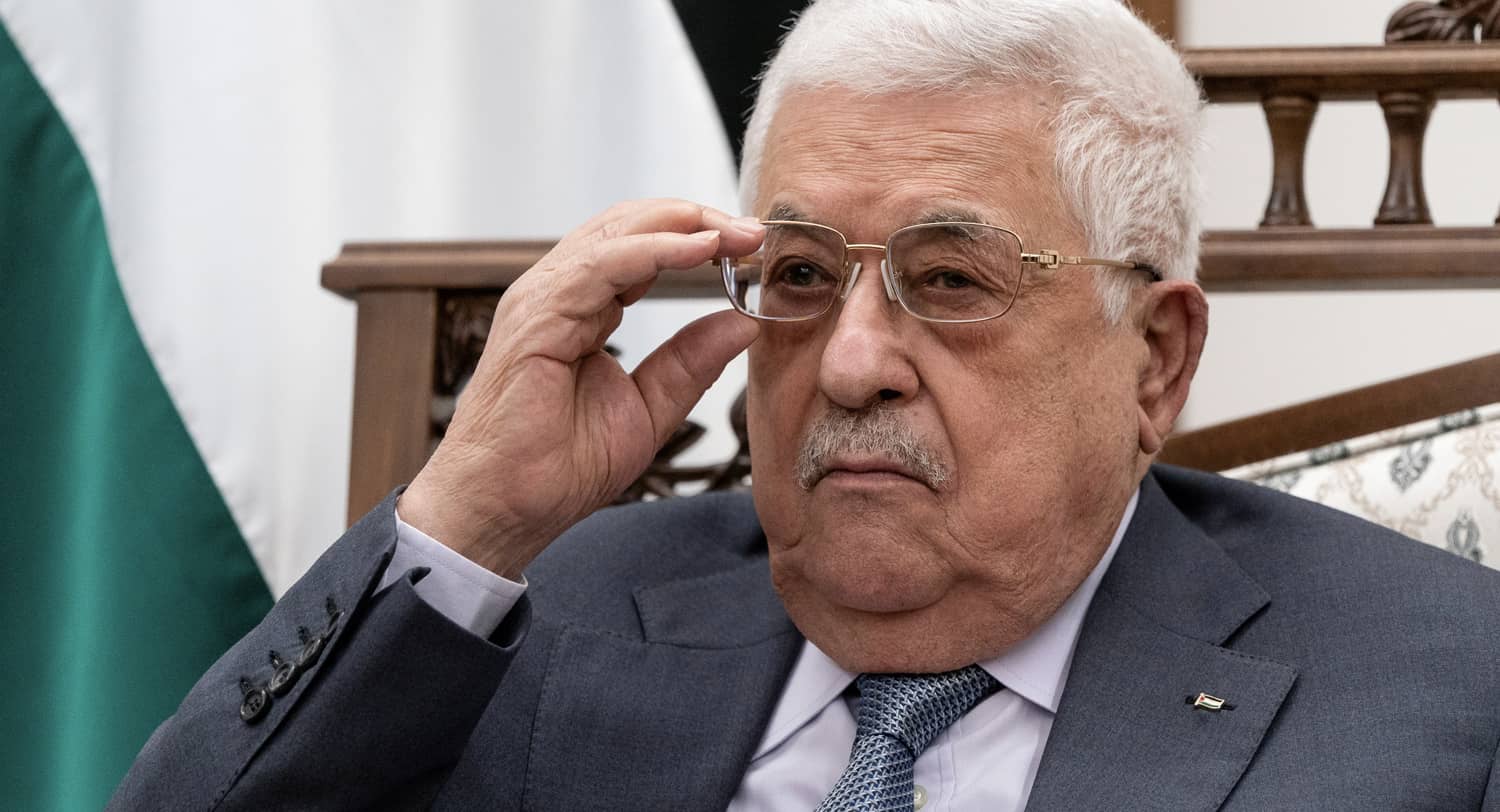
Fatah, which is headed by Palestinian President Mahmoud Abbas, released a video boasting of carrying out 7,200 terror attacks against Israel in 2022 and criticized Hamas for doing nothing.
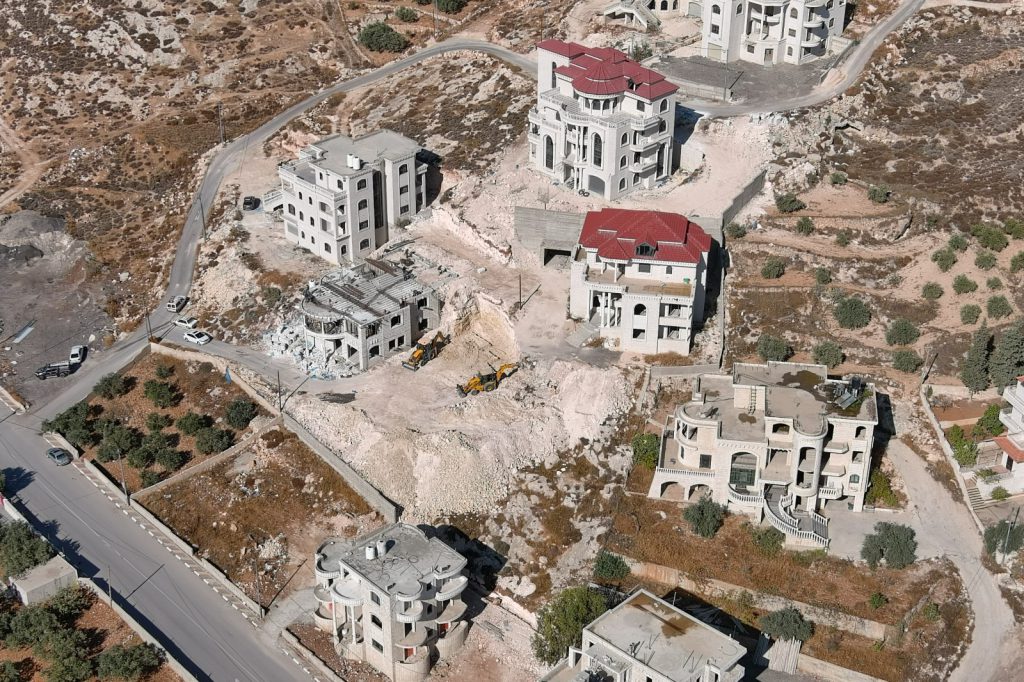
A report released by the Regavim Movement reveals that in 2022, illegal Palestinian construction in Area C, the portion of Judea and Samaria under full Israeli jurisdiction, increased by 80%. The report documents 5535 new illegal structures built in 2022, compared to 3076 structures in the same period in 2021. Regavim: “The Israeli government is creating a de facto Palestinian state.“
In 2022, illegal Palestinian construction in Area C of Judea and Samaria boomed, outpacing the already-alarming rate seen in 2021 by 80%. Regavim’s most recent report, based on data collected through meticulous fieldwork, aerial photography and GIS mapping, compared the situation on the ground in 2021 to that of 2022. The study covered the period of April 2021 through April 2022, analyzing the number of structures, the legal status of the land on which they were built and the jurisdictional lines dictated by international law.
Regavim’s exhaustive study indicates that in comparison to previous years, the data for the most recent period are unprecedented, both in quality and quantity. The structures in built in recent months are not temporary shacks or makeshift shelters that characterized much of the illegal activity in earlier years; in 2022, new Palestinian construction is characterized by “palatial residences, sprawling holiday resorts, amusement and entertainment compounds and event halls, swimming pools and vacation villages, and high-rise residential and commercial towers.” In addition to the mass-scale construction, in many areas development and infrastructure work was carried out to lay the groundwork for future full-scale neighborhoods, such as at Khirbet Khattha near Tarkumiyeh and Lakef near Karnei Shomron.
Regavim studied construction patterns exclusively in Area C, the portion of Judea and Samaria placed under full Israeli jurisdiction in the Oslo Accords framework. At present, according to Regavim’s research, there are 81,317 illegal Arab-built structures in this area, covering an area of approximately 150,000 dunams – twice the total area of Jewish settlement in Judea and Samaria all told, legal and illegal. Illegal Jewish construction stands at 4,382 structures, of which 406 new structures were built in the time period of the new study. Although the disparity in number is striking, it is far overshadowed by the disparity in quality: Whereas illegal Arab-built structures are located in desolate, remote areas far from existing villages or settlement clusters, all of the illegal construction in the Jewish sector is located within the municipal “blue line” boundaries of Jewish settlements.
Analysis of the hard data reveals several additional important facts: Aerial photos show that in Areas A and B – the sections of Judea and Samaria placed under full Palestinian Authority civil jurisdiction under the Oslo framework, there are abundant empty spaces that remain undeveloped and completely un-utilized. Rather than developing these areas, Arab construction has continued to seep into the open spaces of Area C. Additionally, these same aerial photos leave no room for doubt: Arab construction is neither random nor haphazard. Construction is strategically placed, in accordance with the Fayyad Plan, according to pre-established criteria and objectives: Creating contiguous Arab settlement – a pattern that is particularly pronounced in northern Samaria; isolation and strangulation of Jewish communities; construction on the route of planned traffic arteries such as the Funduk Bypass Road and the Tekoa–Ibei HaNachal Access Road in eastern Gush Etzion; construction alongside existing highways, including Route 55 and Route 60, the main roads of Samaria and Judea respectively.
Last week, some residents of Efrat.invited Israel Government minister Matan Kahane to a living room session in their home, in an open session to discuss the November 1 Israel elections
Matan Kahane, a retired officer from the Israel Air Force, had maintained a low profile on the issues of the day during this campaign
His move from the Israel National camp to the peace camp was shrouded in secrecy, until this week .
Matan prefers to speak about his accomplishments as minister of Religious affairs.
HOWEVER, Efrat voters asked hard questions – to discern why Kahane changed his political position, to support “peace now”.
Kahane ‘ s response: was thad he trusts the assessments of the IDF general staff, and that he trusts Benny Gantz.
Kahane could not deal with the question of the questionable credibility of the IDF General Staff, the same IDF general staff which did not forsee the intifada in 1987 and in 2000.
The same IDF general staff which gave rubber stamp approval to the Oslo accord in 1993, even though the PLO never ratified the accord and never canceled the Plo charter.
The same iDF general staff which gave a rubber stamp to the Idf retreat from Lebanon in 2000 , without considering the possibility that terrorist from Hezbollah would fill the vacuum in Southern Lebanon.
The same IDF general staff which gave rubber stamp approval to the Idf retreat from, Gaza in 2005, despite signs that radical Islam would replace the IDF .
Matan Kahane shrugged his shoulders in his endorsement of the new Israel capitulation in the new maritime agreement with Lebanon.
After all, the IDF general staff agrees to it.
The unkindest cut of all was Kahane’s praise of Benny Gantz and his denial of the reality on the ground that Gantz works 24/7 to create a Plo state, with no conditions added.
Full disclosure: as a journalist who has covered Kahane, it hurt to hear Kahane’s response to my soft ball question.
Three years ago. Kahane was the only Mk to say an that he would demand that the PA cancel its law that provides an automatic salary for life for anyone who murders a Jew
. I had asked 90 Mk’s if they favored conditioning aid to the PA on the cancelation of Pay for slay.
The only Mk to respond in the affirmative was Mk Matan Kahane. After that I invited Mk Kahane to appear on a zoom conference with the family of Esther Horgan, a woman who had just been murdered.
So I asked Kahane where he stood on the PAY for slay issue. Kahane answered that he could not promise…After all Benny Gantz and the Idf general staff do everything in their power to facilitate PA salaries for life to those who have murdered Jews . In accordance with the new unprecedented PA law in this regard, which Gantz and the Idf general staff now facilitates. …thanks to the people who facilitated Gantz’s appearance in Efrat one week before the israel elections , we know where Mk Kahane and his political party stands.
Torture of Israeli citizen by Israeli secret police to extract confessions for a conviction of a crime. The Supreme Court of Israel upheld the sentence of three life terms due to confessions in September 2022.
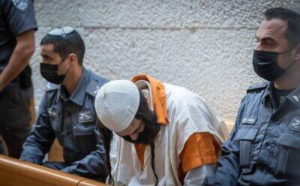
Amiram Ben Uliel [center] at Supreme Court in March 2022.
Amiram Ben Uliel, 28 was arrested in wake of an arson attack on a home in the Arabtown of Duma in July 2015 in which three people were killed. In January 2016, Ben Uliel was indicted for murder and membership in a terrorist organization.
In May 2020, Ben Uliel was convicted of three counts of murder, two counts of attempted murder, three counts of arson, and conspiring to commit a racially-motivated crime. He was sentenced to three life terms plus 17 years’ imprisonment.
Suspects were brought in. Many of them were subjected to torture and isolation. For 21 days, detainees were not allowed to speak to a relative or attorney.
In June 2018, the Central District Court in Lod confirmed that Ben Uliel had been tortured and ruled out several confessions that he had made to interrogators of the General Security Services. The court admitted confessions by Ben Uliel that were made after torture sessions. This served as the only basis for his conviction.
The court also determined that an unidentified defendant, then a minor, was tortured. In May 2019, the suspect, now an adult, entered a plea bargain and eventually was sentenced to 42 months, 32 of which had already been served.
Methods of Torture
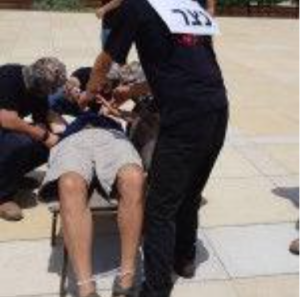
Both media accounts and defense attorneys have reported that the General Security Services used what was termed a “menu of torture” against Ben Uliel and other suspects, most of them minors. They included electric shocks, sexual harassment, beatings, groping by a female interrogator, and the stretching and shrinking of detainees on what was called a Procrustean bed. The torture was approved by the highest judicial authorities, the attorney general, and later the Supreme Court, the latter which upheld the use of torture in obtaining confessions.
Universal Declaration of Human Rights
The detention and interrogation of Ben Uliel violated Article 5 of the Universal Declaration of Human Rights – “No one shall be subjected to torture or to cruel, inhuman or degrading treatment or punishment.”
The case also violated Articles 8-11, which guarantee an effective remedy for violations of fundamental rights, freedom from arbitrary detention, right to a fair trial and presumption of innocence.
In the words of defense attorney Avigdor Feldman, Ben Uliel underwent unprecedented torture by the General Security Services. Feldman, who in 1991 received the Robert F. Kennedy Human Rights Award, said he read a GSS document to the Supreme Court that listed torture methods.
For the first time, I saw an organized listing of torture methods – how long each method was employed on the body of the interrogatee, how many times each procedure was repeated, and the various auxiliary aids that were designed to produce visceral pain. When I studied the document, which I was forbidden to copy or keep in my office, my hair stood on end. I understood that it was prepared by a brain trust of doctors, interrogators, psychologists, and apparently lawmakers, who used the tested and primitive methods whose purpose was to shatter the feeling of self of the interrogatee, to abandon him to the mercy of his interrogators.
Reenactment of torture method by General Security Services.
Call for Action
Amiram Ben Uliel and anybody else who has been tortured must be immediately released. Those who tortured the detainees must be prosecuted.
The General Security Services must come under strict scrutiny with regard to how it conducts interrogations and treats detainees.
International law calls for a complete ban on torture and the need for open trials and transparency. The case of Amiram Ben Uliel has shown how the State of Israel is ready to disregard any legal safeguards to achieve political aims.
The Kingdom has gone over and above its $2 million pledge, giving $50 million this year alone
International community prioritizing other crises over Palestinian plight, says UNRWA chief Philippe Lazzarini
AMMAN: For decades, Saudi Arabia has been among the biggest donors to Palestinian refugees, helping camps in the occupied territories and across the wider Middle East with money, and boosting the coffers of relief agencies working in the region.
Since Israel occupied the West Bank, East Jerusalem and the Gaza Strip, millions of Palestinians have been left dependent on aid provided by the UN Relief and Works Agency for Palestine Refugees in the Near East.
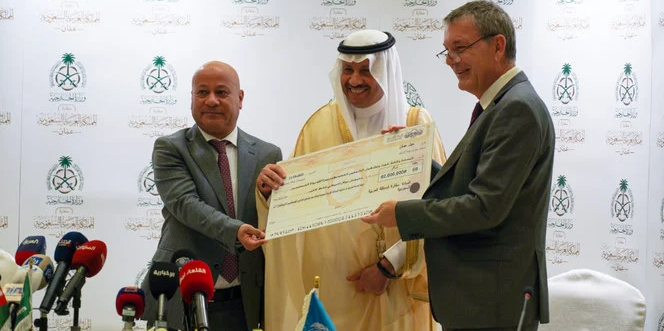
This week, UNRWA acknowledged a $27 million contribution from Saudi Arabia to support programs in the region, taking the Kingdom’s total donations to the $50 million pledge it made this year.
Over the past 20 years, the Kingdom has donated more than $1 billion to the agency, making it one of the largest donor states. The latest donations will help support the more than two million Palestinians in need of humanitarian aid.
Established in 1949, UNRWA’s initial mandate was to provide assistance and protection to Palestinian refugees, pending a just and lasting solution to their plight.
Over the years, however, it has evolved to include the provision of emergency services for those affected by the 1967 occupation, including the millions of refugees in Jordan, Lebanon, Syria, and the West Bank, East Jerusalem and Gaza.
Saudi Arabia has also actively contributed to 108 aid projects in various sectors, from food security and camp coordination to education and health, donating more than $5 billion over the past 20 years through the King Salman Humanitarian Aid and Relief Center.
“Saudi Arabia has been a leading supporter of the Palestinian people on Palestinian territory and the region. It’s important that countries that pledged funds commit to their pledges agreed upon,” Naif bin Bandar Al-Sudairi, the Saudi ambassador to Jordan, told Arab News.
“They see the Kingdom as a nation that sticks to its commitments and leads the humanitarian efforts. This could add indirect pressure to other countries to follow suit.”
Saudi Arabia’s stated annual commitment to UNRWA is $2 million, meaning it has donated 25 times that amount this year alone. Al-Sudairy says this demonstrates the Kingdom’s steadfast support for the Palestinian people.
UNRWA suffered a significant funding setback in 2018 when the US government suspended contributions, which were only restored in 2021. This loss of support came on the back of falling international interest in the Palestinian plight.
“The financial challenges we are facing today started about 10 years ago,” UNRWA Commissioner-General Philippe Lazzarini told Arab News.
“It came at a time when the Israel-Palestine conflict started to be deprioritized, a new emerging political dynamic (appeared), at a time when the attention of this part of the world started to decrease and UNRWA became a collateral of this environment.
“We continued to deliver services, education, primary health, social protection to millions of Palestine refugees as it is expected as per the mandate given to the agency.”
However, due to a host of new challenges, including price inflation, “resources have stubbornly stagnated,” he added.
Since June 1967, an elaborate system of laws and regulations has hit all aspects of Palestinian life in the occupied territories, from the fragmenting of the economy to the destruction of homes, agriculture and cultural life.
Owing in part to the loss of foreign aid support and the effects of the COVID-19 pandemic, the number of Palestinians living below the poverty line has skyrocketed, reaching 53 percent in Gaza, according to the World Bank.
Its May 2022 Economic Monitoring Report said that during the pandemic, income fell in 72 percent of households in the West Bank and 57 percent of households in Gaza. Meanwhile, food insecurity increased from 9 percent to 23 percent in the West Bank and 50 percent to 53 percent in Gaza.
“The deterioration in economic and political conditions fostered a deep fiscal crisis characterized by a steep decline in donor aid, a large financing gap and the build-up of potentially destabilizing domestic debt and arrears to the private sector and pension fund,” the UN Conference on Trade and Development said in a report in August.
UNRWA says $1.6 billion are needed to fully fund vital services for millions of Palestinians across the Middle East. Of this, $806 million are required to support education, health, relief, and social services and protection, and $406 million for emergency assistance in Gaza, the West Bank, and East Jerusalem.
A further $365 million are needed for the emergency humanitarian response in Syria, Lebanon, and Jordan, where Palestinian refugees are hit by overlapping crises, including the protracted Syria conflict, COVID-19, and the political and economic crises facing Lebanon.
Lazzarini says the unpredictability of donations is a significant obstacle, owing to a lack of consistent interest from the international community.
“All this is taking place at a time where there is very little political horizon,” said Lazzarini. “I’m convinced that the lack of funding can easily be overcome if there’s proper political attention and proper political will.
“Sometimes funding can be decreased due to political considerations; at times we receive less from some donors that are not prioritizing this region anymore, or because they had to decrease their overseas budget, and this affects us here in the region.”
The Kingdom’s donations will contribute to UNRWA’s global mobilization to address an unprecedented shortfall this year.
With Saudi Arabia’s support of other partners, the agency has been able to open the 711 schools for 530,000 children in the West Bank, East Jerusalem, Gaza, Jordan, Lebanon, and Syria on time.
Meanwhile, 140 health centers have remained open, providing crucial primary health care to 3 million patients.
“I believe the Kingdom’s stance towards the Palestinian humanitarian cause goes parallel to its stance politically,” said Saudi Ambassador to Jordan Al-Sudairi.
“The Kingdom is the only nation in the world that has proposed two peace initiatives based on UN Resolution 242, the first in Fez presented by King Fahad and the second by then-Crown Prince Abdullah in Beirut.”
Last month, during his address before the UN General Assembly, Saudi Foreign Minister Prince Faisal bin Farhan bin Abdullah confirmed that the Kingdom considers the Palestinian cause a priority, and will continue to do so.
Support for Palestine has been among its primary foreign policies since the establishment of the Kingdom, he added.
Prince Faisal told the UN body: “Security and stability in the Middle East requires a just and global solution for the Palestinian question.”
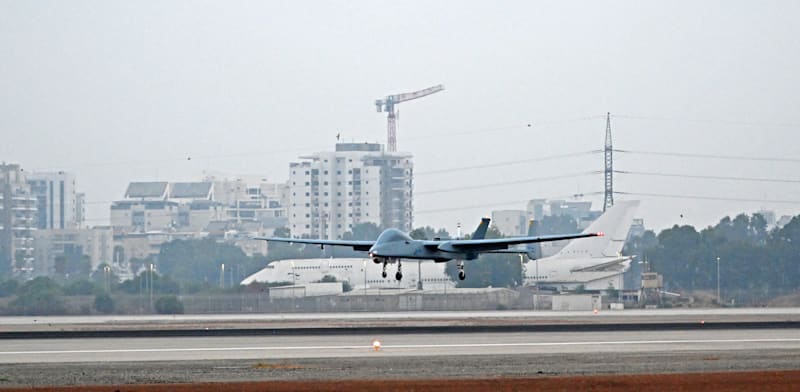
The German media reports that the government wants to use the Heron UAVs it leases from Israel Aerospace Industries to defend against potential Russian attacks on critical infrastructures.
Israeli-made unmanned aerial vehicles (UAVs), which the Germany government has leased in a long-term deal could soon be deployed by the German military to oversee the country’s critical energy infrastructure and monitor movements of the Russian naval fleet – the German media has reported over the past few days. The reports also say that the German parliament has asked the German Air Force to immediate redeploy the UAVs (drones) to provide protection against potential Russian sabotage.
The Germans leased five Heron-TP UAVs, together with two training UAVs in 2016 in a deal worth nearly €1 billion. The deal has been expanded over the past two years. Since the outbreak of the Russia-Ukraine war, the German parliament has decided to let the UAVs be armed with Israeli-made missiles, and begin German Army missions beyond Europe’s borders at an initial cost of €140 million. Over the past two years dozens of German Air Force pilots have been training at the Israel Air4 Force base in Tel Nof in how to operate the UAVs, as part of the overall deal signed with the Israeli government and Israel Aerospace Industries.
The concerns: Russia will try to hit infrastructures
Now, due to the escalating security situation in Europe, there are resolute calls to convert use of the UAVs so that they can oversee Germany’s critical energy infrastructures. Last month’s mysterious explosion of the Nord Stream gas pipeline, which is still being investigated, and concerns that Russia will try to hit civilian infrastructures, like the gas pipeline from Norway and other locations. An incident in which communications lines of the railways were cut near Hamburg, causing massive rail disruptions, is also being investigated.
In recent weeks, Russia has been attacking Ukrainian infrastructure installations including water and electricity, and this has demonstrated for the Germans the danger of hitting infrastructures, especially during the winter when the population is dependent on electricity and heating.
German Member of Parliament Johannes Arlt from the Social Democratic Party (SPD), a member of the government coalition, last week proposed to use the leased UAVs to protect German gas and energy infrastructures. German Interior Minister Nancy Faeser, also from the SDP, called for a significant increase in infrastructures protection. “With the help of the UAVs and their radar, we will be able to monitor wide areas and respond quickly to any disorder,” Arlt told “Der Spiegel.” “Due to Russian threats,” Arlt said, “we must quickly create the legal basis that will allow use of these UAVs for national security purposes.”
Use of UAVs is currently not permitted in German airspace. However, the “Deutsche Zeitung” cited the Ministry of the Interior which recently reported that the Israeli-made drones will soon move to an activity base in their parent squadron, at the Buchel Air Force base where they will perform “trial flights.”
According to the report, the Garman Army aims to create a legal basis that will allow their use also for national security purposes within Germany’s borders, and not only overseas. The triial flights are planned to take place over the next year. The use of UAVs is possible “for specific needs” and as long as it “does not cause disruption to civilian aircraft traffic.”
The EU is trying to produce its own armed UAVs called the “Eurodrone” and leasing UAVs from Israel and arming them with missiles is considered an “interim solution.”
Germany officially announced last month that it plans procuring the “Arrow 3” system from Israel, subject to US approval, in a deal that will cost an estimated €3 billion and will protect Germany and other countries from ballistic missiles.
Commentators in the United States and Israel have hailed the agreement on the maritime border between Israel and Lebanon, which the Biden administration recently brokered, as a great success. They liken it to the Abraham Accords and claim that it is a major step toward normalizing relations between the Jewish State and a historic Arab foe. But a close examination of the agreement simply does not support this view.
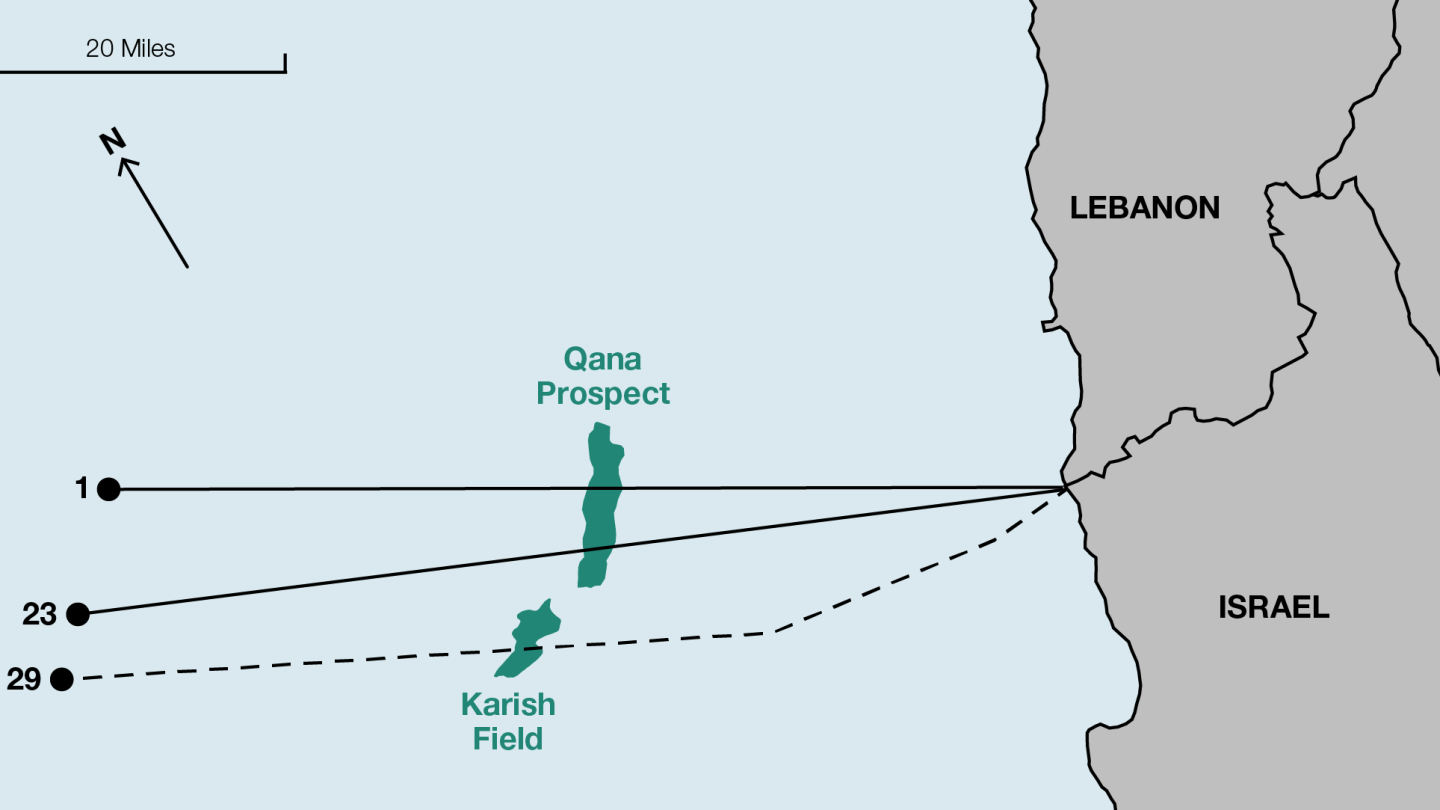
Amos Hochstein, the US State Department senior advisor for energy security, led the mediation effort to resolve this dispute. He built on the initiatives of Presidents Barack Obama and Donald Trump to reconcile the conflicting claims of Israel, which claimed Line 1 (see map) as the northern border of its exclusive economic zone (EEZ), and Lebanon, which claimed Line 23 as its southern border.
In the final months of the Trump administration, Lebanese negotiators revised their claim, moving it further south to Line 29. Beirut, however, never registered this new claim with the United Nations. In other words, Line 23 always remained the official Lebanese position. When Hochstein arrived in Beirut last February, the Lebanese government abruptly dropped its insistence on Line 29 and presented its retreat as a sign of its flexibility, a compromise proposal that it could withdraw if the negotiations failed to produce satisfactory results.
The belated and halfhearted adoption of Line 29 appeared capricious. But the Lebanese were manufacturing a pretext for claiming that Israelis had no right to pump gas from the Karish gas field, Israel’s northernmost field. Karish lies well south of Line 23, but Line 29 dissects it. If the Lebanon-Israel border falls along Line 23 or along another point further north, then the Karish field lies entirely within the Israeli EEZ. By making Line 29 part of the discussion, however disingenuously, Beirut postured itself to claim that Karish lies, in part, in Lebanese waters and that Israel’s exploitation of it constitutes the theft of Lebanon’s resources.
The full value of this tactic became apparent last June when the floating rig for exploiting Karish arrived in Israeli waters from Singapore, where it was manufactured. Lebanese President Michel Aoun and Hassan Nasrallah, the secretary-general of Hezbollah, used the arrival of the rig as the starting bell for a tag-team effort to pull the Americans into the dispute on the side of Lebanon.
Aoun warned Israel that any activity in the area “constitutes a provocation and a hostile act.” He then invited to Beirut Amos Hochstein, who arrived in mid-June. Shortly thereafter, Hassan Nasrallah launched drones, almost certainly acquired from Iran, toward the rig. In addition to intimidating the Israelis, the goal was to instill a sense of urgency in Hochstein and his colleagues in Washington. On July 13, Hassan Nasrallah delivered a speech in which he gave Hochstein and the negotiators two months to produce results. “If we do not get what we rightfully want from the negotiation, there will be a higher cost. Our drones will fly beyond Karish,” he said.
The tag team effort paid off. President Joe Biden, for his part, personally adopted Nasrallah’s timetable. When the president spoke with Lapid in August, he “emphasized the importance of concluding the maritime boundary negotiations between Israel and Lebanon in the coming weeks,” according to the White House. Under military pressure from Hezbollah and diplomatic pressure from Washington, Israel did what it had refused to do for over a decade: dropped its claim to Line 1 or to any compromise position and accepted instead Line 23, the Lebanese position.
In summary, the United States encouraged Israel to concede to all of Hezbollah’s demands. In return, Lapid claimed that Israel had avoided conflict, acknowledging that under pressure he compromised for a period of quiet that will last until Hezbollah, who is under no obligation to anyone, decides to end it.
Below are seven myths about the Israel-Lebanon maritime border agreement, and clarifications about what the deal means.
Source: Dario Sabaghi, “Explained: Renewed Israel-Lebanon Maritime Border Dispute,” Middle East Eye, June 11, 2022, https://www. middleeasteye.net/news/explained-israel-lebanon-maritime-border-dispute-renewed.Notes: Line 1 was Israel’s claimed maritime border. Line 23 was Lebanon’s claimed maritime border, and will likely become the official border. Line 29 was Lebanon’s revised claim that Beirut did not register with the United Nations.
Myth 1: “The agreement will make Lebanon less dependent on Iran.”
Reality:Lebanon is famously corrupt and controlled by Hezbollah, which in turn is controlled by Iran.
The usual cronies will divide the money among themselves, and Hezbollah will get its share. Enriching the fictitiously independent state of Lebanon without enriching Hezbollah and Iran is impossible. So the agreement will not reduce Hezbollah’s grip on the government in any way.
Myth 2: “Israel needs this agreement to proceed with the exploitation of the Karish field.”
Reality: Energean, the company that Israel contracted to develop the Karish gas field, began its work when it looked as if there would never be a deal with Lebanon, and it continued to work when Hezbollah threatened war.
From a commercial point of view, the agreement was irrelevant. The world is replete with examples of companies that exploit gas fields within undelimited or even highly disputed EEZs. When deciding where to work, the companies rely on the security and financial assurances of their host countries, not on international agreements. Lawyers from the United Nations never saved workers on a gas rig caught in the crossfire of hostile militaries.
But even from a strictly legal point of view, Israeli ownership of Karish was never the issue. The Lebanese always staked their claim, officially, on Line 23. The Karish gas field, lying well south of that line, was therefore clearly in Israel’s EEZ.
As for Nasrallah, he did not threaten to attack because he considered the exploitation of Karish to be an especially provocative or hostile act. Nasrallah has made clear that he sees the existence of Israel as a gross and ongoing injustice, an affront to all Muslims, and a threat to Lebanon. “Where is our sea?” he asked in a speech on October 11, after the maritime border agreement was completed. “To us, our sea extends to Gaza,” he answered. From Nasrallah’s point of view, the oil refinery in Haifa and the power plant in Hadera are as much an affront as the Karish rig.
Myth 3: “The deal is a major defeat for Hezbollah and Iran.”
Reality: Nasrallah and Iranian Supreme Leader Ali Khamenei have every right to celebrate this agreement as a major victory, a capitulation by both the US and Israel.
A “historic achievement,” is how Hezbollah’s Deputy Secretary-General Naim Qassem described the demarcation agreement on October 15. “The Resistance [Hezbollah] had a great impact on securing the maritime oil and gas rights for Lebanon,” he continued. “This matter would not have happened without the solidarity between the state and the Resistance.”
Who can argue with that assessment? Hezbollah received everything that it demanded within the timeline that it set. Israel made every conceivable concession; Lebanon made none. Supercharged American mediation rewarded Hezbollah for threatening war.
The proper American answer to Hezbollah’s drone launches would have been a strong statement affirming Israeli ownership over the Karish gas field and emphasizing Israel’s right to self-defense. To the Lebanese politicians, American diplomats should have stressed that the United States will join them as a mediator only after they agree to sit down directly with their Israeli counterparts.
In the meantime, traditional military deterrence, not appeasement, is the only way to contain Hezbollah—and not just Hezbollah. Military deterrence is also the answer to the threat posed by Iran and all its proxies. Biden’s call to Lapid coincided with the Biden administration’s efforts to finalize the negotiations with Iran on the nuclear deal. So Biden may have encouraged Israeli concessions to sweeten the pot for Iran.
Myth 4: “This agreement will help alleviate the European energy crisis.”
Reality: The agreement will have no impact on Europe whatsoever.
Only future historians will know with certainty whether the White House prioritized the Israel-Lebanon deal to reconcile with Iran. But strikingly, the deal lacks any other discernable strategic imperative. Hochstein could have focused on myriad other issues that are more critical—including, for example, working to solve disputes between NATO allies Greece and Turkey over their EEZs, or bringing gas to Europe from Turkmenistan, which has some of the world’s largest reserves. To justify the quixotic choice of priorities, commentators have claimed that this deal will somehow alleviate the European energy crisis. It will not. There is no guarantee that Lebanese gas will ever come on the international market. If it does, it will not appear for another five to ten years—by which time the European energy crisis will be history. As for the Karish field, Israel has from the outset designated its gas for local consumption only, not export. The field is also very small and will have no appreciable impact on gas prices. In any case, Karish, as noted above, would have come online without the deal.
Myth 5: “The deal advances Arab-Israeli peace.”
Reality: The deal advances nothing.
In announcing the deal, President Aoun stressed that “no normalization with Israel took place,” and he refrained from thanking the Israelis for the concessions they made. He did, however, thank Hezbollah. When making this agreement, no Lebanese official met an Israeli official or spoke to one on the phone. There will be no joint signing ceremony, and certainly no handshake on the White House lawn.
While explicitly refusing to make any agreement with Israel, Lebanon pointedly made an agreement with the United States about the location of its southern maritime border. Line 23, the newly agreed upon border, dissects the Qana prospect (see map), an unexplored field from which Lebanon expects to pump gas. Here again, Lebanon refused to make a deal with Israel about joint exploitation of the field. Instead, Israel will work out a deal with TotalEnergies SE, the French company that has the rights to exploit the Qana prospect. The (yet undetermined) compensation that Israel will receive is not for the area it forfeited but for the small section of the Qana prospect south of Line 23, which is firmly in Israel’s EEZ. Lebanon will have no role in the negotiations between Israel and the company, which will serve as a buffer between the states. Although the Qana prospect straddles the border, it will not promote cooperation.
Observers have also claimed that the deal represents a tacit recognition, for the first time, of Israel by Hezbollah. This is categorically false. Hezbollah has previously negotiated, for example, prisoner exchanges through intermediaries with Israel. The organization certainly admits that a “Zionist entity” resides to the south of Lebanon. How could it not? The point of recognition is to acknowledge legitimacy, something Nasrallah vehemently refuses to confer upon Israel. This maritime border agreement tacitly recognizes Israel only in the same way that every missile Hezbollah launches at Israel tacitly recognizes it.
Myth 6: “This deal promotes peace by making Israel and Lebanon-Hezbollah economic partners.”
Reality: In no universe is making Hezbollah a partner of Israel a good thing.
Just a few short years ago, influential voices in both the United States and Europe scoffed at the mere suggestion that Germany’s economic partnership with Russia on natural gas would expose Berlin to extortion by Moscow. On the contrary, they said, Germany would rope Russian President Vladimir Putin into a mutual dependency, one that would turn him into a “stakeholder” in regional stability. Rarely in international politics have events discredited a strategic thesis so quickly and so totally. But even as the Russia-Ukraine War rages, commentators are applying the same flawed calculus to relations between Israel and Hezbollah.
One version of the economic-partnership argument claims that the two gas rigs, one Israeli and one Lebanese, operating close to one another will hold each other hostage. But the next war that will break out between Hezbollah and Israel will likely start elsewhere. When it does erupt, the two rigs’ “coexistence” will hardly influence events. Nor, for that matter, will their “coexistence” spare Israel’s gas platform. If Hezbollah sees utility in destroying the Israeli rig, it will do so with glee. The Israelis, however, will be more restrained. They will hesitate before attacking the Lebanese rig, if one should ever exist, because TotalEnergies SE, which will be compensating Israel for the Qana prospect, will own it.
Myth 7: “This deal will dramatically reduce tensions between Israel and Lebanon by removing a major irritant in relations.”
Reality: The removal of this or that grievance of Hezbollah today will do nothing to prevent the fabrication of new grievances tomorrow.
Hezbollah is a wing of the Qods Force of the Iranian Revolutionary Guard Corps. From the point of view of Tehran, the Lebanese terrorist group constrains Israel and deters it from attacking Iran. If war suits either Nasrallah or his Iranian overlords, Hezbollah will manufacture a pretext for starting one. Lebanon’s politicians will help Nasrallah concoct new pretexts for conflict, just as they concocted the claim to Line 29.
The best that can be said of the maritime border agreement is that it may have bought a limited period of quiet while Israel begins to exploit the Karish field. But America bought this quiet with protection money—money, moreover, that it extracted from Israel’s hide. By encouraging Israel to pay for protection, the US set Hezbollah up to present itself as the savior of Lebanon rather than the architect of its misery. In addition, the deal weakened Israeli deterrence. There will surely be another round of violence with Hezbollah. When that inevitable day comes, Israel will have no choice but to buy quiet as it has always done—either with military force or the credible threat of it. Seen in that context, the deal undermined Israel’s deterrence because it taught Hezbollah and Iran that a threat of war will trigger American mediation.
While the caretaker Israeli government is willing to help the United States sell this policy to its own public, many, probably most, Israelis know appeasement when they see it. It is no surprise, therefore, that the Lapid government is not putting the agreement to a vote in the Knesset.
In sum, the maritime border agreement belongs not in the Abraham Accords frame, but in the Iran-appeasement frame. When the Biden administration came to power, it did not hide its disdain for the Abraham Accords, even refusing to call them by name. The popularity of the accords, however, has forced the administration to pretend to regard them as a positive development. Although the White House and its supporters now pay lip service to the accords, they cannot bring themselves to support a policy that seeks to counter Iran aggressively—the key policy that made the accords possible.
Instead, they have chosen to dress up their preferred policy of Iran appeasement so that it looks like quasi-normalization with Israel, a kind of Abraham Accords lite. In doing so, the Biden administration has taught both Hezbollah and Iran that Washington stands ready to deliver concessions from America’s allies, including Israel, to “deescalate” conflicts in the Middle East.
A recent Op-ed in the Jerusalem Post declared that the Religious Zionist party and its representatives are “damaging Israel’s Jewish character,” which, I suppose, means that Israel’s Jewish character would be better promoted by candidates that were neither religious or Zionist. The good news is that, to paraphrase former US Defense Secretary Bob Gates’ comment on Joe Biden, the author of that opinion has been wrong on every major political and religious issue for close to a half century.
Well, the Religious Zionist party is the only party that can advance the interests of Religious Zionism. It stands for love of all Jews, love of the State of Israel as a force for good and as the beginning of the flowering of the redemption, advancing a more Jewish state that secures Jewish identity, encourages more Torah study and the greater observance of mitzvah, and believes in the integrity of the entire land of Israel promised to us, yes, in the Torah. It wants to foster the observance of mitzvot on highest level and not codify compromises, minority opinions, or diluted forms of observance in order to realize some social goals. There are parties that reflect one or several of these ideas. None represent all of them, except for the Religious Zionist party.
I have always been curious about those Jews on the left, including the author of the Op-ed, so concerned about Israel’s “Jewish character” that they are willing to undermine Israel’s true Jewish character, security and prosperity in order to sustain their vision of what “Jewish” means. They habitually do that by cherry-picking quotations from the Torah or the words of the sages. For example, “Darchei noam,” the ways of pleasantness, is a classic used once by a Reform rabbi to justify intermarriage and used here by the author to recall the Mafdal of old that, for all its accomplishments, served as mashgichim for the secular, Socialist establishment until a new guard took over and disseminated Torah ideals into every aspect of Israeli life – settlement, politics, education, media, the military, social policy and the like.
This is nothing new. The Jewish left, including the relative handful that identify as Orthodox, and especially those in America, have long agonized over Israel’s Jewish character and routinely perceive threats to the survival of that character in many worthwhile endeavors. They fretted over the Jewish character of the State when Menahem Begin became prime minister, when settlements were constructed and expanded in the heartland of Israel, when Israel refuses to indulge the two-state delusion, and when Israel takes elementary measures of self-defense to protect its citizens.
They grow anxious over Israel’s Jewish character when opportunities for Torah study abound and when traditional standards of conversion are applied. For some inexplicable reason, Israel’s Jewish character, as they see it, is never threatened by importing hundreds of thousands of Gentiles of doubtful or partial Jewish lineage or by abdication of Israeli sovereignty in the Negev or Galil due to rampant and illegal Arab construction. They are apprehensive about the threat to the Jewish character of the State by maintaining the public observance of Shabbat, somehow perceiving mass transit and open malls on Shabbat as enhancing Israel’s Jewish character. They become frightened at the threat to Israel’s Jewish character posed by insistence on fidelity to halacha in marriage and divorce and apoplectic over what will happen to our souls if the LGTQ agenda is not adopted, embraced and celebrated.
They are more troubled by Israel’s treatment of terrorists who want to murder us than by Israel’s expulsion of thousands of its own Jewish citizens from their homes. Somehow, that was not perceived as a breach of Jewish values or a threat to Israel’s Jewish character.
The author shed tears over the “low ethical and humane standards” of the Religious Zionist Party, and decried it as a chillul Hashem, without actually offering one example of a violation of Torah and a breach of Torah values. This is a perception of Torah of a sort of Christianity with some different ritual practices, but not an even particularly pious form of Christianity. Jewish sexual ethics, Jewish military ethics, and Jewish nationalism must always bend before the prevailing progressive winds. Simply, put, this view perceives Western morality as superior to that of the Torah, God forbid, and therefore the Torah must always be re-written, reformed and amended in order to accommodate elite opinion. These reforms are accomplished by some people by excising parts of the Torah and by others by exalting Talmudic clichés (usually wrenched from the context) over its substance. In both cases, the result is the same.
These same people – who have repeatedly pressured Israel to withdraw and withdraw, concede and concede, and almost without any limiting principle – prefer the nastiness and hostility to a truly Jewish Israel of a Barack Obama and Joe Biden to the positive attitudes and unprecedented support and decisions of a Donald Trump. To quote the Talmud (Pesachim 50a), we are living in and are witness to an olam hafuch, an upside down world, in which love of Torah, its precepts, its values and its moral requisites are deemed “anti-Torah” and being, acting and thinking Jewish is actually a threat to Judaism.
By this inversion of reality, the only way to protect Israel’s Jewish character is by empowering people who want to secularize Israel, and make it Jewish in name only (which is not Jewish at all). That might make sense to some people – but they should not be taken seriously on these matters of such grave import. They have done enough damage already – to Israel’s Jewish character.
Those who support the ideals of Religious Zionism have no home but in the Religious Zionist Party. Every other choice is a compromise that is based on wishful thinking, and wishful thinking (Oslo comes to mind) is not a sound basis for policy. A robust Religious Zionist party will promote a strong, secure and Jewish Israel. Those who care about that should take note and vote accordingly.
Take your pick and apply it to any number of local and international political leaders. There is no shortage of candidates who qualify and yet still manage to rule the roost.
Amazingly, these proponents of unprincipled politics and diplomacy are able to get away with their actions, and in a depressingly proportion of cases, they actually convince far too many of the righteousness of their cause.
Examples abound, so it is very difficult to sort out the worst offenders.
Two of the biggest recent exponents of immoral duplicity must surely be President for life of the PA, Abbas, and President Putin of Russia. Both these “democratically” elected leaders have had plenty of practice successfully duping the international community for many years. Without a doubt, their recent “love fest” must qualify as one of the best efforts at pulling the wool over the eyes of a willing media and unprincipled political leaders.
Apparently, Abbas has no domestic problems to attend to because it seems that almost every Monday and Thursday, he is popping up in some foreign destination and hobnobbing with anyone who will listen to his torrents of lies against Israel.
His recent meeting with Putin must go down as one of his better efforts. It is said that birds of a feather flock together, and this was certainly the case.
According to media reports issued after their meeting, it could be likened to a gathering of a mutual admiration society. The PA President for life showered the Russian President with expressions of love and support while at the same time dishing dirt to the Americans and repeating his usual slanders against Israel. Like an old record, he again accused Israel of targeting Christian and Muslim holy sites and laying siege to innocent Palestinian Arabs. He can repeat these baseless accusations because he knows that his listeners will applaud and ensure that Israel gets condemned.
Unsurprisingly, Putin gave his seal of approval to these expressions of “peace and tolerance.” The best part, however, was when Putin stated that Russia’s support of the Palestinians was “a matter of principle.”
I suppose one could describe this accolade as being “from Russia with love.”
Neither of these two Presidents would know what principles were if faced with a challenge to actually face the truth. This current mutual embrace reminds one of the heady days of the old Soviet Union when Moscow supported each and every outrageous terror act perpetrated on behalf of the late unlamented Arafat. Abbas was Arafat’s devoted disciple so it is no surprise that history keeps repeating itself.
Meanwhile, on the other side of the ocean, in Washington, where Middle East realities dissolve into muddled mirages, the White House issued one of its pearls of wisdom. Reacting to Abbas spitting in America’s face the Biden Administration commented that it was “disappointed” in the fact that Abbas no longer trusts it.
Fancy that.
They are disappointed and not outraged. Even after this latest insult by the PA President the funds keep being transferred and the same old discredited delusion of a two state solution on the 1947 armistice lines keeps getting peddled.
It seems that despite every available evidence, in words and deeds, the terror groups constituting the PLO, Hamas and the PA can literally get away with murder and the vilest rhetoric. They can hug the most obvious exponents of repression and the worst that can befall them will be expressions of disappointment.
If that is not a perversion of principles, I do not know what is.
Just when you thought that unprincipled policies could not sink any lower, the Australian Government came along to prove everyone wrong. Like a thief in the middle of the night, the Australian Government reversed the existing policy of recognizing Jerusalem as Israel’s capital.
Was the decision to do so without advising Israel a deliberate act?
Did Canberra specifically choose Simchat Torah as the most opportune time to make its move?
If the Guardian newspaper had not noticed a change in wording on the website, how long would it have taken for the Australian Foreign Minister to own up? As it was, she first denied anything had changed and then got caught out.
Israeli spokespersons and Australian Jewish leaders expressed shock, horror, surprise and outrage at this seemingly duplicitous reversal of policy. However, they should have seen this coming a long time ago but unfortunately, refusal to acknowledge reality made them oblivious to the inevitable.
A closer look at the situation reveals the salient truths.
The previous coalition’s so-called recognition of Jerusalem was an exercise of smoke and mirrors. It merely stated that WEST Jerusalem was Israel’s Capital which by default, nudge, nudge, wink, wink, meant that they could have a bob each way and still maintain that the Old City and the rest of Jerusalem could still be the capital of a mythical Palestinian State. It was as useless as stating that half of Canberra was Australia’s Capital while leaving the rest of the city open to internationalization.
To make the situation even more farcical, despite asserting that West Jerusalem was indeed the capital, the Morrison Government refused to shift its Embassy from Tel Aviv. If they had really been serious that is what they should have done, following the American example. This proves beyond a shadow of a doubt that the whole exercise was a political charade.
Further proof that this pareve recognition was, in reality, fake is evidenced by the fact that the current leadership of the Liberal Party refused to commit themselves for future policy statements on the subject.
The plain fact is that Labor Party policy has clearly stated that Jerusalem’s fate is to be decided in peace negotiations which as we all should know by now is pie in the sky. The next step will no doubt be recognition of a terror-supporting State of Palestine. This move would please three important constituencies, namely the left wing of the Labor Party, the Greens and the growing number of Muslim voters.
Australian Jewish machers need to face a politically incorrect situation.
Growing Judeophobia fueled by a combination of appalling ignorance, media-induced disinformation and groups infected with anti Israel poison all point to further retreats from the current “friendly” policies.
Watch future UN and related voting patterns and you will soon see which way the winds are blowing.
 Czech
Czech French
 German
 Hebrew
 Noruegan
 Russian
 Spanish
 Swedish
 Polish
 Portuguese