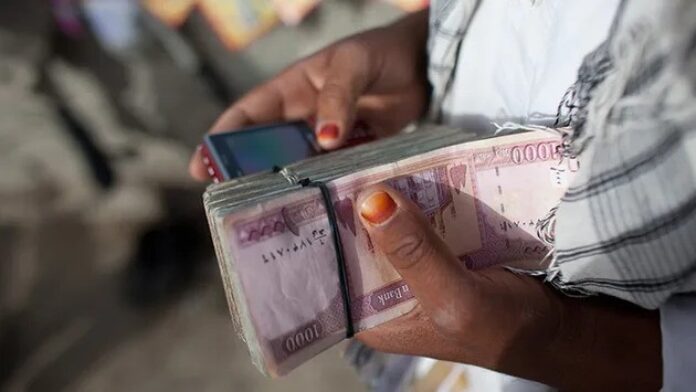
Freedom comes with a price

Pesach (Passover) this year conveys a stark message that is impossible to gloss over or ignore.

As Jews worldwide sit down to their Seder and recite the narrative of the exodus from slavery and bondage to freedom and sovereignty, the reality of current events will be foremost on their minds.

It still remains to be seen whether Israelis will be able to enjoy an uninterrupted evening or whether alerts and sirens will punctuate the evening’s proceedings.

The annual influx of pilgrims coming to Israel for the Festival of Freedom has been severely curtailed as flights are cancelled and Ben Gurion Airport operates on a restricted schedule.

Christian pilgrims intending to visit for Easter have also been affected.

As a consequence, hotels will be empty, although many are filled with evacuees from the north and displaced citizens whose homes have been destroyed or severely damaged by Iranian barrages.

Where will Israeli families celebrate Seder this year?

Large family gatherings will be problematic, especially if there is no reinforced room or shelter nearby. Travelling to and from destinations is fraught with uncertainty, as one never knows when the sirens will blast forth. Stopping your car at the side of the road has its own hazards because, apart from the danger of missile and interceptor debris hitting you, there is also the possibility that some lunatic driver might crash into your car. This has already happened several times.

Communal Seder gatherings also pose a challenge for elderly and physically impaired participants, as reaching a designated space in time can be difficult.

Pesach is traditionally a favourite time for many Israelis to make an exodus in reverse and flock to overseas venues in exotic places where communal celebrations are organised. This year it seems that option will be cancelled.

Numerous people are stuck overseas. They are stranded because airlines have ceased flying to Israel, and EL AL is having trouble repatriating them due to the uncertain situation. Those with families in foreign countries will at least be able to find accommodation, but many others are finding it a daunting task and an economic nightmare.

As reservists are recalled to their IDF units, they leave behind wives and children as well as other dependents. These family members now have to cope on their own and face the challenge of not only organising a Seder without their spouse and partner but also the uncertainty of when they will be able to see them again.

Chol Hamoed, the intermediate days of the Festival, are usually a perfect time for family excursions to nature reserves and other outdoor attractions. It is spring, and the prospect of better weather is a good opportunity to enjoy the great outdoors. School is out for a week, and children are looking forward to fun times.

With daily alerts and sirens, it is highly unlikely that barbecues and picnics will be on the agenda this year.

This year’s Pesach celebrations for Jewish communities in the Diaspora will also take place in the shadow of uncertainty and a certain amount of danger.

Since 7 October 2023, the rise of hate and incitement has accelerated beyond most people’s imagination. It has now returned as an endemic and chronic manifestation, infecting vast swathes of humanity worldwide.

This ancient plague, which has mutated into a frenzy of anti Zionist/Israel/ Jew hate, presents a growing and lethal danger to Jewish communities.

As Australian Jews have learnt to their bitter cost, communal celebrations of religious occasions attract the vile attention of those sections of society who have been infected by generations of perverted education and brainwashing.

How are Diaspora Jews going to cope this year?

Communal Seders are a standard feature of many Jewish communities.

Given the current threats lurking in most countries, will these gatherings be held this year? If so, what security arrangements will be in place to ensure safety? Will participants be too scared to gather together in large groups?

What security will be provided by Government agencies? Will they make the usual banal declarations or will they actually take concrete measures to protect Synagogues and communal gatherings?

More importantly, what worthwhile steps will Governmental and local authorities take to tackle the root cause of this rising tsunami of Jew hate and violence?

It is a waste of time to talk about “social cohesion” when those plotting social evil are not dealt with in any meaningful way.

Why is this night different from all other nights?

This question from the Haggadah has real relevance this year.

It focuses our minds on the experiences of our ancestors over the millennia. There have been occasions in almost every century when the commemoration of Pesach has had to be observed in the most trying of circumstances and in many cases at life-threatening moments.

Whether it was the Inquisition or hate-filled pogrom mobs, Nazi genocidal officials or Soviet secret police, the scenario was always the same. Today’s haters, inspired by jihadist agendas to eliminate the nation-state of the Jews, all follow a familiar script.

As we recite, “In every generation there are those who rise up to destroy us” the meaning couldn’t be clearer.

In Israel, this year, this declaration may very well be accompanied by the sounds of alerts and sirens heralding incoming missiles and drones. One cannot have a more dramatic Seder than when those trying to destroy us actually are doing so as we gather together.

Of course, there could be some unforeseen scenario that changes the situation at the last moment. There is talk of “deals” being concocted. One never knows which news might be fake and which might be true.

Whatever the situation might be, however, there is one overriding message at this time that remains constant.

The liberated Hebrew slaves left Egypt behind with one central aim in mind.

It would take forty years of trekking in a hostile wilderness, but that was the time required for them to be prepared to become sovereign in the Land promised to the Patriarchs generations previously.

In the process, they would receive their constitution at Mount Sinai and gradually transform from a collection of individuals into a nation of tribes ready, willing and able to defend themselves.

This lesson of Pesach is generally glossed over when politicians issue their usual quota of banal messages.

The Jewish People became sovereign in their land. They did not need the approval of the UN, EU or any other such group. They settled, built and developed Judea, Samaria, Hebron and Jerusalem well before either Islam or Christianity existed. This is the message which should be hammered home with emphatic clarity.

Chag Sameach. May “next year in rebuilt Jerusalem” be a reality rather than an annual pious recitation.
From Sderot to Tehran: Unmasking the architects of the ‘double war crime’

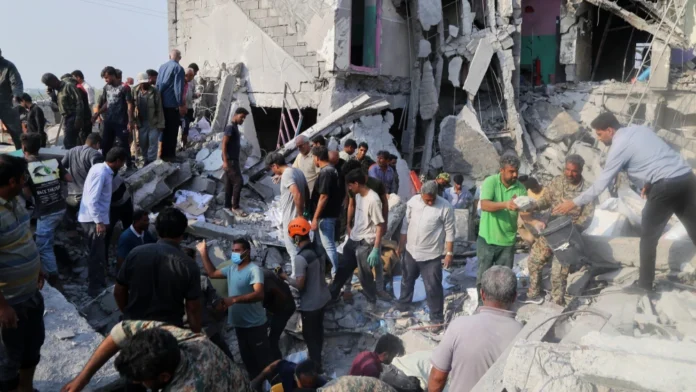
Iranians sift through the rubble of the Shajareh Tayyebeh girls’ school in Minab, Iran, destroyed by a missile strike on the first day of the joint U.S.-Israeli war on Feb. 28, 2026. Credit: Abbas Zakeri/Mehr News Agency/Creative Commons via Wikimedia Commons.

Countless pieces of evidence from the current conflict show Iranian ballistic missiles being launched from within or immediately adjacent to schools and hospitals. Satellite imagery, open-source intelligence (OSINT) and consistent local reports confirm that this is not accidental. It is a deliberate, state-level doctrine designed to embed military power within the heart of civilian life.

As the war between the United States, Israel and Iran unfolds, the world has been saturated with images of civilian tragedy emerging from inside Iran. That includes the devastating strike near the Shajareh Tayyebeh girls’ school in the southern Iranian city of Minab on Feb. 28, day one of U.S. “Operation Epic Freedom” and Israeli “Operation Roaring Lion.” While the loss of more than 150 students sparked immediate global outrage, a critical, strategic question has been ignored: Why was a primary school located directly beside a high-value compound belonging to the Islamic Revolutionary Guard Corps?

For those of us who have spent two decades documenting the civilian battlefield along the border with the Hamas-controlled Gaza Strip, this pattern is painfully familiar. It is the signature of a specific, radical ideology. At its core, this war is not merely about ballistic trajectories or nuclear ambitions; it is a confrontation with a radical ideology that calculates military success through the weaponization of civilian suffering. In international law, the tactic of “human shielding” is a war crime. But what we are witnessing is a double war crime: a regime that fires sophisticated missiles at Israeli civilians while simultaneously using its own children as a physical buffer for its launchpads.

Furthermore, a profound legal asymmetry defines this conflict—one that receives inaccurate attention or, worse, no mention at all. While Israeli and U.S. air forces utilize precision intelligence to target Iranian military infrastructure and IRGC command centers, resulting in casualties that are overwhelmingly combatant-based, Tehran has unleashed a different class of terror. Reports indicate that up to 50% of the ballistic missiles it has fired utilize cluster submunitions—weapons designed specifically to spread destruction across a wide radius to maximize civilian injuries and deaths. The use of these indiscriminate weapons in civilian areas is a direct violation of the Geneva Convention and international law, yet the global outcry remains focused solely on the defensive response.

The tactic is devastatingly effective. When military infrastructure is embedded in schools or hospitals, any defensive strike by Israel or America creates instant imagery of destruction. This imagery travels across the world in seconds via social media, fueled by propaganda driven by artificial intelligence, long before the military context is ever understood.

Twenty years ago, when I arrived as a student in Sderot, the town was already under a constant rain of rocket fire from Gaza. My work documenting those attacks led me to establish the Sderot Media Center, where I dedicated the following decade to showing the world the reality of living one mile from the world’s most dense human-shield environment. From Israeli disengagement in the summer of 2005 until the horrors of Oct. 7, 2023, roughly 30,000 rockets have been launched from Gaza toward Israeli homes. According to assessments by the Israel Air Forces, some 97% of those rockets were fired from within civilian environments: behind apartment buildings, inside hospitals, mosques or atop schools.

Today, Tehran has adopted this proxy tactic as national policy. Satellite imagery from Planet Labs and analysis by Bellingcat confirm that the Minab school stood within 100 yards of an IRGC Naval Forces military installation. The tragedy did not happen at a school; it happened at a military base that used a school as its front door.

The IRGC’s calculation in this “battlefield of images” is cold and surgical. By embedding high-value targets within civilian no-strike zones, the regime attempts to force its opponents into tactical paralysis. If the military site is not targeted, the weapons remain active and lethal. If the site is targeted, the resulting civilian casualties become the immediate global headline. The IRGC understands that in the 24-hour news cycle, the image of a ruined school and dead students carries more weight than the evidence of the missile launcher hidden inside it.

In 2026, this strategy is amplified by multimillion-dollar social-media campaigns and AI-generated content. Images of destruction reach global audiences within minutes, while the complex military questions, such as why students were placed next to a strategic installation or why teachers warned of military equipment in classrooms, emerge far later, if at all. By the time the OSINT community verifies the proximity of the IRGC compound to the Minab school, the narrative of “unprovoked aggression” has already been cemented, fueling orchestrated demonstrations across the West.

There is a profound moral hypocrisy at play. Many voices that mobilized to condemn wartime strikes during Israel’s war with Hamas in Gaza remain silent about the Iranian regime’s domestic brutality. According to reports from Amnesty International and leaked data cited by Time magazine, Iranian security forces have killed upwards of 30,000 to 50,000 of their own citizens during recent waves of anti-government protests. These were civilians demanding freedom, murdered in cold blood by their own government. Yet their deaths rarely spark the global demonstrations seen after a kinetic strike on a military target.

From the hills overlooking Gaza to the current front lines against Tehran, the lesson is clear: Middle Eastern conflicts are fought on two fronts—the battlefield of weapons and the battlefield of images. The more this truth is exposed—the deliberate use of civilians as shields, the calculated weaponization of tragedy and the media manipulation that follows—the more the regime in Tehran is exposed for what it is.

Those who sympathize with this cause are not merely reacting to war; they are amplifying the very strategy of evil that fuels it.

Noam Bedein, a photojournalist, is the founder of the Sderot Media Center. He currently serves as the director of international relations for the Sha’ar HaNegev Regional Council.

An Israeli Survivor Addresses Mamdani’s Wife’s Claim About Israel’s ‘Rape Hoax’

Zohran Mamdani’s wife, Rama Duwaji, has labeled the claims about Hamas members committing rapes on October 7, 2023 as a “mass hoax.” Someone who was there, heard the screams, and saw the bodies, of girls and women, some of them with stab wounds in their vaginas, or with their breasts sliced off, has now replied to Duwaji. More on her eyewitness account can be found here: “Oct. 7 survivor has blistering message for NYC Mayor Zohran Mamdani’s ‘rape hoax’-believing wife: ‘These are facts,’” by Doree Lewak, New York Post, March 14, 2026:

A survivor and witness to the atrocities of the Oct. 7, 2023 Hamas massacre in Israel delivered a blistering broadside to Mayor Zohran Mamdani’s wife after she “liked” a social media post claiming the rapes of Israelis during the terror rampage were a “mass hoax.”

“My message to Mrs. Mamdani is simple: political narratives should never cloud your judgment when it comes to the facts of October 7th. Real people suffered, were raped and were killed,” Tali Biner told The Post Friday from a bomb shelter in Israel.

“I was there.”

Mamdani’s wife, Rama Duwaji liked a February 2024 Instagram post by an anonymous pro-Palestine influencer questioning the validity of a New York Times report about sexually-violent attacks by Hamas on civilians.

Duwaji, 28, was describes herself as a Syrian-American artist, also liked a celebratory Instagram post that shared images of the murderous assault on the day of the attack.

Bliner said she’s speaking for the Oct. 7 rape victims who never got to tell their story — because they were killed after being violated by the Islamic terrorists.

The surgical nurse, now 30, was at the Nova music festival when the massacre unfolded, and spent seven harrowing hours hiding from Hamas killers in a small camper on festival grounds.

She recalls hearing the blood-curdling screams of women, sometimes for what seemed to be 20 minutes.

Biner would hear desperate pleas of “No!” and “Stop!” over and over again, followed by a gunshot.

“I knew beyond any doubt what was happening was not just torture, it was sexual violence,” she said.

When she finally emerged from her hiding place, she discovered naked bodies, young and old, lying on the ground.

“They dismembered bodies and sexually violated women and men, including rape and the insertion of objects into their bodies,” she said.

“These are facts.”…

Girls and women were found with their breasts sliced off, and knives thrust into their vaginas. Men had their genitalia cut off. The bodies of both men and women were found with their eyes gouged out.

Will Rama Duwaji now admit that she was wrong to describe the mass rapes carried out by Hamas members as a “hoax”? Or will she remain silent, thinking she doesn’t owe the world such an admission, despite her hideous “likes” of posts that insist on that “hoax,” either because, as her husband said, she is not a public official, and therefore, in his tortured logic, her views should be exempt from scrutiny, or because she is of the “never apologize, never explain” persuasion? She is, after all, now the mistress of Gracie Mansion and wife to Mayor Mamdani.

We who are not quite so grand as the Mamdanis, however, will keep repeating the question for however long it takes to elicit an answer: Mrs. Mamdani, do you still believe that claims of rape by Hamas on October 7, 2023 were nothing but an Israeli “hoax”? We’ll wait right here for your answer.

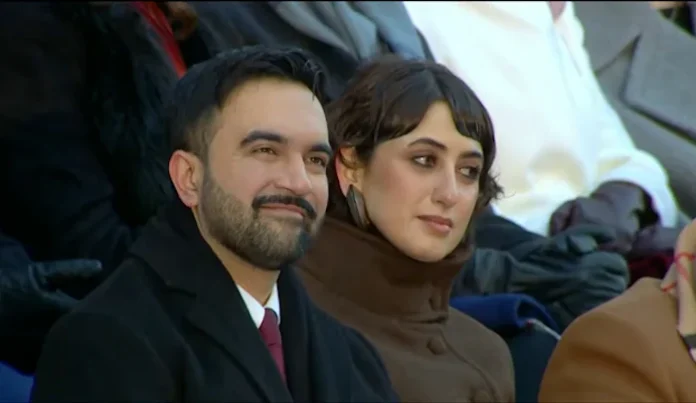
Photo credit: Zohran K. Mamdani and his wife Rama Duwaji by NYC Mayor’s Office, Creative Commons Attribution 4.0.

Korach, Not Amalek: A Better Archetype for the Anti-Zionist “Wicked Son”

Robert Goldberg’s recent essay at the Institute for the Critical Study of Antizionism Substack, adapted from his book The Haggadah: Zionism’s Drama of Destiny, makes a powerful and timely argument: anti-Zionist Jews are not a modern phenomenon produced by Marxism or post-colonial theory, but an ancient archetype encoded in the Haggadah itself. Reading the Seder as political theology, Goldberg identifies Amalek — the tribe that attacked Israel in the wilderness, striking the weak and weary from the rear — as the transhistorical prototype of the Jew who uses intimate knowledge of the covenant to undermine Jewish national destiny. The Wicked Son, on this reading, is Amalek at the Seder table: the insider who withdraws from the collective with the word lachem — “to you,” not “to us” — and must be answered not with patience but with hakheh et shinav, blunting his teeth. Modern anti-Zionist Jews — Goldberg names Shaul Magid, Peter Beinart, and Judith Butler among others — are the latest incarnation of this archetype, providing the intellectual and moral cover that enables external enemies to assault Jewish legitimacy while claiming Jewish sanction.

Goldberg is right that the Haggadah anticipated these figures, and right that the proper response is exclusion rather than dialogue. But the archetype he chooses is the wrong one.

Two Tracks the Haggadah Never Conflates

The Haggadah carries two parallel and distinct theologies of threat, and it never mixes them.

The first is a theology of physical annihilation. It runs through the entire Seder as an unnamed but unmistakable thread. V’Hi She’amda — “and it is this that has stood by our fathers and us” — declares that in every generation enemies rise up l’chaloteinu, to destroy us utterly, and that God rescues us from their hand.

The Haggadah then identifies Laban as worse than Pharaoh: Pharaoh decreed death only for the males, but Laban sought l’akor et hakol — to uproot everything, to erase the Jewish people entirely.

And the Seder ends with Shfoch Chamatecha — “pour out Your wrath upon the nations that do not know You, who have devoured Jacob and laid waste his habitation.” We invoke divine fury against those who have consumed us physically.

This is the Amalek track: the recurring genocidal enemy, appearing in every generation under different names, always seeking the same thing.

The second is a theology of internal communal fracture. That is what the Wicked Son symbolizes. The Wicked Son is not trying to destroy anyone. He is trying to delegitimize Judaism as an insider, quoting the Torah. The Haggadah’s response to him is not a prayer for divine retribution. It is a sharp, deflating one-liner: “It is because of what God did for me when I left Egypt — for me, not for him.” Public mockery. A refusal to engage on his terms. The Wicked Son gets embarrassed, not cursed.

The Haggadah does not respond to the Wicked Son by asking God to pour out His wrath on him.

Jews have two types of enemies, external and internal. Both of them are dangerous. But each has its own methods and each requires different responses. Goldberg gets this wrong.

Amalek is Hamas. Amalek is Haman. Amalek is Hitler. The Wicked Son is something else entirely — and the right name for him, and for the organizations that have multiplied him into a faction, is Korach.

Korach: The Insider Who Weaponizes His Judaism

Korach (Numbers chapters 16-18) is the archetype Goldberg is actually describing. He is Jewish — unambiguously, consequentially Jewish. He is a Levite of distinguished lineage. And his entire attack on Moses derives its force from that standing. “You take too much upon yourselves, for all the congregation are holy” is not an external attack on Jewish leadership. It is a Jewish insider using Jewish language to claim that Jewish particular authority is illegitimate — that the community is better off without it.

This is the structure of “as a Jew, I oppose Zionism.” The phrase has no meaning without the insider credential. It exists to perform exactly what Korach performed: to use membership in the covenant community as the weapon against the covenant community’s legitimate governance. The Jewishness of Peter Beinart, Judith Butler, and the signatories of every Jewish Voice for Peace petition is not incidental to their argument. It is their argument.

Amalek needs no such credential. Amalek attacks from outside.

The Wicked Son Is a Korach, Not an Amalekite

The Wicked Son’s transgression is in his grammar: lachem, to you — a deliberate withdrawal from collective identity using the community’s own language and ritual occasion. He doesn’t crash the Seder as an outsider. He sits at the table and tries to destroy it s a Jew who has the right to be there.

That is Korach’s method, not Amalek’s.

But JVP and IfNotNow go further than the Wicked Son, and here the Korach parallel tightens further still. The Wicked Son at least tips his hand — his separation is legible. JVP still calls itself “Jewish.”. They are a Korach faction: people who manufacture the appearance of a legitimate communal plurality to give outside powers Jewish cover for anti-Jewish positions.

What “Blunt His Teeth” Actually Means

The Haggadah’s instruction to respond to the Wicked Son is “hakheh et shinav”, usually translated as “blunt his teeth” and treated as a metaphor for firm pedagogical correction. But the actual response to the Wicked Son in the text is not a correction — it is a rebuke laced with mockery: “You call yourself one of us, but had you been in Egypt, you would have perished.” This is public embarrassment. The Haggadah recognizes that the Wicked Son’s question is not really a question at all. It is a gotcha — a performance of cynicism designed to destabilize, not to inquire. The correct response to a gotcha is not engagement on its terms but to expose the performance for what it is, hold it up to ridicule, and deny it the dignity of a serious reply.

Applied to the individual anti-Zionist Jew, this means meeting his challenge with the dismissiveness it deserves. The most effective response to “as a Jew, I oppose Israel’s right to exist” is not a careful rebuttal of his historical claims. It is the observation that he has separated himself from the community at every single level – religious, national, political. It is publicizing that his “criticism” of Israel is nothing of the sort, but just wordplay to destroy the Jewish community from within. Movie critics don’t demand that all prints be destroyed, book critics don’t insist that books they don’t like be burned, critics of a nation do not say it should replaced with different people, a different religion and a different political system.

The parallel that should come to mind — and should trigger the same visceral communal response — is Jews for Jesus. Every Jew understands instinctively why Jews for Jesus is not a Jewish organization despite its name, its partial Jewish membership, and its insistence that it represents an authentic form of Jewish identity. Centuries of forced conversion and of Christian persecution carried out under the sign of the cross have taught us what it means when someone deploys Jewish identity in the service of a movement that targets Jewish continuity. We do not debate Jews for Jesus on their terms. We do not grant them space in Hillel or a table at the Jewish community fair. We recognize them immediately as people who weaponize Jewish identity against Jewish survival, and we reject them accordingly. Anti-Zionist Jewish organizations deserve exactly the same response, for exactly the same reason. The weapon is identical in structure: take the credential, hollow out its content, and turn it against the community that issued it.

But the Wicked Son is never alone. The Seder table also holds the Simple Son, who accepts things at face value, and the one who does not yet know how to ask — the young, the unmoored, the Jewishly undereducated who lack the framework to evaluate what they are hearing. For them, the performance of the Wicked Son is genuinely dangerous. They cannot see the gotcha for what it is. They cannot identify the selective deployment of Jewish identity as a weapon. To them, “as a Jew, I oppose this” sounds like evidence that serious, committed Jews have concluded Zionism is indefensible.

This is why the institutional response must be different in kind from the individual one. When Hillel or any Jewish communal organization faces a JVP chapter demanding equal representation as Jews, the question is not whether their arguments deserve refutation. The question is what message recognition itself sends to the Simple Sons in the room. Granting them a platform, treating their demands as legitimate communal discourse, engaging them in debate as though they were a genuine Jewish voice with genuine Jewish concerns, all teaches the uninformed observer that the community is genuinely divided, that the question of Jewish sovereignty is open, and that reasonable, Jewish-identified people have concluded Israel is a moral catastrophe.

None of that is true. All of it is the intended effect.

Hillels should reject JVP outright — not reluctantly, not with lengthy explanations that imply a close call, but clearly and with a reason stated plainly: this organization uses a Jewish name and Jewish membership to campaign for the elimination of the Jewish state, while its members’ Judaism exists in no other context. That is not a Jewish organization with whom we disagree. That is a Korach faction, and the communal response should be as unambiguous as what happened to Korach.

The Method: Pseudo-Argument for the Uninformed

Goldberg credits anti-Zionist Jewish intellectuals with a sophistication they mostly don’t deserve. Korach’s arguments were not philosophically rigorous — they were designed to sound devastating to people without the background to answer them. The all-blue garment question (does it require the blue thread fringes?) isn’t a serious challenge to the laws of tzitzit. It’s a gotcha aimed at the unlearned, engineered to produce the reaction: this whole system is arbitrary nonsense. It works on the Simple Son. It fails immediately against anyone who actually knows something about the subject matter.

“Israel is an apartheid state” operates identically. It sounds authoritative to a college sophomore with no knowledge of Israeli law, South African history, or international legal definitions. It is not meant to persuade rabbis or historians. It is meant to produce, in the unformed Jewish mind, the reaction: wait, Zionism is just racism? The target is always the Simple Son — or the one who does not yet know how to ask. Korach didn’t need to win the argument. He needed to create enough doubt that Moses’s authority seemed contestable.

The Prescription Follows the Diagnosis

Amalek must be physically destroyed: the response is military. Korach must be communally rejected: the response is institutional. The earth swallowed Korach not as a metaphor for argument, but as a demonstration that the rebellion was completely illegitimate. The proper response to JVP is not refutation. It is defunding, deplatforming, and institutional exclusion, because a Korach faction is not owed a seat at the communal table it is working to dismantle. Answering their criticism is easy, and there is a way to do it, but not by platforming them as if their arguments have merit.

The Haggadah’s instruction about the Wicked Son is not answer him — it is blunt his teeth. Deny him the authority to define what the table means. Goldberg reaches this conclusion correctly. But the path there runs through Korach, not Amalek. Getting the archetype right is necessary for knowing what kind of war you are in — and knowing what kind of response wins it.

Not the end of the story: why Iran is far from collapse despite ongoing war

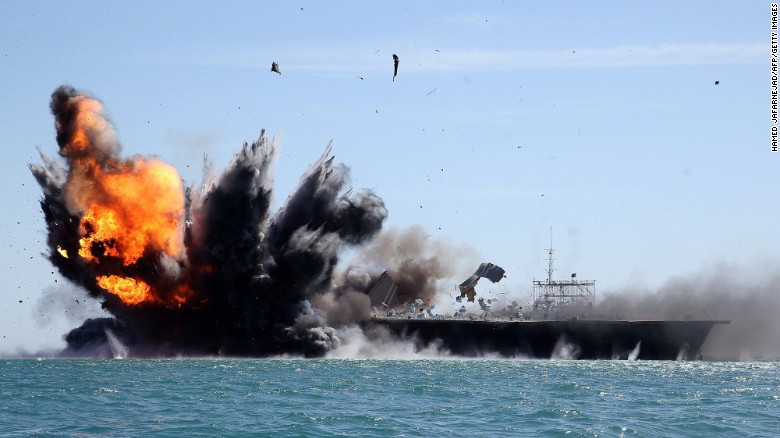
While Iran negotiates an agreement with the West on its nuclear program, it holds naval exercises near the Straits of Hormuz, sinking a mock-up of the USS Nimitz, an American aircraft carrier. (AFP Photo/Fars News/Hamed Jafarnejad)

While Iran negotiates an agreement with the West on its nuclear program,
it holds naval exercises near the Straits of Hormuz, sinking a mock-up of the
USS Nimitz, an American aircraft carrier. (AFP Photo/Fars News/Hamed Jafarnejad)

Three weeks into the war between Israel and the United States and Iran, the need for caution in assessing the situation has sharpened amid reports ranging from optimism that the Islamic Republic is on the verge of collapse and its military capabilities have been destroyed, to forecasts of a prolonged war of attrition that could ultimately leave a more extreme and dangerous regime in place.
Not only is it difficult to form definitive assessments in the midst of war, especially given the media blackout in Iran, but it is also impossible to know when it will end, what military steps are expected next and how they will affect the various actors. The question of Iran’s internal situation is the most complex to assess. It involves a wide range of variables, including the regime’s resilience, its leadership’s perception of reality, command and control capabilities, public sentiment and the ability of a potential protest movement to organize.
What is clear at this stage is that there is no indication the regime is nearing a breaking point or is prepared to make any concessions. On the contrary, while at the outset of the campaign its primary objective appeared to be survival, it now seems to be seeking to exploit the war as a strategic opportunity — both to prevent future attacks against it and to reshape the regional order. In this context, Iran aims to encourage Gulf states to end the American military presence in the region and to establish regional arrangements based on recognition of its status and its capacity for harm.
MAKE ynetGlobal MY TRUSTED SOURCE
At the same time, the regime has so far demonstrated an ability to adapt to the wave of assassinations targeting senior officials. There is no evidence of a loss of control by the security forces, including the Basij militia and internal security units, which continue to operate and adjust to the changing reality, for example by shifting activity from attacked headquarters and bases to civilian institutions and by altering their methods of operation. Arrests and executions of civilians accused of espionage or collaboration with the regime’s enemies have also continued and even intensified.
Even sensitive public events, such as the “Fire Festival”, marked on the last Wednesday before the Iranian New Year (Nowruz), passed without significant incidents, aside from isolated clashes between protesters and security forces.
That said, the elimination of senior regime figures should not be underestimated. Key figures with experience and influence, foremost among them Supreme Leader Ayatollah Ali Khamenei and Supreme National Security Council Secretary Ali Larijani, are not easily replaced. It remains unclear to what extent Mojtaba Khamenei, who according to assessments continues to function despite his injury, is able to effectively assert control. Moreover, there are indications of tensions between the political and military leadership and growing difficulties in maintaining an effective chain of command.
Public sentiment is also difficult to assess. There are early signs of growing criticism from the public, including regime critics, directed at Israel and the United States over the continued strikes, particularly damage to national infrastructure that some view as evidence of a war against Iran itself, not just against the regime
The central question is whether and when a breaking point will be reached that could undermine the regime’s stability and lead to its internal collapse.
Public sentiment is also difficult to gauge. There are early signs of increasing criticism among the public, including regime critics, directed at Israel and the United States over the continued strikes, particularly damage to national infrastructure that some perceive as a war against Iran itself and not just against the regime. An Iranian sociologist identified with the reformist camp recently warned that many citizens who were once among the regime’s fiercest opponents and who viewed its foreign policy as a key driver of the country’s economic problems have changed their views and developed deep hostility toward President Donald Trump and Prime Minister Benjamin Netanyahu.
Even so, the significance of this trend should not be overstated. Past experience suggests that public protest could resume, especially given the regime’s inability — now more pronounced than ever — to address citizens’ hardships. However, it is difficult to assess whether and when protests will reemerge and, in particular, whether they will succeed in bringing about meaningful change.
On the missile front, there appears to be a more systematic effort this time to target not only launch capabilities but also production chains, in an attempt to delay the system’s rehabilitation after the war. While this does not guarantee the prevention of future recovery — especially if some missiles and launchers were merely neutralized, meaning they remain in blocked underground tunnels, rather than destroyed — it could significantly extend the time required for restoration. Meanwhile, the recent increase in launches from Iran indicates it is capable of continuing missile fire — at least at the current scale — for several more weeks.
The nuclear program remains a central source of concern. As long as Iran retains significant capabilities, chief among them hundreds of kilograms of uranium enriched to 60 percent, there is a real risk of renewed acceleration of the program after the war. Absent an operational or diplomatic solution that would remove or destroy critical nuclear components, the regime — led by Mojtaba Khamenei and the Islamic Revolutionary Guard Corps — may decide to alter its nuclear doctrine and move toward developing nuclear weapons. This leadership is not necessarily bound by the concept of a nuclear threshold state and is not constrained by the religious ruling attributed to Khamenei’s predecessor that prohibited the development of nuclear weapons.
Finally, the energy issue has become a central focus. Iran has identified the potential of this lever through its control of the Strait of Hormuz, attacks on regional energy infrastructure and its influence on oil prices. From Tehran’s perspective, this is a strategic card that allows it to prolong the war until it secures guarantees that serve its interests, while exacting a heavy economic price from both the regional and global systems.
The Israeli strike on a gas field in southern Iran once again demonstrated that Tehran does not intend to relinquish this leverage and is even prepared to escalate further. However, it remains unclear to what extent Iran will be able to sustain this strategy over time. If the United States is willing to bear the risks associated with broader military action — possibly including the use of ground forces and at the cost of extending the duration of the war — an opportunity may emerge to gradually reduce Iran’s ability to threaten the global energy market.
Dr. Raz Zimmt is director of the Iran and the Shiite Axis Program at the Institute for National Security Studies.

Iran’s Ayatollah Writes Islamist Version Of ‘Mein Kampf’

Iran Deal: Not to be outdone by the Fuhrer, the Ayatollah Khamenei has penned a 416-page guide on how to rid Israel of the Jews. Once Tehran gets nukes, his theories can go into practice.

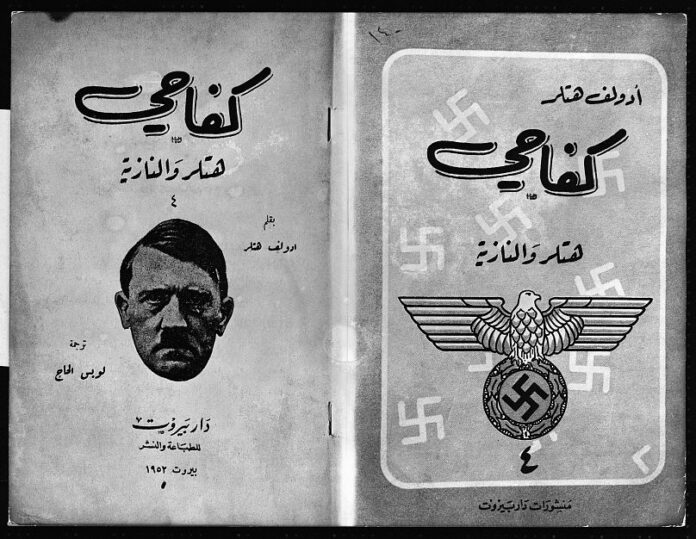
Iran’s Supreme Leader has now published his own version of “Mein Kampf,” Hitler’s infamous 1925-26 autobiographical tract against the Jews. A copy of Khamenei’s “Palestine” landed in the hands of Gatestone Europe Chairman Amir Taheri.

As the Iranian expat wrote in the New York Post, the ayatollah uses words of hate and destruction in the volume, like ” ‘nabudi,’ which means ‘annihilation’ … ‘imha,’ which means ‘fading out,’ and, finally, there is ‘zaval,’ meaning ‘effacement.'”

And Khamenei argues that his strategy for making the state of Israel nothing more than a memory is based on “well-established Islamic principles,” one of which, as Taheri describes it, “is that a land that falls under Muslim rule, even briefly, can never again be ceded to non-Muslims.”

Teheri points out that this is a widespread Islamic belief: “Dozens of maps circulate in the Muslim world showing the extent of Muslim territories lost to the Infidel that must be recovered,” including “large parts of Russia and Europe, almost a third of China, the whole of India and parts of the Philippines and Thailand.”

Israel is “adou” and “doshman,” translated as “enemy” and “foe,” to be targeted for special attention because it is the “ally of the American Great Satan,” and, according to Taheri, “because it occupies Jerusalem, which Khamenei describes as ‘Islam’s third Holy City.’ He intimates that one of his ‘most cherished wishes’ is to one day pray in Jerusalem.”

Khamenei’s nuts-and-bolts means of eliminating Israel is, of course, protracted terrorism that, over the course of years, would eventually convince Israeli Jews to leave for the U.S. or Europe.

And when Iran is, finally, nuclear-armed, the Israeli government may hesitate to counter its terrorist war against the Jewish state. As Taheri notes, Khamenei makes no mention of nukes, but the eventuality is clearly written between the lines.

“Israel fatigue” would take hold of the U.S. and other one-time Israeli friends, and they would seek a way to abandon Israel.

Then what is now Israel, the West Bank and Gaza would combine to become a new nation that never existed before: Palestine.

Taheri surmises that 8 million or more supposed Palestinians, many of whom live nowhere near Palestine, and including most Jordanians (the Kingdom of Jordan being, truth be told, the real Palestinian state), would undemocratically overwhelm 2.2 million Jews in a referendum.

As Khamenei boasts in the book, “We have intervened in anti-Israel matters, and it brought victory in the 33-day war by Hezbollah against Israel in 2006 and in the 22-day war between Hamas and Israel in the Gaza Strip.”

And what replaces the vacuum of power left in the absence of the Jewish state and its “Great Satan” sponsor, America? According to the ayatollah, “the hegemony of Iran will be promoted.”

Does “Iranian hegemony” not sound similar to the Nazis’ infamous demands for German “Lebenstraum” or “living room,” carried out by conquering other ethnic groups’ lands?

Historian John Toland quotes Hitler in 1922: “If I am ever really in power, the destruction of the Jews will be my first and most important job.”

How different is this from Khamenei, in his new book, calling the Jewish homeland “a cancerous tumor”?

Except that the Nazis did not have the bomb. What on earth is the Obama administration doing pushing a deal that perpetuates a 21st-century Nazi state’s ability to build nuclear weapons?

Why Did the US Just Lift Sanctions on Iranian Oil?

BESA Center Perspectives Paper No. 2,370, March 22, 2026

EXECUTIVE SUMMARY: On March 20, 2026, the US announced a temporary 30-day lifting of sanctions on the sale and delivery of Iranian oil. The permit applies only to oil that was already loaded onto tankers by that day, and the oil in question must be unloaded by April 19. This should not be misread as a gesture to Iran. It is intended as a means of quickly releasing tens of millions of barrels of already-purchased oil onto the global market. The object is to ease pressure on oil prices, which should buy the US more time to achieve its war aims.

According to estimates, on the eve of the current war, some 140 million barrels of Iranian oil were floating at sea. This oil had already been produced and loaded onto tankers, and the vast bulk of it had already passed through the Strait of Hormuz before the war broke out. The Chinese had bought most of this oil, but chose to leave it at sea because their strategic reserves were full of the medium-sour oil that Iran produces, and US sanctions on the Iranian banking system made it difficult to resell the oil to other customers. Iranian oil tankers were thus left waiting for months near China’s shore.

The US is attempting to quickly calm the market by allowing countries to buy these millions of barrels of oil. As a significant portion of this oil had already been sold to China, Washington is effectively allowing Beijing, if it so wishes, to release the cargo to be sold in Japan, India, South Korea, and other Asian countries interested in Iranian medium-sour oil. Even if the Chinese opt to keep all the oil for themselves, the result will still relieve the market, because similar types of oil—primarily Russian medium-sour—can then flow to other customers in Asia. According to the US Secretary of Energy, these tankers could begin arriving at Asian ports within three to four days.

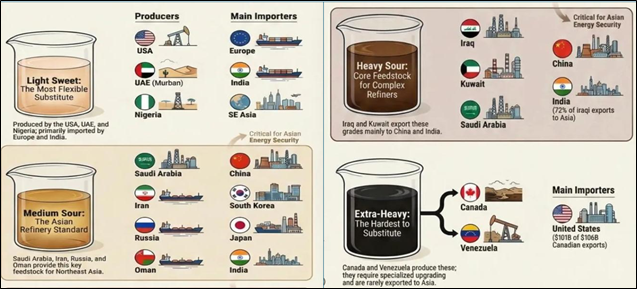
The type of oil is very important here, because it determines who can benefit from the American sanctions relief on Iran’s oil. Oil grades are defined by two main indicators: density (“light” vs. “heavy”) and sulfur content (“sweet” vs. “sour”). The oil’s grade affects the costs of transportation and refining as well as the types of distillates that can be produced from it. Light and sweet oil can produce more gasoline, diesel fuel, and jet fuel. Heavy oil is more suitable for bunker oil for ships or bitumen for asphalt. Refineries are usually built to operate most efficiently with a specific grade of crude oil. They can process other oil grades if necessary, but not at the same level of profitability or efficiency.

(Source: @Adam Tooze)

Iranian oil is mostly medium-sour. Not every refinery can produce the same distillates from it with the same efficiency, and not all countries in Asia have the necessary refining capacity in the first place. Countries like India, Japan, South Korea, and Singapore are well-suited for this oil and have more advanced refining capabilities. In contrast, countries that depend more on imported distillates and less on independent refining, such as the Philippines, Sri Lanka, Vietnam, and Australia, are more vulnerable to prolonged disruptions and would benefit from Iranian oil only indirectly.

This is where China comes into the picture. It has a huge domestic refining capacity and significant reserves, and thus has great influence on gasoline and diesel prices throughout Asia. Even without the American relief on Iranian oil, Beijing could have released some of its strategic reserves or distillates into the market and eased prices for its neighbors – but it has no interest in doing so. As early as the first week of the war, China announced restrictions on distillate exports, leading to a dramatic increase in gasoline and diesel prices in Thailand, the Philippines, and Vietnam. China may be using this as a political lever to increase pressure on the US to end the fighting, or it may at the very least be planning to turn energy into a regional bargaining tool and sell distillates to its neighbors in exchange for political benefits.

The main criticism of the American move is that lifting oil sanctions strengthens the Iranian regime and enriches its coffers during the war. US Treasury Secretary Scott Bessent claims that Washington will monitor sales and make it difficult for Iran to access these revenues, emphasizing the continuation of the “maximum pressure” policy on Iran’s ability to use the international financial system. However, he has not explained how the US will prevent Iran from circumventing the restrictions, as it has done so far. In its trading with China, Iran has often used barter transactions, cash, or payments in yuan rather than dollars to circumvent sanctions. It has also used intermediary companies and countries (mainly Oman and Malaysia) to “launder” the source of its oil, and has relied on offshore bank accounts in Qatar, the United Arab Emirates, Mauritius, and elsewhere with the full knowledge of the countries involved.

It can be argued, however, that Iran’s ability to circumvent US restrictions has been reduced since the beginning of the war, now that Iran itself has bombed some of the countries where it holds offshore accounts. The United Arab Emirates, for example, announced on March 5 that it is considering freezing Iranian accounts in the country. This allows the US to say with greater confidence that it has more control over revenue coming from Iranian oil sales, whether or not this is in fact the case.

In the short term, this seems to be a relatively calculated move by the US. According to the administration’s own statements, its goal is not to provide relief to Iran’s economy but to quickly release oil that has already been produced and is now at sea. The move is designed to relieve pressure on the market for about two weeks. From Washington’s perspective, this is a limited price it is willing to pay to buy time, stabilize the energy market, and preserve greater freedom of action in the war, at least until it can greatly reduce Iran’s ability to close the Strait of Hormuz.

Dr. Elai Rettig is an assistant professor in the Department of Political Studies and a senior research fellow at the Begin-Sadat Center for Strategic Studies at Bar-Ilan University. He specializes in energy geopolitics and national security.

view pdf

‘All about deception,’ says NJ Republican, who can’t get X to remove handle spoofing him, posting Jew-hatred

OLYMPUS DIGITAL CAMERA

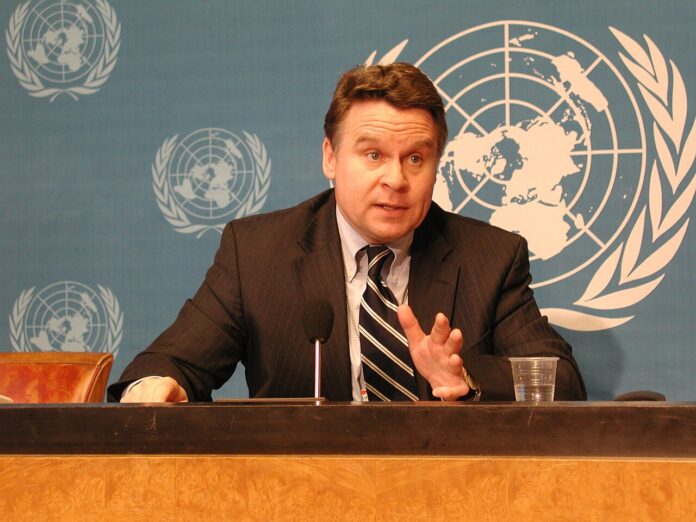
Look up Rep. Chris Smith (R-N.J.) on the social media site X, formerly known as Twitter, and you see his picture and his letterhead. But it’s not his handle.

As a result of that handle, the congressman has been criticized for postings that he didn’t make and opinions that he didn’t express—all while being stymied in his efforts to find out the identity of the person behind the phony handle.

“It’s all about deception, and I have a right to know who is doing this,” Smith told JNS. “I wanted to take it down, but I have a right to know at least who is smearing my name.”

“Somebody in that business over at X knows,” the congressman said. “Why could they know, and I can’t know?”

The account is listed as a “parody” on X, but that hasn’t stopped groups that support the long-term congressman from using that parody’s ChrisSmithNJCD4 handle when thanking him for his efforts in posts on X. (JNS sought comment from X.)

What galls Smith most of all, he said, is that the person behind the handle has used it to spread antisemitic and anti-Israel messages, even though the veteran lawmaker authored the law that made the U.S. State Department’s Office to Monitor and Combat Antisemitism and gave the special envoy ambassadorial rank.

He co-chairs the House Bipartisan Task Force for Combating Antisemitism, and he’s used his chairmanship of a House Foreign Relations subcommittee to hold hearings on the issue.

“It’s been a lifetime of concern and work on behalf of it,” Smith told JNS.

The congressman still tells the story of his family’s sporting goods wholesale business, which was adjacent to a luncheonette where a Holocaust survivor, his tattooed number visible to all, dined regularly.

Smith said that his father wanted his children to talk to him, to ask questions of his experiences.

“My father made sure that my brother and I both had lunch with him,” Smith told JNS. “That’s why Holocaust remembrance is so important, because if you don’t remember it, you repeat the mistakes.”

“Those who forget the past are condemned to relive it,” he said.

Under Smith’s name on social media, however, are tweets such as, “I just spoke to my handler at AIPAC. We need to get American soldiers on the ground in Iran,” invoking the antisemitic trope of Jews controlling the world.

Another antisemitic trope says that “we in Congress are owned by Zionist Israel, and I’m ok with that.”

Some of the posts quote other articles and then comment on them. One quoting Pope Leo XIV criticizing violence against Palestinians calls the pope “an antisemite and a moron.”

Another has an article blaming former President George W. Bush’s 2003 Iraq War on Israel, adding that “I know thousands of American soldiers died for Israel in Iraq, and will gladly do it again in Iran.”

Smith said he got an earlier phony account taken down, but X is refusing to budge on this one. Even though the page expressly says “parody” in two places, people apparently think that’s his official page, he said.

Anti-abortion groups, supporters of Smith’s efforts to highlight China’s efforts against the Muslim ethnic group the Uyghurs, opponents of wind energy off the Jersey shore and even the New Jersey Bankers Association have identified Smith by the phony handle as they praised his work, according to screenshots that Smith’s office shared with JNS.

“I think a lot of people are not aware as to what parody means,” Smith told JNS.

“If this thing is growing, this inauthentic account is going to deceive more people,” he said. “Especially overseas, where there’s a language barrier or something.”

The handle is “posting all these terrible things,” he said.

Smith is not on the social media site, so the phony page is the only one with his name.

He shut down his page on the site, then known as Twitter, in January 2021 citing “security concerns” two weeks after the Jan. 6 riots at the U.S. Capitol.

Smith was one of the House Republicans who refused to overturn the certified election results that showed Joe Biden becoming president. “Divisive and hate-filled tweets have become far too frequent and impede the healing so needed today,” he said at the time.

Smith told JNS that he left the social media site for another reason. He was a leader of congressional efforts to oppose China’s crackdown on Hong Kong’s freedoms.

At one point, China declared that “any contact with a foreigner constitutes a violation,” Smith said. He took a look at his 15,000 followers from Hong Kong and said, “Oh God, they’re going to use that. It’s a hit list for them.”

“So I got off for that reason as well,” he told JNS.

But X won’t do anything to quiet this fake account, Smith said.

He said that he even went up to the site’s owner, Elon Musk, at a House Republican gathering to ask him to take action. Musk told him to contact one of his top officials. Nothing happened.

“That’s why I’ve been profoundly disappointed in Twitter, or X,” Smith told JNS. “We sent letters. We did everything by the book to say, ‘This is an impersonation. It’s malevolent. It is deceptive, and your own policy suggests at least that you want none of that, and it’s absolutely designed to mislead people.’”

At the very least, Smith said, X should let him know who’s behind the site.

“They owe me to tell me who it is,” he said. “There’s no right to secrecy when you’re engaging in such a very nefarious enterprise.”

“This is their word: ‘You may not impersonate other identities or individuals, groups or organizations to deceive them,’” he said. “This is all about deception. It’s all it is. I can’t believe they can’t see that.”

Third week and counting

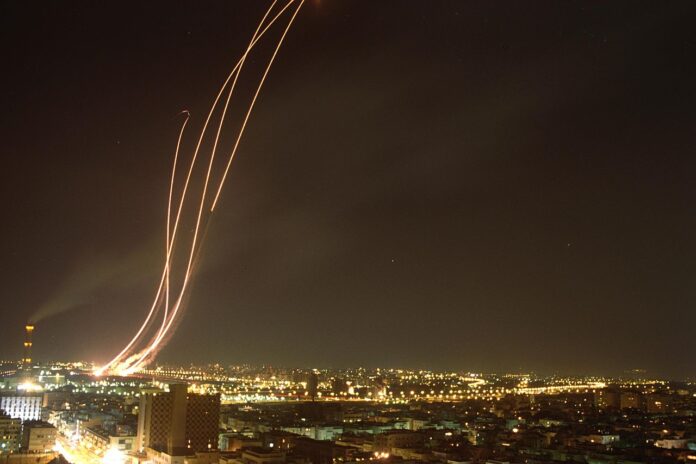
Three weeks of missile and drone bombardments from Iran, together with disrupted sleep and siren-filled days, certainly make life here at the moment a rather action-packed experience.

Most Israelis, however, realise that in order to make the Middle East, in particular, and the world in general, a safer place, a certain amount of pain and inconvenience is inevitable

This highlights the stark difference between those of us living in Israel and those who reside elsewhere.

Many Americans, Canadians, Brits, Europeans, Australians and Kiwis cannot understand the underlying necessity for this current conflict. They have been seduced by a media peddling lies, myths and fables and are succumbing to a spreading malaise of misinformation. If one does not live in the shadow of an existential threat where a terror regime is trying to achieve the means to destroy you, then a simple explanation for this conflict would elude them.

It is hardly surprising when those directly threatened by annihilation retaliate in order to thwart imminent danger. Then the blame always falls on the intended victim rather than the obvious culprit. When the victims happen to be Jews, then the age-old virus is reactivated.

The Iranians are very well aware of this, which is one of the reasons that they plan to inflict as much worldwide economic mayhem as possible. Resultant waves of “blame the Jews/Israelis” can be guaranteed when the price of oil reaches stratospheric levels and oil tankers are attacked in the Strait of Hormuz, resulting in petrol shortages.

Israel is already perceived as having coerced the USA into attacking Iran, and no amount of logic and facts will be able to undo the collateral damage this will cause. Add in the economic and financial hardships that will flow from Iran’s attack on international markets, and you have a perfect storm of Judeophobia waiting to be unleashed.

The political fallout can already be seen and discerned.

In the USA, with all eyes focused already on the mid-term elections later in the year, the omens are ominously stark.

A steady erosion of support for Israel is well underway in both political parties. As there are only two parties to choose from, the options for committed Jewish voters are becoming almost non-existent.

Democrats are rapidly succumbing to extreme progressive and left socialist demonising of the Jewish State.

What was once a solid wall of Republican support for Israel is steadily being undermined by a twin assault from the ultra-phobic isolationist right and the traditional neo Nazi type conspiracies spread by so-called “influencers” and others of that ilk.

Traditional evangelical Christian Zionists are threatened by twin threats of anti Zionist Christian groups tied to liberation dogmas and a younger generation of adherents whose historical knowledge is grossly deficient.

One would think that the majority of American Jews might be concerned for their future. Unfortunately, like their European brethren pre-1939 and today, the warning signals are either dismissed as alarmist or ignored altogether.

Here is something to ponder.

A common thread that binds most of these anti-Israel/ Zionist haters together is their fervent declaration that “we believe Israel has a right to exist.”

This affirmation is somehow supposed to establish the unblemished sincerity that, in fact, they really do have Israel’s best interests at heart.

Think about it for a moment, and you will quickly see what a disgusting notion it really is.

Can you think of any other country or nation whose existence and very legitimacy are challenged to such an extent that politicians, critics and commentators feel the need to declare that it “has the right to exist?”  Which other member of the United Nations needs to be reassured that “it has the right to exist?’”

Which other country, apart from Israel, is so delegitimised that its very presence is questioned?

To add insult to injury, what usually follows next exposes the hypocrisy for what it really is.

Always following the statement that the nation-state of the Jewish

People have a right to exist, is the declaration “that of course it also has a right to defend itself.”  Well, that is really generous, but the caveat that follows lays bare the underlying double standards apparently not applicable to any other country.

What always follows is the solemn admonition that “of course any defence must be proportional and approved by the UN.”  In other words, in order to survive the genocidal machinations of the Jew haters of this world, Israel must never ever take measures which might cause those plotting our demise to regret their actions.

This is what lies at the crux of each and every opposition to Israel defending itself in any meaningful shape and form.

Next time you hear a politician burble any of the above nonsense, you can guarantee that they are merely trying to “cover themselves” from any accusation of selective enmity.

It is excruciating but hardly surprising to witness the current squirming responses to Iranian attempts at precipitating chaos and mayhem.

Freedom of the seas and navigation used to be a well-accepted principle of international law.

Apparently, those days are well and truly in the past.

The Islamic Iranian regime blockades the Strait of Hormuz and throttles the world’s oil supplies. The reaction of major democracies and maritime nations is underwhelming.

Instead of a united stand against this modern form of piracy those most affected resort to rhetoric and apathetic appeasement. News reports had intimated that the French were going to send their aircraft carrier to escort tankers. This turned out to be fake news. Instead, the French resorted to their usual fallback position and apparently initiated pleas to the mullahs and their handlers to be “nice people and allow freedom of navigation.” Having had generations of such spineless policies blow up in their face, one would have thought that they might have learnt that pleading with bullies doesn’t pay.

The British are no better. Starmer and his Labour Government are blowing hot and cold but that is as far as allied solidarity and freedom of the seas goes these days in London. A commentator noted that the Brits don’t have anything worthwhile to send to break the blockade so recycled pontification is about all they can fire off.

The Europeans have fallen back to their well-worn technique of seeing evil but not wanting to do anything meaningful about it.

The Irish, having kissed the Blarney Stone, offer gratuitous advice and declare that only diplomacy and talks can break the blockade.

Australia is apparently sending a reconnaissance plane, which will no doubt terrify the Iranians into surrendering.

Meanwhile, as the IRGC Hezbollah terrorists in Lebanon fire missiles and drones indiscriminately into northern Israel communities, the leaders of Canada, France, Germany, Italy and the United Kingdom issue a stern warning to Israel. Once again, Israel is warned not to “overreact” as its citizens are targeted.

Iran is firing cluster missiles at Israel. These are deadly because they split in mid air and scatter lethal projectiles over a wide area causing multiple fatalities and injuries. These weapons were banned in 2008 when 120 countries signed a convention banning their use.

Guess what?

Have you, by any chance, heard an international outcry over Iran using these weapons? Not a peep has been forthcoming from London, Paris, Ottawa, Canberra, Wellington, Rome, the Vatican and the United Nations among others. It’s only Israelis who are being targeted by these missiles; there’s no need to get excited. One would think that Iran might be hauled in front of the ICJ and World Court at The Hague. Unfortunately, those bodies are still too busy investigating Israel for a fake genocide in Gaza.

After three weeks of this insanity, is it any wonder that most Israelis just want the job properly completed once and for all?

Beyond ceasefire: The unresolved core of the West Asian conflict

Over the next weeks and months, Israel will be pressured by the US into accepting a ceasefire. However, before agreeing to a ceasefire, fundamental issues must be brought to the forefront to show that the war conducted by the Palestinians and their Iranian allies is far from over.

These issues are:

• The official Voice of Palestine, operating on Israeli government radio and TV frequencies, continues its daily incitement.

• The Palestinian “Pay for Slay” law continues, mandating a salary for life for anyone who kills a Jew.

• The PLO charter places the Palestinians in a permanent state of war until all Jews have been expelled from all areas that were Mandatory Palestine.

• The PLO has now spawned a new Palestinian constitution, which does not recognise the right of any Jews to live anywhere in Palestine.

• The Palestinian-designated Jew-free areas include all of the territory which today constitutes the State of Israel.

• The Palestinian war curriculum continues to educate all Palestinian children to live a life of permanent war with the Jews, until all Jews are expelled from Palestine.

• UNRWA transforms generous humanitarian aid into cash for arms training to prepare the next generation for war. Sixty-seven nations pour $1.6 billion into UNRWA for humanitarian services. UNRWA hosts five million descendants of Arabs who left Israel in the wake of the 1948 war and remain in 58 “temporary” refugee camps under the premise and promise of the right of return to Arab villages that existed before 1948.

All the above begs the question: what about the PSF, Palestinian Security Forces, established by the Israeli security apparatus to ensure at least one Palestinian partner on whom it could rely for cooperation?

Already receiving hefty salaries on the PA payroll, all levels of Israeli security document that PSF officers are consistent perpetrators of terrorism against civilians and the security forces of Israel.

Glorified as “martyrs”, all PSF groups are complicit.

The Palestinian Security Forces were formed under the Oslo Agreement signed in September 1995: “To guarantee public order and internal security for the Palestinians of the West Bank and the Gaza Strip… shall establish a strong police force that consists of the Palestinian Police and other branches responsible for national, preventive, public, and presidential security.”

PSF officers hold parallel positions in ‘resistance’ movements, either civil or military, such as the Al-Aqsa Martyrs’ Brigades (the military arm of Fatah), using armed confrontation with Israel. Rather than upholding public order and preventing terrorism, they themselves carry out acts of terrorism against Israeli civilians and members of Israel’s security forces.

In sum, no ceasefire can be implemented in West Asia until each of these issues is resolved.

It is crucial to understand the precise nature of the “ceasefire” that the Palestinians offer: a hudna to stop firing, a term frequently misunderstood as “truce” or “ceasefire”.

A hudna is nothing but a temporary respite and does not remotely resemble either a “truce” or a “ceasefire”.

Here, then, are four terms now in use in the Arabic understanding of what a ceasefire means:

• Hudna: tactical pause intended for rearmament

• Tahida: temporary halt in hostile activity, which can be violated at any time

• Hudaybiyyah: cessation of fighting for 10 years, invoking the “Treaty of Hudaybiyyah” in 628 CE

• Sulch: total cessation of hostile activity

Notably, a hudna, tahida, or hudaybiyyah has no relation to the mu’ahada treaty of peace that Egypt signed with Israel in 1979, or the mu’ahada treaty of peace that Jordan signed with Israel in 1994.

The authoritative Islamic Encyclopaedia (London, 1922) defines “hudna” as a “temporary treaty” which can be approved or abrogated by Islamic religious leaders, depending on whether or not it serves the interests of Islam, and that a “hudna” cannot last for more than 10 years.

The Islamic Encyclopaedia adds that the Hudaybiyyah treaty is the ultimate “hudna”.

When our news agency sent a crew to monitor Yasser Arafat’s speeches following the 1993 Oslo peace accords, we documented that the PLO leader repeatedly declared that the Oslo accords were akin to the Hudaybiyyah treaty.

No one listened.