Facebook Linkedin RSS Twitter
  • Home
  • About
    • About IRNA
  • Articles
    • Israel Resource Review
    • Articles Authored by David Bedein
    • The Philadelphia Bulletin
    • In Swedish
  • Special Reports
    • Foreign Military Aid To The Palestinian Authority
    • Critique of Human Rights Groups
    • How to Communicate to Media and Policy Makers
    • Israelis Evicted From Their Homes, Summer 2005
    • Podcasts
    • The Israeli Arab Community
    • UNRWA
  • UNRWA
    • The UNRWA Reform Initiative
    • Articles About UNRWA
    • Special Reports on UNRWA
    • UNRWA Films
    • Videos About UNRWA
    • Power Point: Anatomy of Hamas takeover of UNRWA
  • Palestinian Authority
    • Articles About Palestinian Authority
    • Palestinian Authority Films
    • Special Reports on Palestinian Authority
    • Schoolbook Research Project
    • Powerpoint: The Next Intifada
  • Videos
    • Behind The Scene with David Bedein
    • Video Blog
    • Video Channel
  • Reviews
  • Contact Us
  • Languages
    • Czech
    • French
    • German
    • Hebrew
    • Noruegan
    • Russian
    • Spanish
    • Swedish
    • Polish
    • Portuguese
  • Subscribe
Search
Saturday, February 14, 2026
Facebook Linkedin RSS Twitter
Sign in
Welcome! Log into your account
Forgot your password? Get help
Password recovery
Recover your password
A password will be e-mailed to you.
Israel Behind The News Israel Behind the News
Israel Behind The News
  • Home
  • About
    • About IRNA
  • Articles
    • Israel Resource Review
    • Articles Authored by David Bedein
    • The Philadelphia Bulletin
    • In Swedish
  • Special Reports
    • Foreign Military Aid To The Palestinian Authority
    • Critique of Human Rights Groups
    • How to Communicate to Media and Policy Makers
    • Israelis Evicted From Their Homes, Summer 2005
    • Podcasts
    • The Israeli Arab Community
    • UNRWA
  • UNRWA
    • The UNRWA Reform Initiative
    • Articles About UNRWA
    • Special Reports on UNRWA
    • UNRWA Films
    • Videos About UNRWA
    • Power Point: Anatomy of Hamas takeover of UNRWA
  • Palestinian Authority
    • Articles About Palestinian Authority
    • Palestinian Authority Films
    • Special Reports on Palestinian Authority
    • Schoolbook Research Project
    • Powerpoint: The Next Intifada
  • Videos
    • Behind The Scene with David Bedein
    • Video Blog
    • Video Channel
  • Reviews
  • Contact Us
  • Languages
    • Czech
    • French
    • German
    • Hebrew
    • Noruegan
    • Russian
    • Spanish
    • Swedish
    • Polish
    • Portuguese
  • Subscribe
  • Middle East
  • Bahrain
  • Iran
  • Iraq
  • Israel
  • Israel Resource Review
  • Lebanon
  • Qatar
  • Saudi Arabia
  • Syria
  • Yemen

My Optimism About the New Arab Revolt

By
Dr. Daniel Pipes,director of the Middle East Forum and Taube distinguished visiting fellow at the Hoover Institution of Stanford University.
-
March 1, 2011
29
Facebook
Twitter
Pinterest
WhatsApp

    Unprecedented convulsions across the Middle East, from Morocco to Iran, prompt three reflections:

    First, these rebellions fit into the context of a regional chessboard, what I call the Middle East cold war. On one side stands the “resistance” bloc led by Iran and including Turkey, Syria, Lebanon, Gaza, and Qatar; it seeks to shake up the existing order with a new one, more piously Islamic and hostile to the West. On the other side stands the status quo bloc led by Saudi Arabia and including most of the rest of the region (implicitly including Israel); it prefers things to stay more or less as they are.

    Power in the Middle East means Mariah Carey coming over to sing four songs at one’s private party.

    The former (but not Syria) have an agenda, the latter (except Israel) want primarily to enjoy the fruits of power. (Caged tigers, anyone? Or a private concert by Mariah Carey ?) The former enjoy the appeal of offering a vision, the latter can deploy guns, lots of them.

    Second, while developments in Tunisia, Libya, Egypt, Yemen, and Bahrain have great significance, there are only two regional geo-strategic giants – Iran and Saudi Arabia – and both are potentially vulnerable. Discontent with the Islamic Republic of Iran became manifest in June 2009, when a rigged election brought massive crowds onto the streets. Although the authorities managed to suppress the “Green Movement,” they could not stifle it and it remains underground. Despite Tehran’s strenuous efforts to lay claim to the revolts across the region, portraying them as inspired by the Iranian revolution of 1978-79 and its own brand of Islamism, these revolts more likely will inspire Iranians to renew their own assault on the Khomeinist order.

    Were such a counter-revolution to succeed, the implications would go far beyond Iran, affecting the Non-Proliferation Treaty regime, Israeli security, Iraq’s future, the global energy market, and – perhaps most critical of all – the Islamist movement itself. Bereft of the most important “resistance” government, the Islamist movement worldwide would likely begin to decline.

    The Kingdom of Saudi Arabia is no ordinary state. Its power lies in a unique combination of Wahhabi doctrine, control over Mecca and Medina, and oil and gas reserves. In addition, its leaders boast an exceptional record of outside-the-box policies. Still, geographical, ideological, and personnel differences among Saudis could cause its fall; the key would then be to whom. Shi’ites who resent their second-class status and would presumably move the country towards Iran? Purist Wahhabis, who scorn the monarchical adaptations to modernity and would replicate the Taliban order in Afghanistan? Or both in the case of a split? Or perhaps liberals, hitherto a negligible force, who find their voice and lead an overthrow of the antiquated, corrupt, extremist Saudi order?

    This latter thought leads to my third and most unexpected observation: The revolts over the past two months have been largely constructive, patriotic, and open in spirit. Political extremism of any sort, leftist or Islamist, has been largely absent from the streets. Conspiracy theories have been the refuge of decayed rulers, not exuberant crowds. The United States, Great Britain, and Israel have been conspicuously absent from the sloganeering. (Libyan strongman Mu’ammar al-Qaddafi blamed unrest in his country on Al-Qaeda spreading hallucinogenic drugs.)
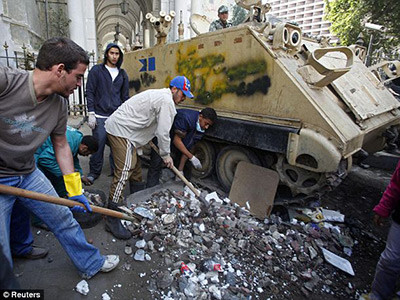
    Citizen clean ups in Tahrir Square symbolize a new civic spirit.

    One has the sense that the past century’s extremism – tied to such figures at Amin al-Husseini, Gamal Abdel Nasser, Ruhollah Khomeini, Yasir Arafat, and Saddam Hussein – has run its course, that populations seek something more mundane and consumable than rhetoric, rejectionism, and backwardness.

    Pessimism serves as a career enhancer in Middle East studies and I am known for doom-and-gloom. But, with due hesitation, I see changes that could augur a new era, one in which infantilized Arabic-speakers mature into adults. One rubs one’s eyes at this transformation, awaiting its reversal. So far, however, it has held.

    Perhaps the most genial symbol of this maturation is the pattern of street demonstrators cleaning up after themselves. No longer are they wards of the state dependent on it for services; of a sudden, they are citizens with a sense of civic responsibility.

    While cautious about premising foreign policies on this abrupt improvement, it would also be a mistake to reject it. The rebel movements need an opportunity to find themselves and to act as adults. Time has come to discard the soft bigotry of low expectations; speaking Arabic or Persian does not make one incapable of building democratic means to attain free ends.


    Facebook
    Twitter
    Pinterest
    WhatsApp

      LEAVE A REPLY Cancel reply

      Please enter your comment!
      Please enter your name here
      You have entered an incorrect email address!
      Please enter your email address here

      Previous articleMediaLine Glorifies Those Who Find Innovative Ways to Circumvent Security Checkpoints. Why?
      Next articleOur World: The West’s proxy war against the Jews

      RELATED ARTICLESMORE FROM AUTHOR

      ISGAP Rejects Columbia University’s Denial of Findings on Qatari Funding and Calls for Full Disclosure of All Foreign Support

      New Investigation And Film Examine UNRWA Education And Refugee Narrative In Gaza

      Pressure Points: School Books in Qatar Continue to Teach Hatred of Jews and Israel

      Israel Resource Review Archives

      Subscribe to our Newsletter

      First Name

      Last Name

      Email*

      Please check your inbox to confirm your subscription.


      March 2011
      S M T W T F S
       12345
      6789101112
      13141516171819
      20212223242526
      2728293031  
      « Feb   Apr »
      Israel Resource News Agency POB 71098 Beit Agron International Press Center 37 Hillel Street Jerusalem 94581 Israel order cakes
      Tel. (+972-2) 623 6368

      Cell phone (+972-58) 722-2661
      David Bedein
      Director of IRNA and CFNEPR
      dbedein@israelbehindthenews.com Media Inquiries
      media@israelbehindthenews.com General Inquiries
      contact@israelbehindthenews.com

      Column from the Director

      David Bedein
      David Bedein
      2505 POSTS6 COMMENTS
      Michael Kuttner
      Michael Kuttner
      467 POSTS0 COMMENTS
      Israel Behind the News
      Israel Behind the News
      31 POSTS0 COMMENTS
      Rochel Grosz
      Rochel Grosz
      1 POSTS1 COMMENTS
      daniel
      daniel
      0 POSTS0 COMMENTS
      © A WEBstationONE.com production, partially funded by the Internet Development Fund and the IDF Link technology.

      © 2003-2025 All rights reserved. Articles and Special Reports on IsraelBehindTheNews.com are copyrighted and may be republished any time and anywhere
      MORE STORIES

      ISGAP Rejects Columbia University’s Denial of Findings on Qatari Funding and...

      February 10, 2026
      The Institute for the Study of Global Antisemitism and Policy (ISGAP) rejects Columbia University’s dismissal of ISGAP’s research into undisclosed Qatari-linked funding and has...