Pray for peace – prepare for action

Peace is always at the forefront of our prayers, but at the same time, most of us should have learnt from bitter past experience that being aware of the challenges ahead is a priority.

At this time of the year, when we are about to welcome a new year and prepare for Yom Kippur, it is appropriate that we briefly look back, take stock of the current situation and prepare for the inevitable challenges ahead.

Optimistic visions that the coming year will herald a reversal of the rapidly rising tsunami of Judeophobia thinly disguised as anti-Zionism will no doubt feature in the messages of many communal leaders, lay and religious. While the sentiments may be worthy of all these platitudes will achieve is to induce a sense of complacency and misplaced hope. Unfortunately, if you take the trouble to survey the slippery slide into chaos that currently afflicts international relations, the realistic forecast is far from sunny.

The hope, of course, springs eternal, but until the Messianic age actually arrives, it behoves us to be wary and realistic.

Far too many times in the past, we fell into the trap of being sucked into premature euphoria and then faced subsequent bitter results. The Oslo disaster imposed on us by ideological hallucinatory politicians, instead of resulting in peace, produced terror, murder, a resurrected Arafat and the creation of the myth of a democratic, peace-loving, invented Palestinian entity. Embraced by the lemmings of the left and a hypocritical international community, this episode in futility has become like an albatross to the ancient mariner.

On the other hand, the Abraham Accords have resulted in intensified and warm relationships not only between Governments but, most crucially, between citizens. This is in stark contrast to the “peace” agreements with Egypt and Jordan, where interpersonal interactions are either rare or non-existent. In fact, the Hashemite Kingdom forbids Israelis from openly displaying religious items and actually confiscates tefillin and tallit from Jews at the border. Negative portrayals of Jews, Judaism and Israel still feature regularly in media outlets, which all contribute to a rather lukewarm if not cold peace.

Whether a warm peace will expand to other moderate Muslim countries in the coming year is still unknown. Oman has yet to give permission for EL AL to overfly its territory, which means direct flights between Australia and Israel remain in limbo.

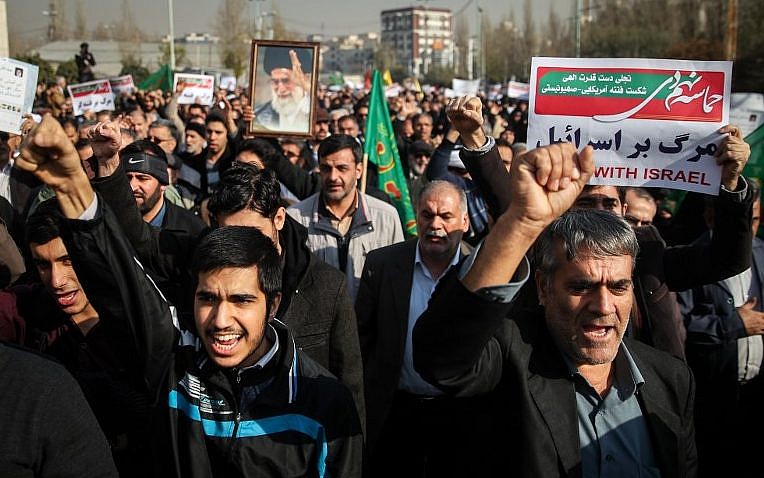
Undoubtedly, until there is regime change in Iran and Islamic-sponsored terror is defeated, the potential for a major conflagration remains. The Iranian President’s questioning of whether the Shoah actually occurred and his regime’s quest to acquire nuclear capabilities and the means to use them must surely be one of the major challenges ahead. Facing an American Administration which is perceived as weak plus European democracies desperate to do business with Tehran, together with Chinese and Russian ambitions in the region, the prospects for a peaceful year ahead are dim.

Israel needs not only to tackle this direct threat but also deal with Iranian surrogates in Syria and Lebanon as well as Gaza, all of them supplied with rockets and itching to launch a conflagration. Add into this mix the corrupt PA and its President for life, liberally supported by an equally corrupt UN, and you have a perfect recipe for chaos and mayhem during the next 12 months.

A perfect example of how morally low the international community has sunk is demonstrated by the fact that the Iranian President will have the red carpet rolled out at UN headquarters in New York, and the media will be falling over itself to provide him with free exposure. It will be interesting to see what sort of a performance the various “progressive” groups, Jews included, perform in the face of Iranian trampling of human rights and terror-sponsored machinations.

Will the New Year give birth to more cockeyed ideas for peace?

If past performance is anything to go by, we can expect continuing sponsorship of a plainly already failed attempt to create a democratic Palestinian Arab State living side by side with Israel in peace and security. This worn-out mantra will no doubt be endlessly regurgitated again despite reality clearly demonstrating that this is an unattainable goal. The Ireland Government this week illustrated the logic of Irish diplomacy. Not only did they embrace Holocaust liar Abbas, but they also intimated that recognition of a non-existent Palestine was likely because, in their own words, “it would have a positive impact on the “peace” process and a two-state solution.” The long-suffering Irish taxpayers will also now have to cough up an extra 2 million Euros in addition to the 6 million Euros donated to UNRWA in order to perpetuate the increasing numbers classified as “refugees.”

As far as the Irish attitude towards Israel is concerned, this can be summed up by the following definition of Irish diplomacy: “the art of telling someone to go to hell and having them look forward to the trip.” Apart from our usual self-flagellators, I doubt any other Israelis lose any sleep over what comes out of Dublin.

As we bid farewell to the current year, the threats confronting Jews worldwide keep increasing, and I am afraid that this will escalate even further. Anti Zionism which is just another form of Jew-hatred, is gaining ground among the ignorant and educated alike. We ignore it at our peril.

On 1 November, Israelis will face yet another election, the outcome of which is still murky and uncertain. The American domiciled President of the World Jewish Congress expressed his dismay at the multiplicity of political parties vying for voters’ approval. He touted the “wonderful” two-party system in the USA as a role model for us to follow. He obviously has no idea that the current Israeli electoral process, flawed though it might be, at least gives minority ethnic groups representation and citizens a wide choice of parties. It also means that we can turf out incompetent coalitions. Looking at the shambles in the USA, where voters only have two choices and where they are stuck with lousy leaders for four years, it’s a no-brainer that we are better off. There is an easy solution to the problem of small parties having inordinate influence. Raise the threshold from 3.2% to 5% and that will mean small parties amalgamating and fewer of them in the Knesset. This will bring more stability to the process of Government.

Hopefully, next year will see even more Olim arriving here. In addition to those fleeing persecution and war, we look forward to increased numbers arriving from so-called free countries. With Judeophobia increasing and Jews being targeted on the streets of Europe and the USA, it is highly likely that young families especially will make the move. We can already see this happening as Jews from the four corners of the globe return to Zion. Another positive phenomenon is the many descendants of secret Jews (Anusim) from the time of the Inquisition and remnants of the lost tribes of Israel returning to the Jewish People and nation. It is a fulfilment of ancient prophecies occurring right now.

As we gather together this Rosh Hashanah, our prayers for universal peace will be as fervent as ever. Unfortunately, they will not be fulfilled unless and until those who promote evil and hate are first thwarted.

Realistically we must be prepared to face tough times. We have been doing that for at least the last two thousand years, and despite enormous sacrifices, we are still here while our adversaries are in the dustbin of history.

May we all be inscribed for a healthy year filled with smachot and positive achievements.
Revealing Maps: The Palestinian Vision as Taught in UNRWA Schools

The present research deals with some 115 maps of the country appearing in the latest edition of schoolbooks issued by the Palestinian Authority in 2020 (few books were issued earlier and have not been revised since then) and used in UNRWA schools. Its source material included 125 books of grades 1-10 in the subjects of Arabic, English, Social Studies (including Geography and History), Islamic Education, Mathematics, Sciences and Technology.

The research aimed at checking the way this country – Israel/Palestine – is presented, in view of the ongoing conflict between the two nations that claim to be its owners. The basic hypothesis of this research was that the two parties see this country in its entirety as their homeland, which should be expressed in the maps appearing in their respective schoolbooks. In order to substantiate this hypothesis, two Israeli geography textbooks were examined too. They were officially licensed by the Israeli Ministry of Education and were issued by the Israeli Center of Educational Technology (CET), which is considered a central publisher of schoolbooks in Israel.

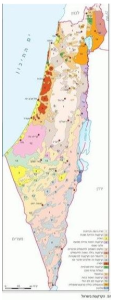
Indeed, there were found in the Israeli textbooks maps that present the country as one unit with no internal boundaries under the name “Israel” when those maps were not of political character. The following example is a map titled “Soils in Israel”, which also includes the territories of Judea, Samaria and Gaza (as well as the Golan Heights that was placed under Israeli legal jurisdiction in 1981).  

Map No. 1 (Israel – Man and Space, Intermediate and High School grades (CET, 2007) p. 187)

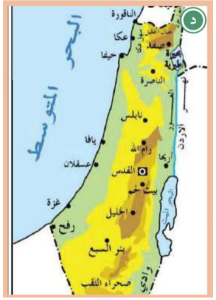
A parallel phenomenon is found in the Palestinian maps as well. Following is a map titled “Physical Map of Palestine”:

Map No. 2 (Social Studies, Grade 5, Part 1 (2020) p. 17)


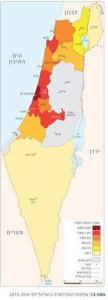
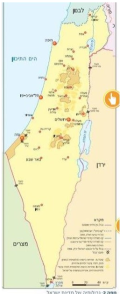
Other Israeli maps express the fact that the territories of Judea and Samaria have not been annexed by Israel (except for East Jerusalem) and the Gaza Strip has become a territory with no Israeli presence there whatsoever since 2005. These are mostly maps that carry an administrative character as they exclude these areas from Israel’s territory using the expression of “[a region with] no data”. Following is a map titled “Population Density in Israel according to Sub-Districts”:

Map No. 3 (Exploring a Country – Geography for Grade 6 [of] State and State-Religious [Schools] (CET, 2015) p. 69


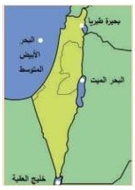
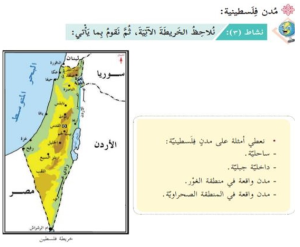
Among the Palestinian maps in use in UNRWA schools, on the other hand, there are only few maps that show the contours of these areas. In the following example, the map does not say specifically what is found beyond them:

Map No. 4 (National and Life Education, Grade 2, Part 1 (2019) p. 62)


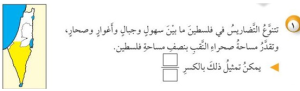
Another map treats the Israeli Negev region as part of Palesti beyond the contours of Judea, Samaria and Gaza:

“1. The physical features in Palestine variegate – plains, mountains, valleys and deserts.                                                                                                                         The surface of the Negev desert is estimated at about half the surface of Palestine.      It is possible to present that by the fraction…”

Map No. 5 (Mathematics, Grade 3, Part 1 (2020) p. 82)


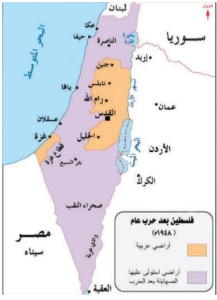
A third map titled “Palestine after the 1948 War” says specifically in its legend what is the area beyond these areas:

“[Orange] Arab territories

[Purple] Territories taken over by the Zionists following the war”

Map No. 6 (Geography and Modern and Contemporary History of Palestine, Grade 10, Part 2 (2020) p. 8)


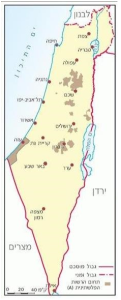
And back to the Israeli maps. The current political reality is described there as is, with the Palestinian Authority’s territories designated as area A, and sometimes its B territories as well, are clearly shown. It should be noted, though, that the PA is not a sovereign political body – even though it has been recognized by the UN as a non-member observer state. According to the Oslo Accords, by which the PA was established and which are still in force, it is an autonomous administrative body under the suzerainty of the Israeli Defense Force, which, in its turn, is subject to the jurisdiction of the Israeli government. Following are two Israeli maps. The first one presents areas A (colored dark brown), and the second one shows areas A (dark brown) and B (light brown):

Map No. 7 (Israel – Man and Space, Intermediate and High School grades (CET, 2007) p. 9)

Map No. 8 (Exploring a Country – Geography for Grade 6 [of] State and State-Religious [Schools] (CET, 2015) p. 10)


In total contrast to these Israeli maps (as well as many others in books examined by the author of this research), there is not even one map in the entire corpus of maps in use in UNRWA schools today that shows the State of Israel. Even in clearly political maps the whole country appears under the name “Palestine” only. Thus, Israel, a recognized sovereign state which has been a member of the UN organization since 1949, is erased from the maps used by UNRWA, an official UN agency!

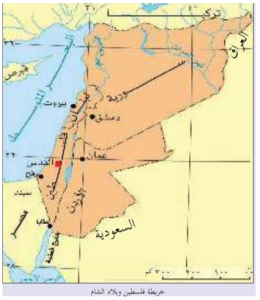
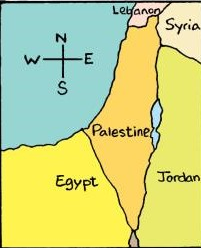
The first map among the ones in the following examples, titled “Map of Palestine and the Levant”, presents the four states in the Levant region under the names: Syria, Lebanon, Jordan and Palestine:

Map No. 9 (Geography and Modern and Contemporary History of Palestine, Grade 10, Part 1 (2020) p. 8)


The second example is taken from an English textbook. The map, untitled, presents the region’s states by their names with no additional details. Here again Palestine replaces Israel:

Map No. 10 (English for Palestine, Grade 6, Part 1 (2019) p. 55)

Another map, titled “Map of Palestine”, gives the names of the neighboring states:

Map No. 11 (Social Studies, Grade 6, Part 1 (2020) p. 9)


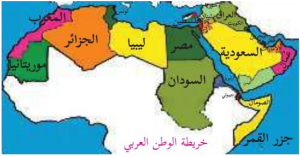
The exclusively Palestinian character of the country as a whole is emphasized in the following example. A map titled “Map of the Arab Homeland” presents the Arab states with their names. The name “Palestine” appears next to the country in its entirety (colored in red) with the Palestinian flag above it:

Map No. 12 (National and Social Upbringing, Grade 4, Part 1 (2020) p. 8)

This map appears in the textbook within the framework of Lesson 2 titled: “Palestine is Arab and Muslim”:

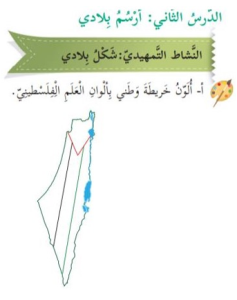
The exclusive Palestinian ownership of the country is emphasized within an exercise in which the student is requested to color the country’s map with the colors of the Palestinian flag:

“The second lesson: I am drawing my country

Preparatory activity: The shape of my country

  1. I will color my homeland’s map with the colors of the Palestinian flag.”

Map No. 13 (National and Life Education, Grade 2, Part 1 (2019) p. 8)


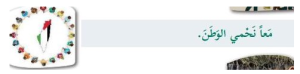
And another example. The inscription next to it says: “Together we shall protect the homeland”:

Map No. 14 (Islamic Education, Grade 2, Part 1 (2020) p. 42)


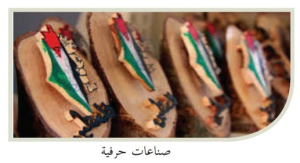
Palestine’s exclusive appearance on the country’s map is also seen in a product sold to tourists which depicts the country’s map colored with the Palestinian flag’s colors, alongside the name “Palestine” in Arabic and English. Following is an example given in another textbook:

Map No. 15 (Social Studies, Grade 5, Part 2 (2020) p. 57)


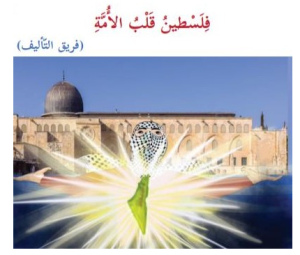
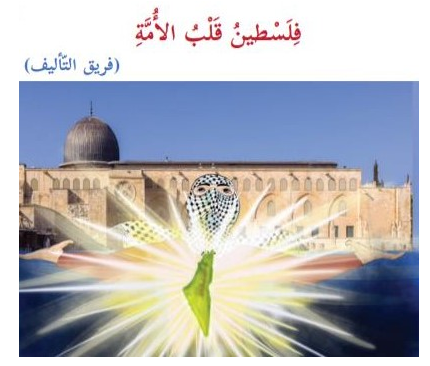
If Israel’s pre-1967 territory is an occupied one, as indicated in map No. 6, then, it should be liberated. The struggle for this goal is hinted in the following illustration that presents the map of the whole country against the background of Al-Aqsa Mosque and a veiled face of what might be regarded as a member of a terrorist organization, under the title “Palestine is the heart of the nation”:

Map No. 16 (Arabic Language, Grade 7, Part 1 (2020) P. 13)


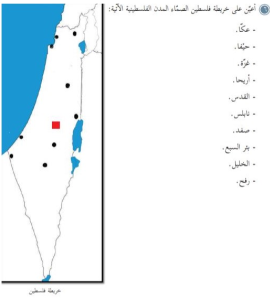
In this context, cities within Israel’s pre-1967 territory where Arabs live, or used to live, are considered Palestinian cities – even if the majority of the population there is Jewish:

“6. I will indicate on a silent map of Palestine the following Palestinian cities:

Acre, Haifa, Gaza, Jericho, Jerusalem, Nablus, Safed, Beer Sheba, Hebron, Rafah.” It should be noted that the bold-lettered names are those of cities inside pre-1967 Israel (including western Jerusalem) and their population is mostly Jewish.

Map No. 17 (Social Studies, Grade 5, Part 2 (2020) p. 39)


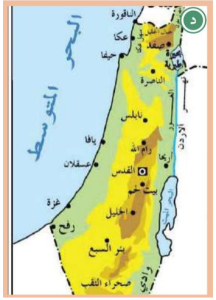
The next example, titled “Palestinian cities”:

“Activity 3: We will look at the map below and then will accomplish the following [requirements]:

We will give examples of Palestinian cities:

-On the coast

-In the hinterland mountains

-Cities located in the Jordan Valley

-Cities located in the desert region”

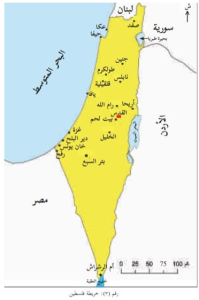
On the map, titled “Map of Palestine” appear the following cities: Acre, Safed, Haifa, Tiberias, Nazareth, Jaffa, Beer Sheba – all are Israeli cities before 1967, as well as Nablus, Ramallah, Jerusalem (of which the western part was Israeli before 1967), Bethlehem, Hebron, Gaza and Rafah.

Map No. 18 (Social Studies, Grade 5, Part 2 (2020) p. 36)


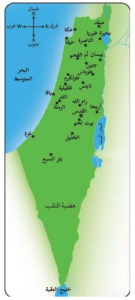
Apart from ignoring the existence of Israel as a sovereign state, having presented its entire territory as occupied – with the implied notion that it should be liberated, there is total non-recognition in the maps used in UNRWA school of the Jews who live in this country and who number today some seven million people. That non-recognition is expressed by the total absence from the map of cities established by Jews in modern times, chiefly Tel Aviv. The message is clear: Jews are foreign to Palestine and they have no legitimate place there. Following is one example out of many: The cities appearing on the map – Safed, Tiberias, Nazareth ,Acre, Beisan (today’s Beit She’an), Umm al-Fahm (declare officially as a city under Israeli rule), Jenin, Tubas, Tulkarm, Nablus, Qalqilyah, Jaffa, Lydda, Ramleh, Ramallah, Jericho, Jerusalem, Bethlehem, Hebron, Gaza, Beer Sheba. The missing cities: Tel Aviv, Holon, Bat Yam, Ramat Gan, Beney Berak, Petah Tikvah, Herzliya, Netanya, Hadera, Afula, Upper Nazareth (lately renamed Nof Hagalil), Kiryat Shmona, kiryat Gat, Beit Shemesh, Dimona, Ofakim, Shderot, Netivot, Karmiel, The Krayot near Haifa, and many others. 

Map No. 19 (National and Life Education, Grade 2, Part 2 (2019) p. 58)


And another example: The cities the names of which are indicated on the map – Acre, Safed, Haifa, Nazareth, Nablus, Ramallah, Jaffa, Asqakan (today’s Ashkelon), Jericho, Jerusalem, Bethlehem, Hebron, Beer Sheba, Gaza, Rafah.

Map No. 20 (Social Studies, Grade 5, Part 1 (2020) p. 55)

See also maps Nos. 6, 11, 18 and there are many more.


Two exceptions are cities established by Jews which appear on the map under the Arabic names of the desolate places where they were later built: Eilat (Umm al-Rashrash) – several times (see maps Nos. 11, 18 above) and Hadera (Al-Khudaira) – once (Mathematics, Grade 4, Part 1 (2020) p. 86).


Israeli maps, by contrast, usually show central cities such as Nablus, Hebron and Gaza in the areas of Judea, Samaria and the Gaza Strip (and see maps Nos. 1, 3, 7, 8 above). 

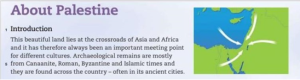
Hiding the Jewish presence in the country in schoolbooks used by UNRWA finds its expression in the historical context as well. Following is a text accompanying the map of this country and its surroundings in an English textbook. The text, titled “About Palestine”, refrains from mentioning the country’s Jewish past:

Map No. 21 (English for Palestine, Grade 10, Part 2 (2017) p. 4)


In conclusion, a simple comparison between the maps in UNRWA’s schoolbooks and their Israeli counterparts provides us with one conclusion: The Israeli maps reflect the existing reality, while the Palestinian maps used by UNRWA express the Palestinian vision. In that vision Israel does not exist, the whole country is under Palestinian sovereignty, the seven million Jews who live in Israel “disappear” – with their cities and their ancient history there, and the way of realizing this vision is by struggle. That struggle is explicitly mentioned in texts examined in former research studies and is hinted here as well (see map No. 16 above).

There is no way of justifying the use of these maps by a UN agency that is committed to the principles of respecting the sovereignty of each member state of the UN organization – including the State of Israel, total neutrality vis-à-vis the parties to the conflict, and the resolution of that conflict peacefully according to UN resolutions. The use of these maps by UNRWA betrays a gross disrespect of these three principles and the donor states should act vigorously in order to change this dismal situation.

Part X: The Peace Institutes

Despite the daily accounts of the destruction of European Jewry, the leading American Jewish organizations believed that at the end of the war, there would be a significant number of surviving Jews who would face a multitude of problems.  

In The Price of Liberty, A History of the American Jewish Committee, Nathan Schachner wrote that on February 9, 1940, the American Jewish Congress asked the American Jewish Committee to join with the Alliance Israélite Universelle, (an international Jewish organization founded in 1860 by the French statesman Adolphe Crémieux to safeguard the human rights of Jews around the world), and the Board of Deputies of British Jews in establishing a Peace Institute in Geneva under the auspices of the Congress. 

The Congress had hoped that although this institute would be established by the World Jewish Congress, every Jewish organization in the US and around the world would cooperate with it. In February and May 1940, the Congress Bulletin reported on the institute, which would become “the instrument of the entire Jewish people for the purpose of obtaining our Jewish peace aims as well as united Jewish front in the fight for Jewish rights, security and freedom of our people everywhere.” 

The proposal aroused much discussion in the American Jewish Committee, but they voted against the idea Schachner asserted. Members of the Committee believed it “inadvisable” to participate with the World Jewish Congress because it was “the symbol of the nationalist Jewish Weltanschauung [worldview] with a fundamental position that the Jews are a nation and constitute a separate political entities in the countries in which they live; a position which the Committee had consistently opposed.” They also felt that Geneva was not an appropriate location for the institute, since the city was surrounded by countries under Nazi rule, and that the proposed structure was too elaborate.  

The Committee’s refusal to participate in this effort did not suggest an insensitivity to the many critical issues the Jews would encounter at the end of hostilities.  At the American Jewish Committee’s annual meeting on January 12, 1941, the delegates heard a report from the Committee on Peace Studies describing the research projects in post-war challenges presented the Research Institute on Peace and Post-War Problems, which was under the direction of Dr. Max Gottschalk the 1941 American Jewish Yearbook reported. 

The “magnitude and diversity” of these problems was so “staggering” that the Committee recognized that it would have been “quixotic to pretend” that its own resources or that of any other single organization could adequately deal with all these issues. Yet it did not believe that all institutions devoted to this work should be consolidated into one organization. What is essential, the Committee believed, was that all those engaged in this work should pool their resources to avoid duplication, and that this information be made readily available to those who could put it to good use. 

Research Institutes 

In addition to these two institutes, which began their work in 1941, there were the Research Institute for Jewish Post-War Problems of the Jewish Labor Committee, and a Research Institute of the War Problems of Torah Jewry under the auspices of the American branch of Agudath Israel. 

In discussing the need for these preparations, Morris Raphael Cohen, Chairman of the American Jewish Committee’s special commission on peace studies, noted that in the US and the British Commonwealth, a large number of organizations had already given serious thought and study to the problems of ensuring an enduring peace. Among these diverse groups were the Federal Council of Churches, the Catholic Association for International Peace, The American Association of University Woman, The League Nations, the Foreign Policy Association, The Commission to Study the Organization of Peace, The Institute of International Education, and The National Policy Association at Washington D.C. 

If Jewish issues in the post-war were to be seriously considered, the Jewish community had to be prepared to present their demands at the peace conference. They could not presume that the democratic powers would understand the unique problems would pose to Jewish survivors. Even the most dedicated friends of the Jewish people were likely to “gloss over” their immediate needs and fail to safeguard their equal rights, a lesson the Jews had learned from their experiences in World War I. 

The institutes were also charged with countering the venomous antisemitic propaganda misleading many Jews and Gentiles in the US and provide a true picture of Jewish life under Nazi terror. If American Jews sought the cooperation of its fellow citizens, they needed to be kept informed. American Jews were the only group in position to provide this information. 

The American Jewish Year Book of 1941 published the American Jewish Committee’s Report of the Committee on Peace Studies that outlined the issues: relief and rehabilitation, migration and questions about their political, culture and cultural status.  

From the experiences of the American Jewish Distribution Committee (JDC) and other relief agencies after WWI, members of the Committee recognized that relief would be “of a magnitude and complexity far beyond anything we have ever thought of before.” They expected that more than 5,000,000,000 Jews in Europe and possibly even more in Northern Africa and the Near East who would be “in unprecedented heart-rending distress,” with American Jews being the only ones in position assist them.  

The Committee realized that existing agencies, employing current procedures, could not provide adequate help.  At that point, they had no idea of how the war would affect their own financial resources. Even if the Committee managed the “superhuman” effort of raising $100,000,000 a year, this would probably be insufficient to fund permanent relief for more than 5,000,000 people. 

This daunting task of how to maximize the Committee’s limited resources, in view of this “overwhelming catastrophe,” required extensive study. Though the Committee members understood that definite plans could not be formulated at that point, they wanted to be prepared with information about the political, economic and social conditions in the countries where relief would be needed. The JDC’s experience would be invaluable in administering aid, yet this assistance would be augmented by “the relief and rehabilitation agencies that the Jews have themselves developed.”  

“A Surplus Population in Europe” 

With regard to migration and colonization, the Committee admitted that “in principle, the Jews are a surplus population in Europe.” Nevertheless, Jews must insist that have been natives of Europe for centuries, that no-non-Jew can claim his family had been there longer, and that Jewish labor and intellect have contributed to the development of these countries, and Jews have sacrificed their lives in their defense.  Yet, no matter how entitled Jews are to return to their former homes, hundreds, if not millions of Jews, “will want, or be compelled, to leave Europe” at the end of the war.  Questions of where they would go in terms of economic, social, legal, social affairs and climactic considerations, and how will they transported to their new homes, were some of the issues they needed to be addressed. 

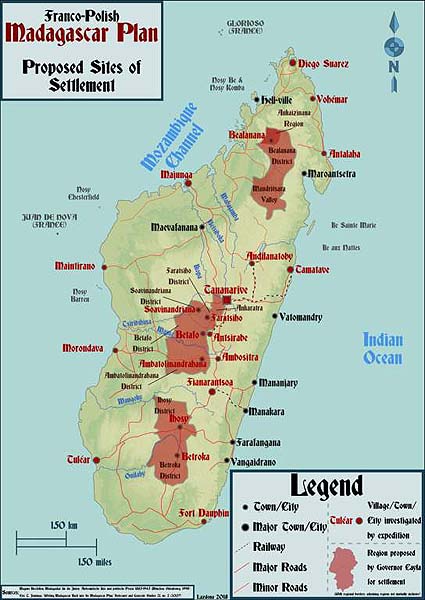
The possibility of a German-dominated Europe also had to be considered. This required a strategy to counter Nazi plans to expel Jews “to uncivilized territories, without regard to their inhabitability.” There were “reliable reports” that Hitler planned to transport Jews to Madagascar, where they would be promised autonomy. World Jewry would be expected to finance this plan or “it would be carried out in a more brutal way.”  

An underlying assumption in this activity was the conviction, at least on an organizational level, that millions of Jews would survive. The institutes had the effect of assuring the average American Jew that there was “a body of Jewish men and women to whom the coming victory is a reality.”  Raising the spirits of Jews who had given up hope was clearly an objective. 

Significantly, these institutes generated much discussion in the Jewish and non-Jewish press. There were articles in: the Congress Weekly in February, March and October 1941, January and February 1942; Der Tog on July 29, 1941; The Jewish Spectator, March 1941, Jewish Frontier March and October 1941; Forward, July 1941; The Jewish Exponent, May, 1941 and January 1942; The Call December 1941; The New Palestine January and February 1941; Foreign Affairs, January 1942; The New York Times July and December 1941; Christian Science Monitor, August, 1942; Harper’s Magazine, September 1941. 

Did the institutes represent an escape from dealing with the rescue of European Jewry?  When large numbers of Jews were dying or seeking refuge, and crying to be rescued, why did a number of American Jewish organizations focus on the future?  This is the question I posed to Salo Baron, professor of Jewish History and Institutions at Columbia University, who was known as “the greatest Jewish historian of the 20th century.”  

 Baron was among a number of distinguished academics who served on the Committee on Peace Studies of the American Jewish Committee. My question struck a raw nerve. In response to my inquiry, he sent a letter to Yehuda Bauer, a professor of Holocaust Studies at the Hebrew University in Jerusalem, and one of the world’s leading Holocaust scholars, complaining about the impertinence of my question. As a student of Bauer’s, he wanted him to know of my audacity in asking such a question. 

After chastising me, Baron explained that the institutes were created for pure research and constituted but one part of their organization’s total activities on behalf of European Jewry. The institutes developed in response to these real needs and should be viewed in this context. 

Many years later, Arthur Hertzberg, a student and an assistant to Baron, told me that Baron’s parents and sister were murdered by the Nazis in Tarnów, Poland. Twenty thousand Jews lived in Tarnow before the war, but after Hitler, there were no more 20. This explained his sensitivity and sense of guilt I had awakened. 

Israel Justified in Closing Palestinian NGOs Argues Renowned Human Rights Lawyer

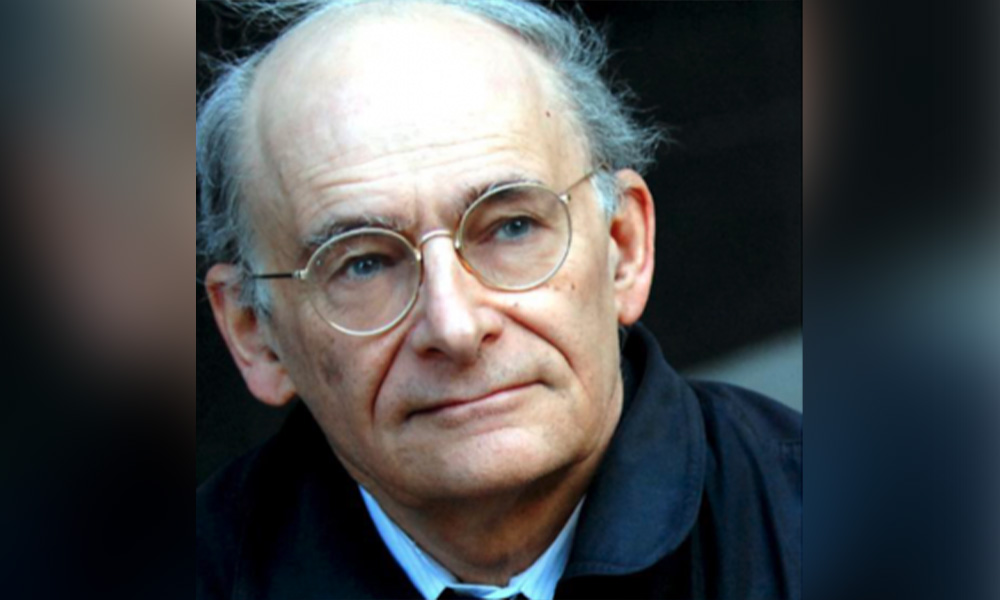
David Matas, B’nai Brith Canada’s Senior Legal Counsel and a world-renowned human-rights activist, recently penned an op-ed arguing that Israel’s closure of several Palestinian non-governmental organizations (NGOs) was justified.

In October 2022, Israel closed six organizations – al‑Haq, Addameer, Defense for Children International ‑ Palestine, the Union of Palestinian Women’s Committees, the Union of Agriculture Work Committees, and the Bisan Center for Research and Development, after having designated them as terrorist groups. Israeli Defence Minister Benny Gantz has stated that the organizations assisted in raising funds for the Popular Front for the Liberation of Palestine (PFLP) by forgery and fraud. The PFLP has been designated a terrorist organization by Canada and Israel, among other countries, for its deadly assaults against innocents.

Matas notes that “it is common for terrorist organizations to escape the rigors of the terrorist designation, to work through associated entities” and that Canada has had to deal with such scenarios previously.

As an example, Matas notes that in 2014, the International Relief Fund for the Afflicted and Needy‑Canada (IRFAN‑Canada) was designated a terrorist entity under the Canadian Criminal Code, on the basis that it had transferred “million worth of resources to various organizations associated with Hamas.” Hamas had previously been designated a terrorist entity by the Canadian government.

Although Israel offers a legal process for groups to be removed from the terrorist listing, to date, none of the six organizations have applied to do so.

“By challenging the listings and closings publicly but not legally, Al Haq and the others leave the impression that they have no hope of persuading legal experts in closed proceedings, with access to all relevant information, that the designations were made in error,” says Matas.

Matas goes on to argue that their failure to legally challenge the terrorist designation indicates that there are solid grounds for Canada also to list the six organizations as terrorist entities.

House Foreign Affairs Committee marks up bill to monitor UNRWA’s educational material

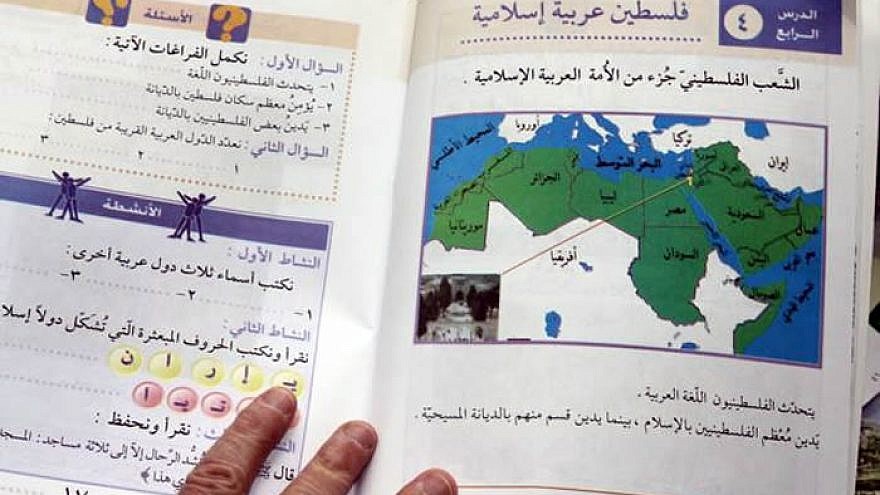
Palestinian Authority textbooks. Credit: Matzav.com.

A bill to hold accountable the U.N. Relief Works Agency (UNRWA) for educational material it provides in Palestinian schools was marked up by the House Foreign Affairs Committee on Thursday.

The U.N. Relief and Works Agency for Palestine Refugees (UNRWA), an agency set up to handle the needs of Palestinians, is partly funded by American foreign aid.

The bill was drawn up by Jewish Rep. Brad Sherman (D-Calif.) but is widely supported by both parties. It is supported by the Institute for Monitoring Peace and Cultural Tolerance in School Education (IMPACT-se) and draws on the organization’s research. The organization also visited Washington D.C. this week to present its research to committee members and officials in the U.S. State Department. The research showed examples of Israel being erased from maps and encouragement of jihad, things that pro-Israel organizations have complained about for decades.

The bill notes that the Palestinian Authority and UNRWA have not removed content from their school curricula that promote violence, anti-Semitism, hatred and intolerance towards other nations or ethnic groups. It calls on the State Department to present an annual report to the committee that assesses the levels of hate and incitement found in the educational content and to inform Congress whether American taxpayer dollars are contributing to its proliferation.

The bill had also been introduced during the last Congress. While it passed a committee vote, it never received a vote on the House floor. This time, the bill has a companion bill in the Senate introduced by Sen. John Kennedy (R-La.).

Sherman said in a news release the markup of the bill is timely because that despite the commitment UNRWA made to address issues with its curriculum in the 2021 Framework for Cooperation, “problems with anti-Semitism and incitement continue to be well-documented.”

“American dollars must be spent in a way that reflect American values of tolerance and peace-building,” he added.

“We must make sure [Palestinian students] are not being taught this type of curriculum, and above that certainly make sure U.S. taxpayers are not paying to make this the curriculum,” Rep. Brian Mast (R-Fla.), a co-sponsor of the bill, said during the committee hearing.

The committee’s chairman Rep. Gregory Meeks (D-N.Y.) said during the meeting that the bill was finalized with help from the State Department, which expressed no opposition to its adoption.

Rep. August Pfluger (R-Texas) added an amendment to the bill, which stated that “anti-Semitism, xenophobia and claims that Israel is an apartheid state should have absolutely no place in any curriculum used by the Palestinian Authority.”

“It is alarming to think that our constituents could potentially be helping promote this type of hateful propaganda through our taxpayers’ dollars,” he said. “My amendment intends to make it crystal clear that our nation will not fund hateful propaganda.”

Changing of the guard

In the words of A.A. Milne, “they are changing the guards at Buckingham Palace.”

With the death of Queen Elizabeth, the expression “passing of an era” was never more apt. For most citizens of the Commonwealth, the Elizabethan era has been the only one that they have ever experienced. For those of us whose years span a rather longer epoch, the term “God save the King” is not such an unfamiliar affirmation.

I grew up under the reign of King George VI when all bank notes, coins and stamps carried the image of the then Monarch and when everyone stood in cinemas as the national anthem played and the King appeared on the silver screen.

In those days at our local primary school, we paraded every morning and stood to attention as the New Zealand flag was hoisted, and we all sang the national anthem. Interestingly enough it was God save the King rather than God Defend New Zealand, which illustrates, I guess, that in the 1940s at least, the priority was saving the King rather than imploring the Deity to defend the country.

In 1953 to commemorate the coronation of the new Queen, representatives of all Wellington area primary and secondary schools were selected to march to and parade in the grounds of Parliament. There, together with members of the armed forces and Members of Parliament, we were to listen to speeches and the broadcast from the BBC of the Coronation itself. I was chosen at the age of eleven to represent our school together with some other pupils and I remember the excitement as we marched through the streets of the Capital waving our flags and caught up in the drama of the occasion.

The most dramatic and totally unexpected event which occurred was the interruption of the broadcast ceremony and the appearance of the Prime Minister on the balcony of the Parliament building. Sidney Holland, the then PM, breathlessly announced that Edmund Hillary of New Zealand and Sherpa Tensing Norgay of Nepal had reached the summit of Mount Everest and were thus the first people in the world to conquer that formidable mountain. All of us joined in the frenetic cheering that followed this news, and it is safe to say that the rest of the coronation broadcast rather paled into insignificance as a result.

We all received a special commemorative coronation coin which, with its royal blue ribbon, looked rather impressive.

Following the accession of the Queen, all Jewish Synagogues under the authority of the UK Chief Rabbi had to hastily amend the prayer for the Royal Family, and therefore all our Singer’s prayer books had sticky labels inserted which reflected the new reality. No doubt, the same thing will happen now, although from my personal observations, it seems that quite a few congregations now omit this particular prayer. In fact, when I was last in Melbourne some years ago, the Chabad Shul I attended did not even recite the prayer for the welfare of Israel and those who defend it.

My closest encounter of the royal kind took place many years later, in 1986, when we were invited as representatives of the Auckland Hebrew Congregation to attend a garden party during the visit of the Queen at that time.

Commentators have all noted the late Queen’s remarkable reign and her record-breaking seven decades of unflinching service to the UK and the Commonwealth.

Jewish spokespersons, religious and lay, likewise have highlighted her personal affinity and interest in fostering good relations with all sectors of society.

There are several aspects which I believe deserve some comment.

The first relates to the fact that during the Queen’s seventy years on the throne, she managed to visit 117 countries, some of them including Australia and New Zealand, several times. When you analyse these royal tours, you find that they cover the whole spectrum from full-blown democracies to regimes with dubious human rights records, from Republics to autocratic monarchies as well as “occupied territories.” It is certainly a prodigious list, and that makes the one glaring omission so obvious.

During all these decades, the one country which has never had the opportunity of being graced with a royal visit is, of course, Israel. When you come to think of it this is rather peculiar for several reasons.

Jewish sovereignty over the territory from the Mediterranean to beyond the river Jordan was, after all, promoted and fostered by the Balfour Declaration and the UK Government of the day and then endorsed by the San Remo Agreement and the League of Nations. Of course, it didn’t take long for the “antis” in the Foreign Office to carve up the eastern side of the Jordan and create an artificial country for their Hashemite friends. That still left everything west of the Jordan, which includes Judea and Samaria, for Jewish settlement and sovereignty, but even this mandated task was subverted by the United Kingdom.

During the years of Jordanian illegal occupation of Jerusalem and what is erroneously termed the “West Bank” not a peep of protest was heard from Whitehall. Following 1967 the British Foreign Office woke up and suddenly invented “illegally occupied Palestinian territories” with which to lambast Israel. Obviously, the Hashemite trashing of the Jewish cemetery on the Mount of Olives and ethnic cleansing of Jews from the Old City of Jerusalem raised nary a ripple of protest because the Queen honoured them with a royal visit in 1984. Abdullah, the Jordanian monarch, has described Her Majesty as a “partner and dear family friend.”

By now, you should have discerned that the malign policies of the British Foreign Office have been responsible for the Queen never visiting Israel because it is at their behest and approval that royal tours take place. The Duke of Edinburgh paid a private visit to the grave of his mother, who is buried on the Mount of Olives and is honoured by Yad Vashem for saving a Jewish family during the Shoah. Prince Charles (now King) visited Israel for the funeral of Shimon Peres and then again in 2020 for the World Holocaust Forum. In 2018 Prince William paid an official visit. It will be interesting to see whether this undeclared “boycott” of Israel being visited by the reigning British Monarch will continue or whether King Charles will put an end to this shameful charade.

Much is being made of the fact that two previous Chief Rabbis were elevated to the House of Lords by Her Majesty. In actual fact, the Queen or King bestows these honours at the request of the Government of the day and is therefore hardly likely to refuse to do so. Margaret Thatcher was an ardent admirer of the late Rabbi Jakobovits, and it was she who promoted him. Likewise, Tony Blair elevated the late Rabbi Sacks to the House of Lords.

Prince Charles (now King) revered the late Chief Rabbi and gave a most moving eulogy when he passed away. His warm public empathy with the Jewish community so openly displayed on many occasions heralds perhaps an even closer relationship in the future.

Among the outpouring of sympathy and pledges of loyalty from the British Jewish establishment, I noted a somewhat revealing sentiment. A senior UK Reform Rabbi of the Maidenhead Synagogue stated that “we do not feel that we are in exile in Britain.” That may very well be the overwhelming belief of most Jews not only in the UK but also in other parts of the Diaspora. No matter how happy and secure they may feel, one hopes that they do not fall into the same complacency as their co-religionists did in Europe pre-war. Today’s rise of Judeophobia in most countries should be a sobering wake-up call for all those who think Galut is a permanent safe haven.

China donates $1m to UNRWA for Palestinian education

The UN Relief and Works Agency for Palestine Refugees in the Near East (UNRWA) has announced that the People’s Republic of China has donated $1 million to provide quality, equitable and inclusive basic education for Palestinian children. UNRWA will use the donation towards the agency’s education programme for the benefit of 9,200 students in 19 schools across the Israeli-occupied West Bank.

“On behalf of UNRWA, I would like to express our deep appreciation to the Government of China for its continued support and dedication towards preserving the rights for Palestine refugees,” said Karim Amer, the Director of Partnerships at the agency. “We greatly value our robust partnership with China, which continues to grow and expand.”

In response, the Head of the Office of the People’s Republic of China to the State of Palestine, Ambassador Guo Wei, said: “China commends and supports UNRWA efforts, and has actively provided assistance through UNRWA to the Palestine refugees within its capacity. For several years in a row, China has made donations in support of UNRWA to provide emergency food aid to refugees in the Gaza Strip and has donated pandemic response supplies and Covid-19 vaccines to Palestine refugees.”

He added that the $1 million donation to UNRWA has been given in order to help improve the livelihood of the Palestine refugees. “We are ready to work with the international community to promote the restoration of the legitimate rights of the Palestinian people, and push for a comprehensive, just and durable solution to the Palestine question, so as to attain peace, stability and development in the Middle East.”

The Chinese donation comes after the Commissioner General of UNRWA, Philippe Lazzarini, told the UN Security Council earlier this month that the agency was facing a funding crisis and called for political and financial support.

“UNRWA is facing an existential threat,” warned Lazzarini. “What is at stake? Quality and principled education for over half a million girls and boys; access to health care for around two million Palestine refugees and a social safety net for around 400,000 of the poorest amongst the poor.” All are in danger, he said.


Behind the scene with David Bedein – September 15, 2022

Behind the scene with David Bedein – September 15, 2022

Fatah movement takes responsibility for terror attacks

The al-Aqsa Martyrs’ Brigades, the military arm of Palestinian Authority Chairman Mahmoud Abbas’ Fatah movement, has returned to terror activity.

An announcement from “the joint room for the nightly disruptions unit in Ramallah and Al-Bireh,” said that during the “summer rains” activity – the code name for the plan for terror attacks against Israel – “our mujihadeen in the nightly disruption unit in the area of northwest Ramallah have succeeded in hurling an explosive device at the Ata’ra military tower (pillbox) today at 12:20 in the morning.”

“The nightly disruptions unit praises the heroic action which fighters carried out, in which they burned the agricultural fields near the colonial town of Beit El, and this was today at eight o’clock in the evening.”

The announcement concluded, “This is a revolution until victory. This is jihad, with Allah’s help, this will be a victory or a fall of a martyr on his way to Allah.”

Ismat Mansour, an expert in the Israeli field, estimates that the nightly disruptions will lead to an escalation of the conflicts in all of Judea and Samaria, which according to him is the most dangerous arena from Israel’s perspective.

Mansour noted that these actions are not organized and do not require complex planning, since explosive devices can be made independently. He expects the events in Judea and Samaria to escalate as the Jewish holiday season approaches.

Adna’an al-Sabah, a political analyst, believes that the conflicts will soon reach pre-1967 Israel, and noted that the Islamic Jihad’s al-Quds Brigades coordinate their actions with Fatah’s al-Aqsa Martyrs’ Brigades.

Recently, the al-Aqsa Martyrs’ Brigades published an announcement in which it took responsibility for carrying out a shooting attack in the Jordan Valley, in which a number of soldiers were injured.

The announcement was called a “military announcement,” and titled, “The beginning of the activities (terror attacks) of the summer rains.” It described the shooting attack as an “heroic action” and a “response to the repeated crimes of the occupation against our fighting nation.”

The al-Aqsa Martyrs’ Brigades promised to continue “to be loyal to the blood of the shahids (martyrs – ed.) and the heroic prisoners, and to remain committed to the path of Yasser Arafat and all the shahids until the Palestine is freed from the ‘impurity of the conquerors.'”

In 2002, Israel declared the al-Aqsa Martyrs’ Brigades, Fatah’s military wing, to be a terror organization.

Congressman Brad Sherman Statement on the House Foreign Affairs Committee Marking up the Peace and Tolerance in Palestinian Education Act

I look forward to the House Foreign Affairs Committee marking up my bill, the Peace and Tolerance in Palestinian Education Act, which passed through the Committee unanimously in the previous Congress and now has a companion bill in the Senate led by Senator John Kennedy. The bill will create new State Department reporting to address the ongoing issue of incitement and antisemitic content in textbooks used by the Palestinian Authority and the United Nations Relief and Works Agency for Palestine Refugees (UNRWA) – which is especially timely given that, despite UNRWA’s renewed commitments to address this issue in the 2021 Framework for Cooperation, problems with antisemitism and incitement continue to be well documented.

For decades, the United States and the American people have been the top donor to the Palestinian people, including to the Palestinian Authority and UNRWA – but this is not a blank check. American dollars must be spent in a way that reflect American values of tolerance and peacebuilding. Unfortunately, the current Palestinian Authority curriculum, used by both Palestinian Authority and UNRWA schools, falls short of reflecting those values.

Instead of envisioning a Palestinian state alongside Israel, textbooks erase Israel from maps, refer to Israel only as “the enemy,” and ask children to sacrifice their lives to “liberate” all of the land between the Jordan River and Mediterranean Sea. One horrific example includes a 5th grade textbook which encourages students to emulate Dalal Mughrabi, a convicted terrorist who perpetrated the 1978 Coastal Road massacre which killed 38 Israeli civilians – including 13 children.

This violent curriculum has violent consequences. This past May, a report found that a 17 year old Palestinian who attempted to stab Israelis was taught incendiary and violent anti-Israel content at school.

The Palestinian Authority and UNRWA must work with the United States to implement a curriculum that promotes peace instead of undermining it. Ending incitement and violence in the curriculum taught to Palestinian schoolchildren isn’t only a matter of Israel’s security – it’s an obligation that the Palestinian Authority and UNRWA owes their beneficiaries, children who deserve quality education that nurtures their future instead of manipulating them to cut that future short by engaging in senseless violence.

I am proud to have introduced this bipartisan legislation that will give Congress the information and tools it needs to finally fully reform Palestinian Authority and UNRWA curriculum – and work towards a more peaceful future for the next generation of Palestinians and Israelis alike.