Daniel Sokatch, CEO of the New Israel Fund and founding Executive Director of Bend the Arc (formally, the Progressive Jewish Alliance) has written a book entitled Can We Talk About Israel? A Guide for the Curious, Confused and Conflicted (Bloomsbury Publishing, 2021). This is a preliminary report covering Sokatch’s presentation of the historical backdrop to the Six Day War in 1967 which is “Part One” of the book covering pages 1-210.
Sokatch is forthright about his “perspective”, stating that he is “a product of the liberal American Jewish community”. Asserting that he possesses intimate familiarity with various aspects of the pro-Israel narrative held by Americans, he suggests that readers listen to the story as he sees it and draw their own conclusions. The reader is warned that “you are probably not going to agree with, or perhaps even believe, everything you read here” (p. 6) and “while I won’t engage in propaganda, I do (italics in original) have an agenda” (p. 5). Sokatch’s stated purpose in writing the book is “to explain why Israel and the Israeli-Palestinian dispute seem to drive so many otherwise reasonable people completely bonkers” (p. 3-4). The book reflects the author’s view that the struggle, in line with Benny Morris’ famous paradigm, is between two groups of “righteous victims” (p. 5).
This reviewer has sought to relate solely to those items that, in his view, were misrepresented in the book (1) factually, (2) by omission of relevant historical factors, or (3) by suggesting an anachronistic spin. In such cases, an alternative understanding of the issue has been suggested. Essentially, the reviewer has attempted to identify how Sokatch’s perspective is shaped by his errors and how his errors could shape his readers’ understanding. As Sokatch himself notes: “people have strong feelings…but that doesn’t mean those feelings are actually based on…well, facts – on an actual understanding of the situation…” (p. 3). I thus ask: Does Sokatch frame his historical overview and presentation of Israel in order to persuade his readers to adopt a particular political position?
The review is organized as follows. Following this brief introduction, I proceed on a page-by-page basis, discussing items that stand out in the book as in need of examination. In the final section, I offer conclusions. Specifically, I try to answer the question of whether Sokatch indeed provides a guide for the “Curious, Confused and Conflicted” – or rather, whether his book adds to the confusion and exacerbates the conflict by providing an anti-factual presentation of Judaism, Zionism, Israel and Jewish history.
Let us now begin the review.
- 9: “King Hussein…flew his royal Jordanian jet around Jerusalem in a salute to the city he once ruled”.
The author does not mention that Hussein’s “rule” was the result of the 1948 invasion of Mandate Palestine by his grandfather, Abdullah, itself a violation of United Nations appeals to refrain from aggressive actions; an illegal occupation followed, in April 1950, by a further illegal act of annexation. (Relatedly, on p. 372, the Index entry for “Jerusalem, East” contains this term: “Israeli annexation”. The term “Jordanian annexation” does not appear there, nor does it appear in the entry for “Jordan”.) What we learn here is that what is missing in Sokatch’s telling can be at least as important as what he includes.
- 12: “The idea of Israel in the Jewish imagination”
While the term “imagination” in academia is often taken to mean “a power of the mind,” “a creative faculty of the mind,” or a “process” of the mind to indicate thinking or remembering, its appearance in this context might mislead the reader into thinking that “the idea of Israel” is a contrived notion.
- 13: “(“Nablus,” in Arabic)”
Indeed, Shechem is now known in Arabic as “Nablus”. Yet “Nablus” originated as a corruption (Arabic lacks a “p”) of the Latin “Neapolis”, or Flavia Neapolis, as named by the Roman emperor Vespasian in 72 CE following Jerusalem’s destruction, a precursor to the naming of Judaea as “Palaestina” by Hadrian at the time of the Bar Kochba Revolt in 132 CE, or just prior. Given the importance of the idea of an Arab Palestine, this background should have been provided.
- 13: “the Palestinian territories in the West Bank”
Following the comment above, regarding p. 9, this is the place for the term “West Bank” to have been contextualized as created only in 1950 as part of Jordan’s illegal annexation of the area. Indeed, the Lexicon chapter, pp. 321-324, discusses at length the “West Bank” but avoids any mention of its status during 1948-1967.
- 13: “The Hebrew Bible is…the origin story…for some people”
The qualification “some” in this sentence seems odd, as the majority of Jews, Christians, and Moslems – in other words, a significant portion the world’s population – accepts the reliability of the Hebrew Bible as a source text. Ancient steles, other writings and archaeological finds confirm, to a very large degree, the outlines of the Biblical narrative, at the least regarding Jewish settlement and residency in the Land of Israel and the Jewish people’s history in that land.
- 13: “The conquest by Israel of the West Bank in 1967”
While perhaps technically correct, “conquest” is a loaded term, especially as Jordan’s 1948 conquest of that area is completely absent from his book. This is one example of Sokatch’s semantic biasing of the reader.
- 14: “sets the stage for yet another musical”
Recourse to humor would seem inappropriate in this context except, perhaps, as an expression of the author’s mocking of Jewish heritage values.
- 14: “Jewish kingdoms rose and fell in what is now Israel and the West Bank”
While technically true, the omission of the proper geo-historical place names of “Judea and Samaria” appears deliberate and purposeful.
- 14: In footnote at the bottom of the page, relating to his use of the phrase “Jewish story”, rather than, say, the Jewish record, Sokatch writes: “this is the Jewish version of the same kind of faith-based views on land ownership that motivated the Muslim conquests of the Middle East and the Indian subcontinent; crusades…Manifest Destiny…and Soviet hegemony over Eastern Europe”. Here, the author both creates a false equivalence and imposes a highly debatable ideological framework.
- 15: “a group of Jewish rebels (and, by all accounts, religious fanatics)”
If all religious groups were described in the book as “fanatics”, this might be considered a side point. Since this is not the case, it once again indicates Sokatch’s derogatory approach to things Jewish. In the footnote at the bottom of the page, Sokatch describes the Hasmoneans as “religious extremists”.
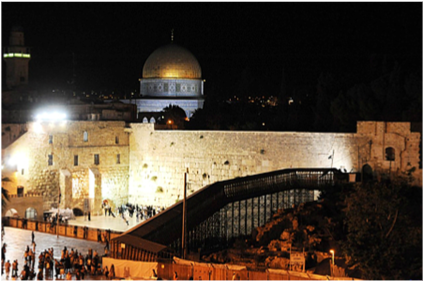
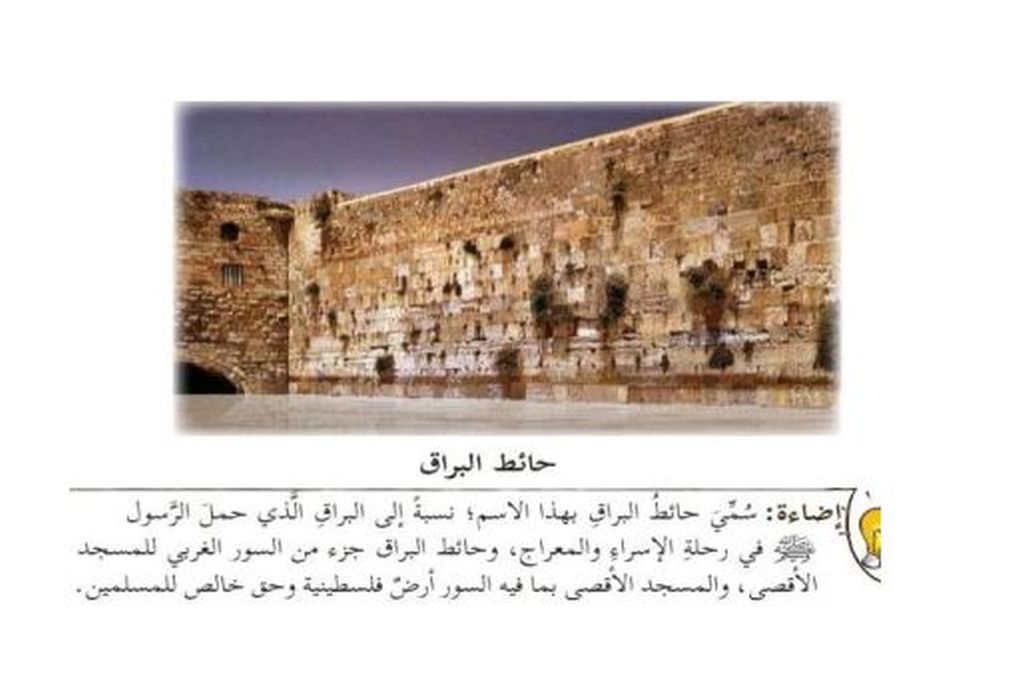
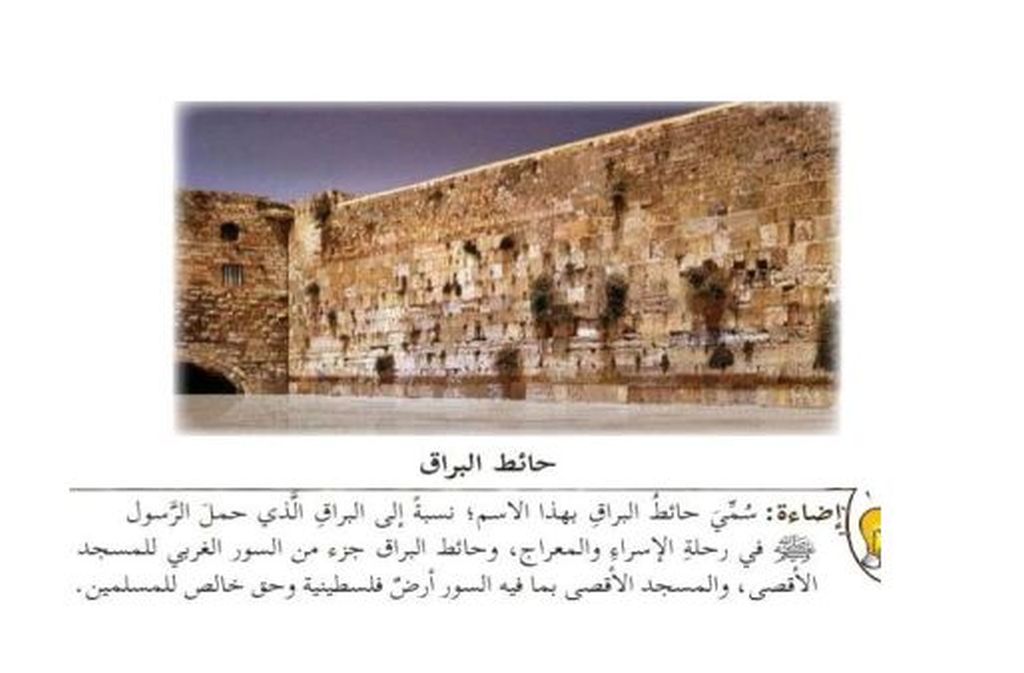
- 16: “the Western Wall is considered the holiest site in Judaism”
This statement is factually inaccurate. The Temple Mount, not the Western Wall, is the most sacred site in Judaism.
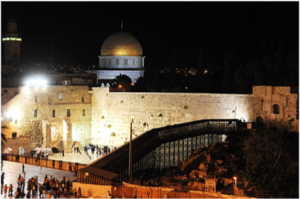
The Western Wall and the Mughrabi Gate leading to the Temple Mount.
(Photo: MILNER MOSHE, GPO)
- 17: “While there were always small communities of Jews living in the Land of Israel between 70 C.E. and the late nineteenth century…”
The first date should properly be 135 C.E. In the early 2nd century, hundreds of thousands of Jews resided in the country. At this point, Sokatch provides a three-page précis of 1800 years of the Jewish Diaspora experience. Yet he is silent on crucial topics such as the history of Jewish emigration to the Land of Israel, including, for example, the rise of Safed and Jewish mysticism, the continuous Jewish life in Jerusalem and Hebron, the emigrations of Hasidim in 1777 or the pupils of Rabbi Eliyahu of Vilna in 1810, the various settlement schemes and more (see, e.g., Arie Morgenstern’s “Dispersion and the Longing for Zion, 1240-1840”, AZURE, Winter 5762 / 2002, no. 12). On p. 22, Sokatch returns to the 1850s and writes, “As I mentioned, even after the Roman exile, some Jews remained in the Land of Israel”. This makes for a rather inadequate presentation, especially in light of the Arab claim that Jews are a foreign entity in the region or that they are non-indigenous to it.
- 19: “the Church adopted a position of hostility toward Jews…this resulted in…stereotyping…persecution and violence.”
No indication is provided in this comment that that the “violence” – at the times of the Crusades, the Black Death, or the Inquisition – resulted in mass murder, expulsions, accusations of ritual murder and more. Another downplaying of Jewish suffering.
- 22: “the General Jewish Labor Bund…rejected emigration.”
As this statement appears after Sokatch mentions the mass emigration of East European Jewry to America, one would think the Bund was anti-emigration to another Diaspora land. Yet, the Bund was anti-Zionist.
- 23: “This philanthropy resulted in the founding, starting in the 1850s…”
Further to the above-mentioned waves of Jewish immigration in the 16th, 17th and 18th centuries, Sokatch ignores the so-called “Forerunners of Zionism”, the rabbis Yehuda Alkalai, Elijahu Guttmacher, Yehuda Bibas and Zvi Hersh Kalischer, the prominent American author Mordecai Manuel Noah and the European socialist Moshe Hess, all active in a proto-political sense prior to 1860. Nor does he mention American presidents who supported a return to Zion such as John Adams, who wrote in 1818 that Jews should be “restored to an independent government” and ‘’I really wish the Jews once again in Judea, an independent Nation…I wish your nation may be admitted to all the privileges of nations in every part of the world.’’ All this, it should be noted, was less of a response to nti-Semitic pogroms (such as occurred in Russia in the 1880s, and the Dreyfus Case of 1894) that Sokatch does detail as a springboard to political Zionism.
- 25: “Herzl was somewhat less wedded than other early Zionists to the notion that the Jewish State be established in Palestine…[emphasis in original]”
Herzl’s consideration of East Africa was not a free choice but one of temporarily saving the Jews in areas being ravaged by pogroms. In the Zionist Congress that voted down his proposal of a Nachtasyl (“night shelter”), he swore allegiance to Jerusalem, quoting Psalms 137:5, “Let my right hand forget its cunning if I forget Jerusalem”. Sokatch implies that perhaps even Herzl would have sought another area for the Jewish State than the Land of Israel, but this implication is not accompanied by an explanation of the historical framework.
- 26: “I’m often asked if I’m a Zionist…Israel is a reality, so asking about someone’s stand on the nineteenth-century movement…doesn’t seem particularly relevant”.
Sokatch would have us believe, as he writes on p. 26, that the sole aim of Zionism was self-determination, and in May 1948, that goal was realized. In his answer to aforementioned question, he both avoids characterizing himself as either a Zionist or not a Zionist, and constrains Zionist goals to the borders of May 1948, which, of course, were the 1947 proposed partition lines. On p. 30, he returns to this “silly” question but again skirts the issue, writing that he simply supports “the liberal vision of Israel enshrined in its Declaration of Independence”.
- 27: “right-wing (‘Revisionist’) Zionists preached a militant gospel of territorial expansion…their early symbols included a map that showed a ‘Greater Land of Israel’…based on the borders of a biblical Kingdom of Israel”.
The map to which Sokatch here refers, commonly known as the “Two Banks has the Jordan” map, actually outlines the original Mandate of Palestine area of what became only Israel and TransJordan (Lebanon was not included in that map as he suggests). The 1919 map that Chaim Weizmann tabled for deliberation of the Versailles Peace Conference did include parts of Lebanon, Syria and, in TransJordan, up to the Hejaz Railway line some 50 kilometers east of the Jordan River (the area of the Biblical tribal portions of Reuven, Gad and half of Menasheh).
It was in July 1922, as per Article 25 of the League of Nations Mandate, that all “the territories lying between the Jordan and the eastern boundary of Palestine as ultimately determined” were effectively separated from the Jewish National Home. The 1923 Carlsbad Zionist Congress, representing all the Zionist parties, adopted the following resolution: that Transjordan and Cisjordan are “one historical, geographic and economic unit” and “in accordance with the legitimate demands of the Jewish people”, the Congress expects that an expression of such will be achieved in Transjordan and eventually will be carried out. Thus, we see that, in contrast to Sokatch’s implication, the “Two Banks has the Jordan” map was not devised for purposes of expansion but against the territorial whittling down of the Jewish National Home.
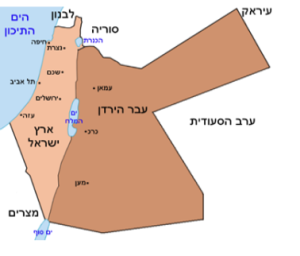
The area of the British Mandate for Palestine / Israel
https://creativecommons.org/licenses/by-sa/3.0/
- 28: “[Jabotinsky] argued in his essay ‘The Iron Wall’ that…the native Arabs [would need be beaten] into submission”
Factually inaccurate. Jabotinsky’s 1923 Iron Wall concept was one of defense against an Arab wave of violence that had murdered, maimed, and raped Jews in Jerusalem in April 1920, Jaffa and Petach Tikva in May 1921 and again Jerusalem in November 1921. He wrote that Zionism “can proceed and develop only under the protection of a power that is independent of the native population – behind an iron wall, which the native population cannot breach… the iron wall, which is to say a strong power in Palestine that is not amenable to any Arab pressure.” Here Sokatch has twisted Jabotinsky’s meaning and intent.
- 28: “today, most right-wing Zionists would never describe Zionism as a colonialist movement”
This statement is correct but not to the extent as Sokatch notes, that it ‘doesn’t serve political talking points’. There is a vast difference between the connotations of the term today and what the term symbolized in the minds of pre-State Zionist leaders and pioneers. For them “colonizing” meant “settling the land” and bringing in Jewish immigrants according to the age-old Jewish legacy. During the period of the early Zionist settlement initiatives from 1878 on, kibbutzim and moshavot were referred to as “colonies”. Today, by contrast, colonialism a term referring to the practice of European or ‘North’ countries to control a native people by a foreign people by establishing colonies with the aim of economic exploitation and dominance. During the period of modern Zionism, namely, post-1878, Jews were returning home and sought to build social and economic cooperation with the local Arabs, themselves a people who had invaded the country and economically disenfranchised the Jews living there.
- 29: “from…1948 to 1977, the proponents of right-wing Zionism were in perpetual opposition…”
Here, one might mention that Gahal, the Herut-Liberal Bloc led by Menachem Begin, was a full member of the 1967-1970 National Unity Government coalition with ministerial responsibilities.
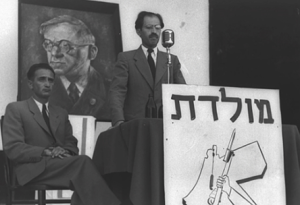
Menachem Begin speaks at an election rally in Tel Aviv. Sitting next to him, Haim Landau.
(Photo: HANS PIN, GPO)
- 29: “in order to gain a majority in the…Knesset, Zionist political parties found it necessary to work with ultra-Orthodox religious parties”
While this statement is accurate, it is worth noting that such cooperation is quite normal, especially in a parliamentary system that relies on coalitions, even with groups outside the elected bodies of governing, and that such cooperation existed during pre-state days with the World Zionist Organization in various periods and circumstances. For example, in 1933, an agreement was made with the Jewish Agency whereby Agudat Yisrael would receive 6.5% of the immigration permits allotted by the British.
On June 19, 1947, David Ben-Gurion sent his “status quo” letter to the leaders of the Agudat Yisrael party to soften their opposition to the establishment of the Jewish state and achieve a united policy to be presented to the United Nations Special Committee on Palestine (UNSCOP). The 1943 Teheran Children’s Agreement was also made with Agudat Yisrael.
- 30: “Jews were heading back to Palestine. Beginning in the 1880s…”
Once again, Sokatch misses an opportunity to highlight centuries of continuous Jewish immigration to the Land of Israel from all over the world – and not only persecution-driven, modern-day nti-S.
- 31-32: “a large native Arab population who quite understandably became more and more hostile…”
First, the indigenous nature of the Arab population is a matter of debate. Second, why “understandably”? Why even intimate that the Arab hostility was justified without providing a more sophisticated presentation of the context?
- 33-34: “Is Zionism Justifiable?”
In responding to a young camper’s question that includes the metaphor of a stranger coming into someone’s house, Sokatch is negligent in overlooking points have been highlighted previously: that Jews, albeit without sovereignty, were present in the Land throughout the years of exile; that Arabs themselves were strangers who arrived as conquerors and occupiers and had come to someone else’s “house”; that the Arabs, based on the Quran, were aware that this land is the Jewish homeland; and that the Jews attempted, to the greatest extent possible, to come in peace, to purchase back their homeland and to accommodate the local non-Jewish residents.
- 35-36: “one school of thought has today’s Palestinians descending from the Biblical Canaanites and Philistines (which is where the name ‘Palestine’ comes from.”
Importantly, no such “school of thought” exists. Instead, this is a pure propaganda claim. The name ‘Palestine’ comes from, as noted above, the Romans. The Philistines of the Bible were the Sea People from the Aegean area – although Sokatch does not even bother to present that “school of thought” to balance his argument. One might be relieved to note that he did not mention Saeb Erekat’s claim to be descended from the Natufians. Or that of Yasser Arafat and Faisal Husseini, who stated that Palestinian Arabs are descended from the Jebusites, following the Al-Mawsu’at Al-Filastinniya (Palestinian encyclopedia) asserting that Palestinians are “the descendants of the Jebusites, who are of Arab origin.”
We are dealing here with historical fact – but more than that as well. As the above clearly demonstrates, Arabs construct “facts” out of whole cloth. Moreover, the author’s presentation sets a pattern of ‘they claim/they claim’ – as if truth were a matter of choice.
- 40: “World War I temporarily interrupted the waves of Jewish immigration to Palestine.”
At this time, more than 40,000 Jews were forcibly deported from their homes and also expelled from Tel Aviv and surrounding communities to the Galilee and to Egypt by the Ottoman regime.
- 41: “The nations of the world had given the United Kingdom another colony to run.”
Again, Sokatch reinforces the false status of the Jewish National Home within the special status it had been defined as a Class “A” Mandate, different from the others in that a nation is provisionally recognized as independent, but receives the advice and assistance, as well as employing the false term “colony.”
- 42: “The Palestinian Arab community’s increasingly furious opposition.”
Furious is an understatement. In April 1920, Arabs in Jerusalem rioted, after a series of unruly demonstrations demanding Palestine, which they referred to a “Southern Syria”, be rejoined to Greater Syria. In those riots, Jews were raped and killed. On p. 43, Sokatch only notes the May 1921 riots and does not mention the killings of Jews at Tel Hai in two separate attacks at the end of 1919 and in February 1920.
- 43-44: “the McMahon-Hussein Correspondence…didn’t actually apply to Palestine.”
Indeed, it did not. Moreover, when Faisal and Weizmann worked out a Zionist-Arab agreement in January 1919, the wording therein was clear: there was to be an “Arab State”, for the Arabs, meaning today’s Saudi Arabia, Yemen, the Emirates, Lebanon, Syria, Jordan and Iraq and a Jewish “Palestine.”
- 46 “the Irgun…clashed with the Hagana.”
This is inaccurate. In fact, the Hagana clashed with the Irgun, including kidnappings, beatings and handing over Irgunists to the British, in the so-called ‘Saison’ operation which is alluded to on p. 47.
- 46: “The Irgun…engaged in tactics that today we would describe as terrorism.”
While this assertion is probably accurate, Sokatch could have indicated that perhaps they need not have – or better, have compared the actions of the Irgun to those of other underground militias held in esteem by today’s progressive liberal left. Additionally, he could have noted that some of the Hagana’s actions would be termed terrorism today.
- 48: “Palestinian Arabs…in 1936…launched a massive general strike.”
Sokatch here omits the violence in which the Arabs engaged, murdering many dozens of Jews, burning kibbutz fields, cutting down Jewish-planted trees and stoning Jewish traffic on the roads. At the bottom of the page, mentioning the “Arab Revolt of 1936-1939,” again he hides its anti-Jewish nature but notes British, Hagana and Irgun attacks on the Arabs and that, on p. 49, “thousands of Arab fighters were killed,” as if this had been a one-sided conflict against Arabs. He also does not mention that the forces of the Mufti assassinated leading local Arab politicians, who adopted a moderate line. In short, this summary is a total reversal of historical fact.
Moreover, this section is introduced by highlighting the rise of Nazism and fascism. The author ignores the vast academic research on the Mufti’s outreach to Hitler in 1933 and the funding of Arab terror in Palestine by Germany and Italy. Only on p. 50 is the Mufti’s alignment with Hitler defined as “an extreme case of sympathy” for the “Axis powers.”
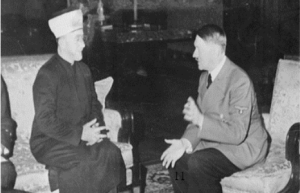
Adolf Hitler and the Mufti al-Husseini, NOV.1941
(Photo: Heinrich Hoffmann)
- 49: “the Arab Revolt did have…one arguably positive outcome…it convinced the British that partition was unworkable.”
It is unclear in the extreme about what was positive about this outcome. A decade later the Arabs again rejected partition, proving their diplomatic rejectionism and leaving them with no state at all.
- 49: “yet another white paper…that envisioned a Jewish national home…as part of an independent Palestine”.
That 1939 White Paper, Britain’s statement of policy termed by David Ben-Gurion as a betrayal, contained this sentence: “His Majesty’s Government therefore now declare unequivocally that it is not part of their policy that Palestine should become a Jewish State.” In September 1939, Ben-Gurion stated: “we must fight the White Paper” (and not as Sokatch translates on p. 50 as “we must stand against the White Paper”). Sokatch does not mention any Zionist opposition to the White Paper. He could have noted the Jewish Agency reaction as published in the Palestine Post, May 18, 1939: that this was “breach of faith as a surrender to Arab terrorism.” Was this what he meant by something “positive” that emanated from the Arab Revolt?
- 52: “Exodus, by Leon Uris…has served as a compelling, if extremely romanticized and rather biased, introduction to Israel.”
Indeed, Exodus was a romanticized novel. And it did underplay the role of the Irgun and Lechi. Yet, it is unclear how it was biased as an introduction. Sokatch provides not a single example to support his claim here.
- 53: “The Palestinian Arab leadership had fallen into a state of weakness and disorganization…”
In discussing the rejection by the Arabs of Palestine of the 1947 partition proposal, Sokatch again offers an excuse, namely, that they were weak and disorganized. In actuality, however, the Higher Arab Committee had won UN recognition and its representatives, Henri Kattan and Emil al-Ghouri had appeared before the UN committee. In addition, they were supported by Arab states who were members of the UN. However, following the Mufti’s instructions, they later boycotted the deliberations out of what they perceived was a position of strength based on their 1939 experience. If anything, it can be said that the Arabs preferred a zero-sum outcome, continuing their three-decade policy of rejectionism, and put forth contradictory approaches.
- 54: “[Palestine’s Arabs] felt that they were being asked to pay for someone else’s (Europe’s) sin…”
While Sokatch’s assertion may be accurate, he should have included a discussion of the veracity of this Arab claim, and whether the leadership of Palestine’s Arabs – the Mufti and top aides – were complicit in the Nazi attempts to exterminate Jews: in anti-Jewish riots in Arab countries during the war, including Nazi-inspired pogroms in Algeria in the 1930s, and in attacks on the Jews of Iraq and Libya in the 1940s. In 1941, 180 Jews were murdered and 700 were injured in the anti-Jewish riots known as “the Farhud”; Sokatch should have discussed whether Arab nationalists such as Rashid Ali al-Gaylani of Iraq and Anwar Sadat in Egypt were sympathetic to Nazism.
- 55: “Almost immediately (following the UN Partition approval), fighting broke out between Arabs and Jews…”
This wording is quite deceptive. Arabs attacked Jews the following day across the country and Jews were forced to defend themselves as the British were called upon to defend them. In fact, already during the summer of 1947 there were Arab attacks on Jews, reflecting the Arab lack of confidence in the UN deliberations.
- 56: “the ultraright Irgun and Lehi organizations entered the Arab town of Deir Yassin…there they massacred between 100 and 250 people.”
According to a 1987 study conducted by the Research and Documentation Center of Bir Zeit University, a Palestine Arab academic institution, the number of Arab dead was 107. In May 2018, Professor Eliezer Tauber published in English the results of his research that there was no massacre in Deir Yassin and that the claim was a fabrication and itself was responsible for the flight of many thousands of Arabs out of the country. Uri Milstein published in 2012 the book “The Myth of the Deir Yassin Massacre.” Sokatch does not mention any of the counter-claims of these scholars.
On the following page, Sokatch writes of Menachem Begin’s bragging about “the story [his emphasis] of the massacre,” as if the no-massacre claim is just a story. Moreover, in a footnote, he writes of Jewish college students unaware of the massacre, it having been “swept under the rug,” and suggests “if they bother to do a bit of research…[they’ll] find out that the massacre there actually happened.” Yet Sokatch failed to heed his own suggestion and research the matter.
At the end of this section, Sokatch writes of: “the massacres of Jews by Palestinians before”; this is the first time he applies such a loaded term to the Arab side of the conflict. Of course, during the time of the Mandate, Jews were also “Palestinians” and so Sokatch again compounds his ignorance, his political outlook and a false presentation of history in order to mislead his readers.
- 59: “this moment of promise for the Jewish people was one of catastrophe for the Arabs of Palestine: it was a moment their homeland disappeared.”
In making an analogy between Zionist leaders’ declaration of independence on May 14, 1948, with an outstretched hand of peace to the Arabs of the country and those already invading it, and what happened to the Arabs of the country at the end of the aggressive hostilities that they initiated, Sokatch misrepresents what took place at the time as well as what was at stake. The Jews were willing to compromise and live together with Arabs. The Arabs, by contrast, were not willing to do so. The “moment of their catastrophe” was in rejecting the partition and going to war six months earlier.
As for a “disappearing homeland,” as noted above, that term is a misreading of the geopolitical reality of the area of Palestine and its Arab inhabitants who, in the decade prior to 1948, especially during the war years, had been a magnet for Arabs from all over the Middle East due to the growing economic advantages. Their community collapsed, their leadership abandoned them, and their wealthy fled. The peasant folk blindly followed the calls for jihad and a war of extermination heard over the radio and in the Arabic press.
- 59: “the militant groups [Irgun and Lehi]…continued to make secret attempts to procure arms…”
Sokatch, as he expands further in the book, is referring to the Altalena arms ship affair that occurred June 20-22, 1948. But there was nothing secret about these attempts. Already in March, the Irgun was in contact with the Hagana in France, who reported to Ben-Gurion and other senior defense leaders of the Yishuv. Two high-level negotiation meetings were conducted with the Hagana and then the IDF. The IDF agreed that the ship would arrive and dock at Kfar Vitkin, a Mapai moshav. All this and more can be found with a simple Google search. Once again, Sokatch displays either ignorance or willful disregard of the historical facts.
It is worth mentioning that on the very same day the Altalena beached at Tel Aviv, a few hundred meters away, the Palmach brought in its own arms ship, the Inaco, with a large quantity of ammunition and 200 tons of explosives.
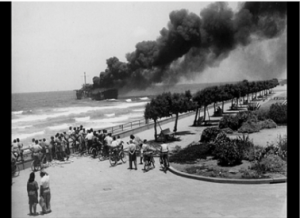
The Irgun ship “Altalena” goes up in flames, off the shores of the city of Tel Aviv.
(Photo: PINN HANS, GPO)
- 61: “while Rabin was no peacenik…”
While it is true that Yitzhak Rabin’s last policy address in the Knesset, on October 5, 1995, a month prior to his assassination, did not support a Palestinian Arab state – “a Palestinian entity…which is less than a state…The borders of the State of Israel, during the permanent solution, will be beyond the lines which existed before the Six Day War. We will not return to the 4 June 1967 lines” – Sokatch is rather dismissive of the man who signed the Israel-Jordan Peace Treaty and agreed to the Oslo Accords.
- 61: “When the fighting stopped…Israel…held 78 percent of the territory of historic Palestine”
This is factually incorrect. “Historic Palestine” territory included all of Transjordan, and, as noted above, the territory east of the Jordan River was effectively removed from the intended Jewish National Home in 1922 as per Article 25 of the League of Nations Mandate. In fact until 1946, Jordan was ruled by the same British High Commissioner who also ruled the Palestine Mandate. The figure of 78% is an Arab propaganda claim without foundation.
- 61: “Jordan held the West Bank and East Jerusalem…the Palestinians held nothing.”
The terms “West Bank” and “East Jerusalem” did not exist in 1948. Jerusalem was a united city, as it had been for 3000 years. The term “West Bank” was coined in 1950 when Jordan illegally annexed the area known in Mandate period as Judea and Samaria. Several thousands of Arabs of Palestine, according to their narrative, including the mayors of Hebron, Bethlehem, Ramallah, the Arab Legion Military Governor General, military governors of all the districts, and other notables, convened in Jericho on 1 December 1948 and expressed the desire for unity between Transjordan and Arab Palestine and their wish that Arab Palestine be annexed immediately to Transjordan. They also recognized Abdullah as their king and requested that he proclaim himself king over the new territory. They did not have “nothing”; they had a new king. That he kept them mostly in refugee camps had nothing to do with Israel.
- 61: “Around 10,000 Jews were kicked out of or fled their homes in territories captured by Arab forces”.
This is factually inaccurate. In October 2003, B. Scott Custer Jr., chief of the international law division of UNRWA (Gaza), informed me that during 1949-50, some 17,000 Jewish Palestinians were cared for by UNRWA and its predecessor agency, just as Arabs were, and by 1952, the responsibility for the remaining 3000 Jews still then receiving assistance was transferred to Israel. Of course, during the period 1920-1948, thousands of Jews resided in Judea and Samaria, mainly Hebron but also in the environs of Jerusalem, the Etzion Bloc, the Dead Sea and even in the majority-Arab cities of Shechem/Nablus, Jenin, Tul Karem and even Gaza and Jericho. And they were ethnically cleansed by the waves of Arab pogroms and riots during those three decades.
While he does, however, on p. 69, mention population transfers between the 1920s and 1950s, he does include what Arabs did to Jews in the Palestine Mandate in his list. To that number should be added some 60,000 Jews, Internally Displaced Persons, who were either displaced or temporarily displaced from their homes, according to Nurit Cohen-Levinovsky in her “Jewish Refugees in Israel’s War of Independence” (2014)
According to Cohen-Levinovsky, some 97 Jewish villages were attacked: of these, 11 were destroyed entirely, and six were conquered and lost – until after the 1967 Six Day War.
In truth, between 10% and 20% of the total number of “Palestinian” refugees were Jews. In his book, “1948,” Benny Morris puts the number of Jewish refugees even higher, at 70,000.
On p. 67, Sokatch returns to the subject and notes that 10,000 Jews were expelled from “behind Jordanian lines” and 2,000 from the Old City. He continues there: “This being Israel and Palestine, even the factual history I’ve related here remains a subject of controversy”. Yet Sokatch contributes to that controversy.
- 61: “Both narratives are true”.
No, they are not. Narratives are imagined realities. In this case, they contain some elements that are indisputable and some elements that are less so. And there are lies, misrepresentations and propaganda, on both sides. Each narrative, that of Israel and that of the Arabs, should be subjected to objective historical research and inquiry.
- 65: “The population transfers that shaped the Arab-Israel conflict have a terrible sort of symmetry…”
Comparing the nti-Semitic persecutions that Jews suffered in Europe from the Crusades to the Black Death to the Inquisition and on to the pogroms of Eastern Europe from the 17th century and on to the 20th century Holocaust, when Jews did nothing to cause that violence except to exist to the supposed “mass expulsion and fight of Palestinian Arabs in 1947-48”, as Sokatch does, is a travesty.
Jews did not blow up marketplaces where Christians shopped nor did they throw rocks at buses, as Arabs did in the 1920s and 1930s. They did not slaughter Christians in their churches. To attempt to create a false historical parallel is not, as Sokatch’s title indicates, an invitation to talk but more an invitation to confuse the interlocutor. Moreover, and as previously noted, this false parallel gives a pass to the Arab campaign to ethnically cleanse Jews during the Mandate years.
- 71: “the Palestinian diaspora – today numbering more than five million people who are the descendants of the “’48 refugees””
On the bottom of p. 72, Sokatch mentions that these refugees “pass down, patrilineally, their refugee status” but does not discuss the uniqueness of that status transferal or other issues connected to the UNRWA, such as the fact that to be a ‘refugee’, required but two years of residency in Palestine, quite a short period of time, or that the UN maintains two refugee agencies: one for Palestine’s refugees and one for all the rest of the world’s refugees. He does mention UNRWA support of anti-Jewish incitement and terror (such as permitting the storage and the firing of rockets at Israel from UNRWA institutions). According to the index, this is the sole mention of UNRWA in his book.
- 75: “we have come here and stolen their country”
David Ben-Gurion, who made the above statement, was describing how the Arabs view the conflict, not stating his own position. And while Sokatch does write that Ben-Gurion “well understood both the terrible predicament and the unending anger of the Arabs of Palestine, now Israel”, to use that quotation to end his chapter (which is found in Nahum Goldmann’s “Le Paraddoxe Juif” [The Jewish Paradox] p. 121) is to use a source, given Goldmann’s own conflicts with Ben-Gurion, which is less than responsible.
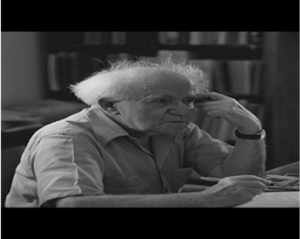
Prime Minister David Ben-Gurion.
(Photo: COHEN FRITZ, GPO)
- 77: “This wasn’t quite as North Korea as it may seem: early Israel was still a democracy, but individualism was less important than societal cohesion.”
This throw-away reference to North Korea is as jarring as it is ridiculous. In any case, as the kibbutz movement was the perennial darling of the old progressive left, it is interesting that Sokatch points to it as a problem.
- 81: “local anti-Israel militants”
Sokatch holds off on referencing Arab terror until the sixth page of his chapter on Israel during the 1950s. His chosen term, “militants,” is anachronistic, one that is currently in use but not then. According to Wikipedia, “According to the Jewish Agency for Israel between 1951 and 1956, 400 Israelis were killed and 900 wounded”. That is an unusual number of terror victims. To provide just one outrageous example of this terror, completely elided by Sokatch, on March 17, 1954, at the Scorpions Pass, an assault was made on an Israeli civilian passenger bus; eleven passengers were shot dead by the attackers, who had ambushed and boarded the bus.
Besides omitting a retelling of Israel’s security difficulties, and the usage of a disguised term for naked terror, Sokatch thus manages to elide the crucial question of whether Arab terror started only after the Six Day War, or was triggered by an “occupation” or “settlement construction”, or, alternatively, was present from the Mufti’s first anti-Zionist riot in 1920, throughout the Mandate and on into the Israel of the 1950s? On p. 86, in passing, he notes the 1964 founding of the PLO but does not discuss the “Palestine” that Arafat and his comrades were intent upon “liberating”.
- 81: “For his part, Ben-Gurion hoped that the invasion [of the Sinai Peninsula in 1956] would lead to expanded borders”
As already noted, Sokatch ignores the eight-year nti-Sem terror campaign against Israel, sponsored by Egypt and backed by Jordan. He also ignores the constant sniper fire toward Jews in Jerusalem during those years. For example, earlier, on September 18, 1948, 12-year-old Yonatan Abramsky was killed by gunfire from the former Mandate era Police School in Sanhedria while he was in his own courtyard in the Kerem Avraham neighborhood. On September 12, 1948, Isaac Fried and Zalman Deutsch were stabbed to death in an orchard at Udim, east of Netanya, their bodies mutilated.
On September 24, 1948, 50-year-old Shlomo Rzabari was knifed to death by infiltrators, and his body was disfigured, east of Petah Tikvah. The victims of hundreds of the nti-Sem infiltrators were civilians, as on October 12, 1953, when a squad infiltrated and reached the village Yehud. There, they threw a grenade into a civilian house, killing Suzanne Kinyas and her two children, a 3-year-old girl and a one-and-a-half-year-old boy. The tracks of the perpetrators led to Rantis village in Jordan.
Israel had a specific security objective during the early 1950s in linking up with Britain and France, a fact that Sokatch overlooks. The Arab states did not accept Israel’s legitimacy. In fact, those security problems could possibly have justified border rearrangements. At the very least, the problems could have demonstrated the inadequacy of those pre-’67 borders and indicated to Sokatch’s readers that Israel may have a valid justification for refusing to “return to the ’67 borders”.
It is worth mentioning that in November 1969, in an interview with the German magazine Der Spiegel, the moderate Israeli politician and diplomat Abba Eban termed those borders “reminiscent of Auschwitz”. He was indicating their extreme indefensibility, is not mentioned at all in Sokatch’s book (based on the index). Sokatch, in leading up to the Six Day War, thus minimizes the ongoing existential threats Israel faced throughout the 1950s and early 1960s.
This apparently minor observation points to a consistent effort on Sokatch’s part to misrepresent the history of the Arab-Israel conflict.
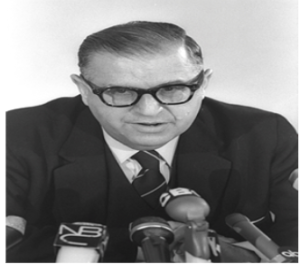
Foreign Minister Abba Eban
(Photo: COHEN FRITZ, GPO )
- 86: “In 1964, the Palestine Liberation Organization (PLO) was founded”
In fact, the PLO dates to 1959, when Fatah (which is the acronym PLO in reverse Arabic: Harakat al-Tahrir al-Watani al-Filastini which translates into “The Palestinian National Liberation Movement”) was founded. Moreover, Sokatch does not discuss the early ideological positions of the PLO and their ramifications for comprehending the real conflict between Jews and Arabs, such as:
Article 2: Palestine with its boundaries that existed at the line of the British Mandate is an indivisible territorial unit.
This excludes any Jewish state in “Palestine”.
Article 3: The Palestinian Arab people possesses the legal right to its homeland, and…it will exercise selfdetermination solely according to its own will and choice.
That would indicate that solely Arabs of Palestine possess a legal right to selfdetermination, not the Jews.
Article 6: Jews who were living permanently in Palestine until the beginning of the Zionist invasion will be considered Palestinians.
As Arab literature marks 1917 as the “Zionist invasion”, being the year the Balfour Declaration was announced, it would seem no Jew born in Israel after 1917 would be allowed to remain.
Article 19 – “Zionism is a colonialist movement in its inception, aggressive and expansionist in its goal, racist and segregationist in its configurations and Fascist in its means and aims.”
Aligning Israel with the idea of colonialism automatically rejects any historical connection of Jews to their national homeland.
- 89-94 “Lighting the Fuse”
Whereas Nasser of Egypt comes across in Sokatch’s presentation as bumbling, uncertain, taking moves based on being humiliated by Arabs states, led by the nose by Russia and so on, virtually stumbling into the 1967 war, and avoiding the bloodthirsty mass marches in the streets of Arab capitals and calls for Israel to be thrown into the sea, Moshe Dayan is “hawkish” and Israelis are “determined”. This is another example of Sokatch’s “those poor Arabs” portrayals.
Sokatch also omits mention of Israel’s diplomatic attempts, including multiple visits to Washington and other Western capitals, to achieve international assistance to prevent war and keep the peace. For example, the 1950 Tripartite Agreement (which Washington had ‘lost’ a copy of). It was to assure Israel of freedom of safe passage after the 1948 war with Egypt. But he does write – based on Gershom Gorenberg, an “anti-occupation” activist – of Israel’s “political and military leadership” who “began to think war…was necessary…they wanted an opportunity to destroy, once and for all, the enemy armies”.
- 96: “the IDF…drove deep into the Jordanian-held West Bank…and captured the ancient cities…whose names evoke the biblical past: Hebron, ‘Shechem’, Jericho.”
It is only here, nearly one hundred pages into his book, that Sokatch hints at Jordan’s illegal occupation and annexation of Judea and Samaria, as well as the rich Jewish national past of the area.
- 97: “Israeli leaders declared that Israel would trade some of (but not all) the land it had captured for peace…”
Sokatch may be referring here to a secret decision made on June 19, 1967, which was relayed to the United States for transmitting to the Arab states. Despite disagreement among ministers on which territories to keep or even annex, the decision was simple: the government unanimously approved the statement that, “Israel proposes reaching peace with Egypt [and with Syria] on the basis of the international border and the security requirements of Israel”.
In his discussion, Sokatch does not mention the famous Khartoum ‘Three Noes’, but adds that “Israelis weren’t worrying too much about that [Khartoum resolution]” – as if Israel had not taken an important diplomatic initiative based on territorial surrender and compromise. Nor does he deal with Arab rejectionism, which has long perpetuated the conflict.
- 102: “In other words, give up land for peace…although they continue to argue over its meaning”.
In dealing with the late 1967 diplomatic moves in the UN leading up to its Security Council Resolution 242, Sokatch leaves aside the famous “the territories”/“territories” debate. Readers seeking clarity on this issue will not find it anywhere in the book, including in the endnotes, which also do not engage with the topic.
As has been noted by many researchers, at this time the United States had adopted a critical change in its position and was no longer demanding an unconditional full withdrawal prior to any discussion of the conflict (as it had demanded in 1957). “Territories” – notably, not “the territories” or “all the territories” – were now bargaining chips. The United States rejected Soviet and Arab efforts to obtain an Israeli withdrawal to the prewar lines. In other words, Israel had a right to expand its borders. The United States secured the adoption of UNSC 242 that predicated a withdrawal for peace yet no withdrawal without a binding peace.
Moreover, UNSC 242 does not mention the term “Palestinians”. It mentions “Arab states” and, as is well-known, Palestine did not exist as a state, ever. This resolution calls for “a just settlement of the refugee problem”, not of a Palestinian people. In addition, it stipulates that there be a “withdrawal of Israeli armed forces from territories occupied in the recent conflict”, a clause that Sokatch does include. Does that mean that Israeli citizens may reside in those territories? Sokatch declines to engage in these matters.
- 106: “Palestinians remaining in the West Bank retained their Jordanian citizenship until 1988…”
While this footnote at the bottom of the page states a fact, Sokatch misses an opportunity to point out that, aside from denial of citizenship, Arabs who left Mandate Palestine were never afforded normative refugee rights in Arab countries and have been discriminated in these places on an infinitely greater scale than the Arabs who remained in Israel. One example among many is Lebanon, where these refugees live under conditions of extreme poverty and repression.
- 106: “militants from the PLO set up new bases of operations in Jordan”
This remark could be misunderstood. Those “new bases” were actually additional bases. PLO bases existed in Jordan prior to 1967. In addition, as noted previously, the continued use of the term “militants” is in error and whitewashes Arab anti-Israel violence.
- 107: “the final straw for Hussein”
Sokatch would have his readers think that the “final straw” (a reference to Avi Shlaim’s book) that led to the “Black September” attacks on the PLO was the hijacking of three commercial airlines. This is a highly tenuous and widely disputed view. The confrontation between the PLO and Jordan was two years in the making and the hijackings, while they provided heightened publicity for the PLO were quite incidental to the reason for the shelling of refugee camps in Amman by Hussein’s army, an action that killed thousands. The reason was that the PLO’s armed attacks on his regime were aimed at destabilizing it. Hussein supported the PLO terror campaign against Israel but it was when his own regime was threatened that he launched the attacks. The real narrative is dismissed.
Here is from a review written by Tomáš Michala, a Slovak Foreign Ministry researcher:
“The Jordanian authorities were gradually losing respect in the Palestinian refugee camps. The PLO fighters were openly carrying weapons; they refused to coordinate their attacks on Israel with the Jordanian army, and, moreover, they even attempted to extort taxes from local residents…At the time [of the hijackings] King Husayn was already taking steps of his own. He dissolved the government and established military rule, asking the guerrillas to withdraw from Amman and to give over their weapons. They ignored this demand and stated that they were ready to fight.”
Interestingly, no note here is made of the 1972 Munich Olympics terror attack perpetrated by the subsequently named Black September PLO group; its first mention is on p. 108. Nor is the assassination on November 28, 1971, by four Black September gunmen of Jordan’s Prime Minister Wasfi Tal in Egypt. In addition, the Black September attack on March 1, 1973, when PLO terrorists seized the Saudi Arabian Embassy in Khartoum, is left out of the discussion. The United States Ambassador, Cleo A. Noel, and the Belgian Charge d’Affaires and the United States DCM, among others, were taken hostage. The operation was planned and carried out with the full knowledge and personal approval of Yasir Arafat, Chairman of the Palestine Liberation Organization (PLO), and the head of Fatah.
After negotiations failed, and on orders from Fatah headquarters in Beirut, they killed the two United States officials and the Belgian Charge. Is Sokatch whitewashing the PLO terror? Had the author included these facts, he would have helped to contextualize this statement of his: “the U.S.-Israel alliance emerged from the Black September crisis much stronger”. As he let things stand, his readers are left to wonder if the aforementioned alliance is based, perhaps, on anti-Semitic/anti-Zionist conspiracy theories.
- 107: “PLO leadership and fighters fled across the border into Syria and then into Lebanon”
These individuals also fled across the Jordan River into Israel. It seems strange that Sokatch doesn’t mention this fact, even as an oddity. Omissions of this sort leave one with the impression that the author is lifting material from Wikipedia and books but, lacking a broad-based foundation of knowledge or reasonable familiarity with his subject, fails his readers even as his narrative props up his narrow view of the so-called “conflict”.
- 109: “but President Nixon authorized an airlift of arms to Israel [during the 1973 Yom Kippur War]”
Sokatch here provides a remarkably thin description of the events. There was a delay in the delivery of these arms which began only on October 13, and Israeli diplomats were, for all intents and purposes, in a near-panic. Kissinger blamed Secretary of Defense Schlesinger while there is the published version that Kissinger said “let Israel bleed a bit”. There were administration officials who felt it would not be justified to pay the political price of an angry reaction from America’s Arab allies for an urgent delivery of tanks and planes. William Clements, the Deputy Secretary of Defense, was the main obstacle at the beginning and the Pentagon was dragging its feet about organizing resupply flights to Israel.
In his section on the lead-up to the Yom Kippur War, Sokatch neglects to discuss in any depth the War of Attrition, although it appears on page 320 in a list of other wars. Conservative casualty lists indicate some 1000 Israelis, both soldiers and civilians, were killed.
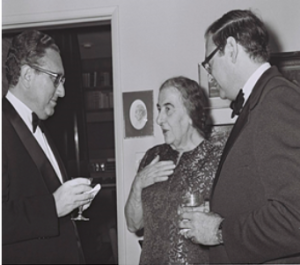
Prime Minister Golda Meir, Political Adviser Simcha Dinitz and Henry Kissinger at Israel’s Ambassador to Washington.
(Photo: MILNER MOSHE, GPO)
- 112: “Mizrachi Israelis…still resented the transit camps to which they (unlike European immigrants) had been sent when they arrived in the country…”
European immigrants also were sent to these camps, the ma’abarot. It was only in the third year of these camps, first opened in early 1950, that the proportion of Mizrahi Jew became predominant.
- 113: “Begin saw them [the Palestinians] as local Arabs…they deserved decent treatment, he believed, but – ironically….not a state of their own”.
Sokatch here adroitly sidesteps the issue of discussing the identity of the local Arabs. This could have been a teaching moment, showing both sides of the matter. Are they “Palestinians”? Who are Israeli Arabs? Who are Jordanians? Do they deserve a state? All he adds on p. 114 is that Begin’s nationalism created a “blind spot” regarding the “aspirations” of the Arabs of Palestine, thus implying that those aspirations are fully justified.
- 114: “Sadat…shocked the world [by visiting Israel in 1977]”
Sokatch’s diplomatic history has it that President Jimmy Carter envisioned a grand regional peace plan and for Sadat of Egypt; as the author puts it: “this represented an opportunity…” There are, however, two problems with this narrative. First, Sadat was furious at Carter for suggesting a summit that would include the Soviet Union. He opposed communism and sought a direct, non-American-supervised peace process with Israel. Second, Sokatch ignores Begin’s pre-Sadat visit diplomacy, his visit and talks with Romania’s Nicolae Ceaușescu and Moshe Dayan, incognito, flying to Morocco for talks with Egyptian senior diplomats.
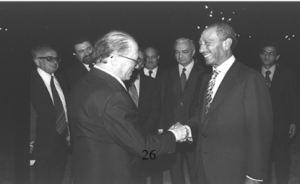
Egyptian President Anwar Sadat and Prime Minister Begin at a meeting in Alexandria, Egypt.
(Photo: MILNER MOSHE, GPO)
- 114-115: “Begin…was committed to thwarting any process that might lead to a Palestinian state in the West Bank, instead favoring some form of limited autonomy”
There is no real discussion of the Begin Autonomy Plan nor its eventual rejection by the PLO, or earlier plans for compromise, such as the Allon Plan. Sokatch allows his readers to assume that a state is the sole option, without analyzing the pros and cons of such a decision, at least vis-à-vis Israel.
- 120: “In 1981, Begin was reelected as prime minister”
Neither in the previous pages, nor those after, does Sokatch mention or discuss the bombing of Iraq’s nuclear reactor, its advantages, disadvantages and its ramifications…ramifications which took place just prior to the elections.
- 122: “On the evening of September 16…by the time they left the camps on September 19”
This is an inaccurate time-frame for the Sabra and Shatila massacre. The Christian forces entered the camps at approximately 18:00 on September 16 and remained until 08:00 on September 18, 1982.
- 124: Again, Sokatch brings in the Deir Yassin “massacre,” this time as an identifying background element of Yitzhak Shamir. Shamir, however, wasn’t in the country in April 1948 but in Africa, escaping from a British detention camp. But he did serve in the Mossad. Sokatch thus hammers away at themes that would strengthen negative views of right-of-center politicians.
- 130: “Reagan considered the settlements…a violation of international law”.
He did not. Even a simple Wikipedia check reveals that: “In February 1981, Ronald Reagan announced that he didn’t believe that Israeli settlements in the West Bank were illegal. He added that “the UN resolution leaves the West Bank open to all people, Arab and Israeli alike”.” The sources:
Laham, Nicholas (2004). Crossing the Rubicon: Ronald Reagan and U.S. policy in the Middle East. Ashgate Publishing and Hiro, Dilip (2013) [First published 1982]. Inside the Middle East. Routledge.
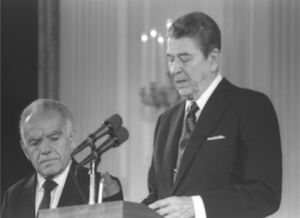
US President Ronald Reagan and Prime Minister Yitzhak Shamir.
(Photo: AYALON MAGGI, GPO)
Moreover, on p. 254, Sokatch again writes that all Republican and Democratic administrations endorsed a claim according to which “settlements are illegal/illegitimate”, thus repeating his error here regarding Reagan. In noting there that the Trump Administration broke with this, he avoids the announcement of then Secretary of State Mike Pompeo that explains how the former US position was in legal error.
- 131: “Palestinians watched as land near Palestinian villages was expropriated and handed over to Israeli settlers”.
Three points draw our attention here. First, Sokatch implies that this land was all privately owned. In fact, little of it was. Second, only the land’s use was transferred, not its title. Third, as noted earlier, Article 6 of the Mandate decision guaranteed a unique right to Jews, that of “close settlement by Jews on the land, including State lands and waste lands not required for public purposes.” In ignoring this right – consistently so throughout his book – Sokatch impairs his readers’ ability to make a fair judgment on the issue. And, in leaving them thus confused, he achieves the very opposite of his stated goal.
- 133: “Rumors that the collision had been deliberate…”
In outlining the start of the First Intifada, Sokatch conceals from his readers an earlier event pertaining to the above-mentioned rumor. On December 6, 1987, an Israeli was stabbed to death while shopping in Gaza. The following day, four residents of the Jabalya refugee camp died in the traffic accident referenced above, and rumors that they had been killed by Israelis in revenge for the Gaza murder began to spread among the Palestinians.
As to the term “First Intifada”, even the newspaper Haaretz, in a piece written by Ofer Aderet on April 16, 2016 (and earlier in several academic articles and books, including Professor John Newsinger and Charles Townshend), recognized that the 1936-1939 period of Arab-initiated anti-Jewish violence was the first intifada. Once again, Sokatch exposes the shallow nature of his historical presentation.
- 135: “do they [Israelis] really relate to Jerusalem as an undivided city”
In seeking to prove that the city is undivided by the fact that Israelis do not visit most parts of the former pre-1967 neighborhoods, while, at the same time, Sokatch notes “politically motivated” urban planning and transportation elements, he ignores totally any Arab violence as a cause for that pattern of behavior.
- 144: “Hamas called for armed struggle against Israel, including terror attacks against civilians…”.
Sokatch does not mention the anti-Jewish/anti-Semitic components of the Hamas ideology, as found in its covenant. Here are a few examples of these outrageous and nti-Semitic statements: a) “Our struggle against the Jews is very great and very serious”; b) quoting the al-Bukhari hadith of “The Day of Judgement will not come about until Moslems kill the Jews…stones and trees will say O Moslems, O Abdulla, there is a Jew behind me, come and kill him”; c) “In face of the Jews’ usurpation of Palestine, it is compulsory that the banner of Jihad be raised”; d) “[Israel is] a vicious enemy which acts in a way similar to Nazism…In their Nazi treatment, the Jews made no exception for women or children”; e) “when the Jews conquered the Holy City in 1967, they stood on the threshold of the Aqsa Mosque and proclaimed that ‘Mohammed is dead, and his descendants are all women’. Israel, Judaism and Jews challenge Islam and the Moslem people”; f) “The Zionist plan is limitless. After Palestine, the Zionists aspire to expand from the Nile to the Euphrates. When they will have digested the region they overtook, they will aspire to further expansion, and so on. Their plan is embodied in the “Protocols of the Elders of Zion”.
- 145: “In December 1988, Arafat announced that the PLO “accepted the existence of Israel as a state in the region…we accept two states, the Palestine state and the Jewish state of Israel…something was clearly changing.”
Arafat’s announcement was delivered at a meeting with members of the International Center for Peace in the Middle East, a Tel Aviv-based leftist group with branches in Israel, the United States and Europe. The AP news item reporting on it noted that “Arafat ended two days of talks with a U.S. Jewish delegation Wednesday by endorsing a statement accepting Israel’s right to exist. At a news conference that followed the talks, however, Arafat hedged, declining to confirm or repeat the statement’s key clauses.”
The AP went on: “Arafat described it as ‘nothing new,’ but rather was ‘an accurate reading and interpretation’ of the policy declaration adopted last month by the PLO’s legislative arm, the Palestine National Council. The PLO’s parliament-in-exile endorsed U.N. resolutions 242 and 338, which recognize the right of all states in the region to exist within secure borders. But the council did not mention Israel by name.” As was recognized at that time and later, the clause that “accepted the existence of Israel” was but a simple acknowledgement that, temporarily, Israel existed.
Moreover, the read-out statement included “the right of the Palestinian people of self-determination, without the external interference” and “called for a solution to the Palestinian refugee problem”. These issues were intended to be open-ended matters that would eventually lead to Israel’s eradication.
In other words, Arafat was playing with the delegation. Sokatch should have noted this possibility, especially as the news report included the statement that Arafat had also announced “the renunciation of terrorism” in his remarks – which was clearly untrue.
This is but one example, in a book filled with such examples, of a historical presentation that consistently awards benefit of the doubt to a specific side: the Arab one.
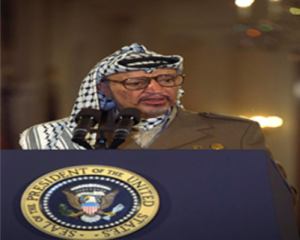
Yasser Arafat
(Photo: SAAR YAACOV, GPO)
- 146: “a furious President Bush leveled sanctions on Israel”.
Sokatch could have included in his discussion that in 1991, Bush lashed out at pro-Israel activists who were lobbying Congress in response to his reluctance to approve the loan guarantees requested by Israel to help absorb Jews from the Soviet Union. Bush termed himself “one lonely guy” battling “a thousand lobbyists on the Hill.” Jewish leaders saw that as an insinuation that the pro-Israel community was possessed of a sinister power, and as borderline anti-Semitic.
He also could have mentioned the role of James Baker, Bush’s Secretary of State, who famously denigrated Israel when he recited the White House phone number at a press conference, advising the Israelis to let their fingers do the walking and saying “When you’re serious about peace, call us’’ or his remark, uttered in the presence of Bush’s Housing Secretary Jack Kemp, “Fuck the Jews; they don’t vote for us.”
- 147: Footnote reads “Today, it’s hard to imagine a U.S. president…pressuring Israel over its settlement policy” referring to the Bush/Baker-Shamir rift.
All presidents did, to various extents, especially Obama. Indeed, he mentions Carter. Moreover, the State Department consistently expressed opposition to Israel’s settlement policy, throughout all administrations. It threatened pro-Israel charities, falsely claiming they would lose their tax-exempt status if they contributed funds across the Green Line. It appears than Sokatch, as noted above, is intent on highlighting issues and framing them so that they fit his and his organization’s political outlook rather than an objective review of history.
- 153: “Rabin’ made an initial peace overture to Syria…it didn’t amount to much; the Syrians weren’t willing to take the risk.”
It would have been appropriate to expand on that overture, as well as to the purported “risk” involved. According to a Brookings Institute paper, “While expressing a willingness to make a massive territorial concession in the Golan, Rabin declined to commit to a full withdrawal from that territory…the Israeli-Syrian negotiation was hindered by Assad’s refusal to explain what, in his view, peace with Israel entailed—whether it included full normalization and what the security arrangements might be—before Israel committed to a full withdrawal from the Golan. All efforts by the Clinton administration to persuade Assad to adopt a more flexible attitude failed.”
This illustrated that Israel could be flexible on territorial issues, which would have helped to convince young people that Israel is not firmly rejectionist regarding peace negotiations.
- 154: “In fact, the [Oslo] negotiations had been under way for a while, even before Rabin approved them.”
In fact, Rabin had no idea any negotiations were being conducted by two private individuals until a half year had gone by. It was Yossi Beilin, Foreign Minister Shimon Peres’ deputy, the person overseeing the secret process, who had concealed those negotiations from Rabin until May 1993. Is that style of government attractive to a liberal audience? Would that style be permissible for any government? In areas other than peace concerns?
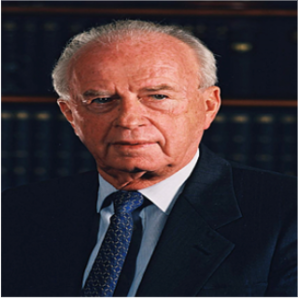
Prime Minister Yitzhak Rabin
(Photo: SAAR YAACOV, GPO)
- 157: “Negotiations…were interrupted…by the first of a long string of terrorist assaults from extremists on both sides…On February 25, 1994, a fanatically right-wing settler…opened fire…killing twenty-nine [Moslems].”
There was no “long string of terrorist assaults from extremists” on the Jewish side. To elaborate on the only attack on the Jewish side at that time, which occurred at the Cave of the Patriarchs in Hebron, is a lopsided presentation of the terror. Until that date, over the same period, almost 30 Israelis had been shot and stabbed to death by Palestinian terrorists, and no Arabs were Jewish terror victims.
- 158: “Just like the militant Jewish settlers, the fundamentalists Palestinian groups Hamas and Islamic Jihad wanted to murder the Oslo process.”
Sokatch continues to create a false parallelism, as if the two sides, in seeking to halt the diplomatic engagement, were also equal in their chosen means. Jews did not blow up restaurants and buses and did not become suicide bombers. They were not “just like” Arab terrorists.
- 165: “At a massive rally…in October 1995, Netanyahu…said nothing [about chants ‘Death to Rabin’]”.
Even if Sokatch believes this claim, in dealing with themes of confusion and conflict, he should have provided some balance by quoting Zalman Shoval’s letter to the New York Times, published on Dec. 1, 1995, which reads: “…the new big lie of the Israeli left: that the Likud leader, Benjamin Netanyahu, ignored chants that termed the late Prime Minister Yitzhak Rabin a traitor and ignored a placard showing Rabin in an SS uniform during an Oct. 5 demonstration in Jerusalem. As Ha’aretz reported the next day: ‘The crowd chanted ‘Rabin Traitor’ and Mr. Netanyahu silenced them, saying such calls do not belong here. ‘We will not replace the government through fire and blood but through the ballot box, and through it alone,’ Mr. Netanyahu declared.”
To the contrary, in a footnote, he relies on Uri Savir’s “The Process” to state that “at those anti-Rabin rallies, Netanyahu didn’t urge his followers to stop portraying Rabin as a Nazi or stop calling for his death”. But there is video evidence Netanyahu did call for a halt to extreme language being used. https://www.youtube.com/watch?v=MgGqprMVR44.
Moreover, the entire controversy of Avishai Raviv, a GSS-employed agent provocateur, and his relationship to the incitement and violence in the period leading up to Rabin’s assassination, is missing from Sokatch’s narrative—even if to deny its validity or argue with its relevance.
- 172: “…Netanyahu ran a campaign aimed at manipulating the anxieties of a nervous public and stoking fears…the appeals to fear and tribalism worked.”
Given the background of that time frame, including the fighting in Lebanon and the continued Arab terror including suicide bombings, Sokatch’s description of Netanyahu’s electoral campaign is narrow, unrepresentative and unfair. Moreover, as he notes on the next page, Netanyahu fulfilled the Hebron Agreement and agreed to the Wye Agreement, thus acting in accordance with the Oslo Accords framework.
- 176: “Barak kept his campaign promise, withdrawing the IDF from Southern Lebanon.”
Sokatch does not mention the way in which retreat was accomplished (by contrast, on p. 178, he goes into detail regarding Camp David II) and, given his liberal outlook, oddly does not mention the fate of the Maronite forces who supported and assisted Israel left behind nor the absorption of many hundreds of them into Israel.
- 178: “92 percent of the West Bank really meant 92 percent of 22 percent of historical Palestine”
“Historical Palestine” comprised of today’s Jordan so all of Sokatch’s percentages are skewed. In comparison, in 1947, the Yishuv accepted some 40% of the area of west-of-the-Jordan-River Mandate territory, having been forced to yield Trans-Jordan, some 75% of “Historic Palestine” in 1922, but Sokatch awards the Jews no credit for this.
- 179: “Camp David was not quite the end of the line for the peace process.”
Sokatch declines to include the Clinton Parameters in his discussion here but does mention them on pp. 183-185.
- 180: “Even as Israel claims sovereignty over the Temple Mount, it has allowed Palestinian Muslim religious authorities to control and administer the Muslim holy sites there”.
In a footnote, Sokatch avoids discussing in any detail the status quo arrangement of 1967 in which Israel agreed, voluntarily, to restrict Jewish prayer there while, in practice, permitting Moslems to destroy Jewish historical artifacts and prevent any religious customs at the site.
- 181: “Sharon and his entourage entered the Temple Mount.”
Sokatch does not inform his readers that there was a pre-visit discussion on September 27 between Israeli Internal Security and Acting Foreign Minister Shlomo Ben-Ami and Palestinian Preventive Security Service chief Jibril Rajoub, who informed Ben-Ami that “there was no reason for concern.”
Sokatch claims on p. 182, that the visit had “lit the fuse” but ignores the many warning signs that were developing that a renewed intifada was being planned, among them the Gaza summer camps for children as young as nine in which guerrilla training (including weapons training) was a focus of activity; the May 21 statement of U.S. National Security Advisor Samuel
Berger on Israeli Independence Day riots by Palestinians and Israeli Arabs; Yasser Arafat’s June 25 threat that if his demands were not met, a renewed intifada would result, with an unprecedented intensity; and the killing by Palestinian security forces of IDF Sergeant David Biri, 19, when their convoy was ambushed at night at Netzarim junction in the Gaza Strip the day prior to Sharon’s visit. In other words, Sharon’s visit, however one views it, was purposefully exploited.
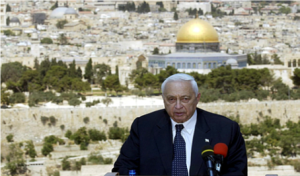
Prime Minister Ariel Sharon against the background of the Temple Mount.
(Photo: OHAYON AVI, GPO)
- 183: “the unarmed protestors.”
While not armed with guns, the violent Arab demonstrators attempted to injure and kill Jewish civilians driving the roads in the North over the Rosh Hashana holiday period and sometimes succeeded in doing so. Cars were smashed with rocks, fiery roadblocks were set up and other violent actions were pursued.
- 186: “the Oslo Process was murdered.”
The claim that the Oslo process was not flawed or that the two-state solution was not unachievable but rather that the Process was “murdered” is debatable, to say the least. In any case, substantiating the claim would take a great deal more proof than Sokatch offers. Sokatch, asserting (on p. 187) that what was directly responsible (his words: “in concert”) for the failure of peace was Rabin’s assassination and a Jewish terrorist in Hebron whose “militant movement” worked “together” with the Hamas, Islamic Jihad “and other violent enemies” (one wonders why he does not mention Arafat’s Fatah), is but proffering a propaganda conceptualization rather than a fact-based political analysis.
- 188: “armed attacks.”
Several points are important to note here. First, Sokatch flips the actual chronology, stating first that the IDF killed Arabs before he informs his readers that “Palestinian militants target[ed] Israeli soldiers and civilians”. It is only nine lines later that those attacks are revealed to include suicide bombings, and that overwhelmingly Israeli civilians were those murdered. It is only in a footnote that one learns that more than twice as many Israeli civilians were killed than IDF soldiers. Sokatch does not offer any analysis of the suicide bombings on the backdrop of Arab culture or politics—as if, he seems to imply, this is a normal method of waging a militant campaign.
- 192: “It would seem that once in power, Sharon… [concluded Israel could not both hold onto the territories had Israel remained democratic]”.
This is the sole explanation Sokatch provides for Sharon to propose his plan of withdrawal, despite the significant material pointing to other reasons for his change of policy. He also avoids discussing the protective media treatment of Sharon, from the “ethrog” wrapping as coined by Amnon Abramovitz and to the “peccadilloes” mentioned by David Landau which were, Landau suggested, minor compared to Sharon getting Israel out of the territories. In doing so, Sokatch is steering the conversation in a very specific direction rather than explaining the context to the confused.
- 195: “In February 2005, Sharon and Abbas…pledged to end Israeli-Arab violence.”
Israel’s Ministry of Foreign Affairs website (https://www.mfa.gov.il/mfa/foreignpolicy/terrorism/palestinian/pages/victims%20of%20palestinian%20violence%20and%20terrorism%20sinc.aspx) lists, from the end of February to the end of December 2005, 42 Jewish victims of Arab terror and hundreds of fatalities. The list continues with many more victims into 2006 and on. Sokatch avoids these statistics and goes on to the Second Lebanon War.
- 197: “with some regularity, Hamas and Islamic Jihad militants in Gaza fired rocket…”
Sokatch does not address the abject failure of the Israeli government’s total withdrawal from “Palestinian territory” and the total dismantling of Jewish communities and the removal of their Jewish residents to placate Arabs or at least, result in a ceasefire.
- 203 – “Right-wing GONGOS (government-organized nongovernmental organizations) first attacked the New Israel Fund.”
In a three-page treatment of the Goldstone Report, which inquired into claims of war crimes during the 2008-09 Gaza military action, in which he accuses the “right-wing” in Israel of an “assault’ which caused a “democracy recession”, Sokatch astonishingly avoids informing his reader that Justice Richard Goldstone, in April 2011, expressed regret that his report may have been inaccurate, writing “if I had known then what I know now, the Goldstone report would have been a very different document”. He indicated that, “civilians were not intentionally targeted as a matter of policy” by Israel.
- 204-205: “legislation designed to power the Jewish majority…”
Sokatch makes no attempt to offer a possible rationale for his list of problematic laws, thus allowing the reader to make an independent decision. Far from writing a book for the confused in order to “to know how [events] will fit into the bigger narrative we are trying to understand” (p. 210), by all indications, he appears to have written a book in order to persuade readers of his partisan agenda
______
Yisrael Medad holds an MA in Political Science from the Hebrew University in Jerusalem and is a Research Fellow at the Menachem Begin Heritage Center in Jerusalem. Born in the United States, he moved to Israel in 1970. He has taught and researched Zionist History for almost six decades.
 Czech
Czech French
 German
 Hebrew
 Noruegan
 Russian
 Spanish
 Swedish
 Polish
 Portuguese