Israeli decision-makers are consumed with the lethal threat posed by Iran and its Lebanese proxy Hezbollah, but a no less insidious threat has gone virtually unnoticed: the Israeli Arabs’ growing rejection of Israel’s Jewish nature and their systematic subversion of state sovereignty and governability.
On the face of it, the participation of the Islamist Ra’am party in the motley ruling coalition established after the May 2021 nation-wide Arab riots seems to point in the opposite direction. For what can conceivably offer a better indication of sociopolitical integration than the inclusion of an Arab party in an Israeli government after a 45-year break? Yet, while the participation of an Arab party in the Golda Meir and Yitzhak Rabin governments (1974-77), let alone the participation of Labor and Likud Arab ministers and deputy ministers in successive governments, implied acceptance of Israel’s Jewish nature (as did outside support by small Arab parties in the 1950s and 1960s), Ra’am is an avowedly anti-Zionist party committed to the substitution of a Muslim theocracy for the State of Israel.
Yet, without Ra’am’s parliamentary support the government will automatically collapse. Giving this Muslim Brotherhood offshoot the decisive say over Israel’s national policies at a time when Israeli Arabs’ defiance of the state and their reversion to mass violence against their Jewish compatriots have reached their highest-ever point constitutes a clear and present danger to Israel’s domestic stability and national security, indeed to its very existence as a Jewish state.
From Acquiescence to Open Rebellion
During the first two decades of Israel’s existence, there were few manifestations of collective rebelliousness by its Arab community, which was still reeling from its traumatic defeat in the 1948 war. Lacking collective cohesiveness and deserted by their traditional leadership, which fled en masse during the war, the Israeli Arabs were placed under military administration—a policy that ended only in December 1966—to prevent their possible transformation into a fifth column that would collaborate with hostile Arab states in the event of a future conflagration, as they had done in the 1948 war.
The June 1967 Six-Day War ended this state of affairs by renewing the Israeli Arabs’ contact with both West Bank and Gaza populations and the wider Arab world. Family and social contacts broken in 1948 were restored, and a diverse network of social, economic, cultural, and political relations was formed. For the first time since 1948, Israeli Muslims were allowed by Arab states to participate in the Islamic pilgrimage to Mecca and Medina, thus breaking an unofficial ostracism and restoring a sense of self-esteem and pan-Arab belonging—and encouraging a correlative degree of alienation from Israel.
This growing alienation quickly made itself felt in the local political scene. During the 1950s and 1960s, most Arab voters had given their support to Israel’s ruling Labor party and/or a string of associated Arab lists. In the 1969 elections, Raqah, a communist and predominantly Arab party and champion of militant, anti-Israel positions, made its successful electoral debut. By December 1973, in elections held two months after the Yom Kippur War, Raqah had become the dominant party in the Arab sector, winning 37 percent of the vote; four years later, it eclipsed its rivals with 51 percent of ballots cast by Arabs.[1]
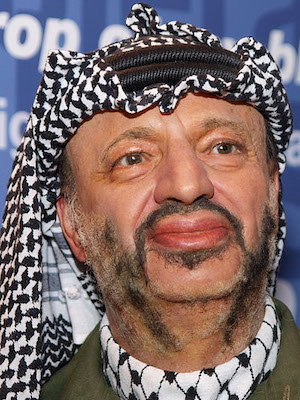 PLO chairman Yasser Arafat worked to indoctrinate Israeli Arabs with an ineradicable hatred of Israel, Jews, and Judaism. PLO chairman Yasser Arafat worked to indoctrinate Israeli Arabs with an ineradicable hatred of Israel, Jews, and Judaism. |
The results of this radicalization process were not slow in coming. In November 1969, the city of Acre, home to some 23,000 Jews and 7,000 Arabs, was rocked by violent riots, sparked largely by Raqah incitement, which led to the departure of Jewish residents and the influx of Arabs from neighboring villages. Lamenting the state’s “soft” handling of the riots, the prominent Druze politician Jabr Moade (MK 1951-59, 1961-81; deputy minister 1971-77) called for immediate suspension of all contacts between Israeli Arabs and the West Bank/Gaza populations. Should the authorities fail “to put off the fire in their neighbor’s home,” he warned, “the fire will eventually burn their home as well.”[2]
This warning proved prescient. By the end of March 1976, Arab radicalization had escalated to mass riots over the government’s intention to appropriate some five thousand acres (of mostly state and private Jewish land) in the Galilee for development, which ended in the deaths of six rioters and the wounding of dozens more. “Land Day,” as the riots came to be known, was, thenceforth, commemorated annually in renewed and increasingly violent demonstrations, often in collaboration with the Palestine Liberation Organization (PLO) and its political affiliates in the West Bank.[3]
Meanwhile, the “Palestinization” of Israel’s Arab population continued apace. In February 1978, scores of Palestinian intellectuals signed a public statement urging the establishment of a Palestinian state. A year later, Israeli Arab students openly endorsed the PLO as “the sole representative of the Palestinian people, including the Israeli Arabs”—effectively rejecting their position as Israeli citizens—and voiced support for the organization’s pursuit of “armed struggle”—the standard euphemism for terrorist attacks—and indeed for its commitment to Israel’s destruction.[4]
| Israeli Arabs supported their West Bank and Gaza brethren with acts of vandalism and armed attacks on their Jewish compatriots. |
By then, extremist politics and violence had become institutionalized as the PLO funneled funds to Arab groups and institutions in Israel, and Israeli Arabs were increasingly implicated in the sale of weapons and explosives to terrorist organizations in the territories.[5] This radicalization process intensified during the intifada years (1987-93) when Israeli Arabs supported their West Bank and Gaza brethren by committing acts of vandalism and launching armed attacks on their Jewish compatriots. It then skyrocketed to unprecedented heights after the Rabin government embarked on the Oslo “peace process” in September 1993.
By recognizing the PLO as “the representative of the Palestinian people,” Israel effectively endorsed the organization’s claim of authority over a fifth of its citizens and gave it carte blanche to interfere in its domestic affairs. Such a concession would be an assured recipe for trouble even under the most amicable of arrangements. Made to an irredentist party still openly committed to the destruction of its “peace partner,” it proved nothing short of catastrophic. While in the mid-1970s less than half of Israeli Arabs defined themselves as Palestinians, and one in two repudiated Israel’s right to exist, by 1999 more than two-thirds identified as Palestinians and four out of five repudiated Israel’s right to exist.[6]
From the moment Yasser Arafat arrived in Gaza in July 1994, the PLO chairman set out to make the most of what Israel had handed him, indoctrinating not only the residents of the territories but also the Israeli Arabs with an ineradicable hatred of Israel, Jews, and Judaism. His intention was made clear as early as his welcoming speech in July 1994, which smeared his new peace partner with extensive references to the notorious anti-Semitic tract The Protocols of the Elders of Zion, and ended with a pledge to “liberate” Israel’s Arab citizens from their alleged subjugation. Arafat proclaimed,
I am saying it clearly and loudly to all our brothers, from the Negev to the Galilee, and let me quote Allah’s words: “We desired to be gracious to those that were abased in the land, and to make them leaders, and to make them the inheritors, and to establish them in the land.”[7]
| Arafat secretly ordered the extension of the PA’s activities to Israel’s Arabs, allocating $10 million in initial funding. |
Within a month of his arrival in Gaza, Arafat had secretly ordered the extension of the Palestinian Authority’s activities to Israel’s Arabs, allocating $10 million in initial funding (in addition to $20-25 million for real estate purchases in Jerusalem) and appointing Ahmad Tibi, an Israeli citizen, to head the subversive operation.[8] In subsequent years, the interference of the PLO and its Palestinian Authority (PA) proxy in Israel’s domestic affairs would range from mediation of internal Arab disputes, to outright attempts to influence the outcome of Israeli elections, to the spread of propaganda calling for Israel’s destruction.
In a Knesset debate on September 21, 1993, a week after the euphoric signing of the Oslo accord on the White House lawn, Likud Knesset member (MK) Benny Begin warned of the agreement’s likely radicalization of the Israeli Arabs and made an impassioned plea for restraint:
I urge Israel’s non-Jewish citizens in Wadi Ara, the Galilee, and Acre to understand that this agreement will plunge us all into a fundamental instability that might undermine the edifice we have laboriously constructed for over 40 years.[9]
This plea proved unavailing. When, in February 1994, a Jewish fanatic murdered 29 Muslims at prayer in Hebron, large-scale riots erupted in numerous Arab localities throughout Israel with mobs battling police for four full days. The scenario repeated itself in April 1996 when dozens of Palestinians in south Lebanon were mistakenly killed in an Israeli bombing of terrorist targets, and yet again in September 1996, when Arafat, capitalizing on the opening of a new exit to an archaeological tunnel in Jerusalem, stirred a fresh wave of violence in which 15 Israelis and 58 Palestinians died.
Things came to a head on September 29, 2000, when Arafat launched his war of terror against Israel (euphemized as “al-Aqsa Intifada”). The next day, the “supreme follow-up committee of the heads of Arab municipalities in Israel”—the effective extra-parliamentary leadership of the Israeli Arabs—issued an official statement proclaiming the death of seven Palestinian rioters as a “premeditated, horrendous massacre” and proclaiming a day of national mourning, with strikes and demonstrations across Israel. The statement declared
The blood of our wounded has mixed with the blood of our people in defending the blessed al-Aqsa and crossed the green line [i.e. the pre-1967 line] … It does not stand to reason that we’ll remain aloof in the face of the … barbaric actions in Jerusalem and the attempt to desecrate al-Haram al-Sharif and to subject it to Israeli sovereignty.[10]
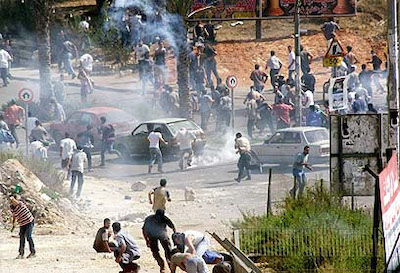 In October 2000, Israeli Arabs unleashed a tidal wave of violence against their Jewish compatriots, which lasted for ten days and was only suppressed with great difficulty. In October 2000, Israeli Arabs unleashed a tidal wave of violence against their Jewish compatriots, which lasted for ten days and was only suppressed with great difficulty. |
Responding to their leadership’s call, on October 1, Israeli Arabs unleashed a tidal wave of violence against their Jewish compatriots that lasted for ten days and was only suppressed with great difficulty and the killing of thirteen rioters. “The October 2000 events shook the earth,” read the report of an official Israeli state commission of inquiry headed by deputy chief justice Theodore Orr, appointed to investigate the causes of the eruption. The report explained:
They involved thousands of participants in many simultaneous places and the intensity of the violence and aggression was extremely high. Various means of attack were used against civilians and members of the security forces, including Molotov cocktails, metal steel marbles unleashed from slings at high speed, stone throwing by various means, rolling of burning tires and in some cases also live fire. Jews were attacked on the roads merely for being Jewish and their property was vandalized. In a number of instances, they were just inches from death at the hands of rioting mobs; indeed, on one occasion a Jewish citizen was killed. Attempts were made to invade and threaten Jewish localities. Main roads were blocked for prolonged periods of time and traffic to various Jewish localities was severely disrupted, at times even cut off for a long time. The aggression and violence were characterized by great determination, lasted for long periods of time, and persisted even in the face of attempts to stop them through various means of crowd dispersal.[11]
Intensified Radicalization
However exceptional in scope and intensity, the October 2000 riots were by no means the only Arab Israeli violent eruption during Arafat’s 4-year-long war of terror. The annual commemoration of the thirteen dead rioters (eulogized by Arab society as “martyrs”) became a hotbed of violence, at times in collaboration with the PLO/PA. In addition, Israel’s defensive counterterrorist measures occasionally triggered violent reactions by its Arab citizens. Thus, for example, on March 29, 2002, two days after a Hamas suicide bomber murdered 30 Israelis and injured another 140 while they celebrated the Passover seder in a coastal town hotel, the Israeli Defense Forces (IDF) launched a large-scale operation (code-named Defensive Shield) against the West Bank terror infrastructure that had murdered hundreds of Israelis in the preceding months. This triggered violent demonstrations in Arab settlements throughout Israel, and the Islamic movement in Israel initiated widespread activities in support of the West Bank Palestinians. Similar violent outbursts occurred in December 2008-January 2009, when Israel moved during Operation Cast Lead to end years of rocket and missile attacks from Hamas-controlled Gaza on its towns and villages.[12]
| Israeli Arab leaders increasingly identified with the sworn enemies of the Jewish State. |
These repeated violent eruptions came against the backdrop of steadily growing identification of Arab Israeli leaders with sworn enemies of the Jewish State. Thus, Azmi Bishara, founding leader of the ultranationalist Balad Party (with seats in the Israeli Knesset since 1999), travelled to Damascus to commemorate the death of Hafez al-Assad, one of Israel’s most implacable enemies. While there, he implored the Arab states to enable anti-Israel “resistance activities,” expressed admiration for Hezbollah, and urged the Israeli Arabs to celebrate the terror group’s achievements.[13] His subsequent prosecution for visiting an enemy state and supporting a terrorist organization only served to boost his international profile and intensify his recklessness. Finally, in 2006, he fled Israel to avoid arrest and prosecution for treason, accused of assisting Hezbollah during its war with Israel that year.
Bishara’s Arab peers did not lag far behind him. Ignoring legislation forbidding unauthorized visits by Israelis to enemy states, they embarked on a string of trips to neighboring Arab states where they conferred with various heads of the anti-Israel “resistance” and, at times, even participated in violent, anti-Israel activities. MK Ahmad Tibi, whose years in Arafat’s service made him persona non grata in Hafez Assad’s Syria, given the latter’s loathing of the Palestinian leader, was beside himself with joy on meeting the deceased tyrant’s son. “Heads of state are begging to shake [Bashar] Assad’s hand, crawling to shake his hand,” he gloated at an Israeli Arab election gathering in January 2009. “Yet what they fail to obtain despite their crawling, others get.”[14] The following year, Tibi travelled to Libya with a delegation of Israeli Arab parliamentarians to meet the long-reigning dictator Muammar Qaddafi, whom he lauded as “King of the Arabs” and who was praised by one of Tibi’s peers as “a man of peace who treats his people in the best possible way.”[15] Confronted with scathing Knesset criticism upon their return, one MK, Taleb Sana, was unrepentant. “Israel’s enemy is Israel itself,” he said. “As Qaddafi said during the visit, they have no problem with Jews but only with Zionism. Perhaps you’ll learn and understand some time—that is, abolish the Jewish state of Israel.”[16]
Open Calls for Israel’s Destruction
By this time, open calls for Israel’s destruction had substituted for the 1990s’ euphemistic advocacy of this same goal. Bishara, whose Balad party was predicated on making Israel “a state of all its citizens”—code for its transformation into an Arab state in which Jews would be reduced to a permanent minority—became increasingly outspoken after his flight from the country, predicting the Jewish state’s fate to be identical to that of the crusading states. His successor, MK Jamal Zahalka, preferred a more contemporary metaphor, claiming that just as South Africa’s apartheid had been eliminated, so its purported Zionist counterpart would be destroyed.[17] And Sheikh Raed Salah, leader of the northern branch of the Islamic Movement in Israel, who never tired of crying wolf over the Jews’ supposed machinations to destroy the al-Aqsa Mosque, “while our blood is on their clothes, on their doorsteps, in their food and water,” prophesied Israel’s demise within two decades should it not change its attitude to the Arab minority.[18]
Such views were by no means limited to the extreme fringes. In 2006, the “supreme follow-up committee” issued a lengthy document outlining its Future Vision for the Palestinian Arabs in Israel. The document derided Israel as “a product of colonialist action initiated by the Jewish-Zionist elites in Europe and the West,” which, it charged, had pursued “domestic colonialist policy against its Palestinian Arab citizens.” The document then rejected Israel’s continued existence as a Jewish state and demanded its replacement by a system that would ensure Arab “national, historic and civil rights at both the individual and collective levels.”[19]
 Since 2008, Israeli Arabs have observed “Nakba Day”—alongside Israel’s Independence Day—to condemn the alleged “catastrophe” of Israel’s establishment and to call for the “right of return.” Since 2008, Israeli Arabs have observed “Nakba Day”—alongside Israel’s Independence Day—to condemn the alleged “catastrophe” of Israel’s establishment and to call for the “right of return.” |
Two years later, as Israel celebrated its sixtieth year of existence, the committee initiated what was to become a common practice by dedicating the “Nakba Day” events—observed alongside Israel’s Independence Day to bemoan the “catastrophe” allegedly wrought on the Palestinians by the establishment of the Jewish state—to the “right of return,” the Arab catch-phrase for Israel’s destruction through demographic subversion. Even in Haifa, an epitome of Arab-Jewish coexistence since the early 1920s, local politicians attempted to replace the name of Zionism Avenue with its pre-Israel precursor.[20]
| By the 2009 national elections, some 40 percent of Israeli Arabs were denying the existence of the Holocaust. |
These incendiary activities had their predictable effect. By the time of the 2009 national elections, some 40 percent of Israeli Arabs were denying the existence of the Holocaust while one in two were opposed to sending their children to Jewish schools or having Jewish neighbors.[21] Small wonder that the 1990s and 2000s saw the demise of Arab votes for Jewish/Zionist parties and their diversion to militant purely Arab parties that were openly opposed to Israel’s very existence, and this process gained considerable momentum in the 2010s. In the 1992 elections, the Arab parties won five of the Knesset’s 120 seats; by 1999, this number had doubled. In the 2015 elections, the Arab parties won 13 seats by running in a unified bloc (the Joint List). In the March 2020 elections they scored their greatest-ever success by winning 15 seats.
Turning a Blind Eye
Rather than strive to nip this growing radicalization in the bud, successive Israeli governments ignored the real nature of the development and instead sought to woo the Israeli Arabs by additional socioeconomic incentives while turning a blind eye to their rapidly spreading lawlessness (e.g., acquisition of hundreds of thousands of illegal weapons) and defiance of state sovereignty, notably via massive illegal building on state land. No less alarmingly, the legal system became increasingly reluctant to enforce legislation designed to prevent the subversion of Israel’s national security and sociopolitical order, notably Article 7A of the “Basic Law: The Knesset” stipulating that:
A list of candidates shall not participate in elections to the Knesset, and a person shall not be a candidate in elections to the Knesset, should there explicitly or implicitly be in the goals or actions of the list, or the actions of the person, including his expressions, as the case may be, one of the following: (1) Negation of the existence of the State of Israel as a Jewish and democratic state; (2) Incitement to racism; (3) Support for an armed struggle by an enemy state or of a terrorist organization, against the State of Israel.[22]
| Even collaboration with terror organizations has not been sufficient for disqualification from Israeli elections. |
When in 1965 the Knesset’s Central Elections Committee disqualified an irredentist Arab Israeli movement—which rejected Israel’s existence—from participating in national elections, the Israeli Supreme Court ratified that disqualification on the grounds that “no free regime—particularly in light of the lessons of recent history—can lend a hand to the recognition of a movement that undermines that very regime.”[23] Yet, in recent decades, the court has systematically blocked all attempts at disqualification despite unequivocal violations of Article 7A. Hence, not one of the Arab MKs who visited enemy states and openly identified with their genocidal designs on Israel was barred from participating in elections, let alone prosecuted. Nor were Arab parties and/or MKs made accountable for their rejection of Israel’s very existence (whether directly or through such platitudes as support for the “right of return”—the standard Arab code for Israel’s destruction via demographic subversion).[24] Even identification or collaboration with terror organizations has not been sufficient for disqualification. For example, in March 2016, Balad and Hadash (as Raqah was renamed since the 1977 elections) berated the Arab League’s designation of Hezbollah as a terrorist organization as undermining the struggle against Israeli expansionism and aggression but were not disqualified.[25] Neither was the Joint List’s leader Ayman Odeh, who participated in PLO-organized events and reportedly received PLO money.[26]
Even Mansour Abbas, the soft-spoken and affable head of the Ra’am party was not deterred from travelling to Qatar to confer with Hamas’s leader Khaled Mashal in 2014 or the terror organization’s military leaders in 2016. Meanwhile, Ra’am’s charitable arms, notably al-Aqsa Association and Aid 48 Association—named to evoke the 1948 “catastrophe” (Nakba) of Israel’s establishment—disbursed vast sums of money to “families of shahids [i.e., killed terrorists] and prisoners [i.e., jailed terrorists]” in the West Bank and Gaza while reportedly maintaining close contacts with Hamas and other anti-Israel organizations in neighboring countries such as Turkey’s al-Furqan, which openly calls for Israel’s destruction. Indeed, in 2015, the Israeli authorities confiscated all of al-Aqsa Association’s bank accounts due to its receipt of some $4 million from Hamas.[27]
In these circumstances, it is hardly surprising that Israeli Arab politicians’ rejection of Israel’s Jewish nature and identification with its enemies has become ever more blatant and pronounced. Thus, MK Tibi told President Reuven Rivlin during the September 2019 parliamentary consultations on the formation of a new government that “we are the owners of this land … we did not immigrate here, we were born here, we are a native population.”[28] Six months later, after another round of national elections brought the Joint List’s Knesset representation to an unprecedented tally of fifteen MKs, Tibi was even more brazen. “The expression ‘Eretz Israel’ [Land of Israel] is colonialist,” he stated in a radio interview. “I reject with disgust the phrase ‘Judea and Samaria,’ it is the Palestinian West Bank, in the occupied Palestinian territories.”[29] And Odeh was no less forthright, telling Rivlin, “We are not solely interested in full civil equality. We are a national group that deserves full national equality.” In other words, they sought to end Israel’s existence as a Jewish state in favor of a binational state in which Jews would be reduced to their Islamic “rightful place” as a “tolerated religious minority” (or dhimmis).
To the May 2021 Insurrection
 When, in April 2021, thousands of Arabs rioted at the Temple Mount, Israeli-Arab politician Ayman Odeh embraced the violence: “Salutes … to the Jerusalem youth who are waging an intifada against the occupation.” When, in April 2021, thousands of Arabs rioted at the Temple Mount, Israeli-Arab politician Ayman Odeh embraced the violence: “Salutes … to the Jerusalem youth who are waging an intifada against the occupation.” |
When, in late April 2021, Hamas drew thousands of rioters to the Temple Mount by using the age-old canard of an imminent Jewish threat to the al-Aqsa Mosque, Odeh embraced the ensuing jihadist violence on the holy site with alacrity, in total disregard of his party’s communist-secularist ideology. “Salutes from the coastal plane, from the Galilee, from the Triangle, and from the Negev to the Jerusalem youth who are waging an intifada against the occupation,” he wrote on his Facebook page on April 24. The next day, as Israeli police sought to calm the situation by removing some roadblocks on Temple Mount, Odeh escalated his rhetoric. “The occupation is retreating before the Jerusalem youth and is removing the barriers at the Damascus Gate,” he gloated.
These are great and honourable positions by the people of Jerusalem, which will ebb and flow until the outbreak of the decisive intifada that will end the occupation and raise the flag of Palestine over Jerusalem’s mosques and churches, and over the walls of liberated Jerusalem.[30]
To Palestinian ears, this echoed Arafat’s threat to sacrifice millions of “martyrs” in order to hoist the Palestinian flag over Jerusalem’s walls.
Against this backdrop, it was hardly surprising that the outbreak on May 10, 2021, of the fourth war in just over a decade between Israel and Hamas triggered a wave of violence by Israel’s Arabs in support of the Islamist terror organization, which dwarfed the October 2000 riots. For two full weeks, as Hamas rained some 4,000 rockets and missiles onto Israel’s towns and villages, the cities of Jaffa, Haifa, Acre, Ramla, and Lod, among others—long considered showcases of Arab-Jewish coexistence—were rocked by mass rioting and vandalism. Synagogues and religious seminaries were torched, and Torah scrolls desecrated. Cars were stoned and burned; private establishments were ransacked, and transportation arteries were blocked, cutting off Jewish localities. Rampaging mobs wielding iron bars, Molotov cocktails, stones, and even firearms roamed the streets in search of Jewish victims. Jewish residents were attacked in their homes, at times with guns, by Arab neighbors with whom they had coexisted peacefully for decades. When hundreds of Jewish families fled the cities in fear for their lives, their homes were swiftly plundered and ravaged.
True to nature, Odeh quickly upped his rhetoric. Having long proclaimed the supremacy of the Israeli Arabs’ Palestinian identity over their Israeli citizenship,[31] he praised their violent assault on their Jewish compatriots in support of Hamas as “a stand of glory and belonging.” “Nothing will separate us,” he stated. “We are one people, and we’ll support the most righteous cause in the world until the end of the occupation and the establishment of the state of Palestine with Jerusalem as its capital.”[32]
He amplified this message on numerous occasions in the coming days, misrepresenting the rapidly spreading Arab violence across Israel’s cities as both patriotic support for their Gaza brethren and an act of self-defense against “settler attacks” backed by the “fascist security forces” on Israel’s Arab citizens.[33] “When we are united and struggle together, we [may] lose one day, yet win a lifetime by asserting our dignity and status,” he proclaimed as the Gaza war and the violence across Israel’s cities entered their second week. Odeh declared,
Our people wrote glorious days over the past week, especially the young ones who showed admirable fierce nationalism. We acted like a united people committed to a collective decision—[this] is a great value that greatly strengthens our people’s position.[34]
Not to be outshone, Tibi applauded the escalating Temple Mount violence as a heroic defense of al-Aqsa by “the youth of Jerusalem and the youth of the ‘inside’ [i.e., Israel’s Arab community]” against the “occupation forces” and “occupation police.” When Hamas missiles began falling on Israeli towns and villages, Tibi uttered no word against this indisputable war crime and instead praised the spreading Arab violence across Israel’s cities as “underscoring our unity with our Palestinian people, with the just cause, with our blessed al-Aqsa Mosque, with our people in Sheikh Jarrah, and against the killing of children in Gaza.”[35] In the next ten days, as thousands of Hamas missiles continued to batter Israel’s population centers, Tibi defended the terrorist assault on his country of citizenship as a “just struggle against occupation,” ignoring altogether that the Gaza population has been living under PA rule since May 1994 and under Hamas rule since 2007. In his account, Israel has never released its grip on the Palestinians and has used the decades-long peace negotiations as a ploy to sustain the “occupation” by other means, which fully justified the continuation of Palestinian “resistance.”[36]
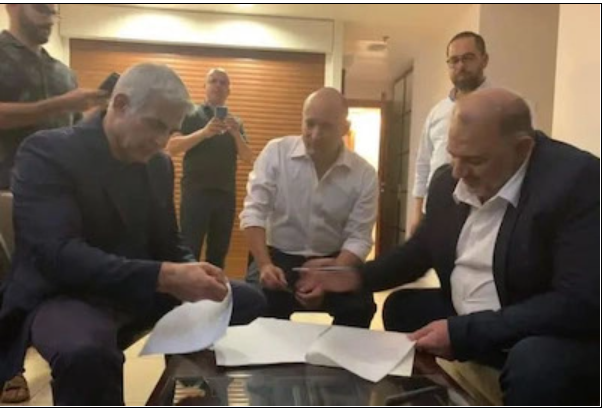
Even Mansour Abbas, who sought to keep a low profile so as to avoid alienating his Jewish partners to the negotiations on the formation of a “government of change” that would oust Prime Minister Benjamin Netanyahu, did not shrink from whitewashing the scope and intensity of Arab violence by putting it on a par with the handful of assertive Jewish responses. In a letter to Netanyahu on May 25, Abbas and his fellow Ra’am MKs condemned the detention of some 1,500 suspected rioters as a deliberate act of collective punishment aimed at intimidating and suppressing Arab youth—”an indigenous group entitled to special protection under international law”—and demanded the immediate suspension of the ongoing police campaign to bring rioters to justice.[37] Following the riots, Ra’am MKs participated in demonstrations demanding the immediate release of the detained rioters, whom they lauded as “ideological prisoners of freedom and prisoners of conscience who paid for our just Palestinian cause.”[38] Yet, the Ra’am party itself had no qualms about threatening Israel with a religious war should Jews be allowed to pray on the Temple Mount—Judaism’s holiest site—insisting that “the blessed al-Aqsa Mosque, with all its 144 dunums area [i.e., the entire Temple Mount], is an exclusive Muslim possession, and no one else has any rights there.”[39]
An Existential Threat Ignored
| Most of the political establishment attributed the riots to supposed discrimination and marginalization of the Arab minority. |
Reluctant to acknowledge the May 2021 riots for what they are and what they portend, the Israeli media, the academic and intellectual elite, and most of the political establishment attributed this volcanic eruption to the supposed discrimination and marginalization of the Arab minority, just as the Orr commission had done with regard to the October 2000 riots.[40] “Wild crops grow on a bedrock of frustration, discrimination and rage,” lamented the newly-appointed minister of internal security Omer Barlev shortly after the riots took place. He continued,
Since the establishment of the State of Israel, there existed an inbuilt inequality between the Jewish and the Arab sectors, and this inequality has increased over time due to the rapid development of the Jewish sector and the immobility of the Arab sector.[41]
Evoking the age-old Zionist hope that the vast economic gains attending the Jewish national revival would reconcile the Palestinian Arabs to the idea of Jewish statehood, this self-incriminatory diagnosis is not only totally misconceived but the inverse of the truth. If poverty and marginalization were indeed the culprits, why had there never been anything remotely like the 2000 and 2021 riots among similarly situated segments of Jewish society in Israel (notably the ultra-Orthodox community and residents of the peripheral “development towns”), or, for that matter, among the Israeli Arabs during the much worse off 1950s and 1960s? Why did Arab dissidence increase dramatically with the vast improvement in Arab standard of living in the 1970s and 1980s?[42] Why did it escalate into an open uprising in October 2000—after a decade that saw government allocations to Arab municipalities grow by 550 percent and the number of Arab civil servants nearly treble? And why did it spiral into a far more violent insurrection in May 2021—after yet another decade of massive government investment in the Arab sector, including an NIS15 billion (US$3.84 billion) socioeconomic aid program in 2015 in all fields of Arab society?[43]
The truth is that, in the modern world, socioeconomic progress has rarely been a recipe for political moderation and inter-communal coexistence but has often been superseded by nationalist, religious, and xenophobic extremism. So it has been with the Palestinian Arabs and Israel’s Arab citizens, whose political extremism and propensity for violence, from the days of the British mandate (1920-48) to the present, have intensified in tandem with improvement in their socioeconomic lot.
In 1937, a British commission of enquiry observed: “With almost mathematical precision, the betterment of the economic situation in Palestine meant the deterioration of the political situation.”[44] Likewise, the more prosperous, affluent, better educated, socially integrated, and politically aware the Israeli Arabs became, the greater their radicalization—to the point where many of them have come openly to challenge their minority status in the Jewish State.
This in turn means that the 2021 riots, just like their 2000 precursor, were not an act of social protest but a nationalist/Islamist insurrection in support of an external attack by an enemy committed to Israel’s destruction. In the words of Muhammad Baraka, head of the “supreme follow-up committee of the heads of Arab municipalities in Israel”—the effective extra-parliamentary leadership of the Israeli Arabs,
Jerusalem has some dear sisters: Jaffa, Haifa, Acre, Lod, and Ramla. Just a few months ago, last May, at the time of the last Intifada—look at the center of the confrontation with the Zionist oppression forces. It was particularly in these cities—the cities that they tried to write off, to distort their image, and erase them from the map of Palestine—these cities rose up and said: “Palestine is here, it was called Palestine in the past, and it is called Palestine once again.”[45]
According to a recently retired senior Israeli intelligence officer, the latest riots were closely coordinated with Hamas, as evidenced among other things by their cessation as soon as the Gaza hostilities ended. This, in his view, indicates that the Israeli Arabs possess “the means and intent to produce large-scale terrorism that will disrupt the routine of life within the country, both of the civilians and of the security forces.”[46] Indeed, the outgoing head of the IDF’s Technology and Logistics Branch, Yitzhak Turjman, revealed in November 2021 that, in a future war, the IDF would avoid moving forces and equipment through the Wadi Ara highway for fear that this central transport artery would be blocked by neighboring Arab towns and villages.[47]
Echoing the ominous first months of the 1948 war (dubbed “the fight over the roads”), when Arab control of Mandatory Palestine’s highways led to Jerusalem’s virtual isolation and the near-collapse of the Jewish war effort, this defeatist assertion underscores the magnitude of Arab lawlessness and defiance of state authority that has transformed large parts of Israel—especially in the Negev and the Galilee—into ungovernable no-man’s lands. The problem ranges from possession of vast quantities of illegal weapons and military equipment—mostly stolen from IDF bases—to illegal occupation of vast tracts of land and massive illegal construction. In 1964, there were some 3,800 illegal buildings in the country’s Arab community; by 2007, this figure had grown to some 50,000 among the Negev’s Bedouin community alone, with 1,500-2,000 new illegal constructions added every year.[48] Other problems include “agricultural terrorism” (e.g., burning forests, destroying agricultural crops and equipment); widespread tax evasion and polygamy (estimated at 20-40 percent among the Negev’s Bedouins);[49] mass racketeering and extortion of individuals and state institutions; and violent criminal activity way above the Arab community’s relative size (e.g., some 80 percent of both murders and weapons-related crimes in 2015-19—four times the percentage of Arabs in the population).[50]
Judging by the first six months of Ra’am’s participation in the coalition, this situation is bound to intensify, as evidenced, among other things, by the passage of the “electricity bill,” legalizing tens of thousands of piratic connections to the electricity grid by illegally built Arab accommodations,[51] thus whitewashing decades of mass illegal construction and encouraging the persistence and expansion of this phenomenon. And given the inordinate budgets awarded to Ra’am and the party’s commitment to legitimating the illegal Bedouin occupation of state lands, most of the Negev—accounting for more than half of Israel’s territory—may well become an ex-territorial zone before too long, as well as a land bridge between the West Bank and the Gaza Strip.
 Israeli parliament members plant trees outside a Bedouin village in the Negev desert, January 12, 2022. Thousands of Bedouins clashed with the police over the planting while the Ra’am party said it would not vote with the coalition unless the tree planting was immediately suspended. Israeli parliament members plant trees outside a Bedouin village in the Negev desert, January 12, 2022. Thousands of Bedouins clashed with the police over the planting while the Ra’am party said it would not vote with the coalition unless the tree planting was immediately suspended. |
Indeed, when, in mid-January 2022, the Jewish National Fund planted trees on state land in the northern Negev as part of its national forestation program (and in celebration of the Jewish holiday of Tu Bishvat, the “New Year of the Trees”), thousands of Bedouins clashed with the police while Mansour Abbas announced that Ra’am would not vote with the coalition unless the tree planting was immediately suspended. And while the government quickly caved in to this ultimatum, Bedouin rioting continued for days, uprooting the newly-planted trees, blocking key transportation arteries, including roads to IDF bases, stoning cars and buses, and laying rocks on the railway line with a potentially disastrous train derailing narrowly avoided.[52] Israeli Arab MKs endorsed the violence as heroic defense of the Negev that belongs to its “young men and women … and not to this government and its many lackeys” (to use the words of MK Touma-Sliman)[53] while Hamas urged Israel’s Arab citizens to “not let our people in the Negev deal with the occupation on their own. All our people ‘inside occupied Palestine’ [i.e., within Israel] must be with them … The time has come for the occupation to pay a price for its presence and aggression in our land.”[54]
| Unless Israel sets clear red lines, Arabs and Jews will be headed to their most devastating confrontation since 1948. |
To deny this reality is the height of folly, and to imagine that it can be deflected by economic inducements or political appeasement is an assured recipe for catastrophe. Unless Israel sets clear red lines and rules of the game to its Arab minority, which encourage its full-fledged integration while reasserting state sovereignty and governability and clarifying in no uncertain terms the permanence of Israel’s Jewish nature, Arabs and Jews will inexorably be headed to their most devastating confrontation since 1948.
Efraim Karsh, editor of the Middle East Quarterly, is emeritus professor of Middle East and Mediterranean studies at King’s College London and former director of the BESA Center for Strategic Studies.
[1] Sabri Jiryis, “The Arabs in Israel, 1973–79,” Journal of Palestine Studies, Summer 1979, pp. 31-3, 35-40.
[2] Maariv (Tel Aviv), Nov. 25, 1969; see, also, Al-Hamishmar (Tel Aviv), Oct. 27, 1969; “Acre File—Volume I,” Prime Minister’s Office, Arab Affairs Advisor, Israel State Archives (ISA), 1970, ISA-PMO-ArabAffairsAdvisor-000ehex.
[3] Maariv, Jan. 22, 1979.
[4] Ibid., Feb. 22, 1979; Jiryis, “The Arabs in Israel.”
[5] Maariv, Feb. 2, May 26, 1986.
[6] “Vaadat Orr. Vaadat Hakira Mamlachtit Leberur Hitnagshuyot ben Kohot Habitahon leven Ezrahim Israelim Behodesh Oct. 2000. Shaar Rishon,” Jerusalem, Sept. 2, 2003, pp. 77, 81.
[7] Radio Monte Carlo in Arabic, July 1, 1994; An-Nahar (Beirut), July 3, 1994. Quoted from the 28th Surah (“The Story”), ver. 4, see, The Koran, trans. with an Introduction by Arthur J. Arberry (Oxford: Oxford University Press, 1982), p. 392.
[8] For a heated debate on the episode, see the 13th Knesset’s 379th session, Jerusalem, Oct. 25, 1995, pp. 221-34.
[9] “The Government’s announcement on the signing of the DOP and the letter exchange with the PLO,” 13th Knesset’s 129th session, Jerusalem, Sept. 21, 1993.
[10] “Vaadat Orr: Shaar Sheni,” pp. 7, 45.
[11] Ibid., p. 3.
[12] Haaretz (Tel Aviv), July 30, Oct. 1, 2001; Apr. 3, 14, 15, Sept. 29, 2002; Mar. 2, 2002; Oct. 9, Dec. 28, 2008; Jan. 12, 2009; Oct. 1, 2012.
[13] Ibid., June 13-17, July 11, Nov. 4, 2001; Feb. 26, 2002.
[14] Ibid., Jan. 12, 2009.
[15] Ynet News (Tel Aviv), Apr. 25, 2010, Feb. 25 2011.
[16] Ibid., Apr. 27, 2010.
[17] Haaretz, June 5, 2008, Jan. 22, 2009.
[18] The Marker (Tel Aviv), Feb. 16, 2007; Haaretz, Apr. 1, 2007.
[19] “Hahazon Haatidi Laarvim Hafalestinim BeIsrael,” The National Committee of the Heads of Local Arab Municipalities in Israel, Nazareth, 2006, pp. 5, 9.
[20] Haaretz, Apr. 20, 24, May 11, 2001; Mar. 6, May 15, 2008; Walla!News, May 15, 2016.
[21] “Vaadat Orr: Shaar Rishon,” p. 77; Ynet News, May 17, 2009; David Koren, “Arab Israeli citizens in the 2009 elections: between Israeli citizenship and Palestinian Arab identity,” Israel Affairs, 16/1, Jan. 2010, pp. 124-41.
[22] “Basic Law: The Knesset (5718-1958).” (Unofficial translation by Susan Hattis Rolef)
[23] Yeredor v. Chairman of the Central Election Committee for the Sixth Knesset, Versa—”Opinions of the Supreme Court of Israel,” Cardozo School of Law, New York, Oct. 23, 1965.
[24] See, for example, the Joint List’s platform.
[25] Haaretz, Mar. 7, 2016.
[26] Ynet News, June 19, 2018; Mida (Jerusalem), Feb. 16, 2021; “Mishakei Hasheikh: Hasifat Haksharim bein Ra’am le-Hamas,” Adkan, Tel Aviv, Oct. 2021.
[27] “Mishakei Hasheikh,” Oct. 2021; Ruth Margalit, “The Arab-Israeli Power Broker in the Knesset,” The New Yorker, Oct. 25, 2021; Caroline Glick, “Ra’am’s success is Israel’s failure,” Israel Hayom (Tel Aviv), Nov. 12, 2021.
[28] Arutz Sheva (Beit El), Sept. 23, 2019.
[29] Jewish Press (New York), Mar. 9, 2020.
[30] Ayman Odeh, Facebook, Apr. 24, 25, 2021.
[31] See, for example, Special Dispatch, no. 6734, The Middle East Media Research Institute (MEMRI), Washington, D.C., Jan. 11, 2017.
[32] Odeh, Facebook, May 10, 2021.
[33] Ibid., May 11, 12, 14, 2021.
[34] Ibid., May 15, 17, 2021.
[35] Ahmad Tibi, Facebook, May 7, 11, 2021.
[36] See, for examples, Tibi’s interviews on Israeli TV channels, May 13, 17, 18, 20, 22, 2021, Facebook.
[37] RotterNet (Tel Aviv), May 25, 2012.
[38] News 20 TV (Jerusalem), Aug. 22, 2021; Hakol Hayehudi (Jerusalem), Aug. 22, 2021; Kalman Libskind, “Ma ata oseh Naftali? 100 yamim rishonim shel Bennett, bli ideologia uvli gvulot,” Maariv, Sept. 25, 2021.
[39] Panet.co.il, July 19, 2021; al-Quds (Jerusalem), July 19, 2021.
[40] “Vaadat Orr: Shaar Shishi,” p. 5.
[41] Ynet News, July 14, 2021; Maariv, Oct. 14, 2021.
[42] Efraim Karsh, “The Radicalization of the Israeli Arabs,” Bar-Ilan University, Begin-Sadat Center for Strategic Studies, 2021, Mideast Security and Policy Studies, no. 196, pp. 11-17.
[43] “Hahlata 922: Peilut Hamemshala Lepituah Kalkali Beukhlusiat Hamiutim Bashanim 2016-2020,” Prime Minister’s Office, Jerusalem, Dec. 30, 2015; “Madrich Ha’isum: Hahlatat Memshala Mispar 922,” Ministry for Social Equality, Jerusalem, Dec. 13, 2017.
[44] “Report. Presented to the Secretary of State for the Colonies in Parliament by Command of His Majesty, July 1937,” Palestine Royal Commission (London: HMSO, rep. 1946), p. 63.
[45] MEMRI TV, Nov. 26, 2021.
[46] “Senior Intelligence source: Israeli Arab rioters coordinated with terror groups,” Arutz Sheva, Nov. 4, 2021.
[47] Maariv, Nov. 12, 2021.
[48] “To the Minister of Justice, from Saadia Gilon,” Office of the Arab Affairs Advisor, Jerusalem, Israel State Archives (ISA), ISA-PMO-ArabAffairsAdvisor R0003m2x, Dec. 10, 1964; Shiri Spector-Ben Ari, “Hasdarat Hityashvut Habeduim Banegev,” Knesset Research and Information Center, Jerusalem, Nov. 5, 2013, p. 1; Rinat Benita, “Bniya Bilti Hukit Veharisat Mivnim BeIsrael,” Knesset Research and Information Center, Oct. 20, 2015.
[49] Yuval Bogeisky, “Poligamia Bekerev Haukhlusia Habeduit BeIsrael: Idkun,” Knesset Research and Information Center, July 21, 2014, pp. 2-3.
[50] Mishteret Israel, Hashnaton Hastatisti 2020, Jerusalem, May 2021; Nurit Yechimovich-Cohen, “Netunim Al Pshi’a Bahevra Haarvit: Idkun,” Knesset Research and Information Center, June 22, 2020; Yechimovich-Cohen, “Averot Neshek—Netunim Vehitmodedut Harashuyot,” Knesset Research and Information Center, Aug. 16, 2021, pp. 1-3, 11.
[51] “Hatsaat Hoq Lediyun Muqdam—Hatsaat Hoq Hatichnun Vehabniya (Tikun—Hibur Batim Lehashmal), 2021,” 24th Knesset, Nov. 23, 2021; see, also, Ayala Eliyahu, “Hiburam Shel Mivnim Lelo Heter Lereshet Hahashmal Beyishuvei Hahevra Haarvit,” Knesset Research and Information Center, Dec. 15, 2000.
[52] The Times of Israel, Jan. 13, 2022; The Jerusalem Post, Jan. 11, 2022; Jan. 13, 2022.
[53] MK Aida Touma-Sliman’s Twitter account, Jan. 13, 2022.
[54] Israel Hayom, Jan. 12, 2022.
 Czech
Czech French
 German
 Hebrew
 Noruegan
 Russian
 Spanish
 Swedish
 Polish
 Portuguese