 Czech
Czech French
 German
 Hebrew
 Noruegan
 Russian
 Spanish
 Swedish
 Polish
 Portuguese



Clear presentation of the UNRWA war to liberate Jerusalem, all of Jerusalem.
Weekly Commentary: Will Israeli Leadership Leverage Russian Invasion For Dramatic Changes
Weekly Commentary: Will Israeli Leadership Leverage Russian Invasion For
Dramatic Changes
Dr. Aaron Lerner 27 February 2022
Pretty much every talking head broadcast in Israel since Russia launched its
invasion of the Ukraine has mentioned that we Israelis see clearly that we
must rely on ourselves.
And while these events may make Israelis even more skeptical of proposals
for arrangements with the Palestinians and other which rely on international
guarantees , the real question is if our
leaders will leverage this “lesson” to institute dramatic changes.
#1. An overall ramp-up in development and production of defense
systems/equipment with a shift to made In Israel production to minimize the
possibility that third parties can impact timely supplies while delinking
the programs from budget decisions made across the Atlantic.
#2. Huge investment in advanced AI to insure that we are ahead of the pack
when the consequences of being behind could be catastrophic.
All of this requires that our economy grows at a breakneck speed to support
this burden.
That’s “all hands on deck” – high labor force participations rates (among
other things, removing income-based discounts for family units in which the
husband is not actively employed).
That’s a skilled work force – (among other things requiring adequate
instruction in the core set of skills in all educational institutions: math,
English, etc.).
And there is more.
For example, it is now clearer than ever that we simply cannot afford the
development of a multi-front “perfect storm”. And that mean replacing the
current “quiet for quiet” model with Hamas and Hezbollah which essentially
permits them to continue their programs to dramatically advance their
ability to hurt us as long as they don’t shoot yet with a pro-active
approach which stops these program now in their tracks.
Can our leaders pull this off?
________________________________________
IMRA – Independent Media Review and Analysis
Since 1992 providing news and analysis on the Middle East with a focus on
Arab-Israeli relations
Website: www.imra.org.il
British Society for Middle Eastern Studies Anti-Israel Conference
07.07.21
Editorial Note
The British Society for Middle Eastern Studies (BRISMES) is currently holding its annual conference. BRISMES was founded in 1973 to provide a forum for educators and researchers in Middle East Studies.
The annual conference is taking place between 5-9 July 2021 on Zoom. One person who helped the organizers is Prof. Neve Gordon, a former Ben Gurion University scholar who called for the boycott of Israel on the pages of the Los Angeles Times in 2009, currently at Queen Mary University of London. BRISMES, as can be seen from its homepage, is mainly concerned with Israel/Palestine.
There are several sessions at the current BRISMES annual conference dealing with Israel and Palestine: “Settler colonialism, power and resistance in Israel-Palestine”; “The Politics of Childhood in Palestine/Israel”; “Forms and Dynamics of Violence and Justice in Israel-Palestine.” And then, session 11 on July 7, is titled “BRISMES Campaigns: Middle East Studies in Practice and Anti-Colonial Education,” with one speaker, Omar Barghouti from the Palestinian Campaign for the Academic and Cultural Boycott of Israel and another speaker is Marcy Newman from the Campaign for the Academic and Cultural Boycott of Israel.
Neve Gordon chairs a session titled “Geographies of war-care.” Gordon also presents a paper, “Legal Exceptions and the Killability of the Wounded Body.” Revital Madar presenting a paper titled “Repression and Repetition: The Construction of Palestinian Death(s) as an Exceptional Repetition in Israeli Military Courts.”
BRISMES is also highly active in PR. Three notices on its front page are indicative in this respect.
The first notice states that on June 9, 2021, the BRISMES Committee on Academic Freedom sent a letter to Professor Daniel Chamovitz, President of Ben-Gurion University, expressing deep concerns about the events on May 11, 2021, on and near the University campus in Beer Sheva. These events, as detailed in the letter, “appear to demonstrate a hostile and discriminatory environment for Palestinian and Arab students, and that on May 11, the University was unable and/or unwilling to provide them with safety and security.” As proof of their allegations, the BRISMES letter cited a Haaretz article on this topic.
However, BRISMES neglected to include the Ben Gurion University response in the Haaretz article, stating: “The incident described occurred outside the university and the dorms. We regret the incident deteriorated into violence, due to people who are not part of the university community, on both sides.” A review of guards’ conduct did not find any suspicion of misdeeds. ‘The security staff of the university acted, while putting themselves at risk, to protect the students by bringing them into the dormitory compound. Everyone who identified as a student was let in, and non-students were prevented from entering,’ said the university. As for the student arrested at the protest, he was brought onto campus by security staff for his own protection. The police later instructed he be released. ‘The university has acted tirelessly to preserve students’ safety and sense of security. We are now in difficult times in all of Israel, but there is zero tolerance for violence, from any side, while we allow for opinions to be exchanged openly and safely.’ The university said it will hold activities to help heal the rifts.”
The second notice states that on May 26, 2021, the BRISMES Committee on Academic Freedom sent a letter to Michelle Donelan MP, the UK Minister of State for Universities, to express deep concerns about the IHRA Working Definition of Antisemitism. Their letter urged the Minister to reconsider the Government’s policy of imposing the IHRA Working Definition of Antisemitism onto universities. BRISMES Committee on Academic Freedom demands “full and unequivocal support for academic freedom and the autonomy of universities.” In other words, anti-Semitic behavior should be considered part of academic freedom, according to the BRISMES Committee on Academic Freedom.
The third notice stated that the BRISMES Council published a statement on the latest escalation in Israel/Palestine viewing with grave concern the latest escalation, noting that yet again, “Palestinians are paying a disproportionate price.” As educators, we are acutely aware of the “long history of Palestinian dispossession.” BRISMES added a link to the online petition “Palestine and Praxis: Open Letter and Call to Action,” which begins by expressing support for the Palestinians by stating:
“As scholars, we affirm the Palestinian struggle as an indigenous liberation movement confronting a settler colonial state. The pitched battle in Sheikh Jarrah is the most recent flashpoint in the ongoing Nakba that is the Palestinian condition. Israel has expanded and entrenched its settler sovereignty through warfare, expulsion, tenuous residency rights, and discriminatory planning policies. The ostensible peace process has perpetuated its land grabs and violent displacement under the fictions of temporality and military necessity. Together these policies constitute apartheid, bolstered by a brute force that enshrines territorial theft and the racial supremacy of Jewish-Zionist nationals. And now, as has been the case for over a century, Palestinians continue to resist their removal and erasure.”
As for the last escalation between Israel and Gaza on May 10-21, 2021, BRISMES does not mention that during the Operation Guardian of the Walls, the Palestinian terrorist organizations in the Gaza Strip launched 4,360 rockets at Israel. Some 680 of the rockets fell inside the Gaza Strip, killing Gazans. An analysis report published by the Meir Amit Intelligence and Terrorism Center on June 22, 2021, found that of the 236 published names of Palestinian killed in the attacks, at least 114 of them belonged to Hamas, Palestinian Islamic Jihad, Fatah, Popular Front for the Liberation of Palestine, Mujahedeen Brigades and Popular Resistance Committees.
BRISMES then moves on to remind its members that a resolution passed at the BRISMES Annual General Meeting (AGM) of 2019, which “expressed support for the boycott of Israeli academic institutions that are complicit in occupation and settler colonialism.”
BRISMES also notes that the 2020 BRISMES AGM resolved to establish the “BRISMES Campaigns Limited” advocating for the “boycott of Israeli academic institutions.” This Campaign is being held during the BRISMES Annual Conference on July 7, 2021.
Clearly, the BRISMES organization has been hijacked by Palestinians and their supporters. This position reflects a more general trend in Middle East Studies, singularly focused on the Israeli-Palestinian conflict from a pro-Palestinian perspective. For instance, the American-based Middle East Studies Association (MESA) has hosted endless panels on the subject.
The study of the Middle East is highly complex and essential. The Middle East is the home to repressive regimes and hosts brutal Islamist terror groups. Scholars and students should profit from BRISMES research into these and other urgent issues.
www.brismes.ac.uk/component/content/article/1-home/1-home
About BRISMES
Founded in 1973, BRISMES provides a forum for educators and researchers in Middle East Studies. Membership is open to all regardless of nationality or country of residence. We work to promote interest in Middle East Studies and to raise awareness of the region and how it is connected to other parts of the world, including the UK. Middle East Studies is a diverse field, which encompasses all the humanities and social sciences and reaches from the present back to classical antiquity. …Read more
News
We are delighted to share the programme for the upcoming BRISMES Annual Conference Knowledge, Power and Middle Eastern Studies. In addition to eminent keynote speakers Pinar Bilgin (Bilkent University, Ankara), Caroline Rooney (University of Kent, Canterbury) and amina wadud (National Islamic University in Jogjakarta), the conference programme includes a plenary roundtable addressing the conference theme, a graduate section event and over 80 sessions. Registration will be open until midnight on 20 June 2021. For more information about the conference and how to register, please visit the conference website.
On 9 June 2021, the BRISMES Committee on Aacdemic Freedom sent a letter to Professor Chamovitz, President of Ben-Gurion University of the Negev, expressing our deep concerns about the events that took place on 11 May 2021 on and near the University campus in Beer Shava. These events, as detailed in the letter, appear to demonstrate a hostile and discriminatory environment for Palestinian and Arab students, and that on 11th May the University was unable and/or unwilling to provide them with safety and security.
On 26 May 2021, the BRISMES Committee on Academic Freedom sent a letter to Michelle Donelan MP, the Minister of State for Univesties, to express deep concerns about comments that were made during the Education Select Committee on 27 April 2021, regarding the IHRA definition of antisemitism and the autonomy of universities. The letter urges the Minister to reconsider the Government’s policy of imposing the IHRA definition of antisemitism onto universities and to make clear their full and unequivocal support for academic freedom and the autonomy of universities.
BRISMES views with grave concern the latest escalation in Israel/Palestine, noting that yet again Palestinians are paying a disproportionate price. As educators, we are acutely aware of the long history of Palestinian dispossession, and of the ways in which rounds of violence are predictable without a just and comprehensive peace. We would like to:
– BRISMES Council, 20 May 2021 ContactIf you need to contact BRISMES, please do so by emailing administrator@brismes.org. As advised by the government, we are currently working from home and are unable to pick up any post. The British Society for Middle Eastern Studies (BRISMES) |
================================================
https://www.brismes.ac.uk/conference/the-programme/
Brismes Conference 2021
Home
BRISMES 2021
The Programme
Keynote Speakers
Publishers’ Exhibition
Registration 2021
About Kent
Solidarity Fund
2020 Call for Papers
Submissions Instructions
FAQs
Contact Us
The Programme
Please find the final programme here:
BRISMES 2021 Conference Download
Minor changes may be made to the programme – for example we will be announcing several exciting events hosted by publishers over the coming weeks!
________________________________
BRISMES expresses its huge gratitude to the following individuals for their service to the Conference Programme Committee for the 2021 conference:
1. Reem Abou-El-Fadl
2. Mo Afshary
3. Nadje Al-Ali
4. Feras Alkabani
5. Orit Bashkin
6. Kirsty Bennett
7. Marianna Charountaki
8. Katerina Dalacoura
9. James Dickins
10. Hoda Elsadda
11. Pascale Ghazaleh
12. Neve Gordon
13. Anthony Gorman
14. Sarah Irving
15. Islah Jad
16. Laleh Khalili
17. Diane King
18. Nesreen Hussein
19. Michelle Obeid
20. Nicola Pratt
21. Dina Rezk
22. Sophie Richter-Devroe
23. Sara Salem
24. Afshin Shahi
25. Nimer Sultany
26. Adam Talib
27. Zahra Tizro
28. Yaniv Voller
29. Rafeef Ziadah
HomeBRISMES 2021
The Programme Keynote Speakers Publishers’ Exhibition Registration 2021 About Kent Solidarity Fund
2020 Call for PapersSubmissions InstructionsFAQsContact Us
Copyright Brismes Conference 2021. All rights reserved. | Powered by WordPress & Writers Blogily Theme
Home
BRISMES 2021
The Programme
Keynote Speakers
Publishers’ Exhibition
Registration 2021
About Kent
Solidarity Fund
KNOWLEDGE,
POWER AND
MIDDLE EASTERN
STUDIES
BRISMES CONFERENCE 2021
5 JULY – 9 JULY 2021
BRISMES 2021 CONFERENCE
KNOWLEDGE, POWER AND MIDDLE EASTERN STUDIES
PAGE
2
TABLE OF CONTENTS
WELCOME 3
ABOUT BRISMES 4
KNOWLEDGE, POWER AND MIDDLE EASTERN STUDIES 6
LIST OF PANELS 7
DAY 1, MONDAY 5TH JULY 7
DAY 2, TUESDAY 6TH JULY 8
DAY 3, WEDNESDAY 7TH JULY 10
DAY 4, THURSDAY 8TH JULY 12
DAY 5, FRIDAY, 9TH JULY 13
PANEL DETAILS 16
DAY 1, MONDAY 5TH JULY 16
DAY 2, TUESDAY 6TH JULY 25
DAY 3, WEDNESDAY 7TH JULY 37
DAY 4, THURSDAY 8TH JULY 48
DAY 5, FRIDAY, 9TH JULY 55
BRISMES 2021 CONFERENCE
KNOWLEDGE, POWER AND MIDDLE EASTERN STUDIES
PAGE
3
WELCOME
The 2021 BRISMES Annual Conference: Knowledge, Power and
Middle Eastern Studies
With great pleasure, BRISMES warmly welcomes you to the annual conference of the
British Society for Middle Eastern Studies (BRISMES), which, for the first time, is being
held on-line due to COVID-19 restrictions. The annual BRISMES conference is the largest
and most prestigious annual UK gathering of scholars and practitioners focussed on the
Middle East and North Africa region. We are grateful to the University of Kent for cohosting
this virtual conference and to Ms Louisa Harvey (Senior Events Coordinator), Dr
Yaniv Voller (School of Politics and International Relations) and Dr Mohammad Afshary
(Law School) for their assistance in organising the event.
With this change of setting in mind, we have created an expansive programme containing
speakers situated across the world. This year’s conference theme encourages
participants to engage with the implications of global calls for decolonizing academia,
including the field of Middle East studies. In addition, we have dozens of panels and
presentations representing the full range of subjects and disciplines making up
the field. We are also honoured to welcome eminent keynote speakers, Pinar Bilgin
(Bilkent University, Ankara), Caroline Rooney (University of Kent, Canterbury) and amina
wadud (National Islamic University in Jogjakarta), a plenary roundtable addressing the
conference theme and a graduate section mentoring event. With events hosted by the
newly-launched BRISMES Campaigns and the BRISMES Committee on Academic Freedom,
we also invite you to see behind the scenes at some of the projects BRISMES teams
are working on and encourage you to get more involved. As well as attending some book
launches, be sure to visit the curated exhibition hall to discover more about some of the
leading publishers across academic fields.
Finally, and particularly in these challenging times, we thank all participants for
contributing and for making the BRISMES conference the stimulating event that it always
is.
Enjoy!
Nicola Pratt, BRISMES Vice President
Bronwen Mehta, BRISMES Conference Coordinator
Kirsty Bennett, BRISMES Conference Coordinator
On behalf of the BRISMES Council
BRISMES 2021 CONFERENCE
KNOWLEDGE, POWER AND MIDDLE EASTERN STUDIES
PAGE
4
ABOUT BRISMES
Founded in 1973, BRISMES provides a forum for educators and researchers in Middle East
Studies. Membership is open to all regardless of nationality or country of residence. We
currently have more than 400 members drawn from all over the world and are governed
by a Council of trustees elected from the membership. We work to promote interest in
Middle East Studies and to raise awareness of the region and how it is connected to
other parts of the world, including the UK. Middle Eastern Studies is a diverse field, which
encompasses all the humanities and social sciences and reaches from the present back
to classical antiquity.
The long history of our field of study has made us particularly aware of the connections
between knowledge and power. We see connections between research, education,
teaching and fundamental questions of social change. We do not believe that research
and education should be divorced from the wider social and political context nor that
it should exist to serve elites. We believe that a commitment to promote research and
education in Middle Eastern Studies involves a duty to consider the conditions under
which knowledge is produced and disseminated, and if necessary, to speak out against
power structures and interests that prevent the flourishing of research and education in
our field.
Database of Academic Expertise
We are continuing to expand our interactive database of academic expertise worldwide.
Our aim is to offer a one-stop shop for access to other sites of interest, information on
courses, job opportunities, new publications and forthcoming events.
Publications
Since 1974, we have published the British Journal of Middle Eastern Studies – now
issuing 5 editions a year through Taylor and Francis – which is free to members.
Scholarships and Awards
We offer a number of funding opportunities and prizes to support and recognize the best
research, to which all BRISMES members are eligible to apply.
Events
We also organise public annual lectures and the BRISMES Annual Conference, which
draws participants from all over the world and attracts the latest research on all aspects
of Middle East Studies in Britain and beyond. Members enjoy a reduced attendance rate
here, too.
BRISMES 2021 CONFERENCE
KNOWLEDGE, POWER AND MIDDLE EASTERN STUDIES
PAGE
5
ABOUT BRISMES (CONT)
Graduate Section
The BRISMES Graduate Section is a hub for students and early career researchers to
have an active voice in the organisation. The BRISMES Graduate Section provides support
and advice to current and prospective graduate students; hosts events and workshops;
raises awareness of academic resources, funding opportunities and career opportunities;
and plays a vital role in making BRISMES more representative and better equipped to
promote Middle Eastern studies.
BRISMES 2021 CONFERENCE
KNOWLEDGE, POWER AND MIDDLE EASTERN STUDIES
PAGE
6
KNOWLEDGE, POWER AND MIDDLE EASTERN
STUDIES
The colonial origins of the term Middle East and the historical imbrications of area studies
with the exercise of colonial and imperialist power were highlighted many decades ago
in the work of Edward Said, amongst others. More recently, the Arab uprisings provoked
calls among some scholars and activists to fundamentally rethink prevalent approaches,
derived from so-called universal paradigms, particularly in the social sciences. We
have asked participants to reflect on the concept of decoloniality and practice of
decolonization of knowledge and pedagogy in relation to the study and teaching of the
Middle East.
Within this conference, we are particularly interested in providing space for scholars
to reflect on their experiences and challenges of writing about the Middle East while
adhering to the disciplinary/academic/institutional requirements of their universities.
The movement to decolonize academia also raises questions around the boundaries
between activism and scholarship. Hence, BRISMES 2021 provides an opportunity to
discuss the ethics and practicalities of professional and political solidarity and activism
and their relevance to academic work. In this light, we ask:
• In what ways can activism inform the study and teaching of the Middle East and vice
versa?
• What are the relationships between decolonization as a political project and as an
intellectual project?
• What are the possible dangers of linking activism and scholarship?
BRISMES 2021 CONFERENCE
KNOWLEDGE, POWER AND MIDDLE EASTERN STUDIES
PAGE
7
DAY 1, MONDAY 5TH JULY
LIST OF PANELS
1A) Decolonising Methodology: Rethinking Approach, Tools and Technique
1B) Theological institutions and actors: Roles and Reforms
1C) The British Influence in the Gulf: Production, Protection, Partnership
1D) Narrating Upheaval in North Africa
1E) Roundtable: The city and al madina: A bilingual conversation
SESSION 1
10am – 12pm
2A) Plenary Keynote – Professor Caroline Rooney: ‘The Revolution is a Woman’: From
Woke Culture to the Arab Awakening
SESSION 2
1pm – 3pm
3A) The role of Academia in Activism and Critical Pedagogy
3B) Exclusion, Sectarianism and Marginalisation
3C) Settler colonialism, power and resistance in Israel-Palestine
3D) Decolonizing Middle Eastern Film and Media Studies
3E) Recovering Radical Knowledge Session 1: Revolutionary Pasts and
Revolutionary Presents
SESSION 3
3:15pm – 5:15pm
4A) Cultural Imaginings: Narrating through novels
4B) BRISMES Committee on Academic Freedom
4C) Islam Calling: Muslim minorities and da’wa
4D) Reflecting on constitution-making: Looking at North Africa after 2011
SESSION 4
5:30pm – 7:30pm
BRISMES 2021 CONFERENCE
KNOWLEDGE, POWER AND MIDDLE EASTERN STUDIES
PAGE
8
DAY 2, TUESDAY 6TH JULY
LIST OF PANELS
5A) Statelessness, self-determination and the struggle for sovereignty
5B) Islamic networks and Islamist movements
5C) The Hashemite Kingdom of Jordan: To thrive, or merely survive, that is the
question
5D) Memory and National(ist) Pasts in Turkey: Reflections Through Oral History
5E) Roundtable: Unlearning/Re-learning Middle East Studies: Challenging
Exclusions Through Ally-ship, Connection and Collaboration
SESSION 5
10am-12pm
SESSION 6
1pm – 3pm
6A) Creating dissenting narratives through Film and Art
6B) Colonial legacies: Borders and Institutions
6C) Decentralization under Neopatrimonialism: Comparative Perspectives from the
Arab World
6D) On Arab Urbanism Session 1
6E) Book Launch: The Umayyad Mosque of Damascus. Art, Faith and Empire in Early
Islam by Alain George
SESSION 7
3:15pm-5:15pm
7A) Plenary Roundtable: Disrupting, Refusing and Transgressing Knowledge
Production in Middle East Studies
BRISMES 2021 CONFERENCE
KNOWLEDGE, POWER AND MIDDLE EASTERN STUDIES
PAGE
9
DAY 2, TUESDAY 6TH JULY (CONTINUED)
LIST OF PANELS
SESSION 8
5:30pm-7:30pm
8A) Questioning the Decolonisation of Middle Eastern Studies
8B) New Frontiers of Political Struggle: Popular Culture and Media
8C) Challenging the domestic/international dichotomy
8D) In the shadow of border control. Reconsidering humanitarianism as
containment in the Middle East and North Africa
8E) Feminist politics in revolutionary times: past struggles and radical futurities
8F) The Politics of Childhood in Palestine/Israel
8G) Roundtable: Perils of our field: discrimination, censorship, and intimidation
BRISMES 2021 CONFERENCE
KNOWLEDGE, POWER AND MIDDLE EASTERN STUDIES
PAGE
10
DAY 3, WEDNESDAY 7TH JULY
LIST OF PANELS
9A) Plenary Keynote – Dr amina wadud: Islamic Feminism: What’s in a Name?
SESSION 9
10am-12pm
SESSION 10
1pm – 3pm
10A) Exploring Memory through Art and Popular Culture
10B) Conceptualising Revolution
10C) Colonial legacies in education: historic and present
10D) Cultural Interactions in Arab Diasporic and Globalized Spaces
10E) Roundtable: Decolonising heritage in the Middle East
SESSION 11
3:15pm-5:15pm
11A) Decolonizing Feminism: Knowledge and Activism
11B) Rethinking militaries, militias and non-state armed actors in politics
11C) “The Century of Camps” – Imagining Encampment and Containment in the
Middle East
11D) Historiography and the Politics of Memory: Jews from the Muslim World
between Assimilation and Self-determination
11E) BRISMES Campaigns: Middle East Studies in Practice and Anti-Colonial
Education
BRISMES 2021 CONFERENCE
KNOWLEDGE, POWER AND MIDDLE EASTERN STUDIES
PAGE
11
DAY 3, WEDNESDAY 7TH JULY (CONTINUED)
LIST OF PANELS
SESSION 12
5:30pm-7:30pm
12A) Academic Freedom and Knowledge Production: The relationship between
state and scholarship
12B) Identities and narratives of the displaced and the diaspora
12C) New Perspectives on an Elusive Conflict: A Multidisciplinary Approach to the
Conflict in Yemen
12D) Sufism and Modernity: Alternative Takes on the 19th and 20th Century in
Muslim Thought
12E) Geographies of war-care
BRISMES 2021 CONFERENCE
KNOWLEDGE, POWER AND MIDDLE EASTERN STUDIES
PAGE
12
DAY 4, THURSDAY 8TH JULY
LIST OF PANELS
13A) Rethinking Gender and Islam: Comparative Perspectives
13B) Conserving heritage and constructing histories
13C) Decolonial critique and the limits of international law
13D) How to get published panel
13E) Roundtable: Decolonizing Islamicate Manuscript Studies
SESSION 13
10am-12pm
14A) Plenary Student Section Session: Writing within and beyond academia
SESSION 14
1pm-3pm
15A) Modes, considerations and consequences of International Intervention
15B) “What is to be done?”: The Arab New Left in the ‘long 1960s’ – Session 1:
Counter-hegemony and Legacies for a radical critique of the present
15C) On Arab Urbanism Session 2
15D) Analysing activism, resistance and resilience in the everyday
15E) Roundtable: Innovating and decolonising Arabic language teaching the UK
higher education sector
SESSION 15
3:15pm – 5:15pm
16A) Deconstructing orientalism through Queer and Feminist theories
16B) The Politics of Economic Reform, Resource Management and Financial
Governance
16C) Mechanics of Authoritarian Coercion
16D) Matters of space in the Middle East
16E) Roundtable: Decolonising Arabic Literary Studies
SESSION 16
5:30pm – 7:30pm
BRISMES 2021 CONFERENCE
KNOWLEDGE, POWER AND MIDDLE EASTERN STUDIES
PAGE
13
DAY 5, FRIDAY 9TH JULY
LIST OF PANELS
17A) Self-determination and the (re)formation of national identity
17B) Forms and Dynamics of Violence and Justice in Israel-Palestine
17C) Beyond oil fields and the desert: orientalism, decoloniality and the Gulf
17D) Recovering Radical Knowledge Session 2: Radical Knowledge Cultivation
across Space and Time
17E: Balancing power: challenges to the Middle East regional system past and
present
SESSION 17
10am-12pm
18A) Diversifying Research on the Arab World: Multi-local Perspectives on Twelver
Shi’ism in Iraq
18B) The Politics of Translation: Understanding Gender and Sexuality in Arabicspeaking
Countries – Language, Power and Hegemony (Session conducted in
Arabic)
18C) Reinterpretations of the Gulf: Time for a decolonization of Gulf studies?
18D) Challenging Western-Centrism, Orientalism and Colonial Narratives
SESSION 18
1pm – 3pm
SESSION 19
3:15pm – 5:15pm
19A) Plenary Keynote – Professor Pinar Bilgin: Nowhere to run? Decolonising the
study of the Middle East between Area Studies and International Relations
BRISMES 2021 CONFERENCE
KNOWLEDGE, POWER AND MIDDLE EASTERN STUDIES
PAGE
14
DAY 5, FRIDAY 9TH JULY
LIST OF PANELS
20A) A journey through literary history
20B) Women’s movements and agency across time and space
20C) Critical perspectives on Palestine, Western Sahara and the International
Community
20D) Palestine through the lens of decolonial epistemologies
20E) Power, Knowledge and “Oriental” Studies in Europe. Interrogating National
Traditions of Middle East Studies
20F) “What is to be done?” – The Arab New Left in the ‘long 1960s’ – Session 2:
Investigating Transnational Entanglements
SESSION 20
5:30pm-7:30pm
End of Conference
Order at Eurospanbookstore.com
“The writing is beautiful, playful, and at times subversive, as the
chapters weave back and forth through history, ethnography,
and theory. It is a must-read for scholars of gender, refugees,
youth cultures, and Middle East anthropology.”
—Marcia C. Inhorn, Yale University
Paper $39.95s 9780815637233 eBook 9780815655244
“Very interesting and valuable to students of Turkey.
The book does a great job of explaining a change in civil and
military bureaucracy and how the AKP was able to manage
to hold to power despite so many challenges.”
—Ekrem Karakoc, Binghamton University, SUNY
Paper $19.95s 9780815637349 eBook 9780815655350
Syracuse University Press
“Indispensable to anyone wishing to study not only Hezbollah,
but also the Shii’tes in Lebanon and, and history of Lebanon
over the last half century. Furthermore, the methodology
underlying this research can and should be used to study other
case studies in the Middle East and beyond.”
—Eyal Zisser, Tel Aviv University
Paper $29.95s 9780815637165 eBook 9780815655213
“This remarkably original book unearths the untold story
of the Jewish and Arab citrus industry in the last hundred years
from bilateral relations to Israeli memory appropriation.
A must read for all scholars of Israel and Palestine!”
—Alon Confino, author of A World Without Jews
Paper $29.95s 9780815636809 eBook 9780815654957
Browse all books on the Middle East at press.syr.edu
BRISMES 2021 CONFERENCE
KNOWLEDGE, POWER AND MIDDLE EASTERN STUDIES
PAGE
16
SESSION 1 (MON 5TH JULY: 10AM-12PM)
PANEL DETAILS
1A) Decolonising Methodology: Rethinking Approach, Tools
and Technique
Chaired by Mohamed Gamal-Eldin, New Jersey Institute of Technology/Rutgers –
Newark
Interviewing outside the “interview-society”. Limits and challenges of the Westernborn
qualitative approach – Odetta Pizzingrilli, Luiss Guido Carli
Knowledge production about Iran and Iranians: beyond inclusion as exclusion – M.
Stella Morgana, Leiden University
Co-production and co-analysis: the value of academic-artistic collaboration with
young people in Lebanon and Jordan – Zoe Jordan, Oxford Brookes; Alexandra Kassir,
Centre for Lebanese Studies; Oroub El-Abed, Centre for Lebanese Studies, Jordan
Decolonising Inquiry: Knowledge Production and the Pursuit of “Arab Public Opinion”
– Kiran Phull, King’s College London
Radical pedagogy and transformative tools for researchers and educators – Kanwal
Tareq Hameed Abdulhameed, Exeter University; Amal Khalaf, Serpentine Gallery;
Katie Natanel, Exeter University
1B) Theological institutions and actors: Roles and Reforms
Chaired by Irwan Saidin, National University of Malaysia
Brothers Behind Bars: Examining the History of the Muslim Brotherhood’s Prison
Ordeals, 1948-75 – Mathias Ghyoot, University of Copenhagen
An Informal Political Actor: The Influence of Ayatollah Sistani In Contemporary Iraq –
Yousif Al-Hilli, University of Birmingham
The Battle of the Grand Imam and the President: The Right to Islamic Legitimacy in
Contemporary Egypt – Andreas Nabil Younan, University of Copenhagen
The Islamic Face of a Pro-western Arab Monarchy, Jordan: An Analysis of Works of
Its Royal Hashemite Family – Fukiko Ikehata, Japan Society for the Promotion of
Science
Al-Shawkānī debates on Christian-Muslim relationships: Accounts, interfaith
dialogue and lawful existence of Christians – Awad Nahee, Najran University – Saudi
Arabia
BRISMES 2021 CONFERENCE
KNOWLEDGE, POWER AND MIDDLE EASTERN STUDIES
PAGE
17
SESSION 1 (MON 5TH JULY: 10AM-12PM)
PANEL DETAILS
1D) Narrating Upheaval in North Africa
Chaired by Hana Natour, Freie Universität Berlin
Romancing Autocracy: Tunisian Women Writers Yearning for the Dictator – Douja
Mamelouk, Le Moyne College
On the Vernacular (Re)turn: The Poetics and Politics of Writing al-Dārija in Tunisia,
2010-2020 – Ben Koerber, Rutgers University
Narrating the Past: Tunisian Prose and the Uprisings of 2010/11 – Hanan Natour,
Freie Universität Berlin
Upheavals of Self and Centre: Rethinking Animal Studies through Libya, and World
Literature through Animals – Charis Olszok, University of Cambridge
Renewing the Left’s project through Culture: Leftist Poetics, Memory and
Mobilisation in Moroccan literature – Karima Laachir, Australian National University
1C) The British Influence in the Gulf: Production, Protection,
Partnership
Chaired by Abdullah Baabood, Waseda University
Gulf History and Colonial Archives: The Case of Britain and India – James Onley,
Qatar National Library
The British, the Advisers and the Institutional Foundations of the State of Kuwait –
Claire Beaugrand, University of Exeter
The ‘Scripts’ of the British Diplomat in the Gulf: Human Agency and National
Interests – Clemens Chay
Orientalism and The Myth of the Reforming Monarch – David Wearing, SOAS
BRISMES 2021 CONFERENCE
KNOWLEDGE, POWER AND MIDDLE EASTERN STUDIES
PAGE
18
SESSION 1 (MON 5TH JULY: 10AM-12PM)
PANEL DETAILS
1E) Roundtable: The city and al madina: A bilingual conversation
Chaired by Aya Nassar, Durham University
Noura Wahby, University of Cambridge
Nadi Abusaada, University of Cambridge
Omar Jabary Salamanca, Ghent University
Deen Sharp, London School of Economics
BRISMES 2021 CONFERENCE
KNOWLEDGE, POWER AND MIDDLE EASTERN STUDIES
PAGE
19
SESSION 2 (MON 5TH JULY: 1PM-3PM)
PANEL DETAILS
2A) Plenary Keynote: Professor Caroline Rooney
‘The Revolution is a Woman’: From Woke Culture to the
Arab Wakening
This presentation will begin with a consideration of the manifesto
launched last year by French scholars that makes the case
that woke culture is responsible for extremist terror and that
postcolonial studies is responsible for this in its promotion
of identity politics. What will be maintained is that extremism
and revolutionary radicalism are different formations, and the
presentation will further clarify key differences between woke
culture and the awakening of the Arab uprisings, particularly with
respect to how women were at the forefront of these uprisings,
hence the slogan: ‘The revolution is a woman.’
Biography
Caroline Rooney is Professor of African and Middle Eastern Studies at the University
of Kent. She was born in Zimbabwe and studied at the University of Cape Town before
taking up a Beit Fellowship to undertake doctoral research at the University of Oxford.
She works and publishes mainly in the areas of postcolonial studies and Arab cultural
studies, focusing on the cultural expression of liberation struggles and their aftermaths
in sub-Saharan Africa, North Africa and the Middle East. She is the author of African
Literature, Animism and Politics (2000), Decolonising Gender: Literature and a Poetics
of the Real (2007), and Creative Radicalism in the Middle East: Culture and the Arab Left
After the Uprisings (2020). Her co-edited publications include: ‘Egyptian Literary Culture
and Egyptian Modernity’, Journal of Postcolonial Writing, 7:4 (2011) and The Ethics of
Representation in Literature, Art and Journalism: Transnational Responses to the Siege
of Beirut (2013). Her research by practice includes theatre productions and documentary
films. From 2009-12 she was a Global Uncertainties Fellow with a programme entitled
‘Radical Distrust: A Cultural Analysis of the Emotional, Psychological and Linguistic
Formations of Political and Religious Extremism.’ From 2012-2015, she held a PaCCS
Leadership Fellowship with a programme entitled ‘Imagining the Common Ground: Utopian
Thinking and the Overcoming of Resentment and Distrust’. She acted as UK PI of ‘Egypt’s
Living Heritage’ (Newton, 2016), and is currently the Co-I of ‘The Crime-Terror Nexus
from Below: Criminal and Extremist Practices, Networks and Narratives in Deprived
Neighbourhoods of Tripoli’ (ESRC).
BRISMES 2021 CONFERENCE
KNOWLEDGE, POWER AND MIDDLE EASTERN STUDIES
PAGE
20
SESSION 3 (MON 5TH JULY: 3:15PM-5:15PM)
PANEL DETAILS
3A) The role of Academia in Activism and Critical Pedagogy
Chaired by Denis V. Volkov, National Research University Higher School of
Economics
Reflections on conducting research with Palestinian refugees in Lebanon – Perla
Issa, Institute for Palestine studies
Are there boundaries between academia and activism in the Arab region? – Sara
Jeffar, University of Milan; Amel Hammami, College of Europe-Natolin; Malaka
Shwaikh, University of St Andrews
Public Pedagogy in Egypt as Postcolonial Practice – Alaa Badr, European University
Institute
Mizrahi Scholar Activism and the Global Middle East: An Asian Americanist Critique –
Nancy Ko, Columbia University
3B) Exclusion, Sectarianism and Marginalisation
Chaired by M. Stella Morgana, Leiden University
Football and the Contestation of Iranian Identity – Ehsan Kashfi, University of
Alberta
Hezbollah’s challenged Leadership over Baalbek: Independents’ Political Contest
facing the ‘Resistance’ since the 2016 Municipal Elections – Jean-Baptiste
Allegrini, University College London
Itineraries of Opposition. The National Pact and Maronite Opinion in Lebanon (1943-
1976) – Borja Wladimiro González Fernández, Universidad Autónoma de Madrid
How are the young voting in Tunisia? An approach to the electoral disaffection
of the youth in the 2018 Municipal elections – Bosco Govante Pablo de Olavide
University; Miguel Hernando de Larramendi, Castilla La Mancha University
Security Vetting and Disposable Citizenship in Turkey – Seckin Sertdemir Ozdemir,
University of Turku
BRISMES 2021 CONFERENCE
KNOWLEDGE, POWER AND MIDDLE EASTERN STUDIES
PAGE
21
SESSION 3 (MON 5TH JULY: 3:15PM-5:15PM)
PANEL DETAILS
3C) Settler Colonialism, power and resistance in Israel-
Palestine
Chaired by Alice Panepinto, Queen’s University BelfastEconomics
The Functioning of Law in Israeli Settler Colonialism – Michael Samuel, Emory
University
Narratives of Human Rights in Israel Palestine: The Construction of Truth – Ibrahim
Saïd, Centre on Conflict Development and Peace-building, the Graduate Institute,
Geneva
Bringing Class into Indigeneity: Palestine, Rawabi, and the Politics of Recognition –
Francesco Amoruso, University of Exeter
The Long 1960s and the Contemporary Palestinian Discourse: The Local versus the
Global – Manar Makhoul, Tel-Aviv University
Under Ah Al Ard eyes[i]: settler colonialism and decolonisation in Palestine – Maisa
Shquier
3D) Decolonizing Middle Eastern Film and Media Studies
Chaired by Terri Ginsberg, The American University in Cairo
Governing through Documentary in the Middle East: Binational University & USIA
Contracts during the Early Cold War: The Case of Syracuse Audio-Visual Center –
Hadi Gharabaghi, Drew University
Legacies of USIA Information Centers within Contemporary Spaces for Cultural
Diplomacy in the Middle East – Bret Vukoder, University of Delaware
Towards a Petro-economy of Arab Film Studies – Terri Ginsberg, The American
University in Cairo
BRISMES 2021 CONFERENCE
KNOWLEDGE, POWER AND MIDDLE EASTERN STUDIES
PAGE
22
SESSION 3 (MON 5TH JULY: 3:15PM-5:15PM)
PANEL DETAILS
3E) Recovering Radical Knowledge Session 1: Revolutionary
Pasts and Revolutionary Presents
Chaired by Sara Salem, London School of Economics
‘Impossible People’ in an Impossible Revolution: When Nonviolent and Radical
Politics Is Met with Violence – Birgit Poopuu, Aberystwyth University
Decolonial memories, colonial circulations? – Omar Al-Ghazzi, London School of
Economics
Cuban-Palestinian Women’s Entanglements – Sorcha Thomson, Roskilde University
Anticolonialism, Third Worldism, and the Cold War: Writing Transnational Decolonial
Histories from Dhufar to Tehran – Marral Shamshiri-Fard, London School of
Economics
BRISMES 2021 CONFERENCE
KNOWLEDGE, POWER AND MIDDLE EASTERN STUDIES
PAGE
23
SESSION 4 (MON 5TH JULY: 5:30PM-7:30PM)
PANEL DETAILS
4A) Cultural Imaginings: Narrating through novels
Chaired by Feras Alkabani, University of Sussex
Islamism in modern Arabic literature: a neglected history – Alessandro Columbu, The
University of Westminster
Unsettling Stories: The Worldiness of Horror in Post-2003 Iraqi Fiction – Tasnim
Qutait, SOAS
Amman in the “post-Arab spring” novel in Jordan – Ismael Abder-rahman Gil, Ca’
Foscari University of Venice
Female Narratives and (Im)mobilities in English – Modern Literature from the Arab
Gulf – Alice Königstetter, University of Vienna
The Complexity of Arab Identity in Fiction and Theory: A look through the Lens of
Immigrants’ Education and Activism – Eman Alamri, University of Manchester
4B) BRISMES Committee on Academic Freedom
Chaired by Nicola Pratt, University of Warwick
Lewis Turner, Newcastle University
John Chalcraft, London School of Economics
Matthew Hedges, Durham University
Zahra Tizro, University of East London
Stephen Wordsworth, Cara (Council for At-Risk Academics)
BRISMES 2021 CONFERENCE
KNOWLEDGE, POWER AND MIDDLE EASTERN STUDIES
PAGE
24
SESSION 4 (MON 5TH JULY: 5:30PM-7:30PM)
PANEL DETAILS
4C) Islam Calling – Muslim minorities and da’wa
Chaired by Antonella Straface, University of Naples “L’Orientale”
When the minority is responsible for the majority: the duty of da’wa in Europe –
Chiara Anna Cascino, University of Naples “L’Orientale”
Migration Aimed at da’wa in Salafi Juridical Thought – Carlo De Angelo, University of
Naples “L’Orientale”
Da’wa as Contention. The Islamic Invitation among the Moroccans Abroad – Nicola
Di Mauro, University of Naples “L’Orientale”
Proselytism and caution: the da’wa in the Ismaili context – Antonella Straface,
University of Naples “L’Orientale”
4D) Reflecting on constitution-making: Looking at North
Africa after 2011
Chaired by Tereza Jermanová, Charles University
The constitution as the battleground for Sudan’s unfinished revolution – Sara
Abbas, Freie Universität Berlin
The Constitutional Question at the Heart of Algeria’s Political Crisis – Rayane Anser,
University of Warwick
There was no alternative: Explaining the cross-partisan constitutional agreement in
Tunisia after the 2010/11 uprising – Tereza Jermanová, Charles University
Democracy by ‘undemocratic’ means? Assessing the role of guiding principles in
Tunisia’s and Egypt’s constitutional processes – Nedra Cherif, European University
Institute
Is constitution-making necessarily about regime change? Egypt 2012 Constitution
and alternatives to democratization theory – Alexis Blouët, University of Edinburgh
BRISMES 2021 CONFERENCE
KNOWLEDGE, POWER AND MIDDLE EASTERN STUDIES
PAGE
25
SESSION 5 (TUE 6TH JULY: 10AM-12PM)
PANEL DETAILS
5A) Statelessness, self-determination and the struggle for
sovereignty
Chaired by Irene Fernandez-Molina, University of Exeter
A Tale of Two Regions: What explains the great divergence between Iraq and the
KRG? – Shwan Azeez, University of Kent; Josh P Hill, Montana State University
Billings
Bargaining Statehood: Unrecognised States and The Question of Sovereignty –
Dilara Ozbek, University of Kent
Syria’s Changing Statelessness Landscape: From Protracted Situations to “Ticking
time bombs” – Thomas McGee, University of Melbourne
“Decontestation of the essentially contestable”: Biopolitics, Ideology and Fantasy
in Kurdish Conflict – Recep Onursal, University of Kent
Syria’s Assyrian Identity and the Political Discourse of Constructing ‘Rojava’ –
Madonna Kalousian, Lancaster University
5B) Islamic networks and Islamist movements
Chaired by Zeina Dowidar, University of Cambridge
The Arab Uprisings and Malaysia’s Islamist Movements: Influence, Impact and
Lesson – Irwan Saidin, National University of Malaysia
British Salafism and the Middle Eastern Connection: Past, Present, and Future –
Iman Dawood, London School of Economics and Political Science
Framing Identities, Shifting the Tactics: Exploring shared perceptions and tactical
decisions by the Islamic Jihad Movement in Palestine during the Second Intifada
(2000-2005) – Antonella Acinapura, Queen’s University of Belfast
Sufi orders and their political commitment in contemporary Turkey – Angelo
Francesco Carlucci, İstanbul Sabahattin Zaim Üniversitesi
BRISMES 2021 CONFERENCE
KNOWLEDGE, POWER AND MIDDLE EASTERN STUDIES
PAGE
26
SESSION 5 (TUES 6TH JULY: 10AM-12PM)
PANEL DETAILS
5C) The Hashemite Kingdom of Jordan: To thrive, or merely
survive, that is the question
Chaired by Rana Sweis, Wishbox Media
Missed Opportunities for Reform and Development in Jordan – Rana Sweis, Wishbox
Media
Jordan’s Decentralization After 2015: Central control under weak intermediaries –
Shun Watanabe, University of Oxford
The Limits of Selective Reformism: Economic neoliberalism and public dissent in
Jordan – Imad El-Anis, Nottingham Trent University
Moral Economy, Social Control and Popular Protest in Modern Jordan – Tariq Tell,
American University of Beirut
5D) Memory and National(ist) Pasts in Turkey: Reflections
Through Oral History
Chaired by Roger Deal, University of South Carolina Aiken
Menemen, 1930: Event, History, Memory – Hale Yilmaz, Southern Illinois University,
Carbondale
Thinking about the Past, Belonging, and the Armenian Citizens of Turkey – Yesim
Bayar, St. Lawrence University
Taş Plak Memories: Reconsidering Social His tory in a Turkish Jewish Community –
Maureen Barbara Jackson, Independent scholar
Oral History as a Way of Understanding Reactions to the Reforms in Hatay – Esra
Demirci, Bilkent University
BRISMES 2021 CONFERENCE
KNOWLEDGE, POWER AND MIDDLE EASTERN STUDIES
PAGE
27
SESSION 5 (TUE 6TH JULY: 10AM-12PM)
PANEL DETAILS
5E) Roundtable: Unlearning/Re-learning Middle East Studies:
Challenging Exclusions Through Ally-ship, Connection and
Collaboration
Chaired by: Lewis Turner, Newcastle University
Sharri Plonski, Queen Mary, University of London
Akanksha Mehta, Goldsmiths, University of London
Elian Weizman, London South Bank University
BRISMES 2021 CONFERENCE
KNOWLEDGE, POWER AND MIDDLE EASTERN STUDIES
PAGE
28
SESSION 6 (TUE 6TH JULY: 1PM-3PM)
PANEL DETAILS
6A) Creating dissenting narratives through Film and Art
Chaired by Thomas Richard, ESPOL, Université Catholique de Lille
The City in Alternative Arab Film – Nadia Yaqub, University of North Carolina at
Chapel Hill
Nationalism after Decolonization in Egyptian Cinema – Mariam Waheed, Faculty of
Economics and Political Science, Cairo University
Queer Heavens: Articulating Gender Fluidity Through Garden Imagery in
Contemporary Middle Eastern Art – Charlotte Bank, Independent scholar
Queer Cinema in the Arab World-Changing Trends – Iris Fruchter-Ronen, University of
Haifa
Resisting (neo)colonialism in Egyptian cinema – Claire Begbie, AUC
6B) Colonial legacies: Borders and Institutions
Chaired by Yasmine Zarhloule, University of Oxford
The construction of smallness in the British discourse regarding the Gulf region and
its effects on state identity – Máté Szalai, Corvinus University of Budapest
Towards a Decolonial History of Islamic Law in the Arabian Peninsula – Alexandre
Caeiro, Hamad Bin Khalifa University
“No Mines, No Borders”: The Experience of the Nakba in South Lebanese Frontier
Communities – Susann Kassem, University of Oxford
BRISMES 2021 CONFERENCE
KNOWLEDGE, POWER AND MIDDLE EASTERN STUDIES
PAGE
29
SESSION 6 (TUE 6TH JULY: 1PM-3PM)
PANEL DETAILS
6C) Decentralization under Neopatrimonialism: Comparative
Perspectives from the Arab World
Chaired by Thomas Demmelhuber, Friedrich-Alexander-University Erlangen-
Nürnberg
Formal participation vs informal leverage? Situating institutional petitions in the
politics of local Morocco – Francesco Colin, International Institute of Social Studies,
Erasmus University Rotterdam
Decentralization under Neopatrimonialism: Conceptual Reflections – Thomas
Demmelhuber, Friedrich-Alexander-University Erlangen-Nürnberg, (Co-authored by
Roland Strum)
The role of elite networks in decentralization: a comparative perspective – Miriam
Bohn, Friedrich-Alexander-University Erlangen-Nürnberg
Decentralization and fiscal policy: a comparative perspective – Erik Vollmann,
Friedrich-Alexander-University Erlangen-Nürnberg
Discussant: Irene Fernandez-Molina, University of Exeter
6D) On Arab Urbanism Session 1
Chaired by: Nadi Abusaada, University of Cambridge
Architecture, the State and the Capital City: Investigating the Muqata’a and
Arafat’s memorial site in Ramallah, Palestine – Anwar Jaber, University of Waterloo
Reasserting Regionalism: The Arab Exhibition in Mandate Jerusalem, 1931- 33 –
Nadi Abusaada, University of Cambridge
An ‘Arab Urbanism’? On regional categories and the articulation of Local Knowledge
– Ibrahim Abdou, University of Cambridge
The Increasing Urbanization of Egypt’s Nile Delta villages and the Shifting Social
Value of Land – Nada El-Kouny, Rutgers University
BRISMES 2021 CONFERENCE
KNOWLEDGE, POWER AND MIDDLE EASTERN STUDIES
PAGE
30
SESSION 6 (TUE 6TH JULY: 1PM-3PM)
PANEL DETAILS
6E) Book Launch: The Umayyad Mosque of Damascus. Art,
Faith and Empire in Early Islam by Alain George
Author Alain George in conversation with Series Editor Melanie Gibson
BRISMES 2021 CONFERENCE
KNOWLEDGE, POWER AND MIDDLE EASTERN STUDIES
PAGE
31
SESSION 7 (TUE 6TH JULY: 3:15PM-5:15PM)
PANEL DETAILS
7A) Plenary Roundtable: Disrupting, Refusing and
Transgressing Knowledge Production in Middle East Studies
Chaired by Sara Salem, London School of Economics and Political Science (LSE)
As scholars of the ‘Middle East,’ living in a colonial metropole, working in
neoliberalised universities, we must confront difficult, challenging, and oftentimes
personal questions about our responsibilities and positionalities as producers
and disseminators of knowledge. How do we produce scholarship that is neither
extractive, nor ordered or disciplined by colonial concepts and categories (including
the concept of ‘the Middle East’)? How do we produce knowledge that is faithful,
relevant and accountable to lived experiences of people in the region and to all
those we teach? How do we navigate neoliberalised structures of research funding,
fieldwork, and academic hierarchies to produce knowledge that is relevant for
struggles for liberation and justice? And how do we mobilise and be(come) political
– in our classrooms, our universities, our ‘field sites’, and the wider world. Building
on Steven Salaita, how then do we research, write, and teach in these conditions of
exploitation?
This roundtable will ask participants to critically reflect on their scholarship and
professional practice, as shaped by global and political forces, and to do so in
conversation with, and learning from, experts in other disciplines and fields. Aimed
at a radical rethinking/redoing of knowledge production in our field(s), it poses
questions and challenges for BRISMES members, and BRISMES as an institution.
How can we learn and improve when we think through coloniality, racialised
capitalisms and other structures and practices of domination, as well as the
struggles that challenge the silencing, erasure and replacement of indigenous and
racialised others.
Kelly-Jo Bluen, London School of Economics and Political Science (LSE)
Jasmine Gani, University of St Andrews
Akanksha Mehta, Goldsmiths Anti-Racist Action
Olivia U. Rutazibwa, University of Portsmouth
Goldie Osuri, University of Warwick
BRISMES 2021 CONFERENCE
KNOWLEDGE, POWER AND MIDDLE EASTERN STUDIES
PAGE
32
SESSION 8 (TUE 6TH JULY: 5:30PM-7:30PM)
PANEL DETAILS
8A) Questioning the Decolonisation of Middle Eastern Studies
Chaired by Kiran Phull, LSE
Decolonising the library, its implications and the role of Middle East librarians –
Waseem Farooq, Aga Khan Library
The Rise of the “Global” and Return of Eurocentrism – Mohamed Gamal-Eldin, New
Jersey Institute of Technology/ Rutgers – Newark
Knowledge Production and International Relations in the Arab Middle East – Mekia
Nedjar, Mohamed Benahmed Oran 2 University
Knowledge Decolonization or Critical Epistemology: A Comparative Perspective
between Development Studies in the Middle East and Latin America – Shimaa
Hatab, Cairo University
Pious Agency: Post-Secularist Approaches to Decolonising Middle Eastern Studies
– Suraina Pasha, University of Sydney
8B) New Frontiers of Political Struggle: Popular Culture and
Media
Chaired by Claire Begbie, AUC
Hegemonic Masculinities and Political Authoritarianism in Turkish Popular Culture –
Deniz Zorlu, Izmir University of Economics
Al-Akhbar as a Platform for Interaction between Secularity and Religion: The
Resistance as a Synthesis – Abed Kanaaneh, Tel Aviv University
Techno-Isl
View ” UNRWA ignites Jerusalem”- in person- or by zoom
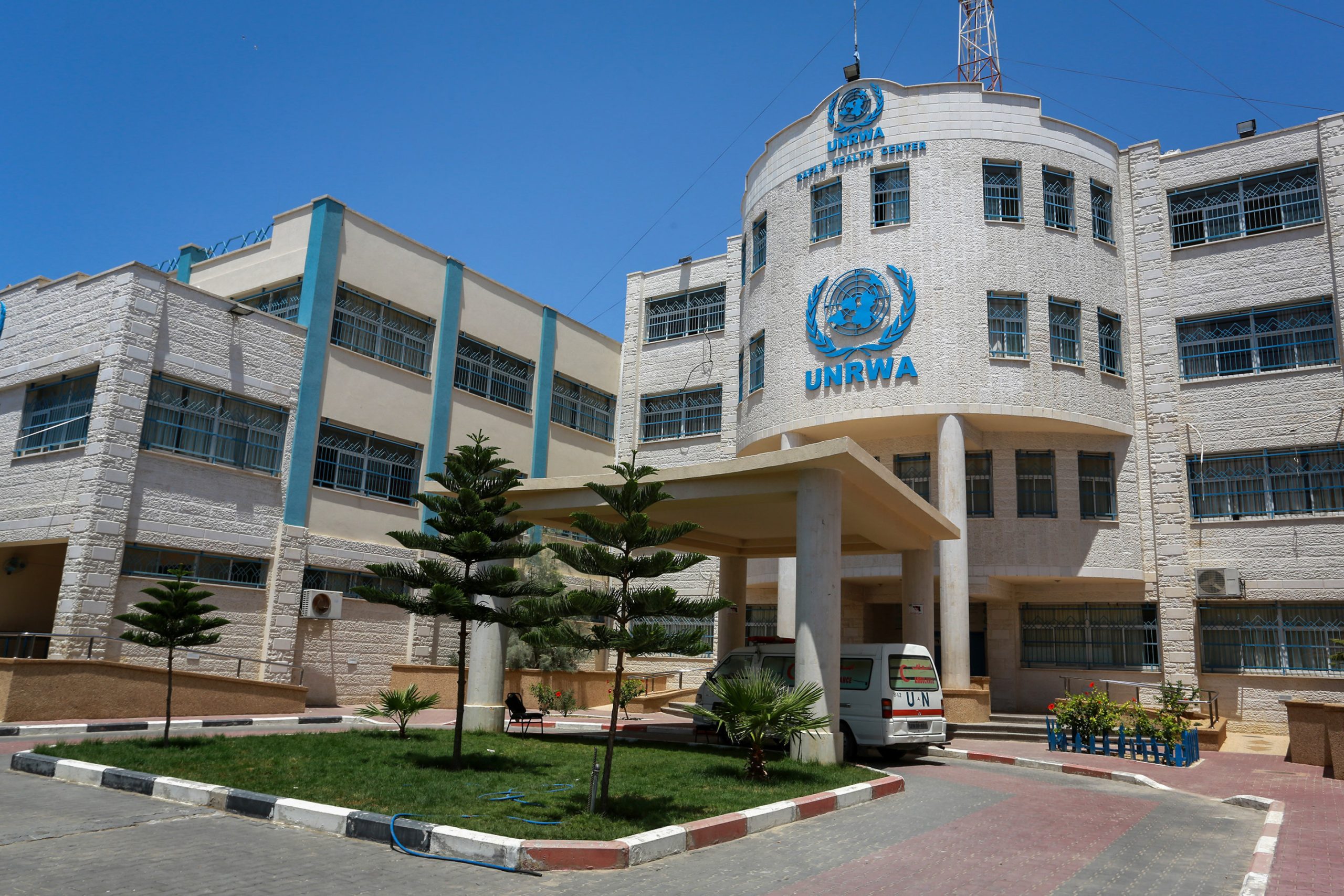
View of the United Nations Relief and Works Agency (UNRWA) building during a strike in Rafah in the southern Gaza Strip, on July 26, 2018. Photo by Abed Rahim Khatib/Flash90 *** Local Caption *** אונר"א
עזה
בניין
שביתה
TRANSLATED INTO HEBREW AND ENGLISH.
On March 7th, 2022 the Bedein Center for Near East Policy Research screens a short movie at the Israel Knesset Parliament , open to the public, which can be viewed on zoom in real time.
The movie “UNRWA Ignites Jerusalem”¸ invites diplomats who fund UNRWA to see the presentation, portraying how UNRWA incites Arabs in Jerusalem into violent rebellion – with footage shot on location, rarely seen in the mainstream media:
Armed UNRWA rioters demonstrating that Israel must remove the Jews from Jerusalem and from the Temple Mount, followed by interviews of young people conducted inside UNRWA, which present children, in their own words, expressing their determination to fight Israel to the death.
Following the movie, the Bedein center will share new Palestinian Authority textbooks which prepare UNRWA children for war, followed by a study which documents that UNRWA youth clubs inside UNRWA that preach armed rebellion against Israel authority over Jerusalem.
To produce this movie, and 22 earlier films, the Bedein Center engaged five journalists, fluent in Arabic, each of whom holds advanced degrees in Islamic Studies.
Invitation to view the movie by registering in person to come to the Knesset:
Link to Zoom:
https://us02web.zoom.us/meeting/register/tZErdO2vrzgsGd0IK0L4zUjGzS2gIhaV3IwK
or
https://tinyurl.com/2p84cc2c
Perilous omens
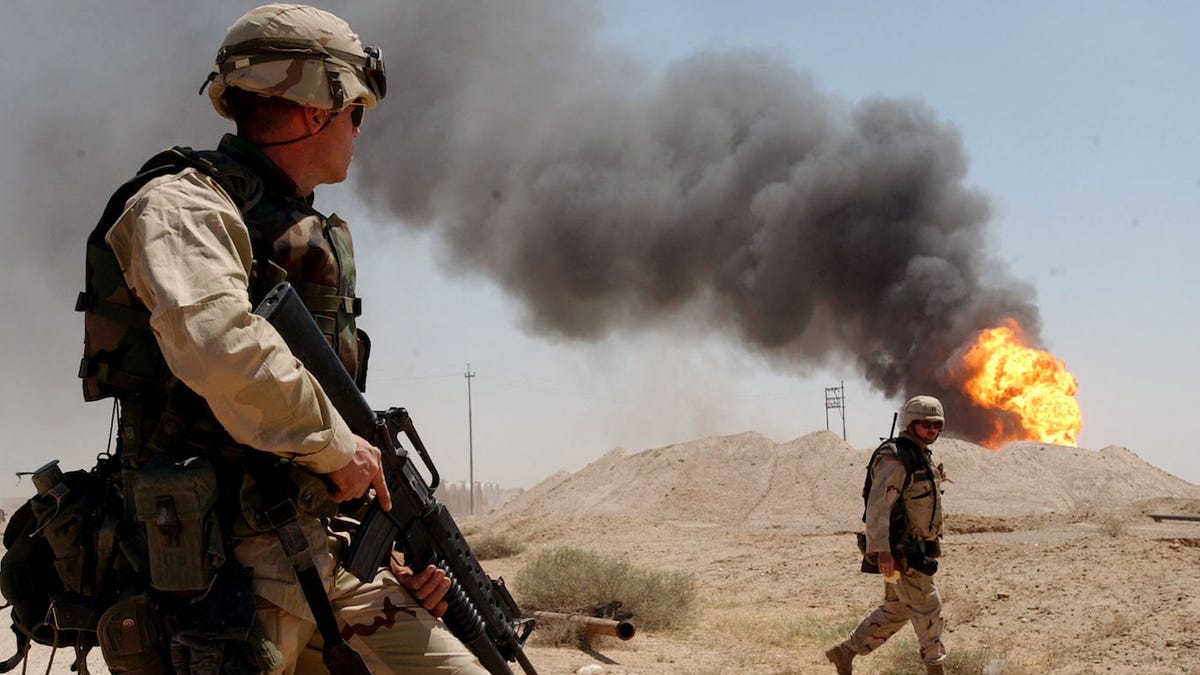
Quote: “There is something coming this way and I don’t want to be here when it arrives.”
Surveying the current international scene one cannot escape the inevitable conclusion that there is a multitude of potential disasters heading our way at breakneck speed.
Although some may still have a chance to get out of the way most of us have no choice other than to face the impending train wrecks.
While temporary band-aid fixes may delay the inevitable chaos it is a certainty that unless the lessons of the past are internalized we are headed down the same dead-end roads. Sweeping problems under the carpet and kicking them away for someone else to solve merely postpones the day of decision. It also emboldens those who threaten our democratic liberties and very lives to embark on ever more outrageous activities.
Those threatening our lives have an enormous advantage.
They sense the weakness and moral cowardice of the democracies and like the German Nazi regime before them they will plot their nefarious schemes accordingly. Every concession to terror, every gesture of appeasement and every sign of reluctance to stand with allies in any meaningful manner, will be a sign that they can literally get away with murder.
None of this is rocket science.
It is the law of the jungle, especially in a world where the institution originally created to prevent these scenarios has now been fatally infected with mankind’s longest surviving virus. When the United Nations and its associated groups can ignore gross human rights abuses and instead concentrate all its venom on the world’s only Jewish State then we know with absolute certainty that what is heading our way will have dire consequences.
The Ukrainian debacle is inexorably unfolding according to a well-defined script which any student of history or someone alive in the late 1930s would instantly recognize.
In the 18 February print edition of the Jerusalem Post, a prominent headline made me sit up in amazement. It read as follows:
“Harris off to MUNICH to reassure an edgy Europe.”
Obviously, the journalist responsible or perhaps his/her editor had no clue whatsoever as to the irony of this headline. How many readers picked up on this seemingly innocent statement? My guess is that very few gave it more than a second’s thought.
Therein lies the root of why today’s politicians, decision-makers and media purveyors of misleading news are blindly and blithely traipsing down the same old failed routes.
The last time a politician travelled to Munich to reassure an edgy Europe was Neville Chamberlain’s pilgrimage to appease Hitler and sell Czechoslovakia down the river. He succeeded brilliantly in this task and an edgy Europe at the time ecstatically embraced his “peace in our time” hallelujah” chorus.
Sending Vice President Harris of the USA as Joe Biden’s representative to Munich was a far more pathetic exercise as her grasp of the situation is almost zilch and her ability to reassure anyone is non-existent. Back in 1938, the French were desperate to avoid conflict and treaties notwithstanding, not a single democracy was prepared to snuff out Hitler’s territorial ambitions. Even when Poland was attacked in 1939 nothing could save it from being ravaged because years of impotent appeasement had merely emboldened the German plan for territorial conquest.
Today’s situation is almost identical. Frantic diplomatic posturing, empty threats and futile summit powwows only exposed the transparent lack of will to support Ukrainian sovereignty. The hollowness of any “guarantees” can already be seen as the USA suggests that the Ukrainian President should relocate to safety in the west of the country and futile appeals to an impotent United Nations are as effective as p……. in the wind. Biden suggests that the world pray for Ukraine and others issue meaningless hot air slogans. Futile international gestures such as lighting up cities in Ukrainian national colours and appeals for “peace” will of course not help the situation. It merely exposes the transparent bankruptcy of those who could have thwarted this in the first place.
The Russians, Chinese, Iranians and North Koreans having witnessed the debacle in Afghanistan and realizing that when it comes to the crunch neither the USA nor the UK and certainly not the EU will thwart terror and territorial ambitions in any meaningful way, can now plan their future strategies with confidence. Taiwan and South Korea should be taking note.
This should definitely be a sobering lesson for Israel. Once again it demonstrates the futility of relying only on the promises and “we’ve got your back” guarantees of those whose first actions when push comes to shove is to run to the UN and huff and puff with hot air. Sanction threats may sound impressive but as we can see with Iran unless there is a willingness to maintain them for the long haul and prevent rogue nations from circumventing them, that route is a dead end.
The perilous omens now on display are a warning for those of us who have not yet been seduced by hallucinatory mirages. Unfortunately but not surprisingly the hallucinators are still active. One of our own homegrown cheerleaders of the failed and disastrous Oslo non-peace accords which resulted in the murder and maiming of countless Israelis has just come up with yet another recipe for pie in the sky “peace.”
Grandly entitled “Holy Land Confederation,” this latest exercise in delusional leftist gestures, offers us a suicidal pact which makes Munich 1938 and 2022 look like child’s play in comparison.
At first glance, this messianic era document is a peacenik’s pipe dream with Jewish residents of Judea and Samaria living in a warm embrace with an equal number of Palestinian Arabs settling in a shrunken pre 1967 Israel. “Permeable borders” which is another name for EU type free movement of people without security checks across all territory is a feature of this plan.
If we were living with Swiss neighbours or perhaps peaceful Tongans in the idyllic South Pacific this vision of heaven might be feasible. However, as in the past, Yossi Beilin and his co-authors, are selling us a product as suspect as snake oil in the old American wild west.
Truth of course is anathema to those who strive mightily to create illusions which is why this following piece of reality translated by PMW never surfaces in the minds of those peddling flawed and fatal solutions: https://palwatch.org/page/29534
The usual suspects have already embraced this “Holy Land” delusional concoction. The UN Secretary General and the US Deputy Secretary of State, who incidentally in her previous incarnation under the Obama White House helped craft the Iranian nuclear enabling piece of paper, have already warmly endorsed the proposals. Waiting in the wings will be those individuals and groups normally biting at the bit to support each and every endeavour which weakens the Jewish presence in Israel and facilitates our eventual demise.
The perilous omens could not be clearer.
We ignore them at our peril.
Arguments and facts about UNRWA
David Bedein
Investigative Journalist and MSW, Community Organization practice,
Two months ago, the DIG Berlin organization from Brandenburg addressed the German Bundestag legislative body with a press release that “put UNRWA funding to the test”[1].
The content of this press release is an appeal to the new federal government of Germany with a proposal for an urgently needed reform process within UNRWA, the agency which aids the 5.3 million descendants of Arab refugees from the 1948 war.
UNRWA has attracted public attention in the past due to internal reports of fianancial misconduct.[2]
In response to this press release, Matthias Burchard, UNRWA Director of the EU Representative Office, wrote to DIG on December 21st, 2021.
In his response he claims, among other things, that the DIG is taking steps “against UNRWA”. This statement is intended to address Burchard’s respective statements.
With its UNRWA-Monitor.com initiative, the Bedein Center for Near East Policy Research in Jerusalem has drawn up specific demands for a reform process within UNRWA[3], which should be carried out by UNRWA donor countries – above all Germany as UNRWA’s largest donor to date.
It is very important to the Bedein Center that UNRWA aid money is supervised.
In the field of humanitarian aid, it is imperative to ensure that public funds are not embezzled, misappropriated or even distributed to members of EU-listed terrorist organizations such as Hamas, Islamic Jihad and PFLP – as UNRWA has been doing for years.
A reform process would help create transparency and implement quality assurance.
Introduction of UNHCR standards
Matthias Burchard addresses each of the demands of the UNRWA Reform initiative.
https://israelbehindthenews.com/2018/02/06/david-bedein-leading-fight-unrwa-reform-initiative/
He comments on the first point, the introduction of UNHCR standards, as follows:
“When providing services, UNRWA, like UNHCR, applies the internationally recognized “principle of family unity”, which you can read about on the website of the UN General Secretariat (see attachment). This was also confirmed by the scientific department of the Bundestag in 2019 .
UNRWA was explicitly not given a political mandate when it was founded, and thus no mandate for the return of refugees, as is falsely claimed.
A solution to the refugee issue was entrusted to the UN Reconciliation Commission for Palestine, which the United States still heads today. Among other things, because the UNCCP does not fulfill its task, the mandate of UNRWA is repeatedly extended by three years (in 2019 by 170 UN member states – see paragraphs 1&2 of the resolution).
However, UNHCR does have a mandate for return.
This is also UNHCR’s primary goal – as well as a WWII lesson – that refugees should, if at all possible, return to where they fled from. It is an internationally recognized right, but difficult to achieve. In 2019, UNHCR was able to repatriate just over 300,000 of the 26 million refugees it cared for together with numerous other UN agencies.
Unfortunately, there is an increasing number of long-term refugee situations (see US State Department overview of 2016). Therefore, the “family unit” law applies here. See above.
In 1948, the UNGA Resolution 194 established a refugee status for those who fled Palestine. UNRWA merely instituted 1,950 criteria and standards to reliably identify those eligible to be registered in the UNRWA registration system and receive the services.”
Contrary to what is often claimed, there is no “right to return” in the aforementioned Resolution 194: The fact that refugees “should” be allowed to return expresses a wish or an appeal – but nothing more. This is even clearer in the original English version, which states that the return “should” be made possible.[4]
And this desire was significantly weakened by the attachment of a crucial condition: Only those who would be willing to live in peace with their (Jewish) neighbors should be able to return. However, the resolution did not say how and by whom this readiness should have been established in the midst of the ongoing war that had been forced upon Israel by the Arab states. Without entering into the realm of speculation, it was clear to everyone that not all refugees met this criterion.[5]
In the beginning, UNRWA saw it as its main task to help the refugees to integrate and to strengthen the economy in the host countries so that the refugees could integrate and become independent. However, since the Arab states and the majority of the refugees firmly rejected this and instead propagated a non-negotiable right of return, UNRWA declares itself to be a kind of quasi-government that came up with large-scale supply services in the areas of education, health and social welfare.
Thus, over time, the refugees’ dependence on UNRWA grew more and more, and the Arab states in which the refugees and their descendants live, absolved themselves of responsibility for the well-being of the Palestinians – the same Palestinians who are otherwise relished as Arab brothers and sisters. In truth, however, they have primarily been used as a weapon in the propaganda war against Israel, and particularly in Lebanon, they are exposed to massive disadvantage and discrimination.[6]
The difference between UNRWA and UNHCR is striking: while UNHCR sees its task as solving the problems of their refugees, UNRWA’s policy is to perpetuate the difficulties of their refugees. If necessary, the UNHCR tries to find a new home for the refugees and helps them with the hurdles and formalities of immigration. UNRWA, on the other hand, as it wrote on the occasion of its 60th anniversary, “has no mandate to find lasting solutions for the Palestinian refugees”.[7]
Today, UNRWA is the largest single agency of the United Nations (and the second largest employer in the Palestinian territories after the Palestinian Authority). It employs more than 27,000 people – 99 percent of whom are Palestinians – and has
an annual budget of around 1.2 billion US dollars.[8] For comparison: the UNHCR has only around 17,000 employees, but they are responsible for 20.4 million refugees.[9]
UNRWA’s definition of who is to be considered a refugee has changed repeatedly since its inception. While neediness played a role at first, this criterion was later dropped. According to the current definition, a Palestinian refugee is anyone “residing in Palestine between June 1, 1946 and May 15, 1948, who lost his home or livelihood in the wars of 1948 or 1967”[10] – and all his descendants , even divorced spouses with a different nationality.[11]
This means that Palestinians inherit refugee status until they “return” to a country which they have never lived in. The overwhelming majority of the now more than five and a half million Palestinians who are registered as refugees with UNRWA and insist on their “return” – have never fled. Instead, that status is passed on to the
the descendants of initial refugees. Of the Palestinian Arabs who left the country during the 1948 war, it is estimated that around 30,000 were still alive in 2012.[12] Today this number is likely to be considerably smaller.
It should also be borne in mind that more than half of the Palestinian Arabs who fled in 1948 did not leave Arab-Palestinian territory at all, but resettled in the West Bank or in the Gaza Strip. Another 10 percent went to Jordan, whose territory was also part of Palestine until 1922. However, today millions of Palestinians live as refugees on Palestinian land, aspiring to return to a land where they have never lived. And UNRWA explicitly supports them in this. With their help, the Palestinians can hold on to their area of ??”return” to change the demographics in Israel so that the Jews would become a minority.
This is also precisely why the Arab states placed the issue of return as their priority, especially in the beginning: in this way they are trying to achieve what they had not been able to achieve by military means in the war against the Jewish state. In 1949, the Egyptian foreign minister explained this very clearly: “When the Arab states demanded that the refugees return to Palestine, they meant “that they should come back as rulers of the homeland, not as slaves.” To make it even clearer: they want to destroy the State of Israel.”[13] It goes without saying that no Israeli government – ??regardless of which parties belong to it – would accept such a thing.
In any case, there is not a single case in the world in which a refugee problem or even a political conflict was solved by a mass return, as the Palestinians are demanding – not even in former Yugoslavia in the 1990s, although there was an explicit agreement to provide for the repatriation of refugees and displaced persons, especially in Bosnia-Herzegovina.
Abolition of PA curriculum in UNRWA schools
Matthias Burchard writes on the absorption on of the PA curriculum at UNRWA schools:
“Since its inception, and in line with UN practice in refugee situations around the world, UNRWA has used the “host country” curriculum. This ensures that Palestinian refugees can integrate into the receiving secondary and higher education system and also participate in the social and economic life of the receiving country.”
However, this argument is devoid of reality and bears no relation to actual UNRWA policy. UNRWA’s mandate does not include integration into a host country and thus participation in social and economic life. To date, there are neither programs for the very integration Burchard mentioned, nor are there efforts to initiate such programs.[14]
In its policy, UNRWA pursues a quasi-governmental orientation with its own infrastructure and educational facilities. Children and young people do not attend the schools in the host countries, but UNRWA’s own schools. It is highly questionable why the curricula of the host countries are used at all. It would make more sense for UNRWA to develop its own teaching system that truly conforms to UN values. UNRWA spokesman repeatedly emphasized that the curriculum used by the Palestinian Authority would correspond to UN values.
Burchard goes on to write:
“The UN, like UNRWA, has no mandate to change curricula or textbooks of the host government, as these are subject to national sovereignty. Nevertheless, UNRWA regularly reviews all newly published host country textbooks and works to ensure that what is taught in UNRWA schools is consistent with UN values ??and principles. This robust system of reviewing host country textbooks helps ensure UNRWA’s zero-tolerance policy towards all forms of racism and discrimination.”
Burchard refers to a study commissioned by the EU by the Georg Eckert Institute (GEI)[15], the results of which were recently published:
“UNRWA welcomes the Georg Eckert Institute’s (GEI) independent scientific and empirical assessment of the teaching materials published by the Palestinian Authority (PA). This EU-commissioned analysis of textbooks published by the Palestinian Ministry of Education (MoE) between 2017 and 2019 offers an objective perspective.
UNRWA is pleased that the GEI’s findings are consistent with its own reviews for the classes it has established. The findings categorically affirm that the textbooks used by the PA “comply with UNESCO standards and adopt criteria prominent in international educational discourse, including a strong focus on human rights.”
The Middle East expert Dr. Arnon Groiss,a journalist who has been examining the PA instruction manuals used in UNRWA schools for more than 20 years to determine whether they really – as UNRWA repeatedly claims – meet the standards of the UN and UNESCO. Here he comes to a completely different conclusion. A March 2021 report shows recent examples from UNRWA textbooks. It has been translated into English and is available online.[16]
Dr. Groiss expresses great concern about this and writes: “One of the most serious examples in the textbooks is even mistranslated in the GEI report.”
In a statement, he goes into detail about the GEI study.[17] He names relevant textbook examples that were either ignored or completely misinterpreted when the GEI study was conducted.
One of the most egregious examples is a poem that appeared in a third-grade textbook between 2017 and 2019, expressing genocidal intentions toward the Jewish citizens of Israel. It says:
I swear! I shall sacrifice my blood
In order to water the land of the noble ones
And to remove the usurper [i.e., Israel] from my land
And to exterminate [ubid] the foreigners’ remnants
O land of Al-Aqsa [Mosque] and the holy place
O cradle of pride and nobility
Patience, patience, for victory is ours
And dawn is peeping from the darkness”
(Our Beautiful Language, Class 3, Part 2 (2019), p. 66. This poem was replaced with a less violent one in the 2020 textbook edition, as mentioned in the GEI report on p. 139.)
 The word “eradicate” (Arabic: “ubid” – ?W?? line 2, section 2, first word) is omitted from the translation of the GEI report. There it says instead: “…to expel transgressors and strangers from my land….”[18]
A murderously charged teaching content is presented distinctly in the PA textbooks and thus played down. A case of translation errors is such a problem for a scientific work such as the GEI study presents. It stands to reason that an approach is being taken that is biased and that an attempt has been made to hide uncomfortable evidence – particularly when it concerns a popular poem read in many UNRWA schools.[19]
Dr. Groiss noted that even in the summary of the report, the GEI half-heartedly conceded:
“The textbooks reaffirm the importance of human rights in general and, in several places, explicitly emphasize a universal notion of these rights. However, this universal notion WILL NOT be carried into a discussion of Israeli rights. (p. 3)
A textbook presents a learning context that reveals both anti-Semitic motives and links characteristics and actions attributed to Jews in the early days of Islam to the current Israeli-Palestinian conflict.
The mapping of Palestine as a political entity, geographic region, or imaginary homeland generally does not include the State of Israel or cities founded by Jewish immigrants.
The term “Israel” is relatively rare, while the term “(Zionist) occupation” dominates in school textbooks.
The acknowledgment of Israel’s right to live in peace and security documented in Yasser Arafat’s letter to Yitzhak Rabin contrasts with the questioning of the legitimacy of the State of Israel expressed in other passages and textbooks.
Arabic language textbooks contain emotionally charged depictions of random violence that tend to dehumanize the infinite adversary, the latter occasionally becoming the object of malice and deceit… perpetrated violence, including violence against civilians, is presented as a legitimate means of resistance… (p. 4)
In numerous places, the textbooks call for tolerance, mercy, forgiveness and justice and encourage students to help others, fight corruption and respect human values. They do not apply these ideas to Israel and the Israeli-Palestinian conflict.
When the issues of… coexistence and tolerance are raised, no reference to the current conflict will be made. (Conclusion, p.170)”
This is only part of the whole picture given by the books used in UNRWA schools.
Since the GEI refrained from providing further examples that would note a negative impression of the PA and UNRWA’s attitude towards Jews and Israel – which clearly contradicts UNESCO and UN principles – here are a few more examples that the GEI report does not take into account:
- Elementary school students learn in National and Social Education that the State of Israel will be replaced by Palestine as the “sovereign state” in the region:
“[Lesson] 2: Palestine is Arab and Muslim”
In this lesson, a map entitled “Map of the Arab Homeland” is presented. On this, the whole country (and thus also the national territory of Israel) is filled in red, “Palestine” is written next to it, and the Palestinian flag can be seen above it.

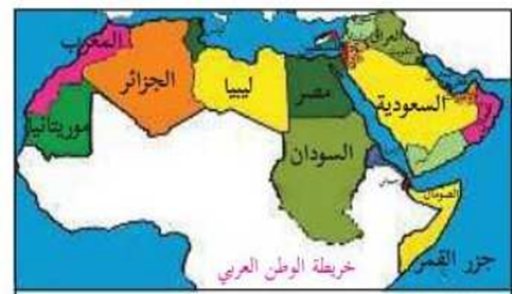 (National and Social Education, 4th Grade, Part 1 (2020), p. 8)
- Israel counts within its pre-1967 borders as Palestinian territory occupied in 1948 – with a very clear indication that it “liberated”, i. H. should be eliminated. Instead of the expression “Israeli territory” the term “the territories occupied in 1948” is used in the following example (math problem):
“The following graph illustrates the number of Palestinians in 2015 according to the Palestinian Statistics Center:
Region Population The West Bank and Gaza Strip
4,750,000
Within the territories occupied in 1948 1,470,000 In the Arab States 5,460,000 In other (foreign) states 685,000
I rank the regions where the Palestinians can be found in descending order of population:
[four empty squares]”
(Maths, Grade 4, Part 1 (2020), p. 22. Emphasis added.)
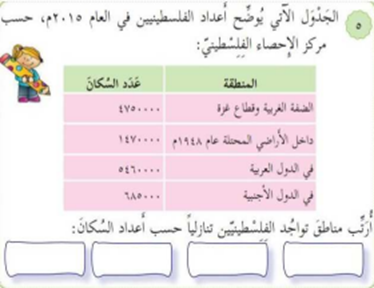 There is no place for Israel in free Palestine:
(Wissenschaft und Leben, 3. Klasse, Teil 1 (2020), S. 65)
 In the UNRWA textbooks, the war against Israel is given a religious character and Jews are demonized as infidels and helpers of the devil, as illustrated by the following verse from a poem:
“Where are the riders [who will ride] to Al-Aqsa [Mosque],
to free her from the grip of unfaithfulness, the helpers of the devil?”
(Arabic Language, 7th Grade, Part 1 (2020), p. 67)
Note: There is no new edition of the textbooks for the current school year 2021/22 and the teaching materials of the previous year are used.
- In the PA textbooks, as used by UNRWA in classes of all ages, there is neither a promotion of neutrality nor peace and understanding.
- Instead, war, non-recognition of the sovereignty and territorial integrity of the UN member state of Israel, and anti-Semitism against the “devil’s helpers” are propagated.
- Overall, this is a breach of UNRWA’s commitment to ensuring the safety and well-being of the children and young people in its care. At the same time, UNRWA is cooperating with the PA in inciting young children to go to war.
Continuation of paramilitary training at UNRWA schools
Not only the school lessons serve to incite, but also leisure activities in the youth clubs and activities during the summer holidays.
Hamas summer camps have been held in the Gaza Strip for many years. In addition to UNRWA Monitor, the media and the IDF[20]also reported on the annual summer camps in the Gaza Strip.
Matthias Burchard comments on this as follows:
“There is no and never was aspired training at UNRWA schools. Again, your source is probably the UNRWA-Monitor, which shows videos – taken from the Hamas website – in order to blame UNRWA. These are hateful and blatant falsehoods with defamatory and misleading information.”
Burchard is probably talking about the documentary film that was published in German in August 2021.[21] These are film recordings by the Bedein Center and its UNRWA Monitor initiative. They were not taken from the Hamas website, nor do they contain untruths with slanderous and misleading information.
Burchard seems unaware that Hamas in the Gaza Strip is recruiting very young children, all of whom are UNRWA students, to be child soldiers. Hamas members are currently employed as teaching staff at UNRWA schools. Instead of showing children a perspective for peaceful coexistence with their neighbors, UNRWA leaves its wards to an EU-listed terrorist organization.[22]
This documentary clearly indicates what really happens with the donations from the UNRWA donor countries, 58 percent of which flow into the education sector.
In plain language, this means that 58 percent of the funds available to UNRWA – thanks to donations – are exclusively used for incitement, violence, anti-Semitism, military training and the recruitment of child soldiers. The latter constitutes an explicit violation of the Geneva Convention and the Convention on the Rights of the Child under international law.
Dismissal of all UNRWA staff with ties to Hamas
Another demand is the dismissal of all UNRWA staff associated with an EU-listed terrorist organization such as Hamas. Burchard writes:
“As a neutral and impartial UN organization, UNRWA has a legal framework for its operations that ensures the neutrality of the United Nations towards staff, third parties, including partners, the use of UNRWA facilities and the provision of assistance to refugees. There are verifications and due diligence procedures in place to ensure UNRWA does not work with third parties that are on the Consolidated UN Sanctions List. The US requires UNRWA to undergo an annual anti-terrorism review — a standard procedure for US foreign aid that UNRWA has passed uncomplained for decades.”
In full compliance with UN best practice, UNRWA is committed to doing everything in its power to ensure the highest standards of internal and external security control. This includes but is not limited to semi-annual verifications of the names of all employees, donors, beneficiaries and suppliers against the UN sanctions list and the annual release of employee lists to host country authorities, including the State of Israel.
It is more than questionable whether such verification measures really take place at regular intervals.
As early as 2009, the Center for Near East Policy Research wrote a report commissioned by the European Parliament EU Commission which documents the Hamas takeover of the UNRWA teachers association and UNRWA workers union in Gaza.
In the course of the conflict between Hamas and Israel in May last year, a terrorist tunnel was found beneath UNRWA schools. As early as 2014, it was confirmed that rockets were fired at cities in Israel from UNRWA schools.[23]
UNRWA itself states on its website that it is responsible for at least 1.4 million refugees in the Gaza Strip (as of May 2021). This makes up 75 percent of the population. 290,000 students attend the 278 UNRWA schools in the Gaza Strip.
It was children from UNRWA Camp Deishe who “celebrated”[24] the founding day of Fatah with automatic weapons a little over a month ago – on January 1, 2022. On August 24, 2020, images were captured that clearly show UNRWA students being implicated in terrorist activities by Hamas and Islamic Jihad earlier in the school year.[25]
This is merely one example of the footage which clearly demonstrates how children from UNRWA schools have been involved in military training and terrorist activities for many years. There are no “untruths with slanderous and misleading information”, as Matthias Burchard claims – but only an unfortunate and bitter reality.
Approval of all UNRWA staff associated with Hamas
Another demand made of UNRWA is the dismissal of all UNRWA staff associated with an EU-listed terrorist organization such as Hamas. Burchard writes:
“As a neutral and impartial UN organization, UNRWA has a legal framework for its operations that ensures the neutrality of the United Nations towards staff, third parties including partners, the use of UNRWA facilities and the provision of assistance to refugees. There are verification and due diligence procedures in place to ensure that UNRWA does not work with third parties that are on the Consolidated UN Sanctions List. The US requires UNRWA to undergo an annual anti-terrorism review — a standard procedure for US foreign aid that UNRWA has passed without complaint for centuries.
In full compliance with UN best practice, UNRWA is committed to doing everything possible to ensure the highest standards of internal and external security control. This includes but is not limited to semi-annual verifications of the names of all employees, donors, beneficiaries and suppliers against the UN sanctions list and the annual release of employee lists to host country authorities, including the State of Israel.”
It is more than questionable whether such verification measures really take place at regular intervals.
As early as 2009, the Center for Near East Policy Research wrote a report for the EU Commission that clearly proves the Hamas takeover of all UNRWA teachers’ associations and unions.[26]
2017 dismissal and severance letters relating to Hamas official Suhail Al-Hindi show that UNRWA only split after public pressure from Hamas members.[27] They also state that Al-Hindi received a severance payment of 177,000 US dollars. The documents were signed by Al Hindi and UNRWA’s founder, Commissioner General Pierre Krähenbühl (see appendix).
UNRWA Commitment
Matthew Burchard writes:
“UNRWA has been working for 70 years in one of the world’s most difficult regions, one marked by violence and conflict. UNRWA is a United Nations humanitarian agency committed to the humanitarian principles of neutrality, impartiality and independence because this is what enables our work and ensures the safety of our staff.
UNRWA is also expanding its school education through U.S. and Norwegian-sponsored human rights, conflict resolution and tolerance education applied in all schools, and a public, centralized digital learning platform with learning materials for teachers and students.
In our opinion, such attacks by the DIG B&B as those on UNRWA are hardly compatible with your statute, which aims to promote international solidarity, tolerance and understanding between people, especially in the Middle East.
UNRWA therefore calls on the DIG B&B to engage in dialogue and to refrain from spreading objective untruths and to immediately delete such content from its website.”
The Palestinians’ insistence on a “return” of 5.3 million descendants of the refugees from the 1948 war follows the goal of destroying Israel on a demographic basis.
Additionally, it is an attempt to reverse the results of a war started by the Arab states against the Jewish state – not the other way around. The alleged right of return of the Palestinians is not guaranteed under international law, nor does the existence of their own UN refugee agency, which actively promotes the Palestinian illusion of a return, have anything to do with it. It is a dangerous illusion that burdens every negotiation and makes it impossible to resolve the conflict.
UNRWA is part of the problem, not part of the solution, and its alleged education in tolerance is in fact the opposite. Criticism of UNRWA and calls for a policy change should be adhered to.
[1] https://www.digberlin.de/pressemitteilung-unrwa-finanzierung-auf-den-pruefstand-stellen
[2] https://www.audiatur-online.ch/2019/11/14/das-palaestinenser-hilfswerk-unrwa-ist-ein-friedenshindernis
[3] https://unrwa-monitor.com/die-unrwa-reform-initiative
[4] https://www.unrwa.org/content/resolution-194
[5] https://www.mena-watch.com/gibt-es-ein-palaestinensisches-rueckkehrrecht
[6] see Roberts, Rebecca: Flüchtlinge zweiter Klasse: Palästinenser im Libanon, Bundeszentrale für politische Bildung, 26. Mai 2016, https://www.bpb.de/gesellschaft/migration/laenderprofile/228365/palaestinenser-im-libanon
[7] Bartholomeusz, Lance: The mandate of UNRWA at sixty, UNRWA, 1. Januar 2010, https://www.unrwa.org/userfiles/201006109246.pdf
[8] see UNRWA in figures, 31. Dezember 2019, https://www.unrwa.org/sites/default/files/content/resources/unrwa_in_figures_2020_eng_v2_final.pdf
[9] see UNHCR: Figures at a Glance, 18. Juni 2020, https://www.unhcr.org/figures-at-a-glance.html
[10] see UNRWA’s own definition on their website: https://www.unrwa.org/palestine-refugees
[11] see Hafner, Georg M./Schapira, Esther: Israel ist an allem schuld. Warum der Judenstaat so gehasst wird, Köln 2015, p. 279.
[12] see Schanzer, Jonathan: Status Update, Foreign Policy, 21. Mai 2012, https://foreignpolicy.com/2012/05/21/status-update/
[13] quote, Dershowitz, Alan: The Case for Israel, Hoboken 2003, p. 85.
[14] Incidentally, Jordan is an exception when it comes to integration. Many former UNRWA refugees and their descendants have already been taken in by Jordan and have thus been able to lead a self-determined life as citizens.
[15] http://www.gei.de/de/abteilungen/wissen-im-umbruch/analyse-palaestinensischer-schulbuecher-paltex.html
[16] https://israelbehindthenews.com/2021/05/27/textbooks-used-in-unrwa-schools/
[17] https://israelbehindthenews.com/2021/10/06/comments-on-the-2021-georg-eckert-institutes-report-on-palestinian-textbooks/
[18] https://owncloud.gei.de/index.php/s/FwkMw8NZgCAJgPW, p.139: „ […] to kick out the violators and strangers from my country.”
[19] https://youtube.com/watch?v=Yan7tf3E6UU
[20] https://www.youtube.com/watch?v=fk3z5E4fEBI – here kids are to be seen with weapons in schools.
[21] https://www.youtube.com/watch?v=IprQEXzwZVY
[22] https://www.mena-watch.com/die-kindersoldaten-der-hamas-2
[23] https://www.mena-watch.com/das-un-palaestinenserhilfswerk-ein-werkzeug-der-hamas/
[24] https://vimeo.com/662065494?embedded=true&source=vimeo_logo&owner=81933074 – “Fatah Day” – UNRWA Deishe Refugee Camp (2022)
[25] https://vimeo.com/449054907, Film: “UNRWA Terror Balloons” (2020)
[26] https://israelbehindthenews.com/library/pdfs/UNRWA%20in%20Gaza%20and%20Terrorist%20Organizations%20A%20Cooperative%20Relationship.pdf
[27] https://www.terrorism-info.org.il/en/21194/
Head of UN Probe on Israel Accused of Prejudice, Watchdog Calls on Her to Resign
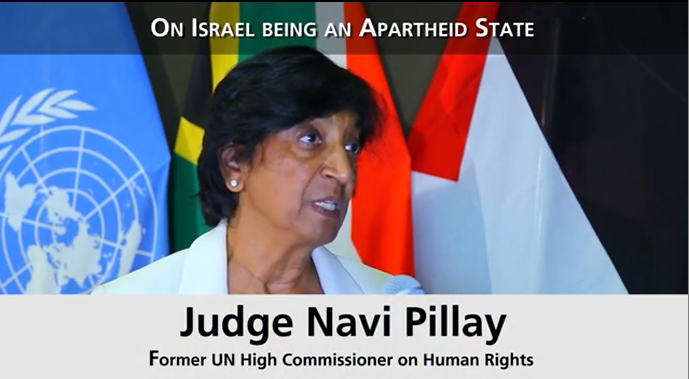
The head of a new United Nations inquiry into last spring’s Hamas-Israel war was accused today of making prejudicial statements on the issues under investigation, compromising her impartiality, and was asked to recuse herself in a legal brief filed today with the UN by a Geneva watchdog group, which has also launched an online petition.
According to the 30-page complaint submitted today by UN Watch, an independent non-governmental organization that monitors the world body, Navi Pillay, a retired South African judge and former UN human rights chief, violated UN rules by failing to disclose numerous of her prior statements that directly prejudge the matters before the inquiry.
“Many of the utterances in question occurred mere weeks before she was appointed by the UN this summer, leaving little room to imagine how Pillay could envisage the issues any differently so soon afterwards,” said Hillel Neuer, Executive Director of UN Watch and an international human rights lawyer.
In a June 14, 2021 joint letter to U.S. President Joe Biden, Pillay decried Israel’s “domination and oppression of the Palestinian people,” calling on the U.S. to “address the root causes of the violence” by ending Israel’s “ever-expanding discrimination and systemic oppression.”
Meanwhile, a key focus of the UN inquiry headed by Pillay is the examination of “root causes of current tensions” between Israelis and Palestinians, including alleged “systematic discrimination.”
In her letter to Biden, Pillay further wrote that the April clashes at Al Aqsa in Jerusalem—also to be examined by the inquiry—constituted “aggressive actions by Israeli forces” against “peaceful protesters and worshippers,” which amounted to “forced dispossession of Palestinians,” the “latest evidence of a separate and unequal governing system.”
According to Neuer, “it is astonishing that the United Nations appointed an individual as the supposedly impartial chair of an inquiry immediately after she declared one of the parties guilty in the very controversies that are at issue in the investigation.”
“By heading this inquiry despite having repeatedly declared Israel guilty of precisely the crimes that she is supposed to investigate, Navi Pillay embodies the injustice of the UN and its human rights council when it comes to the selective treatment of the Jewish state,” said Neuer.
While the inquiry is mandated to examine “systematic discrimination” on the basis of race, ethnicity or national origin, in June 2020 Navi Pillay signed a petition, organized by the South African Boycott Divestment and Sanctions (SA BDS) Coalition, entitled “Sanction Apartheid Israel!”
In a May 2021 lecture, Pillay described Israel’s treatment of the Palestinians as “inhuman.” She compared Israel to apartheid South Africa, and defended the systematic singling-out of Israel under a targeted agenda item at the UN Human Rights Council.
“Apartheid is now being declared a crime against humanity in the Rome Statute, and it means the enforced segregation of people on racial lines, and that is what is happening in Israel,” said Pillay in November 2017.
On May 31, 2010, while serving as UN High Commissioner for Human Rights, Pillay declared that “the Israeli Government treats international law with perpetual disdain.”
“Never throughout her UN tenure did Pillay use such dismissive language regarding any other country—not even against serial abusers such as China, Russia, Iran, Syria or North Korea,” said Neuer.
“From her statements, it is clear that in Pillay’s eyes, Israel is a cruel and oppressive colonizer, and a racist regime. Her narrative of who is the villain is set in stone. Ms. Pillay has long ago made up her mind.”
“Asking Navi Pillay to head an inquiry examining Israel is like asking a vegetarian to review a steakhouse,” said Neuer. “When it comes to Israel, as our legal brief demonstrates, Pillay is the complete opposite of impartial.”
“The legal test is the appearance of bias, and there’s no doubt that Pillay fails the test. We are therefore calling on her to do the right thing, and to resign immediately.”
In contrast to UN Secretary-General Ban Ki-moon and her predecessor High Commissioner Louise Arbour, who had both criticized the UNHRC for its notorious agenda item targeting Israel, Navi Pillay stood out by repeatedly trying to defend this discrimination, in remarks made for example in Italy, Kuwait and South Africa.
In 2009, Pillay headed the UN’s follow-up to the 2001 Durban conference on racism, an event tainted by unprecedented displays of antisemitism.
When Jewish community activists around the world sounded the alarm, Pillay repeatedly demonized them at the UN and in the media as “lobby groups” that were “focused on single issues.”
Neuer said that Pillay needs to consider the principles she was sworn to uphold.
“We are calling on Ms. Pillay, as a former UN human rights chief, to respect the impartiality obligations set forth in the UN Declaration on Fact-Finding, the impartiality guidelines published by her former office, and her own solemn undertaking that she recently gave, on becoming chair of the inquiry, to be impartial.”
“As a former judge on international tribunals, Ms. Pillay must know that their precedents clearly disqualify a judge who had made prior, partisan statements declaring the culpability of one of the parties.”
“it is frankly impossible to imagine how Navi Pillay could lead an impartial investigation into the events of April-May 2021, as well as into alleged systematic discrimination, given what she has already declared on all of these. A reasonable person would consider Navi Pillay to be partial, thereby disqualifying her from serving as a member of the inquiry.”
“If the United Nations and its Human Rights Council are to live up to their founding principles of universality, impartiality, objectivity and non-selectivity, then Navi Pillay cannot be a member, much less the chair, of this Commission of Inquiry.”
“Accordingly, today we are calling on Ms. Pillay to recuse herself. In the event that she refuses to do so, we request Federico Villegas, the President of the Human Rights Council, to remove her.
The commission of inquiry was created at a May 27, 2021 session initiated by the Palestinians together with Pakistan on behalf of the Islamic states. No Western democracy voted for the inquiry, which is unique because its term has no end.
The report of the 3-person probe is to be presented in June 2022 in Geneva. The UN budgeted a record amount of several million dollars for the inquiry, which is expected to hire more than 20 staff to prepare their first report.
Palestinian Arab children in cages?
As a journalist who has covered Palestinians who live in the UNRWA refugee camps since 1987, I have filed a cordial request of the Palestine Chroniicle to provide any kind of documentation to this claim which was published on its site that Israel confines Palestinian children to cages, as the Palestine Chronicle has reported..
Explaining The Iron Dome – What Is This Metaphorical “Invisible Shield”?
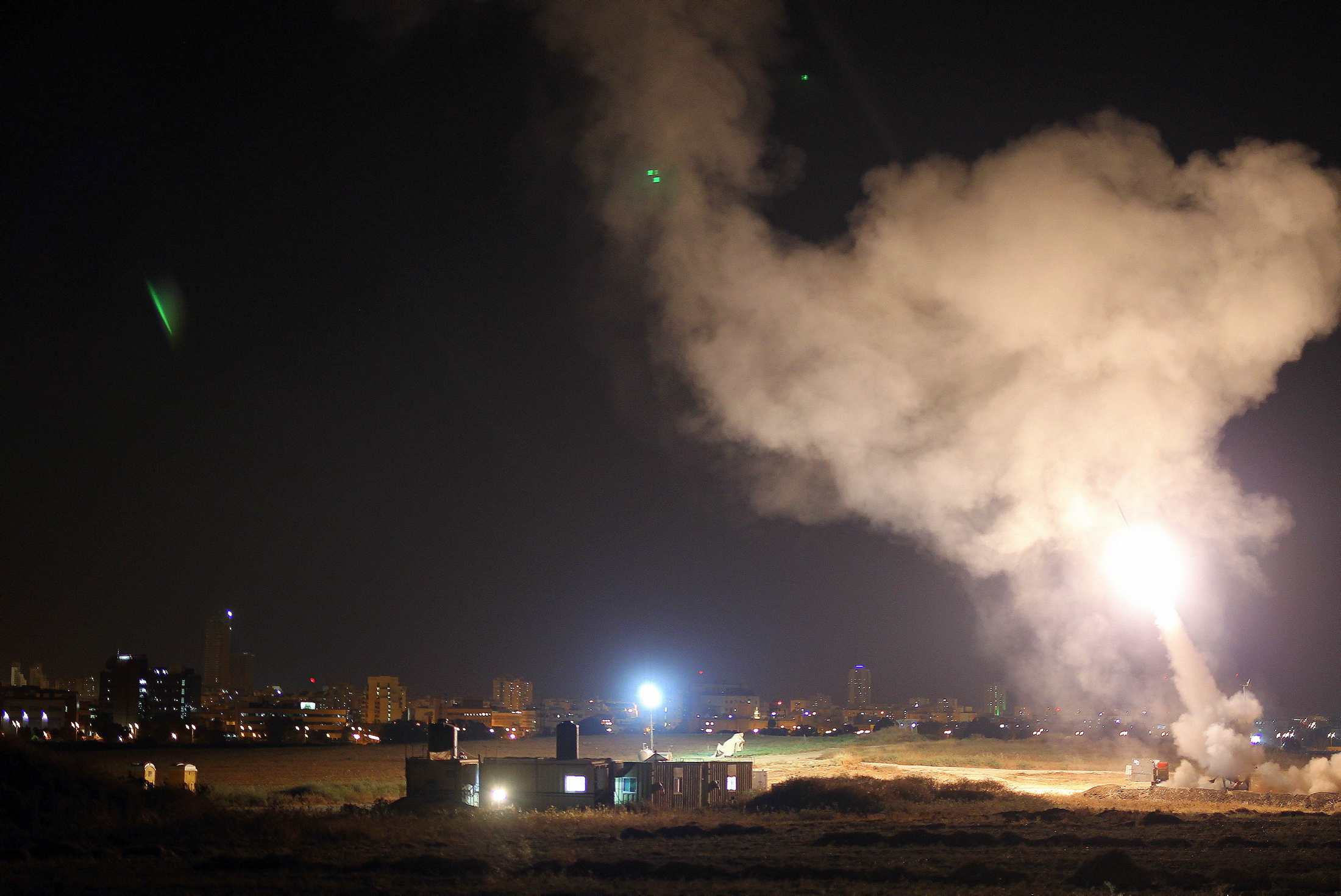
כיפת ברזל ב אשדוד
In the Bible chapter Judges, biblical figure Samson used a donkey bone jaw as a weapon. Also in that same chapter, a tent peg, millstone and a host of other odd weapons are used. Rather than the primitive makeshift weapons of the era, the Iron Dome of today is in stark contrast, a 21st century marvel and not really ‘a massive iron shield’ per se, but a metaphorical name for a defense system that ‘shields’ the nation. Although this dome does not have a 100% effectiveness, it is something many feel is necessary and even launched a kid’s toy line due to popularity. As Hamas attacks have become very frequent and Iran with it’s proxies rhetoric of destroying Israel continues, the Jewish state’s goal to survive is something it can’t be complacent about.
כיפת ברזל ב אשדוד
Videos on social media last year showed rockets fired from Gaza crumble upon impact as if they struck an invisible and impenetrable barrier. The roots of this invisible ‘shield’ go back to the aftermath of the 2006 Israel-Lebanon war, when Iranian proxy, I Hezbollah fired a volley of seemingly innumerable rockets unto Israel. The latter was still recuperating from 2 intifadas prior and a series of suicide bombings. This made the Israelis realise that they had entered a new era in warfare and had to adapt or face more destruction. So in 2007, they announced that the state-run Rafael Advance Systems would concoct a new, innovative technology system meant to defend the nation and with assistance from Israel Aerospace Industries, conceived the Iron Dome system. Again, is not a huge iron barrier that encapsulates Israel like a massive Berlin Wall or Great Wall of China – no, this is a more metaphysical concept.
How it works is multifaceted – firstly, Iron Dome’s radar is able to detect incoming rockets upto 70 km away. The second component is the battle management and weapons control (BMC), which calculates the trajectory to determine whether or not an incoming will hit a zone of human habitation or an empty area. The operater has to make a decision in the blink of an eye. While the Iron Dome is active, targeted residents still have to flee to air raid shelters when a barrage of rockets fly. If they do calculate that rockets will hit an uninhabited area, then they don’t deploy. The system’s success rate is 90 % – this definitely diminishes Hamas’s attacks, but even a 10% miss rate means that although loss of life is mitigated, it is not completely inevitable.
A battery has 3-4 rocket launchers with 20 missiles each. They do not truly strike the incoming projectile as we assume but rather explode when they get close by and this destroys the incoming in the process. The debris from such explosions can still do damage to people and the environment as it falls on the ground below.
Many critics have also mentioned costs: yes, to counter an enemy rocket, is an expense task that does not favour Israel. Each battery, costs over $50 million, and one interceptor Tamir missile costs approximately $80,000. In contrast, a cheap Hamas missile costs a mere 500$ to produce. So, that equals 2 Tamir missiles deployed to intercept each Hamas rocket. If you do the math, for every rocket Hamas or Hezbollah uses, Israel spends over 300 times to deter. Israel’s military budget of 5% of its GDP is already one of the highest in the world. This is money that they could potentially use for infrastructure, education or a slew of other projects.
On the news and social media, we saw dark skies, illuminated by hurling fireballs and sirens wailing away, reminiscent of alien invasions or apocalyptic battles in film. Also, if you think deep, it seems very surreal that a nation in 1948, fended off a host of Arab enemies with the most basic Czechoslovakian-made weapons and now has evolved in a mere 3 generations to having a sophisticated defense system that is the envy of most large nations – and this is while we still have veterans of the 1948 war still living among us. Since 2010, the US has also donated massive amounts of aid to help keep the state of the art defence project afloat.
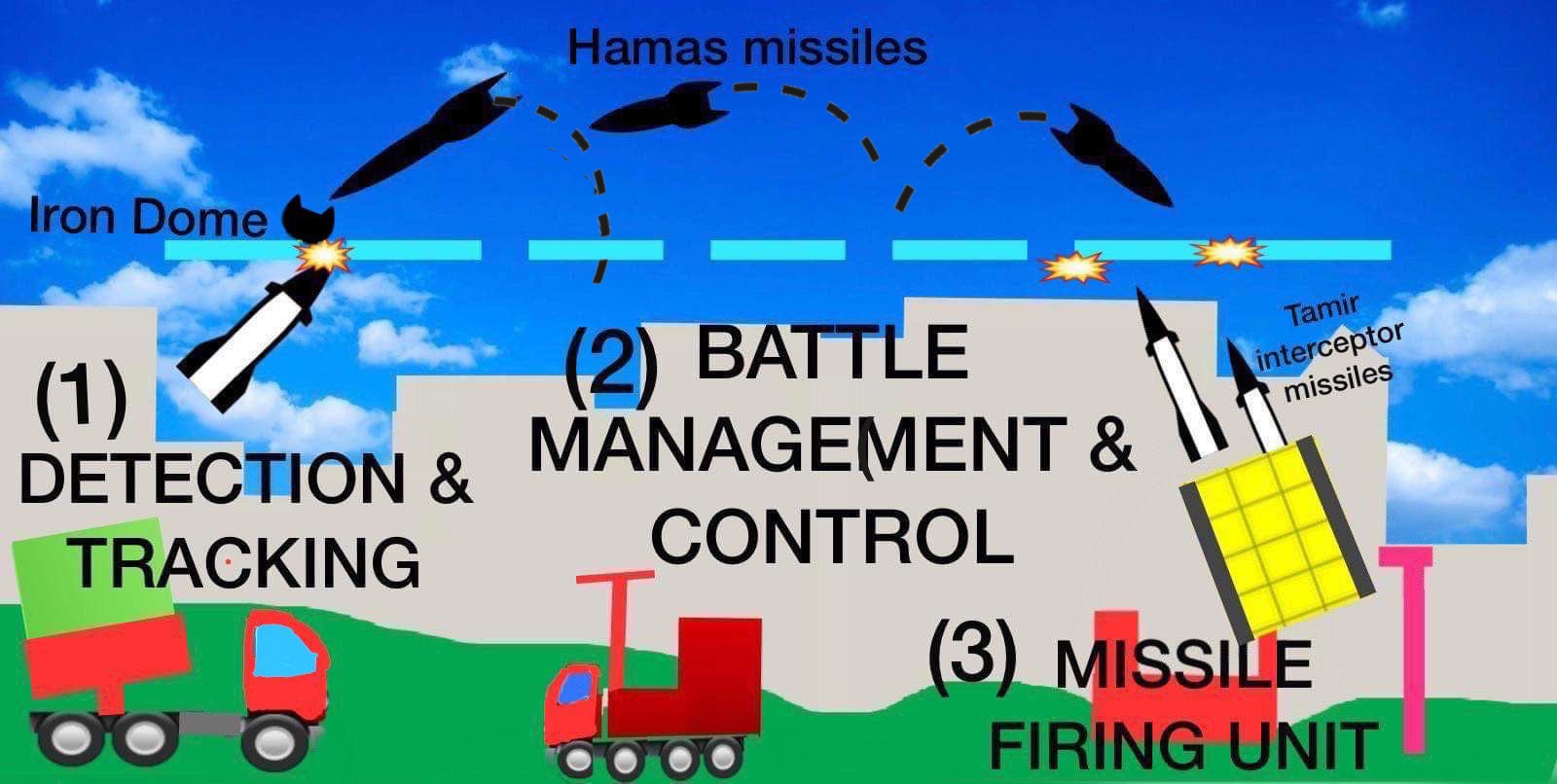
The Dome is also designed to operate in all weather patterns, including fog, rain or snow. In addition, there are Iron Dome installations across the nation. Most are situated strategically in close proximity to Hamas territory. There is also an installation in Tel Aviv. These are also mobile and can be transported by trucks if the need arises and cover more ground (or air). In 2016, Hanan Shpetrik, an Israeli toy car designer, came up with a kid’s toy version of the Iron Dome. Who knows maybe a Transformers movie character morphing into an Iron Dome could be next? Shpetrik in an exclusive interview revealed that the die-cast models were a limited edition of 2000 toys.
So, while the dome was built initially to deter Hezbollah in Lebanon, it evolved into a system that has been used against Hamas in Gaza more so. Still, Hezbollah keeps arming itself and now has an estimated tenfold the arsenal it had in 2006. The Lebanese militia probably have more firepower than some small NATO nations and more-so than, the Lebanese Army. So, Israel has to be ready to counter anything thrown its way. This year, Iran’s proxy in Yemen, Houthis conducted not 1 but 3 brazen attacks on the UAE and has conducted many attacks on Saudi Arabia prior. While Hezbollah and Hamas are on the Israeli borders, who knows if in the near future, Iranian proxy Houthis’ missile ranges could increase? UAE is around 1000km away from Yemen, Israel is 2000km. So who knows how things will evolve, if Israel could face threats from miles away. Maybe the Iron Dome is just the first step in evolution for a more wide-ranging future defence mechanism?
So while the dome does not cut casualties by 100%, it saves lives regardless. Therefore, if the goal is to save every possible life to the best of Israel’s ability, then it is an overall success. So, it is an expense which upholds the nation’s safety and stability and reflects that the state of Israel is willing to invest in saving human life no matter the price.
UN human rights commission query
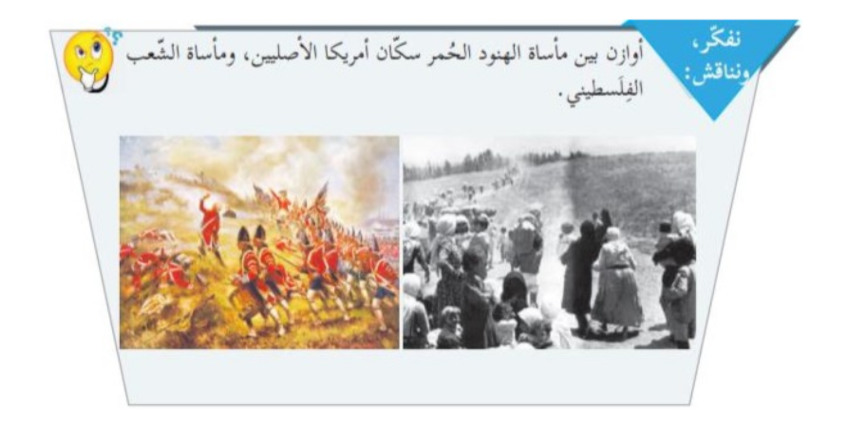
Submission sheet
Individuals, groups and organizations wishing to submit information and documentation to the United Nations Independent International Commission of Inquiry on the occupied Palestinian Territory, including East Jerusalem, and Israel (hereafter the “COI”) are kindly asked to fill in this sheet with any information they are able to provide, and attach it to their submissions.
It is not a requirement to provide all requested information if not available, though particular attention should be given to filling in the section on consent.
Unless indicated otherwise in the form, the COI will consider all materials received to be usable in its reports, but without attribution as to the source
| Name of submitting individual/entity | The Bedein Center for Near East Policy Research – a research institute dedicated to proactive research and publication of well-documented and cutting age data on the core issues of the Israeli-Arab conflict. |
| Contact of submitting individual/entity | Email(s): ctrforneareastpolicyresearch@gmail.com
Telephone: (+972-2) 623 6368 Cell Phone: (+972-54) 722-2661 Web Address: https://www.cfnepr.com/ Agree to be contacted by the COI: Yes |
| Relationship of submitting entity/individual to the alleged victim/s | The victims are all Israeli individuals who are threatened by terror actions committed by Palestinian individuals influenced by the Palestinian Authority’s educational system and its textbooks in particular, which are used in UNRWA schools as well. The Bedein Center is an organization that conducts research of these books’ attitude to Jewish-Israeli individuals and publishes its findings, thus making it available to the public at large. |
| Human rights violation/s or abuses alleged to have occurred | The Palestinian Authority’s schoolbooks, which are taught by UNRWA too, ignore the human rights of Israeli individuals and implicitly incite the Palestinian students to act against such rights under the pretext of “Palestinian liberation struggle”. |
| Violations of the laws and customs of war (international humanitarian law) | The Palestinian Authority’s schoolbooks, which are taught by UNRWA too, praise the murder of innocent Israeli civilians and make the perpetrators national heroes. |
| Date/s of incident/time period | Since 2000, when the first PA schoolbooks were issued. |
| Place of incident | Village/township/city: All places where local schools follow the PA curriculum.
Province: The West Bank, the Gaza Strip, East Jerusalem. |
| Name/s of alleged victim/s gender, age
|
Name: Every Israeli individual
Gender: Both Age: All Ages (embryos – over 90-year-olds). Father’s name: Nationality: Israeli. Profession Phone number/email: Address: |
| Identification of those allegedly responsible | Name of alleged perpetrator if known:
1. The Palestinian Authority (PA): President Mahmud Abbas, Prime Minister Mohammad Shtayyeh, Minister of Education Marwan Awartani. 2. The United Nations Relief and Works Agency (UNRWA): Commissioner-General Philippe Lazzarini, Deputy Commissioner-General Leni Stenseth.
State or non-state entity with which perpetrator is affiliated, if any:
Any identifying marks of the perpetrator which indicate their affiliation, such as the colour or pattern of their uniform and uniform’s insignia:
|
| Description of the incident(s)/allegations (2000-word limit) | Detailed description: The PA textbooks, which are used in UNRWA’s schools as well, de-legitimate the very existence of Jews in Israel, describe them as foreign colonialists and enemies of Islam from its very beginning and call for a violent struggle for the “liberation” of Palestine, including the territories within Israel’s pre-1967 borders, and free Al-Aqsa Mosque from the Jewish “infidels” and “the Devil’s aides” (see the attached PowerPoint presentation).
|
| Description of the State’s response, (500-word limit) | Indicate whether the incident was reported to the authorities: Yes If yes, which authorities: The UN and various Parliaments in countries around the world sponsoring the PA and UNRWA.
Information on any investigations, judicial processes, decision/judgements and sentences, including reparations, in response to the incident: Several resolutions to reduce payments to the PA and UNRWA until they change the curriculum.
|
| Methodology employed in the collection of information | |
| Consent |
Please indicate if consent to provide this information to the CoI has been received from the alleged victims (any consent given must be provided by the victim or by relatives or legal representatives on their behalf, or by a parent/legal guardian in case of a child) Yes consent provided by: A potential victim of PA school incitement with UNRWA’s compliance
If necessary, please explain:
|
| Description of any broader issues not related to specific violations (2000-word limit)
|
Description should be succinct, highlighting issues of relevance to the mandate of the COI, and include concrete examples whenever possible.
Please also include information on the impact of these violations, as well as age and gender-sensitive considerations (e.g. how these violations affected women and men, girls and boys differently) as relevant. The material studied in schools operated by the PA and UNRWA (as well as Hamas in Gaza), is one of the main influencing factors on Palestinian children and youth who turn to orchestrated and non-orchestrated violence against individual Jewish civilians, which has cost thousands of lives so far. It certainly leads to human rights violations perpetrated against Jewish civilians in the country before and after the date taken by the COI as its starting point.
|
| Any other human rights NGOs to whom you reported the incident | If appropriate, please provide name and contact information of any other person or organization to whom the incident was reported.
|
| Additional materials (documents, images, videos, etc) relevant to the incident(s)/allegation(s) | Please indicate, if you are aware of, or in possession of, any additional materials from other sources (including the media and NGOs) in which the above incident(s)/allegations are cited, that are deemed relevant/useful. The COI may follow-up at a later date in order to receive the material(s) indicated.
The attached Power Point presentation Date of publication: January 2022 Title: Jews in Palestinian Authority Schoolbooks in UNRWA Use Source (author/organisation): Dr. Arnon Groiss, Bedein Center for Near East Policy Reseach. Web link; https://www.cfnepr.com Type of material: Documents (total doc); Images (total images); Videos (total videos); Other (please specify): PowerPoint presentation.
|


